Front matter (continued 5)
Reading edition
Bragg answered in good temper, and after disposing of the matters of business, he added: "The enemy is not prepared for us, and if we can strike him a blow before he recovers, success is almost certain. The plan which is proposed has long been my favorite, and I trust our efforts may give you the means to accomplish what I have ardently desired but never had the ability to undertake. Communicate your wants to me freely and I will do all I can to give you strength and efficiency. We must necessarily encounter privations and hardships, and run some risk; but the end will justify the means." [Footnote: Official Records, vol. xxxii. pt. iii. p. 592.]
This, of course, implied prompt action whilst Grant's forces remained scattered and were still suffering from the dearth of supplies which had so nearly approached starvation and nakedness. Schofield's forces were at Knoxville, over a hundred miles northeast of Chattanooga. Part of Sherman's were on the Meridian expedition or now returning to Vicksburg on the Mississippi. Another part, under Logan, were about Huntsville, as far to the southwest as Schofield was to the northeast. In this condition of things a quick blow at Thomas would find him isolated. He could be turned by the north before Schofield could join him if he stayed in his fortifications, and he could be fought on equal terms in the field if he came out of his lines. This made the southern opportunity. To wait for spring was to wait for Grant and Sherman to concentrate the now scattered armies, to have them clothed and fed, and to have the horses and mules ready for a campaign. It is no wonder the government at Richmond thought it worth while to "encounter privations and hardships and to run some risk."
Lee had been in Richmond and was in accord with this plan. He wrote to Longstreet on the day after the date of Bragg's letter just quoted, urging him to drop all other schemes and to unite in influencing Johnston to adopt it. "If you and Johnston could unite and move into Middle Tennessee," he said, "it would cut the armies of Chattanooga and Knoxville in two and draw them from those points, where either portion could be struck at as opportunity offered.... By covering your fronts well with your cavalry, Johnston could move quietly and rapidly through Benton, cross the Hiwassee, and then push forward in the direction of Kingston, while you, taking such a route as to be safe from a flank attack, would join him at or after his crossing the Tennessee River. The two commands, upon reaching Sparta, would be in position to select their future course; would necessitate the evacuation of Chattanooga and Knoxville, and by rapidity and skill unite on either army." [Footnote: Official Records, vol. xxxii. pt. iii. p. 594.]
There were no doubt difficulties in the way--when are there not? But we who were in Grant's command are glad that we were not called upon to meet the enemy under this plan of campaign vigorously executed. We did not lack faith that we could defeat it, but we were much better pleased to have the enemy await the completion of our own preparation and allow us to take the initiative. It cannot be denied that it was based on sound strategy. With his usual considerateness, Lee said that Johnston and Longstreet on the ground should be better able to judge the plan and to decide; but he urged it with much more earnestness than was common in his letters. That Johnston rejected it must be admitted to be very strong evidence that he lacked enterprise. His abilities are undoubted, and when once committed to an offensive campaign, he conducted it with vigor and skill. The bent of his mind, however, was plainly in favor of the course which he steadily urged,--to await his adversary's advance, and watch for errors which would give him a manifest opportunity to ruin him.
Longstreet had written to Johnston on the 5th of March that Mr. Davis had directed a conference between them on the practicability of uniting their armies between Knoxville and Chattanooga, with a view to the movement into Middle Tennessee. Longstreet thinks he can make his part of the movement, but must leave the question of supplies to Johnston after they unite. [Footnote: Official Records, vol. xxxiii. pt. ii. p. 587.] Lieutenant-General John B. Hood, who had been assigned to a corps in Johnston's army, wrote to Mr. Davis on the 7th that the army was well clothed, well fed, with abundant transportation, in high spirits, anxious for battle, and needing only a few artillery horses. A junction with Longstreet's army he thought would make it strong enough to take the initiative, and he strongly supported the plan of moving before Grant could concentrate. [Footnote:Id., p. 606.]
Johnston wrote to Bragg on the 12th that no particular plan of campaign had been communicated to him. [Footnote: Id., p. 613.] He does not appear to have telegraphed a brief inquiry on this subject, but wrote at some length in regard to his requirements before he could be in condition to take the field. He referred to his first opinion in favor of a defensive campaign as unchanged. The ordinary course of mail seems to have required about a week for a letter to reach Richmond. It happened that on the same day Bragg at Richmond was writing to Johnston outlining the plan of campaign mentioned above, adding that it was intended to throw a heavy column of cavalry into West Tennessee as a diversion, and that if by rapid movement Johnston could capture Nashville, Grant would be in a precarious position. The President, on assurance of the immediate execution of the plan, would order to him 5000 men from General Polk, 10,000 from Beauregard, and Longstreet's command estimated at 16,000, but which was really nearer 20,000. Putting these reinforcements and Johnston's own army at lowest figures, his column would amount to 75,000 men. [Footnote: Official Records, vol. xxxii. pt. iii. p. 614.]
After posting his letter of the 12th, Johnston went on an inspection tour to Atlanta, and there on the 13th he received and answered Longstreet's letter of the 5th. He pronounced impracticable the plan submitted to them, and reiterated his fixed opinion that it was best to wait for Grant's advance. In any event, he thought a forward movement should "wait for the grass of May." [Footnote:Id., p. 618.] He argued that it was better to let the enemy's forces advance, and fight them far from their base and near his own. Bragg, on the other hand, had urged the recovery of the populous region of Middle Tennessee as necessary both for obtaining army subsistence and forage, and for the recruitment of the ranks. Both these resources he estimated very highly, and as Tennessee was still claimed as a seceding State, the Confederate conscription laws would be enforced there. On the other hand, every movement in retreat cut off a part of their area for supplies and men, was discouraging to the army, and was followed by numerous desertions of soldiers whose families were within our lines.
In answering Longstreet, Johnston had said that he would execute zealously any plan the President would order; but he evidently insisted on definite and formal commands if he were to depart from his preconceived views to which he held tenaciously. On the 16th of March he wrote again, this time in answer to Bragg's of the 7th. After telling of the impossibility of collecting artillery horses in northern Georgia, he mentions Longstreet's letter to him, to say that he thinks the point of junction suggested is too near the enemy, and that his army should have an accumulation of eighteen or twenty days' supplies before entering upon such a movement. They must also have ordnance stores for a campaign, and wagon trains to carry it all. [Footnote: Official Records, vol. xxxii. pt. iii. p. 636.] Two days later he received Bragg's full letter of the 12th sent by the hand of Colonel Sale as special messenger, and he now answers by telegraph. He says that Grant is back at Nashville, and is not likely to stand on the defensive. To meet at Dalton his expected advance, the reinforcements that had been spoken of must be sent at once. "Give us those troops," he says; "and if we beat him we follow. Should he not advance, we will thus be ready for the offensive. The troops can be fed as easily here as where they now are." [Footnote: Id., p. 649.] Next day he elaborated the same ideas in a letter, adding the suggestion before made by him that the line of advance by way of North Alabama was a preferable one to the route through East Tennessee.
The telegram was answered from Richmond whilst the longer letter was on its way. The answer conveyed the information that Grant would not personally lead the western army, but would turn over its command to Sherman. It also briefly noted the fact that Johnston had not accepted the aggressive policy on which the large reinforcements were made conditional. [Footnote: I do not find this dispatch in the Official Records. It is given in Johnston's "Narrative of Military Operations," p. 298.] He replied that his dispatch expressly accepted taking the offensive, and the only difference was as to details. He therefore repeats the urgent request that the troops be sent at once. [Footnote: Official Records, vol. xxxii. pt. iii. p. 666.]
It is not easy to accept his interpretation of his former dispatch. Waiting indefinitely to see whether the National army would advance, and declaring the administration plan impracticable, hardly looks like assuming the initiative. It was not a difference as to details. The very gist of the subject under discussion was a prompt advance against the parts of our army before they could be united for any purpose. The question would naturally arise, What might happen in the places from which troops were drawn, if they were not used by Johnston immediately? The latter had already said to Longstreet that his requisitions on the commissaries and quartermaster's departments for supplies and wagon-trains were so large as to make filling them "a greater undertaking than anything yet accomplished by those departments, and if they succeed, it will not be very soon." [Footnote: Official Records, vol. xxxii. pt. iii. p. 618.] Yet these were only part of the conditions which he considered essential to any advance.
There seems to have been no rejoinder to Johnston's last telegram, and the subject was dropped. Longstreet was persuaded by his correspondence with Johnston that the combined movement could not be made, and turned to the scheme (already mentioned), of mounting his troops and making an expedition from southwestern Virginia into Kentucky. This was decisively rejected by the Richmond government. [Footnote: Id., p. 748.] Grant was now known to be in Virginia, inspecting the commands there and preparing for an active campaign. Concentration on both sides, and not further morselling of armies was to be the wholesome order of the day, and Longstreet was soon ordered to report to Lee. Between Bragg and Johnston correspondence was limited to the current business of the army, and general plans of campaign were not again mentioned. In April, Johnston became uneasy at the silence which indicated that the President regarded it unprofitable to discuss plans with him, and sent Colonel B. S. Ewell of his staff to Richmond to make explanations in person. He was politely received, and his visit no doubt tended to relax a little the strain in the relations between Mr. Davis and Ewell's chief; but it was too late to accomplish what had been hoped for in January. [Footnote: Official Records, vol. xxxii. pt. iii. pp. 839, 842.] Spring had come, and Sherman's concentration was in progress; indeed it was almost completed. Ewell reported to Johnston again on the 29th of April. On the 1st of May Schofield was at the Hiwassee River in touch with the left wing of Thomas's army, whilst McPherson was closing in on the right.
The certainty that Grant was in Virginia had brought the Confederate government to the conclusion that Lee must be reinforced by Longstreet and by whatever troops Beauregard could spare. The Atlantic coast States were thus to supply Lee with men and means. About four thousand men were to be immediately added to Johnston's army, mostly drawn from Mobile. Polk's infantry would be sent to him also, if, as was nearly certain, Sherman's advance on Atlanta should prove to be our great effort in the West. [Footnote: Id., p. 841.] The doubt whether one of our columns might not move through Alabama made it necessary to continue to the last moment ready for either event. The Gulf States would then become the feeders of Johnston's army in the campaign.
The very unsatisfactory relations between Mr. Davis and General Johnston cannot be overlooked if we would judge intelligently the events of the Atlanta campaign. It may be that the general was right in thinking a winter advance impracticable, though Lee's concurrence in the President's plan is no small argument in its favor. It is, nevertheless, the indisputable province of a government to determine, in view of the whole situation, political and military, whether continued operations are necessary. The army is organized for the sole purpose of reaching the ends at which its government aims in the war. The expenditure of life and treasure should be stopped and the government should sue for peace, unless its armies can be relied upon to act in hearty subordination to its view of the existing exigencies. The general should meet it with absolute ingenuousness and the promptest and clearest decision. He should act at once or ask to be relieved in time to let another carry out the plan. Mr. Davis, like Mr. Lincoln on several occasions, had reason to feel that a prolonged discussion had in fact thwarted him, and that he had not the cordial service he might fairly expect.
One of the results of the financial embarrassments of the Confederacy was the great and growing depreciation of its paper currency. Its officers in the field found their pay a merely nominal pittance, and those who had no independent fortune were reduced to the greatest straits. Interesting evidence of this has been preserved in petitions forwarded to the War Department in February, asking that rations might be issued to them as to the private soldiers. The scale of prices attached to their petition was that at which the government sold the enumerated articles to its officers, and was supposed to show the average cost and not a market price fixed by the retail trade. They paid for bacon $2.20 per pound, for beef 75 cents, for lard $2.20, for molasses $6 per gallon, for sugar $1.50 per pound, for a coat $350, for a pair of boots $250, for a pair of pantaloons $125, for a hat from $80 to $125, for a shirt $50, for a pair of socks $10. [Footnote: Official Records, vol. xxxii. pt. ii. p. 658.] Their statements were verified and approved by their superiors, and General Johnston, in forwarding the petitions, said that at existing prices the pay of company officers was worth less than that of the private soldiers. [Footnote: Id., p. 661.]
CHAPTER XXXVI
ATLANTA CAMPAIGN: DALTON AND RESACA
The opposing forces--North Georgia triangle--Topography--Dalton--Army of the Ohio enters Georgia--Positions of the other armies--Turning Tunnel Hill--First meeting with Sherman--Thomas--Sherman's plan as to Dalton--McPherson's orders and movement--Those of Thomas and Schofield--Hopes of a decisive engagement--Thomas attacks north end of Rocky Face--Opdycke on the ridge--Developing Johnston's lines--Schofield's advance on 9th May--The flanking march through Snake Creek Gap--Retiring movement of my division--Passing lines--Johnston's view of the situation--Use of temporary intrenchments and barricades--Passing the Snake Creek defile--Camp Creek line--A wheel in line--Rough march of left flank--Battle of Resaca--Crossing Camp Creek--Storming Confederate line--My division relieved by Newton's--Incidents--Further advance of left flank--Progress of right flank--Johnston retreats.
The history of the campaigns of 1864-1865 under Sherman have been given in another form, and I need not repeat the narrative of the connected movements of his forces. [Footnote: See "Atlanta," and "The March to the Sea, Franklin and Nashville."] I shall confine myself to the more personal view of events as they came under my own eye, and to such additional knowledge as the publication of the Records has brought within our reach.
Nashville and Chattanooga, being large depots of supply, were fortified and furnished with garrisons. A few other points had also to be garrisoned in some force, besides the numerous small posts and blockhouses. But after all deductions, Sherman still expected to take the field with an army of a hundred thousand men of all arms, and this was what he did. His returns for the 30th of April show his strength to have been 93,131 infantry, 12,455 cavalry, and 4537 artillery. [Footnote: Official Records, vol. xxxviii. pt. i. p. 115.] His cavalry were not all at the front, and fell short of the nominal strength. [Footnote: Memoirs, vol. ii. pp. 23, 24; Official Records, vol. xxxviii. pt. iv. p. 26.]
General Johnston's similar returns for the end of April show his army actually present at Dalton to have consisted of 54,500 infantry, cavalry, and artillery, not including part of a brigade at Resaca and some detachments en route. [Footnote:Id., vol. xxxii. pt. iii. p. 866.] General Polk was on his way to join with 14,000 men, [Footnote: Id., vol. xxxviii. pt. iv. pp. 670, 737, 740.] and these with about 5000 increase of Hardee's and Hood's corps reached Johnston before he was seriously engaged with Sherman, giving him an army of 75,000 men. [Footnote: For a careful analysis of these forces, see "Century War Book," vol. iv. p. 281, a statistical paper by Major E. C. Dawes; also "Atlanta," Appendix A. For the meaning of "effective total" in Confederate returns, see ante, p. 482.] The Richmond government only delayed ordering Polk to join Johnston until it was certain that Sherman intended to operate with a single army upon the Atlanta line, and Polk went even beyond what they seemed to expect of him in carrying the troops of his department to the army at Dalton.
Although he was not aware of the urgency of the Confederate government with Johnston to induce him to take the initiative and operate by turning our left flank, Sherman had considered the possibility of this. The Fourth Corps had been concentrated at Cleveland on the East Tennessee and Georgia Railway about a dozen miles north of the Georgia state line and thirty-five miles from Dalton. The line of this railway was the easy road out of northern Georgia into Tennessee, and pretty closely followed the old Federal road. Had Johnston marched northward, he must have taken this route, and would have found his way barred by the Fourth Corps, which was strong enough to retard his advance till Sherman could have concentrated to meet him. The railways made a nearly equilateral triangle of the country between Cleveland, Chattanooga, and Dalton. It was thirty-eight miles from Chattanooga to Dalton, and twenty-seven to Cleveland. The east side of the triangle was near the Cooyehuttee Creek, a stream heading quite close to Cleveland and uniting, below Dalton, with the Connasauga. This valley is narrow west of the river, and is, much of the way, separated by a high and sharp ridge from the very broken country, which makes up the greater part of the triangle, where the branches of the Chickamauga run northward in parallel valleys till they unite near Chattanooga, and empty into the Tennessee. For nearly forty miles, therefore, the waters on the east side of the dividing ridge run southward to the Gulf of Mexico, whilst on the west side they run northward to the Ohio.
Going south from Chattanooga, the railroad and the wagon roads have to thread their way from one valley to another, the latter climbing painfully the high ridges intervening, the former taking shorter cuts by deep excavations and tunnels. Within sight of Chattanooga the north end of Missionary Ridge is pierced for the railway where Grant's left wing fought in the battle which closed General Bragg's career as a commander in the field. Some twenty miles further on, another ridge is tunnelled where the railroad passes from the Chickamauga valley into that of Mill Creek, a small tributary of the Cooyehuttee, flowing eastward into that river in front of Dalton. Here, at Tunnel Hill, had been Johnston's advanced post during the winter, and Thomas's had been above Ringgold on the top of Taylor's ridge facing it on the west. But as Tunnel Hill did not extend many miles northward, and could be turned in that direction, the Confederates had made Dalton their intrenched camp, and were prepared to retire from Tunnel Hill whenever Sherman should advance in force.
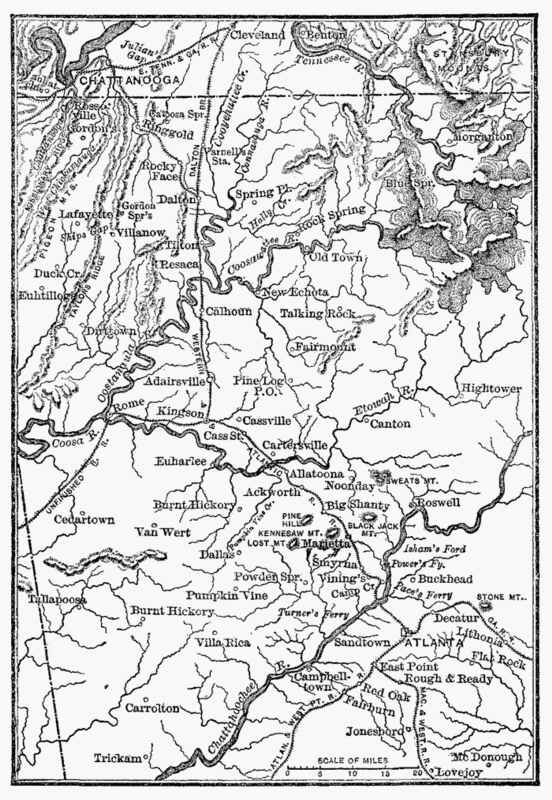
The position at Dalton was an impregnable one to an attack in front on the Chattanooga road. Mill Creek breaks through the Chattanooga Mountains (here known by the local name of Rocky Face), by a crooked gorge flanked by precipitous cliffs called the Buzzards Roost. The west side of Rocky Face is a nearly perpendicular wall, and in the Mill Creek gorge, spurs from the sides so project as to enfilade the entrance like bastions. A little north of the gorge a larger spur from the ridge runs down to the east, connecting with a subordinate parallel ridge, and from the lower slope a line of heavy earthworks continued the defences toward the Cooyehuttee. Mill Creek had been dammed so as to make an inundation in the gorge, and the Confederates held the ridge and cliffs on both sides as well as the fortified line in the lower ground. Some three miles north of Mill Creek Gap, Rocky Face and Tunnel Hill break down into smaller disconnected hills, and here about Catoosa Springs a bit of more open country made a practicable connection between the centre of the Union Army at Ringgold and its left wing advancing from Cleveland. Johnston hoped that Sherman would dash himself against the walls of Rocky Face and suffer severe loss in doing so; and if the ridge was turned on the north by part of the Union Army, this wing would find itself in presence of the strong earthworks skirting Mill Creek, and would be so separated from the centre that he could reasonably hope to crush it. Sherman, of course, could know little of the Confederate position till he was near enough to reconnoitre it, and must find out by experiment how the nut was to be cracked.
On Thursday, the 5th of May, the Army of the Ohio under General Schofield was at Red Clay, a hamlet just south of the Georgia state line. My own division (the third) was encamped a mile in advance, at some springs which furnished a good supply of water. General Judah's division (the second) was at Red Clay. General Hovey's division (the first) was still at Blue Springs, Tennessee, covering the army trains and the repairs of the railway. The cavalry covered the left flank and reconnoitred forward toward Varnell's Station, skirmishing with the enemy's horse. The valley was a narrow one, tributary to the principal valley of the Connasauga, and, near my camp, was filled with a dense thicket of loblolly pine, a second growth which came up in the exhausted light soil of abandoned fields, and which we were to become very familiar with as we advanced into Georgia. As we could not see out in any direction except that of the road, I covered my front with a slashing of the trees by way of a rough abatis to prevent a surprise. We were now the left flank of the grand army.
When we passed Cleveland, the Fourth Corps took up its line of march, bearing away to the westward of ours and went into position at Catoosa Springs, about eight miles southwest of Red Clay, with a ridge intervening. Here General Howard became the left of the Army of the Cumberland, having Palmer's Corps (the Fourteenth), next beyond him facing Tunnel Hill, and Hooker's (the Twentieth) still farther to the southwest, marching by way of Woods Station over Taylor's Ridge upon Trickum in the upper valley of the East Chickamauga. Thomas's army was the heavy centre of the grand army, and his infantry was about two-thirds of the whole. This great preponderance of one organization was faulty in a purely military point of view, but Grant and Sherman both felt that it would not be wise to disturb the esprit de corps of the Cumberland Army by subdividing it, or to offend Thomas by diminishing it, and, anyhow, no such change could have been made without the concurrence of the President.
General McPherson's Army of the Tennessee was to constitute Sherman's right, but was a little delayed in its concentration. At this time it contained only Logan's Corps (the Fifteenth) and the left wing of the Sixteenth (Brigadier-General G. M. Dodge in command). It was moving behind the Army of the Cumberland, to Lee and Gordon's Mills, and thence upon Villanow. [Footnote: Official Records, vol. xxxviii. pt. iv. p. 39.] General Kenner Garrard's strong division of cavalry accompanied McPherson's movement.
Sherman was anxious to allow the enemy as little time for preparation as might be, yet, as he had to give McPherson a day or two to come into line, he set Saturday the 7th of May as the time for the more complete concentration, and an attack upon Tunnel Hill if Johnston should continue to hold it. [Footnote:Id., p. 38.] Accordingly, on Saturday morning all the columns were in motion. Palmer advanced against the ridge of Tunnel Hill in front, and Howard coming from the north turned the flank of the ridge. The hill was held by the Confederate cavalry under Wheeler, supported by Stewart's division of infantry, who were ordered to resist our advance with stubbornness enough to force the display of Thomas's forces. [Footnote: Id., p. 672.] A lively skirmishing fight was kept up till Howard's men advanced toward the flank and rear of the position, when the enemy retreated within Mill Creek Gap. Wheeler was ordered to let a brigade of cavalry retire up the valley of Mill Creek, outside of Rocky Face, and to cover Dug Gap, through which runs the road from Villanow to Dalton. [Footnote: Ibid.]
My division marched from its camp in front of Red Clay over the ridge by Ellidge's Mill to Dr. Lee's on the main road from Varnell's Station to Ringgold, and near the northern end of Tunnel Hill ridge. Here we came into close connection with the Fourth Corps. The rest of the Army of the Ohio followed, the rear-guard holding a gap looking eastward above Ellidge's Mill, and the cavalry covering the front and flank to Varnell's Station. [Footnote:Id., pp. 48, 54.] Our supply station was moved over to Ringgold on the Chattanooga line, and the railroad at Red Clay was soon abandoned. In the movement all the division commanders were ordered to report to me in the absence of General Schofield.
At Dr. Lee's I met Sherman and Thomas for the first time. They had come over from Ringgold to reconnoitre for themselves and observe the effect of Howard's movement turning Tunnel Hill. The house stood upon a knoll looking southward over farm fields and rolling country to the sharp end of Rocky Face, and when my column halted near by, I rode forward with General Schofield to meet the army commander. It was a bright May morning, and a picturesque group was gathered on the sloping lawn in front of the house. The principal officers were dismounted, their horses and escort in the background. An occasional puff of white smoke on the slope of Tunnel Hill in the distance marked the attack going on there, but it was too far away for the cannonade to be more than a muffled sound, not interrupting the conversation. Sherman was tall, lithe, and active, with light brown hair, close-cropped sandy beard and moustache, and every motion and expression indicated eagerness and energy. His head was apt to be bent a little forward as if in earnest outlook or aggressive advance, and his rapid incisive utterance hit off the topics of discussion in a sharp and telling way. His opinions usually took a strong and very pronounced form, full of the feeling that was for the moment uppermost, not hesitating at even a little humorous extravagance if it added point to his statement; but in such cases the keen eye took a merry twinkle accentuated by the crow-foot lines in the corner, so that the real geniality and kindliness that underlay the brusque exterior were sufficiently apparent. The general effect was of a nature of intense, restless activity, both physical and mental. In conversation he poured out a wealth of original and striking ideas, from a full experience, observation, and reading; his assertions would be strong and confident, highly colored by the glow of momentary feeling, unsoftened by the modifications and exceptions which have to tame down broad generalizations before they are put in practice. One did not know him long before discovering that in responsible action he did not lack the prudence which took all probable contingencies into account. His practical work in the field was never reckless, but his boldest outlines of plan were worked out with thoughtful caution in detail and full provision for possible disappointment. When discussing a situation with his familiars, after strongly stating his own view he would add, "Now what is Joe Johnston's game?" and he would analyze his adversary's possible moves with a candor and insight that left no doubt of his full comprehension of the problem before him. In carrying out a plan he was free from the common weakness of giving increased weight to doubts when the conflict is joined, and making a timid execution of a strong purpose; he knew when it was time for debate to stop (even with his own thoughts), and to bend every energy to decisive action. All this was, of course, not visible in the first meeting at Dr. Lee's, but no one could doubt that here was a most original and interesting character, and I soon acquired an undoubting conviction that of all the men I had met, he was the one to whose leadership in war I would commit my own life and the lives of my men with most complete confidence. In him the combination of intellectual insight with fertility of invention and with force of will in execution was of the highest order. I felt that if the end we aimed at was a noble and worthy one, the price he asked us to pay was reasonable, and the object was worth the sacrifices he called for: we were therefore enthusiastic in our obedience.
General Thomas was in person and manner a strong contrast to Sherman. Equally tall, he was large and solidly stout, with an air of dignified quiet and deliberation. His full beard was not of so stubbly a cut as Sherman's, his countenance was almost impassive, and the lines of his brow gave an air of sternness. His part in the conversation was less, his words much fewer and less expressive, but always clear and intelligent. His manner was kindly, but rather reserved, and one felt that his acquaintance must be gradually cultivated. His reputation for cool intrepidity and stubborn tenacity could not be excelled, and no soldier could approach him without a deep interest and respect that was not diminished by his natural modesty of demeanor. Better acquaintance with him made one learn that his intellect was strong and broad, and his mind had been expanded by general reading, with some special scientific tastes beyond his military profession. He was a noble model of patriotic devotion to country, and of the private virtues that make a great citizen. His military career had been an important one from the beginning of the war. Second in rank in the armies of Buell and Rosecrans in 1862 and 1863, at the great battles of Stone's River and Chickamauga he had held his wing of the army defiant and invincible when other parts were swept back by the Confederate impetuosity. No sobriquet conferred by an admiring soldiery was more characteristic than the "Rock of Chickamauga." Between him and Sherman the old affection of schoolmates at the Military Academy was still warm. Sherman still called him "Tom," the nickname of cadet days, and Thomas evidently enjoyed, in his quiet way, the vivacious talk and brilliant ideas of his old friend, now his commander. His army so much outnumbered the organizations of McPherson and Schofield that, as a massive centre, it was necessarily the chief reliance of Sherman for the results of the campaign, and was personified in its leader's weight and deliberation; while the lighter organizations of the Tennessee and the Ohio were thrown from flank to flank in zigzag movements from one strategic position to another as we penetrated into Georgia.
Grant's plan of having the armies of the East and West begin simultaneous movements on the first days of May had been responded to by Sherman with the information that on the first of the month his three armies were in mutual support, and that he would "draw the enemy's fire within twenty-four hours of May 5th." [Footnote: Official Records, vol. xxxviii. pt. iv. p. 1.] The delay in McPherson's reaching his position, slight as it was, had to be considered in ordering other movements in view of the promise to Grant to get into immediate contact with the enemy, and helped in the decision to let Thomas's army advance strongly in the centre and engage the enemy if the chance seemed at all favorable, while McPherson made the flanking movement by way of Snake Creek Gap. On the 4th Sherman had telegraphed Grant that he would "first secure the Tunnel Hill, then throw McPherson rapidly on his (the enemy's) communications, attacking at the same time cautiously and in force." [Footnote: Id., p. 25.]
McPherson's orders went to him on the evening of the 5th, directing that whilst the movements of Thomas and Schofield already described were in progress, on Saturday the 7th he should "secure Snake Creek Gap, and from it make a bold attack on the enemy's flank or his railroad at any point between Tilton and Resaca." [Footnote:Id., p. 39.] Sherman expressed the hope that Johnston would fight at Dalton, but should he fall back along the railroad McPherson was to hit him in flank. "Do not fail, in that event," he continued, "to make the most of the opportunity by the most vigorous attack possible, as it may save us what we have most reason to apprehend, a slow pursuit, in which he gains strength as we lose it." McPherson was assured that Thomas and Schofield would prevent Johnston from turning on him alone, and the sound of battle at the north would show the greater necessity for rapid movement on the railroad. "If once broken to an extent that would take them days to repair, you can withdraw to Snake Creek Gap, and come to us or await the development according to your judgment or information you may receive." [Footnote: Official Records, vol. xxxviii. pt. iv. p. 39.]
Sherman's orders to Thomas were to take Tunnel Hill, and threaten Dalton in front, but not to attack its defences "unless the enemy assume the offensive against either of our wings, when all must attack directly in front toward the enemy's main army, and not without orders detach to the relief of the threatened wing." [Footnote:Id., p. 40.] With similar orders to Schofield, Sherman added: "As soon as Tunnel Hill is secured to us, I shall pause to give McPherson time for his long march; but we must occupy the attention of all the enemy, lest he turn his whole force on McPherson, which must be prevented. Therefore, on the sound of heavy battle always close up on Howard and act according to circumstances. We will not be able to detach to McPherson's assistance, but can press so closely from this direction that he (Johnston) cannot detach but a part of his command against him." [Footnote: Id., p. 38.]
These lucid orders show that Sherman was not contemplating merely a flanking movement to make Johnston retreat and yield territory; on the other hand he strongly expressed the desirability of forcing conclusions as near his own base as possible, and showed his apprehension of the disadvantages which must come from stretching still further his long line of communications. The same desire and the same apprehension were constant with him throughout the campaign, and it was with an unwillingness growing at times into impatience that he found himself compelled to follow Johnston's slow and skilful retreat. It was not till the change of the Confederate commanders that aggressive tactics on the part of the enemy gave the opportunity for severe punishment and led to the speedy destruction of the hostile army. Herein lies the key of the whole campaign.
The possession of Tunnel Hill enabled Sherman to look into Mill Creek Gap, the break in Rocky Face, and the first look was enough to show how desperate would be an attack either upon the precipitous cliffs or into the fortified gorge. His orders for the 8th of May were for Thomas to threaten the Buzzard Roost pass and try to get a small force on Rocky Face ridge. Schofield from Dr. Lee's was to feel along the same ridge southward toward the gap and the signal station which the enemy had established above it on Buzzard Roost. It was to be a skirmishing advance, but no battle, attracting the enemy's attention whilst McPherson was seizing on Snake Creek Gap in Johnston's rear. [Footnote: Official Records, vol. xxxviii. pt. iv. p. 56.]
On our part, Schofield ordered Judah's division to ascend the north point of Rocky Face and press along the sharp ridge southward. My own division was to occupy the passes looking toward Varnell's Station, sending a regiment to support the cavalry there. [Footnote: Id., pp. 55, 66, 85.] General Thomas, seeing no chance of getting to the top of Rocky Face from the west, had ordered the Fourth Corps to attempt it from the north, and Howard had sent in Newton's division to do this before Schofield received his orders for the day. The latter therefore put Judah's division in support of Newton's, extending the line along the east base of the ridge, and called up Hovey's division into close support. With my own division I advanced southeastwardly to hills in that direction, keeping abreast of the movement on Rocky Face. [Footnote: Id., pp. 82, 83; pt. ii. p. 675.]
Sherman had conjectured that the hill-tops would be found to be plateaus on which troops might manoeuvre to some extent, but they proved to be sharp and steep to the very summits, and composed of loose rock of every size, but all as angular as if from fresh cleavage. [Footnote: Official Records, vol. xxxviii. pt. ii. p. 675; pt. iv. p. 84.] Harker's brigade of Newton's division had the advance, but even a brigade was too large a body for combined action, and Colonel Opdycke with his regiment (One Hundred and Twenty-fifth Ohio) took the lead. He made a demonstration as if to turn the north point and go up the eastern side; then leaving the brigade skirmish line to continue to push there, he rapidly moved again to the west side and climbed swiftly to the ridge. Here was only room for four men to march abreast, but charging from rock to rock he succeeded in advancing about a third of a mile southward along the ridge to a breastwork of stone where the enemy, who had fought bravely for every "coign of vantage," were finally enabled to check him. He also threw together a heap of stones to cover and enable him to hold the ground he had gained. [Footnote:Id., pt. i. p. 367.]
Schofield in person had followed the advance of Judah's division, and reconnoitred along the ridge parallel to Rocky Face on the east. It was plain that there was little chance of getting near Buzzard Roost by following Harker's path along the knife-like summit, and he was disposed to let Judah try the effect of a night attack upon the fortified outpost at the enemy's signal station in front of Harker. [Footnote: Id., pt. iv. p. 83.] Sherman realized that he could not hope to carry the Dalton lines from the west and north, and that Johnston was too well satisfied with his defensive position to leave it unless some part of our army was compromised by making a false move. McPherson, however, was entering Snake Creek Gap with so little opposition as to show that the importance of that pass was not understood by Johnston, if indeed he knew of its existence. Sherman therefore determined to keep up active demonstrations with watchful observation of the enemy for another day, whilst the decisive part of McPherson's movement should go on, and was already planning to transfer Hooker's Corps to McPherson's column as soon as the latter should hold the outlet of his gap. He wrote to Schofield, "We must not let Johnston amuse us here by a small force whilst he turns on McPherson." He sometimes suspected this was being done, and had been uneasy during the day at the absence of cannonade from Johnston's lines. [Footnote: Official Records, vol. xxxviii. pt. iv. pp. 83, 84.] The orders for the 9th were that Thomas should continue to push along the crest of Rocky Face from the north and make demonstrations on other parts of his line, whilst Schofield cautiously swung his left flank out toward the east at right angles to the principal ridge and made a strong reconnoissance of the enemy's lines in the immediate front of the town. At midnight Sherman learned that Hooker had made an effort to carry Rocky Face at Dug Gap, two or three miles south of Buzzard Roost, and had failed with considerable loss to Geary's division, which was engaged.
At daybreak on the 9th, my own camp was astir. The division advanced beyond the left flank of the position of Hovey's, then swung the left forward and moved southward astride of the ridge parallel to Rocky Face on the east. Judah's division connected our movement with the left flank of the Fourth Corps across the intervening valley. Hovey's division marched in rear of my left flank as a reserve. McCook's division of cavalry covered the extreme flank at Varnell's Station, under orders to demonstrate on the direct road to Dalton as our infantry advanced. [Footnote: Id., pp. 98-100.] The enemy resisted with strong outposts and skirmish lines posted in several strong barricades of timber and stones. We drove him from these and continued the movement till we confronted the main line of intrenchments. Schofield intended to attack these as soon as Newton's division of the Fourth Corps (which was our pivot) should be able to force the position in its immediate front on the crest of Rocky Face, but Newton was obliged to report that Harker's brigade had failed in its effort, [Footnote: Official Records, vol. xxxviii. pt. iv. p. 102.] and Schofield ordered us to stand fast where we were.
McCook had found a superior force of Confederate cavalry under Wheeler on the Dalton road; his advanced brigade under Colonel La Grange had been roughly handled, and that officer was captured. [Footnote: Id., p. 96.] General Stoneman was, however, advancing from Charleston with the cavalry of the Army of the Ohio, and the affair was of no great significance, though the Confederates claimed a considerable victory for their horse. [Footnote: Id., p. 683.]
Our movement had been an interesting one. As we went forward on the ridge, we could see Judah's line keeping pace with us in the valley and on the lower slopes of Rocky Face, whilst Newton's men continued the line to the summit, where Harker was having a sharp combat in which both artillery and small arms were brought into play. Off beyond our left was a separate rounded height, Potato Hill, on which the enemy had artillery which annoyed us, and to which our own guns answered. The space between was filled with skirmishers, horse and foot, and a rattling fusillade accompanied our march. It was evident that the lines before us were very formidable and held in force, and that the reconnoissance had been pushed as far as possible; to go further would commit us to a desperate attack upon intrenchments. [Footnote: When Johnston's retreat gave us possession of Dalton, we found the works of a very strong character, putting that front quite beyond a coup-de-main. I examined them myself later in the campaign.] But Sherman did not desire to do this. He wished to keep the enemy employed so that he could not send a great force against McPherson, and thus to give the latter a chance to make a success of the movement against Resaca. [Footnote: Official Records, vol. xxxviii. pt. iv. p. 98.] Toward evening he directed Schofield to fall back to a strong defensive position again, as from the news he got from McPherson he was sure Johnston must either attack us or retreat on the next day, and he wished to be ready for a prompt transfer of his army to Snake Creek Gap. But Schofield thought a night movement too uncertain in that broken and tangled country, especially as he had not been pleased with the handling of Hovey's division during the day, and obtained permission to bivouac for the night where we were, sending a couple of infantry regiments to support McCook's cavalry and cover our flank. [Footnote: Id., pp. 99, 119.]
During the night Sherman learned that McPherson had not succeeded in taking Resaca or breaking the railroad, and had retired to the mouth of Snake Creek Gap. Johnston was, of course, now aware of the turning movement, and before morning we had evidence that he was changing the positions of his army to meet the new situation. Sherman immediately turned his whole energy to transferring his army to McPherson's position. Hooker's Corps leading off was followed by Palmer's, and this by ours. Howard's was ordered to remain in position covering the Chattanooga railway, and to follow Johnston directly through Dalton when he left his intrenchments. The movement could not be begun till the 11th, as Stoneman with the cavalry of the Army of the Ohio was marching from Cleveland, and another day was needed to enable him to get upon our left flank, the place assigned him in the combined advance. [Footnote: Id., pp. 112, 113, 126.] Three days' rations in haversacks and seven more in wagons gave provisions for a short separation from our base, and orders to send back all baggage to Ringgold were strictly enforced.
At daybreak of the 10th I advanced my skirmishers to reconnoitre the enemy's lines, which were found to be still held in force, and his troops on the alert. We then proceeded to wheel the whole of the corps backward in line of battle, ready to halt at any moment, and engage the enemy if he should come out and attack us. My division being on the flank, it was to regulate the movement, Judah's conforming to mine on the right, and Hovey's in reserve immediately in rear of mine. [Footnote: Official Records, vol. xxxviii. pt. iv. pp. 123, 131.] We were under a warm skirmish fire of infantry in front, and the enemy's cavalry on our left flank also followed up the movement sharply. Reinforcing the skirmish line till the enemy was driven back, a good position in rear was selected for my second line and it was made to lie down. My first line was then marched slowly to the rear over the other, to another position, where it halted and lay down in turn, whilst the other rose and marched to the rear in a similar manner. Making the troops lie down avoided the danger, incident to such a manoeuvre under fire, that the men in second line would be confused by the passing of the first line through their ranks and break their organization. [Footnote: Officers experienced in war know that manoeuvres which are easy and of fine effect on parade are difficult and even dangerous under fire, and that it is wise to simplify the tactics as much as possible. Marshal Saint-Cyr, whose reputation for tactical skill was second to none in the wars of the French Republic and Empire, thus speaks of the matter in his comments on the battle of Novi, apropos to the break of the French division Watrin, which was in two brigade lines: "La première, attaquée avec vigueur par le général Lusignan appuyé par Laudon, ne soutint qu'un moment le choc, et se rabattit sur la seconde; elle espérait se reformer en arrière de celle-ci, en faisant ce qu'on appelle une passage de ligne; mais il fut démontré une fois de plus, que cette manoeuvre, qui fait un assez bel effet à la parade, ne peut réussir à la guerre lorsqu'on est suivi par un ennemi actif. La premiere entraîna la seconde dans un mouvement rétrograde; de plus elle y apporta assez de confusion pour que ces deux lignes réunies crussent n'avoir d'autre parti à prendre que celui de la fuite," etc. Mémoires, vol. i. p. 257. There can be no question as to the general soundness of this criticism, and we should not have continued the movement described if we had been attacked in force. We should then have fought where we stood, bringing the reserves to support the front line. It justifies, however, the precaution of selecting carefully the alternate positions and making the rear line lie down.] When we came opposite the positions assigned us in the extension of the Fourth Corps line, the division changed front to rear on right battalion and so swung into its place. [Footnote: Official Records, vol. xxxviii. pt. ii. p. 675.] Sherman had sent Captain Poe, his chief engineer, to observe our movement from the crest of Rocky Face held by Newton's troops, and congratulated Schofield upon it, saying it "was described to me by Captain Poe, as seen from the mountain, as very handsome." [Footnote: Id., pt. iv. p. 121.] In his full report made at the close of the campaign, General Schofield referred to it as "a delicate and difficult one, owing to the character of the ground, the position and strength of the enemy, and our comparative isolation from the main army." He adds: "I regarded it as a complete test of the quality of my troops, which I had not before had opportunity of seeing manoeuvre in presence of the enemy." [Footnote: Id., pt. ii. p. 510.]
Schofield had been so dissatisfied with General Hovey that on the same day he asked to have him removed from the command of the division, notwithstanding his high personal esteem for him and his confidence in his personal gallantry. The trouble seemed to be in the comprehension of orders and in the grasp of the surrounding circumstances. Sherman did not feel at liberty to act on the request, as Hovey had been assigned to the new division, before it took the field, in fulfilment of a promise of General Grant under whom Hovey had served in the Vicksburg campaign, and had been recommended for promotion as a recognition of good conduct at the affair of Champion Hill. [Footnote:Id., pt. iv. p. 122. Brigadier-General Alvin P. Hovey had been a Judge of the Supreme Court of Indiana, and a "War Democrat" in politics. His subsequent withdrawal from the army and his connection with Sherman's famous protest against promotions given under stress of personal and political influences at Washington would not be entirely clear without mention of the incident here told.]
Johnston seems to have heard rumors of Sherman's original plan to send McPherson's column against Rome, much further in rear, and he remained under the impression that this was the meaning of the movements he now heard of, until McPherson was in possession of Snake Creek Gap. [Footnote: Official Records, vol. xxxviii. pt. iv. pp. 674, 675.] On the 7th he had urged Polk to hasten his concentration at Rome, and ordered Martin's division of cavalry to Calhoun to cover the communications with Polk, and protect the railroad south of the Oostanaula. Brigadier-General Cantey was at Resaca with at least four thousand men, his own and Reynolds's brigades with fourteen pieces of artillery. [Footnote:Id., pp. 679, 682.] Movements toward his rear were reported to Johnston, and all his subordinates were on the alert to find out what it meant; the cavalry was ordered to watch all gaps south of Dug Gap, but no mention is made of Snake Creek Gap till McPherson had passed through it. [Footnote: Id., pp. 681, 683, 686, 687.] Then Cantey was told to hold Resaca firmly, and call on Martin for assistance if he needed it. Cars were sent to bring a brigade from Rome, intrenchments were made to cover the south end of the Resaca bridge; Major Presstman, chief engineer, was sent to mark out more extensive works about Resaca, and Hood was ordered there with considerable reinforcements. As soon, however, as it was known that McPherson had retired to Sugar Valley, Hood was called back to Dalton, and Johnston requested Polk to hasten in person to Resaca and take command, hurrying forward his corps as fast as possible. [Footnote: Id., pp. 687, 689.] This was the situation on the evening of the 10th of May.
When we took our position on the ridge of Rocky Face as the left of the line, the division was somewhat exposed to a flank attack, and I ordered the fallen timber on the hillside to be thrown together to make obstruction to any hostile advance, besides the usual tactical precautions of outposts and reserves. This, like the slashing made at Red Clay a few days before, was suggested by the difficulty of knowing what was going on around us in a country covered by dense forests with only small cultivated openings here and there. In this instance it was only the gathering of logs and tree-tops already lying on the ground, and utilizing them as a means of delaying an enemy till our lines could be formed. From such beginnings grew up our more and more elaborate system of intrenched camps; a natural evolution of campaigning in a country only partially cleared, with no roads worthy of the name.
To pass such a defile as Snake Creek Gap with an army was no small undertaking. Hooker was ordered to clear a second track, so that two lines could march by the flank at once, but this could only be imperfectly done in the time at command. [Footnote: Official Records, vol. xxxviii. pt. iv. pp. 126, 135, 145.] Careful orders in detail were made, fixing the time for each corps and division to move, keeping the roads filled night and day. Wagons were sent by the rear to Villanow, and the regular subsistence trains were stopped at Ringgold and Tunnel Hill till the Confederate army should be dislodged. For night marching men were stationed with torches at the forking of paths, and boards were nailed to trees as finger-posts.
Early on the morning of the 12th May, my division left its position on Rocky Face and marched through Tunnel Hill station. General Schofield, finding the shorter road to Snake Creek Gap blocked by wagons of the Cumberland Army, ordered a detour to the west, and we marched over to the Trickum and Villanow road, some two miles, and then pushing southward got within three miles of Villanow. It was evident that our movement and that of the whole army were visible from the high ridge of Rocky Face. Johnston was aware of them, and telegraphed to Richmond that Sherman was moving to Calhoun or to some point on the Oostanaula. [Footnote: Official Records, vol. xxxviii. pt. iv. p. 698.] He put everything in motion upon his interior line to Resaca, and the last of his infantry left Dalton that night, covered by a cavalry rear-guard. [Footnote: Id., p. 160.] Howard entered the place next morning.
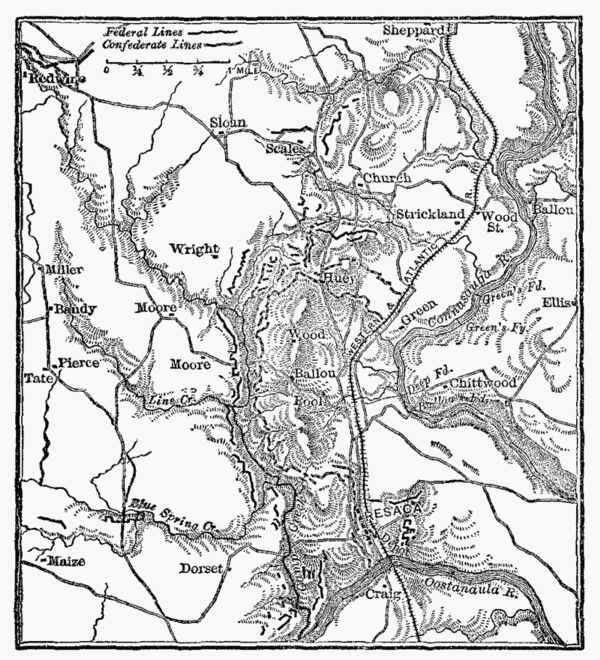
Taking only a short rest, my division marched again at one o'clock through Villanow and Snake Creek Gap into Sugar Valley, followed by Judah's division of our corps, the other (Hovey's) being left to guard the gap and the trains. McPherson's army covered the direct road to Resaca, having Kilpatrick's cavalry on its right flank toward the Oostanaula; Thomas's army was in the centre, consisting of two corps (Hooker's and Palmer's) in Howard's absence; and Schofield was ordered to continue the curve to the left, my own division being the flank and directed to rest the left upon the ridge or near it, facing northward.
The different corps advanced from McPherson's intrenchments to the new line which was near Camp Creek on the Resaca road, facing east, thence curving north and west through a quarter circle to my position on the left close to the dominant ridge, and about four miles north of Sugar Valley P. O. on the main Dalton road. I sent Hanson's brigade forward to reconnoitre toward Tilton (where Howard was), and it reached Martin's store, at the forks of the Dalton and Tilton roads and the crossing of Swamp Creek. A Confederate division had left that position only an hour before, marching toward Resaca. [Footnote: Official Records, vol. xxxviii. pt. ii. p. 675. In the official Atlas (compiled after the war), plate lvii. map 2, Martin's Store is given as Roberts' Store, and the position of the enemy there is marked.]
Later in the afternoon the centre and left of the whole army swung forward toward the east into the line along Camp Creek, quite away from the Dalton road. Reilly's brigade of my division was therefore left as a detachment covering that road until we should know that Howard had advanced beyond Tilton. A regiment of Hanson's brigade was left as an outpost at Martin's store, and the rest of the brigade marched across country by the right of companies to the front, keeping touch with Judah's division and this with the left of the Army of the Cumberland. It was a rough march over ridges and streams through the forest, on the long outer curve, of which the pivot was several miles to the southeast.
Sherman had hoped to be in time to interpose between Resaca and Johnston's army, as he had said in his orders of the 12th, [Footnote: Id., pt. iv. p. 158.] but the Confederates had the short interior line, and Johnston had been able to concentrate about Resaca in the course of the 13th, his rear-guard resisting Howard's advance at Tilton, and his left under Polk holding some high hills west of Camp Creek in front of Resaca which commanded the railroad bridge over the Oostanaula. With the latter exception his chosen line of defence was on the broken ridge between the Connasauga River and Camp Creek, which were nearly parallel to each other for some miles.
On the morning of the 14th the advance was renewed, guided as before by the progress of the Army of the Tennessee on the right and continuing the wheeling movement toward the east. My right brigade (Manson) continued its connection with the rest of the army, but Reilly's had a very difficult and laborious march. I ordered it to advance a mile upon the road it had covered during the night, and then by the right flank to position in line with the rest of the command. After leaving the road Reilly had to break his way through the woods, crossing sharp and deep ravines and watercourses, with no path or landmark to guide him. It was especially difficult for the artillery, and that they got through at all proved that the officers and men were experts in woodcraft. The regiment at Martin's store remained there as an outpost during the day.
Reilly came into line about ten o'clock, and we rested an hour till our flankers reported Howard's corps within supporting distance coming from Tilton. We were on the west bank of the main stream of Camp Creek, where its upper course makes an angle with the lower, some small branches coming into it from the northeast. The valley itself was open, and the change in its direction allowed it to be enfiladed by the enemy's batteries at the angle. Generals Thomas and Schofield were together upon a hill having a commanding view, and at the word from them, "The line will advance," we moved forward into the valley from the slope before them. Each brigade was in two lines, and the artillery was left on the hither side of the valley to cover the movement and reply to the enemy's cannonade. The skirmish line had been advanced to the edge of the woods on the far side, and kept the lead until we approached the Confederate trenches. We passed over two or three ridges and ravines, driving back the skirmishers of the enemy, and charged the line of earthworks on the crest of a higher ridge. Our men dropped fast as we went forward, but the line was carried and the Confederates broke from the next ridge in rear, some two hundred yards away. The direction of these ridges was such that our left was constantly thrown forward as we passed from one to another.
Judah's division on our right had not succeeded in crossing Camp Creek, and our flank was exposed to a galling artillery fire, as the ridge on which we were had its shoulder bare when it came out into the valley, whose curve gave the enemy an enfilading fire upon us. His infantry sought also to drive us out of the position we had captured, and the fighting was heavy for an hour or two. But Howard's corps came up on our left, and we made firm our hold on the hills we had gained, forcing the Confederates to adopt a new line curving to the eastward.
The division had lost 562 men, and our ammunition was nearly exhausted. [Footnote: Official Records, vol. xxxviii. pt. ii. pp. 676-679.] Wagons could not follow us, and toward evening Generals Thomas and Schofield arranged to relieve us with Newton's division of Howard's corps, let us replenish the cartridge boxes, and then pass to the left. This brought again the Army of the Cumberland together, and gave us our usual position on the flank. Newton's men came over part of the ground we had traversed, and as they crossed the open we saw them under the enemy's cannonade, the balls here and there bowling them over like tenpins. Harker's brigade came up to relieve Manson's, which was the most exposed, and Manson and I were standing together arranging the details, our horses being under cover in the edge of the wood. Harker rode up to confer with us and learn the situation, and as we talked, a shell exploded among us, the concussion stunning Manson and a fragment slightly wounding Harker. Manson's experience was a curious illustration of the effect of such an accident. He was unaware of his hurt, and only thought, in the moment of failing consciousness as he fell, that the motion was that of his companions flying upward instead of his own falling; and on coming to himself in the hospital began to speak his sorrow for what he supposed was the death of his friends. He himself never fully recovered from the effects of the concussion. Colonel Opdycke's regiment was one of the first in the winning column, and his men were hardly placed in the line before he was led back, wounded; but as soon as his wound was dressed and he had recovered a little from the shock, he was back at his post. The place was so hot a one that Harker's brigade also exhausted its ammunition and had to be relieved before the left of my own line was moved.
The captured position was firmly held by Howard's corps, whilst Hooker's, which had been relieved by the Army of the Tennessee, was marched to the left of Howard's, extending the line across the ridge toward the Connasauga and turning the enemy's flank. The whole Twenty-third Corps was also united during the night and moved to Hooker's support, where next day Hood made strong efforts to drive our line back. My own and Judah's division were held in reserve, but Hovey's was put in on Hooker's left, extending the line practically to the river, and the division took a gallant part in repulsing Hood. [Footnote: Official Records, vol. xxxviii. pt. ii. p. 511.]
On the extreme right McPherson had bridged the Oostanaula at Lay's Ferry and made demonstrations on Calhoun. The whole Army of the Tennessee had pressed forward to Camp Creek, and toward evening of the 14th forced a crossing and carried some hills near its mouth which commanded the railway bridge. [Footnote: Official Records, vol. xxxviii. pt. iii. pp. 92, 377.] Polk's Confederate corps made strong efforts to dislodge McPherson's men, but failed, and the latter intrenched the position. As Johnston had not succeeded in dislodging Sherman at either flank of the position, and the course of the Oostanaula made it possible for Sherman to put himself upon the railway near Calhoun, the Confederate general evacuated the Resaca position in the night of the 15th, retreating southward toward Kingston and Cassville.
CHAPTER XXXVII
ATLANTA CAMPAIGN: ADVANCE TO THE ETOWAH
Tactics modified by character of the country--Use of the spade--Johnston's cautious defensive--Methods of Grant and Sherman--Open country between Oostanaula and Etowah--Movement in several columns--Sherman's eagerness--Route of left wing--Of McPherson on the right--Necessity of exact system in such marches--Route of Twenty-third Corps--Hooker gets in the way--Delays occasioned--Closing in on Cassville--Our commanding position--Johnston's march to Cassville--His order to fight there--Protest of Hood and Polk--Retreat over the Etowah--Sherman crosses near Kingston--My reconnoissance to the Allatoona crossing--Destruction of iron works and mills--Marching without baggage--Barbarism of war--Desolation it causes--Changes in our corps organization--Hascall takes Judah's division--Our place of crossing the Etowah--Interference again--Kingston the new base--Rations--Camp coffee.
The opening period of the campaign had developed the conditions of warfare in so broken and difficult a country, and they were only emphasized by the later experiences of both armies. Positions for defence could be intrenched with field-works whilst the hostile army was feeling its way forward through dense forests and over mountain ridges. To carry such positions by direct assault was so costly that the lesson of prudence was soon learned and such attacks were more and more rarely resorted to. Sherman had moved upon the enemy at Resaca as promptly as the deployment and advance could be made after the turning movement and the passage of the Snake Creek defile; but we found Johnston strongly placed, on ground naturally difficult of approach, with works which gave his men such cover as to overcome any advantage we had in numbers. Still, the enemy found in turn that we could make counter-intrenchments and quickly extend them till we turned his flanks and threatened his communications, when he must either retreat or assault our works, and that, if he assaulted, the balance of losses would turn so heavily against him as to fatally deplete his army. Johnston carefully and systematically maintained this defensive, and in Virginia, after Lee had tried the policy of attack in the Wilderness, he became as cautiously defensive as Johnston. Grant was slower than Sherman in learning the unprofitableness of attacking field-works, and his campaign was by far the more costly one. The difference in such cases goes much farther than the casualty list; it was shown in October, when Sherman's army was strong and well-seasoned, but Grant's was so full of raw recruits as almost to have lost its veteran quality. There were special reasons which led Grant to adhere so long to the more aggressive tactics, which would need to be weighed in any full treatment of the subject; but I am now only pointing out the fact that in both the East and the West the lesson was practically the same. Aggressive strategy had the advantage it always has, but defensive tactics proved generally the better in so peculiar a field of operations.
Between the Oostanaula and the Etowah was the most open portion of northern Georgia, and it was possible for Sherman to move his army southward in several columns of pursuit on parallel roads (such as they were) without extending his front over a width of more than eight or ten miles. He was eager to bring the Confederates to battle in this region, and urged his subordinates to make haste. The assignment of routes to the different columns gave the centre to General Thomas, following the railroad in general, but putting his three corps upon as many country roads, when they could be found. General Schofield with the Twenty-third Corps was ordered to get over to the old Federal road which runs through Spring Place (east of Dalton) to Cassville. General McPherson with his two corps was sent by the Rome road and such parallel road as might be available, keeping communication with the centre. [Footnote: Official Records, vol. xxxviii. pt. iv. p. 216.] Beyond him, on the extreme right, Davis's division of the Cumberland Army supported Garrard's cavalry division in a movement upon Rome by the west side of the Oostanaula. [Footnote: Id., pp. 198, 202-204.] The object of the last-mentioned movement was the destruction of the Confederate machine-shops and factories at Rome, as well as to cover the flank against movements along the main route of travel from Alabama. The extreme left flank was to be covered by the cavalry of the Ohio Army under General Stoneman.
In making such an advance, success as well as comfort depends upon the care with which the several columns are led, so that each shall keep its place, progressing equally with the others, and avoid above all things cutting into and interrupting those moving on its right or left. Each must keep the common purpose in view, and avoid obstructing the rest, for nothing is more wearisome to the troops and ruinous to the plans of the commander than to have the lines of advance cross each other. In our march of the 17th our own corps was fated to feel the full annoyance and delay of such an interference.
General Thomas ordered Howard's corps to cross by the bridges at Resaca, followed by Palmer's, which was diminished by the absence of Davis's division. He also ordered Hooker's corps to march by the long neck between the Oostanaula and Connasauga rivers to Newtown, and cross the Oostanaula there. Hooker would then follow such roads as he could find within two or three miles of Howard's line of march toward Adairsville. Sherman and Thomas both were with Howard. [Footnote: Id., pp. 202, 209, 210, 216, 217.]
Schofield ordered the divisions of the Twenty-third Corps to cross the Connasauga at different places, and make their way by different roads eastward to the Federal road crossing of the Coosawattee, turning south after crossing that river and marching till abreast of Adairsville and some four or five miles distant from it. As we had to gain several miles of easting and to cross two rivers before marching southward, ours was, of course, much the longer route; and as the pontoons were all in use at Resaca and Lay's Ferry, we had to find fords or build trestle-bridges.
I marched my own division to Hogan's Ford on the Connasauga, two miles below Tilton, and there crossed in water so deep that the men had to strip and carry their clothes and arms on their heads. Once over we pushed for the Federal road and the crossing of the Coosawattee at Field's Ferry. The other two divisions of the corps crossed the Connasauga at or near Fite's Ferry, where were trestle-bridges. [Footnote: Official Records, vol. xxxviii. pt. iv. p. 210.]
General Hooker started upon the Newtown road, which runs southward some miles upon a long, narrow ridge which here separates the Oostanaula from its tributary; but before he had gone far he learned that the crossing at Newtown (the mouth of the Connasauga) was unfordable, and other means of getting over doubtful. He now turned abruptly to the east, crossed the Connasauga at Fite's, and marched toward McClure's Ford on the Coosawattee. [Footnote:Id., pp. 205, 206.] In moving out from Hogan's (or Hobart's) Ford, I had learned that the road from the north which crosses the Coosawattee at McClure's was probably the principal and shortest route to Cassville and had reported this to General Schofield, who ordered Judah's and Hovey's division to take the most direct roads to McClure's. These columns, however, ran into Hooker's, which were making for the same point and had headed Schofield's off, having the inner of the concentric routes on which we were marching. Neither at McClure's nor the more distant ferry at Field's Mill was there any bridge or tolerable ford, and Hooker was no better off than he would have been at Newtown. This movement had wholly disjointed Sherman's plan of keeping the three armies upon separate lines of march. Finding no means for rapid crossing at McClure's, he pushed one of his divisions to Field's, and so occupied and blocked both of the Coosawattee crossings, which by the orders should have been wholly at Schofield's disposal. We found ourselves obliged therefore to camp on the north side of the Coosawattee on the night of the 16th, instead of being well over that river and ready for a prompt advance on the 17th. [Footnote: Official Records, vol. xxxviii. pt. iv. pp. 210, 211, 220, 221, 225, 226.] Hooker himself might much better have obeyed his original orders. He reported to Thomas at ten o'clock on the morning of the 17th that he was not yet over, and had not the means of constructing a bridge that would stand; in short, that he had been "bothered beyond parallel." [Footnote: Id., p. 221.] When Schofield requested that he would allow our troops to take precedence of the Twentieth Corps wagons at either the ferry or the bridge, so that Sherman's expectation might not be disappointed, Hooker suggested that we should march back to Resaca and follow Thomas across the bridges there, thus getting into the place he himself should have taken if the Newtown crossing had been really impossible! [Footnote: Id., p. 227.]
Modern systems lay great stress upon the most scrupulous care on the part of corps commanders to follow the roads assigned them, and to avoid trespassing upon those assigned to others. Moltke has even condensed the whole strategic art of moving troops into "marching divided in order to fight united," and to avoid interference and confusion of columns en route is quite as essential as to keep tactical manoeuvres on the battle-field from crossing each other. [Footnote: See Prince Hohenlohe-Ingelfingen's Letters on Strategy (Wolseley Series), vol. ii. pp. 160, 161, 185, 237, etc.] No better proof of the necessity of the rule could be given than this. Sherman was most anxious to bring Johnston to battle in the open country between the two rivers, and ordered his subordinates to press the pursuit and to engage the enemy wherever he might be overtaken, trusting to the quick advance of the several columns to their support. [Footnote: Official Records, vol. xxxviii. pt. iv. pp. 201, 202, 211, 220, 232, 242.] Anything which delayed the columns or put them on different roads from those indicated by the commanding general, directly tended to thwart his plans. All of Sherman's dispatches during the 17th, 18th, and 19th of May show his disappointment at not getting forward more rapidly.
Johnston seemed disposed, in the afternoon of the 17th, to meet Sherman's wish for a decisive battle, and had selected a position a mile or two north of Adairsville, where the valley of the Oothcaloga Creek seemed narrow enough to give strong positions for his flanks on the hills bordering it. Preliminary orders were given and the cavalry was strongly supported by infantry to hold back Sherman's advance-guard till the deployment should be completed. The skirmishing was so brisk that, at a distance, it sounded like a battle; but upon testing the position by a partial deployment, Johnston concluded that his army would not fill it, and he resumed his retreat on Cassville and Kingston, hoping that Sherman's columns would be so separated that he could concentrate upon one of them, and so fight his adversary in detail. [Footnote: Narrative, pp. 319, 320.]
Schofield had pressed the march of his troops after getting over the Coosawattee, but the interruptions had been such that the distance made was not great, though the time was long and the troops were more tired than if they had made double the number of miles on an unobstructed road. My division was on the extreme left flank and in advance. After crossing the river at Field's Mill, the infantry by Hooker's foot-bridge and the artillery by the flat-boat ferry, I marched at ten o'clock in the evening and reached Big Spring Creek at two o'clock in the morning of the 18th. Resting only till five o'clock, we marched again, going southward on the Cassville road three miles, thence westward on the Adairsville road five miles to Marsteller's Mill. The other divisions of our corps took roads westward of that which I followed, and the cavalry under Stoneman passed beyond our left flank, scouting up the valley of Salequa Creek as far as Fairmount and Pine Log Post-Office. Hooker moved two of his divisions toward Calhoun after getting over the Coosawattee, and these regained the position relative to the rest of Thomas's army which the corps had been ordered to take. The other division (Butterfield's), which had crossed in advance of my own at Field's Mill, was necessarily on roads assigned to Schofield's command, and a good deal of interference was inevitable. Hooker was personally with this division, and in the afternoon of the 18th met General Schofield at Marsteller's Mill, and then went forward about six miles to the foot of the Gravelly Plateau, Butterfield's division going still further forward on its top. [Footnote: Official Records, vol. xxxviii. pt. iv. pp. 238-242. The Atlas of the Official Records does not give the routes of all the columns of either Hooker's or Schofield's corps, nor does it give the line of march of the cavalry on our left. The march of my own division is fixed by the memoranda of my personal diary of the campaign. The official "Atlas" (Plate lviii.) gives two mills as Marsteller's. It is difficult to identify the several roads, but my own line of march was the principal Cassville road leading from Field's Mills and ferry through Sonora until we reached the road running directly to Adairsville. On this last we marched to Marsteller's Mills. Our route on the 19th is also incorrectly marked on the map. See Official Records, vol. xxxviii. pt. iv. p. 256.]
General Schofield assembled the corps at the mills and rested for the night. Early on the 19th my division took the advance and marched southward on by-roads till we overtook Hooker's corps and found it in line of battle, its movement being disputed by the enemy's cavalry. Schofield deployed his corps on Hooker's left, my division taking the extreme flank and advancing in line to the south fork of Two Run Creek. Crossing this, we went forward to a position a mile northeast of Cassville, briskly skirmishing with part of Hood's corps. We found that we were opposite the extreme right of the Confederate position, which was a strong one on the hills behind Cassville; but an exchange of artillery shots satisfied us that we to some extent enfiladed their intrenchments. [Footnote: Official Records, vol. xxxviii. pt. ii. p. 680.] The concentration of Thomas's army with Schofield's made a continuous line facing the enemy on the north and west. Night was falling as we took position.
Johnston had followed the railroad to Kingston, where he was joined by French's division coming to Polk's corps from Rome, and still stuck to the general line of the railway to Cassville, though this led him by a considerable detour to the east. His manifest policy was to make the largest use of the railroad to move his baggage and supply his troops, for wagon trains were not over-abundant with the Confederates. He naturally reckoned also that Sherman could not go far from the same line, and as the road crossed the Etowah near the gorges of the Allatoona hills, he wished to lead the national commander into that difficult country from the north, instead of taking the more direct wagon-roads from Kingston toward Marietta. Could Sherman have been sure of the route his adversary would take, no doubt he would have concentrated his columns by shortest roads on Cassville, gaining possibly a day thereby. [Footnote: Id., pt. iv. pp. 242, 266.]
The position on the hills behind the village of Cassville was so strong a one, and Johnston so much desired to offer battle at an early day, that he resolved to retreat no further and to try conclusions with Sherman here. He signified this in an unusually formal manner by issuing a brief and stirring address to his troops, in which he said that as their communications were now secure, they would turn and meet our advancing columns. "Fully confiding in the conduct of the officers and the courage of the soldiers," he said, "I lead you to battle" [Footnote: Official Records, vol. xxxviii. pt. iv. p. 728.] But when our left flank crossed Two Run Creek and partly turned the right of his position, his corps commanders, Hood and Polk, became so uneasy that they protested against giving battle there, and induced Johnston to continue the retreat through Cartersville across the Etowah River. He saw the mistake he had made as soon as it was done, and never ceased to regret it. [Footnote: Narrative, p. 323, etc.] The Richmond government had been disappointed at his retreat from Dalton and Resaca and its continuation through Adairsville. His strained relations with Mr. Davis were rapidly tending toward his deprivation of command. But more strictly military reasons made his change of purpose very undesirable. Hardly anything is more destructive of the confidence of an army than vacillation. The order to fight had been published, and even a defeat might be less mischievous than the sudden retreat in the night without joining the battle which had been so formally announced. Either the order had been an error or the retreat was one. Every soldier in the army knew this, and the morale of the whole was necessarily affected by it.
Sherman had no mind to follow the enemy into the defiles of Allatoona from Cartersville. His position at Kingston offered a far more easy way to turn that fastness by the south, if he could replenish his stores, rebuild the bridges behind him, and make Kingston the base for a march upon Dallas and thence on Marietta. On the 20th of May his orders were issued for the new movement, to begin on the 23d with preparation for a twenty days' separation from the railroad. [Footnote: Official Records, vol. xxxviii. pt. iv. p. 271.] My own duty on the 20th was to follow the enemy's rear-guard to the river and learn the condition of the bridges and crossings. The division marched early, most of the distance to Cartersville being made in line of battle, the opposition being at times stubborn. The purpose of this was probably to prepare for the destruction of the bridges, which were burned as soon as the rear-guard crossed. We sent detachments to destroy the Etowah Mills and Iron Works a few miles above; [Footnote: Id., pp. 286, 298.] meanwhile General Schofield concentrated the Army of the Ohio at Cartersville, General Thomas occupied Kingston as the centre, and McPherson came into position on the right near the same place. General J. C. Davis's division had occupied Rome, finding there important iron-works and machine-shops as well as considerable depots of supplies. [Footnote: Id., p. 264.] General Blair was advancing from Decatur, Ala., with the Seventeenth Corps, under orders to relieve Davis at Rome, when the latter would rejoin Palmer's corps at the front.
The ten days which had passed since the movement to turn the enemy's position at Dalton was begun, had been in literal obedience to the order to march without baggage. At my headquarters we were, in fact, worse off than the men in the ranks, for, although the private soldier finds his knapsack, haversack, canteen, and coffee-kettle a burden and a clattering annoyance, he soon learns to bear them patiently, for they are the necessary condition of the comparative comfort of his bivouac when the day's march is over. The veteran, indeed, clings to them with eager tenacity, when he has fully learned that they are his salvation from utter misery. But the officer, whose hours of halting are crowded with important business, and whose movements must be light and quick whenever occasion arises, cannot carry on his person or on his horse the outfit necessary for his cooking and his shelter. We had been full of the most earnest zeal to respond thoroughly to the general's wishes, and had not tried to smuggle into wagons or ambulances any extra comforts. We had left mess chests behind, and had used our fingers for forks and our pocket-knives for carving, turning sardine boxes into dishes, and other tins in which preserved meats are put up into coffee-cups. Such roughing can be kept up for a week or two, but it is not a real economy of means to make it permanent. A compromise must be found in which the wholesome cooking of food and the shelter in a rainstorm, without which no dispatches can be written or records kept, may be made to consist with the lightness of transportation which active campaigning requires. The simple, closely packed kitchen kit of a Rob-Roy canoe voyager was more or less completely anticipated by the devices and inventions born of necessity in our campaign in Georgia. The remainder of the season bore witness that we could organize our camp life so as to secure cleanliness of person and healthful living without transgressing the reasonable rules as to weight and bulk of baggage which Sherman insisted on. Every day proved the reasonableness of his system, without which the campaign could not have been made.
The tendency of war to make men relapse into barbarism becomes most evident when an army is living in any degree upon the enemy's country. Desolation follows in its track, and the utmost that discipline can do is to mitigate the evil. The habit of disregarding rights of property grows apace. The legitimate exercise of the rules of war is not easily distinguished from their abuse. The crops are trampled down, the fences disappear, the timber is felled for breastworks and for camp-fires, the green forage is used for the army horses and mules, barns and houses may be dismantled to build or to floor a bridge,--all this is necessary and lawful. But the pigs and the poultry also disappear, though the subsistence officers are issuing full and abundant rations to the troops; the bacon is gone from the smoke-house, the flour from the bin, the delicacies from the pantry. These things, though forbidden, are half excused by sympathy with the soldier's craving for variety of food. Yet, as the habit of measuring right by might goes on, pillage becomes wanton and arson is committed to cover the pillage. The best efforts of a provost-marshal with his guard will be useless when superior officers, and especially colonels of regiments, encourage or wink at license. The character of different commands becomes as notoriously different as that of the different men of a town. Our armies were usually free from the vagabond class of professional camp-followers that scour a European battlefield and strip the dead and the wounded. We almost never heard of criminal personal assaults upon the unarmed and defenceless; but we cannot deny that a region which had been the theatre of active war became desolate sooner or later. A vacant house was pretty sure to be burned, either by malice or by accident, until, with fences gone, the roads an impassable mire, the fields bare and cut up with innumerable wagon-tracks, no living thing to be seen but carrion birds picking the bones of dead horses and mules, Dante's "Inferno" could not furnish a more horrible and depressing picture than a countryside when war has swept over it. [Footnote: Official Records, vol. xxxviii. pt. iv. pp. 273, 297, 298.]
The orders issued from our army headquarters in Georgia forbade soldiers from entering houses or stripping families of the necessaries of life. Most of the officers honestly tried to enforce this rule; but in an army of a hundred thousand men, a small fraction of the whole would be enough to spoil the best efforts of the rest. The people found, too, that it was not only the enemy they had to fear. The worse disciplined of their own troops and the horde of stragglers were often as severe a scourge as the enemy. [Footnote: See Hood's orders, Official Records, vol. xxxviii. pt. v. pp. 960, 963.] Yet I believe that nowhere in the world is respect for person and property more sincere than among our own people. The evils described are those which may be said to be necessarily incident to the waging of war, and are not indications of ferocity of nature or uncommon lack of discipline.
In the organization of the Army of the Ohio, General Schofield made an important change by assigning Brigadier-General Hascall to command the second division in place of General Judah. In the battle of Resaca the division suffered severe loss without accomplishing anything, and General Schofield found, on investigation, that it was due to the incompetency of the officer commanding it. [Footnote: Official Records, vol. xxxviii. pt. iv. p. 243.] The brigade commanders, in their reports, complained severely of the way in which the division had been handled, and the army commander felt obliged to examine and to act promptly. [Footnote: Id., pt. ii. pp. 581, 610, 611.] Judah was a regular officer, major of the Fourth Infantry, a graduate of West Point in the class of 1843, but lacked the judgment and coolness in action necessary in grave responsibilities. General Schofield kindly softened the treatment of the matter in his report of the campaign, but in his personal memoirs he repeats the judgment he originally acted upon. [Footnote: Schofield's Report, Id., pt. ii. p. 511; Forty-two Years in the Army, p. 182. In the passage of his memoirs last referred to, General Schofield had been using the case of General Wagner at Franklin to give point to "the necessity of the higher military education, and the folly of intrusting high commands to men without such education" (p. 181); but he also distinctly recognizes the fact that such education is gained by experience, and the fault of those he uses as illustrations was that they had not learned either by experience or theoretically. I have discussed the subject in vol. i. chapter ix., ante. There must be knowledge; but even this will be of no use unless there are the personal qualities which fit for high commands.] The crossing of the Etowah River on May 23d was again the occasion of an interference of columns, because Sherman's orders were not faithfully followed. To McPherson was assigned a country bridge near the mouth of Connasene Creek, to Thomas one four miles southeast of Kingston, known as Gillem's Bridge, and to Schofield two pontoon bridges to be laid at the site of Milam's Bridge, which had been burned. There were fords near all these crossings which were also to be utilized as far as practicable. [Footnote: Sherman's general plan was given to his subordinates in person, but he repeated it to Halleck, Official Records vol. xxxviii. pt. iv. p. 274. Thomas's order is given, Id., p. 289, and accompanying sketch, p. 290. Gillem's Bridge in the Atlas is called Free Bridge, plate lviii. Schofield's place for pontoon bridges is fixed by his dispatch to Sherman, Id., p. 284, my own dispatch, Id., p. 298, and my official report, Id., pt. ii. p. 680. The line of march and place of crossing as given in the Atlas are incorrect.] We marched from Cartersville on the Euharlee road by the way of the hamlet of Etowah Cliffs, till we reached the direct road from Cassville to Milam's Bridge, when we found the way blocked by Hooker's corps, which had possession of the pontoons which Schofield's engineer had placed. Hooker, however, was not responsible for this, as he had been ordered to change his line of march by a dispatch from Thomas's headquarters written without stopping to inquire how such a change might conflict with Schofield's right of way and with Sherman's plans. Halted thus about noon, we were not able to resume the march till next day, as Hooker had ordered his supply trains to follow his column. [Footnote: Id., pt. iv. pp. 283, 291. Schofield to Sherman and reply, Id., pp. 296, 297. When I wrote "Atlanta," I supposed Hooker acted without orders.] The incident only emphasizes the way in which we learned by experience the importance of strict system in such movements, and the mischiefs almost sure to follow when there is any departure from a plan of march once arranged. There was, of course, no intention to make an interference, and the difficulty rarely, if ever, occurred in the subsequent parts of the campaign.
In preparation for the movement to turn Johnston's new position at Allatoona we were ordered to provide for twenty days' absence from direct railway communication. Within that time Sherman expected to regain the railway again and establish supply depots near the camps. Meanwhile Kingston was made the base, and was garrisoned with a brigade. [Footnote: Official Records, vol. xxxviii. pt. iv. pp. 272, 274, 278.] The returning veterans were coming back by regiments and were fully supplying the losses of the campaign with men of the very best quality and full of enthusiasm. Nine regiments joined the Twenty-third Corps or were en route during the brief halt at the Etowah. [Footnote:Id., p. 291.] The ration was the full supply of fresh beef from the herds driven with the army, varied by bacon two days in the week, a pound of bread, flour, or corn-meal per man each day, and the small rations of coffee, sugar and salt. [Footnote:Id., p. 272.] Vegetables and forage were to some extent gathered from the country. The coffee was always issued roasted, but in the whole berry, and was uniformly first-rate in quality. The soldiers carried at the belt a tin quart-pail, in which the coffee was crushed as well as boiled. The pail was set upon a flat stone like a cobbler's lapstone, and the coffee berries were broken by using the butt of the bayonet as a pestle. At break of day every camp was musical with the clangor of these primitive coffee-mills. The coffee was fed to the mill a few berries at a time, and the veterans had the skill of gourmands in getting just the degree of fineness in crushing which would give the best strength and flavor. The cheering beverage was the comfort and luxury of camp life, and we habitually spoke of halting to make coffee, as in the French army they speak of their soupe.