Volume 1 — THE GUILDHALL By Charles Welch, F.S.A.
Reading edition
Guildhall, the home of civic government and the battle-ground of many a hard-won fight for civil and religious liberty, was built anew by the self-denying efforts of a generation of London citizens just five hundred years ago. This great work took ten years and more in building, and, like its sister edifices of still earlier days, the Tower of London, London Bridge, and Westminster Hall, tested to the utmost the energy and resources of the Londoners of those times. We learn from Fabyan, the alderman chronicler, that the building was begun in the year 1411 by Thomas Knowles, then mayor, and his brethren the aldermen. He tells us:—
"The same was made of a little cottage a large and great house as now it standeth, towards the charges whereof the companies gave large benevolences; also offences of men were pardoned for sums of money church for the maintenance of a chaplain to celebrate fines, amercements, and other things employed."
The Guildhall.
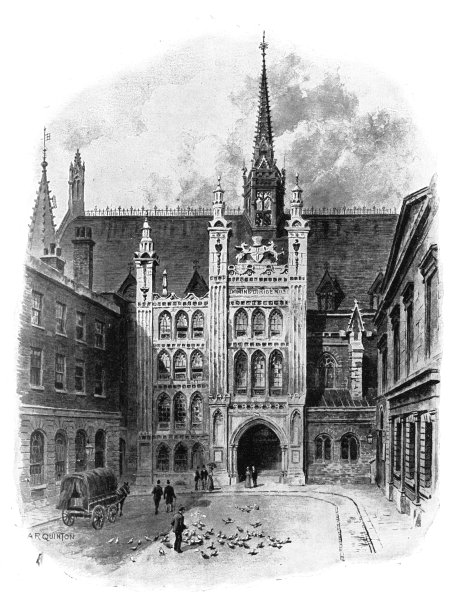
King Henry V., in 1415—the year of his famous victory at Agincourt—granted the City free passage for four boats by water, and as many carts by land, to bring lime, ragstone, and freestone for the work at Guildhall. Private citizens also came forward with contributions. The executors of Sir Richard Whittington, in 1422-3, gave two sums of £60 and £15 for paving the hall with Purbeck stone, and glazed some of the windows, placing in each the arms of Whittington. The rest of the windows in the hall and many of those in its various courts were glazed by various aldermen. So much of this ancient glass as survived the iconoclasm of the Commonwealth period was swept away by the Great Fire. The two handsome louvres which formed such conspicuous objects on the roof of the building were given by Alderman Sir William Hariot during his mayoralty in 1481. The mayor's chamber, council chamber, and several rooms above were built in 1425-6. An important part of the building was still wanting, for the mayors could not keep their feasts at the Guildhall until the time of Sir John Shaa. Under his leadership, and by the help of the Fellowships of the City, wealthy widows, and other well-disposed persons, the kitchens and other necessary offices were completed for use at his mayoralty feast in 1501. Since that year these famous banquets, which had till then been held in Merchant Taylors' Hall, or Grocers' Hall, have regularly taken place at the Guildhall.
On Tuesday, 4th September, 1666, in the course of the Great Fire, the Guildhall was ablaze, and its oak roof entirely destroyed. Vincent describes its appearance in his little book, God's Terrible Voice to the City:
"That night the sight of Guildhall was a fearfull spectacle, which stood the whole body of it for several hours together, after the fire had taken it without flames (I suppose because the timber was such solid oake) in a bright shining coale as if it had been a palace of gold or a great building of burnished brass."
After the Fire the original open roof was not rebuilt, but the walls were raised an additional storey, the ceiling covering this being flat and square panelled; eight circular windows on each side were added. This poor substitute for a roof was built, as Elmes states, "in haste and for immediate use, and evidently a temporary covering." It lasted, nevertheless, nearly two hundred years, until in 1861 the plans for a new open roof corresponding with the original design of the Guildhall were approved by the Corporation. The dimensions of this magnificent building are 152 feet in length, 49 feet 6 inches in width, and 89 feet in height, from the pavement to the ridge of the roof.
In the angles at the west end of the hall, on lofty pedestals, are the celebrated figures of the giants Gog and Magog. They have been believed by some to be Gogmagog and Corinæus, two mystical personages who were said to have fought together in some of those imaginary conflicts between the Trojans and the early inhabitants of Britain, which are recorded by monkish chroniclers of the Middle Ages. These figures were made by Captain Richard Saunders, a noted carver in King Street, Cheapside, and were put up about the year 1708. They took the place of two old wicker-work giants, which it had formerly been the custom to carry in procession at the mayoralty pageants.
The basement of the Guildhall consists of two crypts, which extend beneath the full length of the hall above. The eastern crypt is entirely vaulted and divided into three aisles by two rows of clustered columns of Purbeck marble, the intersections of the vaulting being covered with a most curious series of carved bosses representing flowers, heads, and shields. This crypt, which, fortunately, escaped the Great Fire, is the finest and most extensive undercroft remaining in London, and for excellence of design and sound preservation may be considered a unique example of its kind. For many years it was neglected and choked with rubbish, which covered its floors to the depth of several feet. In 1851 it was restored to its original condition, and was used as a supper-room for H.M. Queen Victoria and the Prince Consort on the 9th July, when the Corporation entertained the leading persons associated with the Great Exhibition held in that year. On that occasion it was fitted up as a baronial hall, the valuable plate lent by the City Companies being displayed upon an oak sideboard. Around each of the columns stood men clad in armour brought from the Tower of London, each holding a torch of gas for lighting the crypt. A charming feature of the decoration was the treatment of the passage in the western crypt—this was filled with trees and flowers of various kinds, and hundreds of singing birds were let free, thus giving the appearance of a forest glade in summer-time. There is no evidence that this crypt was appropriated to any special use in former times, but to-day it serves the useful, if unromantic, purpose of a kitchen for preparing the mayoralty banquet on the historic ninth of November.
The western crypt, which is separated from that just described by a massive wall of contemporary date, has a roof of arched brickwork dating, probably, from the period of the Great Fire. It is doubtful whether it ever formed an open chamber, and it is now, with the exception of its central passage, entirely devoted to cellarage. In one of its deeply-recessed windows were discovered, in 1902, together with some mediæval stone coffin-lids, some portions of the famous Cheapside cross, which was pulled down by order of the Long Parliament in 1643. These fragments, which were removed to the Guildhall Museum, bear the sculptured arms and badges of King Edward I. and his consort Queen Eleanor. The cross was taken down at the request of the Corporation, and, doubtless, by their officials, the mutilated fragments being removed to Guildhall, where these two pieces evidently lay for over 250 years.
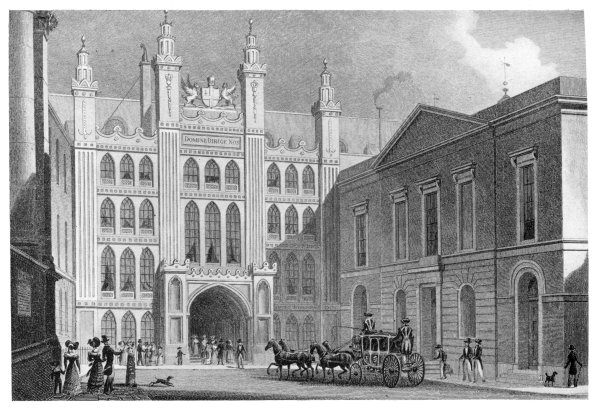
On the south side of the Guildhall, and providing an entrance to it from Guildhall Yard, is a large Gothic porch, or archway. This last addition to the hall, erected in 1425, was one of its most beautiful features, and has been preserved, practically uninjured, to the present day. The porch consists of two bays of groined vaulting, the walls having deeply-recessed moulded and traceried panelling, and being provided with a convenient seat throughout their length on either side. The front of the porch was materially altered in the reign either of Elizabeth or James I., so that we cannot form a complete idea of its magnificent appearance. It was ornamented with seven finely sculptured statues, representing at the top our Saviour, a little below Law and Learning, and lower still, flanking the doorway on either side, Discipline, Justice, Fortitude, and Temperance. The statue of our Saviour disappeared at an early date, but the other six figures may still be in existence, for they were presented by the Corporation, in 1794, to Banks the sculptor, at whose death, in 1809, they were purchased for £100 by Henry Bankes, M.P. for Corfe Castle. The present front of the Guildhall, of which the east wing was removed in 1873, was built by George Dance, the City Architect, in 1789.
Gray's Inn Hall and Chapel.
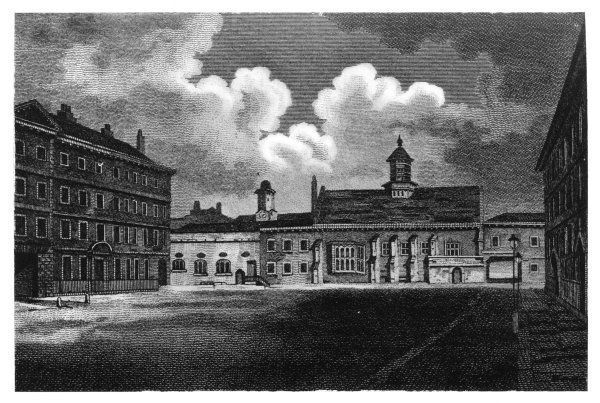
Guildhall Chapel, or College, dedicated to St. Mary Magdalen and All Saints, stood in the north-east corner of Guildhall Yard, immediately adjoining the Guildhall. The chapel is said to have been built at the end of the thirteenth century, when Adam Franceys and Peter Faulore obtained licence from Edward III. to convey a piece of land for the erection of houses for the custos and chaplains of this college. The original building became in course of time too small for the requirements of the citizens, and in 1429, when the new Guildhall was nearing completion, a new chapel was built. This beautiful building, though injured and defaced, was not destroyed in the Great Fire of London, and continued to be used as a chapel until the latter part of the eighteenth century, when its religious services were discontinued. The chapel was then devoted to secular use, and became the Court of Requests until its final demolition in 1822 to make room for the new Law Courts. The great charm of this building was its beautiful western front, which faced the Guildhall Yard. This was adorned with three canopied niches containing statues of Edward VI., Elizabeth, and Charles I. (now preserved in the Guildhall Library), and with a glorious west window of seven lights, a perfect example of the Perpendicular style. Adjoining the chapel on the south was Blackwell Hall, which was for so many centuries the great Cloth Mart of the city.
Among the religious services which formed so bright a feature in ancient civic life those of the Guildhall Chapel held an important place. Besides their attendances at the Cathedral, at Paul's Cross, and at the 'Spital, the Lord Mayor and his brethren, with the City officers, attended Divine service at this chapel on Michaelmas Day before the election of a new Lord Mayor, and on many other occasions throughout the year. The sermons preached on these occasions were printed, and form quite a large body of civic homiletics, many of the preachers being men of great fame and reputation. The practice of attending the Mass of the Holy Spirit (for which a celebration of Holy Communion with sermon is now substituted) was revived, if not originated, by the celebrated Sir Richard Whittington on the day of his own election as Lord Mayor in 1406.
Another of the good deeds of this worthy mayor was the foundation, through his executor, of a library to be attached to the Guildhall College, under the custody of one of its chaplains. This was duly carried out in 1425 by the erection of a separate building of two floors, well supplied with books "for the profit of the students there, and those discoursing to the common people." This public library, which appears to have been the first of its kind in England, had, unfortunately, but a brief existence, all of its books having been "borrowed" in 1550 by the Duke of Somerset, Lord Protector, by whom, as we learn from Stow the historian, they were never returned. The loss has since been, to some extent, supplied by the present library, founded at Guildhall in 1824, and rebuilt in 1873.
In the reign of Henry VI., after the completion of the great hall, other apartments, such as "the mayor's chamber, the council chamber, with other rooms above the stairs," were built. Of these no trace at present remains, and two Common Council chambers have since been erected. The first of these was a picturesque apartment, its walls being covered with statuary and paintings, the latter being chiefly presented to the Corporation by Alderman John Boydell. A new council chamber, of handsome and commodious design, was erected by the Corporation in 1884, from the designs of Sir Horace Jones, City Architect. The Court of Aldermen's present chamber was built in the latter half of the seventeenth century, and is a small but handsome room. The ceiling is painted with allegorical figures of the City of London—Prudence, Justice, Temperance, and Fortitude—executed by Sir James Thornhill, who was presented by the Corporation with a gold cup of £225 7s. in value. Around the walls and in the windows are shields containing the arms of most of the Lord Mayors of the last 127 years.
The Guildhall. Engraved by R. Acom, 1828.
The artistic decoration of the Guildhall and its various apartments includes monuments, busts, and portraits of men whom the City has delighted to honour. In the great hall are the monuments to Admiral Lord Nelson, by J. Smith; to the "Iron Duke," by J. Bell; to the Earl of Chatham, by Bacon, with inscription by Burke; to the younger Pitt, by Bubb, with Canning's inscription; and to Alderman Beckford, by Moore. On Beckford's monument is inscribed, in letters of gold, the speech which that famous citizen addressed, or is said to have addressed, as Lord Mayor, to King George IV. on his throne. Around the hall were formerly hung portraits of twenty-two judges who assisted in the special Court of Judicature appointed to decide the disputes which arose as to sites of property in the City after the Great Fire. These portraits, which are now hung in the old Common Council chamber, were painted at the Corporation's expense by Michael Wright, Sir Peter Lely having declined the commission because the judges refused to wait upon him at his house for the necessary sittings. In the vestibule of the council chambers are a series of portrait-busts of statesmen, philanthropists, warriors, and men of high eminence in the general estimation of their fellow-countrymen. The decoration of the outer lobby was executed as a memorial of his shrievalty in 1889-90 by the late Alderman Sir Stuart Knill, Bart., and exhibits the Corporation and the City Livery Companies in a very pleasing symbolical design.
At the west end of the great hall are two law courts, where the City judges, the Recorder, and the Common Sergeant administer justice in the Mayor's Court. The aldermen sit in rotation as magistrates in the Police Court in the Guildhall Yard, and in Guildhall Buildings is the City of London Court (anciently the Sheriff's Court), over which two judges preside for the Poultry and Giltspur Street Compters respectively.
Besides the courts above mentioned, there are the departments of the various officers of the Corporation, chief in importance among them being that of the Chamberlain. The court over which this officer presides deals with admission to the freedom of the City and the oversight of apprentices. The Freedom of London was a much-coveted privilege in former times, as without it no one was allowed to carry on business in the City. The benefits now are wholly of a posthumous nature, the children and widows of deceased freemen being eligible for election respectively to benefits of an educational and charitable kind. There is, however, an inner circle of honorary freemen, whose names have been enrolled on the City's Roll of Fame. This highly-prized distinction is reserved for those who, in the unanimous judgment of the Corporation, have rendered conspicuous services to their country in their various callings. The roll was reserved almost exclusively in former times for eminent statesmen and naval and military commanders. In more modern times the claims of great explorers, scientific discoverers, philanthropists, social reformers, etc., have been freely admitted, and the honour is bestowed without distinction of politics or creed. In January, 1900, the Honorary Freedom was conferred upon every member of the City Imperial Volunteers before the departure of the regiment for active service in the South African War. The Chamberlain also deals with disputes between masters and their apprentices, and has power to commit refractory apprentices to Bridewell for imprisonment. There was formerly attached to his office a little prison-cell, known as "Little Ease," which exercised a wholesome dread upon the turbulent 'prentices of days gone by. In addition to his judicial duties the Chamberlain has the responsibility of receiving and disbursing the City's cash, and all other moneys which the Corporation administers.
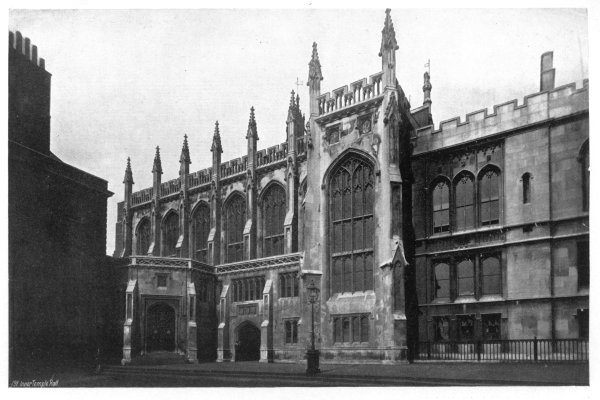
Inner Temple Hall.
The great purpose of the Guildhall as a place of meeting for the citizens is well seen in its use on various official occasions. Here are held the meetings of the Court of Common Hall, that court being an assemblage of all the liverymen of the various guilds. The Common Hall on Midsummer Day is for election by the liverymen of the two Sheriffs and various minor officials. The Sheriffs thus elected are admitted into office in the Guildhall on Michaelmas Eve, and preside on the following day at the Common Hall held for the election of Lord Mayor. The Lord Mayor Elect is formally installed in office at Guildhall, with a quaint and dignified ceremony, on November 8th, and enters upon his duties after a further ceremony at the Royal Courts of Justice on the following day. The Livery also meet in Guildhall to take part in and to hear the result of elections of Members of Parliament for the City. On all these occasions an elevated hustings is raised at the east end of the hall, and strewn with sweet-smelling herbs, the civic party being also provided with nosegays. This old custom is supposed to have originated in the days when the City was ravaged by pestilence, the herbs and flowers being employed as prophylactics.
Now taking leave of the building, it is time to glance very briefly at some of the important events which have taken place within these historic walls. It was here, in 1483, that the Duke of Buckingham, sent by Richard Duke of Gloucester, with his persuasive tongue, prevailed with the citizens to hail the usurper as King Richard III. A different scene was enacted in 1546, when Guildhall was the scene of the trial of the youthful and accomplished Anne Askew, which ended in her condemnation, her torture on the rack, and her martyrdom in Smithfield. The next year saw the trial of the Earl of Surrey, one who was distinguished by every accomplishment which became a scholar, a courtier, and a soldier, and who, to gratify the malice of Henry VIII., was convicted of high treason. This unhappy period also saw the tragic trial and condemnation, in 1553, of the ill-fated Lady Jane Grey and her husband. The trial of Sir Nicholas Throgmorton at Guildhall in 1554, for taking part in Sir Thomas Wyatt's rebellion, had a different result. This trial is one of the most interesting on record for the exhibition of intellectual power, and is remarkable for the courage displayed by the jury in returning a verdict of "acquittal" in opposition to the despotic wishes of the court, though at the expense of imprisonment and fine. In 1642 Charles I. attended at a Common Council and claimed the Corporation's assistance an apprehending the five members whom he had denounced as guilty of high treason, and who had fled to the City to avoid arrest. This incident is commemorated by an inscription affixed to one of the pillars in the new council chamber. During the Civil War and the Commonwealth period the Guildhall became the arena of many an important incident connected with the political events of the times. At a later period, when, in 1689, the Government of James II. had become so intolerable that he was forced to abdicate, Guildhall was the spot where the Lords of Parliament met and agreed on a declaration in favour of the assumption of regal authority by the Prince of Orange, afterwards William III.
Guildhall has been famous also for the many sumptuous entertainments which have been given in it to royalty and other personages of distinction at various times, apart from the annual festivity which marks the entry into office of each Lord Mayor. From the banquet given in 1421 to Henry V. and his Queen, on the successful termination of his campaigns in France—when Sir Richard Whittington, in addition to the luxuries provided for his royal guests, is said to have gratified and astonished the King by throwing into the fire bonds for which he was indebted to the citizens to the amount of £60,000—down to the reign of his present Majesty, nearly every sovereign of this country has honoured the City by accepting its hospitality in the Guildhall. Charles II. showed so much fondness for the civic entertainments that he dined there as many as nine times in the course of his reign.
The Old Guildhall.
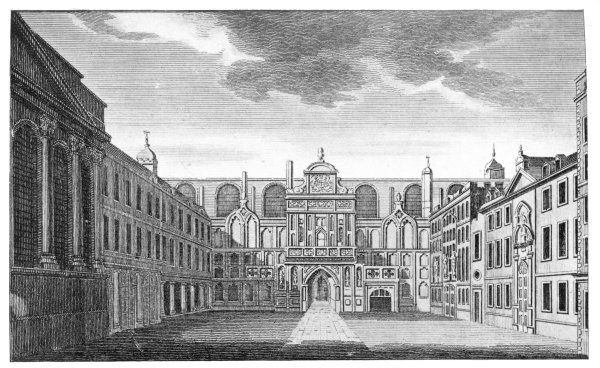
Apart from its strictly official use, the Guildhall is the place of meeting for the citizens generally when any important public question calls for the expression of their views. During the reign of George III. the views of the citizens were in frequent conflict with those of the Ministry of the day. Special meetings of Common Hall were summoned, at which addresses to the King were voted, praying His Majesty to dismiss his Ministers, and terminate the conflict with the American Colonies. More than once the citizens have been in conflict with the House of Commons: for the liberty of the press in 1770, when Brass Crosby, the Lord Mayor, was committed to the Tower; and in 1805, when the liverymen in their Common Hall supported Sir Francis Burdett, who was upholding against the House of Commons the cherished right of liberty of speech. In the long struggle connected with the Reform Bill the City supported the cause of Reform, and, on the Passing of the Reform Act of 1832, entertained in the Guildhall Earl Grey and his principal supporters in both Houses of Parliament.
The voice of the City sounding far and wide from its ancient Guildhall has similarly supported the great causes of Catholic Emancipation, the removal of Jewish Disabilities, and the Abolition of the Slave Trade. In modern times the character of the gatherings at the Guildhall has been still more varied. Foreign sovereigns have been entertained: the allied monarchs in 1814, the Emperor and Empress of the French (1855), the Sultan of Turkey (1867), the Shah of Persia (1889), Alexander II., Czar of Russia (1875), the King of the Hellenes (1881); indeed, almost every crowned head in Europe and the civilised world has been sumptuously received at Guildhall. In 1886, the year of the Colonial and Indian Exhibition, the representatives of our Colonies were warmly welcomed. Then followed the Jubilee of Queen Victoria in 1887, and the Diamond Jubilee in 1897, each occasion being celebrated by entertainments of a memorable character.
The two great windows in the Guildhall have also memories of the deepest interest. That at the west end was placed there by the Corporation in 1869 to recall the many virtues and the "high and spotless character" of the Prince Consort. The window at the east end was subscribed for by the Lancashire operatives in 1868 in gratitude for the help extended to them during the distress occasioned by the Cotton Famine. Of unique interest was the Jubilee Anniversary of Penny Postage, celebrated on the 16th May, 1890, at Guildhall, when the scene within its ancient walls resembled a huge post-office and telegraph-office combined.
Among its many services to humanity at large the Guildhall has voiced, more than once, the outcry against Jewish persecution in Russia. A working-classes industrial exhibition, bazaars and concerts for charitable objects, International congresses of scientific and social bodies, Christmas entertainments to poor and crippled children: these are some of the present-day uses of the Guildhall. It only remains to add the furtherance of religious effort which it has afforded by welcoming such gatherings as those of the Sunday School Centenary, the mission of Canon Aitken, and the yearly meeting of the British and Foreign Bible Society, when one of the youngest collectors present (some small personage of four or five years) cuts the Society's birthday cake after some hearty words of welcome from the Lord Mayor, as the genial host of the City's Guildhall.