Volume 1 — LONDON AND THE HANSEATIC LEAGUE By J. Tavenor-Perry
Reading edition
A remarkable episode in the early history of London, and an element in its making, which through the Middle Ages exercised an important and beneficial influence on its progress and growth, was the settlement of foreign merchants, who, at first as individuals, and later under the control of the Hanseatic League, made it one of the principal trading centres of Northern Europe; and no account of mediæval London would be complete which omitted a reference to the part played by these German and Flemish adventurers. Although it was not until the middle of the twelfth century that the League reached that complete organization which made it for some centuries a great northern power, the trading communities of Germany early acquired some sort of cohesion; and we find them established in London as early as the reign of Ethelred II. The encouragement this Saxon King afforded them was doubtless due to the fact that they were able to offer him the money of which he always stood in need, in return for the privileges he was able to confer on them; and he may have felt that he could always rely on their active support against their common enemy—the Danes. But these first merchants were few and unorganized, and although as time went on they increased in number and importance, it was not until the League itself had become a power that, in the reign of Henry III., they obtained a recognized corporate existence.
The foundations of this originally peaceful confederacy were, curiously enough, laid in war, and that of the baser sort—war for the sake of pillage. The Vikings, finding themselves unable to realize the spoil with which they were sometimes gorged, conceived the idea of founding a market-place to which, by assurances of safety and immunity from further theft, they could induce peaceful merchants to attend and receive, and pay for, the goods which they had stolen. Such was the now vanished town of Jomsborg which Pálnátoki, the Jarl of Fjon, founded about 950 in the country of the Wends, near the mouth of the Oder. This town was intended to be an abode of peace, where not only could the merchants reside in safety, but to which the Viking Jarls, fighting elsewhere between themselves, might resort to exchange the results of their raids. And this city gradually became not only the market for the goods which the sea-rovers gathered from sacked cities and ruined monasteries, but also the emporium of the merchandise of the East, which reached the Baltic from Byzantium by the Euxine and the Dnieper. It was in this Viking market town that the first German merchants established among themselves that association which eventually grew to be the most important trading community of the Middle Ages.
The name which the association took to itself was a Gothic word, and was not improbably conferred upon them by the Vikings themselves, since Hansa means—in the language of the Goths—"a company," or "a troop," and in that sense it occurs in the Gothic version of the Scriptures by Ulphilas, a copy of which is preserved in the library of Upsala. Some of the rules which Pálnátoki made for these merchants remained in force throughout the existence of the League, and formed the basis of the laws by which all the factories of the Hansa were governed. The Joms Vykinga Saga contains some of these rules:—"No man older than fifty years or younger than eighteen winters could be received." "Anyone who committed what had been forbidden was to be cast out, and driven from the community." "No one should have a woman within the burgh, or be absent from it for three nights." Governed by such rules, the Kontors of the League formed among the alien populations in which they were placed semi-monastic establishments, holding only such intercourse with their neighbours as their business required, much like the early British factories established in India.
Hamburg was founded in 809 by Charlemagne, and its merchants were among the first to take advantage of Jomsborg; and it was very shortly after that market was opened when they appeared in London. The growth of the League was, however, very gradual; and it was not until the foundation of Lübeck, which afterwards became its principal city, that it assumed its great importance. But the destruction of Jomsborg by the Danes transferred all the Eastern trade of the Baltic to this new town, which, as a consequence of its increasing importance, was made in 1226 a free city of the Empire; and by 1234 it had become so powerful as to be able to destroy for ever the naval supremacy of Denmark in the sea-fight of Travemünde. Its treaty with Hamburg for mutual defence was made soon afterwards, and this event is reckoned to be the formal establishment of the Hansa League, not only as a corporate body, but as an independent state to make treaties, and, when necessary, to levy war.
Coat of Arms of Hansa Merchant in London.
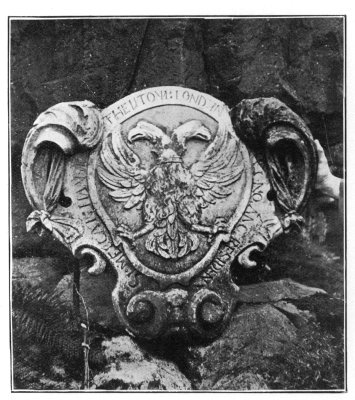
During this same period the German settlement in London had been increasing in importance, and, although not yet recognized as a corporate body, is frequently referred to as a guild or association. There is but little doubt that the William Almaine, one of the three city merchants who completed London Bridge, after the death of Peter of Colechurch, was one of its members, and so important had the London settlement become in the eyes of the Flemings, that in a charter granted to the Flemish town of Damme by Joan of Constantinople in 1241, it is specially provided that no one shall aspire to the office of alderman of that place unless he had been previously admitted a member of the Hanse in London.
In 1250 the permanent buildings of the League in London were commenced by the erection of storehouses; and nine years afterwards, through the influence of his brother Richard, Earl of Cornwall and King of the Romans, Henry III.
"granted that all and singular the merchants, having a house in the City of London, commonly called the Guilda Aula Teutonicorum, should be maintained and upholden through the whole realm by all such freedoms and free usages or liberties as by the King and his noble progenitors' time they had enjoyed."
This "house in the City" was situated to the south of Thames Street, bordering on the river, closely adjoining Dowgate Wharf, one of the principal landing places, and it became known, later on, as the Steel-yard. Several suggestions as to the origin of this name, more or less ingenious, have been made, but it seems most probable that it was due to the fact that there, or thereabouts, was situated a weighing place for foreign goods imported by the Hansa, similar to the King's weigh-house in Cornhill. In this settlement the merchants lived the semi-monastic life required by their rules, avoiding as far as possible intimate association with the people by whom they were surrounded, but with whom they carried on their business; yet at the same time not so exclusively withholding themselves as in the remote settlements of Bergen and Novgorod. Indeed, in return for the privileges which were conceded to them they were required, to a certain extent, to take part in the civil life of London and to share in the duties of its defence.
One of the duties they were required to discharge was the maintenance of one of the city gates—that known as Bishopsgate, from the fact that it had been first erected by Saint Erkenwald, sometime Bishop of London; and one of the first troubles they had with the city Corporation arose in consequence of their neglect properly to perform this duty. It is recorded that in the tenth year of Edward I., who had renewed his father's charter, that a great controversy arose between the Mayor and the "Haunce of Almaine" about the reparation of this gate, then likely to fall, and the matter was brought before the King's Court of Exchequer. The result was that the German merchants were found to have neglected their duty, and they were called upon to pay two hundred and ten marks sterling to the Mayor and citizens, and to undertake that they and their successors should from time to time repair the gate. The names of the merchants who at that time were residing in London, and answered to the court, are given by Stow, and the list is interesting as showing the different parts of Germany represented at that time. They were, Gerard Marbod the Alderman, Ralph de Cusarde of Cologne, Bertram of Hamburg, John de Dele, burgess of Münster, and Ludero de Denevar, John of Arras, and John de Hundondale, all three burgesses of Tréves; so that unless the Alderman himself was from Lübeck, the head city of the League was not represented. An interesting point arises in connection with the repairs of this gate. London in the thirteenth century was a city of wood, with only its walls and churches built of stone, and brick as a building material was almost unknown. But in the great cities of the Hanse League, in Lübeck, Hamburg, and Bruges, brick was the ordinary material, and for the Steel-yard merchants it was as easy to bring bricks from Flanders as stone from Surrey or Kent, and the material itself was very much cheaper. We know that wherever the agents of the League settled they seem to have accustomed the people to the use of brick, and taught them the mysteries of brick-making. This was the case at Hull, a branch of the London Kontor, where, although in a stone-producing country, its great church of Holy Trinity, as well as its walls, were built of brick; and in other branches, such as Yarmouth, Boston, and Lynn, we find early examples of brick-work. Old engravings of portions of the Steel-yard buildings show that they were of brick, and with their Guildhall vied in importance and beauty with the great brick buildings of Lübeck and Bruges.
During the Lancastrian supremacy the German merchants were under a cloud in this country, and many of their privileges were withdrawn; and indeed, for a time, the Steel-yard was closed, whilst the fleets of the League were actively supporting the Yorkist cause. But with the accession of Edward IV. all this was changed, and in 1474 they were reinstated in all their privileges, and embarked on a new era of prosperity in London.
The close connection of the King with the house of Burgundy interested him in the fortunes of the League in Flanders. His sister, Margaret of York, was married to Charles the Bold at Damme, one of the principal Kontors of the League, at which ceremony he was present; and he attended, later on, a great Chapter of the Knights of the Golden Fleece in Bruges, as the stall-plate bearing his arms in the choir of Notre Dame testifies to this day. He granted the Flemish merchants special privileges of exemption from taxation—as, for instance, to the makers of dinanderie at Middleburg by Bruges, that the goods sent from hence to England should be admitted free.
In 1479 the guild rebuilt Bishopsgate, which had again fallen into bad repair, and this time we know that it was built of brick, although the image of the bishop on the side towards the city was carved in stone; and this date synchronises with that great period of brick building in England which included the halls of Gifford, Hargraves, Oxburg, and West Stow, and portions of the college at Eton. The Guildhall of the Steel-yard seems also to belong to this date, for it was just then the area of the enclosure was much extended. We have, unfortunately, but very inadequate accounts of what must have been a very important structure, although remains of it existed to the middle of the last century; but we know that its gable was surmounted by the imperial eagle. The interior, no doubt, was of a magnificence which would bear comparison with the halls of the League in Flanders and Germany, and we know that it contained two large paintings by Holbein of the triumphs of Poverty and Riches, which, later, found their way into the collection of Henry, Prince of Wales, and were destroyed in the fire at Whitehall.
In two particulars at least the London settlement was less exclusive than some of those elsewhere. The merchants built no church for their own private use, but resorted to the adjacent parish church of All Hallows the More, which stood, until its recent destruction, at the corner of Thames Street and All Hallows Lane. The original church perished in the Great Fire, and with it all the monuments which could be associated with the League; but in the rebuilt church, in the reign of Queen Anne, was placed by one Jacob Jacobsen, no doubt a descendant of one of the original Hanse merchants, a very beautiful screen, as a memorial of the League. The screen is now in St. Margaret's, Lothbury, and over the gate of it still soars the German eagle, but surmounted by the arms of England. Although tradition says that the screen was made in Hamburg, there seems to be but little doubt that its delicate carving is the work of an English chisel, perhaps one of those which had been employed at St. Paul's Cathedral.
A Flemish Gray-Beard from the Steel-yard of London.
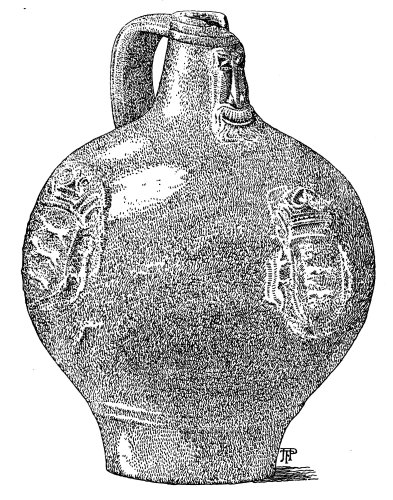
Within the enclosing walls of the Steel-yard on the river's banks was a fine garden planted with vines and fruit trees open to the citizens and their wives, who in fine summer weather took their pleasure there and drank the Rhine wines which the merchants imported from Germany and vended at the rate of threepence a flask. This wine was brought over in stone bottles, made principally at Fretchen, near Cologne, which, from a rough-looking face, intended to represent Charlemagne, placed under the lip, were commonly called "Flemish Gray-beards." When the Cannon Street Railway Station, which occupies part of the site of this garden, was built, many of these in a perfect state of preservation were unearthed; of one of which we give an illustration.
With the discovery of America, and the increasing activity of English merchant adventurers, the trade of the Germans declined, and a domestic revolution in Lübeck, in 1537, destroyed the cohesion of the League, which gradually became effaced during the struggles of the Thirty Years' War. In England its charter was first withdrawn in 1552, and, although its influence slightly revived under Mary in consequence of her Spanish and Burgundian connections, it was finally expelled by Elizabeth.
Of the great League and its Kontor, in London, there remains, perhaps, an echo in the expression, "A pound sterling"—a pound of the Easterlings; but the site of its Steel-yard is now a railway station, and its only tangible memorials remaining are some empty wine bottles.