Volume 1 — HOLBORN AND THE INNS OF COURT AND CHANCERY By E. Williams
Reading edition
Just as Holland denotes the hollow land, so Holborn, or Holeburn, implies the hollow bourne—the bourne or river in the hollow. This once forcible little stream descended four hundred feet in a journey of six miles, taking its rise in Ken Wood, the beautifully timbered estate of the Earls of Mansfield at Highgate. After passing through several ponds, skirting the existing Millfield Lane, it crossed the foot of West Hill and continued its course through what is now known as the Brookfield Stud Farm, till, somewhat to the north of Prince of Wales' Road at Kentish Town, it encountered another stream of almost equal rapidity, the birthplace of which was in the Happy Valley at Hampstead. The united current then rolled on through Camden Town and St. Pancras towards Battle Bridge at King's Cross, from whence it flowed through Packington Street, under Rosebery Avenue, into Farringdon Street, creating steep banks on its flanks, which still remain the measure and evidence of its ancient energy; until, finally, it debouched into that tidal estuary from the Thames mediævally known as the Fleet. Holborn Viaduct, at a much higher altitude, now spans the hollow where once stood Holeburn Bridge, at the wharves on either side of which "boats with corn, wine, firewood, and other necessaries" would unload. But in 1598 John Stow knew of this burn only as Turnmill Brook. Now it no longer exists; the damming of its waters for the erection of mills in the Middle Ages, and its more recent absorption by the water companies, have led to its complete disappearance.
The Manor of Holeburn, which was bounded on the east by the southern part of the Farringdon Street portion of this stream, included both sides of Shoe Lane; but how far west or north it originally extended is not known. In the year 1300, Saffron Hill, Fetter (or Faytour) Lane, and Fleet Street were all outside its bounds. Shoe Lane was known as Sho Lane, at one end of which was a well, called Show Well, from which the neighbourhood drew its water.[75]
It was here that the Dominicans, or Black Friars, made their first settlement in 1222;[76] their monastery was in Shoe Lane, and in 1286, when they moved to the eastern side of the Fleet, by Baynard's Castle, Henry de Lacy, Earl of Lincoln, who was lord of the manor and a justiciar, bought their old houses and established the first Lincoln's Inn.[77] Two other inns of that name, one next to Staple Inn and one in Chancery Lane, came into existence later, as we shall see presently. Here the earl died in 1311, and he was buried in St. Paul's Cathedral. By his will, proved in the Court of Hustings at the Guildhall, he directed that the houses which he had acquired from the monks should be sold;[78] but the inheritance of the manor of Holeburn descended to his son-in-law, Thomas, Earl of Lancaster, the King's cousin and Steward of the kingdom. Legal business was certainly transacted at his Inn. The yearly accounts of the Earldom of Lancaster for that period show that at his house in Shoe Lane, from Michaelmas, 1314, to Michaelmas, 1315, the amount of £314 7s. 4½d. was spent for 1,714 lbs. of wax, with vermilion and turpentine to make red wax, and £4 8s. 3¼d. for one hundred and twenty-nine dozen of parchment, with ink.[79] He was beheaded in 1322, leaving no issue, and his widow, Alesia de Lacy, married secondly Ebulo Lestrange,[80] in whose family the manor remained until 1480, when it passed by marriage to the Stanleys, Earls of Derby.[81] In 1602 it was sold by the widow of Ferdinando, fifth earl, to Lord Buckhurst,[82] afterwards Earl of Dorset, under whose immediate successor it was broken up for building purposes.
The street of Holborn was at first simply the King's Street; afterwards it acquired the name of Holebourne-Bridge-strate. From Newgate to a little way west of St. Sepulchre's Church the high-road was known as "la Baillie"; from thence it bore the same name as the river, being carried over the bridge on to the ridge along which the Romans had built their military stone-way, known as Watling Street, out of which, in the year 1300, there turned two streets towards the south, namely, Scho Lane and Faitur Lane, and two towards the north, one called "le Vrunelane,"[83] afterwards Lyverounelane, then Lyver Lane, now Leather Lane, and the other called Portpool Lane, now Gray's Inn Road.
The justiciars, clerks in Chancery, and serjeants had frequent cause to protest against the manner in which the stream of Holeburn was being defiled. In the Parliament of Barons held in 1307, the Earl of Lincoln, whose Inn was in close proximity, complained that
"whereas formerly ten and twelve ships were wont to come to Flete Bridge and some of them to Holeburn Bridge, now, by the filth of the tanners and others, by the erection of wharfs, especially by them of the New Temple for their mills without Baynard's Castle, and by other impediments, the course was decayed so that ships could not enter as they were wont."[84]
Later on, in 1371, a writ was issued by Edward III. to the mayor and sheriffs to the effect that
"Upon the open information as well of our Justiciars and our Clerks in Chancery and our other Officers, as of other reputable men now living in Fletestrete, Holebourne and Smythfeld, we have heard that certain butchers of the said city, giving no heed to our Ordinance, have slain large beasts within the said city and have thrown the blood and entrails thereof in divers places near Holbournebrigge and elsewhere in the suburb aforesaid, from which abominations and stenches, and the air affected thereby, sicknesses and very many other maladies have befallen our Officers aforesaid and other persons there dwelling to the no small damage of the same our Officers and others," etc.[85]
Political exigencies had led these justiciars, clerks in Chancery, and "our other officers," to settle outside the city walls. London had been a free city in Saxon times, and William the Conqueror had allowed its privileges when, by issuing his famous charter, six inches by one of parchment, he granted its burghers to be all "law-worthy."[86] Successive monarchs had put their seal to further charters, renewing and enlarging previous concessions, so that none of the King's men, whether knight or clerk, might lodge within the city walls, nor might lodging be taken by force, and all pleas of the Crown were to be determined elsewhere. In 1191 the burghers obtained a "sworn Commune," after the pattern of that of Rouen, and it became a boast that "come what may, the Londoners shall have no King but their Mayor."[87]
Henry III., jealous of political control, constantly endeavoured, by irritating Ordinances, to cripple the powers previously conferred. On December 2nd, 1234, he issued a
"Mandate to the Mayor and Sheriffs of London that they cause proclamation to be made through the whole city firmly forbidding that any should set up schools in the said city for teaching the laws there for the time to come; and that if any shall there set up such schools they cause them to cease without delay."
Whatever the reason of this mandate may have been, the result was that the Inns of the apprentices-at-law became fixed in the suburb.
At that date, namely, 1234, the principal officer of the Crown was Ralph Nevill, Bishop of Chichester, the King's Chancellor, who held land on both sides of New Street, afterwards known as Chancery Lane, and who had succeeded to the power and influence previously enjoyed by the justiciar, Hubert de Burgh. This once powerful minister, who had been Regent during Henry's minority, had himself held land in New Street. But upon his disgrace and dismissal in 1232 he was deprived of it, and it was granted
"to the House which the King has founded in the street called Newstrate, between the Old Temple and the New Temple, for the support of the brethren converted, and to be converted, from Judaism to the Catholic faith, saving the garden which the King has already granted to Ralph, Bishop of Chichester, his Chancellor."[88]
This house became the Rolls Office, and in after times, when the Master of the Rolls became head of the Chancery clerks, the street became known as Chancery Lane.
The Old Temple was in Holborn, and the property extended from the north-eastern corner of Chancery Lane to Staple Inn, and possibly further. The Knights Templars sold it about the year 1160 to the Bishopric of Lincoln. Their round chapel, of which the round of the present Temple Church is a replica, still retained its chaplain in 1222, and its ruins were still existing in Queen Elizabeth's reign, quite close to Staple Inn. In 1547 the bishopric had to resign the property to John Dudley, Earl of Warwick, Great Chamberlain of England, afterwards Earl of Northumberland,[89] who conveyed it in 1549 to the Chancellor, Thomas Wriothesley, Earl of Southampton. The eastern part of the property was built upon in 1580 by William Roper, of Lincoln's Inn; and in 1638 the then Earl received licence to demolish his house to make way for eighty smaller houses and one tavern. The rotunda of the Birkbeck Bank occupies the site of what was once Northumberland Court, and Southampton Buildings now cover the grounds of Southampton House.
On the west side of Chancery Lane, or New Street, Ralph Nevill, the Bishop of Chichester, possessed a house which became part of the third and present Lincoln's Inn; but his garden was on the east side of Chancery Lane, and was bounded on the north by a ditch, known in 1262 as Chanceleresdich. This ditch separated his garden from certain property, occupied one hundred years later by serjeants and apprentices of the law, which may be conveniently designated the second Lincoln's Inn. It was situated to the east of Staple Inn, where now is Furnival Street.
Dugdale describes Henry de Lacy, Earl of Lincoln, as a person well affected to the study of the laws, who had gathered around him numbers of students. This statement is probably correct, for in 1292, only six years after the earl had bought the houses of the Black Friars, Edward I. urges the same course upon his Chief Justice of Common Pleas. He enjoins John Metyngham and his fellows, et sociis suis, to provide a certain number of every county of the better and more legally and liberally learned for the purpose of being trained to practise in the Courts.[90] If the Earl of Lincoln had already brought students to London, we may be fairly certain that many of them would have come from his lands in Lincolnshire and North Wales. The second Lincoln's Inn appears to have been much connected with the one, and Davy's Inn with the other.
In the year 1252, Adam de Basing, then Mayor of London, held a block of land, about 100 yards wide by 220 yards long, on the east side of Staple Inn, part of which was leased to Roger the Smith, and part to Geoffrey the Wheelwright. In 1269, Simon Faber, son and heir of Roger, granted a portion of it, lying next to Staple Inn, to Simon the Marshall, "being in breadth at the King's street on the north 12 ells of the iron ell of King Henry," and 48 ells long, "for the yearly rent, to Thomas, son of Adam de Basing, and his heirs, of 10s. sterling, and to Simon Faber and his heirs one rose at the feast of the nativity of St. John Baptist."[91] But Simon the Marshall accepted this grant only to make a feoffment of the property at once to Gilbert de Lincoln, known also as Gilbert de Haliwell and as Gilbert Proudphoet, a dealer in parchment, parmentarius, who held it for thirty-three years; his wife, after his death, holding it for another five. In 1307, William le Brewere and William atte Gate, executors of Gilbert de Lincoln, sold the property, with the buildings thereon, to John de Dodyngton, variously described as parmentarius and skinner, pelliparius, for the sum of one hundred shillings.[92] Within five years, in 1312, John de Dodyngton transferred it to Robert le Hende de Worcester, also parmentarius and pelliparius, who held it for twenty years; from whom it descended in the female line to James Gylot, who in 1369 enfeoffed of it Roger de Podyngton, and Joan his wife, "to hold to Roger and Joan, and the heirs and assigns of Roger, of the chief lords of that fee by the accustomed services for ever."[93] In the same year Roger and Joan "gave" it to Walter de Barton, citizen and cordwainer of London, to hold under the same conditions, in whose possession it remained for seventeen years, when he granted a feoffment of it to Robert de Cherlton, Chief Justice of Common Pleas, Richard the Mauncyple, John Sutton, John Aldurley, and John Parkere,[94] who in the same year transferred it to the Abbot of Malmesbury. By an Inquisition, ad quod damnum, held in May of that year, for the purpose of determining whether the gift might be legally made, it was stated that the property was held in burgage—i.e., town tenure—of the King, and there are no means between the King and the said Robert, etc.[95] The abbot allowed Walter de Barton and his successors to remain in occupation, the monastery receiving the rents.
Though for thirty-three years it had been held by Gilbert de Lincoln, this property did not form a part of what was called Lyncolnesynne. It was partly a brewery and partly a hostel, and remained such until the reign of Henry VIII.
The property east and south of this was, in the year 1262, held by Geoffrey the Wheelwright. That part of it lying east had been leased direct from Adam Basing; it extended from the King's Street to the "land of the Conversi," and was 12 ells in width at the north, 10 ells in width at the south, and 220 yards long. That part lying south had been granted to Geoffrey by Simon Faber; it contained
"in length from the ditch called Chaunceleresdich towards the Church of the Conversi on the south as far as Simon's own curtilage on the north 31 perches of the perch of Henry III., whereof each perch contains 16½ feet,"
and in width 11 ells of the said King;
"to hold to Geoffrey, his heirs and assigns, of Adam Basing, for 2s. 8d. rent paid in the name of Simon, his heirs and assigns, and one rose at the nativity of S. John Baptist to Simon and his heirs."[96]
Adam de Basing gave this property to his daughter, Avice, wife of William de Hadestok, Alderman of Tower Ward.[97] They had a daughter, Joan, who married Adam Bidic, the King's tailor and custodian of the assize of cloth,[98] who in 1291 granted it to William le Brewere and Alice his wife.[99] It was described as stretching from the King's Street on the north to the tenement of the Bishop of Chichester on the south;
"to hold to William and Alice, their heirs and assigns, for the yearly rent of two marks and for suits of court and all other services wont to be done by Geoffrey, le Whelwriste, in the time of Adam Basing, formerly citizen of London."
The widow of William le Brewere, in 1315, granted the property to Robert le Hende de Worcester, who already held the brewery on the west.[100] In 1334 the executors of Robert sold the property (exclusive of the brewery) to Thomas de Lincoln of the Common Bench, the King's serjeant, who is described as son of Thomas de Lincoln.[101] Three years before, in 1331, Thomas de Lincoln had acquired from John de Totel de Lincoln other property to the east of this, and in 1332 a garden also, to the south-east, from Andrew Courtays, the Coupere. These three combined properties formed the inn which came to be known as "Lyncolnesynne." On the 11th January, 1348, Thomas Bedic, grandson of Adam de Bedic, granted all his rights of lordship in this property to Thomas de Lincoln, who thus became entire owner of it.
After holding it for thirty-two years, Thomas de Lincoln, on Sunday, 1st December, 1364, granted it to John Claymond, Justice for County Lincoln, Peter Turke, and Robert de Ditton, "to hold to them, their heirs and assigns, of the chief lords of that fee by the accustomed services."[102] These feoffees, two years afterwards, granted it to William de Worston, Justice of County Wilts., Thomas Coubrigge, William Camme, Vicar of Westport, Malmesbury, and Robert de Cherlton, Chief Justice of Common Pleas; and they, two years later still, in 1369, received letters patent of Edward III, granting them licence to assign it to the Abbot and Convent of Malmesbury,
"to hold to the Abbot and Convent and their successors of the King, the chief lord of that fee, by the services belonging to those houses for ever."[103]
To the east of this property of Lincoln's Inn there was, in 1295, "a tenement with buildings thereon, and a curtilage adjacent," belonging to the Knights Templars, which was then held by Simon le Webbe de Purtepol, Bailiff of the Commonalty of the Guild of Weavers. Upon his death it came into the possession of John Wymondeswolde, chaplain and pelliparius, who in 1328 granted it to Robert the Marshall, citizen and goldsmith of London
"to hold to Robert, his heirs and assigns, of the chief lords of that fee, namely, the Prior of the Hospital of S. John of Jerusalem in England and the Brethren of the Hospital, by reason of the annulling of the Order of the Knights of the Temple, by the service of ten shillings yearly."[104]
This rent was reduced in 1336 to 6s. 8d., because the tenement was ruinous, Robert the Marshall promising to rebuild it. Eventually, in the year 1361, it came into the hands of Gaillard Pete, or Pecche, and eighteen years afterwards he granted it to Robert de Cherlton, Chief Justice of the Common Bench, John atte Mulle, chaplain, Thomas de Worston, and William Camme, their heirs and assigns, "to hold of the chief lord of that fee for the accustomed services."[105] They demised it to the same Gaillard and Agnes his wife for their lives, with remainder to Roger, son of Gaillard, for his life. And eight years afterwards the Chief Justice and his fellow feoffees granted this property also to the Abbot of Malmesbury.[106] In the Inquisition ad quod damnum already quoted, it is stated that "the messuage and garden are held of the King by Gailard Pete," which seems to imply that the Chief Justice and his fellows had been acting all along as trustees; and it is also stated that
"they are worth yearly according to their true value 13s. 4d. and not more because they are charged yearly to the Master of the Church of the New Temple within the Bar of London in 6s. 8d. quit rent."
The Abbot of Malmesbury had now become possessed of three properties in Holborn: the tenement of Walter Barton, next to Staple Inn, acquired in 1387; Lyncolnesynne, acquired in 1369; and the tenement of Gailard Pete, acquired, like that of Walter Barton, in 1387. In the reign of Henry VIII., at the dissolution of the monasteries, there was still at this spot a chapel, a hall, a kitchen, and a "great garden," where the monks had "liberty to walk" when they came to London; and the brewery also was still in existence.[107]
In 1399 a rental of the property of the Convent of Malmesbury was drawn up, in which the following items appear[108]:—
"De Firmario novi hospicii apud Londoniam vocati Lyncolnesynne ad iiiior terminos solvendo per annumVIII li. pro missa Abbatis
De tenemento quondam Gaillardi Poet in HolbourneXX s
De tenemento quondam Walter Bartone AllutariiXIII s IIII d"
Written in a different hand, with different coloured ink, at the bottom margin of the page, and certainly of a later date, the following remarks have been added:—
"LondonHospicium Armigeri jam magnum hospitium quod est ruinosum reddit per annumXL s
TenuraCelda proxima annexa hospicio reddit per annumIX s
tenenciumSecunda celda reddit per annumX s
infra silvamTertia celda reddit per annumVIII s
magni hospiciiQuarta celda que est ..."
[Here the page is cut away.]
The "Inn of the Esquire ... which is ruinous" of the marginal note is obviously the same as the "Lyncolnesynne" of the original entry, with the rent reduced from £8 to 40s. per annum. It is not possible to date this note, but it was probably made in the fifteenth century. In 1422 the Society of Lincoln's Inn took what is believed to be their first lease of the Bishop of Chichester property on the west side of Chancery Lane; but the society existed before that date, as in the Corporation letter books Thomas Broun is described as Maunciple of Lincoln's Inn, under date of 1417. In 1466 the society was paying 9s. yearly to the prior of St. Giles' Hospital for Lepers for another part of its property; and no other rents, apparently, were being paid for any other part on the west side of Chancery Lane. But in the Black Books of that Inn (vol. i., p. 8), under a date only sixteen years later than that of their lease of the Bishop's Inn, the following entry occurs:—
"In the vigil of the Apostles Peter and Paul 16 Henry VI. (1438) John Row delivered to John Fortescue and others in the name of the Society to be paid to ... Halssewylle for the farm of Lyncollysyn in arrear for the 15th year (Henry VI.) in the time of Bartholomew Bolney then Pensioner in full payment 40s. out of money received by him."
The yearly rent for the farm of Lyncollysyn is the same, therefore, as was paid for the ruinous "Hospicium Armigeri"; and in the fourteenth century, as Foss has pointed out, the term "esquire" was often used as a synonym for "serjeant." The Black Books also show that in 1457 a payment was made by the society to the gardener of Staple Inn, from which Inn access could be easily obtained to the "great garden" in which the "Hospicium Armigeri" was situated. It would seem not improbable, therefore, that the second and third Lincoln's Inns may, in the year 1438, have been coexistent and under the same rule. But there is at present no evidence that this same society was connected with the Inn in Shoe Lane, which 130 years earlier had belonged to Henry de Lacy.
John Fortescue, who received the 40s. for payment to Halssewyll, became serjeant in 1441 and Chief Justice of the King's Bench in 1442. In 1465 he wrote his famous work, De Laudibus Legum Angliæ, in which he says:
"The laws are taught in a certain place of public study nigh to the King's Courts.... There are ten lesser houses or Inns (and sometimes more) which are called houses of Chancery, and to every one of them belongeth 100 students at least, who, as they grow to ripeness, are admitted into the greater Inns, called Inns of Court, of which there are four in number, and to the least of which belongeth 200 students or more."
It is clear, then, that the difference between the Inns of Court and Inns of Chancery was recognised in 1465, and it is also certain that one of those four Inns of Court was that to which he himself had belonged, namely, Lincoln's Inn. The others were undoubtedly Gray's Inn and the Inner and Middle Temples. We have seen that in 1387 Lincoln's Inn in Holborn was held directly of the King; we shall find that the other Inns of Court came to be similarly held.
In the year 1294, Reginald de Grey, a member of one of the leading administrative and legal families, was Justiciar of Chester. He received in that year from the Dean and Chapter of St. Paul's a feoffment of the manor of Portpool, which they had received in mortmain from Richard de Chyggewell, alderman and mercer of London. It is doubtful whether Reginald de Grey lived here; it is more likely that he acquired the property for the training of his clerks, having found himself under much the same necessity as his contemporaries, Sir John de Metyngham and the Earl of Lincoln. In 1296 he was in association with Prince Edward, as one of the Regency, during the expedition of Edward I. to Flanders. In 1307 he died, when an inquisition was taken, at which the jurors reported that Reginald le Grey was seized at Purtepol of a certain messuage with gardens and one dove house worth 10s. a year, 30 acres of arable land worth 20s. a year, price 8d. the acre, and a certain windmill worth 20s. all held of the Dean and Chapter of St. Paul's.[109]
In 1316 his successor, Sir John de Grey, created a rent-charge on the property in favour of the prior and convent of St. Bartholomew, in Smithfield, to provide a chaplain to perform daily service in the chapel of the manor; and at an inquisition held in that year, at the Stone Cross in the parish of the Blessed Mary at the Strand, to know whether it would be to the King's damage if he granted the necessary permission, the jurors reported that the property was
"holden of Robert de Chiggewelle by the service of rendering to the same Robert one rose yearly, and the same Robert holds the tenements, together with others, of the Dean and Chapter of St. Paul's, and the said Dean and Chapter hold the same of the king in pure and perpetual alms."[110]
The grandson of Sir John de Grey, another Reginald, died in 1370, and was succeeded by Henry de Grey, under whom the first feoffment-in-trust of this property that we know of took place. For when he died in 1397 it was found by inquisition that Henry, Lord Grey de Wilton, held no land in Middlesex, because by deed he had enfeoffed Roger Harecourt, Justice for Co. Derby; John de Broughton, Escheator for the counties of Bucks and Beds; William Danbury; John Boner, rector of the Church of Shirland (one of the manors of the De Greys), and others, of his manor of Portpoole, called Gray's Inn.[111] This was probably in 1371. Similar feoffments-in-trust were made by successive Lords de Grey until 1506, when Edmund, Lord de Grey of Wilton, sold the manor to Hugh Denys, verger of Windsor Castle, and others, the said Hugh's feoffees.[112]
Hugh Denys died in 1511, and by his will he desired that all such persons as had been feoffed of his manor of "Greysynte" should be seized of it to the use of his heirs, "until such time as the Prior and Convent of the Charterhouse at Shene, in the county of Surrey, have obtained of the king's grace sufficient licence for the amortisement" of the manor to them.[113] And five years later the necessary authority was granted, the manor being described as having escheated to the King, "by the death of Robert de Chiggewell without an heir," to be held to the annual value of £6 13s. 4d.
At the dissolution of the monasteries the Benchers of Gray's Inn had to pay this amount to the Crown, instead of to the Charterhouse at Shene. Charles II. sold the rent to Sir Philip Matthews, and in 1733 the Benchers purchased it from parties deriving title from his co-heirs.[114] The hall of Gray's Inn dates from 1560; the chapel is of unknown, but of ancient date.
The New Temple was in occupation by the Knights Templars before 1186. They were bankers for the King, who sometimes lodged there. Their chapel was the muniment house of the rolls of chancery; there the treasure and regalia were stored; and there Parliaments and Courts, both criminal and civil, were held. Naturally, they needed their own fratres servientes, who were provided with food "at the clerks' tables," and yearly robes at Christmas "of the suit of the free servants of the house."[115]
The chief lord was the Earl of Lancaster. But when the Knighthood was suppressed, in 1308, their clerks were pensioned, and Edward II. granted the property to Aymer de Valence, Earl of Pembroke, he receiving the issues, but holding the manor of the lord, to whom, however, he made a "quit claim" in October, 1314, the Pope having granted the possessions of the Templars to the Knights of St. John. Upon the execution and attainder of Thomas, Earl of Lancaster, in 1322, the King gave the lordship to Hugh le Despencer, who also obtained from the Prior of St. John's a feoffment of the houses and appurtenances,[116] and on the attainder of Hugh le Despencer, in 1327, the lordship and also the ferm came into the hands of Edward III., who put William de Langeford, clerk of the Prior and "chief servitor of the King's religion," in charge as "fermor" at £24 yearly. He repaired the old houses for the King's clerks to occupy;[117] and for some years following litigants coming into chancery would take their oaths in the Temple Church; though sometimes at this period they would attend in the church of St. Andrew in Holborn, Thomas de Cotyngham, one of the Chancery clerks, then being rector there. It was William de Langeford who, in 1335, took a lease from the mayor and commonalty of "a piece of land" without Newgate "for making a hall and three fit chambers at his own expense, for the sessions of the Justices appointed to deliver Newgate Gaol."[118] This early Sessions House is described as being in the King's high street, on the way towards Holebourne. It would have stood at the north-west corner of the present Newgate Street.
The Temple contained an inner consecrated area, which was occupied by the Knights, and some houses adjacent on the west owned by them, but not improbably occupied by students of the law. It appears that when the manor was handed over to the Knights of St. John the King retained part of it, which, however, in 1338, he allowed them to purchase for £100, and from that date we read no more of the chancery being held in the Temple Church. In gratitude to William de Langeford, whose services had secured to the Order the restitution of their property, the prior granted him a lease of "all their messuages and places of the sometime Temple lying from the lane called Chauncellereslane to the Templebarre without the gates of the New Temple." This lease was dated June 11th, 1339,[119] and the lawyers have held the property ever since.
The consecrated and secular areas may, perhaps, be the origin of the division of the property into two Inns of Court; for the lease of 1339 obviously refers only to what is now known as the Middle Temple.
There is a tradition that the students of the Inner Temple came from Davy's Inn, which could hardly have existed at that time under that name, but it may be noted that in the records of that Inn it is stated, under date of 1525, that "Master Barnardston is pardoned the office of Steward because he executed the office of Principal of Davy's Inn at the instance of this Society,"[120] thus showing that this Inn of Court had the right in that year of supplying one of its own members to that office.
In 1521 the Prior of St. John's made complaint that the Society of the Inner Temple was occupying his lands against his will; but at the dissolution of the religious houses in 1541, the rentals became due to the Crown; and James I., in his sixth year, granted the property to the Benchers of the Middle and Inner Temples in perpetuity for a fixed rental of £20,[121] their several moieties of which Charles II. allowed them to purchase in 1673 and 1675 respectively.[122]
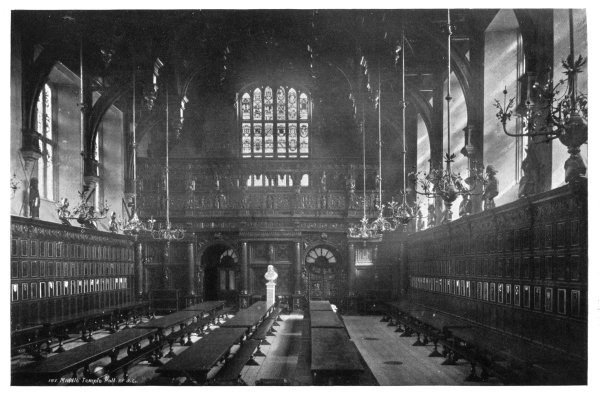
The "round" of the church was completed in 1185, the choir in 1240, and the whole building was "restored" in 1842 at a cost of £70,000. The hall of the Middle Temple was built in 1572, that of the Inner Temple in 1870.
The property on the west side of New Street, or Chancery Lane, had been granted to, or acquired by, the Knights Templars. Henry III.'s Chancellor, Ralph Nevill, Bishop of Chichester, died at his house there in 1244, and the King arbitrarily authorised his Treasurer, William de Haverhill, to secure the property upon the Chancellor's death, so that neither the Templars nor any other person should lay hands on it.[123] To the north of it was a garden once held by William Cottrell, which he had given to the Knights of St. John, who in turn had given it to St. Giles' Hospital for Lepers.[124] In the year 1310, when Henry de Lacy, Earl of Lincoln, died, another Bishop of Chichester, John de Langton, was Chancellor, and was occupying the Inn of the see, whilst the hospital of St. Giles was still receiving rent for Cottrell's garden. No Black Friars house, therefore, ever existed here, nor did Henry de Lacy die here; and all traditions to the contrary can be disproved.
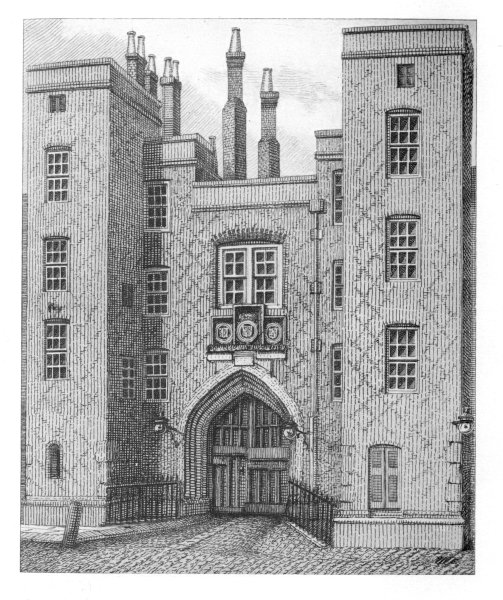
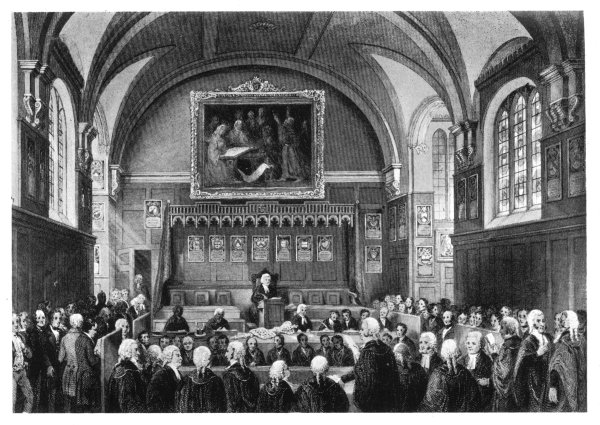
In 1422 the Society of Lincoln's Inn, coming probably from Holborn, took a lease of the Bishop of Chichester's property, and afterwards a lease of Cottrell's garden. In 1537 Bishop Sampson sold the house and land belonging to the see to William and Eustace Sulyard, members of the Inn, from whom it descended to Edward Sulyard, who sold it in 1579 to the society. Subscriptions for this purchase were received by the Benchers, as is evident from the will of Sir Roger Cholmeley, dated 1565, who gave to certain trustees a house in Newgate Market "to hold to them and their heirs for ever towards the purchase of Lincoln's Inn and in the mean season towards the repairs of the same."[125] The hall of this Inn was pulled down and rebuilt in 1489; but since then, in 1845, a new hall, Gothic in character, and of great dignity and beauty, has been erected. The chapel, by Inigo Jones, dates from 1621, and the fine old gateway from 1518.
The Inns of Chancery were at first independent of the four Inns of Court, but, inasmuch as serjeants were chosen only from the latter, it became the custom for students in the lesser Inns, when "they came to ripeness," as Fortescue puts it, to enter one of the higher Inns if they desired advancement. Gradually each Inn of Court took special interest in certain of the lesser Inns, by sending to them Readers and by other marks of patronage, until an impression came to exist, which was much strengthened by various Orders in Council, that a certain governorship of one over the other was a normal, legal, and time-honoured institution. And in a few instances the Inns of Court put the coping stone to this theory by purchasing the property of those lesser Inns, of which they were the patrons. Thus Lincoln's Inn bought Furnival's on December 16th, 1547, having previously held a lease of it, and Davy's on November 24th, 1548; and the Inner Temple bought Lyon's Inn in 1581, which they sold in 1863, the Globe Theatre being built upon its site.
It is doubtful whether Furnival's Inn was ever occupied by the Lords Furnival. In 1331 the property belonged to Roger atte Bowe, a wool-stapler, who died in that year, leaving his tenements in Holbourne and a garden in Lyverounelane to his children. How or when it came into the hands of the De Furnivals is not known; but in 1383 an inquisition post mortem was taken by the Mayor, at which the jurors recorded that
"William Furnyvall, knight, did not die seised of any lands or tenements in the city of London nor in the suburbs thereof. But that in his life time he was seised of two shops and 13 messuages with appurtenances in the street called Holbourne in the suburb of London situated between a tenement of Jordain de Barton on the east (he was a Chauff-cier, i.e., an officer of Chancery who prepared the wax for the sealing of writs to be issued) and a tenement of John Tonyngton on the west and which formerly belonged to Roger atte Bogh. And William de Furnyvale enfeoffed William Savage, parson of the church of Handsworth and John Redesere, chaplain, of the aforesaid messuages and shops to hold to them, their heirs and assigns for ever and they are still thereof seised. And the messuages and shops are worth 100s. and are held in free burgage of the king by the service of 11s. 4d. for all services. William Furnyvall died 12th April last past. Joan his daughter, wife of Thomas Nevill, is his nearest heir, aged 14 years and 6 months."[126]
William de Furnival had succeeded his brother in 1364. Six years before he died—namely, in 1377—he was reported to be feeble and infirm, and it seems most probable from the above inquisition that his Inn was occupied by clerks. Maude, the heiress of Thomas de Neville, married John Talbot, Lord Strange of Blackmere, who was summoned to Parliament as Lord Furnival in 1442, and created Earl of Shrewsbury in 1446. His son, John Talbot, second Earl, was also Treasurer of England. The fifth Earl, Francis Talbot, sold the property in 1547, then in a ruinous condition, to the Society of Lincoln's Inn,[127] who, after holding it for nearly 340 years, sold it to the Prudential Assurance Company, in 1888, who demolished it for their present offices. John Staynford was principal of the Inn in 1425, and John Courtenay in 1450. It was sometimes called an Inn of Court,[128] and had its own chapel, which, however, was in St. Andrew's Church.[129] A coloured drawing of its quaint little Hall, built in 1588, is in the Guildhall Library.
Barnard's Inn, situated to the east of the second Lincoln's Inn, and opposite to Furnival's Inn, was so named from one Lionel Barnard, who was in occupation of it in 1435. But the real owner was John Mackworth, who was Dean of Lincoln from 1412 to 1451. He had inherited it probably from his brother, Thomas Mackworth, of Mackworth, co. Derby, who in 1431 became owner, having married Alice de Basing.[130] At an inquisition ad quod damnum held February 2nd, 1454, permission was given to Thomas Atkyn, citizen of London,
"An executor of the will of John Macworthe, Dean of Lincoln Cathedral, to assign a messuage in Holbourne called Macworth Inne, now commonly called Barnard's Inne, to the Dean and Chapter of the aforesaid Cathedral towards this work, extraordinary fees were raised, and divine service in the Chapel of St. George, in the southern part of the said church, where the body of the said John is buried, for the soul of the said John for ever, in part satisfaction of £20 of land which Edward III. licenced the said Dean and Chapter to acquire. The said messuage is held of the king in free burgage as is the whole city of London and is worth yearly beyond deductions six marks (£4) and there is no mean between the king and the said Thomas Atkyn; whether he has enough of lands, &c., to support all dues and services, &c., remaining after the said donation and assignment or whether he will be able to be sworn on assizes as before this donation the jurors are thoroughly ignorant; but the country will not by this donation in defect of the said Thomas be burdened."[131]
This Inn became attached to Gray's Inn. In 1894 the Dean and Chapter of Lincoln Cathedral sold it to the Mercers' Company for the Mercers' School, and the old hall of the Inn is now used as a dining-room for the boys.
Brooke House, to the west of Furnival's Inn, stood where now is Brooke Street, and was probably at one time an Inn for lawyers. In the reign of Henry V. it was held by John Gascoigne, who demised it to Justice Richard Hankeford,[132] who died in 1431, and whose heir, Thomasina, married Sir William Bourchier, brother of the Treasurer Henry, Earl of Essex. In 1480 his descendant, Fulk Bourchier, died, and it was found that he had enfeoffed John Sapcote and Guy Wollaston, esquires of the King's body (pro corpore domini Regis), and others, of his property in Holborn.[133] His descendant, John Bourchier, was created Earl of Bath in 1536, and in 1623 Bath House passed into the possession of Lord Brooke and took his name.
The earliest evidence yet obtained respecting the name of Staple Inn is in the will of Richard Starcolf, a wool-stapler, which was proved in the Court of Hustings on February 14th, 1334, and dated July 22nd, 1333, wherein he bequeaths his tenement in Holborn, called le Stapled halle, to be sold for pious uses.[134] No less than four stapled halles are known to have been in existence, at this time, at various trade gates of the city, and the meaning of the title has been much discussed.
Lincoln's Inn Gate, Chancery Lane. From an old print published in 1800.
Richard Starkulf was a Norfolk man of Danish origin, and was admitted to the freedom of the city of London in 1310. He is described as a mercer, but no mercer could carry on his trade in those days without belonging to a staple. After his death, as his son Thomas was still a minor, his lands were placed in the custody of William de Hampton, of Shrewsbury, controller of the customs in the King's staple there, and to Richard de Elsyng, another mercer. But the tenement of le Stapled halle, which he directed should be sold, came into the hands of William de Elsyng,[135] also a wool-stapler, a brother of Richard, and the founder of St. Mary's Hospital, commonly known as Elsyng Spital. Five years later, when William de Elsyng made further gifts to the hospital, an inquisition was held to know if the gift might be made without injury to anyone, and thereat some interesting particulars respecting his Holborn property were recorded. We are told that
"there remains to William a tenement in the parish of St. Andrew of Holbourne which is worth yearly in all its issues 100s.; thence should be subtracted 3s. 4d. quit rent yearly to the church of St. Paul, London, and 6s. 8d. for yearly repairs, the clear value thus being £4 10s.; which tenement (with others), remaining after the aforesaid assignment are held of the king in free burgage as is the whole of the aforesaid city and are sufficient for the maintenance of all dues and services and William can be put on assizes, juries and recognisances as before his assignment."[136]
The next person to hold Staple Inn was Thomas de Brenchesle.[137] No record of his appointment to any duties at Holborn Bars has been discovered, but on April 12th, 1343, he was ordered to "attach" Thomas Tirwhitt, of Pokelynton,
"who has taken without the realm twelve sarples of wool uncustomed and uncoketed (i.e., unsealed), as the king is certainly informed, and bring him before the council with all speed to answer for his contempt."[138]
And on April 1st, 1349, Thomas de Brynchesle was ordered,
"upon pain of forfeiture, to be at Westminster with all the evidence in his possession for the time when he was appointed with others to supervise the state of the king's staple in Flanders, before the king and his council on the morrow of the close of Easter next, to inform them of things that will be set forth to him."[139]
It seems apparent, then, that Staple Inn was not unconnected in those days with the staple of wool.
The Ordinance of the Staple was issued in 1313,[140] but there are good grounds for believing that long before this date the site was already in use as a custom house and wool court. The ordinance was embodied in a statute of the realm in 1353.[141] London was no longer mentioned as a staple, Westminster being substituted, the bounds of which were defined as commencing at Temple Bar, and ending at Tothill.[142] But it is likely that the Inn at Holborn Bars was still occupied by attorneys who practised for their patrons of the Staple, and that the Merchants for Wools still had their meetings there. In 1401 Hamond Elyot sued a plaint of debt against Martyn Dyne, of Haydon, Norfolk, for the sum of £26 2s. 3d., in the Court of Staple at Westminster;[143] and one hundred years later, John Dyne, his descendant, also of Haydon, Norfolk, was a member of Staple Inn. In his will, proved 1505, he gives the names of the company of the Inn. Edmund Paston, grandson of the Judge, was a member in 1467, and we learn from one of his letters that the Inn had a Principal at that date.
In 1529, John Knighton and Alice, his wife, daughter of John Copwode of the Remembrancer's Office of the Exchequer, sold the inheritance of the Inn to the Ancients of Gray's Inn, after which there were other feoffments in trust, the last of which, that we know of, dated June 4th, 1622, being that of Sir Francis Bacon, Lord Verulam, to Edward Moseley, Attorney of the Duchy of Lancaster and others, Readers of Gray's Inn, "to hold to them, their heirs and assigns of the chief lords of that fee by the services thence due and of right accustomed."[144] The society eventually became its own master, and in 1811 had no connection whatever with Gray's Inn. It was dissolved in 1884, when its property was sold to a firm of auctioneers, who parted with it in the same year, the Government buying the southern portion for an extension of the Patent Office, and the Prudential Assurance Company the remainder. The lawyers still congregate there; the only difference being a change of landlords, though the hall has been leased to the Institute of Actuaries. The frontage of the Inn dates from 1570 and 1586, the hall from 1581.
Middle Temple Hall.
Davy's Inn is most probably the correct name of the Inn, which for three centuries past has unaccountably, possibly through Stow's mistake, gone by the name of Thavies Inn. No record has yet been found earlier than the reign of Queen Elizabeth in which the name of this Inn is any other than Davy's or David's. The will of John Davy was proved in the Court of Hustings in 1398.[145] He desired to be buried in the church of St. Andrew. To Alice, his wife, he left his lands and tenements in Holborn for life, with remainder to John Osbern and his wife, Emma, testator's daughter, in tail; with remainder in trust for the maintenance of a chantry in St. Mary's Chapel in the church of St. Andrew. The annual proceeds of this latter bequest were still being received by the church in the reign of Henry VIII. The testator was an attorney, and his name occurs in many legal documents relating to Holborn in the reign of Edward III.; he was also associated with others of the neighbourhood in various pavage commissions. It is quite possible, however, and probable, that the Inn which bore his name was an Inn long before his time. It was bought by Lincoln's Inn in 1548, and sold in 1769. It has since been demolished.
New Inn, in the Strand, also called St. Mary's Inn, was a guest Inn, says Sir George Buck, writing in 1615, hired by Sir John Fineux, Chief Justice of King's Bench, in the reign of Edward IV., for £6 per annum, to place therein those students who were lodged in "la Baillie," in a house called St George's Inn, near the upper end of St. George's Lane. In the year 1348 the will of John Tavy, armourer, was proved in the Court of Hustings.[146] He therein orders that after the decease of his wife an Inn, where the apprentices were wont to dwell, should be sold, and the proceeds devoted to the maintenance of a chantry. These apprentices are not in the original will described as ad legem, but these words have crept into a subsequent transcription. The testator was, in 1342, one of the four members of the Company of Armourers appointed by the mayor and aldermen, and sworn to observe and supervise the then new regulations respecting the making and selling of armour.[147] He would certainly have had his apprentices, and it may be he referred to them in his will. He would have been a member of the Fraternity or Guild of St. George of the men of the Mistery of Armourers, St. George being the Armourers' patron saint. This fact seems to suggest that his Inn became St. George's Inn, which would have stood not far from the Sessions House, built by William de Langeford.
The Six Clerks Inn, formerly Herfleet's Inn, and then Kidderminster Inn, was on the west side of Chancery Lane, opposite the Rolls Office, and was probably an Inn of Chancery, though unattached, at a very early date. In 1454 Nicholas Wymbyssh, one of the clerks of the King's Chancery, assigned it to the prior of Necton Park, co. Lincoln, to hold of the King in free burgage.[148] It was then in the parish of St. Dunstan. It acquired the name of Kidderminster Inn from John Kidderminster, one of the society, who purchased it at the time of the dissolution of the monastery. In the eighteenth century the Six Clerks Inn Society moved to the north-western end of Chancery Lane. Stone Buildings, part of Lincoln's Inn, now occupies the site.
Cursitors' Inn, also in Chancery Lane, was sometimes known as Bacon's Inn, having been founded, in 1574, by Sir Nicholas Bacon, Lord Keeper of the Great Seal. In 1478 it was known as the Bores hedde, and then consisted of one tenement and a large garden, about two and a half acres in extent, bounded on the north by the grounds of the Old Temple and of Staple Inn; on the east by that property of the Convent of Malmesbury which had formerly been known as "Lyncolnesynne"; and on the south by a lane now known as Cursitor Street. The rent was then being paid to the Corporation of the City of London, who were probably feoffees of the bishopric of Lincoln; but in 1561 they purchased it of Edward VI., into whose hands it had come at the dissolution of chantries and chapels; and they, in 1574, granted it to Sir Nicholas Bacon,[149] who there housed the cursitor clerks. There were twenty-four cursitor clerks—i.e., Clerks of the Course—whose business was to draw up the writs. The Cursitor Baron administered the oaths to the sheriffs, bailiffs, and officers of the Customs, etc. Cursitor Street perpetuates the name of the Inn.
Clifford's Inn, adjacent to, and south of, the House of Converts, came into the hands of Edward I. in 1298, for the debts of Malcolm de Harley, Escheator on this side Trent. The Earl of Richmond was placed in custody of it, but in 1310 Edward II. gave it to Robert de Clifford, a customs' officer of the Wool Staple, and Marshal of England.[150] When he died in 1316 a third of it only was granted to his widow. During the nonage of the heir in 1345, Edward III. put his clerk, David de Wollore, who was also Keeper of the Rolls of Chancery, in charge of the property.[151] It is said to have possessed its society at this period. It passed from the Clifford family in June, 1468, when a grant was made to "John Kendale, Esq., and his heirs male, of Clifford Inne, late of John Clifford, knight, late Lord Clifford, by reason of forfeiture."[152] The Society of Clifford's Inn was the last of the Inns of Chancery to dissolve.
Clement's Inn, an Inn of Chancery attached to the Inner Temple, was divided within recent years from New Inn, which belonged to the Middle Temple, only by iron railings with a gate. Its origin is unknown, but its name connects it either with St. Clement's Church, or St. Clement's Well. It was certainly in existence before the time of Henry VII.
Lyon's Inn is said to have been an Inn of Chancery in the time of Henry V., but the evidence on this point is uncertain. It was situated in Newcastle Street, Strand, and was attached to the Inner Temple, who bought it in 1581. The Aldwych improvements have wiped out the Globe Theatre which had succeeded it.
Besides the Inns of Court and Chancery, there existed also Inns for Judges and Serjeants, of which the most important were Scrope's Inn, opposite to St. Andrew's Church, in Holborn, and the two Serjeants' Inns in Chancery Lane and Fleet Street, which, however, cannot be treated of here.
Documents of the fourteenth and fifteenth centuries make it quite clear that Staple Inn, Furnival's Inn, Brooke House, and, of course, the old Inn of the Earl of Lincoln, in Shoe Lane, were all within the city boundaries. It was not until December, 1645, that the House of Lords passed a resolution that the Inns of Court were to form a province by themselves,[153] and the resolution was interpreted to cover also their Inns of Chancery dependencies, so that Furnival's Inn and Staple Inn became cut off from the city, and all the Inns became extra-parochial.
It will have been noticed that the properties of the Inns of Court, and most of the Inns of Chancery, came to be held directly of the King. The legal artifice of feoffment to "uses" was adopted in regard to most of these properties; but though the feoffees were chiefly legal persons, they did not apparently always represent the societies; nor is it quite clear whom they did represent; but the societies had no security of tenure until they purchased their respective properties.
Lincoln's Inn Hall: the Lord Chancellor's Court. From a drawing by T. H. Shepherd.
It has been shown that the deep hollow, at the bottom of which flowed the stream of Holborn, formed a natural barrier between the walled city and its suburb. It also divided the guilds and trade associations of London from that plexus of schools of laws which at first radiated from Holborn Bars. The guilds recognised the leading of the Mayor and Commonalty; the schools of law looked for direction chiefly to the law officers of the Crown. In Florence, and other cities of the Middle Ages, the associations of judges, attorneys, and wool-merchant lawyers were as much a part of civic and communal life as any other guild; the different conditions which existed in England led to different consequences.
But the hold which the King's officers obtained, both over the machinery of the Courts and over the voluntary societies of law students, was the cause, no doubt, of the attempts which were made during the Tudor and early Stuart periods to organise all the Inns of Court and Chancery into a University of Law. Those attempts failed; chiefly through the lack of wisdom displayed in issuing arbitrary and meddlesome Orders in Council, instead of allowing unification to mature on those natural and voluntary lines which had already been laid down.
Now the Inns of Chancery have practically vanished, leaving the Inns of Court to monopolise all the glory of the great future which undoubtedly still lies before them.