Chapter VI
Reading edition
illustrations continued. — studies for the bar. — excursion to northumberland. — letter on flodden field. — call to the bar
1790-1792
The two following letters may sufficiently illustrate the writer's every-day existence in the autumn of 1790. The first, addressed to his fidus Achates, has not a few indications of the vein of humor from which he afterwards drew so largely in his novels; and indeed, even in his last days, he delighted to tell the story of the Jedburgh bailies' boots.
TO WILLIAM CLERK, ESQ., AT JOHN CLERK'S, ESQ., OF ELDIN, PRINCE'S STREET, EDINBURGH.
Rosebank, 6th August, 1790.
Dear William,—Here am I, the weather, according to your phrase, most bitchiferous; the Tweed, within twenty yards of the window at which I am writing, swelled from bank to brae, and roaring like thunder. It is paying you but a poor compliment to tell you I waited for such a day to perform my promise of writing, but you must consider that it is the point here to reserve such within-doors employment as we think most agreeable for bad weather, which in the country always wants something to help it away. In fair weather we are far from wanting amusement, which at present is my business; on the contrary, every fair day has some plan of pleasure annexed to it, in so much that I can hardly believe I have been here above two days, so swiftly does the time pass away. You will ask how it is employed? Why, negatively, I read no civil law. Heineccius and his fellow-worthies have ample time to gather a venerable coat of dust, which they merit by their dulness. As to my positive amusements, besides riding, fishing, and the other usual sports of the country, I often spend an hour or two in the evening in shooting herons, which are numerous on this part of the river. To do this I have no farther to go than the bottom of our garden, which literally hangs over the river. When you fire at a bird, she always crosses the river, and when again shot at with ball, usually returns to your side, and will cross in this way several times before she takes wing. This furnishes fine sport; nor are they easily shot, as you never can get very near them. The intervals between their appearing are spent very agreeably in eating gooseberries.
I am ashamed to read over this sheet of nonsense, so excuse inaccuracies. Remember me to the lads of the Literary, those of the club in particular. I wrote Irving. Remember my most respectful compliments to Mr. and Mrs. Clerk and family, particularly James; when you write, let me know how he did when you heard of him. Imitate me in writing a long letter, but not in being long in writing it. Direct to me at Miss Scott's, Garden, Kelso. My letters lie there for me, as it saves their being sent down to Rosebank. The carrier puts up at the Grassmarket, and goes away on Wednesday forenoon. Yours,
Walter Scott.
The next letter is dated from a house at which I have often seen the writer in his latter days. Kippilaw, situated about five or six miles behind Abbotsford, on the high ground between the Tweed and the Water of Ayle, is the seat of an ancient laird of the clan Kerr, but was at this time tenanted by the family of Walter's brother-apprentice, James Ramsay, who afterwards realized a fortune in the civil service of Ceylon.
TO WILLIAM CLERK, ESQ.
Kippilaw, September 3, 1790.
Dear Clerk,—I am now writing from the country habitation of our friend Ramsay, where I have been spending a week as pleasantly as ever I spent one in my life. Imagine a commodious old house, pleasantly situated amongst a knot of venerable elms, in a fine sporting, open country, and only two miles from an excellent water for trouts, inhabited by two of the best old ladies (Ramsay's aunts), and three as pleasant young ones (his sisters) as any person could wish to converse with—and you will have some idea of Kippilaw. James and I wander about, fish, or look for hares, the whole day, and at night laugh, chat, and play round games at cards. Such is the fatherland in which I have been living for some days past, and which I leave to-night or to-morrow. This day is very bad; notwithstanding which, James has sallied out to make some calls, as he soon leaves the country. I have a great mind to trouble him with the care of this.
I dined two days ago tête-à-tête with Lord Buchan. Heard a history of all his ancestors whom he has hung round his chimney-piece. From counting of pedigrees, good Lord deliver us! He is thinking of erecting a monument to Thomson. He frequented Dryburgh much in my grandfather's time. It will be a handsome thing. As to your scamp of a boy, I saw nothing of him; but the face is enough to condemn there. I have seen a man flogged for stealing spirits on the sole information of his nose. Remember me respectfully to your family.
Believe me yours affectionately, Walter Scott.
After his return from the scene of these merry doings, he writes as follows to his kind uncle. The reader will see that, in the course of the preceding year, he had announced his early views of the origin of what is called the feudal system, in a paper read before the Literary Society. He, in the succeeding winter, chose the same subject for an essay, submitted to Mr. Dugald Stewart, whose prelections on ethics he was then attending. Some time later he again illustrated the same opinions more at length in a disquisition before the Speculative Society; and, indeed, he always adhered to them. One of the last historical books he read, before leaving Abbotsford for Malta in 1831, was Colonel Tod's interesting account of Rajasthan; and I well remember the delight he expressed on finding his views confirmed, as they certainly are in a very striking manner, by the philosophical soldier's details of the structure of society in that remote region of the East.
TO CAPTAIN ROBERT SCOTT, ROSEBANK, KELSO.
Edinburgh, September 30, 1790.
Dear Uncle,—We arrived here without any accident about five o'clock on Monday evening. The good weather made our journey pleasant. I have been attending to your commissions here, and find that the last volume of Dodsley's Annual Register published is that for 1787, which I was about to send you; but the bookseller I frequent had not one in boards, though he expects to procure one for me. There is a new work of the same title and size, on the same plan, which, being published every year regularly, has almost cut out Dodsley's, so that this last is expected to stop altogether. You will let me know if you would wish to have the new work, which is a good one, will join very well with those volumes of Dodsley's which you already have, and is published up to the present year. Byron's Narrative is not yet published, but you shall have it whenever it comes out.
Agreeable to your permission, I send you the scroll copy of an essay on the origin of the feudal system, written for the Literary Society last year. As you are kind enough to interest yourself in my style and manner of writing, I thought you might like better to see it in its original state, than one on the polishing of which more time had been bestowed. You will see that the intention and attempt of the essay is principally to controvert two propositions laid down by the writers on the subject:—1st, That the system was invented by the Lombards; and, 2dly, that its foundation depended on the king's being acknowledged the sole lord of all the lands in the country, which he afterwards distributed to be held by military tenures. I have endeavored to assign it a more general origin, and to prove that it proceeds upon principles common to all nations when placed in a certain situation. I am afraid the matter will but poorly reward the trouble you will find in reading some parts. I hope, however, you will make out enough to enable you to favor me with your sentiments upon its faults. There is none whose advice I prize so high, for there is none in whose judgment I can so much confide, or who has shown me so much kindness.
I also send, as amusement for an idle half hour, a copy of the regulations of our Society, some of which will, I think, be favored with your approbation.
My mother and sister join in compliments to aunt and you, and also in thanks for the attentions and hospitality which they experienced at Rosebank. And I am ever your affectionate nephew,
Walter Scott.
P. S.—If you continue to want a mastiff, I think I can procure you one of a good breed, and send him by the carrier.
Let me here set down a little story which most of his friends must have heard him tell of the same period. While attending Dugald Stewart's lectures on moral philosophy, Scott happened to sit frequently beside a modest and diligent youth, considerably his senior, and obviously of very humble condition. Their acquaintance soon became rather intimate, and he occasionally made this new friend the companion of his country walks, but as to his parentage and place of residence he always preserved total silence. One day towards the end of the session, as Scott was returning to Edinburgh from a solitary ramble, his eye was arrested by a singularly venerable Bluegown, a beggar of the Edie Ochiltree order, who stood propped on his stick, with his hat in his hand, but silent and motionless, at one of the outskirts of the city. Scott gave the old man what trifle he had in his pocket, and passed on his way. Two or three times afterwards the same thing happened, and he had begun to consider the Bluegown as one who had established a claim on his bounty: when one day he fell in with him as he was walking with his humble student. Observing some confusion in his companion's manner as he saluted his pensioner, and bestowed the usual benefaction, he could not help saying, after they had proceeded a few yards further, "Do you know anything to the old man's discredit?" Upon which the youth burst into tears, and cried, "Oh no, sir, God forbid!—but I am a poor wretch to be ashamed to speak to him—he is my own father. He has enough laid by to serve for his own old days, but he stands bleaching his head in the wind, that he may get the means of paying for my education." Compassionating the young man's situation, Scott soothed his weakness, and kept his secret, but by no means broke off the acquaintance. Some months had elapsed before he again met the Bluegown—it was in a retired place, and the old man begged to speak a word with him. "I find, sir," he said, "that you have been very kind to my Willie. He had often spoke of it before I saw you together. Will you pardon such a liberty, and give me the honor and pleasure of seeing you under my poor roof? Tomorrow is Saturday; will you come at two o'clock? Willie has not been very well, and it would do him meikle good to see your face." His curiosity, besides better feelings, was touched, and he accepted this strange invitation. The appointed hour found him within sight of a sequestered little cottage, near St. Leonard's—the hamlet where he has placed the residence of his David Deans. His fellow-student, pale and emaciated from recent sickness, was seated on a stone bench by the door, looking out for his coming, and introduced him into a not untidy cabin, where the old man, divested of his professional garb, was directing the last vibrations of a leg of mutton that hung by a hempen cord before the fire. The mutton was excellent—so were the potatoes and whiskey; and Scott returned home from an entertaining conversation, in which, besides telling many queer stories of his own life—and he had seen service in his youth—the old man more than once used an expression, which was long afterwards put into the mouth of Dominie Sampson's mother:—"Please God, I may live to see my bairn wag his head in a pulpit yet."
On the 4th January, 1791, Scott was admitted a member of The Speculative Society, where it had, long before, been the custom of those about to be called to the Bar, and those who after assuming the gown were left in possession of leisure by the solicitors, to train or exercise themselves in the arts of elocution and debate. From time to time each member produces an essay, and his treatment of his subject is then discussed by the conclave. Scott's essays were, for November, 1791, On the Origin of the Feudal System; for the 14th February, 1792, On the Authenticity of Ossian's Poems; and on the 11th December of the same year, he read one, On the Origin of the Scandinavian Mythology. The selection of these subjects shows the course of his private studies and predilections; but he appears, from the minutes, to have taken his fair share in the ordinary debates of the Society,—and spoke, in the spring of 1791, on these questions, which all belong to the established text-book for juvenile speculation in Edinburgh:—"Ought any permanent support to be provided for the poor?" "Ought there to be an established religion?" "Is attainder and corruption of blood ever a proper punishment?" "Ought the public expenses to be defrayed by levying the amount directly upon the people, or is it expedient to contract national debt for that purpose?" "Was the execution of Charles I. justifiable?" "Should the slave-trade be abolished?" In the next session, previous to his call to the Bar, he spoke in the debates of which these were the theses:—"Has the belief in a future state been of advantage to mankind, or is it ever likely to be so?" "Is it for the interest of Britain to maintain what is called the balance of Europe?" and again on the eternal question as to the fate of King Charles I., which, by the way, was thus set up for re-discussion on a motion by Walter Scott.
He took, for several winters, an ardent interest in this society. Very soon after his admission (18th January, 1791), he was elected their librarian; and in the November following he became also their secretary and treasurer; all which appointments indicate the reliance placed on his careful habits of business, the fruit of his chamber education. The minutes kept in his handwriting attest the strict regularity of his attention to the small affairs, literary and financial, of the club; but they show also, as do all his early letters, a strange carelessness in spelling. His constant good temper softened the asperities of debate; while his multifarious lore, and the quaint humor with which he enlivened its display, made him more a favorite as a speaker than some whose powers of rhetoric were far above his.
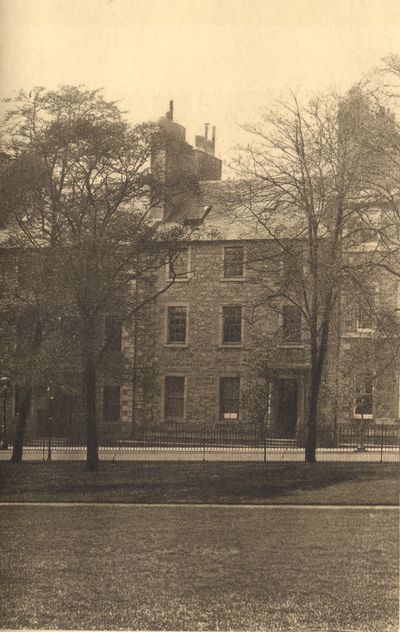
SCOTT'S FATHER'S HOUSE, 25 GEORGE'S SQUARE, EDINBURGH.
Lord Jeffrey remembers being struck, the first night he spent at the Speculative, with the singular appearance of the secretary, who sat gravely at the bottom of the table in a huge woollen nightcap; and when the president took the chair, pleaded a bad toothache as his apology for coming into that worshipful assembly in such a "portentous machine." He read that night an essay on ballads, which so much interested the new member that he requested to be introduced to him. Mr. Jeffrey called on him next evening, and found him "in a small den, on the sunk floor of his father's house in George's Square, surrounded with dingy books," from which they adjourned to a tavern, and supped together. Such was the commencement of an acquaintance, which by degrees ripened into friendship, between the two most distinguished men of letters whom Edinburgh produced in their time. I may add here the description of that early den, with which I am favored by a lady of Scott's family:—"Walter had soon begun to collect out-of-the-way things of all sorts. He had more books than shelves; a small painted cabinet, with Scotch and Roman coins in it, and so forth. A claymore and Lochaber axe, given him by old Invernahyle, mounted guard on a little print of Prince Charlie; and Broughton's Saucer was hooked up against the wall below it." Such was the germ of the magnificent library and museum of Abbotsford; and such were the "new realms" in which he, on taking possession, had arranged his little paraphernalia about him "with all the feelings of novelty and liberty." Since those days, the habits of life in Edinburgh, as elsewhere, have undergone many changes: and the "convenient parlor," in which Scott first showed Jeffrey his collections of minstrelsy, is now, in all probability, thought hardly good enough for a menial's sleeping-room.
Mrs. Scott's curiosity was strongly excited one autumn by the regular appearance, at a certain hour every evening, of a sedan chair, to deposit a person carefully muffled up in a mantle, who was immediately ushered into her husband's private room, and commonly remained with him there until long after the usual bedtime of this orderly family. Mr. Scott answered her repeated inquiries with a vagueness which irritated the lady's feelings more and more; until, at last, she could bear the thing no longer; but one evening, just as she heard the bell ring as for the stranger's chair to carry him off, she made her appearance within the forbidden parlor with a salver in her hand, observing that she thought the gentlemen had sat so long, they would be the better of a dish of tea, and had ventured accordingly to bring some for their acceptance. The stranger, a person of distinguished appearance, and richly dressed, bowed to the lady, and accepted a cup; but her husband knit his brows, and refused very coldly to partake the refreshment. A moment afterwards the visitor withdrew—and Mr. Scott, lifting up the window-sash, took the cup which he had left empty on the table, and tossed it out upon the pavement. The lady exclaimed for her china, but was put to silence by her husband's saying, "I can forgive your little curiosity, madam, but you must pay the penalty. I may admit into my house, on a piece of business, persons wholly unworthy to be treated as guests by my wife. Neither lip of me nor of mine comes after Mr. Murray of Broughton's."
This was the unhappy man who, after attending Prince Charles Stuart as his secretary throughout the greater part of his expedition, condescended to redeem his own life and fortune by bearing evidence against the noblest of his late master's adherents, when
"Pitied by gentle hearts Kilmarnock died— The brave, Balmerino, were on thy side."
When confronted with Sir John Douglas of Kelhead (ancestor of the Marquess of Queensberry), before the Privy Council in St. James's, the prisoner was asked, "Do you know this witness?" "Not I," answered Douglas; "I once knew a person who bore the designation of Murray of Broughton—but that was a gentleman and a man of honor, and one that could hold up his head!"
The following letter is the only one of the autumn of 1791 that has reached my hands. It must be read with particular interest for its account of Scott's first visit to Flodden field, destined to be celebrated seventeen years afterwards in the very noblest specimen of his numbers:—
TO WILLIAM CLERK, ESQ., PRINCE'S STREET, EDINBURGH.
Northumberland, 26th August, 1791.
Dear Clerk,—Behold a letter from the mountains; for I am very snugly settled here, in a farmer's house, about six miles from Wooler, in the very centre of the Cheviot hills, in one of the wildest and most romantic situations which your imagination, fertile upon the subject of cottages, ever suggested. And what the deuce are you about there? methinks I hear you say. Why, sir, of all things in the world—drinking goat's whey—not that I stand in the least need of it, but my uncle having a slight cold, and being a little tired of home, asked me last Sunday evening if I would like to go with him to Wooler, and I answering in the affirmative, next morning's sun beheld us on our journey, through a pass in the Cheviots, upon the back of two special nags, and man Thomas behind with a portmanteau, and two fishing-rods fastened across his back, much in the style of St. Andrew's Cross. Upon reaching Wooler we found the accommodations so bad that we were forced to use some interest to get lodgings here, where we are most delightfully appointed indeed. To add to my satisfaction, we are amidst places renowned by the feats of former days; each hill is crowned with a tower, or camp, or cairn, and in no situation can you be near more fields of battle: Flodden, Otterburn, Chevy Chase, Ford Castle, Chillingham Castle, Copland Castle, and many another scene of blood, are within the compass of a forenoon's ride. Out of the brooks, with which these hills are intersected, we pull trouts of half a yard in length, as fast as we did the perches from the pond at Pennycuik, and we are in the very country of muirfowl.
Often as I have wished for your company, I never did it more earnestly than when I rode over Flodden Edge. I know your taste for these things, and could have undertaken to demonstrate that never was an affair more completely bungled than that day's work was. Suppose one army posted upon the face of a hill, and secured by high grounds projecting on each flank, with the river Till in front, a deep and still river, winding through a very extensive valley called Milfield Plain, and the only passage over it by a narrow bridge, which the Scots artillery, from the hill, could in a moment have demolished. Add, that the English must have hazarded a battle while their troops, which were tumultuously levied, remained together; and that the Scots, behind whom the country was open to Scotland, had nothing to do but to wait for the attack as they were posted. Yet did two thirds of the army, actuated by the perfervidum ingenium Scotorum, rush down and give an opportunity to Stanley to occupy the ground they had quitted, by coming over the shoulder of the hill, while the other third, under Lord Home, kept their ground, and having seen their king and about 10,000 of their countrymen cut to pieces, retired into Scotland without loss. For the reason of the bridge not being destroyed while the English passed, I refer you to Pitscottie, who narrates at large, and to whom I give credit for a most accurate and clear description, agreeing perfectly with the ground.
Walter Scott.
With the exception of this little excursion, Scott appears to have been nailed to Edinburgh during this autumn, by that course of legal study, in company with Clerk, on which he dwells in his Memoir with more satisfaction than on any other passage in his early life. He copied out twice, as the fragment tells us, his notes of those lectures of the eminent Scots Law professor (Mr. Hume), which he speaks of in such a high strain of eulogy; and Mr. Irving adds that the second copy, being fairly finished and bound into volumes, was presented to his father. The old gentleman was highly gratified with this performance, not only as a satisfactory proof of his son's assiduous attention to the law professor, but inasmuch as the lectures afforded himself "very pleasant reading for leisure hours."
I have often heard both Alan and Darsie laugh over their reminiscences of the important day when they "put on the gown." After the ceremony was completed, and they had mingled for some time with the crowd of barristers in the Outer Court, Scott said to his comrade, mimicking the air and tone of a Highland lass waiting at the Cross of Edinburgh to be hired for the harvest work—"We've stood here an hour by the Tron, hinny, and de'il a ane has speered our price." Some friendly solicitor, however, gave him a guinea fee before the Court rose; and as they walked down the High Street together, he said to Mr. Clerk, in passing a hosier's shop—"This is a sort of a wedding-day, Willie; I think I must go in and buy me a new nightcap," He did so accordingly; perhaps this was Lord Jeffrey's "portentous machine." His first fee of any consequence, however, was expended on a silver taper-stand for his mother, which the old lady used to point to with great satisfaction, as it stood on her chimney-piece five-and-twenty years afterwards.[Back to Contents]