Chapter I
Reading edition
memoir of the early life of sir walter scott, written by himself
Ashestiel, April 26, 1808.
The present age has discovered a desire, or rather a rage, for literary anecdote and private history, that may be well permitted to alarm one who has engaged in a certain degree the attention of the public. That I have had more than my own share of popularity, my contemporaries will be as ready to admit as I am to confess that its measure has exceeded not only my hopes, but my merits, and even wishes. I may be therefore permitted, without an extraordinary degree of vanity, to take the precaution of recording a few leading circumstances (they do not merit the name of events) of a very quiet and uniform life—that, should my literary reputation survive my temporal existence, the public may know from good authority all that they are entitled to know of an individual who has contributed to their amusement.
Every Scottishman has a pedigree. It is a national prerogative as unalienable as his pride and his poverty. My birth was neither distinguished nor sordid. According to the prejudices of my country, it was esteemed gentle, as I was connected, though remotely, with ancient families both by my father's and mother's side. My father's grandfather was Walter Scott, well known in Teviotdale by the surname of Beardie. He was the second son of Walter Scott, first Laird of Raeburn, who was third son of Sir William Scott, and the grandson of Walter Scott, commonly called in tradition Auld Watt, of Harden. I am therefore lineally descended from that ancient chieftain, whose name I have made to ring in many a ditty, and from his fair dame, the Flower of Yarrow—no bad genealogy for a Border minstrel. Beardie, my great-grandfather aforesaid, derived his cognomen from a venerable beard, which he wore unblemished by razor or scissors, in token of his regret for the banished dynasty of Stuart. It would have been well that his zeal had stopped there. But he took arms, and intrigued in their cause, until he lost all he had in the world, and, as I have heard, run a narrow risk of being hanged, had it not been for the interference of Anne, Duchess of Buccleuch and Monmouth. Beardie's elder brother, William Scott of Raeburn, my great-grand-uncle, was killed about the age of twenty-one, in a duel with Pringle of Crichton, grandfather of the present Mark Pringle of Clifton. They fought with swords, as was the fashion of the time, in a field near Selkirk, called from the catastrophe the Raeburn Meadow-spot. Pringle fled from Scotland to Spain, and was long a captive and slave in Barbary. Beardie became, of course, Tutor of Raeburn, as the old Scottish phrase called him—that is, guardian to his infant nephew, father of the present Walter Scott of Raeburn. He also managed the estates of Makerstoun, being nearly related to that family by his mother, Isobel MacDougal. I suppose he had some allowance for his care in either case, and subsisted upon that and the fortune which he had by his wife, a Miss Campbell of Silvercraigs, in the west, through which connection my father used to call cousin, as they say, with the Campbells of Blythswood. Beardie was a man of some learning, and a friend of Dr. Pitcairn, to whom his politics probably made him acceptable. They had a Tory or Jacobite club in Edinburgh, in which the conversation is said to have been maintained in Latin. Old Beardie died in a house, still standing, at the northeast entrance to the Churchyard of Kelso, about ... [November 3, 1729.]
He left three sons. The eldest, Walter, had a family, of which any that now remain have been long settled in America:—the male heirs are long since extinct. The third was William, father of James Scott, well known in India as one of the original settlers of Prince of Wales Island:—he had, besides, a numerous family both of sons and daughters, and died at Lasswade, in Mid-Lothian, about....
Robert Scott of Sandy-Knowe married, in 1728, Barbara Haliburton, daughter of Thomas Haliburton of Newmains, an ancient and respectable family in Berwickshire. Among other patrimonial possessions, they enjoyed the part of Dryburgh, now the property of the Earl of Buchan, comprehending the ruins of the Abbey. My grand-uncle, Robert Haliburton, having no male heirs, this estate, as well as the representation of the family, would have devolved upon my father, and indeed old Newmains had settled it upon him; but this was prevented by the misfortunes of my grand-uncle, a weak, silly man, who engaged in trade, for which he had neither stock nor talents, and became bankrupt. The ancient patrimony was sold for a trifle (about £3000), and my father, who might have purchased it with ease, was dissuaded by my grandfather, who at that time believed a more advantageous purchase might have been made of some lands which Raeburn thought of selling. And thus we have nothing left of Dryburgh, although my father's maternal inheritance, but the right of stretching our bones where mine may perhaps be laid ere any eye but my own glances over these pages.
Walter Scott, my father, was born in 1729, and educated to the profession of a Writer to the Signet. He was the eldest of a large family, several of whom I shall have occasion to mention with a tribute of sincere gratitude. My father was a singular instance of a man rising to eminence in a profession for which nature had in some degree unfitted him. He had indeed a turn for labor, and a pleasure in analyzing the abstruse feudal doctrines connected with conveyancing, which would probably have rendered him unrivalled in the line of a special pleader, had there been such a profession in Scotland; but in the actual business of the profession which he embraced, in that sharp and intuitive perception which is necessary in driving bargains for himself and others, in availing himself of the wants, necessities, caprices, and follies of some, and guarding against the knavery and malice of others, Uncle Toby himself could not have conducted himself with more simplicity than my father. Most attorneys have been suspected, more or less justly, of making their own fortune at the expense of their clients—my father's fate was to vindicate his calling from the stain in one instance, for in many cases his clients contrived to ease him of considerable sums. Many worshipful and be-knighted names occur to my memory, who did him the honor to run in his debt to the amount of thousands, and to pay him with a lawsuit, or a commission of bankruptcy, as the case happened. But they are gone to a different accounting, and it would be ungenerous to visit their disgrace upon their descendants. My father was wont also to give openings, to those who were pleased to take them, to pick a quarrel with him. He had a zeal for his clients which was almost ludicrous: far from coldly discharging the duties of his employment towards them, he thought for them, felt for their honor as for his own, and rather risked disobliging them than neglecting anything to which he conceived their duty bound them. If there was an old mother or aunt to be maintained, he was, I am afraid, too apt to administer to their necessities from what the young heir had destined exclusively to his pleasures. This ready discharge of obligations which the Civilians tell us are only natural and not legal, did not, I fear, recommend him to his employers. Yet his practice was, at one period of his life, very extensive. He understood his business theoretically, and was early introduced to it by a partnership with George Chalmers, Writer to the Signet, under whom he had served his apprenticeship.
"To a thing that's uncommon— A youth of discretion, Who, though vastly handsome, Despises flirtation: To the friend in affliction, The heart of affection, Who may hear the last trump Without dread of detection."
In [April, 1758] my father married Anne Rutherford, eldest daughter of Dr. John Rutherford, professor of medicine in the University of Edinburgh. He was one of those pupils of Boerhaave, to whom the school of medicine in our northern metropolis owes its rise, and a man distinguished for professional talent, for lively wit, and for literary acquirements. Dr. Rutherford was twice married. His first wife, of whom my mother is the sole surviving child, was a daughter of Sir John Swinton of Swinton, a family which produced many distinguished warriors during the Middle Ages, and which, for antiquity and honorable alliances, may rank with any in Britain. My grandfather's second wife was Miss Mackay, by whom he had a second family, of whom are now (1808) alive, Dr. Daniel Rutherford, professor of botany in the University of Edinburgh, and Misses Janet and Christian Rutherford, amiable and accomplished women.
My father and mother had a very numerous family, no fewer, I believe, than twelve children, of whom many were highly promising, though only five survived very early youth. My eldest brother (that is, the eldest whom I remember to have seen) was Robert Scott, so called after my uncle, of whom I shall have much to say hereafter. He was bred in the King's service, under Admiral, then Captain William Dickson, and was in most of Rodney's battles. His temper was bold and haughty, and to me was often checkered with what I felt to be capricious tyranny. In other respects I loved him much, for he had a strong turn for literature, read poetry with taste and judgment, and composed verses himself, which had gained him great applause among his messmates. Witness the following elegy upon the supposed loss of the vessel, composed the night before Rodney's celebrated battle of April the 12th, 1782. It alludes to the various amusements of his mess:—
"No more the geese shall cackle on the poop, No more the bagpipe through the orlop sound, No more the midshipmen, a jovial group, Shall toast the girls, and push the bottle round. In death's dark road at anchor fast they stay, Till Heaven's loud signal shall in thunder roar; Then starting up, all hands shall quick obey, Sheet home the topsail, and with speed unmoor."
Robert sung agreeably—(a virtue which was never seen in me)—understood the mechanical arts, and when in good humor, could regale us with many a tale of bold adventure and narrow escapes. When in bad humor, however, he gave us a practical taste of what was then man-of-war's discipline, and kicked and cuffed without mercy. I have often thought how he might have distinguished himself, had he continued in the navy until the present times, so glorious for nautical exploit. But the Peace of Paris [Versailles, 1783] cut off all hopes of promotion for those who had not great interest; and some disgust which his proud spirit had taken at harsh usage from a superior officer, combined to throw poor Robert into the East India Company's service, for which his habits were ill adapted. He made two voyages to the East, and died a victim to the climate in....
I had an only sister, Anne Scott, who seemed to be from her cradle the butt for mischance to shoot arrows at. Her childhood was marked by perilous escapes from the most extraordinary accidents. Among others, I remember an iron-railed door leading into the area in the centre of George's Square being closed by the wind, while her fingers were betwixt the hasp and staple. Her hand was thus locked in, and must have been smashed to pieces, had not the bones of her fingers been remarkably slight and thin. As it was, the hand was cruelly mangled. On another occasion she was nearly drowned in a pond, or old quarry hole, in what was then called Brown's Park, on the south side of the square. But the most unfortunate accident, and which, though it happened while she was only six years old, proved the remote cause of her death, was her cap accidentally taking fire. The child was alone in the room, and before assistance could be obtained, her head was dreadfully scorched. After a lingering and dangerous illness, she recovered—but never to enjoy perfect health. The slightest cold occasioned swellings in her face, and other indications of a delicate constitution. At length, in [1801], poor Anne was taken ill, and died after a very short interval. Her temper, like that of her brothers, was peculiar, and in her, perhaps, it showed more odd, from the habits of indulgence which her nervous illnesses had formed. But she was at heart an affectionate and kind girl, neither void of talent nor of feeling, though living in an ideal world which she had framed to herself by the force of imagination. Anne was my junior by about a year.
Last, and most unfortunate of our family, was my youngest brother, Daniel. With the same aversion to labor, or rather, I should say, the same determined indolence that marked us all, he had neither the vivacity of intellect which supplies the want of diligence, nor the pride which renders the most detested labor better than dependence or contempt. His career was as unfortunate as might be augured from such an unhappy combination; and after various unsuccessful attempts to establish himself in life, he died on his return from the West Indies, in [July, 1806].
An odd incident is worth recording. It seems my mother had sent a maid to take charge of me, that I might be no inconvenience in the family. But the damsel sent on that important mission had left her heart behind her, in the keeping of some wild fellow, it is likely, who had done and said more to her than he was like to make good. She became extremely desirous to return to Edinburgh, and as my mother made a point of her remaining where she was, she contracted a sort of hatred at poor me, as the cause of her being detained at Sandy-Knowe. This rose, I suppose, to a sort of delirious affection, for she confessed to old Alison Wilson, the housekeeper, that she had carried me up to the Craigs, meaning, under a strong temptation of the Devil, to cut my throat with her scissors, and bury me in the moss. Alison instantly took possession of my person, and took care that her confidant should not be subject to any farther temptation so far as I was concerned. She was dismissed, of course, and I have heard became afterwards a lunatic.
My kind and affectionate aunt, Miss Janet Scott, whose memory will ever be dear to me, used to read these works to me with admirable patience, until I could repeat long passages by heart. The ballad of Hardyknute I was early master of, to the great annoyance of almost our only visitor, the worthy clergyman of the parish, Dr. Duncan, who had not patience to have a sober chat interrupted by my shouting forth this ditty. Methinks I now see his tall, thin, emaciated figure, his legs cased in clasped gambadoes, and his face of a length that would have rivalled the Knight of La Mancha's, and hear him exclaiming, "One may as well speak in the mouth of a cannon as where that child is." With this little acidity, which was natural to him, he was a most excellent and benevolent man, a gentleman in every feeling, and altogether different from those of his order who cringe at the tables of the gentry, or domineer and riot at those of the yeomanry. In his youth he had been chaplain in the family of Lord Marchmont—had seen Pope—and could talk familiarly of many characters who had survived the Augustan age of Queen Anne. Though valetudinary, he lived to be nearly ninety, and to welcome to Scotland his son, Colonel William Duncan, who, with the highest character for military and civil merit, had made a considerable fortune in India. In [1795], a few days before his death, I paid him a visit, to inquire after his health. I found him emaciated to the last degree, wrapped in a tartan night-gown, and employed with all the activity of health and youth in correcting a history of the Revolution, which he intended should be given to the public when he was no more. He read me several passages with a voice naturally strong, and which the feelings of an author then raised above the depression of age and declining health. I begged him to spare this fatigue, which could not but injure his health. His answer was remarkable. "I know," he said, "that I cannot survive a fortnight—and what signifies an exertion that can at worst only accelerate my death a few days?" I marvelled at the composure of this reply, for his appearance sufficiently vouched the truth of his prophecy, and rode home to my uncle's (then my abode), musing what there could be in the spirit of authorship that could inspire its votaries with the courage of martyrs. He died within less than the period he assigned—with which event I close my digression.
I was in my fourth year when my father was advised that the Bath waters might be of some advantage to my lameness. My affectionate aunt, although such a journey promised to a person of her retired habits anything but pleasure or amusement, undertook as readily to accompany me to the wells of Bladud as if she had expected all the delight that ever the prospect of a watering-place held out to its most impatient visitants. My health was by this time a good deal confirmed by the country air, and the influence of that imperceptible and unfatiguing exercise to which the good sense of my grandfather had subjected me; for when the day was fine, I was usually carried out and laid down beside the old shepherd, among the crags or rocks round which he fed his sheep. The impatience of a child soon inclined me to struggle with my infirmity, and I began by degrees to stand, to walk, and to run. Although the limb affected was much shrunk and contracted, my general health, which was of more importance, was much strengthened by being frequently in the open air, and, in a word, I, who in a city had probably been condemned to hopeless and helpless decrepitude, was now a healthy, high-spirited, and, my lameness apart, a sturdy child—non sine diis animosus infans.
We went to London by sea, and it may gratify the curiosity of minute biographers to learn that our voyage was performed in the Duchess of Buccleuch, Captain Beatson, master. At London we made a short stay, and saw some of the common shows exhibited to strangers. When, twenty-five years afterwards, I visited the Tower of London and Westminster Abbey, I was astonished to find how accurate my recollections of these celebrated places of visitation proved to be, and I have ever since trusted more implicitly to my juvenile reminiscences. At Bath, where I lived about a year, I went through all the usual discipline of the pump-room and baths, but I believe without the least advantage to my lameness. During my residence at Bath, I acquired the rudiments of reading at a day-school, kept by an old dame near our lodgings, and I had never a more regular teacher, although I think I did not attend her a quarter of a year. An occasional lesson from my aunt supplied the rest. Afterwards, when grown a big boy, I had a few lessons from Mr. Stalker of Edinburgh, and finally from the Rev. Mr. Cleeve. But I never acquired a just pronunciation, nor could I read with much propriety.
In other respects my residence at Bath is marked by very pleasing recollections. The venerable John Home, author of Douglas, was then at the watering-place, and paid much attention to my aunt and to me. His wife, who has survived him, was then an invalid, and used to take the air in her carriage on the Downs, when I was often invited to accompany her. But the most delightful recollections of Bath are dated after the arrival of my uncle, Captain Robert Scott, who introduced me to all the little amusements which suited my age, and above all, to the theatre. The play was As You Like It; and the witchery of the whole scene is alive in my mind at this moment. I made, I believe, noise more than enough, and remember being so much scandalized at the quarrel between Orlando and his brother in the first scene, that I screamed out, "A'n't they brothers?" A few weeks' residence at home convinced me, who had till then been an only child in the house of my grandfather, that a quarrel between brothers was a very natural event.
The other circumstances I recollect of my residence in Bath are but trifling, yet I never recall them without a feeling of pleasure. The beauties of the parade (which of them I know not), with the river Avon winding around it, and the lowing of the cattle from the opposite hills, are warm in my recollection, and are only rivalled by the splendors of a toy-shop somewhere near the Orange Grove. I had acquired, I know not by what means, a kind of superstitious terror for statuary of all kinds. No ancient Iconoclast or modern Calvinist could have looked on the outside of the Abbey church (if I mistake not, the principal church at Bath is so called) with more horror than the image of Jacob's Ladder, with all its angels, presented to my infant eye. My uncle effectually combated my terrors, and formally introduced me to a statue of Neptune, which perhaps still keeps guard at the side of the Avon, where a pleasure boat crosses to Spring Gardens.
After being a year at Bath, I returned first to Edinburgh, and afterwards for a season to Sandy-Knowe;—and thus the time whiled away till about my eighth year, when it was thought sea bathing might be of service to my lameness.
From Prestonpans I was transported back to my father's house in George's Square, which continued to be my most established place of residence, until my marriage in 1797. I felt the change from being a single indulged brat, to becoming a member of a large family, very severely; for under the gentle government of my kind grandmother, who was meekness itself, and of my aunt, who, though of an higher temper, was exceedingly attached to me, I had acquired a degree of license which could not be permitted in a large family. I had sense enough, however, to bend my temper to my new circumstances; but such was the agony which I internally experienced, that I have guarded against nothing more in the education of my own family, than against their acquiring habits of self-willed caprice and domination. I found much consolation during this period of mortification in the partiality of my mother. She joined to a light and happy temper of mind a strong turn to study poetry and works of imagination. She was sincerely devout, but her religion was, as became her sex, of a cast less austere than my father's. Still, the discipline of the Presbyterian Sabbath was severely strict, and I think injudiciously so. Although Bunyan's Pilgrim, Gessner's Death of Abel, Rowe's Letters, and one or two other books, which, for that reason, I still have a favor for, were admitted to relieve the gloom of one dull sermon succeeding to another—there was far too much tedium annexed to the duties of the day; and in the end it did none of us any good.
My week-day tasks were more agreeable. My lameness and my solitary habits had made me a tolerable reader, and my hours of leisure were usually spent in reading aloud to my mother Pope's translation of Homer, which, excepting a few traditionary ballads, and the songs in Allan Ramsay's Evergreen, was the first poetry which I perused. My mother had good natural taste and great feeling: she used to make me pause upon those passages which expressed generous and worthy sentiments, and if she could not divert me from those which were descriptive of battle and tumult, she contrived at least to divide my attention between them. My own enthusiasm, however, was chiefly awakened by the wonderful and the terrible—the common taste of children, but in which I have remained a child even unto this day. I got by heart, not as a task, but almost without intending it, the passages with which I was most pleased, and used to recite them aloud, both when alone and to others—more willingly, however, in my hours of solitude, for I had observed some auditors smile, and I dreaded ridicule at that time of life more than I have ever done since.
My father did not trust our education solely to our High School lessons. We had a tutor at home, a young man of an excellent disposition, and a laborious student. He was bred to the Kirk, but unfortunately took such a very strong turn to fanaticism, that he afterwards resigned an excellent living in a seaport town, merely because he could not persuade the mariners of the guilt of setting sail of a Sabbath,—in which, by the bye, he was less likely to be successful, as, cæteris paribus, sailors, from an opinion that it is a fortunate omen, always choose to weigh anchor on that day. The calibre of this young man's understanding may be judged of by this anecdote; but in other respects he was a faithful and active instructor; and from him chiefly I learned writing and arithmetic. I repeated to him my French lessons, and studied with him my themes in the classics, but not classically. I also acquired, by disputing with him (for this he readily permitted), some knowledge of school divinity and church history, and a great acquaintance in particular with the old books describing the early history of the Church of Scotland, the wars and sufferings of the Covenanters, and so forth. I, with a head on fire for chivalry, was a Cavalier; my friend was a Roundhead: I was a Tory, and he was a Whig. I hated Presbyterians, and admired Montrose with his victorious Highlanders; he liked the Presbyterian Ulysses, the dark and politic Argyle: so that we never wanted subjects of dispute; but our disputes were always amicable. In all these tenets there was no real conviction on my part, arising out of acquaintance with the views or principles of either party; nor had my antagonist address enough to turn the debate on such topics. I took up my politics at that period, as King Charles II. did his religion, from an idea that the Cavalier creed was the more gentlemanlike persuasion of the two.
After having been three years under Mr. Fraser, our class was, in the usual routine of the school, turned over to Dr. Adam, the Rector. It was from this respectable man that I first learned the value of the knowledge I had hitherto considered only as a burdensome task. It was the fashion to remain two years at his class, where we read Cæsar, and Livy, and Sallust, in prose; Virgil, Horace, and Terence, in verse. I had by this time mastered, in some degree, the difficulties of the language, and began to be sensible of its beauties. This was really gathering grapes from thistles; nor shall I soon forget the swelling of my little pride when the Rector pronounced, that though many of my schoolfellows understood the Latin better, Gualterus Scott was behind few in following and enjoying the author's meaning. Thus encouraged, I distinguished myself by some attempts at poetical versions from Horace and Virgil. Dr. Adam used to invite his scholars to such essays, but never made them tasks. I gained some distinction upon these occasions, and the Rector in future took much notice of me; and his judicious mixture of censure and praise went far to counterbalance my habits of indolence and inattention. I saw I was expected to do well, and I was piqued in honor to vindicate my master's favorable opinion. I climbed, therefore, to the first form; and, though I never made a first-rate Latinist, my schoolfellows, and what was of more consequence, I myself, considered that I had a character for learning to maintain. Dr. Adam, to whom I owed so much, never failed to remind me of my obligations when I had made some figure in the literary world. He was, indeed, deeply imbued with that fortunate vanity which alone could induce a man who has arms to pare and burn a muir, to submit to the yet more toilsome task of cultivating youth. As Catholics confide in the imputed righteousness of their saints, so did the good old Doctor plume himself upon the success of his scholars in life, all of which he never failed (and often justly) to claim as the creation, or at least the fruits, of his early instructions. He remembered the fate of every boy at his school during the fifty years he had superintended it, and always traced their success or misfortunes entirely to their attention or negligence when under his care. His "noisy mansion," which to others would have been a melancholy bedlam, was the pride of his heart; and the only fatigues he felt, amidst din and tumult, and the necessity of reading themes, hearing lessons, and maintaining some degree of order at the same time, were relieved by comparing himself to Cæsar, who could dictate to three secretaries at once;—so ready is vanity to lighten the labors of duty.
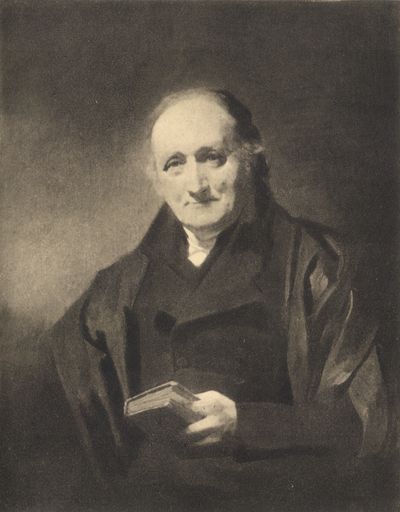
Dr. ALEXANDER ADAM From the painting by Raeburn.
From Dr. Adam's class I should, according to the usual routine, have proceeded immediately to college. But, fortunately, I was not yet to lose, by a total dismission from constraint, the acquaintance with the Latin which I had acquired. My health had become rather delicate from rapid growth, and my father was easily persuaded to allow me to spend half a year at Kelso with my kind aunt, Miss Janet Scott, whose inmate I again became. It was hardly worth mentioning that I had frequently visited her during our short vacations.
At this time she resided in a small house, situated very pleasantly in a large garden, to the eastward of the churchyard of Kelso, which extended down to the Tweed. It was then my father's property, from whom it was afterwards purchased by my uncle. My grandmother was now dead, and my aunt's only companion, besides an old maid-servant, was my cousin, Miss Barbara Scott, now Mrs. Meik. My time was here left entirely to my own disposal, excepting for about four hours in the day, when I was expected to attend the Grammar School of the village. The teacher at that time was Mr. Lancelot Whale, an excellent classical scholar, a humorist, and a worthy man. He had a supreme antipathy to the puns which his very uncommon name frequently gave rise to; insomuch, that he made his son spell the word Wale, which only occasioned the young man being nicknamed the Prince of Wales by the military mess to which he belonged. As for Whale, senior, the least allusion to Jonah, or the terming him an odd fish, or any similar quibble, was sure to put him beside himself. In point of knowledge and taste he was far too good for the situation he held, which only required that he should give his scholars a rough foundation in the Latin language. My time with him, though short, was spent greatly to my advantage and his gratification. He was glad to escape to Persius and Tacitus from the eternal Rudiments and Cornelius Nepos; and as perusing these authors with one who began to understand them was to him a labor of love, I made considerable progress under his instructions. I suspect, indeed, that some of the time dedicated to me was withdrawn from the instruction of his more regular scholars; but I was as grateful as I could be. I acted as usher, and heard the inferior classes, and I spouted the speech of Galgacus at the public examination, which did not make the less impression on the audience that few of them probably understood one word of it.
In the mean while my acquaintance with English literature was gradually extending itself. In the intervals of my school hours I had always perused with avidity such books of history or poetry or voyages and travels as chance presented to me—not forgetting the usual, or rather ten times the usual, quantity of fairy tales, Eastern stories, romances, etc. These studies were totally unregulated and undirected. My tutor thought it almost a sin to open a profane play or poem; and my mother, besides that she might be in some degree trammelled by the religious scruples which he suggested, had no longer the opportunity to hear me read poetry as formerly. I found, however, in her dressing-room (where I slept at one time) some odd volumes of Shakespeare, nor can I easily forget the rapture with which I sat up in my shirt reading them by the light of a fire in her apartment, until the bustle of the family rising from supper warned me it was time to creep back to my bed, where I was supposed to have been safely deposited since nine o'clock. Chance, however, threw in my way a poetical preceptor. This was no other than the excellent and benevolent Dr. Blacklock, well known at that time as a literary character. I know not how I attracted his attention, and that of some of the young men who boarded in his family; but so it was that I became a frequent and favored guest. The kind old man opened to me the stores of his library, and through his recommendation I became intimate with Ossian and Spenser. I was delighted with both, yet I think chiefly with the latter poet. The tawdry repetitions of the Ossianic phraseology disgusted me rather sooner than might have been expected from my age. But Spenser I could have read forever. Too young to trouble myself about the allegory, I considered all the knights and ladies and dragons and giants in their outward and exoteric sense, and God only knows how delighted I was to find myself in such society. As I had always a wonderful facility in retaining in my memory whatever verses pleased me, the quantity of Spenser's stanzas which I could repeat was really marvellous. But this memory of mine was a very fickle ally, and has through my whole life acted merely upon its own capricious motion, and might have enabled me to adopt old Beattie of Meikledale's answer, when complimented by a certain reverend divine on the strength of the same faculty:—"No, sir," answered the old Borderer, "I have no command of my memory. It only retains what hits my fancy; and probably, sir, if you were to preach to me for two hours, I would not be able when you finished to remember a word you had been saying." My memory was precisely of the same kind: it seldom failed to preserve most tenaciously a favorite passage of poetry, a playhouse ditty, or, above all, a Border-raid ballad; but names, dates, and the other technicalities of history, escaped me in a most melancholy degree. The philosophy of history, a much more important subject, was also a sealed book at this period of my life; but I gradually assembled much of what was striking and picturesque in historical narrative; and when, in riper years, I attended more to the deduction of general principles, I was furnished with a powerful host of examples in illustration of them. I was, in short, like an ignorant gamester, who kept a good hand until he knew how to play it.
I left the High School, therefore, with a great quantity of general information, ill arranged, indeed, and collected without system, yet deeply impressed upon my mind; readily assorted by my power of connection and memory, and gilded, if I may be permitted to say so, by a vivid and active imagination. If my studies were not under any direction at Edinburgh, in the country, it may be well imagined, they were less so. A respectable subscription library, a circulating library of ancient standing, and some private book-shelves, were open to my random perusal, and I waded into the stream like a blind man into a ford, without the power of searching my way, unless by groping for it. My appetite for books was as ample and indiscriminating as it was indefatigable, and I since have had too frequently reason to repent that few ever read so much, and to so little purpose.
Among the valuable acquisitions I made about this time was an acquaintance with Tasso's Jerusalem Delivered, through the flat medium of Mr. Hoole's translation. But above all, I then first became acquainted with Bishop Percy's Reliques of Ancient Poetry. As I had been from infancy devoted to legendary lore of this nature, and only reluctantly withdrew my attention, from the scarcity of materials and the rudeness of those which I possessed, it may be imagined, but cannot be described, with what delight I saw pieces of the same kind which had amused my childhood, and still continued in secret the Delilahs of my imagination, considered as the subject of sober research, grave commentary, and apt illustration, by an editor who showed his poetical genius was capable of emulating the best qualities of what his pious labor preserved. I remember well the spot where I read these volumes for the first time. It was beneath a huge platanus-tree, in the ruins of what had been intended for an old-fashioned arbor in the garden I have mentioned. The summer day sped onward so fast that, notwithstanding the sharp appetite of thirteen, I forgot the hour of dinner, was sought for with anxiety, and was still found entranced in my intellectual banquet. To read and to remember was in this instance the same thing, and henceforth I overwhelmed my schoolfellows, and all who would hearken to me, with tragical recitations from the ballads of Bishop Percy. The first time, too, I could scrape a few shillings together, which were not common occurrences with me, I bought unto myself a copy of these beloved volumes; nor do I believe I ever read a book half so frequently, or with half the enthusiasm. About this period, also, I became acquainted with the works of Richardson, and those of Mackenzie—(whom in later years I became entitled to call my friend)—with Fielding, Smollett, and some others of our best novelists.
To this period, also, I can trace distinctly the awaking of that delightful feeling for the beauties of natural objects which has never since deserted me. The neighborhood of Kelso, the most beautiful, if not the most romantic village in Scotland, is eminently calculated to awaken these ideas. It presents objects, not only grand in themselves, but venerable from their association. The meeting of two superb rivers, the Tweed and the Teviot, both renowned in song—the ruins of an ancient abbey—the more distant vestiges of Roxburgh Castle—the modern mansion of Fleurs, which is so situated as to combine the ideas of ancient baronial grandeur with those of modern taste—are in themselves objects of the first class; yet are so mixed, united, and melted among a thousand other beauties of a less prominent description, that they harmonize into one general picture, and please rather by unison than by concord. I believe I have written unintelligibly upon this subject, but it is fitter for the pencil than the pen. The romantic feelings which I have described as predominating in my mind, naturally rested upon and associated themselves with these grand features of the landscape around me; and the historical incidents, or traditional legends connected with many of them, gave to my admiration a sort of intense impression of reverence, which at times made my heart feel too big for its bosom. From this time the love of natural beauty, more especially when combined with ancient ruins, or remains of our fathers' piety or splendor, became with me an insatiable passion, which, if circumstances had permitted, I would willingly have gratified by travelling over half the globe.
I was recalled to Edinburgh about the time when the College meets, and put at once to the Humanity class, under Mr. Hill, and the first Greek class, taught by Mr. Dalzell. The former held the reins of discipline very loosely, and though beloved by his students, for he was a good-natured man as well as a good scholar, he had not the art of exciting our attention as well as liking. This was a dangerous character with whom to trust one who relished labor as little as I did, and amid the riot of his class I speedily lost much of what I had learned under Adam and Whale. At the Greek class, I might have made a better figure, for Professor Dalzell maintained a great deal of authority, and was not only himself an admirable scholar, but was always deeply interested in the progress of his students. But here lay the villainy. Almost all my companions who had left the High School at the same time with myself had acquired a smattering of Greek before they came to College. I, alas, had none; and finding myself far inferior to all my fellow-students, I could hit upon no better mode of vindicating my equality than by professing my contempt for the language, and my resolution not to learn it. A youth who died early, himself an excellent Greek scholar, saw my negligence and folly with pain, instead of contempt. He came to call on me in George's Square, and pointed out in the strongest terms the silliness of the conduct I had adopted, told me I was distinguished by the name of the Greek Blockhead, and exhorted me to redeem my reputation while it was called to-day. My stubborn pride received this advice with sulky civility; the birth of my Mentor (whose name was Archibald, the son of an innkeeper) did not, as I thought in my folly, authorize him to intrude upon me his advice. The other was not sharp-sighted, or his consciousness of a generous intention overcame his resentment. He offered me his daily and nightly assistance, and pledged himself to bring me forward with the foremost of my class. I felt some twinges of conscience, but they were unable to prevail over my pride and self-conceit. The poor lad left me more in sorrow than in anger, nor did we ever meet again. All hopes of my progress in the Greek were now over; insomuch that when we were required to write essays on the authors we had studied, I had the audacity to produce a composition in which I weighed Homer against Ariosto, and pronounced him wanting in the balance. I supported this heresy by a profusion of bad reading and flimsy argument. The wrath of the Professor was extreme, while at the same time he could not suppress his surprise at the quantity of out-of-the-way knowledge which I displayed. He pronounced upon me the severe sentence—that dunce I was, and dunce was to remain—which, however, my excellent and learned friend lived to revoke over a bottle of Burgundy, at our literary Club at Fortune's, of which he was a distinguished member.
Meanwhile, as if to eradicate my slightest tincture of Greek, I fell ill during the middle of Mr. Dalzell's second class, and migrated a second time to Kelso—where I again continued a long time reading what and how I pleased, and of course reading nothing but what afforded me immediate entertainment. The only thing which saved my mind from utter dissipation was that turn for historical pursuit, which never abandoned me even at the idlest period. I had forsworn the Latin classics for no reason I know of, unless because they were akin to the Greek; but the occasional perusal of Buchanan's history, that of Matthew Paris, and other monkish chronicles, kept up a kind of familiarity with the language even in its rudest state. But I forgot the very letters of the Greek alphabet; a loss never to be repaired, considering what that language is, and who they were who employed it in their compositions.
About this period—or soon afterwards—my father judged it proper I should study mathematics, a study upon which I entered with all the ardor of novelty. My tutor was an aged person, Dr. MacFait, who had in his time been distinguished as a teacher of this science. Age, however, and some domestic inconveniences, had diminished his pupils, and lessened his authority amongst the few who remained. I think that, had I been more fortunately placed for instruction, or had I had the spur of emulation, I might have made some progress in this science, of which, under the circumstances I have mentioned, I only acquired a very superficial smattering.
In other studies I was rather more fortunate. I made some progress in Ethics under Professor John Bruce, and was selected, as one of his students whose progress he approved, to read an essay before Principal Robertson. I was farther instructed in Moral Philosophy at the class of Mr. Dugald Stewart, whose striking and impressive eloquence riveted the attention even of the most volatile student. To sum up my academical studies, I attended the class of History, then taught by the present Lord Woodhouselee, and, as far as I remember, no others, excepting those of the Civil and Municipal Law. So that, if my learning be flimsy and inaccurate, the reader must have some compassion even for an idle workman, who had so narrow a foundation to build upon. If, however, it should ever fall to the lot of youth to peruse these pages—let such a reader remember that it is with the deepest regret that I recollect in my manhood the opportunities of learning which I neglected in my youth; that through every part of my literary career I have felt pinched and hampered by my own ignorance; and that I would at this moment give half the reputation I have had the good fortune to acquire, if by doing so I could rest the remaining part upon a sound foundation of learning and science.
I imagine my father's reason for sending me to so few classes in the College was a desire that I should apply myself particularly to my legal studies. He had not determined whether I should fill the situation of an Advocate or a Writer; but judiciously considering the technical knowledge of the latter to be useful at least, if not essential, to a barrister, he resolved I should serve the ordinary apprenticeship of five years to his own profession. I accordingly entered into indentures with my father about 1785-86, and entered upon the dry and barren wilderness of forms and conveyances.
I cannot reproach myself with being entirely an idle apprentice—far less, as the reader might reasonably have expected,
"A clerk foredoom'd my father's soul to cross."
The drudgery, indeed, of the office I disliked, and the confinement I altogether detested; but I loved my father, and I felt the rational pride and pleasure of rendering myself useful to him. I was ambitious also; and among my companions in labor, the only way to gratify ambition was to labor hard and well. Other circumstances reconciled me in some measure to the confinement. The allowance for copy-money furnished a little fund for the menus plaisirs of the circulating library and the theatre; and this was no trifling incentive to labor. When actually at the oar, no man could pull it harder than I, and I remember writing upwards of 120 folio pages with no interval either for food or rest. Again, the hours of attendance on the office were lightened by the power of choosing my own books, and reading them in my own way, which often consisted in beginning at the middle or the end of a volume. A deceased friend, who was a fellow-apprentice with me, used often to express his surprise that, after such a hop-step-and-jump perusal, I knew as much of the book as he had been able to acquire from reading it in the usual manner. My desk usually contained a store of most miscellaneous volumes, especially works of fiction of every kind, which were my supreme delight. I might except novels, unless those of the better and higher class; for though I read many of them, yet it was with more selection than might have been expected. The whole Jemmy and Jenny Jessamy tribe I abhorred, and it required the art of Burney, or the feeling of Mackenzie, to fix my attention upon a domestic tale. But all that was adventurous and romantic I devoured without much discrimination, and I really believe I have read as much nonsense of this class as any man now living. Everything which touched on knight-errantry was particularly acceptable to me, and I soon attempted to imitate what I so greatly admired. My efforts, however, were in the manner of the tale-teller, not of the bard.
My greatest intimate, from the days of my school-tide, was Mr. John Irving, now a Writer to the Signet. We lived near each other, and by joint agreement were wont, each of us, to compose a romance for the other's amusement. These legends, in which the martial and the miraculous always predominated, we rehearsed to each other during our walks, which were usually directed to the most solitary spots about Arthur's Seat and Salisbury Crags. We naturally sought seclusion, for we were conscious no small degree of ridicule would have attended our amusement, if the nature of it had become known. Whole holidays were spent in this singular pastime, which continued for two or three years, and had, I believe, no small effect in directing the turn of my imagination to the chivalrous and romantic in poetry and prose.
Meanwhile, the translations of Mr. Hoole having made me acquainted with Tasso and Ariosto, I learned from his notes on the latter, that the Italian language contained a fund of romantic lore. A part of my earnings was dedicated to an Italian class which I attended twice a week, and rapidly acquired some proficiency. I had previously renewed and extended my knowledge of the French language, from the same principle of romantic research. Tressan's romances, the Bibliothèque Bleue, and Bibliothèque de Romans, were already familiar to me, and I now acquired similar intimacy with the works of Dante, Boiardo, Pulci, and other eminent Italian authors. I fastened also, like a tiger, upon every collection of old songs or romances which chance threw in my way, or which my scrutiny was able to discover on the dusty shelves of James Sibbald's circulating library in the Parliament Square. This collection, now dismantled and dispersed, contained at that time many rare and curious works, seldom found in such a collection. Mr. Sibbald himself, a man of rough manners but of some taste and judgment, cultivated music and poetry, and in his shop I had a distant view of some literary characters, besides the privilege of ransacking the stores of old French and Italian books, which were in little demand among the bulk of his subscribers. Here I saw the unfortunate Andrew Macdonald, author of Vimonda; and here, too, I saw at a distance the boast of Scotland, Robert Burns. Of the latter I shall presently have occasion to speak more fully.
I am inadvertently led to confound dates while I talk of this remote period, for, as I have no notes, it is impossible for me to remember with accuracy the progress of studies, if they deserve the name, so irregular and miscellaneous. But about the second year of my apprenticeship my health, which, from rapid growth and other causes, had been hitherto rather uncertain and delicate, was affected by the breaking of a blood-vessel. The regimen I had to undergo on this occasion was far from agreeable. It was spring, and the weather raw and cold, yet I was confined to bed with a single blanket, and bled and blistered till I scarcely had a pulse left. I had all the appetite of a growing boy, but was prohibited any sustenance beyond what was absolutely necessary for the support of nature, and that in vegetables alone. Above all, with a considerable disposition to talk, I was not permitted to open my lips without one or two old ladies who watched my couch being ready at once to souse upon me,
My only refuge was reading and playing at chess. To the romances and poetry, which I chiefly delighted in, I had always added the study of history, especially as connected with military events. I was encouraged in this latter study by a tolerable acquaintance with geography, and by the opportunities I had enjoyed while with Mr. MacFait to learn the meaning of the more ordinary terms of fortification. While, therefore, I lay in this dreary and silent solitude, I fell upon the resource of illustrating the battles I read of by the childish expedient of arranging shells, and seeds, and pebbles, so as to represent encountering armies. Diminutive cross-bows were contrived to mimic artillery, and with the assistance of a friendly carpenter I contrived to model a fortress, which, like that of Uncle Toby, represented whatever place happened to be uppermost in my imagination. I fought my way thus through Vertot's Knights of Malta—a book which, as it hovered between history and romance, was exceedingly dear to me; and Orme's interesting and beautiful History of Indostan, whose copious plans, aided by the clear and luminous explanations of the author, rendered my imitative amusement peculiarly easy. Other moments of these weary weeks were spent in looking at the Meadow Walks, by assistance of a combination of mirrors so arranged that, while lying in bed, I could see the troops march out to exercise, or any other incident which occurred on that promenade.
After one or two relapses, my constitution recovered the injury it had sustained, though for several months afterwards I was restricted to a severe vegetable diet. And I must say, in passing, that though I gained health under this necessary restriction, yet it was far from being agreeable to me, and I was affected whilst under its influence with a nervousness which I never felt before or since. A disposition to start upon slight alarms—a want of decision in feeling and acting, which has not usually been my failing—an acute sensibility to trifling inconveniences—and an unnecessary apprehension of contingent misfortunes, rise to my memory as connected with my vegetable diet, although they may very possibly have been entirely the result of the disorder and not of the cure. Be this as it may, with this illness I bade farewell both to disease and medicine; for since that time, till the hour I am now writing, I have enjoyed a state of the most robust health, having only had to complain of occasional headaches or stomachic affections when I have been long without taking exercise, or have lived too convivially—the latter having been occasionally, though, not habitually, the error of my youth, as the former has been of my advanced life.
My frame gradually became hardened with my constitution, and being both tall and muscular, I was rather disfigured than disabled by my lameness. This personal disadvantage did not prevent me from taking much exercise on horseback, and making long journeys on foot, in the course of which I often walked from twenty to thirty miles a day. A distinct instance occurs to me. I remember walking with poor James Ramsay, my fellow-apprentice, now no more, and two other friends, to breakfast at Prestonpans. We spent the forenoon in visiting the ruins at Seton, and the field of battle at Preston—dined at Prestonpans on tiled haddocks very sumptuously—drank half a bottle of port each, and returned in the evening. This could not be less than thirty miles, nor do I remember being at all fatigued upon the occasion.
"Jog on, jog on, the foot-path way, And merrily hent the stile-a: A merry heart goes all the day, Your sad tires in a mile-a."
My principal object in these excursions was the pleasure of seeing romantic scenery, or what afforded me at least equal pleasure, the places which had been distinguished by remarkable historical events. The delight with which I regarded the former, of course had general approbation, but I often found it difficult to procure sympathy with the interest I felt in the latter. Yet to me, the wandering over the field of Bannockburn was the source of more exquisite pleasure than gazing upon the celebrated landscape from the battlements of Stirling castle. I do not by any means infer that I was dead to the feeling of picturesque scenery; on the contrary, few delighted more in its general effect. But I was unable with the eye of a painter to dissect the various parts of the scene, to comprehend how the one bore upon the other, to estimate the effect which various features of the view had in producing its leading and general effect. I have never, indeed, been capable of doing this with precision or nicety, though my latter studies have led me to amend and arrange my original ideas upon the subject. Even the humble ambition, which I long cherished, of making sketches of those places which interested me, from a defect of eye or of hand was totally ineffectual. After long study and many efforts, I was unable to apply the elements of perspective or of shade to the scene before me, and was obliged to relinquish in despair an art which I was most anxious to practise. But show me an old castle or a field of battle, and I was at home at once, filled it with its combatants in their proper costume, and overwhelmed my hearers by the enthusiasm of my description. In crossing Magus Moor, near St. Andrews, the spirit moved me to give a picture of the assassination of the Archbishop of St. Andrews to some fellow-travellers with whom I was accidentally associated, and one of them, though well acquainted with the story, protested my narrative had frightened away his night's sleep. I mention this to show the distinction between a sense of the picturesque in action and in scenery. If I have since been able in poetry to trace with some success the principles of the latter, it has always been with reference to its general and leading features, or under some alliance with moral feeling; and even this proficiency has cost me study.—Meanwhile I endeavored to make amends for my ignorance of drawing, by adopting a sort of technical memory respecting the scenes I visited: Wherever I went, I cut a piece of a branch from a tree—these constituted what I called my log-book; and I intended to have a set of chessmen out of them, each having reference to the place where it was cut—as the kings from Falkland and Holy-Rood; the queens from Queen Mary's yew-tree at Crookston; the bishops from abbeys or episcopal palaces; the knights from baronial residences; the rooks from royal fortresses; and the pawns generally from places worthy of historical note. But this whimsical design I never carried into execution.
In other points, however, I began to make some amends for the irregularity of my education. It is well known that in Edinburgh one great spur to emulation among youthful students is in those associations called literary societies, formed not only for the purpose of debate, but of composition. These undoubtedly have some disadvantages, where a bold, petulant, and disputatious temper happens to be combined with considerable information and talent. Still, however, in order to such a person being actually spoiled by his mixing in such debates, his talents must be of a very rare nature, or his effrontery must be proof to every species of assault; for there is generally, in a well-selected society of this nature, talent sufficient to meet the forwardest, and satire enough to penetrate the most undaunted. I am particularly obliged to this sort of club for introducing me about my seventeenth year into the society which at one time I had entirely dropped; for, from the time of my illness at college, I had had little or no intercourse with any of my class-companions, one or two only excepted. Now, however, about 1788, I began to feel and take my ground in society. A ready wit, a good deal of enthusiasm, and a perception that soon ripened into tact and observation of character, rendered me an acceptable companion to many young men whose acquisitions in philosophy and science were infinitely superior to anything I could boast.
Looking back on these times, I cannot applaud in all respects the way in which our days were spent. There was too much idleness, and sometimes too much conviviality: but our hearts were warm, our minds honorably bent on knowledge and literary distinction; and if I, certainly the least informed of the party, may be permitted to bear witness, we were not without the fair and creditable means of attaining the distinction to which we aspired. In this society I was naturally led to correct my former useless course of reading; for—feeling myself greatly inferior to my companions in metaphysical philosophy and other branches of regular study—I labored, not without some success, to acquire at least such a portion of knowledge as might enable me to maintain my rank in conversation. In this I succeeded pretty well; but unfortunately then, as often since through my life, I incurred the deserved ridicule of my friends from the superficial nature of my acquisitions, which being, in the mercantile phrase, got up for society, very often proved flimsy in the texture; and thus the gifts of an uncommonly retentive memory and acute powers of perception were sometimes detrimental to their possessor by encouraging him to a presumptuous reliance upon them.
Amidst these studies, and in this society, the time of my apprenticeship elapsed; and in 1790, or thereabouts, it became necessary that I should seriously consider to which department of the law I was to attach myself. My father behaved with the most parental kindness. He offered, if I preferred his own profession, immediately to take me into partnership with him, which, though his business was much diminished, still afforded me an immediate prospect of a handsome independence. But he did not disguise his wish that I should relinquish this situation to my younger brother, and embrace the more ambitious profession of the Bar. I had little hesitation in making my choice—for I was never very fond of money; and in no other particular do the professions admit of a comparison. Besides, I knew and felt the inconveniences attached to that of a Writer; and I thought (like a young man) many of them were "ingenio non subeunda meo." The appearance of personal dependence which that profession requires was disagreeable to me; the sort of connection between the client and the attorney seemed to render the latter more subservient than was quite agreeable to my nature; and, besides, I had seen many sad examples, while overlooking my father's business, that the utmost exertions, and the best meant services, do not secure the man of business, as he is called, from great loss, and most ungracious treatment on the part of his employers. The Bar, though I was conscious of my deficiencies as a public speaker, was the line of ambition and liberty; it was that also for which most of my contemporary friends were destined. And, lastly, although I would willingly have relieved my father of the labors of his business, yet I saw plainly we could not have agreed on some particulars if we had attempted to conduct it together, and that I should disappoint his expectations if I did not turn to the Bar. So to that object my studies were directed with great ardor and perseverance during the years 1789, 1790, 1791, 1792.
In the usual course of study, the Roman or Civil Law was the first object of my attention—the second, the Municipal Law of Scotland. In the course of reading on both subjects, I had the advantage of studying in conjunction with my friend William Clerk, a man of the most acute intellects and powerful apprehension, and who, should he ever shake loose the fetters of indolence by which he has been hitherto trammelled, cannot fail to be distinguished in the highest degree. We attended the regular classes of both laws in the University of Edinburgh. The Civil Law chair, now worthily filled by Mr. Alexander Irving, might at that time be considered as in abeyance, since the person by whom it was occupied had never been fit for the situation, and was then almost in a state of dotage. But the Scotch Law lectures were those of Mr. David Hume, who still continues to occupy that situation with as much honor to himself as advantage to his country. I copied over his lectures twice with my own hand, from notes taken in the class; and when I have had occasion to consult them, I can never sufficiently admire the penetration and clearness of conception which were necessary to the arrangement of the fabric of law, formed originally under the strictest influence of feudal principles, and innovated, altered, and broken in upon by the change of times, of habits, and of manners, until it resembles some ancient castle, partly entire, partly ruinous, partly dilapidated, patched and altered during the succession of ages by a thousand additions and combinations, yet still exhibiting, with the marks of its antiquity, symptoms of the skill and wisdom of its founders, and capable of being analyzed and made the subject of a methodical plan by an architect who can understand the various styles of the different ages in which it was subjected to alteration. Such an architect has Mr. Hume been to the law of Scotland, neither wandering into fanciful and abstruse disquisitions, which are the more proper subject of the antiquary, nor satisfied with presenting to his pupils a dry and undigested detail of the laws in their present state, but combining the past state of our legal enactments with the present, and tracing clearly and judiciously the changes which took place, and the causes which led to them.
Under these auspices I commenced my legal studies. A little parlor was assigned me in my father's house, which was spacious and convenient, and I took the exclusive possession of my new realms with all the feelings of novelty and liberty. Let me do justice to the only years of my life in which I applied to learning with stern, steady, and undeviating industry. The rule of my friend Clerk and myself was that we should mutually qualify ourselves for undergoing an examination upon certain points of law every morning in the week, Sundays excepted. This was at first to have taken place alternately at each other's houses, but we soon discovered that my friend's resolution was inadequate to severing him from his couch at the early hour fixed for this exercitation. Accordingly I agreed to go every morning to his house, which, being at the extremity of Prince's Street, New Town, was a walk of two miles. With great punctuality, however, I beat him up to his task every morning before seven o'clock, and in the course of two summers, we went, by way of question and answer, through the whole of Heineccius's Analysis of the Institutes and Pandects, as well as through the smaller copy of Erskine's Institutes of the Law of Scotland. This course of study enabled us to pass with credit the usual trials, which, by the regulations of the Faculty of Advocates, must be undergone by every candidate for admission into their body. My friend William Clerk and I passed these ordeals on the same days—namely, the Civil Law trial on the [30th June, 1791], and the Scots Law trial on the [6th July, 1792]. On the [11th July, 1792], we both assumed the gown with all its duties and honors.
My progress in life during these two or three years had been gradually enlarging my acquaintance, and facilitating my entrance into good company. My father and mother, already advanced in life, saw little society at home, excepting that of near relations, or upon particular occasions, so that I was left to form connections in a great measure for myself. It is not difficult for a youth with a real desire to please and be pleased, to make his way into good society in Edinburgh—or indeed anywhere; and my family connections, if they did not greatly further, had nothing to embarrass my progress. I was a gentleman, and so welcome anywhere, if so be I could behave myself, as Tony Lumpkin says, "in a concatenation accordingly."[Back to Contents]