Chapter II
Reading edition
illustrations of the autobiographical fragment. — edinburgh. — sandy-knowe. — bath. — prestonpans
1771-1778
Sir Walter Scott opens his brief account of his ancestry with a playful allusion to a trait of national character, which has, time out of mind, furnished merriment to the neighbors of the Scotch; but the zeal of pedigree was deeply rooted in himself, and he would have been the last to treat it with serious disparagement. It has often been exhibited under circumstances sufficiently grotesque; but it has lent strength to many a good impulse, sustained hope and self-respect under many a difficulty and distress, armed heart and nerve to many a bold and resolute struggle for independence; and prompted also many a generous act of assistance, which under its influence alone could have been accepted without any feeling of degradation.
He speaks modestly of his own descent; for, while none of his predecessors had ever sunk below the situation and character of a gentleman, he had but to go three or four generations back, and thence, as far as they could be followed, either on the paternal or maternal side, they were to be found moving in the highest ranks of our baronage. When he fitted up, in his later years, the beautiful hall of Abbotsford, he was careful to have the armorial bearings of his forefathers blazoned in due order on the compartments of its roof; and there are few in Scotland, under the titled nobility, who could trace their blood to so many stocks of historical distinction.
The race had been celebrated, however, long before his day, by a minstrel of its own; nor did he conceal his belief that he owed much to the influence exerted over his juvenile mind by the rude but enthusiastic clan-poetry of old Satchells who describes himself on his title-page as
"Captain Walter Scot, an old Souldier and no Scholler, And one that can write nane, But just the Letters of his Name."
"It is four hundred winters past in order Since that Buccleuch was Warden in the Border; A son he had at that same tide, Which was so lame could neither run nor ride. John, this lame son, if my author speaks true, He sent him to St. Mungo's in Glasgu, Where he remained a scholar's time, Then married a wife according to his mind.... And betwixt them twa was procreat Headshaw, Askirk, Sinton, and Glack."
But, if the scholarship of John the Lamiter furnished his descendant with many a mirthful allusion, a far greater favorite was the memory of William the Boltfoot, who followed him in the sixth generation:—
"The Laird and Lady of Harden Betwixt them procreat was a son Called William Boltfoot of Harden."
The emphasis with which this next line was quoted I can never forget:—
"He did survive to be A MAN."
He was, in fact, one of the "prowest knights" of the whole genealogy—a fearless horseman and expert spearman, renowned and dreaded; and I suppose I have heard Sir Walter repeat a dozen times, as he was dashing into the Tweed or Ettrick, "rolling red from brae to brae," a stanza from what he called an old ballad, though it was most likely one of his own early imitations:—
"To tak the foord he aye was first, Unless the English loons were near; Plunge vassal than, plunge horse and man, Auld Boltfoot rides into the rear."
"From childhood's earliest hour," says the poet in one of his last Journals, "I have rebelled against external circumstances." How largely the traditional famousness of the stalwart Boltfoot may have helped to develop this element of his character, I do not pretend to say; but I cannot avoid regretting that Lord Byron had not discovered such another "Deformed Transformed" among his own chivalrous progenitors.
So long as Sir Walter retained his vigorous habits, he used to make an autumnal excursion, with whatever friend happened to be his guest at the time, to the tower of Harden, the incunabula of his race. A more picturesque scene for the fastness of a lineage of Border marauders could not be conceived; and so much did he delight in it, remote and inaccessible as its situation is, that, in the earlier part of his life, he had nearly availed himself of his kinsman's permission to fit up the dilapidated peel for his summer residence. Harden (the ravine of hares) is a deep, dark, and narrow glen, along which a little mountain brook flows to join the river Borthwick, itself a tributary of the Teviot. The castle is perched on the brink of the precipitous bank, and from the ruinous windows you look down into the crows' nests on the summits of the old mouldering elms, that have their roots on the margin of the stream far below:—
It was to this wild retreat that the Harden of The Lay of the Last Minstrel, the Auld Wat of a hundred Border ditties, brought home, in 1567, his beautiful bride, Mary Scott, "the Flower of Yarrow," whose grace and gentleness have lived in song along with the stern virtues of her lord. She is said to have chiefly owed her celebrity to the gratitude of an English captive, a beautiful child, whom she rescued from the tender mercies of Wat's moss-troopers, on their return from a foray into Cumberland. The youth grew up under her protection, and is believed to have been the composer both of the words and the music of many of the best old songs of the Border. As Leyden says,
"His are the strains whose wandering echoes thrill The shepherd lingering on the twilight hill, When evening brings the merry folding hours, And sun-eyed daisies close their winking flowers. He lived o'er Yarrow's Flower to shed the tear, To strew the holly leaves o'er Harden's bier; But none was found above the minstrel's tomb, Emblem of peace, to bid the daisy bloom. He, nameless as the race from which he sprung, Saved other names, and left his own unsung."
We are told that when the last bullock which Auld Wat had provided from the English pastures was consumed, the Flower of Yarrow placed on her table a dish containing a pair of clean spurs; a hint to the company that they must bestir themselves for their next dinner. Sir Walter adds, in a note to the Minstrelsy, "Upon one occasion when the village herd was driving out the cattle to pasture, the old laird heard him call loudly to drive out Harden's cow. 'Harden's cow!' echoed the affronted chief; 'is it come to that pass? By my faith they shall soon say Harden's kye' (cows). Accordingly, he sounded his bugle, set out with his followers, and next day returned with a bow of kye, and a bassen'd (brindled) bull. On his return with this gallant prey, he passed a very large haystack. It occurred to the provident laird that this would be extremely convenient to fodder his new stock of cattle; but as no means of transporting it were obvious, he was fain to take leave of it with the apostrophe, now become proverbial—'By my saul, had ye but four feet, ye should not stand lang there.' In short, as Froissart says of a similar class of feudal robbers, nothing came amiss to them that was not too heavy or too hot."
Another striking chapter in the genealogical history belongs to the marriage of Auld Wat's son and heir, afterwards Sir William Scott of Harden, distinguished by the early favor of James VI., and severely fined for his loyalty under the usurpation of Cromwell. The period of this gentleman's youth was a very wild one in that district. The Border clans still made war on each other occasionally, much in the fashion of their forefathers; and the young and handsome heir of Harden, engaging in a foray upon the lands of Sir Gideon Murray of Elibank, treasurer-depute of Scotland, was overpowered by that baron's retainers, and carried in shackles to his castle, now a heap of ruins, on the banks of the Tweed. Elibank's "doomtree" extended its broad arms close to the gates of his fortress, and the indignant laird was on the point of desiring his prisoner to say a last prayer, when his more considerate dame interposed milder counsels, suggesting that the culprit was born to a good estate, and that they had three unmarried daughters. Young Harden, not, it is said, without hesitation, agreed to save his life by taking the plainest of the three off their hands, and the contract of marriage, executed instantly on the parchment of a drum, is still in the charter-chest of his noble representative.
Walter Scott, the third son of this couple, was the first Laird of Raeburn, already alluded to as one of the patrons of Satchells. He married Isabel Macdougal, daughter of Macdougal of Makerstoun—a family of great antiquity and distinction in Roxburghshire, of whose blood, through various alliances, the poet had a large share in his veins. Raeburn, though the son and brother of two steady Cavaliers, and married into a family of the same political creed, became a Whig, and at last a Quaker; and the reader will find, in one of the notes to The Heart of Mid-Lothian, a singular account of the persecution to which this backsliding exposed him at the hands of both his own and his wife's relations. He was incarcerated (A. D. 1665), first at Edinburgh and then at Jedburgh, by order of the Privy Council—his children were forcibly taken from him, and a heavy sum was levied on his estate yearly, for the purposes of their education beyond the reach of his perilous influence. "It appears," says Sir Walter, in a MS. memorandum now before me, "that the Laird of Makerstoun, his brother-in-law, joined with Raeburn's own elder brother, Harden, in this singular persecution, as it will now be termed by Christians of all persuasions. It was observed by the people that the male line of the second Sir William of Harden became extinct in 1710, and that the representation of Makerstoun soon passed into the female line. They assigned as a cause, that when the wife of Raeburn found herself deprived of her husband, and refused permission even to see her children, she pronounced a malediction on her husband's brother as well as on her own, and prayed that a male of their body might not inherit their property."
The MS. adds, "of the first Raeburn's two sons it may be observed that, thanks to the discipline of the Privy Council, they were both good scholars." Of these sons, Walter, the second, was the poet's great-grandfather, the enthusiastic Jacobite of the autobiographical fragment,—who is introduced,
"With amber beard and flaxen hair, And reverend apostolic air,"
in the epistle prefixed to the sixth canto of Marmion. A good portrait of Bearded Wat, painted for his friend Pitcairn, was presented by the Doctor's grandson, the Earl of Kellie, to the father of Sir Walter. It is now at Abbotsford; and shows a considerable resemblance to the poet. Some verses addressed to the original by his kinsman Walter Scott of Harden are given in one of the Notes to Marmion. The old gentleman himself is said to have written verses occasionally, both English and Latin; but I never heard more than the burden of a drinking-song—
Scantily as the worthy Jacobite seems to have been provided with this world's goods, he married the daughter of a gentleman of good condition, "through whom," says the MS. memorandum already quoted, "his descendants have inherited a connection with some honorable branches of the Slioch nan Diarmid, or Clan of Campbell." To this connection Sir Walter owed, as we shall see hereafter, many of those early opportunities for studying the manners of the Highlanders, to which the world are indebted for Waverley, Rob Roy, and The Lady of the Lake.
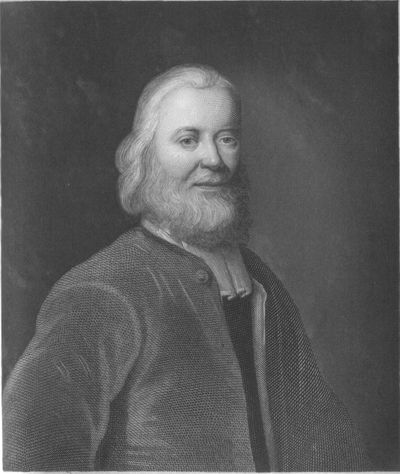
Walter Scott ("Beardie"), Great-grandfather of Sir Walter Scott After the painting at Abbotsford.
I need scarcely remind the reader of the exquisite description of the poet's grandfather, in the Introduction to the third canto of Marmion—
——"the thatched mansion's gray-hair'd sire, Wise without learning, plain and good, And sprang of Scotland's gentler blood; Whose eye, in age quick, clear, and keen, Showed what in youth its glance had been; Whose doom discording neighbors sought, Content with equity unbought."
In the Preface to Guy Mannering, we have an anecdote of Robert Scott in his earlier days: "My grandfather, while riding over Charterhouse Moor, then a very extensive common, fell suddenly among a large band of gypsies, who were carousing in a hollow surrounded by bushes. They instantly seized on his bridle with shouts of welcome, exclaiming that they had often dined at his expense, and he must now stay and share their cheer. My ancestor was a little alarmed, for he had more money about his person than he cared to risk in such society. However, being naturally a bold, lively spirited man, he entered into the humor of the thing, and sat down to the feast, which consisted of all the varieties of game, poultry, pigs, and so forth, that could be collected by a wide and indiscriminate system of plunder. The dinner was a very merry one, but my relative got a hint from some of the older gypsies, just when 'the mirth and fun grew fast and furious,' and mounting his horse accordingly, he took a French leave of his entertainers." His grandson might have reported more than one scene of the like sort in which he was himself engaged, while hunting the same district, not in quest of foxes or of cattle sales, like the Goodman of Sandy-Knowe, but of ballads for the Minstrelsy. Gypsy stories, as we are told in the same Preface, were frequently in the mouth of the old man when his face "brightened at the evening fire," in the days of the poet's childhood. And he adds that, "as Dr. Johnson had a shadowy recollection of Queen Anne as a stately lady in black, adorned with diamonds," so his own memory was haunted with "a solemn remembrance of a woman of more than female height, dressed in a long red cloak, who once made her appearance beneath the thatched roof of Sandy-Knowe, commenced acquaintance by giving him an apple, and whom he looked on, nevertheless, with as much awe as the future doctor, High Church and Tory as he was doomed to be, could look upon the Queen." This was Madge Gordon, granddaughter of Jean Gordon, the prototype of Meg Merrilies.
Of Robert of Sandy-Knowe, also, there is a very tolerable portrait at Abbotsford, and the likeness of the poet to his grandfather must have forcibly struck every one who has seen it. Indeed, but for its wanting some inches in elevation of forehead—(a considerable want, it must be allowed)—the picture might be mistaken for one of Sir Walter Scott. The keen, shrewd expression of the eye, and the remarkable length and compression of the upper lip, bring him exactly before me as he appeared when entering with all the zeal of a professional agriculturist into the merits of a pit of marle discovered at Abbotsford. Had the old man been represented with his cap on his head, the resemblance to one particular phasis of the most changeful of countenances would have been perfect.
Robert Scott had a numerous progeny, and Sir Walter has intimated his intention of recording several of them "with a sincere tribute of gratitude" in the contemplated prosecution of his autobiography. Two of the younger sons were bred to the naval service of the East India Company; one of whom died early and unmarried; the other was the excellent Captain Robert Scott, of whose kindness to his nephew some particulars are given in the Ashestiel fragment, and more will occur hereafter. Another son, Thomas, followed the profession of his father with ability, and retired in old age upon a handsome independence, acquired by his industrious exertions. He was twice married,—first to his near relation, a daughter of Raeburn; and secondly to Miss Rutherford of Know-South, the estate of which respectable family is now possessed by his son Charles Scott, an amiable and high-spirited gentleman, who was always a special favorite with his eminent kinsman. The death of Thomas Scott is thus recorded in one of the MS. notes on his nephew's own copy of the Haliburton Memorials:—"The said Thomas Scott died at Monklaw, near Jedburgh, at two of the clock, 27th January, 1823, in the 90th year of his life, and fully possessed of all his faculties. He read till nearly the year before his death; and being a great musician on the Scotch pipes, had, when on his deathbed, a favorite tune played over to him by his son James, that he might be sure he left him in full possession of it. After hearing it, he hummed it over himself, and corrected it in several of the notes. The air was that called Sour Plums in Galashiels. When barks and other tonics were given him during his last illness, he privately spat them into his handkerchief, saying, as he had lived all his life without taking doctor's drugs, he wished to die without doing so."
I visited this old man two years before his death, in company with Sir Walter, and thought him about the most venerable figure I had ever set my eyes on—tall and erect, with long flowing tresses of the most silvery whiteness, and stockings rolled up over his knees, after the fashion of three generations back. He sat reading his Bible without spectacles, and did not, for a moment, perceive that any one had entered his room, but on recognizing his nephew he rose, with cordial alacrity, kissing him on both cheeks, and exclaiming, "God bless thee, Walter, my man! thou hast risen to be great, but thou wast always good." His remarks were lively and sagacious, and delivered with a touch of that humor which seems to have been shared by most of the family. He had the air and manner of an ancient gentleman, and must in his day have been eminently handsome. I saw more than once, about the same period, this respectable man's sister, who had married her cousin Walter, Laird of Raeburn—thus adding a new link to the closeness of the family connection. She also must have been, in her youth, remarkable for personal attractions; as it was, she dwells on my memory as the perfect picture of an old Scotch lady, with a great deal of simple dignity in her bearing, but with the softest eye, and the sweetest voice, and a charm of meekness and gentleness about every look and expression; all which contrasted strikingly enough with the stern dry aspect and manners of her husband, a right descendant of the moss-troopers of Harden, who never seemed at his ease but on horseback, and continued to be the boldest fox-hunter of the district, even to the verge of eighty. The poet's aunt spoke her native language pure and undiluted, but without the slightest tincture of that vulgarity which now seems almost unavoidable in the oral use of a dialect so long banished from courts, and which has not been avoided by any modern writer who has ventured to introduce it, with the exception of Scott, and I may add, speaking generally, of Burns. Lady Raeburn, as she was universally styled, may be numbered with those friends of early days whom her nephew has alluded to in one of his prefaces, as preserving what we may fancy to have been the old Scotch of Holyrood.
The particulars which I have been setting down may help English readers to form some notion of the structure of society in those southern districts of Scotland. When Satchells wrote, he boasted that Buccleuch could summon to his banner one hundred lairds, all of his own name, with ten thousand more—landless men, but still of the same blood. The younger sons of these various lairds were, through many successive generations, portioned off with fragments of the inheritance, until such subdivision could be carried no farther, and then the cadet, of necessity, either adopted the profession of arms, in some foreign service very frequently, or became a cultivator on the estate of his own elder brother, of the chieftain of his branch, or of the great chief and patriarchal protector of the whole clan. Until the commerce of England and, above all, the military and civil services of the English colonies were thrown open to the enterprise of the Scotch, this system of things continued entire. It still remained in force to a considerable extent at the time when the Goodman of Sandy-Knowe was establishing his children in the world—and I am happy to say, that it is far from being abolished even at the present day. It was a system which bound together the various classes of the rural population in bonds of mutual love and confidence: the original community of lineage was equally remembered on all sides; the landlord could count for more than his rent on the tenant, who regarded him rather as a father or an elder brother, than as one who owed his superiority to mere wealth; and the farmer who, on fit occasions, partook on equal terms of the chase and the hospitality of his landlord, went back with content and satisfaction to the daily labors of a vocation which he found no one disposed to consider as derogating from his gentle blood. Such delusions, if delusions they were, held the natural arrogance of riches in check, taught the poor man to believe that in virtuous poverty he had nothing to blush for, and spread over the whole being of the community the gracious spirit of a primitive humanity.
Walter Scott, the eldest son of Robert of Sandy-Knowe, appears to have been the first of the family that ever adopted a town life, or anything claiming to be classed among the learned professions. His branch of the law, however, could not in those days be advantageously prosecuted without extensive connections in the country; his own were too respectable not to be of much service to him in his calling, and they were cultivated accordingly. His professional visits to Roxburghshire and Ettrick Forest were, in his vigorous life, very frequent; and though he was never supposed to have any tincture either of romance or poetry in his composition, he retained to the last a warm affection for his native district, with a certain reluctant flavor of the old feelings and prejudices of the Borderer. I have little to add to Sir Walter's short and respectful notice of his father, except that I have heard it confirmed by the testimony of many less partial observers. According to every account, he was a most just, honorable, conscientious man; only too high of spirit for some parts of his business. "He passed from the cradle to the grave," says a surviving relation, "without making an enemy or losing a friend. He was a most affectionate parent, and if he discouraged, rather than otherwise, his son's early devotion to the pursuits which led him to the height of literary eminence, it was only because he did not understand what such things meant, and considered it his duty to keep his young man to that path in which good sense and industry might, humanly speaking, be thought sure of success."
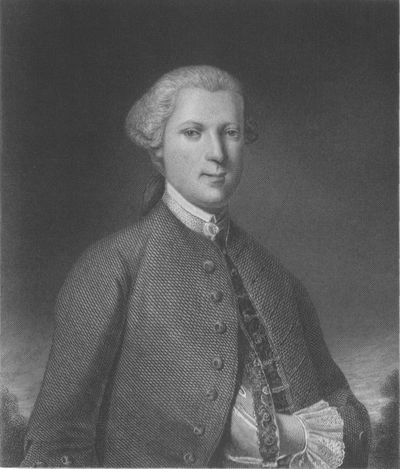
Walter Scott, W. S., Father of Sir Walter Scott After the painting at Abbotsford.
He says that his consciousness of existence dated from Sandy-Knowe; and how deep and indelible was the impression which its romantic localities had left on his imagination, I need not remind the readers of Marmion and The Eve of St. John. On the summit of the Crags which overhang the farmhouse stands the ruined tower of Smailholme, the scene of that fine ballad; and the view from thence takes in a wide expanse of the district in which, as has been truly said, every field has its battle, and every rivulet its song:—
"That lady sat in mournful mood, Looked over hill and vale, O'er Tweed's fair flood, and Mertoun's wood, And all down Teviotdale."—
Mertoun, the principal seat of the Harden family, with its noble groves; nearly in front of it, across the Tweed, Lessudden, the comparatively small but still venerable and stately abode of the Lairds of Raeburn; and the hoary Abbey of Dryburgh, surrounded with yew-trees as ancient as itself, seem to lie almost below the feet of the spectator. Opposite him rise the purple peaks of Eildon, the traditional scene of Thomas the Rhymer's interview with the Queen of Faerie; behind are the blasted peel which the seer of Ercildoune himself inhabited, "the Broom of the Cowdenknowes," the pastoral valley of the Leader, and the bleak wilderness of Lammermoor. To the eastward, the desolate grandeur of Hume Castle breaks the horizon, as the eye travels towards the range of the Cheviot. A few miles westward, Melrose, "like some tall rock with lichens grey," appears clasped amidst the windings of the Tweed; and the distance presents the serrated mountains of the Gala, the Ettrick, and the Yarrow, all famous in song. Such were the objects that had painted the earliest images on the eye of the last and greatest of the Border Minstrels.
As his memory reached to an earlier period of childhood than that of almost any other person, so assuredly no poet has given to the world a picture of the dawning feelings of life and genius, at once so simple, so beautiful, and so complete, as that of his epistle to William Erskine, the chief literary confidant and counsellor of his prime of manhood.
There are still living in that neighborhood two old women who were in the domestic service of Sandy-Knowe when the lame child was brought thither in the third year of his age. One of them, Tibby Hunter, remembers his coming well; and that "he was a sweet-tempered bairn, a darling with all about the house." The young ewe-milkers delighted, she says, to carry him about on their backs among the crags; and he was "very gleg (quick) at the uptake, and soon kenned every sheep and lamb by headmark as well as any of them." His great pleasure, however, was in the society of the "aged hind," recorded in the epistle to Erskine. "Auld Sandy Ormistoun," called, from the most dignified part of his function, "the Cow-bailie," had the chief superintendence of the flocks that browsed upon "the velvet tufts of loveliest green." If the child saw him in the morning, he could not be satisfied unless the old man would set him astride on his shoulder, and take him to keep him company as he lay watching his charge.
"Here was poetic impulse given By the green hill and clear blue heaven."
The Cow-bailie blew a particular note on his whistle, which signified to the maid-servants in the house below when the little boy wished to be carried home again. He told his friend, Mr. Skene of Rubislaw, when spending a summer day in his old age among these well-remembered crags, that he delighted to roll about on the grass all day long in the midst of the flock, and that "the sort of fellowship he thus formed with the sheep and lambs had impressed his mind with a degree of affectionate feeling towards them which had lasted throughout life." There is a story of his having been forgotten one day among the knolls when a thunderstorm came on; and his aunt, suddenly recollecting his situation, and running out to bring him home, is said to have found him lying on his back, clapping his hands at the lightning, and crying out, "Bonny! bonny!" at every flash.
Robert Scott died before his grandson was four years of age; and I heard him mention when he was an old man that he distinctly remembered the writing and sealing of the funeral letters, and all the ceremonial of the melancholy procession as it left Sandy-Knowe. I shall conclude my notices of the residence at Sandy-Knowe with observing that in Sir Walter's account of the friendly clergyman who so often sat at his grandfather's fireside, we cannot fail to trace many features of the secluded divine in the novel of St. Ronan's Well.
I have nothing to add to what he has told us of that excursion to England which interrupted his residence at Sandy-Knowe for about a twelvemonth, except that I had often been astonished, long before I read his autobiographic fragment, with the minute recollection he seemed to possess of all the striking features of the city of Bath, which he had never seen again since he quitted it before he was six years of age. He has himself alluded, in his Memoir, to the lively recollection he retained of his first visit to the theatre, to which his Uncle Robert carried him to witness a representation of As You Like It. In his reviewal of the Life of John Kemble, written in 1826, he has recorded that impression more fully, and in terms so striking, that I must copy them in this place:—
Probably it was this performance that first tempted him to open the page of Shakespeare. Before he returned to Sandy-Knowe, assuredly, notwithstanding the modest language of his autobiography, the progress which had been made in his intellectual education was extraordinary; and it is impossible to doubt that his hitherto almost sole tutoress, Miss Jenny Scott, must have been a woman of tastes and acquirements very far above what could have been often found among Scotch ladies, of any but the highest class at least, in that day. In the winter of 1777, she and her charge spent some few weeks—not happy weeks, the Memoir hints them to have been—in George's Square, Edinburgh; and it so happened, that during this little interval, Mr. and Mrs. Scott received in their domestic circle a guest capable of appreciating, and, fortunately for us, of recording in a very striking manner the remarkable development of young Walter's faculties. Mrs. Cockburn, mentioned by him in his Memoir as the authoress of the modern Flowers of the Forest, born a Rutherford, of Fairnalie, in Selkirkshire, was distantly related to the poet's mother, with whom she had through life been in habits of intimate friendship. This accomplished woman was staying at Ravelston, in the vicinity of Edinburgh, a seat of the Keiths of Dunnottar, nearly related to Mrs. Scott, and to herself. With some of that family she spent an evening in George's Square. She chanced to be writing next day to Dr. Douglas, the well-known and much respected minister of her native parish, Galashiels; and her letter, of which the Doctor's son has kindly given me a copy, contains the following passage:—
"Edinburgh, Saturday night, 15th of 'the gloomy month when the people of England hang and drown themselves.'
Some particulars in Mrs. Cockburn's account appear considerably at variance with what Sir Walter has told us respecting his own boyish proficiency—especially in the article of pronunciation. On that last head, however, Mrs. Cockburn was not, probably, a very accurate judge; all that can be said is, that if at this early period he had acquired anything which could be justly described as an English accent, he soon lost, and never again recovered, what he had thus gained from his short residence at Bath. In after-life his pronunciation of words, considered separately, was seldom much different from that of a well-educated Englishman of his time; but he used many words in a sense which belonged to Scotland, not to England, and the tone and accent remained broadly Scotch, though, unless in the burr, which no doubt smacked of the country bordering on Northumberland, there was no provincial peculiarity about his utterance. He had strong powers of mimicry—could talk with a peasant quite in his own style, and frequently in general society introduced rustic patois, northern, southern, or midland, with great truth and effect; but these things were inlaid dramatically, or playfully, upon his narrative. His exquisite taste in this matter was not less remarkable in his conversation than in the prose of his Scotch novels.
'Seven Roman cities strove for Homer dead, Through which the living Homer begged his bread?'"
The lady smiled at the "Roman cities,"—but already
"Each blank in faithless memory void The poet's glowing thought supplied."
His Uncle Thomas, whom I have described as I saw him in extreme old age at Monklaw, had the management of the farm affairs at Sandy-Knowe, when Walter returned thither from Prestonpans; he was a kind-hearted man, and very fond of the child. Appearing on his return somewhat strengthened, his uncle promoted him from the Cow-bailie's shoulder to a dwarf of the Shetland race, not so large as many a Newfoundland dog. This creature walked freely into the house, and was regularly fed from the boy's hand. He soon learned to sit her well, and often alarmed Aunt Jenny, by cantering over the rough places about the tower. In the evening of his life, when he had a grandchild afflicted with an infirmity akin to his own, he provided him with a little mare of the same breed, and gave her the name of Marion, in memory of this early favorite.[Back to Contents]