Chapter V
Reading edition
illustrations continued. — scott's apprenticeship to his father. — excursions to the highlands, etc. — debating societies. — early correspondence, etc. — williamina stuart
1786-1790
In the Minute-books of the Society of Writers to the Signet appears the following entry: "Edinburgh, 15th May, 1786. Compeared Walter Scott, and presented an indenture, dated 31st March last, entered into between him and Walter Scott, his son, for five years from the date thereof, under a mutual penalty of £40 sterling."
An inauspicious step this might at first sight appear in the early history of one so strongly predisposed for pursuits wide as the antipodes asunder from the dry technicalities of conveyancing; but he himself, I believe, was never heard, in his mature age, to express any regret that it should have been taken; and I am convinced for my part that it was a fortunate one. It prevented him, indeed, from passing with the usual regularity through a long course of Scotch metaphysics; but I extremely doubt whether any discipline could ever have led him to derive either pleasure or profit from studies of that order. His apprenticeship left him time enough, as we shall find, for continuing his application to the stores of poetry and romance, and those old chroniclers, who to the end were his darling historians. Indeed, if he had wanted any new stimulus, the necessity of devoting certain hours of every day to a routine of drudgery, however it might have operated on a spirit more prone to earth, must have tended to quicken his appetite for "the sweet bread eaten in secret." But the duties which he had now to fulfil were, in various ways, directly and positively beneficial to the development both of his genius and his character. It was in the discharge of his functions as a Writer's Apprentice that he first penetrated into the Highlands, and formed those friendships among the surviving heroes of 1745, which laid the foundation for one great class of his works. Even the less attractive parts of his new vocation were calculated to give him a more complete insight into the smaller workings of poor human nature than can ever perhaps be gathered from the experience of the legal profession in its higher walk;—the etiquette of the bar in Scotland, as in England, being averse to personal intercourse between the advocate and his client. But finally, and I will say chiefly, it was to this prosaic discipline that he owed those habits of steady, sober diligence, which few imaginative authors had ever before exemplified—and which, unless thus beaten into his composition at a ductile stage, even he, in all probability, could never have carried into the almost professional exercise of some of the highest and most delicate faculties of the human mind. He speaks, in not the least remarkable passage of the preceding Memoir, as if constitutional indolence had been his portion in common with all the members of his father's family. When Gifford, in a dispute with Jacob Bryant, quoted Doctor Johnson's own confession that he knew little Greek, Bryant answered, "Yes, young man; but how shall we know what Johnson would have called much Greek?" and Gifford has recorded the deep impression which this hint left on his own mind. What Scott would have called constitutional diligence, I know not; but surely, if indolence of any kind had been inherent in his nature, even the triumph of Socrates was not more signal than his.
It will be, by some of my friends, considered as trivial to remark on such a circumstance—but the reader who is unacquainted with the professional habits of the Scotch lawyers may as well be told that the Writer's Apprentice receives a certain allowance in money for every page he transcribes; and that, as in those days the greater part of the business, even of the supreme courts, was carried on by means of written papers, a ready penman, in a well-employed chamber, could earn in this way enough, at all events, to make a handsome addition to the pocket-money which was likely to be thought suitable for a youth of fifteen by such a man as the elder Scott. The allowance being, I believe, threepence for every page containing a certain fixed number of words, when Walter had finished, as he tells us he occasionally did, 120 pages within twenty-four hours, his fee would amount to thirty shillings; and in his early letters I find him more than once congratulating himself on having been, by some such exertion, enabled to purchase a book, or a coin, otherwise beyond his reach. A schoolfellow, who was now, like himself, a Writer's Apprentice, recollects the eagerness with which he thus made himself master of Evans's Ballads, shortly after their publication; and another of them, already often referred to, remembers, in particular, his rapture with Mickle's Cumnor Hall, which first appeared in that collection. "After the labors of the day were over," says Mr. Irving, "we often walked in the Meadows"—(a large field intersected by formal alleys of old trees, adjoining George's Square)—"especially in the moonlight nights; and he seemed never weary of repeating the first stanza—
'The dews of summer night did fall— The Moon, sweet regent of the sky, Silvered the walls of Cumnor Hall, And many an oak that grew thereby.'"
I have thought it worth while to preserve these reminiscences of his companions at the time, though he has himself stated the circumstance in his Preface to Kenilworth. "There is a period in youth," he there says, "when the mere power of numbers has a more strong effect on ear and imagination than in after-life. At this season of immature taste, the author was greatly delighted with the poems of Mickle and Langhorne. The first stanza of Cumnor Hall especially had a peculiar enchantment for his youthful ear—the force of which is not yet (1829) entirely spent." Thus that favorite elegy, after having dwelt on his memory and imagination for forty years, suggested the subject of one of his noblest romances.
"Amid the strings his fingers stray'd, And an uncertain warbling made,"
before "the measure wild" was caught, and
"In varying cadence, soft or strong, He swept the sounding chords along."
His youthful admiration of Langhorne has been rendered memorable by his own record of his first and only interview with his great predecessor, Robert Burns. Although the letter in which he narrates this incident, addressed to myself in 1827, when I was writing a short biography of that poet, has been often reprinted, it is too important for my present purpose to be omitted here.
"As for Burns," he writes, "I may truly say, Virgilium vidi tantum. I was a lad of fifteen in 1786-87, when he came first to Edinburgh, but had sense and feeling enough to be much interested in his poetry, and would have given the world to know him; but I had very little acquaintance with any literary people, and still less with the gentry of the west country, the two sets that he most frequented. Mr. Thomas Grierson was at that time a clerk of my father's. He knew Burns, and promised to ask him to his lodgings to dinner, but had no opportunity to keep his word, otherwise I might have seen more of this distinguished man. As it was, I saw him one day at the late venerable Professor Ferguson's, where there were several gentlemen of literary reputation, among whom I remember the celebrated Mr. Dugald Stewart. Of course we youngsters sat silent, looked, and listened. The only thing I remember which was remarkable in Burns's manner was the effect produced upon him by a print of Bunbury's, representing a soldier lying dead on the snow, his dog sitting in misery on the one side, on the other his widow, with a child in her arms. These lines were written beneath,—
'Cold on Canadian hills, or Minden's plain, Perhaps that parent wept her soldier slain; Bent o'er her babe, her eye dissolved in dew, The big drops, mingling with the milk he drew, Gave the sad presage of his future years, The child of misery baptized in tears.'
Burns seemed much affected by the print, or rather the ideas which it suggested to his mind. He actually shed tears. He asked whose the lines were, and it chanced that nobody but myself remembered that they occur in a half-forgotten poem of Langhorne's, called by the unpromising title of The Justice of the Peace. I whispered my information to a friend present, who mentioned it to Burns, who rewarded me with a look and a word, which, though of mere civility, I then received, and still recollect, with very great pleasure.
"His person was strong and robust: his manners rustic, not clownish; a sort of dignified plainness and simplicity, which received part of its effect perhaps from one's knowledge of his extraordinary talents. His features are represented in Mr. Nasmyth's picture, but to me it conveys the idea that they are diminished as if seen in perspective. I think his countenance was more massive than it looks in any of the portraits. I would have taken the poet, had I not known what he was, for a very sagacious country farmer of the old Scotch school—i. e., none of your modern agriculturists, who keep laborers for their drudgery, but the douce gudeman who held his own plough. There was a strong expression of sense and shrewdness in all his lineaments; the eye alone, I think, indicated the poetical character and temperament. It was large, and of a dark cast, and glowed (I say literally glowed) when he spoke with feeling or interest. I never saw such another eye in a human head, though I have seen the most distinguished men in my time. His conversation expressed perfect self-confidence, without the slightest presumption. Among the men who were the most learned of their time and country he expressed himself with perfect firmness, but without the least intrusive forwardness; and when he differed in opinion, he did not hesitate to express it firmly, yet at the same time with modesty. I do not remember any part of his conversation distinctly enough to be quoted, nor did I ever see him again, except in the street, where he did not recognize me, as I could not expect he should. He was much caressed in Edinburgh, but (considering what literary emoluments have been since his day) the efforts made for his relief were extremely trifling.
"I remember on this occasion I mention, I thought Burns's acquaintance with English poetry was rather limited, and also, that having twenty times the abilities of Allan Ramsay and of Fergusson, he talked of them with too much humility as his models; there was doubtless national predilection in his estimate."
His intimacy with Adam (now Sir Adam) Ferguson was thus his first means of introduction to the higher literary society of Edinburgh; and it was very probably to that connection that he owed, among the rest, his acquaintance with the blind poet Blacklock, whom Johnson, twelve years earlier, "beheld with reverence." We have seen, however, that the venerable author of Douglas was a friend of his own parents, and had noticed him even in his infancy at Bath. John Home now inhabited a villa at no great distance from Edinburgh, and there, all through his young days, Scott was a frequent guest. Nor must it be forgotten that his uncle, Dr. Rutherford, inherited much of the general accomplishments, as well as the professional reputation of his father—and that it was beneath that roof he saw, several years before this, Dr. Cartwright, then in the enjoyment of some fame as a poet. In this family, indeed, he had more than one kind and strenuous encourager of his early literary tastes, as will be shown abundantly when we reach certain relics of his correspondence with his mother's sister. Dr. Rutherford's good-natured remonstrances with him, as a boy, for reading at breakfast, are well remembered, and will remind my reader of a similar trait in the juvenile manners both of Burns and Byron; nor was this habit entirely laid aside even in Scott's advanced age.
If he is quite accurate in referring his first acquaintance with the Highlands to his fifteenth year, this incident also belongs to the first season of his apprenticeship. His father had, among a rather numerous list of Highland clients, Alexander Stewart of Invernahyle, an enthusiastic Jacobite, who had survived to recount, in secure and vigorous old age, his active experiences in the insurrections both of 1715 and 1745. He had, it appears, attracted Walter's attention and admiration at a very early date; for he speaks of having "seen him in arms" and heard him "exult in the prospect of drawing his claymore once more before he died," when Paul Jones threatened a descent on Edinburgh; which transaction occurred in September, 1779. Invernahyle, as Scott adds, was the only person who seemed to have retained possession of his cool senses at the period of that disgraceful alarm, and offered the magistrates to collect as many Highlanders as would suffice for cutting off any part of the pirate's crew that might venture, in quest of plunder, into a city full of high houses and narrow lanes, and every way well calculated for defence. The eager delight with which the young apprentice now listened to the tales of this fine old man's early days produced an invitation to his residence among the mountains; and to this excursion he probably devoted the few weeks of an autumnal vacation—whether in 1786 or 1787 it is of no great consequence to ascertain.
In the Introduction to one of his Novels he has preserved a vivid picture of his sensations when the vale of Perth first burst on his view, in the course of his progress to Invernahyle, and the description has made classical ground of the Wicks of Baiglie, the spot from which that beautiful landscape was surveyed. "Childish wonder, indeed," he says, "was an ingredient in my delight, for I was not above fifteen years old, and as this had been the first excursion which I was permitted to make on a pony of my own, I also experienced the glow of independence, mingled with that degree of anxiety which the most conceited boy feels when he is first abandoned to his own undirected counsels. I recollect pulling up the reins without meaning to do so, and gazing on the scene before me as if I had been afraid it would shift, like those in a theatre, before I could distinctly observe its different parts, or convince myself that what I saw was real. Since that hour the recollection of that inimitable landscape has possessed the strongest influence over my mind, and retained its place as a memorable thing, while much that was influential on my own fortunes has fled from my recollection." So speaks the poet; and who will not recognize his habitual modesty in thus undervaluing, as uninfluential in comparison with some affair of worldly business, the ineffaceable impression thus stamped on the glowing imagination of his boyhood?
I need not quote the numerous passages scattered over his writings, both early and late, in which he dwells with, fond affection on the chivalrous character of Invernahyle—the delight with which he heard the veteran describe his broadsword duel with Rob Roy—his campaigns with Mar and Charles Edward—and his long seclusion (as pictured in the story of Bradwardine) within a rocky cave situated not far from his own house, while it was garrisoned by a party of English soldiers, after the battle of Culloden. Here, too, still survived the trusty henchman who had attended the chieftain in many a bloody field and perilous escape, the same "grim-looking old Highlander" who was in the act of cutting down Colonel Whitefoord with his Lochaber axe at Prestonpans when his master arrested the blow—an incident to which Invernahyle owed his life, and we are indebted for another of the most striking pages in Waverley.
I have often heard Scott mention some curious particulars of his first visit to the remote fastness of one of these Highland friends; but whether he told the story of Invernahyle, or of one of his own relations of the Clan Campbell, I do not recollect; I rather think the latter was the case. On reaching the brow of a bleak eminence overhanging the primitive tower and its tiny patch of cultivated ground, he found his host and three sons, and perhaps half-a-dozen attendant gillies, all stretched half asleep in their tartans upon the heath, with guns and dogs, and a profusion of game about them; while in the courtyard, far below, appeared a company of women actively engaged in loading a cart with manure. The stranger was not a little astonished when he discovered, on descending from the height, that among these industrious females were the laird's own lady, and two or three of her daughters; but they seemed quite unconscious of having been detected in an occupation unsuitable to their rank—retired presently to their "bowers," and when they reappeared in other dresses, retained no traces of their morning's work, except complexions glowing with a radiant freshness, for one evening of which many a high-bred beauty would have bartered half her diamonds. He found the young ladies not ill informed, and exceedingly agreeable; and the song and the dance seemed to form the invariable termination of their busy days. I must not forget his admiration at the principal article of this laird's first course; namely, a gigantic haggis, borne into the hall in a wicker basket by two half-naked Celts, while the piper strutted fiercely behind them, blowing a tempest of dissonance.
That he entered with ready zeal into such professional business as inferred Highland expeditions with comrades who had known Rob Roy, no one will think strange; but more than one of his biographers allege that in the ordinary indoor fagging of the chamber in George's Square, he was always an unwilling, and rarely an efficient assistant. Their addition, that he often played chess with one of his companions in the office, and had to conceal the board with precipitation when the old gentleman's footsteps were heard on the staircase, is, I do not doubt, true; and we may remember along with it his own insinuation that his father was sometimes poring in his secret nook over Spottiswoode or Wodrow, when his apprentices supposed him to be deep in Dirleton's Doubts, or Stair's decisions. But the Memoir of 1808, so candid—indeed more than candid—as to many juvenile irregularities, contains no confession that supports the broad assertion to which I have alluded; nor can I easily believe, that with his affection for his father, and that sense of duty which seems to have been inherent in his character, and, lastly, with the evidence of a most severe training in industry which the habits of his after-life presented, it is at all deserving of serious acceptation. His mere handwriting, indeed, continued, during the whole of his prime, to afford most striking and irresistible proof how completely he must have submitted himself for some very considerable period to the mechanical discipline of his father's office. It spoke to months after months of this humble toil, as distinctly as the illegible scrawl of Lord Byron did to his self-mastership from the hour that he left Harrow. There are some little technical tricks, such as no gentleman who has not been subjected to a similar regimen ever can fall into, which he practised invariably while composing his poetry, which appear not unfrequently on the MSS. of his best novels, and which now and then dropt instinctively from his pen, even in the private letters and diaries of his closing years. I allude particularly to a sort of flourish at the bottom of the page, originally, I presume, adopted in engrossing as a safeguard against the intrusion of a forged line between the legitimate text and the attesting signature. He was quite sensible that this ornament might as well be dispensed with; and his family often heard him mutter, after involuntarily performing it, "There goes the old shop again!"
I dwell on this matter because it was always his favorite tenet, in contradiction to what he called the cant of sonneteers, that there is no necessary connection between genius and an aversion or contempt for any of the common duties of life; he thought, on the contrary, that to spend some fair portion of every day in any matter of fact occupation is good for the higher faculties themselves in the upshot. In a word, from beginning to end, he piqued himself on being a man of business; and did—with one sad and memorable exception—whatever the ordinary course of things threw in his way, in exactly the businesslike fashion which might have been expected from the son of a thoroughbred old Clerk to the Signet, who had never deserted his father's profession.
In the winter of 1788, however, his apprentice habits were exposed to a new danger; and from that date I believe them to have undergone a considerable change. He was then sent to attend the lectures of the Professor of Civil Law in the University, this course forming part of the usual professional education of Writers to the Signet, as well as of Advocates. For some time his companions, when in Edinburgh, had been chiefly, almost solely, his brother-apprentices and the clerks in his father's office. He had latterly seen comparatively little even of the better of his old High School friends, such as Ferguson and Irving—for though both of these also were writer's apprentices, they had been indentured to other masters, and each had naturally formed new intimacies within his own chamber. The Civil Law class brought him again into daily contact with both Irving and Ferguson, as well as others of his earlier acquaintance of the higher ranks; but it also led him into the society of some young gentlemen previously unknown to him, who had from the outset been destined for the Bar, and whose conversation, tinctured with certain prejudices natural to scions of what he calls in Redgauntlet the Scottish noblesse de la robe, soon banished from his mind every thought of ultimately adhering to the secondary branch of the law. He found these future barristers cultivating general literature, without the least apprehension that such elegant pursuits could be regarded by any one as interfering with the proper studies of their professional career; justly believing, on the contrary, that for the higher class of forensic exertion some acquaintance with almost every branch of science and letters is a necessary preparative. He contrasted their liberal aspirations, and the encouragement which these received in their domestic circles, with the narrower views which predominated in his own home; and resolved to gratify his ambition by adopting a most precarious walk in life, instead of adhering to that in which he might have counted with perfect security on the early attainment of pecuniary independence. This resolution appears to have been foreseen by his father, long before it was announced in terms; and the handsome manner in which the old gentleman conducted himself upon the occasion is remembered with dutiful gratitude in the preceding Autobiography.
Mr. Clerk says that he had been struck from the first day he entered the Civil Law class-room with something odd and remarkable in Scott's appearance; what this something was he cannot now recall, but he remembers telling his companion some time afterwards that he thought he looked like a hautboy player. Scott was amused with this notion, as he had never touched a musical instrument of any kind; but I fancy his friend had been watching a certain noticeable but altogether indescribable play of the upper lip when in an abstracted mood. He rallied Walter, he says, during one of their first evening walks together, on the slovenliness of his dress: he wore a pair of corduroy breeches, much glazed by the rubbing of his staff, which he immediately flourished—and said, "They be good enough for drinking in—let us go and have some oysters in the Covenant Close."
Convivial habits were then indulged among the young men of Edinburgh, whether students of law, solicitors, or barristers, to an extent now happily unknown; and this anecdote recalls some striking hints on that subject which occur in Scott's brief Autobiography. That he partook profusely in the juvenile bacchanalia of that day, and continued to take a plentiful share in such jollities down to the time of his marriage, are facts worthy of being distinctly stated; for no man in mature life was more habitually averse to every sort of intemperance. He could, when I first knew him, swallow a great quantity of wine without being at all visibly disordered by it; but nothing short of some very particular occasion could ever induce him to put this strength of head to a trial; and I have heard him many times utter words which no one in the days of his youthful temptation can be the worse for remembering:—"Depend upon it, of all vices, drinking is the most incompatible with greatness."
One morning Scott called on Clerk, and, exhibiting his stick all cut and marked, told him he had been attacked in the streets the night before by three fellows, against whom he had defended himself for an hour. "By Shrewsbury clock?" said his friend. "No," said Scott, smiling, "by the Tron." But thenceforth, adds Mr. Clerk, and for twenty years after, he called his walking stick by the name of "Shrewsbury."
On a fishing excursion to a loch near Howgate, among the Moorfoot Hills, Scott, Clerk, Irving, and Abercromby spent the night at a little public-house kept by one Mrs. Margaret Dods. When St. Ronan's Well was published, Clerk, meeting Scott in the street, observed, "That's an odd name; surely I have met with it somewhere before." Scott smiled, said, "Don't you remember Howgate?" and passed on. The name alone, however, was taken from the Howgate hostess.
The debating club formed among these young friends at this era of their studies was called The Literary Society; and is not to be confounded with the more celebrated Speculative Society, which Scott did not join for two years later. At The Literary he spoke frequently, and very amusingly and sensibly, but was not at all numbered among the most brilliant members. He had a world of knowledge to produce; but he had not acquired the art of arranging it to the best advantage in a continued address; nor, indeed, did he ever, I think, except under the influence of strong personal feeling, even when years and fame had given him full confidence in himself, exhibit upon any occasion the powers of oral eloquence. His antiquarian information, however, supplied many an interesting feature in these evenings of discussion. He had already dabbled in Anglo-Saxon and the Norse Sagas: in his Essay on Imitations of Popular Poetry, he alludes to these studies as having facilitated his acquisition of German:—But he was deep especially in Fordun and Wyntoun, and all the Scotch chronicles; and his friends rewarded him by the honorable title of Duns Scotus.
Meantime he had not broken up his connection with Rosebank; he appears to have spent several weeks in the autumn, both of 1788 and 1789, under his uncle's roof; and it was, I think, of his journey thither, in the last named year, that he used to tell an anecdote, which I shall here set down—how shorn, alas, of all the accessories that gave it life when he recited it. Calling, before he set out, on one of the ancient spinsters of his family, to inquire if she had any message for Kelso, she retired, and presently placed in his hands a packet of some bulk and weight, which required, she said, very particular attention. He took it without examining the address, and carried it in his pocket next day, not at all to the lightening of a forty miles' ride in August. On his arrival, it turned out to contain one of the old lady's pattens, sealed up for a particular cobbler in Kelso, and accompanied with fourpence to pay for mending it, and special directions that it might be brought back to her by the same economical conveyance.
It will be seen from the following letter, the earliest of Scott's writing that has fallen into my hands, that professional business had some share in this excursion to Kelso; but I consider with more interest the brief allusion to a day at Sandy-Knowe:—
TO MRS. SCOTT, GEORGE'S SQUARE, EDINBURGH. (With a parcel.)
Rosebank, 5th September, 1788.
The fishing has been hitherto but indifferent, and I fear I shall not be able to accomplish my promise with regard to the wild ducks. I was out on Friday, and only saw three. I may probably, however, send you a hare, as my uncle has got a present of two greyhounds from Sir H. MacDougall, and as he has a license, only waits till the corn is off the ground to commence coursing. Be it known to you, however, I am not altogether employed in amusements, for I have got two or three clients besides my uncle, and am busy drawing tacks and contracts,—not, however, of marriage. I am in a fair way of making money, if I stay here long.
Here I have written a pretty long letter, and nothing in it; but you know writing to one's friends is the next thing to seeing them. My love to my father and the boys, from, Dear Mother, your dutiful and affectionate son,
Walter Scott.
It appears from James Ballantyne's memoranda, that having been very early bound apprentice to a solicitor in Kelso, he had no intercourse with Scott during the three or four years that followed their companionship at the school of Lancelot Whale; but Ballantyne was now sent to spend a winter in Edinburgh, for the completion of his professional education, and in the course of his attendance on the Scots Law class, became a member of a young Teviotdale club, where Walter Scott seldom failed to make his appearance. They supped together, it seems, once a month; and here, as in the associations above mentioned, good fellowship was often pushed beyond the limits of modern indulgence. The strict intimacy between Scott and Ballantyne was not at this time renewed,—their avocations prevented it,—but the latter was no uninterested observer of his old comrade's bearing on this new scene. "Upon all these occasions," he says, "one of the principal features of his character was displayed as conspicuously as I believe it ever was at any later period. This was the remarkable ascendency he never failed to exhibit among his young companions, and which appeared to arise from their involuntary and unconscious submission to the same firmness of understanding, and gentle exercise of it, which produced the same effects throughout his after-life. Where there was always a good deal of drinking, there was of course now and then a good deal of quarrelling. But three words from Walter Scott never failed to put all such propensities to quietness."
Mr. Ballantyne's account of his friend's peace-making exertions at this club may seem a little at variance with some preceding details. There is a difference, however, between encouraging quarrels in the bosom of a convivial party, and taking a fair part in a row between one's own party and another. But Ballantyne adds, that at The Teviotdale, Scott was always remarkable for being the most temperate of the set; and if the club consisted chiefly of persons, like Ballantyne himself, somewhat inferior to Scott in birth and station, his carefulness both of sobriety and decorum at their meetings was but another feature of his unchanged and unchangeable character—qualis ab incepto.
At one of the many merry suppers of this time Walter Scott had said something, of which, on recollecting himself next morning, he was sensible that his friend Clerk might have reason to complain. He sent him accordingly a note apologetical, which has by some accident been preserved, and which I am sure every reader will agree with me in considering well worthy of preservation. In it Scott contrives to make use of both his own club designations, and addresses his friend by another of the same order, which Clerk had received in consequence of comparing himself on some forgotten occasion to Sir John Brute in the play. This characteristic document is as follows:—
TO WILLIAM CLERK, ESQ.
Dear Baronet,—I am sorry to find that our friend Colonel Grogg has behaved with a very undue degree of vehemence in a dispute with you last night, occasioned by what I am convinced was a gross misconception of your expressions. As the Colonel, though a military man, is not too haughty to acknowledge an error, he has commissioned me to make his apology as a mutual friend, which I am convinced you will accept from yours ever,
DUNS SCOTUS.
Given at Castle Duns, Monday.
I should perhaps have mentioned sooner that when first Duns Scotus became the Baronet's daily companion, this new alliance was observed with considerable jealousy by some of his former inseparables of the writing office. At the next annual supper of the clerks and apprentices, the gaudy of the chamber, this feeling showed itself in various ways, and when the cloth was drawn, Walter rose and asked what was meant. "Well," said one of the lads, "since you will have it out, you are cutting your old friends for the sake of Clerk and some more of these dons that look down on the like of us." "Gentlemen," answered Scott, "I will never cut any man unless I detect him in scoundrelism; but I know not what right any of you have to interfere with my choice of my company. If any one thought I had injured him, he would have done well to ask an explanation in a more private manner. As it is, I fairly own, that though I like many of you very much, and have long done so, I think William Clerk well worth you all put together." The senior in the chair was wise enough to laugh, and the evening passed off without further disturbance.
This young gentleman appears to have had a decided turn for literature; and, though in his earlier epistles he makes no allusion to Scott as ever dabbling in rhyme, he often inserts verses of his own, some of which are not without merit. There is a long letter in doggerel, dated 1788, descriptive of a ramble from Edinburgh to Carlisle—of which I may quote the opening lines, as a sample of the simple habits of these young people:—
"At four in the morning, I won't be too sure, Yet, if right I remember me, that was the hour, When with Fergusson, Ramsay, and Jones, sir, and you, From Auld Reekie I southward my route did pursue. But two of the dogs (yet God bless them, I said) Grew tired, and but set me half way to Lasswade, While Jones, you, and I, Wat, went on without flutter, And at Symonds's feasted on good bread and butter; Where I, wanting a sixpence, you lugged out a shilling, And paid for me too, though I was most unwilling. We parted—be sure I was ready to snivel— Jones and you to go home—I to go to the devil."
In a letter of later date, describing the adventurer's captivation with the cottage maiden whom he afterwards married, there are some lines of a very different stamp. This couplet at least seems to me exquisite:—
"Lowly beauty, dear friend, beams with primitive grace, And 't is innocence' self plays the rogue in her face."
I find in another letter of this collection—and it is among the first of the series—the following passage:—"Your Quixotism, dear Walter, was highly characteristic. From the description of the blooming fair, as she appeared when she lowered her manteau vert, I am hopeful you have not dropt the acquaintance. At least I am certain some of our more rakish friends would have been glad enough of such an introduction." This hint I cannot help connecting with the first scene of The Lady Green Mantle in Redgauntlet; but indeed I could easily trace many more coincidences between these letters and that novel, though at the same time I have no sort of doubt that William Clerk was, in the main, Darsie Latimer, while Scott himself unquestionably sat for his own picture in young Alan Fairford.
The allusion to "our more rakish friends" is in keeping with the whole strain of this juvenile correspondence. Throughout there occurs no coarse or even jocular suggestion as to the conduct of Scott in that particular, as to which most youths of his then age are so apt to lay up stores of self-reproach. In this season of hot and impetuous blood he may not have escaped quite blameless, but I have the concurrent testimony of all the most intimate among his surviving associates, that he was remarkably free from such indiscretions; that while his high sense of honor shielded him from the remotest dream of tampering with female innocence, he had an instinctive delicacy about him which made him recoil with utter disgust from low and vulgar debaucheries. His friends, I have heard more than one of them confess, used often to rally him on the coldness of his nature. By degrees they discovered that he had, from almost the dawn of the passions, cherished a secret attachment, which continued, through all the most perilous stage of life, to act as a romantic charm in safeguard of virtue. This—(however he may have disguised the story by mixing it up with the Quixotic adventure of the damsel in the Green Mantle)—this was the early and innocent affection to which we owe the tenderest pages, not only of Redgauntlet, but of The Lay of the Last Minstrel, and of Rokeby. In all of these works the heroine has certain distinctive features, drawn from one and the same haunting dream of his manly adolescence.
It was about 1790, according to Mr. William Clerk, that Scott was observed to lay aside that carelessness, not to say slovenliness, as to dress, which used to furnish matter for joking at the beginning of their acquaintance. He now did himself more justice in these little matters, became fond of mixing in general female society, and, as his friend expresses it, "began to set up for a squire of dames."
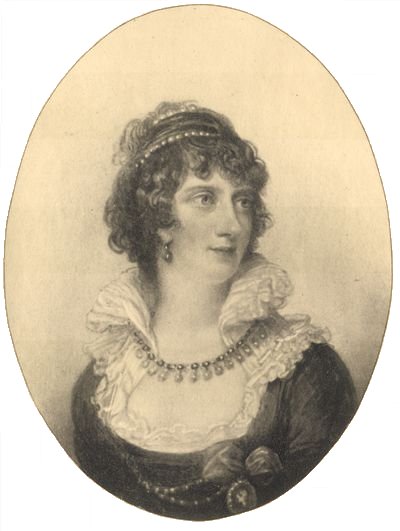
WILLIAMINA STUART From the miniature by Cosway.
Being aware that the young lady, who was very highly connected, had prospects of fortune far above his son's, the upright and honorable man conceived it his duty to give her parents warning that he observed a degree of intimacy which, if allowed to go on, might involve the parties in future pain and disappointment. He had heard his son talk of a contemplated excursion to the part of the country in which his neighbor's estates lay, and not doubting that Walter's real object was different from that which he announced, introduced himself with a frank statement that he wished no such affair to proceed without the express sanction of those most interested in the happiness of persons as yet too young to calculate consequences for themselves. The northern Baronet had heard nothing of the young apprentice's intended excursion, and appeared to treat the whole business very lightly. He thanked Mr. Scott for his scrupulous attention—but added that he believed he was mistaken; and this paternal interference, which Walter did not hear of till long afterwards, produced no change in his relations with the object of his growing attachment.