A RECORD OF THE SUFFERINGS OF THE IMPRISONED COUNTESS LEONORA CHRISTINA.
F. E. (Fanny Elizabeth) Bunnett translation
PREFACE. TO MY CHILDREN.
Beloved children, I may indeed say with Job, ‘Oh, that my grief were thoroughly weighed, and my calamity laid in the balances together! For now it would be heavier than the sand of the sea.’ My sufferings are indeed great and many; they are heavy and innumerable. My mind has long been uncertain with regard to this history of my sufferings, as I could not decide whether I ought not rather to endeavour to forget them than to bear them in memory. At length, however, certain reasons have induced me, not only to preserve my sorrow in my own memory, but to compose a record of it, and to direct it to you, my dear children.[54]
The first of these reasons is the remembrance of the omnipotence of God; for I cannot recall to mind my sorrow and grief, my fears and distresses, without at the same time remembering the almighty power of God, who in all my sufferings, my misery, my affliction, and anxiety, has been my strength and help, my consolation and assistance; for never has God laid a burden upon me, without at the same time giving me strength in proportion, so that the burden, though it has weighed me down and heavily oppressed me, has not overwhelmed me and crushed me; for which I praise and extol through eternity the almighty power of the incomprehensible God.
I wish, therefore, not alone to record my troubles and to thank God for His gracious support in all the misfortunes that have befallen me, but also to declare to you, my dear children, God’s goodness to me, that you may not only admire with me the inconceivable help of the Almighty, but that you may be able to join with me in rendering Him thanks. For you may say with reason that God has dealt wonderfully with me; that He was mighty in my weakness and has shown His power in me, the frailest of His instruments. For how would it have been possible for me to resist such great, sudden, and unexpected misfortunes, had not His spirit imparted to me strength? It was God who Himself entered with me into the Tower-gate; it was He who extended to me His hand, and wrestled for me in that prison cell for malefactors, which is called ‘the Dark Church.’
Since then, now for almost eleven years, He has always been within the gate of my prison as well as of my heart; He has strengthened me, comforted me, refreshed me, and often even cheered me. God has done wonderful things in me, for it is more than inconceivable that I should have been able to survive the great misfortunes that have befallen me, and at the same time should have retained my reason, sense, and understanding. It is a matter of the greatest wonder that my limbs are not distorted and contracted from lying and sitting, that my eyes are not dim and even wholly blind from weeping, and from smoke and soot; that I am not short-breathed from candle smoke and exhalation, from stench and close air. To God alone be the honour!
The other cause that impels me is the consolation it will be to you, my dear children, to be assured through this account of my sufferings that I suffer innocently; that nothing whatever has been imputed to me, nor have I been accused of anything for which you, my dear children, should blush or cast down your eyes in shame. I suffer for having loved a virtuous lord and husband, and for not having abandoned him in misfortune. I was suspected of being privy to an act of treason for which he has never been prosecuted according to law, much less convicted of it, and the cause of the accusation was never explained to me, humbly and sorrowfully as I desired that it should be. Let it be your consolation, my dear children, that I have a gracious God, a good conscience, and can boldly maintain that I have never committed a dishonourable act. ‘This is thankworthy,’ says the apostle St. Peter, ‘if a man for conscience toward God endure grief, suffering wrongfully.’ I suffer, thank God, not for my misdeeds, for that were no glory to me; yet I can boast that from my youth up I have been a bearer of the cross of Christ, and had incredibly secret sufferings, which were very heavy to endure at such an early age.
Although this record of my sufferings contains and reveals nothing more than what has occurred to me in this prison, where I have now been for eleven years, I must not neglect in this preface briefly to recall to your minds, my dear children, my earlier misfortunes, thanking God at the same time that I have overcome them.
Not only you, my dear children, know, but it is known throughout the whole country, what great sorrow and misfortune Dina and Walter, with their powerful adherents, inflicted on our house in the year 1651.
Although I will not mention the many fatiguing and difficult journeys, the perils by sea, and various dangers which I have endured in foreign countries, I will only remind you of that journey which my lord requested me to undertake to Denmark, contrary to my wish, in the year 1657.[E1] It was winter time, and therefore difficult and dangerous. I endured scorn and persecution; and had not God given me courage and taken it from him who was to have arrested me, I should not at that time have escaped the misery of captivity.
You will remember, my dear children, what I suffered and endured during fourteen months in custody at Malmöe; how the greatest favour which His Majesty, King Charles X. of Sweden, at that time showed me, was that he left it to my free will, either to remain at liberty, taking care of our property, or to be in prison with my lord. I acknowledged the favour, and chose the latter as my duty, esteeming it a happiness to be allowed to console and to serve my anxious husband, afflicted as he subsequently was by illness. I accepted it also as a favour that I was allowed (when my lord could not do it himself on account of illness) to appear before the tribunal in his stead. What anxiety and sorrow I had for my sick lord, what trouble, annoyance and distress, the trial caused me (it was carried on daily for more than nine weeks), is known to the most high God, who was my consolation, assistance, and strength, and who inspired me with heart and courage to defend the honour of my lord in the presence of his judges.
You will probably not have forgotten how quickly one misfortune followed another, how one sorrow was scarcely past when a greater one followed in its track; we fared, according to the words of the poet:
Incidit in Scyllam, qui vult vitare Charibdin.
We escaped custody and then fell into strict captivity, without doubt by the dispensation of God, who inspired my lord with the idea of repairing, contrary to our agreement, to Copenhagen instead of Lübeck. No pen can describe how sorrowful I was when, contrary to all expectation, I met my lord in Copenhagen, when I had imagined him escaped from the power and violence of all his enemies. I expected just that which my lord did not believe would happen, but which followed immediately—namely, our arrest. The second day after my arrival (which they had waited for) we were apprehended and conveyed to Bornholm, where we were in close imprisonment for seventeen months. I have given a full description of what I suffered, and this I imagine is in your keeping, my dear children; and from it you see what I and my sick lord endured; how often I warded off greater misery, because my lord could not always brook patiently the bad treatment of the governor, Adolf Foss, who called himself Fux.
It was hard and bitter indeed to be scorned and scoffed at by a peasant’s son; to have to suffer hunger at his will, and to be threatened and harassed by him; but still harder and more bitter was it to be sick beneath his power, and to hear from him the words that even if death were on my lips no minister of God’s word should come to me. Oh monstrous tyranny! His malice was so thoroughly beyond all bounds, that he could not endure that we should lighten each other’s cross; and for this reason he contrived, after the lapse of eleven months, to have us separated from each other, and to place us each in the hardest confinement.
My husband (at that time already advancing in years) without a servant, and I without an attendant, was only allowed a light so long as the evening meal lasted. I cannot forbear bitterly recalling to mind the six months of long and hard separation, and the sad farewell which we took of each other; for to all human sight there was no other prospect than that which the governor announced to us—namely, that we were seeing and speaking with each other for the last time in this world. God knows best how hard our sufferings were, for it was He who consoled us, who gave us hope contrary to all expectation, and who inspired me with courage when the governor visited me and endeavoured to fill me with despair.
God confirmed my hope. Money and property loosened the bonds of our captivity, and we were allowed to see and speak with each other once more. Sad as my lord had been when we were separated at Borringholm, he was joyous when two years afterwards he persuaded me to undertake the English journey, not imagining that this was to part us for ever. My lord, who entertained too good an opinion of the King of England, thought that now that he had come to the throne he would remember not only his great written and spoken promises, but that he would also bear in mind how, at the time of his need and exile, I had drawn the rings from my fingers and had pawned them for meals for him and his servants. But how unwillingly I undertook this journey is well known to some of you, my dear children, as I was well aware that from an ungrateful person there is nothing else to be expected but ingratitude. I had the example of others by whom to take warning; but it was thus destined to be.
Bitter bread was in store for me, and bitter gall was to fill my cup in the Blue Tower of Copenhagen Castle; thither was I to go to eat it and drink it out. It is not unknown to you how falsely the King of England acted towards me; how well he received me on my arrival; how he welcomed me with a Judas kiss and addressed me as his cousin; and how both he himself and all his high ministers assured me of the royal favour, and promised me payment of the money advanced. You know how cunningly (at the desire of His Majesty the King of Denmark) he had me arrested at Dover, and subsequently sent me word through the traitor Lieutenant Braten that he would let me escape secretly, at the same time delivering me into the hand of the Danish Minister Simon Petcon, who had me arrested by eight armed men; keeping aloof, however, himself, and never venturing to come near me. They held sword and pistol to my breast, and two of them took me between them and placed me in a boat, which conveyed me to a vessel held in readiness by the said Minister; a man of the name of Peter Dreyer having received orders to conduct me to Copenhagen.
From this period this record of my suffering begins. It contains all that happened to me within the gates of the Blue Tower. Reflect, my dear children, on these hard sufferings; but remember also God’s great goodness towards me. Verily, He has freed me from six calamities; rest assured that He will not leave me to perish in the seventh. No! for the honour of His name, He will mightily deliver me.
The narrative of my sufferings is sad to hear, and must move the hardest heart to pity; yet in reading it, do not be more saddened than can be counterbalanced by joy. Consider my innocence, courage, and patience; rejoice over these.
I have passed over various petty vexations and many daily annoyances for the sake of brevity, although the smallest of them rankled sore in the wounds of my bitter sorrow.
I acknowledge my weaknesses, and do not shrink from confessing them to you. I am a human being, and am full of human imperfections. Our first emotions are not under our own power; we are often overhasty before we are able to reflect. God knows that I have often made myself deaf and blind, in order not to be carried away by passion. I am ashamed to mention and to enumerate the unchaste language, bad words and coarse invectives, of the prison governor Johan Jaeger, of Kresten Maansen, the tower warder, of Karen the daughter of Ole, and of Catharina Wolff; they would offend courtly ears. Yet I can assure you they surpass everything that can be imagined as indecent, ugly, churlish and unbecoming; for coarse words and foul language were the tokens of their friendliness and clemency, and disgusting oaths were the ornament and embellishment of their untruthfulness; so that their intercourse was most disagreeable to me. I was never more glad than when the gates were closed between me and those who were to guard me. Then I had only the woman alone, whom I brought to silence, sometimes amicably, and at others angrily and with threats.
I have also had, and have still, pleasant intercourse with persons whose services and courtesies I shall remember as long as I live. You, my dear children, will also repay them to every one as far as you are able.
You will find also in this record of my sufferings two of the chief foes of our house, namely Jörgen Walter and Jörgen Skröder,[E2] with regard to whom God has revenged me, and decreed that they should have need of me, and that I should comfort them. Walter gives me cause to state more respecting him than was my intention.
Of the psalms and hymns which I have composed and translated, I only insert a few, in order that you, my dear children, may see and know how I have ever clung steadfastly to God, who has been and still is my wall of defence against every attack, and my refuge in every kind of misfortune and adversity. Do not regard the rhymes; they are not according to the rules which poets make; but regard the matter, the sense, and the purport. Nor have I left my other small pastime unmentioned, for you may perceive the repose of my mind from the fact that I have had no unemployed hours; even a rat, a creature so abominable to others, affording me amusement.
I have recorded two observations, which though they treat of small and contemptible animals, yet are remarkable, and I doubt whether any naturalist hitherto has observed them. For I do not think it has been recorded hitherto that there exists a kind of caterpillar which brings forth small living grubs like itself, nor either that a flea gives birth to a fully-formed flea, and not that a nit comes from a nit.[55]
In conclusion, I beg you, my dear children, not to let it astonish you that I would not avail myself of the opportunity by which I might have gained my freedom. If you rightly consider it, it would not have been expedient either for you or me. I confess that if my deceased lord had been alive, I should not only have accepted the proposal, but I should have done my utmost to have escaped from my captivity, in order to go in quest of him, and to wait on him and serve him till his last breath; my duty would have required this. But since he was at that time in rest and peace with God, and needed no longer any human service, I have with reason felt that self-obtained liberty would have been in every respect more prejudicial than useful to us, and that this would not be the way to gain the possessions taken from us, for which reason I refused it and endeavoured instead to seek repose of mind and to bear patiently the cross laid upon me. If God so ordains it, and it is His divine will that through royal mercy I should obtain my freedom, I will joyfully exert myself for you, my beloved children, to the utmost of my ability, and prove in deed that I have never deviated from my duty, and that I am no less a good and right-minded mother than I have been a faithful wife. Meanwhile let God’s will be your will. He will turn and govern all things so that they may benefit you and me in soul and body, to whose safe keeping I confidently recommend you all, praying that He will be your father and mother, your counsellor and guide. Pray in return for me, that God may direct me by His good spirit, and grant me patience in the future as heretofore. This is all that is requested from you by,
My dearly beloved children, your affectionate mother,
Leonora Christina, V.E.G.
Written in the Blue Tower, anno 1674, the 18th of July, the eleventh year of imprisonment, my birthday, and fifty-third year of my age.[56]
I bear also in mind, with the greatest humility and gratitude, our gracious hereditary King’s favour towards me, immediately after His Majesty came to the throne. I remember also the sympathy of our most gracious Queen Regent, and of Her Highness the Electoral Princess of Saxony in my unfortunate fate; also the special favour of Her Majesty the Queen.
I have also not forgotten to bear duly in mind the favour shown towards me by Her Majesty the Queen Mother, the virtuous Landgravine of Hesse.
I have also recorded various things which occurred in my imprisonment during the period from the year 1663 to the year 1674, intending with these to conclude the record of my sufferings; as I experienced a pleasure, and often consoled myself, in feeling that it is better to remain innocently in captivity than to be free and to have deserved imprisonment. I remember having read that captivity has served many as a protection from greater dangers, and has guarded them from falling into the hands of their enemies. There have been some who have escaped from their prison and immediately after have been murdered. There have also been some who have had a competence in prison and afterwards have suffered want in freedom. Innocent imprisonment does not diminish honour, but rather increases it. Many a one has acquired great learning in captivity, and has gained a knowledge of things which he could not master before. Yes, imprisonment leads to heaven. I have often said to myself: ‘Comfort thyself, thou captive one, thou art happy.’
Since the year 1674 constituted only half the period of my captivity, I have added in this record of my sufferings some facts that occurred since that time within my prison-gates. I am on the eve of my liberty, May 19, 1685. To God alone be the honour, who has moved His Royal Majesty to justice! I will here mention those of whose death I have been informed during my captivity.
1. The Prime Minister of His Majesty, Count Christian of Rantzow[E3], died in the month of September, 1663. He did not live to drink the health of our Princess and of the Electoral Prince of Saxony at the feast of their betrothal. Still less did he live long enough to see a wooden effigy quartered in mockery of my lord, according to his suggestion. Death was very bitter to him.
2. The Mistress of the Robes of the Queen Dowager, who was so severe on me in my greatest sorrow, had a long and painful illness; she said with impatience that the pain of hell was not greater than her pain. Her screams could often be heard in the tower. She was carried on a bed into the town, and died there.
3. The death of Able Catherine was very painful. As she had formerly sought for letters on the private parts of my person, so she was afterwards herself handled by the surgeons, as she had boils all over her. She was cut and burnt. She endured all this pain, hoping to live, but neither the art of the surgeons nor the visits of the Queen could save her from death.[E4]
4. Secretary Erich Krag, who had displayed the malice of his heart in my imprisonment in the ‘Dark Church,’ was snatched away by death in a place of impurity. He was lively and well, had invited guests to dinner, sat and wrote at his table, went out to obey the necessities of nature, and was found dead by his attendants when they had waited some time for him.
5. Major-General Fridrich von Anfeldte,[E5] who had more than once manifested his delight at my misfortunes, died as he had lived. He was a godless man and a blasphemer. He fell a victim to jealousy, and went mad, because another obtained an honorary title which he had coveted; this was indeed little enough to deprive him of sense and reason. He would hear nothing of God, nor would he be reconciled with God. Both Queens, the Queen Dowager and the Queen Regent, persuaded him at length to be so. When he had received the sacrament, he said, ‘Now your Majesties have had your desire; but what is the good of it?’ He continued to curse and to swear, and so died.
6. General Schak died after a long illness.
7. Chancellor Peter Retz likewise.
8. His Royal Majesty King Friedrich III.’s death accelerated the death of the Stadtholder Cristoffer Gabel. He felt that the hate of the Queen Dowager could injure him greatly, and he desired death. God heard him.[E6]
9. It has pleased God that I should be myself a witness of Walter’s miserable death; indeed, that I should compassionate him. When I heard him scream, former times came to my mind, and I often thought how a man can allow himself to be led to do evil to those from whom he had only received kindness and honour.
10. Magister Buch, my father-confessor, who acted so ill to me, suffered much pain on his bed of languishing. He was three days speechless before he died.
11. When the rogue and blasphemer, Christian, who caused me so much annoyance in my captivity, had regained his liberty and returned to his landlord, Maans Armfeld in Jutland, he came into dispute with the parish priest, who wanted him to do public penance for having seduced a woman. The rogue set fire to the parsonage; the minister’s wife was burnt to death in trying to save some of her property, and all the minister’s possessions were left in ashes. The minister would not bring the rogue to justice. He commended him to the true Judge, and left vengeance to Him. The incendiary’s conscience began to be awakened; for a long time he lived in dread, and was frightened if he saw anyone coming at all quickly, and he would call out and say tremblingly, ‘Now they are going to take me!’ and would run hither and thither, not knowing where to go. At length he was found dead on the field, having shot himself; for a long rifle was found lying between his legs, the barrel towards his breast, and a long ramrod in his hand, with which he had touched the trigger. He did not, therefore, die in as Christian a manner as if he had perished under the hand of the executioner, of which he had so lightly said that he should not care for it at all, so long as he could bring someone else into trouble.
A RECORD OF SUFFERING;
OR, A REMINISCENCE OF ALL THAT OCCURRED TO ME, LEONORA CHRISTINA, IN THE BLUE TOWER, FROM AUGUST 8 OF THE YEAR 1663, TO JUNE 11[57] OF THE YEAR 1674.
The past is rarely remembered without sorrow, for it has been either better or worse than the present. If it was more joyous, more happy, and full of honour, its remembrance justly saddens us, and in proportion as the present is full of care, unhappiness, and dishonour. If past times were sadder, more miserable, and more deplorable than the present, the remembrance of them is equally sorrowful, for we recover and feel once more all the past misfortunes and adversities which have been endured in the course of time. But all things have, as it were, two handles by which they may be raised, as Epictetus says. The one handle, he says, is bearable; the other is not bearable; and it rests with our will which handle we grasp, the bearable or the unbearable one. If we grasp the bearable one, we can recall all that is transitory, however sad and painful it may have been, rather with joy than with sorrow.[E7] So I will seize the bearable handle, and in the name of Jesus I will pass rapidly through my memory, and recount all the wretchedness and misery, all the grief, scorn and suffering, contempt and adversity, which have befallen me in this place, and which I have overcome with God’s help. I will, moreover, in no wise grieve over it; but, on the contrary, I will remind myself at every step of the goodness of God, and will thank the Most High who has been constantly near me with His mighty help and consolation; who has ruled my heart, that it should not depart from God; who has preserved my mind and my reason, that it has not become obscured; who has maintained my limbs in their power and natural strength, and even has given, and still gives me, repose of mind and joyfulness. To Thee, incomprehensible God, be honour and praise for ever!
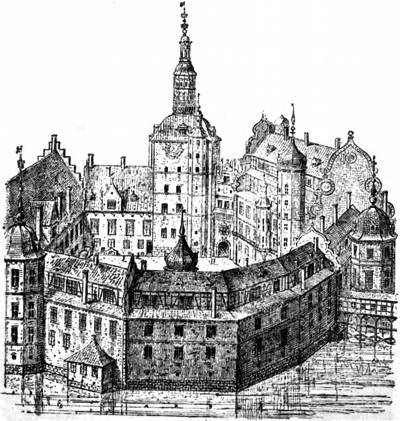
DAS ALTE SCHLOSS IN COPENHAGEN MIT DEM BLAUEN THURM. THE OLD CASTLE OF COPENHAGEN. SHOWING THE BLUE TOWER IN THE MIDDLE OF THE BACK-GROUND.
And now to proceed with my design. I consider it necessary to begin the record of my sufferings with the commencement of the day which concluded with the fatal evening of my captivity, and to mention somewhat of that which befell me on the vessel. After the captain had cast anchor a little outside the pier of St. Anna, on August 8, 1663, at nine o’clock in the forenoon, he was sent on shore with letters by Peter Dreyer, who was commissioned by Petcon, at that time the minister resident in England, of his Majesty the King of Denmark, to take charge of me. I dressed myself and sat down in one of the cabins of the sailors on the deck, with a firm resolution to meet courageously all that lay before me;[58] yet I in no wise expected what happened; for although I had a good conscience, and had nothing evil with which to reproach myself, I had at various times asked the before-mentioned Peter Dreyer the reason why I had been thus brought away. To this question he always gave me the reply which the traitor Braten had given me at Dover (when I asked of him the cause of my arrest); namely, that I was, perhaps, charged with the death of Major-General Fux, and, that it was thought I had persuaded my son to slay him; saying, that he knew of no other cause. At twelve o’clock Nils Rosenkrantz, at that time Lieutenant-Colonel, and Major Steen Anderson Bilde, came on board with some musketeers. Lieutenant-Colonel Rosenkrantz did not salute me. The Major walked up and down and presently passed near me. I asked him, en passant, what was the matter? He gave me no other answer than, ‘Bonne mine, mauvais jeu;’ which left me just as wise as before. About one o’clock Captain Bendix Alfeldt came on board with several more musketeers, and after he had talked some time with Peter Dreyer, Dreyer came to me and said, ‘It is ordered that you should go into the cabin.’ I said, ‘Willingly;’ and immediately went. Soon after, Captain Alfeldt came in to me, and said he had orders to take from me my letters, my gold, silver, money, and my knife. I replied, ‘Willingly.’ I took off my bracelets and rings, gathered in a heap all my gold, silver, and money, and gave it to him. I had nothing written with me, except copies of the letters which I had addressed to the King of England, notes respecting one thing or another relating to my journey, and some English vocabularies; these I also gave up to him. All these Alfeldt placed in a silver utensil which I had with me, sealed it in my presence, and left the vessel with it. An hour, or somewhat more, afterwards, Major-General Friderich von Anfeldt,[59] Commandant in Copenhagen, arrived, and desired that I should come to him outside the cabin. I obeyed immediately. He greeted me, gave me his hand, and paid me many compliments, always speaking French. He was pleased to see me in health, he feared the sea might have inconvenienced me; I must not allow the time to seem long to me; I should soon be accommodated otherwise. I caught at the last word and said, smiling, ‘Monsieur says otherwise, but not better.’ ‘Yes, indeed,’ he replied, ‘you shall be well accommodated; the noblest in the kingdom will visit you.’ I understood well what he meant by this, but I answered: ‘I am accustomed to the society of great people, therefore that will not appear strange to me.’ Upon this, he called a servant and asked for the before-mentioned silver utensil (which Captain Alfeldt had taken away with him). The paper which Captain Alfeldt had sealed over it was torn off. The Major-General turned to me, and said: ‘Here you have your jewels, your gold, silver, and money back; Captain Alfeldt made a mistake—they were only letters which he had orders to demand, and these only have been taken out, and have been left at the Castle; you may dispose of the rest as you wish yourself.’ ‘In God’s name,’ I answered, ‘am I, therefore, at liberty to put on again my bracelets and rings?’ ‘O Jesus,’ he said, ‘they are yours; you may dispose of them as you choose.’ I put on the bracelets and rings, and gave the rest to my attendant. The Major-General’s delight not only appeared in his countenance, but he was full of laughter, and was overflowing with merriment. Among other things he said that he had had the honour of making the acquaintance of two of my sons; that he had been in their society in Holland; and he praised them warmly. I complimented him in return, as was proper, and I behaved as if I believed that he was speaking in good faith. He indulged in various jokes, especially with my attendant; said that she was pretty, and that he wondered I could venture to keep such a pretty maiden; when Holstein ladies kept pretty maids it was only to put their husbands in good humour; he held a long discourse on how they managed, with other unmannerly jests which he carried on with my attendant. I answered nothing else than that he probably spoke from experience. He said all kinds of foolish jokes to my servant, but she did not answer a word. Afterwards the prison governor told me that he (von Anfeldt) had made the King believe, at first, that my attendant was my daughter, and that the King had been long of that opinion. At length, after a long conversation, the Major-General took his leave, saying that I must not allow the time to seem long to me; that he should soon come again; and he asked what he should say to his Majesty the King. I begged him to recommend me in the best manner to their Majesties’ favour, adding that I knew not well what to say or for what to make request, as I was ignorant of what intentions they had with regard to me. Towards three o’clock Major-General von Anfeldt returned; he was full of laughter and merriment, and begged me to excuse him for being so long away. He hoped the time had not appeared long to me; I should soon get to rest; he knew well that the people (with this he pointed to the musketeers, who stood all along both sides of the vessel) were noisy, and inconvenienced me, and that rest would be best for me. I answered that the people did not inconvenience me at all; still I should be glad of rest, since I had been at sea for thirteen days, with rather bad weather. He went on with his compliments, and said that when I came into the town his wife would do herself the honour of waiting on me, and, ‘as it seems to me,’ he continued, ‘that you have not much luggage with you, and perhaps, not the clothes necessary, she will procure for you whatever you require.’ I thanked him, and said that the honour was on my side if his wife visited me, but that my luggage was as much as I required at the time; that if I needed anything in the future, I hoped she might be spared this trouble; that I had not the honour of knowing her, but I begged him, nevertheless, to offer her my respects. He found various subjects of discourse upon Birgitte Speckhans[E8] and other trifles, to pass away the time; but it is not worth the trouble to recall them to mind, and still less to write them down. At last a message came that he was to conduct me from the vessel, when he said to me with politeness: ‘Will it please you, madame, to get into this boat, which is lying off the side of the ship?’ I answered, ‘I am pleased to do anything that I must do, and that is commanded by His Majesty the King.’ The Major-General went first into the boat, and held out his hand to me; the Lieutenant-Colonel Rosenkrantz, Captain Alfeldt, Peter Dreyer, and my attendant, went with me in the boat. And as a great crowd of people had assembled to look at the spectacle, and many had even gone in boats in order to see me as they wished, he never took his eyes off me; and when he saw that I turned sometimes to one side and sometimes to another, in order to give them this pleasure, he said, ‘The people are delighted.’ I saw no one truly who gave any signs of joy, except himself, so I answered, ‘He who rejoices to-day, cannot know that he may not weep to-morrow; yet I see, that, whether for joy or sorrow, the people are assembling in crowds, and many are gazing with amazement at one human being.’ When we were advanced a little further, I saw the well-known wicked Birgitte Ulfeldt,[E9] who exhibited great delight. She was seated in an open carriage; behind her was a young man, looking like a student. She was driving along the shore. When I turned to that side, she was in the carriage and laughed with all her might, so that it sounded loudly. I looked at her for some time, and felt ashamed of her impudence, and at the disgrace which she was bringing on herself; but for the rest, this conduct did not trouble me more than the barking of the dogs, for I esteemed both equally.[60] The Major-General went on talking incessantly, and never turned his eyes from me; for he feared (as he afterwards said) that I should throw myself into the water. (He judged me by himself; he could not endure the change of fortune, as his end testified, for it was only on account of an honorary title which another received in his stead that he lost his mind. He did not know that I was governed by another spirit than he, which gave me strength and courage, whilst the spirit he served led him into despair.[61]) When the boat arrived at the small pier near the office of the Exchequer, Captain Alfeldt landed and gave me his hand, and conducted me up towards the castle bridge. Regiments of horse and foot were drawn up in the open place outside the castle; musketeers were standing on both sides as I walked forwards. On the castle bridge stood Jockum Walburger, the prison governor, who went before me; and as the people had placed themselves in a row on either side up to the King’s Stairs, the prison governor made as if he were going thither; but he turned round abruptly, and said to Alfeldt, ‘This way,’ and went to the gate of the Blue Tower; stood there for some time and fumbled with the key; acted as if he could not unlock it, in order that I might remain as long as possible a spectacle to the people. And as my heart was turned to God, and I had placed all my confidence in the Most High, I raised my eyes to heaven, sought strength, power, and safety from thence, and it was graciously vouchsafed me. (One circumstance I will not leave unnoticed—namely, that as I raised my eyes to heaven, a screaming raven flew over the Tower, followed by a flock of doves, which were flying in the same direction.) At length, after a long delay, the prison governor opened the Tower gate, and I was conducted into the Tower by the before-mentioned Captain Alfeldt. My attendant, who was preparing to follow me, was called back by Major-General von Anfeldt, and told to remain behind. The prison governor went up the stairs, and showed Alfeldt the way to a prison for malefactors, to which the name of the ‘Dark Church’ has been given. There Alfeldt quitted me with a sigh and a slight reverence. I can truly say of him that his face expressed pity, and that he obeyed the order unwillingly. The clock was striking half-past five when Jockum closed the door of my prison. I found before me a small low table, on which stood a brass candlestick with a lighted candle, a high chair, two small chairs, a fir-wood bedstead without hangings and with old and hard bedding, a night-stool and chamber utensil. At every side to which I turned I was met with stench; and no wonder, for three peasants who had been imprisoned here, and had been removed on that very day, and placed elsewhere, had used the walls for their requirements. Soon after the door had been closed, it was opened again, and there entered Count Christian Rantzow, Prime Minister, Peter Zetz, Chancellor, Christoffer von Gabel, at that time Chancellor of the Exchequer, and Erich Krag, at that time Secretary, all of whom gave me their hands with civility. The Chancellor spoke and said: ‘His Royal Majesty, my gracious master and hereditary king, sends you word, madame, that His Majesty has great cause for what he is doing against you, as you will learn.’ I replied: ‘It is much to be regretted by me, if cause should be found against me; I will, however, hope that it may not be of such a kind that His Majesty’s displeasure may be lasting. When I know the cause I can defend myself.’ Count Rantzow answered: ‘You will obtain permission to defend yourself.’ He whispered something to the Chancellor, upon which the Chancellor put a few questions: first, Whether on my last journey I had been in France with my husband? To which I answered in the affirmative. Then, What my husband was doing there? To which I replied, that he was consulting physicians about his health, whether it would be serviceable to him to use the warm baths in the country, which no one would advise him to do; he had even been dissuaded from trying them by a doctor in Holland of the name of Borro,[E10] when he had asked his opinion. Thirdly, What I had purposed doing in England? To this I replied that my intention had been to demand payment of a sum of money which the King of England owed us, and which we had lent him in the time of his misfortune. Fourthly, Who had been in England with me? I mentioned those who were with me in England—namely, a nobleman named Cassetta, my attendant who had come hither with me, a lacquey named Frantz, who had remained in England, and the nobleman’s servant. Fifthly, Who visited my husband in Bruges? I could not exactly answer this, as my lord received his visits in a private chamber, where I was not admitted. Count Rantzow said, ‘You know, I suppose, who came to him oftenest?’ I answered, that the most frequent visitors among those I knew were two brothers named Aranda,[E11] the before-mentioned Cassetta, and a nobleman named Ognati. Sixthly the Chancellor asked, With whom I had corresponded here in the country? To which I answered, that I had written to H. Hendrick Bielcke, to Olluff Brockenhuuss, Lady Elsse Passberg, and Lady Marie Ulfeldt;[E12] I did not remember any more. Count Rantzow enquired if I had more letters than those which I had given up? To which I answered in the negative, that I had no more. He asked further, Whether I had more jewels with me than those he had seen? I answered that I had two strings of small round pearls on my hat, and a ring with a diamond, which I had given a lieutenant named Braten in Dover (it was he who afterwards betrayed me). Count Rantzow asked, How much the pearls might have been worth? This I could not exactly say. He said, that he supposed I knew their approximate value. I said they might be worth 200 rix-dollars, or somewhat more. Upon this they were all silent for a little. I complained of the severity of my imprisonment, and that I was so badly treated. Count Rantzow answered, ‘Yes Madame, His Royal Majesty has good cause for it; if you will confess the truth, and that quickly, you may perhaps look for mercy. Had Maréchal de Birron[E13] confessed the matter respecting which he was interrogated by order of the King, when the royal mercy was offered to him if he would speak the truth, it would not have fared with him as it did. I have heard as a truth that the King of France would have pardoned him his crime, had he confessed at once; therefore, bethink yourself, madame!’ I answered, ‘Whatever I am asked by order of His Majesty, and whatever I am cognizant of, I will gladly say in all submission.’ Upon this Count Rantzow offered me his hand, and I reminded him in a few words of the severity of my imprisonment. Count Rantzow promised to mention this to the King. Then the others shook hands with me and went away. My prison was closed for a little. I therefore profited by the opportunity, and concealed here and there in holes, and among the rubbish, a gold watch, a silver pen which gave forth ink and was filled with ink, and a scissor-sheath worked with silver and tortoiseshell. This was scarcely done when the door was again opened, and there entered the Queen’s Mistress of the Robes, her woman of the bed-chamber, and the wife of the commissariat clerk, Abel Catharina. I knew the last. She and the Queen’s woman of the bed-chamber carried clothes over their arm; these consisted of a long dressing-gown stitched with silk, made of flesh-coloured taffeta and lined with white silk, a linen under-petticoat, printed over with a black lace pattern, a pair of silk stockings, a pair of slippers, a shift, an apron, a night-dress, and two combs. They made me no greeting. Abel Cath. spoke for them, and said: ‘It is the command of Her Majesty the Queen that we should take away your clothes, and that you should have these in their place.’ I answered, ‘In God’s name!’ Then they removed the pad from my head, in which I had sown up rings and many loose diamonds. Abel Cath. felt all over my head to see if anything was concealed in my hair; then she said to the others, ‘There is nothing there; we do not require the combs.’ Abel Cath. demanded the bracelets and rings, which were a second time taken from me. I took them off and gave them to them, except one small ring which I wore on the last joint of my little finger, and which could not be worth more than a rix-dollar, this I begged to be allowed to keep. ‘No,’ said the Mistress of the Robes, ‘You are to retain nothing.’ Abel Cath. said, ‘We are strictly forbidden to leave you the smallest thing; I have been obliged to swear upon my soul to the Queen that I would search you thoroughly, and not leave you the smallest thing; but you shall not lose it; they will all be sealed up and kept for you, for this I swear the Queen has said.’ ‘Good, good, in God’s name!’ I answered. She drew off all my clothes. In my under-petticoat I had concealed some ducats under the broad gold lace; there was a small diamond ornament in my silk camisole, in the foot of my stockings there were some Jacobuses’, and there were sapphires in my shoes. When she attempted to remove my chemise, I begged to be allowed to retain it. No; she swore upon her soul that she dared not. She stripped me entirely, and the Mistress of the Robes gave Abel Cath. a nod, which she did not at once understand; so the Mistress of the Robes said: ‘Do you not remember your orders?’ Upon this, Abel Cath. searched my person still more closely, and said to the lady in waiting: ‘No, by God! there is nothing there.’ I said: ‘You act towards me in an unchristian and unbecoming manner.’ Abel Cath. answered: ‘We are only servants; we must do as we are ordered; we are to search for letters and for nothing else; all the rest will be given back to you; it will be well taken care of.’ After they had thus despoiled me, and had put on me the clothes they had brought, the servant of the Mistress of the Robes came in and searched everywhere with Abel Cath., and found every thing that I had concealed. God blinded their eyes so that they did not observe my diamond earrings, nor some ducats which had been sown into leather round one of my knees; I also saved a diamond worth 200 rix-dollars; while on board the ship I had bitten it out of the gold, and thrown the gold in the sea; the stone I had then in my mouth.[62]
The Mistress of the Robes was very severe; they could not search thoroughly enough for her. She laughed at me several times, and could not endure that I sat down, asking whether I could not stand, and whether anything was the matter with me. I answered, ‘There is only too much the matter with me, yet I can stand when it is necessary.’ (It was no wonder that the Mistress of the Robes could so well execute the order to plunder, for she had frequently accompanied her deceased husband. Colonel Schaffshaussen[E14], in war.) When she had searched every part thoroughly, they took all my clothes, except a taffeta cap for the head, and went away. Then the prison governor came in with his hat on, and said, ‘Leonora, why have you concealed your things?’ I answered him not a word; for I had made the resolution not to answer him, whatever he might say; his qualities were known to me; I was aware that he was skilful in improving a report, and could twist words in the manner he thought would be acceptable, to the damage of those who were in trouble. He asked again with the same words, adding ‘Do you not hear?’ I looked at him over my shoulder, and would not allow his disrespect to excite me. The table was then spread, and four dishes were brought in, but I had no appetite, although I had eaten little or nothing the whole day.
An hour afterwards, when the dishes had been carried away, a girl came in named Maren Blocks, and said that she had orders from the Queen to remain the night with me. The prison governor joked a good deal with the before-mentioned Maren, and was very merry, indulging in a good deal of loose talk. At last, when it was nearly ten o’clock, he said good night and closed the two doors of my prison, one of which is cased with copper. When Maren found herself alone with me, she pitied my condition, and informed me that many, whom she mentioned by name (some of whom were known to me) had witnessed my courage with grief and tears, especially the wife of H. Hendrick Bielcke[E12b], who had fainted with weeping. I said, ‘The good people have seen me in prosperity; it is no wonder that they deplore the instability of fortune;’ and I wished that God might preserve every one of those from misfortune, who had taken my misfortune to heart. I consoled myself with God and a good conscience; I was conscious of nothing wrong, and I asked who she was, and whom she served? She said she was in the Queen’s private kitchen, and had the silver in her keeping (from which I concluded that she had probably to clean the silver, which was the case). She said that the Queen could get no one who would be alone with me, for that I was considered evil; it was said also that I was very wise, and knew future events. I answered, ‘If I possessed this wisdom, I scarcely think that I should have come in here, for I should then have been able to guard myself against it.’ Maren said we might know things and still not be able to guard against them.
She told me also that the Queen had herself spoken with her, and had said to her, ‘You are to be this night with Leonora; you need not be afraid, she can now do no evil. With all her witchcraft she is now in prison and has nothing with her; and if she strikes you, I give you leave to strike her back again till the blood comes.’ Maren said also, ‘The Queen knows well that my mind has been affected by acute illness, and therefore she wished that I should be with you.’ So saying she threw her arms round my neck as I was sitting, and caressed me in her manner, saying, ‘Strike me, dear heart, strike me!’ ‘I will not,’ she swore, ‘strike again.’ I was rather alarmed, fearing that the frenzy might come on. She said further that when she saw me coming over the bridge, she felt as if her heart would burst. She informed me with many words how much she loved me, and how the maid of honour, Carisius, who was standing with her in the window, had praised me, and wished to be able to do something for my deliverance, with many such words and speeches. I accepted the unusual caress, as under the circumstances I could not help it, and said that it would be contrary to all justice to offer blows to one who manifested such great affection as she had done, especially to one of her sex; adding, that I could not think how the Queen had imagined that I struck people, as I had never even given a box on the ears to a waiting-woman. I thanked her for her good opinion of me, and told her that I hoped all would go well, dark as things looked; that I would hold fast to God, who knew my innocence, and that I had done nothing unjustifiable; that I would commend my cause to Him, and I did not doubt that He would rescue me: if not immediately He would do so some day, I was well assured.
Maren began to speak of different things; among others of my sister Elizabeth Augusta[E15], how she had sat in her porch as I had been conveyed past as a prisoner, and had said that if I were guilty there was nothing to say against it, but that if I were innocent they were going too far. I said nothing to this, nor did I answer anything to much other tittle-tattle. She began to speak of her own persecution, which she did with great diffuseness, interspersing it with other stories, so that the conversation (in the present circumstances) was very wearisome to me; I was besides very tired, and worn out with care, so I said I would try to sleep and bid her good-night. My thoughts prevented me from sleeping. I reflected on my present condition, and could in no wise reconcile myself to it, or discover the cause of such a great misfortune. It was easy to perceive that somewhat besides Fux’s death was imputed to me, since I was treated with such disrespect.
When I had long lain with my face to the wall, I turned round and perceived that Maren was silently weeping, so I asked her the reason of her tears. She denied at first that she was crying, but afterwards confessed that she had fallen into thinking over this whole affair. It had occurred to her that she had heard so much of Lady Leonora and her splendour, &c., of how the King loved her, and how every one praised her, &c., and now she was immured in this execrable thieves’ prison, into which neither sun nor moon shone, and where there was a stench enough to poison a person only coming in and out, far more one who had to remain in it. I thought the cause of her weeping was that she should be shut up with me in the terrible prison; so I consoled her, and said that she would only remain with me until another had been fixed upon, since she was in other service; but that I for my part did not now think of past times, as the present gave me sufficient to attend to; if I were to call to mind the past, I would remember also the misfortunes of great men, emperors, kings, princes, and other high personages, whose magnificence and prosperity had far exceeded mine, and whose misfortunes had been far greater than mine; for they had fallen into the hands of tyrants, who had treated them inhumanly, but this king was a Christian king, and a conscientious man, and better thoughts would occur to him when he had time to reflect, for my adversaries now left him no leisure to do so. When I said this, she wept even more than before, but said nothing, thinking in herself (as she declared to me some days afterwards) that I did not know what an infamous sentence had been pronounced upon my late lord,[E16] and weeping all the more because I trusted the King so firmly. Thus we went on talking through the night.
On the morning of August 9, at six o’clock, the prison governor came in, bade me good morning, and enquired whether we would have some brandy. I answered nothing. He asked Maren whether I was asleep; she replied that she did not know, came up to my bed, and put the same question to me. I thanked her, adding that it was a kind of drink which I had never tasted. The prison governor chattered with Maren, was very merry considering the early hour, told her his dreams, which he undoubtedly invented merely for the sake of talking. He told her, secretly, that she was to come to the Queen, and ordered her to say aloud that she wished to go out a little. He said that he would remain with me in the meanwhile, until she returned, which he did, speaking occasionally to me, and asking me whether I wished for anything? whether I had slept? whether Maren had watched well? But he got no answer, so that the time seemed very long to him. He went out towards the stairs and came back again, sang a morning psalm, screamed out sometimes to one, and sometimes to another, though he knew they were not there.
There was a man named Jon who helped to bring up the meals with Rasmus the tower warder, and to him he called more than forty times and that in a singing tone, changing his key from high to low, and screaming occasionally as loud as he could, and answering himself ‘Father, he is not here! by God, he is not here!’ then laughing at himself; and then he began calling again either for Jon or for Rasmus, so that it seemed to me that he had been tasting the brandy. About eight o’clock Maren came back, and said that at noon two women would come to relieve her. After some conversation between the prison governor and Maren, he went out and shut the doors. Maren told me how the Queen had sent for her, and asked her what I was doing, and that she answered that I was lying down quietly, and not saying anything. The Queen had asked whether I wept much. Maren replied, ‘Yes indeed, she weeps silently.’ ‘For,’ continued Maren, ‘if I had said that you did not weep, the Queen would have thought that you had not yet enough to weep for.’ Maren warned me that one of the two women who were to watch me was the wife of the King’s shoemaker, a German, who was very much liked by the Queen. Her Majesty had employed her to attend Uldrich Christian Gyldenlöwe in the severe and raving illness of which he died, and this woman had much influence with the Queen. With regard to the other woman, Maren had no idea who she might be, but the last-mentioned had spoken with the Queen in Maren’s presence, and had said that she did not trust herself to be alone with me. The women did not come before four o’clock in the afternoon. The prison governor accompanied them, and unlocked the door for them. The first was the wife of the shoemaker, a woman named Anna, who generally would not suffer anybody else to speak. The other was the wife of the King’s groom, a woman named Catharina, also a German. After greeting me, Anna said that her Majesty the Queen had ordered them to pass a day or two with me and wait upon me. ‘In God’s name,’ I answered.
Anna, who was very officious, asked me, ‘Does my lady wish for anything? She will please only say so, and I will solicit it from the Queen.’ I thanked her, and said that I should like to have some of my clothes, such as two night-jackets, one lined with silk and another braided with white, my stomacher, something for my head, and above all my bone box of perfume, which I much needed. She said she would at once arrange this, which she did, for she went immediately and proffered my request. The things were all delivered to me by the prison governor at six o’clock, except my box of perfume, which had been lost, and in its place they sent me a tin box with a very bad kind of perfume. When the time arrived for the evening meal, Catharina spread a stool by the side of my bed, but I had no desire to eat. I asked for a lemon with sugar, and they gave it me. The prison governor sat down at the table with the two women, and did the part of jester, so much so that no one could have said that they were in a house of mourning, but rather in one of festivity. I inwardly prayed to God for strength and patience, that I might not forget myself. God heard my prayer, praised be His name. When the prison governor was tired of the idle talking and laughing, he bade good night after ten o’clock, and told the women to knock if they wanted anything, as the tower warder was just underneath. After he had locked both the doors, I got up, and Catharina made my bed. Anna had brought a prayer-book with her, from which I read the evening prayer, and other prayers for them; then I laid down and bid them good night. They laid on a settle-bed which had been brought in for them. I slumbered from time to time, but only for short intervals.
About six o’clock on the morning of August 10 the prison governor opened the door, to the great delight of the women, who were sincerely longing for him, especially Catharina, who was very stout; she could not endure the oppressive atmosphere, and was ill almost the whole night. When the prison governor, after greeting them, had inquired how it fared with them, and whether they were still alive, he offered them brandy, which they readily accepted. When it was seven o’clock, they requested to go home, which they did, but they first reported to the Queen all that had happened during the half-day and the night. The prison governor remained with me.
When it was near nine o’clock, he brought in a chair without saying anything. I perceived from this that visitors were coming, and I was not wrong; for immediately afterwards there entered Count Rantzow, prime minister, chancellor H. Peter Retz, Christoffer Gabel, the chancellor of the exchequer, and secretary Erick Krag, who all shook hands with me and seated themselves by my bed. Krag, who had paper, pen and ink with him, seated himself at the table. Count Rantzow whispered something to the chancellor. The chancellor upon this began to address me as on the previous occasion, saying that his Majesty the King had great cause for his treatment of me. ‘His Majesty,’ he went on to say, ‘entertains suspicion with regard to you, and that not without reason.’ I inquired in what the suspicion consisted. The chancellor said, ‘Your husband has offered the kingdom of Denmark to a foreign lord.’ I inquired if the kingdom of Denmark belonged to my husband, that he could thus offer it, and as no one answered, I continued and said, ‘Good gentlemen, you all know my lord; you know that he has been esteemed as a man of understanding, and I can assure you that when I took leave of him he was in perfect possession of his senses. Now it is easy to perceive that no sensible man would offer that which was not in his own power, and which he had no right to dispose of. He is holding no post, he has neither power nor authority; how should he, therefore, be so foolish as to make such an offer, and what lord would accept it?’
Count Rantzow said: ‘Nevertheless it is so, madame; he has offered Denmark to a foreign potentate; you know it well.’ I answered, ‘God is my witness that I know of no such thing.’ ‘Yes,’ said Count Rantzow, ‘your husband concealed nothing from you, and therefore you must know it.’ I replied, ‘My husband certainly never concealed from me anything that concerned us both. I never troubled myself in former days with that which related to his office; but that which affected us both he never concealed from me, so that I am sure, had he entertained any such design, he would not have held it a secret from me. And I can say, with truth, that I am not the least aware of it.’ Count Rantzow said: ‘Madame, confess it while the King still asks you to do so.’
I answered, ‘If I knew it I would gladly say so; but as truly as God lives I do not know it, and as truly am I unable to believe that my husband would have acted so foolishly, for he is a sick man. He urged me to go to England in order to demand the money that had been lent; I undertook the journey, unwillingly, chiefly because he was so very weak. He could not go up a few steps of the stairs without resting to get his breath; how should he, then, undertake a work of such labour? I can say with truth that he is not eight days without an attack, sometimes of one kind sometimes of another.’ Count Rantzow again whispered with the chancellor, and the chancellor continued: ‘Madame, say without compulsion how the matter stands, and who is privy to it; say it now, while you are asked freely to do so. His Majesty is an absolute Sovereign; he is not fettered by law; he can do as he will; say it.’ I answered: ‘I know well that his Majesty is an absolute Sovereign, and I know also, that he is a Christian and a conscientious man; therefore, his Majesty will do nothing but what he can justify before God in heaven. See, here I am! You can do with me what you will; that which I do not know I cannot say.’
Count Rantzow began again to bring forward the Maréchal de Birron, and made a long speech about it. To this I at length replied, that the Maréchal de Birron in nowise concerned me; that I had no answer to make on the matter, and that it seemed to me that it was not a case in point. Count Rantzow asked me why, when I was demanded with whom I had corresponded in the kingdom, I had not said that I had written to him and to the treasurer Gabel. To this I replied that I thought those who asked me knew it well, so that it was not necessary for me to mention it; I had only said that of which they probably did not know. Count Rantzow again whispered to the chancellor, and the chancellor said: ‘In a letter to Lady Elsse Passberg you have written respecting another state of things in Denmark,’ (as he said this, he looked at Count Rantzow and asked if it was not so, or how it was); ‘what did you mean by that, madame?’ I replied that I could not recollect what cause her letter had given me to answer it in this way; what came before or what followed, would, without a doubt, explain my meaning; if I might see the letter, it would prove at once that I had written nothing which I could not justify.
Nothing more was said with regard to it. Count Rantzow asked me what foreign ministers had been with my lord in Bruges. ‘None,’ I answered, ‘that I am aware of.’ He asked further whether any Holstein noblemen had been with him. I answered, ‘I do not know.’ Then he enumerated every Prince in Germany, from the Emperor to the Prince of Holstein, and enquired respecting each separately whether any of their Ministers had been with my husband. I gave the same answer as before to each question, that I was not aware that any one of them had been with him. Then he said, ‘Now, madame, confess! I beg you; remember Maréchal de Birron! you will not be asked again.’ I was somewhat tired of hearing Birron mentioned so often, and I answered rather hastily: ‘I do not care about the Maréchal de Birron; I cannot tell what I do not know anything about.’
Secretary Krag had written somewhat hurriedly it seemed, for when at my desire he read aloud what he had written, the answers did not accord with the questions; this probably partly arose from hurry, and partly from malice, for he was not amicably inclined towards my late lord. I protested against this when he read the minutes. The chancellor agreed with me in every item, so that Krag was obliged to re-write it. After this they got up and took their leave. I requested to beg His Majesty the King to be gracious to me, and not to believe what he had been informed with regard to my husband. I could not imagine they would find that he had ever deviated from his duty. ‘Yes,’ answered Count Rantzow, ‘if you will confess, madame, and tell us who is concerned in this business and the details of it, you might perhaps find him a gracious lord and king.’ I protested by the living God that I knew nothing of it; I knew of nothing of the kind, much less of accomplices. With this they went away, after having spent nearly three hours with me, and then the prison governor and the women entered. They spread the table and brought up the meal, but I took nothing but a draught of beer. The prison governor sat down to table with the women. If he had been merry before, he was still more so now, and he told one indecent story after another.
When they had had enough of feasting and talking he went away and locked the door; he came as usual again about four o’clock in the afternoon, and let the women go out, staying with me until they returned, which generally was not for two hours. When the women were alone with me, Anna told Catharina of her grief for her first husband, and nothing else was talked of. I behaved as if I were asleep, and I did the same when the prison governor was alone with me, and he then passed the time in singing and humming. The evening meal was also very merry for the women, for the prison governor amused them by telling them of his second marriage; how he had wooed without knowing whom, and that he did not know it until the betrothal. The story was as ludicrous as it was diffuse. I noticed that it lasted an hour and a quarter.
When he had said good night, Anna sat down on my bed and began to talk to Catharina, and said, ‘Was it not a horrible story of that treacherous design to murder the King and Queen and the whole royal family?’ Catharina answered, ‘Thank God the King and Queen and the whole family are still alive!’ ‘Yes,’ said Anna, ‘it was no merit of the traitors, though, that they are so; it was too quickly discovered; the King knew it three months before he would reveal it to the Queen. He went about sorrowfully, pondering over it, unable quite to believe it; afterwards, when he was quite certain of it, he told the Queen; then the body-guard were doubled, as you know.’ Catherina enquired how they had learnt it. Anna answered, ‘That God knows; it is kept so secret that no one is allowed as much as to ask from whom it came.’ I could not help putting in a word; it seemed to me a pity that they could not find out the informer, and it was remarkable that no one ventured to confess having given the information. Catherina said, ‘I wonder whether it is really true?’ ‘What do you mean?’ answered Anna; ‘would the King do as he is doing without knowing for certain that it is true? How can you talk so?’ I regarded this conversation as designed to draw some words from me, so I answered but little, only saying that until now I had seen nothing which gave credibility to the report, and that therefore I felt myself at liberty not to believe it until I saw certain proof of it. Anna adhered to her statement, wondered that there could be such evil people as could wish to murder the good King, and was very diffuse on the matter.[E17] She could be at no loss for material, for she always began again from the beginning; but at last she had to stop, since she spoke alone and was not interrupted either by Catharina or by me.
I got up and requested to have my bed made, which Catharina always did. Anna attended to the light during the night, for she was more watchful than Catharina. I read aloud to them from Anna’s book, commended myself to God, and laid down to sleep. But my sleep was light, the promenades of the rats woke me, and there were great numbers of them. Hunger made them bold; they ate the candle as it stood burning. Catharina, moreover, was very uncomfortable all night, so that this also prevented my sleeping. Early on the morning of August 11 the prison governor came as usual with his brandy attentions, although they had a whole bottle with them. Catharina complained a good deal, and said she could not endure the oppressive air; that when she came in at the door it seemed as if it would stifle her; if she were to remain there a week she was certain that she would be carried out dead. The prison governor laughed at this.
The women went away, and he remained with me. He presented me Major-General von Anfeldt’s compliments, and a message from him, that I ‘should be of good courage; all would now soon be well.’ I made no reply. He enquired how I was, and whether I had slept a little; and answered himself, ‘I fancy not much.’ He asked whether I would have anything, again answering himself, ‘No, I do not think you wish for anything.’ Upon this he walked up and down, humming to himself; then he came to my bedside and said: ‘Oh, the dear King! he is indeed a kind master! Be at peace; he is a gracious sovereign, and has always held you in esteem. You are a woman, a weak instrument. Poor women are soon led away. No one likes to harm them, when they confess the truth. The dear Queen, she is indeed a dear Queen! She is not angry with you. I am sure if she knew the truth from you, she would herself pray for you. Listen! if you will write to the Queen and tell her all about the matter, and keep nothing back, I will bring you pen, ink, and paper. I have no wish, on my soul! to read it. No, God take me if I will look at it; and that you may be sure of this, I will give you wax that you may seal it. But I imagine you have probably no seal?’ As I answered him not a word, he seized my hand and shook it rather strongly, saying, ‘Do you not hear? Are you asleep?’ I raised my head threateningly; I should like to have given him a box on the ears, and I turned round to the wall.
He was angry that his design had failed, and he went on grumbling to himself for more than an hour. I could not understand a word beyond, ‘Yes, yes! you will not speak.’ Then he muttered somewhat between his teeth: ‘You will not answer; well, well, they will teach you. Yes, by God! hum, hum, hum.’ He continued thus until the tower warder, Rasmus, came and whispered something to him; then he went out. It seemed to me that there was someone speaking with him, and so far as I could perceive it must have been someone who asked him if the ink and paper should be brought up, for he answered, ‘No, it is not necessary; she will not.’ The other said, ‘Softly, softly!’ The prison governor, however, could not well speak softly, and I heard him say, ‘She cannot hear that; she is in bed.’ When he came in again he went on muttering to himself, and stamped because I would not answer; he meant it kindly; the Queen was not so angry as I imagined. He went on speaking half aloud; he wished the women would come; he did nothing else but beg Rasmus to look for them.
Soon after Rasmus came and said that they were now going up the King’s Stairs. Still almost an hour passed before they came in and released him. When they had their dinner (my own meal consisted of some slices of lemon with sugar) the prison governor was not nearly so merry as he was wont to be, though he chattered of various things that had occurred in former times, while he was a quarter-master. He also retired sooner than was his custom. The women, who remained, talked of indifferent matters. I also now and then put in a word, and asked them after their husbands and children. Anna read some prayers and hymns from her book, and thus the day passed till four o’clock, when the prison governor let them out. He had brought a book with him, which he read in a tolerably low tone, while he kept watch by me. I was well pleased at this, as it gave me rest.
At the evening meal the prison governor began amongst other conversation to tell the women that a prisoner had been brought here who was a Frenchman; he could not remember his name; he sat cogitating upon the name just as if he could not rightly hit upon it. Carl or Char, he did not know what he was called, but he had been formerly several years in Denmark. Anna enquired what sort of a man he was. He replied that he was a man who was to be made to sing,[63] but he did not know for a certainty whether he was here or not. (There was nothing in all this.) He only said this in order to get an opportunity of asking me, or to perceive whether it troubled me.
He had undoubtedly been ordered to do this; for when he was gone Anna began a conversation with Catharina upon this same Carl, and at last asked me whether we had had a Frenchman in our employ. I replied that we had had more than one. She enquired further whether there was one among them named Carl, who had long been in our service. ‘We had a servant,’ I answered, ‘a Frenchman named Charle; he had been with us a long time.’ ‘Yes, yes,’ she said, ‘it is he. But I do not think he has arrived here yet; they are looking for him.’ I said, ‘Then he is easy to find, he was at Bruges when I left that town.’ Anna said she fancied he had been in England with me, and she added, ‘That fellow knows a good deal if they get him.’ I answered, ‘Then it were to be wished that they had him for the sake of his information.’ When she perceived that I troubled myself no further about him she let the conversation drop, and spoke of my sister Elizabeth Augusta, saying that she passed her every day. She was standing in her gateway or sitting in the porch, and that she greeted her, but never uttered a word of enquiry after her sister, though she knew well that she was waiting on me in the Tower. I said I thought my sister did not know what would be the best for her to do. ‘I cannot see,’ said Anna, ‘that she is depressed.’ I expressed my opinion that the less we grieved over things the better. Other trifles were afterwards talked of, and I concluded the day with reading, commended myself to the care of Jesus, and slept tolerably well through the night.
August 12 passed without anything in particular occurring, only that Anna tried to trouble me by saying that a chamber next to us was being put in order, for whom she did not know; they were of course expecting someone in it. I could myself hear the masons at work. On the same day Catharina said that she had known me in prosperity, and blessed me a thousand times for the kindness I had shown her. I did not remember having ever seen her. She said she had been employed in the storeroom in the service of the Princess Magdalena Sybille, and that when I had visited the Princess, and had slept in the Castle, I had sent a good round present for those in the storeroom, and that she had had a share in it, and that this she now remembered with gratitude. Anna was not pleased with the conversation, and she interrupted it three times; Catharina, however, did not answer her, but adhered to the subject till she had finished. The prison governor was not in good humour on this day also, so that neither at dinner nor at supper were any indecent stories related.
On August 13, after the women had been into the town and had returned, the prison governor opened the door at about nine o’clock, and whispered something to them. He then brought in another small seat; from this I perceived that I was to be visited by one more than on the previous occasion. At about ten o’clock Count Rantzow, General Skack, Chancellor Retz, Treasurer Gabel, and Secretary Krag entered. They all saluted me with politeness; the four first seated themselves on low seats by my bedside, and Krag placed himself with his writing materials at the table. The Chancellor was spokesman, and said, ‘His royal Majesty, my gracious Sovereign and hereditary King, sends you word, madame, that his Majesty has great cause for all that he is doing, and that he entertains suspicions with regard to you that you are an accomplice in the treason designed by your husband; and his royal Majesty had hoped that you would confess without compulsion who have participated in it, and the real truth about it.’
When the Chancellor ceased speaking, I replied that I was not aware that I had done anything which could render me suspected; and I called God to witness that I knew of no treason, and therefore I could mention no names. Count Rantzow said, ‘Your husband has not concealed it from you, hence you know it well.’ I replied, ‘Had my husband entertained so evil a design, I believe surely he would have told me; but I can swear with a good conscience, before God in Heaven, that I never heard him speak of anything of the kind. Yes, I can truly say he never wished evil to the King in my hearing, and therefore I fully believe that this has been falsely invented by his enemies.’ Count Rantzow and the Chancellor bent their heads together across to the General, and whispered with each other for some time. At length the Chancellor asked me whether, if my husband were found guilty, I would take part in his condemnation. This was a remarkable question, so I reflected a little, and said, ‘If I may know on what grounds he is accused, I will answer to it so far as I know, and so much as I can.’ The Chancellor said, ‘Consider well whether you will.’ I replied as before, that I would answer for him as to all that I knew, if I were informed of what he was accused. Count Rantzow whispered with Krag, and Krag went out, but returned immediately.
Soon afterward some one (whom I do not know) came from the Chancellor’s office, bringing with him some large papers. Count Rantzow and the Chancellor whispered again. Then the Chancellor said, ‘There is nothing further to do now than to let you know what sort of a husband you have, and to let you hear his sentence.’ Count Rantzow ordered the man who had brought in the papers to read them aloud. The first paper read was to the effect that Corfitz, formerly Count of Ulfeldt, had offered the kingdom of Denmark to a foreign sovereign, and had told the same sovereign that he had ecclesiastical and lay magnates on his side, so that it was easy for him to procure the crown of Denmark for the before-mentioned sovereign.
A paper was then read which was the defence of the clergy, in which they protested that Corfitz, Count of Ulfeldt, had never had any communication with any of them; that he had at no time shown himself a friend of the clergy, and had far less offered them participation in his evil design. They assured his royal Majesty of their fidelity and subjection, &c. Next, a paper was read, written by the Burgomaster and council in Copenhagen, nearly similar in purport, that they had had no correspondence with Count Corfitz Ulfeldt, and equally assuring his royal Majesty of their humble fidelity. Next followed the reading of the unprecedented and illegal sentence which, without a hearing, had been passed on my lord. This was as unexpected and grievous as it was disgraceful, and unjustifiable before God and all right-loving men. No documents were brought forward upon which the sentence had been given. There was nothing said about prosecution or defence; there was no other foundation but mere words; that he had been found guilty of having offered the crown of Denmark to a foreign sovereign, and had told him that he had on his side ecclesiastical and lay magnates, who had shown by their signed protestations that this was not the case, for which reason he had been condemned as a criminal.
When the sentence with all the names subjoined to it had been read, the reader brought it to me, and placed it before me on the bed. Everyone can easily imagine how I felt; but few or none can conceive how it was that I was not stifled by the unexpected misery, and did not lose my sense and reason. I could not utter a word for weeping. Then a prayer was read aloud which had been pronounced from the pulpit, in which Corfitz was anathematised, and God was prayed not to allow his gray hair to go to the grave in peace. But God, who is just, did not listen to the impious prayer of the unrighteous, praised be His name for ever.
When all had been read, I bemoaned with sighs and sorrowful tears that I had ever lived to see this sad day, and I begged them, for Jesus’ sake, that they would allow me to see on what the hard judgment was based. Count Rantzow answered, ‘You can well imagine, madame, that there are documents upon which we have acted: some of your friends are in the council.’ ‘May God better it!’ I said. ‘I beg you, for God’s sake, to let me see the documents. Les apparences sont bien souvent trompeuses. What had not my husband to suffer from that Swede in Skaane, during that long imprisonment, because he was suspected of having corresponded with his Majesty, the King of Denmark, and with his Majesty’s ministers? Now, no one knows better than his Majesty, and you my good lords, how innocently he suffered at that time, and so this also may be apparently credible, and yet may not be so in truth. Might I not see the documents?’ To this no answer was given. I continued and said, ‘How is it possible that a man who must himself perceive that death is at hand should undertake such a work, and be so led away from the path of duty, when he did not do so at a time when he acknowledged no master, and when such great promises were made him by the Prince of Holstein, as the Prince’s letters show, which are now in his Majesty’s hands.’ Count Rantzow interrupted me and said, ‘We did not find those letters.’ ‘God knows,’ I replied, ‘they were there; of that I am certain.’ I said also, ‘At that time he might have done something to gratify a foreign sovereign; at that time he had power and physical vigour, and almost the entire government was in his hands; but he never looked to his own advantage, but pawned his own property to hasten the King’s coronation, so that no impediment might come between.[64] This is his reward! Good gentlemen, take an example of me, you who have seen me in prosperity, and have compassion on me. Pray his royal Majesty to be mild, and not to proceed to such severity.’
The Chancellor and Treasurer were moved by this, so that the tears came into their eyes. Count Rantzow said to the General and the Chancellor, ‘I think it is a fortnight ago since the sentence was published?’ The Chancellor answered, ‘It is seventeen days ago.’[E18] I said, ‘At that time I was still in England, and now I am asked for information on the matter! Oh, consider this, for God’s sake! and that there was no one present to speak on my husband’s behalf.’ Count Rantzow enquired whether I wished to appeal against it? I replied, ‘How am I to appeal against a judicial decree? I only beg for Jesus’ sake that what I say may be considered, and that I may have the satisfaction of seeing the documents upon which the sentence is based.’
Count Rantzow answered as before, that there were documents, and that some of my friends had sat in the council, and added that all had been agreed, and that not one had had anything to say against it. I dared not say what I thought. I knew well how matters are done in such absolute governments: there is no such thing as opposition, they merely say, ‘Sign, the King wishes it; and ask not wherefore, or the same condemnation awaits thee.’[65] I was silent, and bewailed my unhappiness, which was irremediable. When Krag read aloud the minutes he had written, namely, that when I was asked whether I would participate in my husband’s sentence, I had answered that I would consider of it. I asked, ‘How was that?’ The Chancellor immediately replied, ‘No, she did not say so, but she requested to know the accusation brought against her husband.’ I repeated my words again,[66] I know not whether Krag wrote them or not; for a great part of that which I said was not written. Krag yielded too much to his feelings in the matter, and would gladly have made bad worse. He is now gone where no false writings avail; God took him away suddenly in an unclean place, and called him to judgment without warning. And Count Rantzow, who was the principal mover and inventor of that illegal sentence, the like of which was never known in Denmark, did not live to see his desire fulfilled in the execution of a wooden image.[E19] When this was done, they rose and shook hands with me. This painful visit lasted more than four hours.
They went away, leaving me full of anxiety, sighing and weeping—a sad and miserable captive woman, forsaken by all; without help, exposed to power and violence, fearing every moment that her husband might fall into their hands, and that they might vent their malice on him. God performed on that day a great miracle, by manifesting His power in my weakness, preserving my brain from bewilderment, and my tongue from overflowing with impatience. Praised be God a thousand times! I will sing Thy praise, so long as my tongue can move, for Thou wast at this time and at all times my defence, my rock, and my shield!
When the gentlemen were gone away, the prison governor came and the women, and a stool was spread by the side of my bed. The prison governor said to me, ‘Eat, Leonora; will you not eat?’ As he said this, he threw a knife to me on the bed. I took up the knife with angry mind, and threw it on the ground. He picked up the knife, saying, ‘You are probably not hungry? No, no! you have had a breakfast to-day which has satisfied you, have you not? Is it not so?’ Well, well, come dear little women (addressing the two women), let us eat something! You must be hungry, judging from my own stomach.’ When they had sat down to table, he began immediately to cram himself, letting it fall as if inadvertently from his mouth, and making so many jokes that it was sad to see how the old man could not conceal his joy at my unhappiness.
When the meal was finished, and the prison governor had gone away, Anna sat down by my bed and began to speak of the sorrow and affliction which we endure in this world, and of the joy and delights of heaven; how the pain that we suffer here is but small compared with eternal blessedness and joy, wherefore we should not regard suffering, but should rather think of dying with a good conscience, keeping it unsullied by confessing everything that troubles us, for there is no other way. ‘God grant,’ she added, ‘that no one may torment himself for another’s sake.’ After having repeated this remark several times, she said to me, ‘Is it not true, my lady?’ ‘Yes, certainly it is true,’ I replied; ‘you speak in a Christian manner, and according to the scriptures.’ ‘Why will you, then,’ she went on to say, ‘let yourself be tormented for others, and not say what you know of them?’ I asked whom she meant. She answered, ‘I do not know them.’ I replied, ‘Nor do I.’ She continued in the same strain, however, saying that she would not suffer and be tormented for the sake of others, whoever they might be; if they were guilty they must suffer; she would not suffer for them; a woman was easily led away, but happiness was more than all kindred and friends.
As she seemed unable to cease chattering, I wished to divert her a little, so I asked whether she were a clergyman’s daughter; and since she had before told me of her parentage, she resented this question all the more, and was thoroughly angry; saying, ‘If I am not a clergyman’s daughter, I am the daughter of a good honest citizen, and not one of the least. In my time, when I was still unmarried, I never thought that I should marry a shoemaker.’ I said, ‘But your first husband, too, was also a shoemaker.’ ‘That is true,’ she replied, ‘but this marriage came about in a very foolish manner,’ and she began to narrate a whole history of the matter, so that I was left in peace. Catharina paced up and down, and when Anna was silent for a little, she said, with folded hands, ‘O God, Thou who art almighty, and canst do everything, preserve this man for whom they are seeking, and never let him fall into the hands of his enemies. Oh God, hear me!’ Anna said angrily to her, ‘Catharina, do you know what you are saying? How can you speak so?’ Catharina answered, ‘Yes, I know well what I am saying. God preserve him, and let him never fall into the hands of his enemies. Jesus, be Thou his guide!’ She uttered these words with abundant tears. Anna said, ‘I think that woman is not in her senses.’ Catharina’s kind wish increased my tears, and I said, ‘Catharina shows that she is a true Christian, and sympathises with me; God reward her, and hear her and me!’ Upon this Anna was silent, and has not been so talkative ever since. O God, Thou who art a recompenser of all that is good, remember this in favour of Catharina, and as Thou heardest her at that time, hear her prayer in future, whatever may be her request! And you, my dear children, know that if ever fortune so ordains it that you can be of any service either to her or her only son, you are bound to render it for my sake; for she was a comfort to me in my greatest need, and often took an opportunity to say a word which she thought would alleviate my sorrow.