Chapter X · THE MENTIMETER TESTS
Reading edition
Tests of the abilities of human beings may be classified upon a great many different bases. It is possible, first of all, to classify them according to the qualities of mind and body which they measure. The reason it is difficult so to classify tests of mental ability is that the mind refuses to be cut up into different parts, each one responsible for a specific characteristic. No test can be solved by the use of one and only one group of intellectual faculties. The results obtained in any mental examination are the complex effects of an immense number of different characteristics. No attempt has therefore been made in the classification of the Mentimeters to say that one measures imagination, another measures attention, and another some other quality. Almost every quality enters to some degree in each test.
It is possible to classify tests according to the subject matter which they contain. The Mentimeter tests are so arranged, where it is possible, as to cover a very wide range of subject matter.
It is possible to classify examinations according to the activity required of the candidate being examined. A number of the Mentimeter tests call for completing a series of objects or ideas, while a number of others call for memory of a certain sort, and still others require discrimination between certain differing elements. These differences in the activity of the candidate examined, are not, however, the chief distinctions to be made between the tests.
It is possible to classify measurements according to the number of candidates that may be examined at the same time. 110Some tests cannot be given readily to more than one person at a time, while other tests can be given to several at the same sitting. In so far as possible, the Mentimeter tests are so arranged that they can be given to large numbers at the same sitting. This makes for economy of time and of effort on the part of the examiner.
It is possible to classify tests according to physical characteristics of the candidate examined, such as tests for infants, tests for children, and tests for adults, or tests for the blind and tests for the deaf. The first test in the Mentimeter series is for infants while the remainder of the tests are intended to measure older people.
Tests may further be classified according to the language capacity of the candidates who are examined. Certain of the Mentimeter tests are for non-English-speaking persons primarily, while others are primarily for those who speak English, and still others for those who read English.
The Mentimeter series of examinations which follows consists of thirty different tests, the majority of which are modifications of tests which have been used previously elsewhere. The first test in the series is to be used as an individual test of very young children. The blank provided furnishes brief suggestions, at each point, of what the procedure should be, and also furnishes a place for the examiner to record the result of his questions and observations.
Each examination booklet in the Mentimeter series has on its title page blanks as follows:
NAME______________________________________
AGE AT LAST BIRTHDAY_______LOCATION_______
111The space headed “Location” is to be used to indicate the business or industrial organization or the department of the candidate being examined; or the grade, class, and school of a school pupil. These blanks should always be filled out before the examination begins.
At the middle of the page directions are frequently given with examples to serve in explaining concretely just what the nature of the test is going to be. In the lower right-hand corner of the title page there appears a blank, preceded by the words “Total Score.” This is to be filled out by the examiner after the candidate has marked his paper and after the examiner has scored the results.
Tests numbered from 2 to 10 are classified as tests for non-English-speaking persons. They were designed originally, and can best be used, as group tests, although the directions given on the following pages for these members of the Mentimeter family are usually in terms of an individual examination. If it had been possible to prepare and furnish with this book large charts on which the explanatory samples could be exhibited and the pantomime instructions clearly demonstrated for a group of people at the same time, the instructions would have been printed as for a group examination. Within the confines of a title page of a test booklet only small examples can be presented, and therefore the instructions are for measuring one individual at a time. Any employer, teacher, or supervisor who plans to make use of these tests for non-English-speaking persons would do well to prepare the demonstration material in enlarged form in order to use it in giving the tests to groups of individuals at the same time.
In giving a group test it is practically always necessary to obtain the identifying information called for on the title page before the booklets are opened or turned over. There is a distinct tendency for candidates to try to glance at the pages which follow unless specific directions are given as the papers are distributed that this must not occur.
112The procedure in giving Mentimeters 2 to 10 to people who can understand and even read English is very little different from the procedure to be used with the foreign-language-speaking groups.
Mentimeters 11 to 15 cannot be given as group tests because of the great amount of writing which this would entail. Group tests are most efficient when candidates are required to do nothing other than check the correct answers without having to write anything.
Mentimeters 16 to 30 may be given as individual examinations, although they are planned as group examinations and the results obtained from their use as group examinations will be superior to the results obtained from their use as individual examinations.
In giving all of these tests it is very important that the printed forms prepared by the publishers be employed and that the directions which follow be carefully observed. The stencils furnished with the printed test booklets make it possible for a clerk of average mental capacity to mark and score the results of these examinations with great rapidity and with just as much accuracy as could be obtained by specialists working without such stencils. These stencils and the group method make psychological examinations economical of administration.
The list of Mentimeter tests is as follows:
THE MENTIMETER TESTS
Test for Infants
1.
Typical Performance
Tests for Non-English-Speaking Persons
2.
Pictorial Absurdities
3.
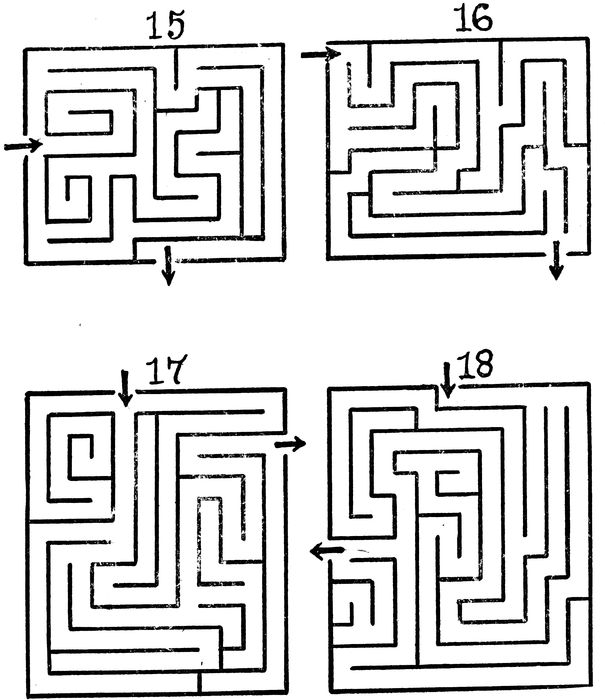
Maze Threading
4.
Dot Pattern Correction
5.
Dividing Geometric Figures 113
6.
Completion of Form Series
7.
Checking Identity of Numbers
8.
Digit-Symbol Substitution
9.
Completion of Number Relation Series
10.
Addition Tests
Individual Tests for English-Speaking Persons
11.
Memory for Numbers
12.
Repeating Numbers Backward
13.
Memory for Sentences
14.
Speaking Vocabulary
15.
Word Discrimination
Group Tests for Persons Who Read English
16.
Naming Opposites
17.
Spelling Tests
18.
Range of Information
19.
Reading: Vocabulary
20.
Reading: Directions
21.
Reading: Interpretation
22.
Disarranged Sentences
23.
Completion of Sentences
24.
Analogies or Mixed Relations
25.
Handwriting Tests
26.
English Composition
27.
Poetic Discrimination
28.
Arithmetic Reasoning
29.
Practical Judgment
30.
Logical Conclusions.
Mentimeter No. 1 TYPICAL PERFORMANCES OF YOUNG CHILDREN
Character of the Test.
The mental capacity of adult persons is indicated rather accurately by the number and variety of things they have 114learned from the school of life, omitting from the count so far as possible those things directly taught by the formal schools. The intellectual capacity of an infant is likewise indicated roughly by the changes which his brief experience in life has brought about in his ability to control himself and his immediate surroundings. At birth the child is practically without control of his own body, except for certain sucking reflexes, certain crying reflexes, and the reflex which causes it to grasp with its fingers or toes the finger or pencil which is brought into contact with them. These reflexes can hardly be said to be a part of the child’s control of his own body, for the child could not avoid obeying them if he so desired. The new-born infant is practically helpless even so far as his own body is concerned. Any degree of control he may later develop over his body or over other things outside is attained because he has a system of nerve and brain cells capable of forming connections and being modified by these connections and their results.
The degree to which the child’s nervous system is organized and supplied with potential connections by inheritance is reflected very early in life by the quickness with which it learns to control itself and its immediate environment. The most ready method of testing this inherited capacity is therefore to determine at any particular age just how complex and adequate a system of control has been developed. The tests for measuring infants and young children consist, then, in those performances under specified standard conditions, which are typical for children at various ages.
The Mentimeter for young children is based directly upon the findings of Prof. Lewis M. Terman and his students in their investigations of children from three to twenty years of age. This investigation was so carefully devised and executed that to improve on the product, the Stanford Revision of the Binet tests, would be almost impossible. The tests for children three and four years of age presented in the following pages are therefore not claimed to be new or original with the present 115authors, who hereby express to Doctor Terman their admiration for his excellent contributions in the field of psychological measurements. The tests here suggested for children under three years of age are modifications of those suggested by Doctor Kuhlmann. All investigators in this field are, of course, indebted to the pioneers, the French psychologists, Binet and Simon.
The method of this test series consists in putting the child into a well-defined situation and observing how he acts. The situation may consist partly in words or other noises impressing themselves upon his ears, or it may consist largely in visual sensations, or even in sensations of physical well-being in his own body. Under a given situation a normal child of a given age or older will act in a certain standard way. The measurement then is in terms of the age for which a given child’s reactions are typical.
The test can best be given by one who is fairly familiar with the infant to be tested, although interest in having the child make a good showing should never be allowed to change one’s judgment of the facts as to the child’s performance. Another danger of too great familiarity is that the examiner may, without intention to do so, drill the child upon those things which are later to be required in the test. In so far as the parent knows what performances are to be included in the tests there is real danger that the child will be “coached up” on these things, even at as early an age as six months.
List of Typical Performances.
Three Months (3 tests, credit 1 month each)
1.
Control of eyes (Both eyes look in same direction. Follows with eyes the movement of bright objects).
2.
Hearing (Reacts with sudden start or scream to loud noises, such as slamming of door, hand clapping. Turns eyes or head in direction of less startling noises, such as opening of door, footsteps). 116
3.
Muscular Control (Moves hand or toy directly to mouth without striking other parts of body and face. Grasps or curls fingers about rattle or pencil placed in hands).
Six Months (3 tests, credit 1 month each)
1.
Muscular Control (Balances head without support. Sits ten minutes or more when supported).
2.
Self-Direction (Attempts to catch self when beginning to fall from sitting posture. Reaches out for toys and near-by objects. Attempts to pull self to sitting posture if given a hand to grasp).
3.
Enjoyment (Plays longer and more persistently with one toy than with another. Laughs aloud when bounced on bed or when familiars indulge in strenuous exercise).
One Year (6 tests, credit 1 month each)
1.
Imitation of Movements (Can learn in half dozen trials to “wave bye-bye,” put hands above head, or hide face in hands).
2.
Locomotion (Creeps toward desired objects, or stands beside a chair without other assistance).
3.
Understanding (Looks at frequently observed objects when names are mentioned: dog, ball, mama, flowers).
4.
Obedience (Understands and usually obeys simple commands: “Lie down! No, No! Spit it out!”).
5.
Speech (Repeats simple syllables: “go, go; da, da; ma, ma; bye-bye”).
6.
Calls attention (Shouts exclamations, looks or even points to objects of special interest: dogs, cats, train, carts, etc).
Two Years (6 tests, credit 2 months each)
1.
Speech (Names articles of food desired: milk, cracker, rice, etc).
2.
Pictures (Points out familiar objects: boy, dog, cat, cow, man). 117
3.
Obedience (Put ball in basket. Close the door. Bring the ball).
4.
Imitation (Imitates actions of other children at play).
5.
Discernment (Removes wrapping from candy; opens sack to get cookies).
6.
Self-Direction (Walks directly to desired locations; rides “kiddie-kar” forward).
Three Years (6 tests, credit 2 months each)
1.
Parts of Body (Points to nose, eyes, mouth, hair).
2.
Familiar Objects (Names key, penny, knife, watch, pencil).
3.
Pictures (Enumerates objects in pictures: Dutch Home, Canoe, and Post Office).
4.
Able to tell own sex.
5.
Gives last name.
6.
Repeats sentences of 6 or 7 syllables.
Four Years (6 tests, credit 2 months each)
1.
Discriminates between circles, squares, and triangles.
2.
Counts four pennies.
3.
Copies a square.
4.
Comprehension of described situation.
5.
Repeats four numbers in order: 4739 2854 7261
6.
Repeats sentences of 12 or 13 syllables.
Directions for Giving the Test.
A very large part of this test must be given informally. It will be necessary to spend considerable time with each child examined in order to make certain that the reactions observed are not merely random movements which are not typical. For the tests of children three years of age and above the reader should very carefully study the detailed directions given by Professor Terman in his book, “The Measurement of Intelligence,” published by Houghton Mifflin Company, if scientific accuracy of results is necessary. The materials called for may be secured from 118C. H. Stoelting and Company, 3037 Carroll Ave., Chicago. The directions given below are intended to be elementary and to indicate what is typical of children at each age rather than to serve as a perfect guide for the most scientific examinations.
Three Months
At the age of three months an infant should be able to coördinate his eyes; that is, to direct both eyes in the same direction and to move them simultaneously. When bright objects are brought into his field of vision and moved slowly from one side to the other, he should be able to follow with his eyes. As a matter of fact, many infants have attained this degree of control within the first week of their lives, but lack of control to this extent at the end of three months is an indication that special medical attention should be sought.
For several days after birth the infant does not ordinarily hear any of the sounds or noises which occur in his vicinity. By the time he has become three months old, it should be apparent, from the sudden start or scream of the child when a door is slammed or someone in his neighbourhood suddenly claps his hands, that the child actually hears these noises. The average child at three months has become so familiar with life and its evidences that he will be able to turn his eyes in the direction of such noises as the opening of a door or the sound of footsteps near his bed.
The first evidences of the child’s recognition of sounds or sights are very difficult to interpret because they consist almost entirely in awkward, random moving of the hands and feet. Gradually the child develops some control over these movements and by the age of three months should be able to move his hand, or a toy in his hand, directly to his mouth without striking other parts of his body or face in the process. The early tendency of the infant to curl his fingers about a pencil or rattle which is placed in contact with them seems almost to disappear during the first month, but by the age of three months the child is again 119able to grasp such objects sufficiently to hold them for periods ranging from thirty seconds upward.
Six Months
The control of his body has so improved by the time he has reached the age of six months that the average child can balance his head without support for several minutes. It is usually possible also for the child to sit in a chair or on the bed with the support of pillows and bed clothing for as much as ten minutes. Occasionally, of course, the child will be able to sit alone as early as six months, but it is not wise to encourage this practice. The lack of ability to sit when supported at the age of six months is not necessarily an indication of lack of intellectual power but may be due entirely to physical weakness.
Not only has the child at six months arrived at the stage where he can balance his head and sit quietly when supported, but he has usually begun to try to assist himself in various ways. Very frequently this attempt at self-help will be evidenced by pulling movements intended to bring him to a sitting posture when a hand is offered to him. There is no hesitation in the ordinary child at six months in his reaching out for toys or for a hand which is held toward him. Very frequently it will be observed that such a child puts out its hand to catch itself if it is beginning to fall from a sitting posture.
The child has usually begun to show signs of pleasure and displeasure long before he has reached six months. This phase of development may be indicated by his playing longer and more persistently with one toy than with any other. It may be shown by much more animated activity when certain familiar individuals are present than would be evidenced in the presence of others equally well known. Very frequently children at this age indulge in amused laughing aloud when bounced on the bed, or when some well-known individual indulges in strenuous exercises accompanied by vociferous exclamations while the baby is watching.
120 One Year
By the time a child has become twelve months old it will be possible to teach it many little tricks and movements of a simple nature. The child seems to imitate almost spontaneously the actions which are often repeated by its parents or nurse. Six to twelve trials should be sufficient to teach the average infant of one year how to “wave bye-bye” when told to do so, or how to hold its hands above its head when asked “How big are you?” or to hide its face behind its hands or behind one of its covers when someone exclaims “Peek-a-boo.”
Some children never learn to creep before learning to walk. As a matter of fact, it seems fairly certain that the child who creeps rapidly may thereby postpone learning to walk. At the age of one year a child should be able to stand beside a chair without other assistance than the support given by the chair, or it should be able to creep very rapidly toward its toys or any other desired objects. Frequently, of course, children have learned to walk fairly well by the time they have attained twelve months, but this is rather unusual and is not particularly an indication of the degree of mental capacity.
The child of one year understands many common words applying to frequently observed objects which have been repeatedly called to his attention. When asked “Where is the dog?—where is the ball?—where are the flowers?” and such questions the average infant will turn its head and look toward the object mentioned, sometimes pointing, although this is somewhat unusual.
Simple commands such as “Lie down! No-no! Spit it out!” and the like, can be understood and are usually obeyed by children of this age.
The speech of a child at this age is of course very simple, consisting of one syllable words, usually repeated. Such expressions as “ma-ma,” “bye-bye,” “da-da,” “go-go,” may be expected in the average child. It is unusual for an infant to 121combine two such expressions into a crude sentence at this age.
The child at one year quite frequently has begun to attempt manipulation of his environment as well as of his own body. Very frequently this will be observed in shouts or exclamations accompanied by looking or even pointing to objects which his familiars have previously pointed out to him, such as dogs, cats, trains, carts, etc. These objects will ordinarily not be named by the child, although peculiar sounds fitting each one may frequently be distinguished. Another manifestation of this same attempt at altering his environment will be the crying in which the child will indulge when he desires to change his resting place or to have something to eat.
Two Years
By the time a child has become two years of age its speech has developed to such an extent that it will be able to name, although frequently not with clearness and distinct pronunciation, many of its toys and articles of food. “Milk,” “rice,” and “cookie,” are examples of the most frequently named objects. Many children have by this age also progressed to the point where two or three or more words may be joined together to form a crude sentence. There are on record children who by two years of age were able to frame fairly good sentences and even to read from simple books, but such records are very unusual.
At this time the child should be able to distinguish pictures of familiar objects, such as dogs, cats, horses, men and boys. This will be manifest not only in the child’s being able to name the objects to which other people point in the picture, but when asked, “Where is the dog?” the infant should be able to point to it if the picture is at all clear.
Simple commands should be thoroughly understood and the well-trained infant will be able to obey without much delay such directions as “Put the ball in the basket,” “Close the door,” “Bring me the doll,” and “Show me the book.”
122The average child at two years of age has become distinctly aware of other children as persons more nearly related to itself than are the adults with whom it is ordinarily associated. This reveals itself in imitation of the actions of other children, such as waving the arms when other children do so, hiding the face against the wall when other children are playing hide and seek, and stepping rhythmically when other children dance.
By the age of two years the average child can distinguish accurately between that which is food and that which is not fit for eating. The wrapping from candy or cookies or other well-liked food will be removed or torn away before an attempt is made to eat the food. Frequently this will result in great annoyance when the child opens sacks and packages to which he is not entitled.
The child at this age has usually learned to walk quite erectly without hesitation to any desired location. If the child is placed upon a “kiddie-kar” his first reaction is to run it backward, but by the age of two years he should be able to guide it well in going forward. Some attempts will be made at running and a great many attempts at climbing by the time the child has reached this age.
Three Years
At three years of age a child when asked to point out different parts of its body (nose, eyes, mouth, and hair) can do so without hesitation. Familiar objects, such as a key, a penny, a pocketknife (closed), a watch, and a pencil (common wooden) will be named at once if held out to the child with the question, “What is this?”
The pictures used in the Stanford Revision of the Binet test may be shown to the child with the direction “Tell me what you see in this picture,” or “Look at the picture and tell me everything you can see in it.” In response to such questions the child should be able to enumerate different objects, such as the little girl, the window, the chair, and the woman in the picture 123of the Dutch Home; or the men, the basket, and the newspaper in the picture of the Post office.
At this age the child has had enough experience to be able to repeat its last name and to know whether people call it a “girl” or a “boy.” The question should be asked in the following fashion: “What is your name?” If the answer is in terms of the given name only, then the question should be amplified as follows: “Yes, but what is your other name? Walter what?” If the surname is still not given, a fictitious one may be framed and the question asked in some such fashion as follows: “Is your name Walter Smith?” If the child is still unable to reply then it is probable that he does not know the family name or is too frightened to give it. In finding whether the child knows his sex the formula for a boy should be: “Are you a little boy or a little girl?” For a girl the question should be: “Are you a little girl or a little boy?”
At the age of three years a child should be able to repeat sentences containing six or seven syllables. Those used by Terman are: (1) “I have a little dog.” (2) “In summer the sun is hot.” (3) “The dog runs after the cat.” In leading up to these repetitions it is well to ask the child first to say single words, such as “school.” “Can you say school?” “Now say, ‘I go to school.’” Then ask the child to say “I have a little dog.”
Four Years
By this time the child should be able to distinguish between circles, squares, triangles, and other geometric forms. Ten drawings of circles, squares, and triangles should be presented to the child and he should be able to find one or two others just like the one to which the examiner points.
The child should by this time be able to count pennies or buttons, at least up to four, without any error. The child should be able to handle a pencil well enough so that a square one inch each way could be copied fairly well. The child’s 124memory has developed to such an extent that if four numbers are repeated to him at the rate of one per second he should be able to repeat them in correct order at once. Three trials should be allowed and at least one of the three should be right. By this time, also, a sentence of twelve or thirteen syllables should be remembered correctly. The sentences used by Terman are: (1) “When the train passes you will hear the whistle blow.” (2) “We are going to have a good time in the country.” (3) “The boy’s name is John. He is a very good boy.” The method of getting the child’s attention and leading up to these longer sentences is the same as was described under Year Three.
The child’s judgment has developed by this time through experience and precept to the point where an inquiry from the examiner as to “What must you do when you are sleepy?” will bring forth a response indicating that one should go to bed and sleep. The question of “What must you do when you are cold?” should bring forth some such reply as, “Put on a coat,” “Build a fire,” or “Stand next to the radiator.” The question, “What must you do when you are hungry?” should bring forth such answers as “Buy some lunch,” “Drink some milk,” or “Eat something.”
Directions for Scoring the Test.
The method of scoring is briefly indicated in the list of typical performances printed on pages 115–117. The three tests at age three months are each to be given one month credit. The three tests at six months are likewise to be given one month credit for each successful performance, as are the six tests at one year. The six tests at two years, the six at three years, and the six at four years, are in each case to be given a credit of two months each. The child who did everything in the entire test correctly would then have demonstrated the mental ability of the average child of four years or older. The child who completes all of the tests at three months and one of the tests at six 125months would then be rated as having mental ability typical of a four-months-old-child. If the child were to fail on only one of the tests at one year but to pass all those previous to one year, his mental age score would be eleven months, according to this system of assigning credits. It will frequently be found that a child does not pass all of the one-year tests before being able to do one or two of the two-year tests and so on. This should not make it more difficult to score the test, for each particular performance has its value indicated in the list which was given above.
It cannot be claimed that these tests, especially those below the three-year-old level, have been fully standardized. They are, however, very much better than the average parent or relative would be able to prepare for him or herself. The mental age score which will result from the use of these tests is not as reliable as will result from the use of the Stanford Revision of the Binet tests with older children, but its reliability is sufficient to point out cases of retardation in intelligence or of distinct brilliance of mind.
Three Months
Control of Eyes. Both of the eyes should look in the same direction and the child should be able to follow with its eyes the movements of bright objects in order to obtain credit in this test.
Hearing. It will not be necessary for the child to react with a start or scream to loud noises and also to react by turning the eyes in the direction of less startling noises in order to obtain credit for hearing. Either evidence, if clear, will be sufficient to warrant giving credit.
Muscular Control. The grasping of a pencil or rattle should not be taken as sufficient evidence of muscular control. The ability of the child, however, to move his hand directly to his mouth as described above will be in itself abundant evidence that the child merits a credit in this test.
126 Six Months
Muscular Control. Either balancing the head or sitting with some support for as much as ten minutes should be accepted as worthy of credit.
Self-direction. The attempt to pull himself to a sitting posture should not be taken by itself as evidence of credit in this test. Only when it is accompanied by one of the other two evidences should it be credited.
Enjoyment. Any two of the evidences of pleasure or displeasure listed may be taken together as indication of credit being deserved.
One Year
Imitation of Movement. Any one of the movements described, which the child learns within a short time by imitation, should give credit in this test.
Locomotion. Either of the two methods of demonstration will be sufficient.
Understanding. At least three familiar objects should be used in this test with success before credit is allowed.
Obedience. At least two simple commands should be understood and obeyed before allowing credit.
Speech. Not less than three different syllables should be used before credit is allowed.
Calling Attention. No credit should be given at this point unless the child very evidently attempts to excite interest and attention in two or three different objects.
Two Years
Speech. Any four distinct articles mentioned by the child when it desires them should be sufficient evidence to give credit here.
Pictures. At least four different objects should be recognized and pointed out before credit is allowed.
127Obedience. Two simple commands of the type mentioned should be sufficient to bring credit at this point.
Imitation. Only after repeated evidences of imitation of other children should credit be given here.
Discernment. Repeated evidences should be required before credit is allowed for this test.
Self-direction. Any one of the evidences described is sufficient.
Three Years
Parts of the Body. Three out of four parts mentioned should be pointed out before allowing credit.
Familiar Objects. Three out of five of the objects mentioned must be named in order to obtain credit here.
Pictures. The child should name at least three objects in one of the three pictures in order to obtain credit.
Sex and Name. Accuracy is necessary here.
Repeating Syllables. One of the three sentences should be repeated absolutely without error.
Four Years
Forms. Out of ten trials, at least seven should be correct in order to obtain credit.
Counting. No error should be allowed.
Copying. Out of three attempts, at least one should be fairly regular and distinctly recognizable as a square.
Comprehension. Success must be attained in two of the three questions in order to receive credit.
Repeating Numbers. One out of three trials should be absolutely correct.
Repeating Syllables. One of the three trials should be without error or two of the three trials with not more than one slight error in each.
128The matter of nourishment and physical well-being may retard a child to such an extent that his intellectual development is delayed. Great care should, therefore, be taken not to interpret a low score on this test too seriously. It should also be noted that familiarity with the test is quite certain to cause parents to put forth special effort to instruct the child along the lines required by the test. The test itself is thereby invalidated. Only when no special instruction has been given at any point covered by the test can one be satisfied that he is obtaining a fair measure of the child’s ability.
The test booklet supplied for this test is not for the use of the candidate being examined but for the examiner to use as a guide and record of the examination. One such booklet should be used for each individual examined, in order to be certain that no test is omitted or wrongly scored and in order to have a record for comparison with future tests of the same individual or of other individuals.
129
Mentimeter No. 2 PICTORIAL ABSURDITIES
Nature of the Test.
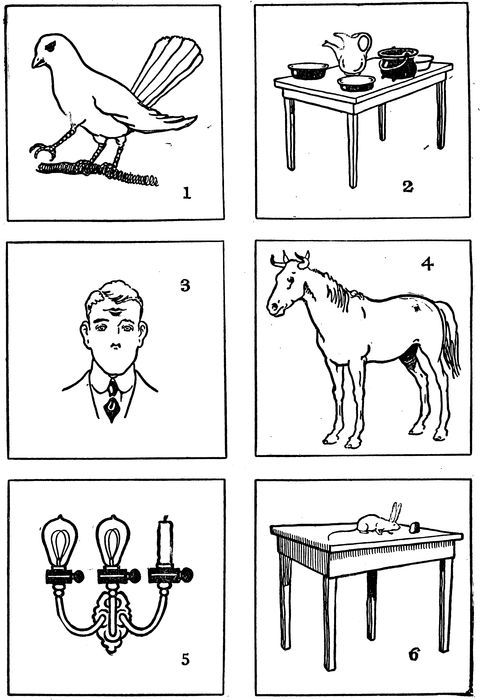
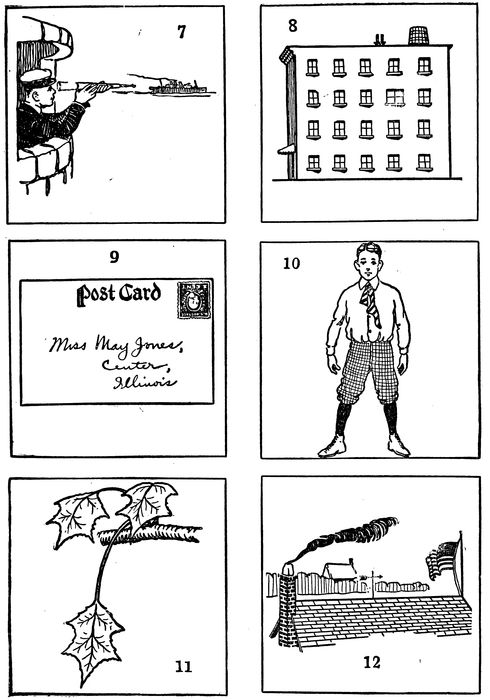
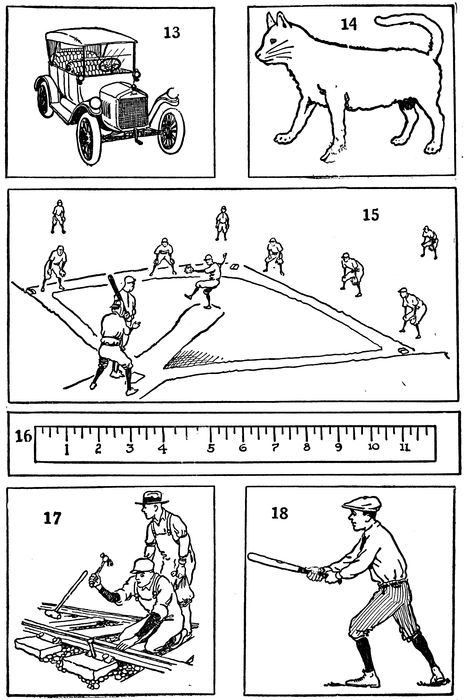
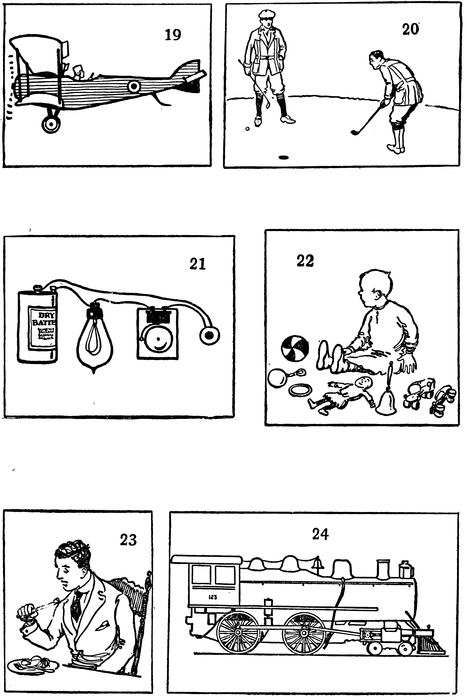
One of the most popular tests in the Army Beta series was the mutilated pictures test, in which the soldiers were to draw into each picture what had been omitted. One great difficulty with this test was the tendency of intelligent men to spend far too much time trying to draw artistically the missing parts. The present test is a modification of that test, so arranged that instead of the candidate being required to draw a missing part he is only asked to make a check mark at the point where there is something that does not fit the remainder of the picture.
The test booklet is arranged with two samples on the title page to show clearly what is to be done when the candidate opens his booklet. By having these samples painted on the wall or blackboard, it would be possible to give the test to large groups of persons at once, although the directions given below are for testing one individual only at a time. Although listed as a test for non-English-speaking persons, some oral direction should accompany the motions by which the test is to be given, and English-speaking persons may be examined by this test as readily as those who speak a foreign language.
The graduation of the pictures according to their approximate difficulty makes the score in this test a real measure of the degree of absurdity which an individual can detect. The pictures themselves were chosen from as wide a field as possible in order to avoid undue advantage to persons of one type of experience rather than another. Only intelligent persons of fairly wide general experience will be able to make a perfect score in the time allowed.
130
Directions for Giving the Test.
The examiner and the candidate to be examined should be comfortably seated at a table with the examination booklet between them. If it is discovered that the candidate is left-handed, the examiner should sit on the left, although under ordinary circumstances the examiner should sit on the right. The blanks on the title page of the booklet should be filled out by the examiner from any records he may have of the name and age of the candidate (if persons who read and understand English are being examined, several may be tested at once and each may be asked to fill out the blanks for himself). For persons who do not understand the English language the words which are used in the following explanations will be more suggestive than informing. The chief part of the demonstration will be the motions through which the examiner goes, and therefore great care should be taken that these be as suggestive of what is wanted as the examiner can make them. To secure uniformity of procedure the routine outline below should be carefully followed.
The booklet should be opened by the examiner and the pictures exhibited for not more than twenty seconds to the candidate, the examiner pointing from one to another of the first half dozen pictures. He should then close the book and call the attention of the candidate to the picture of the rabbit on the title page. He should point to the rabbit’s ear and then point to the inappropriate ear and shake his head. This pointing to the two ears and shaking the head when pointing to the wrong type of ear may be repeated as many as three times in order to impress on the candidate that one of the ears is inappropriate. He should then take his pencil and make a check mark above the ear which is incorrect.
131Mark (✓) the thing that is wrong
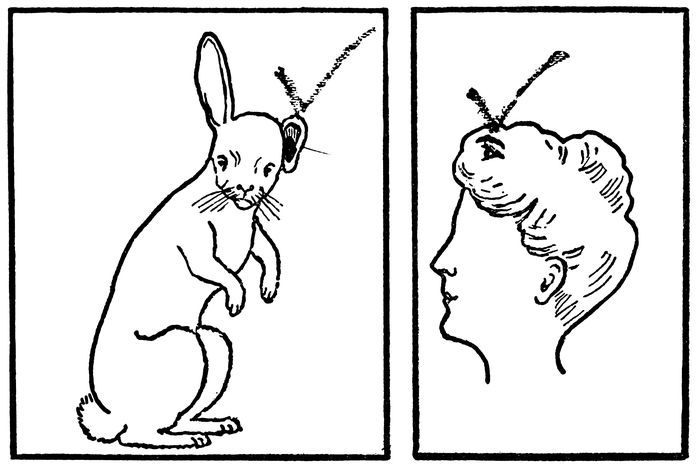
The examiner should then point to the second picture on the title page and look questioningly at the candidate. He may then point to the chin of the face represented and nod his head, “yes.” He may next point to the nose and nod his head, “yes,” but when he points to the place where the eye should be he should shake his head, “no,” and pretend to look for the missing eye. When found, he should make a check a mark over the misplaced eye and smile at his achievement. If special emphasis seems necessary he may point again to the eye in its inappropriate position, and shake his head, repeating the check mark above it.
If the candidate understands but does not read English the examiner may trace with his finger while reading aloud the directions printed above the test pictures. “Mark (✓) the thing that is wrong.” Exactly three minutes (180 seconds) should be allowed from the time the examiner opens the book and furnishes the candidate with a pencil.
132Mark (✓) the thing that is wrong
133
134
135
136At the end of the three minutes the paper should be removed and scored according to the following directions.
Direction for Scoring the Test.
The score in this test is the number of pictures in which the absurd element has been identified and checked. The stencil furnished with the test booklets shows exactly where each check mark should be made thereby saving some time for the person who marks the test. Where the proper element has been checked and the check mark later removed, no credit should be given. Credit should only be given where the final judgment as expressed by the check mark corresponds to the key furnished with the booklets.
A score from 0 to 6 indicates Inferior Ability
A score from 7 to 10 indicates Low Average Ability
A score from 11 to 17 indicates Average Ability
A score from 18 to 20 indicates High Average Ability
A score from 21 to 24 indicates Superior Ability
137
Mentimeter No. 3 MAZE THREADING
Nature of the Test.
A great many experiments have been made upon different types of animals to determine how long it would take them to learn to secure their food by going through an unusual “stunt” or travelling over a circuitous route. Mice have been taught, for example, to travel a long distance and through complicated mazes to secure their food, which is in such cases usually placed at the centre of the maze. The effectiveness of learning to thread a maze as a test of the intellectual capacity of the lower animals is probably not superior to the effectiveness of the same sort of learning as a measure of the intelligence of human beings. It is not possible, however, to include in a book the long passageways and blind alleys which would necessarily have to be built out of pretty substantial material in order to keep men from breaking over its sides, but the idea has so far as possible been carried out in the tests which follow. It is quite certain that the ability to trace through a printed maze with a pencil is not equal to the ability to walk through a specially constructed maze of steel, but it is as near the same problem as can be arranged on paper and printed in quantity.
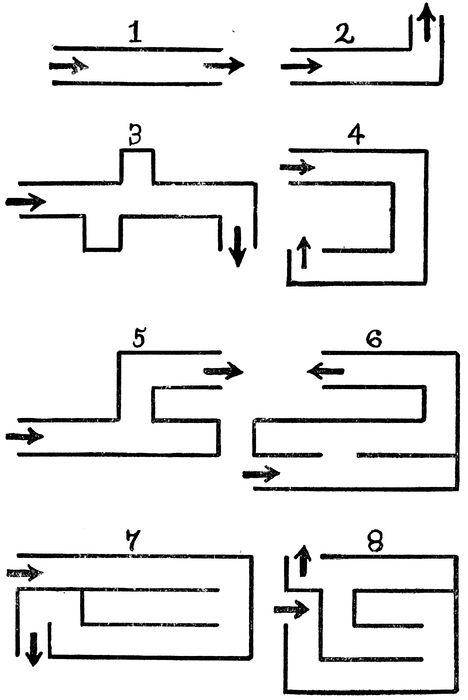
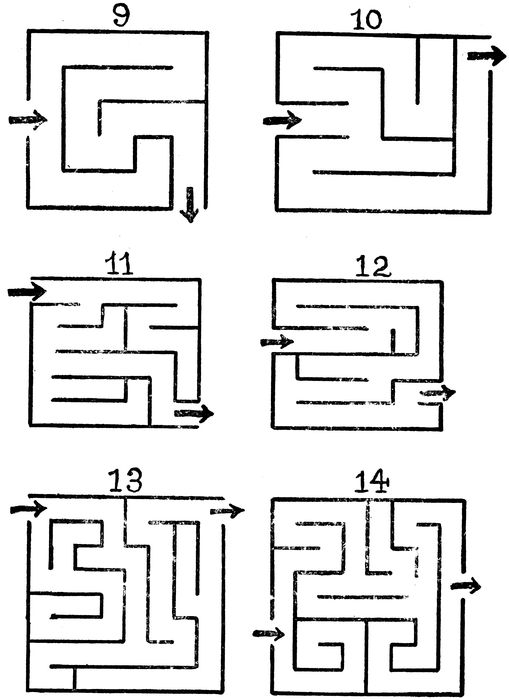
The arrangement of mazes in this member of the Mentimeter family is such that the number of mazes successfully threaded is a distinct indication of the complexity of maze which the individual can successfully negotiate. The test is intended to measure the ability of any individual whether he can read or understand the English language or not. If the two examples shown on the title page are presented on a blackboard, or other large surface, the test may very easily be given as a group test by a skilful examiner, although the directions which follow are prepared for the examination of one individual at a time.
138
Directions for Giving the Test.
The examiner should be seated at a table at the right side of the candidate to be examined. He should first of all secure the information regarding the candidate’s name, age, and other important items, and should then exhibit the mazes which appear inside the booklet, pointing from one to the other in the first half dozen. Not more than thirty seconds should be allowed for this part of the instruction. Turning back to the title page the examiner should point to the first example, pointing first at the entrance and then to the exit. By a motion at each of these two cardinal points, made in the direction in which the arrow points, he should make it clear that the idea is to move in the direction indicated by the arrows. He should then trace his way fairly slowly from the entrance to the exit.
Show by a line how you would pass through the drawings below without touching any line
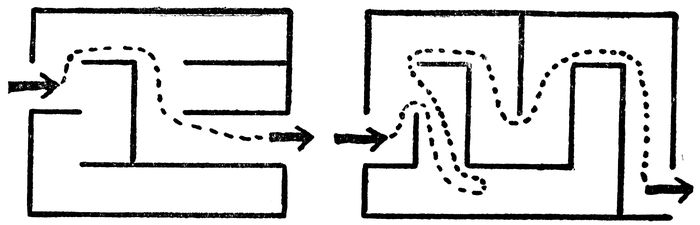
Pointing to the second maze, first to the entrance and then to the exit, the examiner should again signify that motion is to occur at these two points. With his pencil as before he should trace his way from the starting point to the finish, making not more than one error, which he should correct by returning over the same route to the point where it was made without lifting the pencil from the paper.
If the candidate can understand the English language the examiner should then read the directions above the examples. “Show by a line how you would pass through the drawings below without touching any line.”
139Show by a line how you would pass through the drawings below without touching any line
140
141
142
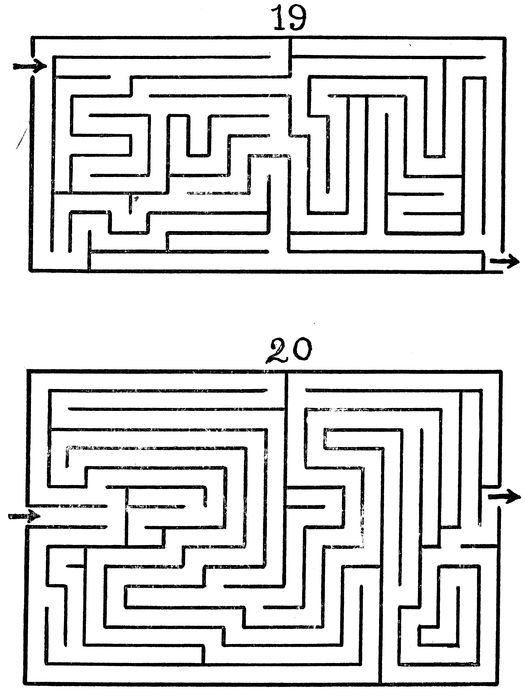
143The examiner should then open the booklet and give it to the candidate with the instruction to begin at number 1 and trace his way from the starting arrow to the finish. No demonstration should be made on the mazes which appear inside the booklet.
Exactly four minutes after starting the test the examiner should stop the candidate and remove the pencil.
Directions for Scoring the Test.
The total score in this test is the number of mazes correctly threaded without error. Where a line has been crossed through accident or unsteady holding of the pencil no penalty should be taken, but if a line has been crossed and not recrossed to correct the defect, no credit should be given for that particular maze. Full credit should be given for the maze as being complete if the line stops at a point somewhat before reaching the finish arrow, provided there is a straight path from the end of the line drawn to some part of this sign of the exit.
Scores from 0 to 5 indicate Inferior Ability
Scores from 6 to 10 indicate Low Average Ability
Scores from 11 to 16 indicate Average Ability
Scores from 17 to 18 indicate High Average Ability
Scores from 19 to 20 indicate Superior Ability
144
Mentimeter No. 4 DOT PATTERN CORRECTION
Nature of the Test.
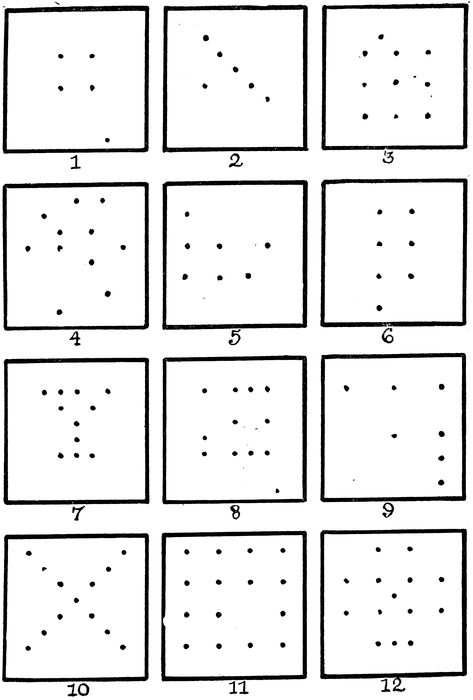
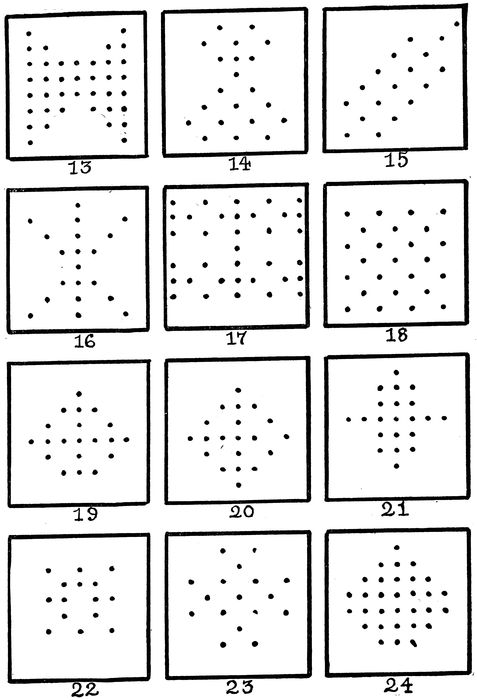
The ability to recognize small elements of discord in an otherwise symmetrical pattern is the feature which this test is planned to measure. The test is very simple, even the most difficult elements in it being very easy of solution. A pattern composed of dots is presented, one dot being included which does not fit the remainder of the pattern. The candidate is required to locate this extra dot in each pattern and to draw a circle around it, indicating that it should be removed. Although an attempt has been made in this test to arrange the elements in the order of their difficulty, the last one in the series is so simple that almost any one can locate the defect in a short time. For this reason the test will not have wide usefulness except as a means of diversion. The method for this test is borrowed directly from the work of Doctor Pressey of Indiana University.
Directions for Giving the Test.
The directions herewith presented are intended to be used by the examiner in testing one foreign-speaking individual at a time. It would be easily possible to paint on the wall the examples given on the title page or to put them on a blackboard in such a manner as to enable the examiner to test quite a large number of persons at the same time.
Draw a ring around the extra dot
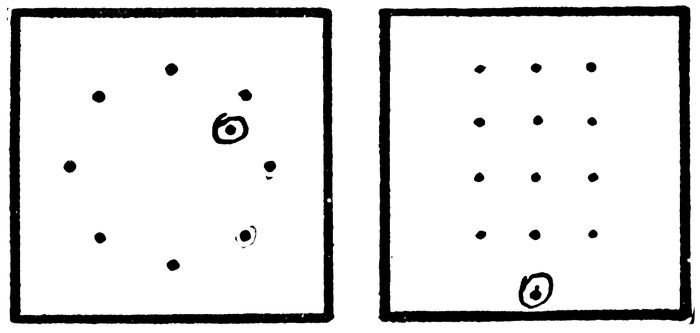
145The examiner should demonstrate to the candidate first of all the nature of the contents of the booklet and then should take up the two examples appearing on the front page. He should trace the direction of the different lines in the pattern with his pencil (without touching the point of the pencil to the paper) and should finally draw a small circle about the extra dot. After this circle has been drawn it would be suggestive to the candidate to trace out again the pattern of the example. When the candidate seems to get the idea, or when both examples have been demonstrated, he should be given a pencil and the opened blank with directions to go ahead. Only two minutes should be allowed for this work, at the end of which time the blanks should be taken from the candidate and scored according to the following directions.
Directions for Scoring the Test.
The score in this test is the total number of patterns in which the extra dot has been correctly pointed out. In many cases the extra dot is located in the centre of the pattern so that there is no really unsymmetrical element in the test, but this should not interfere with the scoring. The stencil provided with the test booklets makes it somewhat simpler to score than it would otherwise be.
Scores from 0 to 8 indicate Inferior Ability
Scores from 9 to 14 indicate Low Average Ability
Scores from 15 to 20 indicate Average Ability
Scores of 21 or more indicate High Average or Superior Ability
146Draw a ring around the extra dot
147
148
Mentimeter No. 5 DIVIDING GEOMETRICAL FIGURES
Character of the Test.
This test is very easily used as a group test with people who can understand spoken English. The test is also capable of being given to groups of illiterate or foreign-speaking individuals, if the examples used in the explanation are painted on a large blackboard to be placed in the front of the room in full view of all those taking the examination. In the absence of such a special blackboard, the test may be used as an individual test with illiterate or foreign-speaking persons.
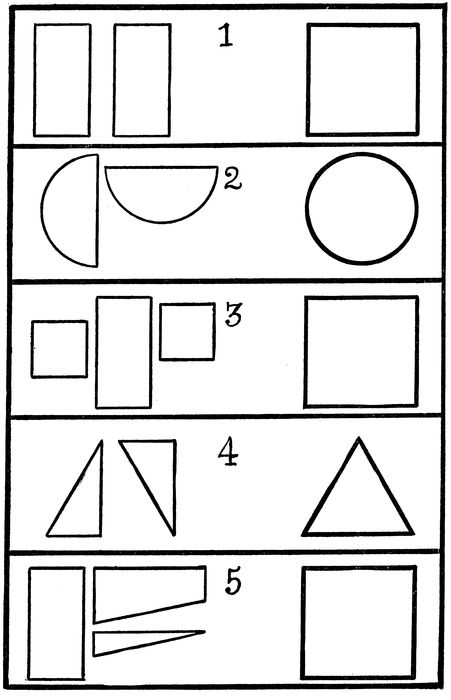
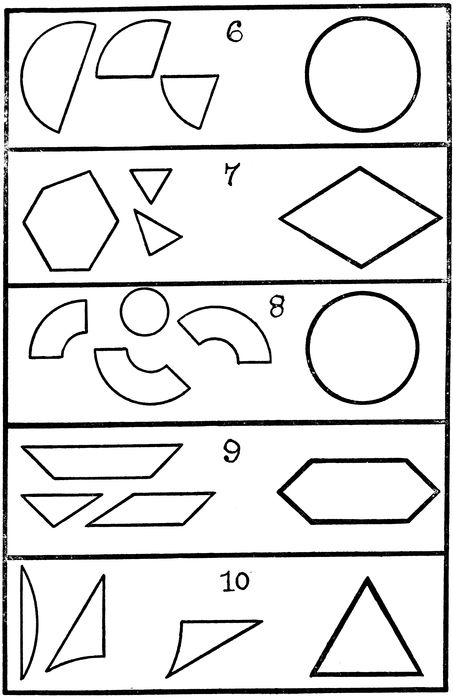
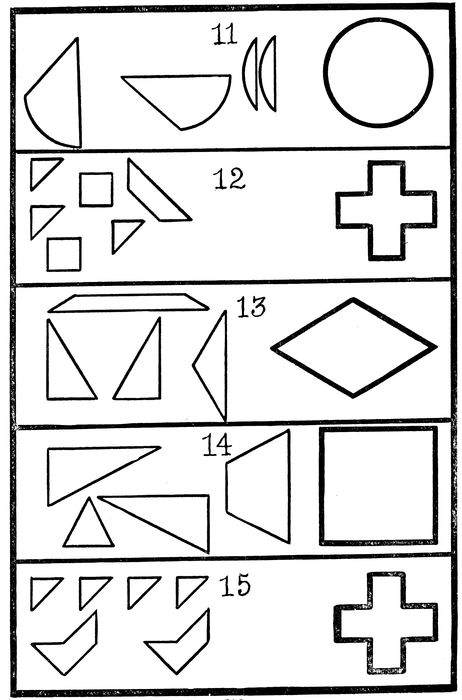
Fifteen geometrical figures, such as squares, circles, triangles, and the like, are presented on three pages of the examination booklet. To the left of each figure are two or more small figures which, when properly arranged, form the large figure on the right. The problem of the candidate is to draw a line or several lines in the large figure on the right to indicate how it might be divided to make up the small pieces shown on the left. The first figures are quite simple and may be very readily done by drawing one or two lines. The problems on the third page require from three to five lines to be drawn and are distinctly more difficult than the problems appearing on the previous pages.
It is very difficult to say exactly what functions of the mind are measured by this test. The greatest difficulty with the test is that a rather high minimum of intelligence is required in order to understand what is necessary or desired. The two examples appearing on the title page of the test booklet are not sufficient to demonstrate clearly to the dull person just what he is to do. It is probable that dull people will succeed very much better in this test if it is given as a test for foreigners, using the special blackboard. The examiner could, in that case, draw a line with chalk to show what is expected. The printed 149directions on the test blank have been made as simple as possible, but they are not wholly satisfactory for the lower ranges of intelligence.
The scoring of this test is somewhat more difficult than for the majority of the other Mentimeter tests. It is intended that one point of credit shall be given for each large figure properly divided. The difficulty comes in being sure that the candidate has intended to draw his lines at exactly the proper place. Inaccuracy may be the result of not knowing where the lines should be placed, or it may be the result of careless execution. If a line is misplaced through careless execution, when it is perfectly clear that the right idea was present in the candidate’s mind, full credit should be given for that element of the test. If it is not certain that the candidate understood where the line should be drawn, no credit should be given for that particular figure.
The stencils, which are supplied with each package of test booklets, should be placed to the left of the five geometrical figures and comparison should be made between the dotted lines of the stencil and the marks made by the candidate in the corresponding figure on the examination sheet. In the first square, for example, full credit should be given whether the line is drawn horizontally or vertically through the figure. The important thing is that two equal rectangles should be created by drawing a single line. Similarly, for each other figure, the important point to be considered is whether or not the lines drawn do form the geometrical figures shown on the left. A little practice will make it possible for the clerk who scores these tests to lay aside the key itself and to carry it in memory.
Various forms of this test have been used by psychologists for a number of years, although its most extensive use was in the Beta series of the United States Army. The same test in modified form was used by Prof. E. L. Thorndike in his tests of mental alertness in the air service. Many individuals were found who could do this test fairly well without being able to succeed with some of the others which were supposedly equally 150as good for general purposes. On the other hand, many individuals of good general ability were found who seemed lacking in the particular type of ability necessary properly to divide these geometrical figures. On the whole, however, the more intelligent men made higher scores than the less intelligent men. Such low relationship between this particular test and other tests of intelligence makes it particularly useful as one of a series to be used for measuring the intelligence of men entering certain mechanical trades where the recognition of the size and shape of objects is of prime importance. Draftsmen, architects, supply clerks, and candidates for similar positions would probably be rated more accurately by this test than would writers, musicians, and academic students.
In the public schools such a test might give some indication of the ability of children to succeed in mechanical or mathematical courses of study. In social gatherings, a great deal of amusement might be found by giving prizes to the individuals completing the entire fifteen figures correctly and in the shortest time. It would seem desirable, however, to omit the time limit when it is used for pure entertainment and to measure with a stop-watch the exact amount of time required for the individual. When all had finished the fifteen elements of the test, the papers could be checked up for accuracy and the prize could be given to the one who had finished correctly in the shortest length of time. This will add an element of interest for it is quite certain that some of those who finished first will have made errors, probably through careless execution, and that someone who finished later in the game will have drawn each line correctly.
Directions for Giving the Test.
a. As an individual test.
The individual to be tested should be seated at the left side of the examiner at a convenient table. The examiner should show the inside of the test blank to the candidate and should 151then point to the similar figures in the explanation on the title page of the booklet. He should then point to the large figure in the first example, possibly tracing its outline with his pencil. Then the attention of the candidate should be called to the parts appearing on the left-hand side. (Their outlines may be traced if it seems desirable.) Next, a movement should be made with the hand as though one were placing the parts upon the larger figure. This may be repeated two or three times, pointing first to the various parts in order and then to the large figure with a rather broad sweep of the hand. After such a study of the situation, the examiner should draw the proper line and exhibit a smile of pleasure at having successfully done the thing. He should point then to the parts of the large figure which are thus created and by jumping his pencil from one of the parts to the corresponding part on the left, he may fairly clearly demonstrate that he has constructed, by his line, elements which are similar to the elements appearing at the left.
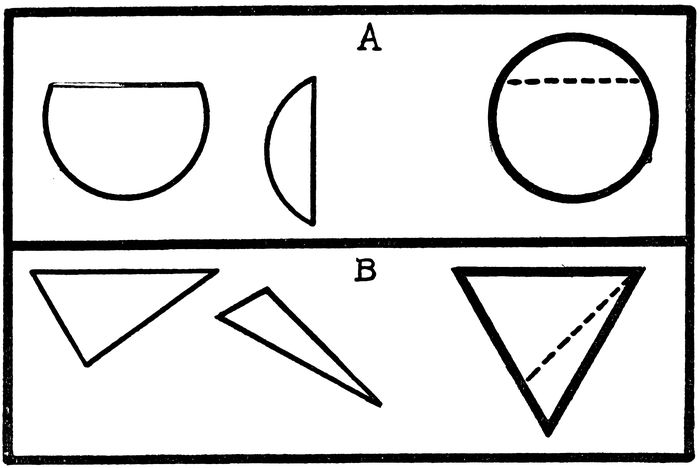
Similar pantomime may be used for the second example, possibly 152introducing a variation by getting a line incorrectly drawn at the first trial, erasing it as soon as it is apparent that the parts do not correspond exactly with the parts appearing in the problem, and redrawing the line so that the correspondence will be exact. The pencil should then be handed to the candidate and the pamphlet opened up for him to begin work. The candidate should be allowed to work for four minutes with occasional signals to “Go ahead,” “Work fast” or “Hurry up.”
b. As a group test for illiterate candidates.
A blackboard containing the two examples should be placed in full view of all the candidates in the room. The test blanks should be passed to the candidates, with well-sharpened pencils or pens and ink. The examiner should then hold up in full view of the group a test blank showing the three pages of figures on which they are to work. He should then get the attention of everyone to the work by saying “Look” or “Watch.” With a piece of chalk, he should then go through the pantomime described above for giving the examination to an individual. Care should be taken that none of the brighter candidates begins work before the signal for everyone to work. When the two examples have been thoroughly demonstrated on the blackboard, the examiner may turn to the group, open up his test blank, and point to the first page of work to be done and say, “Begin here,” “Go ahead,” “Work fast.” At the end of four minutes, he should call “Stop,” should collect all papers, making certain as he does so that some identification mark is present on the paper to show to which candidate it belongs. No special explanation should be given and no person in the group should be allowed to sit idle while the examination is going on. If it is clear that the individual has not understood, the examiner may say, “Do what I did,” pointing to the board and then to the paper. Individuals may be told during the course of the examination, if they seem to be doing nothing, to “Make your marks.”
c. As a group test for candidates who can read English.
153Place each candidate at a table or chair with a writing surface, supply him with a test blank and pencil or other writing instrument. While the candidates are being supplied, the examiner should make the following statement: “Do not open this booklet until you are told to do so. I shall make explanations as soon as everybody is supplied.”
When all are ready, the examiner should hold up a copy of the test and speak as follows: “There are three pages of work to be done. The page before you shows two samples of the kind of thing you are to do. You will notice at the right a large figure and at the left several small figures. When properly placed together, these small figures will make one of the large figures at the right. You are to draw a line, or several lines, through the large figure at the right in such a way as to make of it the small figures at the left.
“Now look at the examples before you. Is there any one who does not see what line ought to be drawn in order to make the large figure show the pieces which appear at its left? You will have four minutes in which to do the work on the three pages. Work quickly, but be sure to draw your lines correctly. If you complete the fifteen figures before I call ‘Stop,’ look back over your work to see that you have made no mistakes.”
If any candidate signifies that he does not understand, the examiner might draw an imaginary line with his hand to show the direction in which the line should be drawn in order to divide the figure properly. As soon as it is certain that everyone understands how to divide the sample figure, the examiner should say: “Now work rapidly and draw your lines on the next three pages.” The time limit of four minutes should be followed exactly.
154Make the small figures by drawing lines in the large one
155
156
157
Directions for Scoring the Test.
The examination score, if each figure of the series is correctly divided, will be fifteen points. The stencils give but one solution to each problem although solutions are possible in practically every case by drawing the same lines in a different direction. The angle or direction is unimportant and there is no need that the lines drawn by the candidate correspond exactly in this respect with the lines on the stencil. The important thing is to see that the proper lines are drawn to make the necessary parts. The final score obtained by counting the number of figures in which lines are properly drawn should be entered at the lower right-hand corner of the title page of the booklet.
Scores from 0 to 2 indicate Inferior Ability
Scores from 3 to 5 indicate Low Average Ability
Scores from 6 to 10 indicate Average Ability
Scores from 11 to 13 indicate High Average Ability
Scores from 14 to 15 indicate Superior Ability
In interpreting these results, it should be recalled that inferior ability in this line of work may be found in individuals who have average ability in some other intellectual fields. This test should not be used extensively until it has been proven to have a high degree of relationship with the characteristics required in the group for which it is used as a selecting agency.
Mentimeter No. 6 COMPLETION OF FORM SERIES
Character of the Test.
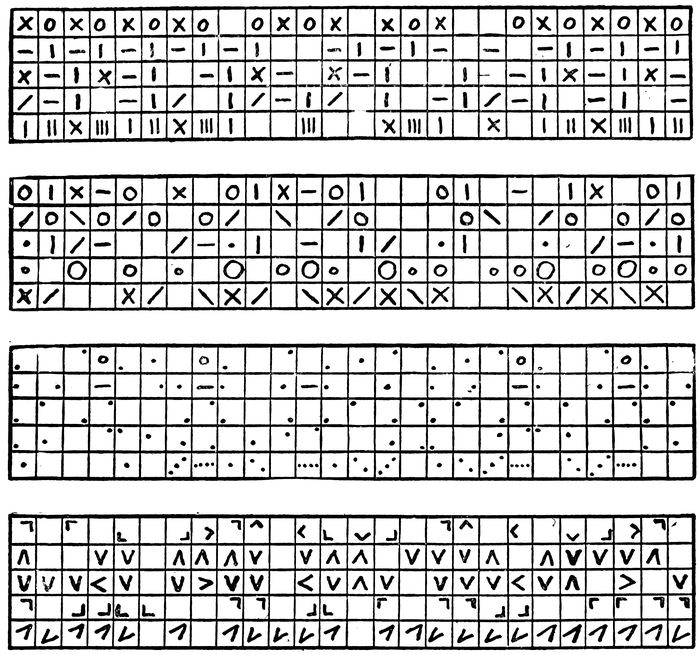
The Completion test is always very satisfactory because it shows in itself just what should be done and does not require a great deal of special explanation. The Form Series Completion test is particularly valuable in that it does not depend upon the English language either in its content or in the explanations to be made of it.
As with the majority of the other tests for non-English-speaking persons this test is here described as a test of one individual 158at a time, although it will be found very simple and easy to test a large group at the same time if the examples which appear on the title page of the test booklet can be painted on the wall or reproduced on a blackboard in such a way that the examiner can demonstrate to everyone at once just what is to be done. It is very desirable to examine large groups at the same time if the provision for such demonstration can be made.
Previous Form Series Completion tests have required the candidate to fill in the last characters of each line, everything being printed in order up to within a few sections of the end. The present form, in which the elisions are distributed through the series rather than being grouped at the end, has the advantage that it may be made more difficult by far than the previous forms. Although this test probably measures a rather specialized type of intellectual ability, it is nevertheless sufficiently well graduated in difficulty so that the result obtained by it will show a close relationship to the result obtained in other more general tests.
The problem of the candidate who is given this test is chiefly that of solving, from the rather meagre data presented, just what the serial order of the different forms may be. This undoubtedly calls for a complex variety of special mental qualities, including imagination and abstract reasoning ability. Nevertheless, it is hardly possible for the authors to make any sort of estimate of just where this test will be most valuable or just what it measures. It will certainly be interesting and entertaining whether it works out to have any particular usefulness or not.
Directions for Giving the Test.
The candidate should be seated at the left of the examiner in order that he may conveniently work upon the test booklet which should be placed on a table between them. After filling out for the candidate the information blanks giving name, age, and the like, the examiner should show for fifteen or twenty 159seconds (not more than 20 seconds) the inside of the booklet. He should then turn back to the title page and demonstrate the nature of the test by means of the examples printed there.

Probably the best and most effective method of demonstration is that of “jumping” the pencil rhythmically from one block to the next corresponding one to show the rhythmic sequence of the same symbols. When a block is reached in which the symbol has been omitted (but in which the samples have been crudely marked with a fine pen), the examiner should make an appropriate heavy mark such as is used in the printed sections of each series. After any symbol has been written on the explanation samples it would be very much worth while to skip rhythmically along the line making certain that the sequence is correctly followed. When it seems fairly certain that the candidate has grasped the rhythmic nature of the forms, the examiner should open the booklet, give him a pencil, and say “Put them in.” “Fix it up.” “Go ahead.”
Allow exactly five minutes for this work. At the end of this time the examiner should take the paper and score it as directed below.
Directions for Scoring the Test.
The score in this test is determined by the number of lines in which the candidate has entered the correct forms to complete the line perfectly. No credit should be given if any one of the sections remain unfilled or be filled incorrectly. The stencil which is furnished with the test booklets makes the task of marking the errors very much simpler than it is without such aid. The total score obtained should be entered in the lower right-hand corner of the title page of the booklet.
160Fill in the missing forms
Scores from 0 to 2 indicate Inferior Ability
Scores from 3 to 5 indicate Low Average Ability
Scores from 6 to 12 indicate Average Ability
Scores from 13 to 15 indicate High Average Ability
Scores from 16 to 20 indicate Superior Ability
161
Mentimeter No. 7 CHECKING IDENTITY OF NUMBERS
Character of the Test.
Bank tellers and other clerical workers find it necessary very frequently to compare signatures or numerical figures as to identity. A test might be arranged in which it was necessary for an individual to compare several sets of numbers all of the same length and general appearance. Such a test would, however, resolve itself very largely into a test of speed. The present form attempts to eliminate some of the speed element and to take to itself as much as possible of the quality of measuring the complexity which is necessary to cause an error in the recognition of identity. There are thirty numbers to be compared with another list of thirty in a parallel column. The first numbers have only two digits but the number of digits is increased fairly regularly until in the last pairs eleven digits in one column must be compared with the eleven digits in another.
This test is probably as useful a measure of ability to notice small details as it is necessary to make. The chief objection to it will come from individuals who are not gifted by nature with the ability to think in terms of numbers. This objection is not serious and will not be as valid even in their own cases as those who make it are inclined to believe. The test may be given as a group test if some means be provided for demonstrating before the entire group at one time just what type of activity is wanted. The directions given below are for giving the test as an individual examination, but with slight modifications the same directions will serve quite well for group examination. It is not necessary, of course, for the candidates to understand the English language if the examiner is thoroughly effective in his pantomimic instructions.
Directions for Giving the Test.
As soon as the proper record has been made of the age, the name, and location of the individual being examined, the examiner 162may turn the test leaflet and exhibit the two columns of numbers which appear on the other side. This exhibition should not be made formally and should last not more than twenty seconds. The pamphlet should then again be placed title page up in front of the candidate.
1ST COLUMN 2ND COLUMN SAME DIFFERENT
356 356 ☐ ☐ A
738 758 ☐ ☐ B
The examiner should then compare the identity of the numbers in the first example. The best way to do this would be to point first at the 3 in the first column then at the corresponding 3 in the second column, nodding his head, “Yes.” The same pointing from one column to the other should be done for 5 and for 6, the second column part of the pointing to be accompanied in each case by nodding the head, “Yes.” As a summary of this first example, the examiner may place his hand over the entire three digits of the first column and then transfer it to the entire three digits of the second column and nod his head, “Yes,” making merely a check mark (✓) on that horizontal line under the word, “same.” With the second example the same sort of pantomime may be used until 5 in the second column has been compared with 3 in the first column, which should be accompanied by a shaking of the head and the verbal exclamation, “No, no!” The summary by means of placing the hand over 738 and then over 758, with another, “No, no,” may be omitted if it is quite clear that the candidate has grasped the idea. In either case the examiner should make the check mark under the word “different.” The sheet may then be turned and the pencil handed to the candidate with the direction “Go ahead. Mark them all.” Exactly two minutes should be allowed after saying, “Go ahead.” At the end of two minutes the paper should be taken by the examiner and scored according to the following directions.
163If the numbers in the second column correspond exactly with those on the same line in the first column, make a check mark in the square on that line under the word “Same.” If the second set on any line differs in any way from the first, check that line under the word “Different.”
1st COLUMN 2nd COLUMN SAME DIFFERENT LINE NO.
96 96 ☐ ☐ 1
83 88 ☐ ☐ 2
77 71 ☐ ☐ 3
33 35 ☐ ☐ 4
82 82 ☐ ☐ 5
641 644 ☐ ☐ 6
956 956 ☐ ☐ 7
507 507 ☐ ☐ 8
9572 9752 ☐ ☐ 9
1832 1832 ☐ ☐ 10
19560 19360 ☐ ☐ 11
94083 94083 ☐ ☐ 12
940817 940847 ☐ ☐ 13
329506 326506 ☐ ☐ 14
654938 654938 ☐ ☐ 15
6998701 6997801 ☐ ☐ 16
7105923 7105623 ☐ ☐ 17
2501036 2500136 ☐ ☐ 18
3674462 3674462 ☐ ☐ 19
61558543 61585543 ☐ ☐ 20
38910066 39810066 ☐ ☐ 21
17198591 17198591 ☐ ☐ 22
685342017 685342017 ☐ ☐ 23
317762849 317762849 ☐ ☐ 24
102435867 102435867 ☐ ☐ 25
3484657120 3484657210 ☐ ☐ 26
4686726631 4686726631 ☐ ☐ 27
6571018034 6571018034 ☐ ☐ 28
38797625147 38797652147 ☐ ☐ 29
26557239164 26557239164 ☐ ☐ 30
164
Directions for Scoring the Test.
The score in this test is the total number of pairs the identity of which has been correctly checked, minus the total number of pairs in which an error has been made in checking the identity. For example, if the last line checked was the twenty-fifth line while two lines had been omitted and errors had been made in checking three other lines, then only twenty lines had been checked correctly, and three lines had been checked incorrectly; so the resulting score would be seventeen points. The maximum score obtainable is of course thirty points and will be obtained only in case every pair has been checked without error. It is possible with this method of scoring to obtain a score less than zero; for example, if a person had checked correctly ten of the identities and had made errors in checking fifteen others, the number of “rights” minus the number of “wrongs” would be minus five. In such cases the score to be entered on the lower right-hand corner of the candidate’s title page is zero.
The stencil furnished with the test leaflets makes it possible to mark this test with great rapidity and without mental fatigue. The point at which care needs to be taken is in making certain that the total score, computed by subtracting the number wrong from the number right, is correct. For this reason the reader is advised to cross out the “line number” of any pair incorrectly checked and to draw a circle around the “line number” of any pair not attempted by the candidate. If this is done consecutively down the page, there will be little difficulty in calculating the total score.
Scores from 0 to 8 indicate Inferior Ability
Scores from 9 to 12 indicate Low Average Ability
Scores from 13 to 22 indicate Average Ability
Scores from 23 to 26 indicate High Average Ability
Scores from 27 to 30 indicate Superior Ability
165
Mentimeter No. 8 DIGIT-SYMBOL SUBSTITUTION
Character of the Test.
Ability to master a language is usually very closely related to general intellectual ability along academic or abstract lines. The relationship between the age at which a child begins to talk and the length of time required later by the same child to learn to use a foreign language would probably be found fairly close.
The Digit-Symbol test has been used rather extensively and for many years as a form of measuring the ability of an individual to learn a new method of expressing himself. Many experimenters have used a Letter-Symbol test rather than the Digit-Symbol, but there seems to be little difference in the character of the results obtained.
The Mentimeter form of the test follows quite closely the corresponding test in the Beta series used in the Army. At the top of the page there appears a key showing just what symbol should be used to indicate each number or digit. The test itself consists of 100 digits with empty squares appearing below them in which one is to write, beneath each digit, its corresponding symbol as shown by the key on pages 166 and 167. An intelligent person usually begins with the first digit and supplies the proper symbol for it at each place it occurs in the test; then begins with the second digit and goes through the entire test writing the symbol for it, and so on. Those of average intelligence more frequently try to supply the proper symbol for each different digit in order as they appear in the test without going through the entire test with each symbol separately. The method of the candidate in doing the work should not, however, be allowed to influence the rating obtained on the test, except as one method may produce a higher score than another.
Investigations which have been made seem to show that although the symbols used are quite distinctly more difficult to 166write than the digits themselves would be, it is nevertheless a better test to measure the number of symbols the candidate can write under the digits than to measure the number of digits one could write correctly under their corresponding symbols. The relationship between ability in this test and general ability to handle ideas and abstract notions is rather remarkably close. It is probable, however, that if the test were lengthened so as to require five or ten minutes rather than two and one half minutes the correspondence with intellectual ability would be increased.
This test will be very useful to employers seeking high-grade clerical service and probably in selecting administrative or supervisory officers. In the public schools it will be useful in some instances in classifying pupils for instruction. As a diversion in the home or social group it will have slight value.
Directions for Giving the Test.
This test has ordinarily been given as a test of several individuals at the same time. It is probable that it will not be as useful when given to one individual at a time as when used as a group test. The instructions are given here, however, as with the remainder of the tests for non-English-speaking persons, with the needs of examining foreigners individually uppermost in mind. By reproducing on the blackboard or on a wall chart the introductory examples one may adapt with almost no change the method of administration here described so that it will work equally well with a group. It is advisable to prepare such introductory charts and to give the tests as group tests rather than as individual tests, not only with the Digit-Symbol Substitution test but also with the other Mentimeters numbered from 2 to 10.
Key: This shows the mark for each number
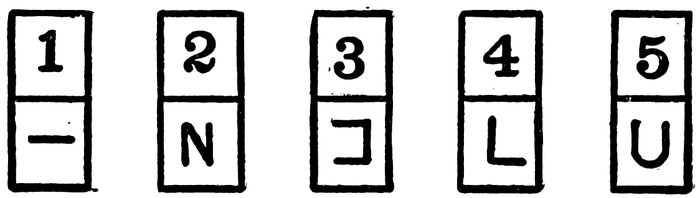
Make under each number the mark which should be there

167Key: This shows the mark for each number

Make under each number the mark which should be there

The individual to be tested should be shown the page on which 168he is to work, for not more than twenty seconds, and should then be shown the two examples appearing on the title page under the printed instructions, “Make under each number the mark which should be there.” The examiner should then compare his key and the digits appearing in the sample series and should write in the proper spaces the appropriate symbols. The idea of getting the symbol from a key will be emphasized and made clear if the examiner at each point moves his finger or pencil from the digit in the example to the digit in the key, then to the symbol in the key and back to the empty space beneath the digit in the example. When all the spaces of the example have been filled (this should be done very slowly at first and then more rapidly toward the end of the example), the examiner should open the booklet, supply a pencil, and say, “Now! Go ahead! Put them in! Hurry up!”
Exactly two and one half minutes (150 seconds) should be allowed from the time the examiner says, “Go ahead,” to the time he calls, “Stop!” All papers should be closed immediately and handed to the examiner.
Directions for Scoring the Test.
The score in this test is the number of symbols correctly supplied. Marking the errors is very much simplified by the use of the stencils furnished with each package of test booklets. The number of symbols correctly written should be recorded at the end of each line in the test and the total for all lines should be entered in the lower right-hand corner of the title page of the booklet.
Scores from 0 to 20 indicate Inferior Ability
Scores from 21 to 35 indicate Low Average Ability
Scores from 36 to 65 indicate Average Ability
Scores from 66 to 75 indicate High Average Ability
Scores from 76 to 100 indicate Superior Ability
169
Mentimeter No. 9 COMPLETION OF NUMBER RELATION SERIES
Character of the Test.
This test may be given to any individuals or groups of persons who can read and understand the arabic numerals. The directions furnished herewith are for the measurement of a group rather than of an individual, although with very slight modifications in instructions the test leaflet may be employed in an individual psychological examination. The title page of the leaflet contains fairly complete directions and three samples of the number series to be completed. Persons who read English readily will have a distinct advantage over those who must depend upon oral instructions, but experience has shown that, even with individuals who do not understand the English language, it is possible to demonstrate on a blackboard, using the sample exercises, with sufficient clearness to enable foreign language-speaking candidates to grasp the idea of the work to be done. No comparisons should be made, however, between results obtained by oral demonstration and results obtained through the use of the instructions printed below, without making allowances for the differences in method of administration.
The Number Relation Series test is so difficult to understand that it is hardly worth while to employ this test with children below ten years of age or with adults whose mental capacity is not equal to or better than that of the ten-year-old school child. The method of marking the test is quite simple when one is supplied with the stencil which is furnished with each package of test blanks. The present form of the test is somewhat different from those used elsewhere and it is difficult to say just what phases of intellectual or mathematical ability are measured by it. The Army intelligence tests included a number relation series test, so arranged that the last two numbers in each series 170must always be supplied by the person tested. Dr. Agnes Rogers, in her study of the prognostication of mathematical ability, employed a test which is very closely related to the one given here. Her results seem to show that this form of test is a splendid measure of mathematical capacity in high school pupils.
It is probable that this test will have very little usefulness in the selection of employees in general, but that it may be found valuable in discovering within an organization persons whose mathematical aptitude would make them very useful in positions where the handling of figures is an important part of the employee’s duty. In schools the chief value of the test will probably be in assisting in the diagnosis of special mathematical ability or lack of ability among pupils entering high school. As a game for social amusement, it is not probable that this test will be highly popular, except among those who are mathematically inclined.
Directions for Giving the Test.
Having supplied each candidate with writing materials the examiner should announce as follows:
“I am going to distribute to you copies of a test which is intended to measure certain special mental capacities. I shall pass it to you with that side up which contains the directions. Do not turn it over or examine the 20 problems which are to be solved. Write your name where it says ‘Name’ and fill in the other blanks on the title page.”
The blanks should be distributed, taking care that each candidate receives the blank right side up and that no candidate turns it over before the command is given to begin work. When names, ages, and other identifying pieces of information have been entered the examiner should ask the candidates to look at the directions carefully while he reads them aloud.
“The other side of this sheet has 20 series of figures, one or more of the figures from each series being left out. You are to 171look carefully at each series, to study out what kind of a series it is and then to write on the dotted lines those numbers which have been omitted. Look at the following samples.
Write on each blank the number omitted
2 4 6 8 10 .. 14 16 18 20 Sample A
16 11 7 .. 2 1 1 2 4 7 Sample B
2 .. .. 2 2 3 2 4 2 5 Sample C
“In Sample A each number is obtained from the previous number by adding 2 to it; therefore, 12 should be the number between 10 and 14. In Sample B, each number is obtained from the next previous number by subtracting 1 less than was subtracted from the number before it—that is, 5 is subtracted from 16 to obtain 11, 4 is subtracted from 11 to obtain 7, 3 should then be subtracted from 7 to obtain a 4 which is to be entered on the blank. In Sample C, every other number is a 2 and therefore the second blank space should contain a 2. Between the 2’s appear numbers, each one of which is one more than the one which preceded it. On the first blank in Sample C there should be a 1 in order to carry out this scheme.”
“You will be allowed four minutes in which to complete the 16 series. Begin with the first and complete as many as you possibly can. Ready! Go!” At the end of four minutes after saying “Go” the examiner should call “Stop! Time up! Give me your papers.” All papers should be collected at once.
Unusual care will need to be taken in giving this test to avoid variations in the directions used with the different groups examined. In order to maintain absolutely comparable test conditions, no variations from the language and routine given above should be allowed.
172
Write on each blank the number omitted
1 2 3 4 5 .. 7 8 9 10 Series 1.
10 12 .. 16 18 .. 22 24 26 28 Series 2.
12 11 10 .. 8 7 .. .. 4 3 Series 3.
1 3 .. 7 9 11 13 15 17 .. Series 4.
.. 39 37 35 33 31 29 .. 25 23 Series 5.
4 5 7 .. 14 19 25 32 40 .. Series 6.
1 64 1 32 1 16 .. ¼ ½ .. 2 .. 8 Series 7.
8 15 .. 29 36 43 .. 57 64 71 Series 8.
10 .. 15 16 20 21 .. 26 30 31 Series 9.
2 .. 8 10 .. 10 20 10 26 .. Series 10.
7 .. 10 11 13 14 .. .. .. 20 Series 11.
.. 4 9 16 25 .. .. 64 81 100 Series 12.
.. 4 7 14 17 .. .. .. 77 154 Series 13.
32 .. .. .. 28 29 26 27 .. 25 Series 14.
6 10 13 .. .. .. 15 13 10 .. Series 15.
60 55 .. .. 46 45 .. 46 48 .. Series 16.
Directions for Scoring the Test.
The score in this test is the number of series correctly completed regardless of the number of blanks in the series. The maximum score obtainable will therefore be 16 points. The stencil furnished with each set of test leaflets will make it very simple to count the number of series correctly completed. A convenient way of indicating that a series is not correctly completed is to cross out the serial number of that series. To indicate that the series was not attempted one might draw a circle around the serial number of that series. The final score should 173be entered on the title page of the leaflet in the lower right-hand corner.
Scores from 0 to 1 indicate Inferior Ability
Scores from 2 to 4 indicate Low Average Ability
Scores from 5 to 8 indicate Average Ability
Scores from 9 to 11 indicate High Average Ability
Scores from 12 to 16 indicate Superior Ability
It should be borne in mind that the type of ability measured by the above scores is not necessarily a true indication of the general efficiency of the possessor.
Mentimeter No. 10 ADDITION TESTS
Character of the Tests.
This Mentimeter is composed of two parts, one of them measuring the difficulty of the addition problems which a candidate can solve, and being therefore a fairly good test of intelligence, the other measuring the speed at which one can add fairly easy problems and therefore having less relations to intellectual ability.
Teachers in school furnish the children with certain information and knowledge or guide their pupils to the sources from which this information and knowledge may be obtained. In Addition, this information takes the form of “2 and 2 make 4,” “9 and 5 make 14” and such sums. The instruction also involves such things as how to carry in addition, how to add when a decimal point enters into the calculation, and all such problems. The teacher also undertakes a somewhat different task, which is the review and drilling of the pupils in order to make the combinations which have been explained automatic in the minds of the children. It is not sufficient for John to know that “3 and 5 are 8,” but he must be able to write or say 174“8” without any hesitation whatever when 3 and 5 are to be added.
In order to test the extent to which teachers have explained addition, one would measure the pupils with a test which increased in difficulty from the first problems to the last, undertaking to determine how difficult a problem can be solved. In order to test the rapidity with which the pupils have learned in their drill exercises to make the different combinations, one would measure the speed with which they can make the simple combinations. The first addition test which is given on page 175 measures the extent of the information which the candidate has gained, while the second measures the speed which the candidate has developed by drilling upon addition problems.
Teachers in the public schools will undoubtedly wish to measure both the speed with which their pupils do simple problems as a result of drill, and the difficulty of the problems which the child can solve correctly as a result of instruction. Of course the test for difficulty of problems solved is not absolutely independent of the effect of drill, although it is relatively much less dependent upon drill than is the other test.
In industrial organizations the first test given will probably be found most useful, while in social groups the greatest amount of entertainment will probably be obtained from the second test. The reliability of the results from the first test is very much higher than the reliability of the results from the second test, for in the second case a difference of one second in time allowed may make as much as one or two points difference in the score obtained.
As with all of the other tests listed in this series of “Tests for Non-English-Speaking Persons,” the Addition tests will bring more satisfactory results, with much greater economy of time, if they are administered as group tests. They are here described, however, as tests for individual candidates in order that they may be given to foreign language-speaking candidates without any other apparatus than that furnished by the test booklets 175themselves. Any teacher or employer who has a number of persons to be examined should prepare a blackboard or wall chart on which to exhibit an enlarged copy of the examples used in the introduction. By placing this at the front of the room in full view of all candidates, the pantomimic instructions here described may be used for non-English-speaking candidates, or simple verbal explanations may supplement them for English-speaking persons.
Directions for Giving Mentimeter 10a.
The examiner, after securing from the candidate his name, address, age, and other pertinent information, should turn the examination leaflet and exhibit, for ten or fifteen seconds, the addition tests which are to be solved. The leaflet should then be turned over to the title page again and attention should be called to the examples appearing on the middle of this page under the heading “Add.” The examiner should point to the first example
2
2
and placing his pencil on the lower 2 and then upon the upper 2 should seem to hesitate for an instant and then write 4 underneath the line. Looking at the second example
15
3
he should place his pencil on the 3 and then on the 5 and, with only an instant’s hesitation, should write 18. Similarly, looking at the third example,
23
25
16,
he should place his pencil first on the 6, then on the 5, then on the 3, and write a 4 underneath the line; then place his pencil on the 1 and then upon the two 2’s in order and write 6 at the left of the 4. With this explanation the examination booklet should be opened and a pencil supplied to the candidate with the instructions “Go ahead! Add them all!”
176
Mentimeter No. 10a.
Add:
(1) (2) (3) (4) (5) (6) (7)
3 2 14 45 13 23 14
2 5 3 34 21 35 45
1 22 30 83
(8) (9) (10) (11) (12)
34 197 374 796 7065375
67 225 49 867 8688256
95 659 623 745 2315553
52 316 5 933 1947272
548 542 3583419
65 213 5224362
564 6869021
235 8518488
676 3493625
2657176
Four minutes’ time should be allowed for this test. At the end of the four minutes the examiner should call “Time up” and take the paper.
Directions for Scoring Mentimeter 10a.
The score in this test is the number of problems correctly solved. No credit should be given for any problem unless each digit in the answer is present, correct, and in its right place.
Scores from 0 to 5 indicate Inferior Ability
Scores from 6 to 8 indicate Low Average Ability
Scores from 9 to 11 indicate Average Ability
A score of 12 indicates High Average or Superior Ability.
Directions for Giving Mentimeter 10b.
The examiner should open the booklet and demonstrate to the candidate, for ten seconds, with just what nature of test he 177is to be confronted. Then, after securing the necessary identifying information, the examiner should point to the problems on the title page under the word “Add.” Pointing to the 1 in the first example and then to the 2, he should write 3 under the line. Pointing to the 4 and then to the 5, in the second example, he should write 9 under the line. Pointing to the 4 and then to the 7 in the third example he should write 11 under the line, and should then pass his pencil and the opened booklet to the candidate with the instruction, “Go ahead! Add them up!”
The most important point in this test is to make absolutely certain that exactly thirty seconds (no more and no less) is allowed from the time the examiner supplies the candidate with a pencil until the time he calls “Stop!” Unless this time is kept absolutely uniform the results of the test will be hardly worth considering. Whether the candidate begins work or not, the time should be calculated from the instant he receives his pencil and the opened booklet.
Directions for Scoring Mentimeter 10b.
The score in this test is the number of correct answers obtained in thirty seconds. Unless an answer is absolutely correct, it should have no credit. If an answer is only partially finished when time is called, it should not be credited as being the correct answer unless it is sufficiently complete in both digits to prove that the right answer had been obtained.