Chapter X · THE MENTIMETER TESTS (continued 3)
Reading edition
Speed score from 0 to 30 indicates Inferior Ability
Speed score from 31 to 50 indicates Low Average Ability
Speed score from 51 to 75 indicates Average Ability
Speed score from 76 to 90 indicates High Average Ability
Speed score from 91 and upward indicates Superior Ability
The score in quality of handwriting is to be determined by comparing the candidate’s handwriting with samples on the Mentimeter for Handwriting Quality:[3] a grade of “A,” indicating superior quality, should be assigned if the candidate’s handwriting is as smooth, beautiful and legible as the sample marked “A,” or if the quality more nearly approaches the quality of sample “A” than the quality of sample “B.” The sample should be given a rating as quality “C” if its general beauty and quality be nearer to the printed sample “C” than to printed samples “B” or “D.” Give to any sample that grade which indicates the printed quality that most nearly equals it in beauty, legibility, and general merit.
In making a record of any candidate’s performance in the handwriting test both quality and speed should be recorded. 239“C–71” would mean that in the Mentimeter test this individual had written quality “C” at a speed of 71 letters per minute. The speed and quality together are necessary in order to know the entire truth about one’s handwriting, for many people produce a beautiful handwriting by taking great pains and wasting much time.
Mentimeter for Handwriting Quality
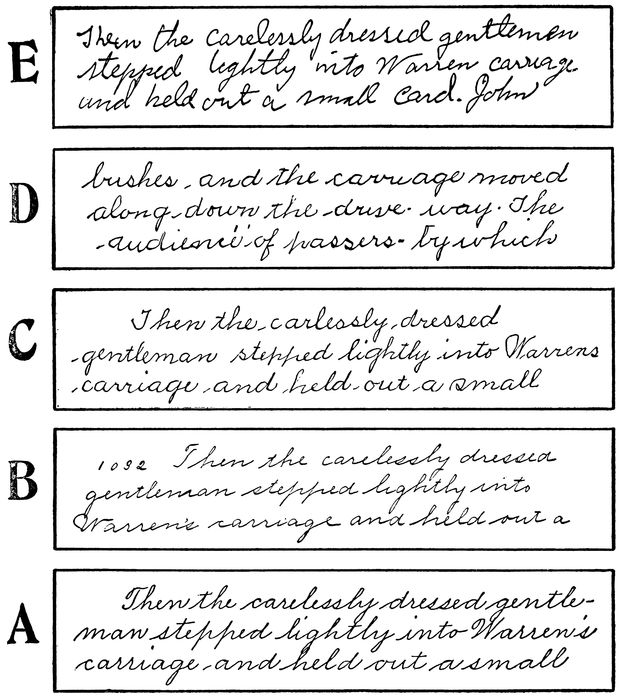
240
Mentimeter No. 26 ENGLISH COMPOSITION
Character of the Test.
Only persons who have had the benefit of a fairly complete elementary school education will succeed very emphatically in this test of ability to write a composition in the English language. The test may be given to large numbers of people at the same time just as readily as to a single individual. The result of the test is, however, a very good index of the general intellectual capacity of the individual, unless he is handicapped by lack of familiarity with the language.
The most common use which most of us have for ability at composing in English is in writing letters to our friends or to those with whom our business brings us into contact. For this reason, the test consists in the statement of a condition under which any one of us might find ourselves and in asking the candidates to write an appropriate letter. The result is graded into one of five groups, according to its general quality.
The problem presented to the candidate is fairly complex. First of all, he must be able to understand the situation described by the examiner and to appreciate what type of letter would be most appropriate under these circumstances. He must also be able to write the words which would express his feelings in the described situation, and in order to make his feelings clearly understood he should be able to punctuate and organize his sentences effectively. The result is a useful index of the general efficiency and maturity of any candidate who has been taught to write in English.
In industrial life there are many types of positions for which persons whose ability to compose written English need not be better than “Inferior,” although there are other positions which would require “High Average” quality of English composition. The advantage of the following Mentimeter lies in the possibility it gives of identifying more exactly just what 241quality is meant when one speaks of “High Average” composing ability.
In the public schools the Mentimeter will serve as a crude basis for classifying the general quality of the compositions written, but for highly scientific work it would be desirable to secure some form of the “Hillegas Scale” which is much more exact and well standardized. A very entertaining evening could be enjoyed by giving this test to a group of people gathered together for social purposes, especially with a group which had tired of the ordinary means of entertainment. Reading the products written should in such a case be entrusted to some one or two individuals of good reading ability and wise judgment. Frequently the results would contain very amusing paragraphs.
Directions for Giving the Test.
Each candidate should be comfortably seated and provided with writing material before any instructions are given. It will usually be well to furnish paper on which there are lines, as many people find the lack of ruling a distinct hindrance to the flow of their thoughts. When everyone is ready, the examiner should direct that each individual write his or her name, age, address, and any other information which seems desirable. The following directions should then be given:
“This test is planned to discover how well you can use the English language in expressing your thoughts and feelings. Imagine yourself employed in a large business house in the city. While you are waiting to find out whether or not you are going to be one of those fortunate people who will be granted a vacation, imagine that you receive a letter from a friend in the country asking you to spend your vacation on the farm. Since you do not know that you will have a vacation, it is impossible for you to accept the invitation at once, but it is necessary for you to acknowledge the fact that you have received the invitation. Write a letter to this friend in the country saying that the invitation has been received and that you appreciate it. You 242need not make the letter long, but write it just as well as you can.” At least twenty minutes should be allowed for the writing of this letter. At the end of twenty minutes all papers should be collected, whether the letters are complete or not—enough will have been written to demonstrate the quality of letter each can write.
MENTIMETER FOR QUALITY OF ENGLISH COMPOSITIONS
Quality: Superior, A.
My Dear Jean:—
Your letter made me peculiarly happy this morning. The joys of last Summer so wrapt themselves about me that, instead of hurrying down Broadway to business, I was sitting on the veranda with you and little Bobby at sunset watching the Hudson creep slowly in and out among the hills. One by one the little villages dropt out of sight as the fog came down from the Catskills, crept across the river, up through the woods and finally nestled among the neighbour’s fir trees. Black crows cawed as they flew lazily over the house, and the little birds came up close to the edge of the woods to sleep in the barberry bushes. Bobby said they came up close so we would hear if anything got them. The little dear! Tell him I have saved a number of stories for him—two new ones about light-houses.
I am rather doubtful as to whether I will be granted a vacation this year. Business conditions are so far from normal, and we are very short of help. However, I may be lucky, and if I am nothing would make me so happy as to spend every day of it with you and little Bobby. I expect to know definitely by the end of next week concerning my vacation and shall write to you immediately.
I thank you more than I can say, Jean. Your invitation has made me very happy.
Sincerely,
243 Quality: High Average, B.
My Dear Mr. Smith:
I appreciate your invitation expressing the desire to entertain me again at your farm during my Summer vacation. I should enjoy coming back this Summer, although I have occasionally been afraid that I was something of a hindrance to your work. It is such a change for me to get to the country that I shall certainly come if possible.
I shall let you know just as soon as I find out whether or not I am to have a vacation this Summer. Thanking you for your kind invitation, I remain,
Sincerely yours,
Quality: Average, C.
My Dear Friend:
Your letter of June 10th has been received, and in reply I would say that I am not sure that I will get my vacation this summer. The boss hasn’t said anything about vacations yet. I would like to come just as much as you would like to have me, but I can’t promise until the old man lets us know. I’ll write to you just as soon as I learn what to expect. Thanks for your invitation.
Yours,
Quality: Low Average, D.
Dear Friend
I got your letter alright, but it don’t look like I was going to get any vacation this summer. We have all been tryin to hint to the boss about how tired we all was but he has to be knocked down to take a hint I guess.
I sure do hope he lets me off. You know how I’d like to come and I want you to keep plenty of green truck growin in the gardin for me to eat.
Yours truly
244 Quality: Inferior, E.
Der Frend
id lik to cum out to yer farm ef the flise ant tou bad but i got to wate the boss hant told us we can tak ar vakashins yit hous the frut & burys this yere il cum ef i can
Directions for Scoring the Test.
Each composition should be compared with the five contained on the Mentimeter for English Composition quality. Give the written composition a mark as “Average,” “Superior,” or “Low Average” according to its quality. If a composition seems to be better than the one on the Mentimeter which is called “Average” but poorer than the one called “High Average,” try to decide which it is nearer in general quality. “Average,” therefore, will mean that a composition is nearer in its quality to the sample printed as “Average” than it is to the sample printed as “High Average,” or to the sample printed as “Low Average.” Any composition which is distinctly better than “Superior” should be rated as “Superior,” and any composition which seems poorer than the one printed as “Inferior” should be rated as “Inferior.”
Mentimeter No. 27 POETIC DISCRIMINATION TEST
Character of the Test.
Differences in the intellectual abilities of people manifest themselves in three fairly distinct ways: first, in ability to accomplish results; second, in ability to think clearly about the situations in which they find themselves; and third, in the feelings which these situations arouse. Practically all of the tests now available for measuring educational achievements or intellectual ability are concerned primarily with the ability to do or to think about situations. This member of the Mentimeter family 245is concerned chiefly with the way in which one feels about different types and qualities of poetic expression. The test cannot be given to illiterate or foreign language speaking persons. It is planned as a group test of persons who read and understand English readily.
The test consists of six short stanzas selected from recognized English poets.[4] Two false versions of each stanza have been prepared and appear on the same page with the original. The group being examined are asked to read each version, trying to think how it would sound if read aloud, and to choose the one which they like “best” and the one which they consider the “poorest” poetry. The differences between the false versions and the true in the first set are smaller than the differences found in the succeeding ones. The score obtained by any individual therefore depends upon how small a difference he can notice.
Although this test is very interesting and entertaining its reliability is not determined and its usefulness is as yet questionable. It certainly would have no great value in industrial life and only small importance in public school work; its chief service will be entertainment in the home and at social gatherings. It is surprising how poor the judgment of many people is regarding the quality of poetic products. It would be interesting at social affairs at which this test is used to make a tabulation of just how many of those present have selected each different version.
246
Directions for Giving the Test.
The examiner should distribute the examination booklets and writing materials with the following instruction:
“Do not open this booklet until I tell you to do so. Notice on the title page a number of blanks for your name, your age, and the like. Fill out these blanks at once but do not look inside the booklet.”
As soon as the blanks on the title page have been filled the examiner should ask the candidates to read carefully the directions while he reads them aloud.
“When you open your book you will find six different sets of poetic stanzas. Each set appears in three different versions. You are to read each version carefully, trying to think how it would sound if read aloud, and then to record on the blank space provided for it which version you think is ‘best,’ which version you think is ‘poorest’ and which version you think is of ‘middle’ value. If you decide that version Y is best then write ‘Y’ after the word Best. If Z is the worst, then write ‘Z’ after the word Poorest, and ‘X’ after the word Middle.
“Think carefully about each set and choose the one which you really think is the best poetry. You will be allowed fifteen minutes in which to read and decide about the six sets. Begin with set No. I and take them in order. Ready! Open your papers and begin work.”
Exactly fifteen minutes after saying “Begin” the examiner should call, “Stop! The time is up. Let me have your papers.” All papers should be taken up at once.
247 SET I
Read each version carefully and try to think how it would sound if it were read aloud.
Which version is the poorest poetry, and which is the best poetry?
Best ........
Middle ........
Poorest ........
Version X
Once there was a violet,
Growing near a stone;
It reminded me of a star
All alone in the sky.
Version Y
A violet grew by a mossy stone,
Where it was hard to see;
It looked like a star, for it shone
As pretty as could be.
Version Z
A violet by a mossy stone
Half hidden from the eye!
—Fair as a star, when only one
Is shining in the sky.
248 SET II
Read each version carefully and try to think how it would sound if it were read aloud.
Which version is the poorest poetry, and which is the best poetry?
I’ll keep a little tavern
Below the high hill’s crest,
Wherein all gray-eyed people
May set them down and rest.
Best ........
Middle ........
Poorest ........
Version X
There shall be plates a-plenty,
And mugs to melt the chill
Of all the gray-eyed people
Who happen up the hill.
Ay, ’tis a curious fancy—
But all the good I know
Was taught me out of two gray eyes
A long time ago.
Version Y
There shall be dishes a-plenty,
And something to take off the chill
Of as many gray-eyed people
As are willing to climb the hill.
’Tis truly an odd fancy,
But everything good that I know
I learned out of two gray eyes
Many years ago.
Version Z
And when those gray-eyed people
Have entered in the gate,
We’ll pass the cheering mug around,
And also pass the plate.
It may sound rather funny,
But I was helped a lot
By someone who had gray eyes
When I was a little tot.
249 SET III
Read each version carefully and try to think how it would sound if it were read aloud.
Which version is the poorest poetry, and which is the best poetry?
Best ....
Middle ....
Poorest ....
Version X
Music, when faint voices cease,
Continues in the memory—
Odours, when the violets fade,
Linger where their smell was made.
Version Y
Music lives in the memory,
Though the songster’s voice is done.
Sweet odours haunt the nose,
Though the violets that waked them are gone.
Version Z
Music, when soft voices die,
Vibrates in the memory—
Odours, when sweet violets sicken,
Live within the sense they quicken.
250 SET IV
Read each version carefully and try to think how it would sound if it were read aloud.
Which version is the poorest poetry, and which is the best poetry?
Best ....
Middle ....
Poorest ....
Version X
No rosebud yet has e’er been seen,
Or flower in tropic lands,
To equal these, more beauteous e’en—
A baby’s hands.
Version Y
No rosebuds yet by dawn impearled
Match, even in loveliest lands,
The sweetest flowers in all the world—
A baby’s hands.
Version Z
No flower that grows,
In this or any other lands,
Compares with these, of daintiest rose—
A baby’s hands.
251 SET V
Read each version carefully and try to think how it would sound if it were read aloud.
Which version is the poorest poetry, and which is the best poetry?
Best ....
Middle ....
Poorest ....
Version X
She speaks in tones of silver
With the voice of morning birds,
And every word that’s spoken of her
Echoes the music of her words.
Version Y
Her every tone is music’s own,
Like those of morning birds,
And something more than melody
Dwells ever in her words.
Version Z
Her tones are pure as silver chimes,
Her notes of birdlike beauty;
The words she speaks are at all times
Replete with life and beauty.
252 SET VI
Read each version carefully and try to think how it would sound if it were read aloud.
Which version is the poorest poetry, and which is the best poetry?
Best ....
Middle ....
Poorest ....
Version X
A pipe and a book,
By the side of the brook,
With the world and her troubles forgot;
Just to read and to smoke,
Man forgets that he’s broke,—
And he finds, after all, that he’s not.
Version Y
Give a man a pipe he can smoke,
Give a man a book he can read;
And his home is bright with a calm delight,
Though the room be poor indeed.
Version Z
Let a man smoke,
And let a man read;
A pipe and a book in any old nook,
Lend peace which is wealth indeed.
253
Directions for Scoring the Test.
The score in this test is determined in a somewhat more complicated manner than is the case of any other of the Mentimeter series. Two points are allowed each candidate for selecting as “Best” the original version in any set and one point of credit is allowed for selecting the poorest version as “Poorest.” It will be observed that the maximum score on any set will be three points if the candidate arranges the versions in the correct order, two points for selecting the best and one point for selecting the worst. This makes the total maximum score, for six sets, eighteen points.
The correct order of merit for each set of selections has been determined by the judgment of approximately one hundred competent judges. It is as follows:
SET I II III IV V VI
Best Z X Z Y Y Y
Middle Y Y X X Z Z
Poorest X Z Y Z X X
Write the final score obtained on the total of the six sets in the lower right-hand corner of the title page of the examination booklet.
Scores from 0 to 3 indicate Very Inferior Ability
Scores from 4 to 7 indicate Inferior Ability
Scores from 8 to 11 indicate Average Ability
Scores from 12 to 14 indicate Superior Ability
Scores from 15 to 18 indicate Very Superior Ability
254
Mentimeter No. 28 ARITHMETIC REASONING
Character of the Test.
Teachers in schools have for a long while based a large part of their judgment about any individual’s intellectual ability almost exclusively upon the facility with which he solved arithmetic problems. Although the ability to solve arithmetic problems has not been so frequently recognized by investigators as an index of intellectual ability as has ability in English, the teachers have found it much easier to estimate intellectual ability upon the basis of showing in arithmetic, because it is easier to judge of success in arithmetic than to judge of success in English or other fields. A child can either solve the problem or else he cannot. This objective nature of the subject of arithmetic has made it a very important subject for the teacher in deciding upon promotions.
In practical life, arithmetic has been recognized as being of value because the training in arithmetic was supposed to enable a student to keep other people from cheating him in financial transactions. The writers have known employers, on a small scale, who used certain tricky arithmetic problems as the basis upon which to judge the intellectual ability of prospective employees. Arithmetic problems have had and will continue to have a distinctive place in the measurement of intellectual capacity. It is probable that this place is well deserved.
Directions for Giving the Test.
As soon as the candidates are seated, they should be supplied with pencils, and the examination leaflet should be distributed with the instruction that it is not to be turned over until special instructions are given to that effect. In order to keep the candidates busy, the examiner should ask them to fill out the 255blanks on the title page, giving name, age, etc. When this information has been obtained, the examiner should ask the candidates to read the directions silently while he reads them aloud.
“On the other side of your papers you will find fourteen problems in arithmetic. The first problems are simple and easy and the last ones are more difficult. Begin with the first problem and solve as many as you can in the four minutes after I say ‘Go!’ Write your answer at the right-hand side of the questions on the dotted lines provided for the answers. You may figure on the left-hand side or on the back of the blank, if you wish. Solve as many problems as you can but be sure to get the answer right. Ready! Go!”
Allowing exactly four minutes after saying the world “Go!” the examiner should call “Stop! Turn your papers over. Give them to me.” All papers should be collected immediately.
Write the answers to these problems on the blanks
Use the other side of the sheet to figure on
ANSWERS
1. How many are 5 men and 3 men? ..........
2. If you earn 2 dollars each day, how much do you earn in 6 days? ..........
3. If you have 10 nickels and lose 3 of them, how many would you have after you found 2 of those that were lost? ..........
4. How many benches will be needed in order to seat 20 people at a picnic, if 4 people sit on each bench? ..........
5. If James sold 3 Sunday papers for 5 cents each and then bought an apple for 3 cents and an orange for 4 cents, how much money had he left? ..........
2566. How much change should you get from a dollar bill after buying 39 cents’ worth of potatoes, 12 cents’ worth of celery, and 26 cents’ worth of butter? ..........
7. If the price of lemons is 2 for 5 cents, how many can you buy for 40 cents? ..........
8. If 29 merchants each bought 34 quarts of canned peas at a wholesale house which had previously sold 2,387 quarts of the same brand, what was the total number of quarts of this brand sold? ..........
9. If a wholesale merchant sold for $50 sugar which he had purchased for $45 and thereby gained 1 cent per pound, how many pounds of sugar were there? ..........
10. If four and a half pounds of fancy onions cost 27 cents, how much will eight and a half pounds cost? ..........
11. Half of the people in a certain city block were born of American parents, one eighth have American fathers and foreign-born mothers, one eighth have American mothers and foreign-born fathers, and both parents of the rest are foreign-born. Of the 1,200 people living in this block, how many have American fathers? ..........
12. A factory used 1,288 tons of coal in 23 days. During the first ten days after a new addition to the factory was opened, the average daily coal consumption was 78 tons. How many more tons were burned per day than previously? ..........
25713. A man spent for cigars and tobacco one sixteenth of his wages for one day. He spent five times as much for food, and half of what remained for repairs on his watch, which left him a dollar and a half. How much did he receive per day? ..........
14. At the middle of the month a merchant had $1,200 in the bank. He deposited $30 each day for six days and on Monday morning wrote checks for two thirds as much as his deposits for the week. Tuesday afternoon he deposited a check one fourth as large as his balance in the bank. What was his balance on Tuesday night? ..........
Directions for Scoring the Test.
The score in this test is the number of problems with absolutely correct answers. No credit should be given for partially correct answers. The total score of the test should be entered on the blank at the lower right-hand corner of the title page.
Scores from 0 to 3 indicate Inferior Ability
Scores from 4 to 7 indicate Low Average Ability
Scores from 8 to 10 indicate Average Ability
Scores of 11 and 12 indicate High Average Ability
Scores of 13 and 14 indicate Superior Ability
258
Mentimeter No. 29 PRACTICAL JUDGMENT TEST
Character of the Test.
This test is applicable to all persons who can read English as readily as the average third-grade public school pupil. For persons of less ability to read but of good ability to understand English, the questions may be asked orally in an individual examination. The results obtained when the questions are asked orally should not be compared with the results obtained when the printed test booklets are employed in a group examination. It is very strongly recommended that the test be used primarily as a group test, according to the instructions given here, in order that direct comparisons may be readily made between the results obtained in various places by different examiners.
The present form of the test is a lengthening of the form used in the Army Alpha series. Twenty-four elements are contained in the Mentimeter form, while only sixteen elements were used in the Army form. Another advantage of the present form over the military edition is the more definite attempt at arrangement of the elements in the test according to their difficulty. Having the series graduated in difficulty, from easy to hard, is a distinct advantage, particularly with young or dull persons, who quickly stop trying unless their first efforts are successful.
The use of questions, in the answering of which thoughtful judgment about every-day affairs would be required, has always been a favourite method of discovering the degree of intelligence possessed by a child or by an adult. Binet, the French psychologist who developed the mental age scale for testing feeble-minded subjects, included in his series a number of test questions of this type. The Stanford Revision of the Binet tests includes three such questions in the Eight-Year-Old series, and three other more difficult questions in the Ten-Year-Old list.
259The chief modification of the method in adapting it for group testing was the supplying of three or four answers from which the subject should select the correct reply. This change makes the markings of the results quite simple, but it takes from the test itself some of its virtue as a measure of the richness of ideas possessed by the person tested. Instead of having to think out an appropriate answer, one needs only to read the answers printed and to use good judgment in selecting the one to be checked as “best.”
The Mentimeter form of the test, although superior in its length and arrangement to the military version, is nevertheless not yet ideal as an intelligence test. The simplest questions and answers that can be printed are too difficult for first- and second-grade school pupils to read and understand, while the most difficult questions and answers one could devise would not be general enough in their subject matter to be included in a “general intelligence” test. In other words, the range of ability that this test will measure is not so wide as that measured by some other Mentimeter tests, with the result that the speed of reading and of making judgments plays a larger part in determining the final score than it would in a perfect intelligence test. In spite of the large part played by speed, the test is a useful index of ability to learn in certain lines of work where rapid decisions on practical problems are necessary.
It is probable that the Practical Judgment test will be found more useful in the measurement of intelligence among school children and clerical workers than in the classification of general employees, although the reader may find unexpected relationships between this test and certain routine occupations. Reliance should be placed upon it only after it has demonstrated in actual trials that it has a close relationship to the special ability desired.
Its use in social gatherings as a form of entertainment will be greatest where each person marks the papers of some other member of the group and reports the judgments found incorrect. 260Most persons are surprised, when they come to look over their booklets carefully, to find how many foolish errors have crept into their records while working at high speed. In order to increase the number of imperfect records and thereby add somewhat to the amusement of the group, the examiner may announce and use two minutes as the time limit, and urge everyone to try to work all of the 24 questions in that time. The general confusion will be increased if the examiner signals the end of the first minute and the end of a minute and a half. Under such conditions, of course, no serious use can be made of the results obtained. The score on the test is not to be used seriously except where the instructions and procedure are exactly as specified below.
Directions for Giving the Test.
Candidates should be comfortably seated at a table or supplied with a convenient writing board. A well-sharpened pencil (or pen with ink) should be in the hands of each candidate before any blanks are passed out. The test booklets should then be distributed, the announcement being clearly made beforehand that “no one will be allowed to open the booklet or turn it over until the signal is given to do so.”
When each candidate has been supplied with a test booklet, title page up, the examiner should say: “Now, write your name on the blank following the word Name.” After a pause long enough to allow this direction to be carried out, the examiner should continue with a similar instruction for each of the other pieces of information required by the title page blanks. “Age at last birthday” should be insisted upon, if there is any question of reporting age in any other way. Group numbers and locations may be left blank where only small numbers of persons are being tested and where there is no probability of getting the papers from one place mixed with those from some other place. The name of the school, factory, or city will usually be sufficient for the blank headed “Location.”
261After the necessary identifying information has been entered at the top of the title page, the examiner should ask the candidates to read silently the directions while he reads them aloud. He should then read slowly and distinctly:
“The following pages contain 24 questions and 4 answers to each question. You are to vote for the best answer to each question by making a check mark (✓) in the square that stands before it. The questions are not hard, and you will be allowed 3 minutes to check the best answers, but be sure to work carefully and rapidly. Vote only for the one best answer to each question. Turn the page! Go!”
At the end of exactly 3 minutes after saying “Go!” the examiner should call “Stop! Close your booklets and pass them to me.” All papers should be collected at once in order to avoid unfairness and cheating.
MARK (✓) THE SQUARE IN FRONT OF THE BEST ANSWER TO EACH QUESTION
1.
What should one do when he is thirsty?
☐ Cry until someone gives him a drink.
☐ Eat a piece of salt pork.
☐ Get a drink of water.
☐ Read a Coca Cola advertisement.
2.
Why do children like to eat candy?
☐ It makes them fat.
☐ It tastes good.
☐ It is good for them.
☐ It is a cheap food. 262
3.
What should one do if it is raining when he starts to work?
☐ Put on lighter clothing.
☐ Wear a raincoat.
☐ Call up the office.
☐ Stay at home all day.
4.
What is the thing to do when your house catches fire?
☐ Try to find out how it started.
☐ Ring the alarm and try to put out the fire.
☐ Run in the other direction.
☐ Watch it burn and calculate your insurance.
5.
What should one do if he accidently steps on someone else’s toes?
☐ Call for help.
☐ Run for the doctor.
☐ Ask the person’s pardon.
☐ Take his own part.
6.
Why do the leaves fall off the trees in the autumn?
☐ The frost has killed them.
☐ To protect the flowers from freezing.
☐ To enrich the ground.
☐ So that one can see farther.
7.
Why do people wear heavier clothing in January than in June?
☐ To protect them from the colder weather.
☐ Because it looks better with furs.
☐ Everybody else does it, especially in January.
☐ It makes a good impression on other people. 263
8.
Where might one expect to find the largest number of expert swimmers?
☐ At the circus.
☐ At the beach of a summer resort.
☐ At a Sunday School picnic.
☐ At a moving picture show.
9.
What should a person do when he is late getting started to work in the morning?
☐ Wait until the next day.
☐ Think up some excuse to make.
☐ Try to make time by hurrying.
☐ Blame it on the street cars.
10.
Why do school houses usually have flag-poles?
☐ For the boys to exercise on.
☐ To show where to have a flag drill.
☐ To display the flag and inspire patriotism.
☐ To decorate the school yard.
11.
Why does water freeze in winter?
☐ It is warm in summer and we need ice.
☐ So the children can skate.
☐ Water always becomes solid at low temperatures.
☐ So it can be put in refrigerators.
12.
What is the best way to stop up a hole by which mice enter the kitchen?
☐ Stuff it with paper.
☐ Place a pile of rags in front of it.
☐ Put a corn cob in it.
☐ Nail a piece of tin over it. 264
13.
Why is milk a good thing to feed young children?
☐ It comes from cows that eat fresh grass.
☐ It is an easily digested and wholesome food.
☐ It is so pure and white to look at.
☐ It can be bought in pint or quart bottles.
14.
What kind of light is best for a reading table?
☐ A tallow candle.
☐ A mercury vapour lamp.
☐ A coal oil lantern.
☐ An incandescent electric bulb.
15.
What is the purpose of advertising food products?
☐ To make people hungry.
☐ To decorate street cars and magazines.
☐ To make people think about eating.
☐ To create a demand for special brands.
16.
Why is harness put on horses?
☐ So that their strength may be utilized.
☐ So that their beauty will be recognized.
☐ To match the colour of the carriage.
☐ To keep them warm.
17.
Why do people put food in refrigerators?
☐ To get it out of the way.
☐ The low temperature keeps it fresh.
☐ To help ice men make a living.
☐ Because the law requires it. 265
18.
Why are fire escapes more frequently put on tall buildings than on one-story buildings?
☐ A tall building is more likely to burn down.
☐ They would spoil the looks of a low building.
☐ Low buildings have fire extinguishers.
☐ One could jump from one-story buildings.
19.
What should one do with a baby when it cries?
☐ Discover and remove the cause of its crying.
☐ Spank it and put it to bed.
☐ Get it a drink of water and rock its cradle.
☐ Give it a bottle of milk or sing to it.
20.
Why is country air considered more healthful than city air?
☐ It has fewer impurities in it.
☐ Trees and grass grow in the country.
☐ More people die in the city.
☐ The wind is stronger in the country.
21.
Why do railroads use electric engines in some cities?
☐ They run faster than steam engines.
☐ They look better than steam engines.
☐ To avoid making the city smoky.
☐ In order to make less noise.
22.
What is the main purpose of lightning rods?
☐ To decorate the roof of the house.
☐ To make the lightning strike somewhere else.
☐ To show which way the wind blows.
☐ To remove the electricity from the air. 266
23.
What is the safest altitude and speed for flying in an airplane?
☐ Low and slowly.
☐ Low and rapidly.
☐ High and rapidly.
☐ High and slowly.
24.
What is the chief purpose of newspaper headlines?
☐ To make the paper attractive.
☐ To show what actually happened.
☐ To help one decide where to read.
☐ To guide public opinion wisely.
Directions for Scoring the Test.
The score in this test is the number of questions correctly answered. A stencil is furnished with each package of tests, which makes it possible to check up at a very rapid rate the accuracy of the votes cast, without ever reading a single word of the answers. The stencil is merely to be adjusted to the page, according to directions given on its face, and where the check mark made by the candidate corresponds to the printed mark on the stencil the question has been correctly answered, while if there is not agreement between stencil and candidate’s check no credit is to be allowed on the question. Any fairly careful clerical worker can learn in two minutes to score such a test with a stencil as rapidly and accurately as a thoroughly trained psychologist could do it.
The final score should be entered in the lower right-hand corner of the front or title page, where it will be easily associated with the name and other information about the candidate.
Scores from 0 to 3 indicate Inferior Ability
Scores from 4 to 8 indicate Low Average Ability
Scores from 9 to 14 indicate Average Ability
Scores from 15 to 19 indicate High Average Ability
Scores from 20 to 24 indicate Superior Ability
267
Mentimeter No. 30 LOGICAL CONCLUSIONS TEST
Character of the Test.
This test is to be given to large groups of individuals at the same time, although it may be given as a part of an individual examination. It will not be found worth while to give this test to individuals who have not had at least the equivalent of an elementary school education. The solution of the problems contained is so difficult that not more than half of the pupils of the sixth or seventh grade of the elementary school would be able to answer correctly more than five or six of the problems.
The method of the test is to present a short hypothesis, introduced by the word “if” and followed by four different conclusions introduced by the word “then.” The individual being examined should read carefully the first part of the statement and understand exactly what it means, and should then put a check mark before the conclusion which would logically follow the hypothesis. There are twelve of these problems, beginning with one which is quite simple and elementary, and progressing to more difficult and more complex statements of a similar nature. The explanations by which this test is introduced are illustrated by an example and are not difficult to understand. The difficulty of the test lies in keeping clearly in mind just what are the implications of the introductory statement or hypothesis.
The present test is almost entirely new, both in its form and in its content. The nearest approach to this particular test was made by Dr. Agnes L. Rogers at the suggestion of Professor Thorndike, when she prepared a list of six problems of which the following is a good sample: “P is larger than Q, R is smaller than Q, therefore P is ........ R.” The blank is to be filled in. It will be observed that the present Mentimeter differs from Doctor Rogers’s test in that names of familiar persons or objects are used in place of the capital letters and that four 268conclusions are stated from which the subject is to select the proper one, rather than leaving to the subject the formulation of his own conclusion.
Because of its newness, it will be impossible to state here just what is measured by this test, but certainly the ability to read and understand the words is one factor, and the ability to think clearly about the logical implications of these words is another very important element making for success. The ability to see the relations between the words is probably as near to what may be called “logical ability” or “reasoning” as to any other popularly recognized “mental qualification.” Although Doctor Rogers found a coefficient of correlation of .65 between her form of the logical reasoning test and a composite measure of mathematical ability, the present Mentimeter is so different that its true value can only be indicated by the comparisons which its users will be able to make between their results and the most accurate measures obtainable of special ability.
This test will probably have very little usefulness in commercial or industrial fields, although it may be very helpful for a professional group such as lawyers, educators, etc., in the selection of clerical or professional assistants. In the public schools, it is quite certain that it should not be used below the high school grades. Even in the high school, it is probable that only those with very great ability in handling abstract ideas and symbols of ideas will be able to make a high score.
The subject matter of those statements which appear in the test is such as would not be found in ordinary life and has very little value in itself. As an entertainment feature, this test will not be successful except among a very specially selected group of people who believe themselves to be extraordinarily keen intellectually. It might be held in reserve as a special “stunt” for any persons who seem to think that they have demonstrated their “high-brow” qualities by making high scores in other tests. Shortening the time limit from five minutes to three minutes would further add to the consternation of such persons.
269
Directions for Giving the Test.
The examiner should distribute one test booklet to each candidate, announcing at the beginning of the distribution that the booklets should not be opened or turned over until an order to that effect is given. Since the blanks on the front cover of the booklet will be self-explanatory to any person capable of taking the test, the examiner may direct that each candidate fill out the blanks on the title page of his booklet as soon as he receives it.
When the information blanks have been filled satisfactorily the examiner should ask the candidates to read the directions silently while he reads them aloud. This reading should be at a very deliberate rate and in good, clear tones:
“The following pages contain twelve sentences, each sentence being printed with four different endings. Only one of these endings can be true if the first part of the sentence is true. You are to decide which ending or conclusion is truest or agrees best with the first part, and to make a mark in the square standing in front of that best ending. Notice the example:
“If roses cost more than violets, then violets
☐ cost more than roses
☐ cost as much as roses
☐ do not cost as much as roses
☐ do not cost less than roses
“The only one of the four endings which can be true, if the first part of the sentence is true, is the third, ‘violets do not cost as much as roses,’ so the square in front of this third conclusion should be check-marked.
“You will have five minutes in which to read and mark the twelve sentences. Think carefully and get all of your marks correctly placed. Ready! Go!”
At the end of five minutes exactly, call “Stop! Time up! Give me your papers.” All papers should be collected at once.
270MARK (✓) THE SQUARE IN FRONT OF THE TRUEST ENDING TO EACH SENTENCE
1.
If John is older than James, then John is
☐ younger than James
☐ older than James
☐ not as old as James
☐ not older than James
2.
If Mary is younger than Will, then Will is
☐ younger than Mary
☐ not older than Mary
☐ not as old as Mary
☐ older than Mary
3.
If Dot is taller than Pet, then Pet is
☐ as tall as Dot
☐ shorter than Dot
☐ not shorter than Dot
☐ taller than Dot
4.
If May is heavier than Jean, then Jean is
☐ not lighter than May
☐ as heavy as May
☐ not heavier than May
☐ heavier than May 271
5.
If Walter runs faster than William, and William runs faster than David, then David runs
☐ faster than Walter
☐ as fast as William
☐ as fast as Walter
☐ slower than William
6.
If Edna is smarter than Bertha, and Bertha is not as smart as Mabel, then Mabel is
☐ not as smart as Edna
☐ not as smart as Bertha
☐ smarter than Edna
☐ smarter than Bertha
7.
If Mr. Jones is wealthier than Mr. Smith, and Mr. Smith is poorer than Mr. Brown, then Mr. Smith is
☐ not as poor as Mr. Jones
☐ richer than Mr. Jones
☐ not as rich as Mr. Jones
☐ not poorer than Mr. Jones
8.
If Robert is noisier than Harold and Harold is as noisy as George, then George is
☐ not noisier than Robert
☐ noisier than Robert
☐ noisier than Harold
☐ not as quiet as Robert 272
9.
If Henry drives faster than Joseph, and Joseph drives no more slowly than Peter, and Peter drives more rapidly than Edgar, then Edgar drives
☐ as rapidly as Henry
☐ no more slowly than Joseph
☐ as swiftly as Peter
☐ less rapidly than Henry
10.
If Monday was cooler than Wednesday, and Tuesday was cooler than Monday, and Thursday was hotter than Wednesday, then Monday was
☐ not hotter than Tuesday
☐ not cooler than Thursday
☐ not warmer than Thursday
☐ cooler than Tuesday
11.
If Mrs. Brown is exactly as extravagant as Mrs. Smith, and Mrs. Smith is less extravagant than Mrs. Jones, then Mrs. Jones is
☐ more frugal than Mrs. Brown
☐ not as frugal as Mrs. Brown
☐ less extravagant than Mrs. Smith
☐ not more extravagant than Mrs. Smith
12.
If there were four parades in a month, and the first was larger than the fourth, and the third was smaller than the second, and the second was not smaller than the first, then the fourth was
☐ larger than the second
☐ equal to the second
☐ not smaller than the second
☐ not larger than the second
273
Directions for Scoring the Test.
The score in this test is the number of sentences for which the correct conclusion is checked. The stencil furnished with the test booklets makes this process of counting the number correct so simple that a child can do it almost at a glance. The degree of intellectual capacity is indicated roughly by the score as follows:
Scores 0 to 1 indicate Low Average or Inferior Ability
Scores 2 to 5 indicate Average Ability
Scores 6 to 8 indicate High Average Ability
Scores 9 to 12 indicate Superior Ability
Attention should be invited here again to the fact that this is a new test and that its reliability and implications will need to be carefully tested and measured before one can be sure what it measures or how accurate it is.
274