APPENDIX B The Army “Alpha” and “Beta” Tests
Reading edition
With Instructions and Method of Scoring
Instructions for giving Alpha Test 1. (To be read aloud by Examiner.)
Test 1, Form 8.
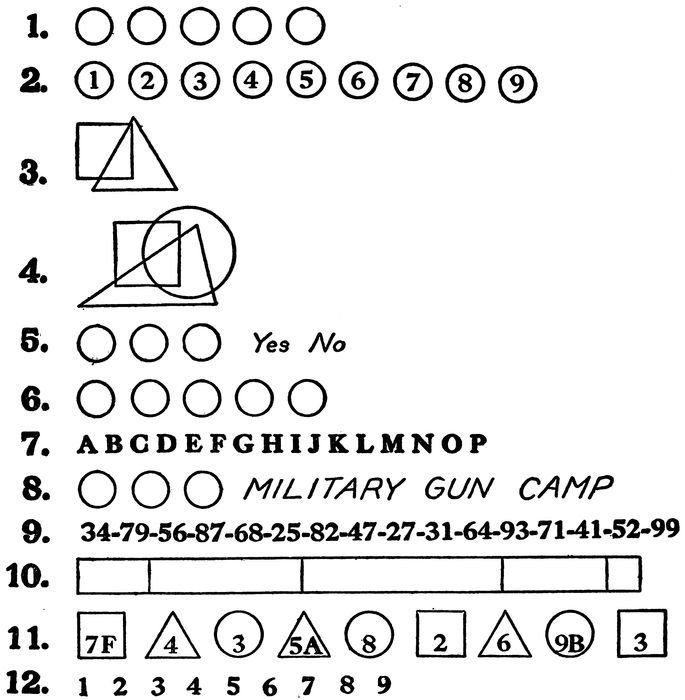
1. “Attention! ‘Attention’ always means ‘Pencils up.’ Look at the circles at 1. When I say ‘go,’ but not before, make a figure 2 in the second circle and also a cross in the third circle.—Go!” (Allow not over 5 seconds.)
2. “Attention! Look at 2, where the circles have numbers in them. When I say ‘go’ draw a line from Circle 1 to Circle 4 that will pass below Circle 2 and above Circle 3.—Go!” (Allow not over 5 seconds.)
3. “Attention! Look at the square and triangle at 3. When I say ‘go’ make a figure 1 in the space which is in the square but not in the triangle, and also make a cross in the space which is in the triangle and in the square.—Go!” (Allow not over 10 seconds.)
4. “Attention! Look at 4. When I say ‘go’ make a figure 2 in the space which is in the circle but not in the triangle or square, and also make a figure 3 in the space which is in the triangle and circle, but not in the square.—Go!” (Allow not over 10 seconds.)
N. B. Examiner.—In reading 5, don’t pause at the word “circle” as if ending a sentence.
5. “Attention! Look at 5. If ‘taps’ sounds in the evening, then (when I say ‘go’) put a cross in the first circle; if not, draw a line under the word No.—Go!” (Allow not over ten seconds.)
6. “Attention! Look at 6. When I say ‘go’ put in the first circle the right answer to the question: ‘How many months has a year?’ In the second circle do nothing, but in the fifth circle put any number that is wrong answer to the question that you just answered correctly—Go!” (Allow not over 10 seconds.)
2967. “Attention! Look at 7. When I say ‘go’ cross out the letter just after F and also draw a line under the second letter after I.—Go!” (Allow not over 10 seconds.)
8. “Attention! Look at 8. Notice the three circles and the three words. When I say ‘go’ make in the first circle the last letter of first word; in the second circle the middle letter of the second word, and in the third circle the first letter of the third word.—Go!” (Allow not over 10 seconds.)
9. “Attention! Look at 9. When I say ‘go’ cross out each number that is more than 50 but less than 60.—Go!” (Allow not over 15 seconds.)
10. “Attention! Look at 10. Notice that the drawing is divided into five parts. When I say ‘go’ put a 4 or a 5 in each of the two largest parts and any number between 6 and 9 in the part next in size to the smallest part.—Go!” (Allow not over 15 seconds.)
11. “Attention! Look at 11. When I say ‘go’ draw a line through every odd number that is not in a square, and also through every odd number that is in a square with a letter.—Go!” (Allow not over 25 seconds.)
12. “Attention! Look at 12. If 4 is more than 2, then (when I say ‘go’) cross out the number 3 unless 3 is more than 5, in which case draw a line under the number 4.—Go!” (Allow not over 10 seconds.)
“During the rest of this examination don’t turn any page forward or backward unless you are told to. Now turn over the page to Test 2.”
297FORM 8 GROUP EXAMINATION ALPHA GROUP NO. ____
Name _______________________________________ Rank ________ Age ____
Company ____________ Regiment ___________ Arm ________ Division ____
In what country or state born? ______ Years in U. S.? ____ Race ____
Occupation _______________________________________ Weekly Wages ____
Schooling: Grades, 1. 2. 3. 4. 5. 6. 7. 8: High or Prep. School, Year 1. 2. 3. 4: College, Year 1. 2. 3. 4.
========================================================================
TEST 1
Division of Psychology, Medical Department U. S. A. Authorized by the Surgeon General, Feb. 8, 1918. Edition, May 20, 1918. 100,000
Instructions for Giving Alpha Test 2.
Test 2.—Arithmetical Problems
“Attention! Look at the directions at the top of the page while I read them. Get the answers to these examples as quickly as you can. Use the side of this page to figure on if you need to. I will say stop at the end of five minutes. You may not be able to finish all of them, but do as many as you can in the time allowed. The two samples are already answered correctly.—Ready—Go!”
After 5 minutes, say “Stop! Turn over the page to Test 3.”
298TEST 2
Get the answers to these examples as quickly as you can. Use the side of this page to figure on if you need to.
SAMPLES 1 How many are 5 men and 10 men? Answer ( 15)
2 If you walk 4 miles an hour for 3 hours, how far do you walk? Answer ( 12)
1 How many are 60 guns and 5 guns? Answer ( )
2 If you save $9 a month for 3 months, how much will you save? Answer ( )
3 If 48 men are divided into squads of 8, how many squads will there be? Answer ( )
4 Mike had 11 cigars. He bought 2 more and then smoked 7. How many cigars did he have left? Answer ( )
5 A company advanced 8 miles and retreated 2 miles. How far was it then from its first position? Answer ( )
6 How many hours will it take a truck to go 42 miles at the rate of 3 miles an hour? Answer ( )
7 How many pencils can you buy for 60 cents at the rate of 2 for 5 cents? Answer ( )
8 A regiment marched 40 miles in five days. The first day they marched 9 miles, the second day 6 miles, the third 10 miles, the fourth 6 miles. How many miles did they march the last day? Answer ( )
9 If you buy 2 packages of tobacco at 8 cents each and a pipe for 65 cents, how much change should you get from a two-dollar bill? Answer ( )
10 If it takes 4 men 3 days to dig a 120–foot drain, how many men are needed to dig it in half a day? Answer ( )
11 A dealer bought some mules for $2,000. He sold them for $2,400, making $50 on each mule. How many mules were there? Answer ( )
12 A rectangular bin holds 200 cubic feet of lime. If the bin is 10 feet long and 5 feet wide, how deep is it? Answer ( )
13 A recruit spent one-eighth of his spare change for post cards and twice as much for a box of letter paper, and then had $1.00 left. How much money did he have at first? Answer ( )
14 If 3½ tons of clover cost $14, what will 6½ tons cost? Answer ( )
15 A ship has provisions to last her crew of 700 men 2 months. How long would it last 400 men? Answer ( )
16 If an aeroplane goes 250 yards in 10 seconds, how many feet does it go in a fifth of a second? Answer ( )
17 A U-boat makes 8 miles an hour under water and 20 miles on the surface. How long will it take to cross a 100–mile channel, if it has to go two-fifths of the way under water? Answer ( )
18 If 134 squads of men are to dig 3,618 yards of trench, how many yards must be dug by each squad? Answer ( )
19 A certain division contains 5,000 artillery, 15,000 infantry, and 1,000 cavalry. If each branch is expanded proportionately until there are in all 23,100 men, how many will be added to the artillery? Answer ( )
20 A commission house which had already supplied 1,897 barrels of apples to a cantonment delivered the remainder of its stock to 37 mess halls. Of this remainder each mess hall received 54 barrels. What was the total number of barrels supplied? Answer ( )
Instructions for Giving Alpha Test 3.
Test 3.—Practical Judgment
“Attention! Look at the directions at the top of the page while I read them. ‘This is a test of common sense. Below are sixteen questions. Three answers are given to each question. You are to look at the answers carefully; then make a cross in the square before the best answer to each question, as in the sample:
“‘Why do we use stoves? Because
☐ they look well
☒ they keep us warm
☐ they are black
“‘Here the second answer is the best one and is marked with a cross.
“‘Begin with No. 1 and keep on until time is called.’—Ready—Go!” After 1½ minutes, say “Stop! Turn over the page to Test 4.”
299TEST 3
This is a test of common sense. Below are sixteen questions. Three answers are given to each question. You are to look at the answers carefully; then make a cross in the square before the best answer to each question, as in the sample:
SAMPLE
Why do we use stoves? Because
☐ they look well
☒ they keep us warm
☐ they are black
Here the second answer is the best one and is marked with a cross. Begin with No. 1 and keep on until time is called.
1
It is wiser to put some money aside and not spend it all, so that you may
☐ prepare for old age or sickness
☐ collect all the different kinds of money
☐ gamble when you wish
2
Shoes are made of leather, because
☐ it is tanned
☐ it is tough, pliable and warm
☐ it can be blackened
3
Why do soldiers wear wrist watches rather than pocket watches? Because
☐ they keep better time
☐ they are harder to break
☐ they are handier
4
The main reason why stone is used for building purposes is because
☐ it makes a good appearance
☐ it is strong and lasting
☐ it is heavy
5
Why is beef better food than cabbage? Because
☐ it tastes better
☐ it is more nourishing
☐ it is harder to obtain
6
If some one does you a favor, what should you do?
☐ try to forget it
☐ steal for him if he asks you to
☐ return the favor
7
If you do not get a letter from home which you know was written, it may be because
☐ it was lost in the mails
☐ you forgot to tell your people to write
☐ the postal service has been discontinued
8
The main thing the farmers do is to
☐ supply luxuries
☐ make work for the unemployed
☐ feed the nation
9
If a man who can’t swim should fall into a river, he should
☐ yell for help and try to scramble out
☐ dive to the bottom and crawl out
☐ lie on his back and float
10
Glass insulators are used to fasten telegraph wires because
☐ the glass keeps the pole from being burned
☐ the glass keeps the current from escaping
☐ the glass is cheap and attractive
11
If your load of coal gets stuck in the mud, what should you do?
☐ leave it there
☐ get more horses or men to pull it out
☐ throw off the load
12
Why are criminals locked up?
☐ to protect society
☐ to get even with them
☐ to make them work
13
Why should a married man have his life insured? Because
☐ death may come at any time
☐ insurance companies are usually honest
☐ his family will not then suffer if he dies
14
In Leap Year February has 29 days because
☐ February is a short month
☐ some people are born on February 29th
☐ otherwise the calendar would not come out right
15
If you are held up and robbed in a strange city, you should
☐ apply to the police for help
☐ ask the first man you meet for money to get home
☐ borrow some money at a bank
16
Why should we have Congressmen? Because
☐ the people must be ruled
☐ it insures truly representative government
☐ the people are too many to meet and make their laws
300
Instructions for Giving Alpha Test 4.
Test 4.—Synonym—Antonym
“Attention! Look at the directions at the top of the page while I read them.” (Examiner.—Read slowly.)
“‘If the two words of a pair mean the same or nearly the same draw a line under “same.” If they mean the opposite or nearly the opposite, draw a line under “opposite.” If you cannot be sure, guess. The two samples are already marked as they should be.’—Ready—Go!”
After 1½ minutes, say “Stop! Turn over the page to Test 5.” (Pause.) “Now you have to turn your books around this way.” (Examiner illustrates the necessary rotation.)
301TEST 4
If the two words of a pair mean the same or nearly the same, draw a line under same. If they mean the opposite or nearly the opposite, draw a line under opposite. If you cannot be sure, guess. The two samples are already marked as they should be
SAMPLES good—bad same—opposite
little—small same—opposite
1 no—yes same—opposite 1
2 day—night same—opposite 2
3 go—leave same—opposite 3
4 begin—commence same—opposite 4
5 bitter—sweet same—opposite 5
6 assume—suppose same—opposite 6
7 command—obey same—opposite 7
8 tease—plague same—opposite 8
9 diligent—industrious same—opposite 9
10 corrupt—honest same—opposite 10
11 toward—from same—opposite 11
12 masculine—feminine same—opposite 12
13 complex—simple same—opposite 13
14 sacred—hallowed same—opposite 14
15 often—seldom same—opposite 15
16 ancient—modern same—opposite 16
17 enormous—gigantic same—opposite 17
18 confer—grant same—opposite 18
19 acquire—lose same—opposite 19
20 compute—calculate same—opposite 20
21 defile—purify same—opposite 21
22 apprehensive—fearful same—opposite 22
23 sterile—fertile same—opposite 23
24 chasm—abyss same—opposite 24
25 somber—gloomy same—opposite 25
26 vestige—trace same—opposite 26
27 vilify—praise same—opposite 27
28 finite—limited same—opposite 28
29 contradict—corroborate same—opposite 29
30 immune—susceptible same—opposite 30
31 credit—debit same—opposite 31
32 assiduous—diligent same—opposite 32
33 transient—permanent same—opposite 33
34 palliate—mitigate same—opposite 34
35 execrate—revile same—opposite 35
36 extinct—extant same—opposite 36
37 pertinent—relevant same—opposite 37
38 synchronous—simultaneous same—opposite 38
39 supercilious—disdainful same—opposite 39
40 abstruse—recondite same—opposite 40
302
Instructions for Giving Alpha Test 5.
Test 5.—Disarranged Sentences
“Attention! Look at the directions at the top of the page while I read them.” (Examiner.—Read slowly.)
“The words a eats cow grass in that order are mixed up and don’t make a sentence; but they would make a sentence if put in the right order: a cow eats grass, and this statement is true.
“Again, the words horses feathers have all would make a sentence if put in the order all horses have feathers, but this statement is false.
“Below are 24 mixed-up sentences. Some of them are true and some are false. When I say ‘go,’ take these sentences one at a time. Think what each would say if the words were straightened out, but don’t write them yourself. Then, if what it would say is true draw a line under the word ‘true’; if what it would say is false, draw a line under the word ‘false.’ If you cannot be sure, guess. The two samples are already marked as they should be. Begin with No. 1 and work right down the page until time is called. ‘Ready—Go!’”
After 2 minutes, say “Stop! Turn over the page to Test 6.”
TEST 5
The words A EATS COW GRASS in that order are mixed up and don’t make a sentence; but they would make a sentence if put in the right order: A COW EATS GRASS, and this statement is true.
Again, the words HORSES FEATHERS HAVE ALL would make a sentence if put in the order: ALL HORSES HAVE FEATHERS, but this statement is false.
Below are twenty-four mixed-up sentences. Some of them are true and some are false. When I say “go,” take these sentences one at a time. Think what each would say if the words were straightened out, but don’t write them yourself. Then, if what it would say is true, draw a line under the word “true”; if what it would say is false, draw a line under the word “false.” If you can not be sure, guess. The two samples are already marked as they should be. Begin with No. 1 and work right down the page until time is called.
SAMPLES a eats cow grass true false
horses feathers have all true false
1 oranges yellow are true false 1
2 hear are with to ears true false 2
3 noise cannon never make a true false 3
4 trees in nests build birds true false 4
5 oil water not and will mix true false 5
6 bad are shots soldiers all true false 6
7 fuel wood are coal and for used true false 7
8 moon earth the only from feet twenty the is true false 8
9 to life water is necessary true false 9
10 are clothes all made cotton of true false 10
11 horses automobile an are than slower true false 11
12 tropics is in the produced rubber true false 12
13 leaves the trees in lose their fall true false 13
14 place pole is north comfortable a the true false 14
15 sand of made bread powder and is true false 15
16 sails is steamboat usually by propelled a true false 16
17 is the salty in water all lakes true false 17
18 usually judge can we actions man his by a true false 18
19 men misfortune have good never true false 19
20 tools valuable is for sharp making steel true false 20
21 due sometimes calamities are accident to true false 21
22 forget trifling friends grievances never true false 22
23 feeling is of painful exaltation the true false 23
24 begin a and apple acorn ant words with the true false 24
303
Instructions for Giving Alpha Test 6.
Test 6.—Number Series Completion
(N. B. Examiner.—Give these instructions very slowly).
“Attention! Look at the first sample row of figures at the top of the page—2, 4, 6, 8, 10, 12, the two numbers that should come next are, of course, 14, 16.
“Look at the second sample—9, 8, 7, 6, 5, 4; the two numbers that should come next are 3, 2.
“Look at the third sample—2, 2, 3, 3, 4, 4; the two numbers that should come next are 5, 5.
“Now look at the fourth sample—1, 7, 2, 7, 3, 7; the next two numbers would, of course, be 4, 7.
“Look at each row of numbers below and on the two dotted lines write the two numbers that should come next.—Ready—Go!”
After 3 minutes, say “Stop! Turn over the page to Test 7.”
304TEST 6
SAMPLES 2 4 6 8 10 12 14 16
9 8 7 6 5 4 3 2
2 2 3 3 4 4 5 5
1 7 2 7 3 7 4 7
Look at each row of numbers below, and on the two dotted lines write the two numbers that should come next.
3 4 5 6 7 8 ..... .....
8 7 6 5 4 3 ..... .....
10 15 20 25 30 35 ..... .....
9 9 7 7 5 5 ..... .....
3 6 9 12 15 18 ..... .....
8 1 6 1 4 1 ..... .....
5 9 13 17 21 25 ..... .....
8 9 12 13 16 17 ..... .....
27 27 23 23 19 19 ..... .....
1 2 4 8 16 32 ..... .....
19 16 14 11 9 6 ..... .....
11 13 12 14 13 15 ..... .....
2 3 5 8 12 17 ..... .....
18 14 17 13 16 12 ..... .....
29 28 26 23 19 14 ..... .....
20 17 15 14 11 9 ..... .....
81 27 9 3 1 ⅓ ..... .....
1 4 9 16 25 36 ..... .....
16 17 15 18 14 19 ..... .....
3 6 8 16 18 36 ..... .....
305
Instructions for Giving Alpha Test 7.
Test 7.—Analogies
“Attention! Look at the first sample at the top of the page: Sky—blue ∷ grass—table, green, warm, big.
“Notice the four words in heavy type. One of them—green—is underlined. Grass is green just as the sky is blue.
“Look at the second sample: Fish—swims ∷ man—paper, time, walks, girl.
“Here the word walks is underlined. A man walks and a fish swims.
“Look at the third sample: Day—night ∷ white—red, black, clear, pure.
“Here the word black is underlined because black is the opposite of white just as night is the opposite of day.
“In each of the lines below the first two words are related to each other in some way. What you are to do in each line is to see what the relation is between the first two words and underline the word in heavy type that is related in the same way to the third word. Begin with No. 1 and mark as many sets as you can before time is called.—Ready—Go!”
After 3 minutes, say “Stop! Turn over the page to Test 8.”
TEST 7
SAMPLES sky—blue ∷ grass— table green warm big
fish—swims ∷ man— paper time walks girl
day—night ∷ white— red black clear pure
In each of the lines below, the first two words are related to each other in some way. What you are to do in each line is to see what the relation is between the first two words, and underline the word in heavy type that is related in the same way to the third word. Begin with No. 1 and mark as many sets as you can before time is called.
1 shoe—foot ∷ hat— kitten head knife penny 1
2 pup—dog ∷ lamb— red door sheep book 2
3 spring—summer ∷ autumn— winter warm harvest rise 3
4 devil—angel ∷ bad— mean disobedient defamed good 4
5 finger—hand ∷ toe— body foot skin nail 5
6 legs—frog ∷ wings— eat swim bird nest 6
7 chew—teeth ∷ smell— sweet stink odor nose 7
8 lion—roar ∷ dog— drive pony bark harness 8
9 cat—tiger ∷ dog— wolf bark bite snap 9
10 good—bad ∷ long— tall big snake short 10
11 giant—large ∷ dwarf— jungle small beard ugly 11
12 winter—season ∷ January— February day month Christmas 12
13 skating—winter ∷ swimming— diving floating hole summer 13
14 blonde—light ∷ brunette— dark hair brilliant blonde 14
15 love—friend ∷ hate— malice saint enemy dislike 15
10 egg—bird ∷ seed— grow plant crack germinate 16
17 dig—trench ∷ build— run house spade bullet 17
18 agree—quarrel ∷ friend— comrade need mother enemy 18
19 palace—king ∷ hut— peasant cottage farm city 19
20 cloud-burst—shower ∷ cyclone— bath breeze destroy West 20
21 Washington—Adams ∷ first— president second last Bryan 21
22 parents—command ∷ children— men shall women obey 22
23 diamond—rare ∷ iron— common silver ore steel 23
24 yes—affirmative ∷ no— think knowledge yes negative 24
25 hour—day ∷ day— night week hour noon 25
26 eye—head ∷ window— key floor room door 26
27 clothes—man ∷ hair— horse comb beard hat 27
28 draw—picture ∷ make— destroy table break hard 28
29 automobile—wagon ∷ motorcycle— ride speed bicycle car 29
30 granary—wheat ∷ library— read books paper chairs 30
31 Caucasian—English ∷ Mongolian— Chinese Indian negro yellow 31
32 Indiana—United States ∷ part— hair China Ohio whole 32
33 esteem—despise ∷ friends— Quakers enemies lovers men 33
34 abide—stay ∷ depart— come hence leave late 34
35 abundant—scarce ∷ cheap— buy costly bargain nasty 35
36 whale—large ∷ thunder— loud rain lightning kill 36
37 reward—hero ∷ punish— God everlasting pain traitor 37
38 music—soothing ∷ noise— hear distracting sound report 38
39 book—writer ∷ statue— sculptor liberty picture state 39
40 wound—pain ∷ health— sickness disease exhilaration doctor 40
306
Instructions for Giving Alpha Test 8.
Test 8.—Information
“Attention! Look at the directions at the top of the page while I read them.” (Examiner.—Read slowly.)
“Notice the sample sentences: People hear with the—eyes—ears—nose—mouth. The correct word is ears, because it makes the truest sentence. In each sentences below you have four choices for the last word. Only one of them is correct. In each sentence draw a line under the one of these four words which makes the truest sentence. If you cannot be sure, guess. The two samples are already marked as they should be—Ready—Go!”
After 4 minutes, say “Stop! Turn over the page to Test 1 again. In the upper right-hand corner, where it says ‘Group No. —,’ put the number 101” (or 102, 103, etc., according to the number of this group in the examiner’s series of groups).
TEST 8
Notice the sample sentence:
People hear with the eyes ears nose mouth
The correct word is ears, because it makes the truest sentence.
In each of the sentences below you have four choices for the last word. Only one of them is correct. In each sentence draw a line under the one of these four words which makes the truest sentence. If you can not be sure, guess. The two samples are already marked as they should be.
SAMPLES People hear with the eyes ears nose mouth
France is in Europe Asia Africa Australia
1 The apple grows on a shrub vine bush tree 1
2 Five hundred is played with rackets pins cards dice 2
3 The Percheron is a kind of goat horse cow sheep 3
4 The most prominent industry of Gloucester is fishing packing brewing automobiles 4
5 Sapphires are usually blue red green yellow 5
6 The Rhode Island Red is a kind of horse granite cattle fowl 6
7 Christie Mathewson is famous as a writer artist baseball player comedian 7
8 Revolvers are made by Swift & Co. Smith & Wesson W. L. Douglas B. T. Babbitt 8
9 Carrie Nation is known as a singer temperance agitator suffragist nurse 9
10 “There’s a reason” is an “ad” for a drink revolver flour cleanser 10
11 Artichoke is a kind of hay corn vegetable fodder 11
12 Chard is a fish lizard vegetable snake. 12
13 Cornell University is at Ithaca Cambridge Annapolis New Haven 13
14 Buenos Ayres is a city of Spain Brazil Portugal Argentina 14
15 Ivory is obtained from elephants mines oysters reefs 15
16 Alfred Noyes is famous as a painter poet musician sculptor 16
17 The armadillo is a kind of ornamental shrub animal musical instrument dagger 17
18 The tendon of Achilles is in the heel head shoulder abdomen 18
19 Crisco is a patent medicine disinfectant tooth-paste food product 19
20 An aspen is a machine fabric tree drink 20
21 The sabre is a kind of musket sword cannon pistol 21
22 The mimeograph is a kind of typewriter copying machine phonograph pencil 22
23 Maroon is a food fabric drink colour 23
24 The clarionet is used in music stenography book-binding lithography 24
25 Denim is a dance food fabric drink 25
26 The author of “Huckleberry Finn” is Poe Mark Twain Stevenson Hawthorne 26
27 Faraday was most famous in literature war religion science 27
28 Air and gasolene are mixed in the accelerator carburetor gear case differential 28
29 The Brooklyn Nationals are called the Giants Orioles Superbas Indians 29
30 Pasteur is most famous in politics literature war science 30
31 Becky Sharp appears in Vanity Fair Romola The Christmas Carol Henry IV 31
32 The number of a Kaffir’s legs is two four six eight 32
33 Habeas corpus is a term used in medicine law theology pedagogy 33
34 Ensilage is a term used in fishing athletics farming hunting 34
35 The forward pass is used in tennis hockey football golf 35
36 General Lee surrendered at Appomattox in 1812 1865 1886 1832 36
37 The watt is used in measuring wind power rainfall water power electricity 37
38 The Pierce Arrow car is made in Buffalo Detroit Toledo Flint 38
39 Napoleon defeated the Austrians at Friedland Wagram Waterloo Leipzig 39
40 An irregular four-sided figure is called a scholium triangle trapezium pentagon 40
307
Directions for Scoring in Alpha Test.
General Rules
1. Each item is scored either right or wrong. No part credits are given.
2. In general, items evidently corrected stand as corrected.
3. In tests where the score is “Number Right,” only wrong items need be checked in scoring. In Tests 4 and 5, where the score is “Right minus Wrong,” wrong and omitted items must be separately checked.
4. Indicate the last item attempted by drawing a long line under that item and out into the margin.
5. Enter the score for each test in lower right-hand corner of the test page and encircle it. When the test has been rescored, a check mark may be made beside the circle.
6. Red or blue pencil increases accuracy of scoring.
Test 1.
(Score is number right.)
1. No credit is given for any item in which more is done than the instructions require.
2. In an item where something is to be written “in” a given space, give credit if a mark crosses a line from haste or awkwardness: give no credit if the position is really ambiguous.
3. Where something is to be underlined or crossed out, give credit if two or three underlinings are made in the required place, and give credit for any method of crossing out.
4. Item 2.—The pencil line must begin and end either on the circumference or within the circles indicated. It may touch the intermediate circles, but must not cut through them.
5. Item 6.—In the circle marked “not 12” there must be some number which is not 12, such as 5, 0, 27.
6. Item 9.—The proper numbers must be crossed out to receive credit.
7. Item 10.—In Form 5, “2” alone and “3” alone, but not “2 or 3,” in each 308of the two largest parts; “5” alone and “6” alone, but not “5 or 6,” in the next to the smallest part, are correct. Similarly for other forms.
8. Item 11.—The lines must cross, or at least touch, the proper numbers; they may or may not cut the accompanying letters. Mere indication of the square, triangle, etc., is not sufficient.
9. Item 12.—Underlining in place of crossing out is wrong.
Test 2.
(Score is number right.)
1. Answer may be written on dotted line or elsewhere near its problem.
2. If two answers are given to any problem count as wrong.
3. If it seems clear that, by a slip, one answer has been put in the wrong bracket, and the next answers are all thus misplaced, give credit for the answers that are right even if misplaced.
4. Omission of dollar sign is permissible.
5. Omission of decimal point is permissible in items, 2, 9, 13, and 14. Fraction may be expressed as decimal in item 15.
Test 3.
(Score is number right.)
1. Any clear method of indicating answer is given full credit—underlining, checking, etc.
2. If two answers are marked, count as wrong unless one is clearly indicated as final.
Test 4.
(Score is number right minus number wrong.)
1. Any clear method of indicating answer is given credit.
2. When both “Same” and “Opposite” are underlined, counts as omitted, not as wrong.
3. If only “Same” is underlined right down the column, score for the test is zero. Similarly if “Opposite” is underlined right down the column.
Test 5.
(Score is number right minus number wrong.)
Same rules as for Test 4.
Test 6.
(Score is number right.)
1. If only one number is written, give no credit.
2. If only one of the numbers is right, give no credit.
3093. If four numbers are written, as frequently happens with certain items (i. e., 33, 11 instead of 3, 3), give full credit.
Test 7
(Score is number right.)
1. Any clear indication other than underlining receives full credit.
2. Underlining of any of the first three words of an item does not remove credit.
3. If two or more of the last four words are marked, give no credit.
Test 8.
(Score is number right.)
Same rules as for Test 7.
Total Score and Rating
The result of examination Alpha is expressed in a total score which is the sum of the raw scores of the several tests. The raw scores are obtained as follows:
TEST METHOD OF SCORING MAXIMUM RAW SCORE
1 R 12
2 R 20
3 R 16
4 R − W 40
5 R − W 24
6 R 20
7 R 40
8 R 40
Total 212
Letter ratings are assigned on examination Alpha as follows:
RATING SCORE
A 135–212
B 105–134
C+ 75–104
C 45–74
C− 25–44
D 15–24
D−[5] 0–14
All ratings above “D−” are entered and reported at once. Men whose scores are below “D” are recalled for examination Beta. Ratings of “D−” may not be given in Alpha, unless recall of the men for Beta is impossible.
310
Method of Giving the Army Beta Tests.
In practice the Beta tests, reproduced in facsimile on pages 313 to 322 following, are given with the assistance of a blackboard chart on which the different tests are painted in white, so that the examiner can show them to the entire group before they see them on their examination papers. There are also required for giving the Beta tests a set of cardboard cubes for the examiner’s use in explaining Test 2, and a set of cardboard pieces cut to the shapes of the figures in Test 7, though of much larger size. The assistance of a demonstrator is also required.
Procedure.
It is most important that examination Beta be given in a genial manner. The subjects who take this examination sometimes sulk and refuse to work. E. and his assistants will find it necessary to fill out most of the headings for the men before the examination begins. The time required for this preparatory work may be used to advantage in making the men feel at ease. As the demonstration preparatory to each test requires some time, the “pencils up” command is omitted in examination Beta. The examiner’s platform should be so high that he can readily see whether or not the subjects are working. Great care should be taken to prevent the overanxious from beginning work before the command “Go.”
Seating conditions should be such that subjects cannot copy from one another and the rule that copying shall not be allowed should be enforced strictly. The blackboard should at all times be kept clean so that the visual conditions may be excellent and constant. The blackboard figures for Test 1 should be exposed when the subjects enter the examining room. As soon as a test has been demonstrated and the men have been told to go ahead, the blackboard should be covered and kept covered until time is called. It should not be turned to the next test until the men have been ordered to stop work on a given test. Care should be taken to have the physical conditions of examination reasonably uniform.
With the exception of the brief introductory statements and a few orders, instructions are to be given throughout by means of gestures instead of words. These gestures accompany the samples and demonstrations and should be animated and emphatic.
It is absolutely necessary that directions be followed closely and procedure kept uniform and definite. Variations of procedure are more likely to occur in Beta than in Alpha, and there is serious risk that if allowed they will lessen the value of results. E. should especially guard against using more or fewer gestures or words for one group than for another. Oral languages should be rigidly limited to the words and phrases given in the procedure for the different tests.
Whether the men get the idea of the test and enter into it with the proper spirit will depend chiefly on the skill with which the examiner, the demonstrator, 311and the orderlies carry out their respective parts. Examiner and demonstrator especially should be selected with the greatest care. An examiner who succeeds admirably in giving Alpha may prove to be entirely unadapted for Beta. Both examiner and demonstrator must be adept in the use of gesture language. In the selection of a demonstrator the Personnel Office should be consulted. One camp has had great success with a “window seller” as demonstrator. Actors should also be considered for the work. The orderlies should be able to keep the subjects at work without antagonizing them and to keep them encouraged without actually helping them.
The demonstrator should have the single task of doing before the group just what the group is later to do with the examination blanks. The blackboard is his Beta blank. Before examination Beta can be given satisfactorily the demonstrator must be letter perfect in his part. Both E. and demonstrator must be very careful to stand at the side of the blackboard in order not to hide the drawings.
As soon as the men of a group have been properly seated, pencils should be distributed and also examination blanks with Test 8 up. While this is being done E. should say “Here are some papers. You must not open them or turn them over until you are told to.” Holding up Beta blank, E. continues:
“In the place where it says name, write your name; print it if you can. (Pause.) Fill out the rest of the blank about your age, schooling, etc., as well as you can. If you have any trouble we will help you.” The instructions given under segregation may be used for filling out the Beta blank. E. should announce the group number and see that it as well as the other necessary information is supplied. Before the examination proceeds each paper should be inspected in order to make sure that it is satisfactorily completed.
After the initial information has been obtained, E. makes the following introductory remarks:
“Attention! Watch this man (pointing to demonstrator). He (pointing to demonstrator again) is going to do here (tapping blackboard with pointer) what you (pointing to different members of group) are to do on your papers (here E. points to several papers that lie before men in the group, picks up one, holds it next to the blackboard, returns the paper, points to demonstrator and the blackboard in succession, then to the men and their papers). Ask no questions. Wait till I say ‘Go ahead!’”
In general, when instructing the group to turn from test to test, E. holds up a Beta blank before group and follows his own instructions as he gives them. As soon as he has turned to desired test or page he says, “This is test X here; look!” (Pointing to the page.)
To suggest to the group the necessity of working rapidly the demonstrator, after proceeding very deliberately with the early samples of each test, hurries as soon as he has worked out the last sample problem.
312(1) to record his response as fast as he can,
(2) then to catch E.’s eyes for approval and
(3) finally, to slip away from blackboard, drawing curtain as he does so.
After the personal data called for on page 1 of blank have been gathered and recorded, the orderlies’ vocabulary in Beta is rigidly restricted to the following words, or their literal equivalents in Italian, Russian, etc.: Yes, No, Sure, Good, Quick, How many? Same, Fix it. Under no circumstances may substitutional explanations or directions be given.
Test 1—Maze
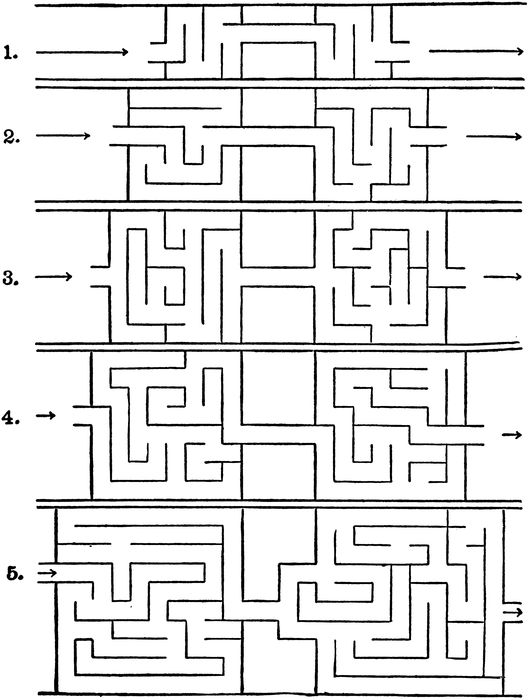
“Now turn your papers over. This is Test 1 here (pointing to page of record blank). Look.” After all have found the page, E. continues, “Don’t make any marks till I say ‘Go ahead.’ Now watch.” After touching both arrows E. traces through first maze with pointer and then motions the demonstrator to go ahead. Demonstrator traces path through first maze with crayon, slowly and hesitatingly. E. then traces second maze and motions to demonstrator to go ahead. Demonstrator makes one mistake by going into the blind alley at upper left-hand corner of maze. E. apparently does not notice what demonstrator is doing until he crosses line at end of alley; then E. shakes his head vigorously, says “No—no,” takes demonstrator’s hand and traces back to the place where he may start right again. Demonstrator traces rest of maze so as to indicate an attempt at haste, hesitating only at ambiguous points. E. says “Good.” Then, holding up blank, “Look here,” and draws an imaginary line across the page from left to right for every maze on the page. Then, “All right. Go ahead. Do it (pointing to men and then to books). Hurry up.” The idea of working fast must be impressed on the men during the maze test. E. and orderlies walk around the room, motioning to men who are not working, and saying, “Do it, do it, hurry up, quick.”
At the end of 2 minutes E. says, “Stop! Turn over the page to Test 2.”
313Test 1
Test 2—Cube Analysis
“This is Test 2 here. Look.” After everyone has found the page—“Now watch.” The order of procedure is as follows:
(1) E. points to the three-cube model on the blackboard, making a rotary movement of the pointer to embrace the entire picture.
(2) With similar motions he points to the three-cube model on shelf.
(3) E. points next to picture on blackboard and asks, “How many?”
(4) E. turns to cube model and counts aloud, putting up his fingers while so doing, and encouraging the men to count with him.
(5) E. taps each cube on the blackboard and motions to demonstrator, asking him “How many?”
314Test 2
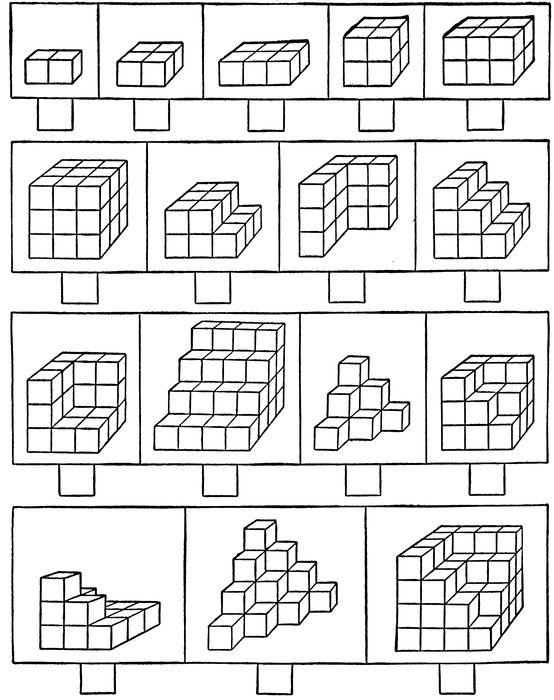
315(6) Demonstrator (pointing) counts cubes on blackboard silently and writes the figure 3 in proper place.
In the second sample of this test, when E. counts cubes of model he
(1) counts the three exposed cubes;
(2) touches the unexposed cube with pointer; and
(3) without removing pointer turns model, so that hidden cube comes into view of group. In other respects procedure with second and third samples is the same as with first.
In counting the 12–cube model, E. (1) counts the top row of cubes in the model (left to right), (2) counts the exposed bottom row (right to left), (3) taps with pointer the end cube of hidden row, (4) turns the entire model around and completes his counting. E. then holds model in same place as drawing and counts (in the same order as above) the cubes on blackboard, counting lines between front and top row as representing the hidden row. He then asks demonstrator “How many?” Demonstrator counts the cubes on blackboard (pointing but not speaking) and writes the response.
Throughout the demonstration the counting is done deliberately, not more rapidly than one cube per second.
At end of demonstration E. points to page and says, “All right. Go ahead.” At the end of 2½ minutes he says, “Stop! Look at me and don’t turn the page.”
Test 3—X-O Series
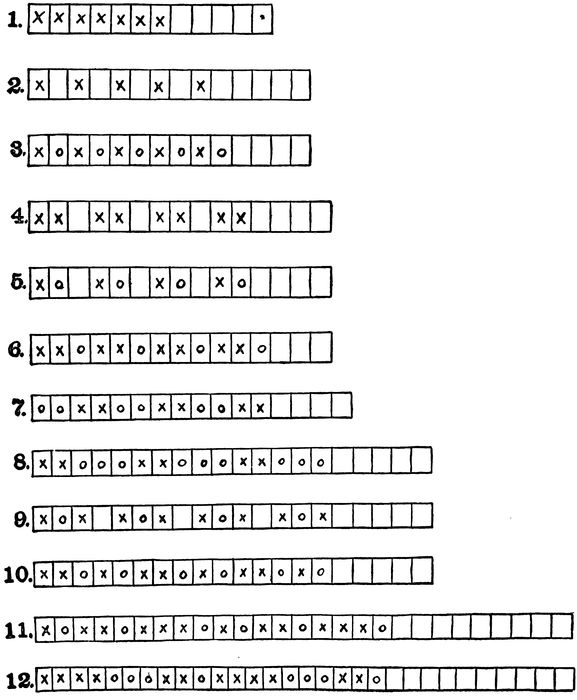
“This is Test 3 here. Look.” After everyone has found the page—“Now watch.” E. first points to the blank rectangles at the end, then traces each “O” in chart, then traces outline of “O’s” in remaining spaces. Demonstrator, at a gesture, draws them in. E. then traces first “X” in next sample, moves to next “X” by tracing the arc of an imaginary semicircle joining the two, and in the same manner traces each “X,” moving over an arc to the next. He then traces outlines of “X’s” in the proper blank spaces, moving over the imaginary arc in each case, and motions to demonstrator to draw them in. Demonstrator, at a gesture, fills in remaining problems very slowly, standing well to the right of the blackboard and writing with his left hand. E. points to page and says, “All right! Go ahead. Hurry up!” At end of 1¾ minutes he says, “Stop! Turn over the page to Test 4.”
316Test 3
Test 4—Digit—Symbol
“This is Test 4 here. Look.” After everyone has found the page—“Now watch.” E. points to first digit of key on blackboard and then points to the symbol under it. Same for all nine digits in key. E. then (1) points to first digit of sample, (2) to the empty space below digit, (3) points to corresponding digit of key, (4) points to proper symbol under digit in key, and (5) traces the outline of the proper symbol in the blank space under the digit in the sample. Same for first five samples. Demonstrator, at a gesture, fills in all the samples, working as follows: (1) Touches the number in first sample with index finger of right hand; (2) holding finger there, finds with index finger of left hand the corresponding number in key; (3) drops index finger of left hand to symbol for number found; (4) holding left hand in this position writes appropriate symbol in the lower half of sample.
317Test 4
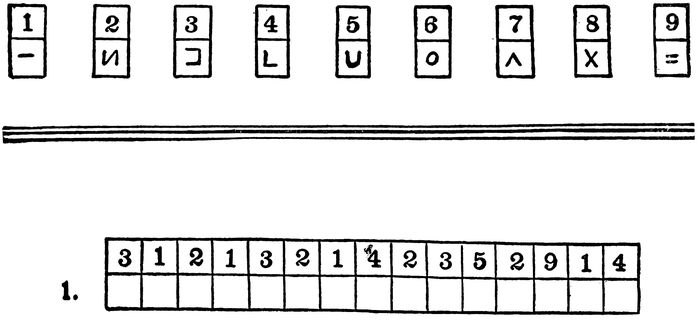
318Similarly with the other samples. While working, demonstrator should stand as far as possible to the left, doing all the samples from this side.
At the end of demonstration E. says, “Look here” and points to key on page, repeating the gestures used in pointing on the blackboard at the beginning of the demonstration. Then, “All right. Go ahead. Hurry up!” Orderlies point out key to men who are at a loss to find it. At the end of 2 minutes, E. says: “Stop! But don’t turn the page.”
Test 5—Number Checking
“This is Test 5 here.” After everyone has found the page, “Now watch.” In this demonstration E. must try to get “Yes” or “No” responses from the group. If the wrong response is volunteered by group, E. points to digits again and gives right response, “Yes” or “No” as the case may be. E. points to first digit of first number in left column, then to first digit first number in right column, then to second digit first number in left column and second digit first number in right column; nods head, says “Yes” and makes an imaginary cross at end of number in right column. Motions to demonstrator, who makes an “X” there. E. does the same for second line of figures, but here he indicates clearly by shaking head and saying “no” that certain digits are not identical. E. repeats for three more sets and after each, looks at group, says “Yes?” in questioning tone and waits for them to say “Yes” or “No.” He repeats correct reply with satisfaction. Demonstrator checks each after group has responded, or at signal from E. if group does not respond. Demonstrator then works out remaining items, pointing from column to column and working deliberately. E. summarizes demonstrator’s work by pointing to the whole numbers in each set and saying “Yes” (indicating X) or “No”; if “No,” he shows again where the numbers are unlike. E. then points to page and says “All right. Go ahead. Hurry up!” At the end of 3 minutes E. says “Stop! Turn over the page to Test 6.”
319Test 5
650 650
041 044
2579 2579
3281 3281
55190 55102
39190 39190
658049 650849
3295017 3290517
63015991 63019991
39007106 39007106
69931087 69931087
251004818 251004418
299056013 299056013
36015992 360155992
3910066482 391006482
8510273301 8510273301
263136996 263136996
451152903 451152903
3259016275 3295016725
582039144 582039144
61558529 61588529
211915883 219915883
670413822 670143822
17198591 17198591
10243586 10243586
659012534 659021354
388172902 381872902
631027594 631027594
2499901354 2499901534
2261059310 2261659310
2911038227 2911038227
313377752 313377752
1012938567 1012938567
7166220988 7162220988
3177628449 3177682449
468672663 468672663
9104529003 9194529003
348465120 3484657210
8588172556 8581722556
3120166671 3120166671
7611348879 76111345879
26557239164 26557239164
8819002341 8819002341
6571018034 6571018034
38779762514 38779765214
39008126557 39008126657
75658100398 75658100398
41181900726 41181900726
6543920817 6543920871
6543920817 6543920871
320
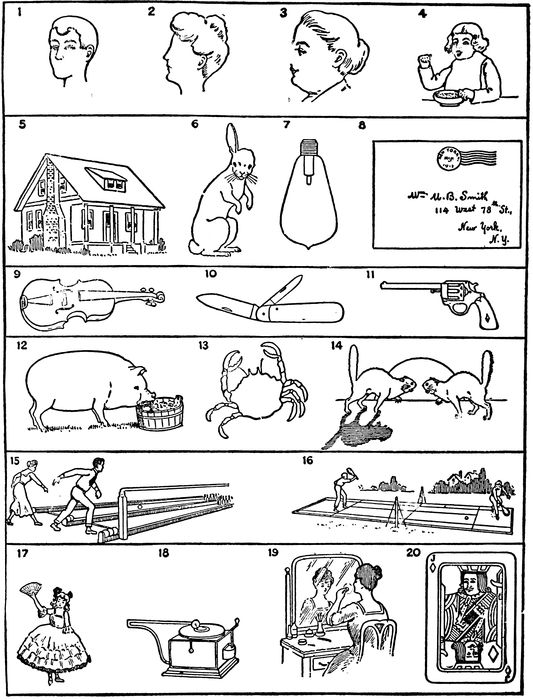
Test 6—Pictorial Completion
“This is Test 6 here. Look. A lot of pictures.” After everyone has found the page, “Now watch.” E. points to hand and says to demonstrator: “Fix it.” Demonstrator does nothing, but looks puzzled. E. points to the picture of the hand, then to the place where finger is missing and says to demonstrator: “Fix it. Fix it.” Demonstrator then draws in finger. E. says, “That’s right.” E. then points to fish and place for eye and says, “Fix it.” After demonstrator has drawn missing eye, E. points to each of the four remaining drawings and says, “Fix them all.” Demonstrator works samples out slowly and with apparent effort. When the samples are finished E. says, “All right. Go ahead. Hurry up!” During the course of this test the orderlies walk around the room and locate individuals who are doing nothing, point to their pages, and say “Fix it. Fix them,” trying to set everyone working. At end of 3 minutes E. says, “Stop! But don’t turn over the page.”
Test 6
321
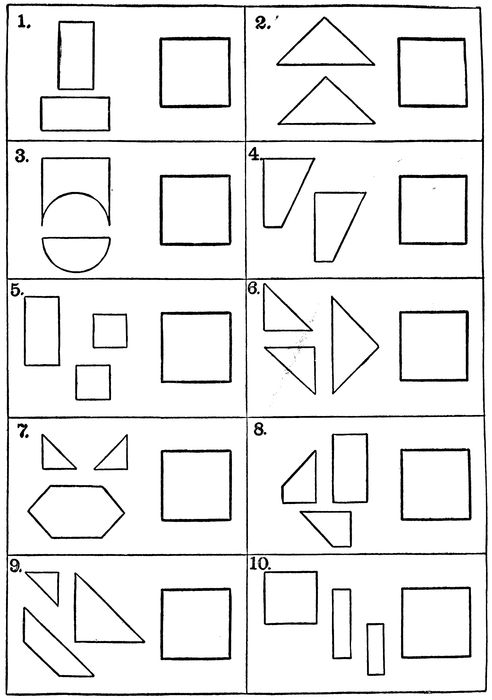
Test 7—Geometrical Construction
“This is Test 7 here. Look.” After everyone has found the page, “Now watch.” Examiner points to the first figure on blackboard. He then takes the two pieces of cardboard, fits them on to the similar drawings on blackboard to show that they correspond and puts them together in the square on blackboard to show that they fill it. Then, after running his finger over the line of intersection of the parts, E. removes the pieces and signals demonstrator, who draws solution in the square on blackboard. The same procedure is repeated for the second and third sample. Demonstrator works out fourth sample, after much study, pointing from the square to the forms.
Demonstrator first draws the two small squares in the upper half of the large square, then the two triangles in the remaining rectangle. Each small figure is drawn in by tracing its entire circumference, not merely the necessary dividing lines. While drawing each small figure in the large square, demonstrator points with index finger of left hand to the corresponding small figure at left of square, taking care not to obstruct the view. At end of demonstration E. holds up blank, points to each square on the page and says, “All right. Go ahead. Hurry up!” At end of 2½ minutes, “Stop! Turn over the page.” Papers are then collected immediately.
Scoring the Beta Tests.
General Rules
1. In general, items evidently corrected stand as corrected. The only exception to this rule is in the maze test.
2. In tests where the score is number right, only wrong items need be checked in scoring. In Test 5, where the score is right minus wrong, wrong and omitted items must be separately checked.
3. Enter the score for each test in lower right-hand corner of the test page and encircle it. When the test has been rescored a check may be made beside the circle.
322Test 7
3234. Red or blue pencil increases accuracy of scoring.
Test 1.
1. One half point for each correctly completed half of maze. A half maze is correct if drawn line does not cross any line of maze (except through awkwardness) nor an imaginary straight line across the opening of a wrong passage.
2. Allow much leeway in the cutting of corners.
3. Spur running into any blind passage counts wrong for that half-item, even though erased.
4. When two lines are drawn, one straight across the page, the other correct, full credit is given.
Test 2.
Score is number right.
Test 3.
1. Score is number right.
2. Any incomplete item receives no credit.
3. Count any item correct if intended plan is carried out. Disregard additional unnecessary marks, such as circles between the crosses of items 2 and 4 in first part of line, etc.
Test 4.
1. Score is one third of number of correct symbols.
2. Use leniency in judging form of symbol.
3. Credit symbol for 2 even though reversed.
Test 5.
1. Score is right minus wrong (number of items checked that should be checked minus number of items checked that should not be checked).
2. If other clear indication is used instead of crosses, give credit.
3. If numbers which should not be checked are marked by some other sign than is used to check similar pairs, count as though not marked.
4. If all items are checked, the score for the test is zero.
Test 6.
1. Score is number right.
2. Allow much awkwardness in drawing. Writing in name of missing part or any way of indicating it receives credit, if idea is clear.
3243. Additional parts do not make item wrong, if proper missing part is also inserted.
4. Rules for individual items:
Item 4.—Any spoon at any angle in right hand receives credit. Left hand, or unattached spoon, no credit.
Item 5.—Chimney must be in right place. No credit for smoke.
Item 6.—Another ear on same side as first receives no credit.
Item 8.—Plain square, cross, etc., in proper location for stamp, receives credit.
Item 10.—Missing part is the rivet. Line of “ear” may be omitted.
Item 13.—Missing part is leg.
Item 15.—Ball should be drawn in hand of man. If represented in hand of woman, or in motion, no credit.
Item 16.—Single line indicating net receives credit.
Item 18.—Any representation intended for horn, pointing in any direction, receives credit.
Item 19.—Hand and powder puff must be put on proper side.
Item 20.—Diamond is the missing part. Failure to complete hilt on sword is not an error.
Test 7.
1. Score is number right.
2. Allow considerable awkwardness in drawing.
3. Extra subdivisions, if not erased, make item wrong.
4. Rules for individual items:
Item 1.—Line of division may be slightly distant from true centre, and need not be straight.
Item 3.—Lines of semi-circumference must start from or near corners of square.
Item 4.—Line must not start from corner.
4. Total Score and Rating
The result of examination Beta is expressed as a “total score,” which is the sum of the raw scores of the several tests. The raw scores are obtained as follows:
TEST METHOD OF SCORING MAXIMUM SCORE
1 Half point for each half maze 5
2 Number right 16
3 Number right 12
4 One third of number right 30
5 Right minus wrong 25
6 Number right 20
7 Number right 10
Total 118
325Letter ratings are assigned on examination Beta as follows:
RATING SCORES
A 100–118
B 90– 99
C+ 80– 89
C 65– 79
C− 45– 64
D 20– 44
D−[6] 0– 19
All ratings above D− are entered and reported at once. Men whose scores fall below D are recalled for individual examination.
Ratings of D− may not be given in examination Beta, unless recall of the men for individual examination is impossible.
326