MAXIMILIAN I (continued 2)
Reading edition
The sudden illness of Julius II. (August 1511), from which a fatal issue was generally expected, led to an episode, which, though trivial in itself and void of result, gives us a vivid impression of Maximilian's visionary nature. He actually entertained the preposterous idea of himself succeeding Julius and uniting Empire and Papacy in one person. Lang, Bishop of Gurk, was to proceed at once to Rome, to persuade the Pope "to take us as coadjutor, so that on his death we may be assured of having the Papacy, and of becoming a priest, and afterwards a saint, so that after my death you will be constrained to adore me, whence I shall gain much glory."[81] If necessary, Lang was to spend 300,000 ducats in bribing the various Cardinals, and Maximilian counted upon the assistance of Ferdinand and the people of Rome. His confidential letter to Margaret bears the signature—"vostre bon père Maximilian, futur pape."
But these extravagant dreams were dissipated by the unexpected recovery of Julius II., who plunged more eagerly than ever into political life. On October 5, 1511, the Holy League was openly published in Rome. Its members—the Pope, Ferdinand and Venice—veiled their real design, the expulsion of the French, under the sanctimonious pretence of maintaining the integrity of the Papal States. Throughout the early stages of the war Maximilian remained virtually inactive, but steadily declined to desert his French allies. But none the less he permitted Ferdinand and the Pope to conclude in his name a ten months' truce with Venice. He was thus in the happy position of being in request with both sides, while himself free from all immediate danger. When the death of Gaston de Foix at Ravenna (April 11, 1512) deprived the French of their most capable leader, and the tide began to turn against them, Maximilian inclined towards the side of the Pope. In allowing 18,000 Swiss to pass through Tyrol on their way to join the Venetians, and in issuing strict orders that all Germans serving with Louis should return home, he was certainly guilty of unfriendly conduct towards his ally. In the actual expulsion of the French from the Milanese he took no direct part, but from want of funds rather than disinclination,—the Diet of Trier turning a deaf ear to his most urgent entreaties. At length in November he took the decisive step. Though he had hoped to see Milan under his grandson Charles rather than Massimiliano Sforza, he consented to a league with Julius II., to whom the Imperial recognition of the Lateran Council was of vital importance. In return for this the Pope promised his support against Venice, with temporal as well as spiritual arms.
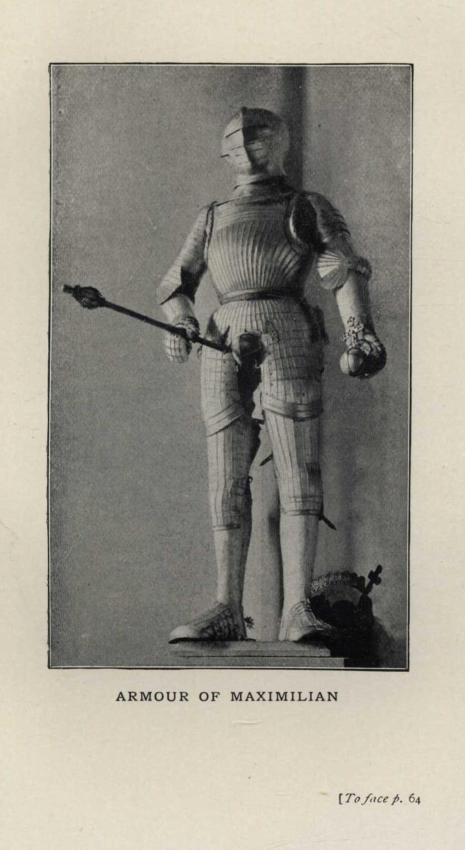
ARMOUR OF MAXIMILIAN
In February 1513, however, the situation was again changed by the death of Julius II., and by the reconciliation of France and Venice. The new Pope, Leo X., was vacillating and untrustworthy, though nominally well-disposed to the Emperor; and the latter began to turn elsewhere for an ally. On April 5, 1513, a treaty of alliance was concluded between Maximilian and Henry VIII., mainly through the efforts of Margaret, who had long urged on her father a break with France and a close union with Spain and England. At first we find him complaining that Henry "gives us only to understand what he wishes from us, while of what he ought to do for us there is no mention."[82] But the promise of 100,000 gold crowns was magical in its effect; all his opposition ceased, and he indulged in the usual sanguine anticipations. Ferdinand, Henry and Maximilian would unite until France was completely crushed, and by a joint invasion would win back all the territories which had been wrested from their ancestors. The alliance was to be cemented at the earliest possible date by the marriage of Charles to Mary of England.
Notwithstanding such threatening signs, the French king pushed on his preparations for a new invasion of Italy. The rapid success of the expedition was suddenly effaced on the field of Novara (June 6, 1513), where the French sustained a severe defeat at the hands of the Swiss and were driven back across the Alps. Their return to France virtually coincided with the expedition of Henry VIII. At the end of June the English army landed at Calais, and marching in three divisions, appeared before Thérouenne on August 1. Eleven days later he was joined by Maximilian, who had already announced his intention of serving as the English king's chief captain. "His experienced eye at once detected a capital blunder in Henry's strategic position," but the lethargy and exhaustion of the French had saved the latter from any awkward consequences. The French armies had suffered terribly at Novara, and Louis XII. himself was too broken in health to infuse vigour into the operations. On August 16, Maximilian, at the head of the allied forces, won a brilliant little victory at Guinegate, the scene of his earlier triumph over the French in 1479. The enemy's headlong retreat won for the engagement the familiar name of the Battle of Spurs. This resulted in the surrender of Thérouenne, whose example was followed on September 24 by the important town of Tournai. But, in spite of Maximilian's eager encouragement, Henry VIII. refused to make full use of his advantage. The lateness of the season, the difficulties of obtaining sufficient supplies, and still more the position of affairs in Scotland, made him anxious to return to England; and in November he re-embarked his army, leaving vague promises of a renewal of the campaign in the following spring. Maximilian's disappointment had been seriously augmented by the course of events on the Burgundian frontier. Towards the end of August an army of 30,000 Swiss and Germans, led by Ulric of Würtemberg, had penetrated into Burgundy, and on September 7 laid siege to Dijon. A determined assault upon the town came within an ace of success, and made it clear to La Trémouille, the commander of the garrison, that any prolonged resistance was impossible. Substantial bribes to the Swiss leaders won over the invaders to a treaty, by which Louis XII. was to make peace with the Pope, to evacuate Milan, Cremona and Asti in favour of the young Sforza, and to pay 400,000 crowns to the Swiss. On the strength of this agreement Burgundy was evacuated; but no sooner was all danger from that quarter at an end than Louis XII. repudiated the treaty, on the ground that La Trémouille had greatly exceeded his powers.
In spite of the failure of Maximilian's hopes, he and Henry seem to have parted on friendly terms. Indeed, the last event of the campaign had been the treaty of Lille (October 17, 1513), between the two sovereigns and Ferdinand, which stipulated for a triple attack on France in the summer. Maximilian was to maintain 10,000 troops on the French frontier in return for a substantial subsidy from Henry VIII., and Charles's betrothal to Mary of England was formally renewed. But the unscrupulous Ferdinand only signed this treaty to infringe it. Ere six weeks had elapsed, he had formed a close alliance with Louis XII., which was to be cemented by the marriage of the Princess Renée to one of Ferdinand's grandsons. Milan and Genoa were to form her dowry, and were to be jointly occupied by the two sovereigns until the marriage was actually accomplished. Although the execution of this treaty could not but thwart one at least of Maximilian's projects—the marriage of Charles and Mary, and that of young Ferdinand and Anne of Bohemia—-the Emperor was none the less won over by the wiles of the Catholic king to listen to French proposals of peace. The earnest dissuasions and sagacious advice of Margaret fell upon deaf ears. "It seems to me," she wrote, "that this is done only to amuse you ... in order to gain time, just as happened last year by reason of the truce.... Small wonder if Ferdinand is the most readily disposed of you three towards peace; for he has what he wants."[83] And again, "you know the great inveterate hatred which the French bear towards our House,"[84] and, "it is clear that now is the hour or never, when you will be able, with the aid of your allies, to get the mastery over our common enemies." Even her warnings that peace means that the Duchy of Burgundy will remain French[85] and that Henry VIII., "if he sees himself deserted by you, will win for himself better terms than you will know how to secure," seem to have been entirely disregarded by the obstinate Maximilian. On March 13, 1514, the Emperor signed the treaty of Orleans with France, and so confident was he of Ferdinand's influence with his son-in-law Henry VIII., that he actually guaranteed the English king's adhesion. The natural result of such presumption was that Henry and Maximilian fell apart, and early in August the former made his own terms with Louis XII., fully justifying Margaret's prophecy that the French King would set more value upon a settlement with England than upon the less solid advantages to be gained from her father's goodwill.
Peace was followed in October by the marriage of the enfeebled Louis XII. and the vivacious Mary of England, the rupture of whose betrothal to Charles completed the estrangement of Henry and Maximilian. But the gaieties and entertainments which heralded the new Queen's arrival proved fatal to the bridegroom. The death of Louis XII. on New Year's Day 1515, and the accession of his cousin, the young and fiery Francis of Angoulême, produced a complete change in the political situation. The typical product of his age, the new sovereign personified only too well the France of the Renaissance and of the later Valois kings, combining all their exaggerated license and treachery with those debased ideals of chivalry which had replaced the ancient code of honour. His mind was fired by wild dreams of foreign conquest, and his accession was promptly followed by preparations for a fresh invasion of Italy. The treaties with England and Venice were renewed, and by the end of March the young Archduke Charles, who had assumed the Government in January, signed, at the instance of his tutor Chièvres, a treaty of peace and amity with France. But the French monarch was not to remain unopposed. A new league was speedily formed against him between the Pope, the Emperor, Ferdinand, Milan and the Swiss, the latter resolutely rejecting all Francis's overtures for peace. Undeterred by the threatening attitude of the League, Francis led a magnificent army of 60,000 men across the Alps, and in the desperate battle of Marignano (September 13 and 14, 1515) drove back the Swiss army by sheer hard fighting. Full 20,000 men were left dead upon the field, and the Swiss, exhausted by so crushing a defeat, were compelled to abandon the Milanese to yet another conqueror. Leo X. promptly sued for peace, and the Spanish and Papal forces in North Italy were practically disbanded.
The strange inactivity and want of interest, which Maximilian would at first sight seem to have displayed, while such grave issues were at stake, must be attributed to an event of great importance in the history of his own dominions. This was no less than his reception, at Vienna, of the Kings of Hungary and Poland, which set a seal to the negotiations and labours of many years by a final understanding between the two dynasties.[86] Under the terms of the Treaty of Vienna (July 22), Prince Louis of Hungary was definitely betrothed to Mary of Austria, while his sister Anne was delivered over to the Emperor to be educated, in view of her marriage with the young Archduke Ferdinand. The flattery and congratulations which surrounded these proceedings included the adoption of Louis by Maximilian as his successor in the Empire. But this was merely a formal move in the diplomatic game, calculated to win the support of the young Prince. The Emperor well knew that the Electors cared little for any wishes which he might express; otherwise we may be sure that Charles, not Louis, would have been designated.[87]
The completeness of Francis's success, and his efforts to rouse the Scots against England drove Henry VIII. into the arms of Ferdinand. (October 19.) English gold was liberally expended among the Confederates; and in February, 1516, 17,000 Swiss mercenaries moved on Verona, to join the Imperialists. Maximilian, whose forces were further swelled by levies of Tyrol and the Swabian League, was thus enabled to take the offensive in North Italy, with better prospects of success than on any previous occasion. In March he led a well-appointed army of 30,000 men across the Mincio, and forced the French and Venetians to raise the siege of Brescia and fall back upon their respective bases. Maximilian continued to advance rapidly beyond the Oglio and the Adda, until he was within nine miles of Milan itself. But now, when Bourbon was well-nigh incapable of any prolonged resistance, and when fortune, after so many rebuffs, seemed at length about to crown the Imperial arms with victory, Maximilian, for some inexplicable reason, hesitated to strike home, and withdrew his army once more behind the Adda. His motives for so extraordinary a step have never been discovered; and today we are as completely in the dark as were his own allies at the time. Pace, who, as English envoy in Maximilian's camp, had peculiar opportunities for clearing up the mystery, writes in his report to Wolsey, "that no man could, ne can, conject what thing moved him to be so slack at that time, when every man did see the victory in his hands, and the expulsion of the Frenchmen out of Italy."[88] Maximilian's own version—that the difficulties of foraging, the enemy's superiority in cavalry, and the stoppage of English money necessitated a retreat—is, in the face of incontestable facts, most improbable; and the only plausible suggestion—that the Emperor's change of policy was produced by a liberal outlay of French gold—is pure conjecture, unsupported by proofs. If we may believe the testimony of Pace in a matter which concerned his own person (and there is no reason to suspect his honesty), the Emperor, in his straits for money, actually profited by the English envoy's helpless condition, to extort a large sum of money from him, declaring that in case of a refusal he would make terms with France and would inform Henry that Pace had been responsible for his defection.[89]
The universal indignation which Maximilian's withdrawal aroused among the troops is shown by the nicknames of "Strohkönig" and "Apfelkönig" which were levelled at him.[90] The army rapidly melted away, and, after struggling through the Val Camonica in deep snow, he reached Innsbruck with but a few hundred Tyrolese troops. On May 26 Brescia surrendered to the French and Venetians, and of all the Emperor's conquests Verona alone continued its resistance.
The sorry outcome of Maximilian's last Italian expedition seriously impaired his credit, alike within the Empire and abroad. He now found it advisable to give heed to the counsellors of his grandson Charles, whose position had been materially altered by recent events. On January 23, 1516, the arch-intriguer Ferdinand had passed from the scene of his questionable triumphs; and the young Archduke was left master of the entire Spanish dominions, with all their boundless possibilities. In spite of Francis' intrigues in Gueldres and Navarre, and his scarcely veiled designs upon the throne of Naples, Charles persisted in a policy of friendship towards France. On August 13 he concluded the Treaty of Noyon, by which Francis was unquestionably the greater gainer. Charles' betrothal to the French king's infant daughter not only put in question his rights to Naples, but also condemned him to remain a bachelor for many years, until the bride should attain a marriageable age. He further undertook to win Maximilian's consent to the restoration of Verona to the Republic, for a sum of 200,000 ducats.
The Emperor at first repudiated an agreement which implied such a lowering of self-esteem, and again sought subsidies from Henry VIII. But the conclusion of the Perpetual Peace between Francis I. and the Swiss (November 29, 1516) left him entirely unsupported, and revealed to him the hopelessness of further resistance. By a treaty at Brussels, Maximilian agreed to surrender Verona and to conclude a six months' truce with the enemy. But wounded pride still kept him from consenting to a permanent peace with Venice, and it was not till July 1518 that he finally acknowledged his discomfiture. A five years' truce was concluded, under the terms of which Maximilian retained Roveredo and the district known as "the four Vicariates."[91] But these small acquisitions were completely outbalanced by the extensive pledging of domains, tolls and other sources of revenues, which the long-drawn-out war had rendered necessary, and by the further accumulation of an enormous debt. The dream of restoring Imperial influence in Italy was thus finally and completely dissolved.[92] While the French ruled supreme in the North of Italy and the Spaniards in the South, Germany alone saw herself excluded from the scenes of her former predominance. The blame of this failure must rest largely with the Imperial Diet, which hardly once throughout Maximilian's reign allowed itself to be moved by considerations of patriotism, and which by a studied neglect of the demands of foreign policy clearly thwarted the true interests of Germany. Yet, while there were several occasions on which the effective assistance of the Estates would have crowned the Imperial arms with success, it cannot be denied that on the whole Maximilian displayed an incapacity and want of decision which forms a striking contrast to his earlier record. The plain truth is that Maximilian lacked the distinguishing features of a great general, combining, if we may use a modern comparison, the qualities of a drill-sergeant and a cavalry-colonel. Brave as a lion himself,[93] he was apt to forget the duties of a commander in the fierce delights of the melée; and the dashing successes of his tactics were often neutralized by the want of a connected plan for the whole campaign. But we cannot review his military failings without bestowing the highest praise on his organizing and disciplinary talents. The landsknechts, who spread the fame of the German arms throughout Europe, were mainly his creation. His eager care for their welfare, and his readiness to share their fatigues and privations, won him the entire devotion, nay adoration of his soldiers; and a personal bond of union was thus established between them, which accounts for their willingness to submit to a continual discipline, such as was still contrary to the practice of the age. Among his many other accomplishments he possessed a practical knowledge of the founder's trade, which enabled him to invent several kinds of siege- and field-pieces, and to introduce various minor improvements in the art of war.
In the summer of 1518, while the settlement with Venice was still pending, Maximilian met the Estates of the Empire for the last time, at the Diet of Augsburg. His two main objects—the election of Charles as his successor, and a permanent military organization with a view to a crusade against the Turks,—met with little encouragement from the Estates, whose minds were filled with religious grievances and dreams of a national German Church. Hence they were scarcely likely to assist the Emperor, when they realized that his present policy involved entire dependence upon the Pope.[94] The endless complaints and proposals which characterized the Diet, "showed clearly that the highest power in the Empire no longer fulfilled its office, but also that the possibility of doing so had been removed from its hands." But Maximilian's comparative lifelessness at this time admits of another explanation, apart from his pre-occupation with the Venetian Treaty. Throughout the year he had been in failing health, and the pathetic words in which he bade farewell to his beloved Augsburg suggest that he was conscious of his approaching end. "God's blessing rest with thee, dear Augsburg, and with all upright citizens of thine! Many a happy mood have we enjoyed within thy walls; now we shall never see thee more!" Possibly at the prompting of Cajetan, the Papal Legate, Maximilian gave a most pointed proof of his lack of sympathy with Luther, by leaving the city only two days before the monk arrived.
The closing months of his life were troubled by the uncertainty of the succession to the Empire. His efforts to secure Charles' election as King of the Romans had almost been crowned with success. The day before he left Augsburg, he induced four of the Electors to meet him and to give their consent to the scheme. But his hopes were dashed to the ground by the opposition of Frederick of Saxony and Richard von Greifenklau, Elector of Trier, who contended that no election for the crown of the Romans was possible, while Maximilian himself still remained uncrowned as Emperor, and that Charles, as King of Naples, was expressly debarred from the Imperial dignity. The cup of his disappointment was full, and the Emperor retired wearily to Innsbruck, hoping to end his days in peace beneath the shadow of his beloved Alps. But one final indignity awaited him. The burghers of Innsbruck, who had suffered severely on former occasions from the Emperor's insolvency, resolutely closed their gates upon him; and he was obliged to retire to Lower Austria. On January 12, 1519, Maximilian's adventurous career closed at the little town of Wels, not far from Linz. The body was interred without pomp in the Church of St. George at Wiener Neustadt; but his heart was removed to Bruges and buried beside the remains of the consort, whose early loss had robbed him of life's brightest joy. Thus, amid disillusionment and humiliation, ends the career which had opened so full of rich promise. With Maximilian passed away the last Holy Roman Emperor, in the true mediaeval sense. The dominion of Charles V. was doubtless more universal than any which Europe had seen since the days of Charles the Great, but its universality was essentially modern rather than mediaeval—dynastic and personal, not founded on the old dreams of an united Christian commonwealth. "Henceforth the Holy Roman Empire is lost in the German, and after a few faint attempts to resuscitate old-fashioned claims nothing remains to indicate its origin save a sounding title and a precedence among the States of Europe."[95]
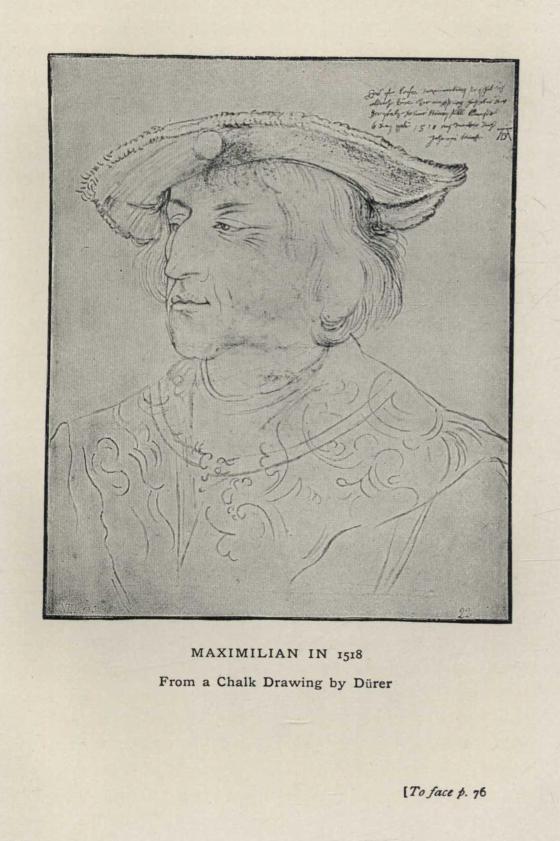
MAXIMILIAN IN 1518 From a Chalk Drawing by Dürer
IV
"The essence of Humanism is the belief ... that nothing which has ever interested living men and women can wholly lose its vitality."—Walter Pater.
It is with a certain sense of relief that we pass from the tragi-comedy of Maximilian's political life to those realms where lies his real claim to fame and gratitude. Great ambitions thwarted by the sordid details of poverty are never a pleasant subject of contemplation; and there have been few monarchs in whose lives they have played a more prominent part. But it may fairly be argued that all the more credit is due to one who, under such unfavourable circumstances, ever remained buoyant and full of the joy of living, and whose frequent disappointments never soured his enthusiasms nor turned him from the path of knowledge. The first of his race to welcome the new culture, and possessed of that joyous temperament which seems to offer immortal youth, Maximilian was acclaimed by the scholars of his day as the ideal Emperor of Dante's or Petrarch's dreams. His predecessors had shown little interest in intellectual pursuits. Sigismund had indeed crowned several poets, but was always too needy himself to spare much money for their salaries; Frederick III. was devoid of literary tastes, and, in spite of his connexion with Æneas Sylvius, gave but slight encouragement to art or learning. But Maximilian surrendered himself, with all his habitual energy and enthusiasm, to the new spirit of the age. In spite of his many political failures he remains to all time the darling of the scholar and the poet. This almost universal favour he did not win by liberal donations or the grant of lucrative posts, for he was seldom free from money embarrassments—nor by the maintenance of a gorgeous court and imposing ceremonial—for his endless projects and expeditions made any fixed residence impossible; but by his restless activity, his manly self-reliance, his wide and human sympathy with all ranks and classes of the people. Above all, he identified himself with the struggling ideals of a new German national feeling, and with the growing opposition to France, to Italy, and to Rome; and, as a national hero, inspired the devotion alike of the scholar, the knight, and the peasant. "Mein Ehr ist deutsch Ehr, und deutsch Ehr ist mein Ehr" is the ruling motive of his life; and the praise which is continually on all lips is, before all, the result of his passionate loyalty to that larger Germany of which the poet sings—
So weit die deutsche Zunge klingt Und Gott im Himmel Lieder singt Das soll es sein! Das, wackrer Deutscher, nenne dein!
Nowhere is the general admiration more evident than in the Volkslieder and the popular poetry of the time. And even when death overtook him in the midst of complete failure and humiliation, no scornful voice is heard, and all is regret and loving appreciation.
First among earthly monarchs, A fount of honour clear, Sprung of a noble lineage, Where shall we find his peer? ... He stands a bright ensample For other Princes' eyes, The lieges all appraise him The Noble and the Wise. His justice is apportioned To poor and rich the same. Just before God Eternal Shall ever be his name. And God the Lord hath willed it, Our pure, immortal King, And welcomed him in glory, Where ceaseless praises ring. Our hero hath departed, Time's sceptre laying down, Since God hath, of His goodness, Prepared a deathless crown.[96]
A vital distinction is at once apparent between the Italian and the German Renaissance. In Italy the movement was essentially aristocratic and largely dependent upon the various Courts—the Medici, the Popes, the Dukes of Urbino. In Germany such open-handed patrons were few and far between. Albert of Mainz, Frederick of Saxony, and Eberhard of Würtemberg stand alone among the princes as patrons of learning; while Ulrich von Hutten is the sole representative of the Knightly order in the ranks of the Humanists.[96a] The political and intellectual development of the German towns is of great importance during this transition period, and it is in them that the leaders of the German Renaissance are to be found. The movement remained throughout municipal rather than aristocratic, making itself first felt where there was closest commercial intercourse with Italy—notably in the cities of Swabia and the Rhine valley. But for this very reason Humanism took deep root in the soul of the German people. Not merely aesthetic or sensuous, like the Italian movement, it had a profound ethical and national basis, on which the powerful art of Dürer, the sonorous language of Luther, the sweet singing of Hans Sachs, might safely rest. Almost from the very beginning it pursued a moral aim. It was inspired by no mere sordid quest of pleasure, but by a noble dream of purer manners and loftier ideals. It realized the decadence into which society, both lay and ecclesiastical, had fallen, and earnestly strove to arrest it in the only possible way—by the introduction of a new spirit at once into the details of daily life, and into the broad principles of national existence. But as the Humanist movement gathered strength and influence, it remained isolated from politics and from those who ruled the destinies of the Empire, and, developing in various places and under separate leaders, tended to waste its energies through lack of systematic or united effort. Under such circumstances its unspoken appeal for assistance in high places met with an eager response from Maximilian. For the last twenty-five years of his life he forms the central figure of the new movement—possibly not its most glorious or most brilliant representative, but yet giving life and uniformity to the whole. If for nought else, he would deserve to be remembered as the connecting link between the Humanists of Strasburg, Augsburg and Nuremberg. In order to interpret this feature of the Emperor's character, we must present a slight sketch of the German Renaissance in its three main channels, with especial regard to Maximilian and his connexion with the leading Humanists, and must then proceed to examine Maximilian's own literary achievements, and his relations to Science and Art in its various branches.
In a quaint old comedy written at the close of the fifteenth century, Cicero and Caesar are brought to life and taken round the cities of Germany. They are made to describe Strasburg as "the most beautiful of the German towns, a treasure and ornament of the Fatherland"; of Augsburg they exclaim, "Rome with its Quirites has wandered here"; while Nuremberg is pictured as "the Corinth of Germany, if one looks at the wonderful works of the artist; yet if you look at its walls and bastions, no Mummius would conquer it so easily."[97] Such are the three great centres of the German Renaissance.
In Strasburg, education was the most crying need of the time; for though there were excellent schools in the Franciscan and Dominican convents, these were reserved for novices, the laity being wholly excluded. Jacob Wimpheling, under whom Humanism first took deep root in the city, was himself a pupil of the Deventer School,[98] and, like them, devoted his energies to educational reform. His hopes of founding a University were not realized, and he had to content himself with forming the centre of a literary society, such as was formed both at Mainz and Vienna by Conrad Celtes. Wimpheling and his friends differ largely from their contemporaries in other parts of Germany. They were characterized by a theological bias which led them into violent and unprofitable controversies. Though himself a cleric, and thus a supporter of the spiritual order and of orthodox belief, he indulged in fierce attacks upon the monks for their immorality, and in spite of his admiration for heathen authors, he pushed his defence of theology so far as to condemn the Art of Poetry as useless and unworthy to be called a science, and only to exempt from utter damnation the sacred poets of Christianity.[99] He was equally limited in his patriotic polemics. His praise of everything German is only surpassed by his hatred for the French and Italians, his profound contempt for the Swiss. His best-known work, entitled Germania, was written with the double object of proving the exclusively German origin of Alsace and of "defending the King of the Romans against the monks and secular preachers who attack him."[100] Even the ingenuous arguments in which the book abounds, and the quaint array of authorities, from Caesar and Tacitus to Aeneas Sylvius and Sabellico cannot blind us to the genuine patriotism, which is latent in every page. "We are Germans, not French," he exclaims, "and our land must be called Germany, not France, because Germans live in it. This fact has been acknowledged by the Romans. For when they had conquered us, the Alemanni on the Rhine, and, crossing the river, saw that the dwellers on the further bank were like us in courage, stature, and fair hair, as well as in customs and way of life, they called us Germans, that is, brothers. But it is certain that we, these Germans, are like the real Gauls neither in speech and appearance, nor in character and institutions. Hence our city and all Alsace is right in preserving the freedom of the Roman Empire, and will maintain it also in the future, in spite of all French attempts to win over or conquer us."[101] Such fervent expressions of German feeling must have called Maximilian's attention to Wimpheling, even without his vigorous defence of the Imperial dignity. In 1510, when Maximilian was opposed to Julius II., and hoped to intimidate him by recounting the wrongs of the German nation, he could think of none more versed in them than Wimpheling, and therefore requested him to draw up a summary of the French Pragmatic Sanction, such as would suit the needs of Germany. In March, 1511, he wrote to Wimpheling that he was about to hold an assembly at Koln, to deliberate with the French envoys as to summoning a general Council; and he begged him to think out means of redressing the various abuses, "without touching religion." As a result of this request, Wimpheling drew up his Gravamina Germanicae Nationis and added the desired Remedia.[102] But the Emperor's policy had already changed, and Wimpheling was informed through the Imperial Councillors that the moment was unfavourable for publication. Indeed, his labours only received the attention which they deserved, when they were employed as the basis of "The Hundred Grievances of the German Nation" (1522).[103]
SEBASTIAN BRANT
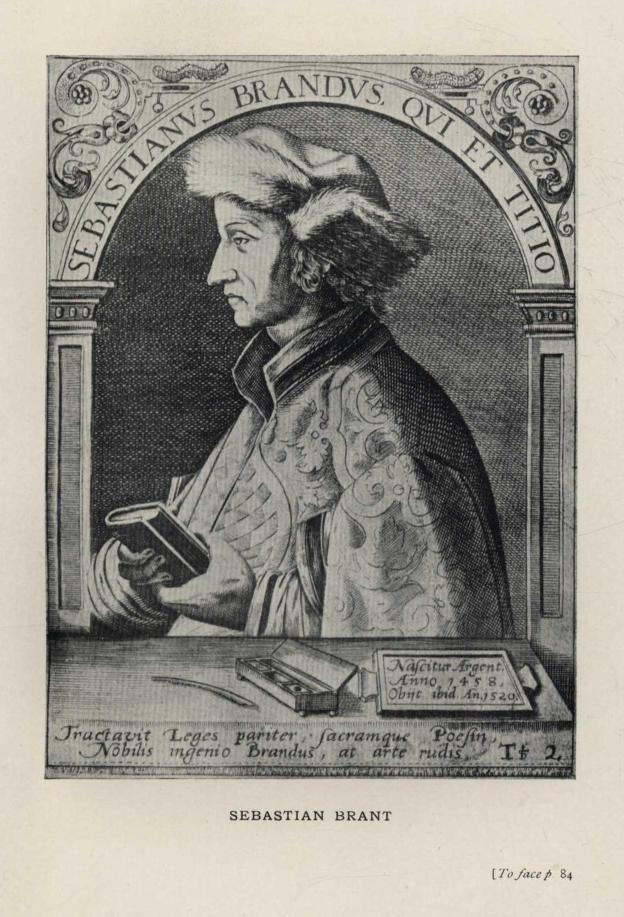
Side by side with Wimpheling stands Sebastian Brant, whose literary worth has probably obtained wider recognition than that of any German Humanist, with the sole exception of Erasmus. His Narrenschiff ("The Ship of Fools") is penetrated by a deep religious spirit, and fearlessly attacks all the corruptions and abuses of the day, "branding as fools all those who are willing, for things transitory, to barter things eternal."[104] Brant is in no sense a great poet; his verses are often stiff and ill-proportioned, and his matter frequently sinks to the level of the common-place. But the appearance of "The Ship of Fools" caused an unparalleled stir, not merely in the republic of letters, but throughout the whole German people; and it owes its extraordinary popularity to its skilful intermixture of problems which were in all men's minds. He was the first to give full expression to the ideas of the middle classes (anticipating the manly independence of the Scottish poet,[105]) when he sang—
Aber wer hätt' kein Tugend nit, Kein Zucht, Scham, Ehr, noch gute Sitt, Den halt' ich alles Adels leer, Wenn auch ein Fürst sein Vater wär'.
But the ruling motives which inspire his muse are the maintenance of the Church in her pristine purity, and the defence of Christendom against the onslaught of the infidel. While he preaches earnestly the Headship of Christ, and exhorts all men to put their trust in God rather than in mortal men, he is also never tired of enjoining reverence for the Emperor, and urging them to unite in loyal obedience to his wishes and aspirations. Apparently unconscious of his inconsequence, he upheld the principle of absolute Papal domination, and yet early associated himself with that august dream of the Middle Ages—the universal monarchy of the Emperor. For him he claimed the same power in the temporal, as the Pope exercised in the spiritual world. As the Pope was the organ of religion, so was the Emperor the source of Law; and the revival of his power as temporal head of Christendom was to coincide with the re-establishment of that order and discipline whose absence Brant so frequently laments. The whole fabric of these vast aspirations Brant rested upon Maximilian. He could not foresee that this prince, so brilliant, so chivalrous, so sympathetic, would disappoint the rich promise of his youth and fail to restore the fallen grandeur of the Empire owing to his schemes of family aggrandisement. He greeted his election with adulatory verses, protesting that under such a prince the Golden Age could not fail to return. The news of Maximilian's imprisonment at Bruges rouses a very whirlwind of indignant phrases, contrary to the whole spirit of his later teaching. "Destroy the Flemings," he cries, "extirpate the very race of this crime, hang and behead the miscreants, overturn their walls, and make the plough pass over this accursed soil. Such is the demand of justice."[106] His belief in omens and portents is unlimited, and they are generally connected with Maximilian in some quaint and high-sounding verses. Thus the killing of an enormous deer on some hunting expedition inspires Brant with an absurd and laboured comparison. "No animal is nobler than the stag: thou, Maximilian, art the most noble of Princes. He stops astonished before things which seem new; thou also dost admire things new and great. At the approach of danger he pricks up his ear and places his young in safety; thou hearest the menacing noises of thine enemies, and dost protect thy people."[107] A number of falcons which were seen to assemble and fly southwards is acclaimed as a symbol of Maximilian, aided by the Princes in his Italian expedition. "Destiny calls you, O Germans; go and restore the Empire in Italy." Even when it became evident that Maximilian was not destined to realize the poet's high ideals, such extravagances did not cease. Moreover, he was sustained by a personal attachment for the Emperor, which was deepened by his various visits to the Court and closer acquaintance with his early hero, and doubtless strengthened by the Imperial favours bestowed upon him. And thus it is with unfeigned grief that Brant celebrates his death. "O magnanimous Caesar, that hope is vanished which we had founded on thee while thou didst hold the sceptre. How should I restrain my tears? Thou wert worthy to live, thou the sole anchor of safety for the German nation. One swift hour hath removed thee: thou art no more, and misfortune assails the Empire."[108] Our subject is Maximilian, not Brant, and we may not linger. But the epitaph on the Strasburg poet's tomb should not be omitted, even in the translation; for it gives us a sure clue to a character which was sweet and winning in spite of all its extravagances. "Toi qui regardes ce marbre, souhaite à Brant le ciel!"
CONRAD PEUTINGER
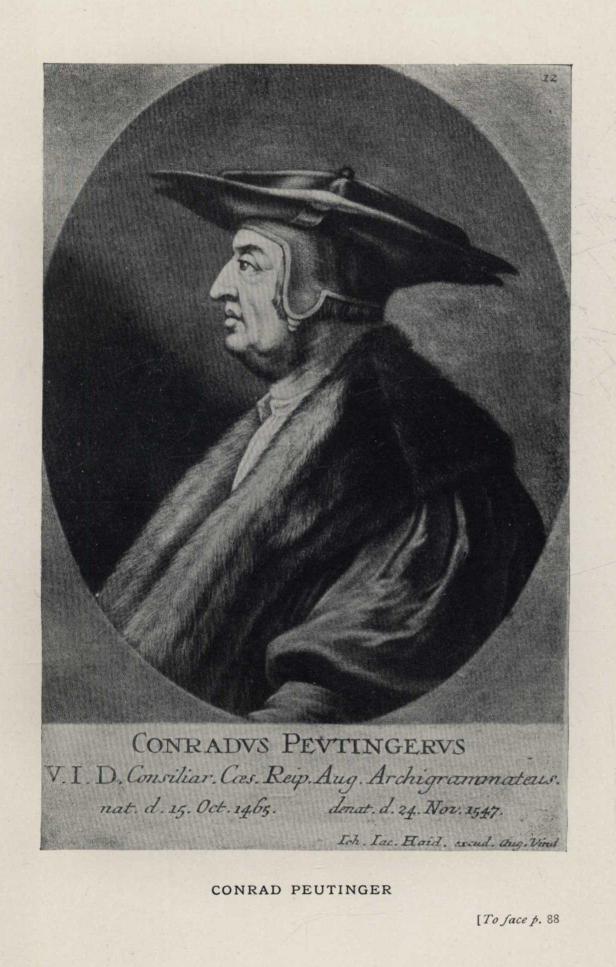
If in Strasburg the movement assumed a theological and educational character, in Augsburg it was rather directed towards politics and the study of history. Alike from its geographical position[109] and from its industrial and commercial importance,[110] Augsburg was thrown into close relations with Italy and Italian thought; and enthusiasm for classical studies was early introduced by Sigismund Gossembrot, one of the leading merchants of the city. The direction of the movement was further influenced by the Diets which were held within the city,[111] and by the frequent visits of the Emperor Maximilian.[112] The place of Gossembrot was worthily filled by Conrad Peutinger,[113] who returned from Italy in 1485, as a doctor of law, embued with all the ardour of a scholar. He became a prominent official of his native city, and retained his position for many years from inclination rather than from necessity, betraying throughout his writings the sharp eye and critical knowledge of the practitioner. His first meeting with Maximilian probably took place at Augsburg in 1491, and from this time onwards he was continually employed by the Emperor in various positions of trust. As ambassador, secretary or orator, he visited many countries in Europe, and, besides ordering affairs of politics, was entrusted with the truly humanist task of presenting and answering formal addresses and greetings. While in his foreign relations he was eager to maintain the honour of the German name, he skilfully used his double position as Imperial Councillor and Town-official to smooth over differences between Maximilian and Augsburg, to the advantage of both parties. The Emperor's love of Augsburg led him to purchase various houses within the walls, and the castle of Wellenburg in the neighbourhood. His action was far from welcome to the burghers, who did not wish this powerful citizen to acquire too much property in their midst; and they were only pacified by the assurances of Peutinger that Maximilian would raise no fortifications round the castle. On the other hand, during his honourable mission to Hungary (1506), he obtained from the Emperor a substantial grant of privileges for his native city—notably the right "de non appellando." But Peutinger was Maximilian's confidant not merely in political affairs. Indeed, his employment in Imperial diplomacy directly arose from his intellectual and artistic relations with Maximilian, who sought the support of every scholar in his attempt to place the Fatherland in the forefront of Art and Science. In Italy Peutinger had learned the value of old Roman inscriptions, and in 1505 he was encouraged by Maximilian to publish a collection of the inscriptions of German antiquity.[114] The Emperor and the scholar kept up a correspondence on the subject of ancient coins, large consignments of which were sent to Augsburg, by order of the former, from every part of the Empire. During Peutinger's visit to Vienna in 1506 he was monopolized for three whole days for learned conversation, and received a new and more important commission from Maximilian. He was to examine the letters and documents of members of the House of Hapsburg, and to prepare a selection of them for publication; and with this object he was assigned a special apartment in the castle of Vienna, to which chronicles and histories were brought for his use from all quarters. Here he remained for almost three months, and the fruit of his labours was the Kaiserbuch, or Book of the Emperors, which was unfortunately never published and which is now extant only in a few fragments. During his labours for Maximilian he seems to have acquired a great number of valuable manuscripts; and had his literary projects been fully realized, we should have gained an astonishing contribution to the historiography of the sixteenth century. But apart from his own unfinished writings, he edited and published, with Maximilian's approval, various early historical works,—the chronicles of Paul the Deacon and of Ursperg being of especial value.[115] Moreover, he was charged by the Emperor with a species of censorship, by virtue of which he prevented the appearance at Augsburg of a Swiss Chronicle, containing statements derogatory to the House of Hapsburg. In short, in almost every phase of the struggle of culture and civilization, which Maximilian so gallantly led, we find Peutinger intimately engaged as his friend and fellow-labourer; and with Beatus Rhenanus we may truly exclaim, "Our Conrad Peutinger is the immortal ornament, not merely of the town of Augsburg, but also of all Swabia!"
The activity of Augsburg was not confined to historical studies. The rising art of Germany had found here a worthy representative in Hans Holbein, who, though not strictly a Humanist himself, took the deepest interest in the movement. His attitude is clearly visible from his portraiture of Erasmus, More, and other leaders of the Renaissance, and from his illustrations to the Praise of Folly and the Dance of Death. But Holbein, though the greatest of the Augsburg School, was too much of a wanderer to be thrown into close contact with Maximilian. The latter none the less found capable artists to give expression to his own literary projects. Hans Burgkmair, the most distinguished of their number, produced over one hundred illustrations of Weisskunig, seventy-seven for the Genealogy, which consists of portraits of Maximilian's ancestors, and close upon seventy for the Triumphal Procession, the main idea of which belongs to Dürer. Leonhard Beck illustrated a book of Austrian Saints, and the greater part of the famous Teuerdank; whilst Freydal represented in his Mummereien the various tournays and festivities of which Maximilian was the central figure. All these woodcuts and engravings were executed under the supervision of Peutinger, who also directed the casting of figures for Maximilian's tomb at Innsbruck, and the making of armour and warlike equipments for the Emperor's own person. Indeed, Maximilian put his Humanist friend to very strange uses; for among the manifold commissions of Peutinger we find the selection of tapestries from the Netherlands, inquiries after the inventor of a special kind of siege-ladder, the building of hatching-houses for the Imperial falcons, and the establishment of an important cannon foundry. The climax is reached when Maximilian employs Peutinger's historical knowledge to obtain the names of a hundred women famous in history, after whom he may christen the latest additions to his artillery!
WILIBALD PIRKHEIMER
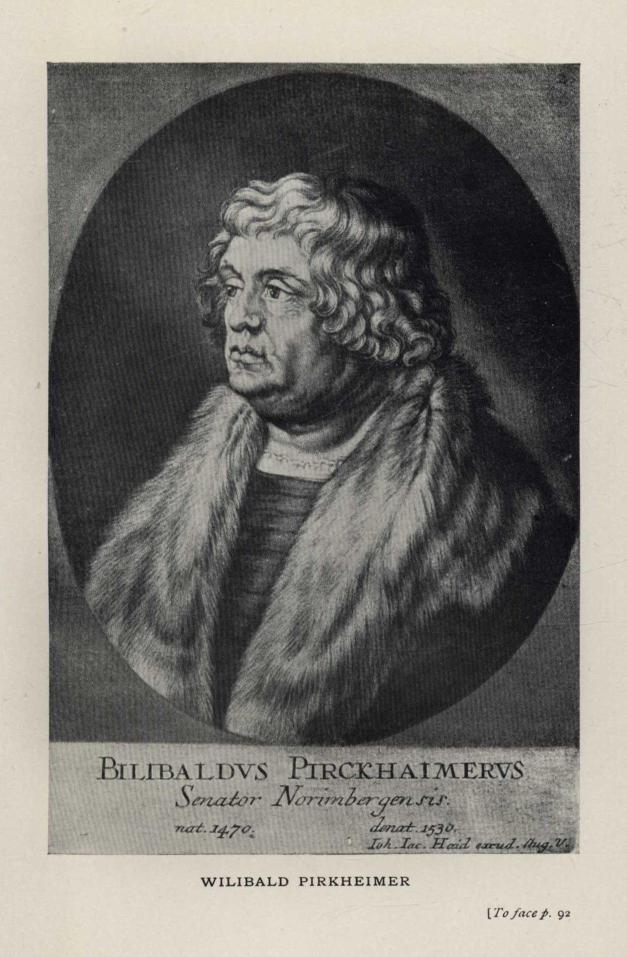
Of the three centres of German Humanism, Nuremberg is the greatest and the most fascinating. The home of invention as well as of industry, it made no mere empty boast in the proverb, "Nürnberg Tand geht durch alle Land." Its churches and public buildings were the glory of the age, its craftsmen and designers perhaps then unequalled in the world. Its literary circle contains a larger number of distinguished names than any of its rivals. Meisterlin, the author of the famous Nuremberg chronicle, Cochläus, the bitter satirist of Luther; Osiander, the celebrated Hebrew scholar and Reformed preacher; Jäger the mathematician; above all Hans Sachs, the cobbler-poet, "the sweet singer of Nuremberg"—all these fill an honourable place in the annals of the city. But the central figures of its life are, beyond any doubt, Wilibald Pirkheimer and Albrecht Dürer; in any case they would monopolise our attention on account of their intimate connexion with Maximilian. When still King of the Romans, he had resided at Nuremberg, and the joyous animation with which he entered into the life of the city won for him wide popularity. "When about to depart, we are told he invited twenty great ladies to dinner; after dinner, when they were all in a good humour, the Markgrave Frederick asked Maximilian in the name of the ladies to stay a little longer and to dance with them. They had taken away his boots and spurs, so that he had no choice. Then the whole company adjourned to the Council House, several other young ladies were invited, and Maximilian stayed dancing all through the afternoon and night, and arrived a day late at Neumarkt, where the Count Palatine had been expecting him all the preceding day."[116] As Emperor, Maximilian paid many visits to Nuremberg, and his first Diet was enlivened by a succession of brilliant masques, dances and tournaments, such as roused the enthusiasm of the local chroniclers. He remained on terms of great intimacy with Pirkheimer, who in many ways is the most typical figure of the German Renaissance. After an excellent education, at Padua and Pavia, in jurisprudence, literature and arts, Pirkheimer became councillor in Nuremberg, and won the special confidence of the Emperor both by his skilful diplomacy and by his patriotic assistance in the Swiss War. His great riches he employed not merely for the adornment of his own house, but also in generous support of less-favoured followers of the Muse. While he resembled Peutinger as diplomat, as historian, and as theologian, he had less of the temperament of a pedagogue, and more of the joyous nature of a true poet. As the representative of a great movement of the intellect, he was open to all its various methods and aspirations, and yet understood the lesson of self-restraint and concentration too well to exhaust his powers in a labyrinth of alternatives. With the true cheerfulness and humour of the man who knows the world, yet remains unsullied by contact with it, he and his friends devoted themselves to what is after all the highest philosophy, the study of mankind—hiding under a smiling face, nay, often a mocking mien, their confidence in the great destinies of the race. And yet a deep pathos attaches to Pirkheimer's closing days. Disappointed in his dreams of moral and spiritual regeneration for the people, he turned wearily back from the paths of the new doctrine to the bosom of Mother Church. His violent attack upon Johann Eck, his noble defence of Reuchlin, had seemed to foreshadow him as a leader of the Reformation.[117] But his ideals were in reality of the past rather than of the future; and, brooding over his shattered hopes, he lingered out a solitary old age, whose sadness is but deepened by his swan-like lament for Dürer.
ALBRECHT DURER
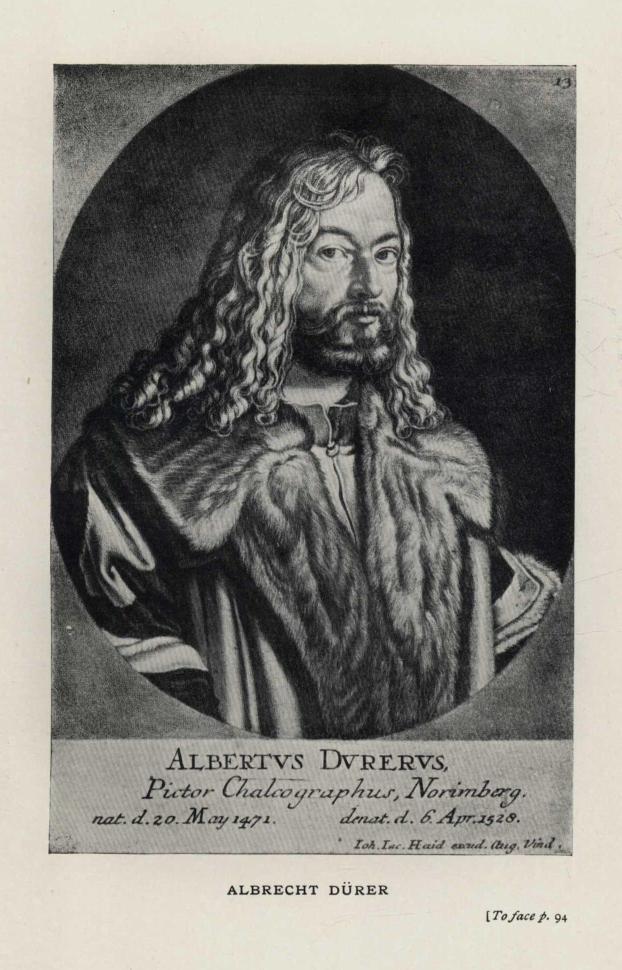
Dürer was indeed well worthy of all the praise which has been lavished upon him; for from all his works there shines forth the noble modesty of a pure good man. Though scarcely a scholar himself, his deep sympathy with the great movement is manifest not only in the manner in which his art interprets it, but also in his own written words.[118] His letters to Pirkheimer from Venice form delightful reading and show the keenness of his sympathy and observation. The years which followed his return to Nuremberg, 1507-1514, were the most productive period of his life, as well as the period of his most intimate connexion with Maximilian. From them date the ambitious designs of the "Ehrenpforte" (Triumphal Arch), which, though executed under Maximilian's direct supervision, were entirely the idea of Dürer. No less than ninety-two large woodcuts, the production of which occupied Dürer for two years, go to make up this imposing metaphorical picture. A structure in itself impossible is overburdened by portraits of all the ancestors of Maximilian, mythical as well as real, and by the many exploits and adventures of the Emperor's own life. But the work must be estimated less by the quaintness of its composition than by its sterling artistic qualities and by the important place which it holds in the development of German Art. The idea was further developed in the "Triumphzug" and the "Triumphwagen," which was completed in 1516. The Imperial and other triumphal cars were drawn by Dürer in sixty-three woodcuts, while the remaining seventy-four were prepared in Augsburg by Hans Burgkmair and L. Beck.[119] The procession, whose magnificence was to idealize Maximilian as the greatest of Princes, includes sketches of almost everything that ever roused the Emperor's interest. Landsknechts, cannon, huntsmen, mummers, dancers of every rank and variety, the noble ladies of the Court, are mingled with allegories of every Imperial and human virtue, elaborately grouped upon triumphal cars. The keen personal interest of Maximilian in the progress of the work is well attested. Indeed, he showed his impatience, while the various blocks were in progress, by frequently visiting not merely Dürer himself, but also the "formschneider" or block-cutter, who lived in a street approached by the Frauengasslein. Hence the old Nuremberg proverb, "The Emperor still often drives to Petticoat Lane."[120] Dürer was appointed painter to Maximilian, with a grant of arms and a salary of 100 florins a year; and a letter of the Emperor to the Town Council of Nuremberg is still extant, in which he demands Dürer's exemption from "communal imposts, and all other contributions in money, in testimony of our friendship for him, and for the sake of the marvellous art of which it is but just that he should freely benefit. We trust that you will not refuse the demand we now make of you, because it is proper, as far as possible, to encourage the arts he cultivates and so largely develops among you."[121] These earnest words of Maximilian reveal to us very clearly his attitude towards the great movement of his day. Yet, sad as it is to relate, Dürer never received payment for the ninety-two sheets of the "Triumphal Arch," which had cost him so much time and labour, and after Maximilian's death they were sold separately. But the Emperor may fairly be absolved from the charge of mean treatment of Dürer, for his own needs were great and many, and it is strictly true that he spent very little upon himself. The great artist was always treated with distinction as a personal friend of the Emperor, who, besides granting him a fixed salary, gave him material assistance in checking the forging and pirating of his engravings. He sometimes resided at Court, when Maximilian held it at Augsburg, and often employed his time in making sketches in chalk of the illustrious persons whom he met. On one occasion Maximilian was attempting to draw a design for Dürer, but kept breaking the charcoal in doing so. When the artist took the pencil and, without once breaking it, easily completed the sketch, the Emperor expressed his surprise and probably showed his annoyance. But Dürer was ready with his compliment. "I should not like your Majesty," he said, "to be able to draw as well as I. It is my province to draw and yours to rule."[122] Not the least interesting and important of Dürer's commissions was to paint that portrait of the Emperor which now hangs in the Imperial Gallery at Vienna. The prominent nose, the hanging eyelid, the half-contemptuous, half-mournful turn of the lips, the wrinkled cheeks and neck, the long hair falling over the ears, the pointed bonnet with its clasp, the sombre flowing robes, form a striking picture and suggest a speaking likeness. Disappointment, but also that peculiar attribute of the Hapsburgs, resignation, are clearly marked upon Maximilian's face. In the other two portraits by Dürer—a chalk drawing executed at the Diet of Augsburg (1518) and a woodcut completed shortly before his death—the features are less rugged, and reveal somewhat more of the sanguine spirit of Maximilian's early days. With the exception of these sketches,[123] Dürer's last commission for Maximilian was the exquisite decoration for the latter's private Gebetbuch (Book of Prayer), of which only ten copies were printed,[124] and which will ever remain one of the gems of artistic and devotional literature. With Dürer's career after 1519 we are not concerned; but it is worthy of notice that his most brilliant work dates from the reign of Maximilian, and that his sympathy with "the nightingale of Wittenberg" seems to have partially diverted his attention from his art.
It must not be supposed that Maximilian's humanistic enthusiasms were confined to the three great centres which have just been described, or that he only helped on such movements as were already animated by a vigorous existence and a fair prospect of success. His own hereditary dominions were even more directly indebted to his efforts than were other parts of the Empire.
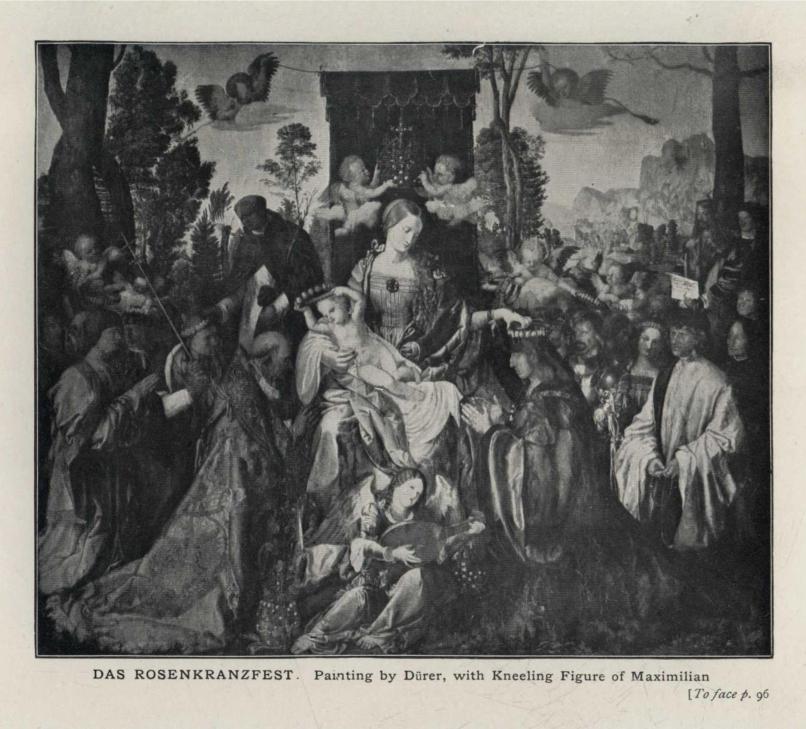
DAS ROSENKRANZFEST. Painting by Dürer, with Kneeling Figure of Maximilian
During the first century of its existence, Vienna University[125] was an autonomous ecclesiastical corporation, over which the methods of the mediaeval Schoolmen held complete sway. But during the long reign of Frederick III., several circumstances combined to cast a blight upon its hitherto flourishing condition. During the Council of Basel it assumed a hostile attitude to the Pope, and its surrender of that position only emphasised its folly; while in the struggle of Frederick and his brother Albert the professors were unwise enough to dabble in politics and thus to throw off the immunity which guarded their proper sphere. Their open sympathy with Albert was fatal to a good understanding with Frederick, who never showed any favour to their body. Vienna further suffered from a six months' siege by Matthias of Hungary (1477) and from a violent outbreak of the plague (1481); and this had scarce abated, when war was renewed and Matthias overran the whole of Lower Austria. During the ensuing siege (December 1484 to June 1485) all lectures were inevitably suspended, and the whole work of the University was at a standstill. The refusal of the University authorities to take the oath of allegiance to Matthias—on the ground that, as a clerical corporation, they were independent of the temporal power—induced the conqueror to stop all the revenues which they derived from the government; and though he at length granted[126] a sum sufficient for the payment of the Professors and other necessities, yet he never extended to Vienna the same liberality towards Art and Science which had distinguished his relations with Buda-Pest. By the time of his death (1490) Vienna University was in a state of almost complete decay.
Under such circumstances the recovery of Austria by Maximilian was greeted with joy on the part of the authorities, and immediate steps were taken to restore the tottering fabric of the University. Maximilian set himself definitely to transform it from a clerical corporation to a home of the new Humanism, and was aided in this difficult task by the Superintendent Perger, the intention of whose office was not only to control the Government grants, but also to decide upon their expenditure, and to refer to the Emperor all questions of professorial appointments. In spite of much internal opposition, the Humanists ere long acquired predominance in the philosophical Faculty, the medicals threw off the monstrous requirements of Scholasticism, and the jurists began to study Roman as well as ecclesiastical law. The revival of Vienna soon roused the interest of that peculiar product of the Renaissance period, the wandering scholar. The first to visit the University was Johann Spiesshaimer—more celebrated as Cuspinian—who rapidly won favour with the Hapsburgs by a poem in praise of St. Leopold, Markgrave of Austria, and who was crowned poet by Maximilian shortly after his father's death, in presence of a brilliant and representative assembly. Soon afterwards he began to hold regular lectures on poetry and rhetoric, discussing such writers as Cicero, Sallust, Horace, Virgil and Lucan. But Perger's preference lay decidedly with the Humanists of Italy, many of whom he had known personally during his residence at Padua and Bologna. At his recommendation, Maximilian in 1493 summoned Hieronymus Balbus from Venice to Vienna, and appointed him lecturer on the Roman Poets. But the Italian's fiery temper soon led him into disputes with the University authorities, and after an unsatisfactory career of two years he found a fresh outbreak of plague in the city a convenient pretext for returning to Italy. Krachenberger and Fuchsmagen, the two councillors whom Maximilian had appointed to assist Perger, doubtless influenced by the unseemly brawling of Balbus, were loud in their complaints of Perger's favouritism, and urged their Imperial master to encourage German rather than Italian scholars. But Maximilian was, after all, only following his own judgment, when in 1497 he sent a cordial invitation to Stabius and Celtes to fill professorships at Vienna.
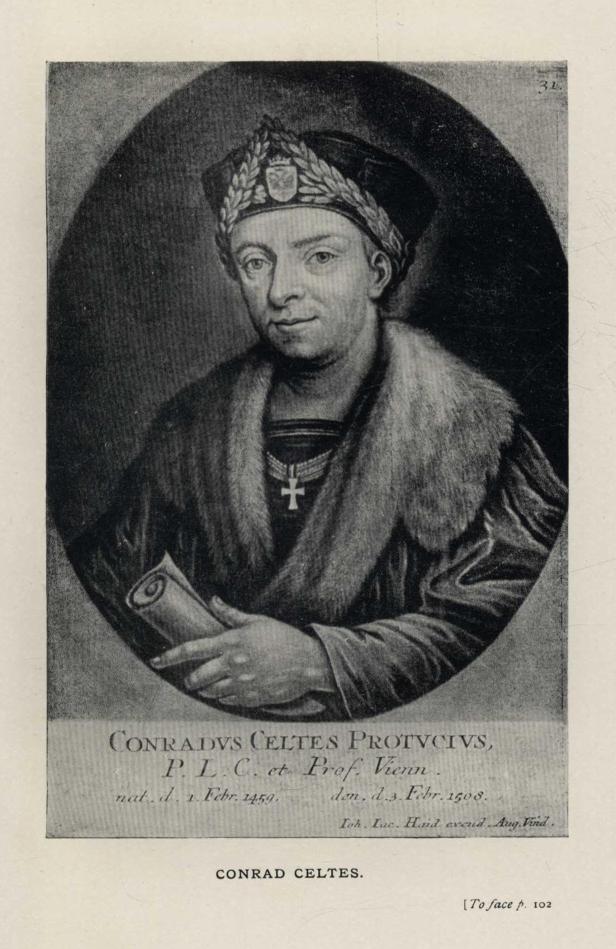
Conrad Celtes is the most famous of the earlier German Humanists, and is in a sense the forerunner of Peutinger and Pirkheimer. But while his influence penetrated into every part of the Empire as a stimulating force, Vienna was the scene of his longest and most definite labours, and hence all mention of him has been postponed till now. Born in 1459, in humble circumstances, Celtes devoted himself from youth to the pursuit of learning, studying the Roman classics in the leading universities of Germany. Without any settled abode, he wandered from one university to another, associating with scholars and supporting himself by lectures on the philosophy of Plato, the rhetoric of Cicero, or the poetry of Horace. In 1486 he visited Italy and made the acquaintance of all the famous Humanists of the age. On his return, the publication of his first treatise, the Ars Versificandi, brought him to the notice of Frederick III., by whom he was crowned as poet at the Diet of Nuremberg (1487). During the next four years he visited Cracow, Prague, Buda, Heidelberg and Mainz, and again settled down at Nuremberg in 1491. Here he published a life of St. Sebald, patron of the city, in sapphics, and a treatise upon the origin and customs of Nuremberg itself. But within a year he was summoned to Ingolstadt as Professor of Poetry and Rhetoric, and here he was residing when Maximilian's letter reached him. The Emperor's appeal was not in vain, and Celtes took up his permanent abode in Vienna University in 1497, as professor of the same subjects as at Ingolstadt. His opening lectures, which treated the philosophy of Plato in connexion with the Neo-Platonism of the Italian scholars, were regarded with suspicion and dislike by many members of the University; but his position was strengthened by the hearty support of Maximilian, who in 1501 appointed Cuspinian, the intimate friend of Celtes, to the post of Superintendent. Celtes, and with him the Emperor, was convinced that new methods of instruction were necessary, if Humanism was to triumph over Scholasticism. "A new institute was required, which should serve for the preparation and training of Humanism, a sort of seminary of Humanist scholars, not outside, but inside, the University."[127] These views led, in October 1501, to the foundation of the "Collegium Poetarum et Mathematicorum" by Maximilian. Planned by Celtes with the active approval of Cuspinian, the College in no way formed a fifth Faculty, though it was directly connected with the Faculty of Arts. Of its two divisions, the first was devoted to the study of mathematics, physics and astronomy, the second to that of poetry and rhetoric. The right of the coronation of poets, which had hitherto lain with the Emperor alone, was now vested by Maximilian in Celtes, as director of his own creation. The most distinguished scholars were to receive the crown of laurel, as a mark of high distinction and as an incentive to further efforts. But this privilege was exercised by Celtes for the first and last time, when in 1502 he crowned Stabius, his former colleague at Ingolstadt, and now Professor of Mathematics and Astronomy at Vienna. All subsequent coronations of poets were by Maximilian himself;[128] and the College of Poets fell into disuse after the death of Celtes in 1508. Even had worthy successors to Celtes and Stabius been found, it is doubtful whether the College would have had a permanent existence. Its hybrid position, as an independent institution and yet an integral part of the University, was a source of endless bickerings and quarrels, which can scarcely have been a recommendation to foreign scholars. Celtes' other peculiar institution, the "Literary Society of the Danube," which he had originally founded at Buda, and which transplanted itself to Vienna when he settled there, was a kind of academy or free union of scholars for the spread of Humanism. Its members were recruited from almost every nation, and were only held together by the personal influence of Celtes; on his death it shared the same fate as the College of Poets.
CONRAD CELTES.
An interesting development of such Humanist unions formed itself in the mind of Aldus Manutius, the famous Venetian printer. He longed for the establishment of an academy which should devote itself to the perfecting of printing and to the spread of the Greek language, and he entertained the further hope of converting it into an educational institute, which should form a point of scientific intercourse between Germany and Italy, under the direct initiative of the Emperor. But though he approached Maximilian on the subject, he obtained nothing but vague promises of assistance, whose fulfilment was thwarted by the Emperor's lack of resources.
Besides his general services to Humanism, Celtes earned the gratitude of Maximilian by his attention to historical studies. His sketch of Nuremberg contains a valuable description of its buildings and its trades, its climate and its inhabitants. His eager investigations resulted in the discovery of the comedies of the Saxon nun Hroswith, whose lax morality has been adduced as a proof of their fictitious character, and the works of Ligurinus, upon which he and his friends lectured at Vienna.[129] At the moment of his death he was engaged upon important work for Maximilian. His projected history of the origin of the House of Hapsburg still remained very much in embryo; but his great work, Germania Illustrata, had assumed very real dimensions and would, if completed, have eclipsed even the famous Nuremberg Chronicle.
The place of Celtes was filled in Maximilian's estimation by Stabius and Cuspinian. The former, who had been crowned poet in 1502, was appointed Historiographer by the Emperor in 1508, and was virtually monopolized for historical research. Even during Maximilian's last illness Stabius was employed to read aloud volumes of Austrian history.[130] But his achievements in the field of history are of trifling value, and are not to be compared to his works on geographical and mathematical subjects. Cuspinian is much more worthy of consideration, especially as his relations with Maximilian drew him in the same direction as Peutinger. Already Rector of Vienna University in 1500, he was incessantly employed by the Emperor on embassies and in affairs of politics. In the course of five years he was engaged in no fewer than twenty-four missions to Hungary, and he took the leading part in the negotiations of 1507 and 1515, which resulted in the double marriage between Austria and Bohemia-Hungary, and the close union of Maximilian with Uladislas (1515). Nothwithstanding his political activity, he found time for medical and historical pursuits, lectures and public addresses on Philosophy and Rhetoric, and elaborate discussions with his Humanist friends. Besides editing several of the later classical authors,[131] he brought out the Weltchronik of Bishop Otto of Freisingen, and the same writer's Warlike Deeds of Frederick Barbarossa. His own productions include an account of the Congress of Princes at Vienna in 1515, and a sketch of The Origin, Religion and Tyranny of the Turks, which naturally roused Imperial interest. All his most important works exhibit traces of his connexion with Maximilian. His Commentarii de Romanorum Consulibus are probably the most profound and critical; but his history De Caesaribus et Imperatoribus Romanorum,[132] which employed him between the years 1512 and 1522, undoubtedly possesses the most practical interest, since it furnishes us with many valuable details of Maximilian's life and character. His other work, Austria, contains a complete history of the country up till 1519, as well as a geographical and topographical description of its several provinces. Unhappily it was not published till 1553, and by that time the maps which were to have been included had disappeared.
Under Maximilian's auspices, the medical faculty of the University was improved to an equal extent with the others, and an ordinance was issued imposing the severest penalties, at the hands of the magistrates, on all foreign physicians whose incompetence was discovered. Again, the Emperor's passionate love of music led to a distinct revival in that noble science. A famous choirmaster of the day, Heinrich Isaak, who had spent twelve years in the service of Lorenzo the Magnificent, was induced to settle at Maximilian's Court, where his labours raised the Imperial Chapel to a high level of musical excellence. Amongst other really valuable compositions, his setting to the poem attributed to Maximilian, "Innsbruck, ich muss dich lassen," is well known at the present day. The Court organist, Paul Hofheimer, was likewise esteemed the glory of his profession, and was the forerunner of a school of brilliant organists scattered throughout Germany.[133]
Though Maximilian knew well how to employ the activity of the scholar and the artist, and to stimulate the most varied aspirations of his time, there is one necessary limitation to our praise of his attitude. The buoyancy of his nature was to some extent due to a trait of vaingloriousness, which gave a rosy colouring to his own achievements, and prevented him from seeing himself as others saw him. Moreover, this airy self-conceit led him to lay by material, which should win from posterity a more comprehensive admission of his greatness than was accorded either by the bare facts of his political life or by the estimate of contemporaries; and thus he naturally emphasized the common idea of that period—that history was a relation of the warlike and peaceful exploits of the monarchs of the world. And yet he often rose above his own limitations. At one time he eagerly entertained the idea of a great Monumenten-Sammlung, or collection of authorities for mediaeval German history; while his encouragement of critical inquiry atoned for the incompleteness of his own conceptions. Still his literary productions are crowded with passages of fulsome adulation, which, by reason of over-statement and extravagant diction, rarely produce the effect intended.
Among these works two stand out prominently; yet even their execution was entrusted to others, partly no doubt on account of the many political demands upon Maximilian's time, but also because he did not himself possess sufficient patience or poetical talent. Weisskunig[134] is a prose romance, much of the material of which was taken down from Maximilian's dictation by his secretaries, and re-arranged and compiled by Marx Treitzsauerwein of Innsbruck. It is divided into three parts, of which the latter is too obvious a mixture of "Wahrheit und Dichtung" to be of any great value. The earlier portion describes the life of the old White King (Frederick III.), his journey to win his bride, his marriage and his coronation, while the second deals with the youth and education of the young White King, Maximilian. The description of his endless accomplishments exhibits to the full the Emperor's love of minute information, as well as the happy conviction of his own excellence in almost every art and science. His quaint conversation with his father on the art of Government has already been referred to (p. 7). Undoubtedly the chief interest and value of the book, which was only given to the world in 1775, lies in its illustrations, which show Maximilian engaged in the most varied pursuits. The charming picture of Mary and Maximilian teaching each other Flemish and German, the deathbed of Frederick III. with its simple pathos, the humorous contrast of the young prince and his instructors in cannon-founding, his serious deportment over his correspondence—these are but four scenes chosen somewhat at random from a most fascinating collection.
Teuerdank, the other great prose-epic of Maximilian, is rather a fairy tale than a history, describing, under a highly allegorical form, the difficulties which opposed themselves to the Burgundian marriage. A fabulously wealthy King has an only daughter, a miracle of virtue and beauty, who is to belong to the most gallant and distinguished of her many suitors. King Romreich dies before a decision has been come to, but Princess Ehrenreich sees from his will that only Ritter Teuerdank is worthy of her hand. She summons him and he promptly sets forth to join her, accompanied by his trusty comrade Erenhold. But he is continually detained and led astray by the Evil One, who urges him to follow his natural instincts, and throws every kind of adventure in his way. Moreover, the envious magnates of Ehrenreich's Court enlist against him three captains, who endeavour to lure him to destruction. Fürwittig represents the vain ambition of youth, to give proof of its strength and skill and glory, merely for its own gratification; Unfalo, the fascination for the noble youth, which lies in travel and adventure by sea and land; while Neidelhard personifies the deadliest of unseen enemies, Jealousy, that foe who leads the young Prince into the most difficult entanglements. But the gallant Teuerdank comes scathless through every ordeal, thanks to his innate virtue and to the powerful genius of Love. But even then his trial is not at an end. At the request of Ehrenreich, and the exhortation of a heavenly messenger, he conducts a campaign against the infidels, who consent to become his vassals. At length he is free to return, covered with glory and honour, to the Court of Ehrenreich, when the marriage is duly celebrated. This extravagant romance, which, with all its sentiment, is inclined to be wooden and tedious, was actually composed by Melchior Pfinzing, Provost of St. Sebald's, Nuremberg, though Maximilian directed its whole tone and substance. It also was elaborately illustrated by Beck, Burgkmair, and others, but its woodcuts are much inferior in interest and in execution to those of Weisskunig. In 1517 the whole work was privately printed upon parchment, but in 1535 it was published to the world in an edition which is famous for its sumptuous style. The Ehrenpforte and Triumphzug, the Genealogie and Wappenbuch lend additional force to the argument that Maximilian's enthusiasm owed part of its vigour to motives of self-glorification. The most important of these works have already been referred to in connexion with the Augsburg artists and with Dürer.[135] But some mention must here be made of the recently discovered Gejaid Buch, which was written for Maximilian during 1499-1500, by his Master of the Game, Carl von Spaur, and adorned with rich illuminations, dealing with the Emperor's sport on the mountains of North Tyrol. This book contains such minute information, that he could at a glance "ascertain the head of chamois and red deer in any of the 200 and odd localities described therein," and is full of hints and suggestions as to the posting of the sportsmen and as to possible quarters for the night. Often when there was no castle in the neighbourhood, the Emperor had to content himself with a primitive log-hut high up on the mountain-slopes. Sometimes, to avoid such rough lodging for the night, he covered tremendous distances on horseback, to get back to more frequented valleys; and it was doubtless on such an occasion as this that he found a beggar dying by the roadside, and, dismounting, gave him his own flask to drink from, wrapped his own mantle round him, and then rode hotly to the next town to summon a priest.[136] Fatigue was well-nigh unknown to him, and he must sometimes "have started from his headquarters in the middle of the night, getting back only after some thirty-six hours in the saddle.... Only those acquainted with the very voluminous correspondence of this keen sportsman can form any idea of the close attention paid by him to every detail connected with the chase.... In the thick of a bloody war in the Netherlands we find him writing letters about a young ibex buck some peasant women in a remote Tyrolese valley were keeping for him, or promising in an autograph letter a silk dress to each of certain peasants' wives in an isolated glen, as a reward for preventing their husbands from poaching this rare game, or giving minute instructions where a particular couple of hunting hounds were to be kept, and what was to be done with their puppies."[137] Our astonishment is not lessened when we learn that Maximilian possessed as many as 1,500 hounds. This brief digression, to which the Emperor's literary works have inevitably tempted us, is far from inappropriate to any description of one whose passion for the chase led him to sign himself "sportsman and Emperor."
Thus, in all their manifold branches, Literature, Art and Science owe Maximilian a deep debt of gratitude. He worthily led the great onward movement of his day, devoting himself to its cause with whole-hearted service. He guided and controlled it up to the very threshold of that mighty Revolution, in which "a solitary monk" was destined to shake the world; and on the threshold it was but fitting that he should leave its direction to others. His little foibles and conceits vanish, in view of the great fact that he had nobly performed his duty in the march of time; and it would indeed have been a cruel mockery of fate, had he been left to see his ideals shattered and falsified, the world of his conception renovated and transformed, while he himself, too old in years and too passionate in conviction to remain leader of the van, dropped backward amid the indistinguishable throng.
Though Maximilian was wholly out of sympathy with the principles which guided Luther, and would probably have opposed him had he lived, yet it may be said that indirectly the Reformation owes something to him. The earlier stages of the German Renaissance were dominated by a strong theological bias, and it was only gradually that the prevailing idea was dispelled, that a student or literary man must belong to the spiritual order. The revival of the study of Greek and Hebrew strengthened the element of criticism; and with criticism of theology came criticism of history, and a desire to dispel the mists which had gathered round the great past of Germany, and to kindle the growing national spirit by a closer knowledge of the glorious deeds of men's ancestors. This patriotic movement, which no one did more to foster and encourage than Maximilian, soon brought the passionate upholders of Germany into collision with foreign sentiment. The opposition to Italy and to Rome, which was mainly due to the degradation of the Papacy and its practice of draining German resources for purely Italian ends, was regarded with favour by Maximilian, though his policy was possibly dictated by secular considerations. Wimpheling's attack on Papal abuses in Germany, written at Maximilian's command, is the most outspoken defiance of Rome prior to the appearance of Luther. But while Maximilian possessed that deep national enthusiasm which was one of the leading inspirations of Luther's career, he had none of the Reformer's profound criticism and self-depreciation, and was too much a man of action to take any deep interest in questions of theology.
We cannot pass to a final estimate of Maximilian's character and policy without some mention of the wonderful monument in the Hofkirche at Innsbruck. The Church itself was erected in compliance with the will of Maximilian, but owing to the loss of the original plans, the whole work was not completed till the year 1583. In the centre of the nave stands a massive marble sarcophagus, which supports the kneeling figure of Maximilian, surrounded by the four cardinal virtues. On the sides of the sarcophagus are twenty-four exquisite marble reliefs, representing the principal events of the Emperor's life, all but four of which were executed by Alexander Colins of Mechlin, the architect of the famous Otto-Heinrichsbau in Heidelberg Castle. Many of the reliefs are especially interesting for the careful studies of faces; those of Maximilian's meetings with his daughter Margaret and with Henry VIII. contain striking portraits of the Emperor. But the unique feature of this famous memorial is the long line of bronze figures which extend round the nave, the silent witnesses of the vanished grandeur of the Holy Roman Empire. All the great rulers of the House of Hapsburg here watch over what should have held the mortal remains of their gallant descendant; while the gentle Mary and her children take their places in the silent pageant. But amid all the throng two figures stand out conspicuously. Maximilian had wished that the heroes of his early dreams should share the long vigil over his grave; and the magic power of Peter Vischer, the great Nuremberg craftsman, has given the touch of life and genius to the figures of Theodoric and Arthur. Fitting indeed it was that the personality of the champion of the Table Round should be made to rise before us. Arthur, the great type of all that was best and noblest in mediaeval chivalry, and Maximilian, the last worthy representative of a worn-out order and a subverted code of honour, are thus indissolubly linked together in our imaginations; and as we turn away from the empty tomb and its spellbound watchers, we can realize something of the glamour and romance of the Imperial dreamer's life.
V
The wideness of Maximilian's interests, and the variety of spheres in which those interests led him to take a part, enhance the difficulty of estimating or defining his character as a whole, and each different attitude demands discussion before any general conclusion can be drawn. His political career, however, despite all its intrigues and complications, is comparatively easy to estimate; for his persistence in controlling his own policy and his dislike of associates and confidants throw the entire responsibility of any given action upon the Emperor's own shoulders. His retentive memory and tireless energy aided him in what would otherwise have been a hopeless effort. "He seldom or never," writes the Venetian ambassador in 1496, "discusses with any one what he has in hand or does, especially in important matters."[138] He was in the habit of dictating to his secretaries late into the night, and often drew up important documents with his own hands; while even during his meals, and in the midst of his hunting expeditions, he dictated dispatches or gave instructions to his councillors. For his credit as a politician this monopolizing spirit was most unfortunate. His secrecy kept his councillors and ambassadors ever in the dark, and rendered a firm attitude on their part almost impossible. His over-confidence, both in his own capacity and in the honesty of others, received many a rude shock, and often made him the dupe of his intellectual inferiors. Machiavelli tells us the opinion of an intimate friend of the Emperor, "that anyone could cheat him without his knowing it."[139] His condemnation as a bungler by the Florentine statesman has been used as an argument in Maximilian's favour; but the only possible inference is that in affairs of state the Emperor's morals had not suffered so complete an eclipse as those of his rivals, while his statecraft was based upon a neglect of sound political principles. But even more prominent than the self-centred nature of his policy are two fatal weaknesses in his character, which account for most of his failures and disappointments—his want of perseverance and his open-handedness. The whole history of his reign is an illustration of the inconstancy with which he flitted from scheme to scheme, never allowing the time necessary for a successful issue; and the disastrous consequences of this habit were only accentuated by the fact that he remained a law unto himself, self-deprived of all moderating influences. It was this fickle and over-sanguine disposition which caused Louis XII. to exclaim, "What this King says at night, he does not hold to the next morning."[140] The criticism of Ferdinand V. is perhaps even more apposite—"If Maximilian thinks of a thing, he also believes that it is already done."[141] Without duly considering the means at his disposal, he stormed impetuously towards an end which was obviously unattainable under the circumstances, and, to make matters worse, he had already lost all interest in the project before there was even a prospect of its being crowned with success. In other cases, his inventive intellect showed him two or three ways towards the same goal, with the result that he either pursued all at once, or, confining himself to one only, soon changed his mind and adopted a course which he regarded as safer. "And so," writes Quirini, "he springs from one decision to another, till time and opportunity are past ... and thus he wins from all men a light enough reputation."[142] But perhaps the greatest weakness of Maximilian's administration was faulty finance. It is true that the resources at his disposal were wholly inadequate, whether in the Empire or in his own dominions. Yet his own unpractical and visionary nature prevented him from making the best of such means as he possessed, and drew him into quite a needless amount of money difficulties. He had absolutely no conception of the meaning of economy, and, deeming it an unkingly trait, gave with both hands to his servants and his friends, and laid no proper check upon his household expenses. The fact that he spent but little upon himself, and that his personal requirements were frugal in the extreme, while it speaks well for the generosity of his nature, cannot affect our estimate of his financial incapacity. Indeed, such were his extravagance and his penury, that the Venetian ambassador was induced to exclaim: "For a ducat he can be won for anything."[143] And truly, the fact that he actually served Venice and Milan, and in later years England, for hire, after the manner of an Italian condottiere, justifies the severe exaggeration of this remark. His liberal patronage of Art and Science, and the magnificence of the Court entertainments, must have contributed in some degree to his popularity among contemporaries; but his ruinous method of raising supplies in his own dominions really transferred the burden of his endless undertakings to the shoulders of the next generation.[144]
As Emperor, Maximilian has been severely censured for subordinating the Imperial to the territorial ideal, and for furthering Hapsburg ambitions at the expense of Germany as a whole. But a survey of his youth and early training at once helps to explain this policy and proves it to have been inevitable. Such a path had been mapped out for him by his father's motto, A.E.I.O.U., and Frederick's own impotence to achieve its aspirations only served to impress it more firmly upon the youthful Maximilian. And indeed there is much truth in his idea, that the building up of a strong hereditary State was the surest road towards an imposing position in the Empire. While the personal defects of Maximilian, which have already been discussed, are largely responsible for the comparative ineffectiveness of his Imperial policy, yet the chief cause of all was inherent in the constitution of the Empire. It can hardly be doubted but that an Emperor far more powerful than Maximilian ever was would have failed to combine the many conflicting elements into a central Government capable of strong and united action. "Constitution, Law, order in the State were everywhere forcing themselves out of the perverted forms of the Middle Ages into more perfect models." But as yet confusion and impotence held sway, and the broad principles of reform were obscured from Maximilian's eyes by a perplexing array of minor questions. Feudalism had long been in decay, and the efforts of rulers in every State were directed towards extending their authority and bringing the nobles and the towns into greater dependence upon the throne. But the permanent taxation and the standing army which made the attainment of this end possible to the French kings, and through which France became for a number of years the first military power of Europe, were denied to Maximilian by the peculiar circumstances of the Empire. Not even in his hereditary lands, still less elsewhere, was there any regular system of "aids" for the sovereign's support; and Maximilian had to wage his wars, either with militia, who were ever slow to assemble and prompt to disband, whose discipline was not beyond reproach, and who were not liable to serve outside their own territory, or with mercenaries, whose maintenance involved an expense which the absence of regular taxation made it difficult to meet. Apart from the revenues of Crown lands and the deeply mortgaged mines and tolls, he could raise no contributions without the Diet's consent; and as a rule each Estate vied with the others in resolutely setting aside all considerations of patriotism and maintaining the tightest hold upon their purse-strings. They showed no sympathy with Maximilian's aims and interests; while the Emperor lacked the power to enforce his wishes upon them. Such circumstances would almost justify his policy of retaliation by obstructing the Diet's efforts towards reform. But in any case he can hardly be blamed for falling back upon a strictly Austrian policy and using his Imperial office to further Hapsburg interests.
Whenever the Emperor's political action is deserving of praise, the House of Hapsburg rather than the Empire will be found to have reaped the benefit. His enthusiastic belief in the future greatness of his House was the guiding star of his whole life, and encouraged him to consolidate his dominions internally, and thus, as he hoped, to fit them to become the central point of a world-wide empire. Besides the introduction of Roman law, for which he was mainly responsible, he thoroughly reorganized the administration of the Austrian Duchies. The revenues had become insufficient for the execution of his princely duties, especially in time of war; and Maximilian set himself to introduce into the country the same methods of Government which he employed in the Netherlands. He replaced the old feudal survivals in the State by a modern officialdom, which gradually paralyzed the opposition of the Estates, and from which certain individuals exercised a permanent control over the government during his own absence. Meanwhile it was his Hapsburg and territorial ambitions which prompted him to reassert the Imperial authority in Italy, and which were partly responsible for his eagerness to recover Croatia and Southern Hungary from the hands of the Turks. Above all, it was these ambitions that inspired him in his endless projects of alliances and marriages—projects which secured for his descendants the glorious inheritance of Spain, the two Sicilies and the New World, and the Kingdoms of Bohemia and Hungary.
Passing from his public to his private life, we may reasonably assert that Maximilian, while far from spotless, compares favourably with the Princes of his time. The excesses of Charles VIII., the luxurious vice of Louis XII., the barbaric licentiousness of Francis I., and again the unrestrained passions of Henry VIII., and Ferdinand V.'s frank disavowal of morality—all these traits are happily wanting in Maximilian's life. He seems to have loved the gracious Mary faithfully and tenderly, and it is said that, to the day of his death, any mention of her name drew from him a deep sigh of remembrance. But for her untimely death he might have resisted the fierce temptations of his royal position. He had at least eight natural children, of whom two only are known to history—George, Bishop of Brixen, who eventually became Prince Bishop of Liège, and a daughter, who perished with her husband, the Count of Helfenstein, in the Peasants' Revolt of 1525. It cannot be maintained that Maximilian's second marriage was a love-match; yet there is reason to believe that, though he paid little attention to the unfortunate Bianca Maria, he at least remained faithful to her.
Though his table was always magnificently served, he himself was extremely temperate, both in food and drink. Indeed, his strong detestation of drunkenness forms a pleasant contrast to the opinions and practice of his courtiers and even of the great princes of the Empire. His moderation and healthy diet gave added strength to a frame which was naturally robust and untiring. He could endure with ease the extremes of heat and cold, prolonged journeys and want of sleep, and even privations in food and drink. His strong constitution was united to a pleasing countenance, which seldom failed to prepossess in his favour. A prominent nose and well-defined features, together with the lightning glances of his eye, imparted to him a searching look, which seemed to pierce through men and read their very souls. Withal, he was fully endowed with that genial and gracious manner which veils its condescension under a mingling of good humour and perfect tactfulness. In conversation he exercised a fascination which was not without its effect even upon his sternest opponents; while the whole-hearted and friendly spirit with which he threw himself into the amusements and sports of the common people won for him an even wider respect and love than his passion for the chase and his intimate relations with the Tyrolese mountaineers. He frequently took his place in a village dance, or competed with the peasants in their shooting matches; and he recommended the chase to his descendants not merely for those delights which none knew better than himself, but also because of the opportunities which it offered to princes of coming into contact with their subjects, of learning their wishes and helping them in their difficulties. His fresh joyous nature showed itself in a thousand little touches, but perhaps in none more vividly than in his ardent love of music and in the delight which he took in the presence of singing-birds in the palace of Innsbruck. Thus whether fraternizing with the peasants of his beloved Tyrol, clad in a hunting suit of simple grey, or affably conversing with the burghers and ladies of Frankfort or Augsburg, he awoke in all hearts an involuntary feeling of admiration.
Before all, Maximilian was a German of the Germans. As he was the last representative of the dying mediaeval chivalry, and the last monarch of the ancient German stamp, so also he was the first German patriot-king of modern times; and herein lies the secret of the love and admiration which his contemporaries poured so fully upon him. The proud and royal motto to which he gave utterance, "My honour is German honour, and German honour mine," graphically reminds us that he identified himself with the joys and sorrows, the glories and the failures of the German race. It is neglect of this fact, and want of sympathy with German thought and ideals, that are responsible for the indiscriminating criticisms of several modern historians—criticisms which would often be bestowed with greater justice upon the constitution of the Empire than upon the Emperor himself. And the motto has been realized in a further sense. For the feeling of Germany, turning from the weaknesses and failures which mar the fullness of Maximilian's glory, has reciprocated the loyalty which he expressed towards his people, and has elevated the chivalrous Emperor into one of the national heroes, worthy to rank with Hermann and Barbarossa. For Maximilian, in no uncertain sense, personified the dreams, the aspirations, the strugglings of the Fatherland. The nation, chastened and revivified by a new birth of patriotism, sought an object on whom to fix its affections and its hopes. It turned naturally to the Emperor, the heir of so many splendid traditions, and it was met on his side by the ardent devotion of a whole lifetime. In a word, he and his people had realized—incompletely it may be, yet in a very genuine sense—the true relations of a monarch and his subjects, and, linked to one another by ties of mutual sympathy, handed down the happy tradition as an example to their remote posterity. "Kaiser Max" (as his people fondly called him) was not a great man, in the strictest sense of the word; yet all lovers of large-hearted and human characters must ever treasure his memory in their hearts.
And here let us take our leave of Maximilian, in the kindly words of a contemporary—
Du hattest wenig ru in dysem leben, Darumb dir Got yetz ewig freud hat geben.
Here upon earth small rest to thee was given, Now God hath granted thee the joy of Heaven.
APPENDIX
APPENDIX I
Though some reference to Maximilian's relations to the question of Imperial Reform was unavoidable, a detailed account must be sought for rather in an authoritative history of Germany than in an essay which centres round an individual. Hence an appendix seems the most fitting place for dealing with the subject.
When Maximilian was elected King of the Romans (1486), it had long been evident that, if a new or reformed constitution was to be secured, the initiative must be taken by the Estates. During the years 1486-89 frequent deliberations took place, with a view to evolving some scheme for strengthening the institutions of the Empire. The leaders of the movement sought especially to impart to the Imperial Diets more regular forms and greater dignity, and to check the resistance to their decrees which was met with in the towns. At the Diet of 1487, the towns, renouncing the policy of obstruction and equivocation which had characterized them throughout the century, were fully represented, and took an active part in the business of the committee which discussed the Landfriede. In 1489 a new stage of development was reached by the Diet, when the three Colleges of Electors, Princes and burghers separated for the first time and conducted their deliberations apart. Their proposal to limit the power of the Imperial Tribunal met with determined opposition from Frederick the Third; and the Estates applied to Maximilian, and obtained from him a promise of the reform of the Kammergericht, or Imperial Chamber. The old Emperor's attitude necessitated a postponement of the question; but on his death in 1493 it was revived with greater urgency than ever. The leading spirit of the whole movement was Berthold of Henneberg, Elector of Mainz, whose patriotism and calm impartiality won the respect of all parties. At the great Diet of Worms, which opened at the end of March 1495, the Estates united in pressing on Maximilian a fulfilment of his promises, and persisted in refusing him all support until he submitted to their demands. The struggle lasted throughout the summer, Maximilian throwing every obstacle in the way of reform, but finally, on August 7, he signed his agreement to the demands of the Diet. The results of the Diet may be classified under four heads: