MAXIMILIAN I
Reading edition
HOLY ROMAN EMPEROR
(Stanhope Historical Essay 1901)
WITH NUMEROUS ILLUSTRATIONS
R. W. SETON-WATSON
Commoner of New College Oxford
"Mein Ehr ist deutsch Ehr und deutsch Ehr ist mein Ehr"
WESTMINSTER ARCHIBALD CONSTABLE & CO LTD 2 WHITEHALL GARDENS 1902
BUTLER & TANNER, THE SELWOOD PRINTING WORKS, FROME, AND LONDON.
PREFATORY NOTE
No apology seems necessary for illustrating such an essay as the present, save that it is an innovation. No one now denies the value of portraits in rendering history more vivid; and it might be argued that an essay dealing with a personality requires illustration more, not less, than important historical studies.
My best thanks are due to the Keeper of the Hope Collection of Engraved Portraits, Oxford, and his assistants, for the use of eight of the illustrations, and for their unfailing courtesy and ready assistance in the selection; to the well-known publishers, Messrs. Velhagen & Klasing, of Leipzig, for the use of illustrations 6, 7 and 12; and to Herr Löwy, of Vienna, for the two photographs of Maximilian (frontispiece) and Bianca Maria Sforza.
The Imperial Arms of Maximilian, which appear upon the cover, are taken from Sir David Lindsay's Scottish Heraldic Manuscript.
But for a prolonged illness the essay would have undergone a much more thorough revision.
ILLUSTRATIONS
1. Maximilian in 1502—Painting by A. de Predis (from a photograph by Herr J. Löwy, of Vienna) . . . (frontispiece)
2. Mary of Burgundy (from the Hope Collection, Oxford)
3. Anne of Brittany (from the Hope Collection, Oxford)
4. Bianca Maria Sforza—Painting by A. de Predis (from a photograph by Herr J. Löwy, of Vienna)
5. Ludovico Sforza, Duke of Milan (from the Hope Collection)
5. Armour of Maximilian (by permission of Messrs. Velhagen & Klasing, Leipzig)
7. Maximilian in 1518—Chalk Drawing of Dürer (by permission of Messrs. Velhagen & Klasing, Leipzig)
8. Sebastian Brant (from the Hope Collection)
9. Conrad Peutinger (from the Hope Collection)
10. Wilibald Pirkheimer (from the Hope Collection)
11. Albrecht Dürer (from the Hope Collection)
12. Das Rosenkranzfest—Painting by Dürer, with kneeling figure of Maximilian (by permission of Messrs. Velhagen & Klasing)
13. Conrad Celtes (from the Hope Collection)
14. Genealogy of the Imperial House of Hapsburg
Index
"Preis dem wackern Gemsenjäger! Ruhm in Fehden, Ruhm in Frieden, In Gedichten Ruhm beschieden Dir, o ritterlicher Max!" —Max von Schenkendorf.
I
There is a peculiar difficulty in bridging over long periods of history, and in clearing our minds of the habits and prejudices of to-day, before we criticize characters and events which belong to distant periods and other lands. This difficulty, in spite of the strange charm which encourages us to surmount it, makes itself all the more felt in a Transition Period, such as the close of the fifteenth, and the dawn of the sixteenth century. The breath of new ideas is in the air.
"The old order changeth, yielding place to new," but the old dreams are not yet banished from the imagination, and the old ideals have not yet wholly lost their power. Change is everywhere apparent, consummation is still a dream of the far-distant future. To those who look for a figure typical of the age, Maximilian stands forth pre-eminent. Heir to all the splendid traditions of the Caesars and the later glories of the Saxon and Franconian Emperors, he filled the highest position of Germany, not in an attitude of indifference or aloofness, but devoting all his energies and sympathies to every movement or aspiration of his time. His actual achievements in the hard concrete of facts are, from a national point of view, but small; but these are more than balanced by his activity in other and more abstract directions. It is in his relations to the budding thought of modern life that we can feel the real charm and fascination of Maximilian's character. For his was a nature which could never rest satisfied with the past, and aspired to ends which only the far distant future was destined to attain.
Maximilian cannot fairly be judged solely from an historical standpoint; from this a judgment in the main unfavourable would be difficult to avoid. For his task was to bridge over a necessary period of transition—to check the perils of innovation, to employ political expedients which could not, from their very nature, stand the shock of later developments, and to make shift with materials and resources which were soon to be altered or replaced. Hence his achievements, though of very real value to his own age, have left but few traces visible to modern eyes. The Southern temperament which he inherited from his mother often drove him into foolhardy adventures, from which he only extricated himself with a loss of dignity. But the questionable results of his headlong enthusiasms are atoned for by the noble ideals which prompted them; and the very traits which were disastrous to his political career have earned for him his truest claims to greatness.
To tell the life-story of an idealist seems to be repugnant to the most modern of historical methods. Hard dry facts must be summoned to describe his career; an array of political exploits and the wearisome details of fruitless legal reforms must be poured forth in profitless and unending monotony. The soul and its impulses, human or divine, seem no longer to be admitted to the chamber of the historian, whose dull and regulated pulse scorns to beat faster at the tragedy of human lives. But if there is one case in which a true account must not be limited to mere facts, it is that of Maximilian. The specious system of accumulating details, coldly balancing them, and leaving the reader to judge, would be utterly unfair in his case. As well attempt to do justice to Luther, while omitting the agonies and self-reproach of his cloister life, the deep formative influence of those silent months upon the Wartburg, as estimate Maximilian, the dreamer and idealist, by the necessities of his purse or the extravagance of his vast designs! His personality and his office do not by any means coincide. There are many features of his character which have no connexion with the government of his lands, which the historians of his own day overlooked, and which would still be overlooked from a strictly political and historical point of view. But while our admiration is aroused by his active share in the great living movements of the age, it must be confessed that his versatility and breadth of interest have an unfortunate counterpart in the fickleness and lack of concentration which led him to flit from scheme to scheme, without ever allowing any single one to attain to maturity. Such inconstancy in a sovereign is usually negatived, or at least held in bounds, by the apparatus of government. But in this case all centred in Maximilian himself, and not even the influential Matthew Lang was entirely trusted in high affairs of state. As a rule, Maximilian could not endure to have men of masterly or original character about him, mainly owing to the passionate conviction with which he clung to his own opinions, and partly perhaps to a half-conscious fear of unfavourable comparisons. We are thus driven to the conclusion that his policy is mainly his own work, and that, though inspired by lofty patriotism and definite family and territorial ambitions, he never succeeded in combining the two motives, and finally left the problem unsolved and insoluble. But this conviction should only serve to remind us that his greatest achievements lie outside the province of politics. Indeed, regarded as a whole, his life is not so much a great historical drama, as an epic poem of chivalry, rich in bright colours and romantic episodes, and crowded with the swift turns and surprises of fortune.
II
To describe the events of Maximilian's political career with any sort of detail would be to narrate the history of Europe during one of its most fascinating and complicated phases. To an essay such as the present such a scheme must be entirely alien; and for its purposes Maximilian's life may be broadly divided into two periods. In the first, which ends with 1490, his ambitions are directed towards the West; and Burgundy, the Netherlands, and the French frontier claim his whole attention. But in the midst of his designs against France, new developments at home summon him away. The acquisition of Tyrol and the recovery of Austria shift the centre of gravity from West to East, and his accession to the Empire finally compels him to take up new threads of policy, which point him to the East and the South rather than to the West. In this later period, which is more purely political, and in which the character of Maximilian is perhaps less marked, the main trend of his policy is towards the re-establishment of Imperial influence in Italy, and combinations either against the French or the Turks. In each case he is doomed to disappointment; and the misfortunes that arise from his continual lack of money and resources form a story at once irritating and pathetic.
While engaged in certain operations against the County of Cilly, 1452, the Emperor Frederick III. narrowly escaped capture by the enemy. He ascribed his safety to a dream, in which St. Maximilian[1] warned him of his danger; and thus when his wife presented him with a son, the infant received the name of his father's saintly patron. Maximilian was born at Neustadt near Vienna on May 22, 1459. His mother, Eleanor of Portugal, whose marriage to Frederick III. has been immortalized by the brush of Pinturicchio,[2] was a princess of lively wit and considerable talent: and many points of his character are to be traced to the Southern temperament of Eleanor, rather than to the phlegmatic and ineffectual nature of Frederick. His early years were times of stress and trouble; and, while still an infant, he shared the dangers of his parents, who were closely besieged in the citadel of Vienna by Albert of Austria and the insurgent citizens. To such straits was the slender garrison reduced, that the young prince is said to have wandered through the castle vaults, tearfully begging the servants for a piece of bread.[3] In spite of a vigorous defence, Frederick must have yielded to superior force, but for the timely assistance of his allies, the Bohemians, through whose influence peace was restored between the rival brothers. The death of Albert in 1463 left Frederick supreme in Austria and its dependencies. But his past experiences had inspired him with a very natural prejudice against the citizens of Vienna; and they, on their part, were never slow to reveal the dislike and contempt in which they held their Imperial master. This mutual ill-feeling largely accounts for the ease with which Matthias effected the conquest of Austria. Frederick, at first from choice, later from necessity, chose Linz or Graz as his Austrian residences, and never overcame his distrust of the Viennese. Thus it was that Maximilian's childhood was spent at Wiener Neustadt, thirteen miles S.E. from Vienna. His education was entrusted to Peter Engelbrecht, afterwards Bishop of Wiener Neustadt; and we learn that up to the age of six he found great difficulty in articulating. This may have thrown him back somewhat; and, indeed, he himself complained in later days of his bad education. "If Peter, my teacher, still lived," he declared, "I would make him live near me, in order to teach him how to bring up children."[4] But Maximilian's strictures are probably undeserved, and may be due to the fact that his tutor restrained him from the study of history, which he loved, and held him down to Latin and dialectics, even enforcing them upon his unwilling pupil by rudely practical methods. Certainly, if we may judge by the accounts furnished in Weisskunig, which seems the most reliable of the books compiled under Maximilian's supervision, there were but few pursuits, physical or mental, in which the young Prince had not his share. Not merely was he instructed in the art of war, and in the technical details of various trades, such as carpentry and founding, but also in the prevailing theories of statesmanship and government. These are quaintly divided by the young White King under five heads—the all-mightiness of God, the influence of the planets on Man's destiny, the reason of Man, excessive mildness in administration, and excessive severity in power; and his discourse on the subject wins the complete approval of his father and the wonder of his biographer. Everything which Maximilian does approaches perfection; if he fishes, he catches more than other men; he cures horses of which all the horse-doctors have despaired; he has few equals as blacksmith or locksmith. But though all this is clearly exaggeration, it yet affords a clue to the accomplishments to which Maximilian was brought up, and to the manysidedness of his early training. There is no doubt as to his proficiency as a linguist; he could speak Latin, French, Italian and Flemish fluently, and had some knowledge of Spanish, Walloon, and English besides.[5] His thirst for knowledge was almost unquenchable, and increased with his years—history, mathematics, languages, all receiving attention from the Royal student. But his literary tastes, even in later life, never superseded his love of manly exercises; and it was no doubt in his early years that he first acquired that passion for the chase which never deserted him. His marvellous adventures in pursuit of the chamois or the bear are still remembered in the Tyrolese Alps. He possessed the most dauntless courage, and is said to have been one of the finest swordsmen in Europe. He had few equals at the tourney; and one of the most romantic incidents of his life was the single combat at Worms, when, entering the lists in the simplest of armour, he overcame a famous French knight, and then, raising his vizor, revealed his identity amid the deafening plaudits of the crowd. Nor were his exploits confined to chivalrous amusements: time and again he proved his courage on the field of battle; notably at Guinegate, where "he raged like a lion in the fight," and later, with characteristic generosity, devoted himself to dressing the wounds of the vanquished. Gallant, chivalrous and versatile, full of high ideals and noble enthusiasms, he was formed by nature to be the darling of his age and nation.
Such general characteristics must suffice for a description of Maximilian's early life, of which we possess but few details or facts, until the Burgundian marriage brought him into the full blaze of the political arena. This famous event, whose results are still to be traced in the political conditions of Europe, was the first step of the House of Hapsburg towards the "Weltmacht" of Charles V.
To Frederick III. belongs the credit of this achievement. During his long reign of fifty-three years the Imperial crown lost much of its remaining prestige and influence; and it is undoubtedly true that Frederick used his Imperial office for purposes of Hapsburg aggrandisement. But he can hardly be blamed for adopting a policy to which there was no alternative. Chosen mainly for his impotence, he had literally no hold upon the Empire itself, beyond the largely nominal prerogatives of his office; and he had good precedent for his scheme of attaining to real Imperial power by building up a compact territorial state. Something must be allowed to a prince who, with such slight resources as Frederick III., could aspire to the proud motto, "Alles Erdreich ist Oesterreich Unterthan,"[6] and who, after years of disaster and disappointment, succeeded in laying the foundations of a greatness which he did not live to see. The policy of the Hohenstauffen was no longer practicable. The power of the Emperor had all but vanished, and the sole way of meeting the territorial tendencies of the great princes was to develop a territorial power for himself. The task required a man of courage and endurance, who should paralyse the opposing forces by passive resistance; and such a man was Frederick. That the Burgundian marriage was no mere lucky accident, but the fruit of a long and deliberate policy, is abundantly shown by the negotiations which preceded the event. A life-long struggle against inadequate means effectually soured the character of the old monarch, but it had not been wholly in vain; and the marked contrast between father and son may perhaps account for the unfavourable light in which Frederick has been viewed by posterity.
The first suggestion of a marriage between Maximilian and Mary of Burgundy occurs in a letter of Pius II. to Philip the Good in 1463.[7] The Pope doubtless hoped that an alliance of Austria and Burgundy would further his great scheme of a crusade against the Turks; but even hints of a kingly title failed to rouse the old Duke's interest in the proposal, and it seems to have been allowed to drop. In 1468 an envoy appeared at the Burgundian Court, with full powers to treat as to the marriage, and the election of Charles the Bold as King of the Romans. But the latter's soaring ambitions were a hindrance to the marriage; and when the long negotiations for the revival of the old Burgundian kingdom came to nothing in 1474, Frederick's object seemed as far from fulfilment as ever. Throughout Charles's reign there was a continual danger of the prize falling to some more favoured suitor. It was only when the Burgundian arms first met with disaster at the hands of the Swiss, that Charles's day dreams began to be dispelled, and he gave serious thought to the future of his only child. A month after the defeat of Grandson, an Imperial embassy waited upon the Duke; and on May 6, 1476, the betrothal of Maximilian and Mary was formally announced. In its immediate results, the alliance was disastrous to Charles; for his desertion by the Prince of Taranto, one of Mary's disappointed suitors, the day before the battle of Morat, was one of the causes of his second defeat by the Swiss. Charles now became anxious to hasten on the marriage, and sent an envoy to obtain his daughter's consent. On November 4, he wrote to Frederick begging him and Maximilian to come with all speed to Koln for the ceremony;[8] and soon after, Maximilian received a letter from his bride, thanking him for the letter and ring which he had sent her, and declaring her agreement with her father. But now, as ever, Frederick was tied down by want of money, and the final catastrophe, when Charles the Bold perished on the field of Nancy (January 6, 1477), found the bridegroom quite unprepared for his new and arduous task. At a time when so much depended on prompt action,[9] the Emperor contented himself with sending despatches to the officials and stadtholders of the Low Countries, urging them to obey none but Mary and Maximilian as her betrothed husband, and promising to come in person at the earliest possible date. Meanwhile, Mary's position was pitiable in the extreme. The ungallant citizens of Ghent took prompt advantage of her weakness by extorting from her "The Great Privilege": the chief cities refused to pay taxes; and French agents everywhere incited the burghers to rebellion. Louis XI. did not imitate his cousin of Austria, and lost no time in profiting by Mary's helpless condition. In the course of a few weeks, Picardy, Franche Comté, and the Duchy of Burgundy were annexed to the French Crown. King Louis demanded, almost at the sword's point, the hand of Mary for the infant Dauphin; and his ungenerous betrayal of her secret overtures exposed her to an unpardonable affront at the hands of her disloyal subjects. Despite her tears and entreaties, and before her very eyes, her two most trusted counsellors were executed by the citizens of Ghent; and the young Duchess found herself friendless and alone, at the mercy of the treacherous Louis and her own rebellious people. In her distress she turned naturally to her knight and protector, Maximilian, whose admirers pictured to her a new Lohengrin destined at the last moment to restore the desperate fortunes of Elsa of Brabant. The romance of this journey to succour his Princess in distress is somewhat marred by the long delay which preceded it. It can only be explained by the money difficulties of his father, and the intrigues of Matthias of Hungary, which brought him to the verge of war with Frederick. Notwithstanding Mary's pressing entreaties[10] for his coming, it was only on May 21 that Maximilian left Vienna, and he did not actually reach Ghent till August 18. But though this delay was of great advantage to Louis XI., it may be doubted whether Maximilian could have effected much, even had he arrived on the scene at an earlier date. The Ghentois were probably hostile to him,[11] or sank their opposition mainly because of the distance of his own dominions. It was the growing fear of French predominance which won adherents to his cause, and he found many supporters among the Flemish nobles, and the party of the Hoeks. The old Netherland chronicler gives us a favourable sketch of Maximilian, when he says: "Though still a youth, he displayed the true qualities of a man and a prince. He was magnanimous, brave and liberal, born for the good of the race. His fame was increased by a countenance of right royal dignity, the splendour of his father's majesty, the antiquity of his lineage, and the amplitude of his inheritance."[12] The day after his arrival in Ghent, the marriage was celebrated by the Legate with great pomp and rejoicings.
"I beheld the pageants splendid, that adorned those days of old; Stately dames, like queens attended, knights who bore the fleece of gold; Lombard and Venetian merchants with deep-laden argosies; Ministers from twenty nations; more than royal pomp and ease. I beheld proud Maximilian, kneeling humbly on the ground; I beheld the gentle Mary, hunting with her hawk and hound."
MARY OF BURGUNDY
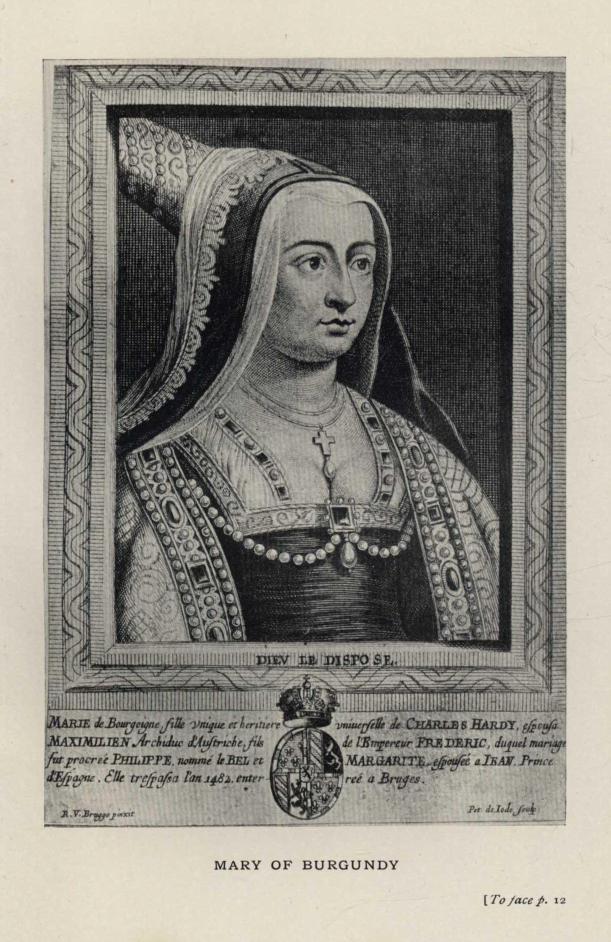
The young Prince seems at first to have carried all before him; and as we read the words of an eye-witness of the proceedings, our charmed fancy pictures for us one of the deathless paladins of Charles the Great. "Mounted on a large chestnut horse, clad in silver armour, his head uncovered, his flowing locks bound with a circlet of pearls and precious stones, Maximilian looks so glorious in his youth, so strong in his manliness, that I know not which to admire most—the beauty of his youth, the bravery of his manhood, or the promise of his future. Man muss ihn gern haben, den glänzenden Mann."[13] From the very first the marriage seems to have been one of great happiness; and the birth of Philip (June 1478) set a crown to their affection. Maximilian himself gives a happy description of his wife in a confidential letter to Sigismund Prüschenk: "I have a lovely good virtuous wife ... She is small of body, much smaller than 'die Rosina,'[14] and snow-white. Brown hair, a small nose, a small head and features, brown and grey eyes mixed, clear and beautiful. Her mouth is somewhat high, but pure and red."[15] Mary was a fine horsewoman, and excelled at most forms of sport; and this formed an additional link between them. "My wife is thoroughly at home with falcons and hounds; she has a greyhound of great pace."[16] In all affairs of Government Mary yielded to her husband, and they remained in complete accord till the day of her death. On Maximilian devolved the task of repelling the French attacks, and we find him complaining of the stress of business which filled every moment of the day.[17] Infusing his own vigour into his new subjects, and substantially aided by the Imperial Diet, he was ere long enabled to take the offensive; and on August 7, 1478, gained a complete victory over the French at Guinegate. The personal prowess which Maximilian displayed, while it helps to explain the estimation in which he was held, inevitably suggests that he was more brilliant as a soldier than as a commander. For so decisive a success, the results were remarkably small. Maximilian's sanguine nature induced him to reject Louis' overtures for peace, and though the tide of invasion had been rolled back, the most favourable time for a satisfactory settlement was allowed to pass. But while Maximilian eagerly awaited the death of the French King,[18] he was himself plunged into mourning and disaster by the sudden death of Mary (March 27, 1482). Filled with the liveliest grief at his unexpected bereavement,[19] he found that at the same time he had lost control of the source of his authority; and though recognized by Brabant and Holland, he met with nothing but opposition from the refractory Flemings. Louis XI. could not repress his delight at the welcome news, and confided to the sagacious Comines his hopes of Maximilian's discomfiture.[20] Nor was he mistaken in his forecast of events. Without even consulting Maximilian, the Flemings ratified the Treaty of Arras with Louis XI. By it the guardianship of Philip was entrusted to the Estates of Flanders; and the infant Margaret was to be educated at the French Court as the bride of the Dauphin Charles. Artois and Franche Comté, over which the Flemings had not the slightest legal control, were calmly ceded as her immediate dowry.[21] To this humiliating treaty Maximilian had perforce to give his assent, and it was not till 1485[22] that the Flemings recognized him as the guardian of his son. Even then his authority was hedged in by various conditions; and the young Duke might not be removed from the country. Maximilian continued to reside in the Netherlands; but the favour which he bestowed on his own countrymen, as well as his influence in Brabant and Holland, soon rekindled the jealousy of the Flemings, who accused him of prolonging the war against France for his own private ends. He could not leave the Low Countries without ruining his position and prospects, and abandoning his children to the mercy of the Ghent citizens; French agents were ready to make the most of even a temporary absence; and he was powerless to assist his father in his unequal struggle with Matthias. But even want of money or resources does not excuse the indifference with which he treated the news of Frederick's misfortunes. The old Emperor was driven from his capital, the whole of Lower Austria fell into the hands of Matthias, and it was only the remonstrances of Venice which assured to Frederick his Adriatic provinces. There was an evident coolness at this period between father and son, and this was not removed by Maximilian's dealings with the Electors, in the hope of securing his election as King of the Romans.
Frederick had been chosen Emperor mainly for his insignificance, but it was felt that he had played the part of a nonentity only too well. There was a growing inclination to turn from Frederick to Maximilian, and to shift the duties of the Empire's struggle with Matthias of Hungary on to the Burgundian possessions of the Hapsburg House. Various causes combined to secure Maximilian's election: but none of the credit can be assigned to Frederick III., who only consented to entertain the idea, when he had become a fugitive from his dominions, and when Maximilian had promised not to make inroads upon his Imperial power. Frederick's manifest dislike of the scheme was a recommendation with most of the Electors. Maximilian was welcomed by Albert Achilles and the old Imperial party, who wished a strong ruler at the head of the Empire; and his favourable attitude towards Reform won favour with the party of Berthold of Henneberg, the great Elector of Mainz. The opposition of France and Hungary was met by the secrecy of the Electors; and their choice was announced almost before the suspicions of Uladislas had been aroused (February 16, 1486). Frederick is said to have wept feebly at the news, but elsewhere the announcement gave rise to the most sanguine anticipations; and the gorgeous ceremonial of his coronation at Aachen made a sensible impression upon the popular mind. The proclamation of a ten years' Landfriede throughout the Empire, which was the new King's first act, was perhaps better calculated to please the Reforming party than the rank of the knights, whose brightest ornament Maximilian was held to be; yet it seemed to augur well for a new era of peace and order.
In 1488[23] a new instrument was devised for the enforcement of the Landfriede. The private feuds, so frequent and so ruinous in mediaeval times, were now falling into disuse, but only because the general unrest took larger forms. Leagues and Unions superseded the looser ties of warlike neighbours, and whole districts became involved in the settlement of some contemptible quarrel. The Swiss Confederacy was in reality a development of this system of Leagues, its primary object being protection against the House of Hapsburg. Every access of strength on the part of the Swiss, and especially the prestige which their triumph over Charles the Bold had won them, tended to weaken the Hapsburg influence in Swabia, the cradle of their race, and their mainstay in the Empire. Thus, when in 1486 the Bavarian Dukes directly infringed the Landfriede by their seizure of Regensburg,[24] the moment seemed favourable for some fresh organization, which should preserve the peace of the Empire and at the same time restore the waning Hapsburg power in Swabia. In July 1487 an invitation was issued in the name of Frederick and Maximilian to all the nobles, knights, prelates and cities of Swabia, to a meeting at Esslingen. This step resulted in the formation of the famous Swabian League. Though really a development of the League of St. George's Shield, whose captain, Count Hugo von Werdenberg, was the chief originator of the scheme, it differed from it by extending its membership from the ranks of the nobles of all orders and classes of the Empire. A confederate Council and Court of Justice were instituted, and expenses were allotted for the raising of an army of 12,000 foot and 1,200 horse. A decisive influence was preserved to the Emperor, and the League was further strengthened by the adhesion of such princes as Sigismund of Tyrol, Eberhard of Würtemberg, and the Electors of Mainz and Trier. The Swabian League remained for many years a leading factor in German affairs. Though it widened the gulf between the Swiss and the members of the Empire (and thus no doubt was partly responsible for the Swiss war of ten years later), it also checked the gradual drifting of single towns from the Imperial to the Swiss system. And still more, it gave the Hapsburgs a strong weapon of defence against the House of Wittelsbach, whose aggressive policy might, without it, have proved entirely successful.
Meanwhile, so far from Maximilian realizing the hopes of the Electors by bringing the forces of the Netherlands to the aid of the Empire, it was not very long ere Imperial troops were needed to rescue him from the hands of his turbulent subjects. He was rapidly becoming unpopular among the Netherlands, whose constitutional traditions were vitally opposed to his dynastic plans; and the French Government, strong in Flemish sympathy, renewed the war with greater vigour and success. Maximilian's first organized body of landsknechts was completely defeated at Bethune, and afterwards roughly handled by their nominal allies. The final outbreak was largely due to a commercial treaty between Maximilian and Henry VII., which closed the Flemish harbours to English products. As a result, a lively commercial intercourse in English cloth sprang up in the coast towns of Brabant, and the economic rivals of Flanders reaped a rich harvest. The French Government fanned the flame of Flemish disaffection. It declared Maximilian to have forfeited the French fief of Flanders, and formally absolved this country from all allegiance to him. His refusal to account for the expenditure of the public money was an additional grievance; and when a rash visit to Bruges, with but a slender escort of troops, placed him in their power, the burghers used their advantage to the full. The morning after his entry a sudden insurrection took place (February 10, 1488). The whole town was soon up in arms, the gates were seized, and the Ducal palace was stormed by an excited mob. Maximilian himself was removed to the Kranenburg, and closely guarded; his councillors were racked in the public square, some of his chief adherents were beheaded, and the citizens of Ghent and Bruges united in depriving him of the Regency, and forming a new government wholly subservient to France. For three months he remained in this perilous condition, in continual fear of death or betrayal to Charles VIII. Kunz von der Rosen, his faithful jester, who shared his captivity, begged Maximilian to exchange clothes with him and thus escape from the city in disguise; but the latter refused to expose him to almost certain death at the hands of the infuriated mob. Maximilian's letter to his father and the Electors shows the imminent danger in which he lay. "They will give me poison to eat, and so kill me ... they are taking all my people from me; this is my last letter for good and all ... I beseech you, in the name of God and Justice, for counsel and aid."[24a] For once Frederick's sluggish nature was fully roused, and, relinquishing all other objects, he moved heaven and earth to obtain his son's release. Over 20,000 men answered to the Imperial summons to Koln, and by the middle of May this army was advancing on Liège. The news of its approach brought the rebels to reason, and led them to hasten on negotiations with Maximilian. Without awaiting the liberating army, he gave his consent to the most humiliating terms, and solemnly pledged himself not to repudiate the agreement. By it he was to win the consent of the Emperor and Electors, and to withdraw all foreign troops from the Netherlands within eight days. He renounced, for Flanders, the guardianship of Philip, and acceded to the formation of a Council of Regency and to a peace with France (May 16). On the strength of these promises he was liberated, and joined his father's army at Liège. Frederick and the Princes refused to recognize any such agreement; it was declared invalid and contrary to his coronation oath, on the ground that the Flemings were subjects of the Empire;[25] and Maximilian, weakly yielding to their pressure, contented himself with returning the 55,000 groschen which had been granted him to lessen the bitterness of the pill. The march was resumed, and Ghent was closely invested. But as usual the old Emperor effected little or nothing, the town made a vigorous defence, and Maximilian was glad to avail himself of events in Germany, which claimed his attention. It is useless to attempt to justify his repudiation of his oath, for he had carefully precluded himself from all lawful methods of evasion. It leaves a deep stain upon his honour, and the most that can be said for him is that it is the one indefensible action of his life.
After an absence of twelve years[26] Maximilian returned to the Empire in December 1488, leaving Duke Albert of Saxony as his representative in the Netherlands. The latter showed his zeal by his promise "so to serve his master that men should write of it for 1,000 years," and displayed great ability both as a commander and an organizer. The cause of peace was furthered by the Treaty of Frankfort (July 7, 1489), in accordance with which Charles VIII. was to use his influence with the Flemings, and an interview was to be arranged between him and Maximilian for the settlement of the Burgundian question. As a result of this treaty, Flanders again recognized Maximilian as lawful Regent and guardian of his son, and granted him the sum of 300,000 gold thalers in token of their submission.
The readiness with which Charles VIII. concluded peace was due to the recent turn of affairs in Brittany, to which country his rivalry with Maximilian was now transferred. During the aggressive war waged by France in the Netherlands the King of the Romans had found a natural ally in the Duke of Brittany, who dreaded the expansive policy of the French King. The death of Francis II. (September, 1488) left the Breton throne to his young daughter Anne; and Ferdinand V. and Henry VII. united to protect her against her dangerous neighbour. But this protection was on the whole rather sympathetic than practical; and the insecurity of her position led the young Duchess to search the political horizon for some efficient defender. She turned to Maximilian as the sovereign most interested in resistance to France and most likely to afford her practical aid. It seemed as though the romantic episode of his first marriage was to be re-enacted in a new quarter. On March 20, 1490, Anne and Maximilian were betrothed, and towards the end of the year the marriage was formally celebrated by proxy.[27] Anne openly assumed the title of Queen of the Romans, and Maximilian's diplomacy was for the time triumphant. But the acquisition of Brittany was a matter of supreme importance to the French Crown; and Charles VIII. strained every nerve to secure the discomfiture of his rival. Brittany was overrun by French troops, Nantes surrendered after a feeble resistance, and Anne found herself closely besieged in Rennes, with little prospect of timely relief, and with a strong French faction within the walls. Maximilian's hands were tied down by the necessities of the Hungarian war, and, confident in the validity of his union with Anne, and relying on the promised aid of Henry VII., he stirred not a muscle in her defence. At last Anne found herself forced to come to terms. Brittany was to remain in the hands of the French, and free passage was granted to her through French territory, on her way to join Maximilian. But her feeling as a Princess overcame her feeling as a woman. She was naturally reluctant to leave her ancestral dominions in hostile hands for the sake of a man whom she had never seen and who was her senior by seventeen years; and her offended pride at Maximilian's inexcusable absence at her time of need led her footsteps to Chateau Langeais rather than to the German frontier. The cunning Charles had all prepared, and was able to produce the double dispensation of Innocent VIII.[28] On December 6, 1491, the marriage of Charles VIII. and Anne of Brittany was duly solemnized at Langeais, and Brittany was finally incorporated with France.
ANNE OF BRITTANY
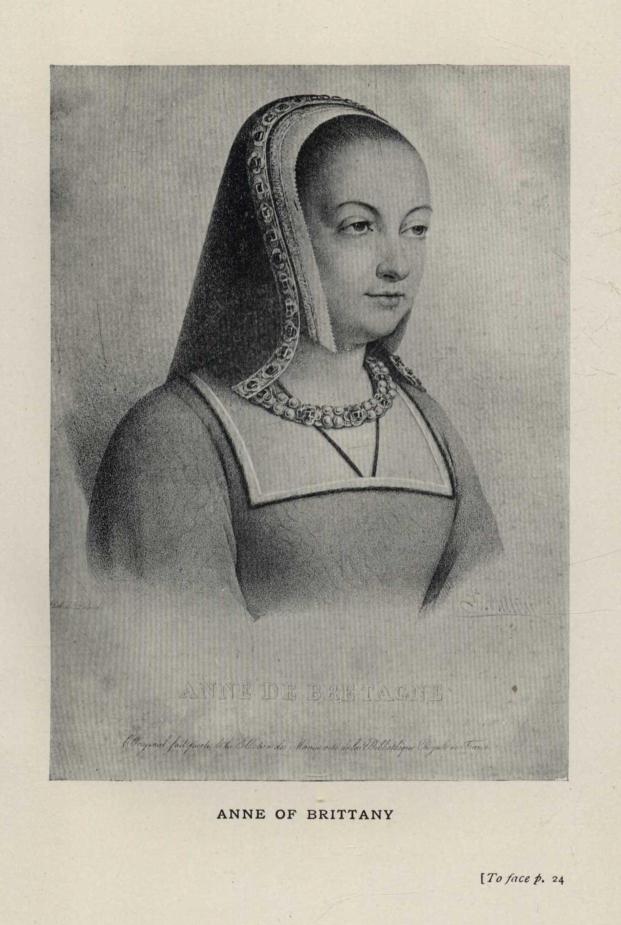
Maximilian, mainly owing to his dilatory conduct, thus found himself exposed to the most unpardonable of insults at the hands of a mere stripling. Not merely had Charles VIII. deprived him of his lawful wife and her inheritance, but in so doing he repudiated Maximilian's daughter Margaret, who, since 1482, had been educated at the Court of Charles as the future Queen of France. To aggravate matters, Charles showed no inclination to restore Margaret's magnificent dowry, which consisted of Artois, Picardy and Franche Comté. Nothing could exceed Maximilian's indignation, and, full of threats of vengeance, he entered into an offensive alliance against France with the Kings of England and Spain.
But the acquisition of Brittany had set a seal to the internal consolidation of France, and Charles, having deprived his enemies of an excellent base for hostile operations, was now free to indulge in his golden dreams of foreign conquest. No concession was thought too great to secure the neutrality of his neighbours. Henry VII. was bought off by hard cash and by the promise of a yearly pension; Ferdinand was appeased by the cession of the coveted provinces of Roussillon and Cerdagne. Maximilian, whose troops were meeting with some success in Franche Comté,[29] saw himself deserted by his allies, and consented to pocket his outraged dignity in return for the substantial concessions of the Peace of Senlis (May 23, 1493). His daughter Margaret was restored, and the French evacuated Franche Comté, Artois and Nevers, in favour of the young Archduke Philip.
III
Das liebe heil'ge Röm'sche Reich, Wie hält's nur noch zusammen?—Faust.
With the Breton incident we reach the close of Maximilian's Western career, and are free to examine the events which engaged his attention while Charles VIII. was robbing him of his bride. The exigencies of Hapsburg policy and of his imperial office now draw him into all the various currents of European diplomacy, and it is hardly to be wondered at, if his personality is sometimes lost sight of in an attempt to connect the intricate threads of contemporary politics. Maximilian the man and the chevalier must be our subject, rather than Maximilian the politician. The kaleidoscope of political combinations must be left to a Sismondi or a Creighton. For it is from the description of his earlier years and of his later relations to Humanism and Art that we gain the truest insight into the charm and fascination of his character—the romantic incidents which made the nation mourn him as the Last of the Knights, and the versatility which dazzled the eyes of so many brilliant contemporaries.
On his return to the Empire, Maximilian found that his presence was urgently needed in Tyrol, where Duke Sigismund, after a long reign of folly and mismanagement, could hardly restrain the general discontent in his dominions from open expression. The incapable old Duke had in later life fallen completely under the power of his mistresses, who played upon his superstitions by incantations and witch-processes, and who squandered the revenues on their own worthless ends.[30] His life-long hatred of Frederick III., which even the cession of Vorder-Austria (1463) could not remove, filled him with the idea that his cousins wished to deprive him during his lifetime, and inclined him towards the Bavarian Court, which eagerly furthered the misunderstanding. The sale of Burgau (1486) to Duke George the Rich called attention to the possibility of Sigismund leaving his possessions outside the Hapsburg family. Bavaria was again responsible for Sigismund's war with Venice; and when defeat came and money failed, the Duke was obliged to sell all the Vorder-Austria lands to Dukes Albert and George on terms which made recovery doubtful. The Austrian party in Tyrol now insisted upon the summons of a Diet, and the Estates subjected Sigismund to an "Ordnung," by which, in return for the payment of his debts, he was restricted to a limited expenditure every year. In the event of his violation of this Ordnung, the Estates were at liberty to choose another Prince from the House of Austria. The Dukes of Bavaria had been brought to reason by the formation of the Swabian League, and raised no serious opposition to this blighting of their hopes. As was to be expected, six months had not elapsed ere Sigismund had broken through the Ordnung; while Albert of Bavaria put in a demand for 100,000 florins, in recompense for the sinking of his claims. This development brought the old Emperor to Innsbruck, whither he was followed in April 1489 by Maximilian. The latter, who entertained more friendly feelings than his father towards Bavaria, maintained a mediatory position. At last, on March 16, 1490, the long-desired step was taken. Sigismund made a formal renunciation of Tyrol, and all his other dominions in favour of Maximilian, contenting himself with a fixed income and free rights of hunting and fishing. Almost at the same time Maximilian was recognized heir by Count Bernard of Görz.
But by that irony of fate which pursued him throughout life, Maximilian was never permitted to finish any one thing thoroughly. Time and again we see him ruined by an excess of alternatives, and by his inability to devote himself exclusively to one out of many objects.
Less than a month after Sigismund's abdication, the death of Matthias Corvinus diverted Maximilian's attention to those ancestral dominions from which his father had been so ignominiously expelled, and justified him in the hope of restoring the old Hapsburg influence over Hungary. Frederick's claim to the latter kingdom was based on the agreement of 1463, ratified by Matthias and the leading Magyar nobles, by which Frederick or his son was to succeed, if Matthias should die childless. Though this condition was now fulfilled, the Hungarians were by no means disposed to act upon it; and Uladislas, King of Bohemia, was a dangerous rival to the Hapsburgs, both by reason of the nearness of his dominions and the strength of his hereditary claims.[31] Several causes combined to handicap Maximilian. His father, with his usual jealousy, refused to waive his rights in favour of Maximilian, who alone was capable of carrying the enterprise to a successful issue. Want of money, his curse throughout life, told heavily against him; nor was any assistance to be obtained from the German Princes without concessions on the Emperor's part, and these Frederick stubbornly declined to make. Finally, Austria claimed first attention, and till it had been recovered, Uladislas was left unassailed in Hungary.
Whatever might be the feeling in the latter country, there was no doubt as to the popularity of Maximilian's cause in Austria. Great enthusiasm prevailed, and his advance was as rapid and bloodless as it was triumphant. Vienna University declared unanimously in his favour, and, by the end of June, 12,000 men had enlisted in his service. In July Maximilian entered Graz, and on August 19, made his triumphal entry into Vienna, which had been hastily abandoned by the Hungarian forces.[32] The oath of allegiance was taken to Maximilian only: the citizens remembered Frederick too well to entrust themselves a second time to his mismanagement. Meanwhile Uladislas had been proclaimed King of Hungary on July 15, 1490,[33] and in September was crowned at Stuhlweissenburg. Maximilian on this occasion displayed great activity, and, aided by a liberal grant of money from the Tyrolese Estates, invaded Hungary at the head of an army of about 17,000 men. Crossing the Raab late in October, he met with but slight opposition; Uladislas was unprepared, and by nature averse to energetic measures; and the invader was joined by a number of Hungarian magnates. But this phenomenal success was fatal to the invaders; and by the time that it reached Stuhlweissenburg, the army was virtually out of hand. In spite of a firm resistance, the city was cannonaded (Maximilian personally directing the artillery) and taken by storm; but a disgraceful scene of plunder and slaughter ensued. Maximilian and his captains were quite unable to restrain the soldiers, and on the next day an open mutiny broke out. Their refusal to advance upon Buda, and the consequent delay, proved fatal to the whole enterprise. When summoned to surrender, the capital indignantly declined, and Uladislas found time to bring up his Bohemians and to threaten Vienna. Frederick III., true to his ultra-Fabian motto—"Mit der Zeit lohnt oder rächt sich alles"[34]—sent no assistance, and Maximilian, seeing his base endangered, and hampered by want of money and discipline, found it necessary to withdraw westwards. His overtures to Poland met with no response, and he was quite unable to continue the struggle alone. By July 1491 Stuhlweissenburg fell into the hands of Uladislas, and all Maximilian's recent conquests were lost. The urgent appeals of Reichenburg to Maximilian for reinforcements and of Maximilian to his father for money were all in vain. His position was absolutely desperate from sheer want of funds,[35] while the turn which Breton affairs were taking seemed to render peace necessary, at whatever price. Frederick, who throughout the war had thwarted his aims and damped his ardour,[36] now offered his mediation, and negotiations were opened in August. By the Treaty of Pressburg (November 7, 1491), Uladislas was formally recognized as King of Hungary, but, failing his lawful issue, the crown was to fall to Maximilian or his son. This promise was to be solemnly ratified by the Hungarian Estates in presence of the Imperial envoys. Moreover, Uladislas renounced all claims upon Austria, and undertook to refund Maximilian for the expenses of the war.[37]
The old Emperor's attitude during the late war had not improved his relations with Maximilian; and the friction was rendered the more acute, when Frederick refused to see his son, and shut off various sources of income from him, thus seriously injuring his chances of success against France. Moreover, Frederick's hostility to the Bavarian Dukes formed a marked contrast to Maximilian's conciliatory position, which was mainly due to the influence of his sister Cunigunda, wife of Albert IV.[38] Duke Albert's high-handed conduct in imposing a general tax on his subjects, in spite of the refusal of the Estates, had led to the formation of a League of discontented nobles, known as the Löwlerbund, which united with the Swabian League and was openly encouraged by the Emperor. By the end of 1491 the movement had ended in hostilities, and on January 23, 1492, Frederick III. published the ban of the Empire against Duke Albert of Bavaria. The Swabian League began to arm. The French were ready to invade the Empire, if the League should attack Bavaria. An outbreak which would involve the whole of South-West Germany seemed wellnigh inevitable, and the entire credit of the preservation of peace, must rest with Maximilian. At the last moment, when the armies were actually encamped and facing each other in the field, his influence secured an adjustment of the quarrel. He had appeased his father's anger by freeing the Austrian dominions from the oath which they had taken to himself, and by referring them to the Emperor as their ruler. Frederick was now satisfied with the restoration of Regensburg to the Empire[39] and the cancelling of Bavarian claims on Tyrol; while a full pardon was granted by Albert to all members of the Löwlerbund. (May 1492.)
Maximilian, notwithstanding this triumph of his diplomacy, met with the utmost difficulty in raising money for his operations against the French; while a new enemy had arisen in the young Charles of Egmont, who had recently recovered the Duchy of Gueldres, and who was destined to be a thorn in Maximilian's side for the rest of the reign. Though his position in West Germany was strengthened by a League with the "Lower Union,"[40] the sole result of his efforts at the Diet of Coblenz was a prospective grant of 94,000 gulden, of which only 16,000 actually came in. His campaign against the French has already been sketched (p. 25). Scarcely were his hands freed by the Peace of Senlis, when an incursion of the Turks into Styria (August 1493) made a fresh demand upon his attention. Then, as usual, the necessary aid arrived too late, and the marauders returned home almost unchallenged. In the midst of this danger Frederick III., whose health had been failing for some time, and whose foot it had been found necessary to amputate,[41] died at Linz, in the seventy-eighth year of his age (August 19, 1493).
The old Emperor had lived to see his dreams of Hapsburg revival and consolidation to a great extent realized; but his irritable nature had led him to thwart the family aspirations on Hungary. In his dread lest the acquisition of a throne should make his son more powerful than himself, he afforded him no assistance, nay rather, threw every hindrance in his way. Frederick's death was an undoubted gain to Maximilian, for it left him Emperor elect and unquestioned ruler of the Hapsburg dominions. Family divisions were no longer possible, since no relative capable of resistance survived.[42]
But while his position was rendered more definite and imposing, there seems to have been at this period a general cooling of Maximilian's popularity, at least among the ruling classes. A powerful party in the Empire, led by Berthold of Mainz, now claimed the fulfilment of those promises of reform which he had made at the Diet of 1489,[43] and his reluctance to devote his time to its discussion produced a distinctly bad impression among the Princes. Moreover, the part which he now began to play in Italian politics, exposing, as it did, the Imperial person to indignity and failure, roused all the old prejudices of the caste of nobles, and acted as a damper to their enthusiasm. Gladly as we should avoid threading the intricate maze of Italian politics—a task which is after all more apposite to a general history—some treatment of Maximilian's attitude during these momentous years is inevitable, even in so slight a sketch as the present. A general idea of Maximilian's ambitions in Italy will best be conveyed by his own words. "Italy has for centuries experienced what it means for the people, if no Emperor is there to restrain unruly passions, and hence the friends of the people have ever looked with favour on the Imperial power, and longed for the return of the Emperor."[44]
BIANCA MARIA SFORZA Painting by A. de Predis
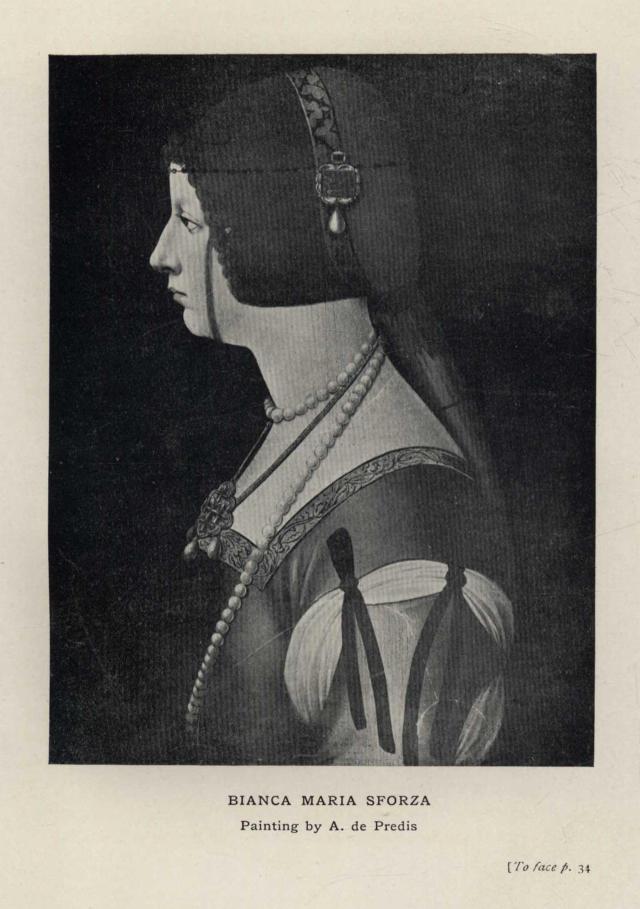
The fortunes of Milan were at this moment in the hands of Ludovico il Moro, who, at first merely Regent for Gian Galeazzo, had retained the whole powers of government in his own hands, even after his nephew had come of age. The young Duke's wife, Isabella of Naples, deeply resented her husband's sudordinate position, and Ludovico lived in terror of intervention on the part of Ferrante and his Florentine allies. Hoping to veil the injustice of his cause under Imperial recognition, he turned to Maximilian, and offered, in return for his own investiture as Duke of Milan, the hand of his niece, Bianca Maria Sforza, and a substantial dowry of 300,000 ducats.[45] So much hard cash seemed to promise to the needy Maximilian the fulfilment of many a golden dream; and the bride's want of pedigree was atoned for by the practical possession of her uncle's money bags. The marriage was duly celebrated on March 9, 1494, at Halle in Tyrol, when the heir of all the Caesars linked himself with the granddaughter of a Romagnol peasant.[46] Thus his first entry into Italian politics rightly exposed him with justice to the nickname afterwards bestowed upon him—Massimiliano Pochi Danari. "On the altar of politics the heart is often the lamb of sacrifice." Maximilian's second marriage is not the most creditable episode in his life. The luckless Bianca Maria never filled the place of Mary in her husband's affections, and remained till her death[47] a mere cipher, with next to no influence over him, and, though never ill-treated, entirely neglected and overlooked. The unpopularity of his marriage in Germany induced Maximilian to postpone the investiture of Ludovico with the Milanese, and Gian Galeazzo dying in the interval, the Emperor was able, with less offence to his conscience, to fulfil his promise in May 1495.[48]
Maximilian's first intention was to employ his wife's dowry in a Crusade against the Turks; and he plunged eagerly into projects of forming active alliances abroad and of raising permanent forces at home to stem the tide of infidel invasion.[49] But disturbing rumours of the doings of Charles VIII. diverted his attention to the Italian Peninsula.
By the death of Lorenzo de' Medici in 1492, the balance of power, which his skill had so long preserved in Italy, was seriously endangered. The incapable Piero inclined towards Naples, whose attitude was now little short of openly hostile to the Milanese usurper. Ludovico, in dire need of some influential ally, made advances to the new Pope and to Venice. But his alliance with these powers was shortlived: Spanish diplomacy effected a reconciliation between Naples and Alexander VI., and Ludovico found himself more isolated than ever. The death of the old King of Naples, in January 1494, hastened events. The universal hatred with which his successor, Alfonso II., was regarded, while it drove the exiled Barons to extreme measures, was favourable to the cause of Ludovico. He turned naturally to Charles VIII., who had recently acquired the Angevin claims to the throne of Naples, and whose feeble mind was filled with all the clap-trap of mediaeval chivalry. The appeal met with an enthusiastic response: every other trend of policy was sacrificed that this might succeed. By the end of August 1494, all was prepared for the invasion of Italy, and, with a magnificently appointed army of 60,000 men, Charles crossed the Alps and was welcomed by the traitor Ludovico. Florence opened her gates to the deliverer: the Pope abandoned Rome at his approach, and looked on in sullen anxiety from Sant' Angelo; and Naples itself was occupied amid general rejoicings, almost before a single blow had been struck.
Dazzled by such unprecedented success, Charles VIII. lost all restraint and began to indulge in the wildest dreams. He was to recover Jerusalem, to eject the infidel from Europe, and to restore in his own person the fallen Empire of Constantinople. Rightly or wrongly, he was credited with the intention of forcing the Pope to crown him Emperor of the West, or of driving him from the Papal throne and instituting a thorough reform of the Church. Such rumours could not but fill Maximilian with an uneasiness which Borgia's letters did not fail to augment.[50] It was only owing to the skilful diplomacy of Charles' envoys and his own strained relations with Venice, that he preserved neutrality for so long as he did.[51] Had not others taken alarm at the turn of affairs, he might have prevaricated till the time for action had passed. Ludovico, who was before all others responsible for the French expedition, was the first to be disillusioned. Alarmed at the open designs of the Duke of Orleans on Milan, he soon became as anxious for Charles' ruin as he had been eager for his success, and looked for assistance to his more powerful neighbours. But it was Ferdinand of Spain who really brought about Maximilian's change of policy, by holding out the tempting bait of a double marriage alliance with his House. The Emperor's[52] suspicions of Venice were overcome, and the Signoria became the centre of opposition to France. The various intrigues were conducted with such skill and secrecy, that even Comines, who then held the post of French Ambassador in Venice, was completely outwitted. But their details do not leave us with a favourable impression of the confederates' straightforwardness. The itch of the Republic's patriotic palm was allayed by a promise of the Apulian ports; while the Pope displayed to the full his talent for shifty intrigue and prevarication, and Maximilian kept up a stream of friendly assurances which effectively duped his young and incapable rival.
Thus the proclamation of the Holy League, between the Pope, Maximilian, Ferdinand, Ludovico and the Venetians, (March 31, 1495) came upon the French as a bolt from the blue. Its ostensible objects were to defend the Papacy, and to secure peace in Italy and mutual protection against the attacks of other Princes. But from the very first its members made little attempt to conceal their genuine aim—the expulsion of the French from the Peninsula. The massing of troops by each of the allies removed all doubts upon the subject; and Charles VIII. saw himself compelled to abandon Naples. On July 6, 1495, ne encountered the forces of the League at the battle of Fornovo, and after a running engagement made good his retreat westwards. Even then the German and Venetian troops might have inflicted serious losses on his armies ere they recrossed the Alps; but the treachery of Ludovico, who concluded a treaty with Charles without consulting any of his allies, forced them to retire and leave the French unmolested.
Meanwhile Maximilian was engaged at the famous Diet of Worms (26 March-August, 1495). Burning to strike a blow which might tend to the humiliation of his rival, he found himself once more, so to speak, the prisoner of his pocket. The Electors and the other Estates were determined that redress should precede supply, and stubbornly refused to grant a single florin, until the question of reform had been placed on a satisfactory basis. Nor can they be accused of any want of patriotism; for the interests of the Empire were by no means coincident with those of Austria. Indeed, had not Maximilian's territorial instincts triumphed so completely over his feelings as Emperor, he might have been the first to recognize the deep and sterling patriotism which inspired the Elector Berthold. As it was, his first intention had been to remain fourteen days at Worms, and, after obtaining the Diet's sanction for the Imperial levies, to conduct a vigorous campaign against the French. But here he was met by the practical impossibility of inducing a body mainly constituted for peace, to undertake a long and tedious war at a distance. The feudal system had fallen into decay, and the old military power of the Empire was no more. New circumstances demanded new measures; and the triumph achieved by a standing army in France pointed the direction which military reform should take. The proposal, then, which Maximilian laid before the Diet, was for a continuous money aid for ten or twelve years; with this he might form an army of landsknechts. But the Diet was wholly unsympathetic, and rigidly confined itself to schemes of reform. Meetings were sometimes held without any reference to the Emperor, and, as he indignantly exclaimed, he found himself treated with less consideration than some petty burgomaster. The struggle of parties lasted throughout the summer, Maximilian adopting a highly undignified attitude of sulking. On three occasions he was particularly pressing, especially in August, when Novara was threatened by the Swiss, and a mutiny of the lands-knechts might be expected, if their pay was not forthcoming. At last nothing was left for Maximilian but submission, and he accepted the Elector Berthold's proposals for reform. But Charles VIII. had already recrossed the Alps, and the time for action was past.
Yet, notwithstanding his enforced inactivity, Maximilian's presence at Worms had not been in vain. The brilliancy of the Court and the gallant ceremonies of the lists hid from the casual observer the true meaning of this great assembly of princes and nobles. Yet the two important results of Maximilian's policy form a striking contrast to his humiliation at the hands of the Electors. In return for the services of Count Eberhard, he erected Würtemberg into a Duchy, at the same time limiting the succession to heirs-male. Since the hopes of the new ducal family rested upon one delicate youth,[53] this arrangement held out to Maximilian or his successors the prospect of acquiring the fair valley of the upper Neckar. But the other achievement of his policy was destined to have far more momentous consequences. This was the fulfilment of his agreement with Ferdinand the Catholic, in accordance with which the Prince of Asturias was betrothed to Margaret of Austria, and the Archduke Philip to Joanna of Spain. By an extraordinary fatality, the latter marriage, which at the time had seemed the less important of the two, came to exercise a vast influence on the history of Europe. The Spanish heir died within a year of his marriage (1497), and Margaret's child lived but a few days. Isabella Queen of Portugal was now heiress of Castile and Arragon; but the fates fought against the unity of the Peninsula. In 1498 Isabella died, and in 1500 her only child, Prince Miguel, followed her to the grave. Philip's wife, Joanna, became heiress of Spain and all its splendid dependencies in the New World.
Though Maximilian had been thwarted in the hope of meeting his rival on the open field, the next year brought a prospect of intervention in Italian affairs. Charles VIII., on his return to France, had set on foot preparations for a fresh invasion. The success of his overtures to the Swiss Cantons, and the servile attitude of Florence, filled the Venetians and Ludovico with alarm; and the two powers invited Maximilian to make an expedition to Italy in person. His eagerness to restore Imperial influence in that country, coupled with his knightly thirst for renown, led him, with curious inconsistency, to submit to the indignity of becoming the pensioner of States whose feudal superior he claimed to be. Each promised 30,000 ducats for three months towards the payment of his troops and engaged a number of Swiss mercenaries in addition. The Emperor's sanguine nature already saw the French party in Italy crushed, and frontier provinces wrested from the grasp of Charles. But the Estates of the Empire, which had been summoned to meet at Lindau, proved more unmanageable than ever. Even had his condottiere-contract not filled them with disgust, they were wholly disinclined to repay his grudging and half-cancelled concessions by grants of money for an object which the Empire viewed with indifference. His penury may be judged by a letter which he received from his councillors at Worms, containing an urgent request for more money, as the maintenance of the courtiers has been stopped, and the Queen and her ladies will be provided for "only three or four days more; and if within that time no money comes, even their food-supplies will come to an end."[54]
LUDOVICO SFORZA (Duke of Milan)
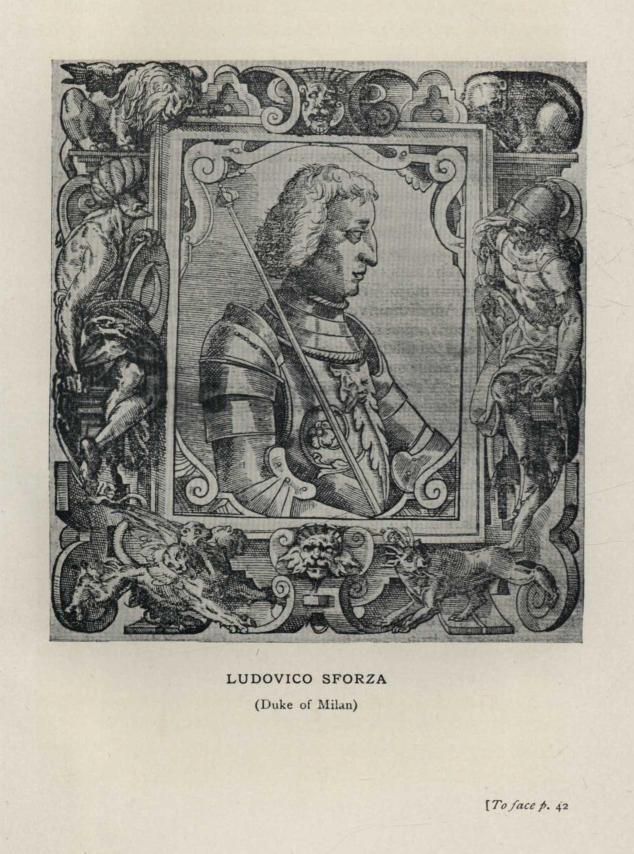
Charles VIII.'s financial straits soon compelled him to abandon his schemes of active interference in Italy; and the Signoria, no longer needing Maximilian's presence, now came to regard him as a positive hindrance to their aggrandizing policy. But nothing could divert him from his project. When the Venetians boggled over their promised subsidy, he secured the necessary sum by loans from the Fuggers. The remonstrances of his advisers were of none avail. At Augsburg and Linz he divided his time between wild dreams of conquest with the Archduke Philip, and the festive entertainments of the citizens. On St. John's Eve he led the fairest maiden of the town to the dance, and gallantly assisted her to kindle the bonfire, to the sound of drums and cornets and the merry music of the dance.[55] In July he had an interview with Ludovico at Munster,[56] receiving him in hunting dress, surrounded by his companions of the chase; and in the last days of August entered Italy by the Valtelline. Even then his compact was not strictly fulfilled. Instead of the stipulated 7,000 men, his army never amounted to more than 4,000. His first scheme, of driving the French from Asti and forcing Savoy to join the League, was sacrificed to the jealousy of Venice, which opposed any increase of the power of Milan. Nor were his own relations with Ludovico distinguished by their cordiality. The latter declined to subsidize him unless the Pope and Venice granted equal amounts, and sought to employ him in garrisoning the Milanese against French attacks.[57] Finally, Maximilian decided upon an attack on Florence, and as a preliminary laid siege to Livorno, curtly informing Ludovico that if he would not provide money for his troops he had better dismiss them to their homes.[58] But the numbers of the besiegers were insufficient for the task, the Venetians held aloof, and the French garrison never lost entire command of the sea. The arrival of a fleet from Marseilles removed Maximilian's last hopes of reducing the city; his resources were by now exhausted, and, declaring that "against the will of God and men he would not wage this war," he hurriedly retired northwards. He turned a deaf ear to the entreaties of the Papal Legate,[59] and before Christmas was again in Tyrol. According to the Italian wits, not even hunting invitations could detain the disappointed monarch. In short his conduct presents a favourable opportunity for introducing the cricitisms of Quirini, one of the first of that line of brilliant ambassadors, whose diplomacy prolonged the existence of Venice till modern times. "He is of excellent parts, and more fertile in expedients than any of his advisers, yet he does not know how to avail himself of any single remedy at the right moment; while he is as full of ideas and plans as he is powerless to execute them. And though two or three methods lie open to his intellect, and though he chooses one of them as the best, yet he does not pursue this, because before its fulfilment another design which he considers better has suddenly presented itself. And thus he flits from better to better, till both time and opportunity for execution are past"![60] Yet with all his indecision and want of perseverance, he was resigned and cheerful in adversity, and it was perhaps at this period that he consoled himself with the assurance "Gott sorgt schon: es könnte noch schlimmer gehen."[61]
Maximilian's failure left the French influence all-powerful in Italy; but Charles VIII. made no further movement, and his premature death in April 1498 materially changed the situation. The first act of Louis XII.—his infamous divorce from Jeanne of France, followed by his marriage to Anne of Brittany—can hardly have been gratifying news to Maximilian. Still, the latter hoped to obtain the restoration of Burgundy from the new King, in return for acquiescence in the French policy in Italy. But when his representations met with no response, he sought aid from the Diet for a war against France. In spite of its refusal, and though he might have seen that the League had no intention of pulling his chestnuts out of the fire, he threw an army into Burgundy. But the Swiss mercenaries, who formed its strength, either were bribed by Louis or mutinied for want of pay; while Philip concluded a separate peace with France (July 2, 1499), actually renouncing the claims which his father brought forward in his name, and receiving from Louis XII. the investiture of Artois and Flanders. The French King was led to conclude this treaty by his designs upon the Duchy of Milan, which he claimed as the lawful heir of the Visconti dynasty. His wise policy of treating the various members of the League as though it were non-existent was crowned with success. Ere long all were pacified but Maximilian, and he was rendered harmless by systematic intriguing with the Swiss Confederates—a policy which had a perceptible influence in producing the memorable Swiss war of 1499. The immediate causes of the outbreak were incidents of petty friction on the Tyrolese border; but the real question at issue was the relation of the Confederates to the Empire.
No sooner had the Swiss in earlier days attained their object of holding directly from the Emperor, than they made it sufficiently obvious that this dependence was for the future to be mainly nominal. During the long reign of Frederick III. they had enjoyed just such a state of internal peace and order as the perpetual Landfriede and the Kammergericht aimed at securing for the rest of the Empire; and now, when Maximilian demanded their submission to the decrees of the Diet of Worms, by contributing men and money for his schemes of foreign policy, war was practically inevitable. Their close relations with successive Kings of France had long shown the slight regard in which they held their nominal ruler. Their connexion with the Empire brought them no advantage, submission to the Common Penny (das Gemeine Pfennig) naturally appeared a hardship to them, and the decisions of the Kammergericht they regarded as assaults upon their treasured freedom. Their refusal of Maximilian's demands was coupled with general steps for union with the sister Leagues of the Graubünden and the Valais. The war began with marauding and skirmishing, growing fiercer and assuming larger proportions when the Swabian League armed itself at the Imperial summons. But the Swiss everywhere held their own: their superiority was admitted even by the Count of Fürstenberg, general of the League, who branded his own troops as "ein flüchtig, schnöd und ehrlos Volk." Maximilian himself had been engaged in unprofitable operations against the Duke of Gueldres, and only arrived upon the scene in July, to find matters going against him. Even his presence did not turn the balance, and at Schwaderloch the Swiss, though somewhat outnumbered, more than held their own. Only four days later (July 24), the army of Henry of Fürstenberg, 15,000 to 16,000 strong, suffered a severe defeat at Dornach at the hands of 6,000 Confederates. The Austrian leader, with many distinguished nobles and about 4,000 men, perished on the field. This disaster dealt the final blow to Maximilian's hopes. At first he shut himself up in the Castle of Lindau, and refused to see any of his nobles.[62] But he soon reconciled himself to the necessity of coming to terms. The Treaty of Basel (September 22, 1499), though less remarkable for its provisions than for its omissions, is one of the landmarks of Swiss history. By it mutual conquests were restored, and Maximilian recovered the Prättigau, while various small disputes were referred to arbitration. But, while Swiss independence was not formally recognized by the Empire till a century and a half later, it was tacitly secured by this treaty; and henceforward the Confederates enjoyed entire immunity from Imperial jurisdiction and from Imperial taxation. Nor was this the only result of the struggle. The Swiss had won for themselves a position which inspired their neighbours with a genuine admiration and a very wholesome fear. Respected and courted by the outer world, they strengthened their position internally by a close union of the Confederates and the Graubünden. The Empire was deprived for ever of a number of its most valuable subjects,[63] and the House of Hapsburg was finally excluded from the cradle of its greatness.
No one reaped fuller advantage from the Swiss war than Louis XII. While all the energies of Maximilian were devoted to coping with the Confederates, he found himself free to carry into execution his projected invasion of the Milanese. Had the Emperor proved successful, Ludovico might perhaps have saved himself (or at least prolonged the struggle) by entering the Swabian League; but with the defeat of Dornach the usurper's fate was sealed. Louis XII., who had already allied himself with the Pope and Venice, winning the support of the latter by the promise of Cremona, crossed the Alps at the end of July with an army of 22,000 men, and entered Milan almost unopposed. Ludovico, deserted and betrayed by his people, sought refuge in Tyrol, and was among the first to bring the tidings of his own misfortunes to his Imperial nephew. But though received with the utmost sympathy and respect by Maximilian, he soon perceived that the latter was as usual at the end of his resources, and that no assistance need be looked for from him. He purchased the services of 8,000 Swiss mercenaries and of the celebrated Burgundian guard, and with their aid recovered his capital and most of its territory. But the army which Louis XII. despatched to the assistance of Bayard consisted largely of Swiss troops; and Ludovico's mercenaries, refusing to fight against their countrymen in the French service, renounced his cause and betrayed him to the enemy. (April 10, 1500). In this undignified way one of the chief disturbers of the peace of Italy bids a last farewell to the field of politics; he remained in the most rigorous confinement at Loches for the next five years, after which the earnest intercession of Maximilian secured some relaxation in his treatment. He was allowed a space of several leagues around his prison for hunting and other amusements, and died in captivity in 1510.
On the very day when Ludovico fell into the hands of the French, Maximilian opened the Imperial Diet at Augsburg. His main object was to obtain aid against France; but the complete failure of his recent military enterprises—alike in Burgundy, Gueldres, Switzerland and Milan—compelled him to acquiesce in the formation of a Council of Regency, (Reichsregiment), which was to discuss all military and financial affairs, and even questions of foreign policy, which at that period were considered the special department of the Monarch. This Council consisted of twenty-one members, of whom sixteen were appointed by the Electors and Princes, two by the Imperial towns; while Maximilian nominated two for Austria and Burgundy, and only one, the President, in his capacity of Emperor. The promoters of the scheme aimed at little short of his abdication; while he, on his part, cheerfully assumed that they would defer to his wishes on matters of foreign politics. The bait held out to him by Berthold was a permanent war administration, possessing power both to levy troops and to impose taxes; from this he promised himself an army of 30,000 men, and money to maintain it. But the project remained upon paper, and Maximilian's disgust was turned to fury when the first step of the new Council was to conclude a truce with France, and virtually to commit him to investing Louis XII. with Milan. Finding himself helpless in view of the Diet's opposition, and determined not to submit to the ruling of the Council, he began to make separate overtures to the French King. In this he was readily encouraged by the Archduke Philip and by Ferdinand, who was already hatching his iniquitous plot for the partition of Naples, and who found Maximilian's hostile attitude to France a drag upon Louis' action. In October 1501 the visit of Cardinal d'Amboise, the trusted adviser of Louis XII., to the Court of Innsbruck, brought matters to a final issue. A treaty, whose friendliness was only rivalled by its hypocrisy, was concluded between the two Monarchs. The infant Archduke Charles was betrothed to Louis' daughter Claude; Louis himself was to receive the investiture of Milan, in return for the sum of 80,000 crowns, and promised to assist the Emperor in his journey to Rome and in his projects against the Turks. But the actual terms of the agreement were of little importance, as they were obviously intended only for momentary ends. The conquest of Naples, which was effected in the years 1501-1505, soon led to quarrels between the two conquerors. Louis XII.'s continual intrigues with the German Princes induced Maximilian to support the Spanish cause by the despatch of 2,500 landsknechts; and by the end of 1504 the brilliant tactics of the great Captain resulted in the final expulsion of the French from the kingdom of Naples. At the same time the Emperor found means to check Louis' intrigues, which the outbreak of the Bavarian war had rendered dangerous. By the Treaty of Blois (September 22), Milan was ensured to Louis XII., and, failing heirs-male, to Claude and her youthful bridegroom Charles.[64] But this agreement, like its predecessor, was not made to be observed. No sooner had d'Amboise obtained Louis' formal investiture from the Emperor (April 1505), than the betrothal of Claude to the Archduke was secretly annulled, and Francis of Angoulême took his place as her prospective husband. The death of Isabella the Catholic, and the struggle of Ferdinand and Philip for the Castilian Regency, removed all danger of any united effort between Spain and the Hapsburgs against France; and early in 1506 Louis' breach of faith was formally proclaimed and ratified by the States-General of Tours.[65]
Notwithstanding this rebuff, Maximilian had gained a very distinct advantage from peace with France. So long as the question of investiture was pending, Louis could not interfere in the affairs of the Empire, and Maximilian was free to profit by the turn of events.
The death of George the Rich, Duke of Bavaria-Landshut (December 1, 1503), resulted in a disputed succession. In spite of a family agreement (Erbvertrag) which expressly nominated as his heirs Duke Albert IV. of Munich and his brother Wolfgang, the old Duke left his lands to his daughter Elizabeth, wife of Rupert, a younger son of the Elector Palatine. Both parties prepared to assert their rights, and Rupert, careless of the consequences, threw himself into Landshut, thus opening the war, and putting himself under the ban of the Empire.[66] The Estates refused allegiance to Albert, and called in Maximilian as mediator in the quarrel. The Emperor preferred to renounce his position of tertius gaudens, and to throw the whole weight of his support on Albert's side. Even had he not already, in 1497, recognized Albert's title, both justice and his own interests urged him to the Bavarian side. The Palatine House had ever been the foe of the Hapsburgs, and Duke Albert, as the Emperor's brother-in-law, would naturally seem the less dangerous of the two claimants. Maximilian at first offered Rupert a third of George's possessions, in the hope of averting hostilities; but, meeting with a curt refusal, he roused the forces of the Swabian League, and, assisted by Würtemberg, Brunswick and Hesse, took the field in person at the head of a considerable army. The sudden death of Rupert (August 20, 1504), closely followed by that of his masculine wife Elizabeth, did not put an end to the war, the Elector continuing the struggle in the name of his grandsons. A fierce encounter took place near Regensburg between the Imperialists and a large body of Bohemian mercenaries in the Elector's service. Maximilian himself led the right wing to the charge, and drove the enemy back to their laager, which, after the example of Zizka, they had constructed from their baggage waggons. A desperate sally for the moment broke the Imperialist ranks, and he was surrounded and dragged from his horse by the long grappling hooks attached to the Bohemians' lances. He owed his life to the distinguished gallantry of Eric of Brunswick, who scattered his assailants when all hope seemed lost. Rallying his troops, he led them on to victory, and defeated the enemy with heavy loss. This affray was followed up by the siege of Kufstein, in which the Emperor's artillery played an important part—especially two heavy pieces, which he had christened "Purlepaus" and "Weckauf von Oesterreich." The hesitation of the garrison, which at first made promises of surrender, and then decided upon resistance, so deeply incensed Maximilian, that when the inevitable capitulation came, he refused to show any mercy. It was only when half the scanty garrison had been executed that the intercession of the Princes prevailed to secure pardon for such as remained (October 17, 1504). The capture of Kufstein was the last serious incident of the war. A truce was concluded in February, 1505, and in August, when Maximilian appeared at the Diet of Köln, he was able to dictate his own terms to the discomfited Elector. With the exception of Neuburg, and some territory north of the Danube, which were formed into an appanage for Rupert's children, all the lands of George were made over to Bavaria. But the Emperor had not conducted the war solely from the kindness of his heart, and both claimed and secured a substantial reward for his services. From the Palatinate he acquired Hagenau and the Ortenau; from Bavaria, Kufstein, Rattenberg, and a number of petty lordships,[67] and, most important of all, the Zillerthal, which gave Tyrol a strong frontier to the north-east, and rounded off the territories to which he had succeeded in 1500 on the death of Leonard of Görz.
Maximilian's reputation in the Empire was now perhaps higher than it had ever been before; the more so, that in the winter of 1504 death had removed his old opponent, Berthold of Mainz, and that the new Elector was a near relative of his own.[68] But when the future was all bright with hope, and when his coronation at Rome and an union of Spain and the Empire against the French and the Turks seemed at last on the point of realization, his golden dreams met with a rude awakening. The sudden and premature death of Philip, who had assumed in person the government of Castile, and was successfully defending himself against the spiteful intrigues of Ferdinand, put an end to the Emperor's projects of Hapsburg combination (Sep. 25, 1506). The Catholic King recovered the Regency, and was soon more powerful than ever in the Spanish Peninsula. Maximilian at first met with no better success in his attempt to secure the government of the Low Countries. The Estates of the seventeen Provinces refused to recognize his claims to the Regency during the minority of his grandson Charles, and were encouraged by Louis XII. in the formation of a Council of Regency. But internal troubles, and the activity of Charles of Gueldres, pled his cause more eloquently than any measures of his own. On their voluntary submission to his rule, he appointed William de Croy, Lord of Chièvres, and Adrian of Utrecht[69] as Charles' tutors, and entrusted the administration to his daughter Margaret, the widowed Duchess of Savoy, who made her public entry into Mechlin in July 1507, and who throughout her rule justified his choice by her scrupulous integrity and brilliant statesmanship.
In the same year, 1507, Maximilian made a fiery appeal to the Diet assembled at Constance, for assistance in his schemes of a journey to Rome and the expulsion of the French from Milan. After considerable delay he obtained a grant of 3,000 horse and 9,000 foot for six months, and received a further promise of 6,000 men from the Swiss envoys. But his sanguine expectations were once more doomed to disappointment. The majority of the promised troops never made their appearance; French gold won over his Swiss allies;[70] and the Estates of his own dominions outdid all previous occasions in their parsimony. Meanwhile his ardent preparations had roused the distrust of Venice, which refused him passage through her dominions, unless he restricted himself to a trifling escort. His army was too weak to force its way either through Milanese or through Venetian territory; and hence he was driven to an expedient which involved a break with the old mediaeval traditions of the Empire. On February 4, 1508, he had himself proclaimed with great pomp and solemnity, in the Cathedral of Trent, as Holy Roman Emperor. It was declared that for the future in all official documents he should be known by the title of "erwählte römischer Kaiser," but that for convenience sake he should commonly be called "Emperor." Julius II. raised no objection, partly because Maximilian fully acknowledged the Papal right to crown him, and still more because his arrival in Rome with an army would have been a most unwelcome event. Maximilian's step was the first departure from the immemorial custom of his predecessors; but with the exception of his grandson, Charles V., not one of his successors in the Empire received his crown at the hands of the Pope.
The refusal of Venice to grant a passage to the Imperial army accentuated the ill-feeling which had long existed between Maximilian and the Republic. Now that his ambitions could find no outlet to the South, he turned his gaze Eastwards, and rashly embroiled himself with his powerful neighbour. Within a month of his assumption of the Imperial dignity, his troops were advancing into Venetian territory from three different directions, threatening Vicenza, the valley of the Adige, and Friuli. Maximilian gives expression to his rosy dreams of victory in a letter to the Elector of Saxony: "The Venetians paint their lion with two feet in the sea, the third on the plains, the fourth on the mountains. We have almost won the foot on the mountains, only one claw is wanting, which with God's help we shall have in eight days; then we mean to conquer the foot on the plains too."[71] But the very day after this confident epistle was penned, Trautson, one of his best captains, was routed and killed by the Venetians, with a total loss of over 2,000. The Venetians now took the offensive in earnest, and, superior both in numbers and discipline, completely turned the tables on the Imperialists. Town after town fell before their advance, and by the end of June, Görz, Pordenone, Adelsberg, Trieste were in their hands; while the fleet seized Fiume and overawed the whole of Istria. As soon as the tide began to turn, Maximilian had hastened back to Germany, to rouse the Electors and the Swabian League, but from neither could he obtain any real assistance. The whole brunt of the defence fell upon the Tyrolese, who responded manfully to the call, and checked the Venetian advance at Pietra, on the way to Trent. But any prolonged resistance was hopeless; and Maximilian saw himself obliged to conclude a three years' truce with the Republic, by which the latter retained all her conquests except Adelsberg.
The Emperor's humiliation at the hands of Venice only served to augment the suspicion and dislike with which she was regarded by her other neighbours. The Pope felt an especial grudge against her, as the possessor of Ravenna and Rimini, which lawfully belonged to the Holy See. Already in the summer of 1507 he had been feeling his way towards a coalition, by an attempt to restore friendly relations between Louis and Maximilian; but the latter was then still too full of schemes for the recovery of Milan to entertain the proposal. When however he engaged in war with Venice, he sent agents of his own accord to Louis XII. The latter at first refused all accommodation unless Venice were included; but when the Republic neglected to include Gueldres in the truce, he availed himself of this flimsy excuse to negotiate with the Emperor. An active exchange of views followed between Margaret and her father, both as to an agreement with France, with regard to which he trusted largely to her judgment,[72] and the proposed marriage of Charles with Mary of England, to which he would only consent in return for a substantial loan.[73] Maximilian himself arrived in the Netherlands in August, but does not seem to have visited his daughter. When the crisis of the negotiations was reached he still remained in the background, and deputed Margaret and his councillor, Matthew Lang,[74] to receive the French envoys at Cambrai. D'Amboise raised so many difficulties that at length Margaret threatened to return home, declaring that they were merely wasting time.[75] This firm attitude brought the French envoys to reason, and on December 10, 1508, the memorable League of Cambrai was duly ratified. Ostensibly it was a renewal of the treaties of 1501 and 1504, with the exception of the betrothal of Claude and Charles. But its genuine aim was the complete partition of the Venetian land-Empire between the four arch-conspirators. The Pope was to receive the towns of the Romagna, Ferdinand the Apulian seaports. Maximilian was to recover all his lost territories and to supplement them by Verona, Padua, Vicenza, Treviso and Friuli; while Louis XII. should occupy Brescia, Bergamo and Cremona. The Imperial conscience, which felt some scruples at so prompt an infringement of the truce, was salved by the commands of Julius II., who bade him, as protector of the Church, take part in the recovery of her lands. Further, to veil the iniquity of the agreement, the Pope excommunicated Venice and all its subject lands.
Though Maximilian thus isolated Venice, and made it possible to recover his lost territory, yet his adhesion to the League was an undoubted political error. Not only did his action assist the destruction of the only power in North Italy capable of resisting the foreigner, and thus directly lead to the establishment of French predominance in Lombardy; but it also implanted in the minds of the Signoria that irremovable distrust of his intentions which was responsible for many of his later misfortunes, and which the pursuance of a straightforward policy might have averted. Had he exercised but a moderate amount of foresight, he would have realized that Louis, with his vast superiority in power and resources, would sooner or later discard his needy ally and reserve the lion's share for himself. It is probable that the false glamour and vanity of the Imperial tradition obscured his eyes to the fact of his own weakness; and what from one point of view is his strength—his unquenchable hopefulness and buoyancy of spirit—here proved his weakness and egged him on to defeat and humiliation.
Leaving the Netherlands after a year's residence, Maximilian repaired to the Diet of Worms (April, 1509). Never before had the Estates been so unanimous in refusing all support and loading him with complaints. The cities were enraged at the practical supersession of the Council of Regency, the Princes at his negotiating without their consent. After mutual recriminations, they separated without effecting anything; and their dispersal marks the end of all genuine attempts at Reform. Even Maximilian's hereditary Estates voted far fewer men than he had expected, and qualified even this grant by making the troops liable to service only when he was personally in command. He thus found himself involved in a serious war, without having sufficient resources to execute his far-reaching designs, and was reduced to pledge tolls, mines, and other sources of revenue in order to raise money.
The first great incident of the war was the Battle of Agnadello (May 14, 1509), in which the Venetians suffered defeat at the hands of the French. The Papal troops occupied Ravenna and the rest of the Romagna, while Ferdinand added the Apulian ports to his new dominions. For the first and last time Venice made Maximilian a really advantageous offer: all his lands should be restored, the Imperial suzerainty should be recognized, and a handsome yearly subsidy paid down. But the envoys of the Republic were not even allowed to approach him, and about midsummer the Emperor opened the campaign in person with 15,000 men. The Venetians had drawn off the mass of their troops to meet the French advance, and he was virtually unopposed. By the middle of July he had recovered all that he had lost, and occupied in addition Verona, Vicenza, Padua, Bassano and Feltre. He had already fetched some heavy artillery over the Brenner to reduce Treviso, when the complexion of affairs was suddenly and completely reversed. The inhabitants of the invaded districts remained loyal to the Venetians, and so many of the Imperial troops were required to check their harassing movements that the towns were insufficiently garrisoned. The Pope and Ferdinand, their own objects once attained, grew indifferent to the progress of the League, and the Venetians bravely rallied and by a sudden movement regained possession of Padua. The Emperor, leaving Treviso, laid siege to Padua with some 22,000 men, and employed his heavy ordnance with considerable effect. But the numbers of the garrison prevented him from maintaining a complete blockade; and when two brilliant and determined assaults had failed to reduce the town, he raised the siege and returned to Tyrol (October). He himself explains his action by the great number of troops and artillery inside, by the wonderful strength of the defences, and by the lukewarm spirit of his own troops.[76] But the main reasons are to be found in the short period for which the troops were voted, and the entire lack of money to win them for further services. Even in August the Emperor was pawning "deux couliers d'or garniz de beaucop de bonnes et riches pierres," and a number of other valuable jewels.[77] The Venetians quickly recovered all places of any importance, with the solitary exception of Verona, which was defended by a mixed garrison of Germans, French and Spaniards. Maximilian, at the end of his resources, threw himself unreservedly into the hands of Louis XII. The Diet of Augsburg, which met in January, 1510, would have acted wisely in strengthening his hands; for, now that there was a danger of both Italy and the Papacy becoming dependent upon France, it was more than ever to the interests of Germany to hold a strong position south of the Alps. In spite of his rash onsets without adequate preparation, Maximilian had a strong sense of the greatness of the Empire, and was pre-eminently fitted to rouse the patriotism of Germany in a struggle against the foreigner. The Diet did, it is true, vote 1,800 horse and 6,000 foot for six months, but it had taken four months to make up its mind to the sacrifice, and even then the troops never arrived. Meanwhile the League had broken up. Julius II., once in possession of the Romagnan cities, devoted himself to the problem of "the expulsion of the barbarian." With this end in view, he removed the ban from the Republic (February, 1510) and concluded a five years' league with the Swiss, who were to send 6,000 mercenaries to his aid. In July the Papal and Venetian armies assumed the offensive, and the latter were able to reoccupy Friuli. But Julius met with disaster on all sides; Maximilian and Louis won over the Swiss to inactivity, and Henry VIII., on whose aid the Pope had reckoned, made peace with France. Maximilian's attitude towards Venice was fiercer and more hostile than ever, and led him to encourage the Pasha of Bosnia to attack her Adriatic possessions. He himself declares that he hopes soon "to carry out some fine exploit and execution against our enemy; for it is not enough to put them to death by the hundred: we must dispose of them by the thousand."[78] Julius was driven to modify or conceal his contemptuous opinion of the Emperor, whom he had treated to the nick-name of "a naked baby."[79] For it was mainly through the latter's influence that the Congress of Mantua was arranged, and attended by the envoys of France, Spain, England and the Pope (March 1511), the primary object being the restoration of the League against Venice. Earnest negotiations were also conducted at Bologna between the Pope and Matthew Lang, who loyally resisted the bribes of a cardinal's hat from Julius and of large subsidies from Venice. The disproportion between the demands of the Emperor and the Republic was too great to be overcome, and the Pope's hopes of winning Maximilian to his League were frustrated. Still powerless by himself, Maximilian was more than ever dependent on the French, and played a somewhat subordinate part in the operations of Louis against the Venetians. A despatch which he received from Trivulzio shows us in what scanty consideration he was held by the French commander. Referring to the capture of Mirandola by a German captain, he declares that "it has thrown me into a worse humour than I have been in during my life," and denounces the Imperialists in the most outspoken fashion.[80]