MAXIMILIAN I (continued 3)
Reading edition
1st. The Landfriede was more closely organized, and was made perpetual. No difficulty was experienced over this point, as Maximilian had taken the lead in enforcing the Landfriede at an earlier date.
2nd. The Kammergericht, or Imperial Chamber, was founded, to act as a court of first instance for all direct subjects of the Emperor. Its jurisdiction was, however, limited to cases of prelates, nobles, knights and towns among each other; in the event of complaints against any of the princes or electors, an arbitration was first necessary before the councillors of the accused Prince. The Chamber consisted of a judge, nominated by the Emperor, and sixteen other members, appointed by the Estates, half being of knightly birth, half learned in the law.
Its distinguishing features were:
(a) That it was to sit continuously in the Empire, not following the court, but fixed permanently at Frankfurt-on-Main.
(b) That it could receive appeals from the Landgerichte.
(c) That its members were to receive their salaries out of the fees of the court, though they might be supplemented from the Imperial revenues if these fees proved insufficient.
(d) That the judge acquired the power of proclaiming the ban of the Empire in the sovereign's name.
3rd. A proposal was laid down for yearly meetings of the Estates, with the object of controlling the Imperial expenditure. To this assembly the treasurer was to deliver the money which he received from the taxes, and it was to hold the exclusive power of deciding the expenditure; while neither the Emperor nor his son might declare war without its consent.
"The constitution thus proposed was a mixture of Monarchical and federal Government, but with an obvious preponderance of the latter element; a political union, preserving the forms of the ancient hierarchy of the Empire." But the defective nature of the Diet's composition, and the virtual impossibility of securing a united effort for any length of time, prevented the accomplishment of this scheme.
4th. In return for these concessions on the part of Maximilian, the Diet instituted "The Common Penny" (Der Gemeine Pfennig). This was an attempt at systematic taxation, according to which an impost of half a gulden was levied on every 500 gulden, and among the poorer classes every twenty-four people above the age of fifteen contributed one gulden.
The Common Penny was imperfectly organized and soon became merely nominal, as the needy Maximilian often found to his cost; and though it was revived under Charles V., it soon disappeared again after a brief and fitful existence.
The only actions of the Diet of Lindau (1496), the next in succession to that of Worms, were to renew the Common Penny, to transfer the Imperial Chamber from Frankfurt to Worms, and to impose a tax upon the Jews of the chief Imperial towns.
Though Maximilian had at Worms evaded the demand for a Reichs-regiment, or Council of Regency, as too serious a limitation to his prerogative, yet at the Diet of Augsburg (1500) he was obliged to give way even at this point. The Diet gave its sanction to a scheme of military organization, according to which every 400 inhabitants were to provide one foot soldier, the cavalry was to be raised by the Princes and nobles upon a fixed scale, and a tax was imposed on those who could not themselves take any active share. In return for this concession, Maximilian consented to the establishment of a Council of Regency, which, had it preserved the powers which were at first granted to it, would have deprived the Emperor of whatever power he still possessed. It was composed of a President, chosen by the Emperor, one delegate from each of the Electors, six from the Princes conjointly, two from Austria and the Netherlands, and two from the Imperial cities. Its powers were most comprehensive, and included the administration of justice, the maintenance of peace, the defence of the Empire from attack, and, most astounding of all, the control of foreign affairs. It is conceivable that Maximilian might have submitted to the Council's authority, had it displayed becoming moderation. But its first act—the conclusion of peace with France—was so directly contrary to the whole trend of Maximilian's policy, that he was naturally driven into active opposition to its powers. "In 1502 he fell back upon his Imperial right of holding Courts of Justice (Hofgerichte), and erected a standing court or Aulic Council (Hofrath), entirely under his own control." He himself was its president, and its assessors were arbitrarily appointed. This action led to a congress of Electors at Gelnhausen in June 1502, at which they arranged to meet four times a year to deliberate on public affairs, and actually announced the first meeting for the following November, without consulting the Emperor in any way upon the matter. Maximilian was too weak to oppose them, and therefore proclaimed the assembly himself. But the successful issue of the War of Landshut and the death of Berthold of Mainz greatly strengthened Maximilian's position in the Empire, and proportionately weakened the cause of Reform. Hence the Council of Regency was allowed to die a natural death.
At the Diet of Constance (1507) some progress was again made. In return for a grant of troops and money, Maximilian re-established the Imperial Chamber, which had held no sittings for three years, and a small tax was instituted to pay the salaries of its officials. The Diets of Worms (1509) and Augsburg (1510) were occupied by complaints and abuse, which were wholly without effect. In 1512, however, the Diet of Koln, to which city it had removed from Trier, secured the division of the Empire into six Kreise, or Circles, for administrative and military purposes. The Circles were to be placed under Captains, who were all controlled by a Captain-general, and the organization was to be entrusted to a council of eight, "who were to act as a Privy Council under the Emperor's control." But the jealousy of the Diet refused him the nomination of these Captains, and of the council, with the result that the measure fell through for the time, and did not take effect till 1521, under Charles V.
This was the last serious attempt at Reform during the reign of Maximilian; for the later Diets were mere scenes of confusion and of mutual recrimination. The failure of the reforming movement only served to emphasize the fact that the constitution of the Empire had become an unworkable machine, and that the Empire itself could only be saved from weakness and disorganization by the rise of a strong central monarchy. But this was not to be. Such a contingency, which Maximilian's vast dreams of Austrian world-power had seemed to foreshadow, was rendered impossible by the great spiritual revolution, which filled all minds throughout the reign of Charles V. Several centuries were required to permit the growth of a strong German state out of the chaos of the mediaeval Empire; and it was reserved for the nineteenth century to see a native dynasty restore to Germany the long-lost blessings of consolidation and unity.
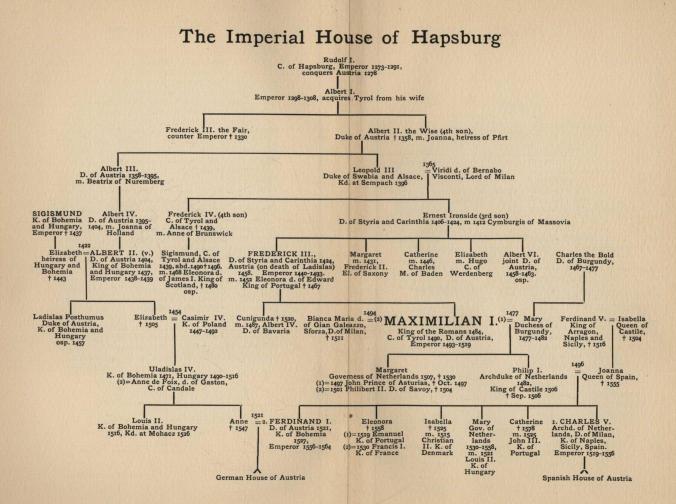
The Imperial House of Hapsburg
INDEX
The names of battles have their dates in brackets Tr.=Treaty
Aachen, 18 Adelsberg, 56. Agnadello (1509), 59. Albert Achilles, 17 Albert IV., of Bavaria, 31, 32, 51 Albert VI., of Austria, 6 Albert, El. of Mainz, 79 Albert of Saxony, 22 Aldus Manutius, 103 Alexander VI., 36 Amboise Cardinal d', 49, 57 Anne of Brittany, 23-5, 44 Apulian Ports, 38, 59 Arras, Tr. of (1482), 16 Ars Versificandi, 101 Ausburg, Diet of (1500), 48; (1510) 61; (1518) 74 —— Humanists of, 87 Aulic Council, 127 Austria, 6, 17, 27, 29, 98 Austria, 105 Balbus, Hieronymus, 100 Basel, Tr. of (1499), 47 Bavarian War of Succession, 51-3 Beck, Leonhard, 91, 95 Berthold, El. of Mainz, 17, 19, 33, 39-40, 49, 53 Bianca Maria Sforza, 34, 35, 42 Blois, Tr. of (1504), 50 Brant, Sebastian, 84-87 Brittany, 23-5 Bruges, 21, 76, 86 Brussels, Tr. of (1516), 72 Burgau, 27 Burgkmair, Hans, 92 Burgundy, Loss of, 12 Burgundian Marriage, 10-13 Cajetan, Cardinal, 75 Cambrai, League of (1508), 57 Celtes, 82, 100-4 Charles, Archduke, 54, 57, 65, 67, 68, 72, 75, 76 Charles the Bold, 10 Charles of Egmont, 46, 48, 57 Charles VIII., 22, 23, 36, 42; death, 44 Chièvres, 54, 68 Coblenz, Diet of (1492), 32 Cochläus, 92 Colins, Alexander, 113 Collegium Poetarum, 102 Comines, 15, 38 Common Penny, 46 Constance, Diet of (1507), 54 Cunigunda, Sister of Max., 31 Cuspinian, 99-101, 104, 105 Deventer, School of, 81 Dijon, 65 Dornach (1499), 46 Dournon (1493), 25 Dürer, Albrecht, 94-7 Eberhard of Würtemberg, 19, 40, 79 Eck, Johann, 93 Ehrenpforte, 94 Eleanor of Portugal, 6 Engelbrecht, Bishop, 7 Eric of Brunswick, 52 Esslingen, 19 Ferdinand V., 23, 25, 37, 38, 49, 50, 53 sqq., 67, 117; death, 72 Fornovo (1495), 38 Francis I., 50, 68-9, 72 Frankfurt, Tr. of (1489), 22 Frederick III., 6, 11, 17, 21, 27 sqq.; death, 33; policy, 9 Frederick, El. of Saxony, 75, 79 Freydal's Mummereien, 91 Fuchsmagen, 100 Fugger, 42 Fürstenberg, C. of, 46 Gaston de Foix, 63 Gebetbuch, 97 Gejaidbuch, 109 George the Rich, D. of Landshut, 27, 51 Germania, 82 Gian Galeazzo, II., 34 Görz, 28, 53, 56 Gossembrot, Sigismund, 87 Grandson (1476), 10 "Great Privilege" of Ghent, 12 Greifenklau, El. of Trier, 75 Grievances, the Hundred, 84 Guinegate (1478), 9, 15; (1513), 65 Henry VII., 23 Henry VIII., 61, 64 sqq., 70 Hofheimer, Paul, 106 Holbein, Hans, 90 Holy League (1495), 38; (1511) 63 Humanists, in Strasburg, 81-7; in Augsburg, 87-90; in Nuremberg, 91-7; in Vienna, 98-105 Hutten, Ulrich von, 79 Innocent VIII., 24 Innsbruck, 27, 71, 75 —— tomb of Max. at, 91, 113 Isaak, Heinrich, 105 Isabella the Catholic, 50 Istria, 56 Joanna of Spain, 41 Julius II., 55, 58 sq., 62, 64 Köln, 11, 21; Diet of (1505), 52 Krachenberger, 100 Kufstein, 52 Kunz von der Rosen, 20 Landshut, 51 Lang, Matthew, Bp. of Gurk, 3, 57, 63 La Trémouille, 66 Leo X., 64, 68 Lille, Tr. of (1513), 66 Lindau, Diet of (1496), 41, 127 Linz, 33, 42 Livorno, 43 Louis XI., intrigues of, 12-16 Louis XII., 44, 47 sqq., 54, 57, 58, 61, 65, 117; death, 68 Louis (II.) of Hungary, 69 Lower Union, 32 Löwlerbund, 31 Ludovico Sforza, 34, 36, 38, 41, 48 Machiavelli, 116 Mantua, Congress of (1511), 62 Margaret of Austria, 16, 24, 25, 40-1, 54, 57, 63, 64, 67 Marignano (1515), 69 Mary of Burgundy, 11, 13-15 Mary of England, 57, 65, 67-8 Massimiliano Sforza, 64 Matthias of Hungary, 7, 17; death, 28 Maximilian I.,--character, 1-4, 121-4; as idealist, 2; as soldier, 73-4; as sportsman, 109-11; dream of Papacy, 62; administration, 115-21; portraits, 97; nicknames, 35, 62, 71. —— Contemporary descriptions of, 10, 11, 34, 116 and note, 117 —— and the German Renaissance, 77-114 Meisterlin, 92 Milan, 37, 45, 48, 50, 57, 69, 70 Moral (1476), 10 Münster, 42 Nancy (1477), 10 Naples, Conquest of, 50 Narrenschiff, 84 Neustadt, 6, 7, 76 Novara, 40; (1513) 65 Noyon, Tr. of (1516) 72 Nuremberg, Chronicle, 92, 104; Diet of (1487), 101; Humanists of, 91-7 Orléans, Tr. of (1514), 68 Osiander, 92 Pace, Richard, 70-1 Padua, 60 Papacy, Max. aspires to, 62 Perger, 99 Perpetual Peace (1516), 72 Peutinger, Conrad, 88-90 Pfinzing, Melchior, 109 Philip, Archduke, 14, 16, 21, 40, 45, 49, 53 Pirkheimer, Wilibald, 92-4 Pius II. (Aeneas Sylvius), 10, 77 Prättigau, 47 Pressburg, Tr. of (1491), 31 Quirini, 34, 117 Ravenna (1512), 64 Regensburg, 18, 32; (1504) 52 Reichsregiment, 48, 59, 125 Renaissance, German, Maximilian's connexion with, 77-114 —— German and Italian, contrasted, 79-80 Rupert of Palatinate, 51 Sachs, Hans, 92 Schwaderloch (1499), 46 Senlis, Peace of (1493), 33 Sigismund, Emperor, 77, 130 Spanish Marriages, 40-1 Spaur, Carl von, 109 Stabius, 102, 104 Strasburg, Humanists of, 81-7 Stuhlweissenburg, 29 Swabian League, 19, 32, 51, 56 Swiss, 40, 41, 45 Swiss War, 45-7 Teuerdank, 108 Thérouenne, 65 Ticiano, Ludovico, 116 Tournai, 65 Trautson, 56 Treitzsauerwein, Marx, 107 Trent, 55, 56 Trier, Diet of (1512), 64 Triumphzug, 95 Trivulzio, 62 Turks, 33, 35 Tyrol, 27, 43, 60 Uladislas IV., 17, 29-31, 69 Ulrich of Würtemberg, 40, 65 Venice, 37, 38, 41, 43, 47, 55-64, 68, 71-3 Verona, 58, 60, 70, 72 Vicariates, the Four, 73 Vienna, Tr. of (1515), 69 —— University, 29, 98-105 Wappenbuch, 109 Weisskunig, 7, 107-8 Wels, 76 Werdenberg, Hugo von, 14, 130 Wimpheling, Jacob, 81-4 Worms, 8; Diet of (1495), 39-40, 125; (1509) 59 Würtemburg, 19, 40, 51 Zillerthal, 53
Butler & Tanner, The Selwood Printing Works, Frome, and London.