VI YOUNG GERMANY (continued 5)
Mary Morison translation
XIX
IMMERMANN
All who are familiar with Heine's works or letters are aware of the warm friendship and brotherhood in arms that united him in his youth to Karl Immermann. He proposed to Immermann to insert some of his epigrams in the Reisebilder, and as a matter of fact there are several pages of them in the book between the divisions Norderney and Das Buch Le Grand. They satirise various literary personages and events of the day. The attacks on those writers who imitated Oriental forms of poetry incensed Platen, and induced him to write his dramatic satire, Der romantische Oedipus, which in its turn called forth Heine's well-known satire.
It was very curious that Platen, in his irritation, should with one blow stamp as Romanticists the two men who, each in his own way, did so much (more than Platen himself) to unswathe from the wrappings of Romanticism a new spirit, a new art—the spirit, the art of modern poetry.
Karl Immermann (born in 1796) was three years older than Heine. He was the son of a correct, austere Government official in Magdeburg, and was himself a man of strong character and solid culture, early imbued with that old Prussian spirit of which there was not a trace in Heine. They were contrasts in almost everything.
Immermann fought in the battle of Waterloo as a volunteer, entered Paris with the army, afterwards retired with the rank of an officer, and studied law at the University of Halle. His strong feeling of justice led him into disputes with the powerful students' union, Teutonia, which had usurped a kind of moral authority over all the students, and enforced its principles, especially that of purity of life, in a domineering, brutal fashion. For several years he continued to oppose the practices of the Union, and more than once during this time was obliged to invoke the power of the law to protect him from the insults and persecution to which he was subjected by his antagonists. The consequence of this was that he was hated by the great majority as an informer—the more so as the political reactionaries took advantage of this opposition to the traditional malpractices of the students' unions, to attack, and, where it was possible, suppress the unions, a proceeding for which Immermann was in no way responsible. From this time onwards he stood alone. Much in his character, much of its dryness and peculiarity, had its origin in this isolation, which also favoured the development of pride and self-esteem.
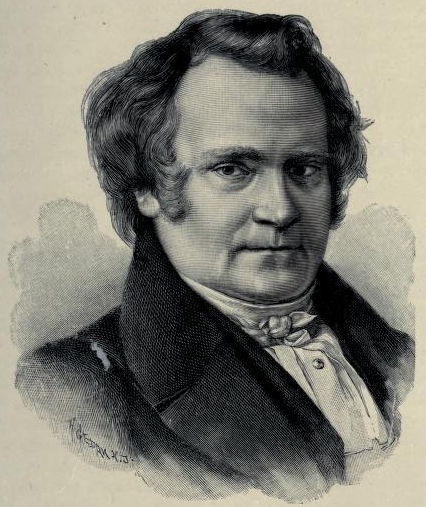
IMMERMANN
In 1819, Immermann was given a Government appointment (that of Divisionsauditor), in the town of Münster, in Westphalia, an old, strictly Catholic, provincial town, where at first he felt himself out of sympathy with every one and everything. But here, ere long, he made acquaintance with the woman who was to be the most powerful influence in his life.
Elisa von Lützow was the wife of Brigadier-General Adolf von Lützow, the famous leader of the volunteer corps celebrated in Körner's song. By birth she was a Dane, a Countess Ahlefeldt-Laurvig of Tranekjær in the island of Langeland. When Immermann first saw her she was twenty-nine, and, according to the testimony of her contemporaries, a most fascinating woman, graceful, charming, intelligent, of aristocratic bearing, and yet genial. From her earliest youth she had made a deep impression on the men who came within her sphere.
She had grown up the supposed heiress of great wealth, but in an unhappy home; her father and mother had become estranged from each other, and about the time she was fourteen they separated. Count Ahlefeldt, a favourite of Frederick VI., was a pleasure-loving man, a pasha with a constantly changing harem; he was a patron of music and of the drama, kept a private orchestra, and entertained companies of French and German actors at Tranekjær; so hospitable and recklessly extravagant was he that even his great wealth could not stand the drain upon it. What brought Elisa and Immermann together was her applying to him for legal advice when her father not only refused to make over to her what had been left her by her mother, who had died in 1812, but also to pay the yearly income which he had settled upon her.
Count Ahlefeldt long refused his consent to his daughter's marriage with the poor and as yet undistinguished foreign officer, but he gave it in 1810, and when, in 1813, the youth of Prussia joyfully and enthusiastically rose to arms at the call of Frederick William III., and Lützow formed the famous volunteer corps known by his name, his wild and daring riflemen (die wilde, verwegene Jagd) found their Valkyrie in their leader's beautiful wife, who was worshipped by the whole regiment as a superior being. Elisa, who appears to have spoken German from her childhood, felt herself at home on German soil, became a faithful daughter of her new fatherland, and identified herself with its interests. She inspirited the brave, nursed the wounded with heroic devotion, was the confidante, helper, and comforter of the best among the young men. After a victory, the choicest of the booty was always presented to her. The lieutenant who first stepped into Napoleon's captured carriage after the fight at Belle-Alliance brought her, as a remembrance, a pair of gloves and two glasses of the Emperor's.
After the conclusion of peace she lived with her husband in the different garrison towns to which he was transferred. In 1817 they came to Münster. The stiff, narrow-minded, bigoted tone of its society was antipathetic to her; but here, as elsewhere, she gathered round her a circle of enthusiastic admirers, who were charmed by her taste and by the keen intelligence which she displayed, without being a great talker—sometimes only by a smile and a nod.
To Immermann she was like a revelation from a higher, nobler world, for which in his lonely, joyless life he had been longing. Lützow's quarters were in a castle-like building that had been a convent, with high windows and great folding doors. Here, surrounded by flowers, statues, books, birds, dogs, and admirers, she seemed like a noble lady of olden days, or one of those princesses of the Renaissance who attracted poets to their courts and inspired them.
With the year 1825 came a great change in Elisa's life. The good-natured and chivalrous but volatile and impressionable Lützow fell so violently in love with an insignificant flirt that he requested his wife to set him at liberty again. This she was not prepared to do; but after she happened to overhear Lützow remark to a friend that when he was quite young he had made up his mind to marry a great heiress, a new light was thrown upon the determination he had shown in their early days to win her, and her feelings towards him changed. Her pride was hurt; she presently informed him that she would no longer stand in the way of his happiness, and agreed to a divorce, the reason of which she kept secret.
Not an angry word passed between husband and wife. The divorce was pronounced in April 1825. Both before and after it Lützow wrote Elisa letters which testify to a most friendly feeling and warm admiration. It was an unlucky day for him when he took the step which separated them. He was universally blamed, and when it came to the point, his capricious enslaver would have nothing to say to him. He repented his delusion when it was too late. Some years afterwards, in order to make a home for himself again, he married his brother's widow, but this lady's temper was so bad that it made the last years of his life most unhappy.
The divorce left Elisa homeless and solitary, and this led to gradually increasing intimacy with young Immermann, who saw in her his ideal, and was passionately desirous to make her his wife. But Elisa shuddered at the thought of a second marriage; the disillusionments of her wedded life had disgusted her with matrimony in general, and she reflected, moreover, that she was six years older than the young poet. When Immermann, in 1827, was promoted to the appointment of Landesgerichtsrath in Düsseldorf, he passionately urged her to accompany him there. She agreed to do this, though she again refused to marry him; both, however, vowed never to think of marriage with any one else.
The lovers inhabited a country house in the village of Derendorf, close to Düsseldorf, where they had their separate suites of apartments. This house, which lay in a great rose garden, they decorated with exquisite taste, and here they lived a full and happy life for a number of years. Düsseldorf was at that time the resort of many of the best artists in Germany, painters like Schadow, Lessing, Hildebrandt. Thither, too, came poets (like Grabbe), composers (Mendelssohn), art amateurs, and critics from all parts. Immermann's and Elisa von Ahlefeldt's house was a rendezvous for all these. In Elisa's circle in Münster, Immermann had distinguished himself as a clever reader of dramatic works; here he continued to give semipublic readings of the same description. This gradually developed a desire on his part to manage a theatre. He rehearsed a number of trial plays with the Düsseldorf theatrical company; artists from other parts came to his assistance; the great actor, Seydelmann from Berlin, played Nathan; Felix Mendelssohn put two operas on the stage for him and directed the performance.
Elisa's father died in 1832. She did not inherit all the wealth that in her youth was expected to be her portion, but the cousin who succeeded to her father's title and property settled a handsome annuity on her. She and Immermann now travelled together—on the Rhine, to Dresden, in Holland; a tour which Immermann took alone is described in his Reisejoumal, which consists entirely of the letters he wrote to Elisa. Everything else was written beside her, and subjected to her affectionate but frequently severe criticism.
After an existence of three years, Immermann's theatre, failing to obtain state aid, had to be closed. This was a great grief to him. He sought to distract himself by a tour in Franconian Switzerland. His Fränkische Reise, the description of this tour, also consists of letters to Elisa. They were the last he wrote her. For during this absence he met, in Magdeburg, a girl of nineteen, Marianne Niemeyer by name, who made a very strong impression on him. When he rejoined Elisa he once more, to her surprise, asked her to marry him. As before, she refused. It would seem as if he had been pretty certain of the answer he would receive, and only desired to salve his conscience. For immediately afterwards, unknown to Elisa, he began a lively correspondence with Marianne, proposed to her, and was accepted. Elisa heard of his engagement from others, and at once resolved to leave Düsseldorf. She did so in August 1839, Immermann accompanying her and the friend with whom she travelled as far as Cologne. Till this time, in spite of her forty-nine years, she had retained her beauty; now she suddenly grew old. In October 1839 Immermann married; in August 1840 he died. Elisa survived him fifteen years.[1]
It is quite obvious that the connection with Elisa, which for so many years was pleasurable and helpful to Immermann, in the end became burdensome to him. But it is unwarrantable to assert (as Goedeke has done) that it was the breaking off of this connection and his subsequent lawful marriage which first gave Immermann the creative vigour which he displayed in his last important work, Münchhausen. It was conceived and executed under Elisa's influence to quite the same extent as his other works.
Her personality and the position in which he stood to her often and in many ways influenced his writings. She is supposed to have suggested his drama, Petrarca, which treats of Petrarch's love of Laura, and represents the irresistible strength of a passion inspired by a high-born lady even when the said lady is not free. Her views on the subject of love, and its unqualified justification as such, are said to be recognisable in the drama, Cardenio und Celinde. She was probably his model for the heroine of the comedy, Du schelmische Gräfin, and certainly the model for Johanne in the novel Die Epigonen. But all this is as nothing in comparison with the general development and refining influence which she exerted over him as an author.
Immermann's is a curious fame. Of all his works only one is still read, his novel, Münchhausen; and only one part of this novel, the smaller half of it (now separated from the rest and published by itself), will carry his name down to posterity. This one small volume is in reality of more value than all the rest of his work.
In its construction, Münchhausen, following the general rule of the Romantic tales, was intentionally disorderly; the book begins, for example, with the eleventh chapter. The hero, a Westphalian baron, is a descendant of the old lying Münchhausen, and, like him, a fantastic liar. The whole was meant to be a sort of satiric repertory of the various humbugs and nonsensicalities of the day, amongst which the author's humour might play at will. But out of all this irregular play of fancy, which corresponds to the title Eine Geschichte in Arabesken, there was gradually developed the great rural romance which has taken a place in German literature under the name of Der Oberhof. Its principal characters, the village magistrate (der Hofschulze) and the fair-haired Lisbeth, represent a new truth, a new creative art. They live and move on "the red soil" of Westphalia, and in their persons the German peasant is for the first time introduced into literature without the sentimentality of the pastoral idyll or the distortion of the opera ballet, undoubtedly conventionalised, but with caste and race individuality. There is a vigorous, fresh naturalness about these characters, which will never grow old.
Der Oberhof has taken its place as the original type of all the European peasant tales, and in certain points it is superior to any of them, old-fashioned in many ways as it now seems. Hundreds of fantastic threads connect this admirable story with the romance of Romanticism, but it is easy to cut them, and then we have before us as it were the hard crystal into which Romanticism finally condensed itself in Immermann's mind.
It is the custom nowadays to regard the peasant tale as a direct offshoot of Romanticism. Yet it undoubtedly, both in France and in the North, marked the transition to an art which, was more true to nature than the Romantic.
It signified a complete change of sphere in German art when Immermann gave up writing historical or fantastic dramas in iambic verse, the scenes of which were laid in countries which he had never seen, and portrayed ordinary human life in the little known province of Westphalia, where he had lived and exercised the functions of a judge. There were no railways in the Westphalia of those days, and no manufactures; but it was a country of patriarchal, wholesome manners and customs, and he had only to represent it with the faithfulness which illuminates, to produce an effect infinitely surpassing that of any of the earlier arbitrary creations of his poetic imagination.
The wealthy peasant landowner, who is the principal personage in this story, is the prototype of all the sturdy, independent farmers of the German peasant tales, and of many in those of other countries. Excellent as many of Auerbach's characters of this type are, he surpasses them all in what may be called the historic greatness which is imparted to this character by the intimate relation which we feel to exist between it and the far back past of the country. This peasant appears on the background of traditions still in force, which link the present with almost forgotten times.
He is a genuine peasant. He is not in the least amiable; he has had no time to cultivate amiability; from his boyhood, life has been too hard to allow of that. His distinguishing qualities are sound common sense, seriousness, obstinacy, pride of position, and permissible self-interest. There is a granite-like foundation to his character. He has the true peasant shrewdness, not to say shiftiness, in business; he is always ready to advise his neighbours how best to hold their own against the authorities when any forced sale of land is threatened, always on his guard against emissaries of the government, even when their mission is the construction of new roads or some such improvement; he is cold in his family relations, and has all the prejudices of the rustic.
And yet he is great. He rules, and he always carries his point. He not only reigns over his own large estate like the stern, patriarchal kings of old, upholding good old customs, keeping his eye on every one and everything, admonishing in proverbs, rewarding with the honour of retention in his service; but, unquestionably the superior of all his neighbours, he has induced them to regard him as their leader, and has quietly, without disturbance or revolt of any kind, led them to free themselves from the supremacy of state authorities and to rule themselves under him as a sort of judge of the old Jewish type. In his district both law-suits and criminal cases are unknown; no one goes to law with his neighbour; no one is ever accused of a crime; one might take it to be an oasis of innocence and peace. It is far from being that; but since medieval times the secret courts of justice (Vehmgerichte) have existed here, and the peasants, under the influence of this great peasant, have agreed to uphold these, and thus privately provide for the maintenance of equity and justice among themselves. They assemble secretly at night in a lonely place and settle their own disputes. The sentences are accepted and executed without dispute. The only punishment awarded is a sort of excommunication of the malefactor, which is as severe a chastisement as any that could be imposed by a state judge. A peasant whom all avoid, whom no one will help, with whom no one will have any dealings, suffers from almost as strict isolation as the man confined in a prison cell.
As a symbol of his power and dignity the old "Hofschulze" treasures a sword, which he believes to be what tradition calls it, the sword of Charlemagne, and which he regards as his most precious possession. His hand is on its hilt when he pronounces judgment. This sword, which was dug up somewhere in the neighbourhood, is really a perfectly common weapon, possibly two hundred years old; and we have an admirable description of how the old farmer is at times tormented by doubts of its antiquity, doubts which, with his peasant shrewdness, he tries to dispose of once for all. He tempts an antiquarian in the neighbourhood with the sight of a beautiful amphora, and then obliges him to give in payment for it a written certification that the sword had undoubtedly belonged to Charlemagne.
The tragic catastrophe of the story is brought about in this way. A man who is now a vagrant had, in consequence of an intrigue with the daughter of the "Hofschulze," been attacked by her brother and had killed him in self-defence. This vagabond, to revenge himself on the "Hofschulze" for the sentence of excommunication which has ruined his life, steals the sword and hides it where no one can find it. The loss breaks the old man's spirit. All the mysteries of the secret court of justice are divulged, and he is obliged to stand his trial.
Granted permission to make a last speech, he says: "Your Worship! I have no doubt that the clerk is noting me down in his minutes as a fool, and my sword and secret judgment-seat as foolery; for so, if I mistake not, I heard the young gentleman call the things that lie nearest to my heart. I would fain give some explanation regarding this foolery." And he goes on to say how, ever since he could think, he has observed that, after calamities such as hailstorms, floods, failure of crops, or cattle-plague, some of those gentlemen came to the district who not only understand how to write reports, but also how to judge everything much better than the people concerned; they described the calamity after it was past, but were never there at the time to help; and if a little money happened to be sent, it never reached those who needed it most. "One thing was more astonishing than all else. One or other of these government gentlemen would order things so in the district that we peasants could not refrain from laughing at it all. In a year or two the same gentleman would come driving in a carriage and four, with all kinds of ribbons and orders on his breast, looking as if he had helped to create the world. Thinking over all this in my plain way, I came to the conclusion that the government gentlemen were of little service to us peasants; nor did they come to do us service; they came to write, and they wrote until they wrote themselves into a carriage and four. ... And then I thought (for all my life I have been given to thinking) that a steady, industrious man will always get on if he watches the wind and the weather, and attends to his business and is a good neighbour. ... And first I accustomed myself, even in times of trouble, never to think of help; I paid my taxes and bore my own burdens ... and then I accustomed my neighbours to do the same. They followed my example; we settled our own affairs among ourselves, and many matters about which much ado would have been made elsewhere, were never heard of beyond the bounds of the parish. ... By degrees we came to settling everything. A peasant has understanding enough to tell who has the best claim to a certain wall or strip of meadow. And when a house has been broken into, the village nearly always knows who has been the thief; but because it is not always possible to bring sufficient proof, a man well known to be a rascal may impudently and scandalously show his face and enjoy his booty, which its rightful owner never recovers. So we quietly took the law into our hands, and no one could accuse us of anything, for we injured no man; we only refused to hold any communication whatsoever with the evildoers whom we placed under the ban; and of this ban men were more afraid than of the judge's sentence and prison."
"And," he concludes, "if other people would but do the same, if the townsmen, the merchants, the noblemen, the scholars, would but manage their own affairs, things would be better than they are. Men would no longer be like stupid children, for ever crying for father and mother, but every man would be like a prince in his own house and among his equals. And the king himself would then be a far mightier monarch, a ruler like no other, for he would rule over hundreds of thousands of princes."
We have the feeling at the end of the story that, now the secret is divulged and the sword stolen, the days of popular justice are at an end. But the author gives us his own opinion on this subject by the mouth of the wise pastor, who declares that the independence which is the watch-word of this peasant and his friends is a reality which cannot be done away with by being divulged, that the idea which has united them, the idea that a man is dependent on his neighbours, not on strangers who stand in a perfectly artificial relation to him, does not require the support of the tribunal under the old lime-tree. In the peasant farmer himself, the mighty old yeoman, he sees the true sword of Charlemagne, which no thief can steal, the true backbone of the country.
Observe that this is written by an author who was a magistrate and the son of a Prussian government official.
A marked contrast to the strong, stern figure of the old peasant, but drawn with as sure a hand, is Lisbeth, the fair-haired, country girl who is the heroine of the tale. Young Count Oswald, who wanders about the country shooting, falls in love with her, and it is the eventful love-story of these two young people which forms the chief attraction of the book. Immermann had in his writings long shown himself to be a firm believer in the unbounded power of love over humanity, but here he tells the story of young love as he had never done before. We have the beat and glow of two innocent young hearts. The youth and maiden meet, full of budding, swelling, healthy presentiments and hopes. No renunciation or disappointment has as yet cooled one drop of their warm blood. The distance between them is bridged over in an original manner. The young sportsman, who has inherited from his parents a taste for shooting, along with absolute incapacity to hit anything, for once in his life succeeds in setting his mark on a living creature; he lodges a whole charge of small shot in the girl's shoulder. The shame and regret he feels give place in time to ardent love. When she has recovered and the two have discovered that they love each other, they go together one day into the wood.
"'I want to ask your wounds to forgive me,' he said—undid her kerchief, and kissed the small red spots between her breast and her white shoulder. She did not resist; her little hands lay folded on her lap, and she sat quite still, a resigned victim of love; but she looked at him bashfully, entreatingly. He could not bear that look; he quickly covered breast and shoulders again with the kerchief, fell at her feet, pressed her knees to his heart, and then walked away a few steps to overcome his emotion."
This suffers in translation. It must be read as it occurs in the original, this little field idyll, in which the lovers play like children; she stands up against him that he may measure her height; he plays with her curls; from time to time she gently whispers: "O du!" but this is all she can say; they make a meal on apples and bread, which they buy from a woman they meet, agreeing that novel writers lie when they assert that love lives on air; she eats from his hand and he from hers. It is all as natural and as good as anything of the same style in Auerbach, Keller, or Björnson.
And Immermann's description of the sorrows of love is no less admirable. Nothing in the book surpasses the passage in which the old farmer tells Lisbeth that her lover is a young nobleman, and makes her understand that she must not expect him to marry her. Oswald has concealed his position and given himself out to be an ordinary forester, only with the intention of giving her a joyful surprise later. If she had taken time to think, she would have come to the conclusion that she need have no fear of his proving unfaithful. But the knowledge that her lover has lied is a blow that upsets her equilibrium, and Immermann profoundly remarks, "For love, as long as it is unshaken, is divine penetration ... but once shaken, once driven to conjecture and surmise, it is madness, which passes cathedrals without seeing them and takes molehills for mountains." This is a profound saying, because it is a true psychological appreciation of a feeling which is the product of unknown causes. Heine's psychology of love was very simple; when he complains, it is always of faithlessness as a wrong knowingly committed. Immermann here represents what may be called the somnambulistic action of the feeling, the instinct, unerring as that of the sleep-walker, which it possesses when undistracted by disturbing forces.
Both in broad outline and in minute detail this first of the peasant novels is sterling poetry. The influence of fantastic Romanticism is still distinct; the secret tribunal, the sword of Charlemagne, the enthusiasm for old customs are Romantic features; even Lisbeth's fanciful pedigree—the fathering of this truthful young being on the old liar Münchhausen—betrays that the tale is an outgrowth of an earlier Romantic literature. All this, however, only throws into stronger relief the laborious, yet vigorous, process of condensation by which healthy, modern realistic appreciation and treatment of popular subjects was evolved out of the arbitrary fantasticality which immediately preceded it.
Immermann is one of the company of authors, including Daniel Defoe, l'Abbé Prévost, the Danish poet Wessel, Chamisso, and Bernardin de St. Pierre, who prove that a single volume is enough to carry a writer's name down to posterity, even if everything else that he has written be quickly forgotten. As a matter of fact, only this one work of Immermann's lives. He wrote mock-heroic poems, such as Tulifäntchen, which was much appreciated in its day, but is now unreadable. He wrote works which, for their day, must be pronounced meritorious, but which are now given over to moth and rust, such as the drama Merlin (1831), a great Romantic work in well-written verse, a sort of unsuccessful pendant to the Second Part of Goethe's Faust and the historic tragedy which was first known as Das Trauerspiel in Tirol ("The Tragedy in the Tyrol"), but was re-named Andreas Hofer. The second of these plays is the better of the two; it is founded on Immermann's own youthful recollections of the formidable resistance encountered by the French in the Tyrol, and is written with both the ability and the will to present a faithful and impartial picture of the two hostile races, so unlike in their character and in their development. This work in its original form, as published in 1826, criticised by Börne in his Dramaturgische Blätter, and satirised by Platen in Der romantische Oedipus, is interesting, especially as a sort of mongrel, the offspring of Kleist's genius mated with Schiller's muse; for the hero reminds us of Schiller's Wilhelm Tell, and the love affair between the Frenchman and the Tyrolese girl, with its tragic ending, of Kleist's Die Hermannschlacht. But the play was too devoid of any really profound, impressive originality to live long, and when, in 1831, Immermann re-wrote it, suppressing everything that had given offence or called forth adverse criticism—the whole love-story and the incident (again recalling Kleist) of the sword which the angel restored to Hofer in a dream—he himself took away what life there was in it. Pride, if nothing else, should have made him retain the character which Platen had tauntingly nicknamed the "Depeschenmordbrandehebruchstyrolerin."
It was an unlucky chance which made bitter enemies of two lovers of liberty like Immermann and Platen, and two rare spirits like Platen and Heine. That which gave rise to the whole literary feud, to the clumsy, ugly attacks on Immermann and Heine in Der romantische Oedipus, to Immermann's retort, Der im Irrgarten der Metrik umhertaumelnde Cavalier ("The Reeling Knight in the Labyrinth of Metre"), and to Heine's crushing attack on Platen in the Reisebilder, deadly from its very stench, was such a paltry trifle, such an insignificant though contemptuous distich, that only an arrogant and quarrelsome disposition like Platen's could have made it the occasion of a war with poisoned weapons.
Platen's letters show what dire offence he took at the two lines by Immermann in the Reisebilder, which might be construed as referring to his ghazels, and how determined he was to revenge himself ruthlessly. Great and serene in the region of pure art, and a manly champion of political liberty, he displays in his onslaught on the men who had insulted him, an offensively boastful degree of self-admiration and an insolence which is partly the arrogance of rank and partly the recklessness of wounded vanity. His letter from Rome of the 18th of February 1828, shows that he really knew nothing about Immermann's Das Trauerspiel in Tirol, which he had determined to attack. Der romantische Oedipus was almost finished when he wrote to Fugger: "Be sure to tell me something about Immermann's Andreas Hofer, something of the plot and any piquant nonsense. I need it for the end of my Fifth Act, where I make him go quite mad." The boundless contempt with which Platen treats Immermann in his play can thus, in spite of his protests, only be regarded as vindictiveness. As regards Heine, it is simply his Jewish birth with which Platen taunts him in both letters and play. In the play everything turns on this—Heine is the Petrarch of the Feast of Tabernacles, the pride of the synagogue. So personal is the satire that Nimmermann is made to say, that though he is content to be Heine's friend, he would not be his mistress, for his kisses reek of garlic, &c. From Platen's letters it is easy to see that he completely underestimated the strength of the antagonists whom he thus challenged. He feels that he is capable of "crushing that Jew, Heine," whenever he chooses to do so. When his friends try to persuade him that attacks on Heine because of his birth carry no weight, he replies, quite unmoved: "That he is, or was, a Jew is no moral offence, but a comical ingredient. Intelligent readers will judge whether or not I have turned it to account with Aristophanic cunning." So sure, so superior does he feel himself, that even in December 1828, immediately before he is utterly discomfited by Heine's return blow, he sees in him nothing but "an impudent Jew, a miserable scribbler and sans-culotte." His moral indignation at the first books of the Reisebilder was, however, so great that he calls the author and his like "veritable Satans."[2] The treatment he met with was not undeserved; scorn was returned for scorn, and his underestimation of Heine and Immermann was cruelly avenged. The scurrilous part of Heine's attack injured himself most by exciting the disapprobation of his own friends and admirers.
The fact that the names Immermann and Platen came to form a constellation of hate was actually due to the similarity of their natures, to the feeling of solitariness which, combined with a self-esteem that was always on the alert, made them prone to proclaim their own praises and to attack others with undue bitterness and with insufficient understanding. These two men, each in his own way, represent the transition from Romanticism to modern liberalism. Platen, who followed in the footsteps of the Romanticists in his assiduous cultivation of foreign forms, the oriental ghazel, the southern sonnet, the ancient Greek Aristophanic comedy and Pindaric ode, shortly before his early death wrote songs and poems (Political Poems, including the Polish Songs—posthumously published) which are on the highest level of spirited modern lyric poetry. And Immermann, who all his life had treated tragic or fantastic themes with Romantic extravagance or symbolism, not long before he died impregnated a piece of homely reality with a spirit of true poetry by which the following generation throughout the whole of Europe was influenced.
XX
HEGELIANISM
It was the Hegelian philosophy, in combination with the Revolution of July, which drove thinking men to take their part in the stirring life of modern history and politics. Not that Hegel himself sympathised with the Revolution of July. Such a violent interference with what to him now represented the rational state of things, could hardly appeal to him, in his sixtieth year, as the great Revolution had done. In politics he had long been a strong Conservative.
But none the less certainly did the Revolution of July change the character of the Hegelian philosophy. It was the historical turning point, the historical crisis that was needed to transfer that philosophy from the lecture-room to the arena of life. One of the peculiarities of the philosophy was, that it was capable of diametrically opposite interpretations. From this time onwards we observe it to be one of the most powerful instruments in the remoulding, the reconstruction of life. We saw that it was so in the case of Heine, who never alludes to Hegel's conversion to Prussian Conservatism except to apologise for it; to him Hegel is always the great philosopher of the new era, the mighty sovereign of the realm of thought.
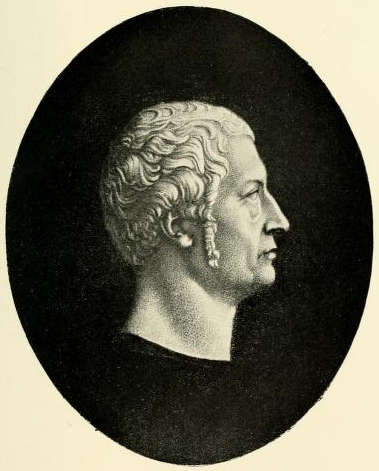
HEGEL
Until Hegel was called to Berlin he had been unsuccessful as a teacher. He had attracted little attention at the other universities, and in his younger days had often lectured to only three or four students. Now he was at the height of his fame. Unlike Schelling, who reached maturity so early, and became so early barren, Hegel, the man of heavier, slower nature, entered the most momentous stage of his career with his forty-eighth year.
Great expectations were formed of him, and he fulfilled them all. His insight was extraordinary; he seemed thoroughly to belong to his time, and yet to live as it were above it—familiar with all its ideas and judging them all with calm superiority and profound conviction. Hundreds upon hundreds of listeners streamed to his lecture-room.
The young student who saw him for the first time thought him an odd-looking figure. He had aged early, his originally powerful figure was bent, and the impression he produced when he entered the lecture-room was that of old-fashioned middle-class respectability. He went to his desk, seated himself, became absorbed in his manuscript, turning over the large leaves and looking up and down them for what he wanted. His carriage was awkward and characterless, his expression listless, his face worn and wasted, not by passion but by the most arduous mental labour. But he had a fine, noble head, and when he turned his face, with a look of profound, dignified, yet simple earnestness towards his hearers, the imprint of high intellect was unmistakable.
He began to speak, cleared his throat, coughed and stammered, had difficulty in finding his words. He had a strong Swabian accent, and a jerky, unrhythmical delivery; involved himself in long, intricate sentences which he seldom managed to bring to a satisfactory conclusion; sought long for the exact word required to express his meaning, but never failed to find it; and when found, it always struck his hearers as extraordinarily telling, whether it was a perfectly familiar or a very uncommon expression. In time this peculiar delivery simply served to make intelligible to the listener the extraordinary difficulty and intricacy of the mental process. There might be tiresome repetitions, but if the student let his attention wander and missed a few sentences, as likely as not he was punished by losing the thread of the discourse. For by means of apparently insignificant intermediate steps some thought had been made to betray its one-sidedness, its narrowness, to involve itself in contradictions, and these contradictions had to be, or were already, explained away.
What struck one as peculiarly characteristic of his lecturing was the combination of two features: the speaker's concentration in his subject, which made it seem as if he spoke entirely for its sake; and his keen anxiety to make himself plainly understood, which made it seem as if after all he spoke chiefly for the sake of the hearer.[1]
He was a wretched orator, this professor, but a wonderful thinker and expounder. The technical terms he employed were bewildering—that extraordinary terminology in which "an sich" meant according to its constitution, and "an und für sich," the completed, absolute existence; but his hearers became accustomed to it, and soon began to feel as if they were floating above the earth in abstractions so refined and so ingeniously complementary that the dialectic of Plato's Parmenides seemed clumsy in comparison; at times as if they were penetrating ever deeper into ever more concrete subjects. The speaker's voice grew stronger, he looked round with a free, confident glance while, with a few pregnant words, he characterised an intellectual movement, an age, a nation, or some specially remarkable individual, such as that nephew of Rameau's who, without being named, is described in the Phænomenology.
The novice who heard the famous thinker propound, without any illustration, the abstract ideas which applied to everything—spirit and nature, matter and mind—ideas of which it was said that they enclosed the seen and the unseen in their mysteriously but methodically woven net—might at first feel tempted to run away, or at any rate not to come back again.
But he did come back, for the laborious delivery soon fascinated him, and he began to feel that he was making progress. Every now and then a lightning-flash of thought illuminated the darkness. The pupil began to comprehend that, in his master's mind, there was no question of this being a system like other systems, a more profound or more comprehensive plan of instruction than other plans, but that the man regarded himself as the originator of an entirely new science, which comprehended the whole of existence, explained everything, God and the world, and was the completion of everything; for the thoughts of all earlier thinkers were discernible in his system, as all the lower animal forms are traceable in the human embryo; everything that had gone before had prepared his way, all endeavours found their fulfilment in him; from this time forwards progress could only lie in the direction of more special development of the separate sections of the great completed plan.
The pupil was henceforth under the master's magic spell. The very abstruseness of the terminology was now an attraction the more; difficulties acted as spurs; it seemed to him a point of honour, a matter of vital importance, that he should understand. And with what rapture he understood!—understood that the whole world of sense was only appearance; the great reality was thought. These separate, individual appearances were not real, not true, only the universal was real. I think, and by inevitable laws the progress of my thought leads me to the complete understanding of myself and of the world. I think my own thought, not regarding it as my own, but as the universal thought, as the thought of all other human intelligences in union with mine; I deprive them all of the individuality which appears to be essential but is not, and see in all these intelligences one intelligence, and in it the principle of existence. This first principle, which finds its highest expression in man, is that which permeates, which creates the world. This first principle, which works and creates blindly in nature, is in me conscious of itself. The absolute, the idea, that which is popularly known as God, is not a conscious or personal being, for consciousness and personality presuppose the existence of something outside the consciousness and personality; and yet it is not quite unconscious. Man's consciousness of God is God's self-consciousness. I cease to live as a single, fortuitous human being, in order to feel the universal life live and pulsate in me.
Logic, which has been nothing but a sort of childish scholastic discipline, which inculcated self-evident facts by the aid of barbaric formulæ (Barbara, Celarent, Ferio, Camestres, Baroco), logic, which had languished and died in ignominy long ago, came to life again in the doctrine of the thoughts of existence in their connection and their unity; for the first thought necessitated, produced the second, amalgamated with it into a third, which in its turn summoned up its antithesis, which was at the same time its complement. Thought of necessity produced thought, until the thought-serpent set its tooth into its own tail, thus forming one inviolable circle, from which the realms of nature and spirit again detached themselves, dropping as the rings dropped from Draupner, the ring of Odin.
And all the sciences came and drank of the new metaphysic, as of a fountain of life, and all renewed their youth. And the system gradually rose before the disciple's eye, homogeneous, carefully articulated, severely symmetrical, of an internal infinity, a spiritual Organon, a gigantic Gothic cathedral, every little part of which repeated the whole, every little triad the great Trinity—thought, nature, and spirit. It rose, built upon the granite foundation of thought, all the buttresses and arches of the realm of nature supporting it as it mounted towards the spirit, soaring to heaven in the mighty three-storied tower of which religion formed the lowest, art the middle, and philosophy the highest course.
But even more to the disciple than the system was the method. For the method, the imperative thought-process, was the key to earth and to heaven. It was by virtue of the method that he understood. It was by virtue of the method that he saw the history of the world to be a connected drama, one grand drama of liberation, in which every race had its part, and all the parts were interdependent.
It was, after all, a truly great thought-poem, which men took for a scientific demonstration; a new species of poetry, more dramatic and more masterly in construction than that which Schelling's intellectual perception had revealed to him; a new intoxicant, more subtle and potent than that provided by the natural philosopher. The system has, indeed, collapsed, the machinery of the method, too fine and intricate, has come to pieces in our hands; only a few of the great fundamental thoughts remain. But he who in his early youth has passed through the Hegel period in his own mental experience, perfectly understands the rapturous enthusiasm of the youth of that day, and the strength they drew from these cosmic thoughts, world-ideas.
Among Hegel's pupils about the year 1830 there were already master-thinkers like Hotho, Gans, Marheineke, Michelet; and almost all the men of mark who appeared in the most diverse intellectual domains from this time until far on in the Fifties, belonged at first to the Hegelian school—Rosenkranz and Werder, Strauss and Fischer, Feuerbach, Marx, and Lassalle. Cousin came from France, Heiberg from Denmark, Vera from Naples, to fit themselves for propagating his doctrines in their native countries.
From the professorial chair in Berlin, the Hegelian philosophy spread throughout Germany, throughout the earth. Seldom or never has a spiritual monarch's throne stood so secure. At the time of Hegel's death (by cholera) in 1831, his followers compared him to Aristotle, to Alexander the Great, even to Christ.
On the literature of the following decade, and in especial on the so-called Young Germany, Hegelianism acted as an emancipating spiritual power, a power that destroyed faith in religious dogma and freed the individual from the burden of the Christianity of the State church. We have already observed that even such an essentially lyric nature as Heinrich Heine's took on the tinge of Hegelianism in this respect, quite independently of the fact that his keen understanding was trained in the school of Hegel; in the peculiar turn of his wit we trace the influence of the Hegelian dialectic, which makes every idea pass over into its opposite (unity of opposites).
But it was as a sort of modern Hellenism that the Hegelian philosophy exercised the most powerful influence upon young minds. What may be called Hegel's Hellenic influence was even stronger than Goethe's.
The reader doubtless remembers the passage in Heine's book on Börne in which he writes on Börne's Nazarenic narrowness. He tells us that he calls it "Nazarenic" to avoid employing the words Jewish or Christian, words which to him convey the same meaning, because he does not use them to designate a faith but a disposition, a nature; and he places the word Nazarenic in opposition to the word Hellenic, which also to him signifies an innate or acquired disposition and view of things generally. In other words, all humanity is divided for him into Nazarenes and Hellenes, men with ascetic, image-hating dispositions, inclined to morbid spiritualisation, and men of cheerfully realistic temperament, inclined to genial self-development. And he designates himself a Hellene—a name which no Romanticist would ever have bestowed on himself.
Hellenism in this sense emanated abundantly from Hegel. His whole intellectual bent is in the direction of that tendency of the time to present modern matter in antique manner, which we observe in Goethe when he writes his Iphigenia, and in Thorvaldsen when he represents the Princess Barjátinska in Greek dress. It was not by mere chance that Hegel and Thorvaldsen were born within a few months of each other in the year 1770. Nor was it a mere accident that Hegel best understood that side of Goethe's nature which turned towards Greece.
Hegel had received his early training in his native country, Würtemberg, under two influences, that of eighteenth century enlightenment with its revolt against theology, and that of classic antiquity. Even as a schoolboy he was keenly interested in the study of the Greek language and literature; as a mere child he was devoted to the Antigone of Sophocles, which in later life was to him the typical Greek work of art, and is constantly referred to in his writings. He declared the study of the ancient classics to be the real introduction to philosophy, and his own system as a whole he gradually moulded on the plan of the ancient systems. It stands in the same relation to the Aristotelian structure of thought in which Goethe's Iphigenia stands to a play of Euripides, or Thorvaldsen's "Triumphal Procession of Alexander" to the frieze of the Parthenon.
His primary natural disposition towards Christianity is shown in his studies and researches as a youthful theologian, the substance of which, taken from the original manuscripts, has been given to the public by Haym. In these early writings he maintains that the Greco-Roman religion was a religion for free men, that a free community, a free state, was the highest ideal of the Greek, an ideal to which he consecrated his labour and his life. The God of Christianity was only a substitute for lost republican liberty. Men had lost power; they could no longer will, but only wish and pray. And the more slavish they grew, the more was a God outside of themselves and above themselves a necessity to them. And it is Hegel's opinion that for us, in our days, has been reserved the task of demanding the return of those treasures—the property of man—that were flung up into heaven. In this he anticipates Heine and Feuerbach.[2]
In his youth Hegel always sees Jewish antiquity through classic spectacles. He calls their ancient history "a condition of unmitigated ugliness." The great tragedy of the Jewish nation is, he says, a very different thing from a Greek tragedy; it neither awakens pity nor terror; for these feelings are only called forth by the fate following on the inevitable errors of a noble nature. He sees the history and fate of the Jews against a background of Sophoclean conception of life and Aristotelian theories. Such ideas as law and punishment are repugnant to him. The Christian doctrine of the forgiveness of sin he can only accept by converting it into the idea of fate reconciled by love. In other words, he can only admire the sufferings of Christ when he looks upon them as he looks upon the sufferings of Oedipus in Colonos, namely, as a fate overtaking the innocent, not as a sacrifice offered for the sins of others.
All that he rescues for himself from the shipwreck of positive religion is the person and life-story of Jesus—that beautiful divine-human personal life which is to him an equivalent for the citizen-life of the ancient world. But his Jesus is not Jesus pure and simple, but a Jesus-Apollo such as Heine describes in his poem Frieden—the giant, who bears the red, flaming sun in his breast for a heart. We have a similar fusion of heathenism and Christianity in the well-known preface to Romancero, where Heine talks of his last genuflection "before the ever blessed goddess of beauty, our dear lady of Milo." For this is not Venus pure and simple, but Venus-Madonna.
Thus Hegel himself is the originator of that pagan Hellenism, of which it was the fashion to accuse Young Germany.
And in his philosophy we can even detect the spirit which might evolve such a watchword as "the emancipation of the flesh." This was a French expression introduced by Heine into German literature, which was eagerly taken up by his admirers and imitators, and was specially execrated by the enemies and denouncers of the new literature. It certainly might be suspected of an immoral meaning in Heine's mouth and of an ugly meaning in Heinrich Laube's; but amongst the best of the men of the young generation it meant nothing but what Goethe and Hegel, too, had in reality desired. Karl Gutzkow has insisted, and with reason, that only a low mind coupled with this expression ideas of licence for all bad passions. For the word flesh in itself conveyed no objectionable meaning. The New Testament says: "The Word was made flesh." Flesh, in the Christian acceptation of the word, means the natural, the unbaptised, the original man. Its emancipation in reality meant to the young enthusiasts of the day nothing more than the restoring of her rights to nature, war against what is contrary to nature. What they desired was to make the laws of nature the rule of conduct, to release nature from interdict and ban.[3]
A neo-Hellenism realised in the Hegelian spirit was what was present to their minds.
It did not seem a matter of great consequence to them that Hegel should end his days as a rigid Prussian Conservative, or that his Philosophy of Right should recognise all existing institutions as "holy things," and make out the highest ethical conceptions to be "idols." He had underestimated the strength of the scientific doubt of the day.
How many institutions still presented themselves as objects of veneration and faith to the normal mind of the period? Four at most—the monarchy, the church, marriage, and property. As regards these, Hegel's doctrine is as follows:
He does not uphold the monarchy as a guarantee for continuity in the execution of great political plans; no, the monarch is to him simply the logically necessary pinnacle of the state-building, something like the dot over the i—a most inconsistent position of Hegel's; to him in all other instances the subjective (the personal) is only a transient form of energy, so that logically the monarch ought to be in time merged in the sovereignty of the State. His defence of monarchy is thus a concession to existing circumstances. Was it any wonder that the following generation drew its own logical conclusion?
With regard to the Church, Hegel took up the position which was subsequently publicly taken up by his disciple Cousin as French Minister of State. He allowed his followers, the so-called Hegelians of the Left, men like Göschen, to demonstrate the harmony of his philosophy with the Bible and with ecclesiastical Christianity, actually in his review bestowing excessive praise on Göschen's aphorisms. The man who in his youthful letters to Schelling had attacked the philosophy of Kant because it could be made to lend itself to the service of orthodoxy, the man who had adjured Hölderlin never to make peace with dogma, now in his own religious philosophy took the ambiguous course of making out every dogma to be the symbol of a thought, and allowing the dogma to stand, with the explanation that it figuratively expressed the same truth as science. Was it any wonder that his pupils drew their own inferences?
Marriage, Hegel regarded as an incident in family life, justified to much the same extent as family property. How it was brought about was of comparatively small importance; arrangement by the parents was probably the most moral way. In his aversion from the arbitrary action of the individual, he dwelt on the irrationality of the private individual's capricious fancy for this or that girl ("dass er sich gerade auf dieses Mädchen capricionire"). He spoke on this subject half like an old Spartan, half like a narrow old bourgeois, and the youth of the day, being neither Spartan nor narrow, did not accept his doctrine.
Property Hegel considered morally justified only as the common property of the family. Only when it is not the possession of an individual is what he calls the egotism of greed overcome. Of course he vehemently condemns Communism. But an impetus had been given to logical conclusion-drawing, and the time came when Hegelians like Marx and Engels drew revolutionary conclusions from the philosophy of the apparently Conservative master.
XXI
YOUNG GERMANY AND MENZEL
When, from the all-embracing thought of Hegel, the noble art of Platen, the polished wit of Börne, the lyric and satiric genius of Heine, the classic fulness of Immermann's Oberhof, we pass on to the men to whom the name Young Germany was more particularly applied, we feel the change to be in the artistic sense a fall—a fall from the confidence and perfect skill of masters to the immaturity and makeshifts of beginners. And among the men of Young Germany there were those who were destined for ever to remain beginners. More especially is the transition from Heine to his successors felt like a fall from graceful, god-like audacity to clumsy youthful defiance of all established custom, all conventional morality.
And yet the best of these men in their best moments displayed a self-devotion unknown to Heine.
The Young Germany of accepted tradition includes neither Heine, Börne, and their contemporaries (who were regarded as its fathers), nor the circle of young scientific men who expressed their views in Ruge's and Echtermeyer's Hallische Jahrbücher, nor the group of political poets who in the Forties gave literary expression to the feelings which found practical expression in the deeds of 1848.
The name in its traditional acceptation has a much narrower signification than that given to it in the present volume.
Its originator was a very earnest, but not specially gifted North German author, Ludolf Wienbarg, born at Altona in 1803. In 1834, under the warlike title of An Æsthetic Campaign (a title invented by Campe, the publisher), Wienbarg published a series of lectures which he had delivered in Kiel, and for which he had been deprived of his right to lecture, though their inoffensive matter and their unctuous manner were little calculated to produce excitement of any kind. To this book, which it is a hard task to wade through nowadays, is prefixed the dedication: "To the young Germany, not the old, I dedicate this book" (Dem jungen Deutschland, nicht dem alten, widme ich dieses Buch). This is all that men remember to-day of Wienbarg's lectures. By young Germany he meant all the young German minds that had broken with tradition in art, church, state, and society, and were devoting their literary talents to the furtherance of the reforms which they felt to be imperative.
The programme he proposes for the new literature is alarming in its vagueness. Its conception of life is to be founded on a harmonious union of sensuality and spirituality. He proclaims a new Hellenism, in which the sensual will be more permeated by spirit than in the case of the Greeks, and the spiritual more permeated by the sensual than in the case of the Christians. But before literature can be born again, life itself must be. Not till the life around them has become healthy and harmonious, can the young generation produce a true work of art.
There was, as we see, nothing new in these declamations and prophecies. Heine had already said the same thing in a hundred ways, comic or poetic; even Menzel in his first period had said the same with all the eloquence of the unsuccessful poet and violent partisan. Here it was expressed in the flowery language and with the rhetoric which seldom fails to produce its effect on immature minds.
The only novelty lay in the fact that now for the first time the exponent of these ideas was a representative of that young generation who regarded Heine as the great author of the age, and that now for the first time expression was given to the theory that prose was the literary form of the new age, and of more value than poetry. Wienbarg's æsthetic theories resolve themselves into glorification of Heine, whom he proclaims to be the great, the greatest prose author. Not till now, he declares, under the influence of French prose, has German prose really been formed. Schiller's style he calls the language of the parade, and Goethe's the language of the court. All the earlier great authors, even Jean Paul, lived, according to him, within a magic circle, far removed from the stir of the world. What distinguishes the prose of a Heine, a Börne, a Menzel, a Laube, from that of the earlier writers is, in his opinion, the want of tranquillity, of placidity (Behaglichkeit), but it is this want that gives it its superiority, the superiority of life. Heine especially is praised for having disdained "the passing fame" of a lyric poet in order to play upon the colossal, cosmic instrument which lies under the hands of a master of German prose.
First Mundt and then Laube, neither of whom was capable of writing a respectable verse, joined eagerly in this glorification of prose at the expense of poetry, the more willingly as by so doing they entered a protest against the Swabian school of poetry, the tardy offspring of Uhland's branch of Romanticism. Mundt positively elevated this cult of prose to the rank of the newest gospel. How little real ability Wienbarg possessed is clearly shown by his second work, Zur neuesten Litteratur, a collection of weak essays, in which the only thing we find to admire is his courageous fidelity to Heine at a time when envious rivals and moral doctrinaires had turned the tide of popular opinion against him.
Wienbarg had called the name Young Germany into existence, but as yet it designated no exactly specified group of authors. Strangely enough it was first applied to definite individuals in connection with a public denunciation and harsh legal proceedings.
The facts were as follows: A number of young authors had gradually brought themselves into notice, who were not exactly in league with each other, but whose common watchword was, spiritual emancipation. They all held aloof from Christianity and dreamed of a new, pantheistic religion for the new era. Many of them desired, under the name of "the emancipation of the flesh" or "rehabilitation of the flesh," the abolishment of the traditional code of morals, and more freedom in the conditions regulating the union and separation of the two sexes. Both the expression of this desire and the desire itself were, in the case of a man like Laube, unpleasantly epicurean, in the case of a man like Gutzkow, unnecessarily defiant and curiously morbid; with others again, such as Mundt, it took the form of championship of what he vaguely called the emancipation of woman, by which he merely meant more independence in home life and in marriage. By all these authors certain distinguished women were held in high honour—in France, George Sand, by whom they were strongly influenced; in Germany, Rahel, Bettina, Charlotte Stieglitz.
They all talked much and loudly of the rights of youth, had all imbibed a certain faith in liberty from Hegel, and all owed their general political tendency to the Revolution of July. Their aim was to identify literature with life, as Hegel had reconciled idea with reality. They had no really profound sympathy with each other, and they soon went each his own way. They were widely enough separated as regarded their places of residence. Heine lived in Paris, Weinbarg at Kiel—entirely isolated; Gutzkow resided in South Germany, Mundt was in Berlin, Laube in Leipzig; and the distances separating these places were very considerable then. Laube was very soon in many ways an opponent of Gutzkow, and a cold, unpleasant critic of Mundt and Kühne. Mundt attacked Gutzkow. An accidental meeting between Laube and Gutzkow in the north of Italy in 1833 contributed to their estrangement rather than their reconcilement. There was no other community between these writers than that usually existing between men of the same age and calling; they were much less a political party than a literary coterie; nevertheless literature was not to them its own aim and end; they desired to devote themselves to the service of the spirit of the age.[1]
This was the reason why they did not occupy themselves with the pure forms of literary art, neither with epic nor with lyric poetry, and but sparingly with dramatic. They all idolised the "Zeitgeist" (spirit of the times), and did homage to it in journalism and fiction, in critical and argumentative essays, in fanciful descriptions of travel, after the pattern of Heine's and Prince Pückler-Muskau's, and at times in long-winded novels.
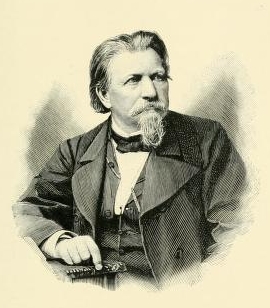
KARL GUTZKOW
The most able of them all was undoubtedly Karl Gutzkow, born in Berlin in 1811, a man of a tireless, energetic, inquiring spirit, absorbed in the thousand problems of modern life, a cross between an analytical critic and a poet, but a man to whom nothing came of itself and who achieved nothing with ease. His personality had no charm, his youth no freshness, his prose no rhythm. But he was bold, inventive, intelligent, and enterprising. He had the gift of pathos, but not the lyric gift; his style was effective, but unmelodious. His mind was specially open to ideas, to all the thoughts and spiritual movements that were abroad at that day. By nature he belonged to the ungainly, but his literary enthusiasm was so genuine, his ambition so great, and his will so strong, that he gradually became an intellectual centre and diffused his influence in many directions. There was a time, about the year 1840, when a great part of what was best in German literature took its tone from him and his adherents.
We saw how it was the Revolution of July that awakened in him a desire to write. The following year, the great year of dismissals, imprisonments, and banishments in Prussia, put the pen into his hand. It was a time when every word underwent the strictest censorship; even the advertisements in the Intelligenzblatt were carefully examined, in case they might contain some hidden political meaning.
Gutzkow began by publishing a newspaper, Forum der Journallitteratur. He had been brought up on the Hegelian idea of the progress of the world towards ever greater liberty. As Gottschall has expressed it: "There swam before his eyes a constant succession of political sunrises and world-liberating theories." His newspaper reached a circulation of seventy copies, and was then given up.
Wolfgang Menzel, at that time the acknowledged master of German criticism, had repeatedly invited Gutzkow to come to Stuttgart and assist him in the editorship of his Litteraturblatt, as he himself, having been elected a member of the Würtemberg Parliament, was no longer able to conduct it alone.
In spite of his hatred of Goethe, nay, partly because of it, Menzel, at this period of his career, was revered by the youth of Germany much as Katkóf and Ploug in their first periods were revered in Russia and Denmark. He, above all others, was to them the man of the day, the friend of liberty. One of Gutzkow's aims in his newspaper had been to defend Menzel, the man after his own heart, against the attacks of his enemies—and Menzel had many enemies, for as a reviewer he was disputatious, quarrelsome, and abusive. But he was, or seemed to be, a man of sincere convictions. He urged the necessity for a profounder conception of patriotism and of religion than was then in vogue, but at the same time he was an ardent Liberal in politics, and as such an admirer of Börne and Heine, who looked upon him as a trusty companion in arms; in Parliament he championed all progressive measures, amongst others the emancipation of the Jews.
Gutzkow, not yet much over twenty, short, slight, fair, and pale-faced, entered the presence of his lord and master, who was thirteen years older than himself, with a bashful reverence which he has compared to that of the student who appears before Mephistopheles-Faust in the first part of Goethe's drama. He saw a man with broad shoulders, a well developed chest, and dark hair, whose clean-shaven face reminded him of a Romish priest's. Round the mouth, with its ugly yellow teeth, a satiric smile played; the expression of the short-sighted eyes behind the spectacles was half defiant, half dignified. The man's temper seemed to be violent, his will inflexible. An expression of faun-like sensuality would come over his features when he talked of some erotic book, and yet Goethe's worldliness was as hateful to him as his indifference to politics, and he uncritically bowed the knee to men and phenomena that to his mind represented the mysterious. His character was a genuine priestly blend of irony and mysticism. He loved Voltaire, and enthusiastically admired Görres.
Master and pupil agreed well at first, both in their social and in their business relations. Gutzkow, who lived now in one, now in another of the towns in the neighbourhood of Stuttgart, indefatigably reviewed the great parcels of books sent him by Menzel. He soon caught the brisk, sweeping journalistic style, and all went well. The youthful works which he himself published, naturally found a more than lenient critic in Menzel. Yet they were poor enough. Briefe eines Narren an eine Närrin ("Letters from a Male to a Female Fool") are humorous effusions without originality, in a style which is partly an imitation of Jean Paul, partly of Heine; and Maha Guru, the History of a God, the description of the psychological condition of a Tibetan who is made Dalai-Lama and consequently worshipped as a divinity, is a piece of fantastic writing, now totally unreadable. Yet Menzel, when reviewing this latter book, chose from amongst the vignettes which alternately figured on the title-page of his review, a laurel wreath, and had Gutzkow's name twice printed within its circle.
Gutzkow's intention in Maha Guru was to show how the god who is supposed to be incarnated in the Dalai-Lama is subordinated to the man in him, the false divinity being completely thrown into the shade by the true nobility, true divinity of the human being. But besides this, the book was intended to be a philosophical-satirical romance in the old style, representing home institutions in foreign guise. The Tibetan theocracy was intended to suggest the European hierarchy, the Tibetan polyandry the European emancipation of woman. The foreign scenery, which Gutzkow had never seen, the foreign customs, which were not described for their own sake, could not interest. The book was suggested to him by the story of the French atheist, Billaud-Varennes, who escaped the guillotine during the Reign of Terror, took refuge in America, and was there worshipped by the Indians as a god. His skill in catching, training, and stuffing birds made such an impression on them that they looked upon him as a second creator. But all this had little to do with Tibet, and the would-be gravity of Gutzkow's theme.
Up to this time Young Germany and its fathers had not seemed to Menzel to be sacrilegious scoffers or bad patriots. Gutzkow's irreligion so far had not disturbed the good relations between him and his master. Menzel himself praised Börne's Letters from Paris, which were attacked on all sides, as manly utterances, and excused their strong expressions as outbursts of feeling which must not be too roughly dealt with; he compared them to the glow-worms which shine so beautifully on mild summer nights, but which turn into poor little grey insects when seized by rough hands.
But it was inevitable that the tie between Gutzkow and Menzel should soon be loosed. From the first Gutzkow had received warnings not to involve himself too deeply with the Stuttgart author. Hegel himself, who took an interest in the young man, had said to him: "How can any one bind himself to a man like that?" The first disagreement between them was on the subject of Menzel's attitude to the South German lyric poets, the so-called Swabian school, followers of Uhland, a poet who not only enjoyed the fame which he most undoubtedly deserved, but a far greater. As a good Swabian, Menzel esteemed and supported these men—Gustav Schwab, Gustav Pfizer, Karl Mayer, &c.—as bulwarks of conventional piety and morality. But Gutzkow, with his keen sense of what was the life-idea of the time, Gutzkow, to whom literature was the church militant, had the greatest objection to such Sunday afternoon, gilt-edged poets, men who put into rhyme old, dead ballad themes, or their own petty, sentimental feelings, whilst they were cautiously watching over their interests as government servants aspiring to professorships or consistory counsellorships.
When Goethe's Conversations with Eckermann appeared, it became known how severely Goethe had judged his admirer Uhland's poetry. He would hear of nothing but the ballads, considering all the rest unworthy of notice. And a most contemptuously disparaging verdict upon the whole Swabian school, from Uhland to Pfizer, was presently published in Goethe's Correspondence with Zelter: he (Goethe) had never expected anything fresh or capable from that quarter; the fellows concealed their want of genius under the moral-religious-poetical beggar's cloak.[2]
After this Gutzkow took courage and proclaimed that to him also this antiquated pastoral and cloistral Romanticism was an abomination. In an essay entitled Goethe, Uhland, und Prometheus he made a violent attack on those poets who sought and "found their creed in their certificates of baptism, their morals in conventionality, their principles in established custom, and their poetry in the poetry of other people." What have you to offer us? he cried. Evening walks in the setting sun. Where is your effort to keep pace with the times?
Meanwhile the reaction against the Revolution of July was in full progress everywhere. The policy of Prussia, as well as that of Austria, was controlled by Metternich; and when the youth of Germany began to understand on what side the power and the energy were, and probably would be for long to come, they went over to that side. Gutzkow says, that out of every hundred students at the University of Berlin at that time, ninety-seven were strong Conservatives; and every meeting with an old school or college companion, more especially if he happened to be a civil servant or an officer, left a most painful impression on his mind.
In such circumstances it often happens that high-spirited, able young men lose their heads and commit rash actions for which they are blamed all their lives.
Schleiermacher was dead, laid to rest with great ceremonial, mourned as a father of the Protestant Church, one of the saints of theology. It had long ago been said, and well said, of him, that his character answered to his name (Schleiermacher = veilmaker). By dint of ambiguities and uncertain utterances he had kept himself popular to the end of his days. No one had brought up against him that Romantic sin of his youth, the Vertrauliche Briefe um Lucinde ("Confidential Letters on the Subject of Lucinde.")
But now Gutzkow, who erroneously concluded that this forgotten book would be omitted from the edition of Schleiermacher's works then in preparation, could not resist the temptation to republish it, and to defend himself and his friends against the perpetual accusations of godless immorality by showing that their erotic views, and even their doctrine of the rehabilitation of the flesh, had been held by that man of God who was the revered lord and master of the theologians.
This might have been a good tactical move if the youth, for he was still only twenty-three, had not written a foolish, boyish preface to the book. In it he addresses himself to the "watchmen of Zion," scoffs at their sanctimoniousness and spiritual coquetry, and thus adjures them:—"For one moment cast your priestly robes from you, forget that a man whom you still perpetually crucify was God, and listen to what happened once on a time elsewhere, in the world of liberty, youth, and fancy!"
What had happened was the publication of Schlegel's Lucinde, that lewd skeleton, which in Gutzkow's eyes is glorious and classic, and of Schleiermacher's letters about it, which in Gutzkow's estimation are divine. The Letters speak for themselves. They absurdly over-estimate Lucinde, but the genuine human feeling in them is beautiful and courageous. In Gutzkow's preface everything is emphasised in a disagreeably defiant manner. He avers that love is of the nature of genius, maintains that priestly action neither adds to nor takes from the sacredness of marriage, tauntingly declaims against the cold prose of the ordinary marriage, "the water-soup weddings, the sordid procreation of children and struggle for mouldy bread." He winds up flippantly with: "Now tell me truly, Rosalie! Is it not since you have worn spurs on your little silk boots, since I have taught you how to throw your cloak over your shoulder, since I have invented a new sort of inexpressibles for you, so that every one takes you to be my youngest, dearly loved brother, is it not since then that you know what I meant by: I love you?" And not content with this female wearer of breeches, who is the realisation of his idea of the emancipation of woman, Gutzkow last of all plays out an atheistic trump; "Where is Franz?—Come here, dear boy. I know they baptized you secretly. Who is God? What! you don't know, you innocent atheist, you philosophic child! Oh, if the world too had only not known about God, how much happier it would have been!"
No specially acute critical faculty is needed to detect the unreality in this student's braggadocio. The original of the Rosalie who was to follow Gutzkow about in page's dress was more probably the Kaled of Byron's Lara than any Heidelberg or Berlin seamstress. It is easy to imagine what effect such a preface to such a book would produce on the general public and on orthodox journalism.
Only a drop was needed to fill the cup of public indignation, and that drop Gutzkow did not fail to add. In 1835 he wrote Wally, die Zweiflerin ("The Sceptic"), which is an exceedingly weak story, with a positively burlesque crucial episode, but which nevertheless influenced the course of events more powerfully than any other German literary work of the day.
Strauss's Life of Jesus had lately come out, and its resolution of the historical element in that life into myths, bold and fanciful to the verge of folly as the hypothesis was, had violently perturbed the thinking minds of Germany. Indignation was universal. A thousand-voiced cry of condemnation rose from the Eider to Switzerland. For many a year, in the public mind, there was a dark stain on the name of David Strauss.
The book was talked about everywhere, and Gutzkow one evening began to discuss its problem with a young girl to whom he was attached. "Don't let us talk about that," she said, "the very thought drives me mad!" These words made a strong impression on him.
Strauss's book itself had not satisfied him. Rationalist as he was, he felt the need for a historic Jesus, and betook himself to the study of Reimarus's old Wolfenbüttel Fragments, to which Lessing before him had devoted so much attention. He determined to publish a selection from these, but it was in vain that he applied with this intention to the most courageous of the German publishers, Campe. In spite of his bold political attitude, Campe dared not expose himself to the rancour of the Hamburg clergy, Pastor Goetze's successors in the cure of souls.
It was about this time that the noble Charlotte Stieglitz committed suicide. The impression produced by this tragic event combined itself in Gutzkow's mind with the impressions made by his young friend's remark and by Reimarus's Biblical criticism—and Wally, the Sceptic, was the result.
It is a childish book, this Wally, but it is innocent, honest, and artless. The heroine is a young lady moving in good society, who, in despair at not being able to overcome the religious doubts awakened in her mind by the man she loves, the sceptical, blasé Cæsar, kills herself with a dagger.
Gutzkow had been unable to withstand the temptation of reminding the venerable lights and defenders of the Church, the dignitaries of all the different classes of the Order of the Red Eagle, that there had once lived men named Hume, Voltaire, Lessing, &c. There was something fascinating to a young man in the idea of reminding such grand folks of such forgotten existences. But it ought to have been done with talent. In Gutzkow's novel the plot was a mere excuse for ventilating theories, Wally was a weak imitation of Lélia, the last novel which George Sand had published.
But its author was in the spring-tide of his youth. It seemed to him as if the whole world were growing young again. The glow of Hegel's sinking sun still illuminated the horizon, Bettina arose like a morning star, the ever-young wisdom of Rahel was scattered abroad over the earth after her death like fruitful dew, Lenau's and Rückert's early poems were like the song of the lark, Ruge's first critical articles and Feuerbach's first philosophic writings were like fresh spring breezes that cleared the air—the time seemed to him so sunny, so promising, so laden with fruit, that it was as it were symbolised by the two glorious summers of 1834 and 1835, with their rich harvests of corn and wine. And it was then he committed his first great youthful blunder.
He was not satisfied with embodying his religious heterodoxy in his book; he also proclaimed his moral heterodoxy, his defiance of the accepted code of sexual morality—a very clumsy and immature defiance. But the best idea of how very innocently Gutzkow interpreted that watchword, "the emancipation of the flesh," which he himself employs, is to be gained from the notorious scene in Wally, which was intended by the author to express his worship of beauty.
Wally loves Cæsar and is loved by him, but they cannot marry each other, because Wally has been obliged to betroth herself to the Sardinian ambassador. Cæsar entreats her that she will as it were symbolically celebrate a spiritual marriage with him by showing herself to him in all her naked beauty the night before her wedding. In an old German ballad, the heroine, Sigune, thus displays herself to Tchionatulander.
No one will deny that Cæsar's request is insane and its fulfilment ridiculous. But the intention of the scene was so chaste and its execution so inoffensive, that only positive low-mindedness could have made it the occasion of calling for the assistance of the police. We read; "The cloak slips from the young hero's shoulders; his hair waves freely and luxuriantly. To the left there appears out of the sun-mist an image of intoxicating beauty—Sigune, displaying herself more bashfully than the Medicean Venus hides her nakedness. She stands there helpless, dazzled by the glamour of the love that besought this favour; her will is gone; she is the personification of shame, innocence, and self-abandonment. And in sign that this is a consecrated, holy scene, no roses bloom, but a high-stemmed lily has shot upwards close to her body, symbolically covering her as the flower of chastity. It all happened in one breathless, silent moment—it was sacrilege, but the sacrilege of innocence and of woeful, eternal renunciation." This is all.
The relations between Gutzkow and Menzel were no longer what they had been. Now and again, in some preface or article, Gutzkow had ventured to make a small joke at the expense of his former patron, or a modest protest against one or other of his utterances. And in a more practical way Gutzkow had for some time past been a thorn in the side to Menzel. His literary supplement to the Frankfort newspaper, Phoenix, was a dangerous rival to Menzel's Litteraturblatt. But there was worse than this. Gutzkow had gradually got into friendly correspondence with the leaders of the new literature, Laube, Wienbarg, Mundt, &c., men who were rapidly taking possession of all the more important literary organs in Berlin, Leipzig, Frankfort, and Hamburg. When, in 1835, Gutzkow and Wienbarg issued the prospectus of a literary review in the style of Revue des Deux Mondes, with almost all the most eminent literary names in Germany on its list of contributors—university professors like Boeckh, influential writers like Varnhagen, not to mention a talented author like Börne and a genius like Heine—Menzel felt the necessity for striking a telling blow.
An invitation to subscribe to the Deutsche Revue had been published. It was written by Gutzkow, in flowery, metaphoric language—declares that science is longing to escape from musty class-rooms into the free open air, that the bird of Minerva is no longer the owl, which is afraid of the light, but the eagle, which gazes steadfastly into the sun, &c., &c.
Instead of confining his attack to this programme, which was inoffensive and in some respects promising, Menzel, in his Litteraturblatt of the 11th and 13th September 1835, published a general manifesto against the company of young authors headed by Karl Gutzkow. The apology for this action, which he makes as an old man (in his Memoirs, p. 304), shows unquestionable proof of narrow-mindedness, but not of any honest conviction. To emphasise the cosmopolitan tendencies and French sympathies of Young Germany, he wrote of it as "La jeune Allemagne." He directed his principal attack against Wally, from which book he quoted a few disconnected passages to show that the whole novel was immoral and sacrilegious; the insignificant sensual element in the story, the Sigune scene, is made its main feature.
"Only in the deepest mire of immorality, only in brothels, are such atheistic views hatched. They were in vogue among the philosophical parasites of the old French court. In the Palais Royal they were translated from the language of the court into that of the Jacobins. Herr Gutzkow has taken it upon himself to transplant once again into Germany that infamous French ape who, in the arms of a harlot, mocks at God, but he has done it in an age which, praise be to God, is more mature and more manly than the age of Voltaire. Even then vice was foiled by the natural disposition of our nation; now it will be even more impossible for it to effect an entrance. Literature will expel it, public opinion brand it.... If such a school for the most impudent immorality and the most refined falsehood is allowed to establish itself in Germany, if all the noble minds of the nation do not set themselves against it, if German publishers do not beware, but venture to offer such poison for sale and to praise their wares, we shall soon see the result.... But I will tread down your filth, though I know that I shall defile myself by doing so; I will bruise the head of the serpent that warms itself in the hot-bed of sensuality.... As long as I live, such infamous dishonouring of German literature shall not go unpunished...."
And Menzel, the practical journalist, was not satisfied, like the ordinary author, with saying a thing once for all. He repeated his accusations in one number after another of his paper with growing emphasis, more abusive language, more venomous imputations, appealing more and more plainly to the State to interfere while it was yet time.
On the 26th of October he wrote: "I know that their war against Christianity, against morality, against marriage is of no more significance than the war of young owls against the old sun. But a spark may give rise to a conflagration.... Upon the new literary judgment-seat in Frankfurt, Venus vulgivaga will be enthroned in place of justice ... never will these men, who only believe in the flesh, these priests of foulness, forgive an author for being purer than they are.... Is it possible to sit still and allow them to propagate French morality among us by word and deed? Under the mask of French republicanism, this libellous, infamous new Frankfurt school is introducing the most frightful immorality. The flesh, unbridled sensuality, the abolition of marriage, are their watchwords, and they not only write obscene books themselves, but serve up the old ones afresh.... They are to a certain extent disciples of Saint-Simon, they proclaim a still more dissolute republicanism, without any virtue, a hetæra-republic on the grandest scale.... As yet these principles are confined to the narrower, aristocratic circles of literature.... But to what do these doctrines appeal but to the bestiality and ferocity which, though they are still slumbering, would be so easily aroused in the great capitals and manufacturing towns, with their obscene haunts of drunkenness and depravity."
On the 11th of November Menzel directly denounces the Prussian university professors who have been rash enough to promise Gutzkow their co-operation in his review: "Are the universities not State institutions? Does the Prussian State no longer protect Christianity, morality, marriage? We have heard so much of the moral, religious, Conservative spirit that prevails in Prussia. Are we now to see the most eminent professors of Berlin, Königsberg, and Halle following at the heels of an obscene Marat, who, like the real Marat, literally preaches the sacrament of 'the irresistible moment' and a republic of sans-culottes and sans-chemises? Are we to hear them raving with him against Christianity, morality, marriage, the family, modesty, against God and immortality, against German nationality and the established order of things?" And he concluded his outburst by applying the designation of a Jewish party to the good Germans, Gutzkow, Wienbarg, Laube, Mundt, and Kühne, because of their sympathy with the ideas of Börne and Heine. Young Germany, he declared, was in reality Young Palestine.
As a consequence of this denunciation, Karl Gutzkow was arrested on a charge of blasphemy and lewd writing, and Menzel was dishonourable enough to go on exciting public indignation against him whilst he was in confinement and the case was being tried at Mannheim. The sentence pronounced was, however, only ten weeks' imprisonment for attacking the existing religious institutions of Baden.
But fear of the revolutionary movements which Menzel maintained would be the result of the teaching of Young Germany, induced the German Confederation to take action, and on the 10th of December 1835 the Federal Diet passed a resolution, which aimed at nothing less than the annihilation of the whole group of authors, young and old, which it comprehends under the designation Young Germany. It reads as follows: "In view of the fact that a school of literature has lately come into existence in Germany, a school now known by the name of 'Young Germany,' or 'the young literature,' whose aim is, by means of belletristic writings, accessible to all classes of readers, impudently to attack the Christian religion, to discredit the existing conditions of society, and to subvert all discipline and morality, the Council of the German Confederation (Bundesversammlung) ... has unanimously passed the following resolutions: (1) All the German Governments bind themselves to bring the penal and police statutes of their respective countries and the regulations regarding the abuse of the press in their strictest sense to bear against the authors, publishers, printers, and disseminators of the writings of the literary school known as 'Young Germany' or 'the young literature,' to which notably belong Heinrich Heine, Karl Gutzkow, Heinrich Laube, Ludolf Wienbarg, and Theodor Mundt, as also by all lawful means to prevent the dissemination of the writings of this school by booksellers, lending libraries, or other means," &c., &c.
It was in this manner that the appellation Young Germany first became familiar to the general public. It was the German Police-Confederation which, constituting itself a critical authority, stigmatised a group of authors, mentioned by name, as an immoral and injurious "school"—and this on the information of one single rival of these men in the favour of the reading public.
Menzel was to Young Germany what Southey in his day was to the "Satanic school" in English literature, alias Byron and Shelley, or Katkóf, a generation later, to the "traitorous school" in Russian literature—Herzen, Ogarev, and Bakunin. In disturbed times the informer is as necessary an appendage to the foreground figures as the envious rival and spy was to the hero of the old tragedies.
XXII
GUTZKOW, LAUBE, MUNDT
The determination of the Federal Council to suppress the writings of Young Germany not only nipped the Deutsche Revue in the bud, but also put an end to the existence of Mundt's Litterarischer Zodiacus, published in Leipzig, and prevented the publication of Laube's Mitternachtszeitung, which was to have appeared in Brunswick. Immediately after Menzel's first attack on Gutzkow and his friends, Mundt, with the valour of the prudent man, had written a series of severe articles against Heine, Gutzkow, and Wienbarg—but all to no purpose; his fate was sealed.
It seemed for a time as if the resolution were intended not only to affect everything that the proscribed authors had already written, but everything that they might write in the future.
An edict of the Prussian Government, dated 11th December 1835, expressly provides that "the future literary productions of Heinrich Heine, wherever they may be published and in whatever language, are to be subject to the same regulations as the writings of Gutzkow, Wienbarg, Laube, and Mundt." And not only was every possible measure taken to silence the obnoxious authors, but (as in Russia, when a man is in disgrace with the Government) it was made illegal, even for those who desired to write disparagingly of them, to print their names. Mundt's name was erased from the list of contributors to the Berliner Jahrbücher für wissenschaftliche Kritik, and in the announcements of Varnhagen and Mundt's edition of Knebel's Literary Remains, Varnhagen alone might be named as editor.
Excessively strict precautions were at the same time taken with regard to foreign publications. A few inoffensive English and French newspapers were countenanced. In the case of all the others the expedient was resorted to of requiring the same postage to be paid for them as for letters, thereby raising the cost of such papers to at least 500 thalers (£75) per annum.[1]
To the leaders of Young Germany the Government thus offered the compulsory choice between biding their time in defiant silence and purchasing other conditions for themselves by disowning their past and making humiliating promises for the future. No one who has had any experience of the average valour of the denizens of the literary world can feel surprised that few stood this test, that many accepted the second alternative. Neither Heine, Wienbarg, nor Gutzkow gave in; but many others made pitiable exhibitions of themselves. Crowds of the young authors who had plumed themselves upon their revolutionary-philosophical, their oppositionist-political ideas, now hastened to prove their philosophic commonplaceness, their political innocuousness. The name "Young Germany" had been an honourable name; but now that those who had borne it found themselves the objects of special police surveillance, they refused to acknowledge it, each declaring that he, at least, did not belong to the party, and that if he ever had done so, it was an old story, and he had since then become a most respectable member of society. In this case, as so often, it was proved that modern high-class education only provides desultory knowledge, does not form character, and least of all amongst those who make their living by their pens.