II THE ROMANTIC SCHOOL IN GERMANY (continued 2)
Mary Morison translation
The conception of the State which we find in Hyperion is also quite in harmony with the spirit of the age, and quite un-Hellenic. "The State dare not demand what it cannot take by force. But what love and intellect give cannot be taken by force. It must keep its hands off that, else we will take its laws and pillory them! Good God! They who would make the State a school of morals do not know what a crime they are committing. The State has always become a hell when man has tried to make it his heaven."
Utterly un-Greek, wholly Romantic, is the love which Hyperion cherishes for his Diotima. It is the same deep and tragic feeling which bound Hölderlin, the poor tutor, to the mother of his pupils, Frau Susette Gontard, and determined his fate. No Greek ever spoke of the woman he loved with the religious adoration which Hölderlin expresses for his "fair Grecian." "Dear friend, there is a being upon this earth in whom my spirit can and will repose for untold centuries, and then still feel how puerile, face to face with nature, all our thought and understanding is." And exactly the same Romantic, Petrarchian note is struck by Hyperion when he speaks of Diotima. Diotima is "the one thing desired by Hyperion's soul, the perfection which we imagine to exist beyond the stars." She is beauty itself, the incarnation of the ideal. Love is to him religion, and his religion is love of beauty. Beauty is the highest, the absolute ideal; it belongs, as a conception, to the world of reason, and as a symbol, to the world of imagination. From his æsthetic point of view, Hölderlin does not perceive that boundary line drawn by Kant between the domains of reason and imagination. His theory, a species of poetic—philosophic ecstasy, having points in common with both Schiller's Hellenism and Schelling's transcendental idealism, is Romantic before the days of Romanticism.
Germinating Romanticism is also to be traced in the gleam of Christian feeling which tinges his half-modern pantheism. He had been originally destined for the Church, and had suffered much from the severe discipline of the monastery where he was educated. In spite, however, of the many evidences of a pious disposition which we find in his letters, he was a pagan in his poems. He disliked priests, and steadily withstood his family's desire that he should become one. In his Empedokles we come upon the following significant reply of the hero to the priest Hermokrates:—
"Du weisst es ja, ich hab es dir bedeutet, Ich kenne dich und deine schlimme Zunft. Und lange Avar's ein Räthsel mir, wie euch In ihrem Runde duldet die Natur. Ach, als ich noch ein Knabe war, da mied Euch Allverderber schon mein frommes Herz, Das unbestechbar, innig liebend hing An Sonn' und Aether und den Boten allen Der grossen ferngeahndeten Natur; Denn wohl hab ich's gefühlt in meiner Furcht, Dass ihr des Herzens freie Götterliebe Bereden möchtet zu gemeinem Dienst, Und dass ich's treiben sollte so, wie ihr. Hinweg! ich kann vor mir den Mann nicht sehn, Der Göttliches wie ein Gewerbe treibt, Sein Angesicht ist falsch und kalt und todt, Wie seine Götter sind."[1]
There is not a trace in Hölderlin of the sanctimonious piety developed by the other Romanticists, who, to begin with, were far more decided free-thinkers than he. Yet his Hellenism is not pagan in the manner of Schiller's and Goethe's. There is a fervency in it which is akin to Christian devotion; his poetic prayers to the sun, the earth, and the air are those of a believer; and when, as in Empedokles, he handles a purely pagan subject, the spirit of the treatment is such that we feel (as we do in a later work, Kleist's Amphitryon) the Christian legend behind the heathen. The position of Empedokles to the Pharisees of his day and country is exactly that of Jesus to the Pharisees of Judea. Empedokles, like Jesus, is the great prophet, and both his willing sacrificial death and the worship of which he is the object awake feelings which remotely resemble those of the devout Christian.
In Hölderlin we find in outline, light and delicate as if traced by a spirit, symbols and emotions which the Romantic School develops, exaggerates, caricatures, or simply obliterates.
III
A. W. SCHLEGEL
In 1797, August Wilhelm Schlegel, then aged thirty, published the first volume of his translation of Shakespeare. Rough drafts of several of the plays in this edition have been found, and these faded, dusty manuscripts not only enable us to follow the persevering, talented translator in his self-imposed task, but, when carefully read, give us direct insight into his and his wife's spiritual life, and indeed into the intellectual life of the whole period.[1]
Even apparently insignificant details are suggestive. The manuscripts are not always in A. W. Schlegel's handwriting. He set to work upon Romeo and Juliet in the winter of 1795-96; in 1796 he married Caroline Böhmer; and we have a complete copy of the first rough draft of the play in Caroline's handwriting, with corrections in Schlegel's. In September 1797, as her letters show, she copied As You Like It from an almost illegible manuscript. And she was more than a mere copyist. She collaborated with Schlegel in his essay on Romeo and Juliet, which ranks next to Goethe's disquisitions on Hamlet in Wilhelm Meister as the best Shakespeare criticism produced in Germany up to that time. We recognise her now and again in some outburst of womanly feeling, or in a greater freedom of style than we are accustomed to in Schlegel. She had a far truer understanding than her contemporaries of the full significance of a work, the aim of which was the incorporation of Shakespeare in his unalloyed entirety into German literature. But her interest in the work and the labourer did not, as the manuscripts show us, survive the first year of her married life. At first it is her handwriting which predominates, and, though it is less frequently to be seen alongside of her husband's in the manuscripts of those plays with which he was occupied during the years 1797-98, her collaboration is still apparent. We find the last traces of her pen in the manuscript of the Merchant of Venice, which dates from the autumn of 1798. In October of that year, Schelling joined the Romanticist circle in Jena. Thenceforward no more of Caroline's handwriting is discoverable.
Among the manuscripts in question, two give us a very distinct idea of the progress of Schlegel's intellectual development. They are two different texts of the Midsummer Night's Dream.
Before A. W. Schlegel's time no one in Germany, or elsewhere, had attempted to translate Shakespeare line for line. The two tame prose translations by Wieland and Eschenburg were, in fact, all that existed. As a student in Göttingen, Schlegel made the first attempt to reproduce in German verse parts of the Midsummer Night's Dream. From childhood he had been "an indefatigable verse-maker." His talent was obviously inherited. Half a century before he and his brother made their appearance, two brothers Schlegel had made a name for themselves in literature—Johann Elias, who lived for many years in Copenhagen, was a friend of Holberg, and, in everything connected with the stage, a forerunner of Lessing, and Johann Adolph, father of August Wilhelm and Friedrich, who, without much originality, possessed decided linguistic and plastic talent.
As a young student, August Wilhelm, already distinguished by his impressionableness as a stylist and opinionativeness as an author, ardently desired to make the acquaintance of Bürger, who was leading a lonely and unhappy life as professor at the University of Göttingen. Bürger's fame as a poet procured him no consideration in a place where learning alone was valued; his social position had, moreover, been injured by the discovery of his relations with his wife's sister. With the feelings of an exile, he warmly welcomed the distinguished and talented young disciple, whose taste was more correct and whose stores of knowledge were better ordered than his own. At this time Bürger was still considered to be Germany's best lyric poet and most accomplished versifier. Schlegel placed himself under his tuition, and learned all his linguistic and metrical devices, all the methods of producing artistic effects by careful choice and arrangement of words and use of rhythm and metres. With his natural gift of imitation, he appropriated as many of Bürger's characteristics as were at all compatible with his entirely different temperament. His poem Ariadne might have been written by Bürger. Bürger had been particularly successful in the sonnet, a form of poetry which had lately come into vogue in Germany. So closely did the pupil follow in the footsteps of his master, that when, many years later, a complete edition of Schlegel's works was published, two of Bürger's sonnets were accidentally included among them.
The master did homage to his remarkably promising pupil in a fine sonnet, beginning:—
"Junger Aar, dein königlicher Flug Wird den Druck der Wolken überwinden, Wird die Bahn zum Sonnentempel finden, Oder Phöbus' Wort in mir ist Lug,"[2]
and ending with the charmingly modest lines:—
"Dich zum Dienst des Sonnengotts zu krönen Hielt ich nicht den eignen Kranz zu wert, Doch—dir ist ein besserer beschert."[3]
Schlegel responded with a criticism of Bürger's frigidly grand Das hohe Lied von der Einzigen, which he praises as a magnificent epic. In collaboration with Bürger he now began a translation of the Midsummer Night's Dream, of which he did the greater part, Bürger merely revising. He was still completely under his master's influence; the manuscripts show that he always accepted Bürger's corrections and deferred to his predilection for sonority and vigour. As a translator, Bürger took no pains to reproduce Shakespeare's peculiarities as closely as possible; he only manifested his own peculiarities, by making all the coarse, wanton speeches, and the passages in which misguided passions run riot, as prominent as possible; he emphasised and exaggerated everything that appealed to his own liking for a coarse jest, and destroyed the magic of the light and tender passages. In spite of his own great and natural love of refinement, young Schlegel strove in this matter also to follow in his master's steps, with the result that he was not infrequently coarse and awkward where he meant to be natural and vigorous.
A better guide would have been Herder, who, long before this, in the fragments of Shakespeare plays in his Stimmen der Völker, had given an example of the right method of translating from English into German. If Schlegel had taken lessons from Herder in Shakespeare-translating, he would never have rendered five-footed iambics by Alexandrines, nor changed the metre of the fairy-songs. No one had realised the inadequacy of Wieland's translation more clearly than Herder. And now the spirit in which the latter aimed at Germanising Shakespeare descended upon Schlegel, who, in spite of the faults of his first attempts, soon surpassed Herder himself.
He was not long in shaking himself free from Bürger's influence. To Bürger the highest function of art was to be national and popular. In 1791, Schlegel, now no longer in Bürger's vicinity, but a tutor in Amsterdam, devoted much attention to the works of Schiller. His poetical attempts were henceforth more in the style of that master; he wrote a sympathetic criticism of Die Künstler; and he was led to a higher conception of art by the perusal of Schiller's æsthetic writings. His metrical style began to acquire greater dignity. But Schiller was almost as incapable as Bürger of developing in Schlegel a true and full understanding of Shakespeare—Schiller, who, in his translation of Macbeth, had transformed the witches into Greek Furies, and changed the Porter's coarsely jovial monologue into an edifying song. If Bürger's realism was one danger, Schiller's pomposity was another.
But at the same time that Schiller enlightened Schlegel as to the high significance of art, the newly-published Collected Works of Goethe, whom he only now began to appreciate, stimulated his natural inclination to study, interpret, and make poetical translations. As already mentioned, this first edition of Goethe's collected works met with but a poor reception. The chief reason of this was that the public, understanding nothing of the poet's mental development, had expected new works in the style of Werther or Götz. But to Schlegel's critical intellect, Goethe's wonderful many-sidedness was now revealed. He understood and appreciated the artist's capacity of forgetting himself for the moment, of surrendering himself entirely to the influence of his subject, which in Goethe's case produced forms that were never arbitrarily chosen, but invariably demanded by the theme. He understood that he himself, as a poetical translator, must practise the same self-abnegation and develop a similar capacity of intellectual re-creation. Two things were required of the translator, a feminine susceptibility to the subtlest characteristics of the foreign original, and masculine capacity to re-create with the impression of the whole in his mind; and both of these requirements were to be found in Goethe; for his nature was multiplicity, his name "Legion," his spirit Protean.
There still remained the technical, linguistic difficulties to overcome; and in this, above all, Goethe was an epoch-making model. He had remoulded the German language. In passing through his hands it had gained so greatly in pliability and compass, had acquired such wealth of expression both in the grand and the graceful style, that it offered Schlegel exactly the well-tuned instrument of which he stood in need. While under Bürger's influence he had looked upon technical perfection as a purely external quality, which could be acquired by indefatigable polishing; he now realised that perfect technique has an inward origin, that it is in reality the unity of style which is conditioned by the general cast of a mind. And he began to see that his life task was a double one, namely, to reproduce the masterpieces of foreign races in the German language, and to interpret critically for his countrymen the best literary productions both of Germany and other lands.
Now, too, Schlegel acquired a quite new understanding of Fichte, the friend and brother-in-arms whom the Romanticists had so quickly won for their cause. He realised that Fichte's doctrine of the Ego contained in extremely abstract terms the idea of the unlimited capacity of the human mind to find itself in everything and to find everything in itself. Round this powerful fundamental thought of Fichte's, August Wilhelm's pliable mind twined itself.
At this time he was much influenced by the correspondence which he kept up regularly with his younger brother. Friedrich had been drawn by August Wilhelm into the stream of the new literary movement, and his militant disposition made him the most reckless champion of the new principles as soon as he felt assured of their truth. The brothers had very different characters. The elder, in spite of the audacity of his literary views, had the better regulated mind. He had early developed a sense of form and of beauty. His chief gift was a capacity for moulding language; and accuracy, dexterity, and the sense of proportion were qualities he was born with. Except in cases of strong provocation, he showed moderation in scientific and artistic controversy; he knew comparatively early what he desired and what he was capable of; and his determination and perseverance made him a successful pioneer of the ideas and principles of which he had chosen to make himself the spokesman. He became the founder of the Romantic School, an achievement for which he possessed every qualification—this man whom his brother jestingly called "the divine schoolmaster" or "the schoolmaster of the universe."
Friedrich Schlegel was the more restless spirit, the genuine sect-founder. He himself tells us, in one of his letters, that it was his life-long desire "not only to preach and dispute like Luther, but also, like Mohammed, to subjugate the spiritual realms of the earth with the flaming sword of the word." He did not lack initiative, and abounded in plans so colossal that there was a jarring disproportion between them and his ability to carry them out. Eternally wavering, without tenacity or fundamental conviction, fragmentary in the extreme, but rich in both suggestive and disconcerting ideas and in witty conceits, he was constantly beset by the temptation to silence his opponents with mysterious terminology, and constantly liable to relapse into platitudes and meaningless verbiage. What Novalis once wrote to him was more correct than any one suspected: "The King of Thule, dear Schlegel, was your progenitor; you are related to ruin." As a critic, he was more impulsive and less impartial than August Wilhelm; as a poet, he was only once or twice in his life genuinely natural, and in his Alarkos he plunged into an abyss of bathos into which his brother, with his more correct taste, could never have fallen. The elder brother had started the younger in his literary career; the younger now drove the elder onward, and in the process put an end, by his unamiability, to the latter's friendly relations with Schiller, and, ultimately, even to his valued and long maintained friendship with Goethe.
August Wilhelm now put his translation of Shakespeare aside for a time, and turned his attention to the poets of the South. He experimented in all directions, translated fragments of Homer, of the Greek elegiac, lyric, dramatic, and idyllic poets, of almost all the Latin poets and many of the Italian, Spanish, and Portuguese. At a later period he even translated Indian poetry, his aim being to make the German language a Pantheon for the divine in every tongue. He lingered longest over Dante, although he did not possess the mastery of form required to render the terza rima; he rhymed only two lines of each triplet, thus altering the character of the verse and doing away with the intertwining of the stanzas.
After this he turned to Romeo and Juliet and Hamlet, sending fragments of his translations to Friedrich, who showed them to Caroline. Her judgment was favourable on the whole, but she found fault with the style as being rather antiquated; this she ascribed to Wilhelm's having been lately employed in translating Dante, his ear having thereby become accustomed to obsolete words and expressions. The fact was, that shortly before this he had awakened to the necessity of being on his guard against the elaborate polish which he had made his aim after giving up Bürger's style; he now fell into the other extreme, became archaic, rugged, and hard.
In 1797 Schlegel sent the first samples of Romeo and Juliet to Schiller. They were printed in Die Horen; and in the same periodical there presently also appeared his essay, Etwas über William Shakespeare bei Gelegenheit Wilhelm Meisters. In Wilhelm Meister Goethe had proclaimed the endeavour to understand Shakespeare to be an important element in German culture. In its conversations on Hamlet he had refuted the foolish theory that the great dramatist was an uncultivated natural genius, destitute of artistic consciousness. Had such been the case, the exact reproduction of his style would not have been a matter of vital importance in a German translation. But with so great an artist as the Shakespeare presented to us in Wilhelm Meister, it was plain that the harmony between subject and form must not be deranged. And yet even Goethe himself had, without any feeling of unsuitability, given his quotations from Hamlet in the old prose translation; even he had not realised how inseparably matter and manner are connected.
Slowly and laboriously Schlegel progresses. His judgment is still so defective that he fancies it impossible to dispense with Alexandrines; in Romeo and Juliet, he retains the five-footed iambics only "as far as possible"; the scene between Romeo and Friar Laurence he renders in Alexandrines, excusing himself with the remark that this metre is less detrimental in speeches garnished with maxims and descriptions than in the dialogue proper of the drama. The result is the loss of Romeo's lyric fervour.
He feels this himself, and with iron industry and determined enthusiasm sets to work again, rejects the Alexandrines, and compels himself, in spite of the verbosity of the German language, to say in ten or eleven syllables what he had said before in twelve or thirteen. For long it appears to him an impossible task to reproduce each line by one line. The translation swells in his hands as it did in Bürger's. Fourteen English lines become nineteen or twenty German. It seems to him that it is impossible to do with less; until at last he gains true insight, and sees, from the very foundation, how Shakespeare raises the edifice of his art. Now he renounces all amplitude and all redundancy that is not in Shakespeare. Each line is rendered by a single line. He curses and bewails the prolixity and inadequacy of German: his language has such different limits, such different turns of expression from the English language; he cannot reproduce Shakespeare's style; what he produces is a stammer, a stutter, without resonance or fire—but he coerces himself, he coerces the language, and produces his translation.
There is no great exaggeration in Scherer's dictum: "Schlegel's Shakespeare takes its place beside the works given to the world by Goethe and Schiller during the period when they worked in fellowship; there is the inevitable distance between reproductive and productive art, but there is the nearness of the perfect to the perfect."
Having acquired complete mastery of the style, Schlegel now began to reap the fruits of his labour. He, the master, opened his hand, and between the years 1797 and 1801 let fall from it into the lap of the German people sixteen of Shakespeare's dramas, which, in spite of occasional tameness or constraint of style, might, in their new form, have been the work of a German poet of Shakespeare's rank.
Let us consider what this really means. It means not much less than that Shakespeare, as well as Schiller and Goethe, saw the light in Germany in the middle of last century. He was born in England in 1564; he was born again, in his German translator, in 1767. Romeo and Juliet was published in London in 1597; it reappeared in Berlin as a new work in 1797.
When Shakespeare thus returned to life in Germany, he acted with full force upon a public which was in several ways more capable of understanding him than his original public, though it was spiritually less akin to him and though they were not the battles of its day which he fought. He now began to feed the millions who did not understand English with his spiritual bread. Not until now did Central and Northern Europe discover him. Not until now did the whole Germanic-Gothic world become his public.
But we have also seen how much went to the production of an apparently unpretending literary work of this high rank. In its rough drafts and manuscripts we may read great part of the intellectual history of a whole generation. Before it could come into existence nothing less was required than that Lessing's criticism and Wieland's and Eschenburg's attempts should prepare the soil, and that a genius like Herder should concentrate in himself all the receptivity and ingenuity of surmise belonging to the German mind, and should, with the imperiousness characteristic of him, oblige young Goethe to become his disciple. But Goethe in his prose Götz only imitated a prose Shakespeare. There had to be born a man with the unique talent of A. W. Schlegel, and he, with his hereditary linguistic and stylistic ability, had to be placed in a position to acquire the greatest technical perfection of the period. Then he had to free himself, by the influence of Schiller's noble conception of art, from the tendency to coarseness which was the result of Bürger's influence, and at the same time to steer clear of Schiller's tendency to pomposity and dislike of wanton joviality, had to gain a complete understanding of Goethe, to enter into possession, as it were, of the language which Goethe had developed, and to attain to an even clearer conviction than his of the essentiality of the harmony of subject and style in Shakespeare. It was necessary, too, that he should be stimulated by the ardour of a kindred talent and assisted by the keen criticism of a woman. Hundreds of sources had to flow into each other, hundreds of circumstances to coincide, of people to make each other's acquaintance, of minds to meet and fertilise each other, before this work, in its modest perfection, could be given to the world; a small thing, the translation of a poet who had been dead for two hundred years, it yet provided the most precious spiritual nourishment for millions, and exercised a deep and lasting influence on German poetry.
IV
TIECK AND JEAN PAUL
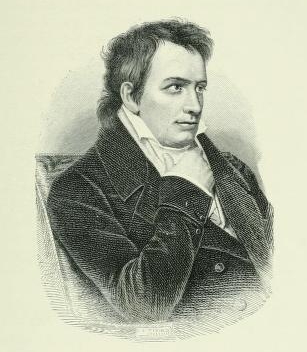
An apprehensive disposition, predisposing to hallucinations, congenital melancholy, at times verging on insanity, a clear, sober judgment, ever inclined to uphold the claims of reason, and a very unusual capacity for living in and producing emotional moods—such were the principal characteristics of Ludwig Tieck. He was the most productive author of the Romantic School, and, after its disruption, he wrote a long series of excellent novels, depicting past and present more realistically than Romantic writers were in the habit of doing.
The son of a ropemaker, he was born in Berlin in 1773. Even as a school-boy he was profoundly influenced by classic writers like Goethe, Shakespeare, and Holberg. He early succeeded in imitating both Shakespeare's elfin songs and Ossian's melodious sadness; but during one period of his youth he weakly allowed himself to be exploited by elder men of letters, at whose instigation he produced quantities of carelessly written, unwholesome literature. Though the spirit and tendency of his writings were prescribed for him, his characteristic qualities are, nevertheless, discernible even in these valueless early works. Under the direction of his teacher, Rambach, he wrote, or re-modelled in the spirit of the "enlightenment" period, sentimental tales of noble brigands, and invented gruesome episodes in the style of the death-scene of Franz Moor. But now and again, in some ironical aside, we get a glimpse of his own more advanced ideas.
A little later we find the future Romanticist writing precocious stories for the almanacs published by Nicolai, that old firebrand of the "enlightenment" period—stories in which superstition is held up to ridicule, and in which we only very occasionally come upon a touch of irony, such as the selection of a particularly inane old man to express contempt for "the stupid Middle Ages" and "Shakespeare's ghosts." No doubt Tieck wrote these compositions principally because he had sold his pen; still they none the less betray the weariness of the desponder, who is so exhausted by his long struggle with questions and doubts of every kind, that he can, without any great reluctance, side with those who depreciate genius and sing the praises of the sensible, bourgeois golden mean. His unsettled mental condition is shown no less clearly in his rationalistic tales than in the supernaturalism, the voluptuous cruelty, and the cold cynicism of the novels and plays dating from the beginning of the Nineties, in which he seems to give us more of himself.
Tieck's first work of any importance is William Lovell. The first part of this novel, which he wrote at the age of twenty, appeared in 1795. In it, when treating of art, he already occasionally touched the strings upon which the Romantic School subsequently played.
William Lovell goes to Paris (which Tieck at that time had not seen), and is, of course, disgusted with everything there. "The town is a hideous, irregular pile of stones. One has the feeling of being in a great prison.... People chatter and talk all day long without so much as once saying what they think.... I occasionally went to the theatre, simply because time hung so heavily on my hands. The tragedies consist of epigrams, without action or passion, and tirades which produce much the same effect as the words issuing from the mouths of the figures in old drawings.... The less natural an actor is, the more highly is he esteemed. In the great, world-renowned Paris Opera—I fell asleep." Such are the impressions made upon Lovell (an Englishman) by Paris at the time of the Revolution. It is nothing but an expression of the prevalent German contempt for the French character and French art, doubly unreasonable in this case because it has simply been learned by rote out of books. In the Théâtre Français, however, Lovell ejaculates: "O Sophocles! O divine Shakespeare!" and he characteristically observes: "I hate the men who, with their little imitation sun (namely, reason), light up all the pleasant twilight corners and chase away the fascinating shadow phantoms which dwelt so securely under the leafy canopies. There is, undoubtedly, a kind of daylight in our times, but the night and morning light of romance were more beautiful than this grey light from a cloudy sky."
LUDWIG TIECK
With the exception of a few such touches, this work seems at the first glance to be distinguished by none of the peculiarities one is accustomed to associate with a Romantic production; but, as a matter of fact, there is no book which reveals to us more distinctly the foundations on which the Romantic movement rests. The main idea and the form of William Lovell (it is written in letters) were both borrowed from a French novel, Le Paysan Perverti, by the materialistic writer, Rétif de la Bretonne. The fact that we are able to trace the origin of a Romantic work directly to French materialism is not without significance; it is in reality from this materialism that the Romanticists derive their gloomy fatalism. Lovell is an extremely tedious book to read nowadays; the style is tiresomely diffuse, the characters are as if lost in mist. Some of the subordinate figures, the devoted old man-servant, for instance, are weak imitations of Richardson—there is not a trenchant trait nor a dramatic situation in the whole book. Its merit, which is as German as are its defects, lies in its psychology. The hero is a youth who is led, slowly and surely, to do away, as far as he himself is concerned, with all authority, to disregard every one of the traditional, accepted rules of life, until at last he is leading the life, not only of a confirmed egotist, but of a criminal.
It is a mistake to feel surprised that so young a man as Tieck could depict such a being. Is it not precisely at this early age, when his spiritual eyesight does not yet enable him to look abroad, that the youth is constantly occupied with all the strange things he sees when he looks into his own heart? Is it not then that he is impelled to unravel himself, to examine his own condition, to look at himself perpetually in the mirror held out to him by his own consciousness? With men of a certain disposition there is no more self-critical age than twenty or thereabouts. There is still so much of life before one then, so much time to do one's work in; one spends the days in learning to know the instrument upon which one is to play for the rest of one's life, in tuning it, or finding out how it is already tuned. The time is still distant when the mature man will seize upon that instrument, which is himself, and use it—as a violin or as a sledge-hammer, according to the requirements of the situation. And if surrounding circumstances offer neither tasks nor sustenance, and the Ego is obliged to go on living upon its own substance, the result will inevitably be the exhaustion, the demolition of the personality.
What is peculiarly characteristic of author, tendency, and period, is the sentimental extravagance to which this introspection leads. In all seriousness the individual dares to make his fortuitous Ego, which has disorganised everything that established custom requires men to respect, the standard of everything, the source of all laws. Here we have unmistakably a distortion of Fichte's fundamental idea. Read the following verses from Lovell and the succeeding reflection:—
"Willkommen, erhabenster Gedanke, Der hoch zum Gotte mich erhebt. Die Wesen sind, weil wir sie dachten, In trüber Ferne liegt die Welt, Es fällt in ihre dunkeln Schachten Ein Schimmer, den wir mit uns brachten. Warum sie nicht in wide Trümmer fällt? Wir sind das Schicksal, das sie aufrecht hält! Den bangen Ketten froh entronnen Geh' ich nun kühn durchs Leben him, Den harten Pflichten abgewonnen, Von feigen Thoren nur ersonnen. Die Tugend ist nur, weil ich selber bin, Ein Wiederschein in meinem innem Sinn. Was kümmern mich Gestalten, deren matten Lichtglanz ich selbst hervorgebracht? Mag Tugend sich und Laster gatten! Sie sind nur Dunst und Nebelschatten, Das Licht aus mir fällt in die finstre Nacht. Die Tugend ist nur, weil ich sie gedacht."[1]
"My outer self thus rules the material, my inner self the spiritual world. Everything is subject to my will; I can call every phenomenon, every action what I please; the animate and the inanimate world are in leading-strings which are controlled by my mind; my whole life is only a dream, the many forms in which I mould according to my will. I myself am the only law in all nature, and everything obeys this law."
When Friedrich Schlegel exclaims, "Fichte is not a sufficiently absolute idealist ... I and Hardenberg (Novalis) are more what idealists ought to be," we remember that ten years previously, and long before there was any talk of Romanticism and Romanticists, Tieck had perceived what were to be the characteristics of the new school, i.e. personal lawlessness, and the glorification of this lawlessness, under the name of imagination, as the source of life and art. Lovell is an extravagant personification of these characteristics. Kierkegaard's Johannes the Seducer, the most perfect and the last example of the type in Danish literature, always keeps within certain bounds; he evades ethical questions, looking upon morality as a tiresome, troublesome power, and never attacking it directly; but Lovell, the more many-sided, the more boldly planned, if less skilfully worked-out character, recoils neither from treachery, nor bloodshed, nor poison. He is one of this period's many variations of the Don Juan-Faust type, with a touch of Schiller's Franz Moor. Satiety of self-contemplation has, in his case, led to a boundless contempt for mankind, to a ruthless sweeping away of all illusions; the one and only consolation being that thus hypocrisy is unveiled and the ugly truth seen. There is a close analogy with much that the Romanticists subsequently wrote in such an utterance as this: "Voluptuousness is undoubtedly the great mystery of our being; even the purest and most fervent love dives into this pool.... Only ruthlessness, only a clear perception of the illusion can save us; Amalie is, therefore, nothing to me, now that I see that poetry, art, and even love, are only draped and veiled sensuality.... Sensuality is the driving-wheel of the whole machinery ... voluptuousness is the inspiration of music, of painting, of all the arts; all human desires flutter round this magnetic pole, like moths round a candle;... hence it is that Boccaccio and Ariosto are the greatest poets, and that Titian and the wanton Correggio stand high above Domenichino and pious Raphael. Even religious devotion I consider to be only a diverted course of that sensual instinct which is refracted in a thousand different colours." One would expect this Lovell, in whose meditations sensuality plays so great a part, to be represented as a man whose instincts lead him far astray. Not at all! He is as cold as ice, as cold as Kierkegaard's shadow of a seducer, whom he in this particular anticipates. He does not commit his excesses with his flesh and blood, but with his fantastically excited brain. He is a purely intellectual being, a North German of the purest water. And there is one particular in which he is, in anticipation, astonishingly Romantic. When he has, so to speak, burned himself out, when every spark of conviction is extinguished in his mind, and all his feelings lie "slain and dead" around him, he seeks refuge in the supernatural and places his trust in mystic revelations, of which an old impostor has held out the prospect. This trait, which, significantly enough, is not to be found in his French prototype, was necessary to complete the character.
The personality here is so hollow, weighs so light in its own estimation, that the impression it produces on itself is, that it is both real and unreal; it has become unfamiliar to itself, and has as little confidence in itself as in any exterior power. It stands outside its own experiences, and when it acts, feels as if it were playing a part. Lovell tells us how he seduced a young girl, Emily Burton: "I suddenly cast myself at her feet, and confessed that it was nothing but my passionate love for her which had brought me to the castle; I declared that this was to be my last attempt to learn if there were any human heart that would still come to my aid and reconcile me to life and fate. She was beautiful, and I acted my part with wonderful inspiration, exactly as if it were a congenial rôle in a play; every word I said told; I spoke with fire and yet without affectation." And later he remarks: "She has herself to reproach for any temporary loss of home happiness; I am not to blame because, in accordance with conventional ideas, she is at present disgraced in the eyes of many. I played one part, she answered with another; we acted the play of a very stupid writer with great seriousness, and now we regret having wasted our time." The whole was nothing but a scene from a play.
In this fictitious character there are already developed those qualities which we find later in real characters, such as Friedrich Schlegel and Gentz; and in this one man's habit of mind we have all that, which, transferred to art, became the notorious irony of Romanticism. Here, in the character, is the undisguised egotism which looks upon life as a rôle; there, in art, the misconception and exaggeration of Schiller's idea that artistic activity is "a game," a play, i.e. an activity without any outward aim—in short, the belief that true art is that which perpetually shatters its own edifice, renders illusion impossible, and ends, like Tieck's comedies, in self-parody. There is the very closest resemblance between the manner in which the hero acts and the manner in which the comedy is written. The irony is one and the same; it may all be traced back to the same egotism and unreality.[2]
In order really to understand the psychological condition depicted in Lovell, we must not only see its ultimate consequences, but must also, as in the case of René, see how it originates and what conditions it. It is conditioned by the ferment of lawlessness distinctive of the period. Hence the most diverse creative minds co-operate in the production of the type. As a Titan of satiety, of tædium vitæ, Lovell is only one of a race of Titans.
Two years before Lovell was planned, Jean Paul, who was ten years older than Tieck and four years younger than Schiller, began a description of this race in his so-called "Faustiade," the novel Titan. Jean Paul is in many ways the forerunner of Romanticism; in the Romantic School Hoffmann recalls him to us, as Tieck recalls Goethe. He is a thorough Romanticist in the absolute arbitrariness with which, as an artist, he sets to work. As Auerbach says, he has "in readiness studies of men, moods, traits of character, psychological complications, and miscellaneous imagery, which he introduces at random, adjusting them to given characters or situations." He thrusts all kinds of irrelevant matter into the elastic framework of his story. He is, further, a Romanticist in his absorption in self—for it is himself, always himself, who speaks by the mouth of his characters, whatever they may be; in the famous humour which with him lords it over all else, respecting none of the conventions of style; and, finally, in the fact that he is the antipodes of classical culture. But, whatever he may have been in art, in life he was not the defender of lawlessness, but the ardent champion of liberty, Fichte's equal in enthusiastic persistence. He was neither the foe of enlightenment, nor of reason, nor of the Reformation, nor of the Revolution; he was convinced of the historical value and the full validity of the ideas which it is the glory of the eighteenth century to have produced and championed. Therefore he uplifted a warning voice against the futile, demoralising fantasticality of the Romanticists.
Titan contains the most powerful of Jean Paul's ideal characters, Roquairol. His strength did not lie in the delineation of ideal characters; he was first and foremost the admirable, realistic idyll-writer.
Roquairol is a prototype of the form in which the age moulded its passion and its despair. He is burning, conscious desire, which develops into fantastic eccentricity, because circumstances have no use for it, and because it does not possess the power to take hold of reality, re-mould it and subject it to itself; it becomes a disease, which strikes inwards and leads to morbid self-contemplation and suicide. Roquairol describes himself in a letter (Titan, iii. Zykel, 88)
"Look at me when I take off my mask! My face twitches convulsively, like the face of a man who has taken poison. I have indeed taken poison; I have swallowed the great poison ball, the ball called Earth.... I am like a hollow tree, charred by a fantastic fire. When the worms in the intestines of the Ego—anger, ecstasy, love, and the like—begin to crawl about in me and devour each other, I look down upon them from the height of my Ego, I cut them in pieces as if they were polypi and fasten them into each other. Then I look on at myself looking on. This repeats itself ad infinitum. What is the use of it all? Mine is not the usual idealism, the idealism of faith; mine is an idealism of the heart, peculiar to those who have often experienced all the emotions, on the stage, on paper, or in real life. But of what good is it?... I often look upon the mountains and the rivers and the ground round about me, and feel as if at any moment they might dissolve and disappear, and I with them.... There is in man a callous, bold spirit, which asserts its independence of everything, even of virtue. Man chooses virtue if he will; he is its creator, not its creature. I once experienced a storm at sea, when the raging, foaming waters lashed themselves into great crested billows, while from a calm sky the sun serenely looked on. So be it with you! The heart is the storm, the sky the Ego!... Do you believe that the authors of tragedies and novels, or at any rate the geniuses among them, who a thousand times over have aped everything human and divine, are different from me? What really sustains them and the others is their hunger for money and renown.... The apes are the geniuses amongst the beasts, and geniuses are apes in their æsthetic mimicry, in heartlessness, malignity, sensuality, and—gaiety."
He relates how an inclination which was simply the result of ennui had led him to seduce his friend's sister. "I lost nothing; in me there is no innocence. I gained nothing, for I hate sensual pleasure. The broad black shadow which some call remorse quickly blotted out the fleeting bright picture of the magic-lantern; but is the black worse for the eyes than the bright?"
He who reflects carefully upon even these short extracts from Jean Paul's huge four-volume novel will see how here again a connecting line is drawn between life and art. Without premeditation, but very significantly, Roquairol takes the nature of the productive artist as an image of his own, and the expressions "charred by fantastic fire" and "the idealism of the heart" are as accurate as scientific definitions. There was no doubt in the author's mind as to what it was he wished to delineate. Roquairol, after committing his last and most abominable crime, namely, visiting Linda by night, disguised as his friend and her lover, Albano, is made to die by his own hand on the stage. He is playing a part which ends in suicide, and he shoots himself dead. He lives to the last moment in a world of appearances and make-believe, confusing or blending the real with the imaginary. And this determination to make reality fantastic or poetical is the distinguishing feature of the succeeding generation, the task to which it set itself, the problem which all its productions were attempts to solve. To understand this is to understand and excuse the blunders it makes in its schemes for the remoulding of reality, such a scheme, for instance, as we find in Friedrich Schlegel's Lucinde.
The great question of the relation of poetry to life, despair over the deep, bitter discord between them, the unwearied struggle to bring about a reconciliation—this is what lies at the foundation of the whole of German literature from the Sturm und Drang period to the death of Romanticism. In order, therefore, to understand Lucinde, as well as Lovell, it is necessary to look back. We understand both better by the help of Jean Paul's Titan. Lovell's predecessor is the Titan Roquairol, Lucinde's the Titaness Linda.
V
SOCIAL ENDEAVOURS OF THE ROMANTICISTS: LUCINDE
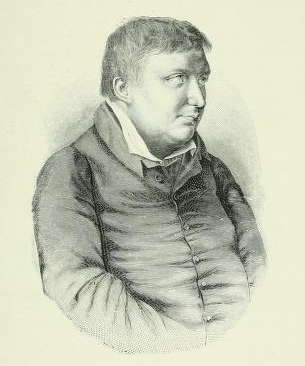
At the University of Jena, in June 1801, a young candidate for the degree of doctor stood on the rostrum delivering his thesis. Everything possible was done to put him out and annoy him; the unprecedented step was taken of providing opponents. One of these, a somewhat inept young man, desiring to distinguish himself, began: "In tractatu tuo erotico Lucinda dixisti," &c., &c. To this the candidate shortly responded by calling his opponent a fool. A regular uproar ensued, and one of the professors indignantly declared that it was thirty years since the platform of the school of philosophy had been profaned by such disgraceful behaviour. The candidate retorted that it was thirty years since any one had been so disgracefully treated. This candidate was Friedrich Schlegel, in those days so much dreaded on account of his terrible opinions that he was sometimes refused permission to spend a night in a town. In a rescript from the Universitets-Kuratorium of the Electorate of Hanover to the Pro-Rector of Göttingen, dated September 26, 1800, we read: "Should the Professor's brother, Friedrich Schlegel, notorious for the immoral tendency of his writings, come to Göttingen, purposing to stay there for any time, this is not to be permitted; you will be so good as to intimate to him that he must leave the town."
Somewhat harsh justice this—and all the to-do was on account of Lucinde!
It is not the creative power displayed in it which makes Lucinde one of the most important works of the Romantic School, for, in spite of all the "fleshly" talk in the book, there is no flesh and blood in it, no real body. Neither is it depth of thought. There is more philosophy in the few paradoxical pages written by Schopenhauer under the title Metaphysik der Liebe than in pretentious Lucinde from beginning to end. It is not even a bacchantic joy in nature, in life. If we compare it with Heine's Ardinghello, a book glowing with genuine Southern joy of life, we see clearly how anæmic and theoretic Lucinde is. It is as a manifesto and programme that the book is valuable. Its main idea is to proclaim the unity and harmony of life as revealed to us most clearly and most comprehensibly in the passion of love, which gives a sensual expression to the spiritual emotion, and spiritualises the sensual pleasure. What it aims at depicting is the transformation of real life into poetry, into art, into Schiller's "play" of powers, into a dreamy, imaginative existence, with every longing satisfied, a life in which man, acting with no aim, living for no purpose, is initiated into the mysteries of nature, "understands the plaint of the nightingale, the smile of the new-born babe, and all that is mysteriously revealed in the hieroglyphics of flowers and stars."
This book is totally misunderstood by those who, like Kierkegaard, arm themselves with a whole set of dogmatic principles, and fall upon it, exclaiming: "What it aims at is the unmitigated sensuality which excludes the element of spirituality; what it combats is the spirituality which includes an element of sensuality." One can scarcely realise the blindness implied by such an utterance—but there are no better blinders than those provided by orthodoxy. Nor is it possible really to understand Lucinde so long as, like Gutzkow, we only see in it a vindication of the doctrine of free love, or, like Schleiermacher, a protest against incorporeal spirituality, a denunciation of the affected foolishness that denies and explains away flesh and blood. The fundamental idea of the book is the Romantic doctrine of the identity of life and poetry. This serious thought, however, is presented in a form expressly calculated to win the laurels of notoriety. Our admiration is aroused by the bold, defiant tone of the author's challenge, by the courage, born of conviction, with which he exposes himself to personal insult, and to public, ill-natured discussion of his private life.
F. SCHLEGEL.
Worthy of admiration, too, is the skill with which the different views and watchwords of Romanticism are collected and presented to us in small compass; for all the various tendencies of the movement, developed by so many different individuals, are to be seen in this one book, spreading fan-wise from a centre. But we are disgusted by the artistic impotence to which the so-called novel, in reality a mere sketch, bears witness, by its many beginnings that end in nothing, and by all the feeble self-worship which seeks to disguise barrenness by producing an artificial and unhealthy heat in which to hatch its unfertile eggs. Caroline Schlegel has preserved for us the following biting epigram, written soon after the book came out—
"Der Pedantismus bat die Phantasie Um einen Kuss, sie wies ihn an die Sünde; Frech, ohne Kraft, umarmt er die, Und sie genas mit einem todten Kinde, Genannt Lucinde."[1]
Beyond considering the word "sin" inappropriate—for Lucinde only sins against good taste and true poetry—I have no fault to find with this cruel satire.
At the very core of Lucinde we have once again subjectivity, self-absorption, in the form of an arbitrariness which may develop into anything—revolution, effrontery, bigotry, reaction—because it is not from the beginning associated with anything that is a power, because the Ego does not act in the service of an idea which could give to its endeavour stability and value; it acts neither in the service of civil nor of intellectual liberty. This arbitrariness or lawlessness, which, in the domain of art, becomes the Friedrich Schlegelian "irony," the artist's attitude of aloofness from his subject, his free play with it (resulting, as far as poetry is concerned, in the dictatorship of pure form, which mocks at its own substance and destroys its own illusions), becomes in the domain of real life an irony which is the dominant feature in the characters and lives of the gifted few, the aristocracy of intellect. This irony is a riddle to the profane, who "lack the sense of it." It is "the freest of all licences," because by its means a man sets himself outside of and above himself; yet it is also the most subject to law, being, we are told, unqualified and inevitable. It is a perpetual self-parody, incomprehensible to "the harmonious vulgar" (harmonisch Platten—the name bestowed by the Romanticists on those who live contentedly in a trivial, common-place harmony), who mistake its earnest for jest and its jest for earnest.
It is not merely in name that this irony bears a fundamental resemblance to Kierkegaard's, which also aristocratically "chooses to be misunderstood." The Ego of genius is the truth, if not in the sense in which Kierkegaard would have us understand his proposition, "Subjectivity is the truth," still in the sense that the Ego has every externally valid commandment and prohibition in its power; and, to the astonishment and scandal of the world, invariably expresses itself in paradoxes. Irony is "divine audacity." In audacity thus comprehended there are endless possibilities. It is freedom from prejudice, yet it suggests the possibility of the most audacious defence of all possible kinds of prejudices. It is more easily attainable, we are told, by woman than by man. "Like the feminine garb, the feminine intellect has this advantage over the masculine, that its possessor by a single daring movement can rise above all the prejudices of civilisation and bourgeois conventionality, at once transporting herself into the state of innocence and the lap of Nature." The lap of Nature! There is an echo of Rousseau's voice even in this wanton tirade. We seem to hear the trumpet-call of revolution; what we really hear is only the proclamation of reaction. Rousseau desired to return to the state of nature, when men roamed naked through the pathless forests and lived upon acorns. Schelling wished to turn the course of evolution back to the primeval ages, to the days before man had fallen. Schlegel blows revolutionary melodies on the great romantic "wonder-horn." But, as we read in Des Knaben Wunderhorn: "Es blies ein Jäger wohl in sein Horn—Und Alles was er blies, das war verlorn."[2] The result is not intellectual emancipation, but simply a refinement of pleasure. The whole wide domain of love is transformed into the domain of art. As Romantic poetry is poetry to the second power, poetry about poetry, refined and chastened poetry, so the love of the Romanticists is refined and chastened love, "the art of love." The different degrees of the higher sensuality are described and classified. I refer the reader to Lucinde, which does not, like Ardinghello, present us with voluptuous descriptions, but merely with dry, pedantic theory, the empty framework of which it is left to the reader's experience and imagination to fill. Romantic audacity is, in one of its aspects, idleness, the indolence of genius. Idleness is described as "the life-atmosphere of innocence and inspiration." In its highest expression it is pure passivity, the life of the plant. "The highest, most perfect life is a life of pure vegetation." The Romanticists return to nature to such good purpose that they revert to the plant. Passive enjoyment of the eternally enduring moment would be their idea of perfection. "I meditated seriously," says Julius to Lucinde, "upon the possibility of an eternal embrace." As genius, which is independent of toil and trouble, and voluptuous enjoyment, which in itself is passive bliss, have nothing to do with aim, action, or utility, so idleness, dolce far niente, comes to be regarded as the best that life can offer, and purpose, which leads to systematic action, is denounced as ridiculous and philistine. The principal utterance to this effect in Lucinde is the following: "Industry and utility are the angels of death with the flaming swords, who stand in the way of man's return to Paradise." Yes, that is exactly what they are! Industry and utility bar the way back to all the Paradises which lie behind us. Therefore we hold them sacred! Utility is one of the main forms of good; and what is industry but the renunciation of distracting pleasures, the enthusiasm, the power, whereby this good is attained!
Return to perfection is, in art, a return to the lawlessness of genius, to the stage at which the artist may do one thing, or may do another which is exactly the opposite. In life it is the retrogression of idleness, for he who is idle goes back, back to passive pleasure. In philosophy it is the return to intuitive beliefs, beliefs to which Schlegel applies the name of religion; which religion in its turn leads back to Catholicism. As far as nature and history are concerned, it is retrogression towards the conditions of the primeval Paradise.[3] Thus it is the central idea of Romanticism itself—retrogression—which explains how it was that even the heaven-storming Lucinde, like all the other heaven-stormers of the Romanticists, had not the slightest practical outcome.
VI
ROMANTIC PURPOSELESSNESS
In Lucinde, then, as in a nutshell, are to be found all the theories which, later in the history of Romanticism, are developed and illustrated by examples. In such an essay as that on the Instinct of Change by the Æsthete in Kierkegaard's Enten-Eller ("Either-Or") idleness is systematised. "Never adopt any calling or profession. By so doing a man becomes simply one of the mob, a tiny bolt in the great machinery of the state; he ceases to be master.... But though we hold aloof from all regular callings, we ought not to be inactive, but to attach great importance to occupation which is identical with idleness.... The whole secret lies in the independence, the absence of restraint. We are apt to believe that there is no art in acting unrestrained by any law; in reality the most careful calculation is required, if we are not to go astray, but to obtain enjoyment from it...."
Idleness, lawlessness, enjoyment! This is the threeleaved clover which grows all over the Romanticist's field. In such a book as Eichendorff's Das Leben eines Taugenichts ("Life of a Ne'er-do-Well") idleness is idealised and exalted in the person of the hero. And purposelessness is another important item, which must on no account be overlooked. It is another designation for the genius of Romanticism. "To have a purpose, to act according to that purpose, artificially to combine purpose with purpose, and thereby create new purposes, is a bad habit, which has become so deeply rooted in the foolish nature of godlike man, that he is obliged, when for once it is his desire to float aimlessly upon the stream of constantly changing images and emotions, to do even this of settled purpose.... It is very certain, my friend, that man is by nature a serious animal." (Julius to Lucinde.)
On the subject of this utterance, even that orthodox Christian, Kierkegaard, says: "In order not to misjudge Schlegel, we must bear in mind the perverted ideas which had insinuated themselves into men's minds in regard to many of the relations of life, and which had specially and indefatigably striven to make love as tame, well broken-in, heavy, sluggish, useful, and obedient, as any other domestic animal—in short, as unerotic as possible.... There is a very narrow-minded morality, a policy of expediency, a futile teleology, which many men worship as an idol, an idol that claims every infinite aspiration as its legitimate offering. Love is considered nothing in itself; it only acquires importance from the purpose it is made to serve in the paltry play which holds the stage of family life." It is perhaps admissible to conclude that what Kierkegaard says about "the tame, well broken-in, sluggish, and useful domestic animal, love," found its most apt application in Germany, which at that time was undoubtedly the home of the old-fashioned womanliness. The satirical sallies in Tieck's comedies occasionally point in the same direction. In his Däumling ("Hop-o'-my-thumb") a husband complains of his wife's craze for knitting, which gives him no peace; a complaint which, perhaps, can only be understood in Germany, where to this day ladies are to be seen knitting even in places of public entertainment—at the concerts on the Brühlsche Terrasse in Dresden, for example. Herr Semmelziege says:—
"Des Hauses Sorge nahm zu sehr den Sinn ihr ein, Die Sauberkeit, das Porzellan, die Wäsche gar: Wenn ich ihr wohl von meiner ew'gen Liebe sprach, Nahm sie der Bürste vielbehaartes Brett zur Hand, Um meinem Rock die Fäden abzukehren still. * * * * * * * * * * Doch hätt' ich gern geduldet Alles, ausser Eins: Dass, we sie stand, und we sie ging, auswärts, im Haus, Auch im Concert, wenn Tongewirr die Schöpfung schuf, * * * * * * * * * * Da zaspelnd, haspelnd, heftig rauschend, nimmer still, Ellnbogen fliegend, schlagend Seiten und Geripp, Sie immerdar den Strickstrumpf eifrig handgehabt."[1]
The most comical part of this satire is the passage which, whether intentionally or unintentionally on the author's part, reads like a parody of the well-known Roman Elegy in which Goethe drums the hexameter measure, "leise mit fingernder Hand," upon his mistress's back:—
"Einst als des Thorns heilig Lager uns umfing, Am Himmel glanzvoll prangte Lunas keuscher Schein, Der goldnen Aphrodite Gab' erwünschend mir, Von silberweissen Armen ich umflochten lag. Schon denkend, welch ein Wunderkind so holder Nacht, Welch Vaterlandserretter, kraftgepanzert, soll Dem zarten Leib entspriessen nach der Horen Tanz, Fühl' ich am Rücken hinter mir gar sanften Schlag: Da wähn ich, Liebsgekose neckt die Schulter mir, Und lächle fromm die süsse Braut und sinnig an: Bald naht mir der Enttäuschung grauser Höllenschmerz Das Strickzeug tanzt auf meinem Rücken thätig fort; Ja, stand das Werk just in der Ferse Beugung, wo Der Kundigste, ob vielem Zählen, selber pfuscht."[2]
When the cult of the useful is carried as far as this, we can understand advocacy of purposelessness.
But purposelessness and idleness are inseparable. "Only Italians," we are told, "know how to walk, and only Orientals how to lie; and where has the mind developed with more refinement and sweetness than in India? And in every clime it is idleness which distinguishes the noble from the simple, and which is, therefore, the essence of nobility."
This last assertion is outrageous, but its very audacity is significant. It shows the attitude of Romanticism towards the masses. To have the means to do nothing is, in its estimation, the true patent of nobility. Its heroes are those who cultivate the unremunerative arts, and are supported by others—kings and knights like those in Fouqué's and Ingemann's books, artists and poets like those in Tieck's and Novalis's. It separates itself from humanity, will do nothing for it, but only for the favoured few. The hero and heroine in Lucinde are the gifted artist and the woman of genius; it is not the ordinary union, but the "nature-marriage" or the "art-marriage" (Naturehe, Kunstehe) for which our interest is claimed. Observe how Julius at once asks Lucinde whether her child, if a girl, shall be trained as a portrait or as a landscape painter. Only as a member of the fraternity of artists do her parents take any interest in her. Only authors and artists have part and lot in the poetry of life.
It is not difficult to understand how it was that Lucinde was barren of any social results. But though the book had no practical outcome, though it was too feeble to effect any kind of reform, there was, nevertheless, something practical underlying it.
Let us cast a glance at the principal characters. They stand out in strong relief upon a background of the profoundest scorn for all the prose of real life and all the conventions of society. The book is in no wise ashamed of its erotic theories; in its conscious purity it feels itself elevated above the judgment of the vulgar: "It is not only the kingly eagle which dares to scorn the screaming of the ravens; the swan, too, is proud, and pays as little heed. Its only care is that its white wings shall not lose their brightness; its only desire, to cling, unruffled, to Leda's breast, and breathe forth all that is mortal in it in song."
The image is pretty and daring, but is it true? The story of Leda and the swan has been treated in so many ways.
Julius is a pessimistic (zerrissener) young man, an artist, of course. We are told in the Lehrjahre der Männlichkeit, the chapter containing what Flaubert has called l'éducation sentimentale, that it was strikingly characteristic of him that he could play faro with apparently passionate eagerness, and yet in reality be absent-minded and careless; he would dare everything in the heat of the moment, and as soon as he had lost would turn indifferently away. Such a trait may not excite our admiration, but it at all events produces a pretty distinct impression of a pleasure-loving, blasé young man, who, feeling no powerful impulse towards action, seeks for excitement while leading a life of careless, coldly despairing idleness. The history of his development is indicated, as is often the case with quite young men, simply by a succession of female names.
Of the women in question we have only very slight sketches, like the pencil-drawings in an album. One of these introductory portraits is rather more elaborated than the rest, that of a dame aux camélias sunk in Oriental indolence, who, like the original dame aux camélias, is raised above her position by a true passion, and dies when she is neither understood nor believed. She dies by her own hand, makes a brilliant exit from life, and seems to us, as she is described sitting in her boudoir with her hands in her lap, surrounded by great mirrors and inhaling perfumes, like a living image of the æsthetic stupor of self-contemplation and self-absorption, which was the final development of Romanticism. After passing through numbers of erotic experiences, all equally and exceedingly repulsive, Julius finally makes the acquaintance of his feminine counterpart, Lucinde, whose impression is never effaced. "In her he met a youthful artist" (Of course!), "who, like himself, passionately worshipped beauty and loved nature and solitude. In her landscapes one felt a fresh breath of real air. She painted not to gain a living or to perfect herself in an art" (On no account any purpose or utility!) "but simply for pleasure" (Dilettantism and irony!). "Her productions were slight water-colour sketches. She had lacked the patience and industry required to learn oil-painting." (No industry!) ... "Lucinde had a decided leaning towards the romantic" (Of course she had; she is romance incarnate!). "She was one of those who do not live in the ordinary world, but in one created by themselves.... With courageous determination she had broken with all conventions, cast off all bonds, and lived in perfect freedom and independence." From the time when Julius meets her, his art too becomes more fervid and inspired. He paints the nude "in a flood of vitalising light;" his figures "were like animated plants in human shapes."
With Julius and Lucinde life flows on smoothly and melodiously, "like a beautiful song," in perpetually aroused and satisfied longing. The action passes, as it were, in a studio where the easel stands close to the alcove. Lucinde becomes a mother, and their union is now the "marriage of nature" (die Naturehe). "What united us before was love and passion. Now nature has united us more closely." The birth of the child gives the parents "civic rights in the state of nature" (probably Rousseau's), the only civic rights they seem to have valued. The Romanticists were as indifferent to social and political rights as Kierkegaard's hero, who was of opinion that we ought to be glad that there are some who care to rule, thereby freeing the rest of us from the task.
VII
"LUCINDE" IN REAL LIFE
Behind this indistinct picture lay a far more definitely outlined reality. The youthful life of the hero corresponded pretty accurately, as Friedrich Schlegel's letters show, with that of the author. In those days Berlin had not yet become pious, but was, according to the evidence of contemporaries, a species of Venusberg, which none approached with impunity. The example of the throne sanctioned every species of moral licence. Enthusiasm for art and literature superseded the official morality which a short time before had been so powerful, but from which men were rapidly emancipating themselves.
In the autumn of 1799, the year in which Lucinde was published, Friedrich Schlegel wrote to Schleiermacher: "People here have been behaving so outrageously that Schelling has had a fresh attack of his old enthusiasm for irreligion, in which I support him with all my might. He has composed an epicurean confession of faith in the Hans Sachs-Goethe style." This was Der Widerporst.
"Kann es fürwahr nicht länger ertragen, Muss wieder einmal um mich schlagen, Wieder mich rühren mit allen Sinnen, So mir dachten zu entrinnen Von den hohen, überirdischen Lehren, Dazu sie mich wollten mit Gewalt bekehren Darum, so will auch ich bekennen Wie ich in mir es fühle brennen, Wie mir's in allen Adern schwillt, Mein Wort so viel wie anderes gilt, Da ich in bös' und guten Stunden Mich habe gar trefflich befunden, Seit ich gekommen in's Klare, Die Materie sei das einzig Wahre. Halte nichts vom Unsichtbaren, Halt' mich allein am Offenbaren, Was ich kann riechen, schmecken, fühlen, Mit allen Sinnen drinnen wühlen. Mein einzig' Religion ist die, Dass ich liebe ein schönes Knie, Volle Brust und schlanke Hüften, Dazu Blumen mit süssen Düften, Aller Lust volle Nährung, Aller Liebe süsse Gewährung. D'rum, sollt's eine Religion noch geben (Ob ich gleich kann ohne solche leben), Könnte mir vor den andern allen Nur die katholische gefallen, Wie sie war in den alten Zeiten, Da es gab weder Zanken noch Streiten, Waren alle ein Mus und Kuchen, Thäten's nicht in der Ferne suchen, Thäten nicht nach dem Himmel gaffen, Hatten von Gott'nen lebend'gen Affen, Hielten die Erde für's Centrum der Welt, Zum Centrum der Erde Rom bestellt, Darin der Statthalter residirt Und der Welttheile Scepter führt, Und lebten die Laien und die Pfaffen Zusammen wie im Land der Schlaraffen, Dazu sie im hohen Himmelhaus Selber lebten in Saus und Braus, War ein täglich Hochzeithalten Zwischen der Jungfrau und dem Alten."[1]
Such a poem from such a hand is a genuine proof of the spirit of the times; and it is instructive to observe that when Wilhelm Schlegel (acting upon Goethe's advice) refuses to publish the poem in the Athenæum, Novalis, against whom it was especially directed, writes: "I cannot understand why Der Widerporst should not be printed. Is it on account of its atheism? Just think of Die Götter Griechenlands!"
The fashions were revolutionary—uncovered bosoms, orientally flowing garments. The tone of the most notable young women of the day was excessively free. No one was more talked of for her beauty at this time than Pauline Wiesel. She was the wife of a highly intellectual man, whose scepticism and satirical, cynical wit made a deep and disturbing impression upon young Tieck (he was the model for Abdallah and William Lovell); and she was one of Prince Louis Ferdinand's many mistresses. The attachment of the dashing young prince, in this case a real passion, still glows in his letters. A contemporary wrote of her: "I look upon her in the light of a phenomenon of Greek mythology." Alexander von Humboldt walked more than thirty miles to see her. It is characteristic of the times that the connection by which Pauline Wiesel compromised herself roused no disapprobation among her more advanced women friends. The irreproachable Rahel, for example, has not a word of blame for it; one might almost imagine that she envied Pauline. As a young girl she writes despondently: "Every means, every possible preparation for living, and yet one must never live; I never shall, and those who dare to do so have the wretched world, the whole world, against them."
The original of Lucinde, however, was certainly superior to her portrait, a woman of an altogether nobler type. She belonged to Rahel's circle, that group of clever young Jewesses who then represented the noblest, freest intellectual life of Berlin—a circle historically important from the fact that it was the only one in which as yet Goethe's fame was really established and true homage paid him.[2] The lady in question was Moses Mendelssohn's clever, self-reliant daughter, Dorothea, who, to please her parents, had bestowed her hand upon the well-known banker, Veit. It was not by beauty but by her wit and her keen intellectuality that she captivated Friedrich Schlegel. He was at the time twenty-five years of age, she thirty-two. There was nothing sensuous or frivolous in either her appearance or manner; she had large piercing eyes and a masculine severity of expression. In his letters to his brother Wilhelm, Friedrich Schlegel praises "her sterling worth." "She is," he says, "very straightforward, and cares for nothing but love, music, wit, and philosophy." In 1789 Dorothea was divorced from her husband and followed Schlegel to Jena. The latter writes at this time: "It has never been our intention to bind ourselves to each other by any marriage contract, though I have long considered it impossible that anything but death should part us. The calculation and adjustment of present and future is antipathetic to me, yet if the detested ceremony were the necessary condition of inseparableness, I should act according to the requirement of the moment and sacrifice my most cherished opinions."
In the arranging of their relations, none of their intimates helped Friedrich and Dorothea more than their clerical friend, Schleiermacher. On none of Schlegel's friends had Lucinde had such a powerful effect. Schleiermacher was at this time chaplain of the Charité Church in Berlin. He had long followed Friedrich's emancipatory endeavours with warm sympathy, and even admiration. In his essay On Diotima, as well as in his harsh criticism of Schiller's Würde der Frauen, Friedrich had attacked the traditional conception of woman's position in society. He had held up to contempt the ordinary marriage, in which the wedded pair "live together with a feeling of mutual contempt, he seeing in her only her sex, she in him his social position, and both in their children their own production and property." What he desired was the moral and intellectual emancipation of women. Intellect and culture, combined with enthusiasm, were the qualities which in his eyes made a woman lovable. The ordinary ideal of womanliness he scorned. He writes with bitterness of the stupidity and criminality of the men who demand ignorance and innocence in women, thereby compelling them to be prudish. Prudery is false pretence of innocence. True innocence in woman he maintains to be perfectly compatible with intellectual culture. It exists wherever there is religion, i.e. capacity for enthusiasm. The idea that noble, enlightened free-thought is less becoming in the case of women than of men is only one of the many generally accepted platitudes set in circulation by Rousseau. "The thraldom of woman" is one of the curses of humanity. His highest desire as an author was, as he naively puts it, "to found a system of morality" (eine Moral zu stiften). He calls opposition to positive law and conventional ideas of right, "the first moral impulse" felt by man.
In his Vernunftkatechismus für edle Frauen ("Catechism of Reason for Noble-minded Women"), a fragment which appeared in the Athenæum, Schleiermacher writes in exactly the same strain, calling upon women to free themselves from the bonds of their sex. Nay, incredible as it may sound, it is quite possible (as Haym has proved) that the frequently quoted saying of Friedrich Schlegel, that there is nothing of serious importance to be urged against a marriage à quatre, really emanated from Schleiermacher. It is levelled at the many degrading and unreal marriages, at the "unsuccessful attempts at marriage," which the State in its foolishness makes binding, and which prevent the possibility of a true marriage. The writer of the fragment in which the saying occurs observes that most marriages are only preparatory and distant approximations to the true marriage; and Schleiermacher, in his Letters, writes that many attempts are necessary, and that "if four or five couples were taken together, really good marriages might result, provided they were allowed to exchange."
The underlying reason for the warm personal interest taken by Schleiermacher in Friedrich and Dorothea is, no doubt, to be found in his own position and circumstances at that time. A devoted attachment existed between him and Eleonore Grunow, the childless and most unhappy wife of a Berlin clergyman.
It seemed to Schleiermacher that the popular indignation roused by Lucinde was largely compounded of philistine and Pharisaical ignorance. The very people who abused it were revelling in Wieland's and Crébillon's immoral tales. "It reminds me," he says, "of the trials for witchcraft, where malice formulated the charge, and pious stupidity carried out the sentence." But what especially led to his ardent championship of the persecuted pair was, he tells us himself, the fact that most of those who complained loudly of offended morality were simply seeking a pretext for a private personal attack on Schlegel.
An invincible spirit dwelt in Dorothea's frail body. She bore unfalteringly all that her violation of conventional morality brought upon her—private condemnation and public defamation in the shape of innuendoes in the attacks on Lucinde. She displayed the most enduring devotion and the most self-sacrificing faithfulness to the man she had chosen. She not only shares his interests and aims, but bears with his unreasonableness and resigns herself uncomplainingly to the caprices of the most capricious of lovers. Nay, more than this, her good sense and cheerfulness scatter all the clouds of despondency that gather round herself and others. Her merry laughter brings relief from Schleiermacher's subtle argumentativeness and Friedrich's transcendental irony. Free in every other respect from feminine sentimentality, she is completely engrossed in admiration of the man she loves, and, with touching modesty, centres all her pride in him. When her novel Florentin is published, a book in which, in spite of its many weaknesses, there is more creative power than in any of Friedrich Schlegel's productions, what makes her happiest and proudest is that his name (as editor) stands on the title-page. She jests merrily on the subject of her literary activity. Blushing and with a beating heart, she sends the first volume of her book to Schleiermacher, and she smiles at the numerous red strokes which adorn the returned manuscript. "There is always the deuce in it where the dative and accusative ought to be." The fact that she too felt impelled to write at the time (about the year 1800) when all the Romanticists, even Schleiermacher and Schelling, were committing literary sins, marks her as one of the German Romantic literary circle; and, moreover, her novel is, in reality, an expression of all the prevailing ideas, an imitation of Wilhelm Meister and Franz Sternbald, an exaltation of the harmoniously cultivated few at the expense of the vulgar crowd, a glorification of the free Bohemian life, of idleness and admirable frivolity, of purposelessness in the midst of the prose of reality.
Dorothea has endowed her hero with characteristics which obviously correspond to Friedrich's as they appeared to her admiring woman's eyes. "In spite of a peculiar and often repellent manner, he has the gift of making himself popular, and wins all hearts without caring whether he does or not. It is of no avail to arm one's self against him with all one's pride; somehow or other he gains entire possession of one. It is often most exasperating not to be able to withstand him, as he himself is not to be won. At times it seems as if he attached another meaning to his words than their obvious one; sometimes when the most flattering things are said to him, he looks utterly indifferent, as if it were a matter of course; at other times, quite unexpectedly, some chance word, let fall without any special intention, affords him the greatest pleasure; he either finds in it or puts into it some peculiar meaning.... But you can imagine how often he gives offence in society."
Florentin's confessions, too, especially those relating to his wild life as a youth in Venice, remind us of Friedrich's youthful experiences in Leipzig. Although Florentin is an Italian, he feels himself strongly attracted by German art and German artists. He teaches himself to draw and paint, and makes his living, now as the gifted Romantic dilettante artist, now as the no less Romantic musician, roaming from village to village. His birth is wrapt in mystery. He is, as he himself says, "the solitary, the outcast, the child of chance. Something indescribable, which I can only call my destiny, drives me on." He avoids all ties of affection: "Alone will I bear the curse which has been laid upon me."[3]
It is unnecessary to criticise this characterisation in detail and point out how naïve and excessively Romantic it is. None the less, its writer is in many ways superior to her surroundings. Not for nothing was she the daughter of the sober, sagacious Moses Mendelssohn.
She would like, she says, to see Friedrich the literary artist, but she would love him better still if she could see in him the worthy citizen of a well-ordered state; it seems to her, indeed, that the character and desires of all her revolutionary friends make literary occupations, reviewing and such-like, as unsuitable for them as a child's cradle for a giant: her ideal is Götz von Berlichingen, who only took up the pen as a rest from the sword.[4]
Here again we are impressed by what strikes us in reading of Frau von Kalb, namely, that the women of this period display more virile and more concentrated power than the men, and that they persist in treating from the social standpoint questions which the men desire to treat only from the literary. They feel the oppression of existing circumstances more strongly, are less enervated by overmuch book-learning, and look at things more practically than the men.
The first important event in the life of the young couple was Fichte's coming to live with them. Fichte had been accused of teaching atheism, and his position as a professor was in jeopardy. Caroline Schlegel writes to a friend: "I must answer your questions about the Fichte affair, though it is a very painful one to me and to all admirers of honourable, frank behaviour. You know pretty well yourself what to think of the first accusation, made by a bigoted sovereign and his counsellors, half of them Catholics, the rest Moravian Brethren.... But Fichte is so exasperated by all sorts of reports from Weimar, about things looking bad for him there, &c. &c., that he declares he will resign if they reprimand him, or put any restriction on his teaching.... All who would stand well at court, and the professors whom Fichte has outshone, denounce his boldness and precipitancy. He is abandoned, actually avoided."
In a letter written jointly by Friedrich, Schleiermacher, and Dorothea, the last-mentioned says: "Things are going well with Fichte here; he is left in peace. Nicolai has intimated that no notice whatever will be taken of him so long as he does not attempt to give public lectures; this would not be well received.... I get on excellently with Fichte, and feel as much at home in this gathering of philosophers as if I had never been accustomed to anything inferior. Though I am still a little timid, this has nothing to do with Fichte personally, but rather with my own position to the world and to Friedrich—I am afraid—yet possibly I am mistaken. I cannot write another word, dear, for my philosophers are pacing up and down the room so incessantly that I am quite giddy."
Here we have a little domestic scene from Dorothea's life in Berlin. The three were so comfortable together that Fichte was desirous to make the arrangement permanent. He writes to his wife that he is trying to persuade Friedrich to remain in Berlin, and August Wilhelm and his wife to remove there. "If my plan succeeds, the two Schlegels, Schelling, who must also be persuaded to come, and we ourselves will form one family, take a large house, have only one cook, &c., &c."[5] The plan was not carried out. The wives of the two Schlegels did not get on with each other. But is it not like a breath from another world to come, in the midst of all this solicitude for Fichte and indignation at the wrong done him, upon such a passage in one of Dorothea's letters as the following: "I heartily thank your mother for the sweet picture of the saint. I keep it where I can always see it. She is the very saint I should have chosen for myself; she suits me exactly. These pictures and the Catholic music touch me so, that I am determined, if I become a Christian, to be a Catholic."[6] Nowhere is the religious confusion which distinguishes the Romantic School more plainly displayed.
But Dorothea is not the only female portrait in Lucinde. During the course of his development Julius makes the acquaintance of an admirable woman, who is described as follows: "This disease was cured, was expelled, by the very first sight of a woman who was quite unique, and who was the first to exercise complete influence over his mind.... She had made her choice, and had given herself to one who was his friend as well as hers, and who was worthy of her love. Julius was the confidant. He knew exactly what it was that made him unhappy, and sternly judged his own baseness.... He forced all his love back into his inmost heart and let passion rage and burn and consume there. But his outward man was quite changed. So successful was he in counterfeiting the most childlike frankness and innocence, and in assuming a sort of fraternal brusqueness to prevent his melting into tenderness, that she never entertained the slightest suspicion. She was gay and genial in her happiness; suspecting nothing, she shunned nothing, but gave her mood and wit free play when she found him unamiable. All the nobility and all the grace, all the divinity and all the waywardness of the feminine character found in her their most refined, their most womanly expression. Each quality was allowed to develop as freely and vigorously as if it were the only one; and the daring mixture of dissimilar elements did not produce confusion, for a spirit inspired it which was a living breath of harmony and love. In the course of the same hour she would reproduce some comic episode with the refined abandon of the accomplished actress, and read a great poem with simple, touching dignity. At one time it pleased her fancy to shine and trifle in society, at another she was all enthusiasm and ardour, and presently she would be assisting others by word and deed, serious, unassuming, and gentle as a tender mother. Her manner of relating it made any trifling incident as entertaining as a delightful fairy tale. She embellished everything with feeling and wit; she had a power of comprehending everything, and of ennobling everything she touched. Nothing great or good was too holy or too common for her passionate sympathy. She understood the slightest suggestion, and answered even the question that was not asked. It was not possible to make long speeches to her; they turned naturally into interesting conversations, during which an ever-varying music of intelligent glances and sweet expressions played over her delicate features. One seemed to see these glances and expressions while reading her letters, so lucidly and genially did she write, as if talking with her correspondent. Those who only knew this side of her might think that she was merely lovable, that she would make an enchanting actress, that nothing but metre and rhyme were wanting to make her winged words exquisite poetry. But this same woman showed on every occasion that called for it the most astonishing courage and energy; and it was from this side of her character, by her own heroic standard, that she judged men."
There is more praise than art in this portrait. Sainte-Beuve would have given us a very different delineation. The original of the picture is a woman who, after the publication of her letters under the title Caroline, was known, as if she had been a queen, only by this, her Christian name. It simplified matters, too, to designate her thus, for she had had so many surnames that it was difficult to know by which to call her. She was a daughter of the well-known German philologist, Michaelis; her first husband was a Dr. Böhmer; after his death she married A. W. Schlegel, and her third husband was Schelling. These two last marriages placed her in the centre of the Romantic circle, which seems naturally to group itself round her. She was its own special muse. Grier, the gifted translator of Calderon and Ariosto, says of her that she is by far the cleverest woman he has known. Steffens and Wilhelm von Humboldt use similar expressions. A. W. Schlegel writes of several of his essays, that they are "in part the work of a highly gifted woman, who possessed all the qualifications of a successful author, but whose ambition did not lie in that direction." Schelling writes at the time of her death: "Even had she not been to me what she was, I should mourn the human being, should lament that this intellectual paragon no longer exists, this rare woman, who to masculine strength of soul and the keenest intellect united the tenderest, most womanly, most loving heart. We shall never see her like again." Her portrait is very striking—fascinating, refined, roguish, and yet tender. She is quite in Leonardo's style. Dorothea is far less complex.
Caroline was born in 1763, and was twenty-one at the time of her first marriage. A. W. Schlegel made her acquaintance whilst he was a student at Göttingen, and fell in love with her, but she refused to marry him. Intercourse between them was broken off for a time, but was carried on by correspondence while Schlegel was at Amsterdam, where he went as a tutor in 1791. Here various amorous episodes, amongst them one serious love affair, threw Caroline for a time into the shade. Meanwhile, she was entangling herself in a net of the strangest relations. In 1799 she had gone to Mainz, where she lived in the house of Georg Forster, Humboldt's teacher, a man equally distinguished as a scientist and an author. When this gifted and admirable, but far too sanguine man, embarked on revolutionary enterprises and attempted to extend French republicanism to the Rhine districts, Caroline enthusiastically aided and abetted him. She was in communication with the members of the Republican Club in Mainz, and she was unjustly suspected of communicating with the enemy through her brother-in-law, G. Böhmer, who was Custine's secretary. When Mainz was reconquered by the German troops, she was arrested, and spent several months in barbarous imprisonment, sharing a room with seven other people. From prison she wrote to A. W. Schlegel for assistance.
Her position was even worse than it appeared to be. In Mainz, in desperation at the disappointment of her dearest hopes (she had expected that the manly, energetic Tatter would offer her his hand), she had thrown herself into the arms of her adorer for the moment, a Frenchman, and the results of this connection would inevitably compromise her for ever, if she were not freed from prison in time. Schlegel's influence and her own brother's unremitting endeavours procured her release. With quiet chivalry August Wilhelm placed Caroline, now forsaken by all her other friends, under the protection of his younger brother, Friedrich. It was in these singularly unpropitious circumstances that Friedrich made her acquaintance. He was by no means prepossessed in her favour, in fact, was inclined to look upon her with contempt; yet this is how he writes: "I had certainly not expected simplicity and a positively divine truthfulness.... She made a profound impression upon me. I longed to be in a position to win her confidence and friendship; but the moment she showed some return of the feeling I saw very clearly that the bare attempt would lead to the most painful struggles, and that if a friendship between us were possible at all, it could only be the fruit of much that was unjustifiable.... Thenceforward every selfish desire was abandoned. The relation in which I stood to her was perfectly innocent and simple. In my behaviour there was the reverence of a son, the candour of a brother, the frankness of a child, and the unobtrusiveness of a stranger."[7]
In 1796 A. W. Schlegel married his somewhat deeply compromised friend. Her circle soon included all the leading men of the day. She was in constant intercourse with Goethe, Herder, Fichte, Schelling, Hegel, Tieck, Schleiermacher, and Hardenberg. This was the time of Goethe's intimate connection with the young school. It was in the process of formation, and its members held their first meetings at Jena. Caroline breakfasts with Goethe, dines with Fichte, and is soon only too inseparable from Schelling.
The following extract from one of her letters to Schelling (March 1, 1801) affords an example of the vigour and the subtlety of this remarkable woman's criticism: "You surely do not expect me, dearest friend, to enlighten you as to the compass of Fichte's mind, though you almost express yourself as if you did. It has always seemed to me as if, in spite of his incomparable reasoning powers, the soundness of his deductions, his lucidity and accuracy, his direct intuition of the Ego, and his discoverer's enthusiasm—as if in spite of all this he were limited. My explanation of the matter is, that the divine spark is lacking in him; and if you have broken through a circle from which he has not been able to escape, I believe that you have done it not so much as the philosopher—don't scold me if I am using the word wrongly—but rather because there is poetry in you and none in him. Poetical inspiration led you directly to productiveness; keenness of apprehension led him to knowledge. He has light, the clearest and brightest, but you have warmth as well; and light can only illuminate, while warmth produces. Now, have I not seen all this cleverly?—just as one sees a boundless landscape through a keyhole."
In another letter we find an amusing reference to Hegel, which shows us that philosopher in a novel light: "Hegel is playing the beau and general gallant" (Hegel macht den Galanten und allgemeinen Cicisbeo).[8]
Caroline shares enthusiastically in all the efforts of the Romantic School; she revises, reviews anonymously, writes herself, influences other writers directly and indirectly. She is obliged to expend that politico-revolutionary ardour, of which she possesses a far larger share than the men, on literary skirmishes and intrigues. We find her, for instance, writing an anonymous and tolerably sharp review of Schlegel's Ion; Schlegel replies, also anonymously, criticising her criticism; then Caroline calls Schelling to her assistance, and he, acting as her champion, falls upon Schlegel still more heavily in a third anonymous article, written in an extremely polished manner—at the same time writing privately to him that he hopes he will not take it amiss. It is to Caroline that the misunderstanding and final rupture between Schiller and Schlegel is due; she sets the brothers against the poet by her extremely witty but unfair mockery of his style; Schiller, on his side, cannot be acquitted of having treated them with considerable haughtiness at the beginning of their literary career. His name for Caroline is "Dame Lucifer."