II THE ROMANTIC SCHOOL IN GERMANY (continued 4)
Mary Morison translation
Alexander von Humboldt has pointed out how the ancients really only saw beauty in nature when she was smiling, friendly, and useful to man. With the Romanticists it is the reverse. To them nature is unbeautiful in proportion as she is useful, and most beautiful in her wildness, or when she awakens a feeling of vague fear. They rejoice in the darkness of night and of deep ravines, in the utter loneliness which produces a shudder of terror; and Tieck's full moon shines as unchangeably over the landscape as though it were a theatrical one of oiled paper with a lamp behind it. I call it Tieck's moon, because it is incontestably Tieck who is the originator of the Romantic moonlit landscape. Nor is it difficult to understand how it should be he, rather than any other of the young writers, who originates such expressions as "forest solitude," "magic moonlit nights," &c., &c. Tieck was born in Berlin, perhaps of all large towns the one whose surroundings possess the fewest natural attractions. Those sandy heaths of Brandenburg, with their tall, spare firs standing stiffly in rows like Prussian soldiers, form as meagre a landscape as one could well find. Whilst Rousseau, living amidst scenery of paradisaic beauty (the neighbourhood of Geneva and Mont Blanc), was strongly, directly impressed by nature, Tieck, in his unlovely surroundings, was seized by the city-dweller's morbid longing for wood and mountain; and this longing gave birth to a fantastic conception of nature. The cold daylight glare of Berlin, and its modern, North German rationalism awoke longings for the primeval forests and an inclination towards primitive poetry.
To prove the truth of this assertion, one has only to read such a passage in the biography of Tieck as the following account of his stay in Halle in 1792: "How entirely different was the nature which met his eyes here in the green valley of the Saale, how much richer and more friendly than the flat heaths surrounding Berlin! The feeling of infinite longing seized him with redoubled force, and filled his heart with almost painful excitement as he wandered through the woods in the springtime. Once more he became intoxicated with nature; a mysterious power seemed to drive him onwards. His favourite resting-place was the Hölty bench near Giebichenstein, from which he overlooked the river and the valley. How often did he watch the sun sink beneath the clouds and the moon mirror herself with a thousand golden beams in the rippling water, or gleam dreamily through the branches! Here he lay many a summer night, drinking in nature in ample draughts."
Is not this the longing for nature of the man who is an exile from it, the view of nature which has the city pavement as its background?
In the description given of the evening after a tiring walk taken by Tieck and Wackenroder in the Fichtelgebirge, Tieck's conception of nature is still more distinctly associated with his personal impressions: "Wackenroder, unaccustomed to such fatigue, flung himself at once upon the bed, but Tieck was too excited. He could not sleep after all the experiences of that day. The spirits of nature awoke. He opened the window. It was the mildest, most magnificent summer night. The moon shed her soft, clear beams upon him. There it was before his eyes, the moonlit, witching night, nature with her ancient, yet ever new marvels and magic! His heart once again swelled high. To what far, unknown goal was he being drawn with irresistible force? Softly and soothingly the clear tones of a horn came floating through the night. A feeling of sadness stole over him, and yet he was intensely happy."[6]
Observe that not even the horn is wanting. What is wanting, what Tieck is destitute of, is any definite aim. We have the same thing in Sternbald, where the wandering artist, led only by his longings and his prophetic enthusiasm, is always, as he himself confesses, forgetting his real aim. "It is not possible," says one of the characters in the book, "to forget one's aim, for this reason, that the sensible man arranges matters so that he has no aim." No one can fail to see the close connection between this particular species of feeling for nature and Romantic arbitrariness, nor how they mutually develop each other.
Let us see the kind of landscapes which Franz Sternbald understands and paints, and how he understands and paints them.
In one part of the book we read: "This was the landscape which Franz intended to paint; but the real scene seemed very prosaic to him, compared with its reflection in the water." Clear outlines, definite forms, are dry prose; but the reflection in the water, the picture as it were to its second power, is Romantic refinement, duplication, glorification. In another part Franz says: "I should choose to paint lonely, terrible scenes—ruinous, crumbling bridges spanning the space between two precipitous rocks, with a foaming torrent raging in the abyss below; strayed travellers whose cloaks flap in the wet wind; horrid brigands rushing from their caves, stopping and plundering carriages, and fighting with travellers." Real stage scenery this, with melodrama into the bargain!
And in what spirit is nature apprehended? "Sometimes," says Franz, "my imagination sets to work and will not rest until it has thought out something quite unheard of. It would have me paint strange objects, of complicated and almost incomprehensible construction—figures composed of parts of all kinds of animals, their lower extremities being plants; insects and reptiles with a strange humanness about them, expressing human moods and passions in a wonderful and horrible manner."
What a picture! what a jumble of monstrosities! Can you not hear Hoffmann fast approaching with his caravan of monsters? The elephant stands on his head, and has a trunk which ends in a garfish; the cat writes its memoirs; the door-knocker is really an old market-woman, &c., &c. Are we not reminded here again, as in Der Freischütz, of the temptations of St. Anthony, as painted by Teniers, or, better still, by Höllen-Breughel, with a regular witches' Sabbath. To the genuine Romanticist, nature, with all her myriads of living forms and beings, seems a great toy-cupboard, and all the toys babble and chatter like those in Andersen's fairy tale.
Read this description of a romantic landscape taken from Novalis's Heinrich von Ofterdingen: "From a height they looked down upon a romantic country, strewn with towns and castles, with temples and tombs, a country which united the gentle charms of inhabited plains with the terrible charms of deserts and precipitous mountains. The most beautiful colours were happily blended. Mountain peaks gleamed like fireworks in their coverings of ice and snow. The smiling plain was clothed in the freshest of green. The distance decked itself in every shade of blue, and the deep blue of the sea threw into relief the innumerable bright pennons waving from the masts of numerous fleets. In the background we could see a shipwreck, in the foreground a merry country feast; far off the terribly beautiful eruption of a volcano and the desolation wrought by an earthquake, and near at hand a pair of lovers exchanging the sweetest caresses under sheltering trees. On one side of this scene a frightful battle was raging, and at no great distance from the battle was to be seen a theatre with a ludicrous play going on. Upon the other side, in the foreground, the corpse of a young girl lay upon a bier, with an inconsolable lover and weeping parents kneeling by its side; in the background sat a sweet mother with her child at her breast, angels nestling at her feet, and peeping through the branches above her head."
What a pot-pourri! And over it all is shed the indispensable pale, yellow light of that friend and well-wisher, protector and betrayer of lovers, that supreme comforter and divinity of the Romanticists—the man in the moon. He is their salvation. His round face and his profile have exactly the degree of distinctness permissible or possible in a Romantic countenance. All the knights of Romanticism wear his yellow livery. And a truer knight of the moon than Franz Sternbald is not to be found.
"I would," he says, "that I could fill the whole world with my song of love, that I could move the moonlight and the rosy dawn, so that they should echo my grief and happiness, until trees, branches, leaves, and grass all took up the melody, repeating it as with millions of tongues." Hereupon he sings a "moonlight song":
"Hinter'm Wasser wie flimmernde Flammen, Berggipfel oben mit Gold beschienen, Neigen rauschend und ernst die grünen Gebüsche die blinkenden Häupter zusammen. Welle, rollst du herauf den Schein, Des Mondes rund freundlich Angesicht? Es merkt's und freundlich bewegt sich der Hain, Streckt die Zweig' entgegen dem Zauberlicht. Fangen die Geister an auf den Fluthen zu springen, Thun sich die Nachtblumen auf mit Klingen, Wacht die Nachtigall im dicksten Baum, Verkündigt dichterisch ihren Traum. Wie helle, blendende Strahlen die Töne nieder fliessen, Am Bergeshang den Wiederhall zu grüssen."[7]
Here we have it all! The glittering flames of the moon, bushes with twinkling heads, rolling billows bearing onwards the face of the full moon, spirits dancing upon waves, night as described by Novalis, night flowers, and a nightingale whose song flows like clear, dazzling moonbeams.
And exactly the same thing recurs again and again. Franz has a dream: "Unperceived, he painted the hermit and his devotion, the forest and its moonlight; he even succeeded, he himself knew not how, in getting the nightingale's song into his picture." Oh, that musical pictorial art! Was not Goethe right in saying that there is more music than painting in the book?
It is very significant that the man who revelled thus in the fantastic suggestions of a district where nature was poor and sterile, should have altogether failed to appreciate the richness and luxuriance, the abundance of healthy sap and vigour, which distinguish the south of England. Shakespeare has had few such fervent admirers as Tieck; and Tieck naturally had the desire to see with his own eyes the natural surroundings amidst which his great teacher and master had spent his life, and from which he had derived his earliest impressions. He expected much. But, oh! what a disappointment! That mind which fancied itself akin to Shakespeare's found nothing congenial in the scenery round Shakespeare's home. The chief characteristic of these counties is an almost incredible luxuriance and vigour of growth. But this wealth of vegetation is unpoetical to the Romanticist, because it is useful, because it has a purpose. Only the blossom which bears no fruit is romantic. We understand his disappointment. Nowhere else does one see such mighty, spreading oaks, nowhere such high and succulent grass. As far as the eye can reach, the green carpet spreads over the undulating fields and the rich meadows, where magnificent cattle graze and ruminate. Quantities of white, yellow, and blue meadow and field flowers break the monotony of colour, and breathe a perfume which the moisture of the air keeps so fresh that it never palls. This vegetation is above all else fresh, not, like that of the south, striking in its contours. The watery, juicy plant does not live long; life streams through it and is gone. The moist air envelops trees and plants in a sort of luminous vapour which catches and tempers the sunbeams; and, as in Denmark, banks of clouds constantly traverse the pale blue sky. When this sky happens to be for a short time perfectly clear, and the sun reaches the earth without passing through mist, the rain and dewdrops sparkle on the green grass and upon the silken and velvet petals of the myriads of gay flowers more brilliantly than diamonds. What matter that the grass is destined to be eaten? Does not part of its beauty lie in its nutritious look? What matter that the fruitful fields are cultivated with the assistance of all the newest agricultural machinery, or that the cattle are tended with the most intelligent solicitude? Is not this the very reason why both animals and plants look so strong, so well nourished, and so nourishing? What we have here is certainly not the imposing beauty of the desert or the ocean, or of Swiss scenery. But has not this landscape a poetry of its own? Who can have spent an evening in Kew Gardens without mentally placing the elfin dance from A Midsummer Night's Dream, or The Merry Wives of Windsor in exactly this scenery, these beautiful parks, with their gigantic old oaks? It was in these surroundings that Shakespeare wrote them. We can divine with what eyes he looked upon the landscape. With what eyes does Tieck look upon it? "Having seen London," says Köpke, "he wished to make acquaintance with some other part of England. Where should he turn his steps, if not to Shakespeare's birthplace? On the way he visited Oxford. But neither was this scenery to his taste. The country they drove through was luxuriantly green, splendidly cultivated; but it was too well ordered, too artificial (No primitive poetry!); it had lost its originality. It lacked that simplicity, that holiness, as he called it, which touches the heart, and by which he had so often been moved in the most sterile parts of his native land. Here industry had destroyed the poetic aroma."
It is clear, then, that there must have been something in the scenery of his own country which appealed to Tieck's personal predispositions. The fantastic conception of nature would not have been carried to such an extreme in this particular country, if there had not been something fantastic in the scenery of the country. It is very evident that German scenery must have met the fantastic spectator half way.
In the first volume of this work, I attempted, by means of a description of Italian scenery, to show how unromantic even the most beautiful of it is. Nor, in spite of the Black Forest and the Blocksberg, can German scenery be called really fantastic; for, as Taine says, it is only the beauty of art which is fantastic; that of nature is more than fantastic; the fantastic does not exist except in our human brain. Still, nature does provide excuses for a certain amount of fantasy. It is especially to be born in mind that in characteristically German scenery the sea is absent, and with it the feeling of wideness and freeness which it alone gives. In river and mountain scenery there is never the wide, open horizon to which we Danes are accustomed.
But, not to lose myself in generalisations, let me give an idea of the scenery amidst which Tieck himself lived longest—that district in the neighbourhood of Dresden which goes by the name of Saxon Switzerland. I shall describe in a few words how it impresses me, and then proceed to show what impression it produces on a Romantic poet. This I can do reliably and exactly, for I have personally known several Romantic poets, and have recently travelled through the district in question in company with an old poet of Romantic tendencies.
We had spent some days in the clear mountain air, looking out over the high open country and rocky peaks of Bohemia, which resemble a sea, with sharply outlined mountains emerging like islands—an interminable stretch of fields and pine-clad rocks. We went through the Uttenwalder Grund up to the Bastei. The valley is shut in by high, fantastic sandstone rocks, piled up in layers, with pine trees clustering in every crevice. The upper part of the rock often projects threateningly over the lower, seeming as though about to fall. One sees many strange freaks of nature—gateways, even triple gateways. In climbing up to the Bastei, one has on the left that remarkable landscape with the steep rocks standing out like giant gravestones—tragic, awe-inspiring scenery, that would make a fitting background for the dance of the dead nuns in Robert le Diable. Standing on the Bastei, one looks over the great plain with its precipitous mountain islands (the fortress of Königstein is built upon one of these), straight, hard lines, absolutely unpicturesque. Kuhstall is an enormous dome of rock. The whole scenery has the appearance of being designed by man, of being a fantastic art production. The last time I saw it, in glorious sunlight, the view was marvellously imposing. Over the great pine-forest which clothed the lower heights, its tree-tops looking like felt or wool, lay a bluish green haze, which spread up the sides of the surrounding hills. The Bohemian villages lay in groups, shining like windows in the sun—in the distance were basaltic mountains, nearer at hand pyramidal, square, or obelisk-shaped rocks. Wherever a single deciduous tree stood among the pines, its yellow autumnal leaves shone amidst their dark surroundings like patches of gold. The only other yellow was that of the lichen upon some of the rocks. These rocks looked as though giants in the morning of time had pelted each other with them, as children pelt each other with stones, or had played at heaping them one on the top of another.
From the Wintersberg the hills look like the remains of a Cyclopean city. An enormous rock, steep and smooth as a wall, stands, decked with firs, in the centre of a wide landscape. Of all one sees, Prebischthor is perhaps what strikes one as being most beautiful. Here again the rocks have taken a fantastic shape, that of a gateway. A gigantic, beam-like rock has laid itself like a lintel across two rock towers. Sitting under it, one looks down upon two separate landscapes, one through the arch to the left, the other an open one upon the right. As I sat there in the evening, the first was hard, cold, austere; over the other the sun was setting, red and glowing. The one was, as it were, in a major, the other in a minor key; the one was like a face without eyes, the other glowed and beamed.
Such was this scenery in the eyes of an ordinary, sober-minded traveller. The Romanticist who was my companion seemed to me to be less moved by the spectacle than I was; at least he said very little about it during the course of the day. But when, towards night, we were making our way down the mountain, his imagination was suddenly fired. It was quite dark, and the darkness acted upon his nerves. It seemed to him as if more and more of the spirits of nature came forth, the darker it grew. And when, in the distance, we saw the first points of light coming from the windows of houses on the mountain side, houses which we could not distinguish on account of the darkness, he had the feeling that these windows must be in the rock itself, and that we could see in if we were only near enough. The illuminated panes were to him great eyes, with which the spirit of the mountain looked out at us; he felt as if the wooded hillside were watching us. He was in a weird, eccentric, genuinely Romantic mood, and I could not follow him. But on this occasion I had the opportunity of learning by personal observation how a German Romanticist of the good old days viewed nature; how it was not until night that it really became nature to him; how he did not look at it, but to one side of it or behind it; and by observing how much more, and yet how much less, my companion felt face to face with nature than I did, I arrived at an understanding of the legitimacy and the narrowness, the unnaturalness and the poetry of the Romantic conception of nature.[8]
XI
ROMANTIC DUPLICATION AND PSYCHOLOGY
Those among my readers who have stood in a room lined with mirrors, and seen themselves and everything else reflected ad infinitum, above, below, on every side, have some idea of the vertigo which the study of Romantic art at times produces.
Every one who has read Holberg's Ulysses von Ithacia remembers how droll the effect is when the characters, as they are perpetually doing, make fun of themselves and what they represent—when, for example, Ulysses exhibits the long beard which has grown during the ten years' campaign, or when we read upon a screen, "This is Troy," or when, at the close, the Jews rush in and tear off the actor's back the clothes which he had borrowed to play Ulysses in. Histrionic art, as every one knows, depends for its effect upon illusion. And illusion is an aim common to many of the arts. A statue and a painting deceive quite as much as a play, the illusion being contingent upon our momentarily taking the stone for a human being, and the painted flat surface for receding reality, in exactly the same way as we forget the actor in his rôle. This illusion, however, is only complete for a moment. It is, indeed, possible for the perfectly uneducated man to be entirely deceived. An Indian soldier in Calcutta shot an actor who was playing the part of Othello, exclaiming: "It shall never be said that a negro murdered a white woman in my presence!" But in the case of the educated man, the illusion comes and goes; it comes at the moment when the tragedy brings tears into his eyes, and goes at the moment when he draws out his pocket-handkerchief and looks at his neighbour. The effect of the work of art is, as it were, focussed in this illusion. The illusion is the reflection of the work of art in the spectator's mind—the appearance, the play, by means of which the unreal becomes reality to the spectator.
In the simple, straightforward work of art no special attention is devoted to illusion; it is not aimed at; nothing is done to strengthen it or to give it piquancy; but still less is anything done to destroy it.
It is not difficult, however, to understand how a certain piquant quality may be communicated to the illusion produced by any art. When, for instance, a Hermes, or any idol, is represented on a bas-relief, when a picture represents a studio or a room with pictures hanging on the walls, a strong indication is hereby conveyed that the bas-relief itself is not intended to affect us as statuary, nor the pictures as painting. And the same sort of effect is produced when one or other of the characters in a comedy cries: "Do you take me for a stage-uncle?"
The theatrical illusion is still further heightened, or, to be quite correct, is still more entirely forgotten, when some of the characters in a play themselves perform a play, as in Hamlet or A Midsummer Night's Dream. It seems extraordinary or impossible that the spectators of this second play should also be acting. The illusion here is artificially strengthened, and yet at the same time weakened, by attention being drawn to it. It is plain that this play with illusions had an immense attraction for Tieck; it was inevitable that it should have. Since it is illusion which makes art serious reality to the spectator, it is by the destroying of the illusion that he is made to feel strongly that art is free, fanciful play.
So Tieck mocks ironically at things which are usually ignored in order not to disturb the illusion. In Puss in Boots the King says to Prince Nathaniel: "But do tell me; how is it that you who live so far away can speak our language so fluently?" Nathaniel: "Hush!" The King: "What?" Nathaniel: "Hush, hush! For any sake be quiet, or the audience too will be finding out how unnatural it is." And, sure enough, one of the spectators presently remarks: "Why in the world can't the prince talk a foreign language and have it translated by his interpreter? What utter nonsense it all is!" This last speech is of course sarcasm, aimed at that demand for realism in art of which Iffland and Kotzebue were advocates. We have one expression of the demand in question in the French misconception of the Aristotelian doctrine of the unity of time and place. Writing on this subject, Schlegel, following Lessing's example, remarked that, after one had taken the great plunge and agreed to regard the stage as the world, it was surely easy to take the lesser one and sometimes permit the said stage to represent different localities. And the Romanticists were never weary of extolling the old Shakespearian theatre (where the place represented was simply intimated by a label attached to the scenes) as a higher development of art than that of their own day. The champions of realism in art were at that time advocating the substitution of solid walls for scenes; Schlegel maintained that those who insisted on having three walls on the stage were logically obliged to go a step farther and have a fourth wall, on the side towards the audience.
It is out of pure defiance of the philistine conception of art that Tieck amuses himself by seating an audience upon the stage and having the play within the play performed to the accompaniment of their critical remarks. They censure, they praise, now condemning a scene as superfluous, now approving the author for his courage in introducing horses upon the stage. While the learned man and the fool are disputing in the palace before the king upon his throne, the former says: "The gist of my argument is, that the new play Puss in Boots is a good play." "That is exactly what I deny," says the fool; whereupon one of the audience cries in amazement: "What! the play itself is mentioned in the play!"
A still more extraordinary state of matters prevails in Die Verkehrte Welt ("The Topsy-turvy World"). As Scaramouch is riding through the forest on his donkey, a thunderstorm suddenly comes on. One naturally expects him to take shelter. Not at all. "Where the deuce does this storm come from?" he cries; "there's not a word about it in my part. What absurd nonsense! My donkey and I are getting soaked. Machinist! machinist! hi! in the devil's name stop it!" The machinist enters and excuses himself, explains that the audience had expressed a desire for stage-thunder, and that he had consequently met their wishes. Scaramouch entreats the audience to change its mind, but to no purpose; thunder they will have. "What! in a sedate historical play?" It thunders again. "It's a very simple matter," says the machinist; "I blow a little pounded colophony through aflame; that makes the lightning; and at the same moment an iron ball is rolled overhead, and there you have the thunder." Play with illusion cannot be carried further than this except by introducing in the play which the performing audience is witnessing, another play acted before yet another audience. "How extraordinary it is!" says Scävola, the blockhead; "we are an audience, and yonder sit people who are an audience too." The plays are fitted into one another like puzzle-boxes.
The madness reached its climax when, within this new inmost play, there appears yet another play. It is confusion worse confounded. "Nay, this is too much," cries Scävola. "Just think of it, good people all! Here we sit as an audience and watch a play; in that play sits another audience watching a third play, and for the actors in that third play yet another play is being acted." And he goes on to explain, like a true Romanticist: "One often has dreams like this, and they are terrible; and thoughts, too, sometimes spin themselves in this fashion ever farther and farther into the heart of things. And both the one and the other are enough to drive a man crazy."
But the music between the acts contains the key to the whole work. The lively Allegro says: "Do ye indeed know what ye desire, ye who seek for coherence in all things? When the golden wine gleams in the glass and ye are animated by its good spirit, when ye feel doubly full of life and soul, and all the floodgates of your being are opened, what do ye think of then? Can ye order and regulate then? Ye enjoy yourselves and the harmonious confusion." And the Rondo says: "Whenever the philosopher is surprised by a thing, and cannot understand it, he exclaims: 'There is no reason in it.' Nay, when reason penetrates to the heart of itself, when it has investigated its own inmost being and carefully observed itself, it says: 'In this, too, there is no reason.' ... But the man who with reason despises reason, is a reasonable man. Much poetry is prose gone mad, much prose is only crippled poetry; that which lies between poetry and prose is not the best either. O music! whither tend thy steps? Neither is there any reason in thee."
In his critical writings Tieck himself gives us the clue to his procedure by averring that the aim of Romantic comedy is to lull the spectator into a dreamy mood. "In the midst of a dream," he says, "the soul often does not believe firmly in its visions; but if the dreamer sleeps on, the endless succession of new magic appearances restores the illusion, keeps him in a charmed world, makes him lose the standard of reality, delivers him up at last completely to the dominion of the incomprehensible."
Music is the formless deep to which the wearied imagination of the Romanticist returns after contemplating itself reflected ad infinitum in its mirror chamber. And the work of art may be likened to one of those carved ivory balls which enclose a whole set of ivory balls, one within the other.
This style of drama was amusingly parodied by J. L. Heiberg in his witty satirical play, Julespög og Nytaarslöjer ("Christmas Fun and New Year's Drollery"). There is less freedom and originality in Hoffmann's imitation, Prinzessin Blandina, in which, in scenes laid behind the scenes, the Stage Manager and the Director discuss the play. The Stage Manager says: "Machinist, give the signal for night." Director: "Why, you are surely not going to have night already? It will disturb the illusion. It is hardly three minutes since Roderick breakfasted in the desert." Stage Manager: "It is the direction given in the book." Director: "Then it is the book that is crazy, and the play is written without the slightest understanding of dramatic art."
In a different department of literature, in the writings of our Danish philosopher, Kierkegaard, we come upon the mirror chamber with its repeated reflections psychologically applied. As the German Romanticist ironically hovers above his own play, with its Chinese puzzle-box scenes and figures, so the Danish psychologist draws further and further away from his subject by putting one author, as it were, inside another. Listen to his explanation in the Afsluttende Efterskrift ("Concluding Postscript"): "My position is even a more external one than that of any author whose characters are imaginary, but who appears personally in his preface. A prompter, impersonal, or personal in the third degree, I have created authors whose prefaces, nay, whose very names are their own production. In the pseudonymous books there is not a word of my own; I judge them as an uninterested third party, have no knowledge of their meaning except that of the ordinary reader, and not the most remote private connection with them, as is indeed impossible in the case of a doubly reflected communication. A single word from me personally, in my own name, would be a piece of presumptuous self-forgetfulness, and would, from the dialectical point of view, destroy the pseudonymous character of the work. I am no more the publisher, Victor Eremita, than I am the Seducer or the Assessor in Enten-Eller; Eremita is the poetically real subjective thinker, whom we meet again in In Vino Veritas. In Frygt og Bæven ("Fear and Trembling") I am no more Johannes de Silentio than I am the Knight of Faith whom he depicts; and just as little am I the author of the preface to the book, it being a characteristic utterance of a poetically-real subjective thinker. In that tale of woe, Skyldig?—Ikke Skyldig? ("Guilty or not Guilty?"), I am no more the experimenter than I am the subject of the experiment, since the experimenter is a poetically-real subjective thinker, and the being he experiments on is his psychologically inevitable production. I am a negligeable quantity, i.e. it is immaterial what I am.... I have all along been sensible that my personality was an obstruction which the Pseudonymi must involuntarily and inevitably long to be rid of, or to have made as insignificant as possible, yet which they at the same time, regarding the matter from the ironical and reflective standpoint, must desire to retain as repellant opposition; for I stand to them in the ironically combined relation of secretary and dialectically reduplicated author of the author or authors."
However different the causes of the reduplication may be in this case, the phenomenon itself is of near kin to the foregoing one. To keep the general public at a distance, to avoid laying bare his heart, and, most important of all, to avoid the tiresome responsibility entailed by speaking in his own name, Kierkegaard places as many authors between himself and the public as possible. Even taking his reasons into consideration, I confess that to me the proceeding seems super-subtle, a sort of reminiscence of the Romantic irony. For although Kierkegaard, as regards his matter, is in many ways ahead of Romanticism, he is still connected with it by his style. It is natural enough that he cannot, or will not, bear the responsibility for what his imaginary characters, the Assessor and the Seducer, say; but it is pure imagination on his part to suppose himself capable of producing his authors at second hand, to suppose, for instance, that he has created the hero in the Engagement Story exactly as Frater Taciturnus would have created him. Several of his would-be authors, Constantin Constantius and Frater Taciturnus, for example, are scarcely to be distinguished from one another, and there is nothing peculiarly characteristic about their productions. The third part of Stadierne ("Stages on the Road of Life") was, as Kierkegaard's own memoranda show, originally intended to form part of Enten-Eller. When he remarks (in Afstuttende Efterskrift, p. 216) that the most attentive reader will hardly succeed in finding in that work, either in language or turn of thought, a single reminiscence of Enten-Eller, he betrays great capability of self-deception. Both works show in every line that they are written by the same author; in both we come upon the same thoughts, often expressed in almost the same words. The Assessor in Stadierne judges Aladdin exactly as he is judged by the Æsthete in Enten-Eller: "What makes Aladdin so great is the strength of his desire."
Along with all this duplication and reduplication we have in the case of the Romanticists the wildest caprices in the matter of the order of presentation. The Topsy-turvy World begins with the epilogue and ends with the prologue; by such pranks imagination proclaims its independence of all law. Frater Taciturnus records what happened to him last year along with what is happening to him this year; every day at noon he notes down what happened that day a year ago (What a memory!), and at midnight what has occurred during the day. Naturally, it is almost impossible to separate the two threads of event. In Hoffmann's Kater Murr, the cat writes its memoirs on sheets of paper which have its master's, Kapellmeister Kreisler's, memoranda on the other side. Both sides of the sheets are printed, the one following the other, so that we read two utterly unconnected manuscripts mixed up with each other, often with interruptions in the middle of sentences or words. Wilfulness, caprice, play with one's own production could scarcely be carried farther. Yet the dissolution of established form did go further, much further. The Romanticists did not rest content with having shattered the conventions of art; they proceeded to decompose the Human personality, and that in many different manners.
It was Novalis who led the way. In Heinrich von Ofterdingen the hero seems to have a foreknowledge of everything that happens to him. "Each new thing that he saw and heard seemed only to shove back bolts, to open secret doors in his soul." But the strangest impression of all is produced on him by his discovery of a mysterious book in the cave of the hermit Count of Hohenzollern, a book in which, although he is as yet unable to interpret it, he finds the enigma of his existence, an existence beginning before his birth and stretching into the future after his death. Novalis's romance being an allegory and myth, his design being to make a single individual represent the whole eternal story of the soul, he turns to his purpose one of the oldest hypotheses of humanity, the idea that the individual reappears generation after generation. Thus the past and the future take part in the present, in the shape of memory and prophetic intuition. He does not actually believe in the transmigration of souls, but to him, the Romanticist who lives in the contemplation of the eternal, time is of such subordinate significance that, just as he recognises no difference between a natural and a supernatural event, so he sees none between past, present, and future. In this way the individual existence is extended throughout an unlimited period of history.
In Danish literature we find this Romantic use of the idea of a previous existence in Heiberg's De Nygifte. The mother is telling her adopted son about the death of her real son:—
"Den Morgen, da ban led sin skrækkelige Dom, Endnu var det neppe daget— Traadte Slutteren ind og sagde: 'Kom! Klokken er nu paa Slaget.' "Da sank ban for sidste Gang til mit Bryst Og udbröd: 'Et Ord du mig give, Et kräftigt Ord, som kan vaere min Tröst Paa min sidste Gang i Live!" "Og jeg sagde ... Men, Fredrik, du skræmmer mig! sig ... Du rejser dig ... hvad bar du i Sinde? Du stirrer paa mig saa bleg som et Lig ... Fredrik. "O Moder! Moder! hold inde! Du sagde: 'Naar du for din Frelser staar, Da sig: Min Gud og min Broder, Tilgiv mig for dine Martyrsaar, For min Anger og for min Moder.' Gertrud. "Ha! hvoraf ved du det? Fredrik. "Mig det var, Forst nu mig selv jeg fatter. Det er din virkelige Sön, du har, Og nu lever han Livet atter."[1]
Heiberg here makes a beautiful and ingenious use of the idea. But the Romanticists are not content with this. It is not enough for them to transpose the personality into the past, or to deck it with the bright peacock's tail of future existences. They split the Ego into strips, they resolve it into its elements. They scatter it abroad through space, as they stretch it out through time. For the laws of space and time affect them not.
Self-consciousness is self-duplication. But it is an unhealthy self which cannot overcome and master this selfduplication. This we saw in the case of Lovell and of Roquairol. There is no greater misery than morbid self-contemplation. He who indulges in it separates himself from himself, observes himself from the point of view of a spectator, and ere long experiences the horrible feeling of the prisoner who, when he looks up, sees the eye of the warder at the little glass pane in the door of his cell. His own eye has become quite as terrible to him as another man's. What tends to make this condition permanent is partly the religious and moral feeling that one ought never to lose sight of, but to be always labouring at and improving one's self, and partly natural curiosity regarding the unknown; one looks upon one's self as a country, the coast of which is known, but the interior of which is still to be explored.
In the case of the man who is healthy in mind and body, this exploration goes on slowly, almost imperceptibly. One fine day the poor prisoner, looking up from his work, finds that the eye has disappeared from the peep-hole. Only now does he begin to breathe, to live. Whether his work be important or unimportant, divine or merely useful, whether he be a Michael Angelo or a cork-cutter, from that moment there is a feeling of balance and unity in his mind; he feels that he is an entire being. In the case of sickly, inactive natures, the eye is never removed from the peep-hole, and a long continuation of this condition leads the individual to the verge of madness. But it is to this very condition that the Romanticists cling. It is this which gives birth to the Romantic idea of the "Doppelgänger,"[2] an idea which finds its first expression in Jean Paul's Leibgeber-Schoppe (in the meditation on Fichte's Ego), and is to be found in almost all Hoffmann's tales, reaching its climax in his chief work, Die Elixire des Teufels. It crops up in the writings of all the Romanticists; we have it in Kleist's Amphitryon, in Achim von Arnim's Die beiden Waldemar, in Chamisso's poem, Erscheinung, and Brentano treats it comically in Die mehreren Wehmüller. To Hoffmann the Ego is simply a disguise worn on the top of another disguise, and he amuses himself by peeling off these disguises one by one. He carries out what Roquairol only suggested.
Theodor Hoffmann's life explains the peculiar form which Romantic self-duplication took in his case. He was born in Königsberg in 1776, the son of parents whose inharmonious union was soon dissolved. His mother belonged to a painfully well-regulated and conventional family; his father was as eccentric as he was clever, and had irregular habits which were a great affliction to his wife's relations. Theodor lost his mother early, and the pedantic severity with which his uncle brought him up only made the gifted boy's occasional wild outbursts wilder and madder. He found vent for his feelings in peculiar musical compositions and remarkably clever caricatures. He studied law as a profession, but at the same time devoted much attention to music. At an early age he fell in love with a young married woman. Feeling that the violence of this passion was undermining his reason, he cured himself of it by tearing himself away from his native town, at the age of twenty.
Soon after this he received a government appointment in Posen. The wild dissipation which prevailed in Poland in those days carried him completely off his feet and materially altered his character. For caricaturing one of his superiors he was removed to Plozk, where he led a more regular life.
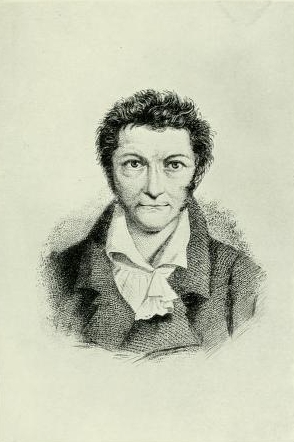
HOFFMANN
In 1804 he was transferred to Warsaw, at that time a Prussian town; and it was the full, varied, and, to a German, quite foreign life of this important city which gave Hoffmann's literary tendencies their decisive, final bent. Much that is mad and strange in his writings may be attributed to the wild, reckless joviality of the Warsaw days. In Warsaw he met Zacharias Werner, another author who was distinctly influenced by the social life of Poland in the beginning of the century. And here, whilst conscientiously fulfilling the duties of his appointment, he not only found time to cultivate his favourite art, music, and to frequent the society of other musical devotees, but also managed to decorate several halls with frescoes, to ornament a library with alto-reliefs executed in bronze, and to paint a room in the Egyptian style, adroitly introducing amongst the extraordinary representations of Egyptian gods, caricatures of his acquaintances, whom he provided with tails and wings. It was in Warsaw too that he conducted concerts for the first time.
In 1806, as every one knows, Prussian rule in Warsaw came to an end. Hoffmann saw the streets of the town crowded, first with the vanguard of the Russian army—Tartars, Cossacks, and Bashkirs—then with Murat's troops, watched the migrations of the races set in motion by Napoleon's campaign, and at last saw Napoleon himself, whom he, the good German, abhorred as a tyrant. In Dresden, in 1813, he was eye-witness of several small skirmishes and one battle; he walked over a battlefield, lived through a famine and a species of plague which followed in the train of the war—in short, his imagination was fertilised by all the horrors of the period, the first result being, characteristically enough, merely a set of funny caricatures of the French.
When still quite a young man, he had married a beautiful Polish lady, who made him a devoted and patient wife; it was probably thanks to her that, in spite of his overstrained nerves, he lived as long as he did. His marriage by no means precluded many passionate attachments to other women, but all these seem to have had their root rather in imagination than in any real feeling. Three days after a young lady with whom he was madly in love had engaged herself to another, he was perfectly happy, having cured himself of his passion by satirising it. He was helped to bear his woe by the pleasure of caricaturing it.
After figuring as a theatrical architect in Bamberg and conductor of an orchestra in Dresden, he went to Berlin, where he spent the last years of his life as a member of the Kammergericht (one of the principal courts of justice). As was natural, the astonishingly gifted man who could write books, improvise on the piano, compose operas, draw caricatures, and scintillate wit when he was in the humour, became a lion in social circles and a fêted frequenter of the taverns. He devoted a great share of his energy and talent to the observation of his own moods, which he watched closely and described day by day in a kind of diary.
Wine, which he only regarded as an exciting stimulant, was in reality much more than this to him. To it he owed much of his inspiration, his visions, those hallucinations which at first were fanciful, but became ever more serious. In his case intoxication actually produced a new kind of fantastic poetry. When under the influence of alcohol, he saw the darkness suddenly illuminated by phosphorescent light, or saw a gnome rise through the floor, or saw himself surrounded by spectres and terrible grimacing figures, which went on disappearing and reappearing in all kinds of grotesque disguises.
It was almost inevitable that this painstaking observer of his own moods and of the external peculiarities, more especially the oddities, of other men, should care little about nature. If he took a walk in summer, it was only to reach some place or other where he would be certain to meet human beings; and he seldom passed a pastry-cook's or a tavern without dropping in to see what kind of people frequented it. This explains the striking want of any feeling for fresh, open-air nature in his books. His mind was at home in a tavern, not in forest solitudes. But if his sense of the beauties of nature was weak, his enthusiasm for art was so much the more intense; genuine Romanticist that he is, half of his productions treat of art.
The peculiar, Romantic theory of human personality held by a poet of this temperament and this development was a product of over-impressionable and over-strained nerves and of irregular living. In his diary I find the following memoranda:—
"1804.—Drank Bischof at the new club from 4 to 10. Frightfully agitated in the evening. Nerves excited by the spiced wine. Possessed by thoughts of death and Doppelgänger. "1809.—Seized by a strange fancy at the ball on the 6th; I imagine myself looking at my Ego through a kaleidoscope—all the forms moving round me are Egos, and annoy me by what they do and leave undone. "1810.—Why do I think so much, sleeping and waking, about madness?"
It was a settled conviction with Hoffmann that when anything good befalls a man, an evil power is always lurking in the background to paralyse the action of the good power. As he expresses it: "The devil thrusts his tail into everything." He was haunted, says his biographer, Hitzig, by a fear of mysterious horrors, of "Doppelgänger" and spectral apparitions of every kind. He used to look anxiously round while writing about them; and if it was at night, he would often wake his wife and beg her to keep him company till he had finished. He imparted his own fear of ghosts to the characters he created; he drew them "as he himself was drawn in the great book of creation." It does not surprise us to learn that of his own works, he preferred those which contain the most gruesome pictures of madness or the weirdest caricatures—Brambilla, for instance.
He relies for effect, in a manner which soon becomes mannerism, upon the sharp contrasts with which he ushers in his terrific or comical scenes. From the commonest, most prosaic every-day life we are suddenly transported into a perfectly distorted world, where miracles and juggling tricks of every kind so bewilder us that in the end no relation, no species of life, no personality, seems definite and certain. We are always in doubt as to whether we are dealing with a real person, with his spectre, with his essence in another form or other power, or with his fantastic "Doppelgänger."
In one of the lighter tales of Hoffmann's last period, Der Doppelgänger, the two principal characters resemble each other so closely that one is constantly being taken for the other; the one is wounded instead of the other; the betrothed of the one cannot distinguish him from the other, &c., &c. All kinds of absurd mistakes are made possible, and the dread of "Doppelgängerei" is turned to good account. The common-sense explanation of the matter is insisted on (much as it is in Brentano's Die mehreren Wehmüller), simply because Hoffmann for once, by way of a change, fancied making some attempt at explanation. The explanation, as a matter of fact, explains nothing. All Hoffmann really cared for was the fantastically gruesome effect, just as all Brentano cared for was the fantastically comical one. Der Doppelgänger possesses no artistic merit.
There is wittier and more audacious invention in the tale, The Latest Adventures of the Dog Berganza. In the first place, we are left uncertain whether the dog is a metamorphosed human being or not; he himself says: "It is possible that I am really Montiel, who was punished by being compelled to assume the shape of a dog; if so, the punishment has been a source of pleasure and amusement." In the second place, even the dog, as dog, sees himself duplicated, and is conscious of the dissolution of the unity of his being. "Sometimes I actually saw myself lying in front of myself like another Berganza, another which yet was myself; and I, Berganza, saw another Berganza maltreated by the witches, and growled and barked at him."
Still greater is the audacity, still more extravagant the whimsicality in the tale of The Golden Jar. In it an ugly old Dresden apple-woman is at the same time the beautiful bronze knocker on Registrar Lindhorst's door. The metal face of the door-knocker occasionally wrinkles itself up into the old crone's crabbed smile. In addition to this, she is the odious fortune-teller, Frau Rauerin, and good old Lise, the fond nurse of the young heroine of the tale. She can (like the fortune-teller in Der Doppelgänger) suddenly change dress, shape, and features. When the matter of her parentage is cleared up, we learn that her papa was a "shabby feather broom," made of feathers from a dragon's wing, while her mamma was "a miserable beetroot."
Lindhorst, the stolid Registrar, who never seems to feel at home except when sitting in his library in his flowered dressing-gown, surrounded by old manuscripts, is also a great magician, who, in the middle of an ordinary conversation, suddenly begins to relate the most insane occurrences as if they were the most natural in the world. He tells, for instance, that he was once invisibly present at a party—quite a simple matter—he was in the punch-bowl. On another occasion he takes off his dressing-gown, steps without more ado into a bowl of blazing arrack, vanishes in the flames, and allows himself to be drunk.
In creating these doubled and trebled existences, the character, for instance, of the Archive Keeper, who is a Registrar by day and a salamander at night, Hoffmann obviously had in his mind the strange contrast between his own official life, as the conscientious criminal judge, severely rejecting all considerations of sentiment or æstheticism, and his free night life as king of the boundless realm of imagination—a life in which reality, as such, had no part.
But of all Hoffmann's tales, it is Die Elixire des Teufels ("The Elixir of Satan") which makes the most powerful impression. Let us dwell for a moment on the hero of this romance, Brother Medardus; for he is a typical character. It is impossible in a brief summary to convey any idea of the mysterious, weird horror of the book; to feel this one must read it. A work more saturated with voluptuousness and horrors the Romantic School, with all its long practice in the style, never produced.—In a certain monastery is preserved a flask of Satanic elixir, which had belonged to St. Anthony. This elixir is believed to possess magic properties. A monk who has tasted it becomes so eloquent that ere long he is the most famous preacher of the monastery. But his eloquence is not of a pious or healthy, but of a carnal, strangely exciting, dæmonic description. Brother Medardus drinks from the flask. A charming woman, his penitent, falls in love with him, and a longing for the pleasures and delights of the world impels him to leave the monastery. He finds a young man, Count Viktorin, asleep in the forest on the edge of a precipice, and half accidentally pushes him over. From this time onwards every one takes him for the Count.
"My own Ego, the sport of a cruel accident, was dissolved into strange forms, and floated helplessly away upon the sea of circumstances. I could not find myself again. Viktorin is undoubtedly pushed over the precipice by the accident which directed my hand, not my will—I step into his place." And as though this were not marvellous enough, he adds: "But Reinhold knows Father Medardus, the preacher of the Capuchin Monastery; and thus to him I am what I really am. Nevertheless, I am obliged to take Viktorin's place with the Baroness, for I am Viktorin. I am that which I appear to be, and I do not appear to be that which I am. At strife with my own Ego, I am an unanswerable riddle to myself."
Medardus, in his own form, now enters into relations with Viktorin's mistress, the Baroness, who has no idea that he is not Viktorin. He is possessed by carnal desires; women fall in love with him; he gives himself up to sensual pleasures, and in order to attain the fulfilment of his wishes, commits crimes of every kind, including murder. Horrible visions haunt him and drive him from place to place. In the end he is denounced and imprisoned. In prison the confusion of individualities reaches a climax. "I could not sleep; in the strange reflections cast by the dull, wavering light of the lamp upon the walls and ceiling, I saw all kinds of distorted faces grinning at me. I put out the lamp and buried my head in my pillow of straw, only to be still more horribly tormented by the hollow groans of the prisoners and the rattling of their chains." It seems to him that he is listening to the death-rattle of his victims. And now he plainly hears a gentle, measured knocking beneath him. "I listened, the knocking continued, and sounds of strange laughter came up through the floor. I sprang up and flung myself upon the straw mattress, but the knocking went on, accompanied by laughter and groans. Presently, an ugly, hoarse, stammering voice began calling gently but persistently: 'Me-dar-dus, Me-dar-dus!' An icy shiver ran through my veins, but I took courage and shouted: 'Who is there? Who is there?'" Then the knocking and stammering begins directly beneath his feet: "He, he, he! He, he, he! Lit-tle brother, lit-tle brother Me-dar-dus ... I am here, am here ... le-let me in ... we will g-g-go into the woo-woo-woods, to the woo-woo-woods." To his horror he seems to recognise his own voice. Some of the flagstones of the floor are pushed up, and his own face, in a monk's cowl, appears. This other Medardus is, like him, imprisoned, has confessed, and is condemned to death. Now everything happens as if in a dream. He no longer knows whether he is really the hero of the events which he believes to have happened, or whether the whole is a vivid dream. "I feel as if I had been listening in a dream to the story of an unfortunate wretch, the plaything of evil powers, who have driven him hither and thither, and urged him on from crime to crime."
He is acquitted; the happiest moment of his life is at hand; he is to be united to the woman he loves. It is their wedding day. "At that very moment a dull sound rose from the street below; we heard the shouting of hollow voices and the slow rumbling of a heavy vehicle. I ran to the window. In front of the palace, a cart, driven by the headsman's apprentice, was stopping; in it sat the Monk and a Capuchin friar who was praying loudly and fervently with him. Though the Monk was disfigured by fear and by a bristly beard, the features of my terrible Doppelgänger were only too easily recognisable. Just as the cart, which had been stopped for the moment by the throng, rolled on again, he suddenly glared up at me with his horrible glistening eyes, and laughed loud, and yelled: Bridegroom! Bridegroom! Come up on to the housetop! There we will wrestle with one another, and he who throws the other down is king and has the right to drink blood!' I cried: 'You monster! What have I to do with you?' Aurelia flung her arms round me and drew me forcibly away from the window, crying: 'For God and the Holy Virgin's sake!... It is Medardus, my brother Leonard's murderer, whom they are taking to execution.' ... Leonard! Leonard! The spirits of hell awoke within me, and exerted all the power they possess over the wicked, abandoned sinner. I seized Aurelia with such fury that she shook with fear: 'Ha, ha, ha! mad, foolish woman! I, I, your lover, your bridegroom, am Medardus, am your brother's murderer. You, the Monk's bride, would call down vengeance upon him? Ho, ho, ho! I am king—I will drink your blood.'"
He strikes her to the earth. His hands are covered with her blood. He rushes out into the street, frees the Monk, deals blows right and left with knife and fist, and escapes into the forest. "I had but one thought left, the hunted animal's thought of escape. I rose, but had not taken many steps before a man sprang upon my back and flung his arms round my neck. In vain I tried to shake him off; I flung myself down; I rubbed myself against the trees—all to no purpose—the man only chuckled scornfully. Suddenly the moon shone clear through the dark firs, and the horrible, deathly pale face of the Monk, the supposed Medardus, the Doppelgänger, glared at me with the same appalling glance he had shot at me from the cart. 'He, he, he! little brother! I am w-w-with you still; I'll n-n-never let you go. I can't r-r-run like you. Y-you must carry me. They were go-go-going to break me on the wh-wh-wheel, but I got away.'" This situation is spun out ad infinitum, but I forbear. To the end of the book one is uncertain of the real significance of the events, of the ethical tendency of the actions, so completely in this case has imagination disintegrated personality.
The Scandinavian author, Ingemann, has followed Hoffmann in this path. He turns to account, for instance, the eeriness in the idea of loudly calling one's own name in a churchyard at midnight; see his tale, The Sphinx, and others in the so-called Callot-Hoffmann style.
But, as already observed, Romanticism is not content with stretching out and splitting up the Ego, with spreading it throughout time and space. It dissolves it into its elements, takes from it here, adds to it there, makes it the plaything of free fancy. Here, if anywhere, Romanticism is profound; its psychology is correct, but one-sided; it is always on the night side or on the inevitability of things that it dwells; there is nothing emancipating or elevating about it.
In the old days the Ego, the soul, the personality, was regarded as a being whose attributes were its so-called capacities and powers. The words "capacity" and "power," however, only signify that there is in me the possibility of certain events, of my seeing, reading, &c. My true being does not consist of possibilities, but of these events themselves, of my actual condition. My real being is a sequence of inward events. For me, my Ego is composed of a long series of mental pictures and ideas. Of this Ego, I constantly, daily, lose some part. Forgetfulness swallows up gigantic pieces of it. Of all the faces I saw on the street yesterday and the day before, of all the sensations which were mine, only one or two remain in my memory. If I go still farther back, only an exceptionally powerful sensation or thought here and there emerges, like a solitary rocky island, from the ocean of forgetfulness. We only keep together the ideas and pictures that remain to us from our past lives by means of the association of these ideas, that is to say, by the aid of the peculiar power they have, in virtue of certain laws, of recalling each other. If we had no numerical system, no dates, no almanacs, wherewith to give some coherence to our different memories, we should have an extremely slight and indistinct idea of our Ego. But however substantial the long inward chain may seem (and it is strengthened, it gains in tenacity, every time we run over its links in our memory), it happens that we at times introduce into it a link which does not belong to it, at times take a link from it and place it in another chain.[3]
The first of these actions, the introducing of new, incongruous links into the chain of memory, happens in dreams. We dream we have done many things which we have never done. It also happens when we have a false recollection. He who has seen a white sheet blowing about in the dark, and believes he has seen a ghost, has such a false recollection. Most myths and legends, especially religious legends, come into existence in this way.
It frequently happens, however, that, instead of adding links to the chain of the Ego, we withdraw them. Thus the sick man, when his mind is wandering, supposes that the words he hears are spoken by a strange voice, or endows his inward visions with an outward reality, as Luther did when he saw the devil in his room in the Wartburg; and the madman not only partly, but entirely confuses himself with some one else.
In a state of reason, then, the Ego is an artificial production, the result of association of ideas. I am certain of my own identity—in the first place, because I associate my name, that sound which I call my name, with the chain of my inward experiences, and secondly, because I keep all the links of this chain connected by the association of ideas, by virtue of which they produce each other. But, since the Ego is thus not an innate but an acquired conception, founded upon an association of ideas which has to maintain itself against the constant attacks of sleep, dreams, imaginations, hallucinations, and mental derangement, it is by its nature exposed to manifold dangers. Just as disease is ever lying in wait for our bodies, so madness lies in wait at the threshold of the Ego, and every now and again we hear it knock.
It is of this correct psychological theory, originally propounded by Hume, that the Romanticists, though they do not define it scientifically, nevertheless have a presentiment. Dreams, dipsomania, hallucinations, madness, all the powers which disintegrate the Ego, which disconnect its links, are their familiar friends. Read, for instance, Hoffmann's tale, The Golden Jar, and you will hear voices issue from the apple-baskets, and the leaves and flowers of the elder-tree sing; you will see the door-knocker make faces, &c., &c. The strange, striking effect is here specially due to the way in which the apparitions suddenly emerge from a background of the most humdrum, ordinary description, from piles of legal documents, or from tureens and goblets. All Hoffmann's characters (like Andersen's Councillor in The Galoshes of Fortune, which is an imitation of Hoffmann) are considered by their neighbours to be either drunk or mad, because they always treat their dreams and visions as realities.
Hoffmann created most of his principal characters in his own image. His whole life resolved itself into moods. We see from his diary how anxiously and minutely he observed these. We come on such entries as: "Romantically religious mood; excitedly humorous mood, leading finally to those thoughts of madness which so often force themselves upon me; humorously discontented, highly-wrought musical, romantic moods; extremely irritable mood, romantic and capricious in the highest degree; strange, excited, but poetic gloominess; very comfortable, brusque, ironical, overstrained, morose, perfectly weak moods; extraordinary, but miserable moods; moods in which I felt deep veneration for myself and praised myself immoderately; senza entusiasmo, senza esaltazione, every-day moods," &c., &c.
We seem to see the man's spiritual life spread and split itself up fan-wise into musical high and low spirits. It is easy to guess from this register of moods that Hoffmann, genuine lover of night as he was, was in the habit of going to bed towards morning, after having spent the evening and night in a tavern.
Romanticism having thus dissolved the Ego, proceeds to form fantastic Egos, adding here, taking away there.
Take, for an example, Hoffmann's Klein Zaches, the little monster who has been endowed by a fairy with the peculiarity "that everything good that others think, say, or do in his presence is attributed to him; the result being that in the society of handsome, refined, intelligent persons he also is taken to be handsome, refined, and cultured—is taken, in short, for a model of every species of perfection with which he comes in contact." When the student reads aloud his charming poems, it is Zaches who is credited with them; when the musician plays or the professor performs his experiments, it is Zaches who gets the honour and the praise. He grows in greatness, becomes an important man, is made Prime Minister, but ends his days by drowning in a toilet-basin. Without overlooking the satiric symbolism of the story, I draw attention to the fact that the author has here amused himself by endowing one personality with qualities properly belonging to others, in other words, by dissolving individuality and disregarding its limits. With the same satirical intention, the same idea is worked out more ingeniously, though more roughly, by Hostrup, the Dane, in his comedy, En Spurv i Tranedans ("A Sparrow among the Cranes" = a dwarf among the giants), in which each one of the other characters attributes to the comical young journeyman tailor the qualities which he himself values most.
Here we have Romanticism amusing itself by adding qualities to human nature; but it found subtracting them an equally attractive amusement. It deprives the individual of attributes which would seem to form an organic part of it; and by taking these away it divides the human being as lower organisms, worms, for example, are divided into greater and smaller parts, both of which live. It deprives the individual, for instance, of his shadow. In Chamisso's Peter Schlemihl, the man in the grey coat kneels down before Peter, and, with admirable dexterity, strips the shadow off him and off the grass, rolls it up and pockets it—and the story shows us the misfortunes which are certain to befall the man who has lost his shadow.
This same tale of Peter Schlemihl shows how Romanticism, as a spiritual force, succeeded in impressing a uniform stamp on the most heterogeneous talents. It would be difficult to imagine two natures more unlike than Chamisso's and Hoffmann's; hence the plot of Chamisso's tale is as simple and readily comprehensible as the plots of Hoffmann's are morbidly extraordinary.
Adalbert von Chamisso was a Frenchman born, who acquired the German character remarkably quickly and completely, to the extent even of developing more than one quality which we are accustomed to consider essentially German. The son of a French nobleman, he was born in 1781 in the castle of Boncourt, in Champagne. Driven from France as a boy during the Reign of Terror, he became one of Queen Louisa of Prussia's pages, and later, at the age of twenty, a lieutenant in the Prussian army. He was a serious, almost painfully earnest, but absolutely healthy-minded man of sterling worth, brave and honourable, with a little of the heaviness of the German about him and much of the liveliness of the Frenchman.
The reverse of Hoffmann, he was no lover of social pleasures, but all the more ardent a lover of nature. He longed on hot summer days to be able to go about naked in his garden with his pipe in his mouth. Modern dress, modern domestic life and social formalities he regarded in the light of burdensome fetters. His love of nature led him to circumnavigate the globe, enamoured him of the South Sea Islands, and is expressed in much of his poetry.
Nevertheless, the imperceptible intellectual compulsion exercised by the age caused him, as author, to adopt Romantic theories and write in the Romantic style. It is characteristic, however, that when in such a poem as Erscheinung ("The Apparition") he treats the Romantic idea of the "Doppelgänger," he does it with a certain moral force which leaves on the reader's mind the impression of genuine despair. The narrator comes home at night and sees himself sitting at his desk. "Who are you?" he asks. "Who disturbs me thus?" returns the "Doppelgänger":—
"Und er: 'So lass uns, wer du seist, erfahren!' Und ich: 'Ein solcher bin ich, der getrachtet Nur einzig nach dem Schönen, Guten, Wahren; Der Opfer nie dem Götzendienst geschlachtet, Und nie gefröhnt dein weltlich-eitlen Brauch, Verkannt, verhöhnt, der Schmerzen nie geachtet: Der irrend zwar und träumend oft den Rauch Für Flamme hielt, doch mutig beim Erwachen Das Rechte nur verfocht:—bist du das auch?' Und er mit wildem kreischend-lautem Lachen: 'Der du dich rühmst zu sein, der bin ich nicht. Gar anders ist's bestellt um meine Sachen. Ich bin ein feiger, lügenhafter Wicht, Ein Heuchler mir und ändern, tief im Herzen Nur Eigennutz, und Trug im Angesicht. Verkannter Edler du mit deinen Schmerzen, Wer kennt sich nun? wer gab das rechte Zeichen? Wer soll, ich oder du, sein Selbst verscherzen? Tritt her, so du es wagst, ich will dir weichen!' Drauf mit Entsetzen ich zu jenem Graus: 'Du bist es, bleib und lass hinweg mich schleichen!' Und schlich zu weinen, in die Nacht hinaus."[4]
The painful moral self-recognition endows the ghost story with marvellous significance.
Chamisso's double nationality was a source of much unhappiness to him in his younger days, when there was violent enmity between the land of his birth and his adopted country. In one of his letters to Varnhagen (December 1805) he writes: "'No country, no people—each man for himself!' These words of yours seemed to come straight from my own heart. They almost startled me; I had to wipe away the tears that rolled down my cheeks. Oh! the same sentiment must have made itself felt in all my letters, every one!"
When, in 1806, Napoleon began the war with Prussia, he issued an order that every Frenchman serving in the enemy's ranks should, when taken prisoner, be tried by court-martial and shot within twenty-four hours. Hence Chamisso, who had in vain demanded to be allowed to resign his commission, was exposed to the chance of a disgraceful death.
He visited France in the following year, but in Paris there was nothing to attract him. "Wherever I am," he complains, "I am countryless. Land and people are foreign to me; hence I am perpetually longing." He was one of the bravest and most capable of German officers (his behaviour on the occasion of the surrender of Hameln proves this), but, as a Frenchman born and an admirer of Napoleon, he would have preferred not to have taken part in the war against France and the Emperor.
After his resignation was actually accepted, he spent some time at the court of Madame de Staël, and made the acquaintance of her international circle of friends. The year 1813, the year of Prussia's declaration of war against France, was the most trying of all for the unfortunate young Franco-German. His heart was divided; he desired the fall of Napoleon because he hated despotism, but at the same time he felt every humiliation which befell the French troops during their retreat from Russia, and every insulting word spoken of the Emperor, as if the misfortune had happened, the insult been offered, to himself. And with this very natural feeling his German associates showed no forbearance. He often cried despairingly: "No, the times have no sword for me." "Action and inaction," he writes in May 1813, "are equally painful to me."
This was the mood which produced his most notable work, Peter Schlemihl. The great historical events which harrowed his feelings made him intellectually productive; the summer of 1813 was a turning-point in his life. "I had no longer a country," he says, "or as yet no country." And so the man without a country writes the tale of the man without a shadow. In spite of its intangibility, a man's shadow is, like his country, like his home, one of his natural possessions, a thing which belongs to him from his birth, which is, as it were, part of him. In ordinary circumstances it is regarded as so entirely natural that a man should have a country, that it is hardly reckoned as a special possession, but is, like his shadow, taken as a matter of course. Chamisso gave expression to all his sadness, to the great sorrow of his life, in his daringly imagined fable. And strangely enough, he not only figuratively gave in it the essence of all his past experiences, but also prophetically imaged his future, his voyage round the world and his scientific labours. After Schlemihl has escaped from the temptations of the devil, he accidentally comes into possession of the seven-leagued boots, which take him to every country in the world, and enable him to pursue his favourite study to the greatest advantage. Schlemihl himself says: "My future suddenly showed itself clearly to the eyes of my soul. Banished from human society by the misdemeanours of my youth, I was thrown into the arms of Nature, whom I had always loved. The earth was given to me as a rich garden, study as the directing influence and strength of my life, knowledge as its aim."
The originality of its plot and the remarkable clearness of its style (this last a characteristic of all Chamisso's writing, and evidently his intellectual inheritance as a Frenchman) made Peter Schlemihl an extraordinary success. It was translated into nearly every language. Ten years after its publication a new kind of lamp, which cast no shadow, was named the Schlemihl lamp.
Chamisso's success naturally roused Hoffmann to emulation. In the clever little Story of the Lost Reflection, the hero leaves his reflection in Italy with the entrancing Giulietta, who has bewitched him, and returns home to his wife without it. His little son, discovering suddenly one day that his father has no reflection, drops the mirror he is holding, and runs weeping from the room. The mother comes in with astonishment and fright written on every feature. "What is this Rasmus has been telling me about you?" she asks. "That I have no reflection, I suppose, my dear," answers Spikher with a forced laugh, and proceeds to try to prove that it is foolish to believe that a man can lose his reflection, but that even if the thing be possible, it is a matter of no importance, seeing that a reflection is simply an illusion. Self-contemplation only leads to vanity, and, moreover, such an image splits up one's personality into truth and imagination.
Here we have the mirror chamber developed to such a point that the reflections move about independently, instead of following their originals. It is very amusing, very original and fantastic, and, as one is at liberty to understand by the reflection whatever one chooses, it may even be said to be very profound. I express no opinion, but simply draw attention to fact.
We have seen that the Romanticist is instinctively, inevitably, the enemy of clearly defined form in art. We have seen Hoffmann mixing up the different parts of his book to the extent of having part of one story on the front, part of quite a different one on the back of the same leaf; have seen Tieck composing dramas like so many puzzle balls one within the other, to prevent the reader taking them too seriously, and Kierkegaard fitting one author inside another in the Chinese box fashion, on the strength of the theory that truth can only be imparted indirectly, a theory which he ended by treating with scorn—we have seen, in a word, that the artistic standpoint of Romanticism is the exact opposite of the artistic standpoint of the ancients. And when, with their leaning to the supernatural, the Romanticists extend the personality of the individual throughout several successive generations, representing him as living before his birth and after his death, or represent him as a day-dreamer, half visionary and half madman, or humorously endow him with other men's attributes and despoil him of his own, fantastically filching now a shadow, now a reflection, they show by all this fantastic duplication and imagination that their psychological standpoint too, is an absolutely different one; for in the days of old both the work of art and the personality were whole, were of one piece. The movement is a perfectly consistent one, regarded as the antipodes of classicism, in short, as Romanticism.
But, granted that man is of necessity, by his very nature, a divided, complex being, he is nevertheless, as the healthy, vigorous personality, one. Aim, will, resolve, make him a complete unit. If, as a natural product, the human being is only a group held more or less firmly together by association of ideas, as a mind he is a complete whole; in his will all the elements of the mind are united. Romanticism only understood and depicted human nature with genius from the natural, from the night side. It made no closer approach in this than in any other of its endeavours to intellectual collectedness, unity, and liberty.
XII
ROMANTIC SOUL. NOVALIS
The traveller who visits a mine is let down into a subterranean shaft in company with a man who carries a lamp, by the uncertain light of which they explore the hidden depths. It is on such an expedition that I now invite my readers to accompany me. The shaft to which we are about to descend is that of the German "soul," a mine as deep, as dark, as strange, as rich in precious metal and in worthless refuse as any other. We shall note the imprint received by this soul in the days of Romanticism, for this purpose dwelling at length on the Romanticist who above all others is the poet of the soul—Novalis.
No word in any other language is the exact equivalent of the German word "Gemüth," here translated "soul." "Gemüth" is something peculiarly German. It is the inward flame, the inward crucible. In the famous words of the "Wanderer's Sturmlied":—
"Innre Wärme, Seelenwärme, Mittelpunkt! Glüh entgegen Phöb-Apollon, Kalt wird sonst Sein Fürstenblick Ueber dich vorübergleiten," $/
Goethe has described soul, and its significance in the poet's life. With those who have soul, everything tends inwards; soul is the centripetal force of the spiritual life. To the man who sets soul above all else in human life, fervour becomes a patent of nobility. In their conception of soul, as in everything else, the Romanticists rush to extremes. They magnify all that is mysterious, dark, and unexplained in the soul, at the expense of what is clear and beautiful. Goethe is to them the greatest of all poets, not because of his plastic power, but because of the obscurity, the dæmonic mystery, surrounding such characters as the Harper and Mignon, and because of the pregnant intensity of his smaller poems. Lessing and Schiller, on the other hand, are not deemed poets at all, and are sneered at and disparagingly criticised because of the outward direction taken by their keen, energetic thought. For enthusiasm, strength of character, and all such qualities are not soul. Soul remains at home when enthusiasm draws the sword and goes forth to war. To the Romanticists the greatest poet is he who has most soul.
The change which takes place in the case of the Romanticists is the turning of Goethe's "Seelenwärme"—warmth of soul—into heat, a heat which rises to the boiling or melting point, and in its intensity consumes all established forms and ideas. The glory of the Romantic poet is the heat and passion of the emotion which burns within him. What Novalis does is done with the force of his whole being. Intense, reckless feeling is his motto.
Friedrich von Hardenberg, a scion of an ancient house, was born at Wiederstedt, in the County of Mansfeld, in May 1772. His father, a man of a vigorous, ardent nature, had, after "leading a very worldly life," been converted at the age of thirty-one, when in great distress because of his first wife's death, to the faith of the English Methodists. At a later period he fell under the influence of the Moravian Brethren, more particularly of Count Zinzendorf; and he was at all times strongly influenced by his elder brother, a bigoted and somewhat ignorant aristocrat of pietistic leanings. The elder brother's will was law in the younger's household after the latter's second marriage; his strict principles forbade the family all social intercourse, and the children were obliged to keep their youthful amusements carefully concealed. In 1787 Novalis's father was appointed director of the saltworks in the little town of Weissenfels.
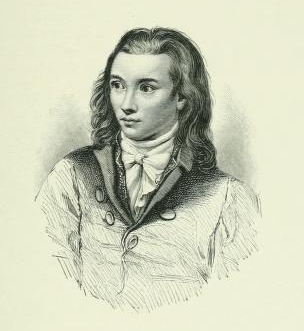
NOVALIS
Tieck became acquainted with the Hardenberg family in 1799, and they made a profound impression on him. Köpke says: "It was a quiet, serious life that they led, a life of unostentatious but sincere piety. The family belonged to the sect of the Moravian Brethren, and set forth its doctrines in their lives. Old Hardenberg, a high-minded, honourable man, who had been a fine soldier in his day, lived like a patriarch among his talented sons and charming daughters. Change and enlightenment in any form were his detestation; he loved and lauded the good old, misjudged days, and on occasion could express his views very decidedly and defiantly, or blaze up in sudden anger."
The following little domestic scene speaks for itself: —one day heard the old gentleman fuming and scolding in the adjoining room. "What has happened?" he anxiously asked a servant who entered. "Nothing," was the dry response; "it is only the master giving a Bible lesson." Old Hardenberg was in the habit of conducting the devotional exercises of the family, and at the same time examining the younger children on religious subjects, and this not infrequently meant a domestic storm.
Such was Friedrich von Hardenberg's home. He was a dreamy, delicate child, an intelligent, ambitious youth. In 1791 he went to Jena to study law. Those were the palmy days of that university, which then numbered amongst its professors such men as Reinhold, Fichte, and Schiller. Novalis found Schiller's lectures specially spirit-stirring, and the poet himself was to the young man "the perfect pattern of humanity." Fichte, whose acquaintance he also made, he enthusiastically called "the legislator of the new world-order." No one at that time could have foreseen in young Hardenberg the future high priest of obscurantism.
We see him in those youthful days intensely absorbed in the study of his own Ego. His plans are constantly changing; at one time he determines to be the diligent, ardent student, at another to throw up the pursuit of science and be a soldier. Strange as it may sound, the men whom he at this time regards as his models are those friends of freedom who were at the same time apostles of the gospel of utilitarianism. He writes to his brother: "Buy Franklin's autobiography, and let the genius of this book be your guide." We occasionally hear of a little youthful folly; he is now and again in trouble because of debts he has contracted; but he reasons very sensibly with his father, when the latter is inclined to take his peccadilloes too seriously.
Father and uncle naturally regarded the French Revolution with horror and loathing, but Friedrich and his elder brother were its ardent partisans.
Things in Saxony being on too small a scale to suit Friedrich's taste, his kinsman, the Prussian Minister (afterwards Chancellor) von Hardenberg, offered him an appointment in Prussia; this, however, he was unable to accept, owing to his father's unwillingness to allow him to become a member of the liberal-minded Berlin cousin's household. He was finally sent to Tennstedt, near Erfurt, to acquire practical experience of the administration of the laws of the Electorate of Saxony under the excellent district magistrate, Just.
Novalis's first friend among the Romanticists was Friedrich Schlegel, whose acquaintance he made at Jena. The two had much in common, and Novalis at once fell under Schlegel's influence. At the age of twenty-five he writes to him: "To me you have been the high priest of Eleusis; you have revealed heaven and hell to me; through you I have tasted of the tree of knowledge." Young Hardenberg shows himself to be entirely free from political prejudice; he takes a great fancy to Schlegel's landlord, because of the man's "honest republicanism," and jokes at Schlegel's severity in blaming him and the said landlord for their loyalty to the princely house. He has an extremely high opinion of Friedrich Schlegel as a critic, admires the fineness of the meshes of his critical net, which allows no fish, however small, to escape, and calls him "einen dephlogistisirten Lessing."
When, in 1797, Schlegel visited Hardenberg at his home, he found him utterly broken down. A young girl, Sophie von Kühn, to whom he had been passionately and absorbingly devoted, had just died. His despair took the form of longing for death, and he fully believed that his body must succumb to this desire and to his longing for the departed. Though he had no definite plans of suicide, he called the desire for annihilation by which he was possessed, "a firm determination, which would make of his death a free-will offering." It was under the influence of these thoughts that he wrote his Hymns to Night.
This excess of despair, and also the singular circumstance that Sophie, who died at the age of fifteen, was only twelve years old when he fell in love with her, seem to testify to something unhealthy and abnormal in Novalis's character. The impression is strengthened when we find him, only one year later, betrothed to a daughter of Von Charpentier, superintendent of mines. It is quite true, as La Rochefoucauld says, that the strength of our passions has no relation to their durability; nevertheless it is strange that Hardenberg could suddenly console himself with another, after finding his one pleasure for a whole year in the thought of death, talking for a whole year as if the grave held everything that was dear to him. It was a somewhat lame excuse that Julie seemed to him a reincarnation of Sophie, though the fancy was not a surprising one, considering how much the Romanticists dwelt on the idea of a previous existence. But here, as elsewhere in Hardenberg's life, much that is apparently unnatural is easily explainable when the circumstances are rightly understood. Sophie von Kühn seems, like Auguste Böhmer, to have been a most precocious child. When the youth of twenty-three made her acquaintance, she possessed all the attractions of the child combined with those of the maiden. Her features were fine, her curly head was lightly poised, and there was a whole world in her large, dark, expressive eyes. More impartial judges than Hardenberg have called her "a heavenly creature."
Sophie's bright, hospitable home presented a striking contrast to young Hardenberg's own; he was fascinated (as was his elder brother) by the whole family; and the young girl, who, had she lived, would perhaps have disappointed him by turning out worldly or insignificant, became his muse, his Beatrice, his ideal. When we remember that, almost at the same time with Sophie, Hardenberg lost his brother Erasmus, to whom he was united by an intimate and beautiful friendship, we cannot think it strange that life should have seemed to him to have lost all its charms. He regarded death not merely in the light of a release; his mystical tendency led him, as already mentioned, to speak of it as "a free-will offering." He wrote in his diary at this time: "My death will be a proof of my understanding and appreciation of what is highest; it will be a real sacrifice, not a flight nor a makeshift." It is at this crisis that he begins to turn in the direction of positive Christianity. Not that he dreamed of declaring allegiance to any particular Church, or belief in any particular set of dogmas, but his pagan longing for death assumed a Christian colouring. His inmost spiritual life had long been of such a nature that, had it not been for the influence of the spirit of the times, he might just as easily have become a determined opponent of all ecclesiastical doctrine. His state of mind seems to have been that indicated by Friedrich Schlegel when he wrote to him a year later: "Possibly you still have the choice, my friend, between being the last Christian, the Brutus of the old religion, or the Christ of the new gospel." Shortly after this his choice was made.
In December 1798 he still feels, when he compares himself with his friend Just, that he is only the apostle of pure spirituality. He does not, like Just, rely "with childlike mind upon the unalterable words of a mysterious ancient document;" he will not be bound by the letter, and is inclined to find his own way to the primeval world; in the doctrines of Christianity he sees an emblematic pre-figurement of the coming universal religion. "You will not," he writes to Just, "fail to recognise in this conception of religion one of the finest elements in my composition—namely, fancy." In other words, he consciously admits fancy to be at the source of his religious development.
In the same year (1798) he sent some fragments to Wilhelm Schlegel for publication in the Athenæum, with the request that their author might be known as NOVALIS, "which is an old family name, and not altogether unsuitable."
Tieck met Novalis for the first time when he visited Jena in the summer of 1799. August Wilhelm Schlegel brought them together, and they were soon devoted friends. The three spent the first evening in earnest conversation, opening their hearts to each other At midnight they went out to enjoy the splendour of the summer night. "The full moon," says Köpke, "was shedding a magic glory upon the heights round Jena." Towards morning Tieck and Schlegel accompanied Novalis home. Tieck has commemorated this evening in Phantasus.
It was under Tieck's influence that Novalis wrote his principal work, Heinrich von Ofterdingen. While he was still engaged upon it, his young life was put an end to by consumption. He died at the age of twenty-nine, only two years after the meeting with Tieck and A. W. Schlegel above described. This early death, a remarkable degree of originality, and great personal beauty have combined to shed a poetic halo round Novalis. The St. John of the new movement, he resembled the most spiritual of the apostles in outward appearance also. His forehead was almost transparent, and his brown eyes shone with remarkable brilliance. During the last three years of his life it could be read in his face that he was destined to an early death.
Novalis was seventeen when the French Revolution broke out. If one were asked to give a brief definition of the main idea of that great movement, one would say that it was the destruction of everything that was merely traditional, and the establishment of human existence upon a basis of pure reason, by means of a direct break with everything historic. The thinkers and heroes of the Revolution allow reason, as it were, to upset everything, in order that reason may put everything straight again. Although Novalis is deaf to all the social and political cries of the period, and blind to all its progressive movements, and although he ends in the most grim and repulsive reaction, he is, nevertheless, not merely influenced, but, all unconsciously, completely penetrated by the spirit of his age. Between him—the quiet, introspective, loyal Saxon assessor—and the poor sans-culottes who rushed from Paris to the frontiers, singing the "Marseillaise" and waving the tricolour flag, there is this fundamental resemblance, that they both desire the destruction of the whole outward and the construction of an inward world. Only, their inward world is reason, his is soul: for them, reason with its demands and formulæ—liberty, equality, and fraternity; for him, the soul, with its strange nocturnal gloom, in which he melts down everything, to find, at the bottom of the crucible, as the gold of the soul—night, disease, mysticism, and voluptuousness.[1]
Thus, in spite of his violent animosity to his age, Novalis belongs to it; the direct opponent of all its enlightened and beautiful ideas, he is, despite himself, possessed by its spirit.
What in Fichte and the men of the Revolution is clear reason, comprehending and testing everything, is in Novalis an all-absorbing self—perception, which becomes actual voluptuousness; for the new spirit has taken such a hold upon him that it is, as it were, entwined round his nerves, causing a species of voluptuous excitement. What with them is abstract liberty, liberty to begin everything from the beginning again, with him is lawless fancy, which changes everything, which resolves nature and history into emblems and myths, in order to be able to play at will with all that is external, and to revel unrestrainedly in self-perception. As Arnold Ruge puts it: "Mysticism, which is theoretical voluptuousness, and voluptuousness, which is practical mysticism, are present in Novalis in equally strong proportions."