SUGGESTIONS FOR THE EMPLOYMENT OF THE MACHINE GUNS OF A BRIGADE TAKING PART IN AN ATTACK ON AN ENTRENCHED POSITION.
Reading edition
1. The whole of the machine guns must be organised under the command of one Officer.
2. This Officer, in conjunction with the Section Officers, must make detailed plans for the employment of the guns.
3. In this manner each gun or group of guns will have a specific task allotted to it. Before the action commences all concerned will thoroughly understand their duties.
4. It must be clearly understood by all Officers of the Brigade that the machine guns have definite tasks allotted to them. That they are under the command of the Brigade Machine Gun Officer, and are therefore not to be given orders or otherwise interfered with by other Officers.
5. The plans of the B.M.G.O. will have been made in consultation with the Brigade Commander, who will have explained to him the course that the action is expected to take.
111All guns must be in their allotted places before the preliminary bombardment commences.
6. The Machine Guns will be allotted as follows:—
A.—Some to go forward with the Attacking Infantry.
These guns should not open fire until the infantry advance takes place.
Their role will be to make good the ground gained by the infantry against counter attack.
They should advance in such a manner as to ensure their reaching the position gained by the infantry in safety.
The locality in which the guns will be mounted in the captured lines should be settled before the advance.
B.—Some to Cover the Infantry Advance.
The possibility of using guns for this purpose and their positions if used depends on:—
1. The lie of the ground.
2. The position of your own and the enemy’s trenches.
When their role of covering fire is completed they should automatically come again under the control of the B.M.G.O., who will give them further orders.
C.—Some Detailed in Pairs to Engage the Enemy’s Machine Guns when these are Located.
These may possibly go forward with the attacking Infantry. This will depend on the nature of the ground, action, etc.
D.—Some in Reserve under the Brigade Commander.
These should be retained as a real reserve and not pushed too early into the fight.
If the attack is to consist of more than one phase, that is to say, of two or more distinct advances, separate plans must be made for each.
Arrangements for the supply of ammunition, belt fittings, ammunition depôts, etc., must be made before the action commences. One Officer should be placed in charge of these arrangements.
The B.M.G.O. should remain with the Brigadier. He should provide himself with a suitable number of orderlies.
112
CO-OPERATION.
The necessity for co-operation between the machine guns taking part in any particular action cannot be overestimated.
Not only should the individual guns of a particular unit work upon some definite plan for mutual support, but the sections of all units that are operating together should co-operate with a view to obtaining the best results from their combined actions. This cannot be done in action unless previously practised. Therefore attention should be paid to training numbers of guns to operate together for some specific purpose.
RANGES.
The ranges fired at have varied from 15 yards (at which, in one instance, a German rush was stopped), to 2,800 yds., at which range a battery of the enemy’s field artillery was silenced. This brings out the importance of:—
1. The allowance for wind at long ranges.
2. The importance of range-taking, range cards, judging distance, visual training, reference points, etc.
3. Practice of the “Swinging Traverse” for stopping rushes and dealing with dense targets at very close range.
4. Practice of traversing by means of the “Automatic Tap” for medium and long ranges.
NATURE OF TARGETS FIRED AT.
Targets have been of all kinds, such as:—
1. Dense masses at all ranges.
2. Extended lines at all ranges.
3. Artillery on the move and in action.
4. Edges of woods, hedges, ditches, etc., where enemy’s firing-line was known to be, but in many cases could not be seen.
5. Enemy machine guns in all manner of positions, usually invisible to the eye or even with glasses.
6. Hollows, wood, and other cover under which the enemy was known to be concentrating.
7. Searching fire to try and locate and beat down hostile fire that was being delivered from concealed positions.
The varied nature of the targets that the machine gunner may have to engage brings out the fact that the machine 113gunner must be very thoroughly trained, and emphasizes the points brought out under “Ranges, Fire Orders, Indication and Recognition.”
FIRE ORDERS.
While in a large number of instances it has been possible to give fire orders by word of mouth, this will, as a rule, be only possible under exceptionally favourable circumstances.
Thus the successful co-operation of the guns working under one leader will very largely depend on the mutual understanding that exists between the Officer and his Gun Commanders.
Therefore the Officer must ensure that all those under him clearly understand:—
1. The part the machine guns are intended to play.
2. The plans of the Machine Gun Officer.
3. The objects in view and the methods by which the Machine Gun Officer hopes to attain them.
In this way, even when individual control by the Officer has been lost, the desired effect will most likely be obtained, for each Gun Commander will be striving to attain that effect, though, perhaps, by different means.
METHODS EMPLOYED IN CONTROLLING FIRE OF SECTION.
The following have been the usual methods:—
1. Fire orders by word of mouth.
2. Signals (including flashlights, etc.).
3. Telephones (in one or two cases in trenches).
4. Orderlies.
But whatever method is employed, a thorough understanding between the Officer and those under him is essential.
NUMBER OF GUNS UNDER ONE COMMAND.
One Officer to a 4–Gun Section is not sufficient. Whether the guns are grouped under the supreme command of one Senior Officer, or whether they work in sections, there should always be one Officer to each pair of guns.
114
ALTERNATIVE POSITIONS ARRANGED FOR.
The great importance of alternative positions being arranged for cannot be overestimated. The best way of moving the gun from one position to another without being seen should be studied. If guns are located and shelled, either:—
1. Move guns at once to an alternative position or right away.
2. Let the gunners cease fire and get under cover until the shelling ceases.
The first will be the more useful proceeding, but success has been obtained several times with the second. For example:—
On one occasion, after shelling for some time, the artillery ceased, thinking, no doubt, that they had “knocked out” the machine guns. Massed enemy infantry then advanced, the machine guns opening fire again from their old position with great effect.
The great importance of concealed approach in occupying positions must be impressed on Machine Gun Officers.
GENERAL REMARKS OF INTEREST.
1. Lack of any organised method of using machine guns. Young and inexperienced Officers are left in many cases to do what they think best with their sections, without any previous consultation or plan as to how guns can be most usefully employed.
2. Lack of any attempt at co-operation between the sections of the units working together in any particular action.
3. Lack of initiative and push. This is usually due to want of knowledge. Though the machine gun is a weapon of opportunity, opportunities seldom occur to those who passively await them.
A good Machine Gun Officer, by keeping himself thoroughly in touch with the situation, must have an opportunity to use his guns with effect.
4. This lack of co-operation is seen both in the open and in trench work. All this points to the fact that co-operation between the whole of the machine guns taking part in any action is not sufficiently studied.
115
GUNS BRIGADED IN ACTION.
On many of the occasions brought to notice in which machine guns have been brigaded they have achieved marked success, but on the whole not sufficient use has been made of this method of obtaining the combined action of a number of guns.
“Brigading” guns does not mean “massing” them. It means the “brigaded” guns are employed with some definite plan under the direction of one Officer.
In all cases where the action of brigade guns has been successful there has been:—
1. A thorough understanding of the plans of the Brigadier by the B.M.G.O.
2. Conference between the B.M.G.O. and the Section Officers at which the arrangements for the employment of the machine guns were fully discussed.
3. Definite orders to the Section Officers.
4. A proportion of the guns held in reserve under the B.M.G.O.
But when the sections have been hastily collected together and placed under the B.M.G.O., without time for making the above arrangements, the result has usually been that sections have been dispersed without definite orders or a complete understanding of the situation, and effect has been lost.
In trench warfare the successful co-operation of the machine guns assisting in the defence of any particular section of the entrenched line has been obtained by:—
1. A previous reconnaissance of the whole line by the B.M.G.O.
2. Diagrams made of own and enemy’s trenches.
3. The number of emplacements.
This has enabled rapid concentration of the requisite number of guns only on any one portion of the enemy’s line, and has prevented unnecessary opening of fire and the consequent waste of ammunition.
In many cases, however, Officers in command of troops in sections of trench line have considered they are also in command of the machine guns placed in that portion 116of the trench occupied by their troops. This has led to:—
1. The disadvantage of dual control.
2. The guns being placed in the same emplacement day after day.
3. The arrangements of Machine Gun Officer being interfered with.
4. The guns being located by the enemy through an unnecessary opening of fire ordered by an Officer who is not an expert in machine gun tactics.
FIRE ORDERS.
The system of fire orders as taught at Hythe previous to the war has been most successful.
Machine Gun Officers are also of opinion that, though it has often been impossible to give orders by word of mouth, the systematic training of all ranks in this system tends to ease of control under difficult circumstances, and when a number of guns are being employed for combined action.
This training forms a basis from which other methods of control can most easily be evolved, and inculcates into the men the necessity for assuring themselves that any orders received by them are passed on by some means to those concerned.
“INDICATION AND RECOGNITION.”
The methods of “indication and recognition,” as taught at Hythe before the war, have proved most useful. This fact has been brought out in the accounts of the most successful machine gun actions, as has also the great value of the use of range cards and indication points. Targets are generally easy to indicate, as men are more alert than in peace-time.
Training in indication, recognition, fire orders, and judging distance, can be given at any time, as no apparatus is required.
This is also valuable, as it trains all ranks in a quick understanding of directions given, study of ground, and trains the eye in quick observation.
117
WORKING GUNS IN PAIRS AND INTERVALS BETWEEN GUNS.
The necessity of using guns in pairs for mutual support in case of mechanical trouble no longer holds good. Guns in the open have usually been placed not less than 50 yards apart. This enables the best use to be made of the ground as protection against artillery fire and for concealment. In trench warfare guns should usually be placed singly, arrangements being made for “cross fire” and mutual support between the guns of any particular section of the defensive line.
OBSERVATION OF FIRE.
Observation of fire has usually been obtainable up to 900 yards, and in favourable circumstances at even longer ranges.
Even when the ground has been unfavourable, observation has often been obtainable on water, walls of houses, enemy’s parapet, etc.
OVERHEAD FIRE AND CONDITION OF GROUND.
During the fighting on the Marne and on the Aisne, guns were often able to support the infantry advance to within 100 yards of the enemy’s position.
Even on flat ground frequent instances are given where overhead fire has been used, with excellent effect, from buildings.
On the whole it would appear that not enough use is made of this fire.
This is a question that should be carefully studied by all Machine Gun Officers.
INDIRECT FIRE BY GRATICULES, LEVEL, AIMING POSTS AND OBSERVATION.
All the suggested methods have been used, and in some cases compasses and maps as well. Effect has been obtained in the open and on enemy’s concentrations at long ranges, and in trench warfare on working parties, ration parties, communications, etc., behind the enemy’s 118lines. A great deal more could be done in this way if all guns were not almost invariably placed in trenches, instead of a proportion being placed in suitable positions in rear, and long-range fire employed. All this points to the fact that a Machine Gun Officer should be acquainted with all methods of employing indirect fire, in order that he may be in a position to make the best of any opportunities that may occur.
CLOSE CO-OPERATION BY MACHINE GUNS WITH THE FRONT LINES OF ATTACKING INFANTRY.
Very little information has been given on this subject, but co-operation seems to have been very poor; but this co-operation is made very difficult in many cases by:—
1. Inability of the M.G. sections to keep pace with the attacking infantry.
2. The visibility of the methods employed of carrying the gun. This leads to many casualties.
3. Lack of tactical knowledge on the part of many of the more junior M.G.Os.
4. Lack of definite plans as to the role of the M.Gs. before the action commences.
The two following examples serve to illustrate some of the above:—
1. In a recent attack, owing to lack of any previous understanding between M.G.Os., eight M.Gs. converged into one small section of a captured trench. Owing to lack of space only two of these guns were able to come into action.
2. In another instance during an attack, six guns converged into one small house. Owing to lack of space, etc., only two of these guns were able to come into action.
Before an attack a certain M.G. Officer was told to await orders from his Commanding Officer. He was forgotten and left behind.
In this case, as soon as the Officer realized that he had been forgotten, he should have used his own initiative.
All these point to the fact that some arrangements for concerted action should be made.
N. B.—See “Guns Brigaded in Action.”
119
OBTAINING AMMUNITION FROM LIMBER FOR GUNS WHEN ATTACKING.
1. The usual system of using Nos. 3 and 4 as carriers is generally adopted. Often these numbers are not sufficient for the work. It is then necessary to borrow men from neighbouring squadrons or companies.
2. The bringing up of ammunition is dangerous work; therefore it is obviously best to avoid employing trained gunners if unskilled men are available.
3. In this manner you conserve your trained gunners for replacing casualties.
4. Pack animals can sometimes be brought close to the firing-line when the ground is favourable, thus saving manual labour.
5. Several instances are given of confusion occurring during an attack, owing to the limber moving without orders. This should be guarded against.
CHIEF MECHANICAL TROUBLES.
The answer to this subject emphasizes the fact that when well looked after, the Maxim or Vickers machine gun is thoroughly reliable. Except in very few cases all breakages may be said to be due to want of care. The following are the principal troubles that have occurred:—
1. Broken Lock Spring.
From inquiries made it would appear that many gunners keep their guns loaded with the lock spring compressed during the whole period that the gun is in the trenches. This practice will be a fruitful source of broken lock springs. The half loading motion should be performed, and the lock spring released. To complete the loading when required should not take more than one second.
2. Bulged Barrels.
These are due to mud getting into the barrel when the gun is being carried into the trenches, while it is being mounted, or through striking against the parapet when in position.
Waterproof sheets or sandbags should be put round the gun when carrying it to or from the trenches.
120
3. Wet Belts.
These can generally be kept dry by covering the box with a waterproof sheet; the exposed part of the belt also being covered by that part of the sheet that is hung over the gun.
4. Muzzle Cups (Vickers’ Gun).
The reason for most of the breakages of these cups is that they are screwed up too tight, thus allowing for no expansion of the metal of the barrel owing to heat. At the same time they must not be too loosely screwed up, as this will equally cause breakages.
5. Stove Pipe Attachment.
Complaints are made that this bursts at the seam. This seam can easily be riveted by the armourer sergeant.
6. Loose Belts.
Loose belts have given trouble owing to wear.
7. Firing Pins.
A number of firing pins have been broken.
Beyond these few things mechanism troubles have been very rare.
USE OF PACK TRANSPORT.
Pack transport for both cavalry and infantry has been found to be more mobile and less conspicuous than limbered wagons. A combination of both is probably best. In many cases, before the war, pack transport was never used; thus when issued it was little understood. Sufficient attention is not paid to the selection of horses for pack work. If the horses with easy action are selected the bad effects of undue jolting can be minimized. Putting on pack and getting in and out of action with it is too little practised.
THE FOLLOWING COMPLAINTS HAVE BEEN RECEIVED.
1. Canvas ammunition carriers soon wear out. These can easily be reinforced with leather by a saddler. A board placed underneath them with rope passed through the brass eyelets has been found very satisfactory.
1212. Jolting of the pack causes the ammunition to slip back in the belt, leading to faults in feed. Boxes can be lined with tin from biscuit boxes. Ammunition has been carried in boxes that have been treated in this way for long periods without any movement of the ammunition.
PACKING AND CARRYING GUNS IN LIMBER.
Almost every detachment appeared to have a different method of packing their limbers. It is advisable that gun, tripod, etc., should be carried in the front portion, as the rear half may have to be discarded. In many cases boxes to hold the gun are fitted into the limber itself with good results. Converted guns are sent in boxes too long to fit the limber.
BREAKAGES TO LIMBER.
Perches, brakes and perch hooks have frequently broken. It is thought that brakes are too often used instead of horses being made to take the weight of the limber when descending hills.
BILLETS.
Most Machine Gun Officers appear to make every endeavour to keep their men in practice, practice being daily given whether in or out of the trenches. There are, however, exceptions, who state that there is no time for training. As all brigades doing trench work are similarly situated, this points to lack of effort in those particular cases. In very few cases is any physical training attempted. This is one of the most important parts of the training of any man who has to carry a heavy weight at a rapid pace. After several days of trench work this becomes more than ever necessary. It is suggested that only the minimum number of men actually required to work the guns should be kept in the trenches. The remainder of the team should be practised daily, and every effort should be made to keep them physically fit. In this way each man would do only very short periods of trench work, and would be in every way better and more prepared for really strenuous work when required.
122
TO TRAIN NEW MEN FOR GUN TEAMS.
Where instruction in billets is carried out on a properly organized system there would appear to be no difficulty in training considerable numbers of new men. In certain brigades, brigade machine gun courses are held under a selected Officer; the men attending these courses are kept out of the trenches for the duration of the course. This would appear to be by far the most satisfactory arrangement. Many Officers complain that as soon as they train a reserve team it is placed in the ranks, the men fighting as ordinary riflemen. Thus after an action when reserve men are required to replace the casualties in the gun team, it is generally found that many of these, on whose training as machine gunners much time and trouble has been spent, have been killed or wounded. This is a mistaken policy. In conclusion:—
1. Trained machine gunners are too valuable to be risked on any work except their own particular job.
2. All trained reserves should be kept out of danger as much as possible until required to replace casualties.
3. At ordinary times four men per gun are ample for work in trenches; the remainder should be kept in reserve.
4. A proper system of training should be established in each brigade.
PAINTING OF GUNS.
It is suggested that guns should be painted on the rainbow smudge system, in order to make them less conspicuous and visible.
KEEPING OFFICERS IN PRACTICE.
It is very important that all Officers, when trained as machine gunners, should be given opportunities of practice and of handling a section. Thus they will be ready to take over the section at any time, if required.
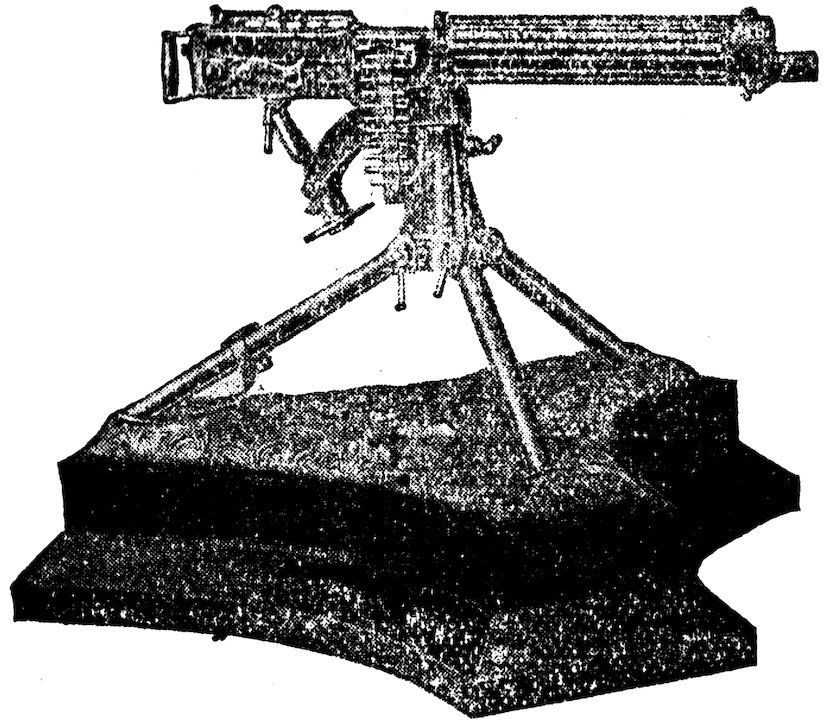
A Silver Model of a Maxim Gun.
War Trophies & Souvenirs
The Goldsmiths & Silversmiths Company have a selection of designs open for inspection or special designs can be prepared by expert artists free of charge. Shells, fuses and other War Souvenirs can be mounted in suitable manner at moderate prices. Estimates can be given for any work to be undertaken. Catalogues and Photographs sent on application.
The
Goldsmiths & Silversmiths Company, Ltd.,
Jewellers to H.M. The King.
112, Regent Street, London, W.
No Branches.

TRADE MARK.
GEO. CORDING LTD.
GUARANTEED
WATERPROOFS

By Appointment To H.M. The King.
WATERPROOF
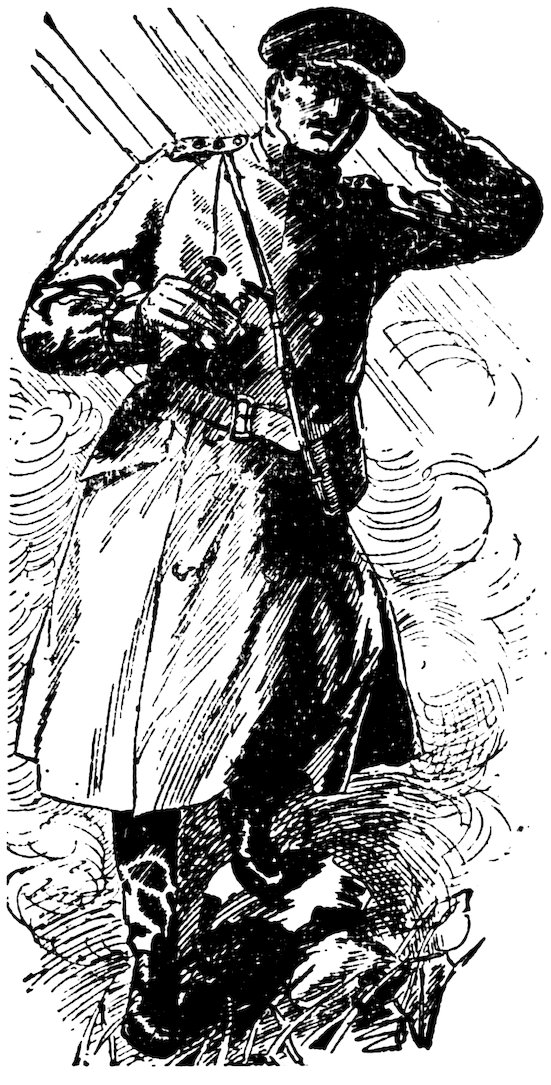
TRENCH COAT
Lightweight 90/–
Medium 105/–
Heavy 105/–
Fleece Linings 45/–
Without Rubber } Write for Prices.
„ (lined Oil Silk)
(Write giving chest measure and length required.)
WATERPROOF
BOOTS & WADERS
OVERALLS, OILSKINS
CAMP & HOSPITAL EQUIPMENT
Geo. CORDING Ltd.
Phones:—
Regent 3738
Gerrard 6327.
125, REGENT STREET 16, NEW BOND STREET London, W.1.
PIPE & McGILL,
LTD.
27, Maiden Lane, Bedford St.,
Strand, London, W.C. 2.
Actual Manufacturers
of Officers’ Uniforms
since 1868.
❧ ❧
Price List on Application.
❧ ❧
BEST MATERIAL AND
WORKMANSHIP ONLY.
Phone: Gerrard 3657.
Telegrams: “WEFT, RAND, LONDON.”
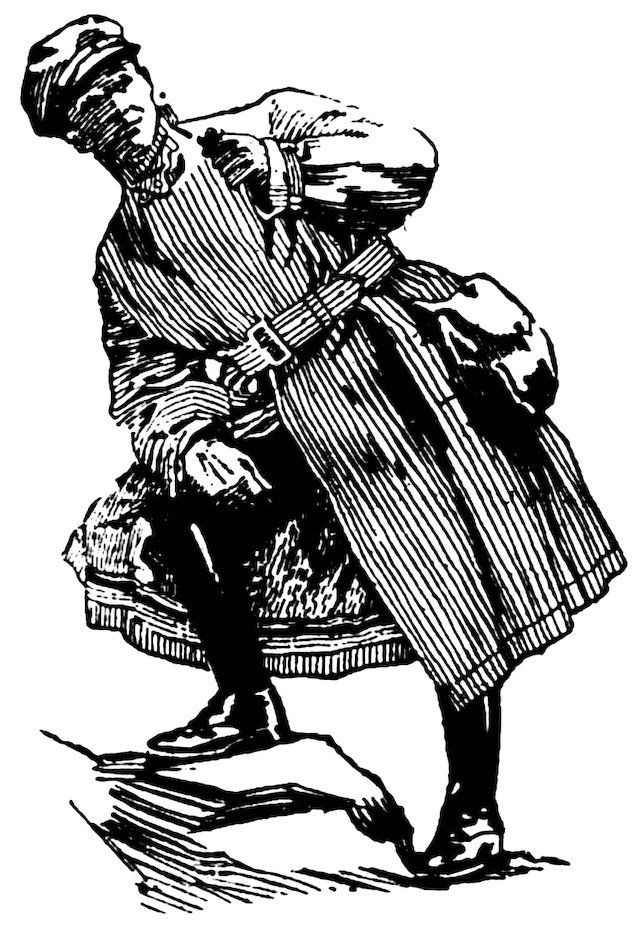
The Rimasop Trench Coat
Made by the old-established Bond Street House of Rimell & Allsop, this coat embodies the suggestions of British Officers who have fought in France and Flanders since the beginning of the War. War experience has proved its practical value. Officers are invited to avail themselves of the experienced services of Messrs. Rimell & Allsop in the selection of any kit, either for Ceremonial occasions or for the Front.
A 16–page booklet will be sent post free to any address by
Rimell & Allsop,
Sporting & Military Tailors,
54, New Bond Street, London, W.
WRIGHT’S
Coal Tar
SOAP
is now known as the
Soldiers’ Soap.
It Soothes, Protects, Heals.
Bournemouth, 1916.
Dear Sirs,
I am sending you an extract from my son’s letter (he is on active service, somewhere in France). I wrote asking if I should send him vermin powder, and his reply is: “DON’T SEND ANY VERMIN POWDER, THANKS; I USE WRIGHT’S COAL TAR SOAP, THAT’S AS EFFECTIVE AND MUCH MORE PLEASANT.”
It seems to me a unique and spontaneous tribute to your soap.
Yours truly, S.....
4½d. PER TABLET.

B.S.A.
RIFLES
AND
SIGHTS
The very extensive B.S.A. rifle and sight plant is at present exclusively engaged in the manufacture of service pattern arms for the War Department. The production of the various B.S.A. target and sporting rifles and sights will be resumed as soon as the pressure due to the war eases off.
There are still remaining in stock a few rifles of ·250, ·300, ·310, and ·32/20 bore.
WRITE FOR DETAILS, POST FREE.
B.S.A. Rifle “Safetipaste”
THE “NO TROUBLE” RIFLE BARREL PRESERVER.
Abolishes the arduous process of scrubbing out rifle barrels. The bore of the barrel has merely to be coated with the preparation. Acid and other products of combustion at once rendered quite harmless. Rifle may safely be put aside for any period. Simply wipe out the bore before firing again. Its polish may be even more brilliant than before.
Sold by all Gunmakers at 1/– per tube.
Inventors and Sole Manufacturers:—
THE BIRMINGHAM SMALL ARMS CO., LTD.,
BIRMINGHAM.
H. Graham Bennet,
Uniform Specialist,
58, Moorgate Street, LONDON, E.C.
Telephone No.: LONDON WALL 205.
Estimate for Outfit for Second Lieutenant of Infantry
on joining Unit (Home Service).
£ s. d.
1 Service Jacket, whipcord material 4 14 6
1 pair Collar Badges for ditto 0 6 6
1 pair Knicker-breeches, whipcord material 1 10 0
1 Service Jacket, fine grade serge 3 10 0
1 pair Collar Badges for ditto 0 6 6
1 pair “Slacks” to match 1 5 0
British Warm Coat (Lined Woollen Plaid) 3 15 0
1 pair Gilt Stars for shoulders of ditto 0 2 6
Sam Browne Belt, fine grade, with two braces, frog, holster, pouch, etc., complete 2 5 0
Cap and Badge 1 0 0
1 pair Spiral Puttees 0 7 6
Haversack 0 7 6
Water Bottle 0 12 6
Whistle and Lanyard 0 2 6
Great Coat Carrier, best grade sling and swivels 0 8 6
3 Best Quality Khaki Flannel Shirts at 10/6 1 11 6
6 Collars to match at 1/6 0 9 0
2 Khaki Silk Knitted Ties at 2/6 0 5 0
22 19 0
Wolseley Valise and Camp Kit complete 7 10 0
30 9 0
Infantry Pattern Burberry Coat 3 13 6
£34 2 6
Strictly Net Cash.
NOTE.—The above figures are a quotation for the complete outfit, and do not refer in every case to separate items.
All the above articles of best materials, best cut and style and sound workmanship.
Full detailed price list and list of regiments, etc., for which outfits have been supplied, can be had on application.
Speciality—Promptitude.
BENSON’S
LUMINOUS
“Active Service” Watch.
VISIBLE AT NIGHT.
WARRANTED TIMEKEEPERS.
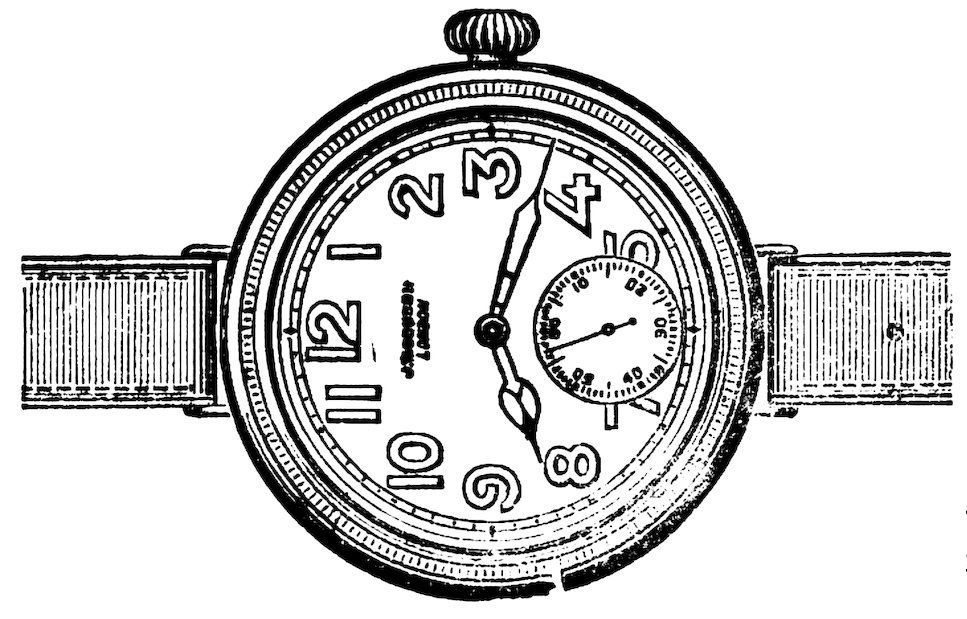
Silver Crystal Glass, £3 3s.
Silver Hunter or Half Hunter, £3 15s.
Gold Crystal Glass £8 0s.
„ Hunter or Half Hunter £8 10s.
Others in Silver from £2 10s.
Fine quality lever movement, fully luminous figures and hands, and extra heavy Screw case (special to our make).
Illustrated Lists of Wristlet Watches, Rings (with size card), Watches, Chains, Jewels, etc., post free.
62 & 64, LUDGATE HILL, E.C. 4, and 25, OLD BOND STREET, W. 1.
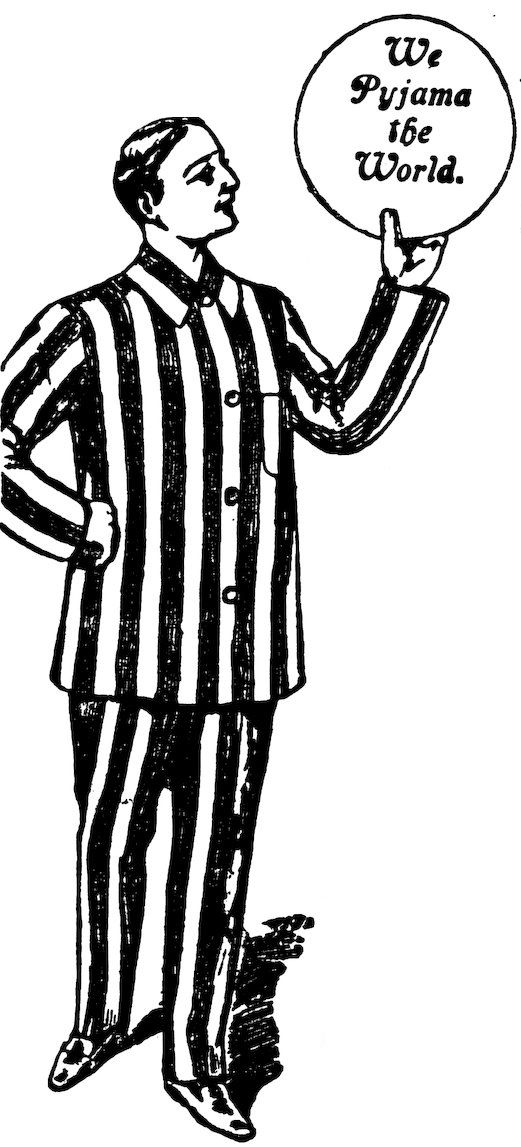
ALWAYS WEAR “SWAN-STRIPE” Pyjamas.
Will not shrink.
Known throughout the world as Swan & Edgar’s Pyjamas.
REFUSE
SUBSTITUTES.
“MERCERISED”
(thin), 6/11 3 for 20/–
CEYLON WOOL,
Medium Weight, 6/11
3 for 20/–
BEST WOOL MIXTURE,
12/6 3 for 36/–
HEAVY PURE WOOL,
18/6 3 for 54/–
PURE SILK,
21/– 35/– 45/–
We hold the largest stock of Pyjamas in London.
ALL PYJAMAS SENT POST FREE IN U.K.
Height and Chest Measurement required.
Swan & Edgar
LTD.
Regent Street and Piccadilly, London, W.

is particularly valuable for use on the Field, in the Hospital, in the Canteen and in Training
It aids and increases nutrition and stimulates and builds up strength to resist climatic changes; it is invaluable for all who have to undergo exertion either to promote fitness or to recuperate after fatigue.
OXO, Ltd., Thames House, London, E.C. 4.
Don’t forget to take
BRYANT & MAY’S
“KAMPITE”
SAFETY TRENCH COOKER
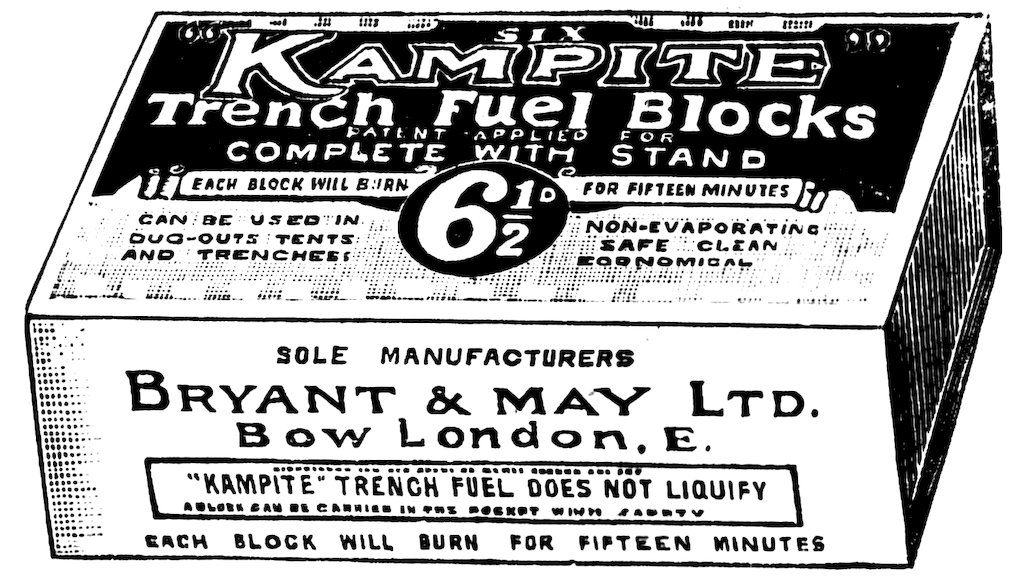
NO SPIRIT NO LIQUID
SAFE, CLEAN & RELIABLE
Complete with collapsible stand and six fuel blocks.
Made by BRYAN & MAY, LTD.,
Manufacturers of the celebrated
‘Brymay’ Safety Matches & Swan Vestas
Smart Yet Dependable
Prior to the invention of THE TIELOCKEN, a Weatherproof combining the smart Service appearance requisite to the Soldier, with such protective powers as would enable it to resist the heaviest downpour and keenest wind, may be said to have been non-existent.
In every case one quality had to be sacrificed for the benefit of the other, and to-day
THE TIELOCKEN
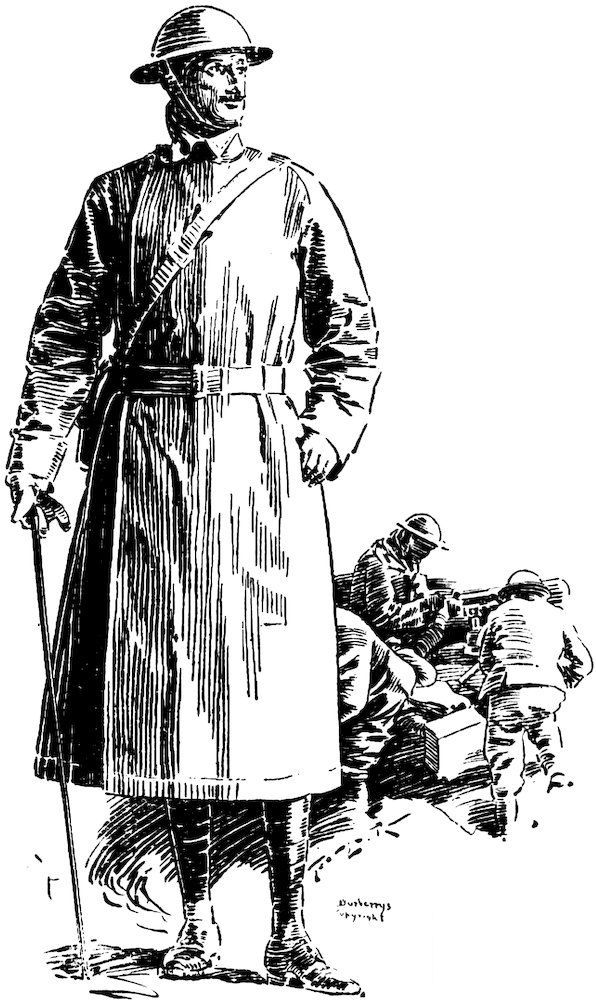
is the only Service top-coat that successfully unites both these essential characteristics.
Its design ensures that, from chin to knees, every vulnerable part of the body is doubly protected.
It affords effective security, yet is healthfully self-ventilating—excludes heavy rain, yet is free from rubber or other air-tight fabrics—is airylight, and yet warm in chilly weather.
Another advantage is its quick adjustment. A belt holds securely—no buttons to fasten.
NEW KIT
BURBERRYS supply well-tailored Uniforms in Burberry-proofed cloths, suitable for any part of the world, as well as every detail of equipment.
Officers’ Complete Kits in 2 to 4 Days or Ready for Use.
Illustrated Military Catalogue Post Free.
BURBERRYS Haymarket LONDON
8 & 10 Boulevard Malesherbes PARIS; Basingstoke and Provincial Agents
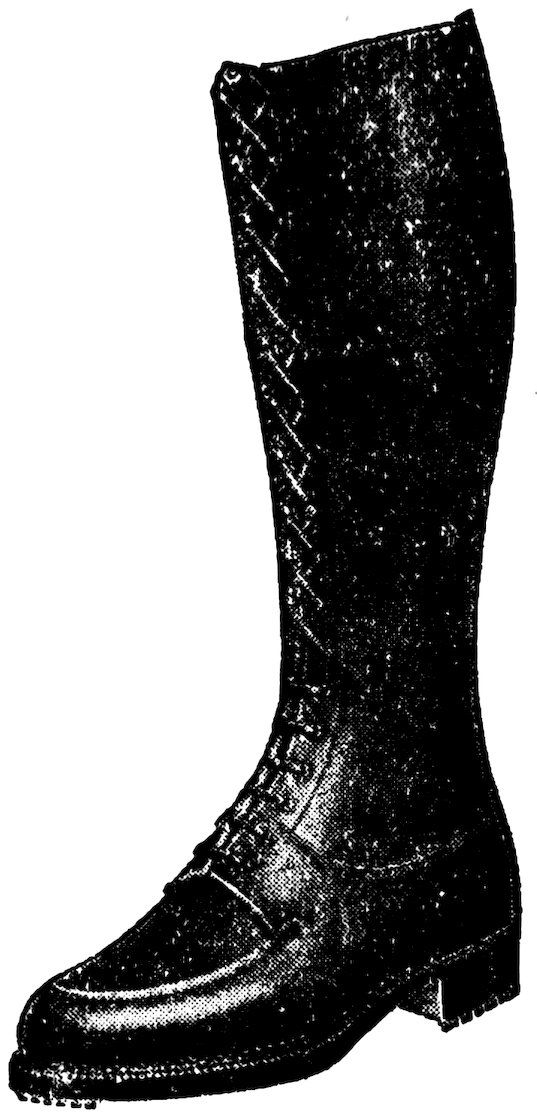
The Best Boots
for
Active Service
are
Faulkners’ Norwegians
in their
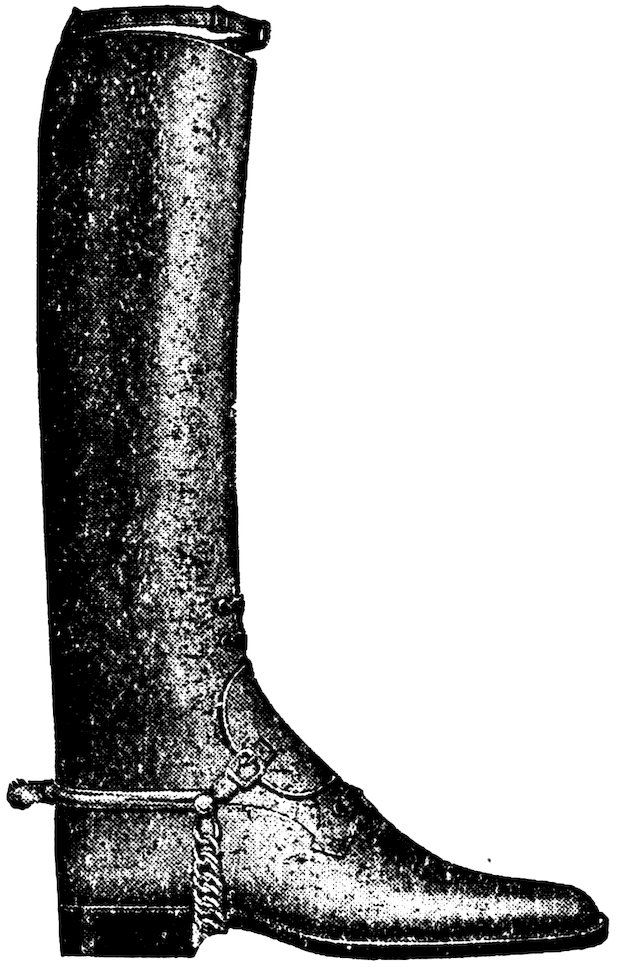
Special Service Leather.
The Smartest Boots
for
Home Service
are
Faulkners’ Field Boots.
Write for Descriptive Booklets of Boots, Leggings and Spurs; also Self-Measurement Apparatus if unable to call.
Faulkner & Son
SPECIALISTS IN SERVICE BOOTS & LEGGINGS.
51 & 52, SOUTH MOLTON STREET, LONDON, W. 1.
And 26, Trinity Street, Cambridge.
Freedom.
“It is not to be thought of that the Flood
Of British freedom, which to the open Sea
Of the world’s praise from dark antiquity
Hath flowed, ‘with pomp of waters, unwithstood,’
Roused though it be full often to a mood
Which spurns the check of salutary bands,
That this most famous Stream in Bogs and Sands
Should perish; and to evil and to good
Be lost for ever. In our Halls is hung
Armoury of the invincible Knights of old:
We must be free or die, who speak the tongue
That Shakespeare spake; the faith and morals hold
Which Milton held.—In everything we are sprung
Of Earth’s first blood, have titles manifold.”
William Wordsworth, 1802.
CHARING CROSS
Turkish Baths
Nevill’s
Northumberland Avenue
PRONOUNCED TO BE THE FINEST IN EUROPE
Are the last word in Comfort and Luxury
Cure
Rheumatism, Lumbago,
Sciatica, Colds, Strains,
Stiffness, Etc.
THEY MAKE AND KEEP YOU FIT
... And at
LONDON BRIDGE, BROAD STREET, CITY,
EDGWARE ROAD, Etc., Etc.
THESE BOOKS WILL HELP YOU
PLATOON & COMPANY DRILL
Compiled by the Commandant and Staff of the London District School of Instruction, Chelsea Barracks. Illustrated. The last word in Drill.
Price 1/–, post free 1/1.
BATTALION DRILL ILLUSTRATED
A very practical work widely used throughout the country. Fully illustrated.
Price 1/– net, post free 1/1.
DUTIES FOR ALL RANKS
Will be of considerable help to you. Gives all duties from the Private to the C.O. Etiquette, Officers’ Messes, hints to young Officers, how to look after your Platoon, &c., &c.
Price 6d. net, post free 7d.
KNOWLEDGE FOR WAR
Every Officer’s handbook for the Front. Based on the War Office Syllabus. Expert information on every subject which an Officer must know before being selected for service in the field.
Price 2s. 6d. net, post free 2s. 8d.
COURTS-MARTIAL FOR PRESIDENTS AND MEMBERS
A complete guide to this intricate subject by a D.A.A. and Q.M.G.
Price 5/–, post free 5/5.
RIFLE SHOOTING FOR WAR
A valuable adjunct to Musketry Regulations.
Price 6d. net, post free 7d.
Send a postcard for full List of Books:
HARRISON & SONS,
Printers in Ordinary to His Majesty,
ST. MARTIN’S LANE, LONDON, W.C.
MILITARY PUBLICATIONS
Swedish Drill Illustrated
The Maxim of
the Moment
GET FIT!
FOR EVERYBODY
Written by Army Gymnastic Expert. Plain, Simple and Concise
PRICE –/6 NET
Post Free Sevenpence
Recruit Training (Infantry) 1914
An aid to an
Instructors
NET –/6 NET
Post Free Sevenpence
ADOPTED BY COMMANDERS EVERYWHERE
Infantry Pocket Book
A Great Boon for
Infantry Officers
and N.C.Os.
Full of Everyday Hints and Data
WITH SPECIALLY RULED PAGES FOR
Nominal Roll, Duty Roster, Register, &c., &c.
PRICE 1/– NET
Post Free 1/1
From the Front: Notes for the New Armies
Full of
Valuable
Hints
Written from Personal Experience
Much can be learnt from this book which will prove extremely serviceable
PRICE –/6 NET
Post Free Sevenpence
Squad Drill Illustrated
Practically Written
Graphically Depicted
Including
SECTION DRILL
PLATOON DRILL
RIFLE EXERCISES
EXTENDED ORDER
Can be understood by anybody
PRICE –/6 NET
Post Free Sevenpence
Company Drill Illustrated
(IN RED
COVER)
Illustrating clearly each movement and showing the positions of commanders
THE NEXT BOOK TO “SQUAD DRILL”
PRICE –/6 NET
Post Free Sevenpence
Battalion Drill Illustrated
Indispensable
to Officers and N.C.Os.
Full of Graphic Illustrations
A wealth of detail invaluable to all who are in command of Units of any denomination
PRICE 1/– NET
Post Free 1/1
Guard Duty Illustrated
Direct—Simple—Useful
Full of Information
Invaluable alike to the Regulars & Volunteers All you want to know about Guard Duties
PRICE –/6 NET
Post Free Sevenpence
Handbook for Company Officers
A Valuable Aid
for all Officers
and N.C.Os.
HANDY SIZE 1/6 CLOTH BOUND
Post Free 1/9
“This convenient and well-arranged handbook sets out in clear and simple language an epitome of the duties which fall to a company officer and a group leader.”
Duties for all Ranks
A Compendium
of Information
Specially compiled, clear and concise, embracing
Adjutant’s Duties. Officers’ Messes
A Guide for all—Regulars and Volunteers—from C.O. to Private
Every Officer, N.C.O. and Private should have a copy of this Manual
PRICE –/6 NET
Post Free Sevenpence
Knowledge for War
Expert information on
all Subjects taken under
the W.O. Syllabus
EVERY OFFICER’S HANDBOOK FOR THE FRONT
PRICE 2/6 NET
Post Free 2/9
Written by Experts. Send a postcard for full syllabus
Platoon & Company Drill
The Chelsea
Barracks
Text Book
OFFICIALLY ADOPTED BY THE WAR OFFICE
See September, 1916, Army Orders
PRICE 1/– NET
Post Free 1/1
Rifle Shooting for War
A Practical
Illustrated Book
The outcome of the experience of an International Rifleman
PRICE –/6 NET
Post Free Sevenpence
Fire Orders Direction & Control
PRICE –/6 NET
Post Free Sevenpence
Aids to Musketry
A Valuable Manual on
an Important Subject
PRICE –/6 NET
Post Free Sevenpence
Machine Gun Manual
With Drill, Fire Orders
& Notes from the Front
A COMPLETE MANUAL TO MACHINE GUNNERY
Maxim—Vickers—Lewis—Colt—Hotchkiss
PRICE 1/– NET
Post Free 1/2
Trench Sketching Illustrated
A Booklet of extreme
practical value
COMPASS AND PERISCOPE WORK
PRICE –/9 NET
Post Free Tenpence
The War Manual
Two Volumes Now Ready
Full Prospectus Post Free
PRICE 5/– NET
Each
Courts-Martial
Full Proceedings
thoroughly described
INVALUABLE TO ALL OFFICERS
Should be in every Mess
PRICE 5/– NET
Post Free 5/3
Summaries of Evidence Courts of Enquiry, &c.
Will help
you over
many a fix
With complete formulas and examples
PRICE –/9 NET
Post Free Tenpence
Modern Range Finders
Will increase the efficiency
of the Range
Finder in everyday use
A thoroughly descriptive Booklet
PRICE –/6 NET
Post Free Sevenpence
Miniature Rifle Ranges
Fully Illustrated
Really Practical
All owning or about to own a range should have this book
PRICE –/6 NET
Post Free Sevenpence
Bayonet Fighting for War
With 55 Photographic
Illustrations
THE JU-JITSU OF BAYONET WORK
Valuable knowledge in a tight corner
PRICE –/9 NET
Post Free Tenpence
Company & Platoon Commands
A Pocket
Aid to
Memory
PRICE –/3 NET
Post Free –/3½
Automatic Pistols & Revolvers
Every Officer should peruse this book
PRICE –/6 NET
Post Free Sevenpence
Artillery Field Formulæ
For 18–pr. and
15–pr. B.L.C.
ALL THE NECESSARY DATA AT A GLANCE
Compact for the Pocket. Printed on Linen
PRICE –/6 NET
Post Free Sevenpence
The “Sight-Angle” Sketch Block (Terrell’s Patent)
For the making
of Perspective
Sketches
INVALUABLE FOR ARTILLERY & INFANTRY
(With full Directions and Specimen)
SKETCH BLOCK 3/– Post Free 3/4
Waterproof case for same 2/6 Post Free 2/8
Case and Block complete 5/6 Post Free 6/–
Maze Drill Illustrated
A Valuable Adjunct for Training
PRICE 1/– NET
Post Free 1/2
English-Flemish Military Guide
Wholly elaborated close to the line
of battle, where the first editions
have also been printed and sold
PRICE –/10 NET
Post Free 1/–
Invaluable to all Troops proceeding to Flanders
Military Guide for the Eastern Campaign
Extremely helpful to those
in or about to proceed to
EGYPT, SALONICA,
MESOPOTAMIA, &c.
With Field Vocabulary in English-French-Greek-Turkish
PRICE 2/6 NET
Post Free 2/9
Physical Drill for Home Defence Corps
With Illustrations
and Specimen
Lessons
PRICE –/6 NET
Post Free Sevenpence
English-French Guides & Vade-Mecums
Full List
Post Free
Canvas and Camaraderie
A Charming
Souvenir for
your Friends
FULLY ILLUSTRATED
“Should prove a blessing in every camp, the collection of songs being most interesting.”
Vide Press.
PRICE –/6 NET
Post Free Sevenpence
Field States British Expeditionary Force
AND
OTHER
DATA
PRICE 1/– NET
Post Free 1/1
“A mass of data; strength, road space, animals, transport, tools, medical services, bridging material, camp billets, etc.; of great value for quick reference.”
SMART, SERVICEABLE AND SOLDIERLY.
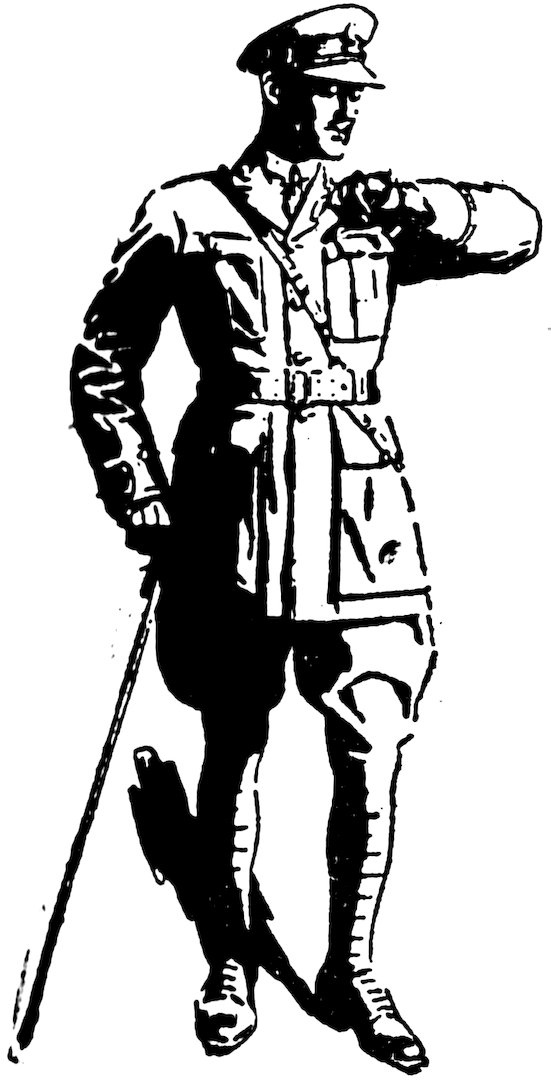
Let the Leading Military Tailors make your kit and you are assured of quality in material, soldierly smartness in cut, correctness in detail, and strict moderation in cost. Thresher’s Guide illustrates and describes everything in Officers’ Uniforms and Equipment. The long experience and wide knowledge which it embodies are invaluable to the Cadet receiving a commission who wishes to be well and efficiently equipped without throwing away money.
The Guide is kept constantly up-to-date, fresh editions, containing the latest information, being frequently published.
Write for Guide (E) to Kit and Equipment.
A FEW PRICES.
£ s. d.
Whipcord F. S. Jacket 4 4 0
Slacks 1 12 6
Bedford Cord Riding Breeches 3 3 0
Service Cap 0 15 6
British Warm from 4 4 0
Sam Browne Belt and Shoulder Strap 1 7 6

By Appointment to H.M. The King.
THRESHER & GLENNY
152 & 153, STRAND
LONDON, W.C. 2.
Estd. 1850.
Elvery’s Ltd.
“Waterproof” Trencher
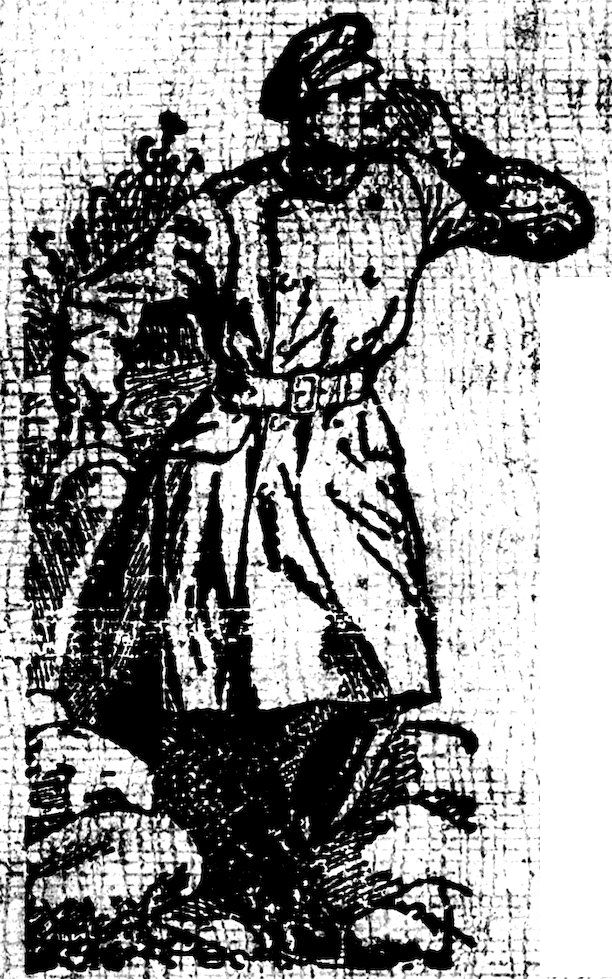
☛ ELVERY’S TRENCHER is made of “Triple-proofed” fabric without the aid of Oilsilk or Cotton, and is unsurpassed as a reliable “Trench Coat.”
¶ “Land & Water” says: “it is a good coat worthy of the consideration of all officers in need of a really reliable coat.”
Best make & finish, special value, 4½ gns.
Active Service Waterproof, 3 gns.
(Guaranteed Stormproof.)
☛ Elvery’s are waterproof Experts, and are replete with all Waterproof Kit Requirements, Boots, Leggings, Gloves, etc.
Complete War Office Kit, £7 10s.
J. W. ELVERY & CO., Ltd., Waterproof Specialists,
ELEPHANT HOUSE, Estd. 1850,
31, CONDUIT STREET, LONDON, W.
(One door from New Bond Street), And at DUBLIN & CORK.
TRANSCRIBER’S NOTES
Moved ads prior to the title page to the end of the text.
Silently corrected obvious typographical errors and variations in spelling.
Retained archaic, non-standard, and uncertain spellings as printed.
Re-indexed footnotes using numbers.
On page 87, “are as on pages .” is printed that way.