General.
Reading edition
DUTIES. (Referring mainly to the Maxim and Vickers’ Guns.)
Section Officer.
To command his section in accordance with orders and the tactical situation.
To select gun positions.
To observe and control fire.
To give instructions to range taker.
To act, when brigaded, under instructions of the B.M.G.O.
Sergeant.
Supervise guns coming into action as the section officer will direct.
Be prepared to take command in the event of the officer becoming a casualty; in fact, act as the officer’s understudy.
Corporal.
Responsible for packing, and contents of limbered wagon·
On the march he will be in rear of it and work brake as required.
Superintend unpacking, and take command in the absence of officer and sergeant.
See that rifles and packs of Nos. 1, 2, 3 and 4 are put into wagon.
Have spare parts box handy.
Supervise ammunition supply and belt filling.
Direct limbered wagons as required.
Superintend filling of sandbags and cutting of brushwood.
Watch for signals from section officer.
Take place of sergeant in the event of him becoming a casualty.
86
No. 1 Firer.
Will personally clean and look after his gun.
Carry tripod into action, place it in position and assist No. 2 in mounting.
Repeat all orders received.
Observe his own fire.
No. 2.
Assists No. 1 at the gun, carries it into action and mounts it with the assistance of No. 1.
Attends to the feeding.
Watch for signals from the section officer.
Nos. 3 and 4.
Ammunition carriers.
No. 3 takes first supply to the gun assisted by No. 4 and arranges that spare parts wallet is brought up to gun position.
He is also responsible that the condenser is in position before water boils.
No. 4 takes ammunition from limber to No. 3 when a further supply is required.
Takes condenser complete, and half filled with water to No. 3.
No. 5—Scout.
Acts as ordered by section officer.
No. 6—Range taker.
Takes ranges and prepares range cards.
The other No. 6, is a spare man and acts according to orders from his officer.
Drivers.
Remain with wagons and must act on signal from the officer. They should be taught to fill belts by hand or machine and to act as ammunition carriers.
SECTION DRILL (WITH TRANSPORT).
Drill with Limbered Wagons.
The detachment will be formed up in two ranks six paces in rear of the wagon, facing outwards.
On the command or signal “Action,” the driver dismounts and stands to his horses. The sergeant and Nos. 5 and 6 double out to the section officer. The corporal lowers the tail-board and superintends the unpacking. The remaining numbers ground arms on the word of command of the senior number, and fall out to the wagon to perform the duties detailed above.
87The corporal selects a suitable covered position for the limbered wagon, if necessary.
On the command or signal “Dismount guns,” the procedure for unpacking is reversed, and when completed, detachments fall in and take up arms by word of command.
Drill with Pack Transport.
Normally mules will be led by Nos. 1, 2, 3, 4, 7 and 8.
On the command “Prepare for action,” Nos. 2, 3, 7 and 8 will link their mules to those immediately in front of them.
Nos. 7 and 8 will lead Nos. 1 and 4 mules. Nos. 1 and 2 will march on the tripod and gun sides respectively of No. 1 mule and loosen straps. Nos. 3 and 4 will march on either side of No. 2 mule.
On the command or signal “Action,” No. 1 will off-load the tripod and No. 2 the gun; No. 3 will off-load the leading ammunition animal.
The corporal will select a suitable covered position for the pack animals. The other duties of the various numbers are as on pages .
On the command or signal “Stand to,” Nos. 1, 2 and 3 will reverse the actions of off-loading. The detachment will then form up for marching.
SECTION DRILL (WITHOUT TRANSPORT).
Guns, tripods and ammunition boxes will be placed on the ground, muzzles to the front and in line, legs to rear, straps round rear legs buckled, clamps sufficiently tight to prevent legs from hanging loose when tripod is lifted. Traversing clamp sufficiently loose to enable gun to be deflected by a sharp tap with the hand on rear crosspiece, guns on right and not closer to each other than eight paces, ammunition boxes three paces in rear.
Fall in.—Detachment for the two guns will “fall in” in two ranks, five paces in front of the interval between guns, sergeant on left of front rank, corporal covering him in rear.
Front rank will be right gun detachment.
Rear rank will be left gun detachment.
Number.—As in squad drill.
Take Post.—Detachments turn outwards and double to their respective guns (sergeant and corporal on outer 88flanks, where they can superintend). Nos. 1 and 2 fall in on left of tripod; No. 3 on left of ammunition box. (If ground suitable these numbers should lie down.)
Nos. 4, 5 and 6 fall in, in single rank, in rear of No. 3.
The gun position and point of aim is then indicated, followed by command:—
Mount Gun.—No. 1 picks up tripod, having previously seen that both elevating screws are exposed the same distance, carries and places it in position indicated. In adjusting, he must ensure that crosshead and sights are upright, and legs clamped tight. No. 2 should so time his advance that he will arrive immediately the tripod is adjusted. He will carry gun to right side of tripod, holding rear crosspiece with left hand, gun muzzle to rear under right arm. Kneels on left knee, facing tripod, and supporting weight of gun on right knee, places it on tripod, drives in and turns down crosshead joint pin, and removes cork plug from steam escape hole.
No. 1 fixes elevating joint pin and directs gun towards the mark.
No. 2 kneeling and placing ammunition box in position.
No. 3 when he sees gun nearly mounted, will carry ammunition box forward and place it within reach of No. 2. He then retires to a position not immediately in rear of the gun.
Load.—No. 1 raises tangent sight, No. 2 passes tag of belt through feed block. No. 1 turns crank handle on to buffer spring, pulls belt to left front as far as it will go, and lets go crank handle, releases strain on belt, then turns crank handle on to buffer spring, again pulls belt to left front and lets go belt and crank handle. The gun is now ready to fire.
Single Shot Loading.—Carry out first half of loading motions, then, without touching belt, turn crank handle on to buffer spring and let go.
800 (Range).—No. 1 repeats the order and adjusts slide to elevation required.
At (Object).—No. 2 adjusts traversing clamp if ordered to by No. 1, who lays the gun, raises automatic safety catch with forefinger and prepares to fire.
When No. 1 is ready No. 2 holds up his hand.
Fire.—No. 1 presses the double button.
89Cease Fire.—No. 1 releases automatic safety catch and remains steady.
Traversing Fire.—No. 1 will lay gun on flank named, press button, and tap alternately, with the hand, on the rear crosspiece in the required direction, until limit is reached.
Unload.—No. 1 lowers the sight (not the slide), turns the crank handle twice in succession on to buffer spring, letting it fly back each time on to the check lever; then presses up finger pieces on bottom pawls, No. 2 withdrawing and repacking belt in box. No. 1 clears ejector tube and lock, and releases lock spring by pressing double button.
Dismount Gun.—No. 1 removes crosshead and elevating joint pins. No. 2 replaces cork plug, passes ammunition box to No. 3, and removes gun to its original position in rear, No. 1 following with tripod, joint pins will then be pushed home, legs folded and clamped.
Prone Position.
Mount Gun.—No. 1 crawls into position, pushing tripod forward with right hand, having first adjusted front legs by turning it over and moving legs round so that they remain in a slightly backward position over the elevating wheel.
When in the position ordered for mounting, he turns legs down and adjusts so as to secure a low, upright position of the crosshead.
No. 2 will then move into position, on his back, carrying the gun across his body, muzzle to the front. On reaching tripod he will push muzzle towards No. 1 who will assist in mounting, and insert crosshead joint pin, No. 2 inserting elevating joint pin and removing cork plug.
No. 1 will then turn into position for firing, supporting himself against the legs of No. 2.
Adjust sights, load, and fire as ordered.
Out of Action.—No. 1 will unload, Nos. 1 and 2 (in prone position) will take hold of rear leg (No. 1 with right hand, No, 2 with left), and draw gun out of action until under cover, when gun will be dismounted in the usual manner; No. 2 having drawn ammunition box back with the gun.
90
TESTS OF ELEMENTARY TRAINING.
No. of Test. Nature of Test, with Commands. Standard Time. Remarks.
I. To erect tripod and mount gun. “Mount Gun.” 20 sec.
II. To load the gun. “Load.” 5 sec. All motions distinct. No slurring.
III. To adjust sights and lay gun “At ... (Range) ... Object ...” 12 sec. From range being ordered until No. 2 holds up his hand.
IV. To unload the gun. “Unload.” 5 sec. Motions distinct, belt correctly repacked, Lockspring released.
V. To dismount the gun. “Dismount Gun.” 15 sec. All points as at beginning of Test I., and cork plug replaced.
VI. To bring gun into action (Range ... Object ...) “Action.” 40 sec. All points for Tests I., II. and III. to be fulfilled. Time taken until No. 2 holds up his hand.
VII. Horizontal Traversing (Limits of Traverse). “Traversing Fire.” 3 sec. for each complete series.
VIII. Diagonal Traversing (Limits of Traverse). “Traversing Fire.” 4 sec. for each series.
IX. Rectifying Stoppages. “Gun Stops.” Correct procedure begun, 3 sec. Correct remedy applied and gun relaid after remedy.
CHARACTERISTICS OF MACHINE GUN.
The fact that the gun is mounted upon a platform and the personal factor thus reduced, results in a close grouping of fire, and practically the same results are obtained in war as in peace, the beaten zone being about half the area of that of rifle fire. This gives the following advantages:—
Surprise effect.
Observation of fire for ranging.
Overhead covering fire.
Other advantages of the machine gun are:—
Narrow frontage (a machine gun only occupying the same frontage as two infantrymen).
Difficult to locate.
Normal rate of fire about 500 rounds per minute. 91All-round traverse, which allows gun to be turned in any direction without moving tripod, and with little exposure.
Mobility: It can go wherever a man can go on foot.
It has, however, the following drawbacks:—
Overheating, and consequent stoppage through too prolonged fire.
Noise of firing, and steam from barrel casing reveals position.
Narrow and scattered objects are unsuitable targets.
It will be seen therefore that the machine gun is a weapon of opportunity particularly adapted for surprise effect, but not for sustained fire action.
FIRE DIRECTION.
The following methods should be used:—
Ranging Fire.
Bursts of fire limited to from 10 to 20 rounds.
It is unlikely that observation will be obtained with larger bursts.
Rapid Fire.
In groups of from 30 to 50 rounds, the firer pausing slightly between each group to confirm the alignment of sights.
Traversing Fire.
Distributed laterally, and applied in a series of small groups, the object being to cover as wide a front as possible, with a minimum of volume. (Groups should consist of from 5 to 10 rounds only.) A belt of 250 rounds should cover a frontage of 25 yards in one minute.
Swinging Traverse.
For trench warfare, and against dense targets at close ranges, the traversing clamp being kept fairly loose and the gun traversed evenly and smoothly from side to side, both hands retaining their hold on the traversing handles.
Combined Sights.
When two or more guns are working together, the depth of the effective zone can be increased by ordering different elevations for each gun, both, however, using the same point of aim.
92The respective depth and width of effective zones may be taken as being:—
Range. Mark VI. Mark VII.
Depth. Width. Depth. Width.
Yards. Yards. Feet. Yards. Feet inches.
500 150 4 220 2 6
1,000 70 8 140 5 0
1,500 60 13 70 10 0
2,000 50 19 60 17 6
From this it is apparent that, allowing an error of 10 per cent. in ascertaining the range, the flatness of trajectory within 800 yards will insure the target being included in the effective zone, therefore with Mark VII ammunition combined sights should not be used at less than 800 yards.
Bracketing.
When only a section is available and the “combined sights” method does not give sufficient assurance of fire effect, “bracketing” should be used as follows:—
The range estimated, probable error determined, and the limits between which it is necessary to search with fire, the maximum and minimum elevation will be allotted to right and left gun respectively, who fire a burst and then work inwards (one higher, one lower) by altering their respective elevations 50 yards each time, eventually passing each other. If observation of the fire can be obtained, correct elevation should be immediately ordered.
With Mark VII ammunition this method would not be necessary at 1,000 yards, as with a 10 per cent. error the “combined sights” method would give a satisfactory result.
Vertical Searching.
The range to nearest point of objective is taken, sight adjusted and gun laid on this point.
Sights are then set for the farthest point of the objective. This will bring the line of sight short of the aiming-point. A series of bursts are then fired, care being taken that each burst strikes just beyond the former one, but does not leave any gap between groups.
Overhead Fire.
Can be employed normally from or at a commanding position, or across a valley, but not when own troops and those of the enemy are on same plane.
93Range of target must be accurate. If 1,000 yards or under, angles of sight to enemy and own troops must not be less than 30 minutes. If range is between 1,000 and 1,500 yards, the angle must not be less than 60 mins.
Overhead fire should not be used at 1,500 yards and over.
The following method of sighting can be used.—
Adjust backsight to correct range of target and lay gun on mark. If gun is nearer than 900 yards, raise sight by 400 yards, and if further than 900 yards, raise sight 250 yards.
The new line of sight gives safety angles.
When heads of own troops come into line of sight, cease fire, or continue to elevate gradually, keeping pace with advance.
Indirect Fire.
Firing from concealed positions at an auxiliary aiming mark.
A machine gun protractor, or graticules cut across the focal plane of prismatic glasses are most satisfactory. By this means indirect fire can be applied as easily as direct fire.
Night Firing.
The gun may be laid by day and left until required, or by use of the “night firing box,” as follows:—
A stick is placed in the ground 10 yards in front of gun in a direct line with the target, and at night the stick is replaced by the “night firing box”—the sights altered (but not the gun) until aligned on the lamp at the point where the lines form the true centre.
Searching and deflection can be satisfactorily carried out with this apparatus.
EXAMPLES OF FIRE ORDERS.
Normal Fire Order using One Elevation.
Range.
Aiming mark.
Fire (signalled).
Cease fire (signalled).
Changes in elevation (up or down 100), as required.
Combined Sights.
Range and differences.
Aiming mark.
Fire (signalled).
Changes in elevation (left gun up 200, right gun down 200) (or more, as required).
94
When Brigaded within Hearing.
The B.M.G.O. issues fire orders direct to the Nos. 1 as above.
When “differences” “by sections” are required the fire order will be as follows:—
B.M.G.O.
(a)
By sections—Range—Differences.
(Pause for section officers to name the number of their sections and the “range” for their sections; they do not repeat the “differences.”)
(b)
Aiming mark.
(c)
Fire.
Traversing Fire.
Range.
Target (naming right and left limits to be traversed).
“Inwards traversing.”
Fire (signalled).
The same method is employed when laying on the centre, the caution “Outwards traversing” being given.
When brigaded within hearing orders are issued as follows:—
By B.M.G.O.:—
Range.
Limits of traverse.
Fire (signalled).
Section officer repeats limits to be traversed, and immediately issues orders respecting ground to be traversed by their own sections, corresponding to their own positions.
Vertical Searching Fire.
Range.
Aiming mark.
To “range” vertical searching.
Fire (signalled).
Bracketing Fire.
Ranges—bracketing.
Aiming mark.
Fire.
SIGNALS.
In many cases observation will be impossible from the gun position and it will be necessary for observers to signal results from a flank.
95The following semaphore code is used in signalling the results of observation of fire:—
P—
Plus: meaning fire observed at least 50 yards beyond target.
M—
Minus: meaning fire observed at least 50 yards short of target.
T—
Right: meaning fire observed to right of target.
C—
Centre: meaning direction of fire correct.
U—
Unobserved: meaning no observation obtained.
Q—
Query: meaning fire observed, but its position uncertain.
R—
Range: meaning range correct.
The signaller at the observation post should give the “call up” to show that the observers are ready. “P” and “M” may be repeated for multiples of 50 yards; thus, “PP” would mean, “Fire observed at least 100 yards beyond target.” Signals should be repeated from the gun position if this can be done without disclosing the position to the enemy.
On all occasions when guns are firing, the following signals should be used in controlling fire:—
Signal for “Action.”—Both arms fully extended, raised from the sides to a position in line with the shoulders and lowered again. This motion to be repeated until it is seen that the signal is being complied with. Note.—A machine gun is said to be “In Action” when it is mounted, loaded and laid, but not necessarily firing.
Signal for “Out of Action.” Arm swung in a circular motion in front of the body.
By No. 2.
Hand up—Gun ready to open fire.
By Controlling Officer.
Hand u— Preparatory to opening fire.
Hand dropped—Open fire.
Elbow close to the side, forearm waved horizontally—Cease fire.
GENERAL MACHINE GUN COURSE.
Extracts from War Office Letter No. 9/General Number/4976 (M.T. 2), dated 14th May, 1915.
1. PERSONNEL.
The following table shows the establishment of the Service Machine Gun section to be maintained in the 96following units:—New Armies, Reserve Units, Territorial Force Units, Colonial Contingents.
Unit. Officers. Sergeants. Corporals. Privates.
New Armies (Infantry Battalions):—
Service Section 1 2 1 24
Reserve Section[2] 1 2 1 24
Reserve Cavalry Regiments 1 1 1 24
Territorial Force:—
Yeomanry Regiments 1 1 1 24
Infantry Battalions 1 2 1 24
3rd Line Depôts 1 1 1 24
Special and Extra Reserve Infantry Battalions:— 1 1 1 24
2nd Reserve Infantry Battalions (supplying 3 Battalions)[3] 1 1 1 24
2nd Reserve Infantry Battalions (supplying 2 Battalions)[3] 1 1 1 18
2nd Reserve Infantry Battalions (supplying 1 Battalion)[3] 1 1 1 12
Colonial Contingents:—
Cavalry Regiments 1 1 1 24
Infantry Battalions 1 2 1 24
In draft producing units, the personnel of machine gunners will always be maintained; a reserve of men thoroughly trained in mechanism, drill, etc., must be available to fill the gaps in the service section caused by drafting.
2. AMMUNITION.
300 rounds (Territorial Force Units, Mark VI., other Units, Mark VII.) will be fired in the General Machine Gun Course by each Officer, N.C.O. and man of the existing service section or on his appointment thereto, as soon as he is fit to fire.
Exceptions:—
(a) Men who have already fired a complete course:
(b) Men who have commenced a course previously approved will complete such course.
97Machine gunners of New Army Battalions, other than 2nd Reserve Battalions, will not commence the course until authority is given to do so.
Ammunition allotted to Machine Gun Sections is not to be expended for rifle firing.
3. GENERAL MACHINE GUN COURSE.
Part I. Rounds allotted.
Practice 1.— Grouping 10
„ 2.— Single shot, traversing 10
„ 3.— Application 20
„ 4.— Vertical searching 20
„ 5.— (Omitted).
Additional Practice.— Swinging traverse 30
Repetition 20
110
Part II.
(Range 400 yards for all Practices except Practice 14.)
Time. Rounds
Seconds. allotted.
Practice 7.— Ranging 20
„ 8.— (Omitted).
„ [4]9.— Application 20 30
„ [4]10.— Traversing 50 60
„ 11.— (Omitted).
„ 12.— (Omitted).
„ 13.— Observation 20
„ 14.— Fire at successive positions (range 600 yds. to 200 yds.) 40
Total 170
Part I. 110
Part II. 170
Surplus for repetition of indifferent shots to be pooled and used at the discretion of the Commanding Officer 20
Grand total 300
98
Notes.
Part I.
1. Additional Practice.—For trench warfare, and against dense targets at close range, the “Swinging Traverse” has been found necessary. It in no way replaces the method of traversing by automatic tapping, which should still be considered the normal method. The swinging traverse is taught by teaching a man to traverse a machine gun instructional target evenly and smoothly in about 6 seconds.
Part II.
2. Practice 10.—It will be necessary to shorten the target, as 40 rounds less are allowed for in this practice. This will be done by using two 10–feet screens instead of three. Spaces will be 20 inches.
3. Practice 13.—(a) If a field firing range is not available Practice 11 will be substituted for this practice.
(b) Observation should be taken by three parties, left, right, and centre, who should change round after each firer. Section Officers should ascertain that each man has observed from each position.
4. Practice 14.—10 rounds will be fired at each of the four distances from 600 yds. to 200 yds. on the lines laid down in Musketry Regulations. These rounds will be “spaced out” before commencing the practice, and the firer will proceed to the next range on completing his 10 rounds, whether he has secured a hit or not.
Classification.
5. Machine gunners will be classified upon the result which they obtain in Practices 9 and 10, General Machine Gun Course, as follows:—
To be classified as a “1st Class Gunner” 50 points.
To be classified as a “Qualified Gunner” 25 points.
Points will be allotted in the classification practices on the same basis of scoring as laid down in paragraph 647, Musketry Regulations, Part I., 1909 (reprint), 1914.
Preliminary instruction in aiming and firing should be given by means of a Rifle Attachment.
A very satisfactory one can be obtained at small cost from Messrs. A. G. Parker & Co., Whittall Street, Birmingham.
99
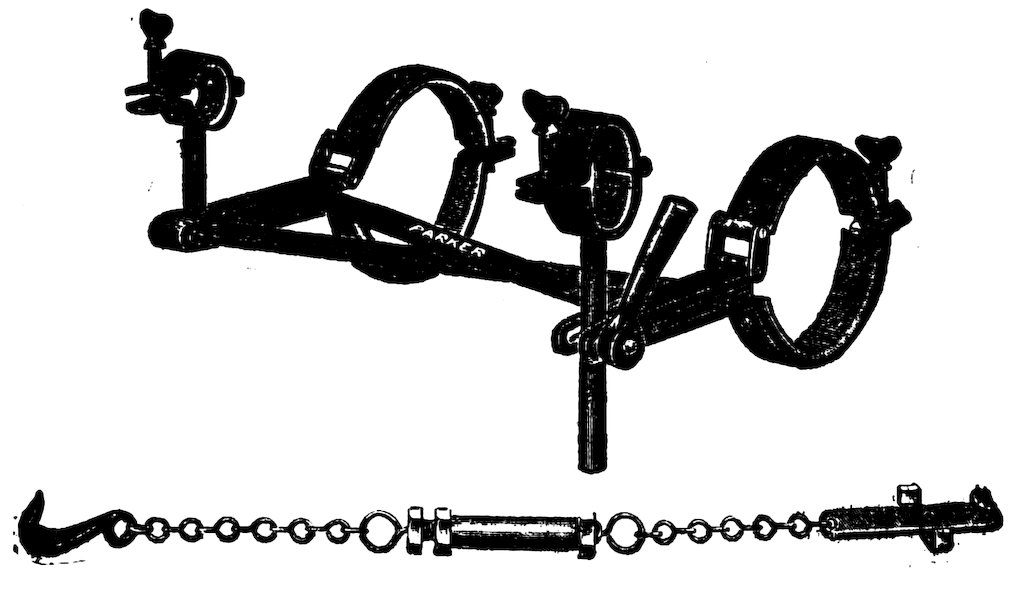
The illustration is practically self-explanatory. The large round clamps fit on the water jacket of the machine gun and the small clamps hold the rifle, which can be adjusted to hit at exactly the same mark as the machine gun barrel is aimed at.
The trigger of the rifle is connected to the machine gun by the adjustable chain device shown.
The apparatus is in constant use at the Schools of Musketry, and is the invention of Armourer Sergeant-Major Hiscock, of the Motor Machine Gun Section.
WAR ESTABLISHMENTS OF NEW ARMIES, 1915.
4
Guns.
1
Subaltern.
2
Sergeants.
1
Corporal.
24
Privates.
6
Drivers.
1
Batman.
1
Riding horse.
12
Draught horses.
4
G.S. limbered wagons.
The G.S. limbered wagons contain:—
4 guns with tripods.
7,000 rounds of ammunition in belts, and
4 ammunition pack saddles for lead horses.
1 pick-axe, 1 shovel, and 1 billhook are carried with each machine gun tripod as part of its equipment. 60 sandbags per infantry battalion are carried for use with machine guns.
100
NOTES FROM THE FRONT.
Points to Remember.
Conceal guns and men.
Select best position to achieve the object you hope to achieve.
Have alternative positions prepared.
Provide effective obstacles.
Keep guns and belts free from dirt.
Give out any preparatory orders necessary.
Be always ready to fire when wanted.
Study the ground all round the position.
Remember the value of cross fire.
Keep your fire for the proper moment.
Choice of Gun Positions.
The choice of a gun position must be governed by the following considerations:—
Enfilade fire, against the enemy and against ourselves.
Overhead fire, to support our own troops.
Long-range fire, against enemy’s supports.
Fire against houses, etc., in rear of enemy’s line.
Fire against likely places for enemy’s machine guns.
Concealment from enemy’s artillery.
Alternative positions.
Lines of advance and retreat.
Covered approach for ammunition carriers, etc.
Facilities for control of guns.
Avoid:—
Obvious positions.
Positions easy to describe. } Either from surroundings
Positions easy to arrange upon. } or maps.
Positions near prominent objects or aiming-points.
Ground which will facilitate observation of fire by the enemy.
Employment of Machine Guns.
The fire of well-concealed machine guns may often be directed against:—
Windows, doors, roofs, etc., of houses thought to be occupied.
101Areas of bush, crops, etc.
Open spaces across which the enemy are dribbling in small parties in order to concentrate at another point.
The enemy’s firing-line.
It may happen that machine guns are forced to open fire in self-defence, or to assist the advance of the infantry in spite of the target offered not being a suitable one for machine guns.
Any tendency, however, to open fire with machine guns without good reason must be suppressed.
Machine Guns and Artillery.
Every effort must be made to prevent machine guns being located by artillery.
If guns are shelled they must either:—
Change their Position at once.—This would be the usual proceeding. A movement of quite a short distance—say 50 yards—is quite sufficient in many cases; or—
Cease fire while detachments take cover until the shelling stops.—If this be done, the hostile artillery may think that the machine guns have been put out of action.
Good targets may then present themselves, and the guns may be able to reopen fire with good effect from the same position.
There have been several cases of machine guns firing against artillery with great success. The following instances are quoted:—
(a) A section of machine guns worked forward to a concealed position 900 yards away from a German field battery in action. The section brought oblique fire to bear on the battery and completely silenced it.
(b) A section took a German field battery in enfilade at 2,400 yards. The battery was firing at the time, the gunners fled from their guns, and the battery was silenced.
Note.—Frontal fire by machine guns against shielded artillery can only be expected to produce moral effect. This moral effect may, however, be considerable; and, in addition, the machine gun fire may greatly hamper the supply of ammunition to the guns, etc.
102
The Occupation of Various Positions by Machine Guns.
Barricades.—When barricading roads, bridges, streets, etc., machine guns should not be placed on the barricade itself if equally good effect can be obtained by placing the guns in positions commanding the approaches to the barricade.
Banks.—The banks of rivers, canals, streams, etc., can be made use of for gun positions, or covered lines of advance or retreat.
Crops.—Standing crops often form useful cover for guns and concealed lines of advance, etc.
Ditches.—These can often be used to enable machine guns to be pushed forward, so as to bring oblique or enfilade fire to bear on the enemy.
Great care must be taken not to show above the banks of the ditch.
A few men should be pushed along the ditch on the exposed flank as a protection against snipers, counterattacks, etc.
Houses.—Houses may be used as follows:—
Place the gun in the back of a room, firing through an open window, or a window from which a few panes of glass have been removed.
Remove a few tiles from the roof, and fire through the opening thus made.
Should a house have two doors or two windows, directly behind one another, the gun may be placed in rear of the house, and fire through these doors or windows.
Place the gun in rear of the house, so that oblique or enfilade fire can be brought to bear on the enemy.
If the house possesses a cellar, the gun may be placed in the cellar, a few bricks being removed, so as to enable the gun to be fired from the ground-level.
In whatever position the gun is placed some protection should, if possible, be provided for the numbers, such as an emplacement of sandbags, stones, bricks, etc.
103It should be remembered that if the gun is located in a building by the enemy’s artillery, it may be necessary to evacuate the building quickly; arrangements must therefore be made to meet this contingency.
Folds in the Ground.—Great use can be made of folds in the ground for the concealment of machine guns.
The gun should be placed so as to enable the bullets to clear the crest, while the gun and detachment are concealed as much as possible.
Haystacks.—These can be made use of as follows:—
Hollow out front of haystack.
No. 1 sits in this hollow, with his back against the hay.
The loose hay is piled up in front of the gun.
Cut out a place for the gun on top of the haystack.
If possible, make a rough platform of boards.
The gun then fires over the top of the ridge of the stack.
Place the gun behind the haystack in such a manner that oblique or enfilade fire may be brought to bear on the enemy.
The gun is then entirely concealed from the front.
This is, as a rule, the best method of using a haystack.
Hedges.—Can often be used as a covered approach and as fire positions giving cover from view.
A few men should be placed along the hedge, on the exposed flank, for protection.
Mounds of Earth, Roots, etc.—These may be used as follows:—
Hollow out the mound from the rear, so that the gun can fire from the hollow while it is concealed from the front.
Planks, sandbags, etc., can be used to support the earth.
Fire over the top of the mound, using the mound as a parapet.
Place the gun behind the mound, using the mound as a cover from the front, while oblique or enfilade fire is brought to bear against the enemy.
104Stacks of Wood.—The stack may be hollowed out from the rear, so that the gun can be placed inside the stack, and fire to the front, while being perfectly concealed from view.
The position can be strengthened by using sandbags inside the stack.
Stooks of Corn can also be used to provide cover from view.
Trees.—Trees, when in leaf, may be used as possible gun positions.
Trees with strong branches are necessary, and a platform for the gun must be built in the branches.
Tree-trunks can also be used to provide cover from view.
Trenches.—When guns are not used in trenches they should, when possible, be placed so as to bring oblique or enfilade fire against:—
The enemy’s trenches.
The ground over which the enemy must pass, should he attack.
Our own front line trenches in case the enemy penetrates into them.
To achieve these objects guns may be placed:—
In a salient.
At the base of a re-entrant.
At the horns of a re-entrant.
At a bend in the trench.
In an emplacement jutting out from the general line of the trench.
In all cases the gun should, if possible, be covered from fire from the front, and should be able to sweep the front of the entrenched line with cross fire.
Thus, although each gun may be firing to its flank, its front is swept by the fire of a neighbouring gun.
Arrangements should be made so that guns so placed may be able to fire to their front, should an emergency make this desirable.
This can be done by:—
Arranging that some sandbags can be removed and the gun fired to the front through the loophole thus made.
105In this connection it must be remembered that:—
(a)
If the sandbags are left in place for a considerable time without being removed, they may become embedded and be found unmovable.
(b)
That loopholes filled with single sacks will not be bullet-proof.
Training the gunners to:—
(a)
Remove the gun quickly from the tripod and fire from the top of parapet without it.
(b)
Lift the gun and tripod out of the trench and fire it from some previously selected spot.
Note.—Both these methods require much practice.
Every endeavour should be made to conceal the position of the gun from the front.
Gun emplacements must therefore be made to appear exactly like the remainder of the trench or breastwork.
Several emplacements should be made for each gun, and practice should be made in moving guns quickly from one emplacement to another.
Guns may be placed—In the Front Line of Trenches.—This may be taken as the general rule.
In Support Trenches.—There are occasions when it may be advisable to place guns in the support trenches.
Here they may be arranged so as to:—
Prevent a further advance of the enemy should they capture the front line.
Enfilade the front line should it be captured.
Sweep the communication trenches.
In Positions in Rear.—If the ground is favourable it may be possible to place guns, in concealed positions, in rear of the entrenched line.
They can be arranged so as to:—
Fire over the trenches and sweep the ground in front.
Fire through gaps in the defensive line.
Command positions where the enemy may concentrate prior to the assault.
Command positions likely to be occupied by the enemy’s machine guns.
Command covered approaches on the defensive line.
106Enable guns to fire on enemy’s trenches with greater effect.
Give overhead covering fire in case of an advance by our own troops.
General Notes on Trench Work.
If guns are often used, the positions from which they are fired should frequently be changed.
Thus the enemy may be deceived as to the number and position of the guns.
Emplacements should be numbered, and range cards placed in each.
When taking over a line of trenches the machine gun officer must make careful arrangements for controlling the fire of his guns.
The machine gun officer must:—
(a)
Establish himself at a place where he can always be found.
(b)
Keep in touch with his guns with the officers of the line of trenches he is assisting to defend.
(c)
Arrange for ammunition supply.
(d)
Arrange for reliefs.
Towers, windmills and other high buildings may often be used with advantage:—
For overhead fire.
(a)
Cover the advance of friendly troops.
(b)
Fire at attacking enemy over the heads of our own troops.
(c)
Enable fire to be directed into enemy’s trenches.
(d)
To direct the fire of guns situated in other positions.
Woods, especially when in leaf, are often most valuable for concealing the position of guns.
Care must be taken that the guns are not placed too near the edge of the wood or individual men expose themselves.
All communications between guns should be made in the wood, well in rear of the guns.
Alternative positions should be selected, so that the 107guns may be moved rapidly from one to another if desired, with as little loss of time as possible.
Lines of retirement through the woods must be arranged and also lines of communication between guns and limbers thought out.
Machine Guns in Action.
The Attack.—The guns should be dug in whenever it is possible to do so without giving away their position.
It is often impossible to see anything of the enemy. Therefore likely positions for him to occupy must be looked for.
Surprise, obtained by a concealed advance, is essential to the successful handling of machine guns.
The progress of the infantry must be carefully watched, with a view to pushing on a certain number of guns and to closely support them whenever possible.
The usual methods of supporting the infantry attack will be:—
(a)
Fire from the flanks.
(b)
Overhead fire.
(c)
Long-range searching fire.
(d)
Fire from a forward position.
Every opportunity for the use of overhead fire should be seized.
All suitable ground, buildings, etc., that may enable this kind of fire to be used should be looked for.
The enemy’s machine guns are the weapons that are most likely to hold up the attack.
Therefore every effort should be made to locate them, and to concentrate the fire of our own machine guns upon them.
It may sometimes be possible to use machine guns to search systematically all places in the area of attack likely to be held by the enemy.
This searching fire has undoubtedly considerable moral effect on the troops subjected to it, and may greatly assist the subsequent infantry advance. It requires, however, a large expenditure of ammunition.
If the preliminary reconnaissance is properly carried out, it is quite possible for the guns employed for this purpose to remain undetected, even though pushed well forward.
108The general rules as to position of machine guns in attack are as follows:—
(a)
The fire of a large proportion of the available guns should be carefully organized to cover the infantry advance.
(b)
This covering fire is no longer possible, move up a proportion of the available guns either into, or on to, the flanks of the infantry firing-line.
(c)
A proportion of the guns should usually be held back as a reserve in the hands of the commander.
(d)
Thus each gun has a definite duty to perform, and co-operation between guns is assured.
It may be possible, and advantageous, to move forward a proportion of the guns with the attacking lines of the infantry.
The guns allotted to this duty will not take part in the covering fire, but will keep themselves fresh and their ammunition intact, in readiness for the advance.
Their duties will be to:—
(a)
Help the infantry to gain fire superiority at the decisive point.
(b)
Make good and hold positions won.
(c)
Pursue the enemy by fire.
(d)
Watch for and repel counterattacks.
(e)
Enable the infantry to re-organize.
As enemy snipers are a particular source of annoyance to machine gunners, they should be watched for.
The defence of prepared positions has been already dealt with under the heading of Machine Guns in Trenches.
Machine guns in any defensive position must be so organized that they can support each other mutually throughout any given section of the defensive line.
It must be remembered that the best positions for machine guns are not always the same by night and day.
It will often be necessary to move the guns from the night position to the day position before dawn.
Rearguard Action.—The following points must be considered:—
A wide field of fire.
Guns must be carefully concealed in the least obvious places.
109Covered lines of retreat must be carefully reconnoitred.
Limbers must be close up, to facilitate hasty retirement.
Positions in rear must be chosen before the guns leave the position they are holding.
A proportion of the guns should occupy the position in rear, before all guns retire from the forward position, thus the retirement of the last guns can be covered.
Village Fighting.—As soon as the infantry have made good one edge of the village, the guns will be brought up as close to the firing-line as possible.
They will then search windows, doorways, roofs, etc., likely to be held by the enemy.
Guns will be used to command cross-streets, etc., so as to guard against attacks on the flanks or rear of the infantry.
Guns should also be posted on the edges of the village, to prevent flank attacks.
During village fighting every use should be made of windows, doors, etc., as machine gun positions (see page 102).
Co-operation.—The necessity for co-operation between the machine guns taking part in any particular action cannot be overestimated.
Not only should the individual gun of a particular unit work upon some definite plan for mutual support, but the sections of all units that are operating together should co-operate with a view to obtaining the best results from their combined action.
This cannot be done in action unless it has been previously practised.
Therefore great attention should be paid to training a number of guns to operate together for some specific purpose.
110The following notes from overseas on machine guns, compiled by Capt. E. Feilder (Attached Gen. Staff, A.T.C.), are of considerable value:—
INSTRUCTIONS FOR MACHINE GUN OFFICER.
1. The Machine Gun Officer should have a complete knowledge of the nature of the action and the plans of the Commander.
2. The Commanding Officer should inform the M.G. Officer generally of the part he expects the guns to play, and the particular assistance he requires from him.
3. The M.G. Officer should then be allowed to form and carry out his own plan of action in such a way as best meets the requirements of the C.O. and the situation generally.
4. When possible, ample time should be given the M.G. Officer to make his arrangements.
5. He should not be given hurried orders at the last moment; such a proceeding is very seldom necessary.