Chronological Index of Contents. (continued 9)
Reading edition
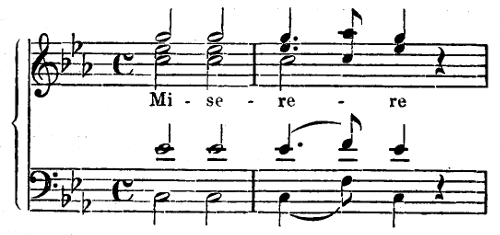
but was given by the singers in the following barbarous manner:
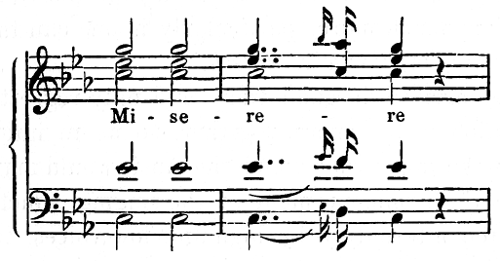
I could not have believed even my own ears, much more those of others, that they sing in such wise in the Sixtine chapel, had I not heard it subsequently repeated. Is this perhaps the mysterious method of executing these old compositions, of which it is related that it is known alone to this choir, and has been handed down traditionally? Impossible! Modern Italians only can sing in so barbarous a style, who may perhaps possess a feeling for melody, but who in all that is called harmony are grossly ignorant.
When however this first Miserere had been endured, I was soon attracted by something else. These simple sequences of harmony, consisting almost wholly of triads, this mixing and sustaining of the voices, at one time increasing to the most tumultuous forte, at another dying away into the softest pianissimo; the continual and lengthened sustaining of single tones to a degree attainable only by the lungs of a castrated person, and then especially the soft introduction of a chord, while that of other voices is still faintly sustained, give to this music, in spite of all its deficiencies, something so peculiar, that one feels irresistibly attracted by it. I can now therefore readily understand that in former times, when the choir was much better, this must have made an immense impression upon foreigners who had never heard pure vocal music and the voices of castrated persons. It might even now be made most charmingly effective, if the singers of the choir had only a director of more extensive knowledge. But as it is, they do not generally sing even with purity.
On this first day, two compositions of Allegri and Baini were given, and each of them repeated once. Between each of these ten not very long divisions a prayer was recited in a low tone by the cardinals, bishops, and other clergy, which from its resemblance to the roll of distant thunder had a good effect. At the conclusion of the ceremony however, the servants, scraping and treading upon the foot-boards, made a very unpleasant noise for musical ears, which greatly disturbed and then obliterated the impression made by the music, to which one would willingly have abandoned oneself a little longer. This noise they tell me is to represent an earthquake!
On the second evening I managed things in such a manner as to arrive at the chapel just at the commencement of the real singing, and on the extinguishing of the last taper. The crowd was so great, that I was obliged to remain standing some time at the entrance surrounded by Englishmen, who during the whole time of the music spoke to each other in a very loud tone of voice, and would not even allow themselves to be restrained from it by any signs to keep silence. Besides this, the singers sang much more carelessly than the day before, and frequently very false, so that I was very glad when the earthquake came to put an end to the ceremony. Three new compositions were added to the two of yesterday, for which reason each required to be sung but once. In other respects everything was exactly the same as the first time.
At a later period I had an opportunity of seeing the Miserere collection published by Kühnel of Leipsic, but did not find a single one of those which we heard in Rome. The library of the Sixtine chapel must however be so rich in such compositions, that they are enabled to select different ones for many years in succession.
Both evenings after the Miserere we saw the illumination of the cross in the church of St. Peter. Upon entering by the grand entrance, whence one sees the illuminated cross at the farthest distance, it makes an imposing impression, but so soon as one approaches nearer, it loses greatly. The effect would be far greater if all the other lights in the church were extinguished. But as it is, not only hundreds of lamps burn round the entrance to the subterranean chapel, but innumerable other lights besides in every part of the church. The brilliant illumination in the cross casts therefore no prominent shadow. The Pantheon was also illuminated this evening, which must have had a magnificent effect. Unfortunately we arrived just as the lights were being extinguished.
On the previous evening prince Frederick took me to a party, at which the fiftieth psalm, or the Miserere of Marcello, was exceedingly well sung by dilettanti. But as the orchestral accompaniment was, as is usual in Rome, very bad, and the composition throughout monotonous, I soon got tired of it and was glad when it came to an end.
On Saturday forenoon we took a long walk to St. Paul to see the magnificent ancient pillars in that otherwise very ugly church. On our way back, we saw the pyramid of Cestius and the so-called mount of pot-sherds. At noon we met at the eating-house at the sign of “The Ermine” a German drawer, Herr Rösel, who easily persuaded us to take another walk in his company. He first pointed out to us an arched, old Roman subterranean canal, the Cloaca maxima, I think; we then went to a small, insignificant church, but which contains many fine antiquities, in order to see the divine service of the Greek church, which is celebrated on this day only; but the crowd was so great, that we could not obtain an entrance. Upon this we went to see the temple of Vesta, and lastly ascended the mount Aventino, where our companion led us before the door of a garden and shewed us through the key-hole one of the most startling sights imaginable. Through a long arched gallery overgrown with wild shrubs and verdure the dome of the church of St. Peters is seen magnificently lit up and gilded by the rays of the setting sun. We had then the door of the garden opened for us, in order to admire closely, a very large and beautiful palm tree which was just then in full bloom.
On the following morning the ringing of bells and salves of artillery from the castle of St. Angelo reminded us that it was Easter Sunday, and of the necessity of a speedy toilet if we would not lose the sight of the great ceremony in the church of St. Peter’s. But the fearful crush of the crowd upon the bridge almost compelled us to turn back. Completely carried along by the throng, we at length arrived on the other side of the Tiber, and then hastened to get into a less crowded side street, which also led to the grand square in front of the church. We there found many thousand persons assembled, and among them many pilgrims, with their hats ornamented with shells collected from every quarter of the world, who were impatiently awaiting the moment when the Holy father should give his benediction from the balcony. But some time was to elapse before that would take place, and we therefore first took a turn through the church, where we found every part decorated just the same as at Christmas, and as we could hope to see very little of the ceremony, we preferred taking a walk in the open air as the weather was so fine. We got back again about 12 o’clock, and found the populace still in a state of acute suspense. The balcony over the grand entrance to the church was decorated with crimson velvet, and to shield it from the rays of the sun a gigantic tent was stretched over it. In the gallery above the pillars on the left-hand side a box had been erected for the accommodation of the most distinguished foreign visitors. A number of pages bearing tapers first made their appearance on the balcony, then followed the cardinals, and lastly the Pope, borne upon a sedan, and having on each side of him the white fans of ostrich feathers. As soon as he appeared, all the people fell upon their knees and a solemn stillness took the place of the wild tumult which had previously prevailed. There was something exceedingly imposing in the reverential awe impressed by this moment upon the feelings. The pale old man then arose, and with a slow and dignified movement of the hands, blessed the assembled multitude. In the mean-time, two folded papers were thrown down from the balcony, one of which, as I was told, contained the damnation of all heretics, and the other the papal indulgence for all good believers then present. The damnatory-bull did not however reach the ground, but flew driven by the wind into a window that stood open, while the bull of indulgence was caught by the people who struggled for its possession.
On our way to the eating-house, we were joined by Herr Kelle of Stuttgard, whose acquaintance we had previously made in Dresden. He asked us among other things whether we were satisfied with our tour in Italy and with what we had seen. Upon which I complained that we had found many things which did not realise the expectation that had been raised in our minds by previous travellers. He found that very natural, and considered that it arose from the circumstance that not one of the travellers upon his return would confess, that he also had been made an April-fool of by his predecessors. It reminds me, he continued, of the well-known anecdote of a man who advertised that he had a horse in his stable which had its head where other horses had their tails. But the curious who went to see it found nothing more than a horse fastened to the crib by the tail, yet took good care to conceal it from the others who were waiting outside the door—because they were ashamed. The application of the story is easy!
After dinner we took another walk in the villa Borghese, and then made our preparations for our departure, which was fixed for the next morning.
In company of two persons from Stuttgard and one from Munich, with whom we had collectively hired a vetturino, we this time performed the far more interesting return-journey by the way of Perugia to Florence, in six days. On the evening of the second day we arrived at Terni, and hastened before the sun had set, to visit the celebrated waterfall, about two hours’ walk from that place. We proceeded as far as the foot of the mountain and then hired some asses already saddled for the purpose in the very romantically situated village, to which half Terni attracted by the mildness of the Sunday evening had repaired as a pleasant promenade. These soon and safely carried us up the ascent to the waterfall. The view from the mountain, before one turns into the valley into which the waterfall precipitates itself, is very varied and charming. The scene then, as one approaches nearer to it, becomes more and more wild and romantic. As the sun was now about to set, we did not tarry long but made all possible haste to reach the waterfall before nightfall, in part to see the imposing spectacle in a proper light, and partly for security’s sake, as the country hereabouts has not a very good reputation. With the last declining rays of the sun we reached the rock which rises out of the dark foaming abyss opposite the fall, and where for the convenience of visitors a pavillon furnished with benches has been erected. The view of the majestic spectacle from this point of sight is beyond the power of language to describe. We were all riveted as it were to the spot with admiration and wonder. Certainly at no former period of my life did any of the beauties of nature, not even the first sight of the Alps, make so deep an impression upon me. After we had stood here for full ten minutes and fully feasted our eyes with the magnificent sight, we returned to Terni without accident, on one of the mildest and finest evenings of spring, exceedingly delighted with our charming excursion.
On the fourth day of the journey it became suddenly very cold, so much so that towards evening snow even began to fall, and lay upon the ground till the morning. But when we entered the deep valley in which Florence lies, we found everything in bloom.
We remained one day only in Florence, which we nevertheless turned to good account. In the forenoon we visited the cathedral, the baptistery and the Boboli gardens. Unfortunately, as it was a holiday, we could not get admittance to see the tomb of the Medici and the Pitti Palace. In the afternoon we took a walk to the Cascini.
Next morning, the 14th April, we resumed our journey, to Bologna without our previous companions, who remained some time longer in Florence. We found a great deal of snow in the Apennines, and once more got into complete winter. In dismal Bologna we stopped one day only. The host of the “Pellegrino” had made out a somewhat shamefully long bill against us, in abatement of which I resorted to a means I had frequently put in practice; that is, I deducted a third from the account, which after some discursive wrangling, he was obliged to submit to. Subsequently I always resorted to this expedient, and found it answer better than the previous plan of pre-arrangement, which I had hitherto followed, but in which after all I always found that I was cheated.
We now proceeded by way of Modena, Reggio, Parma and Piacenza, to Milan. As we did not stop long any where, I can say nothing more of those cities than that we everywhere found similar crowds of ragged beggars, the same system of cheating among the hotel keepers, and the same dirt. On the market place of Piacenza, we saw the two gigantic bronze statues. Whether they have any artistic merit, I cannot take upon me to say, as we saw them only in the evening twilight.
In Milan we put up at the Pension Suisse, which I recommend to all travellers for cleanliness and cheapness. We were again struck on our first going out by the magnificence and beauty of the exterior of the cathedral. It is without doubt the finest building that we ever saw, more noble and richer than the façade of the church of St. Peter’s.
The celebrated Grassini, to the imitation of whose singing Rode is said to be indebted for his peculiar method of play, which differs from the school of Viotti, had announced six representations in the theatre della Scala. As they were however but thinly attended, three only took place, at the last of which we were present. It consisted of unconnected scenas from “the Horatii and Curatii” of Cimarosa, and some other airs, among which also Ombra adorata. Grassini, who in the flower of her age was without doubt a distinguished vocalist, is now somewhat passée. In that however which time could not steal from her she still stands alone; that is, she has a good style, and plays and sings with much intensity of feeling—in truth with far more feeling and expression than Catalani, but she is nevertheless greatly behind the latter in brilliancy of execution and as regards voice.—Hence whenever the production of a brilliant effect alone, was the desideratum, she did not altogether give satisfaction, but in impassioned recitative she charmed the audience by her truthful force of expression.
I found this time also, the della Scala theatre admirably adapted to give effect to music. I know of no place in which the voices as well as the orchestra sound so grandly, and so distinctly at the same time; it is therefore immeasurably preferable in an acoustic point of view to the San Carlo theatre.
As upon our first appearance at the theatre our speculation had been so unprofitable, we tried this time the music hall of the conservatorium, fixed the price of entrance at three francs, and on account of the theatre gave our concert in the forenoon. Whether attributable to the unusual hour or to the already too advanced season of the year—suffice to say, it was again very thinly attended, and did not return much more than the expenses.
In the company of two Englishmen, the younger of whom was tolerably amiable, we set out from Milan on the 2nd of May, slept in Arona, and on the following morning were anew enraptured by the heavenly scenery round the Lago maggiore, which we now again found in the garb of spring, and arrived towards evening at the village of Simplon, at the foot of the Simplon pass. Here, upon taking leave of Italy, we were again cheated in real Italian style, being compelled, for instance, to pay two francs for each cup of coffee.
The next morning we commenced the at this season of the year somewhat difficult journey over the mountain pass, and reached the snow region one hour after leaving Simplon. Here it was necessary to take the carriage to pieces; the body was placed upon one sledge, the wheels upon another, and our luggage upon a third; and in this manner the caravan proceeded with several additional horses at a slow rate. In the higher regions of the pass, where the snow remained hard, there were not many stoppages, but further down, where the warmth was already considerable, and the snow not very deep, we came every moment to a standstill. Sometimes the horses sank in up to their bellies, at others the carriage would get jammed fast between walls of snow as high as a house, when it became necessary to clear a passage for it; and then again the road had to be cleared of the fallen avalanches that encumbered it and obstructed our progress. We therefore went on before, and arrived two hours earlier at the fourth refuge station, wet through up to the knees, it is true. At this place the snow had disappeared, and here we refreshed ourselves with a simple breakfast, and rested from the fatigues of our toilsome promenade. We heard many avalanches come thundering down, and were in constant fear that it might fare with us as with some travellers who had passed the day before. These, arrived near to one of the galleries pierced through the rock, saw a fearful avalanche sweeping down upon them, and had but just time sufficient to take refuge in the gallery. To their horror, however, they found both exits had been blocked up by the snow, so that for three fearfully anxious hours they were shut in, until the inspector of the road had worked his way through to them.
When at length the carriage arrived, we drove on to Brieg, where we passed the third night, and for the first time again heard our mother-tongue spoken, which sounded right welcome to our ears. Our fourth day’s journey brought us to Sion, where French is spoken. In the Valais we found the spring much less forward than on the other side. Here, the cherry-trees were scarcely in bloom, while in Lombardy and on the Lago maggiore they had long passed their bloom. We thus once more found ourselves in spring, in which we had constantly been since the beginning of February.
On our fifth day’s journey we came to the celebrated Pissevache, which is close to the road. But our expectations were not altogether satisfied; for in comparison with the waterfall at Terni, this looked very insignificant in our eyes. We slept at Bex, a charmingly situated little village, which the inhabitants call not without reason un paradis terrestre. The inn here may compete with the largest hotels of many capitals.
On the sixth day we travelled continuously along the lake of Geneva through Vevay to Lausanne. This place, so much lauded, and also much resorted to in summer by the English, is not so beautiful as I expected. The views on the lake of Thun, and still more on the lake of Zurich, are far more varied; but all the Swiss lakes are in my opinion far behind the Lago maggiore. On the seventh day we arrived at length at Geneva.
In consequence of a severe cold I was confined for some days to my bed. During this time Herr Dupont and the Rev. Pastor Gerlach, with some other musical friends, took some pains to make arrangements for a concert. But it was easy to see beforehand that it would not be a very brilliant affair, for in part the prevailing distress and dearness of provision were still too great; and partly because several concerts had taken place shortly before for the benefit of the poor. The season was also too far advanced, and the majority of the wealthy families had already retired to their country-seats. In fact it did not much more than cover the expenses. We also permitted ourselves to be persuaded to play at Herr Piclet Rochemont’s and Herr Dupont’s private parties; and the very numerous company assembled at both their tea-parties then thought it no longer worth while coming to our concert. The brothers Bohrer, who had been there a month before we came, did not meet with better success. Taken as a whole the Genevese have very little taste for art, and are always speculating how they can best squeeze the numerous foreigners who reside there summer and winter. At any rate they know very little of German art and German artists, and do not know our classical composers even by name. The foreign language, and the long French rule to which they were subjected, explains all this sufficiently.
Of all towns of Switzerland Geneva may boast the greatest number of distinguished artists, but who here, as almost everywhere else, are split into two or more parties, and live a regular cat-and-dog life among themselves. Of these the brothers Hensel and Wolf and Herr Berger (properly Münzberger) are the most prominent. I was so fortunate as to bring these gentlemen together at my concert, who otherwise never played together, and had thus for a Swiss town a really good orchestra. The Rev. Pastor Gerlach received us in the most friendly manner, and rendered us even many obliging services; he even gave up to us the Lutheran church for our concert, in which music has a very good effect. Without that we should been compelled to give it in the dark and cheerless theatre, which would have occasioned considerable expense (300 Francs).
In Geneva I had the unexpected pleasure of meeting once more my old teacher Kunisch of Brunswick. This worthy man had experienced every possible caprice of fortune. When a young man he was a first-rate hornist, but from its inducing at last a spitting of blood, he was obliged to abandon that instrument to save his life. By the most untiring application he then in three years attained to a considerable skill on the violin, and subsequently procured an appointment as first violin at the national theatre in Berlin. When after the battle of Jena the Prussian court was obliged to fly from Berlin and the royal orchestra was dispersed, he was driven from Berlin by the intrigues of Herr Schick, who much wanted to obtain his place. He then first went to Switzerland, when already advanced in years he learned the French language, and, afterwards went to Lyons, where he again procured an appointment as first violin at the theatre. Well pleased with his situation here, he had just begun to feel comfortably settled down, when by an unluckly fall he dislocated his left hand, which soon became perfectly rigid, so that he could no longer play the violin, and consequently was obliged to give up his situation. He was now for a third time compelled to learn another instrument, and thenceforth earned a scanty subsistence as a teacher of the piano-forte. He was exceedingly pleased to meet me again, and seemed very proud to be able to call me his pupil.
Upon perusing the here intercalated diary of the Italian journey I miss some incidents which even now (in 1847) are so vividly impressed on my memory that I cannot forbear appending them here in continuation.
Mention has already been made of the circumstance that I had alone to thank the exertions of the Austrian ambassador Count Apponyi for being enabled to give a concert in Rome during Advent, at which time all public music is forbidden. Count Apponyi undertook to represent my request for permission to the governor of Rome, but advised me nevertheless not to wait for the reply, but to make arrangements as quickly as possible for the concert, while he would procure for me the necessary subscribers. I went to work immediately, but found my efforts impeded by very considerable difficulties. The salon in the Ruspoli Palace, which Count Apponyi had procured for me, was like every other part of that fine uninhabited building, in a very ruinous condition. It was necessary to re-glaze the windows in many places, to fill up the holes in the marble pavement with bricks, and to hire the necessary furniture, chandeliers, seats, music desks, &c. &c. But it was first of all especially necessary to cleanse the palace, from the entrance to the saloon, from the filth with which the esplanade and the handsome flight of marble steps ornamented with statues were filled in such a manner, that whole cart-loads of it required to be carried away. I was also first obliged to find one by one singers and musicians in the immense city, and to engage them for my concert, all of which occupied a great deal of time. Until the day of the concert, and even on that itself till the evening, I was in continual anxiety lest a refusal of my request should arrive and overthrow every thing I had done. But the police were so humane, that they did not forward this to me till the day after the concert when I had already in hand a satisfactory return in the shape of receipts. I was hereby relieved of great uneasiness and one which until then had greatly embittered my stay in Rome. My travelling funds had come to so low an ebb, from the hitherto scanty receipts from my concerts in Italy, that I saw with alarm they would in no manner suffice for an extension of our journey to Naples, and scarcely even for a direct return to Germany. To be so near to Naples, the most desired object of the whole journey, and now to turn back—that was a reflexion too fearful for me to bear with calmness! I therefore conceived the idea of applying to the Beer family, which had meanwhile arrived from Venice, for a loan. Intimate as was my friendship with the son Meyer Beer (afterwards Meyerbeer) I could nevertheless not overcome my reluctance to express my wish on the subject, and applied therefore in preference to a rich friend of mine in Alsace, who however, as it frequently happens with such applications, paid no attention to it. But now, thanks to the handsome receipts which my concert had brought in, all prospect of pecuniary want was dissipated, and I could venture upon the further journey to Naples without anxiety. This was nevertheless delayed by the illness of my children till the latter end of January; and as Dorette, wholly occupied with attending to them, could now no longer accompany me in my excursions, I kept frequent company with the Beer family, and they having arrived later, I could now serve them as Cicerone. Of an evening, when the light no longer permitted anything more to be seen (for the theatres were still closed during Advent), the three sons accompanied me sometimes to my lodgings, and we then shortened the long evenings with a game at whist. As it was at that time, however, very cold in Rome, and there was no means of heating my room, we used to set ourselves down in my enormous bed with our backs turned to the four cardinal points, with the leaf of a table between us, and in that manner played our rubber in comfortable warmth and in the best humour.
Of my stay in Naples, the following incident is to be added.
On the day of my first concert, I received in the green-room of the San Carlo theatre, a visit from the celebrated singer Crescentini, whom I had already become acquainted with in Rome. After he had said many very complimentary things relative to my play and my compositions, he made the following proposition to me. The present director, Zingarelli, who, with his religious turn of mind, was very unremitting in praying with his pupils, but who practised them in music very little, was to be pensioned off, and he, Crescentini was applying for the appointment. But as he understood nothing of instrumental music, the Neapolitan minister contemplated appointing a second director for that, and had thought of me, as my play and my compositions had quite enchanted him at my concert on the previous day. If therefore I felt disposed to make an application for the place, I was to accompany him immediately to the minister, where further proposals would be made to me. This took place. I returned to Dorette highly satisfied with the propositions of the minister, and we were not a little pleased at the thoughts of taking up our home in such a paradise as Naples. But week after week passed away, without any further communication from the minister, and we learned from Crescentini that the whole project had been abandoned by reason of the expense it would entail. We dared not therefore delay any longer the period of our departure, for I again found that my treasury was so decreased by our numerous excursions in the environs of Naples, which we had made in the company of our Silesian friends, and of which I was always obliged to bear half the expenses, that my means would scarcely suffice for the return journey to Switzerland.
This calculation proved indeed but too correct; for on our arrival at Geneva, my funds were completely exhausted. As my concert there also brought in but very little, and I knew beforehand that with the then (in the spring of 1817) prevailing famine in Switzerland, but very little was to be earned in the other Swiss towns, I for the first time in my life experienced the bitter anxiety arising from a want of the means of subsistence. It is true we possessed some valuables which had been presented to us at several courts; but the bare thought of being obliged to sell or to pledge these, was still much too painful to our feelings. Necessity, however, compelled us to do so. I was just on the point of looking for a place where money was advanced upon pledges, when Dorette suggested that it would be preferable to reveal our position to the most friendly of all our acquaintances there, the Pastor Gerlach, and offered to go to him herself, as I had not the courage to do so. She took with her her handsomest ornament, a diadem of brilliants, a present from the Queen of Bavaria, and proceeded to the reverend gentleman’s house. Never in all my life did I pass such painful moments as those which elapsed during her absence. At length, after a seemingly never-ending half hour, she returned, and brought back the pledge—but with it the sum necessary for the prosecution of our further journey. She was still in a state of excitement from a fright she had experienced there. While, with the greatest embarrassment and with faltering lips, she disclosed to the Pastor our momentary necessities, and made a request for a loan upon the pledge she proferred, he had suddenly burst into a loud fit of laughter and vanished into an adjoining room. But before she had time to reflect upon the meaning of this outburst of hilarity, which seemed to her so greatly out of place, he returned bringing the required sum, and said to her in the kindest manner: “I am delighted that the worthy pair of artists have afforded me so great a pleasure as to render them a service; but how could you think that a clergyman would lend upon pledges like a jew?”
Thus, then, our immediate wants were relieved and we could resume our journey. We now first went to Thierachern to fetch our carriage and the harp, which we had left there the previous autumn. As Dorette required a little time to get her hand again into play upon her instrument, and we did not moreover require to hurry, as the favorable period for concert-giving was passed, we stayed there a fortnight, practised again each forenoon our duets for harp and violin, and in the afternoons, favoured by the most beautiful spring weather, visited once more all our former favorite spots. At length, however, we were obliged to make up our minds to leave the paradise of Thierachern and proceed further upon our artistic tour. In Switzerland we met with very little success, for the permission to give public concerts was everywhere refused on account of the prevailing famine, and it was permitted in Zurich only because we there offered to hand over a part of the proceeds to the poor. I there played for the first time since my return to Germany my vocal scena and a solo-quartet (Op. 43) that I had begun in Italy and finished in Thierachern; both compositions were received with very great applause. But with that I was obliged to content myself; for the receipts from this concert were far below those of the previous year. I could not therefore keep my promise as to time, in the repayment of the sum borrowed in Geneva, which gave me much uneasiness. But the Pastor Gerlach, upon my communicating to him the reason, in excuse for my failure, returned the most satisfactory reply, and I could thus proceed on my journey with a mind more at ease.
But even in Germany also, where we gave concerts in Freiburg, Carlsruhe, Wiesbaden, Ems, and Aix-la-Chapelle, the receipts were but middling, on account of the generally prevailing distress, so that they scarcely covered our travelling expenses; and not until we reached the last-named town, where our play produced a great sensation and enabled us to give three very numerously attended concerts, did sufficient remain to enable us to liquidate my debt to Gerlach.
From Naples to Aix-la-chapelle we had now travelled for four months continually in the direction from south to north, without stopping very long anywhere. We had therefore found everywhere beyond and on this side of the Alps, the trees in bloom, and thus enjoyed an extension of the spring season in a degree such as it has never since been our lot to know. At Aix-la-Chapelle we arrived in the height of summer, and in the middle of the bathing season. For our farther journey to Holland this was the most unfavourable time for concert-giving, and I therefore resolved to stop some weeks in Aix-la-Chapelle. We had there become acquainted with several zealous musical amateurs, at whose houses music parties were frequently given. I had also found some good quartet-accompaniers with whom I practised my Vienna quartets and quintets; and as they were greatly admired by all who heard them, I gave them frequently.
We thus passed the time of our stay in Aix-la-Chapelle in a very pleasant manner, equally divided between work and pleasure. The instruction of the children, which indeed had never entirely ceased during the whole journey, for we used to give them instruction even in the carriage as we travelled along, was now resumed with more earnestness and regularity. I also began to compose again, and wrote there the first number of my four-voice songs for men’s voices (Op. 44) of which Gœthe’s “Dem Schnee, dem Regen” became afterwards a favorite table song.
Towards autumn we continued our journey to Holland, and on our way thither first gave some concerts at Cologne and Dusseldorf which were very well attended. Thence we proceeded to Cleves, where we made the acquaintance of the notary, Mr. Thomae, a zealous friend of art and a distinguished dilettante, who played several instruments. In his house we had music very frequently, and the two families, inclusive of the children, soon became so attached that they formed a life-enduring friendship. Through this circumstance our stay in Cleves became so attractive that we took leave of the friendly little town and its charming environs with much reluctance.
The fame of the Spohr artist-couple had however not yet reached Holland, and we were therefore first obliged to break ground there. In this however we soon succeeded. In that wealthy land, favourably disposed towards German art and German artists, we made a great sensation, and consequent thereon also a flourishing business. We had already played at Rotterdam and the Hague, and had just arrived at Amsterdam, where we had also already made our appearance in Felix meritis and had afterwards given a concert upon our own account, when I received a letter from Mr. Ihlée, director of the theatre at Frankfort on the Main, in which, on the part of the shareholders of that theatre, he offered me the appointment of director of the opera and music, and in case of my acceptance thereof, added the request that I would enter upon it with all possible despatch. The terms, it is true, were not so brilliant as those of my Vienna appointment, but sufficient nevertheless to maintain a family. Certainly I should have liked to have continued my artistic tour, in which I took great pleasure, at least till the spring; but they were very pressing in Frankfort, and Dorette longed once more for domestic repose. I therefore consented without further hesitation and set out immediately upon the return journey. At Cleves, where we alighted at the friendly house of the Thomae family, we were forced, despite the pressing urgency to accelerate our journey, to stop a few days. Although it was now mid-winter, every thing was again done to make our stay agreeable. Music parties, sledge excursions and other amusements succeeded each other alternately. On the evening before our departure, as we sat at the supper-table, cracking nuts and thinking regretfully of the approaching parting, my friend Thomae made the proposal that the Spohr family, as a memorial of their presence there, should plant one of the nuts in the garden. This proposition was received with general acclamation. Upon a spade being brought, both families, wrapped in warm cloaks, repaired in procession to the garden, in the very centre of which, after I had cleared away the snow, I dug a hole, in which the children planted the nut. In the following spring the appearance of the germ above ground was announced to us at Frankfort. This, carefully protected by a circular fence, grew by degrees to a fine tree, and even now (1852) the Thomae family, as one of the sons not long since informed me, thinks with pleasurable feelings of that evening and the absent friends.
In Frankfort I was received by the shareholders of the theatre and by the whole company of the theatre and orchestra in the most friendly manner. A dinner was given in my honour in the saloon of the “Weidenbusch,” at which the usual toasts were given and speeches made in due form. The orchestra, which, under the able direction of its previous leader Mr. Schmitt, had acquired the reputation of being one of the best in Germany, I found somewhat deteriorated, from his long illness. But as a ready disposition was shewn by all to meet my wishes and arrangements, and as they soon accustomed themselves to my method of directing, the former ensemble was soon re-established. My predecessor had led with the violin, and by the wish of the singers I began also in the same manner, indicating the time with the bow, and keeping the violin ready at hand, in order to assist with that when necessary. But I soon accustomed them to so precise a practise of their parts that such assistance as that was soon no longer necessary. I now laid the violin aside and directed in the French style, with the bâton.
The routine of business on the Frankfort stage was at that time as follows: the managers chosen by the shareholders, met every week the technical directors (Mr. Ihlée for the drama and I for the opera) at a sitting at which the programme for the week was agreed upon and everything concerning the management arranged. The præses, or senior of this directory, was a merchant of the name of Leers, who liked the office and therefore always managed to be re-elected. In the course of time he had acquired a certain tact in the routine of managing the theatre, and spoke usually therefore in a very decided tone. His whole endeavour was directed to economy, in order to diminish the yearly recurring deficit of from 14 to 17,000 florins, which the shareholders were obliged to cover. He liked best the singers, performers and musicians, who engaged at the lowest salaries, and in the choice of the operas and plays which were to be given he always decided upon those which would entail the least expense. Ihlée and I had also an especial interest in getting rid of the deficit, as we had a share in any overplus secured to us by agreement: but we thought this would be much more surely attained if an endeavour was made to raise the character of the theatre by engaging distinguished talent and the representation of classical works. We were therefore frequently in opposition to Mr. Leers and his colleagues, and one of them only, Mr. Clement Brentano, entertained the same opinion as ourselves. But he seldom succeeded in obtaining the victory for it, as it was always his custom to defend it merely with light sallies of wit and sarcasm. The animosity which sprung out of this difference of opinion between Mr. Leers and myself was not perceptible, however, till a later period, for at first we agreed very well. It was therefore not very difficult for me to obtain the consent of the managers to bring out my opera “Faust.” I was very desirous of at length hearing this work, which I had written five years before at Vienna, and I hastened all the preparations as much as possible. As there was no baritone among the singers of the theatre who could satisfactorily take the part of Faust, I was obliged to give it to the tenor, Mr. Schelble, afterwards the founder and director of the society of St. Cecilia, who possessed in his mezzo-tenore, the necessary compass as also the requisite skill in execution. After the rehearsals had commenced, Schelble expressed the wish that I would write another air for him which would shew his voice off to more advantage than those which were in the opera. As I found a suitable place for its introduction immediately after the duet at the commencement, and Mr. George Döring (hautboy of the orchestra and subsequently a much admired romance writer) furnished me with appropriate words for it, I was very pleased to be enabled to satisfy Schelble’s wish. This air: “Liebe ist die zarte Blüthe” (Love is the tender blossom), which was afterwards so frequently sung at concerts, and innumerable times in London by Pischek, is therefore the first thing I composed in Frankfort. Meanwhile the study of the opera had proceeded so well that it could be announced and performed for the first time in March (1818). At first, it is true, it pleased the great majority less than the connoisseurs, but with each representation gained more admirers; so that from that time it has remained almost constantly in the repertorium of the Frankfort stage, and has been studied anew after short intervals.
This success encouraged me to new dramatic compositions. I therefore looked about me for the materials for a work of the kind, and found one that suited me in Appel’s book of ghost stories, in the tale called “Der schwarze Jäger” (the black huntsman). Döring, with whom I spoke upon the subject, offered to work it out as an opera. We devised together a plot which differed chiefly from Kind’s text-book (which was at that time as yet unknown to us) in this, that we retained the tragical conclusion of the story. As soon as Döring had written the first scenes, I immediately set about the composition. The introduction was already for the most part sketched out, when the celebrated tragedian Madame Schröder, and her daughter, the afterwards more celebrated Schröder-Devrient, came to Frankfort, and during her visit saw the work I was engaged upon on the piano. They then informed that C. M. von Weber was composing music for the same subject as an opera, and had already finished the first act. This induced me to lay my work aside, as I had reason to fear Weber would come forward with his opera much earlier than I. As it afterwards proved, however, such was not the case; for the “Freischütz” appeared first in 1820, and my opera “Zelmira and Azor,” which I began almost a year later, was already given on the 4th April 1819. Nevertheless I have not regretted that I abandoned the materials of Appel’s story, for with my music, which is not adapted to please the multitude and excite the popular enthusiasm, I should never have met with the unexampled success that the “Freischütz” met with.
As I was now again obliged to look about me for a libretto, I began meanwhile to write quartets. The chief reason for this was the solicitation of some lovers of that kind of music to institute public-quartet performances, which had not hitherto been given in Frankfort. At these I wished also to be enabled to bring forward some new compositions, and for that purpose I wrote in the course of the summer the three quartets (Op. 45). When I played the first of these at a musical soirée at Schelble’s, Jean Paul was one of the audience. He appeared to interest himself very much for this new composition and ascribed to it a highly poetical signification, of which while composing it I certainly never thought, but which recurred in a very striking manner to my mind at every subsequent performance of the quartet.
On the 29th July 1818 my family was again increased by the birth of a little daughter, who was christened by the name of Theresa after her godmother Mrs. Thomae of Cleves, and was held over the font by my friend Speyer. Dorette now felt very happy at having a permanent-dwelling place, so as to be able to devote herself wholly to the care of the new visitor.
In the autumn began the first set of the public quartets in the little saloon of the “Rothes Haus.” The assistants were: second violin the concertmaster Mr. Hofmann, viol Mr. Bayer, violoncello Mr. Hasemann, at that time bass-trumpet of the orchestra, and afterwards first violincellist of the Cassel orchestra. I brought forward some quartets of Haydn, Mozart, Beethoven, and some of my own, which we had practised in the most careful manner in two rehearsals. They made therefore a great sensation by the precision of their execution, and were so well received that in the course of the winter another set could be given.
In September 1818 I began also the composition of the new opera. Mr. Ihlée had proposed as subject the text of the formerly very much admired opera “La Belle et la Bête,” by Gretry. As this at that time had wholly disappeared from the German repertory, and was wholly unknown to the younger generation, I readily assented to the proposition; for from my earliest youth I had a predeliction for this tale, and even remembered an air of Gretry’s opera, that namely of Zelmira with the echo, which as a boy I had frequently heard my mother sing, and also sung myself. Herr Ihlée offered to alter the text to the style of the modern opera, which, as he well understood stage business, he did greatly to my satisfaction.—At that time Rossini’s music became then first known in Germany, and “Tancred” in particular brought down a very storm of applause in Frankfort. Almost at every sitting of the theatre I was obliged to hear from Mr. Leers the words: “That is an opera that pleases and attracts the public, you must bring out more of that kind!”—Little as I was an admirer of Rossini’s music, as the severe criticism thereof in the diary of the Italian journey shews, yet the applause which “Tancred” had met with in Frankfort was not wholly without influence on the style of my new opera. I was furthermore induced to this by the considerable power of execution possessed by four singers (Miss Friedel, the sisters Campagnoli, and Mr. Schelble) who were at my command. This explains why the music to “Zelmira and Azor” has so much colouring and vocal ornamentation in the parts sustained by the three sisters, and that of Azor. The opera was studied most attentively by the singers and the orchestra, and met with great success at the very first representation, indeed a more general one than “Faust,” which however, at a later period, both in Frankfort and the rest of Germany, reassumed the place in public estimation which its real merits as an opera more properly justified.
During the course of the winter I gave another concert with my wife, for which I had written a new sonata for harp and violin. As, since I had once more a fixed residence, pupils again presented themselves, both native and foreign, I was overburdened with work the whole winter. When spring at length came I was therefore very desirous of a little rest and I was well pleased when four of my earlier musical friends of Rudolstadt, Messrs. von Holleben, Müller, Sommer and Methfessel, came to Frankfort and urged me to accompany them to Mannheim, where a musical festival was to take place. I managed to get leave of absence for eight days, and joined the party. From Darmstadt, where the charming mountain-road begins, we went on foot to Heidelberg, and carried our necessary luggage in knapsacks, on our backs. Three of the Rudolstädter, Müller, Sommer and von Holleben, who were first-rate harmonists, had strapped their horns upon their knapsacks, and Methfessel, who accompanied our four-part songs with the guitar, carried his instrument slung by a band over his shoulders. In this manner our travelling-party, notwithstanding their respectable exterior, had completely the appearance of an itinerant music-band, and as, in high and jocund spirits, we always entered all the villages and small towns either playing or singing, we had always a long train of jovial listeners, and numerous applications to “strike up,” which, to the great regret of the applicants, were of course not complied with. We made short stages, and ascended the ruins of several castles which lay near our road. There we partook of the meal brought with us from the neighbouring inn and seasoned it with horn-music, song and mirthful jest. On the third day we arrived at Heidelberg, where we visited the castle. A flourish of horns soon brought a number of hearers around us, who were highly delighted with our four-part songs and Methfessel’s comic lyrics. As we had inscribed our names in the visitors’ book, it soon became known in the town that I and some musical friends were on our way to the festival at Mannheim, and in the evening a deputation from the Heidelberg musical society made its appearance at our inn with an invitation to make the passage to Mannheim the next morning on board the society’s vessel. We consented with very great pleasure.
This voyage was the most brilliant episode in the whole journey. When I and my companions set foot on board the vessel, which was dressed out with festoons of flowers up to the top of the mast, we were welcomed in the most friendly manner by the already assembled male and female singers, with a choral-song. While the boat was passing directly afterwards between high rocky banks on either side, which threw back the echo, the Rudolstädter first returned the compliment with their horns, which had a fine effect there. Then followed our songs, and Methfessel again distinguished himself in particular by the execution of his humorous songs, which he accompanied in a masterly manner on the guitar. These put the whole company in the merriest mood. As we drew near the end of our journey we were met and welcomed by the Mannheim musical society on board several boats decorated with flags and flowers. My presence on board the Heidelberg boat was already known. The committee of the festival therefore saluted me and my companions, and presented us with tickets of admission to the rehearsals and performances. To me even apartments were offered in a private house, which I was however obliged to decline, as it would separate me from my companions. As soon as we had landed, therefore, we sought for an inn. Unfortunately, however, we found it already so full of visitors that we were obliged all five to accommodate ourselves in one room, and the next day the crowd of applicants for lodging was so great that we had great difficulty in protecting our room from the invasion of yet more guests. In the evening, since, as may be readily supposed, beds were not to be had, we lay down contented beside each other on some clean straw, nor was our good humour in the least disturbed thereby.
As regards the musical performances, I now only recollect that I and my companions, who, together with me, had assisted at the festival at Frankenhausen, were not so satisfied with the effect of the music here as there, which can alone be accounted for by the circumstance that the performance at Frankenhausen took place in the church, a place sonorous and well adapted on account of its excellent acoustic qualities, while at Mannheim they were given in the theatre.
On the third day we set out upon our return journey. As the road from Mannheim to Mayence would have been too uninteresting to travel on foot, we hired a boat with two vigorous rowers, and went by water. But in this way also the journey was rather tedious. We had, moreover, passed the previous night at a ball, and felt very tired; it was therefore no wonder that we sought to make up for the lost night’s rest, and passed the greater part of the time in sleep. On our arrival at Mayence we nevertheless met with a little adventure which put us in the merriest mood during the last hours of our being together. Evening was drawing in when, after our landing, we proceeded to look for the best inn in the town. Just as we were about to enter it, in the already described dress of travelling musicians, the host, who was looking out of the window, called out to us in an angry tone of voice: “Be off with you! we don’t take in such people as you!” This style of address amused me amazingly, as I had frequently joked my companions upon their dress, and laughing, I called out to Mr. von Holleben: “High warden of forests, did you hear that? they will not take us in here; we must look for another inn!” But the host, startled at hearing my friend addressed by such a grand title, darted down-stairs in a minute and made his appearance immediately in the street, and with bows innumerable entreated the gentlemen to walk in and graciously pardon his silly mistake! As we followed him into the house and were all ushered by him into the well-lighted dining room, his embarrassment was ludicrous in the extreme: our highly respectable appearance seemed now to allay all his fears, when the unlucky horns strapped upon the knapsacks, and Methfessel’s guitar suspended from his neck, excited new doubts as to whether we were guests worthy of entertainement in his house. But when we ordered three rooms with wax lights (which latter I purposely mentioned), five beds and a good supper, all uttered in the curt imperative tone of persons of importance, his last lingering scruples vanished, and his whole demeanour became thenceforth cringingly servile. This specimen of the mean vulgarity of innkeeper-nature amused us long, and was subject of mirth up to the last moment of our being together. The next morning, as my leave of absence was expired, I returned to Frankfort and the Rudolstädter continued their journey down the Rhine, as they had proposed.
As I entered my house, the children ran joyfully to meet me, but my wife, who had been in very low spirits at our parting the week before, was now suffering extremely from the shock sustained from a fright. In order that the reader may understand the cause of this, I must advert to some previous incidents that had occurred while in Frankfort.
In the latter part of the autumn of 1818 Turner, a player on the hautboy, came to Frankfort. I had previously known him in Brunswick, where we were both members of the orchestra. Already at that time Turner distinguished himself greatly by his skill upon that instrument, as also by his talent for composition. Upon his subsequent travels, particularly while in Vienna, where he lived some time, he had acquired the reputation of being the first of living hautboyists. At the same time, however, many strange stories were current of his residence there; of a liaison with a lady of rank, whom he afterwards accused of having given him poison in a cup of coffee. A criminal inquiry was instituted, whereat it was elicited that he had periodical fits of insanity, at which times he was possessed with the fixed idea of being poisoned. These relations concerning him, which passed from mouth to mouth, imparted to him a certain interest, and his concerts were on that account most numerously attended. I found him on his arrival in Frankfort—for he immediately paid me a visit—more earnest and reserved, it is true, than when I was previously acquainted with him in Brunswick, but otherwise remarked nothing whatever peculiar in him. As his play pleased very much, and as I knew moreover that his orchestral skill was very great, and as from George Döring’s retirement from the orchestra (he had now thought of devoting himself entirely to authorship), a vacancy had occurred for a hautboy player—I proposed at the next sitting of the theatrical committee that Turner should be engaged as first hautboy. The salary he asked was not unusually high, and therefore the proposition met with no opposition, even Mr. Leers himself making no objection. Turner took his place therefore in the orchestra, and proved a real acquisition by the tasteful execution of his soli and by his fine tone. After some time, however, a remarkable melancholy was observed in him, which gradually increased so much, that at length not a word above a whisper was to be got from him. Nevertheless he always performed his orchestral duties with punctuality, so that I hoped these periods of sadness would pass off without further results. Soon however they assumed the character of complete aberration of mind, in which the fixed idea of the Vienna poisoning again evinced itself. It was now full time to remove him from the orchestra, to prevent the possibility of some unpleasant occurrence. Döring, a near relation of Turner’s, undertook to provide for him and get him cured, and engaged also to temporarily fill his place. The malady now soon increased with such violence, that it was necessary to have him constantly watched by keepers. One evening, nevertheless, he succeeded in escaping from them scarcely half-clothed. During a violent snow-storm he wandered about in the open fields half the night, nor did he return home till towards morning, covered with a thick crust of snow and ice. As he had immediately gone to bed in this condition, the doctor found him in the morning bathed in perspiration and in a violent fever. This perhaps, however, brought about a crisis, for from that day he got better, and he was soon enabled to resume his duties in the orchestra with fully restored sanity of mind. I remarked, nevertheless, that for about eight days in every month, and always with the moon’s increase, he was visited by a slight return of his melancholy madness, which announced itself beforehand by a fixed look and a certain feverish restlessness. I then, with Döring’s assistance, managed to keep him away from the orchestra for a few days, until his more cheerful look bespoke anew his recovery. In this manner Turner performed his duties up to the summer and it was hoped that by degrees he would also be cured of these slighter attacks also. In the latter part of this time he again, as formerly, called upon me now and then, and even spent the evening with me, and demeaned himself in a friendly manner towards my wife, and shewed much interest in the children. When therefore I went to Mannheim with my Rudolstädt friends, it did not at first appear at all strange to Dorette to see him walk one morning into the room; but as, without any salutation or uttering a word, he sat down opposite to her and gazed upon her with his eyes fixed, she began to feel uneasy, and was at length seized with fear. As she was quite alone with him (the children being at school) she was about to call in a needlewoman, who was sewing in the adjoining room; but scarcely had she risen than he also sprang up and clasped her in his arms. With a shriek of terror she tore herself from his grasp, rushed into the adjoining room, the door of which the sempstress had then just opened, and she succeeded in closing and bolting the door before Turner could follow her. There was, however, unfortunately no further issue from this room, and the two terrified women found themselves besieged by the madman. His endeavours to force the lock they met by pressing against the door with their whole weight, and all the strength which terror imparted to them; and succeeded, for after a few vain efforts he abandoned his purpose, ran down the stairs and out of the house. Dorette now felt about to faint, was obliged to send for the doctor, and kept her bed for some days. After my return, her pleasure thereat and the assurance of again being under my protection, soon restored her, and thus this circumstance was fortunately attended by no worse results. For the unfortunate young man this last violent outbreak of his malady entailed his discharge by the directors of the theatre. After again recovering, he went to Holland, and at first gave there several concerts in which he was greatly applauded, and which were also very remunerative; but upon a fresh attack was put into a mad house, where he soon afterwards died. The world lost in him a very great musical genius, the full development of which was barred by the sad affliction that befel him.
Meanwhile the acrimony of feeling that existed between Mr. Leers and myself became constantly more apparent, and a sitting of the directors seldom passed over without a regular dispute. He asserted that I required too much time for the study and production of new pieces because I was too fastidious in the matter. He expressed the opinion, that a new opera ought to be studied every fortnight, or at least an old one completed in those parts that required to be newly filled up. In vain I represented to him, that it was impossible for an opera that was carelessly studied to go off well, and therefore that it never could give satisfaction; that once brought into discredit, it would draw no audience, and then the time and money expended upon it would be sheer waste. With this self-willed, obstinate man, who, moreover, before my appointment had never met with any opposition in the management, every sensible representation was ineffectual; and as I would not allow any opera to be brought out until it had been studied thoroughly as far as the means and strength of the company allowed, our contest never ceased. This, together with an intimation made by Mr. Leers at a general meeting of the shareholders, “that for their theatre they did not require a musical artist of eminence, but merely a good indefatigable workman, who would devote his whole time and energies to the theatre,” induced me to give in my resignation at the next meeting of the committee, to date from the end of September (1819). The news of this soon spread through the town, and excited general regret among the lovers of music. Börne, in his journal “The Balance” gave expression to his sentiments on the subject, and indeed in a by no means gentle manner towards the theatrical-committee of management. I left Frankfort with a light heart, for my summons to that town had only been an interruption to the gratification of my love of travelling; but my good wife was very grieved at it—she who looked forward to the consequent separation from the children, as these, from requiring now a regular school education, could no longer be taken with us on our artistic tours. But I consoled her nevertheless with the promise that she should always pass the summer months with her children, and only travel with me during a period of from four to five months in the winter. Before my departure from Frankfort I had accepted an engagement from the Philharmonic Society of London for the next season of the sitting of Parliament, which engagement was offered me by Ferdinand Ries, the celebrated pianist and composer, in the name of the society. This had been instituted but a few years before by from twelve to sixteen of the most eminent musical artists in London: Clementi, the two Cramers, Moscheles, Ries, Potter, Smart, and others, with the object of giving every year eight grand concerts during the season. Notwithstanding the very high price of admission, the number of subscribers was so great, that many hundreds of those who had inscribed their names could not obtain seats at the commencement of the season, and could obtain them only by degrees in the course of the summer. The funds of the society were therefore so great, that they could not only engage the first artists and singers in London for the soli in their concerts, but the most reputed musicians on the Continent.—In this manner I was also engaged for the season of 1820, and for a considerable remuneration, which secured to me the expenses of the journey thither and return, and the expenses of a four months’ residence in London, I undertook the performance of a fourfold duty. I was required, namely, to direct some of the eight concerts, to play soli in some, to assist in all of them as orchestra violinist, and lastly to leave in the hands of the society as their own property one of my orchestral compositions. At the same time a benefit concert was also insured to me in the rooms of the society, with the joint assistance of the orchestra. Although my wife was not included in this engagement, yet I could not make up my mind to leave her behind me for four long months. It was therefore resolved, on consulting with my family, that my wife should accompany me and make her appearance as artiste in London at least in my own concerts. As the season commenced in the middle of February, and therefore the sea-passage would be made at the roughest time of the year, we resolved, in order to shorten it as much as possible, to go by way of Calais; and in order to be enabled to give concerts on the journey in the Belgian and French towns, to set out six or eight weeks earlier. We first proceeded to Gandersheim to my parents, who had undertaken the care and education of the children during the winter, and then set out upon an artistic tour to Hamburg, where we gave two concerts with very great success. I played there, before highly respectable audiences, my new quartets, which had been previously published there: they were exceedingly well accompanied, and as violinist upon those occasions I made the most sensation with my two solo-quartets. I played likewise a few times the two quintets, and I found the passion for this kind of music to be greater here than anywhere else, except perhaps in Vienna. In the catalogue of my compositions, Goethe’s ballad “Wenn die Reben blühen” is enumerated as composed by me in Hamburg, but I do not now recollect the reason of its being so designated.
We then proceeded to Berlin, Dresden, Leipsic, Cassel, and other places, in all of which we gave concerts, but respecting all of them I now no longer remember anything particular. Of our performances in Berlin one of the newspapers gave a most favourable notice.
In Brussels we found another travelling artist-couple who, like ourselves, gave performances on the harp and violin. They were Monsieur Alexandre Boucher and wife from Paris. I had already heard a good deal about him and was therefore very desirous of making his personal acquaintance. Boucher had the reputation of being a distinguished violinist, but a great charlatan also. He bore a striking resemblance to Napoleon, both in the features of his face and in his figure, and did his best to turn this resemblance to account. He had acquired by study the deportment of the exiled emperor, his way of wearing his hat, and of taking a pinch of snuff with the greatest possible exactitude. When on his artistic tours he arrived in a town where he was unknown, he immediately presented himself with these acquired arts on the public promenade or in the theatre, in order to attract the notice of the public and to be talked about; he even endeavoured to spread the report that he was persecuted by the present sovereign and driven from France on account of his resemblance to Napoleon, because it brought back the recollection of the beloved exile to the mind of the people. In Lille, at least, as I there afterwards learned, he had announced his concert in the following manner: “Une malheureuse ressemblance me force de m’expatrier; je donnerai donc, avant de quitter ma belle patrie, un concert d’adieux,” etc. That announcement had contained also some similar charlatanerie, as follows: “Je jouerai ce fameux concerto de Viotti en mi-mineur, dont l’éxécution à Paris m’a gagné le surnom: l’Alexandre des violons.”
I was just on the point of calling upon Monsieur Boucher, when he anticipated me by paying me a visit. He offered in a most friendly manner to assist me in the arrangements for my concert, and shewed himself in every respect, deduction made of his self-glorification, a very amiable man. He introduced us to several families who were lovers of music, who then by inviting us to their musical parties, procured for us the opportunity of hearing the Boucher-couple. Both shewed in their joint performances great skill; but all the compositions they played were poor and barren, and of those of Monsieur Boucher himself I no longer recollect anything. At first Monsieur Boucher played a quartet of Haydn, but introduced so many irrelevant and tasteless ornaments, that it was impossible for me to feel any pleasure in it. The manner in which Boucher allowed himself to be waited upon by his wife on these occasions was remarkable. When he had taken his seat at the quartet desk, she would ask him for the key of the violin-case, open it, bring him his violin, then the bow, which she had previously resined; she then laid the music before him and lastly seated herself near him, to turn over the pages. When we were then invited to play, the whole of this process was inverted; for I not only fetched my own instrument, but took my wife’s harp out of the case also, led her to the seat where she was to play and then tuned up, all of which in the previous performance had been the business of Madame Boucher. But I took upon me the tuning of the harp upon every appearance in public, not only to save my wife the trouble, but also to bring the instrument to a perfectly pure and tempered pitch, which, as is well known, is not so easy a matter. We played one of our brillant duets, and met with great applause. Boucher in particular seemed charmed with my play, and he may perhaps have meant it with some sincerity; for in a letter of recommendation which he gave me to Baron d’Assignies in Lille, and which the latter shewed to me as a curiosity, after describing the characteristics of my play; he said: “Enfin, si je suis, comme on le prétend, le Napoléon des violons, Mr. Spohr est bien le Moreau!”
My concert took place in the new large theatre and met with marked approbation; but the receipts, after deduction of the very considerable expenses, were but small, for our fame had not yet reached Brussels. It is true we were invited by lovers of music and the public journals to give a second concert; but as a favourable day did not immediately offer, and our stay at the chief hotel where we had stopped was very expensive, we preferred setting out immediately on our journey to Lille.
Arrived there, my first visit was to Monsieur Vogel, who had been mentioned to me as the best violinist in the town and as director of the dilettanti-concerts. I did not find him at home, but Madame Vogel, who received me in a very cordial manner. When I told her my name, her face became animated, and she anxiously inquired whether I was the composer of the nonette, the theme of which she sang to me. As I smiling replied yes, with an outburst of French vivacity she threw her arms round my neck, and exclaimed: “Oh how delighted my husband well be, car il est fou de votre Nonetto!” I had scarcely returned to the inn, when Monsieur Vogel appeared with a countenance lit up with pleasure, and welcomed me with the warmth of an old friend. In the house of this amiable couple we passed some very happy hours, and gave a concert in the saloon of the dilettanti society, the arrangements for which were made by Monsieur Vogel, the whole of the members of the society being desirous to hear the composer of the so frequently performed nonette play in person. The joint play of my wife and self was especially received with such enthusiastic acclamation, that the day was immediately fixed for a second concert. Some lovers of music from the neighbouring town of Douay, who had come over to the concert, invited us in the name of the musical society of that place to give a concert in Douay also, and insured to us the sale of 400 tickets at five francs each. I had therefore the finest prospect of carrying from Lille plenty of money, when an unexpected occurrence quashed all my hopes. The carriage was already packed and we were on the point of starting for Douay, when the report was spread in the town that the telegraph had just announced from Paris the assassination of the Duke de Berri. It was not long before placards were posted at the corners of the streets by order of the mayoralty, announcing officially this mournful intelligence to the inhabitants of Lille. As all concert-giving was now necessarily suspended throughout France, but the period of my engagement in London not yet arrived, I was easily induced by Messrs. Vogel, d’Assignies, and other lovers of music, to remain yet longer in Lille. Private musical parties now took place almost daily, and I had thus an opportunity of performing all my quartets, quintets, and compositions for the harp to this circle of enthusiastic lovers of music. I found on these occasions a very sympathetic and graceful auditory, and therefore still recall with infinite pleasure the remembrance of those musical soirées. At these many other interesting things were related to me concerning Boucher. Among others, upon one occasion, in the midst of his play, when according to his idea something had gone wrong, he suddenly ceased playing, and without paying any regard to those who accompanied him, he again repeated the unlucky passage, addressing himself aloud with the words: “Cela n’a pas réussi; allons, Boucher, encore une fois!” The termination of his second and last concert was also of a highly comic character. As his concluding subject he played a rondo of his own composition which had at the end an impromptu cadence. At the rehearsal he had begged the gentlemen dilettanti to fall in right vigorously with their final tutti immediately after the shake of his cadence, and added that he would give them the signal by stamping with his foot. In the evening, when this concluding piece began, it was already very late, and the dilettanti were growing impatient to get home to supper. But when the cadence in which Boucher as usual exhibited all his artistic tours de force seemed never likely to end, some of the gentlemen put their instruments into their cases and slipped out. This was so infectious, that in a few minutes the whole orchestra had disappeared. Boucher, who in the enthusiasm of his play had observed nothing of this, lifted his foot already at the commencement of his concluding shake, in order to draw the attention of the orchestra beforehand to the agreed signal. When he had now concluded the shake he was fully satisfied of what would follow, namely the most vigorous entry of the orchestra and the burst of applause it was to bring down from the enraptured audience. His astonishment may therefore be imagined when all that fell upon his ear was the loud stamp of his own foot. Horrified he stared aghast around him, and beheld all the music desks abandoned. But the public, who had already prepared themselves to see this moment arrive, burst out into an uproarious laughter, in which Boucher, with the best stomach he could, was obliged to join.
The time for our departure for London had now arrived. As I was desirous of purchasing in London a new Erard harp with the improved double movement for my wife, we left the old instrument in the care of Monsieur Vogel. The family were very pleased at this, as they now reckoned with certainty upon seeing us again on our return journey.
Arrived in Calais, I immediately went to the packet-boat office to take our berth for the passage. Thence I took a walk to the port, to look at the vessel in which we were to sail in the afternoon. As I now, however, remarked that the sea, even in the inside of the harbour, was very rough, and ran so high outside that the waves broke high over the pier head, I lost all inclination to cross with the sea so stormy, and hastened back to the office, to have the berths taken transferred for the following day. In the afternoon while taking a walk in the town I took good care not to take my wife near the sea, so that, dreading the passage as she already did, she might not observe how rough it was. The thoughts of being obliged to cross at so stormy a season of the year with my delicate and nervous wife disturbed my rest throughout the night; as soon as day broke I hastened therefore again down to the harbour to see whether the storm had not abated. It appeared to me to have done so, and I therefore fetched Dorette, brought her on board, and advised her to lie down in the cabin. A good-natured German who served as seaman on board this English packet-boat, promised me to take every care of her and bring her all she might require. This enabled me to go upon deck, where in the open air I hoped to be somewhat enabled to resist sea-sickness. Meanwhile the preparations were made for departure, and the vessel was towed out with long ropes close along the left-hand side jetty of the harbour by from sixty to eighty men. Scarcely, however, had she reached this, when a gigantic wave seized her and in a moment hurled her to the opposite side of the harbour, so that she was almost thrown against the extreme point of the right-hand pier. Immediately upon this the waves broke over the deck, and the hatches and cabin doors were obliged to be closed. Of all the passengers I was the only one who remained on deck, and had seated myself on a bench near the mast, round the foot of which was piled a high coil of cable. Here I hoped to be protected from the water that poured in torrents over the deck; but the waves soon broke in over the bows to such a height, that to prevent being completely drenched by them I was compelled to stand up upon the bench. I had not done this many times, before I found my strength fail me to repeat it; and in a short time therefore in spite of my thick cloak I found myself wet through to the skin, which made my already wretched condition but more distressing. In addition to this I was then seized with such violent cramp in the stomach from the straining which follows when the stomach has nothing more to yield, that I thought I should expire under it. Fortunately, however, favoured by the storm, the passage was an unusually quick one. Nevertheless, the three hours of its duration seemed to me an eternity;—at length we arrived at Dover, but another misfortune awaited us here; for on account of the tide being at ebb, we could not enter the harbour, and were constrained to disembark the passengers in open boats in the offing. For this purpose as soon as we had cast anchor, the boats were lowered, and we were called to get into them to be put on shore in the harbour. I now saw my suffering fellow-passengers come from below, pale and trembling like ghosts from the grave, and it was very evident that they had not fared better in the cabin than I upon deck. At length, supported by the kind sailor, my poor wife appeared also, in a most suffering condition. I was just about to hasten to her, when a young and beautiful girl, whom I had already remarked, it is true, when we came on board, but who then did not think me worthy of a look, suddenly threw her arms round my neck, and without uttering a word, clung close to me. I readily guessed the motive of this extraordinary conduct. The poor, terrified creature had been a joint spectator of the manner in which the first passengers had been put on board the boat, and how when it had been lifted by the still surging waves as high as the deck of the vessel, it then sank as it were into an abyss, and was again lifted up, which was the moment seized by the sailors to thrust another passenger or pitch another object of luggage into it. This rough method of proceeding had so terrified her, that she left the arm of the female who accompanied her, and clung to me, whom she may have considered the strongest of the passengers. There was no time for explanation; I bore her therefore in my arms into the boat, and then hastened back to my wife, to put her also into it. Scarcely had I effected this without accident, when the still terrified fair one clung close to me anew, and indeed so as to excite Dorette’s extreme surprise. But the danger of the passage was too absorbing to permit of any remark on the subject, and upon landing the young girl had scarcely felt the firm ground under her feet than she left hold of me without a word of thanks, and taking the arm of her companion walked away. That she was some young lady of rank accompanied by her governess, may be readily imagined from this truly English behaviour.
Arrived at the inn, I exchanged my thoroughly wet clothes for dry ones, and having satisfied our re-awakened appetite at the table d’hôte, and gained strength for the further journey, we immediately took places in the coach, which was to leave in the afternoon for London. The greater part of this journey was made at night, and when on the following morning we were set down in the yard of the coach-office with our luggage, I found myself in very great difficulty. In spite of every endeavour, I could not succeed in finding any one either there or in the office to whom I could explain myself, for I knew not a word of English, and none of all whom I addressed, understood either German or French. Nothing therefore remained for me but to hunt up some interpreter in the public street while my wife watched the luggage. But it was yet early in the morning, and I saw therefore none but people of the lower class, from whom I could hope nothing. At length a better dressed man approached, whom I first addressed in German, then, as he shook his head, expressed to him my wants in French; but the man shrugged his shoulders and went on his way. A second person, however, who had witnessed this scene, approached me, and asked me in good French what it was I wanted? He was one who hired himself out as day-interpreter, and out-door servant at hotels, and at my request immediately fetched a hackney-coach for me, to drive to Mr. Ries, whose address I fortunately remembered. We were now soon taken to the lodgings that had been engaged for us, where we could at length repose from the fatigues of our voyage and night journey.
The next morning, on which a meeting of the directors of the Philharmonic society was to assemble, I was to be introduced to them by Mr. Ries. I therefore made a careful toilette, and expressly for the occasion put on a bright red Turkish shawl-pattern waistcoat forming part of my ward-robe, and which was considered on the Continent as a most elegant article and of the newest fashion. Scarcely had I appeared in it in the street than I attracted the general attention of all who passed. The grown-up people contented themselves with gazing at me with looks of surprise, and then passed on their way; but the young urchins of the street, were loud in their remarks, which unfortunately I did not understand, and therefore could not imagine what it was in me that so much displeased them. By degrees, however, they formed a regular tail behind me, which grew constantly louder in speech and more and more unruly. A passer-by addressed me and probably gave me some explanation of its meaning; but as it was in English, I could derive no benefit from it. Fortunately Mr. Ries’ house was not very distant, and I reached it shortly after. His wife, a young amiable English woman, and who spoke French fluently, now soon solved for me the problem of my adventure. The death of George III. had but recently taken place and a general mourning had been officially ordered, and according to English custom no person durst appear in public otherwise than in a black suit. In all other respects it is true my dress was black, and therefore in accordance with the requisition, but the unfortunate red waistcoat contrasted with it but the more prominently. Mrs. Ries observed to me that I had doubtless to thank my imposing height and my earnest expression of countenance for having escaped from the rude licence of the boys in the street, and from their resort to its more open exhibition of pelting me with mud. In order to avoid all further offence, Ries then first drove with me to my lodgings, in order to exchange my red waistcoat for a black one.
After I had been welcomed in a friendly manner by the directors of the Philharmonic Society, some of whom spoke German and others French, a council was held respecting the programme of the first concert. At this I was required to play solo twice and to lead as first violin. To this I replied that I was quite ready to perform the first, but must beg that I might be permitted to lead in one of the subsequent concerts, as my solo play would appear to less advantage if both were required of me on one and the same evening. Clear as this was acknowledged to be by some of the gentlemen who were themselves solo-players, yet it gave rise at first to a long and earnest discussion, as it was contrary to the custom of the society, but at length it was complied with. Still greater subject of offence, however, was my request to be permitted on this my first appearance to play my own compositions only. The Philharmonic Society, in order to exclude from their programmes all shallow and worthless virtuosi-concerti, had laid down the law, that with the exception of the pianoforte concerti of Mozart and Beethoven no similar musical pieces should be played, and that solo players had only to perform that which they should select. Nevertheless, after Ries had continued the discussion in English, and therefore unintelligibly to me, and represented to the gentlemen that my violin-concerts in Germany would therefore become excluded by their bann, they at length yielded in this also. I therefore at the first Philharmonic concert, came forward with my cantabile scena, and in the second part with a solo quartet in E major, and met with great and general applause. As a composer it afforded me an especial gratification that the whole of the directors now shared the opinion of Mr. Ries, and as a violinist the greatest pleasure, that old Viotti, who had always been my pattern, and was to have been my instructor in my youth, was among the auditory and spoke to me in great praise of my play. As I had thus so successfully passed through the ordeal of my first appearance in London, I devoted the next day to the delivery of my letters of recommendation. Not knowing a word of English this was for me by no means a pleasant business, and brought me into frequent perplexity. Not having been told that in London people announced themselves by knocking at the street doors, and gentlemen always by giving a succession of loud rapid knocks; I, in German fashion, rang very gently at the bell, which is done in London only by those who have business with the kitchen, and I could not imagine why the servants who opened the door always looked at me with an expression of astonishment, and could not at all imagine that I wished my name to be announced to their masters. As those also for whom my visit was intended frequently understood as little as their servants either German or French, the most perplexing scenes were of frequent occurrence. I was however exceedingly amused by one at Rothschild’s, to whom I brought a letter of recommendation from his brother at Frankfort, and a letter of credit from Speyer. After Rothschild had taken both letters from me and glanced hastily over them, he said to me in a more subdued tone of voice: “I have just read (pointing to the “Times”) that you managed your business very efficiently. But I understand nothing of music; this is my music (slapping his purse), they understand that on the exchange!” Upon which, with a nod of the head, he terminated the audience.—But just as I had reached the door, he called after me: “You can come and dine with me, too, out at my country-house!” A few days afterwards also Madame Rothschild invited me to dinner; but I did not go, although she repeated the invitation. Nevertheless, the letter of recommendation to Rothschild was not wholly useless, for he took a whole box at my benefit concert.
As immediately on our arrival in London I was obliged to prepare for my appearance in public; and my wife was engrossed with our domestic arrangements, we had unfortunately delayed writing to apprise my parents at Gandersheim of our safe arrival, by which the old folks were thrown into a state of alarm from which they did not recover for a long time. The vessel in which we had designed to cross the channel on the day of our arrival in Calais, and for which I had at first paid the passage money, and had the tickets transferred for the next day’s packet, on account of the roughness of the weather, had been driven completely down channel and was given up for lost, until it at length turned up again somewhere on the coast of Spain. A French newspaper had cited our names among the passengers on board. What therefore could be natural, than that the French papers should collectively announce: “The artist-couple Spohr and wife have perished on the passage to England.” This was soon copied into German papers, and to wit into the country paper taken in by my parents. Unfortunately, this first fell into the hands of my mother, who was already in a state of anxiety from the long delay of letters from England. A shriek of anguish and an immediate fainting of it were the result of this. The whole family was thrown into confusion, and when at length my mother recovered her senses, there began a general outburst of tears and mourning. My sister first recovered some calmness of mind, and urged as subject of hope and consideration how frequently newspaper reports were wholly false. She also entreated that no one should speak on the subject in the presence of my children, who were now seen returning from school, which request was faithfully promised. But my mother could not refrain from embracing those she believed to be now orphans with more than usual tenderness. This circumstance, together with the yet swollen eyes of the mourners, excited no small astonishment in the children, and when no reply was made to the inquiries they made respecting these incidents, and no one would sit down to supper, they also began to weep, without knowing wherefore.
At length the arrival of the postman put an end to this painful scene. All sprang up delighted, with the expectation of a letter from England. But the joy was but of short duration, for when they recognised the “Frankfort” post-mark and Speyer’s hand writing on the address, they now indeed believed that they were about to read nothing else than the corroboration of the sad newspaper report. No one, therefore, had the courage to open the letter, until at length my sister summoned the resolution. Scarcely had she glanced her eyes over a few words than she exclaimed with joy: “They have arrived safe,” and then handed the letter to my father, who read it aloud to them with great emotion. Speyer informed them that he had just received the announcement from the house of Rothschild in London, that they had there made me a payment of money, and that therefore the newspaper report of the loss of Herr Spohr and his wife was unfounded, which he had therewith immediately communicated to allay all their alarm. A general exclamation of joy was now uttered by all, and the previously neglected evening meal was turned into a very feast of delight. Immediately after supper my father seated himself at his writing table, to thank Mr. Speyer for his kind attention, and to give the editor of the country paper a sound rating for having thrown a family into such grief by the heedless insertion of an unauthenticated report in his columns.