Chronological Index of Contents. (continued 8)
Reading edition
The following and similar crescendo passages are also peculiar to Rossini, they appear in almost all his musical pieces, and the Italian public are thrown into ecstasies by them; for instance, in the overture to the “Italiana.”
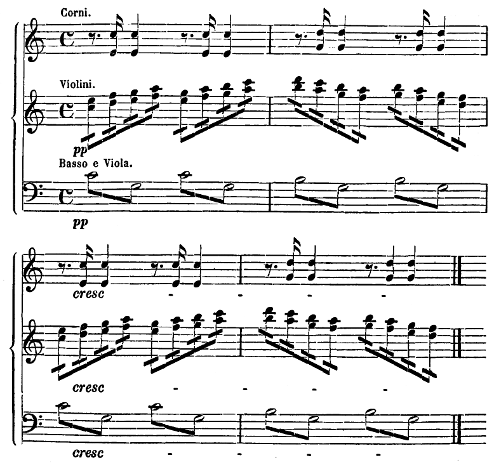
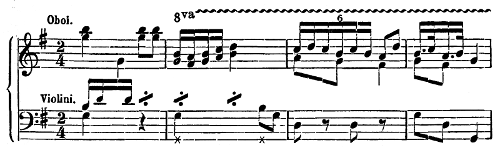
In this manner it continues for a while, until at length at the strongest forte, the public break out into a furious clapping of hands and shouts of “Bravo!” In fact it can so little resist such a crescendo, that even the luckless imitators of Rossini, like Signor Romano in the opera last night, understood how to draw down a storm of applause by it. That such passages are frequently very incorrect and offensive from the passing notes occurring in them, it is not necessary for me to remark; even in the celebrated cavatina from “Tancredi,” so enthusisiastically admired throughout Italy, and which was also sung to-day, there are in the very first bars the most hideous-sounding octaves, between the bass and the second hautboy, that I ever heard.
The first result of my judgment of Rossini is, therefore, that he is by no means wanting in invention and genius and with those qualifications had he been scientifically educated, and led to the only right way by Mozart’s classical masterpieces, he might readily have become one of the most distinguished composers of vocal-music of our day, but, as he now writes, he will not raise Italian music, but much rather lower it. In order to be new, Rossini departs more and more from the simple and grand style of song of former days, and does not reflect that in so doing he wholly robs the voice of its charm and advantages, and actually debases it, when he forces it to execute passages and fioritures, which every petty instrumentalist can produce much purer, and especially much more connected, because he has no need to express a syllable every time on the third or fourth note. With his “flowery song,” however much it may please, he is therefore in a fair way to make a clearance of all real song which is already now very scarce in Italy, and in which the despicable horde of Imitators, who here as well as in Germany pursue their pitiful calling, are doing their best to assist him.
December 29.
Last evening I went with Meyerbeer to hear “Tancredi” at the Argentino theatre. I never witnessed a more wretched performance. The singers, with the exception of Paris the elder, are very mediocre; the prima donna, the younger Paris, is yet quite a beginner, the basso was frightful, the orchestra worse than in the smallest provincial town in Germany, and in a word, it is an assemblage of folks such as had all Italy been ransacked for the purpose, it would have been difficult to find worse. God help the composer whose work falls into such hands! They disfigured it in such a manner that one can no longer recognise it. The only one person who distinguished herself, was the elder Paris, who, in the part of “Tancredi,” displayed a powerful, healthy contralto voice and a cultivated execution. It would be unjust after such a representation to pass judgment upon the opera, and the more so, as several passages were omitted and others substituted. The ballet which was given between the acts, was quite of a piece with the rest: a serious ballet executed by a number of grotesque dancers! But among these were some men, who made themselves remarkable by the power, and agility and by springs of all kinds.
During the last week we have again seen many interesting things; the museum of the Capitol, in which the dying gladiator and several Egyptian statues pleased me most—the latter less remarkable for artistic beauty than for singularity; the picture gallery in the Doria palace, which contains among many other remarkable pictures, four beautiful landscapes by Claude Lorrain; another gallery in the Colonna palace, in which hangs an extremely beautiful head of Raphael; the handsome and richly decorated churches of Santa Maria Maggiore and St. Giovanni in Laterano, &c. From the portal of the latter one has an extensive view in the direction of Albano, which with the ancient aqueducts, which the eye can follow for miles, and other remains of ancient Roman architecture, possesses much romantic interest.
On Sunday evening, the weather being very clear, we ascended the dome of St. Peter’s church. The ascent is at first by a footway of a spiral form without steps as far as the roof of the church. Arrived there once fancies one’sself again in the streets of a town, for the ground is paved, and a number of houses, some of which are inhabited, together with numerous small and large cupolas, prevent a view into the distance. But if you walk up to the gigantic statues over the portal of the church, you then see at how great a height you are standing. The pavement of the square in front of the church looks like a minute mosaic, and the people little puppets creeping about upon it. On looking up to the dome from here, it looks like an enormous isolated building; from the first interior gallery one has also to mount to a considerable height before one arrives at the second, where the first swell of the dome begins. The view from these galleries, particularly from the second, down into the church is quite sui generis, and makes one positively shudder. The hundred lamps which burn right under the dome at the entrance of the subterranean chapel, seem to mingle as in one flame, and the human beings below appear like moving black spots. From the second gallery one then ascends between the inner and exterior dome by wooden steps up to the lantern, from which one has again a view down into the church that makes the head turn. From here a flight of winding stone steps once more leads up into a tolerably large chamber situated in the top of the lantern, and thence at length ascending an iron ladder, one passes through the shaft to the ball, which is large enough to contain from twelve to sixteen persons.
The foolhardy can ascend yet higher, by a ladder outside the ball, up into the cross, but we were quite satisfied with having been as high as the ball. The view from the external galleries is magnificent and varied beyond description. Below, proud Rome with its inummerable palaces, ruins, columns and obelisks; around it the villas.
In the distance the mountain near Tivoli and Albano, above which are seen the peaks of snow-covered mountains, and far away on the west the Mediterranean, which at the time of the day we ascended the dome looked like a fiery stripe in the distant sky. After we had long enjoyed this entrancing view, we descended and found that two hours had passed very rapidly in the ascent of the dome.
We also went up the high column on the Piazza Colonna, and from its summit, which rises high above all the houses, enjoyed one of the finest views of Rome and its immediate environs.
December 30.
I have acquired the conviction that the Italians, even in modern times, are not wanting in natural abilities for the study of the fine arts, and indeed, that on the whole they surpass therein the northern nations. Almost all their singers have a happy ear for intonation, and the faculty of immediately seizing and repeating a melody once heard; although but very few of them, even among the theatrical singers possess what we call music, and most of them scarcely even know their notes. At the last musical party at Apponyi’s there was a Canon of Cherubini’s to be sung, in which Moncade who, as I had been told, is one of the singers who cannot read music, although formerly a theatrical singer, was solicited to take a part. As he willingly assented to sing something that he did not know, I immediately thought that in his case at least what I had heard was untrue. The Countess first sang the slow melody consisting of eight bars and Moncade repeated it note for note with all the little ornaments which she had added. But when his part began, he could get no farther: nevertheless, he did not permit himself to be disconcerted, but sang away by ear, which certainly sometimes did not sound much like music by Cherubini. When, however, the third singer, who also had no music before him, began, after his first simple entry in the second part, also to compose, such confusion and discord arose that they were obliged to leave off. Both singers declared very ingenuously that they had hoped, they would have accomplished it; like the Englishman who, when he was asked if he played the violin, replied: “It is possible, but I have never yet tried.”
Among the lower uneducated classes of the people, a remarkable genius for painting is by no means rare here, which is awakened by the early contemplation of the public works of art. In this manner the attention of the painters here has been attracted for the last year and more by the extraordinary artistic talent of a lad in the streets. This boy, without ever having had the least instruction, draws large historical sketches in charcoal upon the white walls of the houses, and there is scarcely a street in which some of his artistic work is not to be seen.
Sometimes he chooses for his subject a Madonna, or some legend, at others a Roman triumph. But in no one instance has he ever copied from any existing subject, or even repeated himself; his fancy constantly creates something new. Some of these sketches excite the greatest astonishment by the richness of the composition, comprising frequently more than thirty or forty figures, and by the correctness of the drawing. The most remarkable to me is the certainty with which he throws off and depicts his ideas. You see no double stroke in the contours—nothing wiped out—everything stands there at once clear and prominent. When he draws he is always surrounded by a crowd of people, who look on with gratification at the skill he displays; but he is so deeply engrossed with his work, that he heeds neither the surrounding spectators nor their remarks. I have been told that Canova took this lad, with the view of developing his talent; but that regular kind of life did not all please him, and he soon ran away.
January 1. 1817.
The new year has begun very unpleasantly for us. This morning Emily was taken suddenly ill. The doctor thinks she will have the scarlet fever; should that be the case, we shall be obliged to postpone our departure for Naples, which we had fixed for the 7th, for at least a fortnight. Added to the annoyance of remaining here yet longer without any object and in anxiety, is that of being compelled to see our fellow-countrymen with whom we had contemplated making the journey together depart alone, and that also of missing the opening of the St. Carlo theatre at Naples, which is to take place on the 12th. To console ourselves for the latter we shall meanwhile hear the new opera of Rossini, which he is writing for the Valle theatre, and the début of Madame Schönberger at the Argentino.
January 3.
Not only Emily, but Ida also has caught the scarlet fever, and now for a certainty we shall not be able to leave before the 20th. Both children were very ill for some days, and my good Dorette has been extremely alarmed and anxious. I have kept up my spirits and amused myself in inventing some puzzle-canons and have now began to write a new solo-quartett.
I should so much have liked to make Rossini’s acquaintance; but before he has finished his opera this is quite out of the question. The impressario, in whose house he lives, neither permits him to go out nor to receive visits, so that he may not neglect his work. Should his opera not be brought out before our departure, I shall probably not be able to see him.
January 18.
The children have recovered sooner than we had anticipated, and we have fixed to leave for Naples the day after to-morrow.
Last Thursday I went again to Sirletti’s, and yesterday to the morning concert at Count Apponyi’s; at neither place, however, was any thing played worth particular notice, with the exception of a fine quartett by Mayer and a duet from a comic opera of Fioravanti. Mayer is remarkable for scrupulously correct harmony, regularity of rhythm and a good treatment of the voices in part compositions, and surpasses therein all modern Italians. The duet out of Fioravanti more particularly interested me from the circumstance that it is also adorned with the modern so-called “flowery song,” from which I find that Rossini is neither the first nor only one who makes use of it. I begin moreover to judge him more favourably, as long as he does not venture beyond the limits of comic opera, and when his music is as gracefully executed as by the Countess Apponyi and Moncade.
On the 20th January we left Rome. The Campagna di Roma is as little cultivated on this side as on the other; the road as far as Albano derives nevertheless much interest from the many antiquities seen on the way. The numerous remains of three or four old Roman acqueducts give a particularly romantic aspect to the country round. One of the acqueducts, which was less injured, has been repared in later times, and still serves to supply Rome with water upon this side.
While our vetturino was baiting his horses at Albano, I ascended the mountain upon which the lake of Albano is situated. The view across it towards Rome is exceedingly beautiful. Below at one’s feet is seen the lake with its high precipitous banks thickly covered with trees and underwood; upon the right a long building, the use of which I do not know; to the left, upon the high steep bank, Castel Gandolfo, and in the extreme distance the mass of houses of Rome. The form of the lake and of its high precipitous banks indicates plainly that it has been formed by the falling in of a burnt-out crater.
The road from Albano to the little dirty town of Velletri, where we took up our first night-quarters, presents a great variety of scenery.
On the second day we crossed the Pontine marshes, which extend from Velletri to Terracina, a distance of four and twenty Italian miles. We did not find them so desolate and barren as we expected, for one has always a sight of the mountains on the left, and here and there of even a few patches of cultivated land. The numerous herds of oxen, buffaloes, swine, and in the dry parts, of sheep also, give some life to the uniformity of the level. But houses are of rare occurrence, and the inhabitants have always a pale unhealthy appearance. In the heat of summer the exhalations from the marshes are very dangerous, even to travellers who do but cross them, particularly if they abandon themselves to sleep, to which one is greatly induced by the uniformity of the road. Only last summer a young lady who could not resist the disposition to sleep inhaled death here, and was carried off by a malignant fever three days after her arrival in Naples. Such cases are not unfrequent in summer.
At Torre a tri ponti, a solitary hostelry, all the inmates of which looked as if they had just risen from their graves, we dined, and had very excellent meat, and roast ducks and geese, of which there are swarms in the uncultivated parts of the marshes.
Terracina, where we arrived at night-fall is most charmingly situated. The town stands upon a wild rocky eminence, but we stopped below at a very excellent inn close to the sea. From our windows we had a view of the sea, and on the following morning enjoyed the magnificent sight of the rising sun. Close below our windows, the waves broke with considerable noise, although during the previous day the wind had not been high. The air was as mild as after a warm summer’s day in Germany, and in the evening late we saw the fishermen launch their barks through the surf by moonlight, to cast their nets.
On the next morning we had to pass through the most dangerous part of the whole journey, from being the most infested with banditti. This part is between Terracina and Fondi, where the road lies through a thinly inhabited country and almost always between masses of low bushes in which the scoundrels easily conceal themselves, and can shoot down travellers and their escort from an ambuscade without being perceived. It is here where the most robberies are perpetrated, and but recently only some travellers were again attacked. But the government has at length taken earnest measures to suppress this. We found several hundred peasants employed in cutting down all the bushes on both sides of the road and burning them; and we met several strong detachments of soldiers, sent out to hunt up the banditti in their fastnesses. From twenty to thirty have already been brought in and hung up with little ceremony. On this side of the Neapolitan frontiers we met a picquet of soldiers at intervals of every quarter of an hour, which bivouacked on the side of the road and sent out patrols during the night.
At Fondi, a poor dirty looking hole, where we were almost torn to pieces by beggars, we saw the first gardens of lemons, pomegranates and oranges. We took a walk through the town and were delighted with the sight of the splendid trees, which were loaded with the finest fruit. In the gardens and in the market we saw fine fresh vegetables, such as cauliflowers, savoy-cabbages, carrots, &c. But at noon the heat was so great, that we were obliged to seek the shade.
We passed the night at Molo di Gaëta, also a small town situate close to the sea. From the windows of our inn in the evening we saw the fishermen put out to sea by torchlight to fish. Between Molo and Santa Agata we saw a great number of evergreen shrubs and plants, which do not grow even in the north of Italy, and upon the rocks several kinds of aloes, such as we grow in greenhouses. Several other shrubs which are also indigenous with us were already in their first leaf. On the road-side the air was perfumed by the violets, and the fields with the blossoms of the beans.
Capua, where we passed the last night of our journey, is a handsome town with fine buildings. We supped in the evening with two Austrian officers, who told us among other things, that they did not bury people in Capua, but threw them down a hole about a mile from the town, which was unfathomly deep, but was believed to have a communication with the sea, as after some lapse of time one could hear the bodies of those who were thrown down fall into the water.
The road from Capua to Naples is the most uninteresting of the whole journey. Nothing else is to be seen on either side of the road but high mulberry trees and pendant vines, both now without leaves. At two o’clock in the afternoon we at length arrived at the long-wished for Naples, and found a lodging which had been already engaged and prepared for us by one of our fellow-countrymen.
End of the First Volume.
Naples, January 1.
Naples, although not remarkable for beautiful architecture, is, from its situation and many peculiarities, one of the most beautiful cities of the world. On coming from Rome, one certainly misses the grander taste in architecture and other works of decorative art formed upon and refined by the study of the antique, which for ages has rendered that city the most interesting of all others to the architect, the sculptor and the painter; but one is compensated for that in Naples by other advantages that Rome has not. To an inhabitant of northern lands, the city presents from its amphitheatrical position a most imposing spectacle, and with its flat roofs covered with party-coloured and lacquered tiles, its cupolas and towers, it has a very novel and oriental appearance. It is moreover one of the most lively cities of the world, at least one of the most noisy; for although Vienna and Hamburg, the two most populous cities that I have yet seen, may have proportionately as many inhabitants as Naples, yet the latter, partly from its southern liveliness, and partly from the circumstance that here all classes idle away more time in the streets than they work at home, is much more animated than those cities. The noise in the streets is positively great beyond description, and until one has become somewhat accustomed to it, one is completely deafened by it. All the mechanics pursue their calling in the streets: blacksmiths, locksmiths, copper-smiths, carpenters, tailors and shoemakers—all alike sit in front of their houses variously intermingled, and work. Added to that the rattling of the carts and vehicles, which in the principal streets almost always move on two lines, the wild cries of itinerant vendors, always endeavouring to undersell each other, and lastly the animated language and gestures of those who meet, or converse in the streets, who to a German seem as though they were in violent dispute, although they are perhaps merely talking of the weather or some unimportant piece of news or town gossip. But more striking than in any other city of the world is the contrast between the luxury in the equipages and dress of the higher classes, and the dirt and nakedness of the lower ones, particularly of the so-called Lazzaroni. Of these whole families are to be seen lying in the streets in the midst of the beau monde, looking for vermin upon their half-naked bodies. A more disgusting sight I never beheld! And yet before Murat’s time, who made soldiers of all the able-bodied Lazzaroni, these vagabonds were far more numerous.
February 3.
Yesterday we made our first excursion. In company with our Silesian fellow-countrymen, Herren von Raumer, von Lattorf, Hagen and Kruse, we first drove out to Portici to see the museum. Here, in a suite of apartments, are preserved the paintings and interior-decorations found in Herculaneum and Pompeii, from whence they have been taken from the walls with the plaster, and are here hung up in frames with glass doors. Of the greater part of them the colours are in excellent preservation, especially a very fine red. The room or interior decorations, consisting of arabesques, small landscapes, and the figures of animals, are almost all well painted. The larger historical paintings taken from temples and public buildings have great artistic merit, and are remarkable both for drawing and colour. Some of these are in a wonderful state of preservation, and appear as though they had been painted but recently. Besides these paintings, there is in another room a collection of a variety of metal utensils, a helmet, and some vases in pottery, with different kinds of grain, partly burnt by the glowing ashes, such as wheat, barley, Indian corn, beans, &c. &c. These different kinds of grain are readily recognised, and we found them quite similar to our own in size and form. All the other antiquities which were formerly preserved here have been transferred to Naples, and it is intended to transfer the paintings there also.
As the weather was extremely fine, we felt a great disposition to make the ascent of mount Vesuvius without loss of time. But as it was almost impossible for women and children to climb the last steep ascent, Dorette and the children returned to Naples, accompanied by Herr Kruse. We others hired some asses for the journey and return, at the extremely low charge of four Carlini (about 15½d.), and set out at 12 o’clock at noon. At first the road lies through vineyards for about the distance of an hour and a half’s journey, and with but a gentle ascent only; but the road begins already to be difficult, being very uneven and stony. We saw several vineyards enclosed with large bush-aloes instead of hedges. After the lapse of an hour and a half we came to a plain which spread away before us like a desolate waste, as far as the proper base of the volcano. Not a vestige of vegetation met the eye; on every side nothing but masses of lava piled upon each other! Our path now turned leftward across the plain towards a mountain ridge, which rises like an island out of the midst of this fearful wilderness. On this stands the so-called hermitage, a building of two stories high, where we refreshed ourselves with bread, wine, cheese and fruits, and enjoyed the fine and now tolerably extensive view. After a short rest, in company with ten Englishmen whom we met here, we resumed the road, which still continues to run over the summit of the ridge as far as the crater. This part of the way is the least difficult, leading for some distance through bushes of sweet chesnuts, the plain covered with black lava stretching away before the eye. After half an hour’s progress we reached the steepest part of the ridge, at the foot of which we were obliged to leave the asses. Now began the difficult part of our work. Treading upon deep ashes without solid bottom, at every footstep one slips back so far, that one has often scarcely advanced an inch; and the mountain is here so steep, that one is obliged to use the hands as well for progression. Fortunately a ridge of solid lava extends downwards almost from the whole height, and rises like a ridge of rock from out of the ashes. When one has reached this, the toil is less, as the ground beneath has again become firm. But were one obliged, as at first, to wade always through the ashes, it would require a whole day to make the ascent of this height alone. Nevertheless it took a good hour to accomplish it, although we set out from our resting place with recruited strength, and with the hope of soon reaching the summit. On reaching the top, we saw again a small plain before us, from which in several places between the lava-rocks a white sulphurous steam ascended. The ground here was more or less hot and our footsteps produced a hollow sound. After we had passed rapidly over this we had to climb another though a lower height, and then beheld at a moderate distance before us the two craters, which were now vomiting fire. We sat down upon the ground between the lava-rocks and found ourselves as though sitting in a heated stove, for a great heat rose from the earth, which was nevertheless very agreeable to us. After we had rested here some time, some one of the company asked whether one could not ascend between the two cones close to the brink of the crater? All the guides replied in the negative, and assured us it was very dangerous to approach it nearer. We saw sufficiently well ourselves that it would be impossible to ascend direct from the place where we stood, as we should have run the risk of being stifled with the smoke of the crater upon our left. But it seemed to us that a way might possibly be found round the left side of one crater, from which we could ascend on the windward side of the other; so we immediately proceeded to make the trial together; after some objections our guides followed also. We had scarcely proceeded a distance of two hundred paces, when one of the craters with a fearful report threw out a quantity of red-hot stones, some of which fell at no great distance from us. This soon brought the whole party to a standstill; but after some little hesitation the foremost proceeded onward and the rest of us followed. In this manner, after a toilsome passage, we reached the rear of the left-hand crater, and then began to ascend the cone. But this was the most laborious task of the whole day, for we had now to climb a very steep incline up to our knees in ashes. Nevertheless, after great exertion we reached the summit and stood on the narrow edge of the crater, which, in the form of a funnel, is about two hundred feet in diameter at the upper part of the opening. After we had taken breath here awhile, and contemplated the eruptions of the other crater, which lay before us to leeward, the one close to which we were standing, became suddenly quite clear of smoke, and we could look down into the awful abyss. We there saw large cavernous fissures between the masses of rock forming the neck of the funnel, out of which flames burst at intervals; but as these were immediately followed by smoke, this sight was of short continuance only. One of the Englishmen of our party took it into his head, at a moment when the smoke of the crater upon the brink of which we were standing was somewhat less, to run across even to the other, in order to look down into it. But scarcely had he reached the brink, when an eruption, though fortunately not a very strong one, took place, from which he had barely time to save himself, and rush back again to us. At the same moment a third crater behind us began to make a noise, and it was now indeed high time that we should make our retreat. Though it was ashes merely that it threw up, yet by the timely fear with which it filled us, it was our saviour from utter destruction; for scarcely had we reached our old halting-place than the hitherto very quiet crater on the brink of which we had stood, threw out such a mass of red hot stones, exactly in the direction of the place where we had stood, that we should all have been struck down and overwhelmed by them had we stopped there five minutes longer. After our daring party had recovered from the terror which had seized upon all, we were compelled to avow our extreme rashness in having ventured to ascend so high despite the warnings of our guides.
We now once more bivouaked upon our warm place, and recruited our spirits with the provisions we had brought with us. But with night drawing on, far away from every living creature, and surrounded on all sides by desolation, it was a fearful reflexion to think that we sat here suspended as it were over a sea of fire, upon a perhaps not very thick crust, which sooner or later might give way beneath us. Several of our party made the observation, that it was indeed a mad piece of folly to have risked life upon chances so eminently possible, for the mere gratification of an idle curiosity. But these reflexions nevertheless did not prevent us from enjoying with much relish the eggs our guides had brought with them and cooked in the hot ashes, and which we washed down with a draught of delicious Lacrymæ Christi.
We here awaited the approach of night; saw the sun sink below the sea, and the full moon rise behind the craters, her yellow light forming a beautiful contrast with the red flames that issued from them. On our right we saw at the same time the reflexion from the burning lava which poured from an opening in the side of the mountain, which however it was impossible to approach without the greatest danger.
About seven o’clock we set out upon our return, which at first, from our being obliged to descend on the shaded side of the mountain was on account of the darkness both very difficult and dangerous. But when we arrived at the precipitous places, our guides led back us by another way, where we slid down with giant steps over deep ashes. Below we found our asses, upon which we rode to Portici by a magnificent moonlight. At ten o’clock at night we arrived once more at Naples, highly gratified with the extremely interesting day’s adventures.
February 7.
During the constant fine spring weather we daily take a walk to see the immediate environs of the city. The favorite walk of the children is to the quay, on which is the light-house, partly because the busy life in the port itself, as well as the sight of the different kinds of vessels, from the ship of war mounting a hundred guns down to the fisherman’s boat, affords them immense pleasure, and partly because the way leading to it presents the most lively picture of the habits and occupations of the lower classes. From the St. Carlo theatre to the harbour there is, next to the Toledo-street, always the greatest crowd; at a short distance from which are all the small hole-and-corner theatres, where performances take place all the day long and where, upon a platform outside, a couple of fiddlers and a merry-Andrew constantly invite the passers-by to enter. Between these are the booths of the itinerant vendors, who, perched upon a table, recommend their medicaments to their numerous listeners and purchasers. Upon the quay, where there is no noise from the carts and carriages, the puppet-show players pitch their portative theatres, and the Improvisatori entertain the Neapolitans with the heroic feats of their ancestors. Sometimes one of these reads aloud to his auditory and then explains what he has been reading. But here also swarm the most impudent and disgusting beggars, and the most expert pick-pockets; so that one cannot be too careful how one gets mixed up with them. On my first walks into that quarter I lost my pocket handkerchief each time. If one waits here till the evening the Vesuvius, with its red fire, presents a singular and magnificent contrast with the white lights of the Pharos.
The Royal garden on the Chiaja is also another very interesting walk. It extends for a considerable length close to the sea, and consists of three very broad alleys with small flower-beds laid out in the English style. It is ornamented with several fine statues and groups in marble; in the centre stands the celebrated Farnesian Bull, a splendid antique by a Greek master; on both sides are several fine copies of ancient works of art, such as that of the Apollo of Belvedere, the rape of the Sabines, &c. &c. From eleven in the forenoon on fine days, the beau monde assembles here to look and to be looked at. If one proceeds still farther along the Chiaja, one soon comes to the road that leads through the Grotto of Pausilippo to Puzzuoli. This long gallery, extending at least for a thousand paces right through a mountain of considerable height, is very remarkable of its kind, for the galleries cut through the rocks in the road over the Simplon are but child’s play compared to this work. The entrance on this side between towering rocks is exceedingly romantic; at a great distance off the noise of the carriages driving through resembles thunder, and it is said that at night, when all is quiet here, the sound of the vehicles in the streets of Naples, is echoed through this rocky gallery like that of distant thunder. The interior is lighted day and night with numerous lamps. At the entrance and in the middle are little chapels, at which the passengers are solicited for alms. Above the entrance high up on the rocks, a small grotto is pointed out, where the immortal poet Virgil lies buried.
A few days ago we visited also Fort St. Elmo, from which one has an extensive view over the whole city and of the expansive bay.
February 12.
Last evening we returned from a delightful excursion to the islands. On Sunday at noon, in company with our three Silesian countryman, we went across to Ischia in a hired boat. We were at first obliged to sail round the promontary of Pausilippo: Nisida and Procida lay quite close to us, Cape Micen somewhat in the background, and Ischia at a greater distance, in a direct line before us. These islands and promontories with their steep, and towering rocks close to the sea, and the rich fertility of their interior, present every moment and on every side on which they are beheld new aspects of varying interest, now of a beautiful and now of a bolder and grander character. Procida, in particular, one of the most populated spots of the whole world, presents a magnificent view from the sea, the whole island having the appearance of a large city. As the wind blew tolerably fresh and against us, night came on before we could reach Ischia. But the beauty of the evening would not permit us to regret our having been delayed. The stars shone with a brightness such as in Germany at least they are never seen to shine with; and Venus in particular was resplendent with so clear a light that its beams were reflected in the sea like those of the moon, and one could plainly discern a shadow from any intervening object. The sea, also, at every stroke of the oar shone as with the light of myriads of glowworms. About eight o’clock we at length landed at the north shore of the island and found a comfortable night-lodging in the handsome house of a clergyman.
On the next morning we soon set out upon our way to see the interior of the island and to ascend the Epomeo. As at Ischia there are neither vehicles nor roads to travel on, we all mounted upon asses, which carried us more conveniently and safely over the rocky and uneven ground. After passing through several level tracts in the highest cultivation we came to the small but lively town of Ischia, on the sea-shore, and onward to the foot of the Epomeo between vineyards to the opposite side of the mountain, where it is more convenient to climb. After we had ascended about half-way by very bad roads, we halted for an hour to rest and refresh the animals, and then completed the other still more toilsome part of the ascent. Meanwhile the sky had unfortunately become overcast with clouds, and upon reaching the summit of the mountain we were enveloped in a thick mist. We then entered a hermitage of some size, consisting of several rooms and passages, and of a chapel. It resembles that at Freiburg in Switzerland, and like that also is hewn out of the solid rock, by two industrians recluses. We waited here some time in the hope that the weather would clear up, and several times also we had a glimpse between the clouds over the level parts of the island, which lay like a map outspread in the distance before us; but Naples, Capri, and Sorrento were veiled from our sight. We were at length obliged to set out on our way once more, without having had the pleasure of enjoying the fine view from here, which is perhaps one of the finest in the world, and had already considered our toilsome journey as a labour in vain, when on a sudden, after we had descended somewhat lower and stood under the stratum of clouds, the magnificent view of the whole of the islands, promontories and bay, with Vesuvius smoking in the background, displayed itself to our enraptured eyes. Long we stood lost in admiration of the singular beauty of the scene, and at length, when the setting sun gave token of departure, we returned by the shortest but steepest road, where we could make no use of the asses, to our quarter of the previous night. The Epomeo, which 450 years ago was a volcano, exhibits on this side, which is much more wild and barren than the other, numerous traces of former eruptions. The road led now almost continually over weather-worn lava. Upon the rocks we saw at very frequent intervals the stock-gilliflower in bloom, which here and in the neighbourhood of Naples grows wild. On the way-side violets and other plants, several of which are not indigenous with us, were in full flower, and in the gardens, the almond tree. At length we came to a place where there are warm baths, which in summer are much frequented by the Neapolitans. At the house of our host we found a plentifully spread table awaiting us, which after all the fatigue of the day was exceedingly acceptable. A fiery white Ischian wine of the year 1811 we found especially agreeable to the palate.
We re-embarked the next morning at eight o’clock and landed first at Cape Micenus, where we visited the large subterranean reservoirs of soft water from which the Roman fleets were supplied, and the cento camere of Nero, which were probably prisons for the detention of prisoners of war. We then sailed right across the bay to Puzzuoli, and there made another pilgrimage to some antiquities. On running into the harbour we sailed past the still standing piers and arches of the bridge of Caligula, which that Emperor designed throwing across the bay. Although built of bricks merely, such is the excellence of the cement used in their construction, that their remains, after the lapse of so many centuries, still bid defiance to the unceasing action of the waves.
Our cicerone led us first to the Solfatara, a round level field-like space enclosed on all sides with rocks, apparently a crater which at some remote period had fallen in. The subterranean fire still burns beneath, nevertheless, for in many places smoke issues out of the earth, and as on Mount Vesuvius, deposits sulphur. At those places the ground is burning hot, and the foot-tread sounds hollow. Our guide flung a large stone upon the ground, which made it vibrate for a considerable distance round us, and produced a very loud, hollow sound. Thence we proceeded to another subterranean reservoir of water similar to that at Cape Micenus; inspected the ruins of an amphitheatre and several temples, and at last reached the most interesting antiquity in the whole neighbourhood—the ruins of the temple of Serapis, close to the sea-shore. So much has been written respecting all these antiquities, that it would be superfluous to dwell upon them here, but the remains of the temple of Serapis are so remarkable, and afford such evidence of its former size and grandeur that to see them alone amply repays a journey here. Towards the evening we drove back to Naples through the grotto of Pausilippo.
February 15.
As I have now been several times to the St. Carlo theatre, I can with confidence put my judgment to paper respecting it. On the first visit I experienced the same feeling as in the church of St. Peter: it did not appear to me so large as it really is, and it was not until I had been frequently told that it is four feet wider and I know not how many longer than the theatre at Milan, that I could believe it. But when the curtain drew up and I could compare the size of the human beings with the painted objects of the decorations, I readily observed that here also I had been deceived by the correct proportions of each gigantic object. Here for the first time the horses introduced on the stage did not appear out of proportion with the rest, and the people one saw at the extreme depth of the theatre, were still in just proportion with objects which surrounded them. For ballet and pantomine I know of no better adapted locality, and military evolutions of infantry and cavalry, battles, storms at sea, and such things can be produced without falling into the ridiculous and the paltry; but for operas the house is too large. Although the singers, Madame Colbran and Signori Nozzari, Benedetti, and others, have very powerful voices, yet one hears only the highest notes given out with the full strain of the voice; but all tender pathos in song is wholly lost. This is said not to have been the case before the fire, and the theatre was then quite as sonorous as Della Scala at Milan. This prejudicial change is ascribed to three causes first, the proscenium has been widened by several feet; secondly, the ceiling is not so concave as formerly; and thirdly, the high projecting decorations in stucco obstruct the sound and do not send it back. If the house was in reality so sonorous formerly, then they have greatly deadened that faculty in the new building, and they would do very wisely to eject (the sooner the better) all the unnecessary trumpery of ornament and gildings, which besides is exceedingly heavy and not in the best taste, and so regain the former advantages.
The first opera I saw was “Gabriele de Vergi,” by Count Caraffa, who formerly was a dilettant merely, but now as a younger son without means, is become an artiste, and as such strives to earn a subsistence. The opera pleased me very much, but without being altogether particularly attractive for me. The style is even and dignified, but the orchestra is too much overladen, and the voice parts are too much obscured. The execution was very precise, both on the part of the singers and of the orchestra. The latter, under the correct and spirited but somewhat too loud direction of Signor Festa, had studied it well, but were somewhat wanting in nuances of piano and forte; the wind instruments in particular are always too loud in the piano. Of the singers nothing further can be said than that they have good and powerful voices. Whether they have a good execution cannot be ascertained in this theatre; for one hears them either singing at the top of their voices, or one cannot hear them at all. After the opera Duport’s ballet of “Cinderella” was given, the decorations, costumes, &c., of which were of a very expensive character. Besides Duport and his wife, the dancer Vestris attracted much notice. The music was nearly the same as that we heard in Vienna in that ballet; a polonaise newly introduced by Count Gallenberg, the ballet-composer here, pleased greatly from its originality and sweetness.
Another opera, also by a dilettant, Signor Carlo Saccenti, was given a week ago, after a three months’ study and rehearsal. The king, who is a great patron of the composer, had fixed on it for the opening of the San Carlo theatre, and Mayer, who had been sent for here by the impresario, to write a new opera for the occasion, was obliged to keep his back. But as it was afterwards found that it would be impossible to be perfect in it by the day appointed for the opening, Mayer was permitted to write a Cantata in all haste, with which on the 12th January the theatre was at length opened. This cantata, though written with great despatch, is said nevertheless, according to the opinion of connoisseurs to contain a good deal of fine music; but as the text or subject was the burning of the theatre, one little calculated for composition, it could not well have been other than a somewhat tame production. Nor could it be expected, with the little attention given to it by the public, more occupied with the brilliant illumination of the house and the splendour and Spanish etiquette which the court displayed at the opening of the theatre, that the reception given by the public to the cantata should have been other than a very cold one. Nevertheless, it was not properly speaking a failure. After this had been brought out, the study of Saccenti’s opera was again resumed. All that reached the public concerning these rehearsals was very unfavourable. His friends said he had composed a work which from its originality and excellence would produce a complete reform in operatic compositions: the singers and musicians, on the other hand, said that in all their lives they had never sung or played anything more villanous, tedious and incorrect than that unfortunate opera. The impartial conjectured that, as is usual with such conflicting opinions, the truth would lie in the mean; but I soon satisfied myself, after a few rehearsals which I attended, that the musicians were perfectly right in the judgment they had formed of it. It would indeed be scarcely possible to put together a more outrageous piece of music, even if one strove expressly, and with the greatest industry to act contrary to all the most approved rules of rhythm, structure of the periods, harmony and instrumentation. There was no trace of song or sensible carrying out of an idea; every third bar was something else, with the most incorrect modulations. In the very beginning of the introduction three ugly quints follow each other in quick succession. One of the musicians from recollection said that the composer justified it very ingeniously with the example of the English sailor who was brought before a magistrate for having married three wives, but whom the law could not reach as it forbade bigamy only, and made no mention of trigamy; in the same manner, said the composer, it is forbidden to have two quints in succession, but by having three the penalty contemplated by the law was evaded.
After rehearsals innumerable, the representation took place in the presence of the court and with a crowded house. Notwithstanding the here prevailing formal Spanish etiquette, which commands that the curtain shall be drawn up immediately the king enters the box and which constrains the poor singers to exhibit themselves on the stage during the whole duration of the overture, without being able to move in the spirit of the characters they impersonate; and which moreover forbids every demonstration of applause or of disapprobation; despite this constraint, which impedes free judgment, the opera was hissed in optima forma. On the following night it had the same fate, without a single friend of the composer’s daring to clap a hand. With this second representation, at which I was present, the opera was for ever consigned to the tomb. It is called “Aganadeca;” its author is Signor Vincenzio de Ritis. The subject, from Ossian, is said not to be without merit, and it is regretted that it did not fall into the hands of a better composer. The latter, however is not sensible of his own deficiency; he ascribes its failure to the little musical judgment of the Neapolitan public, and intends sending his work to Germany. May Apollo and the muses bestow their blessings upon it!
February 20.
The Carneval came to a close yesterday, and the fasts have begun. After the noise of the last day of the carneval, the quiet which has now succeeded does one really good, although the evenings are somewhat dull, as all the theatres are closed for four days. At the St. Carlo theatre instead of the customary oratorios this year operas will be given as usual, but without ballets, which are wholly forbidden at this season. At the Fiorentino theatre we saw an opera of Guglielmi (son), “Paolo e Virgina,” which met with some success. But the music of the third act is quite Italian for insipidity, in which Paul, during a storm at sea, sings an air in the usual form, and with the usual insipid intermediate acting, exhausting himself in shakes and passages, when he would act much more sensibly if he hastened to the assistance of his loved one. This sea-storm without an appropriate music was therefore the most ridiculous thing I ever saw at a theatre, and solicited no sympathy for the whole affair from the spectators. It is true the machinery also at this theatre was most mean and childish. Among the singers Mesdames Chabran and Canonici distinguished themselves greatly. The former has a fine soprano voice, great ease of execution and a good school; the latter the same qualifications with a powerful contralto voice. They had particularly well studied their duets. In this theatre we found for the first time in Italy, with a full house and a frequently repeated performance, a quiet and sympathetic audience. The house is roomy and prettily decorated, but the stage very small and narrow.
I had expected the end of the carneval to have been far more gay than I found it. The whole amusement consisted in the crowding together of half Naples, masked and unmasked, in vehicles and on foot in the street of Toledo, where they moved up and down and pelted each other with little balls of gypsum. The masks of the carriages were provided for the purpose with whole baskets full of these little bullets, and with shovels, so as to enable them to throw them up to the balconies. They carried tin shields on the left arm, with which to ward off the missiles of other maskers. As these were frequently of a tolerable size and were thrown with full force, the fun frequently proved somewhat rough for those persons who were not masked, and many a lady must doubtless have taken home with her a few blue marks on her neck and arm. Nevertheless all was borne with good humour and without dispute, as the liberty conferred by the mask serves to excuse all impoliteness. The masqued balls at the San Carlo theatre are said to have been somewhat wearisome affairs; although there was no want of masks in character, yet there was very little wit and ability to personate the characters in accordance with the costume and manners of the period.
February 26.
I have been twice to the conservatory of music. The first time I was present at a practice concert of the pupils, in which several overtures, or first themes of symphony composed by one of them, who at the same is first violin also, were tried. They were not devoid of fancy, but in form and instrumentation complete imitations of the overtures of Rossini, which certainly are not calculated to serve as models. The execution was but tolerable; the young folks, particularly the violinists, have no school at all; they know neither how they should hold the violin nor the bow, and play neither purely nor distinctly. Nor can it be otherwise with the bad instruction they receive. Festa, the only violinist here of a good school, is not employed in the conservatory of music. It is highly reprehensible that the young people are permitted to give their practise-concerts without the superintendence and guidance of their instructors; their first violin and director, who is himself still a pupil, is wholly wanting in self possession and judgment. He bungles the allegro tempi in such a manner that all distinctness is out of the question. Among the wind instruments, a hornist, a lad of eleven years of age, is very remarkable. On the occasion of the second concert at which I was present, two singers made their appearance, who had neither good voices nor a good method. All that I have yet heard, is far inferior to what the Milan musical students can perform. Signor Zingarelli, director of the conservatory here, and teacher of the theory of music and singing may possess many qualifications as a composer of operas; but it is generally said that since his appointment the conservatory has very much declined. That he at least does not know how an orchestra should be conducted or a symphony executed, he proves by allowing so quietly these things to take place in his presence. Of the merits of our German composers he has some very erroneous notions. One day, when I paid him a visit, he spoke for a long time of Haydn and other of our composers with great respect, but without even once mentioning Mozart; I therefore turned the conversation upon the latter, upon which he said: “Yes, he also was not deficient in talent, but he lived too short a time to cultivate it in a proper manner; if he could only have continued to study ten years longer, he would then have been able to write something good.”!
March 3.
An opera has been again put on the stage written by Mayer several years ago. It is called “Cora” and is founded on the same subject as Kotzebue’s “Sonnenjungfrau” (Virgin of the Sun). There are certainly some fine passages in the music, but taken as a whole it has not satisfied my expectations of Mayer’s music. He is after all deeply tinctured with the Italian manner and almost wholly an apostate from the German. His method of carrying out the vocalisation and his instrumentation are thoroughly Italian. This certainly is not to be wondered at, for since the age of fourteen he has lived in Italy, and never wrote for any other than Italian audiences. I think, that apart from his natural talent, he has raised himself above the others alone by having always endeavoured to procure all the best German works, which he studied, and made use of, the latter indeed sometimes a little too much. Throughout Italy, and here in particular, he is very much admired and liked: he merits it also in every respect, and as a man is ever the upright, smooth-spoken unassuming German. He is much attached to his fatherland, and seems only to regret that it was not his fate to pursue his career as a composer in Germany. In Bergamo, where he is director of the orchestra, he now only desires to live in retirement, and write solely for his church. He assured me that nothing but the honour of writing for the reopening of the San Carlo theatre could have induced him to leave his retreat once more, but that the opera “La vendetta di Junone,” which he had now completed, should certainly be his last work for the theatre. In “Cora” the favorite piece with the public is the finale, consisting of a theme in three variations in the old style of Pleyel; one of the singers sings the theme, Davide the first variation in quavers, then Nozzari the second in triplets, and in conclusion la Colbran the third in semiquavers. As it is well sung, it greatly pleases the public, and critics therefore must be silent.
March 6.
Last evening Signor Pio Chianchettino gave a concert in the Fondo theatre. He is a nephew and pupil of Dussek, and played two concertos of that master in his manner. Although his play was pure, distinct and even full of expression, yet here again, as every-where else, the piano-forte as concert-instrument proved itself insufficient to awaken the enthusiasm of an audience; and the more so is this the greater the size of the place. For that reason also upon this occasion, the song-pieces pleased far more than the concertos, although no one could find fault with his play. I myself felt this also; for although I am very fond of the piano, when a composer rich in ideas improvises upon it, yet as concert-instrument I am wholly unmoved by it; and a piano-forte-concerto in my opinion is only effective when written like those of Mozart, in which the piano is not much more thought of than any other orchestral instrument. The singers, Madame Chabran and the Signori Davide, Nozzari and Benedetti, all distinguished themselves, and were loudly applauded. One becomes more sensible of their merits when one hears them in a smaller place than the San Carlo theatre. Davide and Nozzari may be called almost perfect singers, they both have very fine voices; the former a very high tenor, the latter a high baritone, remarkable fluency of execution and much true expression. Benedetti has a very fine bass voice, but sings rather coldly.
March 7.
We have again taken some rather more distant and highly interesting walks. The object of one was the Camaldula convent, which is situated upon a hill above two hours’ drive from the centre of the city. We rode as far as the foot of the mountain, where as the carriage road terminated, we were obliged to make the ascent on foot. The view from the convent garden is perhaps one of the most extensive and beautiful in the world. On one side are seen Ischia, Capri, Procida, Nisida and the promontories which we had visited in our previous excursion, accompanied by the blue mirror of the sea; on the opposite side Capua, Caserta, and in the back-ground the snow-covered mountains; on the side of Naples a part of the city itself, the whole bay with the opposite coast, and on the left the smoke-emitting Vesuvius; lastly, on the fourth side, the shores and salient promontories near Gaëta, as far as Terracina. As the weather was very propitious for us, this was one of the most magnificent days we ever passed in the enjoyment of the beauties of nature. The monks, some of whom we caught sight of, did not appear in the same humour as we were; for they all wore a gloomy aspect.
We took a shorter but not less interesting walk on the new road to Rome, which was begun under Murat, but has remained unfinished since his dethronement. It leads over a mountain from which one has the most admirable view of the city, and it is much to be regretted that it is not complete; for then the traveller would be able to form a more worthy conception of the city before his entry into Naples, while now by the old road, which winds through a narrow mountain ravine, he sees nothing of Naples until he has entered the most dirty and least attractive part of the city; which leaves him long in doubt whether he actually is in the world-famed Naples.
We passed a very pleasant day at the villa of the banker Heigelin, which is situated also upon a mountain near the Strada Nuova, whence one has a beautiful view. Old Heigelin, an amiable, open-hearted German, has ornamented this place of his own creation with so many fine things, such as grottoes, ruins, temples, fountains, &c. &c., that it would be actually impossible to crowd any thing more together in so small a space. Although perhaps the whole is somewhat frivolous as regards the manner in which it is laid out, it has nevertheless many individual things worthy of attention. For us Northerns, for instance, the vast number of exotic plants, which were for the most part in full bloom, were objects of great interest.
March 11.
Last evening our concert took place. As the impressario of the court theatres, Barbaja, an extremely selfish man, asked me too much money for the hire of the theatres, for the Fondo for instance 100 Neapolitan ducats and for the San Carlo 200 even, I adopted his proposal rather to give my concert in the assembly-room of the San Carlo theatre, which he offered me lit up for nothing. This apparently disinterested offer was nevertheless calculated also for his advantage, for the assembly-room and the adjoining rooms were the places for the hazard-tables, which he had rented, and to which by means of my concert he hoped to attract the most fashionable and wealthiest company of the city. This use of my concert, which could in no way prejudice me, I could readily allow him. As the saloon is not very spacious, I fixed the price of admission, as at Rome, at one piaster, and although I had not a more numerous, yet I had a more susceptible public than there. Encouraged by this and supported most efficiently by the very accurate accompaniment under Festa’s direction, as well as by the room itself, which was so advantageous for my instrument, I played better than I had done in many other towns in Italy. Besides my compositions a duet by Mayer and a terzet of Cherubini were sung by Signore Davide, Nozzari and Benedetti. Even during the evening I was solicited on all sides to give a second concert in the theatre.
March 18.
This morning early we visited the “Studii,” i. e. the building in which the treasures of art from Pompeii and Herculaneum are preserved, together with the collections previously made of statues and paintings. The library is situated also in the same building. As it is impossible to see all in one day, we chose for to-day the statues and the library. Among the former are some very celebrated statues from the Farnese collection, of which numerous excellent casts have been made, and two equestrian statues found in Pompeii, of great artistic worth. In one room are two glazed cases, full of antique bronzes, also from Pompeii and Herculaneum, consisting of lamps, small penates and all kinds of domestic utensils. These things, as well as the statues in marble are in the most perfect preservation, and appear scarcely so many days old as they are years; but every thing of iron is much eaten by rust, as for instance the handles and rings of various vessels of bronze.
The library is contained in a fine handsome and spacious apartment and several adjoining rooms. On the floor of the grand room the line of the meridian is drawn, on which, through a small hole pierced in the wall for that purpose, the sun’s rays fall at noon. When a person claps his hands at a particular spot in this apartment, an echo repeats it more than thirty times in rapid succession. This arises probably from the position of the window-recesses, which are high up, near the ceiling.
Lastly we visited the room where the rolls of papyrus are preserved and unrolled. They have all the appearance of charcoal, and one might mistake them for that, were it not that one can easily distinguish the edges of the leaves. A manuscript fully unrolled, mounted upon linen, framed and glazed, hangs against the wall. As the paper is burnt quite black the letters are scarcely to be distinguished, and one cannot but admire the patience, the penetration, and the knowledge of languages of those who have known how to unravel its sense. It is a treatise on music: each side is divided into three columns. In the first is seen an engraved, accurate copy of the unrolled papyrus, with all its defects, and rents; in the second, the contents in modern Greek characters, in which the letters and words that are wanting in the original are filled in with red letters, and in the third, a Latin translation. They are now unrolling another manuscript, but do not appear to be hurrying themselves much, for we found one person only thus occupied. The method pursued is a very simple one. Small strips of fine parchment are stuck with gum close to each other or rather somewhat lapping over each other, upon the charred rolls, after which the paper is gradually and carefully released and removed. The process is of a necessity a slow one, but considerably more might have been unrolled by this time. If these precious remains of ancient learning were in the possession of a German sovereign, they would all have been deciphered long since.
March 22.
As I did not like the trouble of making the arrangement for a second concert, I readily accepted the proposal of the impressario to play twice at the San Carlo theatre between the acts of the opera for the sum of 300 ducats. This I did the evening before last for the first time. I was very much afraid that the violin would not fill the immense house, but I was soon set at rest on that point on being told at the rehearsal that every note was distinctly heard in the most distant parts of the house. But of a necessity nevertheless I was obliged to forego every finer nuance in my play. Although the house was very full, yet the greatest silence prevailed whilst I was playing, and after the second piece of music I was called forward.
Last evening I played at the Casino mobile, in a very fine saloon, my concerto in the form of a scena, and a pot-pourri with pianoforte accompaniment. As the room is very favourable for music, both of these had a very sensible effect upon the audience. The remainder of the concert, consisting of symphonies and pièces d’harmonie, was not of importance.
I forgot to mention a concert given by Signora Paravicini at which we were present, at the Teatro nuovo, on Wednesday last. She played, between the acts of a comedy, the first violin-concerto of Rode in D minor, a pot-pourri by Kreutzer, and at the end an Adagio and Rondo of the same composer. I have been accustomed to hear my instrument ill used by women, but I never saw it used so badly as by Signora Paravicini. I was the more surprised at this, as she has acquired some fame, and has a vast deal of pretension; as an instance of this, she told people here that she had heard Rode in Vienna, but that he had excited no other sentiment in her than pity. Her turn had now come to excite pity if one can feel it at all for arrogance and unskilfulness. She has a very excellent violin, a Stradivari, and in the cantabile draws from it a tolerable tone; but that is her only merit. In other respects she plays in bad taste, with a profusion of meaningless ornamentations, and the passages indistinctly: her intonation is not pure and her bow stroke extremely bungling. The applause was very lukewarm and was elicited only when Prince Leopold her patron began to clap his hands. Much more interesting than Paravicini’s play, was the comedy, which was capitally performed. Signor de Marini played remarkably well, and he is altogether one of the best actors of the day. The theatre, certainly, is smaller than the Fiorentino and Fondo, but quite as pretty.
At private-parties I have played my quartetts and quintetts a few times, which were exceedingly well accompanied by Messieurs Dauner and son, the young and talented violinist Onario, whom I have practised in some of my things, and by the accomplished violoncellist Fenzi, who lived formerly in Cassel. They afforded great pleasure, and Mayer assured me he had never enjoyed a greater musical treat. On the second occasion we played them at the house of Lady Douglas, who herself plays the piano very well and is said to have sung exceedingly well some years ago. She and her husband are the first English in whom I have found a real taste for music.
March 23.
On looking through this diary I observe that I have forgotten to mention the performance of two masses given at the expense of Prince Esterhazy of Vienna. The first by old Umlauf of Vienna, was remarkable for nothing in particular; but the second by Haydn, in D minor, which was performed with great solemnity and military pomp on the emperor’s birthday, afforded much gratification. Mesdames Chabran and Canonici, and Signori Nozzari and Benedetti sang the solo parts very beautifully; the chorus and orchestra were also admirable. Unfortunately, at the express desire of the Prince, almost all the tempi were taken too quick, and thereby much spoiled.
Milan, April 22.
Prevented from writing by the great press of business in the last days of our residence in Naples, and the hurry of our return journey, which was almost unbroken by a day of rest, I have got greatly in arrears, and have therefore much to fetch up, even respecting Naples.
Mayer’s new opera was at length brought out a fortnight before Easter, after it had been once more re-christened, but it was a total failure, so that it lived through two and a half representations only, and probably is for ever at rest. On the third evening, in fact, the first act alone was given, with one act of Paer’s “Sargino.” Both the subject and the music of Mayer’s opera are equally uninteresting and tedious. The latter especially is wanting in life and spirit; it is so common-place and so spun out, that one can hardly hear it without falling asleep. This actually occurred to me, to Count Gallenberg, and to several others, at the grand rehearsal. Mayer seems to have exhausted himself, which is no wonder with the enormous quantity of operas which he has written. It is certainly high time for him to retire as a composer of operas, that he may not entirely forfeit the repute he had acquired, and he would have done well if he had not accepted the last invitation to Naples. The evening after the first representation of his opera he set out on his return to Bergamo.
About this time the arrival of Madame
Catalani
set all the lovers of music in Naples in great commotion. She immediately took advantage of this enthusiasm and announced a few days afterwards a concert in the Fiorentino theatre, the prices of admission being seven-fold the usual ones. On the day before the concert, it was with difficulty that I got two pit tickets, and that because I had previously bespoken them, at 22 Carlini each. Never perhaps were the expectations of an audience at a higher pitch of tension, than were those of the Neapolitan public on that evening. My wife and I, who for years had longed to hear this celebrated singer, could scarcely repress our impatience for the moment of her appearance. At length she did appear, and a deathlike silence pervaded the whole house. She came forward with a cold and pretentious air, and saluted neither the Court nor the public, which created an obvious unpleasant sensation. Perhaps she had expected to have been received with a burst of applause, which however is not the custom in Naples, and this perhaps put her out of humour. But when after her first song she was greeted with a storm of applause, she became more friendly, and remained so for the rest of the evening. She sang four times, two airs by
Pucitta
,
Ombra adorata
of
Zingarelli
(or, as the Neapolitans insist, of
Crescentini
, whose name also was down on the bills) and variations on the thousand times varied “
Nel cor non più mi sento
.” The airs by
Pucitta
were extremely poor; the famed
Ombra adorata
can only be considered fine, when all thoughts of the text are banished from the mind; the variations were common place, but become piquante from her manner of execution. She pleased us greatly, by the constantly pure intonation and the perfect finish with which she executes every kind of vocal ornamentation and of passages, and by her quite peculiar and characteristic style of singing; but she does not come up to that ideal of a perfectly accomplished singer, which we had expected to find her. Her voice which has the extensive range of

to

is both full and powerful in the low and middle notes, but the transition to the
voce di testa
at
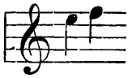
very observable, and from three to four notes in that region are much weaker, than the deeper and highest; for which reason she gives all passages which occur in those notes, with half-voice, only in order to conceal the inequality. Her voice is wanting also in the youthful freshness, which, however, in a female singer of forty years of age, is not to be wondered at. Her shake is wonderfully beautiful; and equally pure whether in the half or whole notes. A peculiar style of run through the half notes, properly speaking the enharmonic scales, since every note was produced twice, is greatly admired as something quite her own. To me, nevertheless, it was more remarkable than beautiful; for it sounded to me like the howling of the storm in the chimney. Another kind of vocal ornamentation, which in itself is common enough, she gives, however, in a manner that imparts great charm to it. It would be expressed in notes somewhat in this manner:

but at the same time it must be observed, that she took breath at every sixteenth-pause, which gave to this part a very impassioned character. Among the variations was one with syncopated notes, which from her peculiar style of execution derives also a very characteristic and interesting charm; and another in triplets
legato
she gives in perfection. But what I most missed in her singing, was
soul
. She sings recitative without expression—I might say with carelessness, and in
Adagio
she remains cold. Neither were we even
once
deeply moved, but experienced merely that sense of pleasure one always feels when one sees and hears mechanical difficulties overcome with ease. This, also, was the sentiment of all those who sat in our immediate neighbourhood. Some unpleasant and prejudicial habits, which she is not likely now to correct, I must yet advert to. To these belong firstly, that in certain passages, particularly those which she gives with force, every note is delivered with a sort of see-saw movement of the lower jaw, as in mastication, so that a dumb person, if he
saw her sing
, would have no great difficulty in distinguishing crochets from quavers and up and down running passages from one another. In the shake, more especially, the movement of the lower jaw by which every note might be counted, is very striking and disfiguring. Secondly, in impassioned passages her whole body partakes of a southern but highly unbecoming mobility, from which a deaf man would likewise of a certainty easily guess the subject.
A few days afterwards we heard her again in the rehearsal to her second concert, in which she sang five times, and exhibited the same qualifications, but also impressed no one at any time by a show of feeling in her execution. She seemed to me much less pretentious here and more amiable; and she was very polite to the orchestra and the persons who had gathered to hear her, so that I can readily believe what I was told—that her pretentious air when appearing in public, arose more from embarrassement than pride, and was assumed by her to conceal her fears. A young man who stood behind the side-scenes during her concert assured me, that upon first stepping forward on the stage she trembled in every limb, and could scarcely breathe for nervousness. It is said that here in Milan she did not give general satisfaction; and her last concerts were much less numerously attended than the first. One part of the public was in favour of Grassini, whom we have now heard here also, but of whom I shall speak later. The admirers of the latter had played Catalani a malicious trick by distributing for sale at the entrance of the theatre at her first concert an Italian translation of the unfavourable opinions respecting her that had appeared in the Hamburg and Leipsic musical journals. Catalani, herself, expecting to find in it a sonnet or something of the kind in her praise, purchased a copy.
The day after Catalani’s first concert in Naples took place, Rossini’s “Elisabetta” was given at the San Carlo theatre, in which Colbran played the first part. As every body knew that it was her intention to compete with Catalani, the house was more than usually crowded, both by partizans and antagonists of Colbran. The latter on the previous evening called Catalani’s concert the exequies of Colbran, and people were therefore extremely curious to learn what would be the result of the evening. Immediately upon her appearance she was received with a concert of hisses, but simultaneously also with vehement applause. As, however, this time she really sang and played exceedingly well, the applauders increased in number and the hissers grew less, so that at last she was called forward almost unanimously by the audience. She is far behind Catalani in voice and every mechanical point of excellence, but she sings with true feeling and plays with considerable passion. The composition of this opera is one of Rossini’s best, but with all the merits, it has also all the weak points of the others.—In the theatre, a ridiculous trait of pretentious magnanimity on the part of Catalani furnished subject of amusement. A few evenings before, when she first went to the theatre, she sent her secretary behind the scenes to express to Colbran and the other singers that “she was perfectly satisfied with their performances.”
Freiburg in Breisgau, June 20. 1817.
Previous to our leaving Naples, we devoted one whole day more to a visit to Pompeii. We were so fortunate as to have a clear and tolerably warm day, a real wonder throughout the whole of the month of March! While from the middle of January to the end of February the weather was almost without interruption the most beautiful spring weather, with the beginning of March winter suddenly returned. A cold and stormy rain fell in the vallies, and snow in the mountains to such a depth, that they were no longer accessible. On Vesuvius it was said to be from three to four feet deep. But March is generally very cold and the real winter month of the Neapolitans.
The ruins of Pompeii, which from having lain covered for nearly 2000 years with a light crust of dry ashes, are in far better preservation than all the remains of that period which have been exposed to the air, made a deep and really solemn impression upon us. The ruins of the Colosseum and other ancient buildings in Rome, impress one with an idea of the artistic taste, the wealth, and love of grandeur of the ancients; but here the sight of simple small private dwelling-houses, which are as entire as on the day of the fearful catastrophe, makes one acquainted with the habits and ways of their civic life, and, by ocular evidence, with many customs unknown to our mode of living, and described to us by ancient writers.
On entering one of these houses, which may have belonged to a well-to-do individual in the middle class of society, one finds a row of small, neat rooms all painted al fresco, like the paintings cut out of the walls from Herculaneum, which are preserved at Portici. These chambers have rarely any window, and but one door to admit light and air, which opens upon a court yard, round which runs a covered gallery. In the centre of the court is a fountain, near this a circular marble table round which stand marble benches to recline upon at meal time, furnished with a somewhat higher projection to support the elbows; and on one side of the court is one or more tastefully decorated baths. All these houses had but one floor or story and were much smaller than our dwelling houses. It is greatly to be regretted that the domestic utensils which were found there could not be left in their place! One would then have had a perfect conception of the habits and mode of life of the former inhabitants of this remarkable city. The pavement of the streets is still in the same condition as it then was, and the impression of the wheels of the vehicles as also of the feet of the foot-passengers are still to be seen in the streets. Over the shops one still sees expressed in Greek characters painted on walls, the wares which were sold in each, and at the corner of a street an advertisement of that period. In the shops where oil was sold huge earthen-ware jars, let into the masonry of the front wall, are still to be seen, from which that article was dipped out for sale. In many cellars in good preservation, similar tall jars, but with very narrow necks are to be seen, in which wine was kept. In one of these cellars the skeleton of a woman was found, and so completely imbedded in the ashes, that the form of her body could be distinguished as in a mould. A part of this form in which the impress of her breast is left, is preserved at Portici. In her hand was found a large leathern bag with coins in it.
The street which is in the best preservation is the street of the tombs, in which on both sides scarcely any thing is to be seen but tombs, some of which are built in the Egyptian pyramidal-form, and others in the Roman style. In these tombs, urns have been found in which the ashes and bones of the burned dead were preserved. The inscriptions upon these tombs are sometimes Greek, sometimes Latin, and begin very frequently with the exclamation: “Siste viator!” “Stop passer-by!” &c., which mode of arresting the attention of the way farer here in a frequented and busy street was much more in place than it is in our generally very retired churchyards, in which it has been imitated in a somewhat inappropriate manner.
The public buildings, theatres, temples, &c., which attract attention in Pompeii, are certainly neither so vast nor so grand and beautiful as those of Rome, Puzzuoli and other places; but they nevertheless exceed in importance everything that a modern provincial town can offer to the visitor. Where, for instance, would one find in any of these, a vast circus for public games, and two large theatres! Of the latter, one was roofed over, and served probably for the performance of comedies; the other, with a stage, an orchestra, and a circular, very lofty amphitheatre gives us an idea of the sort of place in which the Roman actors, provided with a mask to increase the volume of sound, performed their tragedies before an audience of from 10,000 to 15,000 spectators. But the temples also, the finest of which is now being dug out of the ashes, afford ocular demonstration of the love of grandeur and of the good taste of the ancients in architecture.
The vineyards and cultivated land which lie above the yet unexcavated part of the city, have been already long purchased by the former king of Naples; hence if the work had been carried on with energy, which, however, is not to be expected from the present government, which prosecutes all such things very indolently, the whole of this highly interesting city would be laid bare in a few years, and from the high ground which surrounds it might all be surveyed at one glance. At present the different parts which have been excavated are still separated from each other by long strips of land under cultivation, which one is obliged to ascend like so many hills; and one is greatly surprised after having traversed one of this sort of fields to see beneath one another part of the city, which contrasts so strangely with the vines, trees, fields and peasant’s huts upon the high ground.
The day before our departure from Naples we once more paid a visit to the Studii, and inspected the large collection of Etrurian vases of every imaginable form. We were greatly pleased also, with the fine collection of paintings, among which the pictures by Raphael recently brought back from Sicily were special objects of our admiration.
On the 29th March we set out on our return journey to Rome. The morning of our leaving was very stormy and unpleasant for me; for in the first place I had a dispute with the vetturino, who wanted to thrust a fifth person into the interior of the vehicle, in the shape of a dirty and ill-smelling Capucin friar, till at length after much desultory disputation we consented to his being accommodated in the cabriolet, and as a further incident of annoyance, my family was at first not permitted to pass out of the gate, because they had not been mentioned in the new Neapolitan passports which it is requisite to take upon leaving the country. It was in vain that I shewed my old passport, in which my wife and children were mentioned; and it was not until I had pledged my word to go back and procure another passport that I was allowed to move from the spot. I therefore went back to the minister, while my wife and children proceeded without further hindrance on their way. Arrived at the minister’s, I there found all still buried in sleep; but with fair words and that which with Italians is far more effectual, money, I at length succeeded in procuring a new passport. Furnished with this I jumped into a hired carriage, and drove with all speed to overtake my family, which I did about half-way to Capua and thus relieved them of a great anxiety respecting me. Among the annoyances with which travellers in Italy are almost worried to death, is the excessive strictness in regard to passports, which is frequently carried to a ridiculous extreme. We subsequently saw an instance in which a traveller who had already got beyond Parma on the Lombard frontier was sent all the way back to Leghorn because his passport had not been signed by the Austrian consul at that place.
In a second vehicle which accompanied us travelled an Englishman, who was possessed of an extraordinary skill in taking the fine views in a few minutes. For this purpose he made use of a machine which transmitted the landscape on a reduced scale to the paper. Between Velletri and Albano, where we went part of the way on foot in order better to enjoy the magnificent landscape and the mild air, we saw the whole method of his proceeding, which afforded infinite pleasure to the children. He shewed us afterwards his collection of views, of which he had upwards of two hundred of Naples and its neighbourhood alone. He gave me his address: Major Cockburn, Woolwich, nine miles from London.
Our re-entry into Rome filled us anew with wonder and admiration of the remains of the old Roman architecture, which we had not seen for three months. We were much amused also with the simple remarks of the Capucin friar, whose first visit this was to the mainland, and who was totally inexperienced in every thing. Apart from his dirt, he was really a good-tempered, simple sort of man, and quite endurable. He was full of restless impatience to see the pope officiate. How various are the wishes and inclinations of men! He perhaps felt as we did the day before the concert given by the celebrated Catalani! I wish with all my heart that he may return to his convent, better satisfied then we returned home from that concert.
With great difficulty we procured a miserable apartment in a private house, for which nevertheless we were obliged to pay half a piaster per diem. Strangers from every part of Italy had poured into Rome to be present during the Holy Week, in addition to whom also, pilgrims, and the devout gathered together from all parts of the world, were now here to receive remission of their sins. The streets were thronged to that degree that we were frequently obliged to pull up as we drove through.
Our apartments had a look-out upon the Tiber from a wooden balcony; from here we could follow the course of the Tiber from the Porta Romana to the bridge in front of the castle of St. Angelo. The stillness of the quarter of the city beyond the Tiber, lit up by the ruddy evening sky and the moonlight, contrasted in a remarkable manner with the dense throng which poured to and fro across the bridge and then disappeared in the streets leading from the castle of St. Angelo to the church of St. Peter. High above all the houses and palaces which lay between us and the church of St. Peter, rose the latter, proudly and majestically, filling us with wonder and admiration of its gigantic proportions. Tired as we were, it was long before we could tear ourselves away from this magnificent sight, and we remained till a late hour in the mild evening air upon our balcony. When we at length lay down to rest, we called to each other once more: “To-morrow, to-morrow, then we shall hear the famous Miserere!”
Aix la Chapelle, Aug. 10. 1817.
Here at length, I find once more a few moments leisure to continue my narrative of our return journey from Italy.
On the 3rd April we at last heard the-long-wished-for Miserere in the Sixtine chapel. We had been told that females were admitted by tickets, and that men were required to appear in shoes. But a ticket for Dorette was now not to be had, and I was therefore obliged to make up my mind to go alone. But when I recognised among the Swiss guard at the entrance of the church one whom I knew and whose good will I had won upon a former occasion by a present for accompanying us up to the dome of St. Peter’s church; I enquired of him whether he could not assist to procure me an admission into the chapel for my wife without a ticket; and upon his assurance that he would do his best, I hastened home to fetch her. After some discussion with the other Swiss guards we were so fortunate as to be admitted, although several English ladies of rank who came unprovided with tickets were refused admittance and turned back. The Swiss cannot bear the English nor the French, and favour the Germans upon such occasions much more, particularly if one can talk to them in a few words of “Schwizerdütsch.”
We yet arrived in good time, and only regretted that we were not allowed to remain together, so as to interchange at the moment the impression which the music would make upon us.
Before the commencement of the singing, nineteen psalms were chaunted alternately by high and low voices, in the same manner unisono, and in the form of prayer, as we had already found so tedious at Christmas; and we had to bear with the last eight or nine of these: after every one, which lasted for five long minutes, one of the tapers is extinguished that burns upon a gigantic pyramidal-shaped candelabra in front of the high altar. How one wishes that the last of them also was extinguished! At length the wished-for moment comes, and by degrees a silence ensues which not a little increases the expectation of that which now follows. To this sentiment of expectation, the solemn twilight which now prevails in the church faintly illumined with the last gleam of the rosy tints of evening, and the repose felt at length by the ear after the hoarse bellowing of the psalms may be ascribed the delicious impression that I experienced from the first long-drawn chord of C flat, and which seemed to me like music from another world. But one was too soon reminded that it was an earthly music that fell upon the ear, and one indeed sung by Italians; for immediately after the second bar, the ear was rent by a horrid succession of quints! The theme was doubtless after this manner: