Chronological Index of Contents. (continued 7)
Reading edition
The costume of all these people and animals was well chosen, and had one not seen round the Circus the modern beau monde, with now and then among the runners a three cornered hat, the wearer of which kept order in the games, and, not have heard the Turkish music playing the march from “Aline”, one might indeed for a moment have fancied, to see beneath one the old Romans of yore. But these soldiers and hackney carriage drivers were so sparing of their miserable horses, and at the same time so clumsy, that they soon dissipated every deception.
On the 3rd early in the morning we parted from our agreable fellow travellers, who now proceeded on their farther journey by another road through the Tyrol to Munich. We slept in Vicenza, a filthy dirty place. Our windows looked out upon a lonely street, in which heaps of dirt of the most disgusting kind infected the air in an unbearable manner. But one meets with the same kind of thing here even in the largest Cities, and in the most magnificent squares. If one ascends a retired flight of steps, often of the finest marble, at the grandest palaces, it behoves one to keep in the centre, to avoid contamination, and even the Cathedral of Milan is unapproachable on many sides for the high heaps of filth. This exceeding dirtiness, in which the Italians surpass almost all other nations, prevails also in most of the apartments and kitchens. I thought to myself that a Dutchman would go out of his senses here!
On the 4th at noon, we arrived at the ancient, unsightly Padua, where we stopped till eight o’clock in the evening. We then continued our journey by water in the Canal-Diligence. On getting into the bark, deceived by the uncertain moonlight I missed my footing, and fell into the water; but in my fall I fortunately caught hold of the gunwale of the bark, and was immediately pulled on board again. With the exception of the fright and the trouble of changing my clothes I experienced no unpleasant consequences from this fall. The bark is very conveniently fitted up for the accommodation of from twenty four to thirty persons, and towed by a horse at full trot, goes very fast. The last half of the Canal is thickly dotted on both sides with beautiful country seats and gardens, which at this period are inhabited by the wealthy Venetians. The Palace of the former Viceroy, in which the governor Count Goes resides during the fine season, is particularly remarkable. We much regretted passing this beautiful part of the country in the night, but even by moonlight the view presented is magnificent. At five o’clock in the morning, when all Venice was yet asleep, we arrived, and alighted at the Albergo della Scala.
Venice, October, 10.
Little as Venice upon the whole, has come up with my expectations, yet I was the more surprised by the beauty of some parts of the city. The Piazza San Marco, is particularly imposing. The thousand-year old church of St. Mark, built in the oriental style, with its five cupolas, its innumerable statues and magnificent mosaic-pictures with their resplendent gold ground; the colossal Bell tower with its pyramid which serves as a beacon to the mariner far away on the Adriatic sea, the three grand buildings almost in the same style of architecture which enclose the square upon three sides; the busy life under the Arcades, the rich shops of the traders and the tastefully decorated coffee-houses, in and in front of which from eight o’clock in the morning till far into the night the fashionable idle world of both sexes may be seen collected: the mingled vociferations of the numerous vendors of refreshments, and of the criers who read aloud the proclamations of the government, or announce the pieces to be performed in the evening at the different Theatres—all these together form so varied a picture, that a stranger finds subject therein for a whole week’s entertainment.
If one then proceeds to the second square which abuts on the first near the church, enclosed on the east side by the former palace of the Doges, and on the west by the prolongation of one of the three large buildings adverted to; a new spectacle quite different from the former one presents itself. Before you, the harbour dotted with gondolas, barks and trading ships of all sizes; on the left the quay bordered with magnificent buildings and churches extending as far as the giardino publico. Opposite, situated upon a small island, a monastery in whose handsome church the last Pope was elected, and to the right on the other side of the grand canal the church of San Giorgia maggiore with its majestic dome, surrounded by other beautiful buildings. When the eye has feasted itself on these objects, it is attracted by the nearer surroundings; by the motley crowd of human beings upon the high-arched stone bridges leading over the numerous canals which from this spot intersect the City; by the loading and unloading of the larger ships, the embarking of the fashionable and unfashionable world in gondolas and barks for pleasure-excursions, or journeys of business; by the singular forms of the fish and shell-fish exposed here for sale, and the other numerous striking objects peculiar to a sea-port. Having seen all this, one returns gladly to the square of St. Mark, and there finds new subjects for admiration. Upon contemplating the church more attentively, the four gigantic bronze horses over the chief entry first attract the eye, less by their artistic worth, for they are not of the finest proportions, than on account of their antiquity and their various fortunes. Carried off by the Venetians on the taking of Constantinople, they were placed as war-trophies over the chief entrance of the church of St. Mark, and there remained undisturbed until the French after the conquest of Italy took them to Paris. From thence with all the other treasures of art carried from Italy, they were again brought back after the capture of Paris by the allies, and reinstated in their old place amid the exultations of all Venice. Besides these horses, there are many other memorials of the triumphs of the Venetians in the church of St. Mark. Statues, bas-reliefs, arabesques, columns and capitals from Greece, Egypt and the Barbary States, and it is subject of astonishment in this building, that, though comprising so many objects executed in the most different styles of Art, it presents nevertheless a whole of such harmonious beauty. In front of the church, stand three lofty red painted masts, which on Festival days are decorated with long silken streamers reaching to the ground, and their cast bronze foot-sockets are ornamented with fine bas-reliefs.
On the second square, close to the water, stand two colossal pillars of Egyptian granite, each pillar hewn in one single block. One supports a winged lion in brass, which was also carried to Paris, the other, the patron Saint, the holy Theodorus upon a crocodile.
The interior of the church of St. Mark, is not less beautiful than the exterior. Walls, niches, and domes are entirely covered with Mosaic-pictures, among which it is true some are of little artistic worth; but in the most of them, the composition, drawing, and colouring are very fine, and all have a pure gold ground which in spite of its great age still shines as though it were new. Here, however, one is soon surrounded by whole rows of mendicants, who plead hunger so piteously and look so disgusting, that one is glad to make one’s escape from them with the sacrifice of a few copper coins. In fact one cannot pass through any part of the city at any time without being addressed by beggars, and it is said as many as 25,000 here suffer from hunger. At this period, it is true, the poor subsist very cheaply on cooked, or rather roasted, pumpkins, which are sold at the corner of every street, and of which a piece as big as the hand costs but a centisimo.
On leaving the Square, one finds but little to divert attention, for in Venice people neither ride nor drive, the streets being so narrow that frequently two persons cannot walk side by side. In the busiest part of the city not far from the Ponte Rialto, the crowd is so great that one has a difficulty to work one’s way through it. From the dirty habits of the Italians, who throw every sort of refuse into the canals, and from the pestilential smell of half-putrid fish and muscles, together with the disagreeable effluvia from the workshops of most of the artizans, it is very natural to suppose that in these narrow streets, the whole year long, one cannot once breathe a pure air.
Here gondolas take the place of vehicles, and are to be had at a very cheap rate. They all have an awning of black cloth, which gives them a mournful appearance. At the time of the Republic such luxury prevailed in the decoration of the gondolas, that the government found it necessary to establish the present mode of covering. The gondoliers are very expert in rowing and steering, and however great may be the throng on the canals, they pass each other with great swiftness, without coming in collision. When one hires two of them, the speed is equal to that of a horse in full trot. As the houses have, besides the front entry towards the water, a side door or exit upon the street, one can go, it is true, everywhere by land; but on account of the bridges one is obliged to make so many turnings, that one can get to the required place as quickly again by water.
October 12.
By the most beautiful weather we to-day enjoyed the singularly splendid view from the tower of St. Mark, which is ascended very conveniently by a spiral ascent without steps. The view is truly enchanting! On one side one sees over the extensive mass of houses to the mainland, in the distance the snow-covered mountains of the Friaul; on the other side the harbour with its varied and busy life, the Islands covered with handsome churches and buildings; and in the back-ground the open sea. I do not remember having ever seen so beautiful a view from any tower, not even from that of St. Michael’s at Hamburg.
At 4 o’clock we visited the church of the Foundling, where a mass was being performed by the female foundlings. The orchestra and choir were composed entirely of young girls; an old instructress of music gave the time, another accompanied on the organ. There was more to be seen than to be heard, for the composition and execution were execrable. The girls playing the violin, flute, and horns, looked strange enough; the contra-bassist was unfortunately not to be seen, being hidden behind the trellis. There were some good voices among them, and one quite remarkable, which sang up to g on the fourth leger line (g3); but the style of singing of all was horrid.
We have made the acquaintance of several lovers of music, the two Counts Tomasini, and Signors Contin, Filigran, and several others whose names I do not know. The two former are assisting me greatly in making arrangements for my Concert, and if at the present bad time of the year for business, when every body of note is in the country, I should have a tolerable Concert, I shall have them to thank for it.
To-day we had a visit from a German musician, Herr Aiblinger, from Munich, and a pupil of Winter, who has been residing in Venice for the last sixteen years. He is a pianist and composer, and seems to possess much real taste for his art. At least he complained to us, with a most piteous face, that in this country it was impossible for him to keep pace with his German brothers in art, because he had scarcely ever the good fortune to hear a German work of any note, and that with his enthusiasm for music, his heart was fit to break; that his circumstances bound him to a city where, for sixteen years, he had heard every year the same things over again, while the Germans, in the meantime, had witnessed the production of so many classic works. I afterwards saw some of his productions, and it is much to be regretted that he has been confined in this Siberia of art. In order to give me an idea how little art and artists were esteemed, even by gentlemen who wished to pass for Mæcenas’s, he related to me an anecdote of what occurred to Bärmann of Munich, who was here last winter with Demoiselle Harles. Count Herizo, a very rich nobleman, who, during the winter, gives a concert at his house every week, to which he frequently invites as many as two hundred persons, besought Bärmann, through a third party, to play at one of them. The latter had himself already announced a public concert, and presuming that it would be greatly to his disadvantage if he played elsewhere before, he declined the invitation, but promised to play after his own concert. On the same day, however, Count Herizo gave one of his customary grand concerts in which “the Creation” was performed, I believe for the first time in Venice; and Bärmann had so thin an attendance, that to cover the expenses of the concert he was obliged to add forty francs from his own pocket. Nevertheless a week afterwards, Count Herizo repeated his invitation to Bärmann, who now, however, demanded a gratification of twelve Louisd’or. After much debate this was at length agreed to. But Bärmann shortly after was apprised that it was intended to play off a hoax upon him. To avoid this he wrote anew to decline the invitation, and went on a pleasure excursion with Harles to the mainland. Upon his return, a friend of Count Herizo’s came to inquire of him the reason why he would not play, and on being told, he assured him upon his honour that nothing of the kind was intended, and that Bärmann had not the least to fear; upon which the latter gave his promise to appear at the next concert. He was very politely received by Count Herizo, and the music began. After the space of an hour, when six pieces had been performed, Bärmann was curious to know when his turn would come; he therefore asked the loan of a programme from his neighbour, and found at the end of the whole of the pieces of music, which at least would last two hours more, the following words: “If time will permit, Herr Bärmann will also perform a concerto on the clarinet.” His rage may be imagined. Count Herizo is reported then to have said to him at the end of the concert, in a loud tone of voice: “We have no time to hear you this evening, but we shall perhaps another time!” and in this manner he was cheated of his pecuniary gratification. Bärmann immediately slunk out, but in so doing was so unfortunate as to mistake the way, and instead of taking the passage leading out upon the street, plumped right into the canal. Fortunately the gondoliers plying near the spot came to his assistance, and soon pulled him out. Half-perished with cold, and highly exasperated, he returned home. Next morning he was summoned before the police by Count Herizo. The director of police, after the matter had been explained to him by Bärmann, had nevertheless courage sufficient to justify Bärmann, and to point out to Count Herizo the rudeness of his conduct. Under such circumstances, however, Bärmann thought it advisable to hasten his departure, especially as a suspicious-looking fellow had been making inquiries about the hours of his going out of evenings. Fräulein Harles, also, came badly off. In the first opera she gave tolerable satisfaction, and fault was found only with her bad accent; but on the first representation of the second opera, she was so disconcerted, in her very first scene, by the loud talking, coughing, and laughing of the audience, that she ran off the stage in the middle of her aria, and fell down behind the scenes like one dead. She was seized with an inflammation of the throat, and, during the whole winter, was unable to sing any thing else but the speaking recitatives. All pièces d’ensemble and both finales were sung without her, and yet, as she could find no substitute, she was obliged to appear before the public every evening. The managers deserve praise, for they played her no underhand tricks, but paid her according to the agreement made.
October 15.
There are two kinds of dilettanti-concerts given here. One takes place every fortnight at the Fenice theatre, under the direction of Count Tomasini. At the one at which I was present Teresa Sessi, who was formerly engaged at Vienna, sang two airs, a duet, and a quartet, with much applause, in her old style, which is neither better nor worse. Besides her, a dilettante attracted the attention of the auditory by singing several buffo things in the genuine Italian caricature style. All the rest, particularly the composition and execution of the ouvertures, was, as is usual in Italy, exceedingly bad.
The other is a sort of practice concerts, and takes place once a week, under the direction of Signor Contin. With the exception of some of the wind instruments and of the bass-viols, the orchestra is wholly composed of dilettanti, and the pieces performed consist mostly of symphonies and overtures by German masters. But a proper study of these works is quite out of the question, and it is considered matter of gratulation if they are got through without coming to a stillstand. On the day I was present, a very old symphony of Krommer’s was performed first, which was followed by the one in E flat major by Andrew Romberg.
For the finale I was solicited to direct Beethoven’s second symphony in D major, which I could not refuse. But I had a rare job with the orchestra, for they were accustomed to quite other tempi than I took, and seemed not at all to understand that there are shades of forte and piano in music, for all worked with bow and breath as hard and incessantly as they could, and my ears rang the whole night with the infernal noise. But these practice concerts are nevertheless so far good that they afford the lovers of music in Venice the opportunity of hearing several of our classical instrumental compositions, such as the overtures to “Don Juan” and the “Zauberflöte,” which they had not hitherto been acquainted with; and, though but imperfectly, they learn to feel that the Germans are immensely superior to them in that kind of composition. Indeed they say so themselves, but they do not thoroughly believe it, and only acknowledge it, in order to be enabled to boast with more freedom of their superiority in song and vocal compositions (!!). The self-satisfaction of the Italians, despite their poverty of fancy is in fact unbearable; whenever I executed in their presence any of my things, they thought they could pay me no higher compliment than when they assured me they were quite Italian in taste and style.
October 16.
To-day in the forenoon, in company with three Silesians, we went to the ancient palace of the Doges. The so-called golden stair case was the first thing that attracted our attention. It is outside the building as far as the first floor, is of the finest marble, and ornamented with colossal statues of beautiful proportions. Up to the second and third stories it is in the interior of the building, and there is richly decorated on the sides with marble bas-reliefs, on the ceiling with gilt mouldings and small fresco-paintings, and with very fine statues in the niches. We then saw an extensive suite of salons and apartments, which were truly grand in decoration, the walls and the ceilings are painted in oil by the best masters, and here and there at intervals are the richest and most beautiful sculptured ornaments I ever beheld. The subjects of these pictures are almost exclusively incidents in the history of Venice; Doges returning thanks to the Holy Virgin for victories achieved, or the surrender of the keys of some one of the fortresses besieged by the Venetians, etc. etc. Despite the want of good taste in the bringing together, in these paintings, of heavenly and earthly personages, the execution and grouping of each, particularly in those by Paul Veronese, is exceedingly fine. Altogether in my opinion, there is no kind of decoration so befitting and worthy of a princely palace as this, in which the deeds of the nation are immortalized at the same time with the name of the most skilful national artist. In the present day how little feeling exists for this kind of patriotism! Where up to the present day is there to be seen any painting illustrating the modern deeds of heroism of the Germans, executed by the order of a Sovereign? And yet how greatly the artists of the present day are in want of such encouragement and support! And I am here speaking of painters and sculptors only; poets and musicians ought also to have been invited to immortalize the deeds of the German people.
We came at last to the great library, which contains also a perfect treasure of paintings and antique statues. From the gallery of this hall one has a charming view of the harbour.—In order to be enabled to make a comparison between the style of decorating palaces in former time with the modern method, we visited the apartments in the government building fitted up by order of the former Viceroy. We found them pretty and convenient, it is true; but what a difference between the earnest splendour of that ancient palace and the tasteless ornamentation of the new! Instead of the marble bas-reliefs and the rich gilt mouldings and ornaments of the latter, here we found slovenly painted arabesques by the hands of unknown daubers, and the walls hung with silk tapestry or figured paper instead of the pictures of famous masters.
October 17.
Yesterday Paganini returned here again from Trieste, and therefore, as it would appear, has at once abandoned his project of going to Vienna. He called on me this morning, and so I have at length made the personal acquaintance of this wonderful man, of whom since I have been in Italy I have heard some story or other every day. No instrumentalist ever charmed the Italians so much as he, and although they are not very fond of instrumental concerts, yet he gave more than a dozen concerts in Milan and five here. On making nearer enquiry, what it is that he in reality fascinates his auditory with, one hears from the non-musical portion the most exaggerated encomiums—that he is a complete wizard, and brings tones from his violin which were never heard before from that instrument. Connoisseurs, on the other hand, say that it cannot be denied he certainly possesses a great dexterity with the left hand, in double-chords and in passages of every kind, but that the very thing by which he fascinates the crowd debases him to a mere charlatan, and does not compensate for that in which he is utterly wanting—a grand tone, a long bow-stroke, and a tasteful execution. But that by which he captivates the Italian public and which has acquired for him the name of the “Inimitable,” which is even placed under his portraits, consists, on a nearer enquiry, in a succession of feats which, in the dark times of good taste, the once so famous Scheller performed in the small towns and some capitals of Germany, and which at that time equally excited the admiration of our countrymen, viz, in the flageolet tones; in variations upon one string, in which for the purpose of imposing more upon the audience, he takes off the other three strings of the violin; in a peculiar kind of pizzicato, produced with the left hand without the help of the right or of the bow; and in many tones quite unnatural to the violin, such as the bassoon tone, the voice of an old woman, etc. etc.—As I never heard the wonderful Scheller, whose saying was: “One God! one Scheller!” I should much like to hear Paganini play in his peculiar manner, and the more so, because I presume that so admired an artist must possess some more real merits than those adverted to.
The origin of his present skill as a virtuoso is said to have been a four years incarceration, to which he was condemned, for strangling his wife in a fit of violent rage. Such, at least, is the public report in Milan and here also. As from a wholly neglected education he could amuse himself neither with writing nor reading, he cheered the ennui of the tedious hours of his existence in the invention and practise of all the tricks of art with which he now astonishes all Italy. By his disobliging and rude behaviour he has made enemies of several of the lovers of music here, and they, after I have played any thing before them at my lodgings, extol me upon every opportunity at Paganini’s expense, in order to annoy him, which is not only very unjust, since between two artists of such entirely different style no parallel can be drawn; but is also disadvantageous to me, because it makes all Paganini’s admirers and partizans my enemies. His opponents have inserted a letter in the journals, in which they say that my play recalls to them the style of their veteran violinists, Pugnani and Tartini, whose grand and dignified manner of handling the violin has become wholly lost in Italy, and had been compelled to make room for the petty and childish manner of their virtuosi of the present day; while the Germans and French had understood how to adapt that noble and simple method of play to the taste of modern times. This letter, which appeared in to-day’s paper without my knowledge, will certainly do me rather harm than good with the public, for the Venetians are firmly persuaded that it is impossible to come up to Paganini, much less to surpass him.
October 19.
Our concert took place yesterday, and was better attended than I had expected, since all who have the means to go into the country, or who are not tied to the city by very urgent business, are away, and of all my letters of recommendation the only one I have been yet able to deliver is the one to the governor Count Goes. Neither is it worth the trouble, to bring letters of introduction to Italians, for they are of no manner of use. A cold offer of their services, which they do not intend to give, is all that one gets from them. But I must return to the concert. It took place in the St. Luca theatre, which, next to the Fenice, is the largest and handsomest in Venice. The proprietor, Signor Vendremi, let me have it on the condition that I should relinquish to him two-thirds of the sale of the boxes which were not private property. There exists, namely, a curious custom in Italy, which is, that certain boxes are sold to private individuals for as long as the house stands, whereby the proprietor of the house abandons all right to them. But these proprietors of boxes must pay the price for admission at the entrance the same as everybody else. This is the same for every part of the house, and always a very low one; with the boxes which remain in the hands of the proprietor of the theatre rare bargains are sometimes driven, and on the performance of very attractive pieces they are frequently paid as high as several carolini. Yesterday very little was taken for the boxes, so that signor Vendremi did not profit much. From the coldness of the public at the commencement of my play, I immediately observed that there was a prejudice against me; but by degrees it subsided, and towards the close of the concert the applause was so unanimous, that I was twice called for. All that I afterwards played now found a much more ready reception, and the clapping of hands was as boisterous as in Milan.
To-day there has also appeared in the paper a very favorable report upon yesterday’s concert, in which it says, in reference to the letter adverted to, that it is unjust and partial to endeavour to praise one style at the expense of another, and that there should be no monopoly of any one genre in art: in which report, however, it also says of me, among other things, “that I unite the Italian sweetness with all the depth of study peculiar to our nation, and that I must be acknowledged to take rank among the first of living violinists—encomiums therefore, such as might content the vainest artist.”
October 20.
Paganini called upon me early this morning to compliment me upon the concert. I very urgently solicited him to play something, and several musical friends who were at my place united their entreaties to mine. But he very bluntly refused, and excused himself on account of a fall, the effects of which he still felt in the arms. Afterwards, when we were alone, and I again besought him, he said, his style of play was calculated for the great public only, and with them never failed in its effect; and that if he was to play anything to me, he must play in a different manner, and for that he was at the moment by no means in the humour; but that we should probably meet in Rome or Naples, and then he would not put me off with a refusal. I shall therefore leave this place in all probability without hearing the wonderful man.
This morning, on going out, we had the wholly unexpected pleasure of meeting Meyerbeer and all his family. He is now returned from a tour through Sicily to meet his parents here, who have not seen him for five years: he will then turn back through Florence and Rome to Naples, to be present at the opening of the new theatre of St. Carlo. It was a real enjoyment to me to be able once more to converse with a well-educated German artist on subjects of art. His brother gave me the gratifying information that my opera “Faust” had been performed in Prague. On their journey through they were present at a rehearsal of it. I now look forward with hope to more detailed information respecting its representation.
At the theatre St. Moise we were present at the first performance of the old opera “Don Papirio,” which had been studied with great attention by the vocalists and the orchestra. The prima donna, Madame Marchesini, already somewhat passée, distinguished herself greatly on that evening by good execution and clever acting. The buffo singer, whose name I do not remember, was also very excellent.
Bologna, October 25.
Late on Monday evening we left Venice by the “mail boat.” As the wind was very favorable, we performed the first part of the journey by water, as far as where the canal falls into the Lagunes, very quickly. Twice, for a short distance, we crossed a part of the open sea, that is the great and lesser harbour of Chiozza, where the motion of our bark was so violent from the roughness of the sea, that Dorette and the children were regularly sea-sick. I only escaped this affliction by seating myself on the deck in the fresh air. When we had run into the canal, and afterwards into the Po, where the boat was towed by horses, it went slowly and quietly enough, so that I soon went to fetch up the patients. As I am told here, that the rich people of the town are still in the country, and that even at the most favorable season of the year concerts scarcely cover their expenses, we shall abandon the idea of giving one here, and continue our journey to Florence to-morrow morning by vetturino.
Florence, October 28.
The journey here over the Apennines, with very fine weather, was exceedingly pleasant. The mountains, though of a considerable height, are wooded almost to their summits, and the trees and bushes, were now rich with the most beautiful colours of their autumnal garb. The valley in which Florence lies presents a highly charming prospect. When one looks down upon the beautiful gardens and country seats, one seems to be entering a very Paradise.
November 2.
Florence does not quite come up to the expectations one forms of it from the description of over-enthusiastic travellers. Dresden is called the German Florence, but is not much honoured by the parallel. The situation of Dresden, as well as the city itself, are incomparably finer. The Arno is a dirty, mean-looking river, and is not in the least to be compared with the majestic Elbe. The four bridges which lead over it and connect the two parts of the town are certainly good and substantial, but not so long or so elegant as that of Dresden. Neither has Florence such fine buildings nor such handsome squares as Dresden, and excels it alone in its treasures of art of every kind. Of these there are so many here, that one can scarcely find time to see them all. On the square in front of the ancient palace stand several groups of colossal statues in marble and bronze of the most celebrated of the old masters, which make of this square, otherwise so irregular and unattractive, one of the most interesting in the world for connoisseurs in art. A group in marble, representing the rape of a Sabine, especially charmed us. From this square it is not far to the cathedral, a gigantic building with a cupola, which in circumference and height is said to be little inferior to St. Peter’s at Rome. The exterior is somewhat too party-coloured and not very tasteful; the walls are inlaid with tables of marble of different colours, which present a variety of patterns. Near the church stands a very lofty square clock-tower, which is ornamented in the same manner. Belonging thereto, although isolated from it, is also a christening chapel built in the same style, and also with a tolerably high dome. Here are the celebrated gates of bronze, of which Michael Angelo said they were worthy to stand at the entrance to the abode of the blessed, as they were too beautiful for any earthly building. There are three of them, two of which are executed and ornamented in the same style. But the single one is by far the handsomest and has far larger bas-reliefs than the other two. In the whole world is not to be seen any thing more beautiful in the grouping, drawing, perspective, softness and purity of the work than these bas-reliefs.
In another church we saw a succession of tombs, among which those of Michael Angelo, Nardini, and Alfieri interested us greatly. On the tomb of the former is his bust, executed with his own hand, and three female figures (by one of his pupils) personifying the three arts in which he excelled: architecture, painting, and sculpture, mourning for his loss. What however does it not confer upon the artists who merited such memorials of their worth, and upon their contemporaries also who raised them to them! Where can one find anything of the kind in Germany? Where have Mozart and Haydn the memorials to their honour? In Vienna no one even knows where they are buried.
November 5.
On the day we arrived, and almost every evening since, we have been to the theatre in the Via della Pergola. They are now giving an opera of Rossini’s, “L’Italiana in Algeri,” and a grand ballet. Rossini is now the favorite composer of the Italians, and several of his operas, “Tancredi,” “Il Turco in Italia,” and the above-named, are performed with great applause in almost every town in Italy. I was therefore glad, after having heard his compositions so frequently and highly praised in Milan and Venice, to hear something of his myself. This opera has, however, not wholly satisfied my expectations; in the first place it is wanting, like all Italian music, in purity of style, characteristic proprieties in the personages, and judicious calculation of the length or shortness of the music for the scene. These indispensable qualities of an opera to which we would give the appellation classic, I had however not expected, as we do not at all miss them in an Italian opera. One is accustomed to have the same person sing alternately in the tragic and comic style, and to hear from a peasant girl the same pompous vocal ornamentation as from a queen or a heroine, and to hear one of the persons performing sing alone, for a quarter of an hour at a time, in situations of the most impassioned kind, while the others walk about in the back-ground, or partly behind the scenes, and chat and laugh with their acquaintances. But I did indeed expect qualities which should distinguish Rossini’s work above that of his colleagues—novelty of ideas, for instance; purity of harmony, etc.; but of all these I found but little. What the Italians consider new in Rossini’s operas is not new to us; for they consist of ideas and modulations for the most part long since known in Germany; for instance the appoggiatura in the bass at the beginning of the much-admired duett in the first act:
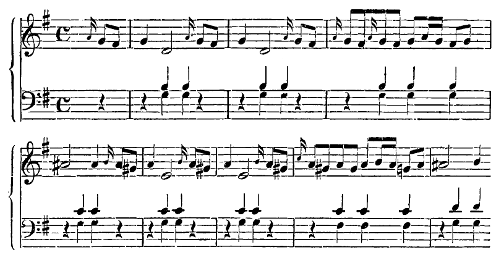
which the musicians in Florence boasted of to me as something quite new, and discovered by Rossini. In Milan, where I heard the same duet at a concert, it was probably found too hard, and the fifth and sixth measures were thus changed:
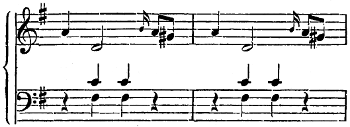
Or the following modulation, also, at the finale of the first act:
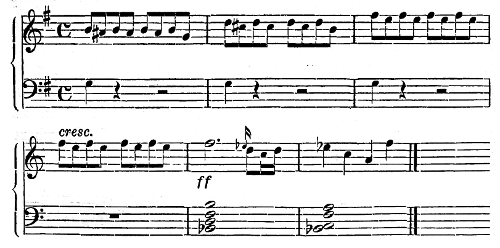
Purity of harmony is not to be found in him any more than in any other modern Italian composer; and I have heard many sequences of quints like the following:
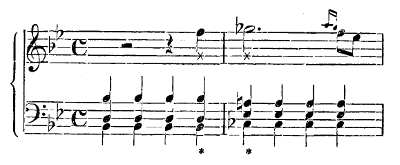
But in attention to the rhythm and in the complete use he makes of the orchestra, he distinguishes himself above his countrymen.
The instrumentation, however, as compared with ours, first introduced by Mozart, is still very meagre, and the Italians in that still cling too much to the old. The viols and bassoons almost always go through the whole opera col Basso, and the clarinets and hautboys in Unisono. As in most Italian operas with from six to eight contra-basses there is only one violincello, and usually not even a good one, they as yet know nothing here of the (since Mozart’s day) frequent use of the violincello for middle voices, which, skilfully brought in, has such a splendid effect; and they are far behind the Germans in the knowledge of how to get the best effect from the wind instruments. But what surprised me most, was to hear sometimes in these operas a very uneven cantabile, while a flowing and for the voice grateful and well arranged cantabile is the only praise-worthy quality of the modern Italian operatic music, and must compensate for all the deficiencies and faults. The two following passages struck me most; the first in an aria of the prima donna, the second, in the first finale, where it frequently recurs:

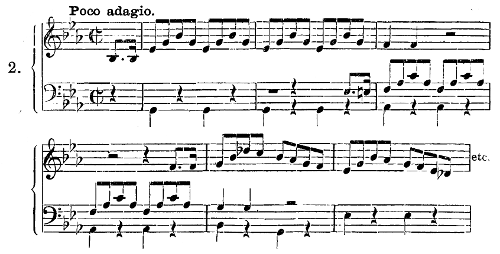
Both these passages are not only unsingable but exceedingly insipid, and the second especially, from the somewhat slow movement and its frequent recurrence, is wholly unbearable.
Among the singers in this opera, Madame
Georgi
, the prima donna, is the only remarkable one. She has a full, powerful voice of rare compass, from

to

Her part is written for a contralto, and she can therefore exhibit her high notes in the
fiorituri
only; if she possesses equal power in the low notes a deep soprano part would suit her much better. Like almost every singer we have yet heard in Italy she has the vice of ornamenting too much, and does not know how to derive all the advantage she might from her splendid voice. One hears very plainly, moreover, that she does not draw in the least upon her own spontaneous feeling and taste, but everything has been studied; so that her
fiorituri
, which are repeated every evening, note for note, become so wearisome that one cannot hear her again without repugnance. She was formerly a dillettante, and only now sings in the third theatre; but nevertheless she is already an excellent actress.
The ballet, which is given every evening between the two acts of the opera, is the most splendid of any I have ever yet seen. I think it is called “The Destruction of the Western Empire,” and is especially remarkable for the constant introduction of great masses of persons on the stage in full activity who form the boldest and most surprising groups. It has been studied with extraordinary correctness, and is performed every evening with the same precision. At the end a cavalry engagement was represented, which however always looks somewhat stiff and awkward.
November, 8.
Last evening our concert took place in the theatre della Pergola. The Grand-duke, to whom I brought a letter from his brother Rudolph, and who has received me several times very graciously at his residence, honoured it with his presence, accompanied by his whole family. The small though select auditory was very animated, and after having greeted the Grand-duke with the usual recognitions, were not restrained from a loud expression of applause of my performances. The music had a very good effect in the spacious and sonorous theatre; but the accompaniment was not of the best.—To-day I have received a great number of invitations to give a second concert next week, from which I am promised a better result. I shall make the venture, although the Grand-duke, who goes to-morrow to Pisa to meet his brother Rainer, will not be here. Yesterday’s concert, exclusive of the Archduke’s present to me, did not bring in more than the evening’s expenses, which were, as they always are, very considerable; the price of admission being only three paoli, and all disposition over the sale of a single box being again denied me. A very favorable notice of my concert appeared this afternoon in the newspaper.
November, 12.
As we have now been several times to the picture-gallery, and attentively observed all that it contains, I will commit to paper a few words, not upon the truly splendid works of art which it contains, for they have already been frequently and well described, but also the expression of the impression which they made upon me. I must first of all give due praise to the admirable custom, one by no means usual in Italy, of admitting the public to the gallery free. At the entrance one finds a notice in four or five languages, that the guardians of the gallery are forbidden under the penalty of the loss of their situation, to take the smallest present. Though perhaps they may not altogether adhere too strictly to this injunction, one is at least fully secured from the importunate begging, with which one is everywhere pursued in Italy, and in this place, made sacred by art, gives oneself peacefully up to the enjoyment.
To assist my memory hereafter I have sketched a plan of the gallery and marked the position where the works of art stand which made the greatest impression upon me. As I never make use either of a guide or a book to find the objects worthy of observation in a city (I am averse to all dictation as what I should admire, and never permit myself to be deprived of the pleasure of finding for myself the works of art in a gallery which are known to me by reputation), therefore it is very possible that I have erred in many instances. On the first day I looked for a long time and with attention at the works of art which are in the gallery proper, before the apartments were opened in which the most choice are situated. I am even now glad I did so, as afterwards, when I had seen the most perfect specimens of art, I could never again remain for any length of time with the works exhibited in the gallery. One exception to this was the group of the Laocoon, which I always contemplated with renewed admiration. When the sanctuary of art was thrown open we first beheld the celebrated Medicean Venus, whose perfect and surpassingly beautiful form is yet more thrown out by the large curtain of red-velvet suspended behind her. In the same rotunda with her are the greatest master-pieces ever produced by the chisel and by the brush: the Apollo del Belvedere[23] and Raphael’s St. John. To contemplate and admire in these three works of art the highest ideal of human beauty is an enjoyment quite peculiar in its kind. After reiterated contemplation and long hesitation I gave the palm for beauty to the St. John. Any thing more charming and at the same time more noble than the whole form of this Youth cannot be imagined by the most lively fancy. What may have contributed somewhat to this decision on my part is the circumstance that the Apollo as well as the Venus are of a three-quarter-life size, a proportion which seems to be not quite happily chosen, as the figures being so nearly the real size of life, always appear to be wanting in something, which, if they were smaller, would not be the case. The Apollo has nevertheless a rather too feminine beauty, which not I alone, but my wife also and several other persons present remarked. In this apartment are numerous other master-pieces, among which a head by Raphael, the Venus of Titian; and a group of gladiators in marble, excited most our admiration. Of the pictures arranged according to the schools in the side apartments, the head of a female, by Carlo Dolce, pleased me most; but one soon returns again to the gems of the whole collection. On the other side of the building, in two apartments, is the collection of Bronzes, among which the celebrated flying Mercury excites the most admiration. In another saloon is a collection of Niobes, among which are some beautiful works of art. Besides these we saw innumerable portraits of celebrated masters, for the most part painted by themselves.
November 13.
Behind the residence of the Grand-duke is a large garden called, I know not why, Boboli. It is open to all on Sundays and Fridays. Last Sunday we went there for the second time, and afterwards heard mass in the Court-chapel. The Grand-duke, who has a collection of between three and four-hundred masses of celebrated masters of every period, had given out upon this occasion one of Michael Haydn’s for performance; it was executed with tolerable precision, but it was found necessary to play a very simple solo for the tenor-trumpet upon the viol. The musicians asked me afterwards whether we had players on the trumpet in Germany who could execute such soli as that!
Upon our way back our hired lacquey pointed out to us the covered passage leading from the Grand-ducal residence to the water side, which passes through several streets at a considerable height, and after being carried across the river Arno over one of the bridges, and through a few more streets, abuts at the government buildings in which the gallery is also situated. This gallery, which is at least a quarter of an hour’s walk in length, is used by the Grand-duke when in wet weather he attends the sittings of the privy council.
November 15.
Our concert yesterday was not better attended than the first and therefore brought in nothing. I am now convinced that an instrumental-musician, even under the most favourable circumstances, can earn nothing in Florence; for in the first place the Italians esteem and like instrumental music too little, and in the second the price of admission is much too low in proportion to the considerable expenses. I must here observe, as somewhat worthy of note, that one part of the orchestra, namely, all the violinists, took no payment, which for people who must live from their daily earnings, and for Italians who, wherever possible, extort three times the price of every thing, is certainly very astonishing. For the rest, my play was received with still greater applause yesterday than the first time. Madame Georgi sang exceedingly well the admired cavatina (sung everywhere in Italy) in Rossini’s “Tancredi,” with the following theme:

It was again to be deplored, that upon the return to the theme she overwhelmed it with so much ornamentation that one could recognise nothing of the original song. Signor Sbigoli, first tenor at the Pergolo theatre, who had also given his assistance at the first concert, again sang two airs in a good style, and with much exertion, but with little voice. He, like the singers in Venice and Milan who sang at my concerts, required payment, but was satisfied with the very moderate sum of a carolin for each concert.
This afternoon we, for a last excursion, strolled out to the Porta Romana, to see the fresco-painting, so celebrated from the circumstance which gave rise to it, and which adorns a small mean-looking house there. The following is related concerning it: The Medici had sent to Rome for the most famed masters of that time, to paint, I believe, the chapel al fresco. The Florentine painters first became informed of this upon the day previous to the arrival of the strangers, and jealous of the preference which they had attained, they resolved at least to shew them, that they were quite as well able to execute the work, which they were sent for to perform. They combined their abilities therefore, and in one night, by the light of torches, painted this large fresco-picture, of which it is true but few traces now remain, but which sufficiently attest the excellence of the work. As the house on which this painting is executed, is so situated that it must attract the immediate attention of all persons entering at this gate, the foreign artists immediately observed the work, which had been completed but a few hours before, and as modesty was not then so rare among artists as it is in the present day, they immediately turned back, and sent word to the Medici, that they could not understand why they had been written for, since Florence produced artists who could execute so admirable a work of art in the space of a single night, as they had beheld. As a matter of course the work was then given to the Florentines for execution.
We have fixed our departure for to-morrow. Some things of note, such for example as the tomb of the Medici, which we have not yet been able to see, we must defer until our return journey.
Rome, November 22.
We arrived at length last night, after a long and tedious journey, in the former capital of the world. The journey was rendered tedious, first by the slowness of our vetturino, the driver of which had taken up, besides ourselves, who had hired the interior of his vehicle for twelve Louisd’or (inclusive of night lodgings and supper), three other travellers in the so-called cabriolet, and therefore could only drive at a walking pace, secondly, by reason of the raw weather and the cold, which for Italy was very great, and against which so little shelter is found at the inns where we stopped for the night, where the windows and doors are always open a good hand’s breadth, the floors of stone, and the generally very lofty rooms not to be warmed by a chimney fire; thirdly, from the uninteresting and barren country through which the road passes. One has the choice of two roads. The one longer, but more interesting, by way of Perugia, a journey of seven days; the other through Sienna of six days. We took the latter. As far as Sienna it is not without interest, and it is a clean and a pretty town, which has moreover the reputation that the purest Italian is spoken there. But from there the road runs through numerous barren stretches of country. Neither houses nor trees are to be seen, and now and then only the melancholy testimonials of Roman justice, that is, high posts from which are suspended the arms and legs of bandits and murderers. How in a country whose soil yields without manure two harvests, one of corn and the other of maize, men should be compelled by hunger to subsist by robberies, is to me incomprehensible: but so it is. So long as corn is in abundance, all the roads are safe, but when hunger pinches, the sternest severity is unavailing. During the rule of the French knives were forbidden to be carried on the person on pain of the galleys; if any one drew a knife upon an opponent he was treated as a murderer and hung without mercy. By such measures the public security was soon re-established and for a long time one heard of no more assassinations. Now, though certainly those regulations still exist, they are not rigorously carried out: the previous insecurity prevails anew, and it is not safe to venture alone into the more lonely streets of the city.
Before we could drive to an inn, we were obliged to proceed to the custom-house, where our trunks and other luggage were inspected in the closest manner. For my violon, although it is an old one and for my own use, I was obliged to pay a duty of seven Paoli.
December 5.
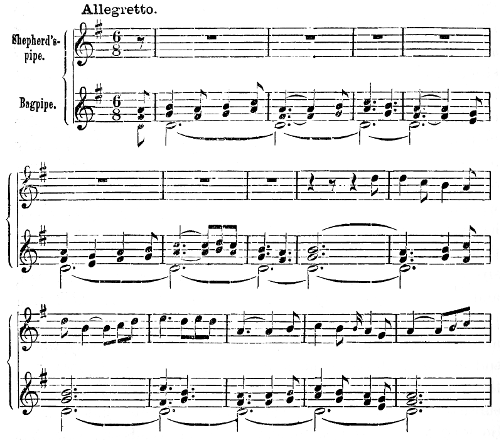
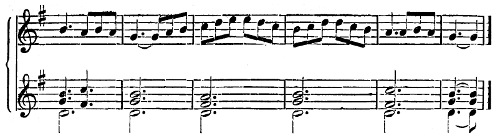
This is the first music we heard in Rome, and since then have heard it so frequently, that I have been enabled to write it down easily. During the time of Advent, when all public music is forbidden, the theatres closed, and a real deathlike stillness prevails, whole troops of virtuosi on the bagpipe come from the Neapolitan territory, who play first before the pictures of the Virgin and Saints, and then collect in the houses and in the streets a viaticum, or travelling penny. They generally go in pairs, one playing the bagpipe and the other the shepherds-pipe. The music of all, with a few unimportant deviations, is the same, and is said to have its origin in a very ancient sacred melody; but from the way in which these people now play it, it sounds profane enough. Heard at a certain distance it nevertheless does not sound badly; the one who plays the bagpipe produces an effect somewhat as though three clarinets were blown, he of the shepherds-pipe a sound like that of a coarse powerful hautboy. The purity of the notes of the bag-pipe and shepherds-pipe is very striking. Wherever one now goes, be the part of the city which it may, one hears the above music.
Last Sunday Prince Frederick of Gotha took me to the famous Sestine Chapel, where I for the first time saw the Pope, surrounded by all the Cardinals in their fullest ecclesiastical splendour, and heard his celebrated singers of the choir. Whether it is that I am differently organized from other travellers, or that my expectations are always too exalted from the perusal of books of travel, neither the music, the place, nor the ecclesiastical ceremony pleased me, or impressed me with awe. The singers of the choir were about thirty in number, who comported themselves in a somewhat off-hand and uncouth manner. The soprani, for the most part old men, frequently sang false, and altogether the intonation was anything but pure. They commenced with melodies for two voices of very ancient date, which were declaimed by the singers rather than sung. Then followed some things for four voices, written in a condensed style, and arranged for the voices to fall in like in a catch. The composition of these seemed to me very dignified, in the genuine old ecclesiastical style, and well calculated for the place. The execution was correct, it is true, but, as we have said, too coarse, and not better than most of our German choristers could have sung the same kind of thing. Three and four-voiced soli interchanged alternately with the choir; sometimes one heard also the crescendo effected by the gradual and successive entry of the voices, and the diminuendo produced by the inverse process, which in the celebrated Miserere on Good Fridays is said to have so charming an effect. It had also a good effect to-day, but this can be equally obtained from any well-practised choir. The place is indeed extremely favorable to simple slow church music, as it is very sonorous and the voices blend well with one another; but I know several churches in Germany—for instance the castle chapel at Würzburg and the catholic church at Dresden—where music sounds even better. I became also, convinced anew, that vocal and instrumental music combined have a much finer effect than vocal music alone, which, after all is always somewhat monotonous, and, on account of its restricted limits, becomes tedious. But in the papal chapel there is never any instrumental music, being contrary to ecclesiastical etiquette. Lastly, as far as regards the ceremonies, which, according to the accounts of travellers, are on Good Friday of so elevating a character, and increase immensely the effects of the music, this was by no means the case on Sunday; on the contrary, many things took place which could not but appear ridiculous to an unprejudiced spectator; for instance, the frequently repeated removal, as though at the word of command, of the little red caps of the cardinals, the clumsy awkwardness of several of their attendants when carrying after them their long violet-coloured trains, and on handing to them and again taking off their caps, etc. I also felt indignant when I saw that the priests who read the mass, and the preacher, before he ascended the pulpit, threw themselves upon their knees before the Pope and kissed his red slipper; and how every time previous thereto two assistants fell upon one knee, spread out his capacious mantel and lifted his sacerdotal frock to enable him to raise his foot for them to kiss. Neither did any of his assistants hand any thing to him, not even his pocket handkerchief, without previously kneeling before him. What is this but a degradation of humanity?
The celebrated “Last Judgement” of Michael Angelo, and all the other fresco-paintings which decorate the chapel, have greatly suffered and are much blackened with smoke. But one can still see sufficient of the former, which covers the whole wall behind the altar, to admire the grandeur of the composition and the masterly touch of the artist in the execution.
After the mass the sacrament was presented to the Pope and all the Cardinals in the Pauline Chapel, which, illuminated by innumerable tapers, presented when first seen an imposing spectacle. As we got there first, we heard the chaunt of the choristers who walked at the head of the procession, approach by degrees nearer and nearer, which produced a fine crescendo. A silent prayer, during which all present remained kneeling, here closed the ceremony.
In Rome there are two private musical réunions: one, a kind of singing academy, takes place every Thursday at the house of its institutor, Sirletti, a teacher of singing and of the piano-forte. From thirty to five-and-thirty singers, mostly dilettanti, meet here, some of whom have very fine voices, as, for example, Madame Vera (née Häser) and the tenor, Signor Moncade. Up till now we have been there twice. The first day, in compliment to us Germans, they gave Mozart’s Requiem, and that very powerfully and purely; all the soli and the quartet were especially well sung. Madame Vera with her splendid sonorous organ, her firm intonation, and her fine management of the voice, sang her part in an irreproachable manner. The grand and very difficult fugue was in particular sung purely and well. The only disturbing influence upon the execution, which otherwise would have afforded us great enjoyment, was signor Sirletti’s pianoforte accompaniment from the score. It is true we ought not to have expected better; for where should an Italian teacher of singing and pianoforte get a knowledge of harmony sufficient to read and play correctly a score of Mozart’s? But as his deep (!) knowledge of harmony had been greatly extolled to me previously, I had certainly expected something better. He struck some such barbarous harmonies at times, that, could Mozart have heard him, he would have turned round in his grave. After the Requiem they sang a piece of Händel’s hitherto unknown to me, and, for the finale, the Halleluja; the latter in particular was powerfully and purely sung.
On the previous Thursday they had sung some of Marcello’s Psalms, for two and three voices. These Psalms, which the Italians consider classic master-pieces, and of which some years since a fine edition was published with long commentaries on the particular beauties of each Psalm, pleased me very well, but I did not find anything so very particular in them; on the contrary, I am persuaded, although I am not very familiar with the German works in this style, that we have compositions of the kind by Bach and others which are greatly superior to them. They appear to me, particularly in the form, to have been carelessly constructed, they deviate frequently for a length of time from the chief key, and then close immediately after the return to the tonic in a very unsatisfactory manner. Those for three voices begin generally with soprano and tenor, and the bass first enters with the repeat; but this third voice was never essential, and always sounded like an orchestral fundamental bass; there were however some among them in which the voices took up their parts as in a canon, and these were very remarkable. Nevertheless, on the whole, the part-writing and modulation were very monotonous, and the same intrate and appoggiaturas recurred in all. Signor Sirletti’s accompaniment was again also very disturbing in these Psalms, and particularly unpleasant to me was an impurity of some of the full chords, which in these simple three-voiced things was still more out of place. With that, like all Italians whom I have yet heard accompany, he has the execrable fashion practice of doubling the bass notes with the right hand, which with some accords, for instance 6/5 accords, sounds quite unbearable with the leading tone. That moreover, by this method octaves must arise in the solution, does not appear to trouble the Signori, nor are their ears offended by it. To me it was also exceedingly displeasing that some Germans who were present seemed so much delighted. What is the meaning of these grimaces? The Italians really might be induced to believe that we have never heard any thing so good in Germany. When will Germans cease to be the blind admirers and the apes of foreigners!
The other private musical réunion takes place every Monday, at the home of Signor Ruffini, the proprietor of the great manufactory of strings for instruments. Here operas are executed also by dilettanti as concert music, before an auditory of from 200 to 250 persons. The singers stand upon a slightly raised platform, and the orchestra, consisting of four violins, viol, violincello, double bass, two clarinets, two horns, and a bassoon, is disposed round them in a semi-circle on the level floor. Last Monday, when Prince Frederick took us there, an old opera buffo of Paisiello was given. The selection was certainly not the best concert music. The music of a comic opera can alone be produced with the desired effect upon the stage, combined with the proper action which belongs to it; but apart from that, this one appeared to me somewhat insipid. The execution both on the part of the singers and the orchestra, was equally bad; Signor Moncade, with his splendid tenor voice, was the only one worthy of remark. Between the two acts a dilettante executed the first Allegro of a clarinet concerto with much ability and a tolerably good tone, but without the least taste. He was another illustration of a remark I have already made, that Italian virtuosi and dilettanti direct their whole attention to the acquirement of mechanical skill, but as far as regards a tasteful style of execution, they form themselves very little after the good models which their best singers might be to them; while our German instrumentalists generally possess a very cultivated style and much feeling, which, without taking pattern of any one, they must find in themselves.
December 7.
As Rome, like other Italian cities, offers us no great musical treats (and even less than usual, at the present moment, as all the theatres are closed), we must, like all other travellers, content ourselves with the creations of architecture, painting, and sculpture of the former flourishing period of Italian art. Of these certainly there is a wealth such as is not to be found in any other city in the world. Wherever one goes—in the streets, in the squares, palaces, churches, and gardens—one sees everywhere columns, obelisks, statues, bas-reliefs and paintings. We first strolled through all the streets, in order to familiarise ourselves with the remains of ancient Roman architecture. The venerable Pantheon, the Forum Romanum with its triumphal arches and columns, and particularly the Colosseum, filled us with wonder and admiration. We then ascended the Capitol, saw the Tarpeian rock and a thousand other places and objects made interesting by Roman history.
On the following day we visited the immortal Michael Angelo’s master-piece, the church of St. Peter. Several travellers whose expectations of this gigantic structure from their point of view had not been satisfied, had much depressed mine, and from that circumstance perhaps it made a powerful impression upon me. The open space before the church, with the semi-circular colonnades, the obelisk and the two stupendous fountains are of themselves of imposing grandeur. But on entering the interior of the church, one is seized with wonder and admiration at the magnificence of the decorations. Without being overloaded, it contains such wealth in mosaic pictures, statues, and bas-reliefs, that it would occupy weeks to examine all the separate works of art. As all these things are in the most harmonious relation and proportion to each other, and are as colossal as the whole structure itself, one is greatly deceived at first in regard to the size of the church. But upon contemplating more nearly the separate objects, one finds, for instance, that the little angels which hold the basins for holy-water, when seen closer, are taller than the tallest Prussian grenadier; and one finds the assertions of the architects who have taken all the dimensions of the building, more creditable, that, for instance, the cathedral of Strasburg could conveniently stand under the dome without the top of the tower reaching higher than into the lantern. But it is necessary to ascend into the interior of the lantern itself to convince oneself of the correctness of the other calculations, viz., that the pen of St. Peter is eight feet long, that four men abreast can conveniently walk round upon the cornice, etc. etc.
From the church we went to the museum of the Vatican. The riches it contains in treasures of art and antiquities, and the size and splendour of the place, surpass even the most exalted expectations. One first enters a long gallery on both sides of which the walls are encrusted with ancient Roman inscriptions and sepulchral stones, which had but little interest for us. We then came into a second gallery, in which are statues, busts, and fragments of sculpture innumerable. We then entered the famed Belvedere, where all round a circular open court, in the centre of which is a fountain, a number of niches, apartments, and saloons contain the most precious works of ancient and modern art. We first saw in one of the niches the celebrated Apollo of Belvedere, whose form is still considered the beau ideal of manly vigour and beauty. By a mistake for which I may be readily pardoned, since as I have said I never make use either of a guide or book, I had taken the somewhat feminine figure in the gallery at Florence for the universally admired Apollo of Belvedere. That statue, which is also of extreme artistic beauty, is, as I am now informed called the Apollino. In a second niche we saw the celebrated group of Laokoon and his sons; in a third, three master-pieces of Canova, a Perseus and two Roman gladiators. The Perseus is a wonderfully beautiful figure, but evidently imitated from the Apollo; for the head as well as the position of the body and of the mantle are strikingly similar. One of the gladiators is said to resemble more an English prize-fighter than a Roman gladiator; at least such is the opinion of the pupils and partisans of Thorwaldsen, who cannot forgive Canova his certainly very blamable vanity, that he should have placed his work, the only one of a modern in a museum of antiques. Nevertheless, if one judges without reference to persons, it must be admitted that in Perseus he has produced a splendid work of art, and that there are hundreds of antiquities in the museum which are not equal to it in artistic beauty.
In one apartment there is a great number of animals, single and in groups, in marble and other yet more costly and rare varieties of stone, of the most perfect execution. I could not give the preference to any one of them without disparaging the others. In other apartments are vases of immense size, of Egyptian granite and porphyry, cups, fountains and sarcophages with bas-reliefs, arabesques and other ornaments, as well as statues of all sizes. A two-wheeled Roman chariot, such as were used in chariot races, with two incomparably beautiful horses, greatly pleased us. The magnificence of the saloons, rotundi, apartments, and staircases exceeds anything we have ever seen. The floor consists almost wholly of ancient mosaics, and the ceilings are decorated with the most splendid fresco-paintings.
From the Belvedere two handsome staircases then lead one story higher up to a long gallery. One then enters an apartment in which the tapestries are hung which were worked after the drawings of Raphael. As is natural to suppose, not only the colours are said to be bad, as is usual with all tapestries, but the drawing is also defective, so that connoisseurs in art esteem them but little. In the composition and throughout the grouping, nevertheless, the spirit of Raphael is visible.
Now come the celebrated “Stanzi” of Raphael, which are considered by painters and connoisseurs in art as the most costly and beautiful, not only in Rome, but in the whole world. One of these apartments he finished entirely himself; in the others only some of the figures are of his execution; the rest were painted by his pupils and friends after his drawings and under his eye. The paintings are in much better preservation than those in the Sixtine chapel and, with the care which is now taken of them, they may for centuries to come attract the admiration of connoisseurs. It is nevertheless a sad reflection that some of the most precious things produced by the genius and pencil of Raphael are here adherent to the walls, and must perish with them. It is therefore fortunate that these paintings have been and are so frequently copied and engraved, that something of them will yet remain when the originals shall be no more. But this must not be permitted to be done in the way resorted to by the young Parisian academicians, who stick their tracing paper upon the paintings with wax or even fasten it on with nails, in order to copy the contours, by which proceeding a quantity of the lime cement has already crumbled away from one of the walls. An iron rail is now put up round the apartments, so that one can no longer approach close to the walls. The passages from these apartments lead to the “Logge” of Raphael, by which is understood the arched galleries outside the buildings. Those decorated by that master himself are now enclosed by glazed windows to shield them from the destructive effects of the weather, the rest are open. In these “logge” there are but four small paintings from his own hand; all the rest are painted by others after his drawings. In a niche at the end of the gallery stands a bust of Raphael, which is said, however, to be but an indifferent likeness of him.
December 9.
On a second visit which we made yesterday to the museum, we saw the room containing the celebrated oil paintings of Raphael. The finest of them is without a doubt the Transfiguration, respecting which so much has been written, and disputed. Connoisseurs of art are not agreed as to whether the composition is correct or defective. Some maintain that it consists of two separate groups which do not harmonise with each other in the least; others, on the contrary, say that every part is in the most perfect and beautiful accord. Without troubling ourself with the contentions of the æsthetics, which was renewed by two persons in our presence, we gave ourselves up to the enjoyment of its contemplation. It is extremely interesting to see here three paintings of Raphael of different periods of his life in close proximity to each other. The eldest, or that of his youthful days, hangs by the side of one by his master Perugino, and is painted wholly in his style, with the same hardness of outline and the same formal, almost symmetrical grouping. The one of the middle period (a Madonna with the child, and some others figures, resembling very much the painting at Dresden in the grouping) evinces his own genius enfranchised from the form of his teacher. In the third, the “Transfiguration,” his last important work, we see the fully developed artist.
December 12.
As we live in a couple of rooms which cannot be heated, we have suffered somewhat from cold the last eight days, on account of the Tramontana, or north wind, which has not ceased to blow all that time; but although we have had hoar-frost a few times in Rome, we have had no ice yet, neither has it snowed. When we rose this morning, we found that the outside of our window was dim with moisture, and on opening it a warm moist air blew in; while the weathercocks informed us that the Sirocco (south wind) was blowing. It now soon became overcast, and this afternoon it is raining. Generally, however, the Tramontana brings bright settled weather. As Rome is very damp and dirty, one soon longs for the return of that wind, and is better content with a little cold than with the unwholesome moisture. In the spring of the year especially, when it begins to grow warm, this moisture is said to be quite unbearable, and to engender dangerous fevers, particularly on the other side of the Tiber, in the neighbourhood of the Vatican, where many a stranger, who has taken up his residence there on account of the cheaper rate of the lodging, has found a grave. In the summer months especially Rome must be very unhealthy, the air being charged with the exhalations from the dead bodies, which, according to ancient custom, are here all deposited in the vaults of the churches. Every time one of these vaults is opened, which takes place almost every day, a stench rushes out which penetrates into the interior of the very palaces of the living. At the time of the domination of the French the dead were buried outside the city, but no sooner was the papal rule restored, than that wholesome regulation was discontinued. No corpse is permitted to remain unburied longer than twenty-four hours, and accordingly the body of any one deceased is laid upon a bier, some eight or ten hours only after the breath is out of it, and carried with uncovered head, breast, and feet, in broad daylight, through the street to the church, and set down before the altar, when if the estate is sufficient to pay the expenses, a mass for the dead is read, and the body is thrown uncoffined through one of the openings of the vaults. That many only apparently dead are in this manner buried with the rest, may be readily imagined; and a few years ago such a case actually occured. A poor man, who a few hours after his apparent death had been thrown into the vault, was aroused by the fall and passed two fearful days among the half-decomposed bodies, when fortunately the chief entrance to the vault was opened in order to clear it out, and the poor fellow was rescued and is still living.
In no city in the world, I think, is the contrast so striking between the most luxurious splendour and the most abject misery as here. On the marble steps of the palaces, among the statues for which thousands have been paid, near the altars of the churches which are laden with golden ornaments and utensils—everywhere, in fact, one sees half-starved mendicants lying, who moan for bread, and gnaw the stumps of cabbages or the peel of lemons, which they have picked out of the gutter. At first I thought this a trick merely to excite the compassion of strangers; but I became convinced afterwards that many of the poor must for days subsist on such horrid food, or perish with hunger. The Romans are accustomed to see this misery from their youth, and seldom give alms (except they drop it into the begging-box of some well-fed monk collecting for his monastery), and strangers soon become hardened to pity, when they find that as soon as they have given something to one beggar, they are immediately surrounded by twenty others. It is true there are many among them who beg from sheer idleness, but there are many also who are quite unable to work for a livelihood. In this respect also I admire my native country, where every pauper has at least potatoes and bread, and a case of one dying of starvation in the midst of his richer fellowmen is wholly unheard of.
December 19.
Last evening our concert took place. As I had been refused permission to give a public concert in the theatre during Advent, I was obliged to make arrangements to give it at a private house, without any public announcement. Prince
Piombino
granted me an apartment for the purpose in the
Ruspoli
palace, and Count
Apponyi
, the Austrian ambassador, procured for me a considerable number of subscribers; so that this was the first concert in Italy that brought me a somewhat considerable profit. The price of admission was one Piaster (nearly a Laubthaler). The orchestra, composed of the best musicians of Rome, was nevertheless the worst of all that had yet accompanied me in Italy. The ignorance, want of taste, and stupid arrogance of these people beggars all description. Of
nuances
in
piano
and
forte
they know absolutely nothing. One might let that pass, but each individual makes just what ornamentation comes into his head and double strokes with almost every tone, so that the
ensemble
resembles more the noise of an orchestra tuning up than harmonious music. I certainly forbade several times every note which did not stand in the score; but ornamentation has become so much a second nature to them, that they cannot desist from it. The first hornist, for instance, blew once in the
Tutti
, instead of the simple cadence,
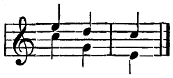
the following
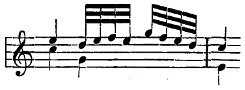
The Clarinets blew perhaps at the same time
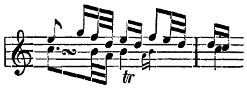
instead of
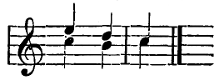
and now if one imagines the figured passages for the violins, which the composer has prescribed, some conception may be formed of the bewildering noise which such an orchestra gives you for music. With that, the musicians have so little musical taste, and are so unskilled in note-reading, that we nearly broke down twice. Here also, my concerto in the form of a vocal-scene pleased most, and I gained far more applause for the way in which I played the song parts, than for the mastery of very great difficulties. A tenor belonging to the papal orchestra, the permission for whose co-operation I had obtained with great difficulty, sang a duet with Mademoiselle
Funk
of Dresden, and a very beautiful air of
Rossini
, the best of that composer which I had yet heard.
December 20.
Last evening I was present at a small private musical performance at the house of Count Apponyi. There was much good vocal music with piano accompaniment. The best were a duet from a “Passione” by Paisiello, most charmingly sung by Madame Häser and the Countess Apponyi; an aria by Zingarelli with chorus, written for Madame Häser and executed by her in the most finished manner; a duett of Rossini’s, sung by Countess and Signor Moncade. Madame Häser sang with a feeling and a purity such as I never heard her display before. Her magnificent sonorous voice, which in a room with much reverberation sounds almost too sharp, particularly in the higher tones, had a fine effect yesterday in an apartment where the tapestry and carpeting deadened the sound. She has at command every nuance of tone, from the most tender breathings to the greatest fullness of power, and she knows how to avail herself of it in a masterly manner. She has lost, it is true, the brilliant fluency of voice which was formerly so much admired in Dresden, but she retains still enough of it to enable her to give every vocal ornamentation with ease and elegance. The only thing I miss in her singing is the shake, which in the present day is so much neglected. Moncade is a singer with a fine chest voice, and a tasteful though not a very feeling execution. Besides them, Prince Frederick of Gotha sang an air, and a bass singer a couple of Buffi.
I have again been twice to Sirletti’s music parties. A week ago some parts of the Requiem were repeated and the Halleluja; but the rest of the evening was wholly devoted to Marcello’s Psalms. With regard to the latter, I find my former opinion still more confirmed. In the fine edition of these Psalms, there is also a biography of Marcello, in which the reason is given for his relinquishing theatrical compositions, to which alone he had previously devoted himself, and taking all at once to sacred music. On visiting a church in a retired part of Venice, he had the misfortune to fall through a badly covered opening into one of the subterranean dead-vaults, and remained there a long time before his cries for assistance were heard. This accident induced so serious a tone of mind, that ever after he would write nothing but sacred music.
I have again been to Ruffini’s music parties also, and heard a tragic opera by a young and early deceased composer, who had much native talent but evinced also a complete deficiency of study. The singer showed to more advantage in this opera than in the one they gave previously; but the orchestra was just as unbearable. I sat next to the formerly so celebrated singer Crescentini (but, who is said to have now wholly lost his voice, although he is scarcely fifty years of age), and I had the satisfaction to find that his opinion upon the present state of music in Italy agreed in every respect with mine. His conversation evinced the highly cultivated artiste, free from the trammels of prejudice. He deplored that at the present day the good school of vocal music, the only one in which Italians had distinguished themselves, had become more and more rare every day, and upon his last return to Italy (I think he had been in Paris) he had found so frivolous and bad a taste, that it no longer bore the least trace of the former simple yet noble style of his time. To him, also, who had heard much good music in Germany and France, the insipidity and incorrectness of modern Italian music are abominations.
December 23.
Now that the festival of Christmas is approaching, begging, with which one is plagued here at all times, will be carried on on a large scale. Wherever you go, you are greeted with the cry of “Pleasant holidays!” and you are then expected to pull out your purse. This system of begging occurs, it is true, in Germany at New Year, but is by no means so general as here. For instance, the servants of all the nobility and gentry at whose houses have shewn yourself, if but once, come to beg of you; and indeed at other times as well, foreigners are laid under contribution by them. If you have paid the master a visit, the servant comes the next day and asks you for a present. As one cannot give less than three Paoli, it becomes a dear amusement to deliver many letters of introduction here. The poor devils are certainly very badly paid, and must resort to such a system of begging if they would not starve.
Yesterday Meyerbeer and his mother arrived here. He received a letter in Florence from Carl M. von Weber, and read to me from it the gratifying intelligence that my Opera “Faust” had already been twice performed at Prague with marked approbation.
December 25.
Last evening we were present at a service in the Sixtine chapel preparatory to the approaching high festival. I had anticipated something very effective but I found myself very much mistaken. The illumination was by no means effective, for the chapel was soon so filled with the smoke of the tapers that you could not see distinctly ten paces before you. Instead of the four-voice Psalmody which I had hoped for, the singers of the choir recited merely a rather long Litany of prayers in unison, without any melody, something as the following:

To listen to this for almost half an hour without interruption was the greatest musical penitence that I ever endured. At length, in the midst of a silent prayer, we were refreshed by a four-voiced solo, in which the splendid soprano-voice before alluded to was again remarkable. But immediately after this, the monotonous chaunt was again resumed, and now we thought it preferable to work our way through the compact crowd at the expense of great exertion rather than to endure it any longer.
This morning early we at length saw the head of the catholic church in the highest ecclesiastical pomp perform mass in the church of St. Peter. The high altar under the dome, divested of its habitual covering, was radiant with gold and precious stones; the clergy and cardinals, habited in their richest gold-embroidered stuffs, the body-guard in their splendid uniform, the Swiss guard in their bright polished old German armour, in a word all converted with the pope contributed to render this service the most splendid spectacle ever performed in a church. For more than a theatrical spectacle it was not to the surrounding crowd: not a sign of emotion or spiritual elevation was to be seen among the many thousand spectators! The appearance of a spectacle got up for amusement was more especially given to it by the circumstance that for the accommodation of the high personages who were present—the king of Spain, the queen of Etruria, the princes of Prussia, Gotha and others—a sumptuously decorated box had been erected, and, that upon the amphitheatre the fashionable world of Rome was present in full dress. A singular contrast with this splendour was presented by the rags and dirt of the riff-raff of the Roman populace who had pressed to the very step of the high altar. As the “service” became tediously long, and what the singers sang was neither very interesting, nor could be heard distinctly for the noise in the church, we preferred to take a walk, as the weather was so mild and bright, but returned in sufficient time to the church to see the procession, which forms the close to the whole performance.
In front moved a detachment of the body-guard, behind these the Cardinal’s hat was carried upon a sword; then came the Cardinals, and lastly the Pope seated upon a richly decorated sedan or throne borne by eight priests; on either side of him two large fans of white ostrich feathers; then all the clergy, and lastly the remainder of the body-guard and Swiss guards. During the procession, the Pope, a venerable old man of 75, on whose pale and interesting face the exhausting influence of frequent fast and of the long fatiguing service were very distinctly visible, bestowed with a feeble motion of the hand his blessing upon the people. But the latter shewed during this no sign of devotion; not a knee was bent; there was laughing and loud talking during the whole service. The procession passed out through a side chapel into the Vatican. The immense size of the church could be first rightly seen to-day, from the mass of human beings which it held. It was full half an hour before they could make their exit through three large doors.
December 27.
Yesterday, at last the theatres were once more opened, after being closed six months. At the Argentino theatre, the largest and handsomest, Rossini’s “Tancredi” was performed, at the theatre Valle, a new Opera buffa by Signor Pietro Romano, called “Il Quiproquo.” As “Tancredi” is an old opera, the first night of which is not more interesting than the succeeding ones, Meyerbeer easily persuaded me to go with him to the Valle theatre, while my wife and the children, with Madame Beer, went to the Argentino theatre. Before the opera a farce in prose was given, imitated from our German “Proberollen.” Then came the first act of the opera, the text of which we soon recognised as an adaptation of the “Nouveau Seigneur de Village.” The subject, though spun out somewhat too much, was neither so stupid nor so wearisome as those of most Italian operas. But so much the more insipid and common-place is the music. Signor Romano has taken the now so much admired Rossini as his model, and so closely imitated him, or rather copied him outright, that the pit called out every moment “Bravo Rossini!” With that his music is so incorrect, that an ear accustomed to a pure harmony cannot hear it without disgust. Nevertheless that was no injury to it here, but much more so its want of fire and noise, the last of which the Italians are as fond of as the French and Germans. Once only, after a duet, the pit called out the encouraging and joyful “Bravo Maestro!” for which he immediately made a most profound bow. All the rest was listened to with coldness, and at the conclusion of the opera neither approval nor displeasure was expressed. The singers were by no means sure of their parts, and were continually making mistakes. Madame Georgi, the prima donna, who in the previous carnival had been the favorite of the public, did not please much yesterday, and had the annoyance of seeing the seconda donna, who certainly did not sing badly, called forward after her aria in the second act, an honour which had not fallen to her lot all the evening. She shewed her displeasure at this by singing the rest of her part with the utmost indifference and with half-voice only, by which however she injured the last finale very much, and was perhaps the cause of the opera’s going off so coldly, and of the report which prevails in the town to-day, that she had not given satisfaction. The orchestra, composed for the most part of the professors (!) who had played at my concert, played crudely, incorrectly and without any sort of difference between piano and forte.
This morning there was another private music party at Count Apponyi’s. Nothing else scarcely was sung but things from Rossini’s operas, of which a terzette, from “Elisabetha,” if I am not mistaken, pleased me most, on account of the excellent treatment of the voices. The more I hear of Rossini’s compositions, the more I am disposed to join in part with the general opinion, which pronounces him the most distinguished of modern Italian composers, and as a reformer of the taste in operatic style. Mayer may nevertheless with propriety be excepted, who has, if not so much imagination as Rossini, yet, certainly, more knowledge and æsthetic feeling. That the latter is wanting in knowledge of harmony, delineation of character, sense of the difference between the serious and comic style, and of propriety, I observed already in Florence, after hearing the “Italiana in Algeria.” Rossini, however, has devised some quite new things, although they are not necessarily good because they are new: for instance his “flowery song,” as Meyerbeer very characteristically calls it, which in reality is nothing more than that the passages hitherto sung on one vowel are sung with a series of syllables, as in an aria in the “Italiana”:
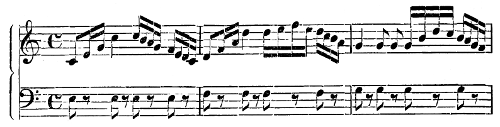
or in a duet between a tenor and a bass in the same opera, where the part for the second voice is very unsingable and more like an orchestral bass than a singing bass:[24]
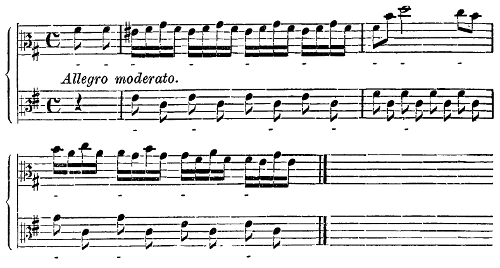
Every time such little tricky passages occur, and are well executed by the singers, as to-day by Moncade especially, the auditory breaks out into an ecstasy of applause which causes Italian music to degenerate more and more into a mere tickling of the ears and both singers and composer; become every day less capable in use of working upon the feelings; so that I may say without exaggeration, that of all the compositions we have yet heard in Italy, I have not experienced the least emotion, with the exception of one or two passages in the “Testa di bronzo”; and of all the singers we have yet heard, Madame Häser alone, in a duet from the old “Passione” of Paisiello moved me for a few seconds.
Likewise new, and first introduced by Rossini, is the way in which the speaking passages in the Opera buffa, hitherto usually written in one tone, or at least at very close intervals only, and formerly always given legato, are provided with syllables, as for instance in the beginning of the above duet:
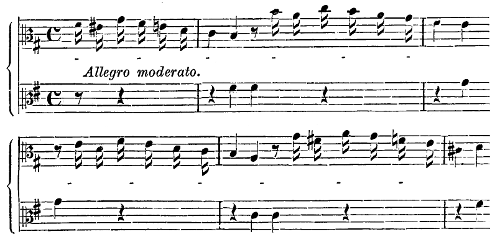
Well known as this commencement is (it resembles the beginning of a finale in a quartett of Haydn in E flat-major):

yet his method of giving it with the different syllables of the text in this manner is quite new; but whether good or not, is still the question; to me it always sounded as though travestied, as if, for instance, a song which admits of a feeling execution were executed upon a singing instrument and for fun’s sake so caricatured that it excited laughter instead of emotion. At any rate no instrumentalist of taste would play the above song staccato.