Chronological Index of Contents. (continued 10)
Reading edition
The following day my letter arrived also from London, and increased yet more by its good intelligence the joy of my family.
At the house of Mr. Ries I had made the acquaintance of Mr. Erard, the head of the London firm Erard Brothers, and accompanied by my wife had already visited his show rooms of finished harps. We could not however immediately make up our minds in the choice of one, as Dorette wished first to try which size would suit her best, and in particular whether she could be able to accustom herself to the new mechanism. Mr. Erard removed all hesitation from her mind in that respect, by kindly offering to lend her a harp for trial and choice, during our stay in London, which if it did not suit her, she could change for another or wholly return. This offer she thankfully accepted, and began immediately to practise on the new instrument; but at first she could not well succeed upon it. The new harp, though of the smallest pattern, was nevertheless considerably larger, as well as much more strongly strung, than her own, and therefore required a greater exertion of strength, and it was very difficult for her to acquire a mastery of the new mechanism à double movement, from being accustomed from her childhood to the single movement. She therefore soon felt convinced that it would require several months’ practice on this harp before she could play upon it in public, and I accordingly resolved to allow her to appear once only, at my benefit-concert, in order that she might give an additional attraction to it. Meanwhile my turn had come to direct one of the Philharmonic concerts, and I had created no less sensation than with my solo play. It was at that time still the custom there that when symphonies and overtures were performed, the pianist had the score before him, not exactly to conduct from it, but only to read after and to play in with the orchestra at pleasure, which when it was heard, had a very bad effect. The real conductor was the first violin, who gave the tempi, and now and then when the orchestra began to falter gave the beat with the bow of his violin. So numerous an orchestra, standing so far apart from each other as that of the Philharmonic, could not possibly go exactly together, and in spite of the excellence of the individual members, the ensemble was much worse than we are accustomed to in Germany. I had therefore resolved when my turn came to direct, to make an attempt to remedy this defective system. Fortunately at the morning rehearsal on the day when I was to conduct the concert, Mr. Ries took the place at the Piano, and he readily assented to give up the score to me and to remain wholly excluded from all participation in the performance. I then took my stand with the score at a separate music desk in front of the orchestra, drew my directing baton from my coat pocket and gave the signal to begin. Quite alarmed at such a novel procedure, some of the directors would have protested against it; but when I besought them to grant me at least one trial, they became pacified. The symphonies and overtures that were to be rehearsed were well known to me, and in Germany I had already directed at their performance. I therefore could not only give the tempi in a very decisive manner, but indicated also to the wind instruments and horns all their entries, which ensured to them a confidence such as hitherto they had not known there. I also took the liberty, when the execution did not satisfy me, to stop, and in a very polite but earnest manner to remark upon the manner of execution, which remarks Mr. Ries at my request interpreted to the orchestra. Incited thereby to more than usual attention, and conducted with certainty by the visible manner of giving the time, they played with a spirit and a correctness such as till then they had never been heard to play with. Surprised and inspired by this result the orchestra immediately after the first part of the symphony, expressed aloud its collective assent to the new mode of conducting, and thereby overruled all further opposition on the part of the directors. In the vocal pieces also, the conducting of which I assumed at the request of Mr. Ries, particularly in the recitative, the leading with the baton, after I had explained the meaning of my movements, was completely successful, and the singers repeatedly expressed to me their satisfaction for the precision with which the orchestra now followed them.
The result in the evening was still more brillant than I could have hoped for. It is true, the audience were at first startled by the novelty, and were seen whispering together; but when the music began and the orchestra executed the well-known symphony with unusual power and precision, the general approbation was shewn immediately on the conclusion of the first part by a long-sustained clapping of hands. The triumph of the baton as a time-giver was decisive, and no one was seen any more seated at the piano during the performance of symphonies and overtures. On this evening also the concert overture which I had composed before I left Frankfort was given for the first time. As it pleased very much the Philharmonic society accepted it as the composition which according to my contract I was to leave in their hands. I kept no copy of it and soon forgot it entirely, so that a few years afterwards when preparing a thematic catalogue of my compositions I could not recal to mind the beginning of it, for which reason the theme of it is wholly wanting in the text.
During the delivery of my letters of introduction in London, as also upon many other occasions, I had so much felt the want of some one to serve me as interpreter that I was continually making inquiries for a person to accompany me who could speak German and English. At length Mr. Ries bethought him of an old servant of the deceased Salomon[25] of the name of Johanning, who would be competent to fill that office. It is true, that he had retired from service, and as heir to his late master had bought a small country-house in the neighbourhood of London. Mr. Ries hoped nevertheless that the yet vigorous old man would consent to take the situation, for which purpose he sent for him to town, and the offer on my part was made to him. When he learned that it was to enter the service of a German and a musician, and furthermore of a violinist, as his deceased master had been, he immediately expressed his readiness, and even left it to my option what remuneration I should give him at the close of the season. Thenceforth he came every morning into town, and having first interpreted the wishes of my wife to the landlady respecting the dinner, he then accompanied me on my rounds of business. From his long residence in London, however, he had forgotten a great deal of his German, and his English doubtless was not very classic; for in his interpreting frequent misunderstandings would take place. When I had thus presented the remainder of my letters of introduction with less difficulty than before, I again found time and leisure for new compositions. I first wrote a symphony (the second D flat, Op. 49) and played it for the first time at one of the Philharmonic concerts, which I had to conduct, April 10. 1820. At its rehearsal, it met with very great approbation both from the orchestra and the numerous persons who were present; but in the evening it was received with real enthusiasm. I had in part to thank the numerous and particularly excellent stringed instruments of the orchestra for this brillant success, and in this composition I had given them a special opportunity of exhibiting their skill in playing with purity and precision of ensemble. In fact, as regards the stringed instruments, I have never since heard that symphony given with so much effect as on that evening. The next morning all the London newspapers contained reports respecting the new symphony that had been composed in their town, and vied with each other in their praise of it. Similar favourable notices of my play upon every occasion of my appearance soon spread my fame throughout the town, and pupils readily presented themselves to receive instruction from me on the violin, as well as ladies who were desirous of being accompanied on the piano. As all expressed their willingness to pay a guinea for each hour’s instruction, I readily accepted their offers, as I considered that I owed it to my family to turn the good fortune I had met with in London as a musician to my pecuniary advantage. In this manner, after having first devoted a few hours to composition at home or to music with my wife, I was running or driving about all day in huge London, and frequently right weary of it; for the greater part of my pupils had neither talent nor application, and took lessons of me merely to be enabled to say that they were pupils of Spohr. I nevertheless call to mind with some pleasure several originals who amused me with their singularities, and therewith somewhat relieved the bitter trouble I had with them. One was an old general on half-pay, but who always made his appearance in full uniform, decorated with all his orders, and with the extreme of high military bearing. He, as an exception, came always to my house, but, nevertheless, required to play for three quarters of an hour only, as according to the custom there deduction was made of the quarter of an hour for the drive. He came every morning, Sundays excepted, in his old state carriage, precisely at 12 o’clock, ordered one of his belaced and powdered footmen to bring up his violin-case, and after a dumb greeting sat himself down immediately to his music desk. But previous to that he took out his watch to see at what o’clock the lesson would commence, and then set it down close to him. He would bring easy duets with him, chiefly of Pleyel, in which I played second violin. Although there were many things in his play that indicated the unpractised pupil, I soon saw that it would not be wise to point them out to him; I contented myself therefore with accommodating my tones as much as possible to those of the old gentleman, and so we played one duet after the other in the best concord. As soon, however, as we had played the three quarters of an hour, the general would stop, though in the middle of the piece, take from his waistcoat pocket a one-pound note in which a shilling was wrapped up, and put it upon the table. He would then take up his watch, and take leave in the same taciturn manner as he had entered.
The other original was an old lady whom I accompanied on the piano. She was a passionate admirer of Beethoven, against which I had nothing to say, but she had the whim, moreover, never to play any other music than that of her favorite. She had all Beethoven’s pianoforte-compositions, as also his orchestral works arranged for the piano. Her apartment was also hung with every portrait of him that she had been able to procure. As many of these differed greatly in resemblance to each other, she urged me to inform her which most resembled him of the whole. She possessed also some relics of him which had been brought to her from Vienna by English travellers, among others a button of his dressing-gown and a piece of music paper with some note marks and ink-blots from his hand. When I apprized her that I had lived for some time on terms of great intimacy with him, I rose greatly in her estimation, and she had then so much to ask that on some days we never played at all. She spoke French with tolerably fluency, and could even bring out a few words of German. Her pianoforte play was not at all bad, so that I was rather pleased to play the sonatas for piano and violin. But when she subsequently produced the trios also, and played with me without violoncello, and then even the piano concertos, in which, with the exception of first orchestral-violin, which I played, all else was wanting, it became very clear to me that her enthusiasm for Beethoven was nothing but affectation, and that she had not the least perception of the excellence of his compositions.
I became acquainted with a third singular character in the following manner. One morning a servant in livery brought a letter to me, which my old Johanning translated in the following manner: “Mr. Spohr is requested to call at the house of the undersigned, at 4 o’clock precisely.” As I did not know the name appended to the note, nor could ascertain from the servant the purpose for which my attendance was requested, I replied thereto in an equally laconic manner: “At the hour indicated I am engaged and cannot come.” The next morning the servant reappeared with a second much more polite note: “Mr. Spohr is requested to honour the undersigned with a visit, and to appoint the time himself.” At the same time the servant had been ordered to offer his master’s carriage, and as I had been meanwhile informed that the writer was a celebrated physician, who frequently attended concerts, and interested himself especially in violin music, I no longer hesitated to go, but indicated the appointed hour to the servant and was duly fetched in the doctor’s carriage. An amiable old gentlemen with snow white hair received me at the foot of the stairs, but we now discovered to our mutual regret that we could not make ourselves intelligible to each other, for he spoke neither German nor French. We stood opposite to each other in great embarassment, until he took me by the arm and led me into a spacious room on the walls of which a number of violins were hung. Others had been taken from their cases and placed upon tables. The doctor handed a bow to me and pointed to the instruments. I now comprehended that I was to give my opinion of the respective merits of the violins, and immediately began to try them and to arrange them in order according to their worth. This was no easy work to do; for there were a great number of them, and the old gentleman brought them all in succession, without omitting one. When at length, after the lapse of about an hour, I had found the best six of them, and still played on these alternately to discover the very best of them, I observed that the doctor eyed one of them with looks of particular fondness, and his face lit up with pleasure every time I struck the strings. I therefore readily gave the kind old gentleman the satisfaction of indicating that instrument as the matador of the whole collection. Quite delighted with this announcement, he now brought a viola d’amour, and began to play a fantasia on this long-unused instrument. I listened to him with pleasure, as I had not heard the instrument before and the doctor played by no means ill. Thus terminated the interview to the satisfaction of both, and I had taken up my hat, to take my leave of him when the old gentleman, with a kindly expression of countenance and several low bows, handed to me a five-pound note. Astonished at this, I looked at the note and the donor, and at first knew not what he meant; when it struck me that he intended it as a remuneration for my testing his violins, and shaking my head with a smile, I laid the note on the table, pressed the doctor’s hand with warmth, and hastened down stairs. He followed me out into the street, assisted me into the carriage and then spoke some words with evident emotion to his coachman. This had made so much impression on the coachman, that he immediately told it to old Johanning, who had come with the carriage, to open the door. He had said to him: “You are driving there a German who is a perfect gentleman; and I expect you will take him home to his house with the greatest care.”—A few months afterwards, when I gave my benefit concert, the doctor sent for a ticket and forwarded to me at the same time a ten-pound note.
Meanwhile my wife had by unflagging industry acquired great proficiency on the new harp, but in doing so—on account of the greater stretch of arm it required and the stronger tension of the strings—she had exerted herself over much and now suffered greatly from the exhaustion it had induced. From former experience I had learned that nothing so quickly imparted fresh strength to her nerves as the frequent enjoyment of fresh air. I therefore availed myself of every moment of sunshine in the first days of spring to take gentle walks into Regent’s Park, which was very near to our dwelling in Charlotte Street. On Sundays, when all music ceases in London, and when even without fear of giving offence we could not play in our own apartments, we used to make more distant excursions to Hampstead, and to the other parks. Our companion and guide was alternately the younger Ries and an old amiable man of the name of Stumpf, an instrument maker. I soon had the gratification of seeing my wife regain fresh strength and spirits from the mild influence of the English spring, but I adhered strictly to my previous resolution that she should appear once only at my own concert, and declined with firmness several offers that were made to her. But as for myself, I played at all concerts where they were willing to pay the price I asked, and as this according to English notions was not excessively high, I was in frequent requisition, and saw my name announced on almost all the concert-programmes of the season. But I never could make up my mind to play for remuneration at private parties, for the manner in which musicians were then treated there, was to me most unbecoming and degrading. They were not admitted to join the company, but were shewn into an adjoining room, where they had to wait until the moment arrived when they were summoned to the apartments where the company was assembled before whom they were to play; their performance over, they had to leave the room again immediately. My wife and I were ourselves once eyewitnesses of this contemptuous treatment of the first and most eminent artists in London. We had received letters of introduction to the king’s brothers the Dukes of Sussex and Clarence, and as the latter was married to a German, a Princess of Meiningen, I paid them a visit accompanied by my wife. The Ducal couple received us in a very kind manner and invited us to a musical party they were to give in a few days and at which we were also asked to assist. I then thought in what way I could best extricate myself from this disgusting exclusion from the company, and resolved if I could not succeed to return home immediately. When therefore we entered the palace, and a lacquey was on the point of opening the door of the room where the other musicians were assembled, I told Johanning to deliver my violin case to him, and with my wife on my arm, immediately ascended the staircase before the lacquey had time to recover from his astonishment. Arrived at the door of the apartments where the company were assembled, I announced my name to the footman in waiting, and as he hesitated to open the door I evinced an intention of opening it myself. Upon this the lacquey instantly threw open the door and called out the names of the new-comers. The Duchess, alive to German usages, rose immediately from her seat, advanced a few steps to meet my wife, and led her into the circle of ladies. The Duke welcomed me also with a few friendly words and introduced me to the gentlemen around him. I now thought I had successfully achieved all; but I soon observed that the servants notwithstanding not did consider me as properly belonging to the company, for they always passed me by with the tea-tray and other refreshments, without offering me any. At length the Duke may also have remarked this; for I saw him whisper a few words in the ear of the steward of the household. After this the refreshments were also presented to me. When the concert was to commence the steward of the household sent a servant to summon the invited artists in the order in which their names appeared on the programme. They hereupon entered the apartment with their sheet of music or instrument in hand, saluted the company with a profound bow, and began their performances. They were the élite of the most distinguished singers and musicians in London, and the execution of their respective pieces was almost without exception charmingly beautiful. This, however, did not appear to be felt by the noble and fashionable auditory; for they did not cease their conversation one moment. Once only when a very favorite female singer entered the room they became somewhat more silent, and a few subdued bravas were heard, for which she immediately returned thanks with profound curtsies. I was exceedingly annoyed by this derogation of art and still more so with the artists who submitted to be so treated, and I had a great mind not to play at all. When the turn came to me, therefore, I purposely hesitated so long till the Duke, probably at a sign made to him by his wife, invited me himself to play. I then requested one of the servants to bring up my violin case, and I then began to play the piece I had proposed to myself without making the customary bows to the company. All these circumstances excited no doubt the attention of the company, for during the whole time of my performance the greatest stillness pervaded the apartment. When I had concluded the ducal pair and their guests applauded. Now also I first expressed my thanks by making a bow. Shortly afterwards the concert terminated, and the musicians retired. If our having constituted ourselves part of the company had furnished matter of surprise, this was still more increased when they saw that we stopped there also to supper, and during the supper were treated with great attention by the ducal hosts. The circumstance to which we doubtless owed this distinction—one so unheard-of and repugnant to all English notions of that day—was the fact that the Duchess had known us while yet living in her paternal house, and had there witnessed the friendly reception which, at the time when we lived at Gotha, we had frequently met with at the court of Meiningen. The Duke of Sussex, to whom I had brought a letter of recommendation from the Duke of Cambridge, then regent of Hanover, received me also with great distinction and conversed with me a good deal. During a conversation we had upon the subject of English national songs, the Duke even sent for his guitar and sang to me some English and Irish national songs, which afterwards suggested to me the idea of working up some of the most popular of these as a pot-pourri for my instrument, and of introducing the same at my concert.[26] When the company broke up, which was not till long after midnight, we returned home greatly pleased with the result of our daring and with the victory we had gained over the prejudices of London society.
Among those who solicited me to play solo at their concerts was Sir George Smart, one of the directors of the Philharmonic Society. During the season he gave a succession of subscription concerts which he called “sacred concerts,” in which nevertheless a great deal of the music was “worldly” also. I played at two of them, in return for which Sir George undertook the arrangements for my benefit-concert—a by no means light task even for a native well versed in the matter, and which if I had undertaken in person would perhaps have occupied six weeks of my time, which I could employ in a much more advantageous manner. My concert took place on the 18th. June, and was one of the most brillant and well attended of the whole season. Almost every person to whom we had brought letters of recommendation—and among them also the Dukes of Sussex and Clarence—had taken either boxes or reserved seats, and several of those wealthy personages had forwarded considerable sums for them.
A great number of the subscribers to the Philharmonic Society also retained their seats, and as the lowest price for a ticket was half a guinea, and the room held nearly a thousand people, the receipts were very considerable. I derived a great additional advantage from the circumstance, that the expenses which otherwise in London are enormously high, were greatly reduced on this occasion by the refusal of several of the members of the orchestra to receive any gratuity, from a friendly feeling towards me, and from the agreement previously entered into by me with the Philharmonic Society, that the use of the rooms should cost me nothing. On the other hand, however, I had to pay all the singers, and I yet well remember that I was obliged to pay Mrs. Salmon, the then most popular female vocalist in London, and without whose presence my concert would have been considered not sufficiently attractive, the sum of thirty pounds sterling for a single song; and she made it a further condition of agreement, that she should not sing until towards the end of the concert, as she had first to sing at a concert in the city, six miles off. I must here mention also a singular custom which prevailed at all concerts in London at that time, which now, however, like many other strange practices of that period, has been discontinued. Namely, it was required that the party giving the concert should provide the auditory with refreshments during the pause between the first and second parts of the concert. These were accordingly supplied at a buffet in an adjoining room, and one was obliged to agree beforehand with the confectioner upon the sum for their purveyance, which at my concert was undertaken for ten pounds sterling. If the company consisted for the most part of persons of rank and fashion, with whom it was not usual to take any refreshments, the confectioner used to make a good thing of it, but if it was a very numerous and mixed company, and the heat very great, he might frequently be a loser. But he never did a better stroke of business than at my concert.
This took place on the very day that Queen Charlotte of England made her entry into London on her return from Italy, to make her defence before Parliament against the charge of infidelity brought against her by her husband. All London was divided into two parties, the larger of which, composed of the middle and lower classes, was on the side of the Queen. The town was in the greatest commotion, and it was a very fortunate thing for me that I had already disposed of the whole of the tickets for my concert, as otherwise by this unfavourable circumstance I might have incurred a very great loss. The bills announcing my concert, posted at the corners of the streets, were quickly pasted over and covered with large placards in which in the name of the people a general illumination of the town was called for to celebrate the day; and Johanning brought me word that the populace threatened to smash the windows in every house, where this call was not complied with. As at that time the police force as well as the few military were not sufficiently numerous to protect the royal palaces from the threatened excesses of the populace, the partisans of the king, who were wholly unable to repress the tumult, were compelled to abide the worst, and contented themselves with making the best use of the short notice given by having their windows nailed up with boards, in order to save their costly mirrors and furniture. In this manner during the whole of the day the sound of the carpenter’s hammer was everywhere heard, particularly in Portland Place, close adjoining where many of the nobility resided, and these preparations of defence were subjects of great derision and amusement to the young vagabonds of the street. While we were rehearsing at home the pieces to be performed in the evening, the people poured in crowds through the streets to meet the Queen upon her entry. As this took place in the direction of the city, it became perfectly quiet towards evening at the West-end. We found therefore, as we drove at half-past eight o’clock to the concert-rooms, the streets almost less thronged than usual, and met with no obstacle on our way. But we remarked everywhere active preparations for the illumination, in order that the sovereign will of the people might be immediately complied with. My wife, who was somewhat nervous respecting her first public appearance with the new harp, was in great trepidation as to what might occur from this excitement of the populace, and I was greatly afraid that the agitation in which I saw her would be prejudicial both to her play and to her health. I therefore endeavoured to soothe her by argument and persuasion, in which I happily succeeded. The concert-room filled by degrees with a numerous auditory and the concert began. I am able to give here the entire programme, as Sir G. Smart upon my last visit to London (in the year 1852) made me a present of a copy of that which was handed at the time to the audience upon their entry into the rooms. It runs as follows:
NEW ARGYLL ROOMS.
MR. SPOHR’S CONCERT.
Thursday, June 18th. 1820.
PART I.
Grand Sinfonia (M. S.)Spohr.
Air, Mr. T. Welch, “Revenge, revenge, Timotheus cries”Haendel.
Grand Duetto (M. S.), Harp and Violin, Mad. Spohr and Mr. SpohrSpohr.
Aria, Miss Goodall, “Una voce al cor mi parla.” Clarinet obligato, Mr. WillmanPær.
Sestetto for Pianoforte, two Violins, Viola, Violincello and Contrabasso, Messrs.: Ries, Watts, Wagstaff, R. Ashley, Lindley and DragonettiRies.
Irish Melodies (M. S.), with Variations for the Violin, Mr. Spohr (composed expressly for this occasion)Spohr.
PART II.
Nonotto for Violin, Viola, Violincello, Contrabasso, Flute, Oboe, Clarinet, Horn and Bassoon, Messrs. Spohr, Lindley, Dragonetti, Ireland, Griesbach, Willman, Arnull and HolmesSpohr.
Scena, Mrs. Salmon “Fellon, la pena avrai”Rossini.
Rondo for the Violin, Mr. SpohrSpohr.
Aria, Mr. Vaughan “Rendi’l sereno”Haendel.
OvertureSpohr.
Leader of the BandMr. Spohr.
At the PianoforteSir George Smart.
The new symphony, though already known to the orchestra, was again carefully rehearsed through with them, and was executed in a masterly manner, and it met with a more lively applause, if possible, than on its first performance. While the air that followed was being sung I tuned my wife’s harp for her in the adjoining room and spoke some words of encouragement to her. I then led her into the concert-room and we took our places to begin the duet. Silent expectation pervaded the whole auditory, and our first tones were eagerly awaited, when suddenly a fearful noise was heard in the street, which was immediately followed by a volley of paving stones against the unilluminated windows of the adjoining room. Terrified at the noise of the breaking glass of the windows and chandeliers, the ladies sprang up from their seats, and a scene of indescribable confusion and alarm ensued. In order to prevent a second, volly of missiles, the gas lights in the adjoining apartment were speedily lighted, and we were not a little gratified to find that the mob after giving another uproarious cheer at the success of their demonstration went on their way, and thus by degrees the previous quiet was restored. But it was some time before the public resumed their places in the room and became so far tranquillized that we could at length begin. I was not a little fearful that the fright and the long pause would make my wife still more nervous and I listened therefore to her first accords in the greatest anxiety; but when I heard these resound with their usual power I became immediately tranquillized, and gave my attention wholly to the unity and ensemble of our play. This, which in Germany had always pleased so much, did not fail to make its effect upon an English audience also; the applause, indeed, increased with every theme of the duet, and at its conclusion seemed as though it never would cease. As we retired highly gratified with this success, we neither of us thought that it was the last time, that Dorette would play on the harp. But of that hereafter!
As regards the other items of the programme in which I took part, I was particularly pleased with the good reception which the nonette met with. I had already played it with the same artists at one of the Philharmonic concerts, and was invited on many sides to repeat it at my concert. The accuracy of our ensemble was this time more complete, and therefore it could not fail in its effect. The Irish melodies were generally well received. Thus, in spite of the disturbing intermezzo, the concert terminated to the general satisfaction of all. The interval after the first part and the promenade in the adjoining saloon were this time entirely prevented by the damage which it had sustained; the confectioner told me that, having had no demand for his refreshments, he was the ten pound in pocket, although he had had some things smashed on the buffet by the volley of stones. When at length, exceedingly fatigued, we got into our carriage, we were not able to drive straight home, as the mob in the neighbourhood of Portland Place still had it all their own way. The coachman was therefore obliged to take all manner of circuitous turnings, and it was past one in the morning when we at length drove up to our own door. With the exception of our floor we found the whole house lit up, and the landlady was awaiting our return in the greatest anxiety, in order to light up our windows also. And indeed it was high time; for the mob were heard approaching. But as in obedience to their sovereign will they found the whole of Charlotte-street brilliantly illuminated, they passed on without committing any excesses. But it was not safe to extinguish the lights, and not until the lapse of several hours, when the town had become quite quiet, did we at length get the rest we so much needed.
Now comes a sorrowful period in my life, on which I now still think with grief. My wife felt so ill from the effects of the great exertions she had made in acquiring the mastery of the new harp and the alternate impressions upon her nervous system on the evening of the concert, that I was greatly afraid she was about to have a third attack of nervous fever. It was therefore high time to come to some firm resolve as regarded her future well-being. Already after her second attack in Darmstadt, when she had become fully restored to health, I had endeavoured to persuade her to abandon her nerve-destroying instrument, but when I saw how much this proposition distressed her, I again immediately relinquished it. She was too much heart and soul the artiste, and had acquired too great a love for the instrument to which she owed so many triumphs, to be able to give it up readily; and it had always been a source of happiness to her to think that she could assist with her talent towards the maintenance of our family. But now, that she was but too convinced that her physical powers were not sufficient to conquer the new instrument, and a return to the old one would not satisfy her after having made herself intimately acquainted with the advantages of the new one in tone and mechanism, it became much easier for me to win her over to my way of thinking, particularly when I represented to her that as the artiste she could still be known, and in future appear at my concerts as pianiste, for which she had all the necessary qualifications. This tranquillized her very much, although she was obliged to admit to herself, that she would never be able to achieve upon the pianoforte the same success as on the harp, upon which in Germany at least she had not her equal. I moreover promised her, that in order to give her performances the charm of novelty, I would write some brilliant concert themes, and as it was very important for me to try my hand also at pianoforte compositions, I immediately set to work and finished before leaving London the first subject of the piano-quintet Op. 52. In order to remove the harp wholly from her sight, I sent it to Mr. Erard. When I informed him that my wife was compelled to abandon the harp entirely on account of the weak state of her health, he took it back very willingly, and refused a compensation for the use made of it up to that time. In a most gallant manner he said, the instrument had now acquired a real value, from having been played upon by so celebrated an artiste, and that too at her last public performance.
I now again took daily walks into the country with my wife and had soon the pleasure of seeing that she was gradually recovering her strength. The thought that she would soon see her children again contributed no doubt in a very great measure towards this improvement. I also longed to be home again with my family, and immediately the last Philharmonic concert was over, I made preparations for leaving.
I must here by way of appendix speak of the musical institution of Mr. Logier, which I visited several times with great interest, and respecting which I sent the following report to the Leipsic Musical Journal of August 1820: “Mr. Logier, a German by birth, but resident for the last fifteen years in England, gives instruction in pianoforte-play and in harmony upon a method of his own invention, in which he permits all the children, frequently as many as thirty or forty, to play at the same time. For this purpose he has written three volumes of studies, which are all grounded upon perfectly simple themes, and progress by degrees to the most difficult ones. While beginners play the theme, the more advanced pupils practise themselves at the same time in more or less difficult variations: one might imagine that from this manner of proceeding great confusion must ensue, out of which the teacher would be able to distinguish very little; but as the children who play these studies, sit near each other, one hears, according to whichever part of the room one may be in, either one or the other of the studies very distinctly. The teacher also frequently makes half of the pupils, at times all but one, cease playing, in order to ascertain their progress individually. In the last lessons he makes use of his chiroplast, a machine by means of which the children get accustomed to a good position of the arms and hands, and which so soon as they have progressed so far as to know the notes and keys, is removed first from one hand and then from the other, and then for the first time they put their fingers to the keys and learn to play scales; but all this, in the respective studies, with all the children at once, and always in the strictest time. When they have then progressed to a new lesson they do not of course succeed in bringing out more than a few notes of each bar, in the quick movement which they hear being played near or around them; but they soon overcome more and more of them, and in a shorter time than might well be believed, the new lesson is played as well as the previous one. But what is most remarkable in Mr. Logier’s method of teaching is, that, with the very first lessons in pianoforte playing he teaches his pupils harmony at the same time. How he does this, I do not know; and that is his secret, for which each of the teachers in England who give instruction on his system pay him one hundred guineas. The results of this method with his pupils are nevertheless wonderful; for children between the ages of seven and ten years solve the most difficult problems. I wrote down on the board a triad, and denoted the key in which they were to modulate it: one of the littlest girls immediately ran to the board, and after very little reflection wrote first the bass, and then the upper notes. I frequently repeated this test, and indeed with the addition of all manners of difficulties: I extended it to the most divergent keys in which enharmonic changes were required, yet they never became embarrassed. If one could not succeed, another immediately came forward, whose bass perhaps was corrected by a third; and for everything they did they were obliged to assign the reason to the teacher. At length I wrote upon the table a simple treble—the first that came into my head—and told each of them to put the other three voices to it, each upon her own slate. At the same time I said to them that the solution of the theme which the teacher and I should consider the best, I would inscribe in my musical album as a souvenir of their performance. All were now full of life and activity, and in a few minutes one of the littlest of the girls, who had already distinguished herself by her play and in working out the first problems, brought me her slate to inspect, but in her haste she had omitted an octave in the third bar between the bass and one of the middle voices. No sooner had I pointed it out to her, than blushing and with tears in her eyes she took back the slate and rapidly corrected her error. As in her performance the bass was indisputably the best of all, the teacher wrote it in my album, and I subjoin it here with diplomatic accuracy.
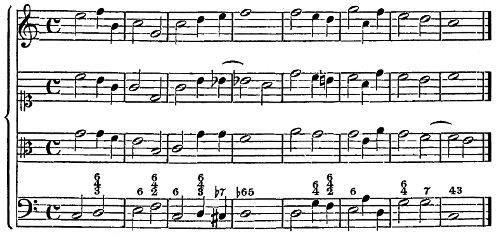
The resolutions of the other children were more or less good, but all of them correct, and mostly written out in four different keys. Each also played her own immediately without any embarrassment on the pianoforte and without “fault,” &c.”
Upon my announcing our approaching departure to my old Johanning, tears came into the eyes of the kind and affectionate old man. He had become so fond of us that he would have even refused all remuneration for the services he had rendered us, and positively objected to take the sum I had reserved for him. But upon my insisting on his taking it he complied, on the condition that I would not refuse him a favour he wished to ask of me. I asked him what it was, and he did not keep me long in suspense, but stammered out in an embarrassed manner the request that I and my wife would do him the honour to take our dinner, the day before our departure, at his house. When we consented thereto without hesitation, his whole countenance immediately brightened up, and he could not find words to express sufficiently his gratitude. On the appointed day he made his appearance dressed as I had never yet seen him, in a full-dress suit of his deceased master’s, with hair powdered, and in white silk stockings, and at our door stood a hackney carriage for four persons, which was to take us to his country house, and in which a musician whom he had also invited, and whose acquaintance we had already made, and who was the most intimate friend of his late master, was already seated. When we had got in, Johanning refused to take the fourth seat, saying that it would be unbecoming of him to do so, although I pointed out to him that he was now no longer my servant, but for this day my host and entertainer. But he was not to be persuaded, and took his usual place by the side of the coachman. On the way there our companion related to us many particulars highly creditable to Johanning—how he had shewn the most ardent attachment and fidelity to his master, and after his death had applied the greater part of the money he had left him, to the erection of a memorial to his master in Westminster Abbey, so that we felt penetrated with the highest respect for our recent servant. Upon our arrival he opened the carriage door and led us into his house. The property consisted of a small house with a small garden attached, and everywhere the greatest neatness and cleanliness. He led the way up one flight of stairs to his reception room, and did not fail to show us immediately the bell-pull near the mantle-piece, to which he forthwith gave a tug, although he kept no servant whom he could summon with it, since he and his wife were their own servants. We then took a turn through the little garden and then entered the parlour, where the table was laid for three persons. Johanning again refused to take a seat near us at table, and this time for the cogent reason that we should then have had no one to wait upon us. Upon this he brought up the dinner and as master of the house waited upon his guests, during which occupation his whole countenance wore an expression of the greatest pleasure. The dinner was exceedingly well dressed and served up on an elegant china dinner-service which had belonged to his master, and the excellent Rhenish wine which he placed before us was no doubt derived also from the same source. The dessert, strawberries and cherries, was the produce of his little garden, and this he did not fail to announce to his guests.—When dinner was over he led the way once more to his drawing-room, where we found Mrs. Johanning, who till then had been engaged in the kitchen in dressing and sending up the dinner, in full Sunday attire. There at length, though only after repeated pressing, the worthy old couple allowed themselves to be persuaded to take seats at the table, on which coffee had already been placed. Johanning was now in the height of happiness, and interpreted with no little satisfaction to his wife the praises which we had expressed and still reiterated of the admirable manner in which we had been entertained. Towards evening the coach again drove up to the door to take us back to town. But Johanning could not be deterred from resuming his old place by the side of the coachman, to accompany us home, and open the carriage door. In fact, even on the next morning he presented himself again, in order to be of assistance at our departure. At the coach-office we found also several friends and acquaintance waiting to bid us farewell.
We returned again by way of Dover and Calais, in order to take our own carriage which we had left at Lille. Our passage across this time was a very calm one and the weather fine, so that not any of the passengers were sea-sick. Between Calais and Lille the diligence stopped at a so charming place to dine that even now, after so long a time, I recollect it with a feeling of pleasure. It was at the small town of Cassel, which is situated upon a high isolated conical hill that rises in the midst of an extensive plain. The weather being fine, dinner had been laid for the travellers in the garden of the inn under a bower of vines, and during the repast, from this pleasant, cool situation we enjoyed an extensive view over the beautiful country round. In Lille we again spent some pleasant days in the society of the Vogel family and other of our friends there, and then without longer stay set out in our own carriage upon our further journey.
As a natural consequence of the painful ordeal of grief through which my parents had passed on our account, and after the first long separation from our children, our reception this time in Gandersheim was beyond measure one of heartfelt joy, and after our protracted exertions and fatigue we now indeed felt once more happy and freed from care in the calm repose of the country. This was just the time for me to set myself to new labours, and I there first completed the quintet for pianoforte, flute, clarinet, horn and double-bass which I had begun in London, and in which I proposed that my wife should make her appearance in the world of art as a pianiste on our projected winter tour. Indeed, it was high time to occupy her in its artistic study; for as she now felt quite re-established in health, she had the greatest desire to resume her harp. With the assistance of the new quintet, however, and supported by the medical counsel of my father, I soon succeeded in dissuading her from it. She therefore devoted her attention to the pianoforte with the greatest zeal, and in a short time had the gratification of finding she had reacquired her former technical skill upon that instrument. After the lapse of a few weeks she succeeded therefore in executing the new and difficult concert-piece to her and my satisfaction.
About this time we had a visit from two musical Hamburg friends, Messrs. Fritz Schwenke and Wilhelm Grund, the latter of whom brought his younger brother Edward with him, who was already a good violinist, to become my pupil. With the assistance of these three I now gave our musical friends of Gandersheim a quartet-party such as they had never heard before nor have since. In order to have my new quintet heard upon this occasion also, I quickly rewrote the accompaniment of the four wind-instruments, for a stringed-quartet, and in this shape was highly pleased with its effect, as also with the brilliant play of my wife. From the great success this had met with, she felt much encouraged in her new studies and consoled in some measure for her relinquishment of the harp. To provide her still with new materials for practice, I rewrote also two former harp-compositions for the piano, a pot-pourri and a rondo with violin, which appeared later as Op. 50 and 51. We practised these together also with the greatest care, and they were destined for performance at private parties on our next winter tour. After the departure of the Hamburg visitors I commenced the instruction of my new pupil. By his talent and amiability he soon won the esteem of the whole Spohr family, from the old grandfather down to little Theresa, whom he always called in pure Hamburg dialect: “Du säute Deren.” As he played well on the piano, he undertook the musical instruction of Emilia and Ida, and young as he was, he knew how to keep them assiduous to their studies. Himself as violinist he soon made so much progress, that I practised him in and played with him the three extremely difficult violin-duets which I wrote in Switzerland (Op. 39) and for which I had never yet been able to meet with a fellow-player. By the accurate, pure and spirited execution of this almost always four-voiced duets we made a great sensation, and musical amateurs from the whole country round came to hear us play them. We played one of them also with great success at a concert in Hildesheim, given there by the director of music Bischoff, the same who undertook the Frankenhaus musical festivals. Towards autumn, just as I had begun to compose a new violin concerto (the 9th. D-minor. Op. 55, published by André of Offenbach) for the winter journey, I received an invitation from music-director Rose in Quedlinburg to conduct a musical festival which he was about to hold there. I very gladly accepted it, and made all haste to complete my concerto so as to be able to perform it there for the first time. While practising it I received great assistance from Edward Grund, who was able to accompany through the score on the piano, an assistance, which I had never before experienced.
The musical festival took place on the 13th. and 14th. October 1820, and went off to the full satisfaction of the originator and the numerous auditory. Upon my proposition, Schneider’s “Last Judgement” was given on the first day, at which the composer himself was present. On the second day, among other things my London symphony was performed, and, as well as my new violin concerto, was received with great approbation. I met in Quedlinburg many of my former friends and acquaintances from Sondershausen, Gotha, Leipzig, Magdeburg, Halberstadt and Brunswick, and passed several delightful days with them. After our return from this pleasant excursion, upon which my parents and Edward Grund, as well as my wife, had accompained me, it became full time to set out upon our winter tour, the terminus of which was to be Paris. A new parting from the children, my parents, and the pleasant society of Gandersheim, was therefore necessary; and Edward Grund returned to Hamburg with the intention of coming again in the spring to prosecute his studies under my guidance.
We took Frankfort, Heidelberg, Carlsruhe and Strasburg on our way to Paris, and gave concerts in all those towns. In Frankfort, where we lived in the house of my friend Speyer, we still found a lively remembrance of our artistic talents; our concert in the salon of the “Weidenbusch” was crowded to overflowing, although the room could easily accommodate eight hundred persons. My new violin concerto, excellently accompanied, made a great sensation; Councillor André himself, who previously had always some fault to find with my compositions, seemed quite satisfied with my new work; for he repeatedly requested me, after the rehearsal even, to let him have the publishing of it. Although I declined this most positively, as I was bound by a promise to my then publisher Peters of Leipsic, to let him have all my new manuscripts, yet in the evening at the concert André again pressed me, and so pertinaciously, that to get rid of him, and to prepare quietly for my solo-play, I at last called out to him “Yes.” This precipitancy however cost me dear, for although I immediately informed Peters of all the circumstances, in order to exculpate myself with him, I was compelled to endure many bitter reproaches for my excessive pliancy towards Mr. André. The new piano quintet with wind-instrument accompaniment, which was now also performed, made likewise a great sensation, and Dorette’s purity of piano-forte play, of which until then the friends of music in Frankfort had known nothing, was greeted with the loudest applause. I was more particularly pleased with this result, as of all others it was calculated to console my wife for the abandonment of her harp.
Of the other towns between Frankfort and Paris, and of the concerts given there I have forgotten everything; I must however advert to the acquaintance I made of Councillor Thibaut at Heidelberg on this occasion. That celebrated jurist conducted a choral society that he had instituted; but excluding all modern church music, he permitted ancient Italian music only to be sung, of which he had made a rich and rare collection. Until then I knew nothing more of this music than what I had heard in the Sixtine chapel at Rome, and was therefore very thankful to the Councillor for the permission he gave me to be present at the rehearsals of his society, at which I became better acquainted with several of those old works, which were carefully practised by them. Thibaut’s opinion that this music alone represented the true ecclesiastical style, and surpassed all that had ever been written since, I cannot coincide with, for to me Mozart’s requiem, incomplete as it passed from the hands of that master, who died during its composition, is alone worth more than all I ever heard of earlier church music; nevertheless, the simple-grandiose style of those works made then a great impression on me, and I begged permission to study their scores through. After some hesitation my wish was granted in such wise that I was permitted to visit Thibaut’s music-room at particular hours, and to go through the works on the piano, but was not permitted to take any home with me. I took daily advantage of this favour, and by that means made myself intimately acquainted with the vocal method and harmonic sequence of the old masters. While so engaged I was seized with the desire of trying for once an ecclesiastic piece alla Capella for several voices, and in the following summer I carried out my idea at Gandersheim with the composition of the mass for ten voices, Op. 54. I certainly did not strive to imitate the simple treble movements of the old masters; but on the contrary I did a good deal towards carrying out the rich modulation of the later Mozart method.
Respecting our stay in Paris I published at the time “Four letters to a Friend” in the Leipsic Musical Journal of 1821, which I here append.
FIRST LETTER.
Paris, December 15. 1820.
I trust, my dear friend, that you will give me credit for writing to you so soon on the eighth day after our arrival, at a time when so many novelties crowd upon my notice, that I find it difficult to collect my thoughts. But for my own sake I must not permit the materials to grow upon me too much, otherwise I shall be wholly unable to deal with them in their due order.
With a beating heart I drove through the Barrière of Paris. The thought, that I should at length have the pleasure of making the personal acquaintance of the artists whose works had inspired me in my early childhood, excited the emotion which I then felt. In fancy I reverted to the days of my boyhood, in which Cherubini was my idol, whose works I had had an earlier opportunity of becoming acquainted with in Brunswick, at the then permanent French theatre there, than even the works of Mozart; I vividly recollected the evening when the “Deux Journées” was performed for the first time—how, intoxicated with delight and the powerful impression that work had made upon me, I asked on that very evening to have the score given to me, and sat over it the whole night; and that it was that opera chiefly that gave me the first impulse to composition. The author, and many other men whose works had had the most decided influence on my development as a composer and violinist, I was now soon to behold.
We had therefore scarcely got under cover, when I made it my first business to pay a visit to those artists. I was received by all in a friendly manner, and relations of friendship soon sprang up between me and several of them.
I was told of Cherubini, that he was at first very reserved toward strangers, repulsive even; I did not find him so. He received me, without any letter of introduction, in the most friendly manner, and invited me to repeat my visit as often as I pleased.
On the evening of our arrival Kreutzer took us to the grand opera, where a ballet of his, with pretty characteristic music: “Le carnaval de Venise,” was performed. It is observable in the singers and dancers of the grand opera, that they have been accustomed to move in a more spacious place; in this one, where the space is much more confined as compared with the opera house that has been abandoned, they appear in a much too sharp relief. Several grand operas, those of Gluck’s for instance, can no longer be represented at all, there being not even the necessary room for the whole orchestra. For this reason every one looks forward with hope for the early completion of the new opera house; but actively as they are working upon it, that will not be ready before the middle of next summer. Before the ballet the opera: “Le Devin du village,” the words and music by Rousseau, was given. Is it a subject for praise or blame, that the French, notwithstanding the many excellent things with which their operatic repertoire has been enriched during the last twenty years, still give the oldest things of all? And is it indeed a proof of an advanced cultivated taste for art, when one sees them give as enthusiastic a reception (if not more so) to the oldest operas of Grétry with their poverty of harmony and incorrectness, as to the master pieces of Cherubini and Méhul? I think not! How long have not the operas of Hiller and Dittersdorf and others of those days, disappeared from our repertoire, although these are far to be preferred for their real musical worth to the greater part of Grétry’s. But on the other hand it is certainly very discouraging, that with us the new only, however poor and defective, finds a ready reception, and many excellent things of older date are set aside for them and forgotten. Nevertheless it must be said to the honour of the taste for art of the Germans, that Mozart’s operas at least are the exception, and for the last thirty years have constantly been produced in all the theatres of Germany, which is a proof that the German people are at length impressed with the inimitable perfection of those master-pieces, and are not to be deceived on this head, however extensively the sweet musical poison may spread which flows in upon us so profusely from beyond the Alps.
The orchestra of the grand opera, as compared with the other orchestras, reckons among its members the most celebrated and distinguished artistes, but in ensemble is said to be behind the Italian opera. I cannot yet judge how far that may be correct, as I have only heard the latter as yet. In Kreutzer’s ballet, which was played by the orchestra with the greatest precision, I was greatly pleased with a hautboy solo, which was executed in a masterly manner by Mr. Voigt. This artist has succeeded in giving to his instrument a perfect uniformity of tone and intonation throughout the whole range from C to the high F, an accomplishment which almost all hautboy players have failed in attaining. His execution is moreover full of grace and good taste.
For some days past I have been less edified at the grand opera than I was the first time. “Les mystères d’Isis” was performed. Too well indeed are justified the complaints of the admirers of Mozart of the disfigurement of the beautiful “Zauberflöte” in this piece of workmanship, which the French themselves re-christened on its appearance “Les Misères d’ici”! One must blush that it should have been Germans, who so sinned against the immortal master. Everything but the overture has been meddled with; all else has been thrown into confusion, been changed and mutilated. The opera begins with the concluding chorus of the Zauberflöte; then comes the march in Titus, and then in succession some fragmentary piece from other operas of Mozart, and even a little bit of a symphony of Haydn; then between these recitatives of Mr. Lachnitz’ own manufacture. But worse than all this is, that the transposers have applied a serious text to many cheerful and even comic passages of the Zauberflöte, by which the music of those passages becomes a parody of the text and of the situation. In this manner, for instance, Papagena sings the characteristic air of the Moor: “Alles fühlt der Liebe Freuden,” &c.; and the pretty terzet of the three boys: “Seid uns zum zweitenmal willkommen,” &c., is sung by the three ladies. Of the duet: “Bei Männern, welche Liebe fühlen,” &c., a terzet has been made, and so on. Worse than all, however, they have taken the liberty of making alterations in the score: for example, in the air: “In diesen heil’gen Hallen,” at the words: “So wandelt er an Freundes Hand,” the imitating bass
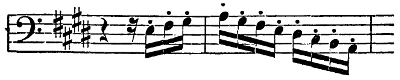
is entirely left out, which is here indispensably necessary, not alone to the harmony, but because it expresses the act of wandering in so characteristic a manner, and the bass sound the B only a few times instead. You may therefore readily imagine how insipid and meagre this passage now sounds, which in Germany is so frequently admired. Moreover, in the terzet of the three females, where Mozart strengthens and supports the third voice with the violins only, the transposers have added both violoncello and double-bass; so that at these tender passages, which are for three voices only, the bass lies in three different octaves, which to a cultivated ear is unbearable. Similar offences are of frequent occurrence. We must nevertheless do the French the justice to say, that they have always highly disapproved of this vandalic mutilation of a great master-piece (the extent of which from their ignorance of the original is yet not known to them); but how is it, that the “Mystères” have nevertheless kept their place undisturbed in the repertoire for the last eighteen or twenty years?—and here where the public moreover, as I see every day, rule so despotically in the theatre, and manage to have everything their own way!—
To me, as a German, the performance was not satisfactory. Even the overture was not executed so well as it should have been by so excellent a union of first-rate musicians. It was taken too quick, and still more hurried at the close, so that the violins instead of playing semiquavers could only play quavers. The singers of the grand opera, whose great merits may perhaps lie in declamatory song, are little qualified to render the soft airs of the Zauberflöte in a satisfactory manner. They sing them with a blunt roughness that deprives them of all tenderness. The getting-up in scenery, dresses and dancing is respectable, but not so handsome as I had expected.—Yesterday we went for the first time to the grand opera, and saw “Clari,” a grand ballet in three acts, the music by Kreutzer. Little as I like ballets, and little, in my opinion as pantomime merits the aid of the resources of art, as these are lavished on it here, I nevertheless do not deny that the Parisian ballet may sometimes afford agreeable amusement, until one becomes wearied with the monotony of the mimic movements, and of the yet greater sameness of the dances. But with all the perfection with which it is given here, pantomime, from the poverty of its signs, which always require a printed explanation of their meaning, is, as compared to recitative drama, a mere outline by the side of a finished drawing. However it may be embellished with golden ornament and decorated surroundings, as is the ballet here by magnificence of costume and decorations, it gives the outline only, and the life is wanting. In the same manner I may compare the drama to the opera—as a drawing by the side of the painting. From song, the poem receives its first colouring, and by it only, and the powerful aid of harmony, does it succeed in giving expression to the indefinable and merely imagined emotions of the soul which language must be content alone to hint at. The music to “Clari” is a great success, and in the second and third act especially the effect is most captivating. It facilitates greatly the comprehension of the subject by a correct delineation of the passions, and contains a treasury of pretty melodies which one regrets do not form part of an opera. Mademoiselle Bigottini played the chief character, and evinced a deep study of mime and action in her play. That in very impassioned situations she carried the expression of her features to the borders of grimace, may perhaps be imputed to the circumstance that hitherto she has always appeared in a spacious place, where on account of the distance it was requisite to give strong play to the features. Perhaps as a German this is my fancy only, for the applause was never more tumultuous than when (to my feeling) she overstepped the bounds of the beautiful and graceful.
Before the ballet, the one-act opera “Le rossignol” was given; from which Weigl took the subject of his German opera of “Nachtigall und Rabe.” The music of the French opera is of no account, and interested me only through the masterly execution of a flauto-solo by Mr. Tulou. It is impossible to hear a finer tone than that Mr. Tulou draws from his instrument. Since I heard him, it appears to me no longer so inappropriate, when our poets compare the pleasing sound of a fine voice to the tones of a flute.
SECOND LETTER.
Paris, December 31. 1820.
Since the despatch of my first letter, a fortnight has elapsed, replete with enjoyment, and since then we have both seen and heard much that is beautiful; but for the present I must content myself with writing to you upon that which most nearly concerns my art. I have now made my appearance before musicians and dilettanti, connoisseurs and a lay public, as violinist and composer, first at Mr. Baudiot’s, primo violoncellist of the royal orchestra, on the day after at Kreutzer’s, and since then at three private parties. At the soirées of the two first the company consisted almost wholly of musicians; at Kreutzer’s, in particular, almost all the first composers and violinists of Paris were present. I gave several of my quartets and quintets, and on the second day my nonet. The composers present expressed themselves to me in very laudatory terms upon the composition, and the violinists upon my play. Of the latter, Viotti, both the Kreutzers, Baillot, Lafont, Habeneck, Fontaine, Guerin, and several others whose names are not so well known in Germany, were present; and you may imagine that it was then highly necessary that I should collect my faculties, to do credit to my countrymen. The wind-instrument parts in my nonet were played by the five artists of whose masterly execution of Reicha’s quintets you will have so frequently read in accounts from Paris. I had the pleasure of hearing them play two of those quintets, but shall reserve to myself all detailed observations thereon till I shall have heard some more of them. At the request of all the musicians present my nonet was played again the same evening; and if the readiness with which the assistant players read à prima vista that difficult piece of music had surprised me, I was still more gratified, upon its repetition, by the manner in which they now entered into the spirit of the composition and re-executed it.
The young pianist Herz, of whom you have also doubtless read in the Parisian musical miscellanies, played twice on that evening, at first his own variations on the theme from the “Schweizerfamilie,” and then Moscheles’ well-known variations on Alexander’s march. The extraordinary execution of this young man is the astonishment of everybody; but with him, as with all the young artists here whom I have yet heard, it seems to me that his technical cultivation is in advance of that of his mind; otherwise, in a company composed of artists only, he would surely have given something different and more intellectual than the break-neck tricks of art he exhibited. But it is very singular, how all here, young and old, strive only to shine by mechanical execution, and individuals in whom perhaps the germ of something better lies, devote whole years and every energy to the study and practice of one single piece of music, frequently of the most worthless kind, in order to create a sensation with it before the public. That the mind remains torpid under such circumstances and that such people never become much better than musical automatons may be readily imagined.
Hence one seldom or never hears in the musical réunions here an earnest, well-digested piece of music, such as a quartet or quintet of our great masters; every one produces his show-piece; you hear nothing but airs variés, rondos favoris, nocturnes, and the like trifles, and from the singers romances and little duets; and however incorrect and insipid all this may be, it never fails to produce an effect, if it is executed right smoothly and sweetly. Poor in such pretty trifles, with my earnest German music I am ill at ease in such musical parties, and feel frequently like a man who speaks to people who do not understand his language; for when the praise of any such auditors extends even sometimes from my play to the composition itself, I cannot feel gratified by it, since immediately afterwards he bestows the same admiration upon the most trifling things. One blushes to be praised by such connoisseurs. It is just the same at the theatres: the masses, the leaders of the fashion here, know not positively how to distinguish the worst from the best; they hear “Le Jugement de Midas” with the same rapture that they hear “Les deux Journées” or “Joseph.” It requires no long residence here, to adopt the frequently expressed opinion, that the French are not a musical nation.
The artists themselves here are of this opinion, and frequently reply, when I speak of Germany in this respect: “Yes, music is loved and understood there, but not here.” In this manner may be explained how good music wedded to a wretched theatrical piece, falls to the ground, and wretched music united to a good pièce de théâtre, may be highly successful.
This has deprived me of all desire to write for any of the theatres here, as I had previously much wished to do; for apart from the fact that I should have to begin de novo, like a young composer—since, with the exception of some of my violin pieces, they know little or nothing of my compositions—and further that I should have to work my way through a thousand cabals, which would rise up against me as a foreigner with fearful violence before I could get my work performed, so that at the end I should find, although I might have written good music, its success would be uncertain, as that depends, as I have said, almost wholly on the theatrical piece. This may be seen from the notices in the journals here upon recent operas, in which whole columns are devoted to a critique of the text, and the music is dismissed with a passing notice of a few words only.
Were it not so lucrative to write for the theatres in Paris, there would have been long since no good composer willing to do so. But from the considerable gain which a successful opera brings in during one’s whole life-time, new works are produced almost every day; authors and composers turn their mind constantly to the creation of new effects, but do not neglect at the same time, to ply the public for months together in the journals, and provide the necessary number of paid claqueurs in the pit on the evening of the performance, in order to ensure a brilliant reception for their work and thereby an ultimate rich harvest from its frequent repetition. If only half as much were to be gained by an opera in Germany, we should soon be equally rich in good composers for the theatre as we now are in instrumental composers, and we should have no further need to introduce foreign pieces upon our stage, for the most part unworthy of the artistic culture of Germans.
After a residence of now three weeks it may be well imagined that we have repeatedly visited all the theatres. I am the more pleased at this as the circle of my acquaintance has become larger, and my engagements both for the morning and evening have so much increased that for the next fortnight we shall be able to devote but few evenings to the theatre.
Of the Théâtre français, the Odéon, and the four lesser theatres, I shall say nothing; as in a musical point of view they offer nothing worthy of notice. In the two first they give nothing but entr’actes, and in the four others almost nothing else but vaudevilles. That this last kind of theatrical pieces, which, thanks to Apollo and the muses, has hitherto been transplanted into no other country, is so much liked here that four theatres give almost nothing else, is the most striking proof that the French are not musical; for the sacred art cannot be more abused anywhere than in these kind of songs, which are neither sung nor spoken, but rattled out in intervals, and which are in most striking anomaly with the melodies, and the accompanying harmony. All Frenchmen of taste are agreed that the vaudeville, which formerly was given in one theatre only, has by its increase deteriorated more and more the taste for true music, and therefore had a prejudicial effect upon art here. We have been to each of these theatres once, to hear the celebrated comedians Brunet, Pothier and Perlet, but are not likely to go a second time, for the enjoyment one derives from the wit and inexhaustible humour of those performers is too dearly purchased by hearing such wretched music. I was particularly struck by the skill with which the orchestra in those theatres follow the singers, who do not in the least adhere to the time, or the notes. But this is, also, their chief merit, for in other respects they are but middling musicians.
We have been frequently to the Italian opera, and much enjoyed ourselves there. Last evening we saw “Don Juan” there, at last, after it had been frequently announced. The house was again, as upon the previous performances, filled to overflowing, and hundreds of people could find no room, even half an hour before the curtain drew up. I was disposed to believe that the Parisians had at length understood the classical beauty of this work, and that they flocked always in greater numbers to enjoy it; but I soon relinquished that opinion when I saw that the finest parts of the opera—the first duet, the quartet, the grand septet, and several other things—passed off without making any impression upon them, and two subjects only received a storm of applause, which was given rather to the singers than to the composer.
These two subjects, which were each respectively encored, were the duet between Don Juan and Zerline: “Reich mir die Hand mein Leben” etc., and the air of Don Juan: “Treibt der Champagner” etc.; the first, because Signor Garcia, not having depth of voice sufficient, transposes it to B flat, and the last even a whole tone higher, to C. Madame Fodor-Mainville, who well knew that the song-pieces of Zerlina would please the Parisians more than all the rest of the opera, chose very wisely that part, and the result shewed that she had calculated rightly. What would she care, were the characters of the opera wholly transposed, so long as she meets with a storm of applause. The real connoisseur can only consent to this when he dismisses from his mind that she personates the role of a peasant girl, and when he wholly sets aside the true intention of the subject represented; for she decorates the simple songs of her part with a number of high-flown embellishments which, splendidly though she may execute them, are here wholly out of place; first because they do not at all belong to Mozart’s music, and secondly, because they are wholly incompatible with the character. With deduction of this, it certainly affords an unusual enjoyment to hear this part, which in Germany is usually played by a third-rate singer, impersonated by a first-rate one, and so distinguished a vocalist. Signor Garcia, as Don Juan, uses also too much ornamentation. Where this is only moderately admissable, he comes out with a fioritura a yard long; and these are most out of place in the serenade, where the supposed mandoline accompaniment forbids the most simple ornament. Nevertheless he gives full latitude in it to his fancy, and in order to do this more conveniently, he takes the tempo very slow. On the other hand, however, he sings his song incomparably “Treibt der Champagner” etc., and I acknowledge that I never heard that air so well sung. The pliability of the Italian tongue is of great use to him in this, and instead of losing his breath in it, as is usual with our German singers, his vocal power increases to the end.
The other parts are sung more or less well, but none of them badly, and one must gratefully acknowledge that each does his best to do honour to the work. One may also be very satisfied with the performance, when one loses sight of the claims one is justified in making upon so celebrated a combination of artists. But to a German it soon becomes very evident that these singers, who execute Italian music only, and that of Rossini especially, in the highest perfection, cannot give the music of Mozart with the same excellence; the difference of style is far too great. The effeminate, sweet execution which accords so well with the former, obliterates too much the energetic character which distinguishes Don Juan above all other of Mozart’s operas.
The orchestra, which the Parisians always pronounce the first in the world, made some mistakes. Twice for instance the wind instruments were very obviously at fault, and they wavered several times so much, that the conductor was obliged to beat the time for them. I became confirmed but the more strongly in my opinion, that a theatrical orchestra, however excellent it may be, on account of the great distance of the extreme ends, should not be conducted otherwise than by a continual beating of the time, and, that to mark the time constantly by motions of the body, and the violin, like Mr. Grasset does, is of no use. In other respects this orchestra is justly famed for the discretion with which it accompanies the singer, and in that might serve as a model for the other Parisian as well as many German orchestras.
The choruses are also excellent, and the effect particularly powerful and grand at the concluding allegro of the first finale. But why here, as well as almost everywhere else, is this allegro taken so unreasonably quick? Do then the conductors wholly forget, that by so doing they decrease instead of increasing the power, and that the triplet movement of the violins which must first give life and motion to the whole, cannot be brought out clearly and forcibly in a movement of such exaggerated rapidity, and instead of hearing the living whole, it becomes a mere skeleton sketch without fillings in?!
When one hears so beautiful a piece of music lose its effect by incorrectness of time, one wishes again that the marking of the tempi was finally and universally established either on Mälzel’s or Weber’s method, or still better upon both at the same time. But then of course orchestral conductors must follow them conscientiously, and not as now, follow their own fancy merely.
THIRD LETTER.
Paris, January 12. 1821.
With a mind greatly relieved, I write to announce to you, my dear friend, that I have made my public début and with success. It is always a hazardous undertaking for a foreign violinist to make a public appearance in Paris, as the Parisians are possessed with the notion that they have the finest violinists in the world, and consider it almost in the light of arrogant presumption when a foreign considers he has talent sufficient to challenge a comparison with them.
I may therefore well be a little proud of the brilliant reception I met with the day before yesterday, and the more so that, with the exception of a dozen persons, the auditory was personally unknown to me, and there were none among them who had been admitted with free tickets in purchase of their service as claqueurs. But I had prepared myself very carefully for the occasion, and was properly supported by the careful accompaniment of Mr. Habeneck. I was, however, not in the least nervous, which is sometimes the case with me when I appear for the first time in a strange country, and which occurred to me the year before in London. The reason why I did not feel so in this instance, was doubtless, that here I had already played before all the most distinguished musicians, previous to my appearing in public; but in London eight days only after our arrival, without having been previously heard by any person, I was constrained to appear at the philharmonic concert.
Before I enter into any details of the concert, I must first relate how I came to give it. It is at all times a tedious business to make arrangements for a concert in any town, but in Paris, which is so extensive, where so many theatres are daily open, where there is so much competition and so many obstacles to overcome, it is indeed a Herculean task. I think also that this is the reason why so many artists who come to Paris, decline giving a public concert, which, besides being attended with the enormous expense of nearly 3000 francs, is always an undertaking of great risk. If these matters have been extremely unpleasant to me in other places, you may readily imagine how I feared to attempt them here. In order to get over the difficulty, I bethought myself of making a proposition to the directors of the grand opera, to divide with me the expenses and the receipts of an evening entertainment of which the first half should consist of a concert and the second of a ballet. Contrary to the expectation of all those to whom I had spoken on the subject, this proposition was acceded to.
The consent of the minister was however so long delayed, that the concert could not be announced till three days before it took place, and although the house was well filled, yet I ascribe to this delay that it was not so crowded as I had expected so novel and, from its novelty, so attractive an arrangement would have been for the Parisians. The half which came to my share, after deduction of the expenses, was therefore, as you may imagine, not very considerable: but as I had not calculated upon making much pecuniary gain in Paris, I do not regret this arrangement at all, as it saved me an immense deal of trouble, and yet gave me an opportunity of making my appearance in public. Of my own compositions I gave: the overture to “Alruna,” the newest violin concerto, and the potpourri on the duet from “Don Juan.” Between these a cavatine of Rossini’s was sung by Mademoiselle Cinte, and a duet, also of the same master, by Messrs. Bordogni and Levasseur. At the rehearsal the overture was repeated three times, and in the evening therefore, although it did not go off quite so well as the last time at the rehearsal, the public nevertheless could not refuse their applause of its execution. In the concerto, as well as in the potpourri, some of the wind instruments failed twice, from a negligence in observing the pauses, which seems somewhat usual with the French, but fortunately it was not much disparaged by it. The satisfaction of the audience was unmistakably expressed by loud applause and cries of Bravo! To-day, however, the criticism of the majority of the journals is not so favourable. I must solve this riddle for you. Previous to every first appearance in public, whether of a foreigner or a native, these gentlemen of the press are accustomed to receive a visit from him, to solicit a favourable judgment, and to present them most obsequiously with a few free admission tickets. Foreign artists, to escape these unpleasant visits, sometimes forward their solicitations in writing only, and the free admissions at the same time; or, as is of frequent occurrence, induce some family to whom they have brought letters of introduction, to invite the gentlemen of the press to dinner, when a more convenient opportunity is offered to give them to understand what is desirable to have said of them both before and after the concert. This may perhaps occur now and then in Germany; but I do not think, that newspaper critics can be anywhere so venal as here. I have been told that the first artists of the Théatre français, Mlle. Mars, and even Talma, pay annually considerable sums to the journals, in order to keep those gentlemen constantly in good humour, and that the latter, whenever they wish to extricate themselves from any pecuniary embarrassment, find no method so sure as to attack some esteemed artist until he submits to a tribute of money. How the opinions of a press that are so purchasable, are at all respected, I cannot understand. Suffice however to say, I did not pay any of these supplicatory visits, for I considered them unworthy of a German artist, and thought that the worst that could happen would be, that the journalists would not take any notice at all of my concert. But as these have each a free pass to every performance at the grand opera, I found I was mistaken. They all speak of it; some with unqualified praise, but the majority with a But, by which the praise is more than sufficiently diminished. In all these notices, however, French vanity speaks with the utmost self-assurance. They all begin by extolling their own artists, and their artistic culture, above all other nations; they think that the country that produced Messrs. Baillot, Lafont and Habeneck, need envy no other its violinists; and whenever the play of a foreigner has been received here with enthusiasm, it is nothing more than a proof of the great hospitality which the French in particular shew towards foreigners. Apart from this vanity the notices are very contradictory: The “Quotidienne” says, for instance: “Mr. Spohr aborde, avec une incroyable audace, les plus grandes difficultés, et l’on ne sait ce qui étonne le plus, ou son audace ou la sureté avec laquelle il exécute ces difficultés.” In the “Journal des Débats,” on the other hand: “Le concert exécuté par Mr. Spohr n’est point surchargé de difficultés,” etc. These gentlemen differ also in opinion respecting the merits or demerits of my compositions. The majority think them good, but without saying why; but “Le Courier des Spectacles,” which altogether speaks most disparagingly of me, says: “C’est une espèce de pacotille d’harmonie et d’enharmonie germaniques que Mr. Spohr apporte, en contrebande, de je ne sais quelle contrée d’Allemagne.” But Rossini is his man, of whom he says further on: “Cet Orphée moderne a défrayé de chant le concert de Mr. Spohr, et il lui suffit pour cela de prêter une petite aria et un petit duo bouffo.” But as a violinist I found more grace in his eyes; he says for instance: “Mr. Spohr comme exécutant est un homme de mérite; il a deux qualités rares et précieuses, la pureté et la justesse,” but then winds up his phrase like a true Frenchman: “s’il reste quelque temps à Paris, il pourra perfectionner son goût et retourner ensuite former celui des bons Allemands.” If the good man only knew what the “bons Allemands” think of the musical taste of the French?!
This ridiculous vanity in the Parisians is shewn also in their conversation. When one or other of their musicians plays anything, they immediately ask: “Well, can you boast of anything like that in Germany?” Or when they introduce to you one of their distinguished artists, they do not call him the first in Paris, but at once the first in the world, although no nation knows less what other countries possess, than they do, in their—for their vanity’s sake most fortunate—ignorance.
You are doubtless astonished that I have as yet said nothing of the music of the royal chapel; but I delayed doing so intentionally, until I had first heard some of Cherubini’s masses. Lesueur and Cherubini, the two directors of the music of the royal chapel, assume the duties of their office every three months alternately; our arrival took place during the time of Lesueur’s directorship, and Cherubini’s did not begin till the first of January. But the musical directors of the royal chapel do not conduct the music themselves, and preside only in their court uniform at the head of the vocal personnel, without taking any active part in the performance. The director de facto is Plantade; Kreutzer leading player of the first violin, and Baillot of the second. The orchestra is composed of the first artists in Paris, the chorus is powerful and good. Every mass is rehearsed once or twice, and under Plantade’s sure and spirited direction, every thing goes exceedingly well.
Although previously prepared by Mr. Sievers’ account, I was very far from expecting to hear music here of the style we call church-music in Germany; yet I was greatly taken by surprise by the brilliant theatrical style of a mass by Plantade, which I heard on my first visit to the chapel on the 17th of last month. There is not the least trace of the ecclesiastical style, not a vestige of the canonical management of the voices, and still less of a fugue. But apart from this, there were very pretty ideas, and much good instrumentation, which would be quite in place in a comic opera. The concluding allegro, probably upon the words: Dona nobis pacem (for I am not certain, since the French pronounce Latin in a manner very unintelligible to a German ear) was so completely in the style of the finale to an opera (like those usually with three or four times increased tempo) that at the end, forgetting completely where I was, I expected to see the curtain fall, and to hear the public applaud.
At midnight, on the 24th December, we heard a so-called “Messe de minuit” of Lesueur’s composition. First of all we were obliged to endure a great trial of our patience, in which during two somewhat tedious hours, from ten to twelve o’clock, we heard nothing but psalms, sung off in the most monotonous manner, and interrupted at intervals with barbarous peals of organ-play. At length, at midnight, the mass began. Again the same frivolous theatrical style as in that of Plantade, but which at the solemn midnight hour was still more insufferable. But what most surprised me, particularly from Lesueur, who is reputed here a first-rate harmonist, and was educated, if I am not mistaken, for a teacher of harmony at the Conservatoire, there was not even a four-part management of the voices! Though at times it may be effective in an opera, when writing only a two-part vocal distribution, to let the soprani go in octaves with the tenors, and the alti with the bass, partly with a view to facilitate the execution of the generally bad theatrical choruses, and partly to obtain by that means more material power; yet to me it seems quite barbarous to introduce this in the church, and I should therefore like to know what Mr. Lesueur, who must certainly be an artist of reflective powers, means by it. In the place of the offertory, variations by Nadermann for the harp, horn and violoncello were thrust in, executed by the composer and Mrs. Dauprat and Baudiot. You who know, that in Germany a serious symphony even appeared to me too mundane at this part, may therefore readily imagine what an unpleasant impression these frivolous, French variations on the harp must have made upon me in a mass at midnight; and yet I saw the people present in earnest prayer. How is it possible for them to feel a religious sentiment with such trivial music! This must be either a matter of no importance to them, or they know how to close their ears effectually; otherwise, like myself, they would of a certainty be reminded of the ballet at the grand opera, in which those three instruments are heard in a like manner in the most voluptuous dances. Although the harp in ancient times was the favorite instrument of a pious king, it should for all that be banished from the church, because it is wholly unfit for the severe style which is the only one suitable for that edifice.