Chapter XXI · Application of Steam-power to Navigation—Miller and Symington—Boulton and Watt’s Engine adopted by Fulton.
Reading edition
It will be remembered that one of the early speculations of Roger Bacon related to the employment of engines of navigation without oarsmen, “so that the greatest river and sea ships, with only one man to steer them, may sail swifter than if they were fully manned,”—that one of the uses to which Papin proposed to apply the steam-engine was to “propel ships against the wind and tide,” in illustration of which he constructed his model steamboat,—and that, shortly after Newcomen’s engine had become generally introduced as a pumping power, Jonathan Hulls took out a patent with the object of applying it to tow ships into and out of harbours. Hulls was followed, after a long interval, by Jouffroy in France and by Fitch in America, but none of their experiments proved successful; and it was not until Watt invented the condensing engine that it was found practicable to employ steam as a regular propelling power in navigation.
It was natural that the extraordinary success of Watt’s invention should direct attention anew to the subject. The engine, in the powerful, compact, economical, and manageable form, into which he had brought it, was found able to effect rotary motion in the various processes of manufacture; and, in a maritime country like England, the thought that would naturally occur to many minds would be this: If the steam-engine can drive mill-wheels, why may it not in like manner be employed to drive the wheels of carriages by land and the paddle-wheels of vessels by sea? The subject was, indeed, often brought under the notice of both Boulton and Watt; but the anxiety, annoyance and expense to which they had been subjected in defending their original patent, deterred them from venturing on this new field of enterprise. Watt never made his proposed locomotive engine for running on common roads; and the model constructed by Murdock at Redruth in 1784, remained a model still.
The subject was, however, shortly after taken up by William Symington, at Wanlockhead, in Scotland, where his father was employed as engineman in superintending the working of one of Boulton and Watt’s pumping-engines. The sight of this engine, and his father’s employment upon it, had probably the effect of first directing his attention to steam-power and its extended uses; and having heard of Murdock’s ingenious design from Boulton and Watt’s men, who were constantly visiting and inspecting the pumping-engine,[364] it occurred to him to try whether he could not himself construct the model of a steam-carriage for use on common roads. He succeeded in making his model, and when it was finished, Mr. Meason, the manager of the Wanlockhead Lead Mines, was so much pleased with it that he asked the young man to accompany him to Edinburgh, to show it to the leading men of science in that city. Mr. Meason allowed it to be exhibited at his own house, Symington being in attendance to give explanations. Some of the Edinburgh professors, who came to see the model, were so much pleased with the youthful inventor (then only about twenty years of age), and the indications of mechanical genius which his machine displayed, that they strongly recommended Mr. Meason to enter him as a student at the University, which he readily assented to, and Symington accordingly matriculated at Edinburgh College in 1786, and, amongst other lectures, attended those of Dr. Black on Chemistry in the following session.
The Scotch roads were in too bad a condition at the time to admit of their being run over by a locomotive, and Symington eventually abandoned his proposed scheme. But he had also an idea that the steam-engine might be economically applied to the working of boats on canals, or ships at sea; and with that object he invented an engine specially adapted for the purpose. This clearly appears from his correspondence with Thomas Gilbert, M.P., brother to the Duke of Bridgewater’s land steward. Mr. Gilbert had inspected the model of the steam-carriage while on a visit to Edinburgh, and at the same time had some conversation with Symington as to the employment of the steam-engine in hauling canal-boats, the result of which was that Symington promised to write him more fully on both topics. He proceeded to do so in a letter dated Wanlockhead, 24th September, 1786; in which, after describing the dimensions, power, mode of working, and the probable price (about 70l.) of a full-sized locomotive, he proceeded—
“But an engine of the same power and apparatus for working boats on canals, will only coast about fifty pounds, and will only weight 110 st. Each strock of the engine will have a force equall to 160 st. weight when applied, which undoubtedly will be able to drag a great weight upon water, when we run the proportion between it and what a man can do in a boat with common oars, whose exertion does not exceed more than 7 stones; but of this you will be a better judge than me. The engine we propose for working the land-carriage is Mr. Watt’s, with some very material alterations; and before we can use it we must make an agreement with him, which we intend to propose immediately. But the engine we propose to work boats or ships with is an engine intirely of our own invention, and more powerful and better adapted for the purpose than Mr. Watt’s engine. This engine of our own we have presently at worke here is a large moddle, by which we have properly ascertained its power, and found it exceed Mr. Watt’s engine nearly two pounds upon each square inch on the piston, without any greater consumpt of coals. Another advantage attending our engine is its being little more complicated than the old engine that works with an atmospheric pressure. We are to use our endeavours immediately for a patent for this engine as well as our carriage; your assistance, when we get application made, will be of great service to us, and thankfully received by, Sir, &c. &c., William Symington.”[365]
About the same time that Symington was exhibiting his model carriage in Edinburgh, Mr. Miller of Dalswinton was trying experiments at Leith in propelling boats by paddle-wheels worked by men at a capstan. He had a triple vessel built, with wheels placed inside, on turning which the vessel was impelled forward. It will be observed that this was but a repetition of the old experiment of Blasco Garay at Barcelona, and of Savery on the Thames. The experiments were on the whole successful, but the power employed in propelling the vessel was felt to be defective, and the turning of the capstan was very hard work, at which men could not be brought to work continuously for any long period.
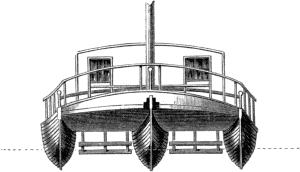
MILLER’S TRIPLE VESSEL.
Mr. Miller, being curious as to all mechanical novelties, went, amongst others, to see Symington’s model locomotive; and in the course of conversation with the inventor informed him of his own project, describing the difficulty he had experienced in getting his paddles turned for lack of power. The immediate remark of Symington was, “Why don’t you use the steam-engine?” He proceeded to show how easily the engine might be connected with the wheels of the boat, using the model of the steam-carriage before him to explain his meaning. Mr. Miller appeared to have been struck by the suggestion, and in the pamphlet which he shortly after published describing his new vessel, he referred to the probable employment of steam-power for the purpose of driving the paddles. “I have reason to believe,” he said, “that the power of the steam-engine may be applied to work the wheels, so as to give them a quicker motion, and consequently to increase that of the ship. In the course of this summer, I intend to make the experiment; and the result, if favourable, shall be communicated to the public.”[366]
Mr. Miller subsequently contrived and constructed a double vessel, 60 feet in length, worked by a paddle-wheel placed amidships between the two halves of the ship, with a clear waterway in the middle in which the paddle was worked, propelling the vessel. An experiment with this new ship was tried in June, 1787, which was considered successful. “The vessel being put in motion by the water-wheel, wrought by five men at the capstern, was steered so as to keep the wind right ahead, and her rate of going was found by the log to be three and a half miles in the hour.”[367] A sailing-match was arranged by Mr. Miller, in which he was to run his vessel from Inchcolm (a small island in the Frith of Forth) to Leith, against a Custom-house wherry which was reckoned a fast sailer. In this race the double vessel beat by a few minutes. A young man named James Taylor, who officiated in Mr. Miller’s family as tutor to his two younger sons, was on board the vessel, and took his turn in working the wheels, which he found to be “very severe exercise.” In consequence of this trial and its results, Taylor became persuaded that unless a more commanding power than that of men could be applied, the invention of the paddle-ship would prove of little use; and on turning the matter over in his mind, he suggested to Mr. Miller the use of the steam-engine. This, however, was no new idea, as, from what we have already stated, it is clear that it had already occurred to Symington, who had even contrived an engine for the express purpose of propelling ships. As Taylor was intimate with Symington, and a fellow-student with him at Edinburgh College in the session of 1786–7, it is probable that Taylor obtained from him his first idea of the application of the steam-engine to Mr. Miller’s paddle-boat.
The result of Symington’s and Taylor’s suggestion was, that Mr. Miller resolved to make a further experiment; and he ordered a double boat to be built and fitted with a steam-engine for trial on Dalswinton Loch, near his country-seat in Dumfriesshire, in the course of the following summer. Symington prepared the plans of the engine, the castings of which were executed by George Watt, an Edinburgh founder; and when the parts were ready, Symington and Taylor went together to Wanlockhead, in the summer of 1788, to have the engine erected and placed in the boat in readiness for the proposed trial.
In the mean time, other projects of a similar kind were afoot; and Boulton and Watt continued to be solicited from different quarters on the subject of engines for sailing ships. To these they continued to turn a deaf ear. They were willing to execute engines to order, but they declined to undertake them as speculations. Thus, in the spring of 1788, we find Sir John Dalrymple, one of the barons of the Court of Exchequer at Edinburgh, addressing Boulton on the subject of the proposed application of the steam-engine to the propulsion of ships, and the reply of the latter clearly shows what were then the views of the Soho firm on the subject:—
“Sir,—I have just received the honour of your letter of the 23rd inst., by which I observe you are intent upon applying the power of steam to the navigation of ships, boats, &c.
“It is one of the applications of our engine which Mr. Watt and I have often talked of, but we were deterred from the prosecution of it more from political than mechanical difficulties, as well as from some prudential reasons; besides which, we thought we could be more useful to the public and to ourselves by confining our attention to such subjects as were within the limits of our own powers and our own country. We still continue of that opinion, and are persuaded that it would be folly in us (who have our hands and heads full of solid and important business) to engage in any set of new experiments, or, like Charles XII., go in quest of conquest in foreign kingdoms, and leave our own to be conquered.
“If you or your friends want any of our steam-engines for any purpose you may think proper to apply them to, we shall be very glad to serve you upon the usual terms; although I must confess that I should be sorry to see them applied to one purpose which perhaps may be of as much importance to this country some time or other as Admiral Drake’s fire-ship was on a former emergency.
“I beg the favour of you not to consider me or Mr. Watt as schemers or projectors, but as men who are following their regular established trade and manufactures of great extent,—amongst others that of steam-engines,—and engineers, in which capacity we shall always be found attentive to your commands.”[368]
Symington had many difficulties to encounter in erecting his engine at Leadhills. Though it was of very small size, being of only about two horses power, with a four-inch cylinder, it required as much skill to construct as a much larger engine would have done. The arrangement of the power was new, as well as the application; and, as in the case of every new machine, where unforeseen defects were brought to light, new expedients had to be contrived for the purpose of overcoming them. Mr. Miller became impatient for its completion, and repeatedly wrote from Edinburgh urging despatch, fearing lest some other projector should get the start of him in applying the steam-engine to the driving of ships. Taylor, who managed the corresponding part of the enterprise, replied, “You need be under very little apprehension as to any person getting before you in this. It is easy in conversation, but very different in execution. However, as such a circumstance would be equally unpleasant to us, to prevent it you may depend upon the greatest expedition being used.”[369]
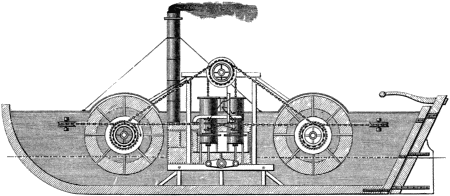
SYMINGTON’S FIRST STEAMBOAT ENGINE.
Taylor being further urged by his employer, again wrote from Leadhills on the 12th September, 1788,—“Mr. Symington and I are as busy here as we possibly can be. We work from six o’clock in the morning till dark in the evening, without losing a moment; also, to forward us the more, we have called in the aid of a watchmaker here, who works along with us. We are now in great forwardness, and will not be long of finishing. I could not ascertain to a day when it will happen, but believe we shall have it at Dalswinton some time before the end of the month.”[370]
The engine was shortly after finished, mounted in a strong oak frame, and taken to Dalswinton. It was then placed on the deck of Mr. Miller’s double pleasure-boat, twenty-four feet long and seven broad, which had been prepared for its reception.
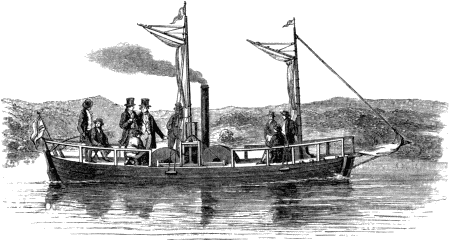
MR. MILLER’S EXPERIMENTAL STEAMBOAT.
The engine was placed on one side of the boat, the boiler on the other side to balance it, and the paddle-wheels in the middle; the rotary motion being obtained from the engine by chains, ratchet-wheels, and catches. The first experiment was tried on the 14th of October, 1788, and proved successful, the engine being propelled at the rate of five miles an hour.[371] Among the persons present on the occasion, besides Miller, Symington, and Taylor, were Alexander Nasmyth, the landscape painter, and Robert Burns, the poet, then a tenant of Mr. Miller on the neighbouring farm of Ellisland. After a few further experiments the engine was taken out of the boat and carried into Mr. Miller’s house, where it remained for many years, and was eventually deposited in the Museum of Patents at Kensington, where it is now to be seen.
The experiments made with this first steamboat were so satisfactory that Mr. Miller resolved to try one upon a larger scale. By this time Messrs. Allen and Stewart, of Leith, had built for him another double vessel, ninety feet in length; and he wrote to Symington, requesting his estimate of the cost of fitting it with a suitable steam-engine. Symington’s reply was to the effect that a proper-sized engine for such a vessel would, in his opinion, be about 250l., including the float-wheels. The necessary order was given, and Symington proceeded to the Carron Ironworks for the purpose of constructing it. The vessel arrived at Carron on the 24th June, and by the month of November following the engine was finished and put on board ready for trial.[372] The result was not so satisfactory as in the case of the experiment on Dalswinton Loch. The paddle-wheels were too weak; first one float and then another broke off; and the trial had to be suspended until the defects were remedied. The next trial was, however, more satisfactory. The vessel reached a speed of seven miles an hour; and this was repeated with the same result. There must, however, have been some defect in the engine performances; for, in a letter written by Miller to Taylor, who was present throughout, he expressed the opinion that Symington’s engine was altogether unsuitable for giving motion to a vessel.[373] He accordingly ordered the engine to be taken out and placed in the Carron Works, and the vessel itself to be laid up at Bruce Haven.
Thus matters remained until the spring of the following year, when Mr. Miller decided on applying to Boulton and Watt for an engine of a proper construction, offering at the same time to associate them with him in his enterprise. The negotiation was opened by Robert, afterwards Lord Cullen, who addressed Watt on the subject; but his reply was not encouraging. Like his partner, Watt was averse to new speculations; and he had had too much anxiety and worry in connexion with his original enterprise to enter upon any new one. It will also be observed that he entertained doubts as to the eventual success of ocean navigation by steam. The following was his reply:—
“Dear Sir,—We have heard of Mr. Miller’s ingenious experiments on double ships from Sir John Dalrymple, and also some vague accounts of the experiments with the steam-engine, from which we could gather nothing conclusive, except that the vessel did move with a considerable velocity.
“From what we heard of Mr. Symington’s engines, we were disposed to consider them as attempts to evade our exclusive privilege; but as we thought them so defective in mechanical contrivance as not to be likely to do us immediate hurt, we thought it best to leave them to be judged by Dame Nature first before we brought them to any earthly court.
“We are much obliged to Mr. Miller for his favourable opinion of us and of our engines, which we hope experience would more and more justify. We are also fully sensible of his kind intentions in offering to associate us with him in his scheme; but the time of life we have both arrived at, and the multiplicity of business we are at present engaged in, must plead our excuse for entering into any new concern whatever as partners; but as engineers and engine-makers we are ready to serve him to the best of our abilities, at our customary prices, for rotative engines, and to assist in anything we can do to bring the scheme to perfection.
“We conceive that there may be considerable difficulty in making a steam-engine to work regularly in the open sea, on account of the undulating motion of the vessel affecting the vis inertiæ of the matter; however, this we should endeavour to obviate as far as we could.
“It may not be improper to mention that Earl Stanhope has lately taken a patent for moving a vessel by steam, but not by wheels. His Lordship has also applied to us for engines; but we believe we are not likely to agree with him, as he lays too much stress upon his own ingenuity.
“We cannot conclude without observing, that were we disposed to enter into any new concern whatever, there is no person we should prefer to Mr. Miller as an associate, being fully apprised of his worth and honour, and admirers of the ingenuity and industry with which he has pursued this scheme.
“Permit me now, Sir, to return you my thanks for your obliging attention to me, and for the trouble you have taken in this affair, and to ask the favour of your presenting Boulton and Watt’s respectful compliments to Mr. Miller.—I remain, dear Sir, &c. &c.,
“James Watt.”[374]
Mr. Miller proceeded no further with his experiments, on which he had already expended a large sum of money. He seems to have lost faith in the applicability of the steam-engine to the propulsion of ships, and reverted to his original idea, as we find him taking out a patent in 1796 for a new kind of flat-bottomed ship, which he proposed to impel during calms by means of wheels worked by capstans; but he makes no mention whatever of the use of the steam-engine.
Symington was greatly disappointed with the result of his experiments. Being without the means of carrying the steamboat further, he feared that all his past labours would prove in vain, and that some more fortunate speculator would carry off the prize that seemed almost within his grasp. The subject was not, however, allowed to sleep. Fitch and Evans were pursuing the invention in America; Rumsey, another American, came over to England in 1788, with a scheme for propelling boats by steam; and Fourness and Earl Stanhope were making experiments in the same direction; but none of them had yet succeeded in constructing a practicable working steamboat. Thus ten more years passed, during which other inventors came forward, took out patents, made their trials, failed, and disappeared.
In the year 1801 Symington had another chance. Lord Dundas, Governor of the Forth and Clyde Canal Company, had been revolving in his mind whether some more expeditious and economical method than horse-power might not be contrived for hauling the boats along the canal; and, being aware of the experiments made by Miller and Symington ten years before, he determined to give Symington’s engine another trial. A boat was accordingly built for the purpose of the experiment, and named the ‘Charlotte Dundas,’ after his Lordship’s daughter. For this vessel Symington contrived a steam-engine of a greatly improved character. It was a direct-acting engine, the steam acting on each side of the piston, after the method invented by Watt, whose patent had now expired; the rotary motion of the paddle-wheels being secured by means of a connecting-rod and crank, instead of by chains and ratchet-wheels, as in the first two boats.
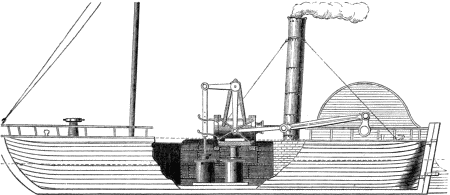
MACHINERY OF THE ‘CHARLOTTE DUNDAS.’
The first trial of the vessel was perfectly satisfactory. After making a trip to Glasgow, she was employed in towing vessels along the canal. She was also occasionally sent down the Frith to bring up ships detained by contrary winds to the canal entrance at Grangemouth.[375]
Fortune at length seemed to smile on poor Symington, and his spirits were proportionately elated at the result of these important experiments. He had, in fact, achieved a decided success in the ‘Charlotte Dundas,’—in which he combined together, for the first time, those improvements which constitute the present system of Steam Navigation. Indeed Mr. Woodcroft, a competent judge, says that “the vessel might, from the simplicity of its machinery, have been at work at this day with such ordinary repairs as are now occasionally required to all steamboats.”[376]
Lord Dundas was so well satisfied with the performances of the vessel that he proposed to introduce the inventor to the Duke of Bridgewater, the great canal proprietor, who had expressed to him his wish to employ some method of hauling his boats more effective than horse-power. His Lordship accordingly directed Symington to have a model of his steamboat constructed for the purpose of showing it to the Duke. Symington went up to London himself to explain its mechanical arrangements, and the Duke was so much pleased with it that he ordered eight boats of the same construction to be made as speedily as possible for use upon his canal. Symington returned to Scotland to proceed with the execution of this important order.
But in the moment of his apparent triumph fate again proved hostile to the inventor. Though Lord Dundas was fully satisfied with the performances of the ‘Charlotte Dundas,’ and hailed the use of steam as the beginning of a new era in navigation, the proprietors of the canal became seriously alarmed lest the banks should be washed away by the waves which the steamboat raised in its wake, and they came to the resolution of prohibiting all further experiments. To add to Symington’s vexation, the very same day on which this adverse decision of the canal managers reached him, he received intelligence of the death of the Duke of Bridgewater, and an order to suspend the erection of the eight steamboats until fresh instructions had been given. By this time Lord Dundas had expended about 7000l. on his experiments, and was not disposed to proceed any further with them. The ‘Charlotte Dundas,’ the first successful steamboat, was accordingly laid up at Bainsford, in a creek of the canal; and the attempt to introduce steam navigation on canals was from that time suspended.[377]
Symington’s experiments, though they proved most unfortunate as respected himself, nevertheless led to the adoption of the system of navigation by steam both in America and Scotland. Among the many visitors who inspected the ‘Charlotte Dundas’ were Fulton the American artist, and Andrew Bell the engineer, of Glasgow. Fulton was on board the first vessel in the month of July, 1801, when she made a run of eight miles on the Forth and Clyde Canal in an hour and twenty minutes; on which occasion he narrowly inquired into the action of the engine and paddle-wheels, and made careful sketches of the vessel and her machinery.[378] Andrew Bell also made frequent visits to the ‘Charlotte Dundas,’ as well as to the pattern shop where the models of the machinery were kept; and there is little doubt that, like Fulton, he obtained his ideas of steam navigation principally from what Symington had accomplished. Fulton and Bell were well acquainted with each other,[379] and kept up a correspondence on the subject of steamboats. Bell, according to his own account, supplied Fulton with information and drawings of steamboat machinery; and it was by his recommendation that Fulton ordered the engine for his first successful steamboat from Boulton and Watt.
With the information obtained at Grangemouth, Fulton proceeded to Paris, where we shortly find him in communication with Mr. Livingstone, the United States’ envoy, who, like Fulton, took much interest in the subject of steam navigation. They had a model steamboat built for trial on the Seine; but when on the point of making the first experiment, the weight of the machinery broke the boat in two, and the whole went down together. Fulton’s greatest difficulty, as was to be expected, consisted in finding a suitable engine to propel his proposed boat, and he wrote to his friends in England on the subject. In March, 1802, we find him addressing Dr. Cartwright, who had invented an improvement in the steam-engine, which he thought would render it more suitable for driving vessels, requesting to be informed of the cost of one of six horse power, with particulars of its size and weight. Fulton communicated to his correspondent that, besides his proposed steamboat, he was experimenting on his ‘Nautilus’ or diving-boat for navigating under water; the object of this invention being to blow up the English ships of war which were then blockading the French ports. The experiments with the ‘Nautilus’ under water were said to have proved tolerably successful, though it had not yet succeeded in blowing up any of the English ships.
Not being able to obtain any satisfactory information from Dr. Cartwright, Fulton addressed a letter to James Watt, jun., of Soho, requesting to be informed of the price of a light and compact engine for his proposed vessel. “The object of my investigation,” he said, “is to find whether it is possible to apply the engine to working boats up our long rivers in America. The persons who have made such attempts have commenced by what they call improving Watt’s engine, but without having an idea of the physics which lie hid in it from common observers; but such improvements have appeared to me like the improvements of the preceptor of Alcibiades, who corrected Homer for the use of his scholars. Their ill success, and their never having found a good mode of taking a purchase in the water, are the reasons why they have all failed. Having, during the course of my experiments on submersive navigation, found an excellent mode of taking a purchase on the water, I wish to apply the engine to the movement. The only thing wanting is to arrange the engine as light and compact as possible.”[380]
The information asked for was duly communicated to Fulton, and a few months later he sent Boulton and Watt the drawings of parts of an engine which he requested them to make for him. By this time the rumour had gone abroad of the destructive powers of the ‘Nautilus,’ and Lord Stanhope publicly called attention to the subject in the House of Lords, representing the dangerous character of the invention. On Fulton’s order reaching Soho, Boulton suspected that it might really be intended for the ‘Nautilus,’ and he at once communicated with Government on the subject. To Lord Hawkesbury he wrote,—
“I presume your Lordship is not unacquainted with the name of Fulton. I mean Fulton the engineer and pretended inventor of an infernal machine for destroying the British Navy. He is the same person whom Lord Stanhope alluded to in some of his speeches in the House of Peers.
“I never had any transaction or acquaintance with him. However, he has written to my house (Boulton and Watt) from Paris, and has transmitted drawings of sundry parts of a steam-engine. The remainder, he says, is to be executed under his own directions, and though he orders them to be shipped for America, it is not impossible but they may be transhipped before they reach there.
“The drawings and letter were delivered to my house in London-street by a Mr. Barlow; and as he refers to Sir Francis Baring for payment, I directed my agent (Mr. John Woodward) to call upon Sir Francis, and in consequence thereof he wrote to my house a letter, of which I enclose a correct copy as well as of Mr. Fulton’s.
“Whatever doubts we may have of his project, we have none respecting the propriety of acquainting your Lordship with every particular as to this matter that has come to our knowledge.”[381]
Boulton concluded by requesting instructions how to act; but all necessity for further caution was shortly after removed by Fulton coming over to England and imparting his secret to the British Government. An old Danish brig was placed at his disposal in Walmer Roads, and after two days’ effort, during which he was assisted by Sir Home Popham, he eventually succeeded in blowing up the vessel; but he accomplished his purpose with so much difficulty, that from that time no further fears were entertained of the much dreaded ‘Nautilus.’
In the following year the steam-engine ordered by Fulton for his proposed boat was proceeded with at Soho. It was of about nineteen horse power. The cylinder was 24 inches in diameter, and the stroke four feet. The dimensions were as nearly as possible the same as those of Symington’s ‘Charlotte Dundas’ engine; and Mr. Woodcroft pertinently remarks that “such similarity in the dimensions cannot easily be imagined to have been accidental.” The engine, when finished, was sent to America early in 1805. She was there fitted on board the vessel which had been prepared for her reception; and the first voyage of Fulton and Livingstone’s ‘Clermont’ was made in August, 1807, when a speed of nearly four miles an hour was attained. This was the first vessel that ran regularly for commercial purposes and for the benefit of her owners; and though Fulton neither invented the ship, nor the engine by which she was driven, nor the combination of the two, he was entitled to every merit for the perseverance and ability with which he carried his important enterprise to a successful issue.
A few years later Henry Bell, in like manner, introduced steam navigation on the Clyde. He had at an early period pressed the subject on the consideration of the Government, but failed to induce them to take up the scheme.[382] He then resolved himself to start a steamboat, as the best and most practical method of exhibiting its powers; and the ‘Comet,’ of thirty tons burthen, was built to his order by Messrs. John Wood and Company, of Port Glasgow. The vessel began to ply regularly between Glasgow and Greenock in August, 1812;[383] and before long Clyde steamers were known all over the world.
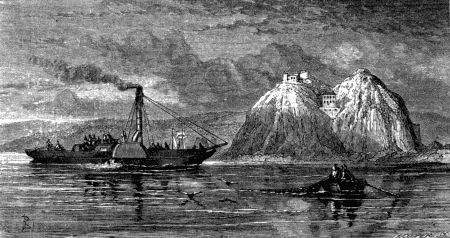
THE ‘COMET’ PASSING DUMBARTON.
[By R. P. Leitch.]
It will thus be observed how very gradual has been the invention of the steamboat. It has been made step by step, by many men living in many ages. First, we have Blasco Garay making experiments with paddle-wheels in the harbour of Barcelona three hundred years ago, the revival probably of some old and half-forgotten method of propelling ships; then the repetition of the experiment by Prince Rupert and Savery in the Thames more than a hundred and fifty years later; next Savery’s invention of his steam-engine, followed by Papin’s idea of combining the engine with the paddles, and his construction of a model to illustrate its practicability. Later, we have Jonathan Hulls’s patent for his steamboat, in which the engine was worked by atmospheric pressure, followed by numerous experiments with a like object, in England, France, and America. The invention of the condensing engine of Watt, and its application to rotary motions, was the next great step. Miller’s revival of the experiments with paddle-wheels led to the application by Symington of Papin’s idea of combining the steam-engine with the paddles, which he at length successfully worked out in the ‘Charlotte Dundas.’ And finally the invention was applied to practical purposes by Fulton and Livingstone in America, and by Bell in Scotland.
And thus became established, in the eloquent words of George Canning, “the new and mighty power, new at least in the application of its might, which walks the waters like a giant rejoicing in its course, stemming alike the tempest and the tide, accelerating intercourse, shortening distances, creating, as it were, unexpected neighbourhoods, and new combinations of social and commercial relations, and giving to the fickleness of winds and the faithlessness of waves the certainty and steadiness of a highway upon the land.” But it is a noteworthy fact, that it was not until the invention of James Watt was applied to the purposes of steam navigation that its practicability was established and its success secured. Until then, all the experiments which had been made were regarded as comparatively fruitless, though they were leading step by step to the great result; and to this day the engines constructed after Watt’s principle continue to be the great motive power alike of river and ocean navigation.
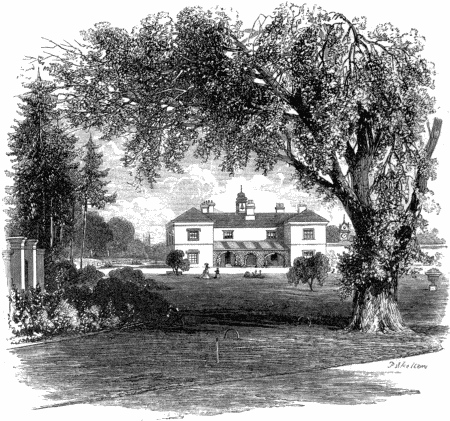
WATT’S HOUSE, HEATHFIELD.
[By Percival Skelton.]