Chapter IX · Birmingham—Matthew Boulton.
Reading edition
From an early period, Birmingham has been one of the principal centres of mechanical industry in England. The neighbourhood abounds in coal and iron, and has long been famous for the skill of its artisans. Swords were forged there in the time of the Ancient Britons. The first guns made in England bore the Birmingham mark. In 1538 Leland found “many smiths in the town that use to make knives and all manner of cutting tools, and many loriners that make bittes, and a great many nailers.” About a century later Camden described the place as “full of inhabitants, and resounding with hammers and anvils, for the most part of them smiths.” As the skill of the Birmingham artisans increased, they gradually gave up the commoner kinds of smithery, and devoted themselves to ornamental metal-work, in brass, steel, and iron. They became celebrated for their manufacture of buckles, buttons, and various fancy articles; and they turned out such abundance of toys that towards the close of last century Burke characterised Birmingham as “the great toy-shop of Europe.”
The ancient industry of Birmingham was of a staid and steady character, in keeping with the age. Each manufacturer kept within the warmth of his own forge. He did not go in search of orders, but waited for the orders to come to him. Ironmongers brought their money in their saddle-bags, took away the goods in exchange, or saw them packed ready for the next waggon before they left. Notwithstanding this quiet way of doing business, many comfortable fortunes were made in the place; the manufacturers, like their buttons, moving off so soon as they had received the stamp and the gilt. Hutton, the Birmingham bookseller, says he knew men who left the town in chariots who had first approached it on foot. Hutton himself entered the town a poor boy, and lived to write its history, and make a fortune by his industry.
Until towards the end of last century the town was not very easy of approach from any direction. The roads leading to it had become worn by the traffic of many generations. The hoofs of the pack-horses, helped by the rains, had deepened the tracks in the sandy soil, until in many places they were twelve or fourteen feet deep, so that it was said of travellers that they approached the town by sap. One of these old hollow roads, still called Holloway-head, though now filled up, was so deep that a waggon-load of hay might pass along it without being seen. There was no direct communication between Birmingham and London until about the middle of the century. Before then, the Great Road from London to Chester passed it four miles off, and the Birmingham manufacturer, when sending wares to London, had to forward his package to Castle Bromwich, there to await the approach of the packhorse train or the stage-waggon journeying south. The Birmingham men, however, began to wake up, and in 1747 a coach was advertised to run to London in two days “if the roads permit.” Twenty years later a stage-waggon was put on, and the communication by coach became gradually improved.
When Hutton entered Birmingham in 1740, he was struck by the activity of the place and the vivacity of the inhabitants, which expressed itself in their looks as he passed them in the streets. “I had,” he says, “been among dreamers, but now I saw men awake. Their very step showed alacrity. Every man seemed to know and to prosecute his own affairs.” The Birmingham men were indeed as alert as they looked—steady workers and clever mechanics—men who struck hard on the anvil. The artisans of the place had the advantage of a long training in mechanical skill. It had been bred in their bone, and descended to them from their fathers as an inheritance.[95] In no town in England were there then to be found so many mechanics capable of executing entirely new work; nor, indeed, has the ability yet departed from them, the Birmingham artisans maintaining their individual superiority in intelligent execution of skilled work to the present day. We are informed that inventors of new machines, foreign as well as English, are still in the practice of resorting to them for the purpose of getting their inventions embodied in the best forms, with greater chances of success than in any other town in England.
About the middle of last century the two Boultons, father and son, were recognised as among the most enterprising and prosperous of Birmingham manufacturers. The father of the elder Matthew Boulton was John Boulton of Northamptonshire, in which county Boultons or Boltons have been settled for a long period, and where there are records of many clergymen of the name. About the end of the seventeenth century, this John Boulton settled at Lichfield, where he married Elizabeth, heir of Matthew Dyott of Stitchbrooke, by whom he obtained considerable property. His means must, however, have become reduced; in consequence of which his son Matthew was sent to Birmingham to enter upon a career of business, and make his own way in the world. He became established in the place as a silver stamper and piecer, to which he added other branches of manufacture, which his son Matthew afterwards largely extended.
Matthew Boulton the younger was born at Birmingham on the 3rd September, 1728. Little is known of his early life, beyond that he was a bright, clever boy, and a general favourite with his companions. He received his principal education at a private academy at Deritend, kept by the Rev. Mr. Ansted, under whom he acquired the rudiments of a good ordinary English education. Though he left school early for the purpose of following his father’s business, he nevertheless continued the work of self-instruction, and afterwards acquired considerable knowledge of Latin and French, as well as of drawing and mathematics. But his chief pleasure was in pursuing the study of chemistry and mechanics, in which, as we shall shortly find, he became thoroughly accomplished. Long after he joined his father in business, he delighted to revert to his classical favourites. From an entry in his private memorandum-book of expenses at the age of about thirty, though then very economical in other respects, we find him expending considerable sums in experiments on electricity, and on one occasion laying out a guinea on a copy of Virgil, from which it appears that trade had not spoilt his taste for either science or letters.
Young Boulton appears to have engaged in business with much spirit. By the time he was seventeen he had introduced several important improvements in the manufacture of buttons, watch-chains, and other trinkets; and he had invented the inlaid steel buckles which shortly after became the fashion. These buckles were exported in large quantities to France, from whence they were brought back to England and sold as the most recent productions of French ingenuity. The elder Boulton, having every confidence in his son’s discretion and judgment, adopted him as a partner so soon as he came of age, and from that time forward he took almost the entire management of the concern. Although in his letters he signed “for father and self,” he always spoke in the first person of matters connected with the business. Thus, in 1757, we find him writing to Timothy Holles, London, as to the prices of “coat-link and vest buttons,” intimating that to lower them would be to beat down price and quality until it became no business at all; “yet,” said he, “as I have put myself to greater expense than anybody else in erecting the best conveniences and the completest tools for the purpose, I am not willing that any interlopers should run away with it.” We find him at the same time carrying on a correspondence with Benjamin Huntsman, of Sheffield, the celebrated inventor of cast-steel.[96] On the 19th January, 1757, he sends Huntsman “a parcel of goods of the newest patterns,” and at the same time orders a quantity of Huntsman’s steel. “When thou hast some of a proper size and quality for me, and an opportunity of sending it, thou may’st, but I should be glad to have it a little tougher than the last.” He concludes—“I hope thy Philosophic Spirit still laboureth within thee, and may it soon bring forth Fruit useful to mankind, but more particularly to thyself, is the sincere wish of Thy Obliged Friend.” With a view to economy, Boulton in course of time erected a steel-house of his own for the purpose of making steel; and he frequently used it to convert the cuttings and scraps of the small iron wares which he manufactured, into ordinary steel, afterwards melting and converting it into cast-steel in the usual way.
From the earliest glimpses we can get of Boulton as a man of business, it would appear to have been his aim to be at the top of whatsoever branch of manufacture he undertook. He endeavoured to produce the best possible articles in regard of design, material, and workmanship. Taste was then at a low ebb, and “Brummagem” had become a byword for everything that was gaudy, vulgar, and meretricious. Boulton endeavoured to get rid of this reproach, and aimed at raising the standard of taste in manufacture to the highest point. With this object, he employed the best artists to design his articles, and the cleverest artisans to manufacture them. Apart from the question of elevating the popular taste, there can be no doubt that this was good policy on his part, for it served to direct public attention to the superior and honest quality of the articles produced by his firm, and eventually brought him a large accession of business.
In 1759, Boulton’s father died, bequeathing to him the considerable property which he had accumulated by his business. The year following, when thirty-two years of age, Matthew married Anne, the daughter of Luke Robinson, Esq., of Lichfield. The lady was a distant relation of his own; the Dyotts of Stitchbrooke, whose heir his grandfather had married, being nearly related to the Babingtons of Curborough, from whom Miss Robinson was lineally descended—Luke Robinson having married the daughter and co-heir of John Babington of Curborough and Patkington. Considerable opposition was offered to the marriage by the lady’s friends, on account of Matthew Boulton’s occupation; but he pressed his suit, and with good looks and a handsome presence to back him, he eventually succeeded in winning the heart and hand of Anne Robinson. He was now, indeed, in a position to have retired from business altogether. But a life of inactivity had no charms for him. He liked to mix with men in the affairs of active life, and to take his full share in the world’s business. Indeed, he hated ease and idleness, and found his greatest pleasure in constant occupation.
Instead, therefore, of retiring from trade, he determined to engage in it more extensively. He entertained the ambition of founding a manufactory that should be the first of its kind, and serve as a model for the manufacturers of his neighbourhood. His premises on Snow-hill,[97] Birmingham, having become too small for his purpose, he looked about him for a suitable spot on which to erect more commodious workshops; and he was shortly attracted by the facilities presented by the property afterwards so extensively known as the famous Soho.
Soho is about two miles north of Birmingham, on the Wolverhampton road. It is not in the parish of Birmingham, nor in the county of Warwick, but just over the border, in the county of Stafford. Down to the middle of last century the ground on which it stands was a barren heath, used only as a rabbit-warren. The sole dwelling on it was the warrener’s hut, which stood near the summit of the hill, on the spot afterwards occupied by Soho House; and the warrener’s well is still to be found in one of the cellars of the mansion. In 1756, Mr. Edward Ruston took a lease of the ground for ninety-nine years from Mr. Wyerley, the lord of the manor, with liberty to make a cut about half a mile in length for the purpose of turning the waters of Hockley Brook into a pool under the brow of the hill. The head of water thus formed was used to drive a feeble mill below, which Mr. Ruston had established for laminating metals. He also built a small dwelling-house about 150 yards from the mill, and expended upon the place a sum of about 1000l. in all. When Mr. Boulton was satisfied that the place would suit his purpose, he entered into arrangements with Mr. Ruston for the purchase of his lease,[98] on the completion of which he proceeded to rebuild the mill on a large scale, and in course of time removed thither the whole of his tools, machinery, and workmen. The new manufactory, when finished, consisted of a series of roomy workshops conveniently connected with each other, and capable of accommodating upwards of a thousand workmen. The building and stocking of the premises cost upwards of 20,000l.
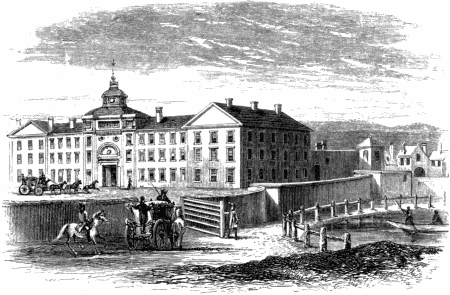
SOHO MANUFACTORY.
Before removing to Soho, Mr. Boulton took into partnership Mr. John Fothergill, with the object of more vigorously extending his business operations. Mr. Fothergill possessed a very limited capital, but he was a man of good character and active habits of business, with a considerable knowledge of foreign markets. On the occasion of his entering the concern, stock was taken of the warehouse on Snow Hill; and some idea of the extent of Boulton’s business at the time may be formed from the fact, that his manager, Mr. Zaccheus Walker, assisted by Farquharson, Nuttall, Frogatt, and half-a-dozen labourers, were occupied during eight days in weighing metals, counting goods, and preparing an inventory of the effects and stock in trade. The partnership commenced at midsummer, 1762, and shortly after the principal manufactory was removed to Soho.
Steps were immediately taken to open up new connexions and agencies at home and abroad; and a large business was shortly established with many of the principal towns and cities of Europe, in filagree and inlaid work, livery and other buttons, buckles, clasps, watch-chains, and various kinds of ornamental metal wares. The firm shortly added the manufacture of silver plate and plated goods to their other branches,[99] and turned out large quantities of candlesticks, urns, brackets, and various articles in ormolu. The books of the firm indicate the costly nature of their productions, 500 ounces of silver being given out at a time, besides considerable quantities of gold and platina for purposes of fabrication. Boulton himself attended to the organization and management of the works and to the extension of the trade at home, while Fothergill devoted himself to establishing and superintending the foreign agencies.
From the first, Boulton aimed at establishing a character for the excellence of his productions. They must not only be honest in workmanship, but tasteful in design. He determined, so far as in him lay, to get rid of the “Brummagem” reproach. Thus we find him writing to his partner from London:—“The prejudice that Birmingham hath so justly established against itself makes every fault conspicuous in all articles that have the least pretensions to taste. How can I expect the public to countenance rubbish from Soho, while they can procure sound and perfect work from any other quarter?”
He frequently went to town for the express purpose of reading and making drawings of rare works in metal in the British Museum, sending the results down to Soho. When rare objects of art were offered for sale, he endeavoured to secure them. “I bid five guineas,” he wrote his partner on one occasion, “for the Duke of Marlborough’s great blue vase, but it sold for ten.... I bought two bronzed figures, which are sent herewith.” He borrowed antique candlesticks, vases, and articles in metal from the Queen and from various members of the nobility. “I wish Mr. Eginton,” he wrote, “would take good casts from the Hercules and the Hydra, and then let it be well gilt and returned with the seven vases; for ’tis the Queen’s. I perceive we shall want many such figures, and therefore we should omit no opportunity of taking good casts.” The Duke of Northumberland lent Boulton many of his most highly-prized articles for imitation by his workmen. Among his other liberal helpers in the same way, we find the Duke of Richmond, Lord Shelburne, and the Earl of Dartmouth. The Duke gave him an introduction to Horace Walpole, for the purpose of enabling him to visit and examine the art treasures of Strawberry Hill. “The vases,” said he, in writing to Boulton, “are, in my opinion, better worth your seeing than anything in England, and I wish you would have exact drawings of them taken, as I may very possibly like to have them copied by you.” Lord Shelburne’s opinion of Boulton may be gathered from his letter to Mr. Adams, the architect, in which he said:—“Mr. Boulton is the most enterprising man in different ways in Birmingham, and is very desirous of cultivating Mr. Adams’s taste in his productions, and has bought his Dioclesian by Lord Shelburne’s advice.”
Boulton, however, did not confine himself to England; he searched the Continent over for the best specimens of handicraft as models for imitation; and when he found them he strove to equal, if not to excel them in style and quality. He sent his agent, Mr. Wendler, on a special mission of this sort, to Venice, Rome, and other Italian cities, to purchase for him the best specimens of metal-work, and obtain for him designs of various ornaments—vases, cameos, intaglios, and statuary. On one occasion we find Wendler sending him 456 prints, Boulton acknowledging that they will prove exceedingly useful for the purposes of his manufacture. At the same time, Fothergill was travelling through France and Germany with a like object, while he was also establishing new connexions with a view to extended trade.[100]
While Boulton was ambitious of reaching the highest excellence in his own line of business, he did not confine himself to that, but was feeling his way in various directions outside of it. Thus to his friend Wedgwood he wrote on one occasion, that he admired his vases so much that he “almost wished to be a potter.” At one time, indeed, he had serious thoughts of beginning the fictile manufacture; but he rested satisfied with mounting in metal the vases which Wedgwood made. “The mounting of vases,” he wrote, “is a large field for fancy, in which I shall indulge, as I perceive it possible to convert even a very ugly vessel into a beautiful vase.”[101]
Another branch of business that he sought to establish was the manufacture of clocks. It was one of his leading ideas, that articles in common use might be made much better and cheaper if manufactured on a large scale with the help of the best machinery; and he thought this might be successfully done in the making of clocks and timepieces. The necessary machinery was erected accordingly, and the new branch of business was started. Some of the timepieces were of an entirely novel arrangement. One of them, invented by Dr. Small, contained but a single wheel, and was considered a piece of very ingenious construction. Boulton also sought to rival the French makers of ornamental timepieces, by whom the English markets were then almost entirely supplied; and some of the articles of this sort turned out by him were of great beauty. One of his most ardent encouragers and admirers, the Hon. Mrs. Montagu, wrote to him,—“I take greater pleasure in our victories over the French in the contention of arts than of arms. The achievements of Soho, instead of making widows and orphans, make marriages and christenings. Your noble industry, while elevating the public taste, provides new occupations for the poor, and enables them to bring up their families in comfort. Go on, then, sir, to triumph over the French in taste, and to embellish your country with useful inventions and elegant productions.”
Boulton’s efforts to improve the industrial arts did not, however, always meet with such glowing eulogy as this. Two of his most highly finished astronomical clocks could not find purchasers at his London sale; on which he wrote to his wife at Soho, “I find philosophy at a very low ebb in London, and I have therefore brought back my two fine clocks, which I will send to a market where common sense is not out of fashion. If I had made the clocks play jigs upon bells, and a dancing bear keeping time, or if I had made a horse-race upon their faces, I believe they would have had better bidders. I shall therefore bring them back to Soho, and some time this summer will send them to the Empress of Russia, who, I believe, would be glad of them.”[102] During the same visit to London, he was more successful with the king and queen, who warmly patronised his productions. “The king,” he wrote to his wife, “hath bought a pair of cassolets, a Titus, a Venus clock, and some other things, and inquired this morning how yesterday’s sale went. I shall see him again, I believe. I was with them, the queen and all the children, between two and three hours. There were, likewise, many of the nobility present. Never was man so much complimented as I have been; but I find that compliments don’t make fat nor fill the pocket. The queen showed me her last child, which is a beauty, but none of ’em are equal to the General of Soho or the fair Maid of the Mill.[103] God bless them both, and kiss them for me.”
In another letter he described a subsequent visit to the palace. “I am to wait upon their majesties again so soon as our Tripod Tea-kitchen arrives, and again upon some other business. The queen, I think, is much improved in her person, and she now speaks English like an English lady. She draws very finely, is a great musician, and works with her needle better than Mrs. Betty. However, without joke, she is extremely sensible, very affable, and a great patroness of English manufactures. Of this she gave me a particular instance; for, after the king and she had talked to me for nearly three hours, they withdrew, and then the queen sent for me into her boudoir, showed me her chimneypiece, and asked me how many vases it would take to furnish it; ‘for,’ said she, ‘all that china shall be taken away.’ She also desired that I would fetch her the two finest steel chains I could make. All this she did of her own accord, without the presence of the king, which I could not help putting a kind construction upon.”[104]
Thus stimulated by royal and noble patronage, Boulton exerted himself to the utmost to produce articles of the highest excellence. Like his friend Wedgwood, he employed Flaxman and other London artists to design his choicer goods; but he had many foreign designers and skilled workmen, French and Italian, in his regular employment. He attracted these men by liberal wages, and kept them attached to him by kind and generous treatment. On one occasion we find the Duke of Richmond applying to him to recommend a first-class artist to execute some special work in metal for him. Boulton replies that he can strongly recommend one of his own men, an honest, steady workman, an excellent metal turner. “He hath made for me some exceeding good achromatic telescopes [another branch of Boulton’s business].... I give him two guineas a week and a house to live in. He is a Frenchman, and formerly worked with the famous M. Germain; he afterwards worked for the Academy of Sciences at Berlin, and he hath worked upwards of two years for me.”[105]
Before many years had passed, Soho was spoken of with pride, as one of the best schools of skilled industry in England. Its fame extended abroad as well as at home, and when distinguished foreigners came into England, they usually visited Soho as one of the national sights. When the manufactory was complete[106] and in full work, Boulton removed from his house on Snow-hill to the mansion of Soho, which he had by this time considerably enlarged and improved. There he continued to live until the close of his life, maintaining a splendid hospitality. Men of all nations, and of all classes and opinions, were received there by turns,—princes, philosophers, artists, authors, merchants, and poets. In August, 1767, while executing the two chains for the queen, we find him writing to his London agent as his excuse for a day’s delay in forwarding it: “I had lords and ladies to wait on yesterday; I have French and Spaniards to-day; and to-morrow I shall have Germans, Russians, and Norwegians.” For many years the visitors at Soho House were so numerous and arrived in such constant succession, that it more resembled an hotel than a private mansion.
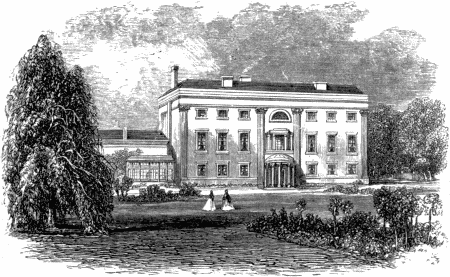
SOHO HOUSE.
The rapid extension of the Soho business necessarily led to the increase of the capital invested in it. Boulton had to find large sums of money for increased stock, plant, and credits. He raised 3000l. on his wife’s estate; he borrowed 5000l. from his friend Baumgarten; and he sold considerable portions of the property left him by his father, by which means he was enabled considerably to extend his operations. There were envious busybodies about who circulated rumours to his discredit, and set the report on foot, that to carry on a business on so large a scale would require a capital of 80,000l. “Their evil speaking,” said he to a correspondent, “will avail but little, as our house is founded on so firm a rock that envy and malice will not be able to shake it; and I am determined to spare neither pains nor money to establish such a house as will acquire both honour and wealth.” The rapid strides he was making may be inferred from the statement made to the same correspondent, which showed that the gross returns of the firm, which were 7000l. in 1763, had advanced to 30,000l. in 1767, with orders still upon the increase.
Though he had a keen eye for business, Boulton regarded character more than profit. He would have no connexion with any transaction of a discreditable kind. Orders were sent to him from France for base money, but he spurned them with indignation. “I will do anything,” he wrote to M. Motteaux, his Paris agent, “short of being common informer against particular persons, to stop the malpractices of the Birmingham coiners.” He declared he was as ready to do business on reasonable terms as any other person, but he would not undersell; “for,” said he, “to run down prices would be to run down quality, which could only have the effect of undermining confidence, and eventually ruining trade.” His principles were equally honourable as regarded the workmen of rival employers. “I have had many offers and opportunities,” he said to one, “of taking your people, whom I could, with convenience to myself, have employed; but it is a practice I abhor. Nevertheless, whatever game we play at, I shall always avail myself of the rules with which ’tis played, or I know I shall make but a very indifferent figure in it.”[107]
He was frequently asked to take gentlemen apprentices into his works, but declined to receive them, though hundreds of pounds’ premium were in many cases offered with them. He preferred employing the humbler class of boys, whom he could train up as skilled workmen. He was also induced to prefer the latter for another reason, of a still more creditable kind. “I have,” said he, in answer to a gentleman applicant, “built and furnished a house for the reception of one kind of apprentices—fatherless children, parish apprentices, and hospital boys; and gentlemen’s sons would probably find themselves out of place in such companionship.”
While occupied with his own affairs, and in conducting what he described as “the largest hardware manufactory in the world,” Boulton found time to take an active part in promoting the measures then on foot for opening up the internal navigation of the country. He was a large subscriber to the Grand Trunk and Birmingham Canal schemes, the latter of which was of the greater importance to him personally, as it passed close by Soho, and thus placed his works in direct communication both with London and the northern coal and manufacturing districts.[108]
Coming down to a few years later, in 1770, we find his business still growing, and his works and plant absorbing still more capital, principally obtained by borrowing. In a letter to Mr. Adams, the celebrated architect, requesting him to prepare the design of a new sale-room in London, he described the manufactory at Soho as in full progress, from 700 to 800 persons being employed as metallic artists and workers in tortoiseshell, stones, glass, and enamel. “I have almost every machine,” said he, “that is applicable to those arts; I have two water-mills employed in rolling, polishing, grinding, and turning various sorts of lathes. I have trained up many, and am training up more plain country lads into good workmen; and wherever I find indications of skill and ability, I encourage them. I have likewise established correspondence with almost every mercantile town in Europe, and am thus regularly supplied with orders for the grosser articles in common demand, by which I am enabled to employ such a number of hands as to provide me with an ample choice of artists for the finer branches of work; and I am thereby encouraged to erect and employ a more extensive apparatus than it would be prudent to provide for the production of the finer articles only.”
It is indeed probable—though Boulton was slow to admit it—that he had been extending his business more rapidly than his capital would conveniently allow; for we find him becoming more and more pressed for means to meet the interest on the borrowed money invested in buildings, tools, and machinery. He had obtained 10,000l. from a Mr. Tonson of London; and on the death of that gentleman, in 1772, he had considerable difficulty in raising the means to pay off the debt. His embarrassment was increased by a serious commercial panic, aggravated by the failure of Fordyce brothers, by which a considerable sum deposited with them remained locked up for some time, and he was eventually a loser to the extent of 2000l. Other failures and losses followed; and trade came almost to a standstill. Yet he bravely held on. “We have a thousand mouths at Soho to feed,” he says; “and it has taken so much labour and pains to get so valuable and well-organised a staff of workmen together, that the operations of the manufactory must be carried on at whatever risk.” He continued to receive distinguished visitors at his works. “Last week,” he wrote Mr. Ebbenhouse, “we had Prince Poniatowski, nephew of the King of Poland, and the French, Danish, Sardinian, and Dutch Ambassadors; this week we have had Count Orloff, one of the five celebrated brothers who are such favourites with the Empress of Russia; and only yesterday I had the Viceroy of Ireland, who dined with me. Scarcely, a day passes without a visit from some distinguished personage.”
Besides carrying on the extensive business connected with his manufactory at Soho, this indefatigable man found time to prosecute the study of several important branches of practical science. It was scarcely to be supposed that he had much leisure at his disposal; but in life it often happens that the busiest men contrive to find the most leisure; and he who is “up to the ears” in work, can, nevertheless, snatch occasional intervals to devote to inquiries in which his heart is engaged. Hence we find Boulton ranging at intervals over a wide field of inquiry; at one time studying geology, and collecting fossils, minerals, and specimens for his museum; at another, reading and experimenting on fixed air; and at another studying Newton’s works with the object of increasing the force of projectiles.[109] But the subject which perhaps more than all interested him was the improvement of the Steam Engine, which shortly after led to his introduction to James Watt.