Chapter XX · Prosperity of Soho—Young Boulton and Watt—The Riots—William Murdock.
Reading edition
The steam-engine had now become firmly established as a working power. Beginning as a water pumper for miners, it had gradually been applied to drive corn and cotton mills, to roll and hammer iron, to coin money, to work machinery, and to perform the various labour in which the power of men and horses, of wind and water, had before been employed. The numerous orders for new engines which came in at Soho kept the works increasingly busy. Many skilled workmen had by this time been trained into expertness and dexterity; and, being kept to their special departments of work,—fathers training their sons to work with them at the same benches,—a degree of accuracy and finish was reached which contributed to establish and maintain the prestige of the manufactory. The prosperity of the firm was also materially promoted by the able assistants who had been trained at Soho, and were in due time promoted to superintend special departments of the business. Among these were Murdock, Walker, Southern, Ewart, and Lawson, who enjoyed the fullest confidence of their chiefs, and repaid it with unswerving loyalty.
When the concern had become thoroughly organised under these able heads of departments, Boulton and Watt began to breathe more freely. Their financial difficulties had now disappeared, and instead of laying out capital, they had begun to accumulate it. They had laboured hard for their reward and richly earned it; and after their long up-hill struggle, they well deserved rest and peace at last. They now began to take occasional journeys of recreation, with which they varied their journeys of business. Thus, in the autumn of 1789, we find Boulton making a tour in Derbyshire, during which he was overtaken at Buxton by a letter from the Lords of the Privy Council on coining business, giving him “marching orders for London;” but a party having been formed to visit the Peak Cavern, he decided “to obey the Ladies rather than the Lords.” Three days later, however, we find him in London, “writing in a full chattering coffee-house at Charing Cross,” and desiring his friend Mr. Barrow to pay his respects to the ladies whom he had so hurriedly left. While in London, he received a letter inviting him to pay a visit to Holland and stand godfather to his friend Mr. Hoofletter’s son; to which he replied, that he would be glad to stand godfather to the boy and have the name of Boulton associated with an honest race, but was sorry that he could not assist at the christening or at the dinner. “But pray act for me,” he added; “do everything that’s proper (as is the custom in the country); give the nurse five guineas from me, and I will repay you. My best respects to Mrs. Hoofletter, and my blessing on the young Christian.”
Watt’s troubles and anxieties also were in course of gradual abatement. Though still suffering from headaches, asthma, and low spirits, he seems on the whole to have become more satisfied with his lot. Prosperity agreed with him as it does with most people. It is a condition easy to bear, and Watt took to it kindly. As years passed over his head, he became placid, contented, and even cheerful. His health improved, and he enjoyed life in his old age as he had never done in his youth. He ceased longing for the rest of the grave, and gave over “cursing his inventions.” On the other hand, he took pleasure in looking back over the long and difficult road he had traversed, and in recounting the various steps by which he had perfected his great inventions. Nor did he cease to invent; for he went on inventing new things to the close of his life; but he followed the pursuit as a recreation and delight, and not as a business and a drudgery.
Watt too, like his partner, began to make tours of pleasure, for the purpose at the same time of gathering health and seeing the beauties of nature. In August, 1789, he wrote Boulton from Cheltenham, that he had been making a delightful journey through the Western Counties, by way of Worcester, Malvern, Hereford, and Chepstow, and that he felt in better health and spirits than he had been for a very long time. Occasional letters reached him from Birmingham about orders received for engines, nothing being done without first consulting him. That the concern was thriving, may be inferred from the comparative indifference with which he now regarded such orders. An engine having been ordered by a doubtful person, Watt wrote—“I look upon such orders as of little value. They are so precarious in their duration, and in this case there is risk of bad payment or swindling. Whatever care we take, he is like a shaved pig with a soaped tail.” On a demand being made upon him for abatement of dues, he wrote—“We have never made concessions to anybody but they have been attended with loss to us and half a dozen more; and it would appear that, if our patent lasted long enough, the power of a horse would grow to that of an elephant.”[328]
In the course of the following summer, Watt visited the pleasantest spots in the neighbourhood of London, and amongst other places took Windsor in his way, where he had the honour of an interview with the King. He had already met his Majesty at Whitbread’s brewery in the early part of 1787, for the purpose of explaining to him the action of the new rotary engine; and the King had expressed the desire to see him again when in the neighbourhood of Windsor. The following is Watt’s brief account of the visit:—
“At Windsor I had a short conversation with the King. He never mentioned you nor the coinage, nor anything that led to it; therefore I could not bring it on; nor do I believe it could have been of any service. He asked about engines, and how the Albion mill was going on?—Answer: Very well in respect to grinding, but not so well in regard to the trade. Asked: Who was the manager?—Answer: Mr. J. Wyatt, who made the wooden hospitals. He observed, that Wyatt was not bred to the milling business; how had he learnt it?—Answer: That he was a man of ability and observation. Asked: What sort of engines were we making?—Answer: For almost everything, but at present principally for brewers, distillers, cotton-spinners, iron-men, &c.—Asked: How we were paid for them?—Answer: By horses power, 5l. a year in the country, and that we made none under four-horses power.—Asked: If these premiums afforded sufficient profit?—Answer: That they did in large engines, but not in small.”[329]
As Boulton and Watt advanced in years they looked forward with pleasure to the prospect of their two eldest sons—Matthew Robinson Boulton and James Watt, junior—joining them in the business they had established, and relieving them of the greater part of their anxieties and labours in connexion with it. Both were young men of intelligence and character, carefully educated, good linguists, and well versed in practical science. We find many references to the education of the two young men in the letters of Boulton; few or none in those of Watt. The former alike attracted young people and was attracted by them, entering heartily into their pursuits; the latter was too much absorbed by study, by inventions, and by business, to spare time for the purpose. Besides, he was, like his countrymen generally, reserved and undemonstrative in all matters relating to the feelings and affections.
Both boys were trained and educated so as to follow in their fathers’ steps. Every pain was taken to give them the best culture, and to imbue them with the soundest principles. The two boys usually spent their holidays together at Soho; and, growing up together, they learnt to think, and feel, and work together.
“Jim returns to school this evening,” wrote Boulton, to Watt in Cornwall; “he has behaved exceedingly well, and not a single bill of indictment has been found against him. He had got it into his head that he would not be an engineer, which I did not contradict, but I gave him and Matt the small wooden water-wheel, which they proceeded to erect below my duck-pond, and there worked a forge; but not having water enough, necessity has put them upon erecting a Savery’s engine, which is not yet finished, though they are both exceedingly keen upon it. We have killed many poor robins by pouring fixable air upon them, and had some amusement in our electrical and chemical hobby-horsery, which the young ones like much better than dry Latin. Jim desires me to ask you to give him leave to learn French.”
At the same time Boulton’s own son was making good progress under the Rev. Mr. Stretch, to whom Boulton wrote,—
“Baron Reden has gone to the North. On his return, he will leave his son with you for a year or two, and then invites Matt to return with him to Germany. Youth is the time to learn languages, and the Baron’s offer is certainly a great temptation ... let him [Matt] not neglect the present, but apply himself so as to become well grounded in Grammar and Latin ... he is capable, but not of close application, to which he must be inured, as no proficiency of any kind can be acquired without it.”
The Baron’s offer was not, however, accepted; but desirous that his son should acquire proficiency in French, Boulton took him over to Paris, towards the end of 1786, and placed him under a competent master. Many kindly letters passed between father and son during the latter’s stay at Paris. The young man spent rather more money than his father thought could do him good. He therefore asked him to keep an account of his personal expenses, which “must balance exactly,” and implored him above all things to “keep out of bad company.”
“The future reputation and happiness of your life,” wrote the anxious father, “depend upon your present conduct. I must therefore insist that you do not go strolling about Sodom and Gomorrah under any pretence whatever.... It will not be pleasant to you to read this, but I must do my duty to you or I shall not satisfy my own conscience. I therefore hope you will do your duty to yourself, or you cannot do it to me. There is nothing on earth I so much wish for as to make you a man, a good man, a useful man, and consequently a happy man.”[330]
The father’s anxieties abated with time; the son applied himself assiduously to French and German, and gave promise of becoming a man of ability and character. Writing to his friend Matthews, Boulton said—“Matt is a tolerable good chemist.... He hath behaved very well, and I shall be glad when the time arrives for him to assist me in the business.” In the summer of 1788, young Boulton paid his father a holiday visit at Soho, returning again to Paris to finish his studies. Writing of his departure, to Matthews in London, the father said—“I hope that my son is set off for Dover: my heart overflows with blessings and love to him.”[331]
The education of young Watt was equally well cared for. After leaving school at Birmingham, his father sent him for a year to Mr. Wilkinson’s ironworks at Bersham, to learn carpentry in the pattern shop.[332] He then returned to his father’s, from whence he was sent to school at Geneva, where he remained for three years perfecting himself in the modern languages. On his return to England in 1788, we find Boulton writing to Mr. Barrow of Manchester, asking him to obtain a position for young Watt in some respectable counting-house, with a view to his acquiring a thorough commercial training. He was eventually placed in the house of Messrs. Taylor and Maxwell, where he remained for about two years, improving himself in his knowledge of business affairs. His father’s reputation and standing, as well as his own education and accomplishments, served to introduce the young gentleman to many friends in Manchester; and, although far from extravagant in his habits, he shortly found that the annual sum allowed him by his father was insufficient to pay for his board, clothing, and lodging, and at the same time enable him to keep clear of debt. Knowing Boulton’s always open hand and heart, and his sympathy for young people, the embarrassed youth at once applied to him for help. Why he did not apply to his father will be best understood from his own letter:—
“I am at this moment,” he explained, “on the best footing possible with my father, but were I to inform him of my necessities, I do not know what would be the consequence. Not that I suppose the money in itself would be an object to him, but because he would look upon it in the light of encouraging what he would call my extravagances. Never having been a young man himself, he is unacquainted with the inevitable expenses which attend my time of life, when one is obliged to keep good company, and does not wish to act totally different from other young men. My father’s reputation, and his and my own station in life, require that I should live at least on a decent footing. I am not conscious of having committed any foolish extravagances, and I have avoided company as much as possible; but I have also constantly avoided the reputation of avarice, or of acting meanly on any occasion. My father, unfortunately for me, measures the present times and circumstances by those when he was of my age, without making the proper allowances for their immense disparity; consequently it is in vain for me to endeavour to convince him of the necessity of my conduct.”[333]
He concluded by expressing his sense of Mr. Boulton’s many friendly acts towards him, and confessing that there was no other person on whom he could so confidently rely for help in his emergency. The reply of Boulton was all that he could desire. With sound fatherly advice,[334] such as he would have given to his own son under similar circumstances, he sent him a draft for 50l., the amount required by young Watt to clear him of his debts.
Among the friendships which he formed at Manchester, was one of an intimate character with Mr. Cooper, a gentleman engaged in an extensive business, fond of books, and a good practical chemist. We find young Watt requesting Boulton to recommend to Mr. Cooper “a person to keep his library in order and to make experiments for him, he not having time enough to attend to the details of them himself.”[335] Cooper was besides a keen politician, and took an active interest in the discussion of the important questions then agitating the public mind. Watt was inflamed by the enthusiasm of his friend, and with the ardour of youth entered warmly into his views as to the regeneration of man and the reconstruction of society.
Mrs. Schimmelpenninck has, in her autobiography, given a vivid picture of the interest excited in the circle of friends amongst whom she moved, by the thrilling events then occurring in France, and which extended even to the comparatively passionless philosophers of the Lunar Society. At one of the meetings held at her father’s house in the summer of 1788 “Mr. Boulton,” she says, “presented to the company his son, just returned from a long sojourn at Paris. I well remember my astonishment at his full dress in the highest adornment of Parisian fashion; but I noticed, as a remarkable thing, that the company (which consisted of some of the first men in Europe) all with one accord gathered round him, and asked innumerable questions, the drift of which I did not fully understand. It was wonderful to me to see Dr. Priestley, Dr. Withering, Mr. Watt, Mr. Boulton himself, and Mr. Keir, manifest the most intense interest, each according to his prevailing characteristics, as they almost hung upon his words; and it was impossible to mistake the indications of deep anxiety, hope, fear, curiosity, ardent zeal, or thoughtful gravity, which alternately marked their countenances, as well as those of my own parents. My ears caught the words ‘Marie Antoinette,’ ‘The Cardinal de Rohan,’ ‘diamond necklace,’ ‘famine,’ ‘discontent among the people,’ ‘sullen silence instead of shouts of “Vive le Roi!”’ All present seemed to give a fearful attention. Why, I did not then well know, and, in a day or two, these things were almost forgotten by me; but the rest of the party heard, no doubt, in this young man’s narrative, the distant, though as yet faint rising of the storm which, a year later, was to burst upon France and, in its course, to desolate Europe.”[336] A few short months passed, and the reign of brotherhood began. “One evening, towards the end of July,” continues Mrs. Schimmelpenninck, “we saw at a distance a vehicle (usually employed to carry servants to town or church) returning at more than its usual speed. After some minutes the door of the drawing-room opened, and in burst Harry Priestley, a youth of sixteen or seventeen, waving his hat, and crying out, ‘Hurrah! Liberty, Reason, brotherly love for ever! Down with kingcraft and priestcraft. The majesty of the people for ever! France is free, the Bastille is taken!’”[337] “I have seen,” she adds, “the reception of the victory of Waterloo and of the carrying of the Reform Bill; but I never saw joy comparable in its intensity and universality to that occasioned by the early promise of the French Revolution.”
The impressionable mind of Dr. Priestley was moved in an extraordinary degree by the pregnant events which followed each other in quick succession at Paris; and he entered with zeal into the advocacy of the doctrines of liberty, equality, and fraternity, so vehemently promulgated by the French “friends of man.” His chemical pursuits were for a time forgotten, and he wrote and preached like one possessed, of human brotherhood, and of the downfall of tyranny and priestcraft. He hailed with delight the successive acts of the National Assembly abolishing monarchy, nobility, church, corporations, and other long established institutions. He had already been long and hotly engaged in polemical discussions with the local clergy on disputed points of faith; and now he addressed a larger audience in a work which he published in answer to Mr. Burke’s famous attack on the ‘French Revolution.’ Burke, in consequence, attacked him in the House of Commons; while the French Revolutionists on the other hand hailed him as a brother, and admitted him to the rights of French citizenship.[338]
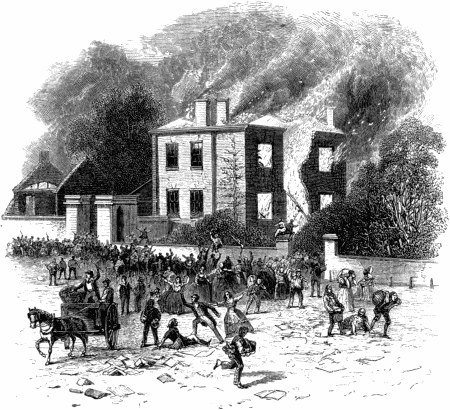
BURNING OF DR. PRIESTLEY’S HOUSE AT FAIRHILL.[339]
These proceedings concentrated on Dr. Priestley an amount of local exasperation that shortly after burst forth in open outrage. On the 14th of July, 1791, a public dinner was held at the principal hotel to celebrate the second anniversary of the French Revolution. About eighty gentlemen were present, but Priestley was not of the number. A mob collected outside, and after shouting “Church and King,” they proceeded to demolish the inn windows. The magistrates shut their eyes to the riotous proceedings, if they did not actually connive at them. A cry was raised, “To the New Meeting-house,” the chapel in which Priestley ministered; and thither the mob surged. The door was at once burst open, and the place set on fire. They next gutted the old Meeting-house, and made a bonfire of the pews and bibles in the burying-ground. It was growing dusk, but the fury of the mob had not abated. They made at once for Dr. Priestley’s house at Fairhill, about a mile and a half distant. The Doctor and his family had escaped about half an hour before their arrival; and the house was at their mercy. They broke in at once, emptied the cellars, smashed the furniture, tore up the books in the library, destroyed the philosophical and chemical apparatus in the laboratory, and ended by setting fire to the house. The roads for miles round were afterwards found strewed with shreds of the valuable manuscripts in which were recorded the results of twenty years labour and study,—a loss which Priestley continued bitterly to lament until the close of his life.
Thus an utter wreck was made of the philosopher’s dwelling at Fairhill. The damage done was estimated at upwards of 4000l., of which the victim recovered little more than one-half from the county. The next day, and the next, and the next, the mob continued to run riot, burning and destroying. On the second day, about noon, they marched to Easyhill and attacked and demolished the mansion of Mr. Ryland, one of the most munificent benefactors of the town. Bordesley Hall, the mansion of Mr. Taylor, the banker, was next sacked and fired. The shop of the estimable William Hutton, the well-known bookseller and author, was next broken open and stripped of everything that could be carried away; and from his shop in the town they proceeded to his dwelling-house at Bennett’s Hill in the country, and burnt it to the ground.[340] On the third day, six other houses were sacked and destroyed; three of them were blazing at the same time. On the fourth day, which was a Sunday, the rioters dispersed in bands over the neighbourhood, levying contributions in money and drink; one body of them burning on their way the Dissenting chapel-house and minister’s dwelling-house at Kingswood, seven miles off. Other Dissenters, of various persuasions, farmers, shopkeepers, and others, had their houses broken into and robbed in open day. It was not until the Sunday evening that three troops of the Fifteenth Light Dragoons entered Birmingham amidst the acclamations of the inhabitants, who welcomed them as deliverers. At the instant of their arrival, the mob had broken into Dr. Withering’s house at Edgbaston Hall, and were rioting in his wine-cellars, but when they heard that “the soldiers” had come at last, they slunk away in various directions.
The members of the Lunar Society, or “the Lunatics,” as they were popularly called, were especially marked for attack during the riots. A common cry among the mob was “No philosophers—Church and King for ever!” and some persons, to escape their fury, even painted “No philosophers” on the fronts of their houses! There could be no doubt as to the meaning of this handwriting on the wall. Priestley’s house had been sacked, and Withering’s plundered. Boulton and Watt were not without apprehensions that an attack would be made upon them, as the head and front of the “Philosophers” of Birmingham. They accordingly prepared for the worst; called their workmen together, pointed out to them the criminality of the rioters’ proceedings, and placed arms in their hands on their promising to do their utmost to defend the premises if attacked. In the mean time everything portable was packed up and ready to be removed at a moment’s notice. Thus four days of terror passed, but the mob came not; Watt attributing the safety of Soho to the fact that most of the Dissenters lived in another direction.[341]
Many of the rioters were subsequently apprehended, and several of them were hanged; but the damage inflicted on those whose houses had been sacked was irreparable, and could not be compensated. As for Dr. Priestley, he shook the dust of Birmingham from his feet, and fled to London; from thence emigrating to America, where he died in 1804.
While such was the blind fury of the populace of Birmingham, the principles of the French Revolution found adherents in all parts of England. Clubs were formed in London and the principal provincial towns, and a brisk correspondence was carried on between them and the Revolutionary leaders of France. Among those invested with the rights of French citizenship were Dr. Priestley, Mr. Wilberforce, Thomas Tooke, and Mr. (afterwards Sir) James Mackintosh. Thomas Paine and Dr. Priestley were chosen members of the National Convention; and though the former took his seat for Calais, the latter declined, on the ground of his inability to speak the language sufficiently. Among those carried away by the political epidemic of the time, were young James Watt and his friend Mr. Cooper of Manchester. In 1792 they were deputed, by the “Constitutional Society” of that town, to proceed to Paris and present an address of congratulation to the Jacobin Club, then known as the “Société des Amis de la Constitution.”[342] While at Paris, young Watt seems to have taken an active part in the fiery agitation of the time. He was on intimate terms with the Jacobin leaders. Southey says that he was even the means of preventing a duel between Danton and Robespierre, to the former of whom he acted as second.[343] Robespierre afterwards took occasion to denounce both Cooper and Watt as secret emissaries of Pitt, on which young Watt sprang into the tribune, pushing Robespierre aside, and defended himself in a strain of vehement eloquence, which completely carried the assembly with him. From that moment, however, he felt his life to be unsafe, and he fled from Paris without a passport, never resting until he had passed the frontier and found refuge in Italy.
The public part he had taken in French Revolutionary politics could not fail to direct attention to him on this side of the channel. His appearance at a public procession, in which he carried the British colours, to celebrate the delivery of some soldiers released from the galleys, was vehemently denounced by Mr. Burke in the House of Commons. The notoriety which he had thus achieved, gave his father great anxiety; and after young James’s return to England in 1794, he was under considerable apprehensions for his safety. Several members of the London political Societies had been apprehended and lodged in the Tower, and Watt feared lest his son might in some way be compromised by his correspondence with those societies. Boulton, then in London, informed him of the severe measures of the Government, and of the intended suspension of the Habeas Corpus Act; to which Watt replied,—
“I thank you for your intelligence, which I have communicated with due caution to Mr. S. and my son. The former says he has had no correspondence whatever with any of these societies, nor has frequented any here,—that he may have uttered unguarded or foolish words in private companies, but that he knows nothing of, nor is he concerned in, any plot or political scheme whatsoever. The latter says he never corresponded with any of them at any time, though he once executed a commission for one of them, and sent his answer to Mr. Tr.,—that for these two years he has had no sort of connexion with any of them, and for more than a year all his correspondence has been recommending his friends not to intermeddle with public affairs. As he proposes to see you to-morrow, he will explain himself, and I need not bid you council him for the best.”[344]
A few days later, his apprehensions of danger to his son not being removed, he wrote Boulton again as follows:—
“I am made very uneasy on account of James by this Bastille Act[345] now (I fancy) passed, and which I cannot help thinking un peu trop. I submit whether it might not be best for you to endeavour to make his peace with M[inist]ry by a candid avowal of his errors, and of his subsequent change of sentiment and renunciation of all correspondence with these traitors. In the mean time he had better make the best of his way to here, Liverpool, or Scotland; from either of the latter he might find his way to America if necessary. In any case let him not go in company with any of the persons who have laid themselves open to suspicion. I would not, however, have him rashly run out of the country. M[inist]ry must know who have been the active abettors of the plot, and, if they act wisely, will not molest those who have seen their error or have had the good sense to resist all temptations of engaging in plots against the peace of the country, whatever their opinions about parliamentary representation might be.... Query, whether Denmark, Hamburg, or Norway, might not be preferable to America, lest we go to war with the latter. If you find he is obnoxious, his letters to me should be directed by another hand, and not signed.”[346]
Four days later, Watt’s alarm was not abated by the appearance in Birmingham of king’s messengers making seizures of persons concerned in seditious correspondence. “They have taken up,” he wrote, “one Pare, who kept a reforming club at his house, and one or two others. The soldiers were ordered under arms to prevent tumult. I hear also that Wilkinson has been threatened with a mob at Bradley, and has prepared to defend himself with cannon, pikes, &c., but that matters are now quiet there. In respect to James, you must advise him, I cannot; but I think he would be better at home, following his business, than elsewhere.”[347] James eventually returned to Birmingham, where we find him from this time forward taking an increasingly active part in the affairs of the concern. He took entire charge of the manufacture of the letter-copying machines, now become a considerable branch of the business; and he shortly after entered the engine firm as a partner, in conjunction with Mr. Boulton’s eldest son, Matthew Robinson.
The infusion of young blood had the effect of imparting new vigour to all the branches of manufacture at Soho, and at the same time of relieving the senior partners from a considerable amount of labour and anxiety. The business was now in a very thriving state; there was abundance of orders for engines coming in; and the principal difficulty of the firm was in finding skilled workmen enough to execute them. Thus we find Watt junior writing to Boulton junior in January, 1795,—“We must have additional men, rather too many than too few, until we have got the start of our orders, for without that we shall always feel ourselves embarrassed and clogged. I shall therefore desire Rennie to renew his applications at Lancaster, which appear as yet to have been unsuccessful.”
The junior members of the firm were also useful in protecting the engine patent right, the infringement of which had become general all over the country. This was a disagreeable part of their business; but, if not attended to, the patent must be given up as worthless. The steam-engine was now regarded as an indispensable power in manufacturing operations. It had become employed in all important branches of industry; and it was, of course, the interest of the manufacturers to avoid the payment of dues wherever they could. An instance of this evasion was detected at the Bowling Ironworks near Bradford, and notice was given of proceedings against the Company for recovery of dues. On this the Bowling Company offered to treat, and young Watt went down to Leeds for the purpose of meeting the representatives of the Bowling Company on the subject. On the 24th February, 1796, he wrote his friend Matthew Robinson Boulton as follows:—
“Inclosed you have a copy of the treaty of peace, not amity, concluded at Leeds, on Saturday last, between me, Minister Plenipotentiary to your Highnesses on the one part, and the Bowling Pirates in person on the other part. I hope you will ratify the terms, as you will see they are founded entirely upon the principle of indemnity for the past and security for the future. The diameter and length of stroke of their different engines, four in number, I have; the times of their commencing to work will be sent you by Mr. Paley; and the amounts of the premiums may be definitively calculated upon my arrival, which will be about the latter end of this week.”
Another engine constructed after Watt’s patent was discovered working at a mill at Carke, in Cartmel, Lancashire. Mr. Stockdale, son of the proprietor, tells the following story of its detection. He states that the first engine employed at the works was one on Newcomen’s construction, which was used to pump water into the reservoir which supplied the water-power by which the mill was driven. It was then determined to apply the steam-power direct to the machinery, and a new engine was ordered from Manchester, without communicating with the patentees. The mill was in full work when a stranger called, representing that he belonged to the concern of Boulton and Watt, and requesting to inspect the engine. The request was complied with, and Mr. Stockdale afterwards invited him to stay to dinner; but it was the dearest dinner he ever gave, as only a few weeks later a claim for 1800l. was made by Boulton and Watt for dues upon the engine, which was, however, eventually compromised by the payment of 400l.
The most unscrupulous pirates, however, were the Cornishmen who, emboldened by the long quiescence of Boulton and Watt, and knowing that the patent had only five or six more years to run, believed that they might set the patentees at open defiance, which they proceeded to do. Notwithstanding the agreements entered into and ratified on both sides, they refused point blank to pay further dues; and Boulton and Watt were thus at last driven to have recourse to the powers of the law. Had they remained passive, it might have been construed into a tacit admission that the patent right had from the first been indefensible, and that the sums which they had up to that time levied for the use of their engine had been wrongfully paid to them. But neither had ceased to have perfect faith in the validity of their patent, and both determined, even at this late stage, to defend it. “The rascals,” wrote Watt to Boulton, “seem to have been going on as if the patent were their own.... We have tried every lenient means with them in vain; and since the fear of God has no effect upon them, we must try what the fear of the devil can do.”[348] Legal proceedings were begun accordingly. The two actions on which the issues were tried were those of Boulton and Watt v. Bull, and Boulton and Watt v. Hornblower and Maberley; and they were fought on both sides with great determination. The proceedings extended over several years, being carried from court to court; but the result was decisive in both cases in favour of Boulton and Watt. It was not until January, 1799, that the final decision of the judges was given;[349] almost on the very eve of expiry of the patent, which had not then a full year to run. It was not, however, with a view to the future that these costly, anxious, and protracted legal proceedings had been carried on, but mainly for the recovery of dues under existing agreements, and for dues on engines erected in various quarters in infringement of the patent. Most of the Cornish adventurers had paid nothing for years. Thus Poldice had paid nothing since October, 1793, and was in arrear 2330l. Wheal Gons had paid nothing since May, 1793, and was in arrear 4290l. The Wheal Treasure adventurers, and many others, had set Boulton and Watt at open defiance, and paid nothing at all.
On the issue of the proceedings against Bull, Boulton and Watt called upon the Mining Companies to “cash up,” and arrears were shortly collected, though with considerable difficulty, to the amount of about 30,000l. Young Boulton went into Cornwall for the purpose of arranging the settlements, and managed the business with great ability. “I am now to congratulate you,” Watt wrote to his partner from Glasgow, whither he had gone on a visit, “on the success of Mr. R. Boulton’s very able transactions in Cornwall; and I hope that at last we may be freed from the anxiety of the issue of law which has so long attended us, and enjoy in peace the fruits of our labours. When you write to Mr. B. I beg you will present my best wishes and best respects to him, expressing my warmest approbation of his exertions.” On another occasion, while the cause was in progress before the courts of law, Watt wrote,—“In the whole affair, nothing was so grateful to me as the zeal of our friends and the activity of our young men, which was unremitting.”
The senior members of the firm had for some time been gradually withdrawing from the active management of the concern. We find Watt writing to Dr. Black in 1798,—“In regard to the engine business, I now take little part in it, but it goes on successfully.” Four years later he wrote,—“Our engine trade thrives; the profits per cent. are, however, very, very moderate; it is by the great capital and expensive establishment of engineers, &c., that we keep it up; without our tools and men very little could be done, as we have many competitors, some of whom are men of abilities.” But the business was now safe in the hands of the young and active partners, who continued to carry it on for many years, with even greater success than their fathers had done. They reaped the harvest of which the others had sown the seed. The patent right expired in 1800; but the business of the firm, nevertheless, became larger and more remunerative than it had ever been before. The superior plant which they had accumulated, their large and increasing capital, the skilled workmen whom they had trained, and the first-class character of the work which they turned out, gave the establishment of Boulton and Watt a prestige which they long continued to maintain.
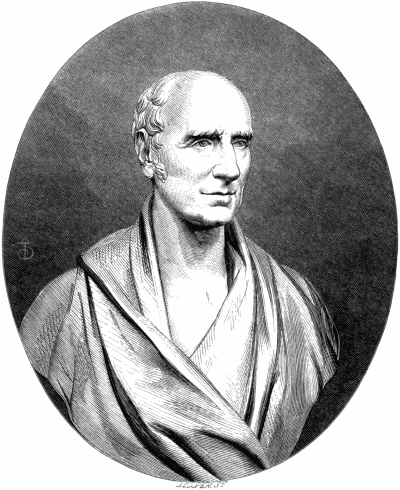
WILLIAM MURDOCK.
The young partners had also the great advantage of the skilled heads of the different departments, who had been trained by long and valuable experience. For many years William Murdock was the Mentor of the firm. Though tempting offers of partnerships were made to him, he remained loyal to Boulton and Watt to the last. They treated him generously, and he was satisfied to spend his life in their service. He had gradually worked his way to the foremost place in their establishment, besides achieving reputation as an inventor and a man of practical science. His model locomotive of 1784 was the first machine of the kind made in this country; and it is to be regretted that he did not pursue the subject. But Murdock was a very modest, unambitious man, content to keep in the background, and not possessed by that “pushing” quality which helps so many on to fortune. We have already stated that he invented the sun and planet motion, which was eventually adopted by Watt in preference to his own method of securing rotary motion. His daily familiarity with pumping-engines in Cornwall also led him to suggest and introduce many improvements in their details, which Boulton and Watt were always ready to adopt. He was a great favourite in Cornwall, and not less esteemed for his estimable and manly qualities than for his mechanical skill. When the adventurers heard of his intention to return to Soho, in 1798, they offered him 1000l. a year to continue at the mines, but he could not be tempted to remain.
Returned to Soho, Murdock was invested with the general supervision and management of the mechanical department, in which he proved of essential value. He was regarded as “the right hand” of Boulton and Watt. He proceeded to introduce great improvements in the manufacture of the engines, contriving numerous machines for casting, boring, turning, and fitting the various parts together with greater precision. His plan of boring cylinders by means of an endless screw (turned by the moving power) working into a toothed wheel, whose axis carried the cutter head, instead of by spur gear, was found very useful in practice, and produced a much more smooth and steady motion of the machine. As early as 1785, he invented the first oscillating engine,[350] which still continues in use in various improved forms. His invention of the double D slide valve, in place of the four poppet valves in Watt’s double engine,[351] was also found of great value; saving steam, and ensuring greater simplicity in the construction and working of the engine. In his oscillating engine the motion is given to the slide valve by the oscillation of the cylinder, and engines of small power still continue to be worked in this manner. Another of his improvements in engine construction was his method of casting the steam cases for cylinders in one piece, instead of in separate segments bolted together, according to the previous practice. He also invented a rotary engine of an ingenious construction; but though he had one erected to drive the machines in his private workshop, where it continued employed for about thirty years, it never came into general use.[352] Murdock had a good deal of the temperament of Watt: he was always scheming improvements, and was most assiduous in carrying them out. In such cases he would not trust to subordinates, but executed his designs himself wherever practicable; and he sometimes carried his labours so far into the night that the rising sun found him at his anvil or his turning lathe.
Murdock is also entitled to the merit of inventing lighting by gas. The inflammable qualities of the air obtained by distillation of coal had long been known,[353] but Murdock was the first to apply the knowledge to practical uses. The subject engaged much of his attention in the year 1792, when he resided at Redruth. As his days were fully occupied in attending to his employers’ engine business, it was only in the evenings, after the day’s work was over, that he could pursue the subject. It is not improbable that he was led to undertake the investigation by Mr. Boulton’s chemical enthusiasm, which communicated itself to all with whom he came in contact. It will be remembered that the latter occupied much of his leisure at Cosgarne in analysing earths, minerals, and vegetable substances, trying to find out the gases they contained; and Murdock was his zealous assistant on these occasions. In the paper which he communicated to the Royal Society on the subject of lighting by coal-gas in 1808, for which they awarded him their large Rumford Gold Medal, he observed,—
“It is now nearly sixteen years since (1792), in the course of experiments I was making at Redruth, in Cornwall, upon the quantities and qualities of the gas produced by distillation from different mineral and vegetable substances, that I was induced by some observations I had previously made upon the burning of coal, to try the combustible property of the gases produced from it, as well as from peat, wood, and other inflammable substances; and being struck with the great quantities of gas which they afforded, as well as the brilliancy of the light, and the facility of its production, I instituted several experiments with a view of ascertaining the cost at which it might be obtained, compared with that of equal quantities of light yielded by oils and tallow. My apparatus consisted of an iron retort, with tinned iron and copper tubes, through which the gas was conducted to a considerable distance; and there, as well as at intermediate points, was burnt through apertures of various forms and dimensions. The experiments were made upon coal of different qualities, which I procured from different parts of the kingdom for the purpose of ascertaining which would give the most economical results. The gas was also washed with water, and other means were employed to purify it.”[354]
Murdock put his discovery to the best practical test by lighting up his house and offices at Redruth with gas; and he had a gas lantern constructed, with a jet attached to the bottom of the lantern and a bladder of gas underneath, with which he lighted himself home at night across the moors when returning from his work to his house at Redruth.[355] On the occasion of a visit which he made to Soho in 1794, he took the opportunity of mentioning to Mr. Watt the experiments he had made, and their results; expressing his conviction of the superior economy, safety, and illuminating qualities of coal-gas, compared with oils and tallow. He then suggested that a patent should be taken out for the application, and at various subsequent periods he urged the subject upon the attention of his principals. But they were at the time so harassed by litigation in connexion with their own steam-engine patent, that they were unwilling to enter upon any new enterprise which might possibly lead them into fresh embroilments; and nothing was done to protect the invention.
On Murdock’s return to Soho in 1798, he proceeded with his investigations, and contrived an apparatus for making, purifying, and storing the gas on a large scale; and several of the offices in the building were regularly lighted by its means. On the general illumination which took place in celebration of the Peace of Amiens in 1802, the front of Soho Manufactory was brilliantly illuminated with gas, to the astonishment and admiration of the public. The manageableness, the safety, the economy, and the brilliancy of the new light being thus proved, Boulton and Watt in 1803 authorised Murdock to proceed with the general fitting up of the manufactory with pipes and burners, and, from that date, it continued to be regularly lit up with coal-gas. Several large firms followed their example; amongst others Phillips and Lee, Burley, and Kennedy, at Manchester, and Gott and Sons, at Leeds; and the manufacture of gas-making apparatus became one of the regular branches of business at Soho. Several years later, in 1805, when Watt went down to Glasgow, he found gas in pretty general use.
“The new lights,” he wrote to Boulton, “are much in vogue here; many have attempted them, and some have succeeded tolerably in lighting their shops with them. I also hear that a cotton-mill in this neighbourhood is lighted up with gas. A long account of the new lights was published in the newspapers some time ago, in which they had the candour to ascribe the invention to Mr. Murdock. From what I have heard respecting these attempts, I think there is full room for the Soho improvements,[356] though, when once they see one properly executed, it will have numerous imitations.”
Several years after the introduction of the new light, a German, named Wintzer or Winsor, brought out (in 1809) a scheme similar to one projected in Paris by Le Bon, for lighting the streets by gas. He proposed a Joint Stock Company, with a capital of 300,000l., and held forth to subscribers the prospect of a profit of ten thousand per cent.![357] He applied to Parliament for a Bill, against which Murdock petitioned, and was examined before the Committee. Though they were staggered by the crudities of Winsor, they had some difficulty even in accepting the more modest averments of Murdock as to the uses of coal-gas for lighting purposes. “Do you mean to tell us,” asked one member, “that it will be possible to have a light without a wick?” “Yes, I do, indeed,” answered Murdock. “Ah, my friend,” said the legislator, “you are trying to prove too much.” It was as surprising and inconceivable to the honourable member as George Stephenson’s subsequent evidence before a Parliamentary Committee to the effect that a carriage might be drawn upon a railway at the rate of twelve miles an hour without a horse.
No wonder that strange notions were entertained about gas in those early days. It seemed so incredible a contrivance, to make air that could be sent along pipes for miles from the place at which it was made to the place at which it issued as jets of fire, that it ran entirely counter to all preconceived notions on the subject of illumination. Even Sir Humphry Davy ridiculed the idea of lighting towns with gas, and asked one of the projectors if it were intended to take the dome of St. Paul’s for a gasometer; and Sir Walter Scott made many clever jokes about the absurdity of lighting London with smoke, though he shortly after adopted the said “smoke” for lighting up his own house at Abbotsford. It was popularly supposed that the gas was carried along the pipes on fire, and that hence the pipes must be intensely hot. Thus, when the House of Commons was first lighted up with gas, the architect insisted on the pipes being placed several inches from the wall for fear of fire, and members might be seen applying their gloved hands to them to ascertain their temperature, expressing the greatest surprise on their being found as cool as the adjoining walls.[358]
The advantages of the new light, however, soon became generally recognised; and gas companies were established in most of the large towns. Had Murdock patented the invention, it must have proved exceedingly remunerative to him; but he derived no advantage from the extended use of the new system of lighting except the honour of having initiated it,—though of this more than one attempt was made to deprive him. As he himself modestly said, in his paper read before the Royal Society, “I believe I may, without presuming too much, claim both the first idea of applying, and the first actual application of this gas to economical purposes.”
Murdock’s attention was, however, diverted from prosecuting his discovery of the uses of gas to a profitable issue by his daily business, which was of a very engrossing character. He continued, nevertheless, an almost incessant contriver, improver, and inventor; following, like his master Watt, the strong bent of his inclinations. One of his most cherished schemes was the employment of compressed air as a motive power. He contrived to work a little engine of 12-inch cylinder and 18-inch stroke, which drove the lathe in the pattern-shop, by means of the compressed air of the blast-engine employed in blowing the cupolas at the Soho Foundry; and this arrangement continued in use for a period of about thirty-five years. He also constructed a lift worked by compressed air, which raised and lowered the castings from the Boring-mill to the level of the Foundry and the Canal Bank.[359] He used the same kind of power to ring the bells in his house at Sycamore Hill; and the contrivance was afterwards adopted by Sir Walter Scott at Abbotsford.[360] He experimented on the power of high-pressure steam in impelling shot, and contrived a steam-engine in 1803, with which he made many trials at Soho, in anticipation of Perkins’s apparatus. He was the inventor of the well-known cast-iron cement so extensively used in engine and machine work; and the manner in which he was led to it affords a striking illustration of his quickness of observation. Finding that some iron-borings and sal-ammoniac had got accidentally mixed together in his tool-chest and rusted his saw-blade nearly through, he took note of the circumstance, mixed the articles in various proportions, and at last arrived at the famous cement, which eventually became an article of extensive manufacture at the Soho works, completely superseding the cement invented by Watt. In 1810 he took out a patent for boring stone pipes for water, and cutting columns out of solid blocks by one operation. In 1815 he invented an apparatus for heating the water for the Baths at Leamington by the circulation of water through pipes from a boiler,—a method since extensively adopted for heating buildings and garden-houses. While occupied in erecting the apparatus at Leamington, a heavy cast-iron plate fell upon his leg and severely crushed it, laying him up for many months.
His ingenuity was constantly at work, even upon matters which lay entirely outside his special calling. Mr. Fairbairn informs us that he contrived a variety of curious machines for consolidating peat moss, finely ground and pulverised, under immense pressure, and moulding it into beautiful medals, armlets, and necklaces, which took the most brilliant polish, and had the appearance of the finest jet. Observing that fish-skins might be used as an economical substitute for isinglass, he went up to London to explain to the brewers the best method of preparing and using them.[361] While in town on this errand, it occurred to him that there was an enormous waste of power in the feet of men and animals treading the streets of London, which might be economised and made productive; and he conceived the idea of using the streets as a grand treadmill, under which the waste power was to be stored up by mechanical methods, and turned to account! Another of his ingenious schemes—though then thought equally impracticable with that last mentioned—was his proposed method of transmitting letters and packages through a tube exhausted by an air-pump. This idea seems to have led to the projection of the Atmospheric Railway, the success of which, so far as it went, was again due to the practical ability of Murdock’s pupil Samuel Clegg. Though the atmospheric railway was eventually abandoned, it is remarkable that Murdock’s original idea has since been revived, and practised with success, by the London Pneumatic Despatch Company.
Such is a brief sketch of the life and works of this estimable and ingenious mechanic, for so many years the mainstay of the Soho works. Mr. Fairbairn, who first made his friendship at Manchester in 1816, speaks of him as one of the most distinguished veterans in mechanical engineering then living,—“tall and well-proportioned in figure, with a most intelligent and benevolent expression of countenance.” He was a man of robust constitution, and though he sorely taxed it, he lived to an old age, surviving the elder Boulton and Watt by many years.[362]
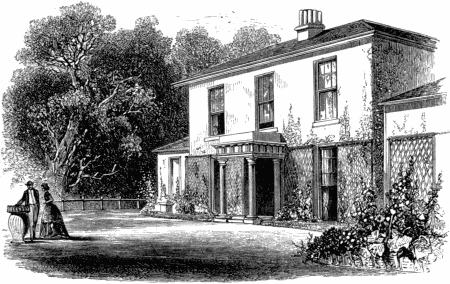
MURDOCK’S HOUSE, SYCAMORE HILL, HANDSWORTH.[363]