WHAT CAME OF A FOXGLOVE.
Reading edition
A FAIRY STORY.
B ehind, before, in the branches of the trees, amongst the blades of grass, creeping under the mushrooms, swinging on the foxgloves, and clinging to the ragged-robin, were the fairies.
Blanche and Belinda did not see them, because of the bright golden sunshine, which hides the fairies from mortal sight; but the fairies saw the two girls walking arm in arm through the wood.
Blanche stooped to gather a splendid crimson foxglove, which she shook gently, saying,
"The bells shall ring For the fairy king; Ding, dong, bell! Ding, dong, bell!"
But, alas! as she shook it, no fewer than seven little fairy pages fell to the ground. They were not much hurt, but they were very indignant at being knocked about in that manner; also the feathers in their caps were much ruffled.
They sprang to their feet feeling very angry, especially as the other fairies were laughing.
"We are the Queen's pages, And very great our rage is!"
they shouted.
And then, as they looked more carefully at one another and saw how tossed and tumbled were their pretty suits of embroidered white velvet, they burst out crying, saying—
"We are not fit to be seen By her Majesty the Queen; Our clothes are all blue and green, Who will wash and make them clean?"
"I will," said the Fairy Queen; "I saw it all, and I am very angry.
My pages shall not be Treated so shamefully!"
And her face grew as red as a peony.
"walking arm in arm"
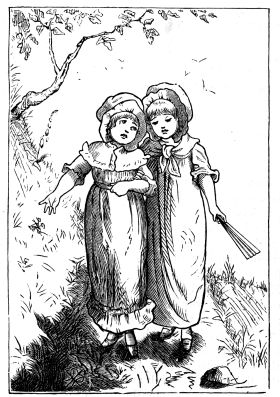
But Blanche and Belinda knew nothing of all this; they had not any idea that the fairies were in the wood.
Blanche had just thrown down the foxglove, for suddenly there issued out of every flower clusters of bees, that buzzed and hummed and made a dense cloud around the two little sisters until they could not see one another.
II.
And then——
Why, suddenly all the bees disappeared as quickly as they had come, and all was sunshine and brightness again; and Belinda was not stung, though she looked at her arms and hands, and felt her forehead and cheeks and neck, expecting to be covered with great smarting lumps. Instead of which, she had never been freer from pain; and the world around had never looked so beautiful as it did to-day, with so many butterflies of divers colours, and great green dragon-flies, that she wondered where they all came from. The wood-path, too, grew more lovely, and patches of blue sky appeared through the branches of the trees.
All at once she cried out—
"Blanche! Blanche!"
For Blanche was nowhere to be seen; and though she hunted in and out among the trees and bushes, she could not find her. No one answered, except the echoes repeating, "Blanche! Blanche! where are you?"
And then Belinda sat down, and she began to cry.
III.
Belinda cried for half an hour without stopping, and her eyes were swollen up, and her cheeks wet with tears. Some one was standing by her, and a voice was saying—
"Why are you crying, little girl, I pray, On such a pleasant sunny summer day? I'm a little packman, with my funny pack. Such a weight! oh, such a weight! to carry on my back. What will you buy, maiden? what will you buy? Half a dozen handkerchiefs, to wipe your cheeks quite dry?"
Belinda looked up, and in her surprise left off crying. Before her stood a small boy with a bundle of wheat over his shoulder. He looked tired and melancholy, and not by any means as jovial as might have been expected from his words.
"Handkerchiefs!" said Belinda, disdainfully. "Why, you've nothing but a wisp of straw over your shoulder, and it can't be any weight."
"he ... stood with his hat in hand."
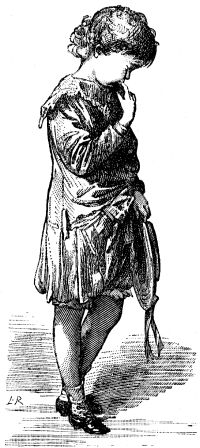
"Try it," said the boy, throwing it down upon the ground.
But Belinda took no notice of it.
"And you're not a packman, only a little boy," she said, angrily; "how can you tell such stories?"
The melancholy-looking boy answered—
"Perhaps I'm a king in disguise, Although of a very small size; If you were a little more wise, You might find in my pack a great prize.
However, I'll leave it for you, and the first young gentleman you meet with will, perhaps, pick it up and carry it home for you; for you will soon find you are not able to lift it yourself."
And so saying the boy turned away, and Belinda was again alone.
"Not lift a few ears of corn," she said, giving a slight kick to the heap at her feet.
But as her foot touched it it was no longer a bundle of wheat, but a sack tied close at the mouth, and it expanded until it was as large as Belinda herself. Added to which there appeared to be something alive in it, for it moved from side to side as though some creature were struggling inside.
"Oh! perhaps it is Blanche!" exclaimed Belinda, "and the boy has brought her back. He said 'a great prize,' and a king in disguise. He may have been a fairy, who can tell?"
And she tried to open the sack, but to no purpose, for she only tore her fingers and made them bleed, and the blood dropped down on her frock and stained it, and she grew very hot.
There was a glassy pool close by, so she knelt down and bathed her hands and face; and as she rose up she caught sight of herself in the pool, and for a moment she scarcely knew herself, for she was dressed so grandly. She had on a pink satin gown and a white satin apron with cherry-coloured bows, and a gauze cap, and red shoes with gold buckles.
"I wonder wherever these clothes could come from?" she said aloud.
The sack gave a roll, and whatever might be within was evidently trying to get out. And again she called out—
"Blanche! Blanche!"
She tried to lift up the sack, for she thought if she could drag it along she might in time find some one who could open it.
But she found that the melancholy boy was right, she could not move it.
"And I am not likely to meet with any one in this part of the wood."
IV.
Some one was whistling in the distance.
Belinda listened.
Then she cried out, "Help! help!"
The footsteps came nearer, and a boy in a fine suit came along. As soon as he saw Belinda he made a low bow, and stood with his hat in his hand.
"This must be a gentleman," thought Belinda, "or he would not be so polite."
But she did not speak.
"Did you not cry out for help?" asked the youth.
"Yes," replied Belinda; "I have lost Blanche, and I want some one to find her, and to help me to carry this bag; for I can't lift it, and I believe there is a prize in it."
"Prize!" repeated the boy; "I should think there was! Why this bag is full of wonderful magic toys, and if you let them out they will search the world over until they find anything that you have lost. Where did you get them from?"
"A boy with a bundle of corn brought the sack. At least it wasn't a sack, but it turned into one—and——"
"It must have been Oberon himself, the King of the Fairies, you know, who brought the sack to you."
"Ah!" returned Belinda, "he did say something about a king in disguise, but I did not believe him."
"Perhaps if you had been more polite," answered the boy, "you would have found Blanche back by this time, for he knows all about her. The Queen has carried her away because she knocked her little pages about."
"Knocked her little pages about! you are as foolish as the other boy. But if you know so much, pray where has the Queen hidden her?"
"How should I know?" replied the boy.
"Oh, dear!" exclaimed Belinda, and she began to cry again.
"Do be wise," said the boy; "crying does no good."
"Wise, prize, size, disguise," murmured Belinda.
"What are you saying?" he asked.
"Oh, nothing!" said Belinda.
"That is not true," he answered; "you said some words; say them again."
"out rushed the toys."
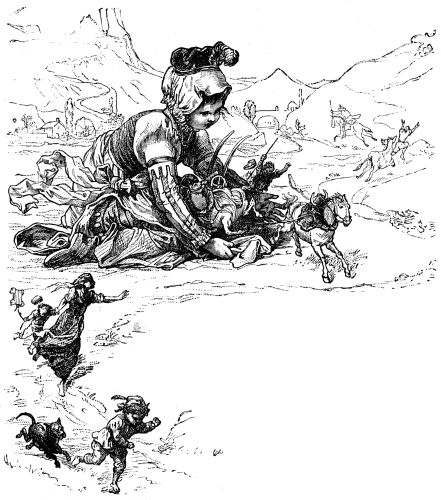
And as Belinda repeated the words the boy lifted up the sack quite easily, and cut the string that fastened it, with his knife. And his clothes changed even as Belinda's had done. He wore now a sort of helmet with a plume of feathers in it, and a slashed dress; and he knelt down and opened the mouth of the sack. Ah! was not Belinda astonished, for out rushed the toys—such toys—all of them able to move about. One of them, a man on horseback, galloped away over a bridge, in the distance; another ran up the mountain with a donkey following after him. A woman and a little child next rushed down into the valley, so did a boy with a dog that did not look like a dog running behind him.
To all of these the youth said—
"Now be kind, Find, find, find!"
Belinda gazed in astonishment, for never had she seen such toys before.
"Now," said the boy, as a white horse with a cart behind it emerged from a heap of carriages and toy soldiers, "jump in, and you and I will drive about the world till we find Blanche."
"But we can't possibly get in," returned Belinda; "it is too small for one, certainly for two."
"Do not be stupid," said the boy; "almost all mischief comes from stupidity; get in whilst I hold the horse."
How Belinda got into the little cart she did not know; but in it she was with the boy beside her, and he was driving as fast as he could go. And there was plenty of room for both.
The toy soldiers had mounted their horses and were riding behind them and at the side of them, for the boy had said—
"Mount quickly, guards."
And as they went along, Belinda presently heard the man on horseback and the woman and all the magic toys come clattering after them as hard as they could come.
"Ah!" observed the boy; "we are on the right path; the King has sent them after us."
"The King!"
"Yes; did you not see a toll-man on the bridge?"
"No," answered Belinda; but she whispered to herself, "a king in disguise; wise, prize, size."
"You are getting more sensible," said the boy, as he drove faster and faster till the white cart-horse seemed to turn into a race-horse, he went so swiftly.
"There will be an accident," said Belinda.
And so there was, for the cart-wheel flew off, and down went the cart, and Belinda and the boy were tumbled into a ditch, whence they scrambled out and rolled down a grassy slope, on and on and on, such a distance that Belinda felt quite giddy.
"This is the end of the drive," said the boy; "we need not trouble about the horse and cart. Follow me."
And Belinda followed him.
He pushed aside the red chestnut flowers and the sycamore branches, and as he did so all the birds seemed to wake up, and to sing a wonderfully beautiful song. There were nightingales singing, though it was day, and the larks were carolling as blithely as at early morn. As for the thrushes, their voices were so clear that Belinda was sure she could hear the words they were saying.
Of course it was poetry, only Belinda had never heard such beautiful poetry before.
And the waterfall was singing, so was the brook, but they sang a different song.
"Lullaby, oh, lullaby! Slumbering let the maiden lie, Sweetest dreams shall float around her, Magic blossoms shall surround her. Fairy chains shall keep her still, Fairy wand ward off all ill, Gnat or fly shall not come nigh, Lullaby, oh, lullaby! Sleep, sweet maiden, fear no harm, Potent is the fairy charm."
"Oh, boy! are they talking about Blanche?"
"Hush!" said he; "come quietly."
Belinda came softly, and looked where he pointed, and would have cried out—
"Blanche!"
But the boy put his hand over her mouth.
Nevertheless they had found Blanche.
Yes! there she was fast asleep on a crimson cushion with tall white lilies and bright poppies and splendid foxgloves nodding all round her and drowsily ringing their sweet bells; whilst a flood of fairy light fell over her. She looked very happy, as though she were having pleasant dreams.
"she was fast asleep."
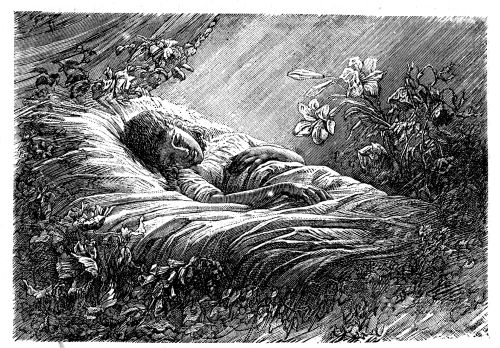
"Kiss her," said the boy.
And Belinda stooped and kissed her.
And then Blanche opened wide her eyes, saying.
"Where have you been?" she asked; "I have had such a nice sleep. It all came from the foxglove."
Belinda looked round to thank the boy, but he had vanished.
So had the cushion and the lilies, and the poppies.
"Why it's the old woodpath again," murmured Belinda. "I know the place quite well. Size, wise, prize, disguise; disguise, prize, size, wise," she repeated; "yes, the young gentleman must have been a king in disguise."
Blanche looked surprised.
"Yes, that is just what I was dreaming of. I thought I had really quite lost you, and he brought you to me."
Perhaps the youth was Oberon; but if so, of course he never told them.
"But he must have been a great many Oberons," Belinda went on, musing; "the melancholy packboy, the toll-man, the young gentleman! Ah! it is of no use thinking about it, one only gets confused."
But if she had had ears to listen to fairy music, she would have heard this song:—
"Each little page Hath lost his rage, The punishment is o'er; The sisters twain Have met again, To separate no more. So 'tis decreed by Queen and King, Who now the two together bring."
Julia Goddard.