The Editor's Pocket-book.
Reading edition
Who were the Janizaries?
About 1330 the Sultan Orkhan formed a military force out of Christian prisoners who had been compelled to become Mohammedans, and to these was given the name of Janizaries, from two Turkish words meaning new troops. A few years later they were more regularly organised, and granted special privileges, their number being increased to 10,000. Though for a time their ranks continued to be recruited from Christian prisoners, the service began, at length, to attract young Turks. Their chief officer, called the aga, wielded almost unlimited power. They fought on foot and were noted for the impetuosity of their charge. In course of time they manifested a rebellious spirit, often being the cause of conspiracies, riots, atrocities, and assassinations of rulers, statesmen, and high officials, and ultimately they grew to be more formidable to the Sultan than even foreign foes. Attempts to disband them were unsuccessful till Sultan Mahmoud II. finding himself opposed by them in 1826, managed to excite against them the fanatical zeal of other portions of his troops. Deserted by their aga and other officers, they were utterly crushed, their barracks were burned, and their force was declared, on June 17, 1826, to be for ever dissolved. It is estimated that 15,000 of them were executed and more than 20,000 banished. In this way this once famous body of men was extinguished.
A Canine Guide.
A Lincolnshire farmer has a dog that for practical wisdom will compare favourably with most men. Should its master leave anything—such as a stick or gloves—on the farm, he has but to make known by a sign the fact of his loss when off the dog will trudge, and not come home till it has found the missing article. It will permit a well-dressed man to enter the farm-yard by day, but should a beggar put in an appearance this respecter of persons will gently seize him by his clothes and see him safely off the premises. By night, however, all strangers approach at their peril. The farmer's sister lives on the adjoining farm, communication between the two farms being obtained by means of a single plank across the deep ditch that separates them. Sometimes the farmer's children want to visit their aunt, and they are always entrusted to the care of the dog. It marshals them in a small troop, conducts them to the bridge, where a halt is called. The bairns are then taken over one by one, doggie seizing hold from behind of the child's dress. It then waits for the return journey and escorts them home in the same way.
The Taming of Bucephalus.
Bucephalus, the famous steed of Alexander the Great, is said to have been broken in in the following manner. The horse was so fierce and unmanageable that no one would ride it. It had broken one man's neck, another man's leg, and seriously injured several others. An animal with such a reputation no doubt excited a good deal of attention, and Alexander was one day watching it in the Hippodrome or Circus, when it struck him that the horse was rendered ungovernable by fear of its own shadow. Accordingly he mounted it, and running it against the sun—so that its shadow fell behind—in due time succeeded in thoroughly subduing it. Tradition stated that through being the first to break in Bucephalus—which became his favourite charger—Alexander had fulfilled the condition which had been declared by an oracle to be necessary to his gaining the crown of Macedon.
The Price of a Picture by Landseer.
Sir Edwin Landseer's magnificent stag-picture called, "The Monarch of the Glen," and well known all over the world from engravings, was recently exposed to auction, when it fetched the enormous price of £6,510. It is said that the painter sold it off his easel for 800 guineas. The bidding at the sale began at £2,000, and by bids of one hundred guineas reached £4,000, at which price it was hoped that it might have been secured for the National Gallery. The competition, however, continued beyond that sum, until the picture was sold for 6,200 guineas. Only one other picture by Landseer has brought a higher price—namely, the famous Polar Bear subject, "Man proposes, but God disposes," which realised £6,615.
"Ignoramus."
As commonly used nowadays this term is equivalent to "dunce," but it was originally employed as a law term. It is a Latin word, and literally translated means, "we do not know." In former days when a grand jury considered that a bill or indictment was not supported by sufficient evidence to prove the need for a trial, they wrote the word "ignoramus" on the back of it, signifying that they rejected it. The words used in present practice are simply "not a true bill," or "not found." But in course of time the old Latin term was made serviceable, as we have seen, in a new way.
Saved by South Sea Islanders.
Considering the reputation that most of the South Sea Islands used to enjoy for cannibalistic practices, it is pleasing to read that the natives of one of the isles in the Marshall group in the South Pacific Ocean rescued the crew of a vessel wrecked near Ujaal Island. A number of natives went in their boats to the wreck and took off the crew and a lady passenger, conveying them to an island some fifteen miles from the spot where the ship was lost, and treating them with great kindness. Tents were erected out of the sails of the wrecked vessel, which were removed for the purpose.
A Strange Vow.
Not long since there died in a workhouse in Southwark a pedlar who used to sell odds-and-ends on a tray on London Bridge, and who pretended to be deaf and dumb. It is said that, though clothed in rags, he was a Swiss gentleman of means who, stung by remorse, had vowed not to open his lips for ten years, to go bareheaded and barefooted, and to abandon for twenty years all the advantages of his fortune. His vow was rigidly kept, and at the period of his death he was in the fourteenth year of his singular penance.
Honour among Cats.
Seeing that pussy is by no means friendly to birds, it is rather gratifying to hear of a cat that was entrusted with the care of a shopful of birds and was true to her trust. She was shut in the shop for the purpose of doing battle with such rats and mice as might put in an appearance; and discharged this duty with signal success. Yet though it may have been—at first at any rate—a sore trial to her to keep her paws off the birds, she was able to resist every temptation to gratify her natural tastes, and might even have been seen quietly snoozing on the top of one of the cages.
Memory in Parrots.
These birds have retentive memories. A parrot that belonged to a lady recognised a black servant after three years' absence. Another bird was so fierce that no one in the house liked to touch it, but it would allow a lady visitor to handle it with impunity. It was at last given away, as its ill temper seemed incurable. About three years later this lady called upon a friend, when a parrot in the corner of the room became greatly excited. As it was generally very quiet in its demeanour, its mistress remarked the unusual behaviour, but her visitor on going up to the cage recognised her old friend of the savage disposition, which had not forgotten her. When she spoke to it the bird was much pleased, and came on to her hand and fondled her.
The Clock-tower in Darmstadt Palace.
The residential palace in Darmstadt, where Queen Victoria made a brief stay in the spring of this year, has a clock-tower the chimes in which discourse sweet music four times every hour. At the first quarter they strike up a verse of the stirring "Watch on the Rhine;" at the half-hour the familiar notes of "God save the Queen" fall upon the listener's ear; at the third quarter an air from the well-known opera of the "Marriage of Figaro," enlivens the palace; while the hour is hailed with the bridal chorus from Wagner's "Lohengrin."
Oiling the Waves.
During the last two or three years a good deal has been heard of experiments for calming an angry sea by pouring oil upon the troubled waters. This has been proved to have a marked effect, but it is interesting to note that the idea is by no means new. In 1844 experiments were made in the North Sea, with a view to test this special property, and though several gallons were used on the occasion, no diminution of their rage was noticed in the waves. Captain Wilkes, however, the commander of the United States Exploring Expedition in the Antarctic Ocean, 1838-42, observed that the oil leaking from a whaler had a stilling influence upon the sea. And this quite agrees with the result of nearly, if not all, recent trials.
Spider Knicknacks.
A large trade is done at Santa Barbara, in South California, in the preparation of stuffed specimens of a big, ugly, vicious, poisonous spider. Cards decorated with these insect monsters are readily bought by tourists, by museums, and by science schools. This spider excites great curiosity on account of the nest with trap-door which it constructs with much skill, but though its native valleys abound with countless numbers of the homes and tunnels, yet hardly a living spider can be seen. It is for this reason, doubtless, that the demand for stuffed specimens is so considerable as to engage wholesale merchants as well as retail shopkeepers in meeting its supply.
An Affectionate Dog.
Early this year, a lady died in New York. She had had a Skye terrier as a pet for twelve years, and during the two months of her illness it remained by her bed. After the funeral it took up its old position by the bed, refusing to eat. A few days afterwards it found a pair of its mistress's shoes which had been thrown out of doors. The faithful animal brought them in its mouth to the bedroom, placed them on the floor, laid its fore paws and head across them, and continued in this position for several hours. Early one morning its mournful cries aroused the household, and exactly a week, to the very hour, after its mistress's death, the poor terrier expired beside the bed, its head and paws still resting on the cast-off shoes. This story shows how keenly some animals feel the loss of those who have treated them kindly.
A Sagacious Cavalry Horse.
Some weeks since a gentleman was knocked down by a cab in a busy street in London, and owed his escape from what might have proved a fatal accident to the sagacity of the horse by which the cab was driven. The hansom cab was going along at an ordinary pace, and the gentleman (who carried a bundle of papers) tried to pass it. In doing so he was knocked down, his papers were scattered, and he was himself in imminent danger of being run over, as the driver did not notice the accident in time to pull up. The horse, however, happened to be an old cavalry horse, and it neatly stepped over the prostrate body of the gentleman and stopped just as the wheels of the vehicle had reached his body. The gentleman was then dragged from his perilous position, much shaken and frightened, but in other respects uninjured.
What is a Nabob?
You have now and again met with the phrase, "rich as a nabob," and have perhaps wondered what a nabob had to do with riches. I will tell you. Under the Mogul Empire the provinces of India were administered by deputies called nawâb, who commonly amassed great wealth and lived in much splendour. The title was used under British rule, but became gradually corrupted into nabob. In course of time it was applied generally to all natives who had grown rich, and latterly it was bestowed—more often in a derisive sense—upon Europeans who, having made large fortunes in India, returned to their native land and spent their money in a luxurious and ostentatious way.
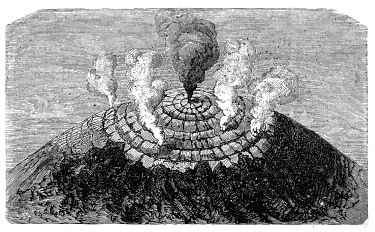
active volcano in réunion
A Curious Volcano.
Most active volcanoes have nothing very remarkable about them so far as the discharge of lava is concerned. In the Isle of Bourbon or Réunion, which lies in the Indian Ocean, there is, however, a volcano which is in a state of eruption twice every year. It occupies about one-sixth of the whole island, it often changes its crater, and the streams of lava sometimes reach to the sea. The surrounding district is called the Burned Land, from the desert aspect which it always wears. From the accompanying picture it will be seen that this volcano occasionally has several sources of lava.