A DAY ON BOARD H.M.S. BRITANNIA.
Reading edition
By the Rev. J. Clement P. Aldous, Chief Instructor and Chaplain to Cadets.
The Britannia is the training-school for naval officers. All boys who are to be fighting officers in the British Navy go to the Britannia. They enter when they are about thirteen, and stay there two years, and from this ship they go as midshipmen to our ships in all parts of the world. We are going to pay a visit to the Britannia, and see how these young naval cadets spend their day.
If we want to see the whole day through, we must start early. So we will take a boat and go off from the shore at five o'clock in the morning of a fine summer day. It is only a row of some 200 yards to reach the Britannia from the shore. She is anchored in the middle of the River Dart or Dartmouth Harbour.
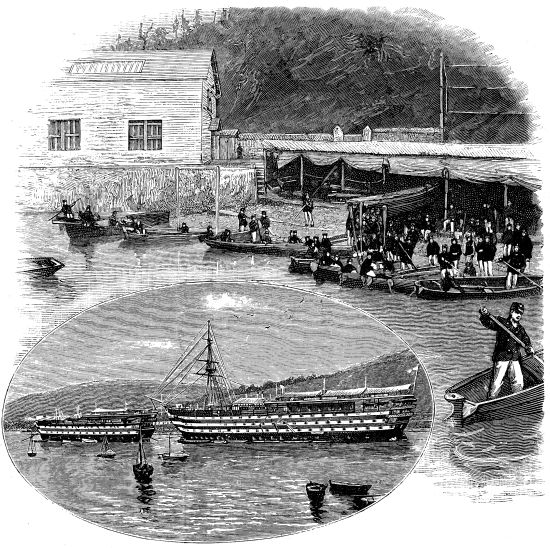
Have you ever seen one of England's old wooden walls—a three decker? How high she stands out of the water! If you will look at the picture you will see that there are quite six storeys to this great floating house. As you come up to the ship's side in a boat, she towers above you like a great cliff—a wooden wall—you can see what these words mean now.
Let us step up the ladder; they will be surprised to see us so early. The sentry on the middle deck wishes to know our business. "We have come to see everything," we say, and show our authority for coming.
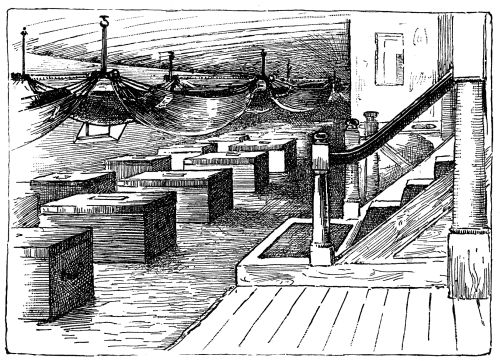
So we go up a ladder—not a staircase, mind!—to the sleeping deck. There we see two long rows of chests, which represent the wardrobe, chest of drawers, washing place, private locker, every piece of furniture, in fact, which a naval cadet possesses.
Over these hang the hammocks, each the sleeping-place of a cadet. A hammock is such a funny thing to sleep in. I dare say you have a string hammock on your lawn, in which you sometimes lie on a very hot summer's afternoon. But it is a queer bed to sleep in, for your head and your heels are both of them stuck up in the air, while your body hangs underneath in a graceful curve.
hammocks on board the britannia
Half past five is struck, or rather three bells, for man-of-war time goes by half-hours till eight bells are reached at noon and midnight, four and eight o'clock, when it starts again. Three bells! a corporal walks along and picks out here and there some unfortunate boy who has been misconducting himself the day before—perhaps he was late or idle—and he has to "turn out" an hour before the others and stand up till they join him. A wretched beginning of a day, especially on a winter's morning—to stand shivering on an open deck, while all his comrades are peacefully tucked up in their warm hammocks. I think if you knew you would get this punishment, my little friend, you would take good pains to be in time.
As we walk round the hammocks we now see the servants busy placing the cadets' clothes on their chests, ready for them to dress. There is a servant to about ten boys.
By-and-by five bells is struck, half past six, and a bugle rings out a merry peal, on the middle deck. It is the turn-out bugle, and you can play it on the piano:—
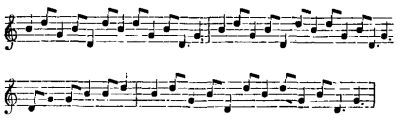
In a few moments we hear the same bugle-call, far away. The bugler is gone off to the Hindostan, and he is giving the sound for the other boys to turn out.
We only saw half the cadets in their hammocks in the Britannia. If you will look at the picture on page 145 you will see another smaller ship, the Hindostan, moored ahead of the Britannia. The younger boys sleep in "the other ship," as it is called.
What a merry noise there is, as the cadets bound out of their hammocks, and rush off to the big salt-water bath, which is fitted in either ship! I am glad we are only describing a visit, for were we looking on we should get drenched from head to foot.
The corporals walk about among the hammocks to see that all the young gentlemen are turned out.
"Show a leg there, sir! Come along, come along now, now, now, bugle's gone long ago, sir," as he finds some sleepy youth, not at all willing to show a leg. "Make a start, sir."
Basins are fitted up along the deck for them. They need not use the basins in their chests. These must be used at sea when the weather is not rough enough to dash the water out over the clothes.
At five minutes past seven a warning bugle is heard, to warn them that in ten minutes they must be dressed and ready. Some are kneeling at their chests, beginning the morning with prayer for help to live as in God's sight all the day. Some are hurrying on their clothes. Some are reading the Bible, a few verses, as they have promised their people at home never to omit to do.
At a quarter past seven rings out another bugle-call.

This means assembly, and the cadets all troop down to the middle deck, where they form in line, two deep, all along the deck; the port watch in the fore part of the ship, and the starboard watch farther aft. This division into two parts, starboard watch and port watch, is to accustom them to the idea of the whole ship's company being always divided into two watches.
The cadet captains stand in front of the two lines, the chief captains one at the end of each watch. These are cadets chosen as "monitors" to have charge of the others.
The silence bugle sounds, though no one is supposed to make a noise after the assembly has sounded. The officer of the day comes along, a lieutenant, whose duty it is to look after the cadets that day. "Open order! March," is his order; "Rear rank, dress," says the chief captain, and he walks round the two lines, and sees that the cadets are properly dressed. That white lanyard you see round their neck is for holding their keys. A sailor always has a knife at the end of such a lanyard.
"Close order! March," and the officer of the day marches them off to their various studies for the morning. Let us go and see where they have gone. Half of them, one watch, have gone down into the large mess-room. They sit round the room at the tables by the ship's side, and prepare work for their naval instructors. In a little while the servants will lay the middle tables for breakfast, but they do not mind the noise.
Up in the lecture-room, the chaplain has some classes at a Bible lesson. Just outside the lecture-room a sailor is teaching some of the boys at a model of a ship. On the main-deck of the "other ship," a sergeant is drilling some of the boys, and on the place where all stood for the first muster cadets are seated on forms, and are being taught by a sailor the meaning of some sea expressions, and what they are to do to avoid collisions at sea.
So they are busy at work till at ten minutes past eight a bugle goes for all to go down into the mess-room, where they range themselves at their places for breakfast.
At a quarter past eight the chaplain comes down to read prayers, the captain of the ship and the officer of the day coming down too. Then breakfast and letters, which are handed round to the fortunate ones.
There is plenty of talk at breakfast; but tea, coffee, and cocoa, bread-and-butter, meat of some sort, eggs, bacon, or fish and porridge, are very welcome after the hour's work, with which the day has begun.
At a quarter to nine there is a bugle-call which sends a pang to some hearts. Defaulters' bugle. Those who have been reported during the previous day are told to "fall in on the aft deck," and there they stand in a line. The commander comes and hears the report—investigates the case—asks what the cadet has to say, and then awards some punishment. We have seen one form of it. Then there is extra drill and march out with a corporal, or standing up after the others have "turned in," or as we should say, gone to bed. Poor fellows! it is a court of justice; and they would do well to keep off the aft deck. If the offence is serious, it is reported to the captain of the ship, who is head of all. Perhaps the offender is reduced to "second class for conduct," and has to wear a piece of white tape on his arm, be kept apart from all the others, and undergo all sorts of drills and privations.
At nine, the bugle sounds assembly—the principal assembly of the day, "Cadets' Divisions" it is called. All the officers are present. The cadets are again inspected, and they are marched off to their various studies for the morning. Mathematics and navigation are learned with the naval instructors. Then there are French and drawing, English, seamanship, instruments and charts, natural philosophy and many difficult things which it is considered necessary for these little fellows to master before they are fit to go to sea. If we visit them in their class-rooms, we shall see very light cheery rooms built on the upper deck, so that they have light from above. There are eight pupils only in each room, each having a separate table with a drawer for books. The naval instructor is teaching them, with the help of a blackboard, to do some questions about ships sailing, or to solve some problem made of lines and circles.
The cadets are all taught how to find by the sun and the compass where their ship is on the sea, and how they ought to steer her to get from place to place.
In another class-room, we find a staff commander teaching a class how to use the sextant, which is the sailor's most useful instrument for finding his place at sea, from sun and stars; or he may be teaching them how to use a chart or to draw a chart themselves.
In the lecture-room a lecture is being given on the steam-engine and the ways in which heat is used. Behind the lecturer, in glass cases, are many beautiful models for teaching the cadets all about machines, light, heat, sound, magnetism, and electricity, such as would make many boys long to pull them about for a while, and see how they work.
We might go and learn how the sails are set and furled from one of these fine models of ships, or how anchors and cables are managed from another.
In this little room, called the "Sick Bay," we find some poor fellows who have to lie in bed. One has caught a cold, and one has cut his foot in bathing. Fortunately, the Sick Bay is most frequently empty, for the Britannia life is a very healthy one.
There are eight studies like the one where we saw the naval instructor teaching navigation, four in each ship. In the Hindostan we find two Frenchmen teaching their classes how to read and write French, and two drawing studies, in one of which they are taught to draw models with the aid of ruler and compasses. In the other they are learning the use of paints and paint-brushes. It is so useful for a young boy to be able to make sketches in water colours of all the pretty places he goes to; some of them are really quite clever at it before they leave.
1. the cadets' boat-house and boats; 2. the britannia and hindostan. (See pp. 143, 146.)
We hear a noise of marching about; the bell is struck four times; ten o'clock. The French classes are only an hour long, and boys are changing class-rooms.
At five minutes to eleven there is a bugle-call, followed by a hurry-scurry; the whole ship is alive at once. There is an interval of a quarter of an hour. Leap-frog in the open air on the upper deck; running after one another till they get out of breath; fun of all sorts immediately becomes the order of the day, and certainly this quarter of an hour is right well spent in throwing off the evil effects of working too hard.
It is too soon interrupted by the warning bugle. And the whole ship sinks into silence as the cadets go back to their studies; those who have been at seamanship or drawing going to the harder work of mathematics.
At one o'clock study is over for the morning, and a good hard morning's work it has been for the boys, since a quarter past seven, with a break for breakfast, and an interval for play.
On half-holidays, work is over at twelve, and we shall soon see how they spend their half-holidays. Bugle—"wash hands," and then the merry bugle which means dinner.
Before and after dinner, a blessing is asked by the chief captain of cadets. When the cloth has been removed and grace has been said, away they rush for a short time of fun before study at two, and they do a somewhat light class of work till half-past three.
This is the happy time of all the day, and so you would think if you saw them.
Before you would have thought they could be all fairly out of their studies, you will see many of them rushing down to the large boats, which are waiting alongside. They are dressed in white flannel trousers, which they are all obliged to put on before going ashore. It is a fine sight to see these boats, one on each side of the ship, filled full of boys, all eager to get to their games.
We must follow them ashore. But first, I must tell you that in winter they go directly after dinner, and stay ashore till four o'clock. They then have their afternoon study from half past four till six.
It is much better for the boys to have daylight for their run ashore, instead of waiting till daylight has all gone, and landing at half past three to find it soon become dark.
On Wednesday and Saturday, when there is a half-holiday, they have dinner at twelve and land directly after. And then they are free in summer till a quarter to seven. What a royal time most schoolboys would think this! No roll-call. They are quite free to go as far as they like, for there are no bounds, except the town.
They are on their honour not to go into houses. This, and their promise not to bathe at any but the appointed time and place, are the only restrictions put upon them.
But we must hurry after them, or they will get the start of us, and we shall lose them.
We have not far to go before we catch them. A bugle sounds, and a hundred and twenty forms plunge from the bathing-stage and quay into the water. The bright harbour is dotted with the heads of swimmers. Some backward boys are being taught to swim in a "swimming-tray," a thing like a flat-bottomed barge, sunk with its bottom about four feet below the surface. A capital place it is for teaching youngsters to swim. But all soon learn, and are free to join the others in sporting about and cutting capers in the water. A warning bugle of one note says "it will soon be time to get out," and by the time the bugle sounds fifteen minutes from the first, they must all get out of the water.
The gymnasium—the building in the top left-hand corner of the picture on p. 145—is close by. Here they must go through a series of exercises, and they are obliged to attend till they can do them. "Compulsory Gyms," is not a favourite, so they like to get through and be free.
Here are the "blue boats,"—boats which they may have by themselves, gigs for four to pull, skiffs for two or one. They may row about wherever they like, and when the new boys first come, they are very fond of going out in boats as often as they can. They have to take turns with one another in using them. There are six little sailing-cutters too, which the elder cadets may take and sail by themselves. Then, besides, there is a fine yacht, a schooner, which they may sail on a holiday, when ten or twelve wish to go.
These young fellows have every sort of game. We turn away from the water, and follow some who are mounting a steep path. Here is the racquet-court—four are playing racquets and four playing fives.
And climbing still higher up the hill, we get to the cricket-field, a glorious sweep of grass with nets for cricket and lawn tennis, as much as heart could wish.
In the summer, there is a match at cricket between the Britannia eleven and some neighbours every half-holiday, and the Britannias usually win, though they play the best elevens round. Their officers play with them.
There is a flow of boys with paper bags from a suspicious-looking little house in the corner of the field. Ah! I thought as much. No schoolboy can do without his sweetstuff, and here it is. "Stodge" they call it, a horrible name, but very true. I am sure much more sensible are those who walk off to the neighbouring village of Stoke Fleming, where they can get a nice tea from Mrs. Fox from sixpence to a shilling.
We well remember how shocked Mrs. Fox was to come in and find the elder son of the Prince of Wales chopping sticks in her kitchen; for these two young princes six years ago spent a cadet's life of two years, and lived with the others, and worked and played exactly like the rest.
The Britannia life, you will see, is a very free and happy life. "Work while you work and play while you play" is the motto, and there is plenty of work and plenty of play for all who will have it.
In the afternoon of a half-holiday, when there is a grand cricket-match, and the band plays, and many ladies come to grace the field, there is not a brighter sight in all the country side, for the field stands in the prettiest place possible, with lovely country, sea and hills, to be seen around.
But it is time for all to go back—the longest afternoons must end, and the letter B, a square flag with a red middle, which is hoisted to recall them, is already displayed on the Britannia's mast.
A bell in the cricket-field says "play is over," and down they go in twos and threes to find the same big boats ready to take them back.
It has been a fine afternoon, and the field and sports have looked at their best. But if it had rained hard, and when the cadets came out from dinner, or from study, they had found the words "No Landing!" hanging by the ship's clock, there would have been no such fun. It is a long afternoon when it rains, and they are tied to the ship.
Tea at seven, or a quarter past—a merry meal with all the stories of the day to tell. Sometimes an accident—a boy has fallen down the cliff, or been hit in the field—will throw a damp over all. Sometimes they will be all alive with the discussion of a piece of news—there is to be a war. In six months some of them will be fighting. Sometimes an adventure, an irate farmer has caught two in his wheat, and has chased them and possessed himself of a cap. They will see that cap next morning, and its owner will be standing on the aft deck at 8.45 for judgment.
In the winter there is a pack of beagles, which lead the cadets a fine chase over the country.
"Oh! they are spoiled, these boys!" you will say. But wait till you see them, in a year's time, broiling under a tropical sun, cruising for weeks in a boat after slavers, and living on a short allowance of dry food and water. These young fellows are welcome to a happy life while they can get it.
For tea they have cold meat, or something else substantial. After tea, work for those who have it to do, in two studies, which are kept quiet, or in the mess-room.
The band plays, and some cadets dance with one another on the open middle deck.
And at a quarter past nine, prayers are read in the mess-room, and the bugle sounds "Turn in."
And the ship is silent till the day begins again.