BURIED ALIVE;
Reading edition
OR, LOVE NEVER LOST ON A DOG.
"H eigho!" sighed Thusnelda, as she lay on the straw not far from the spot where her three beautiful puppies were curled up in a heap. "Heigho!" she sighed, "I do hope dear master will not deprive me of any more of my darlings. Let me see now, there were ten of them originally. Yes, ten, for I counted them over and over again fifty times a day, and now there are only three. Heigho!" Here she glanced round towards these sleeping beauties in the straw, and her lovely eyes were brimming over with motherly affection and intelligence.
"To be sure," she added, "master has kept the three prettiest, that is some consolation, and the others have all gone to good homes, where I doubt not their virtue will be duly appreciated, though I shall never, never see them more."
Thusnelda was a dog of German birth and extraction. In truth, she was a Dachshund, and a high-bred one too, and both in this country and in Berlin she had taken many honours at dog shows.
Some might not have thought Thusnelda's body shapely. She was long and low, with a red jacket as smooth and soft as satin; so low in stature was she, that her chest almost touched the ground, and her fore legs were turned in at the ankle, and out at the feet—the latter indeed were almost out of all proportion, so big and flat were they; but no one could help admiring Thusnelda's splendid head, her broad intelligent skull, and her long silky ears and gazelle-like eyes. If ever eyes in this world were made to speak love and affection and all things unutterable, those eyes were Thusnelda's.
She got up at last and went and stood over her darlings. She gazed at them long and fondly, wondering and thinking what future they had before them. She held her head so low as she did so, that her splendid ears trailed and touched them. They moved in their sleep, they kicked and gave vent to a series of little ventriloquistic barks as puppies have a habit of doing; then the mother licked them fondly with her soft tongue, and therefore one awoke. It was Vogel. The names of the other two were Zimmerman and Zadkiel. As soon as Vogel awoke she gave a joyful wee bark of recognition, which aroused both her tiny brothers, and the whole three rushed at once to their good mother.
"Ah, my dears," she said; "you are very fond of me at present, I dare say, but you will get to be different as you grow older, I expect. However, I must make the most of you while you are young. Why, let's see, you will be six weeks old tomorrow, and you can lap every bit as well as I can. Yes, and it's quite a treat to see you lapping, and master thinks so too."
"Master" did.
"Master" was very fond of dogs, and he doted on good ones. He used to come and admire these three puppies by the hour. The milk he gave them was of the freshest and creamiest, and he even thickened it with a little boiled flour. Whenever Vogel and Zimmerman and Zadkiel saw him coming with the milk-pan they expressed their joy by saucy little barks and yelps, and made a headlong but awkward rush towards him, and when he put down the pan they weren't content to simply put their heads over the side and lap. No, they must have their fore feet in as well, although their mother often told them it was only little piggies that fed in that fashion. But Vogel was worse even than Zimmerman or Zadkiel, because she used to insist upon getting in the dish bodily. Only Vogel was master's favourite, and he used to take her kindly out of the dish again and place her by the side of it, and try to show her how to lap like a lady.
Vogel was the prettiest, Zimmerman the biggest and sauciest, and Zadkiel by far the wisest of the trio.
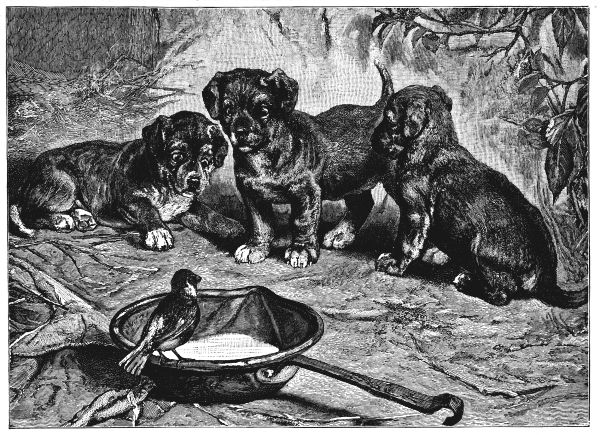
In the picture with which our artist has presented us, Vogel is standing in the centre, Zimmerman is lying on the left, while the far-seeing, deep-thinking Zadkiel is sitting on the right.
An impudent sparrow has just alighted on the puppies' pan, and is coolly helping himself to what has been left from breakfast.
"Delicious!" the sparrow is saying. "I'm the king of all the birds in the creation. Everybody admires me, I build in the choicest apple-trees, and feed on the daintiest food. Farmers cut down their hay that I may make my nest, farmers' wives kill the fowls that I may find feathers to line it, and even the cows cast their coats to aid in the same good work. Why, you little puppies, don't you admire me also, you ridiculous-looking fluffy things?"
"I admire your profound impudence," Zimmerman is saying.
"I am astonished at your daring audacity," Vogel is remarking.
But Zadkiel is thinking. "I dare say," he says at last, "that even such a wretched mite of a bird as you must have been meant for some good purpose. To pick up the grubs and the green flies perhaps."
"Absurd," cries the sparrow, and off he flies in disgust.
Then the pups forget all about it, and begin to lick each other's noses and toes—I was nearly saying toeses—in the funniest way imaginable. After that they go in for one of the most terrible sham fights that has ever been fought.
"You'll be a badger, Zadkiel," cries Vogel, "and Zimmerman and I will worry you to death."
So at it they go pell-mell. Zadkiel is hemmed up in a corner of the cart-shed, and his brother and sister make pretence, to tear him limb from limb. Zadkiel defends himself gallantly, but has to succumb at last, for he is fairly rolled on his back, and in a few minutes is, figuratively speaking, turned inside out. Then they espy the good-natured admiring face of their mother, peering at them over the corner of the straw, and at her they all rush. They make believe that she is a fox, and her life is accordingly not worth an hours' purchase.
"Ha! ha! ha!" laughs some one not two yards away, and looking up they espy "master," who all unknown to them has been enjoying the fun for the last half-hour.
"You dear, delightful little pets," he says, "why, you are as lively as kittens, and as healthy and happy-looking as the summer's day is long. You will do your mother credit yet. Your legs are straight, but work will bend them into the right shape, then you'll be able to creep into any rabbit's hole in the country,
"To beard a badger in his drain, A wild wolf in his lair."
So in order to make these little rascals' legs bend to the proper shape, master, as soon as they got a little older, used to bury bones for them deep down in the garden earth, and get the whole trio to scrape and find them.
This was grand fun, and by the time the puppies were six months old they were just as shapely as the mother was, or as unshapely, if you like it better, for after all perhaps the beauty of their bodies consisted in their ugliness.
It isn't every one who knows how to rear puppies properly, but this master did. He fed them on bread and milk, and broth and scraps of meat four times a day, he never forgot to give them plenty of the freshest of water, and as for straw, why they could at any time bury themselves in it. But this was not all, for he made the little things his constant companions, when he himself went out for exercise. And didn't they scamper and didn't they dance, and frolic, and run! Many a rat, and stoat, and polecat had reason to wish them far away, I can tell you.
Few people know how wonderful, intelligent, and sagacious a dachshund can become under proper treatment. But there must be system in the treatment. The whip must be hidden away out of sight entirely, the animal must be treated like a reasoning being, as indeed it is; it thus soon comes to know not only every word spoken to it, but your will and your wishes from your very movements and looks.
A dog never forgets kind treatment, and whenever he has the chance he acts a faithful part towards a loving master. I could tell you a hundred true stories illustrative of that fact, but one must here suffice. Had you seen the dachshund puppies then as they are represented in our engraving, brimful of sauciness, daftness, and fun, and seen them again two years after as they appeared when accompanying their beloved master in his rambles, you certainly could not have believed they were the same animals. They were still the same in one respect, however, for Vogel was still the beauty and Zadkiel the philosopher.
One day their master went out to hunt in the forest. It was far away in the wilds of the Scottish Highlands. He had gone to shoot deer, but as he was returning in the evening after an unsuccessful stalk, he caught a glimpse of a fox disappearing round the corner of an old ruin.
"Ho! ho!" he cried. "You are the rascal that steals my ducks. We'll have you if we can."
But the fox had taken at once to his burrow in the ruin. It was a very ancient feudal castle, only just enough of it remaining to give an idea of the shape it once had been, for regardless of the respect that is due to antiquity the keepers had carted away loads of the solid masonry to build their houses, leaving the place but a beautiful moss-grown chaos.
"Watch," was all the master said to his dogs as he crept in through an old window into the donjon keep. It was a foolhardy thing to do, for the stones were loose around it, but he had many times got in there before, and why, he thought, should he not do so now. Besides, this was Reynard's favourite den, and he hoped to shoot him in it. But the fox had improved on his dwelling since the hunter had last paid him a visit; he had excavated another room. Stone after stone the hunter began to pull down, when suddenly there was a startling noise behind him, and he found himself in the dark.
the puppies and the sparrow (See p. 158.)
Buried alive! Buried in a dungeon in which there was hardly room to turn. The situation is too dreadful for pen to describe. He sank on the soft damp mould of the floor and gave himself up to despair. And thus hours went past.
Hitherto there had not been a sound, but now the impatient yelping of the faithful hounds told him they had begun to appreciate the terrible danger of the master.
The rest of the story may be told in a very few words. Vogel did nothing but run about wild with grief, and made the rocks around her echo the sounds of her grief. Zimmerman set himself to work to dig the master out. But alas! solid stone and lime were too much for even his strong little limbs. But where was the wise and thoughtful Zadkiel? Gone. He turned up some hours after at his master's house, and his strange behaviour soon caused the servants to follow him into the deep forest and straight to the old ruin.
Morning had dawned ere the hunter, more dead than alive, was extricated from his living grave. His first act as soon as he recovered was to return thanks to Him who had delivered him, his next to embrace his faithful dogs.
ARION.