FOOTNOTES:
Reading edition
VII
Prevalence of wagering in the eighteenth century—Riding a horse backwards—Lord Orford's eccentric bet—Travelling piquet—The building of Bagatelle—Matches against time—"Old Q." and his chaise match—Buck Whalley's journey to Jerusalem—Buck English—Irish sportsmen—Jumping the wall of Hyde Park in 1792—Undressing in the water—Colonel Thornton—A cruel wager—Walking on stilts—A wonderful leap—Eccentric wagers—Lloyd's walking match—Squire Osbaldiston's ride—Captain Barclay—Jim Selby's drive—Mr. Bulpett's remarkable feats.
In the eighteenth century the bloods of the day bet on anything and everything. A well-known spendthrift, for instance, made a practice of backing one raindrop to roll down a window quicker than another—a practice which gave rise to the following lines:—
The bucks had dined, and deep in council sat, Their wine was brilliant, but their wit grew flat: Up starts his Lordship, to the window flies, And lo! "A race!—a race!" in rapture cries; "Where?" quoth Sir John. "Why, see the drops of rain Start from the summit of the crystal pane— A thousand pounds! which drop with nimblest force, Performs its current down the slippery course!" The bets were fix'd—in dire suspense they wait For vict'ry pendent on the nod of fate. Now down the sash, unconscious of the prize, The bubbles roll—like pearls from Chloe's eyes, But ah! the glittering charms of life are short! How oft two jostling steeds have spoiled the sport. Lo! thus attraction, by coercive laws, Th' approaching drops into one bubble draws— Each curs'd his fate, that thus their project cross'd; How hard their lot, who neither won nor lost!
Besides the huge sums which were lost at games (in 1793, £22,000 changed hands in a single day between two players at some billiard-rooms in St. James's Street), a great deal of money was frittered away in matches of an eccentric kind.
In 1722, for instance, a number of young men subscribed for a piece of plate, which was run for in Tyburn Road by six asses, ridden by chimney-sweepers. Two boys rode two asses on Hampstead Heath for a wooden spoon, attended by above five hundred persons on horse-back. Women running for Holland smocks was not uncommon; and a match was even projected for a race between women, to be dressed in hooped petticoats. Considerable sums of money are said to have changed hands over these events, whilst a wager of £1000 depended on a match between the Earl of Lichfield and Mr. Gage that the latter's chaise and pair should outrun the Earl's chariot and four. The ground was from Tyburn to Hayes, and Mr. Gage lost through some accident.
In 1735, Count de Buckeburg, a well-known German author, on a visit to England, laid a considerable wager, that he would ride a horse from London to Edinburgh backwards, that is, with the horse's head turned towards Edinburgh, and the Count's face towards London; and in this manner he actually rode the journey in less than four days.
At the end of the eighteenth century an officer trotted fifteen miles from Chelmsford to Dunmow in one hour and nine minutes with his face to the tail.
The eccentric wager made by George, Lord Orford, an ancestor of the present writer, is well known. The latter, in 1740, bet another nobleman a large sum that a drove of geese would beat an equal number of turkeys in a race from Norwich to London. The event proved the justness of his Lordship's expectations, for the geese kept on the road with a steady pace, but the turkeys, as every evening approached, flew to roost in the trees adjoining the road, from which the drivers found it very difficult to dislodge them. In consequence of this, the geese arrived at their destination two days before the turkeys.
This nobleman, who, by his eccentricities, had acquired the name of the mad Lord Orford, trained three red deer to draw him in a light phaeton, and in this uncommon equipage he frequently made excursions to some distance, in Norfolk and Suffolk, till a singular adventure taught him the danger of the practice.
One morning in winter, when the scent lay well on the ground, he was taking one of his common drives towards Newmarket; his way was over the heath. It happened that a pack of hounds, being out for a chase, took scent of the deer, opened and followed in full cry. The deer caught the death sound, took the alarm, and set off at full speed. It was in vain his Lordship endeavoured to pull them in; fear of death was greater than fear of their lord, and they dashed off towards Newmarket, a place they were well accustomed to. The dogs were at their heels, but the deer were sufficiently in advance to reach the inn they were accustomed to put up at, when they dashed into the yard, with their terrified lord close at their heels, and the hounds not far behind them; the ostlers, however, exerted themselves to get the gates fastened before the hounds came up, when the whipper-in called them off.
In 1758, Miss Pond, daughter of the compiler and publisher of Ponds Racing Calendar, wagered a thousand guineas that she would ride a thousand miles in a thousand hours. This feat she accomplished (it is said on one horse) by the 3rd of May, having begun in April. A few weeks later Mr. Pond rode the same horse in two-thirds of the time.
Even the most trivial things were utilised for losing or winning money.
A Yorkshire sportsman won a considerable bet on the extreme extent to which a pound of cotton could be drawn in a thread by one of the Manchester spinning jennies; the loser betted that it would not reach two miles in length; but, upon measurement, it was found to exceed twenty-three.
A young man of the name of Drayton undertook for a considerable sum to pull in a pound weight at the distance of a mile, that is, the weight had to be attached to a string a mile in length, and Drayton to stand still and pull it to himself. The time allowed for this singular performance was two hours and a half. The odds were against him, but he won his wager.
A printer at Chester for a wager picked up 100 stones each a yard apart, returning every time with them to a basket at one end of the line, in 44½ minutes, it having been betted that he would not complete his task within 47 minutes.
So great was the love of betting amongst sporting men that when they were on a journey they would wager as to what they might meet with next. This method of gambling was afterwards made into a regular game which was called "Travelling Piquet." This was defined as a mode of amusing themselves, practised by two persons riding in a carriage, each reckoning towards his game the persons, or animals, that passed by on the side next them, according to the following estimation:—
A parson riding on a grey horse Game
An old woman under a hedge do.
A cat looking out of a window 60
A man, woman, and child in a buggy 40
A man riding with a woman behind him 30
A flock of sheep 20
A flock of geese 10
A post-chaise 5
A horseman 2
A man or woman walking 1
Death itself was not infrequently made the subject of a wager. Just before two unfortunate men, hung at the Old Bailey, were dropped off, a young nobleman present betted a hundred guineas to twenty "that the shorter of the two would give the last kick!" The wager was taken, and he won; for the other died almost instantly, whilst the shorter man was convulsed for nearly six minutes.
So great was the mania for wagers at this epoch, that even the clergy were affected by the prevailing craze. A young divine, in the vicinity of Edinburgh, declared himself ready to undertake for a wager of a hundred guineas to read six chapters from the Bible every hour for six weeks. The betting was ten to one against him.
In France matters were much the same as in England.
The Duc de Chartres, the Duc de Lauzun, and the Marquis de FitzJames once competed in a foot-race from Paris to Versailles for two hundred livres; this was won by the Marquis de FitzJames.
The Duc de Chartres bet a considerable sum with the Comte de Genlis that the latter would not go from Paris to Fontainebleau and back before he (the Duc de Chartres) had pricked 500,000 pinholes in a piece of paper. The Comte de Genlis was the winner by several hours.
The wager of the Comte d'Artois as to the building of Bagatelle is historical. He bet Marie Antoinette 100,000 livres that he would erect a palace on a certain site in the Bois de Boulogne in six weeks.
Nine hundred workmen were employed night and day, whilst patrols of the Swiss Guard seized any building materials which might be of use on the roads in the vicinity—these, it must, however, be added, were paid for. At the end of the six weeks the Comte d'Artois entertained Marie Antoinette at a splendid fête in the completed house.
Matches against time were common. In 1745 Mr. Cooper Thornhill rode three times between Stilton and Shoreditch—two hundred and thirteen miles—in eleven hours and thirty-four minutes on fourteen different horses. Six years later, Captain Shafto won £16,000 by winning a wager that he would cover fifty miles in two hours. He was allowed as many horses as he pleased.
Not a few of these matches against time were carried out under most whimsical conditions.
On 22nd August 1774, for instance, Anthony Thorpe, a journeyman baker, at the Artillery Ground, ran a mile tied up in a sack, in eleven minutes and a half.
In 1773 a London to York match was run, the winner, a mare, taking forty hours and thirty-five minutes to complete the journey.
A sensational match of a more sporting description was the ride of George IV., when Prince of Wales, to Brighton and back, a journey of one hundred and twelve miles, which the Royal sportsman is said to have performed on one horse in ten hours.
A wonderful ride was that performed in 1786 by a featherweight jockey at Newmarket, who rode one horse twenty-three miles in two or three minutes under the hour.
The Duke of Queensberry ("Old Q.") was at one time fond of sporting matches, in which he generally came off victorious, for he was a shrewd man. In 1789, during the Newmarket October Meeting, he and Sir John Lade, mounted on a brace of mules, rode from the Ditch in for £1000. This ludicrous race, which was very anxiously and obstinately contested, terminated in favour of the Duke.
Mr. Thomas Dale was also the hero of a donkey match at Newmarket, where he rode one hundred miles in twenty-two hours and a half on an ass; £100 to £10 was laid against this being done within twenty-four hours.
Old Q., when Earl of March, for a wager, sent a letter fifty miles within an hour by hand, which was cleverly effected by the missive in question being enclosed in a cricket ball and thrown from one to the other by twenty-four expert cricketers.
On another occasion Old Q. made a bet of a thousand guineas that he would produce a man who would eat more at a meal than any one Sir John Lade could find. The bet being accepted, the time was appointed, but his Grace, not being able to attend the exhibition, wrote to his agent to know what success, and accordingly received the following note:—
My Lord,—I have not time to state particulars, but merely to acquaint your Grace that your man beat his antagonist by a pig and apple-pye.(Signed) J.P.
A curious wager which led to litigation was one between Old Q., when Lord March, and Mr. William Pigot. The latter and Mr. Codrington being together at Newmarket, it was proposed to run their fathers against each other. Mr. Pigot's father was upwards of seventy, and Mr. Codrington's father little more than fifty. The chances were calculated, and Mr. Codrington, thinking them disadvantageous to him, declined the bet, whereupon Lord March agreed to stand in his place, and mutual notes were interchanged. Mr. Pigot's note was:—
I promise to pay to the Earl of March 500 guineas if my father dies before Sir William Codrington.
William Pigot.
The Earl's was:—
I promise to pay to Mr. Pigot 1600 guineas in case Sir William Codrington does not survive Mr. Pigot's father.
March.
The fact was that Mr. Pigot's father was then actually dead, but that was wholly unknown to the parties.
It was contended on the part of Mr. Pigot, that, as he could not possibly win, he ought not to lose, and it was compared to a ship insurance. If the policy upon a ship had not the words "lost or not lost" inserted, and the ship should be actually lost at the time of making that policy, it would be void.
For the plaintiff it was argued that the contract was good, because the fact being wholly unknown to the parties, it could not influence either.
The wager was held to be good, and the plaintiff obtained a verdict of £500, the amount of his wager.
The most important match made by the "evergreen votary of Venus," as Old Q. was called, was in 1750, when, as Lord March, he bet Count O'Taafe, an Irish gentleman notorious for eccentricity, one thousand guineas that a carriage with four wheels could be devised capable of being drawn at not less than nineteen miles within an hour.
Wright of Long Acre exhausted all the resources of his craft to diminish weight and friction; the harness was made of silk combined with leather. Four thoroughbreds, with two clever light-weight grooms, were selected, and several trials, causing the death of some horses, were run. On August 29, 1750, the match came off over a course of a mile at Newcastle, many thousands of pounds being wagered on the result, which was favourable to Lord March, the carriage being drawn over the appointed distance well within the hour. Three of the four horses which drew the machine had won plates. The leaders carried about eight stone each, the wheelers about seven, and the chaise, with a boy in it, about twenty-four. The time was 53 minutes 27 seconds.
The print (here reproduced) was published in 1788 by J. Rodger, after the original painting by Seymour, which is now, I believe, in the possession of Lord Rosebery.
Large sums were laid upon very trivial and useless performances, and a certain number of individuals, well-known for their physical strength, used to undertake to carry out all sorts of queer tasks.
In 1789 a man called Shadbolt, a respectable innkeeper at Ware, called Goliath on account of his great muscular powers, undertook, for a considerable wager, to run and push his cart from Ware to Shoreditch Church (a distance of twenty-one miles) in ten hours, which he easily performed within the space of six hours and a few seconds, without the least appearance of fatigue. Great sums were won and lost on the occasion.
All sorts of curious wagers were laid in Ireland. The celebrated Buck Whalley, for instance, once jumped over a carrier's cart on horse-back for a bet. This he did from an upper story of a house, quantities of straw being laid on the other side of the cart.
Thomas Whalley, known as Jerusalem Whalley, owing to the journey which he made for a wager to Jerusalem, was the son of a gentleman of very considerable property in the north of Ireland. His father, when advanced in years, married a lady much younger than himself, and left her a widow with seven children.
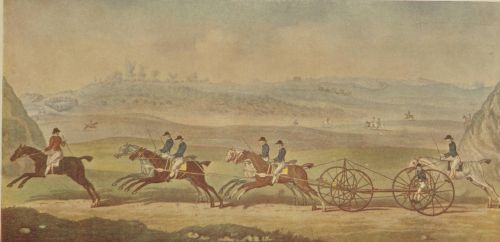
The Chaise Match.
Thomas Whalley was the eldest son of this family, and had a property of £10,000 per annum left him by his father. At the age of sixteen he was sent to Paris to learn the French language and perfect himself in dancing, fencing, and other elegant accomplishments. The tutor selected to accompany him was not able or desirous of checking young Whalley's extravagance. The latter purchased horses and hounds, took a house in Paris, and another in the country, each of which was open for the reception of his friends. His finances, ample as they were, were found inadequate to the support of his extraordinary expenses, and, with the hope of supplying his deficiencies, he had recourse to the gaming-tables, which only increased his embarrassments. In one night he lost upwards of £14,000. The bill which he drew upon his banker, La Touche, in Dublin, for this sum was sent back protested, and it became necessary for him to quit Paris. On his return to England, however, his creditors (or rather the people who had swindled him out of this money) were glad to compound for half the sum.
Whalley then went back to Ireland and took a house in Dublin, where he lived in the most expensive manner, but quickly tiring of rural life decided to return to the Continent. While he was still hesitating as to his exact place of destination, some friends, with whom he was dining, and who had heard that he was intending to go abroad, made inquiry of him whither he was going. He hastily answered: "To Jerusalem." Upon this, certain that he had no such intention, they offered to wager him any sum he did not reach that city. As a result of this, in spite of the fact that he originally had not the faintest idea of such an expedition, he was so much stimulated by the offers made him that he accepted bets to the amount of £15,000, and at once made preparations for his journey. A few days later he set out, and having accomplished what was then an adventurous journey, eventually returned to Dublin within the appointed time, and in due course claimed and received from his astonished antagonists the reward of his most unexpected performance.
After staying some time in Dublin, Whalley again went to Paris, and was witness to the very interesting scenes which occurred in the early part of the Revolution in France. He remained in Paris till after the return of the King from Varennes; and, when it became no longer safe for a subject of the King of Great Britain to remain in France, he returned to Ireland.
Being of a very active disposition, Whalley made constant trips to England, where he frequented the gaming-houses in London, Newmarket, and Brighton, and soon dissipated a large part of his remaining fortune. He then retired to the Isle of Man, where he employed himself in cultivating and improving an estate he possessed there, and in educating his children. He at the same time drew up memoirs of his own life, which were discovered a few years ago and published under the title of Memoirs of Buck Whalley.
Another sporting character well known in Ireland was the celebrated Buck English, who spent the latter part of his life in litigious turmoil, and was a man who experienced infinite vicissitudes of fortune. Born to a large estate, the earlier part of his life was spent in scenes of the most unbounded dissipation; but these were curtailed when he got into the hands of a litigious attorney, who, for years, kept him out of his property. Mr. English was tried for his life, for the murder of Mr. Powell, and was with difficulty acquitted, and escaped narrowly from being torn to pieces by the mob in Cork. Previous to this, he threw a waiter out of a window, and desired him to be "charged in the bill!" In his career, he fought two duels with swords, in the streets of Dublin; was a Member of Parliament, and an excellent speaker; was thrown into a loathsome prison for debt, where his constitution was totally destroyed. He died almost immediately after his liberation, just as he recovered his fortune.
In October 1791, at the Curragh Meeting in Ireland, Mr. Wilde, a sporting gentleman, made bets to the amount of two thousand guineas, to ride against time, viz., one hundred and twenty-seven English miles in nine hours. On the 6th of October he started in a valley, near the Curragh course, where two miles were measured in a circular direction; each time he encompassed the course it was regularly marked. During the interval of changing horses, he refreshed himself with a mouthful of brandy and water, and was no more than six hours and twenty-one minutes in completing the one hundred and twenty-seven miles; of course he had two hours and thirty-nine minutes to spare.
Mr. Wilde had no more than ten horses, but they were all thoroughbreds from the stud of Mr. Daly.
Whilst on horse-back, without allowing anything for changing of horses, he rode at the rate of twenty miles an hour for six hours. He was so little fatigued with this extraordinary performance, that he was at the Turf Club-house in Kildare the same evening.
The Right Honourable Thomas Conolly also rode for a wager of five hundred guineas on the Curragh. He was allowed two hours to ride forty miles with any ten hunters of his own. He with ease rode forty-two miles in an hour and forty-four minutes on eight hunters.
At this time much money was wagered both in Ireland and England upon the leaping powers of the horse, and occasionally the methods employed were none too honourable.
A young sportsman, for instance, having boasted of the powers of a recently purchased hunter which he offered to back at jumping against any horse in the world, a friend ridiculed the idea, and said he had a blind hunter that should leap over what the other would not. A wager to no inconsiderable amount was the consequence, and day and place appointed. The time having arrived, both parties appeared on the ground with their nags; when laying down a straw at some distance, the friend put his horse forward, and at the word "over" the blind hunter made a famous leap; while neither whip nor spur could induce the other to rise at all.
A very sporting bet was decided in the most fashionable part of London in 1792. On the 24th of February in that year was accomplished the feat of leaping over the high wall of Hyde Park from Park Lane. A bet of five hundred guineas was reported to have been laid between a Royal personage and Mr. Bingham, that the latter's Irish-bred brown mare should leap over the wall of Hyde Park, opposite Grosvenor Place, which wall was six feet and a half high on the inside, and eight on the out. Mr. Bingham having sold his mare to Mr. Jones, the bet, of course, became void. Mr. Jones offered bets to any amount that the mare should do it, but his offers were not accepted. Mr. Bingham, to show the possibility of its being done, led his beautiful bay horse, Deserter, to the same place, who performed this standing leap twice without any difficulty, except that, in returning, his hind feet brushed the bricks off the top of the wall. As the height from which he was to descend into the road was so considerable, he was received on a bed of long dung. The Duke of York, Prince William of Gloucester, the Earl of Derby, and a number of the nobility joined the vast concourse of impatient spectators, who were pretty well tired out before the jumping began.
Another remarkable feat was the leap over a dinner-table with dishes, decanters, and lighted candelabra, performed by Mr. Manning, a sporting farmer, on a barebacked steed in the Rochester Room at the White Hart Inn, at Aylesbury, during the steeplechases in 1851.
Wagers entailing considerable risk and endurance were popular in the past. Two gentlemen at a coffee-house near Temple Bar once made an extraordinary bet of this nature. One of them was to jump into seven feet of water, with his clothes on, and to entirely undress himself in the water, which he did within the appointed time.
The present writer, when an undergraduate at Cambridge, witnessed a somewhat similar exploit performed in the Cam on a particularly cold winter's day.
On this occasion, however, the undergraduate, a man of herculean frame, who had wagered that he would undress in the water, was allowed to cancel his bet after he had discarded everything but one sock. As he appeared to be much exhausted, all bets were declared off by mutual consent. The layer of the wager was in a terrible state on leaving the water, but entirely recovered the next day.
Those fond of shooting frequently wagered on their powers as shots.
In 1800 the celebrated Colonel Thornton made a bet that he killed 400 head of game at 400 shots. The result was, he bagged 417 head of game (consisting of partridges, pheasants, hares, snipes, and woodcocks) at 411 shots. Amongst these were a black wild duck and a white pheasant cock; and at the last point he killed a brace of cock pheasants, one with each barrel. On the leg of the last killed (an amazing fine bird) was found a ring, proving that he had been taken by Colonel Thornton when hawking, and turned loose again in 1792.
Colonel Thornton could not bear to hear that any one had outdone him at anything. On one occasion a foreigner was boasting of the sporting powers of the Comte d'Artois, afterwards Charles X., and asserted that the Prince in question was, without doubt, considered the greatest shot in Europe. On hearing this the Colonel looked highly offended, when the foreign sportsman added, "except Colonel Tornton" (thus pronounced), "who is acknowledged to be the longest shot in the world." There was a great deal of bitter-sweet in this, but the Colonel wisely interpreted the phrase in a sense complimentary to himself.
Colonel Thornton, though his name has come down to us as a great sporting character, was not by any means universally popular in his own day. Notwithstanding that he was of quite respectable descent, and had inherited a comfortable fortune, he was never on familiar terms with the aristocratic sportsmen of his age, with whom it was his darling passion to be able to associate. A well-known member of the Jockey Club, when the Colonel's name was mentioned, once said: "Oh! Thornton, never let us hear that fellow named; we don't know him."
The Colonel provoked much ridicule by his overwhelming ambition to excel everybody in everything—a notable instance of which was his taking Thornville Royal, a palatial house of which his family and suite could only occupy one corner, his means being inadequate to keep up the house and domain in proper style. Incapable of restraining an innate tendency to exaggeration, Colonel Thornton was known to many as "Lying Thornton," a nickname which was in some degree justified by the palpably mendacious accounts of his exploits, which his craving for notoriety prompted him to disseminate. His conceit was gigantic. He once actually sent an apology for not being present at a Royal Levee, which absurd conduct caused a great personage many a hearty laugh.
The Colonel's extravagance, and the lawsuits in which he indulged, often reduced him to great straits for ready money. Nevertheless, he was always possessed of considerable property. Colonel Thornton undoubtedly deserves to be remembered as a sportsman, though his reputation as such would have been greater had he not sought to excel all men in bodily activity and physical exertion, as well as eclipse them in the extent and variety of land and water sports, which was naturally an impossible feat.
Much given to litigation in life. Colonel Thornton gave the lawyers employment even after his death. By his will he bequeathed all his remaining property to an illegitimate daughter by Priscilla Druins, leaving his wife, Mrs. Thornton, nothing, and his son by her only £100. The will was disputed by the lawyers both in France and England. In the English Courts it was decided that the Colonel had never ceased to be a British subject, and that, therefore, the will must be valid. The French Court, passing a contrary judgment, decreed that the Colonel had petitioned in 1817, and obtained a complete naturalisation; that his real domicile being therefore in France, the will must be decided by its laws; and that the property having been willed to a child born in adultery, and otherwise contrary to the laws of France, the will was null and void; and they adjudged accordingly, with costs in favour of Mrs. Thornton, the lawful wife. The Colonel's real property appeared to be very little. He inhabited the Château de Chambord only as a tenant, but he had purchased the domain of Pont le Roi, and the vendors sued the Colonel's legatees for the purchase money.
At the dawn of the nineteenth century long-distance matches continued to be in vogue. The distance between Burton, on the Humber, and Bishopsgate, in the City of London, one hundred and seventy-two miles, was covered in something like eight hours and a half by a sportsman in 1802, who had bet that, with the fourteen horses allowed him, he would accomplish the journey in ten hours.
In April 1806 a very singular bet, or agreement, was made at Brighton between Lieutenant-General Lennox and Henry Hunter, Esq. The former, after some remarks on the prevalent winds at Brighton, proposed to give to the latter, during the space of twenty-eight days, whenever the wind blew from the south-west, one guinea per diem, provided the other would forfeit to him the same sum, during the same period, every day that the wind should blow from the north-east, which proposal was instantly accepted. For the ensuing thirteen days the wind lay mostly in the south-west quarter, upon which Mr. Hunter remarked that, in spite of south-west gales not being to every one's taste, this was merely another proof of the old adage that "It is an ill wind that blows nobody good."
In 1807, Captain Bennet, of the Loyal Ongar Hundred Volunteers, engaged to trundle a hoop from Whitechapel Church to Ongar, in Essex, in three hours and a half, a distance of twenty-two miles, for the wager of one hundred guineas.
He started on Saturday morning, November 21, precisely at six o'clock, with the wind very much in his favour, and the odds about two to one against him. Notwithstanding the early hour, the singularity of the match brought together a numerous assemblage. The hoop used by Captain Bennet on the occasion was heavier than those trundled by boys in general, and was selected by him conformably to the terms of the wager. The first ten miles Captain Bennet performed in one hour and twenty minutes, which changed the odds considerably in his favour.
He accomplished the whole distance considerably within the given time, as the Ongar coachman met him only five miles and a half from Ongar, when he had a full hour in hand.
A cruel wager was the following, made in December of the same year, when a Mr. Arnold, a sporting man who resided at Pentonville, bet Mr. Mawbey, a factor of the Fulham Road, twenty guineas that the former did not produce a dog, which should be thrown over Westminster Bridge at dark, and find its way home again in six hours, as proposed by Arnold. The inhuman experiment was tried in the evening, when a spaniel bitch, the property of a groom in Tottenham Court Road, was produced and thrown over from the centre of the bridge. The dog arrived at the house of her master in two hours after the experiment had been made.
Little consideration was shown for animals in those days.
On a Saturday evening in August 1808, a crowd of people assembled at Hyde Park Corner to watch the start of a pony which was, for a stake of five hundred guineas, matched to start with the Exeter Mail and be in Exeter first, with or without a rider. A man leading the pony was at liberty to take a fresh post-horse whenever he liked. The backer of the pony won the match, for though the odds were against it, the game little animal arrived at Exeter in very good condition, forty-five minutes before the Mail reached that city. Several thousands of pounds were wagered on the result.
It should be added that the pony drank ale during the journey, and several pints of port in addition.
The distance from London to Exeter is about one hundred and seventy-four miles.
In 1809 a very extraordinary wager was decided upon the road between Cambridge and Huntingdon. A gentleman of the former place had betted a considerable sum of money that he would go, a yard from the ground, upon stilts, the distance of twelve miles, within the space of four hours and a half: no stoppage was to be allowed, except merely the time taken up in exchanging one pair of stilts for another, and even then his feet were not to touch the ground. He started at the second milestone from Cambridge in the Huntingdon Road, to go six miles out and six miles in; the first he performed in one hour and fifty minutes, and did the distance back in two hours and three minutes, so that he went the whole in three hours and fifty-three minutes, having thirty-seven minutes to spare within the time allowed him.
In the winter of 1810-1811 a bet of £500 was made by the Duke of Richmond, then Lord-Lieutenant of Ireland, with Sir Edward Crofton (who afterwards committed suicide), that the latter should not produce a horse who would leap, in fair Irish sporting style (which allows just touching with the hind feet), a wall seven feet high. Sir Edward brought forward a cocktail horse, called Turnip, being got by Turnip, a thoroughbred son of old Pot8o's (a horse imported, like the celebrated Diamond, into Ireland by Colonel Hyde), out of a common Irish mare.
On the day appointed, a gate was removed from its place in a very high park wall, near the Phœnix Park, and, men and stones being ready, was built up to the required and specified height, in the presence of his Grace. While this was being expeditiously accomplished by men used to building up such fences. Turnip was kept walking about, by a common groom in jacket and cap. When all was ready, and the signal given, over he went, but had so little run that the Duke, thinking the rider was going to turn him round and give him a race at it, turned his head at the moment, and did not see the leap; to reassure him, however, the horse was put over it again. He was a slow horse, and died afterwards from the effects of a severe run with the Kildare hounds in an open country, where, though the fences would in England be reckoned severe, they were nothing to the walls of Roscommon and Galway.
About 1811 there appears to have been a recrudescence of the craze for eccentric wagers. A good deal of interest was excited in January of that year by the strange performance of a soldier in the Guards, who had betted two guineas that he would mark a cross on every tree in St. James's Park, that was within his reach, in an hour and ten minutes. He started at ten o'clock in the morning from the first tree in Birdcage Walk, and completed his task in three minutes less than the time allowed him. A great number of bets depended upon the result.
In the same year a French cook, in the employ of Lord Gwydir, wagered a considerable sum in the neighbourhood of Lincoln, that he could roll a round piece of wood like a trencher from Grimsthorpe to Bourn, a distance of nearly four miles, church-steeple road, at one hundred starts. The bet having been accepted, the Frenchman had a groove formed round the edge of the wood, and, with the aid of a piece of cord, he accomplished his task in ninety-nine starts.
In the same year an ostler of the Dragoon Inn, at Harrowgate, undertook, for a wager of one guinea, to drag a heavy phaeton three times round the race-course there, being nearly four miles, in six hours. He started at six in the evening, and at fifteen minutes to nine he had performed his singular task.
In 1812 Scrope Davis, then a Fellow of King's College, Cambridge, betted five thousand guineas that he would swim from Eaglehurst, the seat of Lord Cavan, near Southampton Water, to the Isle of Wight. This feat, however, he did not attempt, as he received seven hundred and fifty guineas forfeit from the sporting gentleman with whom he made the wager.
Scrope Davis was a particularly cultivated man, who for a time frequented the gaming-table with considerable success. Eventually, however, like the great majority of gamblers, he found himself with little to live upon except his Cambridge fellowship. He retired to Paris and bore his altered fortunes with the greatest philosophy, whilst occupying himself in writing a diary which has unfortunately disappeared.
In 1813 another literary man of sporting tendencies—a Mr. Thacker, who had been an assistant master at Rugby—undertook at Lincoln, for a wager of £5, to make two thousand pens in ten hours; this he performed nearly two hours within the time. It was stipulated that they should be well made; and a person was appointed umpire who examined every pen as he made it. The pens were afterwards sold by auction at the Green Dragon, where the bet had been decided.
In 1814 a somewhat novel wager was decided in a tavern in the City.
Two gentlemen undertook to drink against one another, one to drink wine, and the other water, glass for glass, and he that gave in was to be the loser. They drank the contents of a bottle and a half each, but the wine-drinker was triumphant. The unfortunate water-drinker was afterwards taken ill, being confined to his bed with an attack of the gout.
In February 1815 a journeyman baker performed a wonderful feat of winning a bet of fifty pounds to ten laid him by a gentleman that he would not stand upon one leg for twelve hours. A square piece of carpet was nailed in the centre of the room, and the time fixed was three o'clock in the afternoon, when the baker made his appearance without shoes, coat, or hat, and proceeded to take up his position upon his right leg. After standing eight hours and a half, before a great number of people, the gentleman, seeing the agony which the baker appeared to be in, offered him one-half of the wager to relinquish the bet; but, to the great astonishment of the spectators, the man refused, saying he would have the whole, or at least try for it; the perspiration was then running off him like rain, but he still persisted, when the bets were fifty to one against him. Nevertheless he performed what was in its way a wonderful feat, remaining on the one leg three minutes longer than the stipulated time, when he was put into a chair, and carried home.
In May of the same year, a novel bet of £500 was laid in a coffee-room in Bond Street. The wager in question stipulated that a gentleman should go from London to Dover, and back, in any mode he chose, while another made a million of dots with a pen and ink upon a sheet of writing-paper.
In 1826, Lloyd, the celebrated pedestrian, started, on Monday the 19th March, at eight in the morning, to perform thirty miles backwards in nine successive hours, including stoppages, at Bagshot, Surrey. He went on during the morning at the rate of four miles an hour, although the ground was much against him, and finished his task with apparent ease fourteen minutes within the time. He immediately mounted a friends horse, and proceeded to Hartford Bridge, where he took up his quarters for the night, and walked on to Odiham the next morning (Tuesday), where he undertook to walk twenty miles backwards in five hours and a half, which, with the advantage of a good road, he again accomplished seven minutes and a half within his time.
The same year a gentleman made a bet that he would cause all the bells of a well-frequented tavern in Glasgow to ring at the same period without touching one of them, or even leaving the room. This he accomplished by turning the stop-cock of the main gas-pipe, and involving the whole inmates in instant darkness. In a short period the clangor of bells rang from every room and box in the house, which gained him his bet amidst the general laughter and applause even of the losers.
As the nineteenth century crept on, life grew more strenuous, and the eccentric wagers, once so popular, went out of fashion; sporting matches, however, were occasionally made.
In 1831, Squire Osbaldiston, of historic sporting memory, when forty-four years old and over eleven stone in weight, won a thousand guineas by riding two hundred miles in eight hours and thirty-nine minutes, the conditions of the wager stipulating that he should go the distance in ten hours. No less than twenty-eight horses were utilised in this historic match.
At 3.15 A.M., July 13, 1809, at Newmarket, Captain Barclay, the famous pedestrian, successfully ended a walk of a thousand miles in a thousand successive hours at the rate of a mile in each and every hour. This great walker had three-quarters of an hour to spare and completed his task with great ease, 100 to 1 being offered upon him on the last morning of his walk. About £100,000 depended upon this match, of which £16,000 was won by Barclay himself.
Seventeen years later Captain Polhill easily accomplished the task of walking, driving, and riding fifty miles in twenty-four consecutive hours, the whole distance of a hundred and fifty being negotiated with five hours to spare.
Jim Selby's coaching feat of driving to Brighton and back in eight hours is still fresh in the memory of many. A thousand pounds to five hundred was laid at the Ascot meeting of 1888 against such a performance. Selby started from the White Horse Cellar, Piccadilly, at 10 in the morning of July 13, and reached the Old Ship at Brighton at 1.56. Immediately starting on the return journey, he arrived at the White Horse Cellars at 5.50, and thus won the bet by ten minutes. In the same year an extraordinary sporting feat was performed by a friend of the writer, Mr. Charles Bulpett (thirty-seven years old at the time), who took £500 to £200 that he would ride a mile, run a mile, and walk a mile—three miles in all—within sixteen minutes and a half. This he was successful in doing, the exact time occupied being sixteen minutes and seven seconds. It should be added that the extraordinary athletic powers displayed on this occasion were greatly enhanced by the fact that Mr. Bulpett was suffering from a game leg.
The same gentleman also won another sporting match of an original kind. Dining one evening at the Ship at Greenwich (formerly a great resort and the scene of an annual ministerial fish dinner) with some friends, the subject of swimming came under discussion, and in the course of the conversation some one, pointing across the river, spoke of the difficulty of swimming the Thames at this spot in ordinary clothes.
"I will," said Mr. Bulpett, "lay you £100 to £25 that I do it." The bet was taken and the next day, according to the terms of the wager, Mr. Bulpett entered the water at the Ship dressed in a frock coat, top hat, with a cane in his hand. A boat with his friends in it followed his progress. He reached the opposite shore with the greatest ease, though he was carried a mile and a quarter down by the tide, and when he got there offered to lay the same bet that he would then and there swim back to the other shore, but there were no takers. Had the wager been repeated, there is little doubt but that another £25 would have found its way into the pockets of this redoubtable athlete.
A feat of a somewhat similar kind to Mr. Bulpett's was performed in 1891 by Mr. J.B. Radcliffe, who within the space of fifteen minutes rowed, swam, ran, cycled, and rode a horse the distance of a quarter of a mile, successfully covering the mile and a half in the appointed time.
VIII
Gambling in Paris—Henry IV. and Sully—Cardinal Mazarin's love of play—Louis XIV. attempts to suppress gaming—John Law—Anecdotes—Institution of public tables in 1775—Biribi—Gambling during the Revolution—Fouché—The tables of the Palais Royal—The Galeries de Bois—Account of gaming-rooms—Passe-dix and Craps—Frascati's and the Salon des Étrangers—Anecdotes—Public gaming ended in Paris—Last evenings of play—Decadence of the Palais Royal—Its restaurants—Gaming in Paris at the present day.
There has always been much gambling in Paris, and up to the middle of the last century that city was the stronghold of public gaming, the Goddess of Chance wielding absolute sway in the Palais Royal, where licensed gaming-tables existed.
The toleration of public gaming in Paris dated as far back as the reign of Henri IV. In 1617 there were forty-seven "Brelans" frequented by any one who cared to play, each of which paid a daily tribute of one pistole to the Lieutenant Civil, who held an office in a great measure corresponding with that of the modern Prefect of Police. Henri IV. himself was much addicted to gaming, and the celebrated Sully attempted to reform him. The King in question having once lost an immense sum of money at play, Sully let his royal master send to him for it several times without taking any notice; at last, however, he brought it and spread the coins before him upon a table. The King fixed his eyes upon the vast sum—said to have been enough to have bought Amiens from the Spaniards—and at last cried out to Sully, "I am corrected, I will never again lose my money at gaming while I live."
The gaming-resorts of old Paris were filled with people whose reputations for probity were generally a good deal more than doubtful. In one of the best of these tripots a gentleman, whose turn to hold the hand had come, delayed the game by insisting on searching for a few pieces of gold which he had dropped on the floor. The other players, eager to pursue their game, remonstrated with him saying, "You know we are all honest people here." "I know that," was the reply, "honest people, one of whom gets hung every week when the law is in a mood to do its duty."
Scandals of the most disgraceful kind were of constant occurrence, and in consequence of the numerous quarrels relating to unpaid wagers, Francis the First once proposed to create a special court of jurisdiction to deal with such cases. A list of judges and officials was even drawn up, but the scheme was never actually put into execution.
Whilst the ordinary folk flocked to more or less obscure gaming-houses, the noblesse in the seventeenth century were great patrons of the tennis-court known as the "Tripot de la Sphère," in the Marais. A considerable amount of etiquette prevailed, and not a few careers were wrecked owing to the overbearing demeanour of some of the great nobles.
Cardinal Mazarin, however, introduced games of chance at the Court of Louis XIV. in 1648, and having initiated the King and the Queen Regent into the pleasures of the gaming-table, as an indirect consequence caused the decadence of tennis, mail (pall mall), and billiards.
Games involving strength, skill, and exercise became neglected, and the population somewhat demoralised.
Gaming spread from the Court to Paris, and from thence to provincial towns, in many cases producing a very disastrous effect.
Louis the Fourteenth was fond of backgammon, at which one day he had a doubtful throw. A dispute arose, and the surrounding courtiers all remained silent. The Count de Gramont happened to come in at that instant. "Decide the matter," said the King to him. "Sire," said the Count, "your Majesty is in the wrong." "How," replied the King, "can you thus decide without knowing the question?" "Because," said the Count, "had the matter been doubtful, all these gentlemen present would have given it for your Majesty."
Cardinal Mazarin himself was generally ready to bet about anything. He was driving in the country one day with a certain Count, when the latter proposed that they should wager on the number of sheep they should pass in the fields on each side of the road, one taking the right and the other the left side. The Cardinal was a heavy loser over this, as, much to his surprise, both going and returning the side selected by his companion simply swarmed with sheep, whilst very few were to be seen on the other.
As a matter of fact, as he afterwards genially hinted, the Count had taken measures not to lose his bet, but the Cardinal, who was good-natured in such matters, bore him no ill-will.
Another great ecclesiastic who was equally good-humoured about losses at play was the Cardinal d'Este, who, one day entertaining at dinner a brother prince of the Church, the Cardinal de Medici, played with him afterwards, and quite carelessly allowed the latter to win a stake of some ten thousand crowns, because, as he told an onlooker, he did not wish his guest to go away in a bad humour, or feel that he had been made to pay for his dinner.
Hoca was a very popular game about this time. Certain Italians who had come into France in the train of Cardinal Mazarin contrived to obtain a concession from the King which enabled them to establish places in which this game might be played, and as they took care always to keep the bank themselves, they soon began to attract unfavourable notice owing to the large sums which fell into their maw. The game in question was prodigiously favourable to the bank, the players having only twenty-eight chances against thirty. In consequence of the public scandal which resulted, the Parliament of Paris stepped in and threatened severe punishment against these men, whilst it was made punishable by death to play hoca at all. Nevertheless, it continued to be in high favour at the Court, where many were ruined by gambling.
In 1691, Louis XIV. determined to put a stop to the evil, and issued an order that no one should engage at faro, basset, and other games of chance on any consideration; every offender was to be fined 1000 livres, and the person at whose house any such game was played incurred a penalty of 6000 livres for each offence. Gamblers were also to be imprisoned for six months. The order in question, however, appears to have effected nothing, for some years later the same prince published a still severer edict, by which he forbade, on pain of death, any gaming in the French cavalry, and sentenced every commanding officer or governor who should presume to set up a hazard-table to be cashiered, and all concerned to be immediately and rigorously imprisoned.
About the commencement of the Regency all Paris went mad over gaming; many of the houses of the great nobles were virtually tripots, special lights outside announcing this to passers-by. Horace Walpole declared that at least a hundred and fifty people of the highest quality lived on the play which took place in their houses, which any one wishing to gamble could enter at all hours. At the mansion of the Duc de Gevres persons desirous of taking the bank paid about twelve guineas a night. Such proceedings were deemed to be no disgrace to the nobles.
Soon the gambling fever assumed a far more dangerous form than cards or dice, owing to the wild speculation brought into fashion by Law. This man, who was born in 1688, was the son of a lawyer at Edinburgh. Coming up to London he fell in love with the sister of a peer, who, disapproving of such a marriage with an adventurer, challenged Law, and fell in the duel. Law immediately escaped into Holland, and was tried, convicted, and outlawed in England. Perhaps it was in Holland he acquired that turn of mind which revels in immense calculations; anyhow he became an adept in the mysteries of exchanges and re-exchanges. From thence he proceeded to Venice and other cities, studying the nature of their banks. In 1709 he was at Paris, avid as ever of speculation.
At the close of the reign of Louis XIV., the French finances were in great disorder; and Law, having obtained an audience of that monarch, had almost convinced the bankrupt king of the feasibility of his speculative projects. He had offered to pay the national debt by establishing a company, whose paper was to be received with all possible confidence, and who were to make immense profits by their commercial transactions. The minister, Desmarest, however, took alarm and, to get rid of Law, threatened him, by one of his emissaries, with the Bastille. Law quitted Paris, and became a wanderer through Italy. He then addressed himself to the King of Sardinia, who refused the adventurer's assistance, curtly declaring that he was not powerful enough to ruin himself!
At the death of Louis XIV., the Duke of Orleans was Regent. Law saw his chance and ventured again to Paris, where he found the Regent docile enough. The latter, indeed, was placed in a most trying situation: the finances were all confusion, and no one appeared competent to settle them. At first the Regent listened somewhat reluctantly to Law, doubtful as to what consequences must follow such colossal schemes as those in which the adventurer dealt. Matters, however, going from bad to worse, the numerical quack was called in to relieve, by his powerful remedy, the disorder which no one else would even attempt to cure.
Law commenced with most brilliant prospects. He established his bank, was chosen director of the East India Company, and soon gave his scheme that vital credit which produced real specie. In that distracted time, every one buried or otherwise concealed his valuables; but, when the spells of Law began to operate, every coffer was opened, while the proprietors of many estates seemed to prefer his paper to the possession of their lands. All Europe appeared delighted; Law acquired millions in a morning; whilst the Regent, thoroughly duped, felicitated himself on his possession of so great an alchemist.
Law was honoured with nobility, and created Comte de Tankerville; as for marquisates, he purchased them at his will. Edinburgh, his native city, humbly presented him with her freedom, in which appears these remarkable expressions:—"The Corporation of Edinburgh presents its freedom to John Law, Count of Tankerville, etc., etc., etc., a most accomplished gentleman; the first of all bankers in Europe; the fortunate inventor of sources of commerce in all parts of the remote world; and who has deserved so well of his nation." From a Scotchman (says Voltaire) he became, by naturalisation, a Frenchman; from a Protestant, a Catholic; from an adventurer, a Prince; and from a banker, a minister of state.
Law's novel system of finance was perhaps most aptly defined by a dissipated and spendthrift member of the French noblesse, the Marquis de Cavillac, who, much to the Scotchman's disgust, bluntly accused him of plagiarising from his own methods, which, as he added, consisted in drawing and giving bills which would certainly never be met.
Meanwhile a veritable rage for speculation prevailed. Fortunes were made in a month, and stock-jobbing was carried on even in the narrowest alleys of Paris. Singular anecdotes are recorded of this time. A coachman gave warning to his master, who begged at least that he would provide him with another as good as himself. "Very well," was the reply, "I have hired two this morning; take your choice, and I will have the other." A footman set up his chariot; but, going to it, got up behind, where from force of habit he remained till reminded by his own servant of the mistake. An old beggar, who had a remarkable hunch on his back, haunted the Rue Quincampoix, which was the crowded resort of all stock-jobbers; here he acquired a good fortune by lending out his hunch for five minutes at a time as a desk.
Law himself was adored; the proudest courtiers were humble reptiles before this mighty man; dukes and duchesses patiently waited in his ante-chamber; and Mrs. Law, a haughty beauty, when a duchess was announced, exclaimed, "Still more duchesses! There is no animal so tiresome as a duchess!"
The Court ladies never left Law alone. One morning, when he was surrounded by a body of grandes dames, he was going to retire. They inquired the reason, which was of such a kind as should have silenced them; but on the contrary, they said, "Oh! if it is nothing but that, let them bring here a chaise percée for Mr. Law." When the young king was at play, and the stakes were too high even for his Majesty, he refused to cover them all; young Law (the son of the adventurer) cried out, "If his Majesty will not cover, I will." The King's governor frowned on the boy of millions, who, perceiving his error, threw himself at the king's feet.
The infatuation ran through all classes, and even the French Academy solicited for the honour of Law becoming their associate—this Scotchman was the only speculator they ever admitted into their body.
The evil hour, however, at last arrived; the immense machine became so complicated that even the head of Law began to turn with its rapid revolutions. In 1719 he created credit; but in May 1720, uncounted millions disappeared in air. Nothing was seen but paper and bankruptcy everywhere. Law was considered as the sole origin of the public misfortune, no one blaming his own credulity. The mob broke his carriages, destroyed his houses, and tried to find the arithmetician in order to tear him to pieces. He escaped from Paris in disguise, and long wandered in Europe incognito. After some years, he found a hiding-place in Venice, where he lived, poor, obscure, yet still calculating. Montesquieu, who saw him there, said: "He is still the same man; his mind ever busied in financial schemes; his head is full of figures, of agios, and of banks. His fortune is very small, yet he loves to game high." Indeed, of all his more than princely revenues, he only saved, as a wreck, a large white diamond, which, when he had no money, he used to pawn.
Voltaire saw his widow at Brussels. She was then as humiliated, as miserable, and as obscure, as she had been triumphant and haughty at Paris.
After the collapse of Law's schemes the stream of gaming returned to its ordinary channels, and high play continued as formerly to be the pastime of the noblesse, some of whom kept more or less public gaming-tables.
Not, however, till 1775 were public gaming-tables, somewhat resembling those still flourishing at Monaco, licensed in Paris. In that year Sartines, the celebrated "Lieutenant of Police," began to authorise regular "maisons de jeu," the profits of which were in principle supposed to be devoted to the foundation of hospitals, but in reality failed to reach their destined goal of philanthropy. The most popular game played was called "la belle." Certain privileged ladies, it may be added, were accorded permission to preside at the twelve gaming-tables of Paris twice a week. The bankers gave these attractive sorceresses six louis at each sitting, and paid all other expenses. A third day in the seven was set aside for the benefit of the police, who, once every week, ungallantly pocketed the six golden pieces of each of the presiding goddesses, most of whom were battered baronesses and ruined marchionesses, who had petitioned for the somewhat dubious honour of presiding at these tripots. Amongst them were Madame de Thouvenère, la Baronne de Gancière, and la Marquise de Sainte Doubeuville. The ladies were generally represented by deputies of the fair sex, who received a fair share of the wages of iniquity. The directors of the gaming-houses in question were as a rule the valets of grand seigneurs, the best known being a man called Gombaud, who acted as cashier-general. The success of the authorised "houses" led to the establishment of rival and clandestine tripots. The most celebrated of these private pandemoniums, which were practically "Hells," were kept by Madame de Selle, Rue Montmartre; la Comtesse Champeiron, Rue de Cléry; and Madame de Fonteneille. Rue de l'Arsenal. It was at the last-named place that Sartines, who often visited such places as a private individual for his own pleasure, narrowly escaped the blow of a poniard, on being recognised by a ruined gambler. A good deal of crime and misery was declared to arise from the existence of these gaming-houses, and at length, in 1781, after many suicides and bankruptcies innumerable, they were temporarily prohibited. The main cause, however, was that the brother of a favourite mistress of a pet courtier, after ruining himself and robbing a friend in order to obtain funds with which to play, had put an end to his existence, by blowing out his brains, at a gaming-house kept by Madame de la Serre, Place des Victoires. After this the demon of gaming took refuge at the Court, where shady financiers and well-dressed scoundrels carried on a very lucrative traffic almost under the nose of His Most Christian Majesty. The privileged hôtels of the ambassadors, where the police had no control, became also the sanctum sanctorum of the vampires of that period. In addition to this, after a short lapse of time, the original Golgothas were re-licensed, the game called "biribi" displacing "la belle," and becoming the popular road to ruin of the day.
Biribi is now probably quite obsolete. It was played upon a table which contained seventy numbers, to which there were corresponding numbers enclosed in a bag.
These the banker drew out one by one, the player whose money was on the corresponding number on the table being paid a sum equivalent to sixty-four times his stake. As at roulette, there were a great number of other chances—pair and impair, noir and rouge, du petit et du grand côté, la bordure du tableau, les terminaisons, and the like.
There were nine columns of numbers, each of which contained eight, with the exception of the middle column, which was the banker's; this consisted of six numbers only, which were considered zeroes.
Unattractive as this game must appear to a more sophisticated generation, biribi became a regular craze.
About this time another epidemic of domestic horrors and public crimes caused the Hells to be denounced to Parliament, which cited the redoubtable lieutenant of police, Sartines, to its bar, and after a good deal of gesticulation and ultra-moral oratory—most of it from those members of the Parliament who themselves kept privileged receptacles of gaming—it was decided that the high court of peers should be convoked, in order that they might deal severely with those minor ruffians, who, in contravention of the laws, carried on clandestine play. The patrician moralists shortly after issued a decree, sanctioned by Royalty, that the bankers of unauthorised gaming-houses should be liable to the carcan (pillory), branding with a hot iron, and the fout (flogging).
After this the licensed Hells carried on their golden commerce in full security, but not entirely without competition, in spite of the aforesaid pains and penalties which were in several cases enforced. A curious and characteristic consequence of such a state of affairs was the use to which certain diplomatic representatives put their mansions, making good, or rather bad, use of the immunity from interference which their office of Envoy conferred. M. le Chevalier Zeno, the Venetian Ambassador, turned his house into a regular casino, admitting any one into it who would play. For those of the lowest degree a particular room was reserved, known to its habitués as "l'enfer." Remonstrances and representations from the authorities were powerless to effect the cessation of what became a public scandal, the Venetian Embassy continuing to be little but a gambling-hell, till the departure of the Ambassador in question.
Three other Ministers also maintained establishments of a similar kind. These were the Prussian Envoy, who resided in the Rue de Choiseul, the Envoy of Hesse-Cassel, whose house was in the Rue Poissonnière, and the Ambassador of Sweden, whose gambling establishment was on the Place du Louvre, at a house bearing the inscription "Écuries de M. l'Ambassadeur de Suède." The somewhat singular methods employed by the enterprising Diplomats in question were very freely commented upon in a report issued by the "Lieutenant de Police" in February 1781, nothing, however, being done to check the scandal. On the contrary, certain members of the noblesse, being struck with the pecuniary advantages to be reaped from keeping a gaming-house, followed the example of the Ambassadors, M. le Marquis and M. le Comte de Genlis presiding over establishments of this kind in the Place Vendôme and in the Rue Bergère. It became no uncommon thing for Chevaliers de St. Louis to act as bankers or croupiers. Owing to the decoration they wore they were not subject to the same jurisdiction as ordinary mortals, besides which, many of them were excellent swordsmen. This naturally gave them a great advantage in the case of any protest on the part of the players against the methods employed by the bank, a circumstance which eventually led to a royal prohibition of further gaming enterprises being undertaken by Chevaliers of this Order.
As the stormy days of '89 approached, gambling became more and more prevalent, and during the Revolution, notwithstanding the Spartan austerity which it was declared was to be a characteristic of the new era, gaming was freely tolerated by the authorities. Later, when Fouché assumed the office of Minister of Police, the privilege of keeping gambling-houses was let out as openly and as publicly as the King's Ministers had farmed out the duties upon salt, tobacco, or wine to the "fermiers généraux" of the revenue. Cards of address to gambling-houses were distributed in all parts of France in the same manner as circulars in London. The sum of money which this system of toleration brought into Fouché's pocket reached upwards of ten thousand pounds per month. The Prefect at Lyons, Vermignac, learnt, to his cost, how dangerous it was to meddle with this lawful income of Citizen Fouché; for, having ordered the suppression of all gambling-houses in that city, Fouché represented him in such a light to Bonaparte that he lost the honourable place of Prefect, and was sent, in disgrace, as Minister to Switzerland, a situation no Prefect's secretary would by choice accept, on account of the unsettled state of that country, and the disagreeable and difficult part a French Minister had at that time to perform there.
Besides what the farmers of the gambling-houses paid to Fouché every month, they were obliged to hire and pay 120,000 persons employed in their houses at Paris, and in the provinces, as croupiers, from half a crown to half a guinea a day; most of these 120,000 persons were also supposed to be spies for Fouché.
In 1789, Thiroux de Crosne, Lieutenant de Police, estimated that there were fifty-three houses in Paris where illegal games were played; other authorities of that time gave figures far in excess of this. Tripots existed in the Rue Notre Dame des Victoires, Rue des Petits Pères, Place des Petits Pères, and Rue de Cléry. No. 35 Rue Traversière, Saint Honoré, No. 18 Rue de Richelieu, and No. 10 Rue Vivienne were all well-known gaming places.
In the Palais Royal, however, thirty-one different establishments were ready to allure the votaries of fortune. At No. 33 a man named Dumoulin, who had been a lackey in the service of the Dubarry, acted as croupier; No. 50 was known as the rendezvous of Royalists; No. 113 enjoyed a bad reputation as being the cause of a great number of suicides; No. 36 was very decorously conducted, no woman being allowed to enter its doors, whilst non-alcoholic refreshments and a light beer were alone provided in order that the players should run no risk of exciting themselves.
In order to further safeguard their clients, the proprietors of No. 36 maintained a regular armed guard who effectually prevented the incursion of undesirable characters.
There existed at this period a regular gang of black-mailers, who, headed by a ruffian named Venternière, made a practice of entering gaming places and extorting money from the executive under the threat of creating such a disturbance as to cause the tables to be suppressed. The gang in question were, however, thoroughly routed in November 1793 when making a determined incursion into No. 36. They were very roughly handled, their leader being laid senseless upon the pavement.
A celebrated Parisian gamester at the time of the Revolution was Monsieur de Monville, who was a great deal in the company of the Duc d'Orléans—a Prince whose passion for play was notorious. Whilst the projected arrest of the Duc was being debated in the Convention, this gentleman was engaged in a particularly spirited gambling duel with the regicide Philippe Égalité; the players indeed were so absorbed in their game as to cause dinner to be served on the very table at which they were playing. At this moment Merlin de Douai burst into the room with the announcement of the impeachment of the Duc, who, horror-struck at such news, deplored the ingratitude of his accusers, after the many proofs of patriotism which he had given. Then turning to Monville he cried, "What do you think of such an infamy, Monville?" The latter, whilst leisurely squeezing a lemon over his sole, said in the calmest manner in the world, "It is certainly horrible. Monseigneur, but what did you expect? The rascals have got all they could out of your Highness, who is now of no more use; consequently they are going to treat you as I do this lemon." He then, in the most elegant manner in the world, threw the remains of the fruit in question into the fire-place, remarking the while, "One must never forget. Monseigneur, that a sole should be eaten quite hot."
M. de Monville was a great frequenter of the gambling-rooms over which presided the beautiful Madame de St. Amaranthe, whose tragic fate on the scaffold excited so much pity. The tripot over which she cast her smiles was at No. 50 in the Palais Royal, which has been mentioned before, and was the most luxurious in Paris. It was said, indeed, that it resembled nothing so much as Versailles in the days before the Revolution, and here many Royalist conspirators were wont to assemble. Denunciations of what was described as a reactionary stronghold were being constantly received by the Committee of Public Safety, and the popularity of the presiding goddess of this shrine of chance with the Royalists eventually led to her execution.
The Revolutionary authorities saw reaction in everything, even in playing-cards, and in 1792 they arrived at the conclusion that the kings were but antiquated symbols of tyranny, and attempted to substitute a card called the "pouvoir exécutif" in their place. Players using these new-fashioned cards, instead of speaking of the king of hearts or clubs, were obliged to say the "pouvoir exécutif" of hearts and so on. Citizens Dajouré and Jaume, however, improved upon this, and invented a new sort of pack in which the king became "le génie," the queen "liberty," the knave "equality," and the ace "law." Hearts, clubs, spades, and diamonds were changed into peace, war, art, and commerce. The cards in question, it may be added, made no successful appeal to gamblers, who continued to prefer the sort still in general use. They were, however, extremely prettily designed, and are now reckoned amongst the artistic curiosities produced by the Revolution.
During our war with France some French prisoners at Deal were once rather amusingly rebuked for their anti-monarchical tendencies by a private of the West Essex Militia, which regiment was then quartered at Deal. The man in question had been begged by the prisoners to procure them a pack of cards, which he did when off his duty; but before he delivered the cards, picked out the four kings. The Frenchmen, discovering the deficiency, said the pack was imperfect, having no kings in it. "Why," replied the soldier, "if you can fight without a king, surely you can play without one!"
The Palais Royal, called during the Revolution the Palais Égalité, soon became the most famous gambling-resort in the world—to-day it is but a pathetic shadow of its former self. Built in imitation of the Piazza San Marco at Venice by Cardinal Richelieu and bequeathed by him to Louis XIII., the palace in question was in course of time given by the Roi Soleil to his brother and thus became the property of the Orléans family. Fantastically extravagant and crippled by debts, Philippe Égalité first conceived the idea of putting the noble building raised by the great Cardinal to a commercial use, continuing to obtain a very large sum by letting out suitable parts as shops, gaming-houses, and restaurants, some of them of a rather questionable nature.
The Palais Royal, before it contained shops and gaming-tables, had been the resort of all that was most aristocratic in Paris. Walks and flower-beds abounded, whilst on the southern side was an alley of ancient chestnut trees of great antiquity, the destruction of which provoked much indignation and sorrow.
The transformation of the historic palace and grounds into a bazaar effected a great change in the habits of the Parisians, who, without distinction of rank or class, flocked to the spot which, since the stately days of Anne of Austria, had been the evening promenade of good society alone.
Louis XVI. is said, after hearing of his cousin's decision in this matter, to have remarked: "I suppose we shall now only see the Duc d'Orléans on Sundays—he has become a shop-man!"
The Prince in question, however, cared little about this as long as he was able to procure the large sums necessary for his wildly extravagant mode of living. The centre of Parisian activity, the Palais Royal was the incarnation of Paris in the eyes of all pleasure-loving Europe, the famous Galeries de Bois becoming the resort of all the profligate frivolity of a somewhat unbridled age.
The old gardens, sad and deserted to-day, have witnessed some strange scenes in their time. Here it was that one summer's day Camille Desmoulins uttered those burning words which heralded the approach of the Revolution.
It was on the Palais Royal that Philippe Égalité let his eyes linger as the tumbrel bore him through a hooting mob, past the splendid old home which he had once inhabited, to where the guillotine awaited him in the Place de la Révolution—now the Place de la Concorde. From the windows of that self-same Palais Royal, in July 1830, did the son of Égalité look hopefully yet half-fearfully expectant on another mob, yelling and triumphant, which, after storming the Louvre and sacking the Tuileries, came screeching the Marseillaise, roaring "Vive la Charte!" "Vive la République!" "Vive Lafayette!" and most portentous of all for him, "Vive Louis Philippe!" The last cry won the day; and Louis Philippe, Duke of Orleans, went forth from the Palais Royal to become the Citizen King.
Many queer characters haunted the galleries of the Palais Royal. As late as the early years of the reign of Louis Philippe there could on most days be seen there an aged individual who was pointed out as "Valois Collier." He had been the husband of the infamous Jeanne de St. Remy, "Comtesse" de la Motte, who was wont to boast (mayhap with some probability of truth) that a strain of the royal blood of the Valois ran in her veins.
On the side of the Galerie d'Orléans were the famous Galeries de Bois, the resort of all lovers of careless gaiety during the Directory, the Consulate, the First Empire, and the Restoration. In 1815 these galleries were nicknamed, owing to the extensive Muscovite patronage which they enjoyed, "Le Camp des Tartares."
The Palais Royal in its palmy days was the centre of luxury—an emporium of every alluring delight. While its brilliantly-lit piazzas were viewed with real or pretended horror by the austere, it was a very Mecca to the pleasure-seekers of the world. In England the place was often called "the Devil's Drawing-room," it being said that here a debauchee could run the whole course of his career with the greatest facility and ease.
On the first floor were cafés where his spirits could be raised to any requisite pitch; on the second, gaming-rooms where he could lose his money, and salons devoted to facile love—both, not unusually, ante-chambers to the pawnbrokers who resided above; whilst, if at the end of his tether and determined to end his troubles, he could repair to some of the shops on the ground floor, where daggers and pistols were very conveniently sold at reduced prices—every facility being thus provided for enjoying all the pleasures of life under one roof.
Besides the licensed gaming-tables there were also many forms of unsanctioned dissipation in divers subterranean chambers. A number of billiard-rooms, each containing two or three tables, provided further opportunities for passing the time. Women were everywhere, and from about midday till three o'clock in the morning, the galleries of the Palais Royal were thronged by crowds of gaily-attired nymphs ready to lend their aid in charming the dream of life. In the days of the Terror they absolutely dominated the whole place. It was an epoch when many knew that the guillotine was being made ready to receive them, and for this reason were seized with a veritable frenzy to snatch as much enjoyment as possible.
The close connection which at that time existed between illicit passion and death was well typified in the personality of one of the most popular sirens. Mademoiselle Dubois, known as "la fille Chevalier," who was a reigning favourite of the gardens. The girl in question possessed no great beauty, her chief attraction being that her father was the executioner at Dijon, who had sent numbers of people into the other world.
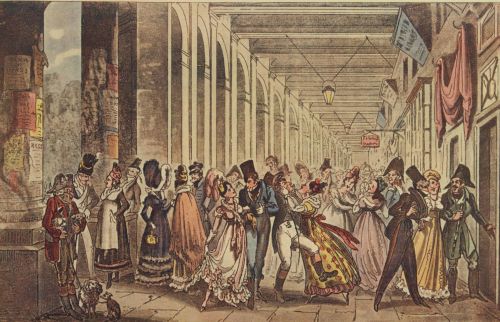
The palmy days of the Palais Royal. From a contemporary print.
The gaming-rooms were on the southern side of the Palais Royal. To enter them you ascended a staircase and opened the door of an ante-chamber, where several hundred hats, sticks, and great-coats, carefully ticketed, were arranged, under the charge of two or three old men, who received either one or two sous from every owner for the safe delivery of his precious deposit. No dogs were admitted into these sacred apartments, nor anything which was likely to disturb the deep attention and holy quiet which pervaded them! From this ante-chamber opened a folding-door, which led to a large, well-lighted room, in the centre of which was a table surrounded, at a moderate estimate, by two hundred and fifty or three hundred persons anxiously inspecting a game. The salons in the various establishments opened one into another, and in some there were as many as six rooms which contained tables.
At one time a curious condition was imposed upon the proprietors of the gaming-tables. They were obliged to furnish every one who entered their rooms with as much table-beer as they chose to call for. Waiters were therefore perpetually running backwards and forwards with overflowing tumblers of this refreshing beverage—six or seven crowded on a tray.
On the restoration of the Bourbons, public play in Paris continued to flourish with unabated vigour.
There were in 1818:
7 Tables of Trente-et-un.
9 " Roulette.
1 " Passe-dix.
1 " Craps.
1 " Hazard.
1 " Biribi.
—
20
These twenty tables were divided into nine houses, four of which were situated in the Palais Royal.
To serve the seven tables of trente-et-un there were:
Francs.
28 Dealers, at 550 francs a month, making 15,400
28 Croupiers, at 380 " " 10,640
42 Assistants, at 200 " " 8,400
For the nine roulette tables and one passe-dix:
80 Dealers, at 275 francs a month 22,000
60 Assistants, at 150 " " 9,000
For the service of the craps, biribi, and hazard:
12 Dealers, at 300 francs a month 3,600
12 Inspectors, at 120 " " 1,440
10 Aids, at 100 " " 1,000
6 Chefs de Partie at the principal houses, at 700 francs a month 4,200
3 Chefs de Partie for the Roulettes, at 500 francs a month 1,500
20 Secret Inspectors, at 200 francs a month 4,000
1 Inspector-General at 1,000
130 Waiters, at 75 francs a month 9,750
Cards every month cost 1,500
Beer and refreshments 3,000
Lights 5,500
The refreshments for the grand saloon, including two dinners every week, cost 12,000
————
The total expenses every month thus amounted to 113,930
The amount produced by the gaming-houses of Paris in 1823 was given as follows:—
Francs. Francs.
Rough Revenue 15,000,000
Expenses: upkeep of gaming-houses, pay of croupiers and the like 1,000,000
Annual tax to Government 5,000,000
Fifteen per cent for the poor 500,000
———— 6,500,000
—————
Total profits of proprietors 8,500,000
The scale of payment received by the croupiers and employés would seem to have somewhat closely approximated to that in vogue at Monte Carlo to-day. Every establishment employed the services of a functionary called l'homme de force, whose duties seem to have exactly corresponded with those of the less picturesquely named "chucker-out" of to-day.
The lowest stake permitted at trente-et-quarante was five francs—in certain rooms gold only was allowed—a lower limit of two francs being imposed at roulette. In this respect, matters were much the same as at German gaming-tables, which began to be put an end to after the war of 1866. The regulation now prevailing at Monte Carlo, which prescribes twenty francs at trente-et-quarante and five francs at roulette, is a very salutary one, preventing as it does a certain class of player from risking small sums which he can ill afford to lose. During the existence of the Paris gaming-tables there was at times a good deal of agitation in favour of raising the limit at roulette, the lowness of which was said to be responsible for widespread ruin amongst the working-classes. Occasionally, however, fortune was kind towards some of her humble worshippers. A cook employed at a Paris restaurant happened one day to stroll into the gaming-rooms established at No. 113 in the Palais Royal. He had no money, so amused himself looking at the people and eating oranges, a number of which he had brought with him. The rooms were hot, and a thirsty player offered to give the man six sous for one of the oranges, which the cook accepted. He then proceeded to throw the six sous on the biribi table, where he won six francs, which were increased to two hundred at roulette. At trente-et-quarante he was even more lucky, and after playing with the greatest success for some time found himself with a profit of some five hundred thousand francs. His master, the restaurant-keeper, who was a wise man, with some difficulty persuaded him to invest these large winnings in sound securities, whilst pointing out the folly of any further gambling. The cook never played again, and ended his days in affluence. He is said to have been the only man of this class who ever made a fortune at the Parisian gambling-tables.
Numbers of people who frequented the gaming-houses of the Palais Royal came there when they were already ruined, and, losing the small sums which still remained to them, afterwards created disturbance and scandal.
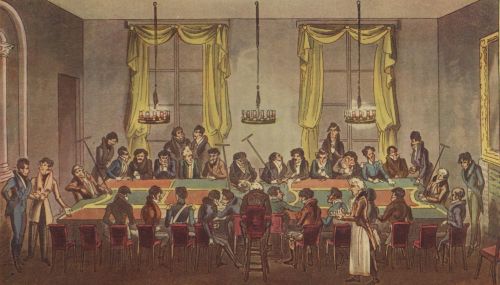
A Gaming Table in the Palais Royal.
A case of this sort which attracted a good deal of attention was that of an English half-pay colonel, who, having lost all his money at one of the Palais Royal Hells, determined to kill himself and every one in the place besides. With this object in view he smuggled into the place a canister full of explosive powder, which he put under the table and furtively set alight. Though players and croupiers were very unpleasantly astonished at the result, no one was hurt except the Colonel, who was very roughly handled and was thrown into prison, from which he was after a time sent over to England as a madman.
Amongst the games played were two which are now quite forgotten; these were passe-dix and craps.
Passe-dix is said to be the most ancient of all games of chance. According to tradition it was at this game that the soldiers played for the garments of Christ after the crucifixion.
There is one banker and any amount of players, each one of whom holds the box in turn. When a point under ten is thrown all the players lose their stake. If, however, a point above ten is thrown the banker pays double on all stakes. At private play every player banks in his turn, but in the Palais Royal the bank was, of course, held for the proprietors of the gaming-rooms.
The game of creps or craps mentioned in the list of tolerated games is now obsolete as a medium for any serious gambling in Europe. Curiously enough, however, it still survives in another continent, being even at the present day a favourite game in mining camps in Alaska, where it is well known in the gaming-saloons which are almost inevitable accompaniments of such settlements. The game would appear to consist of a board, something like an enlarged and glorified backgammon board, on which are emblazoned an anchor and five other emblems. The banker, when the money has been staked on these emblems, shakes out six dice, each of which bears on its facets devices corresponding with the designs on the board, the players being paid in proportion to the number of dice showing the figure they have selected. The boards used in Alaska are said to have been copied from similar ones brought by French emigrants to California during the famous gold fever in the 'forties. In some cases the identical boards exported from France are said to be still in use.
The bankers at craps claim that the odds are perfectly even as between the bank and the players, a statement which, however, would not resist the test of serious mathematical investigation.
The farmer-general of all the metropolitan houses of play at this time was Monsieur Benazet, Colonel of the Garde Nationale of Neuilly. M. Benazet, after the Revolution of 1830, was decorated by Louis Philippe with the cross of the Légion d'honneur, on account of his loyalty. Besides the officials who have been enumerated, there was a horde of attached spies, providers, pickers-up, and hangers-on, paid for doing the "dirty work" of the houses, both in and out of doors. The name, rank in life, presumed fortune, habitation, and habits of each gaming-house guest were registered; and, if they became regular customers, a sobriquet, or nickname, was given to each. By this means the constant players were, in a certain degree, known to the police. The salaried satellites of the maisons de jeu, when they entered upon their office, were peremptorily told that "it was their duty to regard every man who played at the tables as an enemy."
Three of the gaming-houses catered almost entirely for players of means, Frascati's and the Salon des Étrangers being well-known to all the gamblers of Europe. No. 154 in the Palais Royal, it should be mentioned, was also a favourite resort of high gamblers during the occupation of Paris by the Allies. Marshal Blücher lost very large sums there.
This rough old soldier was a most irascible player, and when he lost (which was more often than not) he would rap out volleys of German oaths whilst glaring at the croupiers. He usually played very high, and would grumble at the limit of 10,000 francs imposed as a maximum; so great was the sensation that he created, that any table at which he might be playing was always uncomfortably crowded.
In 1814 the stakes on the tables of the French gaming-houses consisted of the coins of all nations, it being not uncommon to see French napoléons and louis d'or, English guineas and crowns, Dutch ducats, Spanish doubloons, Russian roubles, as well as the various moneys of Prussia, Italy, and Germany, on the tables at the same moment. Notes were somewhat rare, though occasionally some daring gamester would stake a French one for a large amount.
The Salon and Frascati's were situated close together at that extremity of the Rue Richelieu which opens into the Boulevards; they both presented a highly aristocratic exterior, and both professed to be aristocratically exclusive and to admit no person without a suitable and satisfactory introduction. From this rule, however, Frascati's in its latter days departed; and the Cerberus who guarded the portals of that pandemonium very, very seldom refused admittance to any one whose exterior afforded evidence that he possessed any material wherewithal to feed (it were too much to say, satisfy) the devouring appetites of the bank.
Frascati's opened rather later than the other gaming-houses, its portals being only thrown open at one in the afternoon.
The Salon des Étrangers, also a favourite resort of Marshal Blücher, was frequented chiefly by that class who could afford to frequent gaming-houses, the ambassadors of foreign potentates frequently presiding at its sumptuous and magnificent entertainments.
The opening of these houses took place with nearly as great regularity as that of any bureau in Paris.
A well-known figure at the Salon was an old gentleman whose existence was bound up with that of this gaming-house. He had been completely ruined by play, and the proprietors of the Salon allowed him a pension to support him in his miserable senility—just sufficient to supply him with a wretched lodging, bread, and a change of raiment once in every three or four years! In addition to this he was allowed a supper (which was his dinner) at the gaming-house. Thither, at about eleven o'clock at night, he went. Till supper-time (two) he amused himself in watching the games and calculating the various chances, although he was destitute of the means of playing a single coup. At four he returned to his lodging, retired to bed, and lay till between nine and ten on the following night. A cup of coffee was then brought to him; and, having dressed himself, at the usual hour he again proceeded to the Salon. This had been his round of life for several years; and during all that time (except on a few mornings about midsummer) he had not beheld the sun!
Another constant frequenter of the Salon des Étrangers during the occupation of Paris by the Allies in 1814 was a Mr. Fox, a popular Secretary of the British Embassy, who was notorious for his easy-going disposition. Though usually most unfortunate at play, he once had an extraordinary run of luck, when having taken up the dice-box, he threw eleven successful throws, broke the bank, and took home some sixty thousand francs as winnings. All of this he spent in buying presents for ladies, which he declared was the only way to prevent the rascals at the Salon from getting back their money.
At the same gambling-place Lord Thanet lost enormous sums, whilst a young Irishman, Mr. Gough by name, was totally ruined there, and in consequence blew out his brains.
On the green cloth of the Salon des Étrangers also melted away the fortune of Sir Francis Vincent, who, having dissipated the whole of a fine property at play, entirely disappeared from the gay world. Frascati's—a more amusing resort—was in its palmy days regularly haunted by an aged gentleman well dowered with means, who was daily carried by his servant to the rouge-et-noir table. There he sat playing from three o'clock until five, at which hour, precisely, the servant returned and carried him (for he had entirely lost the use of his legs) back to his carriage. He was a man of large fortune, and the stakes he played were not considerable; yet he was elated by every lucky coup, and at every reverse he gnashed his teeth and struck the table in rage. No sooner, however, had the moment for his departure arrived, than he regained his equanimity, utterly regardless as to whether he had been a winner, or a loser, by the proceedings. "I have outlived all modes of excitement," said he, "save that of gaming: it is that that takes the fastest hold on the mind and retains it the longest; my blood, but for this occasional agitation, would stagnate in my veins—I should die."
Ten fêtes were given during the year at Frascati's, the sole gaming-place to which, after 1818, women were allowed admittance.
The disinclination of the Parisian authorities to throw open the public gaming-rooms to women was founded upon very substantial grounds, for at the beginning of the nineteenth century, great scandals had arisen owing to ladies becoming desperate after unsuccessful play. In 1804, for instance, a young and beautiful Hanoverian Countess, who had lost 50,000 livres, planned and executed the robbery of a fine coronet of emeralds, which she contrived to purloin at a ball given by the owner, Madame Demidoff. The youth, beauty, and high rank of the thief caused a great agitation in favour of her being pardoned, but Napoleon, who was never moved by mere sentimental considerations, refused to annul the sentence which had been passed upon her.
When they take to gambling, Frenchwomen become passionate devotees of play, as may be verified at any casino in France when baccarat and petits chevaux are in full swing. Very often they become so fascinated by the spirit of speculation that they can think of nothing else. An instance of this was the lady who, confessing to her priest, owned she was desperately fond of gambling.
The confessor, after pointing out the evils of such a passion, advanced several arguments against play, amongst which a principal one was the great loss of time which it must inevitably occasion.
"Ah," said the lady, "that's just what vexes me—so much time lost in shuffling the cards!"
Besides the licensed gaming-houses there were at this time a number of "maisons de bouillotte," which, though unlicensed, were more or less under the surveillance of the police. Here a good deal of play went on practically unchecked, an added attraction being the female society of no very rigorous morality which frequented such resorts. The favourite game played in these bouillottes was not the "bouillotte" from which they took their name, but écarté, in some ways a modification of the old French game of "la triomphe." Écarté in its present form would seem to have been first played in the early part of the nineteenth century in Paris, whence it made its way to England about 1820.