FOOTNOTES: (continued 2)
Reading edition
Whilst such places, together with Frascati's and the Salon des Étrangers, were the resort of the fashionable world, humbler gamblers betook themselves to half a dozen houses which were frequented by all classes of the population, the most popular being Nos. 9, 129, and 113 in the Palais Royal. Play began at twelve in the morning, except on Sundays and holidays, when one was the hour fixed; on certain Saints' Days and at Christmas all the gambling houses were compelled by law to close at midnight, except the Salon des Étrangers and No. 9 in the Palais Royal, two of those curious exceptions for which the authorities in France have always had (and still have) a liking, being made in their favour.
On January 21, the day on which the unfortunate Louis XVI. had been guillotined, a special regulation forbade any play at all. In 1819, however, no notice was taken of this, which led to a great outcry; and the following year the gambling-houses did shut their doors on the day in question, but the keepers demanded a rebate on the sum paid to the Government as compensation for their loss of profits.
The evil days of the Palais Royal as a pleasure-resort began about the time of the Revolution of 1830, when it became evident that a determined effort was going to be made to alter the character of the place entirely. In 1831, stringent measures were adopted with regard to the class of persons allowed to frequent the galleries, the amusements permitted being exposed to a rigorous censorship, whilst every effort was made to efface the traditions of light-hearted frivolity and licence which had hung about the old place since the days of the Revolution.
Numbers of the tradesmen who owned shops in the Palais Royal had called for these measures. They were imbued with the somewhat pharisaical respectability which is so often the appanage of their class, and entertained the totally fallacious idea that the purification of the gardens would cause a greater number of visitors from abroad to frequent and make purchases at their shops. It soon became evident that the fate of the gaming-tables was sealed, a great outcry being raised against the toleration of what was characterised as a public scandal, and was denounced as such in the Press. English opinion particularly was said to be bitterly hostile to the tables, and the deluded tradesmen of Paris entertained an idea that the doubtful pleasures of the Palais Royal prevented much foreign money from pouring into their pockets.
Finally in 1836, chiefly owing to the efforts of a Mr. Delessert, it was decided that the gaming-houses of Paris should be closed two years from that date, and on the 1st of January 1838 the Palais Royal ceased to offer any attractions appealing to the gambler.
At the time when the agitation for the suppression of public gaming in Paris was going on, a good deal of abuse was heaped upon the proprietors of the tables, who were denounced as vampires sucking the blood of the poor. One of them, M. Borsant by name, was exempted from censure, being noted for many favourable traits not often to be met with in those drawing their revenue from gaming. This gentleman once actually restored 17,000 francs lost by a young man to his astonished parents. The actual date of the cessation of public play in Paris was Sunday, December 31, 1837. So numerous had the visitors been during the last few weeks preceding this date, that an additional police force had been found necessary for the maintenance of order. In consequence of the excitement, the manufacturers and tradesmen of Paris had come to a general agreement not to pay their workmen's wages before twelve o'clock on Sunday night, lest the money might be carried to swell the last day's receipts of the great joint-stock company to which all the Parisian gaming-houses belonged.
On the last evening, which was a Sunday, the rooms at Frascati's were so thronged that there was scarcely a possibility of stirring in them. The tables were overladen with money. At ten o'clock such was the crowd inside that it was found necessary to shut the street doors.
Placards stuck up in all the rooms warned the gamblers that the play would not be suffered to extend a single minute beyond midnight, which was the hour specified by the law. The Salon or Cercle des Étrangers, still the most fashionable of the gambling-houses, which usually was opened only at eleven at night and closed at three or four in the morning, opened on Sunday evening at nine o'clock, a notification to such effect having been sent round to the habitual frequenters of the place. On Saturday and Sunday all the gambling-houses of Paris, especially No. 154 of the Palais Royal and Frascati's, were immensely crowded. Several dramatic incidents occurred. A workman destroyed himself on quitting No. 113, and two young men who had lost large sums disappeared entirely.
In accordance with the edict previously announced, the game ceased exactly at midnight. The gambling during the last days of the tables had been very high, and crowds flocked to witness the end. Disturbances were anticipated, and the municipal guards were in consequence posted in considerable force about the various rooms. At Frascati's an immense crowd of visitors assembled, but they dispersed peaceably, after encountering the shouts and hisses of the mob that had collected in the Rue de Richelieu outside to witness their final exit from that historic haunt of pleasure. A dramatic incident occurred, one unhappy wretch shooting himself as the doors closed for ever. He had lost heavily, and was in despair at the prospect of being unable to retrieve his losses.
In 1838 a case came on for trial before the Court of Assizes, Paris, which excited a good deal of interest. The prisoner, a clerk to a merchant, had gambled on several occasions, and had lost at Frascati's and the gaming-houses licensed by Government upwards of 100,000 francs, the property of his employer. In the course of the trial, Benazet, the lessee of these establishments, stated that in the course of a year there was thrown on the tables of the gaming-houses comprised in his licence 800,000,000 francs (£32,000,000): that, independently of the annual sum paid to Government for the licence (which was 6,000,000 francs or £240,000), the clear profit on the tables during the last year of their life, 1837, was no less a sum than 1,900,000 francs (£76,000), but that three-fourths of this sum was paid over to the city of Paris; the other fourth (£19,000) was his proportion of the gain. M. Benazet eventually declared that he would refund his part of the sum lost by the prosecutor's clerk if the city of Paris would equally pay back the three-fourths of it which had passed to its credit. The average number of gamblers admitted to those houses had been three thousand a day, another thousand having been denied entrance.
From the moment that the tables were suppressed, the prosperity of the shops in the former Palace of Cardinal Mazarin began to wane. As the years rolled on, visitors became fewer and fewer, till the place assumed the forlorn aspect which it wears to-day, when even the tourist scarcely deigns to visit its deserted galleries.
At the time of the Revolution there had been a number of first-class restaurants in the Palais Royal. The café kept by Méot, for instance, enjoyed a great reputation for its cellar. Here could be procured twenty-two sorts of red wine, twenty-seven of white, and sixteen different kinds of liqueurs, most of which had come from the cellars of the noblesse. Méot's was essentially a Royalist restaurant, and contained little rooms where aristocratic clients could dine in luxurious privacy.
Beauvilliers, once cook to the Prince de Condé, also kept a restaurant much frequented by adherents of the old régime, and here Rivarol Champcenetz and others used, while dining, to compose articles for the famous Royalist sheet—Les Actes des Apôtres.
A well-situated restaurant was Véry's, which paid no less than 196,275 livres a year as rent for No. 83. Véry's was founded in 1790: here it was that Danton gave dinners to his friends, and pointed out to them "that their turn had come to taste the delights of life; and enjoy the sumptuous mansions, exquisite dishes, rare fabrics, and beautiful women which were the legitimate spoils of the victors." This restaurant was much frequented by foreigners, with whom it had a great reputation; every Englishman of means who visited Paris made a point of dining there once or twice.
At No. 73 was the restaurant Venua, where the Girondins used to dine at ten francs a head. Robespierre also used to frequent its gaily-decorated saloons, and men alive in the middle of the last century well remembered the sinister profile and sky-blue coat of the "sea-green incorruptible" reflected in the mirrors which adorned this café.
A badly-lit, ill-appointed restaurant was that kept by Fevrier; nevertheless, its democratic lack of luxury attracted austere patriots.
Lepelletier de St. Fargeau, dining here on the 20th of January 1793, at five o'clock in the afternoon, was accosted by a young man who stabbed him to death as one who had voted for the execution of Louis XVI.
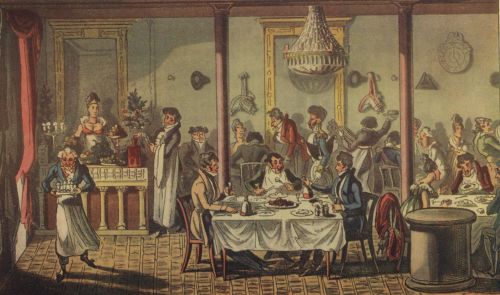
Very's in 1825.
As Paris gradually recovered from the fever of the Revolution, many other first-class restaurants were established in the Palais Royal, several of which survived up to our own time.
All of these have now long disappeared from the spot which was once a shrine for the gastronomers of Europe. To-day the very name of Véfour is forgotten. Les Trois Frères Provençaux, the Café Corazza, and other resorts, once famous for their cuisine, have long ceased to make any appeal to the modern gourmet, whilst even the less pretentious cafés, which, in the early days of the third Republic, offered the passing traveller a sumptuous dinner for two or three francs, have almost, without exception, closed their doors.
From time to time schemes have been mooted which were to galvanise the Palais Royal into some semblance of life; the latest of these is a plan to pierce a street, or rather a drive, right through it, by which means the place would become a thoroughfare and regain its lost vitality.
Sad and mournful as the old gardens are to-day, it is not altogether without the bounds of possibility that they will in the future once again become the resort of the wealthy pleasure-seekers of the world.
The fine shops which formerly abounded beneath the colonnades are memories of the past, all the great shopkeepers having migrated from what has become a little city of the dead. A number of the shopkeepers in the Palais Royal lived to regret bitterly the rigorous measures for which they had once so vehemently called, and there is no doubt that the unfortunate commercial results which followed, once it had ceased to be a pleasure-resort, made a deep and lasting impression upon the mind of the Parisian tradesman, who to-day thoroughly realises that visitors to Paris are attracted by some amusement of a speculative kind.
The Parisian shop-keeper would probably welcome the revival of public gaming-tables for he is a warm supporter of French racing, where the betting is legalised and carried on by the State, well knowing the commercial benefits which indirectly accrue to the city of Paris.
During the Second Empire, Doctor Louis Véron, ex-dealer in quack medicines, ex-manager of the Grand Opéra, and ex-proprietor of the Constitutionnel newspaper, offered an enormous royalty to Government for the privilege of establishing a gambling-house in Paris. The Emperor Napoleon III., however, declined to consider the proposal.
At the present day, though no public tables exist, there are ample facilities for play in Paris, and baccarat flourishes in many a Club to which admission is not difficult. The great evil of the gaming-houses of the Palais Royal was that they especially appealed to a class which could not afford to lose their hard-earned money—the poor being lured to ruin. Such a state of affairs is non-existent in modern Paris, where gambling, as far as possible, is limited to those able to afford to indulge in it.
A Frenchman cares little for Clubs without play, and many a Cercle draws its principal support from the cagnotte at baccarat; this amounts to about ten per cent on the sum put into the bank, which goes to the highest bidder up to five hundred louis, when, if there are two or three competitors, they draw lots for it. The percentage in question, however, varies as the bank increases, and is not levied after a certain amount of renewals.
In former years the management of some of these gambling-clubs was somewhat lax, and occasionally undesirable characters entered the rooms and passed themselves off as members. At a certain well-known resort, which formerly flourished not far from the Place de l'Opéra, high gambling was the order of the day just before dinner. One fine afternoon there was as usual somewhat spirited bidding for the bank, which was eventually secured for some four hundred louis by a very distinguished-looking man whose face was new to the usual frequenters of the place. The individual in question, taking the banker's seat, the cards having been shuffled and cut, produced no money but merely told the croupier opposite, "Il y a quatre cents louis en banque," upon which that official, with all the dignity of his race, tapped a piece of red cardboard and repeated, "Quatre cents louis à la carte."
The stakes were made and the cards dealt—neuf on the right, huit on the left—both sides won. "Caissier," cried the banker to the official who exchanged money for counters and vice versa at the desk, "donnez dix mille francs." The result of this was, however, unsatisfactory, for the caissier most politely explained that he had no authority to advance money to members, and certainly not to members whom he did not know. "Well," said the banker, "if that is the case I must go and get my pocket-book from my coat; it will be the matter of an instant." This optimistic forecast, however, was hardly justified by subsequent events, for the banker never returned, and eventually the expectant and anxious players became so enraged that the management of the Club thought it best to pay them their winnings. The banker, it afterwards transpired, had been a notorious sharper.
It was at a Club of the same sort, where the membership was rather mixed, that a certain English nobleman, finding that his pocket-book, containing several thousand francs, had been taken out of his coat hanging in the hall, did not hesitate to tell the committee that it must have been purloined either by the waiters or the members, and received the reply, "We can answer for the waiters!"
Not very far from Paris, at the Casino of Enghein, much baccarat is played, which has rendered the resort in question very popular, so much so indeed that the criminals known as "apaches" have begun to haunt the road from Paris. Not very long ago a band of these pests contrived to stop a motor, one of them lying down in the road in front of it, and the rest attempting to rob the occupants when the car was pulled up. The miscreants were on the point of wrenching a valuable pearl necklace from a lady's neck when another car arrived and put the assailants to flight.
About a couple of years ago roulette was played—practically without let or hindrance—at St. Germain. No wheel, however, was employed, its place being supplied by a dial on which by an ingenious device the winning number and colour appeared on a croupier firing a sort of rifle. The result was the same as at ordinary roulette, and just as in the old-fashioned form of the game most people lost their money. This resort, it should be added, was eventually closed by the authorities, who were aroused by the great increase of gaming in Paris owing to the introduction of baccarat with one tableau. This will be dealt with at the end of the next chapter.
IX
Public gaming in Germany—Aix-la-Chapelle—An Italian gambler—The King of Prussia's generosity—Baden-Baden—M. de la Charme—A dishonest croupier—Wiesbaden—An eccentric Countess—Closing of the tables in 1873—Last scenes—Arrival of M. Blanc at Homburg—His attempt to defeat his own tables—Anecdotes of Garcia—His miserable end—A Spanish gambler at Ems—Roulette at Geneva and in Heligoland—Gambling at Ostend—Baccarat at French watering-places—"La Faucheuse" forbidden in France.
In former times a great deal of public gaming was carried on at Aix-la-Chapelle, where the alluring rattle of the dice-box was to be heard from morning till night. Here there were fixed hours for play, one bank opening as another shut—biribi, hazard, faro, and vingt-et-un being the favourite games. The chief banker paid a thousand louis per annum for his licence during the season; and it was said that his profit in general exceeded four thousand, and sometimes double that sum. There were two gaming-houses a mile or two from the town, and each gambling-house, each room, nay, each part of a room, had its fashionable hours. From the commencement of play to the conclusion (that is, from ten in the morning to two or three the next morning), only two hours were allotted for meals.
In 1792 a little Italian created a considerable sensation at this gaming-resort, to which he had come as an adventurer, with a few louis d'or in his pocket, determined to try the favour of fortune. His first attempt was at hazard, where he played crown stakes, which, as fortune smiled on him, were increased to half a guinea, guinea, and so on to bank-notes. In the space of twenty-four hours he had stripped the bank of upwards of four thousand pounds; and the next morning, resuming his operations, broke the bank entirely, his winnings amounting to more than nine thousand pounds. One would have imagined that a poor needy adventurer, who most probably had never seen a twentieth part of such a sum before, would at once have pocketed his winnings and returned (in his own mind a prince) to his native country. Content, however, was a stranger to his mind, and the accession of one sum only brought with it anxiety for a greater. He continued to be successful; and for several days the bankers ceased to play, so completely had he reduced them to their last stake. When a fresh supply of cash did at last arrive the little adventurer recommenced operations—for a few hours with his usual success. The luck, however, at last changed, and from being the possessor of ten thousand pounds he left the bank reduced to his very last louis. He next proceeded to negotiate a loan of about thirty pounds, and returned to the tables, much to the discomfort of the bankers, who, from the success that attended his play, had conceived no small dread of him. His usual run of good luck attended him, and from being master of only thirty pounds, he left the table with more than ten thousand. He remembered a resolution he had formed in his fit of poverty, went to an inn, ordered a carriage, and packed up his baggage. In the interim, however, one of the directors of the bank, learning his intention, set off to interview him, resolved to use all the rhetoric he was master of to persuade him to relinquish his design. His arguments were too specious not to destroy the resolution of the poor Italian, whose fortitude vanished in a moment, and instead of making for his native country he returned to the gaming-table, where, in a very few hours, he was stripped of every soldo he had in the world, and left to reflect on the diversity of fortune which he had known in the space of so short a time. The moment he got back to his lodgings he sold the greater part of his clothes, and by this means raised a few louis which he took to his old haunts, where he now cut a sorry figure.
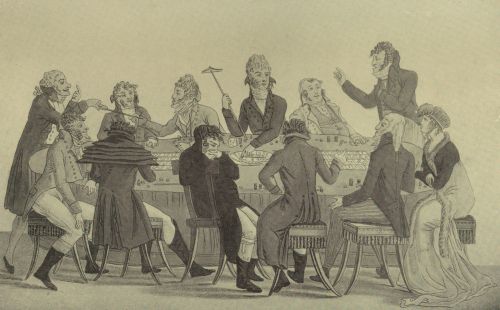
Roulette in the Eighteenth Century.
A considerable sensation was once caused at the principal faro-table at Aix-la-Chapelle by the success of a plainly-dressed stranger, who, after playing in modest stakes for some time, suddenly challenged the bank for the whole of its capital, carelessly tossing his pocket-book to the banker, that the latter might not question his ability to pay in case he lost. The banker, surprised at the boldness of the adventurer, and no less so at his ordinary appearance, at first hesitated to accept the challenge; but on opening the book and seeing bills to a prodigious amount, and on the stranger sternly and repeatedly insisting on his complying with the laws of the game, with much reluctance he shuffled the cards in preparation for the great event. Excitement ran high, and all eyes were soon attentively riveted upon the trembling hands of the affrighted banker, who, while the gambler sat unruffled and unconcerned, turned up the card which decided his own ruin and the other's success.
The bank was broken, and the triumphant stranger, with perfect coolness and serenity of features, turned to a person who stood at his elbow, to whom he gave orders to take charge of the money. "Heavens," exclaimed an infirm old officer in the Austrian service, who had sat next the winner at the table, "if I had the twentieth part of your success this night I should be the happiest man in the universe." "If thou wouldst be this happy man," replied the stranger briskly, "then thou shalt have it"; and, without waiting for a reply, disappeared from the room. Some little time afterwards the entrance of a servant astonished the company with the extraordinary generosity of the stranger as with his peculiar good fortune, by presenting the Austrian officer with the twentieth part of the faro bank. "Take this, sir," said the servant, "my master requires no answer"; and he suddenly left him without exchanging another word.
The next morning all Aix-la-Chapelle was agog with the news that the lucky and generous stranger was no less a personage than the King of Prussia.
In more recent times Aix-la-Chapelle appeared only destined to end its gambling days as a trap for incautious travellers, many of whom, in consequence, never saw the Rhine, and returned to England with very misty ideas about Germany.
About 1840 several other German pleasure-resorts began to include gambling amongst the attractions offered to visitors. After the closing of the Parisian gaming-houses the proprietors, who found the business much too profitable to be tamely resigned, turned their gaze beyond the Rhine, where a fair field for their exertions in the pursuit of a livelihood presented itself. After many weary negotiations with the several governments, a syndicate of bankers, with M. Chabert at their head, simultaneously opened their establishments at Baden-Baden, Wiesbaden, and Ems. It was a very hard contest between the Regents and the Frenchmen before the terms were finally settled, and the latter expended much money and many promises in getting a footing. But they eventually succeeded, and a few years saw their efforts richly rewarded. As they had a monopoly, they could do pretty much as they pleased, and made very stringent and profitable regulations relative to the refait and other methods of gaining a pull. On the retirement of M. Chabert with an immense fortune, the company was dissolved, and M. Benazet became ostensibly sole proprietor of the rooms at Baden-Baden. The terms to which he had to subscribe were sufficient to frighten any one less enterprising than the general of an army of croupiers; he was compelled to expend 150,000 florins in decorating the rooms and embellishing the walks round the town; and an annual sum of 50,000 florins was furthermore demanded for permission to keep the establishment open for six months in the year.
At Baden-Baden a well-known figure for many years was the old ex-Elector of Hesse, who made his money by selling his soldiers to England at so much a head, like cattle, during the American War. The Prince in question was easily to be recognised by the gold-headed and coroneted rake he always had in his hand. A constant player, he was a most profitable customer to the bank. Eventually, however, the superior attractions of Homburg led him away. The Revolution of 1848 frightened or angered him to death.
At Baden the bank at roulette had two zeroes, an enormous advantage, which rendered the certainty of success in the long run, which the bank must of course possess, almost ridiculously easy. Nauheim, on the other hand, was modestly content to claim only a quarter of the refait at trente-et-quarante, a good deal less than that taken by the present Monte Carlo tables. The keen competition of its rivals, Wiesbaden and Homburg, was the cause of this generosity.
In the late 'sixties a gaming hero, M. Edgar de la Charme, created a great sensation at Baden, where, for a number of days together, he never left the gaming-room without carrying off a profit which usually did not fall far short of a thousand pounds in English money.
At the end of several days of almost unparalleled good fortune, M. de la Charme, reflecting that there must be an end even to the greatest run of luck, packed his portmanteau, paid his bill, and strolled down to the railway station, accompanied by some of his friends. There, however, he found the wicket closed, there being still three-quarter's of an hour before the departure of the train. "Well," he exclaimed, "I will go and play my parting game," and, taking a carriage, drove back to the Kursaal, though his friends made every effort to prevent him. Arrived at the Casino, he sat down at the trente-et-quarante, where in twenty minutes he broke the bank again. He then left, but, while getting into his cab, caught sight of the inspector of the tables walking to and fro under the arcades, and said to him in a tone of exquisite politeness, "I could not think of going away without leaving you my P.P.C."
The society at Baden was said to be as mixed as that frequenting the Paris boulevards. There was indeed a good deal of Parisian Bohemianism about this charming spot, which, since the closing of the tables, has been forced to rely upon its proximity to the Black Forest and other natural attractions—poor substitutes to the gambler for the whirl of the roulette wheel and the chanting of the croupier at trente-et-quarante.
The rooms which re-echoed to these exciting, if none too reputable sounds, to-day seem somehow to present a rather sad and almost wistful appearance. Surely, "if aught inanimate e'er grieves," the Kurhaus must sigh for the vanished days of the Second Empire, and for the gay, careless folk who thronged its halls, now so decorous and staid.
Old gamblers used to say that the croupiers at Baden were recruited from the same families who had held the rake in the gambling-rooms of the Palais Royal. Certain veterans were even pointed out as being survivors of the great days of Frascati's and the Salon.
Baden made no pretence to any particular exclusiveness. Here all men and women were equal, people sitting down cheek by jowl with any one at trente-et-quarante or roulette, a practice not much in favour at aristocratic Ems, where the fashionable lounger was more given to tossing down his stake carelessly as he or she strolled through the rooms.
Though the croupiers at Baden-Baden were generally above suspicion, the bank was swindled by its employés on more than one occasion. A notable instance was that of an official who was discovered to have carried on a system of plunder for a long time with security. He used to slip a louis d'or into his snuff-box whenever it came to his turn to preside over the money department; he was found out by another employé asking him casually for a pinch of snuff, and seeing the money gleam in the gaslight.
On the whole the croupiers at Baden were admirable, sometimes preserving their self-control under the most trying circumstances. On one occasion when a young Englishman, of high repute and bearing an honourable name, vented his rage at losing by breaking a rake over the head of the croupier, the latter merely turned round and beckoned to the attendant gendarme to remove his assailant and the pieces of the rake, and then went on with his parrot-like "rouge gagne, couleur perd."
The croupiers in general seemed to unite the stoicism of the American Indian with the politeness of the Frenchman of the ancien régime. Impassive under all circumstances they seemed to fear neither God nor man; for when a shock of the earthquake of 1847 was felt at Wiesbaden, though all the company fled in terror, they remained grimly at their posts, preferring to go down to their patron saints with their rouleaux, as an evidence of their fidelity to their employer. It is not unlikely that they regarded the earthquake as a preconcerted scheme to rob the bank!
The public buildings of Wiesbaden were charming, especially the Kursaal, with its open "Platz," its colonnades and magnificent ball-room, its "salons de jeu," reading-rooms, restaurant, and charming gardens behind. Here were lakes, fountains, running streams, which made it as pretty a place as any of its kind on the banks of the Rhine.
Towards the last days of the gambling at Wiesbaden the majority of the players belonged to the middle and lower middle classes, leavened by a very few celebrities and persons of genuine distinction. The general run of visitors, indeed, was by no means remarkable for birth, wealth, or respectability, and it used at that time to be said that all the aged, broken-down courtesans of Paris, Vienna, and Berlin had agreed to make Wiesbaden their autumn rendezvous.
One of the well-known eccentric notabilities of Wiesbaden at that time was a certain Countess—an aged patrician of immense fortune, whose very existence seemed bound up with that of the tables. She used daily to be wheeled to her place in the "temple of chance," where she usually played for eight or nine hours with wonderful spirit and perseverance. A suite of eight domestics were in attendance upon her, and when she won, which was not often, she invariably presented each member of her retinue with—twopence! This was done, she would naively declare, "not from a feeling of generosity, but in order to propitiate Fortune." On the other hand, when she lost, none of them, save the man who wheeled her home and who received a donation of six kreuzers, got anything at all but hard words. Unlike her contemporary, a once lovely Russian Ambassadress, she did not curse the croupiers loudly for her bad luck, but, being very far advanced in years and of a tender disposition, would shed tears over her misfortunes, resting her chin on the edge of the table. This old lady was very intimate with one or two antediluvian diplomatists and warriors, whom she used to entertain with constant lamentations over her fatal passion for play, interspersed with bits of moss-grown scandal, disinterred from the social ruins of a bygone age. Radetzky, Paul Eszterhazy, Wrangel, and Blücher had been friends of her youth; and, to judge from her appearance, no one would have been surprised to hear that she had attended the Jeu du Roi in the galleries of Versailles, or played whist with Maria Theresa.
Wiesbaden boasted a financier from Amsterdam, who usually played on credit—that is to say, he pocketed his winnings, but, if he lost, borrowed money of the banker, squaring his account, which was generally a heavy one, at the end of the week. Another well-known character was an English baronet, who always brought a lozenge-box with him. When this was filled with gold he would leave the rooms. He seldom had to remain long, for he possessed his own luck, and that of some one else into the bargain.
Wiesbaden, like the other German gaming-places, was made virtuous by compulsion rather than choice. When Nassau was annexed by the astute Bismarck, the law which abolished legal gambling affected this place as it did Homburg, Ems, and other Spas. It should, however, be added that its provisions showed a scrupulous regard for vested interests.
As the fateful 1st of January 1873—the day on which all public gaming throughout the German Empire was to cease—approached, there was considerable excitement, not only amongst the usual frequenters of the tables, but also amongst the general population of the place, who fully realised the financial benefits which had accrued to them through roulette and trente-et-quarante, the impending prohibition of which they deplored.
At midnight on the 31st December 1872, after a hundred years of existence, the Kursaal clock at Wiesbaden sounded the close of play. There was considerable disorder in the rooms on the last night, the place being converted into a bear-garden. During the last week the rooms got so enormously thronged that the administration found it necessary to admit only by tickets. 1872 was a splendid financial year, for, after paying all the enormous expenses (5000 florins a day), including the yearly tax of 200,000 florins to the Prussian Government, the shareholders received interest on their capital at the rate of 107 per cent per annum. A number of the eighty or ninety croupiers were retained by M. Blanc for service at Monaco, whilst the rest it is believed went into trade.
On the last night an immense throng gathered in the rooms, eagerly crowding round the tables. The play, however, was unusually dull, and on the green cloth, which had usually been liberally sprinkled with gold, only a few spare florins were to be seen. The croupiers did their best to dispel the depression which hung over the gamesters; and as the final moment approached, shouted louder and louder, adding to their usual formula, "Faites vos jeux, Messieurs," the words "le troisième dernier!"—the third last chance; "le deuxième dernier!"—the second last; and finally "le dernier!" which seemed to sound like a death-knell. Their appeals had little effect, the moment being of such solemnity as to stifle all emotion and paralyse every movement. Here and there some small stake was noiselessly placed on the table by some timid and unfamiliar hand, but the audacious spirit of the real gambler was for the moment lulled to rest, and no one seemed eager to try a last serious struggle with the goddess of chance. The closing of the gaming-tables was a veritable convulsion of nature as regards Wiesbaden. On the 1st of January 1873 there was universal confusion in hotel and lodging-house, and the streets were thronged with departing travellers and overladen porters, while the railway stations were blocked with eager applicants for tickets. With a haste bordering on indecency the old gambling-saloons were taken possession of by the municipal authorities, and stripped of their furniture; windows and doors being thrown open to the air, and the halls, formerly devoted to chance, handed over to a host of painters, white-washers, and scrubbers. The green tables, which had caused so many emotions, were thrown out, and cast into heaps, preliminary to being carted away as old furniture. The results to the town were disastrous. Many of the hotels fell into bankruptcy and were forced to close their windows—their doors they might have left open, for there were no guests to enter them.
The shopkeepers, more especially the jewellers, who generally were pawnbrokers too, and all dealers in articles of luxury, were also great losers by the change.
The joint-stock company, which had owned the tables, dissolved, after having divided a large amount of surplus. The shareholders had indeed no cause for complaint, yet one of the two directors took the dissolution so much to heart that he soon after drank himself to death.
A few days after the cessation of play hardly a gambler remained in the place.
One exception, however, there was, who for some years was pointed out as a rare specimen of an extinct race by the few officials of the rooms who had been retained as door-keepers and the like in the building from which all life had fled.
Still clad in the torn, somewhat shabby livery of more prosperous days when "Trinkgeld" was abundant, these men would describe to visitors how this Englishman, a man bearing an historic name, had created a sensation at the tables, where he had been notorious for his ill-luck. To all appearance entirely ruined, he had suddenly been left some twenty thousand pounds, which had soon followed the rest of his fortune into the coffers of the bank. Reduced to his last florin, fortune for a moment had seemed to relent, and he had left the rooms with about seven thousand pounds in his pocket. Having deposited this at his banker's, he had then declared his intention of never playing again—in less than a week the sum had been withdrawn and lost.
His friends, now believing him to be incorrigible, settled upon him a small allowance, which was paid quarterly, and with unfailing regularity found its way to the green cloth.
Seemingly stunned by the closing of the rooms, this Englishman lingered on for some years, mournfully marching about the spot which had engulfed his fortune, the loss of which, however, caused him less concern than being deprived of the means wherewith to gratify the passion that had dominated his life.
All the gambling companies had to pay large sums in return for the privileges which they enjoyed, but still they progressed most successfully till they were frightened from their propriety by Monsieur Blanc. This gentleman, after struggling against immense opposition on the part of the Frankfort merchants, who were naturally alarmed at the danger to which their commis and cash-boxes would be exposed by the proximity of a gambling-table, obtained a concession from the Elector of Hesse to establish a bank at Homburg-von-der-Höhe. Play was soon in full swing, with the additional attractions of being open all the year round, and of having only a trente-et-un après (known as the refait) for the players to contend against. Some time after, Wilhelmsbad was opened as a rival to Homburg, with no après at all; and the above mentioned, with the addition of Ems, Aix-la-Chapelle, and Cöthen, formed the principal establishments where "strangers were taken in and done for" throughout Germany.
Wilhelmsbad scarcely attracted the outside world at all, being frequented almost exclusively by Germans. Wildungen might have been called a child left out in the cold; the accommodation was indifferent, and the place itself cheerless and devoid of charm, besides which it was not so easy to get at. Modestly conscious of its slender claims to consideration, the authorities presiding over the tables allowed a minimum stake of 10 groschen (1 franc 25 cents), and only enforced a tax of a quarter of the refait at trente-et-quarante and a quarter of the zero at roulette, a state of affairs which should have been far from unfavourable to the players.
As a matter of fact, public gaming, whatever may be said against it, left those places where it formerly flourished in a high state of prosperity—the Kursaals and gardens of German health-resorts, such as Homburg and Baden-Baden, owed their inception entirely to gaming, whilst several other insignificant places were converted into agreeable pleasure-resorts by the influence of trente-et-quarante and roulette.
In spite of the doubtful morality of the enterprise carried on by the proprietors of the tables they certainly metamorphosed several miserable German townlets into cities of palaces. They planted the gardens; they imported the orange trees; they laid out the parks; enclosed the hunting-grounds; and, as it were, boarded, lodged, washed, and taxed the inhabitants. Homburg, for instance, was entirely the creation of M. Blanc.
The story of the commencement of the immense fortune accumulated by M. Blanc is curious.
One fine day in 1842 the two brothers Blanc, who were temporarily disgusted with France owing to a daring and unsuccessful speculation connected with the old semaphore telegraph (which electricity rendered obsolete), arrived at Frankfort.
Their stock-in-trade consisted of a few thousand francs, a roulette wheel, and an ancient croupier, a veteran of Frascati's who knew everything worth knowing about gambling and cards.
The purpose of this visit was to convince the authorities of Frankfort that their city would derive great benefit from affording facilities for public play, but with this, however, they were not disposed to agree. In consequence of its cool reception, the little party then wended its way to the obscure village of Homburg, where the elder of the two brothers, after some negotiations, obtained permission to set the roulette wheel going in one of the rooms of the principal inn.
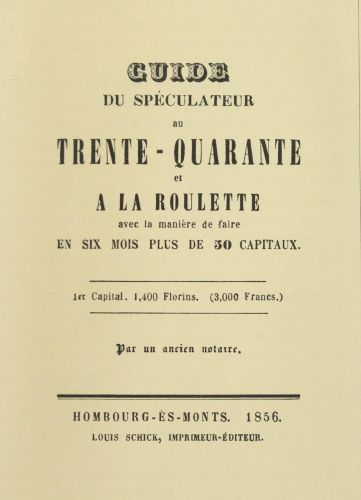
As at Monte Carlo to-day, infallible "guides" to success at the tables were to be obtained in the Homburg book-shops. The above is a facsimile of the title-page of one of the most curious of these booklets.
The next year an exclusive concession was granted to the Blancs to establish games of hazard within the dominions of the Landgraf. They agreed to build a Kursaal, lay out public gardens, and pay about 40,000 florins (something over four thousand a year) to the Landgraf. A company was formed, and soon the fashionable world flocked to Homburg—ostensibly to drink the waters, but, in reality, to lose their money at trente-et-quarante and roulette.
The general policy pursued by M. Blanc at Homburg was very similar to that afterwards adopted at Monte Carlo, which is still in its essential features followed by the present administration.
The hours allotted to play were from eleven in the morning to eleven at night, which was also the case at Monaco up till quite recent years.
The proceedings at Homburg before play began, that is to say, the counting of money and other preparations for the day's campaign, were also much the same as at Monte Carlo, though the actual opening of the rooms for play was more dramatic. As the clock struck eleven the strains of martial music were heard and the doors of the "salons" were thrown wide open, admitting a stream of people, amongst whom were many officers, a note of colour being struck by their uniforms, which were principally white or green.
In the early days of Homburg, owing to an extraordinary rainfall, a flood of water once made its way into the gaming-rooms and caused the players to beat a precipitate retreat. A fat old German Princess, however, who was devoted to play, was too heavy to get out in time, and had to be hoisted up on to one of the roulette tables, where she placidly remained till matters were put right and the play had resumed its normal course.
In the Kursaal were the Café Olympique, private rooms for parties, and, most important of all, a big saloon and two smaller ones. Here from eleven in the forenoon to eleven at night, Sundays not excepted, all the year round, people from every part of the world came to throw their gold and silver upon the tables.
As a town Homburg was practically created by the Kursaal. The hotel-keepers and tradesmen lived by it as well as the Landgraf, whose main source of revenue was derived from it. This sovereign, of course, was practically sold to the Kursaal, the Board of Directors being the real rulers of Hesse-Homburg. The prosperity which the advent of M. Blanc had brought to his dominions cheered the declining years of this Prince, who was the oldest reigning sovereign in Europe at the time of his death, which occurred on the 24th of March 1866. He had attained the great age of eighty-three when he expired in the arms of two weeping widowed women—one his niece, the Princess Reuss, the other his aged sister, the Dowager Grand Duchess of Mecklenburg-Schwerin. This event caused a temporary cessation of play, which had been continuous since the 17th of August 1843.
The insidious fascination connected with gambling was once strikingly exemplified at Homburg. The story, though a well-known one, will bear repetition.
M. Blanc had been pondering what to give his wife on her birthday, when a peculiarly attractive parasol caught his eye as he was strolling amongst the shops; so he went in and inquired the price, which was twenty marks. The founder of the great gaming establishment was a careful man, and it seemed to him that to pay so much for a parasol was extravagant. Nevertheless, he ordered it to be put aside for him, saying that he would call and pay for it later.
On his way to the Casino the thought suddenly struck him: "To win twenty marks in the rooms is quite easy—numbers of people do it, but they don't stop; which is the reason I make so much money. Why shouldn't I win the price of this parasol—make my twenty marks and walk out?"
Walking up to a trente-et-quarante table and unobtrusively stationing himself behind a group of players, M. Blanc furtively slipped twenty marks on the red—black won. Forty marks on the red—black again won. Eighty marks on the black—red won. He now became excited and, the money he had in his pocket being exhausted, edged towards an astonished chef de partie, to whom he was, of course, well-known, and instructed him to place one hundred and sixty marks on red. The croupier dealt the cards, and announced that red had lost. By this time every one had realised that M. Blanc was staking against his own tables, and the whole room flocked to see such an extraordinary sight. The croupiers concluded that their chief had gone mad, for he stood looking fixedly at the cards, entirely absorbed in the effort to recover his losses and win the price of the parasol. To make a long story short, he continued to stake till he had lost about £1000, when of a sudden he realised the situation and rushed out of the rooms. He was, of course, considerably chaffed about this exploit, which was said to have been the only occasion on which he had been known to play. For many a long day afterwards, he used regretfully to say: "That was the dearest parasol I ever bought in my life."
M. Blanc, who was more assailed than any other banker, was once nearly made the victim of a stratagem, which might have entailed serious results. A scoundrel contrived to get into the "Konversationhaus" by night, and blocked up all the low numbers in the roulette machine in such a manner that the ball, on falling in, must inevitably leap out again. On the next day he and his accomplices played and netted a large sum by backing the high numbers. They carried on the game for two or three days, but were fortunately overheard by a detective while quarrelling about the division of their plunder in the gardens behind the establishment. They were arrested and the money recovered. A very dangerous design was also formed against M. Blanc by one of his croupiers, who, being discontented with his lot, determined to make his fortune at one coup. The plan he contrived was this. He procured a pack of prearranged cards, which he concealed in his hat, and when it came to his turn to deal he intended to drop the bank cards into his chapeau and cleverly substitute the others; but this artfully-concocted scheme was upset by one of his confederates who considered that he might make a better and safer thing of it by telling M. Blanc beforehand.
A great attack was once made by a Belgian syndicate upon the tables at Homburg, and for a time had some appearance of ultimate success. In the end, however, M. Blanc emerged triumphant from the contest, which is mentioned by Thackeray in the Kickleburys on the Rhine.
It was at Homburg that the celebrated Garcia once created an enormous sensation by asking the bank to double the limit of 12,000 francs. According to one account a meeting of the Directors was hastily summoned by M. Blanc, who was in favour of letting Garcia have his way; but it was finally decided that no alteration should be made. Another version is that M. Blanc consented to double the limit if Garcia would play sitting down and not standing up, the veteran banker's opinion being that any one standing up was much more likely to depart with winnings than a player seated at the table. Garcia accordingly sat down, and though at first very unlucky, eventually rose a winner.
Garcia is said to have come to Germany with two thousand francs—his whole fortune—in search of employment. Whilst at Frankfort he determined to go and try his luck at the Homburg tables, and being fortunate enough to get on several runs of his favourite colour—red—he won about £20,000 in three weeks. An Englishman, it is said, was so convinced that the runs on red must end, that he watched for what he deemed a propitious moment and began staking maximums on black against Garcia, with the result that in a few days he left Homburg without a penny.
Garcia continued to play on after his rival's defeat, and though at one moment he was reduced to a capital of six thousand francs, he retrieved his fortunes by a run of fourteen reds, and eventually left Homburg with some £50,000—some say more. He now declared that he was determined never to play again; but this resolution was soon broken, for within a couple of years he was trying to break the bank at Baden. Black turned up too often for him, however, and he lost heavily.
He then thought he would try Homburg again, and was there eventually reduced to beggary after a few months' play. This gambler subsequently figured in a most unsavoury card scandal which took place in Paris in February 1863 at the house of Madame Julia Barucci. This lady, who was young and attractive, was always surrounded by a large circle of admirers, and the party which she gave to celebrate her first evening in a new abode was therefore particularly animated, about thirty guests being present, amongst whom was Signor Calzado, the well-known manager of a Paris theatre. Calzado, it should be said, was disliked by the party generally—Garcia alone being on terms of intimacy with him—not only because he was a gamester, but probably because he had the reputation of being a card-sharper, which he was, and a very bold and original one too. (Calzado once went to Havana and bought up every pack of cards in the place, having previously freighted a vessel with marked playing-cards, which arrived just in time to supply the dealers, whose stocks were completely exhausted. With the cards he had prepared and imported, Calzado played incessantly, and for high stakes, being, as an inevitable result, a constant and heavy winner.) The most popular guest was Signor Miranda, Gentleman of the Queen of Spain's household, a constant and honourable gamester, well-known as being capable of losing large sums. He came with about 100,000 francs in his pocket. As soon as possible Garcia arranged a rouge-et-noir table, at which his countrymen, Calzado and Miranda, took their places, the latter soon winning 30,000 francs. After supper baccarat was proposed; whereupon Garcia absented himself from the room for half an hour under the pretext of wishing to smoke a cigar in the air. Retiring into a private chamber, he disposed about his person several packs of cards which he had brought with him, and then returning to the gaming-table began to play for high stakes. His success was extraordinary, and in a short time he won 140,000 francs, chiefly from Signor Miranda. Calzado, who followed Garcia's lead, also won a large sum. The extraordinary good luck of Garcia, and the marvellous character of the cards which he held, aroused the astonishment of the players as well as the suspicions of those looking on, and it was at length perceived that some of the cards in Garcia's hand were of a different design from that of the packs provided by the hostess. He was charged with foul play; whereupon, somewhat confused, he admitted having introduced cards of his own, though stoutly maintaining that he had played fairly, and had brought certain packs from his club merely because they always proved lucky cards to him, which in this instance was certainly true. He offered as a matter of courtesy and as a favour, being, as he said, desirous of avoiding a scandal, to refund his winnings, if the whole affair were hushed up. At the same time he produced the sum of 50,000 francs; but those whom he had cheated were not to be tricked into accepting a third part of their losses in place of the whole, and an extraordinary scene followed. Seeing that his position was desperate, and fearful lest he should be forcibly despoiled of his ill-gotten winnings, Garcia tried to escape. Finding the door bolted, he rushed all over the house, finally hiding himself in a corner of an obscure room, from which he was chased by his amazed pursuers, who seized him and roughly stripped him of all the money in his possession. It was now the turn of Calzado, who was then asked to display the contents of his pockets, or suffer himself to be searched. He refused to do either, but stealthily allowed a roll of bank-notes, to the value of 16,000 francs, to slip down his trousers and fall on the floor. The roll was picked up and handed to him, but he denied all knowledge of it. Eventually the brother cheats were permitted to leave the house, but after their departure it was reckoned that, in spite of everything, they had carried with them at least 40,000 francs.
Garcia and Calzado were both tried for swindling. The former appeared in person; Calzado, however, had fled. Both were convicted of malpractices, Garcia being sentenced to five years' and Calzado to thirteen months' imprisonment, in addition to fines of 3000 francs each. They were also ordered to pay jointly 31,000 francs to Miranda. The hostess, Madame Barucci, escaped punishment, but was placed under strict police supervision, lest she should again allow prohibited games to be played in her house. Garcia died in great misery about 1881.
In 1872 the gambling-establishment at Homburg became a thing of the past. A great number of the townspeople of that resort were shareholders, and all, more or less, derived some profit direct or indirect from the play. During the war between Austria and Prussia they began to be somewhat perturbed, and on their annexation to the latter country, they hoped against hope that Bismarck, whatever he might do with kings, would leave what to them was far more important than dynasties and kingdoms—the bank—alone.
In 1867, however, the blow fell, and the directors of the gambling-rooms, summoned to appear before the Governor, were informed that all play was to cease in 1872.
It should be added that an arrangement of a not unfair kind protected the interests of the shareholders.
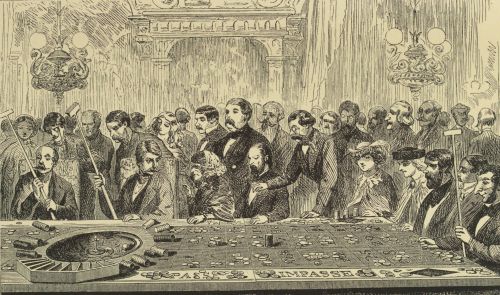
Gambling at Homburg. Drawn by the late G.A. Sala. (Impasse should of course be Impair.)
During these last days of play at Homburg a great crowd had been coming in, but still the tables were not inconveniently crowded, and people were able to stake their money with ease though without comfort. There was, however, a good deal of pilfering and snatching of money, which had always been rather a feature at this resort, shrill-tongued harpies being apt to pounce on the couple of five-franc pieces just won by any simple Englishman ignorant of the German tongue. As the end approached the usual high play still prevailed, but the administration was a good deal disturbed by the advent of workmen, shopmen, and others, a very different class of people from their aristocratic clients of the summer season. These new visitors were sturdy, brutal customers, who became frenzied if they lost a florin, and seemed not unlikely to revenge themselves by some lawless raid. This very unlucrative crowd continued to increase, and it became known that on the last two days the forces would be recruited by yet larger bands. The administration, wisely reckoning that the result might be a general riot organised for purposes of plunder, took measures to avert such a crowning catastrophe. On the Sunday, then, while numbers of speculative individuals at Frankfort and other towns were arranging for one grand final expedition, and were looking forward to being in at the death, it was determined to end play for ever suddenly and without notice. Before five o'clock this had been done, much to the indignant surprise of the new arrivals, and the rage and fury of the less scrupulous. This, perhaps, was no undignified end; and Homburg, from a gambling point of view, may be said to have "died game." The administration maintained its honeyed, courteous phrases to the last, and on the Monday stuck little proclamations all over the walls, to the effect that the "Administration begged to inform la société that there would be no play on the 30th and 31st inst. Signed: The Kurhaus Direction." Nevertheless on the back sheet of the Belgian papers was a huge advertisement proclaiming to all whom it concerned that there would be play to the last day of the month. Such an oversight was scarcely fair to the friends and admirers of the tables, some of whom travelled from a great distance to bid a final adieu to the Halls of Chance.
The appearance of the gambling-house on the day after the cessation of play was indescribable, resembling a badly-set scene by daylight. Numbers of charwomen and men-servants hung about in groups; officials, like those of a bankrupt hotel, went about with keys; chairs were piled on the long gaming-tables by irreverent hands; everything looked as though there was going to be a sale by auction. The ball-room, however, still had its chairs all set out in order, as if company were expected, whilst the orchestra played in the gardens, which already presented a neglected air. Even the theatre looked shabby, though behind the frame of wire network was to be read the announcement of the last—the very last in all truth—appearance of the "Diva Patti" in La Sonnambula.
Ems was another gambling resort. This was essentially a rendezvous of all the pleasure-loving aristocracy and fashionable financiers of the day—unlike Wiesbaden and Homburg, which were rather the chosen battle-fields of well-known and seasoned gamblers.
A Spaniard at Ems made a very comfortable living by a method of playing he had invented. He placed three louis d'or on the manque, which contains all the numbers to eighteen, and two louis on the last series of twelve; that is, from twenty-four to thirty-six. Thus he had only six numbers and two zeroes against him. If manque gained, he won three louis and lost two; if a number in the last twelve came up, he won four and lost three; but a continuation of zeroes would have ruined his calculation. Russians in particular were very fond of Ems. Many played very high, and a good deal of private gambling was done there on the quiet.
At Geneva in the 'sixties trente-et-quarante was somewhat furtively played in a Cercle des Étrangers. Roulette, however, was not allowed. The authorities perhaps feared that the noise of the little ball flying round on its course to a numbered compartment might awaken Calvin from the quiet of his tomb.
There was once what was practically a regular gaming-house on English soil. This was in the 'fifties, when mild roulette was played on the island of Heligoland. A miniature roulette-table there was much frequented by joyous Israelites and English officers from the mainland. In 1856, however, an outraged English tourist wrote a furious letter to The Times, complaining of such horrors existing under the British flag. He denounced the scandalous desecration of the English name, and so forth; and in consequence the Governor issued an edict against the roulette. Play, however, on a diminutive scale continued there some time longer.
The closing of the gaming-tables in Germany was the cause of many rumours as to the future of gambling enterprise. The Valley of Andorra in the Pyrenees was said to have been selected by some French speculators as the scene of their operations for the ensuing year, a well-known financier being declared to have obtained a monopoly of theatres, hotels, casinos, railways, and almost everything else that this valley lacked and might be supposed to want. There was also a rumour that efforts were being made to start tables at St. Moritz, in Switzerland, very tempting offers having been made to the authorities.
These anticipations were not, however, realised, and Monte Carlo remains the only regular public gaming-place in Europe, though intermittent public gambling has been tolerated at certain Belgian pleasure-resorts, notably at Ostend. Two or three years ago public gaming was altogether prohibited there, but it now appears to flourish much as before. It is almost superfluous to add that when it was announced that the Belgian authorities had determined to suppress all public play there was much enthusiastic congratulation from this country. The usual time-worn phrases as to the demoralising effects of gambling were unctuously presented to a public whose conscience, it was declared, had too long been outraged by the proximity of such a dangerous temptation; and the Belgians were told that they might anticipate reaping a golden harvest as the result of the high-principled attitude which had been adopted, for the English would now be able to visit their pleasure-resorts without fear of contamination.
A large number of the Ostend shopkeepers really believed that the suppression of play would bring more foreign money into their pockets; but they soon realised their mistake, for when the visitors from across the channel found that there was no chance of enlivening their stay at Ostend (a resort of few natural attractions) with a little flutter, they beat a precipitate retreat, and the prosperity of the town began to suffer severely.
Eventually, as the result of serious protest from the local shopkeepers and others who saw ruin staring them in the face, a species of compromise has been adopted; and baccarat with one tableau (of which more anon) is now allowed in the Cercle, election to which is not very difficult.
A short time ago roulette without a zero was here held out as a great attraction to visitors. As a matter of fact this game was only played for a limited number of hours every day, and these were precisely those when visitors would in the ordinary course of events be taking their meals. The game was merely kept going as a lure to the more profitable baccarat, the authorities being well aware that roulette without a zero is unlikely to prove a great source of profit to the bank.
Experience teaches that for some reason not very clearly understood single tableau baccarat would seem to be particularly favourable to the banker. So great, indeed, has been the havoc wrought by this game that the French have given it the name of "La Faucheuse,"—"the mowing-machine"!
Those who cried out so loudly for the suppression of the trente-et-quarante at Ostend have, like so many well-meaning people, done little but harm, for the suppressed trente-et-quarante was a far less dangerous game. Trente-et-quarante, it should be added, is played at St. Sebastian, where up to the present year there was also roulette.
At French watering-places gaming flourishes as merrily as ever during the season. At Trouville, Biarritz, and Aix-les-Bains the game of baccarat forms one of the chief attractions. There is a good deal of high play at Trouville at the time of the races. During the present year one player alone—a very rich gambler fond of high stakes—lost no less than a million francs. No inconsiderable portion of this sum must have gone in the percentage which the French Government now levies upon banks at baccarat. During the last year there was also a great deal of play at Nice, where the game in question was as popular as the classic roulette and trente-et-quarante of Monaco.
It is almost impossible to conceive how the vast majority of French summer pleasure-resorts would contrive to exist were baccarat and petits chevaux to be suppressed, for a certain portion of the large profit derived from play is devoted to the upkeep of the Casinos, which furnish visitors with excellent entertainment. It is, indeed, owing directly and indirectly to the toleration of play that the French plages are proving such formidable rivals to the miserably dull English seaside resorts, which offer so little to visitors who are fond of a little exciting amusement.
In 1907 the French Government promulgated a new code of regulations to be enforced at Casinos, all of which were closed for two or three days throughout France—an operation which, of course, evoked a mass of hypocritical and totally inaccurate comment in England.
France was congratulated upon her determination to stop every form of that gambling which had for so many years shocked English visitors, who would, of course, warmly welcome the stern measures about to be enforced, and flock across the Channel in largely increased numbers as a result.
As a matter of fact, the Casinos were closed merely to emphasise the fact that the Government intended to see that the new regulations which they imposed, amongst which was one regulating a tax upon baccarat banks, should be respected.
The very rumour that it was proposed permanently to prohibit gambling terrified the local authorities, a large number of whom at once went up to Paris to ascertain whether there was any foundation of truth in such an idea, which to many a watering-place would mean nothing less than ruin.
They were, however, soon reassured, for in the end only one small and insignificant Casino was permanently closed.
By the decree of June 21, 1907, certain games of chance are permitted at watering-places and health-resorts which have been officially recognised as such by the Minister of the Interior, on the representation of the Municipal Council and the Prefect. These are baccarat, écarté, and the game of petits chevaux and its varieties. A tax of fifteen per cent is levied on the sum produced by the cagnotte at écarté and baccarat.
Counters, which were formerly used at Casinos to represent money, were entirely prohibited, a prohibition which, however, does not apply to Clubs. The reason for this was that players were apt to obtain considerable advances from the caisse in baccarat-rooms, a state of affairs not so likely to happen when ready money alone may be staked. Playing in cash is also generally of a more careful kind than play in counters, which for the time being seem nothing at all. A player, of course, has a far greater chance at baccarat than at petits chevaux, where the percentage is very unfavourable to him, one horse out of the nine being the bank's.
According to the new law, fifteen per cent is now levied on the gross winnings of the bank at this game every day; should the bank lose it is allowed to deduct the sum lost from its winnings the next day.
The sum produced by this tax of fifteen per cent is to be devoted to charity, and to various other objects of public utility and affecting the public health.
When this decree was first issued, chemin-de-fer baccarat was not included amongst the list of tolerated games, the French authorities being still horror-struck with the recollection of the single tableau baccarat, called "La Faucheuse" (the game which, thanks to Puritan effort, is played at Ostend), which had provoked such gross scandals in Paris. It was, however, subsequently legalised by a special decree which was promulgated in the Journal Officiel of the 18th August 1907, and is taxed at the same rate as other tolerated games.
The main cause of the French Government moving in the matter of gambling at all had been the large increase of so-called gambling clubs in Paris entirely devoted to single tableau baccarat, from which an enormous harvest of gold had been gathered by those holding the banks. It was said that no less than 126 new establishments of this kind had sprung up in Paris, a state of affairs calculated to make the dead proprietors of the long-suppressed and very strictly regulated tables in the old Palais Royal turn in their graves. Many of these Clubs were frequented by women, and it was rumoured that many of the brightest stars of the French demi-monde had lost almost everything they had. Paris began to be seriously alarmed. Drastic measures were adopted; the foreign proprietors of the gaming-places expelled from France; "La Faucheuse" forbidden throughout the country; and gambling generally placed upon the strictly regulated footing which has been described. The results of the very sensible action of the French Government appear to be highly satisfactory, for since the promulgation of the decree regulating play no scandals have occurred, whilst it is anticipated that in the course of time a sum well over two million pounds a year will be available for objects of public utility.
Surely the wise regulation of what appears to be an irradicable evil is far more salutary, alike from a financial and a moral point of view, than the unthinking policy of drastic suppression, which, as experience teaches, has ever been powerless to extirpate gambling.
X
The Principality of Monaco—Its vicissitudes—Early days of the Casino—The old Prince and his scruples—Monte Carlo in 1858 and 1864—Its development—Fashionable in the 'eighties—Mr. Sam Lewis and Captain Carlton Blythe—Anecdotes—Increase of visitors and present democratic policy of administration—The Cercle Privé and its short life—The gaming-rooms and ways of their frequenters—Anecdotes—Trente-et-quarante and roulette—Why the cards have plain white backs—Jaggers' successful spoliation of the bank—The croupiers and their training—The staff of the Casino—The viatique—Systems—The best of all.
Many years before the tables at the German resorts were closed by the Prussian Government, M. Blanc was quietly seeking for a suitable spot where his roulette wheels might whirl free from interference and his croupiers deal in unmolested peace.
Gaming-house proprietors seem in one respect to resemble the monks of old, for almost invariably their establishments have been pitched amidst attractive surroundings commanding lovely views. Thoroughly imbued with this tradition, M. Blanc eventually selected the little Principality of Monaco as being a suitable spot to afford his industry a peaceful and alluring haven. After certain negotiations with the reigning Prince Charles Albert, he obtained the required concession, and a Casino (in its earliest days called the "Elysium Alberti") was erected upon the rocky ground known as the Plateau des Spelugues, which, adversaries of gaming will rejoice to learn, means in Monagasque patois "the plain of the robbers."
The ruling family of Monaco, the Grimaldis, had been exposed to many vicissitudes. During the French Revolution their people rose in rebellion and plundered the Palace, which afterwards served as a military hospital during Napoleon's Italian campaign, and later on became the Dépôt de Mendicité for the Department of the Alpes Maritimes. In 1841, however, Florestan I., the reigning Prince, repaired the home of his ancestors, which was thoroughly restored by Charles Albert after the advent of M. Blanc.
In the turbulent past the Princes of Monaco at times experienced considerable difficulty in holding their own, and often had to defend their rugged old rock against piratical raids, besides occasionally having to cope with internal troubles, the last of which occurred in 1847, when the Monagasque bitterly resented taxation. The cannon given by Louis XIV. to the Grimaldi of his day may still be seen near the palace. These are fine specimens of the founder's craft, and bear the grim motto "Ultima ratio regum," amidst much ornate decoration.
The armed force which the Princes maintained was much improved in uniform and equipment when M. Blanc brought prosperity to Monaco. Even up to quite recent years there existed a smart little army of something under a hundred men, in all probability the best dressed and least offensive troops in all Europe. Their rifle practice, it was always said, was indifferent, owing to the fact that they could not fire inland, because the boundaries of the Principality were so limited; but whatever may have been their efficiency or non-efficiency as a fighting force, their light-blue uniforms—with old-world aiguillette, neat shako, and picturesque cape—were highly ornamental features, which struck a pleasant note of colour in the streets of the Condamine or about the grounds and terraces of the Casino.
This little army is now but a memory, for within the last decade the reigning Prince, who is a warm advocate of International Arbitration, realising, it is said, that the maintenance of a standing army was inconsistent with his well-known love of peace, abolished the last relic of military strength left to the Grimaldis. Such sentries as are still required are at present furnished by the gendarmerie, whose dainty cocked hat—most military and attractive of head-dresses—was at the same time superseded by an abominable cloth-covered helmet, which for unalloyed ugliness would easily carry off the prize against all competitors. Thus does it constantly happen in the modern world that, whilst there is much prating about art, cultivation, and taste, the very people who should do their best to preserve every distinctive and decorative reminder of a more artistic past are foremost in the work of obliteration.
Old Monaco consisted of a few unattractive streets and a somewhat dilapidated Palace, in which lived the blind old Prince who granted the concession for the tables to M. Blanc, and by so doing converted his poverty-stricken realm into the most prosperous State in the world.
At first, the Prince was somewhat troubled by conscientious scruples as to tolerating gaming, but these were appeased by the large sums which were rendered available for religious purposes and the building of churches—the Church of St. Dévote, which stands in the ravine, for instance, is said to have been erected from funds received in exchange for permission to increase the number of roulette tables, whilst the beautiful little cathedral on the Palace rock would never have been built had not M. Blanc made his descent upon the Principality.
Much abuse has been lavished on the Prince for granting the concession, but it seems a doubtful question whether he did not do more good than harm when he signed it. Certainly his own people of Monaco (who, except on one day in the year—the Prince's birthday,—are not allowed to enter the Casino) gained very largely thereby.
To them the establishment of the Casino has brought lasting prosperity, whilst it has indirectly benefited the whole Riviera, now so popular as a pleasure-resort. On the other hand, a number of people, no doubt, have been ruined at Monte Carlo, but such as these—gamblers at heart—would most probably in any case have lost their fortune in other forms of speculation. It should also be realised that the number of those who have actually been ruined by the Casino is extremely small—as a rule those who lose their last penny at the tables are individuals who, already at their last gasp owing to a long series of gambling reverses, come to Monte Carlo with such funds as they can scrape together in order to indulge in one last desperate plunge.
The old Prince was a kindly man at heart, and did not like to think of visitors losing more money than they had actually brought with them. For this reason he forbade the establishment of any Bank in the Principality, and as a natural consequence, numbers of waiters, who carried on a brisk business in money-lending, made nice little fortunes.
In later years Smith's Bank was established on French territory; this was afterwards absorbed into the Crédit Lyonnais, which (the prohibition having been revoked) is now quite a prominent feature of Monte Carlo.
At the time when M. Blanc made his peaceful conquest of Monaco the place was sparsely populated and miserably poor. The contrast indeed between the Monaco of fifty years ago and the Monte Carlo of to-day is striking in the extreme.
The following description of the Principality at that time was given to the writer by one who has seen every phase of its development.
In 1858 this gentleman and his wife, being on their honeymoon in France, drove from Marseilles to Cannes, then also quite a small place. A report had recently reached the latter place that the celebrated M. Blanc had started gaming-tables at Monaco, and accordingly the Duc de Vallombrosa, who owned the finest château at Cannes, invited several of the English visitors to go over to the Principality on his yacht, and in due course the party climbed up to the rock, on which stands the Palace.
After making inquiries they found the gaming-tables—two roulette and one trente-et-quarante—which were installed in a very unpretentious barnlike edifice somewhere near the spot where the Cathedral is now.
The arrival of manifestly well-to-do visitors created quite a sensation amongst a somewhat limited crowd, mostly composed of Italian tourists who were indulging in a little mild play. M. Blanc, it should be added, had merely started these tables as a preliminary step, being at that time engaged in negotiations with the reigning Prince as to the erection of a more serious gambling establishment in the latter's dominions.
After playing a stake or two the party made their way down to the little town in the Condamine, where, finding that donkeys could be hired, they determined to picnic out of doors. Accordingly, taking the requisite materials with them, they made their way by a bridle path (which more or less followed the present road) to the plateau, on which the present palatial Casino stands to-day.
Monte Carlo (the place was then unnamed) was almost a bare rock covered with rough grass, and here and there a few stunted pine and olive trees, most of the latter of immense age. A few tumble-down hovels were sparsely scattered here and there on the mountain side, in which lived a miserably poor peasantry; the whole spot was as different from the Monte Carlo of to-day as it is possible to conceive.
Just about where is now the ornamental plot in front of the doors of the Casino, the party collected some dry bits of sticks, boiled their kettle, cooked an omelette and drank their tea, whilst they revelled in the lovely view, which remains to-day almost the sole feature which the hand of man has been powerless to change.
Almost the last of the few survivors of this expedition also described to the present writer the marvellous alteration which he found on his next visit to the Principality some six years later. The first Casino had then been built by M. Blanc, and a small Hôtel de Paris stood where the gigantic modern one stands to-day. M. Blanc, in addition to presiding over the rooms, was in supreme command of the hotel, which was managed on the most liberal principles, bills being never sent in unless they were asked for. Since those days the hotel has been much enlarged and altered. It is now being entirely rebuilt on a palatial scale.
When visitors of any standing whatever were about to depart, M. Blanc himself would be present to wish them good-bye, and also to inquire whether they might not like a thousand francs for the expenses of their journey, adding that this could be refunded on their next visit, or sent him at their convenience.
In 1864, except the hotel, there were scarcely any houses in Monte Carlo itself, and most of the visitors had to live on the other side of the Bay in the old town. As the journey from Nice by road took four hours, an abominable and, it was said, unseaworthy, small white steamer, the Palmaria (probably the best that could be got), had been chartered by M. Blanc to convey visitors from Nice. This vessel anchored beneath the Castle rock, where its passengers were landed in boats, being met by four-horse omnibuses which plied gratis between the rock and the Casino.
The Palmaria made two journeys from Nice a day. If the weather was calm and nothing went wrong, the passage took something like an hour and a quarter. It was a curious sight to see visitors landing in the highest spirits for a flutter, most of them to return in the evening to Nice, weary and sea-sick, without a penny to take a cab to their hotel.
In the early days of Monte Carlo there were two zeroes, and the inevitable result was that the Palmaria's evening cargo was usually largely composed of what were facetiously called "empty bottles."
The crowd which thronged to the tables was of a heterogeneous description and not at all smart. There were a number of enterprising damsels in pork-pie hats and a considerable sprinkling of raffish Englishmen, looking as if they had seen better days and were likely to see worse.
Monte Carlo, though a tiny place, already bore evidences of its future expansion. An air of prosperity pervaded it, and the inhabitants had lost the air of hopeless poverty which was formerly such a characteristic of the Principality of Monaco.
In the early days of the Casino not much was heard of its existence, the truth being that M. Blanc, after his experiences at Homburg, feared lest European public opinion might demand the abolition of the tables were their existence to be too prominently thrust before it. In consequence of this as little attention as possible was drawn to the gambling which, if alluded to in the Press at all, was merely mentioned as one of the minor attractions. Knowing the sensitiveness of M. Blanc with regard to publicity, unscrupulous journalists traded upon it, demanding bribes to keep silence, whilst ephemeral newspapers, containing sensational accounts of suicides of ruined gamblers, were published solely in order to extort blackmail.
As time went on, however, Monte Carlo began to be regarded as an established institution, and many visitors took to coming there year after year.
The development of the Riviera as a pleasure-resort steadily proceeded, and at the present time the coast from Genoa to Marseilles is an almost unbroken line of pleasure-resorts filled with villas, not a few veritable palaces, all of which owe their existence to the advent of M. Blanc with his roulette and trente-et-quarante. Abuse gambling as you may, it has in this instance beyond all question brought wealth and prosperity to the inhabitants—not to the rich, for there were no rich—but to the people of the soil, born and bred along this beautiful coast-line lapped by the azure waters of the Mediterranean.
It was after M. Blanc's death in the early 'seventies that the Casino was first enlarged, and the theatre built by M. Garnier. From time to time further additions have been made—an entirely new gambling-room was added only a few years ago, and at the present moment another is being built.
Monte Carlo itself, which even in the 'eighties was quite a little place, has now become a regular town with streets stretching up along the mountain side almost up to the gigantic hotel, which is now such a conspicuous feature of the Principality.
The earthquake of 1887, though it ruined the season of that year, was probably beneficial to the prosperity of Monte Carlo, for it brought the name of the place prominently before the public eye. Shortly after that date the vast crowds which now throng to the place began to make their appearance, and Monaco quite changed its character. New hotels were opened and numbers of houses built, whilst Monte Carlo quite lost its air of reposeful peace and became a sort of cosmopolitan pleasure-town swarming with excursionists. Before this the Casino used to shut at eleven, after which hour every one went to bed, there being no night cafés to go to such as exist to-day.
From about 1882 to 1890 was perhaps the best day of the Principality from a social point of view, for at that time it was the resort of a number of the most distinguished and fashionable people in Europe. All the sporting characters of the day made a point of paying a yearly visit to Monte Carlo—most of them are gone now, including Mr Sam Lewis, who always played in maximums with varying success.
Another well-known figure was Captain Carlton Blythe, who is still alive. He was very successful at trente-et-quarante, where his operations were conducted in a most methodical manner. It was his practice to stake only when sequences were the order of the day. By means of men told off to watch the tables, he was kept informed of this, being sometimes sent for even when not in the Casino. His stakes were high, generally about two thousand francs, which, if won, were increased to six thousand, the next being a maximum (12,000 francs), which was left on till the termination of the run. At times this cheery devotee of coaching was extraordinarily lucky; it is said that he once won as much as £10,000 during a deal.
I believe, however, that in the end this system, like so many others, broke down.
The authorities of the Casino were then rather more particular than at present as to the costume of visitors, and in many cases refused to grant cards of admission to people of the most indisputable respectability on account of their dress not being in conformity with the regulations which they laid down.
On one occasion, indeed, the late Lord and Lady Salisbury, who lived close by at Beaulieu, having been seized with a fancy to look into the rooms, presented themselves at the entrance, where cards of entrée are issued either for the day or longer periods.
They were both dressed in thoroughly country clothes which the official in command viewed with no kindly eye, as his offhand manner showed. When, however, the visitors, in accordance with the regulations, gave their names, he was convulsed with laughter, and at once told the distinguished couple to go about their business and not try their jokes upon him.
The Prime Minister and his wife, who were rather amused at the incident, accordingly retired. Some time afterwards the matter reached the ears of the Administration, who, as a sort of compensation, sent a box at the theatre, but no very profound apology was made. The great gambling monopoly is no respecter of persons, and in the Casino, as on the Turf, complete equality prevails.
In the same year, 1892, a curious incident occurred at a trente-et-quarante table. An individual having staked a maximum on the black, red won. He immediately snatched up his (or rather the bank's) notes from the table and ejaculating, "C'est la dot de ma fille," strode out of the rooms before any one quite realised what had happened. For some reason or other he was not followed and got clear away.
Many rich Englishmen annually found at Monte Carlo relaxation and rest from lives of arduous work in the city; some of these regarded play much as sportsmen do shooting, hunting, or yachting.
One of these, now dead, said to the writer: "I have regularly taken a villa here for years, and with hardly an exception have lost the sum which I set apart for gaming every year; but I do not regret it. The amount of amusement which I have obtained has been well worth the money. I might, it is true, have kept a yacht which I should have hated, or taken a shooting which would have been little to my taste. I might, in fact, have spent the money in various ways which would have thoroughly bored me—on the whole I am well content."
Another well-known high player, who from time to time has lost large sums at Monte Carlo, once declared that he considered the money well invested. "Many a large landowner," said he, "is not as lucky as I have been, for he is obliged to spend a large sum every year on the upkeep of his estate for which he obtains nothing in return. I, at least, have had a great deal of amusement."
To this it may be objected that the money which goes into the coffers of the Casino benefits no one—but this is not strictly true, for the shares are held by all sorts of people, who draw their profits in the same way as from any industrial enterprise.
In the 'eighties there were many less hotels than at present and not a great number of villas, whilst the Café de Paris, which has since been rebuilt in an enlarged form, was about the only restaurant apart from the dining-rooms in the hotels. The Gallery, now filled with shops, which is such a favourite morning resort, had not yet come into existence, and except the admirable band in the Casino (which gave two performances a day, free) there was little music in Monte Carlo—a spot which now rings from morning till late at night with the strains of Tzigane bands.
After the tables were closed—at eleven—there were no amusements at all, and, instead of sitting up half the night, every one went to bed—contentedly or discontentedly, as they had won or lost.
The gambling-rooms were much quieter in those days, the flocks of German excursionists having not yet arrived. Many of these visitors, as a rule somewhat undesirable from a decorative point of view, are divided up into little coteries or bands, each of which elects a leader who is entrusted with such funds as the party is desirous of risking at the tables, where the leader alone stakes for all, winnings or losings being divided in proportionate shares.
Of late years the crowds round the gambling-tables have increased to such an extent that except in the early morning or during dinner-time it is impossible to make certain of obtaining a seat. Formerly two or three old men of solemn aspect were always to be found sitting at the trente-et-quarante marking down the run of the game, and on a louis being unostentatiously slipped into their hand they would at once yield up their seat. Of late years, however, they are no longer to be seen, the Administration having banished them from the Casino, much to the discomfort of habitual players desirous of risking substantial sums under comfortable conditions. In old days far more attention was paid in a great many other small ways to visitors who had the appearance of belonging to the upper strata of society. To these the croupiers and other officials made a point of being especially obliging and polite.
The authorities of the Casino, however, seem now to have decided on a more democratic policy, no favour being shown to any one. From a financial point of view this is probably not unsound, a vast number of small players, who drop a certain amount of five-franc pieces and then depart to make way for others, being probably more profitable to the bank than a few heavy gamblers, some of whom may hit it very severely.
It is more than likely that scarcely one in fifty of the individuals who sit with a pile of silver beside the roulette wheel goes away a winner, whereas amongst the high gamblers at trente-et-quarante success is not so rare as is usually supposed. The proof of what has been stated was furnished by the brief existence of the "Cercle Privé"—a new gaming-room which for a short time was highly appreciated by frequenters of Monte Carlo some seven or eight years ago.
The "Cercle Privé" was open only at night in a room upstairs, and men alone enjoyed the privilege of being allowed to play there. There were four tables, three trente-et-quarante and one roulette, a small bar where refreshments could be obtained, smoking was permitted, and the tables, which did not commence operations till the ones downstairs had closed, were kept going very late.
From the point of view of players this innovation was highly successful; for, owing to the comparatively small number of persons who frequented the "Cercle Privé," greater comfort prevailed than downstairs, whilst the conditions in general were far more conducive to calculated and calm speculation.
A large proportion of the frequenters were well known to one another, and the whole thing somewhat resembled a club, the members of which were leagued together against the bank.
Runs, intermittencies, and other tendencies of chance at certain tables could be carefully noted; occasionally there would be no play at all at one table, the whole crowd staking on a run at another; as the room was small, anything of the sort soon reached the ears of every one. Play as a rule was high, and the players, for the most part, were well used to gambling. The results to the bank were most disastrous. On a certain evening it lost more than had ever before been lost in one day by the Casino, and at the end of the year the accounts of the "Cercle Privé" proved anything but an agreeable study for the officials supervising the finances of the great gambling monopoly.
The next year it was closed, and there has since been no inclination on the part of the authorities to repeat what was to them a very unprofitable speculation.
Amongst various causes which in this instance operated to the detriment of the bank was the difficulty, generally amounting to impossibility, of players obtaining a further supply of money when what they had in their pockets had run out. At such a late hour, when the Bank was closed and the caisse of most hotels shut up, no matter how rich a man might be, he could not obtain any considerable amount of cash. Consequently, should he lose what he had brought with him, he was reduced to playing with such modest sums as could be borrowed from friends, who naturally could not be expected to make any substantial advance, as any moment they themselves might be in a similar predicament.
The bank, on the other hand, was equipped with ample funds, and its loss—unlike those of the players, which, after a certain point, were limited by necessity—often extended into a very large figure; consequently, when it was in good luck, it only won a comparatively moderate amount, and when in bad lost very heavily.
Another reason for the ill-success of the bank was that the policy pursued in the large rooms downstairs had in the case of the "Cercle Privé" been exactly reversed. In the former there have always been many more roulette tables than tables devoted to trente-et-quarante—upstairs there was only one roulette table as a counter-attraction to the three devoted to the rival game.
Trente-et-quarante is mathematically one of the most favourable of games at which a gambler can play, the percentage against him produced by the refait being only 1·28 per cent.
Roulette, on the other hand, is, owing to the zero, highly advantageous to the banker.
The bank's percentage on all-round play at the tables is more than one-seventy-fourth of all the figures staked; the actual winnings of the bank being about one-sixtieth part of all the money actually placed on the board. At the present time the bank's winnings (gross) are, roughly, £1,200,000 per annum.