FOOTNOTES: (continued 4)
Reading edition
All this, however, has been written of time after time; indeed, the fascinating story of the Turf has found many admirable chroniclers. Nevertheless, these have hardly touched upon some of the more obscure figures, who seem to have escaped notice.
Such a one was Major Leeson, a well-known sporting character at the close of the eighteenth century, who may be taken as typical of the sharp racing man of humble origin, and who, having by astuteness attained a certain prosperity, was eventually reduced to beggary by the allurements of gambling. An Irishman of obscure birth, Mr. Leeson originally obtained his commission through the patronage of a Scottish nobleman, by whose munificence he was sent to school at Hampstead, and afterwards to the French military academy of Angers. Whilst at this seminary he fought a duel with a well-known baronet, and both combatants displayed great courage. Leeson was soon after appointed a lieutenant in a regiment of foot, in which he conducted himself as a soldier and a gentleman.
During his military career, Leeson was especially popular with his men, whose liking for their young officer almost amounted to adoration, owing to his ardent championship of their interests. While they were quartered in a country town, one of the sergeants, a sober, steady man, was wantonly attacked by a blacksmith, who was the terror of the place. The sergeant defended himself with great spirit as long as he was able, but was obliged, after a hard contest, to yield to his athletic antagonist. This intelligence reached Mr. Leeson's ears the next morning, and without delay he set out in pursuit of the victor, whom he found boasting of the triumph he had gained over the "lobster," as he called the sergeant. The very expression kindled Leeson's indignation into such a flame, that he aimed a blow at the fellow's temple, which was warded off and returned with such force that Leeson lay for some minutes extended on the ground. Leeson, however, renewed the attack; and his onslaughts were made with such rapidity and success, that the son of Vulcan was eventually stretched senseless on the ground. In order to complete the triumph, Leeson placed him in a wheel-barrow; and in this situation he was wheeled through all the town amidst the acclamations of the populace. Soon after this, Mr. Leeson exchanged his lieutenancy for a cornetcy of dragoons.
He now began to be attracted by the seductions of gaming and the Turf, both of which exercised a fascination over his mind which he was unable to resist. Fortune was kind, and an almost uninterrupted series of success led him to Newmarket, where his evil genius, in the name of good luck, converted him in a short time into a professional gambler. At one time he had a complete stud at Newmarket; and his famous horse Buffer carried off all the capital plates for three years and upwards, though once beaten at Egham, when 15 to 1 was laid on it. Major Leeson's discernment in racing matters soon became generally remarked, and he was consulted by all the sharpest frequenters of the Turf on critical occasions.
In later years, however, Major Leeson experienced the ill-fortune which is too often the lot of gamblers. A long run of ill-luck preyed upon his spirits, soured his temper, and drove him to that last resource of an enfeebled mind—the brandy bottle. As he could not shine in his wonted splendour, he sought the most obscure public-houses in the purlieus of St. Giles, where he used to pass whole nights in the company of his countrymen of the lowest class. Overwhelmed by debt and worn-out body and soul, he was constantly pursued by the terrors of the law, and alternately imprisoned by his own fears or confined in the King's Bench, till, a broken and miserable man, he welcomed death as a friend come to relieve him of an almost insupportable load.
An eccentric supporter of the Turf, who died in 1799, was Councillor Lade. It was his highest ambition to be thought a distinguished member of the sporting world; but in this, as in the more contracted circle of private life, he was not destined to cut a conspicuous figure, being by nature much better calculated for an obscure place in the background. During the last twenty years of his life he kept a miserable lot of spindle-shanked brood mares, colts, and fillies at Cannon Park, between Kingsclere and Overton in Hampshire—a place which, owing to its barrenness, was quite unsuited for breeding horses.
His successes on the Turf were insignificant. During the last twelve years of his life he hardly ever brought less than six, seven, or eight horses annually to the post for country plates (never till the last two or three years presuming to sport his name at Newmarket); nevertheless, few of them, if any, ever realised his expectations, or paid one-third of the expenses in the way of breeding, breaking, training, running, or sale. Councillor Lade's almost constant sequence of disappointments originated in one single cause strikingly palpable to every eye but his own, which was their breeder's parsimony. His mares were in a wretched and deplorable state of emaciation during the whole time of bearing their foals, whilst a systematic starvation of both dams and offspring when foals, and a miserable sustenance barely enough to support life when weaned, totally nullified his chances of success upon the Turf.
It was no uncommon thing to see the Councillor's favourite brood mare, Laetitia, and many others with their foals, in the fertile months of May and June, upon the side of a barren, burnt-up hill, with barely pasture sufficient to keep even the dam in existence, without even a possibility of affording half the nutriment necessary for the unfortunate foal. Owing to these highly injudicious and cruel methods, his stud, even when of superior blood, was always inferior in bone and strength to its rivals, there being in it never more than one horse in every eight or ten with constitutional stamina sufficient to bear the training necessary before going to the post.
When after his death the Councillor's wretched stud were on their way to be sold by auction they excited universal pity from the humane in the towns and villages through which they passed. Many of the horses sold for the trifling sum of two or three guineas each, owing to the wretched condition of the poor animals. Councillor Lade, in his Turf transactions as elsewhere, was so consistently parsimonious even to those whom it would have been good policy to conciliate that every man's hand was against him, even that of his own servants.
One of his manias was to run his horses as much as possible at race meetings near his home, in order to avoid the expenses of travelling.
The years 1797 and 1798 were the most prosperous of his Turf career. Seven of his horses went to the post for twenty-four plates and purses, of which Truss, Will, and Grey Pilot won seven fifties—two at Ascot, two at Abingdon, and one each at Reading, Winchester, and Stockbridge.
Councillor Lade was in himself a singular and unsociable man, seldom seen in company, upon the race-course or elsewhere. Cynically cold and innately parsimonious, few cared to sojourn beneath what might be justly termed, in more senses than one, a habitation without a roof. Hospitality was alien to the spirit of Cannon Park, and the building itself was one entire mass of chilling frigidity which betokened a total lack of good cheer. The owner was constantly involved in pecuniary disputes and lawsuits with his dependents, in which he was usually worsted.
It was not infrequently his practice to drive his curricle and greys without a servant the fifty-seven miles to Cannon Park, not even taking them once out of the harness; a handful of hay, and two or three quarts of water at Salt Hill, and Spratley's, the Bear, at Reading, in addition to the turnpikes, constituted the entire expense of the journey, it being an irrevocable opinion of his that servants on the road were more troublesome and expensive than their masters.
The Councillor was married to a lady of excellent family, who, owing to mental trouble, lived in seclusion. This, however, did not trouble him much, for he took care to make up for the lack of a wife's society by a profusion of female friends, who enlivened his elegant house in Pall Mall, his rural cottage near Turnham Green, and even his unadorned inhospitable mansion at Cannon Park.
Another unpleasant Turf character about this date was "Louse Pigott," a man of good Shropshire family. The slovenly manner of dressing and general unkempt appearance of this gentleman had obtained for him his unsavoury nickname. He had originally been possessed of some wealth, but going racing soon lost practically his whole fortune. Devoid of means, and prompted apparently by the same spirit which induces unsuccessful modern gamblers at Monte Carlo to apply to the authorities for a sum sufficient to enable them to leave the Principality of Monaco, Mr. Pigott conceived the original idea of making representations to the Jockey Club, with a view to receiving pecuniary aid. Needless to say his petition was treated with a complete lack of consideration which, it was said, so enraged him that in revenge he wrote the libellous work called The Jockey Club, a volume of short but scandalous biographies of persons well known in the sporting world. Though Pigott appears to have escaped punishment for this, the publishers, Messrs. Ridgway & Symonds, were incarcerated in Newgate.
"Louse Pigott" appears to have been an eccentric character in many ways, for one September evening in 1793 he got into great trouble at the London Coffee-House, Ludgate Hill, where, sitting with a friend, Dr. William Hodgson, he became very vociferous in giving toasts of a disloyal kind, finally loudly proposing success to the "French Republic." This was immediately resented by a gentleman present, who, rising to his feet, proposed "The King," a toast which was drunk with cheers by all present except Pigott and his companion, who made use of such improper expressions that peace officers were sent for, who removed the apostles of revolution to the lock-up.
The next morning they were charged with drinking "the French Republic and the overthrow of the present system of Government and all Governments of Europe except the French; likewise of speaking disrespectfully of the King, the Duke of York, Lord Mayor, and other persons in high authority. They had," it was deposed, "called the Prince of Hesse a swine-dealer, and Ministers in general robbers and highwaymen." Finally, when being conveyed to the cells, they had shouted from the coach windows, "The French Republic, and Liberty while you live."
Being unable to find bail, the two prisoners were sent back to prison, to remain there till tried at the ensuing Old Bailey Sessions. The bill preferred against Pigott, however, was eventually thrown out and he was discharged. The general comment upon his release was that "he who is born to be hanged will never be drowned," and vice versa. His companion, Dr. Hodgson, was less fortunate, and received some punishment for the advanced sentiments which he had uttered.
Probably the shrewdest nobleman who ever went racing was the eccentric but highly astute "Old Q." At the time when he owned race-horses he was generally hand-in-hand with his jockey, Dick Goodison, with whom he had a perfect understanding. During a lengthy connection with the Turf, "Old Q." never displayed the least want of philosophy upon the unexpected result of a race. As a matter of fact he never entered into an engagement but where there was a great probability of his becoming the winner. In all emergencies his Grace preserved an invariable equanimity, and his cool serenity never forsook him, even in moments of the greatest surprise or disappointment. A singular proof of this occurred at Newmarket just as the horses were about to start for a sweepstakes. His Grace was engaged in a betting conversation with various members of the Jockey Club, when one of his lads, who was going to ride (in consequence of his light weight), tactlessly called him aside, asked him, too soon and too loud, How he was to ride that day? Perfectly convinced this had been overheard, his Grace, with well-affected surprise, exclaimed, "Why, take the lead and keep it to be sure! How the devil would you ride?"
Matches were a great feature of the period, and very large sums were staked. An historic match was that between Sir Harry Vane's Hambletonian and Mr. Cookson's Diamond for three thousand guineas, run over the Beacon Course during the Newmarket Craven meeting of 1799. Hambletonian, who was ridden by Buckle, carried eight stone three pounds, and Diamond, ridden by Dennis Fitzpatrick (Deny), eight stone; the betting was five to four on Hambletonian.
Though both gallant steeds have now long since mouldered into dust, together with the gay company of sportsmen who assembled to see them run, the memory of their desperate neck-and-neck struggle over that terrible last half-mile is not forgotten, and will ever shine amongst the chronicles of equine fame as the most sporting and gamely contested match of all time.
Hambletonian, a bright bay and a grandson of Eclipse, was a wonderful horse. He was only once beaten, at the York August meeting 1797, when he ran against Deserter and Spread Eagle, and took it into his head to bolt out of the course and leap a ditch.
Diamond, a beautiful brown bay, smaller than Hambletonian, was got by Highflyer. He was the more compact horse of the two.
Hambletonian being a Yorkshire bred horse, the Yorkshiremen backed him for prodigious sums, whilst Diamond was strongly supported by the Newmarket people, the horse being well-known in the neighbourhood.
Every bed in Newmarket (which could not hold a tenth of the visitors) was occupied, whilst Cambridge and all the towns and villages within twelve or fifteen miles were also thronged with people. Stabling was not to be had, and no chaise or horse could be procured on any of the roads, all having been engaged three weeks before.
The weather was most auspicious, and the general scene on the Heath highly interesting and attractive. All the gentlemen of the Turf, as the phrase ran, from the neighbouring counties were collected on the course, and many of the nobility of England, which was then a real and powerful nobility, including the Duchess of Gordon, were assembled to see the race.
At the start the horses kept tolerably close, Hambletonian retaining the lead till the last half-mile, when Diamond got abreast of him. The two horses then raced home in a most desperate manner, the nose of one or the other being alternately in front till Hambletonian won in the last stride. Both horses were terribly whipped and spurred, particularly Hambletonian. The four miles one furlong and one hundred and thirty-eight yards were covered in about eight minutes and a half.
Every one declared that this match was the most exciting ever known, and it was acknowledged even by the losers (who were described as being as much pleased as losers could be) to have been thoroughly fairly contested, each jockey having made the best of his horse.
As soon as the race was over, Sir Harry Vane Tempest, who, besides the stakes, had won about three thousand guineas, declared on the course that Hambletonian should be taken out of training the next morning, and in future he would ride him only as a hack. Sir Harry afterwards travelled to town in a post-chaise and four, and arrived at the Cocoa Tree at half-past eleven at night. The news of his victory, however, was already known, Mr. Hall, of Moorfields, who had three horses on the road, having got to town between nine and ten.
A bronze penny token of fine medallic design—now very scarce—commemorates this famous match. An inscription is on one side and a picture of the race on the other.
Mr. Cookson, the owner of Diamond, did not lose any enormous sum over the race. He was well-known for his shrewdness, and in one year, 1798, is said to have realised nearly £60,000 by the victories of Ambrosia and Diamond.
Hambletonian became the sire of over a hundred and forty winners.
Another match between Diamond and Mr. R. Heathcote's Warter strongly excited the sporting world, which was much puzzled how to bet. Warter having beat Diamond in the Oatland stakes of 1800, the latter was to receive seven pounds in the projected race. This, according to the knowing ones, was an advantage of the utmost importance, and Diamond became a strong favourite, his backers flattering themselves with the opinion that one of Warter's legs would fail him in running, and that consequently they were on the right side. Till about a fortnight before the meeting betting was equal; six to four was then betted in favour of Diamond, and was at first very cautiously accepted.
So highly was the gambling mania roused that, till a late hour on the Saturday night previous to the meeting, all the sporting houses near St. James's, and even more to the eastward, were crowded with betting-men of every description. The bolder sort dashed at the odds, whilst others more cautiously hedged, and all waited the event with the most anxious expectation.
The whole of Sunday the Newmarket road was crowded with carriages and cattle of every description, from the dashing curricle to the humble buggy, and from the pampered hunter to the spavined hack.
When every mouth was opening to bet, and expectation was on tiptoe, it was declared in the Coffee-room, that Warter, by reason of a kick, had declared forfeit, and the famous match was off.
Another match, which excited enormous interest at the beginning of the nineteenth century, was that between Mrs. Thornton, wife of the celebrated Colonel Thornton of Thornville Royal (now Studley Royal, the seat of Lord Ripon), and a gentleman well known in sporting circles, Mr. Flint by name. This was run at York in 1804, and is memorable as being the only race chronicled in the Racing Calendar in which a woman's name is mentioned. The entry, dated August 25, 1804, runs thus:—
Mr. Flint's Brown Thornville by Volunteer out of Abigail, aged, rode by the owner, beat Colonel Thornton's ch. h. Vinagrillio, aged, rode by Mrs. Thornton, four miles, five hundred guineas.
The weights were catch weights, and before the race five and six to four were laid upon the lady, which increased during the early portion of the race to seven to four and two to one, it seeming likely during the first three miles that Mrs. Thornton would secure an easy triumph. During the final mile, however, things entirely changed, and the victory of Mr. Flint appearing certain, odds were laid upon him. Over two hundred thousand pounds, it is said, were lost and won over this race, which excited a vast amount of interest. The lady's horse, it may be added, was a very old one.
Mrs. Thornton's dress was a leopard-coloured body with blue sleeves, the rest buff, and blue cap. Mr. Flint rode in white. The race was run in nine minutes and fifty-nine seconds. In the published account of the race it is stated that "No words can express the disappointment felt at the defeat of Mrs. Thornton, the spirit she displayed and the good humour with which she has borne her loss having greatly diminished the joy of many of the winners."
The fortunate individuals in question seem, however, to have been under some misapprehension as to the lady's equanimity under defeat, as she subsequently sent an angry letter to the York Herald complaining that she had been treated with scant courtesy.
Though the lady signed herself Alicia Thornton she seems to have had no legitimate claim to the name—she was a Miss Meynell, and her sister was by way of being the wife of Mr. Flint. The race engendered much ill-feeling between the two couples.
The year after the race on the Knavesmire a fracas occurred between Colonel Thornton and Mr. Flint, the latter being very indignant at not having received £1000 of the £1500 wagered by the gallant Colonel on his wife's success. Mr. Flint vigorously applied a new horsewhip to the soldier's shoulders. The aggressor was taken into custody, Colonel Thornton afterwards making an application in the Court of King's Bench for leave to file a criminal information against Flint, who (he deposed) had challenged him to fight a duel, and horse-whipped him on the race-ground at York. The Colonel maintained that the bet of £1000 was a mere nominal thing, intended to attract people to the race-course, and that it was understood that only £500 of the £1500 should be paid. The case was eventually dismissed, the Colonel apparently sticking to his £1000.
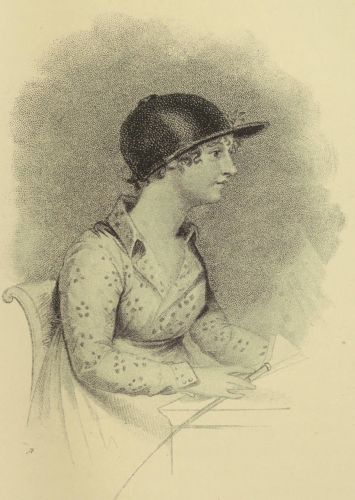
Mrs Thornton. Pub. Feb 1, 1805, by J. Wheble, Warwicksquare.
In after-life Flint became miserably poor, and eked out a living as a manager of a horse bazaar at York. He eventually committed suicide by taking a dose of prussic acid.
At the York August meeting in the following year Mrs. Thornton rode another match against Buckle, the celebrated jockey. Mrs. Thornton, in the highest spirits, appeared dressed for the contest in a purple cap and waistcoat, long nankeen-coloured skirts, purple shoes, and embroidered stockings. Buckle was dressed in a blue cap, with blue bodied jacket, and white sleeves. Mrs. Thornton carried 9 st. 6 lb., Mr Buckle 13 st. 6 lb. At half-past three they started. Mrs. Thornton took the lead, which she kept for some time; Buckle then exercised his jockeyship, and took the lead, which he retained for only a few lengths, when Mrs. Thornton won her race by half a neck. On this occasion Mrs. Thornton rode Louisa, by Pegasus, out of Nelly; and Buckle rode Allegro, by Pegasus, out of Allegranti's dam.
As the English Turf began to rise in importance some attempt was made to introduce racing into France. As early as the reign of Louis XV. a number of the French nobility had frequented Newmarket. The well-known sportsman, Hugo Meynell, much resented this, and grimly declared that he wished the peace was all over and England comfortably at war again. A particularly unpopular visitor was the Comte de Lauraguais, who purchased the celebrated race-horse, Gimcrack, took him over to France, and for a big bet ran him twenty-two and a half miles, it is said, within an hour.
At the end of the eighteenth century Philippe Égalité raced at Newmarket, where he seems to have created an unfavourable impression. Though he entered a good many horses, he was not particularly successful as an owner. In France the sporting exploits of this Prince and of the Comte d'Artois excited a good deal of indignation. They were declared to be the associates of grooms, and to enter into scandalous combinations in the races which they organised, whilst treating the onlookers with the most ineffable contempt and savage ferocity. It would certainly appear that at times they used their whips on the spectators as well as on their horses; and not only encouraged the officers to maltreat the crowd, but employed such grossness of speech, and offensive oaths, as showed that these Princes were not unskilled in the language of the vilest part of the nation. High betting was general, and noblemen turned jockeys and rode their own racers. When the Comte de Lauraguais appeared at Court, after a long absence, the King coldly inquired where he had been for so long. "In England," the Count replied. "What did you do there?" "I learnt there, please your Majesty, to think." "Of horses," retorted the King.
The early days of the French Turf were unedifying. In a match between the Duc de Lauzun and M. de Fénelon the latter fell from his horse, broke his arm, and lost his wager. The same gentleman betted with another nobleman as to which of them could reach Versailles and return to Paris the quicker in a single-horse chaise. The horse of the first died at Sèvres, and the other expired in the stable at Paris, a few hours after his return.
Frivolous courtiers, not satisfied with exercising their inhumanity on their horses, exposed themselves to the derision of Paris by other kinds of races. The Duc de Chartres, the Duc de Lauzun, and the Marquis FitzJames once betted five hundred louis who could first reach Versailles on foot. Lauzun gave up the foot-race about half way; Chartres about two-thirds; FitzJames arrived in an exhausted state, and was saluted as conqueror by the Comte d'Artois. The hero in question was near expiring in the arms of victory and had to be put to bed. Blood-letting was resorted to, and though he won his wager he contracted asthma.
Marie Antoinette, not satisfied with foot and horse racing, instituted contests of speed in which donkeys were bestridden, the successful jockey being rewarded with three hundred livres and a golden thistle.
During the first Empire, Napoleon, probably with an eye to the horsing of his cavalry, decreed that there should be races, and races of a sort there were, chiefly in the Department of the Orne and at a hippodrome at Le Pin, the seat of a Government stud established by Colbert in the days of the Roi Soleil.
After the restoration of the Bourbons, racing was intermittently carried on at Vincennes, at Fontainebleau, in the Champs de Mars, and at Satory-Versailles, which were the chief places of racing near Paris. The ground at both was detestable. At Satory-Versailles, in wet weather, the course was so deep in mud that the horses could hardly move. At the Champs de Mars the ground was often "so hard as to endanger the strongest legs," and "when the horses galloped the jockeys were liable to be blinded by a cloud of dust and small pebbles." As a matter of fact the races were more often than not won by the mounted gendarmes, who rode with the horses from start to finish.
In the early days of the French Turf the fields were, of course, small, and so was the value of the prizes. For this reason, in order to eke out a fair number of races with very few horses, the practice of running races in "heats" was grossly abused. In 1840, Madame de Giraudin wrote: "The races on Sunday were favoured with superb weather, and the extraordinary sight was seen of nine horses running together—nine live horses, nine rivals—a rare spectacle in the Champs de Mars. Generally one horse runs all alone, contending against no opponent, and always coming in first. But this does not signify; it excites the admiration of those who love sport, and especially of the philosophers among them; it is so noble to strive against and overcome oneself!"
The foundation of the French Turf as we see it to-day dates back to 1833, when the French Jockey Club was founded.
Before this there had existed in the Rue Blanche an English Jockey and Pigeon Shooting Club founded by a Mr. Thomas Bryon, who acted as secretary. In 1830, of the eighteen members, four were English, including that very original character. Lord Henry Seymour, and in course of time he took a leading part in originating a Members' Club, which should resemble the English Jockey Club, and should be lodged in a luxurious Club-house.
The twelve founders of the French Jockey Club were soon joined by a large number of sportsmen, among whom were the novelist, Eugène Sue, Lord Yarmouth, and Mr. John Bowes, who passed most of his life in Paris. The latter gentleman won the Derby four times. On the first occasion, in 1835, when Mundig beat Ascot (which belonged to the writer's grandfather, Lord Orford) by a head, Mr. Bowes was still an undergraduate at Cambridge—in subsequent years he won it again with Cotherstone, Daniell O'Rourke, and West Australian.
The French Jockey Club, at its institution, consisted of Royal Princes, noblemen, ordinary men of property, all persons of considerable influence interested in horse-breeding and in the improvement of the breed of horses by means of horse-racing and the "selection of the fittest." Most of them were good horsemen, who rode their own horses on occasion. M. de Normandie, for instance, was the winner of an improvised race which took place at Chantilly in 1833 between himself, Prince Lobanoff, Viscount de Hédouville, and others. This is said to have suggested the idea of forming the present beautiful race-course there. This gentleman, who must be ranked as one of the fathers of the French Turf, frequently acted in the earliest days of the French Jockey Club as steward, judge, and starter; and though he does not appear to have introduced any famous strain of blood into the studs of his country, greatly contributed to establish French racing on its present prosperous footing.
M. de Normandie is said to have won the first regular steeplechase ever run in France on English principles. This took place in 1830, near St. Germain, and in December 1908 a gentleman was still living who was supposed to have taken part in it.
This was Mr. Albert Ricardo, J.P., who spent his early days in Paris. A great supporter of sport, Mr. Ricardo, who died on the last day but one of the year, had won the Cambridgeshire with The Widow as far back as 1847. He had also been a keen cricketer in his youth, and was one of the two first members of the I Zingari.
There was steeplechasing at the Croix de Bernay as early as 1832, and at La Marche some little time later.
The Auteuil steeplechase course, which is now the head-quarters of the sport in France, was not inaugurated till after the war of 1870.
Through the influence of the Duc d'Orléans, the son of Louis Philippe, who was killed in a carriage accident in 1842, the French Jockey Club obtained leave to hold regular meetings in the Champs de Mars; and he it also was who, in 1834, arranged the creation of the race-course at Chantilly, which, till Longchamps was started in 1856-57, was without doubt the best course in France. At Chantilly was run the first French Derby (Prix du Jockey Club) in 1836, and the first French Oaks (Prix de Diane) in 1843.
The stables of the Duc at Chantilly were presided over by an English trainer, George Edwards, and his principal jockey was Edgar Pavis. In 1840 his English-bred horse, Beggarman, won the Goodwood Cup. Besides this the Duc d'Orléans won a number of French races. As a matter of fact, racing in France, from 1834 to 1842, was more or less of a duel between the Prince in question and Lord Henry Seymour.
The latter extraordinary personage was born in Paris in 1805, and is believed never to have set foot in England. Lord Henry Seymour was said to be related on his mother's side to "Old Q." or George Selwyn, or both, and from either or both of them he probably inherited some of his numberless eccentricities as well as his taste for the Turf. He was a well-known figure in Paris and its neighbourhood, for it was his constant practice to drive about in a carriage with four horses, postilions, and out-riders. After Mardi Gras, he would sit with other congenial spirits at the window of the noted "Vendanges de Bourgogne," watching the descente de la Courtille (the return from the ball) in the early morning, when he would scatter heated pieces of gold among the crowd of returning "maskers." Lord Henry is said to have been the original of the eccentric character described by Balzac, who delighted in furtively administering drastic medicines to his dearest friends, the very unpleasant effects of which afforded him intense amusement. He delighted also in giving away cigars with something explosive inserted at the end, afterwards watching the effect of a light applied by the unsuspecting smoker. He died in Paris in 1859.
In 1856 the French Turf entered upon a new and important era, a promise being obtained from the Government and the municipality of Paris that a race-course should be included in the projected plan for the transformation of the Bois de Boulogne. In the Longchamps meadows, on the borders of the Seine, an expanse of level and unencumbered ground was allotted to the Société d'Encouragement, and by an arrangement with the municipality of Paris, the Société became lessees of the race-course for fifty years, undertaking to pay an annual rent, as well as to build stands, which, at the expiration of the lease in 1906, should become the property of the city. The old stands, which during the last three years have been replaced by magnificent new ones, were erected by the architects of the city of Paris, at an expense of 420,000 francs (£16,800), and subsequent expenses brought the amount up to 1,284,981 francs (about £51,395). The race-course was opened on the last Sunday in April 1857, and the first Grand Prix was run in 1862, when the Ranger won.
The moving spirit in the institution of this race, now the richest in the world, is said to have been the Emperor Napoleon the Third, represented by the Duc de Morny, the creator of Deauville. The first Grand Prix was worth £4000 and an objet d'art; the amount of the stakes for the same race in 1909 was some £16,000.
When the Grand Prix was first inaugurated, many vigorous protests were made in England against the race being run on a Sunday, but by these the French declined to be swayed. As a matter of fact, notwithstanding Anglo-Saxon plaints at the iniquity of Sunday racing, the beautiful courses at Longchamps and Auteuil are very popular with visitors from across the Channel on many a fine Sabbath day, when Englishmen, known for their stern and unflinching moral rectitude, are not infrequent spectators on such occasions. One of these, a public man, notorious for his advocacy of every form of puritanical restriction, whilst exhibiting some confusion at being recognised by a friend, could only make the defence: "Well, after all, it doesn't matter, as I am not betting." In all probability, however, he, like other visitors, had backed his fancy!
An important share in the laying-out of Longchamps race-course was taken by the late Mr. Mackenzie Grieves, who, originally an officer in the Blues, took up his residence in Paris, became a member of the French Jockey Club and played a prominent part in the organisation of French racing. Mr. Mackenzie Grieves, whose memory is preserved by an important race to which his name has been given, was personally known to the writer, who retains pleasant recollections of his great charm and dignified appearance, both of which were highly characteristic of one of the last of the fine old school. He was a most graceful rider and a master of the haute école.
Though racing in France was naturally suspended during the war, it was once more in full swing in 1872, when the Grand Prix was won by Cremorne. In consequence of the downfall of the second Empire a number of the important races were renamed. The Prix de l'Impératrice, for instance, became the Prix Rainbow; the Prix du Prince Impérial the Prix Royal Oak. The Prix Gladiateur, one of the oldest French prizes, has under its various names strikingly reflected the vicissitudes of French politics. Originally it was the Prix Royal, then Prix National, then Grand Prix de l'Empereur, till, with the rise of the third Republic, it was called after the famous race-horse.
In 1885 there was great jubilation amongst French sportsmen at the victories of Plaisanterie, which won both the Cesarewitch and Cambridgeshire, as well as twelve out of thirteen events in France.
The appearance of the daughter of Wellingtonia and Poetess in the Cesarewitch was said at the time to be owing to two bookmakers, T. Wilde and Jack Moore, who made it worth the while of the filly's owners (M.H. Bony and Mr. T. Carter) to start her, guaranteeing them 33 to 1, though they themselves had only got 20 to 1 in England. Wilde, it was declared, brought back to France after the race nearly five million francs (£200,000), won by backing Plaisanterie, of which Jack Moore paid out some 600,000 (£24,000) in five-franc, ten-franc, and twenty-franc pieces to French backers who had been on the good thing.
In common with the rest of the fraternity, these two very sporting layers have now long disappeared from the French race-course. Bookmaking in France practically ceased to exist with the introduction of the Pari Mutuel in 1891.
Previous to that time bookmakers had pitches provided for them some way behind the stands, where they were allowed to exhibit lists of the horses running in the various races, against which were chalked the odds, the variations in which were thus easily shown. The whole thing was most decorously conducted, and the system worked fairly well. Nevertheless, from time to time, rumours were rife as to an intended suppression of the bookmakers by the French authorities, and at last in 1891 they were definitely bidden to cease plying their business. The new decree was rigorously enforced, crowds of police in uniform and plain clothes being present on the Parisian race-courses, and any one found openly making a bet was ruthlessly arrested—a perfect reign of terror, indeed, prevailed amongst betting-men, and very great dissatisfaction ensued amongst habitual frequenters of the French Turf. On several occasions, notably one Sunday at Auteuil (when the writer was present), a large force of military were on the ground, regiments of cavalry being in reserve outside the race-course. Feeling ran very high, and the races were run amidst hoots, yells, and other demonstrations of indignation, some of which most unjustly took the form of missiles hurled at the jockeys. The cabmen and proprietors of the char-à-bancs who drive the public to the various race-courses around Paris, the keepers of the small restaurants along the various lines of route, loudly complained that the new era of restriction which had dawned would completely ruin them. The saddest people of all, however, were very naturally the bookmakers, most of them English, who for many years had made a living on the French race-courses, for, whilst the public generally were more or less certain that some new method of betting would be devised, they fully realised that the suppression of their business was no mere outburst of outraged morality on the part of the Government, but a well thought-out scheme for appropriating their spoils and diverting them to public purposes. The golden days were gone, and ruin stared them in the face.
In a very short time public indignation was allayed by the announcement that French racing was not, as it had been averred, about to be stamped out by the high-handed brutality of those at the head of the State. Betting would be allowed, but only through the medium of the Pari Mutuel or Totalisator, which would be established on a legal basis on every race-course in France; and after the passing of the law, which definitely laid down the manner in which speculation on the French Turf was in future to be conducted, the beautiful courses round Paris were once more thronged by crowds of relieved race-goers.
The law in question, passed on 2nd June 1891, expressly prohibited any form of betting on race-courses except through the medium of the Pari Mutuel, and strictly defined the conditions on which the latter was to be worked. For a few years after this law came into operation a certain toleration was extended to a few of the principal bookmakers, who still continued to make bets in an unobtrusive way, but of late years the authorities, considering that such a state of affairs tends to decrease the receipts drawn from the Totalisator, have become exceedingly stern in repressing any attempts at such a form of speculation.
The percentage levied on the sums staked at the Pari Mutuel is now eight per cent for the race-courses round Paris and that at Deauville, and ten per cent for race-courses in the provinces. Of this sum the five great Parisian racing associations and that of Deauville are allotted four per cent, the rest being applied to charitable and other public purposes. A different scale applies to the provincial race-courses, where the receipts are naturally not so remunerative.
The official figures issued on 7th June 1909, show that £160,000,000 has been staked by the public by means of the Pari Mutuel since its institution in 1891. During the last eighteen years no less than £4,000,000, produced by the percentage levied on this sum, has been applied to public purposes; besides this, various charities and the Racing Societies have profited to an enormous extent.
To-day, owing to the large sums which are available from this source, there is to all intents and purposes no poor-rate in France—the Pari Mutuel takes its place.
As regards the racing itself, it is shown by the official statistics to be in a more flourishing condition than ever before.
In 1891 there existed in France 253 Racing Societies, which held 526 meetings; on the 31st of December 1904 an official statement showed that 396 societies held 906 meetings. During this period more than twenty-nine millions of francs, considerably more than a million pounds sterling, produced by the percentage levied on the Pari Mutuel, had been devoted to racing prizes and the general encouragement of horse-breeding in France. Since the institution of the Totalisator the race-courses and stands have been much improved, funds being abundant.
As a means of speculation for the casual visitor to a race-course the Pari Mutuel is a most convenient form of betting. An excellent organisation exists on every French race-course for enabling those desirous of backing any horse to do so by taking their ticket at one of the many bureaux, above which are inscribed the amount which any ticket represents.
Separate betting bureaux exist for ladies in the special stands which are on some courses set aside for them, and everything is done to render the public thoroughly comfortable.
A list of the horses running is clearly displayed, and there is when possible place betting. On some race-courses the field can be backed, which, in the event of an outsider winning, is not unprofitable. The lowest sum for which a ticket is issued is five francs, the highest five hundred francs. There is, of course, no limit to the number of tickets which any one who wishes to do so may take. Should a backer not be desirous of changing a winning ticket into cash upon the race-course he can keep it till his return to Paris, where, on presenting it at a Central Office at certain fixed hours (defined on the ticket), he receives his money without any inconvenience. In justice, however, to the French race-course authorities it should be added that, considering the huge amount of money carried by those going racing in France, robberies are extremely rare.
Admission to the "pesage," the best and most expensive enclosure, is only 20 francs for a man, 10 francs for a woman. There is also a cheaper stand, and admission to the course costs a franc.
Though a certain number of heavy betters complain of the lack of bookmakers, the general public appears satisfied.
On the Grand Prix day of the present year, when the race was for the first time won by a French jockey, £185,326 passed through the Pari Mutuel at Longchamps, out of the percentage levied on which the poor received no less than £3700. Whatever may be urged against the Totalisator in France, it is bound to benefit a certain number of people, which is a good deal more than can be said for any other form of betting, gambling, or speculation.
Those who in the pages of this book have wandered through the gaming-houses of Europe, and have briefly surveyed the careers of most of the chief gamblers of the past, will, it is hoped, do the writer the justice to admit that he has in no wise sought to minimise the grave evils which are the almost inevitable result of worshipping the goddess of Chance.
Nothing, indeed, is more striking than the almost universal ruin which has ever overtaken the vast majority of gamblers, except the complete failure which has invariably attended all attempts to stamp out this vice by means of coercive measures.
The futile and ineffectual results which, during the last two hundred years, have invariably followed all drastic repression, are clearly demonstrated by hard facts; at the present time speculation, gambling, and betting all flourish as they never flourished before.
In open combat, the strong arm of the law is resistless; but there is no possibility of its ultimate triumph or power of eradicating the desire of gaming from the human mind; and more especially in a country where speculation on the Stock Exchange is regarded with the greatest tolerance by those who denounce the race-course and the card-table.
The anathemas of well-meaning and unworldly ecclesiastics, the plaints of zealous philanthropists, the strident declamations of social reformers, who call for legislative measures of drastic restriction, can only cause the philosophic student of human nature to deplore that so much well-meaning effort should be devoted to such a futile end.
In sober fact the gambling mania is one for which no specific remedy exists—it is possessed by those who are well aware of its dangers, and realise that in the ordinary course of events it must prove ultimately destructive. Repress it in one direction and it reappears—more often than not worse than ever—in another.
It is impossible to dragoon human nature into virtue. The leopard cannot change its spots, or the Ethiopian his skin. Man with his craving for strong emotions will assuredly find means of gratifying them, and it is mere hypocritical rubbish to assume that in the future milk and water is to be the elixir of life.
The well-meaning altruist, who looks with contempt on the frivolous occupations which appear to amuse a great part of mankind, should remember that they, on the other hand, are equally at a loss to account for the pleasure which he derives from the more elevated pursuits in which their lower mental capacities forbid them to indulge.
As a matter of fact the strongest motive with all mankind, after the more sordid necessities are provided for, is excitement. For this reason gambling will continue—even should all card-playing be declared illegal and all race-courses ploughed up.
Repugnant as the idea may be to the Anglo-Saxon mind, regulation, not repression, is without doubt the best possible method of mitigating the evils of speculation; and, moreover, such a system possesses the undeniable advantage of diverting no inconsiderable portion of the money so often recklessly risked into channels of undoubted public benefit.
The time is not yet when English public opinion is prepared to face facts as they are; but though it may be at some far distant day, that time must come, when a wiser and more enlightened legislature, profiting by the experience of the past, will at last realise that the vice of gambling cannot be extirpated by violent means. Reluctantly, but certainly, it will endeavour to palliate the worst features of gambling by taking care that those who indulge in it shall do so under the fairest conditions, whilst at the same time paying a toll to be applied for the good of the community at large.
Such is the inevitable and only solution of a social problem which from any other direction it is absolutely hopeless to approach.
INDEX
Abingdon, Lord, befriended by Mr. Elwes, 16; and O'Kelly, 145 Adolphus, Mr., and Duke of Wellington, 11 Aix-la-Chapelle, gaming at, 282; an Italian's adventures at, 282-4; a royal gambler at, 284-6 Alvanley, Lord, 110 Ambassadors use their mansions as gaming-houses, 248-9 Ancre, Maréchal d', the wife of, 10 Anne, Queen, supporter of the Turf, 389 Annuities, paid by Brooks's, 116; paid by gamblers as compromise, 171 Antoinette, Marie, 209, 419 Archer, Lady, 56 Ardesoif, Mr., roasts a game-cock to death, 196; his just reward, 196 Arlington, Earl of, 39 Arnold, Mr., his cruel wager, 225 Arthur's, Mr. Elwes a member of, 15 Artois, Comte d', his bet with Marie Antoinette, 209, 210; his conduct on the Turf, 418 Ashburnham, Lord, 39 Ass and chimney-sweep race, 205 "Athenæum," a notorious gaming-house, 89; confused with real Athenæum Club, 93 Atkins, a bookmaker, last authority on hazard, 81 Atkinson, Bartle, a famous trainer, 175 Atkinson, Joseph, 42 Aubrey, Lieut.-Col., his maxim, 157; his distinguished antagonists and associates, 157 Australian story, an, 159-63 Author, a lucky, and his method of speculation, 164-6 Avarice combined with passion for play, 13 Baccarat, decision re, 129, 130; single tableau, 313, 317, 318 "Bad houses, beware of," 43 Baden, ex-Elector of Hesse gambles at, 287; M. de la Charme at, 287, 288; society at, 288, 289; croupiers at, 289, 290 Bagatelle, the building of, 209, 210 Baggs, Major, his luck at hazard, 82; his adventures abroad, 83; and Lord Onslow, 83; a skilful swordsman, and man of culture, 83; his generosity, 84; wins from the King, 84; falls a victim to gaming, 84 Baily, Mr., of Rambridge, 145 Barber, the Canterbury, 34-37; an Indian, as balloonist, 190 Barclay, Captain, pedestrian, 232 Barucci, Madame Julia, a card scandal at the house of, 304-7 Basketing, 199 Basset, 53 Bassette, 52 Bathing adventure, a, 194 Beauclerk, Topham, 27 Bedford, Duke of, and Nash, 31, 32; horsewhipped, 150 Bellasis, Theophilus, 42 Benazet, M., farmer-general of gaming-houses, 264; proprietor of rooms at Baden-Baden, 286, 287 Bennet, Captain, trundles a hoop, 224, 225 Bentinck, Lord Frederick, beat by Col. Mellish in a foot-race, 170 Bentinck, Lord George, and Lord Kelburne, 382, 383; his large winnings, 383, 384 Bentinck, Rev. Mr., and the Duc de Nivernois, 51, 52 Berkeley, Captain, and his game-cock, 202, 203 Bertie, Lord Robert, 15 Betting-houses started, 99, 100; fraudulent proceedings illustrated, 100; suppressed, 102 Billiards, a one-eyed player, 64 Bingham, Mr., his horse leaps Hyde Park wall, 219 Biribi, method of play, 247 Blackmail, keepers of gaming-houses subject to, 42; at the Palais Royal, 251, 252 Blanc, M., starts gambling-tables at Homburg, 298; plays for a parasol, 301, 302; victim of a stratagem, 302; a croupier's scheme, 303; and Garcia, 303, 304; opens a Casino at Monaco, 319 Bland, Sir John, 108; squanders his fortune and shoots himself, 109 Blind cock-fight enthusiast (Lord Bertie), 199, 200 Blind horse wins a leaping contest, 219 Blo' Norton Hall, 33 Blücher, Marshal, fond of gambling, 11; passion inherited by his son, 11; wins his son's money, 12; at the Palais Royal, 265 Blythe, Captain Carlton, a frequenter of Monte Carlo, 329; his method of play, 329 Boarding-schools, gaming taught at, 56 Bond, Ephraim, 89; takes over "Athenæum," 92, 93 Boothby, Mr., his opinion of Fox, 27 Borsant, M., a generous gaming-house proprietor, 272; revelations, 274 Bouillotte, 270 Bow Street troops, 44 Bowes, Mr. John, four times Derby winner, 421 Brampton, Gawdy, 33 Brelans, 235 Bridge, 135, 136 Bristol, Lord, turns the tables on Lord Cobham and Mr. Nugent, 104 Brooks, Mr., ready to make advances, 114; dies poor, 114 Brooks's, unlimited gambling at, 114; Fox's large losses at, 115; annuities granted to ruined members, 116; the betting-book at, 116; favourite games at, 116; relics preserved at, 117 Brummell, Beau, plays heavily, 112; his promise to the brewer, 112; his superstition, 113 Buckeburg, Count de, rides his horse backwards from London to Edinburgh, 205 Buckingham, Duke of, 39; Quin's story of the, 39 Buckingham Palace, 39 Buckinghamshire, Earl and Countess of, 57, 58 Bullock, Mr., 195 Bulpett, Mr. Charles, his remarkable feats, 233, 234 Bunbury, Sir Charles, 402 Burge, known as "the Subject," 89; his passion for the gaming-table, 90, 91 Byng, Hon. Frederick, on gambling, 94, 95 Byng, Sir John, his dispute with "T' au'd un," 381 Byron, Lord, a frequenter of Wattier's, 122 Calzado, Signor, cheats at cards, 305-7; sentenced to imprisonment, 307 Canterbury barber, the, 34-37 Card-money, 54 Carlisle, Lord, 105; a high gambler, but warns Selwyn, 106 Carriage race, a, 213 Casanova, his card duel with d'Entragues, 21-24; his meeting with Fox, 26 Cavillac, Marquis de, accuses Law of plagiarism, 242 Chabert, M., opens houses at Baden-Baden, Wiesbaden, and Ems, 286 Champeiron, la Comtesse, 246 Chance, the laws of, 6; in roulette, 9; public tables offer best, 10; tradesmen devotees of, 33 Chaplin, Mr., his fortunate Derby, 375 Charles II., founder of the English Turf, 386; an experienced rider, 386; his house at Newmarket, 386; Nell Gwynne's threat, 387; his witty answer to Sir Christopher Wren, 387; his amusements at Newmarket, 387, 388; his generosity, 388 Charme, M. de la, at Baden, 288 Chartres, Duc de, 209, 419 Cheating, methods of, 78 Chesterfield, Lord, 39 Chesterfield Row, 65 Chetwynd, Sir George, his Recollections, 82 Cibber, Colley, 108 Clarke, Vauxhall, his cock-fighting match with Col. Lowther, 196 Clavering, Sir John, appoints Mordaunt his aide-de-camp, 182 Clergyman, a betting, 209 Cleveland, Duke of, and Billy Pierse, 381, 382 Cobham, Lord, makes a vulgar bet, 103; forced to make public apology, 104 Cock-fighting in England, 195; some great patrons, 195; a famous battle at the Cock Pit Royal, 196; a cruel monster, 196; betting, 197; unexpected winners, 197; celebrated London cockpits, 198; Royal Cockpit taken down, 198; punishment for foul play, 199; a specimen challenge, 200; present-day fights, 200; famous trainers, 201; the last of the cock-fighters, 201; courageous birds, 201-3 Cocoa Tree, big stakes at the, 111 Codrington, Mr., 212 Colonel, the English, and his wife's ear-rings, 158 Colton, Rev. Caleb, a successful gambler, 138; his publications, 138; his affairs become involved and he decamps, 139; settles down at Palais Royal, 139; studies gambling, 139; commits suicide, 140 Combe, Alderman, 112 Combe, Hervey, 20, 21 Concannon, Mrs., 56, 62; Mr., 57, 58 Conolly, Rt. Hon. Thomas, 218 Cook, a fortunate, 262 Cookson, Mr., owner of Diamond, 413 Copley, Sir Joseph, 110 Cornwallis, Lord, and Mordaunt, 191 "Corpse" card-player and the Parisian banker, 156, 157 Countess, an eccentric, 291, 292 Court, gambling at, 38 Craps or Creps, an old French game, 263; survives in America, 264 Cribb, Tom, pugilist, his fight with Nicholl, 177 Cribbage, a fashionable game, 62 Cricket ball, a letter sent by, 211 Crockford, William, 96; wins large sum, 97; founds his famous Club, 97; profits made by, 98; his views on gaming, 98 Crockford's, Duke of Wellington becomes member of, 11; large tips to waiters, 94; blamed for increase of gambling-houses, 94; magnificence of, 97; expense of running, 98; heavy losses at, 113 Crofton, Sir Edward, high leap at Phœnix Park, 227 Croupiers, stoicism of, 290; at Monte Carlo, 354, 355; a school of, 354, 355 Cumberland, Duke of, 39, 137; institutes Ascot Meeting, 390; a born gambler, 390; his cruelty, 390; good-natured when racing, 391; a fortunate loss, 391; match with Duke of Grafton, 391; his horse Eclipse, 391 "Curse of Scotland," origin of the name, 137, 138 Dale, Thomas, rides a donkey-race, 211 Damer, Mr., makes the acquaintance of Dick England, 69; ruined at tennis, 70; his tragic end, 70 Darlington, Lord, 107, 169; a match with Col. Mellish, 174, 175 Dartmoor, gambling at, 50 Davies, a bookmaker, his betting, 385 Davis, Scrope, 228, 229 Dayrolle, Mr., 108 Death, as a subject for wagers, 105, 209; a duel with, 157 Decency, sense of, lost by gamblers, 158 Deer, used in place of carriage-horses, 206 Delessert, M., the means of closing Parisian gaming-houses, 272 Demidoff, Madame, robbed by a countess, 269 Dennisthorpe, Mr., 195 Derby, Lord, a patron of cock-fighting, 195, 200 Desmarest, French minister, 240 Desmoulins, Camille, 256 "Devil's Drawing-room," the, 257 Devonshire, Duchess of, 59; and "Old Nick," 60; scandal about, 60-62 Devonshire, Duke of, and Fox, 28 Devonshire Club, formerly Crockford's, 97 Dickinson, old Jack, an honest tipster, 377, 378 "Dispatches," 78 Dorchester, Lord, 70 Doulah, Asoph ud, Nawab of Oude, his sword practice, 187; his barber's aerial punishment, 190; his love of cock-fighting, 193 Drummond and Greville, Messrs., open a betting-house, 99 Dwyer, cigar-shop and betting-house keeper, 101; bolts with large sum, 102 Earl, William, 91; his "Athenæum" swindle, 92; transported, 93 Eclipse, the greatest horse of all time, 391-4 Edgecumbe, Dick, 106 Égalité, Philippe, a royal shop-man, 255; a follower of the Turf, 418 Elwes, Mr., 13; succeeds to a fortune, 14; a gambler at heart, 14; quixotic, 14; a member of Arthur's, 15; plays for two days and nights, 15; his avarice, 15, 16; and Lord Abingdon, 16; and the clergyman, 16, 17; elected to Parliament, 17; his admiration for Pitt, 17; his last bout, 18 Elwes, Sir Harvey, a miser, 13 Émigrés, 45; passion for gaming among, 49 et seq.; a cause of irritation, 54 Ems, a gambling resort, 310; a Spaniard's method at, 310; Russians at, 311 England, Dick, and the young tradesman, 68, 69; and Mr. Damer, 69-72; shoots Rolles, a young brewer, 73; flies to the Continent, 73; ends his days in London, 73 English, Buck, tried for murder, 217; member of Parliament, 217; his death, 217 English view of gambling, 163; and Sunday racing, 425, 426 Entragues, d', and Casanova, 21-24 E.O., fraudulent, 47; method of play, 55 Estates lost at play, 33 Este, Cardinal d', and the Cardinal de Medici, 238 "Excessive" gambling, definition of, 126 Execution, betting at an, 209 Exeter Mail beaten by a pony, 226 Existence, a strange, 267 Faro, invented by a Venetian, 52; introduced into France, 52; prohibited in France, 53; finds its way to England, 53; Fox's favourite game, 53; method of play, 53; crusade against, 57 Fawkener, Sir Everard, 106 Female assistants to sharpers, 95 Fénelon, M. de, his match with Duc de Lauzun, 419 Fenwick, Mr., 195 Ferguson, Sir Rowland, his opinion of Col. Mellish, 178 Field Club, The, 135 Fishmonger's Hall, 97 FitzJames, Marquis de, 209, 419 Fitzpatrick, General, 115 Flint, Mr., his race with Mr. Thornton, 415, 416; assaults Col. Thornton, 416, 417; commits suicide, 417 Foley, Lord, 401 Fonteneille, Madame de, 246 Foote, Sam, 66 Fortune, image of, kept by Roman emperors, 5; aid of, invoked by fetishes, 5; sometimes favours non-gamblers, 159 Foubert, a celebrated French riding-master, 386 Fouché, gaming-houses licensed by, 250; punishes interference, 250 Fox, Charles James, and Casanova, 26; a member of Brooks's, 26; White's, 105; unsuccessful gambler, 26; and Duke of Devonshire, 28; and Sir John Lade, 28, 29; borrows from waiters at Brooks's, 28; fond of horse-racing, 29, 400, 401; ruined at twenty-five, 115 Frascati's, a noted gaming-house, 266; an inveterate player at, 268; fêtes at, 269; dramatic incident at closing of, 274 French Jockey Club, 421 et seq. Galeries de Bois, 257 Game-cock, gentleman attacked by, 201; fox killed by, 202; in a naval action, 202, 203; awarded a medal, 203 Games, unlawful, 132, 133 Gaming-houses, suppressed, 99; officials, 40, 41 Gaming-tables kept by ladies, 48, 52, 245 Gancière, la Baronne de, 245 Garcia, his winnings at Homburg, 304; a card scandal, 304-7; sentenced to imprisonment, 307; his death, 307 Geese and turkey race, 206 Geneva, gambling at, 311 Genlis, Comte de, 209 George I. and the Turf, 389; George II. gambles, 39; George IV. rides to Brighton and back, 210, 211 George, Prince of Denmark, and horse-racing, 389 Germany, gaming in, 282 et seq. Gevres, Duc de, 239 Gilliver, Joe, fights cocks for Georges III. and IV., 201; his great-nephew's success, 201 Gillray, his caricatures of female gamblers, 56 Giraudin, Madame de, 420 Glasgow, Lord, his love of enormous wagers, 382, 383 Grafton, Duke of, 39 Grafton Mews, No. 13, 45 Graham's Club, 122 Gramont, Count de, his shrewd decision, 237 Granville, Lord, 97 Greville, Mr., 108, 385 Grieves, Mr. Mackenzie, 426 Groom-porter, the, 39, 86 Grosvenor, Lord, and Tattersall, 397 Gully and the Game Chicken, match between, 177 Gwynne, Nell, 387 Halton, Mr., 195 Hambletonian v. Diamond, a great race, 411-13 Hamilton, Captain, 65 Hamilton, Duke of, 195 Hammond, Mr. John, his successes on the Turf, 373 Harvey, Mr., a midshipman gambler, 111 Hastings, Marquis of, his large bets, 384; ruined, and early death, 385 Hawke, Hon. Martin, fights Col. Mellish, 176; a marvellous pistol shot, 176; duel with Baron Smieten, 177; patron of pugilists, 177 Hawkins, Sir Henry, his decision in Park Club appeal, 131 et seq. Hawley, Sir Joseph, a heavy better, 384 Hazard, a popular game, 74; made illegal, 75; method of play, 76-78; privilege of players, 78, 79; a lucky throw, 79; drunk men best players, 79; rules now forgotten, 81; French hazard, 82; runs of luck, 82 Heligoland, gaming-house on island of, 311 Hells, 40, 86 et seq.; defenders of, 42; West-End, 84; principal proprietors of, 85; source of profits, 86, 87; a prospectus, 88; precautions with visitors, 96 Henri IX. addicted to gaming, 235 Hertford, Lord, 39 Hesse, ex-Elector of, 287 Highflyer, a famous horse, 394-6 Hoca, brought to France by Italians, 238; play punishable by death, 239 Hodgson, Dr. William, 409-10 Hodsock Priory, 179 Holdernesse, Lord, 39 Holford, Mr., 195 Homburg, gaming at, started by brothers Blanc, 298; hours of play, etc., 299; a flood at, 299; the Kursaal, 300; the Landgraf, 300; Garcia at, 303 et seq.; scenes at close of Kursaal, 307-10 Hook, Theodore, his epitaph on Lord de Ros, 123 Hughes, Mr. Ball, 97 Humbug, method of play, 66, 67 Humphries, Mr., horsewhips Duke of Bedford, 150 Hunter, Henry, 224 Huntingdon, Lord, 39 Ingham, Sir J., his decision re baccarat, 129, 130 Insurance, fraudulent, 48; speculative, made illegal, 49 Invalids, gambling, 155 "Ivories," 79 James II., a lover of field sports, 388 Jeffries, Mr. John, 108 Jehu, Sir John, 28 Justiniani introduces faro into France, 52 Kelly, J.D., 90 Kenyon, Lord, scathing remarks by, 56 Kerridge, Thomas, 33 Kildare, Lady, 108 King's Place, a raid in, 44 La Belle, a popular French game, 245 Lade, Councillor, an eccentric supporter of the Turf, 405; his meanness, 406-8 Lade, Sir John, taught a lesson by Fox, 28, 29; bets with "Old Q.," 211 Ladies of fashion, keep faro-banks, 48; gaming-tables, 52; on trial, 57 et seq.; extravagances of, 59 "La Faucheuse," 313; played at Ostend, 317; forbidden in France, 317, 318 La fille Chevalier, 258 Lansdowne, Marchioness of, 180 Lauzun, Duc de, 209, 419 Law, John, kills a peer in a duel and escapes to Holland, 240; outlawed, 240; studies finance, 240; interview with Louis XIV., 240; threatened by Desmarest, 240; trusted by Duke of Orleans, 241; puts schemes in operation, 241; created Comte de Tankerville, 242; presented with freedom of Edinburgh, 242; anecdotes, 242, 243; his downfall, 244 Leaping wagers, 218, 219, 220, 227 Leeson, Major, 403; vanquishes the blacksmith, 404; his Turf career, 404, 405 Lennox, Lieut.-General, 224 "Le Wellington des Joueurs," 113 Lewis, Mr. George, 125 Lewis, Mr. Sam, a frequenter of Monte Carlo, 329 Liddell, Sir H.G., 195 Lloyd, pedestrian, runs a race backwards, 231 Loftus, Mr., cockpit owner, 197 Long sittings, 19, 20, 21-24, 62, 115 Lonsdale, Lord, 196 Lookup, Mr., 63; and Lord Chesterfield, 64; becomes saltpetre manufacturer, 65; privateering ventures, 66; dies at his favourite game, 66 Losers ready to fight, 25 "Lottery," a game favoured by ladies, 55 Louis XIV., 237; issues edict against play, 239 "Louse Pigott," an unpleasant Turf character, 408; charged with disloyalty, 409, 410 Lowther, Colonel, 195; at Cock Pit Royal, 196 Luttrell, Lady Elizabeth, 57, 58 Luynes, Duchesse de, and Talleyrand, 137 Macao, introduced by French émigrés, 121 MacGregor and his militia regiment, 141 Maisons de bouillotte, 270; de jeu, 245 Malcolm, Sir John, 20, 21 Manning, Mr., his novel leap, 220 March, Lord, 105 Martindale, Henry, 57-59 Martine, Colonel, engineer to Asoph ud Doulah, 188 Massena entertains Col. Mellish, 179 Mazarin, Cardinal, introduces games of chance, 237; always ready to bet, 237 Medici, Cardinal de, 238 Medley, Sporting, 42 Meggot, Mr., 13, 14 Mellish, Mr. Charles, 167 Mellish, Colonel Henry, his boyhood, 167; enters army, 168; his accomplishments, 168-70; appearance and mode of dress, 170; his horses, 170, 171; his big stakes, 171; and the Turf, 173-5; sells his estate, 176; Duke of Wellington's compliment, 178; befriended by Prince Regent, 179; settles at Hodsock Priory and marries, 180; his early death, 180 Methodists, 85 Methods, 4 Merry, Mr. James, 375 Mexborough, Lord, 195 Mills, Pemberton, ties up Brummell, 112 Milton, Lord, 70 Miranda, Signor, cheated by Garcia and Calzado, 305, 306 Monaco, 9; gambling at, 319 et seq.; the Grimaldis, 320; the army, 321; improvements due to M. Blanc, 322; Casino brings prosperity, 322; old Prince's consideration, 323; a visit to, fifty years ago, 324, 325 Monte Carlo, in 1864, 326; early frequenters, 327; development of, 328, 329; patrons, 329 et seq.; regulations as to dress, 330; hotels, restaurants, etc. in the 'eighties, 332; the "Cercle Privé," 334, 335; the bank, its gains and losses, 335-7; mistaken ideas about the gaming-rooms, 337, 338; systems of old players, 339; superstitions, 339-43; trente-et-quarante, 343-5; a successful swindle at, 346-8; roulette, 348-52; the croupiers, 354, 355; annual profits, 357; the Casino employés, 357, 358; the viatique, 358, 359; playing for a living, 359; systems of play, 360-73 Montfort, Lord, 108, 109 Monville, M. de, 252 Moral Betting Club, circulars issued by a, 101 Mordaunt, Colonel John, devoted to cards from youth, 180, 181; leaves for India, 182; ignorance of writing, 182, 183; Hindoo and Persian scholar, 183; his method of calculation, 184; meets with Asoph ud Doulah, 186; aide-de-camp to the Nawab, 187; saves Zoffany's head, 188; his hospitality, 191; excellent pistol shot, 192; wounded in a duel, 192; his love of cock-fighting, 195; his early death, 193 Morny, Duc de, 425 Morocco-men, 48 Mount Coffee-House, Mr. Elwes a member of, 17 "Multipliers," 1, 2; statute against, 2 Mundy's Coffee-House, 41 Mytton, Jack, played best when drunk, 80; punishes foul play, 80; presence of mind, 80; often plucked when young, 81 Napoleon, a poor card-player, 11; encourages horse-racing, 420 Napoleon III. and the institution of the Grand Prix, 425 Nash, Beau, does penance, 30, 31; rides upon a cow, 31; his advice to a giddy youth, 31; and Duke of Bedford, 31, 32; and the young peer, 32; a bet on the life of, 108 Naylor, Mr., his big win at the Derby, 375 "Neptune," 117 Newcastle, Duke of, 52 Nivernois, Duc de, 50; and the Rev. Mr. Bentinck, 51, 52 Normandie, M. de, 422 North-country gambler, a, 12, 13 Northumberland, Duke of, 15; patron of cock-fighting, 195 Nugent, Mr., 103, 104 O'Birne, Mr., his generous offer, 111 O'Burne, Mr., 57, 58 Ogden, Mr., 9 O'Kelly, Colonel Andrew, and his uncle's parrot, 148, 149 O'Kelly, Colonel Dennis, 42; his military rank, 141; sometimes known as Count, 141; and Catherine Hayes, 142; his racing successes, 142; hospitable, yet mean, 142; a true-bred Milesian, 143; not a fighting-man, 143; and the Jockey Club, 143; the black-legged fraternity, 144; and the sporting aristocracy, 145; his attachment for Ascot, 145; his small note, 146; and the pickpocket, 146, 147; the map of his estates, 147; his wonderful parrot, 147; becomes owner of Eclipse, 393 "Old Nick," 59; and the Duchess of Devonshire, 60; vouches for a friend's respectability, 60 One leg, twelve hours' stand on, 230 Onslow, Lord, and Major Baggs, 83 Onslow, Mr. George (Cocking George), out-ranger of Windsor Forest, 195 Orford, Lord, his geese and turkey race, 206; drives deer in place of horses in his phaeton, 206; chased by hounds, 207 Orléans, Duc d', anecdote of, 252 Orleans, Duke of, Regent, 241; duped by Law, 241 Osbaldiston, Squire, 232 Ostend, gambling at, 312; single tableau baccarat at, 313 Oyster-houses, gambling in, 95 Packer, Colonel, 138 Palais Royal, tripots in, 251, 253; Venternière and his black-mailers, 251, 252; its history, 254-6; queer characters, 256; "the Devil's Drawing-room," 257; facilities for dissipation, 258; the gaming-rooms, 258 et seq.; the stakes, 261; a fortunate cook, 262; the mad colonel, 263; passe-dix and craps, 263; famous gaming-houses, 265; Marshal Blücher games at, 265; falls on evil days, 271; the end of gaming at, 272-4; present condition of, 275; schemes to revivify, 277 Panton, Colonel, 140 Panton, Mr., 117 Paper, a lucky bit of, 160-2 Parasol, an expensive, 301, 302 Pari Mutuel, the, 427-32 Paris, gambling in, 235 et seq.; present-day, 278-81; anecdotes, 279-81 Park Club, high play at baccarat at, 124; proceedings against, 124 et seq.; rules of, 126, 127; proprietor and committee fined, 130 Parrot, a wonderful, 147-9 Passe-dix, method of play, 263 Pearson, Prof. Karl, his roulette experiments, 351 Peterborough, Earl of, 180 Petersham, Lady Catherine, 108 Pharo, or pharaoh, 53 Pharaon, le, 53 Philosopher's stone, 2 Piazza, Covent Garden, 42 Pierse, Billy ("T' au'd un"), his idea of making a fortune on the Turf, 381; his opinion of Sir John Byng, 381; on friendly terms with Duke of Cleveland, 381, 382 Pigot, Mr. William, and "Old Q.," 212 Poland, Mr., 125 Polhill, Captain, 232 Pond, Miss, rides a thousand miles, 207 Pond, Mr., publisher of Racing Calendar, 207 "Posting," 172 Potter, Paul, game-cock feeder to Lord Derby, 200 Pour et contre, 53 Pratt, Mr. Edward, 119; his wonderful memory, 119; silence a hobby, 120; whist his sole earthly aim, 121 Prisoners of war, gambling among, 50; strange sleeping conditions, 50; an amusing rebuke, 254 Private gambling, evils of, 136 Prussia, King of, gambles at Aix-la-Chapelle, 284; his generosity, 285 Public tables offer best chance, 10 Pur Plomb Club, 75 Queensberry, Duke of ("Old Q."), rides a mule race, 211; sends letter by cricket ball, 211; an eating contest, bet with Mr. William Pigot, 212; and Count O'Taafe, 213; his shrewdness, 410; his presence of mind, 411 Racing games, 75 Racing Plomb Club, 75 Radcliffe, Mr. J.B., 234 Raggett, 20 Raids, 44, 46 Raindrop race, the, 204 Rebuke, an amusing, 254 Regent, Prince, wins large sum from Mellish, 171; befriends him, 179 Restaurants in Palais Royal: Méot's, 275; Beauvilliers', Rivarol Champcenetz at, 275; Véry's, Danton at, 276; Venua, frequented by Girondins and Robespierre, 276; Fevrier's, a tragedy at, 276; Véfour's, 277; "Les Trois Frères Provençaux," 277; Café Corazza, 277 Revolution, gambling during the, 249 et seq. Revolutionary playing-cards, 253, 254 Ricardo, Mr. Albert, 422, 423 Richmond, Duke of, 227 Rigby, Mr. Richard, squanders his fortune, 149; rescues Duke of Bedford, 150; appointed Paymaster-General, 151; loses his post, and in difficulties, 151; assisted by Thomas Rumbold, 151; his kindness to a stranger, 152 Rivers, Lord, a dashing player, 113 "Rivett, General," 44 Riviera, prosperity of, due to M. Blanc, 328 Robespierre, 276 Roche, Captain, 67 Rolles, a brewer, shot by England, 73 Ros, Lord de, and the Satirist newspaper, 122; amusing evidence at trial, 122; dies in disgrace, 123 Rosebery, Lord, on chances of the Turf, 374 Rosslyn, Lord, his system, 366-9 Roulette, chances of, 9; method of play, 348-51; Prof. Karl Pearson's experiments, 351; a new form of, 281 Rowlandson, 20 Roxburgh Club, 20 Royal edict against play, 239 Rumbold, Thomas, waiter at White's and Governor of Madras, 151 Runs, extraordinary, 9, 82 Russell, Mr. Charles, 125 Sack race, a, 210 St. Amaranthe, Madame de, keeps a luxurious tripot, 253 St. Ann's parish officers' warning, 43 St. Fargeau, Lepelletier de, murder of, 276 St. Germain, a new form of roulette at, 281 St. James's Palace, 38 St. Louis, Chevaliers of, as croupiers, 249 Sainte Doubeuville, la Marquise de, 245 Salisbury, Lord and Lady, their amusing experience at Monte Carlo, 330, 331 Salon des Étrangers, a favourite resort of Marshal Blücher, 266; a pensioner, 267; a run of luck, 267; heavy losers, 268 Sandwich, Lord, plays hazard with Duke of Cumberland, 390 Sartines, Lieutenant of Police, authorises gaming in Paris, 245; his narrow escape of assassination, 246 Saxe, Madame, 22-24 Scott, General, a famous whist player, 117; his cute bet, 117; his generosity, 118; a careful liver, 118 Seaside resorts, French, gambling at, 314 et seq.; Casino regulations, 315-17 Sefton, Lord, a heavy loser, 113 Selby, Jim, a coaching feat, 232, 233 Selle, Madame de, 246 Selwyn, George, 105, 106, 138 Sermons against gambling, 85 Serre, Madame de la, 246 Servants demoralised by gambling-houses, 96 Seymour, Lord Henry, 421-4 Shafto, Captain, 210 Shelley Hall, 33 Shepherd, John, 43 Shooting wagers, 221 Slaughter-houses, 40, 43 Smith, Mr. Justice, 134 Smith, Tippoo, 20, 117 Speculation, passion for, 1, 2; in France, 240 et seq. Spencer, Lord Robert, 115, 145 Spirit of play in eighteenth century, 38 Sporting Medley, 42 Stair, Lord, offends the French, 103 Stavordale, Lord, 115 Stilts, a journey on, 226 Stock Exchange, gambling on, 163-6 Stroud, 42 Sturt, Mrs. Mary, 57, 58 Subscription-houses, 40 Sue, Eugène, 421 Sully, rebukes Henri IV., 235, 236 Sulzbach, 21 Sussex, Duke of, a heavy loser to Col. Mellish, 171 Systems at Monte Carlo, 360-73; the martingale, 363, 364; the Labouchere, 364; Lord Rosslyn's, 366-9; a sensible method of play, 370, 371; none thoroughly reliable, 372, 373 Talbot, Mr., 109 Talleyrand announces the death of the Duc d'Enghien, 137 Tattersall, Mr., purchases Highflyer, 395; compared with O'Kelly, 395, 396; his shrewdness, 396, 397; befriended by Lord Grosvenor, 397; his business, 397, 398 Tempest, Sir Harry Vane, 413 Tetherington, 42 Thacker, Mr., wins penmaking contest, 229 Thanet, Lord, 97; at the Salon, 268 Thatched House Club, 28 "There he goes," 35 Thornhill, Mr. Cooper, 210 Thornton, Colonel, 415, 416, 417; a shooting wager, 221; a bitter-sweet compliment, 221; unpopular, 222; known as Lying Thornton, 222; his conceit, 222; his will disputed in England and France, 223 Thornton, Mrs., her race with Mr. Flint, 415; contest with Buckle, the jockey, 417 Thouvenère, Madame de, 245 Throw, a marvellous, 114 Thynne, Mr., a disgusted gambler, 115 Tips, 4 Townshend, 46, 50 Tradesmen, devotees of chance, 33 "Travelling Piquet," 208 Trente-et-quarante, 10; method of play, 343-5 Tripots, 236, 239, 251; ladies preside at, 245; clandestine keepers of, 246; temporarily prohibited, 246; edict against unlicensed, 248; a luxurious tripot, 253 Turf, the, difficulty of making money on, 374 et seq.; some great wins, 375; sporting journalists and tipsters, 376; philanthropic tipsters' circulars, 376, 377; an honest tipster, 377, 378; three classes of racing-men, 378; bookmakers and their chances of profit, 378, 379; betting must be systematic, 379; Ascot unfortunate for backers, 379, 380; recent changes in method of speculation, 382; Charles II. founder of the English Turf, 386; the Whip run for at Newmarket, 388; royal supporters of, 386-9; Duke of Cumberland patron of, 390; early race meetings, 398 et seq.; eccentric races, 400; matches, 411-7 Turf, the French, 417 et seq.; Hugh Meynell, 418; Comte de Lauraguais, 418, 419; Philippe Égalité, 418; Comte d'Artois, 418; unedifying races, 419; Jockey Club founded, 421; steeplechasing, 423; the Duc d'Orléans, 423; enters on a new era, 424; the Grand Prix, 425; Plaisanterie, 427; T. Wilde and Jack Moore, 427; Pari Mutuel, 427-32 Tying-up, 31, 32 Ude, M. Eustache, cook at Crockford's, 97 Uxbridge, Lord, 81 "Valois Collier," 256 Vandéreux, M. Fernand, 75 Venternière, blackmailer, 251, 252 Véron, Doctor Louis, 278 Vincent, Sir Francis, 268 Voltaire and John Law, 242 Wade, General, and the poor officer, 153, 154 Wager, a vague, 109; a curious, 110 Wagers, eccentric, 103 et seq., 108, 116, 197, 204-14, 220, 224-31, 233 Walpole, Horace, on Mr. Damer's death, 70; and White's coat of arms, 106; on Parisian gaming-houses, 239 Warburton, Sir P., 195 Ward, Mr., 20 Warthall Hall, 33 Waterloo, revival of gaming after, 111, 112 Wattier's Club, a gambling resort, 121; its proprietor, 122; frequented by Byron and Beau Brummell, 122 Waugh, Captain, and the goose, 192 Weare, 88 Wellington, not a player, 11; a member of Crockford's, 11; and Mr. Adolphus, 11 Whalley, Thomas (Jerusalem Whalley), jumps a carrier's cart, 214; his extravagance, 215; Jerusalem and back, 216; publishes Memoirs, 217 Wharton, Mr., 195 Whist, a serious affair, 118, 119, 121 White's Club, becomes a gambling centre, 104; main supporters of, 105; coat of arms, 106, 107; old betting-book, 107 et seq.; hazard allowed, but faro barred, 110; gambling given up, 110; fossilised members, 110; present condition, 111 Wiesbaden, croupiers at, 290; the Kursaal, 290; players at, 291; an eccentric countess at, 291, 292; two strange players, 292; close of tables at, 293; effects of the closing on the town, 295; the last of the gamblers, 295, 296 Wilberforce, caught playing faro, 138 Wilde, Mr., his remarkable ride, 217, 218 Will, a gamester's, 78 William III., a patron of racing, 389 Williams, George, 106 Williamson, Major, 67 Wind, a bet about the, 224 Windsor, Mother, 45 Windsor Forest, outrangership of, 195 n. Wine v. water, 229, 230 Wolfe, Colonel, his answer to Duke of Cumberland, 390 Women and freak races, 205; as gamesters, 269, 359, 360 Wontner, Mr. St. John, and Park Club, 124 Wortley, Lady Mary, 39 Wren, Sir Christopher, and Charles II., 387 Wright of Long Acre, 213 Yarmouth, Lord, 421 Zeno, M. le Chevalier, Venetian ambassador, 248 Zoffany, court painter to Nawab of Oude, 187; paints caricature of the Nawab, 187; his narrow escape, 188, 189; a favourite of royalty, 194; his pictures, 194
THE END
Printed by R. & R. Clark, Limited, Edinburgh.
By RALPH NEVILL
FRENCH PRINTS OF THE EIGHTEENTH CENTURY
Illustrated. 8vo. 15s. net.
Mr. C. Lewis Hind in the DAILY CHRONICLE.—"Congratulations to Mr. Ralph Nevill! He has produced an art book that presents itself almost as a novelty—the proper kind of art book, too: a hundred pages and more of catalogue, fifty illustrations, and the text informative and bearing the signs of erudition and enthusiasm.... A pretty book, yes; but a book also of knowledge which the collector of eighteenth-century French prints must possess."
MORNING POST.—"A better book could not be desired. Mr. Nevill is a cultured critic and perfectly versed in his subject. He writes with equal vigour and effect, whether he is giving us biographical notices of artists and the history of the development of line and colour printing in France, or analysing the differences in the various states of the more important specimens. The work is admirably and very completely illustrated."
PALL MALL GAZETTE.—"A book crowded with curious information, and which the collector, in spite, perhaps, of his little group of M. Bocher's volumes, cherished during long years, must feel it his business to possess.... We thank him for a book which must have cost him labour; but which he must have executed with enjoyment, and in the happy possession of an overflowing measure of the connoisseur's knowledge. The book will certainly push appreciably further into English hands those charming instances of Eighteenth-Century Line Engraving which record, not only beautiful and dignified interiors, and the sunlit, statue-studded gardens, and cool streams and skies of France, but, more even than these, and to yet greater effect, the graceful pose and the spontaneous cordial gesture of such a chosen people, in irresponsible and radiant hours."
Edited by RALPH NEVILL
LEAVES FROM THE NOTE-BOOKS OF LADY DOROTHY NEVILL
With Portraits. 8vo. 15s. net.
MACMILLAN AND CO., Ltd., LONDON.
MACMILLAN'S NEW FICTION
ACTIONS AND REACTIONS
By Rudyard Kipling. Uniform Edition. Extra Crown 8vo. 6s. Pocket Edition. Limp Leather. Fcap. 8vo. 5s. net. Edition de Luxe. 8vo. 10s. 6d. net.
OPEN COUNTRY
A Comedy with a Sting. By Maurice Hewlett. Extra Crown 8vo. 6s.
STRADELLA
By F. Marion Crawford. With 8 Illustrations by George Gibbs and Frank Craig. Extra Crown 8vo. 6s.
ROBERT EMMET
A Historical Romance. By Stephen Gwynn, M.P. Extra Crown 8vo. 6s.
THE EDUCATION OF UNCLE PAUL
By Algernon Blackwood. Extra Crown 8vo. 6s.
A GENTLE KNIGHT OF OLD BRANDENBURG
By Charles Major, Author of "Dorothy Vernon," etc. Extra Crown 8vo. 6s.
THE KEY OF THE UNKNOWN
By Rosa Nouchette Carey. With a Portrait. Extra Crown 8vo. 6s.
MACMILLAN'S NEW BOOKS
HALDANE MACFALL
THE FRENCH PASTELLISTS OF THE XVIIITH CENTURY
Their Lives, their Times, their Art, and their Significance. By Haldane Macfall. Edited by T. Leman Hare. Demy 4to. 42s. net.
With 40 examples in colour and 12 in black of the works of the following artists: La Tour, Perronneau, Lundberg, Labille Guiard, Rosalba Carriera, Boucher, Boze, Chardin, Drouais, Vigée le Brun, and others.
With Illustrations in Colour
THE WATER BABIES
By Charles Kingsley. With 32 Illustrations in Colour by Warwick Goble. Crown 4to. 15s. net. Also an Edition de Luxe. Printed on hand-made paper, and limited to 250 copies. Demy 4to. 42s. net.
THE FOREST LOVERS
By Maurice Hewlett. With 16 Illustrations in Colour by A.S. Hartrick. 8vo. 5s. net.
Lieut.-Colonel J.H. PATTERSON
IN THE GRIP OF THE NYIKA
Further Adventures in British East Africa. By Lieut.-Colonel J.H. Patterson, D.S.O., Author of "The Man-Eaters of Tsavo." With Illustrations. 8vo. 7s. 6d. net.
LORD ACTON
LECTURES ON THE FRENCH REVOLUTION
By the late Lord Acton, D.C.L., LL.D. Edited with an Introduction by John Neville Figgis, M.A., and Reginald Vere Laurence, M.A. 8vo, 10s. net.
LORD KELVIN
THE LIFE OF WILLIAM THOMSON
BARON KELVIN OF LARGS
By Silvanus P. Thompson, D.Sc., F.R.S. With numerous Photogravure Portraits and other Illustrations. 2 vols. 8vo.
LORD KELVIN'S EARLY HOME
Being the Recollections of his Sister, the late Mrs. Elizabeth King; together with some Family Letters and a Supplementary Chapter by the Editor, Elizabeth Thomson King. With 23 Illustrations from Mrs. King's own Drawings and those of her Daughters. 8vo. 8s. 6d. net.
Hon. JOHN W. FORTESCUE
A HISTORY OF THE BRITISH ARMY
By the Hon. John W. Fortescue. Volumes V. and VI.
From the Peace of Amiens (1802) to the evacuation of Spain by the British troops (1809). With Maps. 8vo.
MACMILLAN AND CO., Ltd., LONDON.