FOOTNOTES: (continued 3)
Reading edition
A large proportion of the gains of the Monte Carlo bank is derived from small players who enter the rooms with the deliberate intention of either making a certain sum or losing what they have in their pockets; these form, as it were, the rank and file of the gambling army which is constantly being decimated by the Casino, and the almost total absence of such an element in the room upstairs reduced the play to a duel between the bank and a number of persons, the majority of whom were, more or less, capitalists and who, as often as not, went home immediately after bringing off one big and successful coup.
The gaming-rooms in the Casino at Monte Carlo have often been described as a hot-bed of vice and debauchery, the tables surrounded by a seething crowd of excited figures whose countenances betray the intense emotions which the vitiating effects of play arouse. "Cries of triumph, imprecations, moans and sobs are heard on every side." In certain highly coloured accounts, suicide is spoken of as being an ordinary occurrence, the crowd making way without comment for the passage of the corpse of some unfortunate gambler who, at the end of his tether, has blown out his brains.
All this is purely fanciful, and conveys no idea whatever of the real state of affairs prevailing in the rooms, where calm and good order invariably reign. There exists, indeed, an almost religious hush in the halls of this great Temple of Chance. After dinner, and towards the time of close of play, the scene, it is true, becomes more animated, but, as a rule, the only sounds heard are those connected with the games played. What conversation there is is almost exclusively devoted to short comments on such matters as the lack or abundance of runs on one particular colour, the persistent recurrence of certain numbers, the amount of winnings or losings of some well-known player, or the like; people rarely speak, when at the table, of their own vicissitudes in the battle with chance.
The real gamblers, that is to say, those to whom speculation is the very breath of life, speak least of all, their whole mind being concentrated upon the system or method of staking which it is generally their practice to adopt. They sit with unmoved faces, which appear neither elated by victory nor depressed by defeat.
A well-known Monte Carlo type—more abundant perhaps in the past than to-day—is the beau joueur, the man who plays to the gallery and, let it be added, pays handsomely for his performance. Certain and inevitable ruin is the fate of these individuals, who sacrifice themselves to the spirit of vanity. As a rule, the winnings or losings of such people are a great subject of conversation and discussion amongst the frequenters of the tables—they are said to have either won or lost enormous sums—to be at the end of their tether, or to have an enormous fortune behind them. Their fame, however, is of no enduring kind, being at best a nine days' wonder. They are soon forgotten, and their departure, leaving only too often their money in the vaults of the Casino, and an unpaid bill at their hotel, excites not even passing comment from the crowd of spectators whose approving gaze and fleeting admiration has been so dearly bought.
Some old players remain watching the game for a considerable space of time without risking a stake at all, till the moment arrives when either superstition or calculation prompts them to take the first steps in the campaign. Many of these come provided with memorandum books filled with column after column of figures, records of past runs on colours, and recurring sequences of numbers carefully inscribed as a guide to fathoming the capricious movements of fortune.
Others bring queer little mechanical contrivances, which are manipulated in a manner to show the correspondence between certain chances; whilst yet another section quite frankly display all sorts of fetishes, to some of which they attach a quite serious importance. A piece of the rope which has been used by a hangman is a fetish reputed to be an almost certain passport to good luck. The experience of the present writer with a grim relic of this kind did not, however, give any support to such a belief. As a great favour he was once given a small hempen souvenir by a friend, and armed with the precious talisman he betook himself to a trente-et-quarante table, where a good seat was secured. From the very first, however, it was evident that the gruesome charm was not exercising its occult influence in a direction favourable to its new, and perhaps somewhat sceptical, possessor. When runs were sought for, alternates appeared, and vice versa. Refaits were dealt with unnatural frequency; in fact, disaster followed disaster in an unbroken sequence, with the result that the little bit of rope was all that the player had in his pocket as he somewhat disconsolately strode out of the rooms, rather inclined to wish that the hempen relic had been utilised for its original purpose around the neck of its donor.
Gamblers are generally most superstitious folk and swayed by all sorts of whimsical ideas.
Years ago an old lady used to give the authorities a good deal of trouble by repeatedly bringing a small portion of ham into the rooms, and, whilst at play, cutting off slices and eating them. For some reason or other she had the fixed idea that, in her case, ham-eating propitiated fortune.
The rules of the Casino naturally forbid any proceeding of such a kind in the rooms, and whenever the ham was produced the chef de partie was obliged to point this out. The old lady in question, who was a well-known character, was, however, very rich, and, being a constant and high player, any drastic action would naturally have been disadvantageous to the best interests of the bank. Some compromise was, therefore, eventually arranged, by which the amount of ham consumed was so infinitesimal as to pass almost unnoticed by the general public.
Certain players attach considerable importance to the numbers inscribed upon the check handed to them by the attendants who look after cloaks and sticks. Now and then, as must of necessity happen in the ordinary course of events, an individual succeeds in winning a good stake by backing a number at roulette corresponding with that on his wooden ticket; more often, however, he fails, and then proceeds to work out all sorts of combinations of numbers, adding, subtracting and dividing, as the fancy seizes him.
The number of the sleeping-berth which has carried the visitor from Paris is also often chosen, as is that of his bedroom in the hotel. The date of a birthday, the sum total of the numbers on a watch, or of the figures on a coin, the number of cigarettes left in a case, or of coins in the pocket, and other similar trifles are all noted with intense interest by a certain class of player, eager for any clue which they believe may assist them in their struggle to achieve success.
It used, at one time, to be said at Monte Carlo that the clergyman of the English Church there never gave out any hymns under number thirty-six, as he had discovered that some of his congregation had made a practice of carefully noting down the numbers with a view to backing them at roulette. Most players, even the least superstitious, have some special lucky number of their own, which they make a point of following. Occasionally it turns up two or three times in succession, which, of course, further confirms them in constantly backing it, and, more often than not, losing far more than they have won.
The present writer's experiences in this direction have not been of an encouraging nature.
Some years ago, being on his way to the Principality, he was much struck by the curiously persistent way in which the number 13 confronted him throughout the journey. His room at Paris was 13; the number of his sleeping-berth in the train to Monaco was 13; and finally he was put into room No. 13 at the Hôtel de Paris on the day of his arrival, the 13th day of the month. All this, to any one with a vestige of superstition, looked as if 13 was a number well worth backing, and accordingly the writer hastened to the rooms, eager to see whether the tip would come off. As a matter of fact the only thing which did come off was the end of his finger, which in his haste to get to the Casino he slammed in his bedroom door. After having been attended to by a surgeon he finally obtained a place at roulette and steadily backed number 13, which, to his intense disgust, appeared rather less frequently than the other numbers. The same unsatisfactory state of affairs prevailed throughout his stay, which on that occasion was a prolonged and unpleasant one.
The curious influence which the advent of certain persons, or the occurrence of trivial incidents, appears to exert in matters of luck is well known to all gamblers. Many of them generally regard a number of trifles with feelings of considerable apprehension at the gaming-table, entertaining the most extraordinary likes and dislikes for various people and things, and cherishing queer fancies at which, in ordinary life, they would be the first to scoff. All this, of course, is akin to the superstition of the savage, a queer atavistic reminder of civilised man's humble descent.
Though the principles of roulette and trente-et-quarante are known to many, it may not be out of place to give brief descriptions of these games as played at Monte Carlo.
Before play begins the money is set out at one end of the table. The gold, after being weighed in scales, is placed in rouleaux, and the bank notes ranged according to their value. Everything is verified by an inspector, who taps each row with a rake and signs his name to a statement on paper.
At trente-et-quarante the minimum stake is a louis, the maximum 12,000 francs (£400), and the capital with which each table begins play £6000. "Breaking the bank" merely means that the money at a particular table is exhausted, and that play has to be suspended while more money is being procured.
Trente-et-quarante is a game of four even chances—rouge and noir, couleur gagne and couleur perd. It is played with six packs of cards, which, having been shuffled, are cut by one of the players. There is often a good deal of competition for this ceremony, the cut being by request reserved for some keen player. As a rule, however, others give way when any one who seems in luck—especially a lady of attractive appearance—steps forward to cut the cards.
After every one has staked and "rien ne va plus" has been called, the croupier deals the first card face upwards, and continues dealing until the cards turned up exceed thirty pips in number, when he must announce the numbers from "trente-et-un" to "quarante." This top line of cards is black, and when it is less in number than the one which is dealt beneath black wins.
Another line underneath is then dealt for rouge. When the two lines are equal in the number of pips—say thirty-six each—the dealer announces an après; thirty-one is the refait when all stakes are en prison. When, however, a refait has been dealt, a player may withdraw half his stake if he chooses, or move his money over from the red "prison" to the black "prison." In the case of another refait, the money is removed into another space, which is called the second prison. The odds against a refait turning up are usually reckoned as 63 to 1. The bank is said, however, to expect it twice in three deals, and there are generally from twenty-nine to thirty-two coups in each deal. By paying one per cent players may insure their stake. A large white counter is placed by the croupier on or near the money insured, which is unaffected by the refait. There are high players, however, who consider it bad policy to insure, and prefer to run the risk of 31 being dealt in both lines.
As a matter of fact, from a mathematical point of view, thirty-one is the number which the cards are most likely to make, as any one can easily prove for himself; the combinations formed by the numbers of the pips on the cards being more adapted to produce thirty-one than anything else. It is for this reason, no doubt, that the number in question was chosen for the refait, when the game first came into vogue.
At trente-et-quarante, besides the even chances of rouge and noir, there are also the even chances of couleur gagne and couleur perd.
The first card dealt determines couleur. If, for instance, it is red and rouge (the bottom line) wins—couleur gagne—the croupier says, "rouge gagne et la couleur"; if it is black and rouge wins—couleur perd—the croupier says, "rouge gagne, couleur perd."
The prison, of course, applies to couleur just as it does to rouge and noir.
At certain stated intervals, in the presence of a sous-directeur or chef de partie, the used packs of cards from trente-et-quarante are carried to a furnace in sealed sacks and scrupulously burnt.
A good many years ago the backs of the cards used at trente-et-quarante were plain white; at the present time, however, a slight design, the pattern of which varies daily, is upon them.
The reason for the change was said to be that the plain backs once facilitated a fraud, which cost the authorities of the Casino many thousands of francs. The story is a curious one.
One morning, as trente-et-quarante was pursuing its usual somewhat monotonous progress, a player with a large pile of money before him, seated next the croupier dealing, entered into an altercation with a neighbour about some stake, in the course of which, owing to violent gesticulations, a whole heap of coins was swept to the ground. Considerable confusion arose, which naturally necessitated the interference of the chef de partie (who supervises the game). The attention of everybody, both officials and players, was drawn to the spot where the dispute was taking place; the owner of the fallen treasure loudly declaiming against rough, bullying swindlers being allowed to enter the rooms at all. However, after much chatter, the money having been all found, peace was restored and the game proceeded on its ordinary course.
It was very soon evident that a number of very high players were that morning seated round the table, for quantities of notes and gold began to make their appearance. What was more remarkable was that all the high players seemed to be inspired with the same excellent idea, for every one of them invariably backed the winning chances. So extraordinary was their luck that, after the bank had lost a good deal of money, one of the high officials, who had been watching the game, announced that for the time being further play would be suspended at that particular table, as there was reason to believe that the cards had been tampered with. This naturally provoked a storm of protest, and in the confusion which ensued, the high players slipped unobtrusively away, their pockets well stuffed with the money they had extracted from the bank.
An hour or two later an attempt was made by the authorities to trace them, but, curiously enough, not one was to be found in the Principality. They had all crossed the French frontier and had dispersed in various directions. The cards were afterwards carefully counted and examined, and a thorough investigation of that morning's play is said to have proved beyond all doubt that the whole affair had been a cleverly hatched plot against the bank.
The two men who had quarrelled at the table were professional swindlers, and had carefully rehearsed the disturbance, in order to divert attention from the dealer, who remained apparently quite unmoved whilst the chef de partie and other officials were inquiring into the dispute. During this time an accomplice on the other side of this croupier had taken advantage of the general turmoil to slip a portion of a prepared pack into the man's hand. This was furtively exchanged by him for a certain number which he was holding ready to deal. Of these the accomplice relieved him. The high players were all swindlers, well aware how the cards had been arranged. The croupier, heavily bribed, was a rare exception, for, as a rule, Monte Carlo croupiers are above all suspicion. His share in the swindle was detected and he appeared in the Halls of Chance no more.
As was perfectly obvious, a robbery of this kind was greatly facilitated by the plain white backs of the cards in daily use. It was therefore decided that in future every morning a new design should be produced for the backs of these cards, which, known only to a special department, would effectually prevent any chance of prepared packets being interpolated with the packs issued by the authorities.
At roulette as at trente-et-quarante the money is publicly counted out and verified by an inspector before play begins.
The roulette wheels are balanced in the presence of the public, and one of the blue-coated garçons de salle goes from table to table with a spirit-level, which is placed upon the rosewood rim of the cylinder, a chef de table verifying the accurate adjustment of the wheel by seeing that the air bubble is exactly in the centre.
The maximum stakes allowed on the different chances at roulette are:—
Francs.
On one number 180
On two numbers (à cheval) 360
On three numbers transversal 560
Four numbers (en carré) 750
On 0, 1, 2, 3 750
On six numbers transversal 1200
On one dozen 3000
On one column 3000
On all the even chances 6000
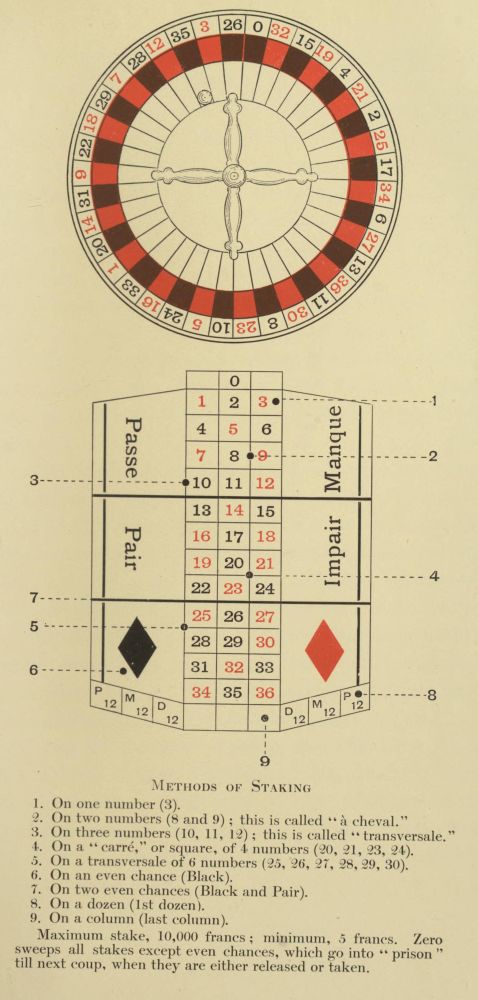
Plan of Roulette Table as used at Monte Carlo
The amount with which play is begun each day is 80,000 francs, or £3200.
Each roulette table has two boards, on which players may stake, the roulette wheel (a cylinder let into the table) lying between the two. The numbers of the roulette are arranged irregularly, though reds and blacks alternate. Zero, which is not counted as a colour, lies between 32 red and 15 black. There are in all thirty-seven little compartments which receive the ball—eighteen red, eighteen black, and zero. The accurate odds, therefore, are 36 to 1 against any particular division; nevertheless the bank only pays 35 to 1, which causes its profit to amount to 1 in 37, nearly 2·865 per cent.
The lowest stake allowed at roulette is five francs, the highest 10,000 francs, known as a maximum.
The two sides of the roulette table are duplicates of one another, each of them being divided something like a chess-board into three columns of squares, which amount to thirty-six; the numbers advance arithmetically from right to left, and consequently there are twelve lines down, so as to complete a rectangle; as 1, therefore, stands at the head, 4 stands immediately under it, and so on. At the bottom lie three squares marked 12 p, 12 m, 12 d, that is, first, middle, and last dozen. Three large spaces on each side of the numbers are for red and black; even and odd; manque and passe, that is, the numbers in the first and second half respectively from 1 to 18, and from 19 to 36 inclusive. At the top of each board is zero, which sweeps all stakes, except those on the even chances, into the coffers of the bank.
The stakes having been made a croupier says: "Le jeu est fait, rien ne va plus." The wheel is set in motion. At the same time a croupier sends the ball flying round the cylinder, the roulette wheel bearing the numbers being made to revolve in an opposite direction. The ball eventually falls on to the wheel, and as the latter slackens its speed, enters a compartment, the number of which is announced thus: "Dix-sept, rouge, impair et manque."
When zero is announced all the money on the table is annexed by the bank with the exception of that staked upon the even chances red or black, odd or even, passe or manque—the sums on these are moved to the edge of the board, being en prison till the next coup, when they are taken or released according to the colour and chance which wins.
The odds laid by the bank work out as follows:—
Stakes placed on any number or on zero are paid at the rate of 35 to 1—a player on the numbers is therefore taking 35 to 1 about a 36 to 1 chance, which must be to his prejudice in the long-run—on any four numbers 8 to 1, on any six numbers 5 to 1. Red or black, odd or even, passe (the numbers after 18) or manque (the numbers before 18) are even-money chances. The dozens and columns are 2 to 1 chances.
Stakes are often placed à cheval, that is to say, on two adjoining numbers, which together are paid at the rate of 17 to 1. The red numbers and the blacks are unequally divided in the columns. The centre column contains eight black and only four reds; the first column has six reds and six blacks; while in the last column there are eight reds and four blacks.
Professor Karl Pearson, when making an exhaustive study of the laws of chance, drew up a series of elaborate tables, with the intention of comparing the results of a number of spins of the roulette wheel with those produced by drawing numbers from a hat and tossing with coins.
The conclusion at which he arrived was that, whilst the colours followed the laws of chance as they are generally understood, the other even chances, passe and manque, pair and impair, exhibited such capriciousness in their recurrence as could not have been expected had roulette been played continuously through the whole period of geological time.
The roulette wheels of Monte Carlo are perfectly honest machines. The cylinder of each is sheet copper, carefully balanced and strengthened by bands of metal. It revolves in its bed on a vertical pivot of steel, the top of which has a cup-like hollow, into which oil is poured. A mechanic, whose business it is to clean and prepare the wheels every morning, pours oil also into the gun-metal socket which forms the centre of the wheel, and it is then dropped into its place upon the pivot.
The great care which is taken by the authorities to ensure the absolute accuracy of their roulette wheels is based upon very sufficient grounds, for a slight defect in one of those machines once cost them a large sum.
Amongst the frequenters of the rooms at Monte Carlo there is always a large number of astute and none too scrupulous individuals quick to note any little circumstance likely to be of advantage to themselves. For this reason some slight tendency of the roulette wheel to stop in such a way as to cause a certain group of numbers to have an advantage over the rest is very quickly noticed and advantage taken of it.
A mechanic from Yorkshire, Jaggers by name, once cost the Casino some two million francs. Well aware of the difficulty of maintaining a nicely adjusted machine in a perfectly stable condition, Jaggers engaged six assistants, whom he posted at different tables to note the numbers at roulette all day long, whilst he himself undertook to make an elaborate analysis of the results. After a month's play peculiarities were clearly to be discovered in the appearance of the numbers at each of the tables quite out of consonance with the law of average, some numbers turning up more, some less. Having ascertained this fact Jaggers and his men began to play on the numbers which kept ahead of the rest, and won some hundred and forty thousand pounds. The authorities then realised that all was not right, and changed the roulette wheels from one table to another for every day's play, with the result that the bank recovered £40,000. Jaggers, however, was not yet defeated, for by searching observations he discovered minute marks on most of the six wheels, which enabled him to follow them from table to table—a mere scratch was enough.
In a short time he and his assistants knew what numbers would be most likely to recur at certain tables, and the £40,000 which the bank had regained was soon won back.
The authorities controlling the play now began to take a serious view of the situation, and in consequence consulted the manufacturer of the roulette wheels in Paris with a view to constructing cylinders capable of baffling Jaggers and his gang. A new set of wheels were constructed with interchangeable partitions, so that the position of the various receptacles to receive the ball might be changed every evening, when practically a new wheel would be produced, the receptacle which had served for one number on any certain day being utilised for another on the other side the next.
By these means Jaggers was eventually defeated. He was astute enough to perceive that the advantages which he had so cleverly utilised for his own profit no longer existed and, after having lost back some portion of his gains, retired from Monte Carlo some £80,000 to the good.
In order to obviate all chance of anything of this kind happening again, the roulette wheels are carefully examined and tested every day, the most thorough precautions being taken to ensure conditions of the fairest kind.
Whatever objections may be urged against the gambling-rooms as an institution, no accusation of unfairness can be raised against the way in which play is conducted at Monte Carlo. In this respect scrupulous and undeviating honesty is the absolute rule.
A croupier, like a poet, is said to be born, not made. Many of those employed at Monte Carlo, according to current report, are descendants of those who raked in the money of the Allies (and especially of the English officers) in the old gambling-rooms of the Palais Royal in 1814.
A large section belong to great croupier families, members of which dealt the cards and plied the rake in the "conversation houses" and Kursaals of Baden, Homburg, Ems, and other German Spas which have been described. There is something rather stately about these men, most of whom have a peculiar look of detachment not lacking in dignity.
Solemn, courteous, suave, and unmoved, they appear little affected by the monotony which must of necessity attach to their calling. They are, it is said, excellent husbands and fathers, of simple tastes, their chief amusement being playing cards for very modest stakes amongst themselves—for they are a class apart.
A School of Croupiers exists, at which applicants are trained.
The course of instruction in question is located in the Club-room of the Tir aux Pigeons and the Salle d'Escrime. Here during the six summer months are tables exactly like those in the public rooms above, each pupil in turn taking the rôle of croupier, whilst others, personating players, stake money all over the table. The novice croupier learns to calculate and pay out winning stakes with sham money, consisting of metal discs and dummy bank-notes.
It takes at least six months to produce a finished croupier.
A roulette croupier receives two hundred and fifty francs a month; whilst dealers at trente-et-quarante are paid three hundred francs. The working-day is six hours, in two spells of three hours each; each man being for three days in succession at one table. Every table is controlled by six croupiers, a seventh being held in reserve as a relief.
At the tables the suavity of manner and impartiality of croupiers in settling disputes is generally above all praise. The difficulties with which a croupier has to contend are sometimes disturbing in the extreme, but his decision is final and, as the players know, admits of no appeal.
Though the tables are surrounded by a mob of persons avid of gain, yet there are times when winning stakes remain unclaimed for several coups. When this is observed by the croupiers, the money is set aside for a certain time, after which it goes to swell the funds of the bank. Odd though it may appear, people very often depart leaving winnings behind them on the table—a curious case of this once came under the writer's observation.
A lady, who was leaving Monte Carlo, had been sitting all the morning at the roulette, trying with little success to get on a run, and at last left the rooms to go to lunch with the writer, who afterwards, having escorted her to the hotel to prepare for her journey, strolled again into the Casino.
Just within the door he was accosted by an excited and voluble Englishwoman, who explained that the lady (whom she had observed with the writer) had left two louis on the red when she rose from her chair. Red had won twice, and the attention of the croupiers had been drawn to the unclaimed eight louis, for which the speaker had then assumed the responsibility, saying she was to play them for a lady who had gone out of the rooms. She had then proceeded to play up the eight louis till they had become sixty-four, when, at her request, the whole sum was taken off the table. The chef de partie meanwhile declared that the bank would not part with the money till the owner of the original two louis returned.
After waiting for some time, the woman (who frankly said that she hoped to receive a share of the money for having played it up) became much perturbed at not knowing where to find the only owner whom the bank would recognise, and the advent of the writer, to whom she explained the whole thing, was therefore most opportune. The lady when told that sixty-four louis was waiting for her was naturally much pleased, and on drawing the sum on her way to the station, very cheerfully gave the woman a third of what had been won.
Of late years the annual profits of the Casino at Monte Carlo have worked out at about a million, £4000 a day, it is said, flowing into the coffers of the bank during the season. The disbursements, however, are very heavy, amounting literally to hundreds of thousands of pounds. Amongst these must be reckoned £9000 for clergy and schools, £6000 for charity, and £20,000 for police. The arrangement, which was some years ago renewed with the reigning Prince, naturally absorbs a very large sum of money; but, when everything has been paid out, the annual profits do not fall far short of £500,000, the shareholders, even in bad years, receiving something like thirty per cent.
The Casino employs about two thousand officials and employés; the general management being carried on by a directeur-général, who receives 100,000 francs a year, and three directeurs. Three sous-directeurs, under whom are the chefs de table and the croupiers, have to superintend the gaming-rooms, in which eighteen inspectors walk about the rooms quietly and continually, keeping watchful eyes on employés and players. These inspectors are known only to the initiated, and have the appearance of being ordinary onlookers, fond of watching the play. Amongst other duties these men keep an eye upon the people staking, in order to detect any habitual snatchers of other people's money, and also to report on any one who may apply for the viatique.
The viatique, or sum of money doled out to unsuccessful gamblers by the Casino, consists of the price of a second-class ticket to the applicant's home, together with some small additional funds to enable him to proceed on his journey.
The dole in question was in the earlier days of Monte Carlo generally granted without much demur, but at the present time a successful applicant has to comply with some very unpleasant formalities.
To obtain the viatique, the presumably penniless gamester must present himself at a special office, just off a corner of the central gaming-room, and there he must take an oath that he has lost over £300. Inquiries are then made as to whether the applicant has really lost a large sum at play, which is easily discovered by the evidence of the inspectors and officials presiding at the tables. If these inquiries corroborate the story told, he is handed the money, for which he signs a receipt; and until the advance is repaid, the recipient is not allowed to pass the doors which separate the atrium from the gaming-rooms. As a matter of fact, I believe those who have received the viatique are now photographed so as to be identified by the door-keepers.
There have been instances of unsuccessful system players, who, after obtaining the viatique, have remained at Monte Carlo, constantly vaunting the virtues of their peculiar method of play, indulgence in which has shut them off from the tables.
Whilst the enormous majority of those who frequent Monte Carlo lose, as the princely dividends of the Casino show, certain is it that a number of persons continue to eke out a living by very moderate and careful play. Living in humble lodgings or cheap hotels in the Condamine are many who make it the business of their lives to win one louis, or even ten francs, every day, sitting for hours perhaps in the accomplishment of the task.
Some of these are ruined gamblers, who, being reduced to a modest competency owing to their ruling passion, have more or less learnt wisdom and are content to wait for long periods of time without staking at all, whilst quick to grasp the advantage which can be taken from a well-marked run. Old women, with queer handbags and bundles of what resemble washing-books, abound at the roulette tables, some of them being exceedingly shrewd and in a small way not unsuccessful players.
When a woman really grasps the spirit of play she is undoubtedly far cleverer than a man, who more often than not regards the gambling as a personal combat between himself and the bank, which he thinks of rather as a living thing than the ruthless inanimate machine which, in sober fact, it is.
The majority of women, however, are quite hopeless as gamblers, merely frittering their money away, often quite ignorant of the odds, chances, and general procedure of either trente-et-quarante or roulette, at which their favourite method of staking is to try and back winning numbers.
The methods and systems employed by habitual frequenters of the rooms are of every possible description, some being devised to win but a louis, and others to secure a princely fortune.
The numbers at roulette are very profitable to the bank, for no system or method, no matter how carefully devised (except the one employed by Jaggers), has ever assisted any one to back a winning number or set of numbers. All this is mere chance, and no calculations as to previous numbers and the like are of the least assistance. Every coup that is played is an absolutely new coup, and quite unaffected by anything that has gone before. There is really no reason why one number should not keep turning up during the whole of one day's play except the fact that such a thing has never been known to happen. It appears certain that the general tendency of chances is to equalise themselves at the end of a certain period, but as the player of necessity cannot possibly tell whether any given chance is on the up or down grade, such knowledge is of no assistance whatever to him.
A certain number is observed not to have turned up for a considerable length of time, and the conclusion is formed that an increasing stake upon it must in the end prove a good investment. More often than not the very contrary is the case, for there have been whole days at Monte Carlo during which a number at one table has scarcely appeared at all. On the other hand, if a record of every coup at this table had been kept, the recurrence of every number would, in the course of time, be found to be practically the same. Complicated systems have often been devised, the main principle of which was covering a large proportion of the numbers, only a few, supposed by deduction to be unlikely to turn up, being left untouched. Disaster has invariably followed even a moderate run on such numbers, which, of course, occurs in the end, completely draining the players' pockets.
The even chances, without doubt, afford a player the greatest likelihood of success.
Staking a louis every time on both black and red, or any other even chance, leaving on any winnings in the hope of catching a run, is occasionally not a bad plan. The trouble of staking on both chances can be modified by calculation, though it is somewhat apt to lead to confusion.
A great number of players spend their whole time trying to strike a run at trente-et-quarante—this generally occurs when they are absent from their favourite table. The third coup would seem to be the most dangerous: for this reason, when a colour has run twice it is better to withdraw some portion of the sum staked, and then the remainder may be left to double up.
The practice of staking on the dozens at roulette is generally very attractive to those fresh to the tables, who like the idea of landing a two to one chance. The same type of player is, as a rule, at one time or another, fascinated by that system (or rather method of staking) which consists in backing two dozens, that is, laying two to one against the bank. Most of such players, however, soon discover how disastrous this may prove, and it should be realised that it is by no means an unusual occurrence for a dozen not to appear for ten or twelve coups—seventeen, I believe, is the record number of non-appearances. The great objection, however, to backing two dozens is zero, which sweeps everything but the even chances.
Another method of play is to stake against the recurrence of any number of even chances in an identical order.
Ten coups at trente-et-quarante, for instance, having resulted thus:
Red
Red
Red
Black
Red
Black
Black
Red
Red
Black,
the player plays black, black, black, red, and so on in an exactly opposite sense, increasing his stake till successful. As a matter of fact it is not very usual for any given number of coups to recur in exactly the same succession, and played with discretion this system occasionally yields fair results.
Another simple method is to stake red, black, alternately, doubling up till the winning colour is caught. This has the advantage of ensuring profit from a run, but a directly opposite series of alternate reds and blacks must, of course, prove ruinous in the extreme.
The martingale, which is merely going "double or quits," is the simplest of all systems. There are two martingales, the small and the great. In the small martingale the aim is to get back all previous losses in one coup, and to leave you a winner of one unit at the finish.
The progression is as follows: 1, 2, 4, 8, 16, 32, 64, 128, 256, 512, 1024. If you played this system at a roulette table with a unit of five francs, it takes eleven consecutive losses to defeat you, and one loss less at the trente-et-quarante table, where the minimum stake is 20 francs.
You may go on playing this martingale for weeks at a time without encountering an adverse run of sufficient magnitude to enable the bank to capture your stake. The only thing you have to fear is a run of 12 against you; you can only double up eleven times, and your last stake will be 5120 francs. Runs of 12, however, are rare.
The great martingale aims at getting back all the previous losses and winning one unit for every coup played. The progression is 1, 3, 7, 15, 31, 63, 127, 255, 511, 1023, and the player is defeated by ten consecutive losses at roulette, and nine at trente-et-quarante.
When playing the little martingale the player has to double his stake every time he loses, in order to recover his losses and be one unit to the good. Whereas, in the great martingale he not only doubles his stake but adds one unit to each coup, and only stands one chance in 1024 of losing at each coup, that is, of encountering an adverse run of ten.
A popular system is that known as the Labouchere system. Its main principle is to keep scratching out the top and bottom figures whenever you win, till no figures are left, and always to put down your loss when you lose, which, added to the topmost number, forms the next stake.
Before beginning to play write down on a card 1, 2, 3, in this order:—
1
2
3
Your object is to win six units, and you always stake the sum total of the top and bottom figures—1 + 3 = 4. If you win, you strike out the 3 and the 1:—
1
2
3
Your next stake will now be 2. If you win again, your task is over, for you have won your six units. Suppose, however, as alas! most frequently happens, that you lose your first stake 1 + 3, you must add the figure 4 at the bottom of your score thus:—
1
2
3
4
Your next stake will now be 1 + 4 = 5. We will then say that you win, in which case cross out the 1 and the 4, making your score:—
1
2
3
4
The next stake would be 2 + 3. You lose, and your score stands:—
1
2
3
4
5
The next stake would be 2 + 5. You win, and you cross out 2 and 5:—
1
2
3
4
5
The next stake would be 3, and if you win you cross out 3, and have won the six units that you started out to win.
Not infrequently this system, after very nearly proving successful (one number only being left), goes entirely wrong and runs into very big figures, and in such a case the player is very lucky if he succeeds in regaining his losses and winning the six units originally sought for. More often than not he finds himself obliged to desist through lack of capital.
The writer's own experience of this system, which he has thoroughly tested on several occasions at Monte Carlo, was that very frequently the six units would be won several times in succession with comparatively slight difficulty—at times, indeed, it appeared almost ridiculously easy to win. In the end, however, there invariably came a day when a very contrary state of affairs prevailed, and the money won returned, with interest, to the bank.
It should be added that before the writer embarked upon his efforts to defeat the bank at Monte Carlo by means of this system, he gave it a thorough trial by dealing out the required number of packs of cards at trente-et-quarante, and noting the results of the various coups. In almost every case the system proved completely successful, as systems generally do when they are not being played for money.
An exception to this was Lord Rosslyn's defeat by Sir Hiram Maxim, when the former's system, played for sham money, was beaten at the 3080th coup. Nevertheless the system in question is not a particularly bad one, were it not that it requires a considerable capital. Ten thousand units or more are essential, with £16,000 on the basis of a one-louis unit.
If fortune should favour the player, the profit would be from five to six hundred louis a day.
The principle of this system is to increase the stakes by one unit every time, without ever decreasing, until all previous losses are wiped out and one louis as well is gained for every coup played.
Two exceptions to this rule, however, exist. The first stake is always "one," but if you lose this, instead of your next stake being two, it is three; after that it should be four, five, six, seven, eight, etc., until your task is accomplished. The game is finished when you can wipe out all minus quantities from your score sheet and bring the result to +1. Suppose, therefore, your score sheet shows you to be -3, and your stake in the ordinary way ought to be 7; instead of staking 7 you would only stake 4, in order to arrive at the result of +1 if you win. In the event of your losing the stake of 4, your next stake will be 8, just as if you had staked 7 in the ordinary course of the game the previous coup. If you lose the 8, you would continue with 9, 10, 11, and so on.
If you win two or three stakes of 1 at the commencement, they are considered as definite gains, and put away quite apart from your capital.
In the event of your losing the first two stakes of 1 and 3, your position is:—
First loss -1
Second loss -3
—
Total loss -4
The object of the system being to win a unit per coup as well as to recover any loss, in order to keep a clear record of the amount you require to win, it is best to add one unit to your losses after every coup.
Supposing that the game is begun with four losing and three winning coups, it will be scored as follows:—
First loss 1 to which add 1 more.
1
—
Total -2
Second stake -3 and lose.
—
Lost -5 to which add 1 more.
1
—
Total -6
Third stake -4 and lose.
—
Lost -10 to which add 1 more.
1
—
Total -11
Fourth stake -5 and lose.
—
Lost -16 to which add 1 more.
1
—
Total -17
Fifth stake +6 and win.
Lost -11 to which add 1 more.
1
—
Total -12
Sixth stake +7 and win.
—
Lost -5 to which add 1 more.
1
—
Total -6
Seventh stake 7 and win.
—
Result +1
Result.—Coups played, 7; coups lost, 4; units won, 20. Coups won, 3; units lost, 13. Total won, 7.
The last stake, it will be observed, is only 7 instead of 8. This is because you only require to arrive at a result of +1. Had 8 been staked in the ordinary course and won, you would have won a unit more than you needed, but would have taken some unnecessary risk.
Those desirous of giving various systems a trial should not omit to study the method of staking set forth in Mr. Victor Bethell's lively little book, Ten Days at Monte Carlo. A merit of this system is that it only seeks to win a certain moderate amount every day, and does not allure the player with hopes of immense and impossible gain.
Most systems as a rule prove successful for a short time, and while this happy state of affairs prevails, the player, not unnaturally, congratulates himself upon having discovered an infallible method of overcoming the wiles of chance. Sooner or later, alas, comes the day when his laborious calculations prove quite powerless to defeat the bank, and clearly demonstrate that the success, which at one time seemed so certain and easy, was merely the result of having hit upon a vein of good luck.
In all probability the best method of staking is the following, which was once carried out for some two months with complete success. The method in question was successfully worked by a gentleman (known to the present writer), who owing to the illness of a relative, was obliged to remain at Monte Carlo for a rather lengthy period of time. He was, it must be understood, very well off, and by no means a gambler. His plan was this: every day he put a hundred-franc note in his pocket, which he changed into five-franc bits in the Casino. With these twenty coins he commenced to play. His stake was usually but one or two of these coins at first, though sometimes he would lose his whole capital in a few moments trying to back winning numbers.
If successful, any notes he might receive were put in his pocket-book not to be used for play. It was no uncommon thing for him to leave the Casino with a profit of a thousand francs.
On the other hand, it would often occur that for a number of days in succession he would lose his hundred francs without hardly having won a stake at all. In the long run, however, he was a very considerable sum to the good, a comparatively small number of winning days having far more than compensated him for the large number of those on which the hundred francs had been speedily lost. Under no circumstances did he ever risk more than a hundred francs in one day. It was, of course, the system of putting all paper money in the pocket which caused this method to succeed. It should be added that when the hundred francs had rolled up into twenty or thirty louis at roulette the player often tried his luck with them at trente-et-quarante. The essential advantage of this method of staking is the limit imposed upon loss; under no circumstances can more than one hundred francs a day be lost, whilst when in luck a very large sum may be won.
The method described above is not a bad one for any one who is making a prolonged stay at Monte Carlo, and is not desperately anxious to indulge in serious gambling; a better course to be adopted by those who are, is to decide exactly how much they are prepared to lose, take the whole of sum in question into the rooms one morning, divide it into a certain number of stakes, and with these play a limited number of coups on the even chances. If successful, repeat this operation the next day with the winnings alone, and so on until a fairly substantial sum has been amassed, when the wisest course is to cease all further gambling for that visit.
It must never be forgotten that the fewer coups which are played the more chance there is of winning.
Long sittings at the trente-et-quarante or roulette table are absolutely certain to end in loss, besides being inexpressibly tedious, trying to the eyes, and destructive to health.
A man who plays a great part of the day and all the evening after dinner must certainly end by being a loser; whereas he who merely plays for a few minutes at a time has a very fair chance of ending up a winner, always provided, of course, that the fates are propitious.
In the long run nothing is to be gained by making a toil of gaming, the only justifiable defence of which is that in moderation it affords a good deal of pleasurable though generally costly excitement.
There are good methods of staking and bad methods; but there is not, and, so far as can be foreseen, never will be, a thoroughly reliable system. The best is that which minimises loss, acting as a check in the case of an unfavourable run. All complicated mathematical calculations undertaken with a view to defeating the bank are vain, for none of them take into consideration that most important and mysterious factor—luck—which so often seems to shun serious gamblers.
"If I were resolved to win," said a lover of systems, "I should go very soberly with a hundred napoleons, and be content with winning one." "That would never do," was the reply of a player well versed in the fallacies of gamesters' calculations. "Better go, after a good dinner, with one napoleon, resolved to win a hundred."
XI
Difficulty of making money on the Turf—Big wins—Sporting tipsters and their methods—Jack Dickinson—"Black Ascots"—Billy Pierse—Anecdotes—Lord Glasgow—Lord George Bentinck—Lord Hastings—Heavy betting of the past—Charles II. founder of the English Turf—History of the latter—Anecdotes—Eclipse—Highflyer—The founder of Tattersall's—Old time racing—Fox—Lord Foley—Major Leeson—Councillor Lade—"Louse Pigott"—Hambletonian and Diamond—Mrs. Thornton match—Beginnings of the French Turf—Lord Henry Seymour—Longchamps—Mr. Mackenzie Grieves—Plaisanterie—Establishment of the Pari Mutuel in 1891—How the large profits are allocated—Conclusion.
In the course of some remarks on racing made by Lord Rosebery at the 131st dinner of the Gimcrack Club he said:—
"I don't think any one need pursue the Turf with the idea of gain."
This statement, though a discouraging one for sportsmen, is nothing more than the plain, unvarnished truth, as any one who cares to look into the matter can find out for himself. A quicker and more convincing method, open to those with plenty of funds, is to own race-horses.
The Turf, as a means of making money, is indeed not to be considered seriously. Certain bookmakers, of course, have made, and do still make fortunes, but bookmaking cannot properly be called going on the Turf.
Owners have also existed who, for a time, have reaped a rich harvest by the success of their horses. Over Hermit's Derby Mr. Chaplin is said to have landed an enormous stake, something between a hundred and a hundred and twenty thousand—he never received the whole of the amount which he won. Mr. John Hammond was also at times very successful in winning large sums. He is said to have cleared over £70,000 by the victory of Herminius in the Ascot stakes of 1888. This horse he had bought for two hundred and forty guineas! A singularly lucky owner was Mr. James Merry, who is supposed to have cleared over £80,000 when Thormanby won the Derby. Another big win was that of Mr. Naylor, who is supposed to have won £100,000 over Macaroni for the Derby of 1863.
Nevertheless, from a financial point of view betting on horse-races is almost without exception disastrous, and, whether they know too much or know too little, men who systematically indulge in it to any great extent stand an excellent chance of being left with empty pockets.
As for the general public, a number of whom are more or less given to risking an occasional bet, their chance of winning is absolutely infinitesimal. An individual who bets throughout the year is indeed very lucky if he loses only two-thirds of the money he has risked—as a rule he does far worse than this. The sporting papers, on which many rely, are of course genuinely anxious to assist their readers to find winners, but do not pretend to be infallible guides. Sporting journalists themselves, who should be in an excellent position to obtain reliable information, are not infrequently peculiarly unsuccessful in their own bets; probably few end the year on the winning side. The most expensive guides of all are, of course, the advertising tipsters, some of whom make quite large sums by issuing thoroughly unreliable vaticinations to a touchingly confiding clientele. Some time ago one of these men very cleverly took advantage of a newspaper competition, when a prize had been offered by a sporting paper for naming the most popular tipster of the day. Purchasing some thousands of coupons he put his own name on them, of course varying the writing to prevent suspicion. As a result of these tactics he was eventually adjudged to be the prize tipster, and, though the scheme cost him a good deal of money, it eventually brought considerable grist to his mill.
The circulars and letters issued by these prophets are generally admirably calculated to increase the number of their followers.
Not infrequently they adopt a high-flown style. One for instance, moved by purely philanthropic motives, declares that "when he casts his practised eye on the broad surface of struggling humanity and witnesses the slow and enduring perseverance or impetuous rush of the many to grapple with a cloud, he is seized with an intense desire to hold up the lamp of light to all." Another adopts a bluffer style and writes:—
Dear Sir—DON'T WASTE YOUR MONEY. Let me entreat you not to miss to-morrow's GOLDEN PADDOCK WIRE; it will be honestly worth a £10 note.
My RELATION connected with a certain WELL-KNOWN STABLE says, "Frank, my boy, get your money on at once; this is another 20 to 1 chance." A GOLD MINE is before us—miss this and you will miss a pile of GOLD and silver.
OWNER and TRAINER HAVE planked their money down; both will travel with the GRAND ANIMAL (the name of which I will forward for 5s.) to-morrow by special train.
Send a postal order and secure the name of the smartest three-year-old that ever came under the starters' orders or romped past the judge's box lengths ahead of all the favourites, winning clients and myself many HUNDREDS OF POUNDS.
Yet another offers infallible information if clients will merely put a small portion of their stake on for him. As some of the horses he gives must win he probably does fairly well. Whilst most of such tipsters are but sorry guides, some are undoubtedly honest men and try to do their best for their clients.
Such a one was Old Jack Dickinson, a thoroughly honest sporting tipster, who will be remembered by all race-goers of some years ago. This well-known character, who was a fine sprint runner in his day, bore a quite unblemished reputation, though a backer of horses and a professional vendor of tips. Old Jack was a regular church-goer in his own parish, where his death caused genuine sorrow. Though in his capacity as a Turf tipster he was at times compelled to issue his circulars on Sunday, this he did not like, and by way of salving his conscience in the matter he is said to have made a practice of devoting all the money he received from the Sunday information to church purposes, it being put into the collection box.
On the Turf, exclusive of betting men, jockeys, and trainers, there are three classes—men of large fortune, with well and old-established studs, fixtures as it were; sporting men of moderate fortune, who confine themselves to four or five horses at a time, and run merely in their own part of the world; and lastly, men of small or no fortune, who run for profit more than amusement. It is the conduct of many of this last class which has at times been injurious to the Turf.
The sporting owner, who has to pay large trainers' bills and meet the other inevitable charges incident to the sport of which he aspires to be a pillar, cannot reasonably hope to make a profit on his racing; even the sharp betting man is in many cases out of pocket at the end of a year. Expenses, such as travelling, hotel bills, and the like, amount to a considerable sum, and for this reason every supporter of the Turf is greatly handicapped before he even makes a bet.
Layers as well as backers have large disbursements which they cannot avoid—as a matter of fact the vast majority of bookmakers who have died rich men have made their fortunes through commercial enterprises, though, of course, the moderate capital originally invested was made in the Ring. To acquire any considerable sum in this manner is by no means an easy thing. Much is heard about successful bookmakers; little of those who fail and disappear.
If betting can ever be made profitable, it must be carried on in a most systematic and restrained manner. A few points in the odds make the difference often of some thousands; and it will require a man's whole time and attention to take advantage of any turn in the market.
A young man who goes racing with the idea of making money is of necessity quickly disillusioned in the most unpleasant of ways. If he knows no racing men he is, of course, hopelessly at sea; but should he have means of obtaining really good information, his fate is generally even more deplorable, for some untoward incident almost invariably happens when a big coup is on and the good thing goes down.
Not a few, in despair at continual losses, make up their minds to wait for "absolute certainties," and lay heavy odds on some horse which it would seem cannot possibly be beaten, a method which usually proves very expensive in the end.
Of all meetings Ascot seems most fatal to gamblers of this description. A particularly disastrous meeting was that of 1879. In the Vase, Silvio, 9 to 4 on, fell before Isonomy; Peter, 5 to 2 on for the Fern Hill Stakes, was beaten by Douranee; Victor Chief, 7 to 4 on, was fourth to Philippine for the Seventeenth New Biennial; Valentino second for the Maiden Plate at 5 to 4 on; Silvio, 6 to 4 on, was beaten in the Hardwicke; and Aventurier, 2 to 1, was defeated by Royal for the Plate of one hundred sovereigns, which concluded this woeful meeting.
Another "Black Ascot" was that of 1882. 8 to 1 was laid on Geheimniss, which could only obtain second place in the Fernhill Stakes; 9 to 2 on St. Marguerite, third in the Coronation Stakes; 11 to 8 on Rookery, second in the New Stakes; and 9 to 4 on Foxhall, second in the Alexandra Plate. An appalling series of disasters for the unfortunate backer!
Layers of odds on again suffered at Ascot in 1894, when 5 to 1 was laid on Delphos for the All Aged Stakes, and 5 to 1 on La Flèche for the Hardwicke on the Friday. The odds in each case were upset, both being second.
At Ascot this year backers as usual did not fare particularly well, for notable upsets occurred in the Coventry Stakes, won by the Admiration colt at 20 to 1, and in the All Aged Stakes, in which 100 to 15 was laid on Hallaton which succumbed to his only rival Hillside.
When everything is said and done, there can be no doubt that the individual who starts out, either as bookmaker or backer, with the idea that he is going to make a fortune must, as an old racing character (Billy Pierse, whose father fought at Culloden) used to say, "want it here."
This expression was very popular with "T' au'd un" or the "Governor," as Billy was commonly designated on the Yorkshire courses. Once at Doncaster, when Sir John Byng had to decide a dispute as to jostling to the prejudice of a horse trained by "T' au'd un," the latter insisted that Sir John could not distinguish between a race and a charge of cavalry, and that he could by no earthly explanation be made to comprehend in what a "jostle" in racing consisted. So cantankerous was Billy on the subject that he accosted an old gentleman, whose erudition he held in high esteem, in the following manner: "Tell me, sir, wasn't this Sir J. Byng's father or grandfather hanged?" "No, Mr. Pierse," was the reply, "not hanged; probably you allude to the Admiral, who was shot." "I thowt," rejoined Billy, "it was sommat o' t' sowort, an' it's much of a muchness between hanging and shooting; but I'll uphoud ye that this Sir John Byng will never do for the Turf—he may be well enough for a General, but he'll never do for the Turf! He wants it here, sir," added Billy, putting his finger in a most expressive manner on his forehead, "he wants it here!"
The maxims of "T' au'd un" were held in great respect, and the Duke of Cleveland, for whom he won several races on Haphazard, used frequently to ask the old man (who had had his last mount in the St. Leger of 1819) to Raby. Concerning these visits Billy used to say, "I never forgot that I was Billy Pierse—I was useful or I wouldn't have been theer." This was to some extent true, for the Duke had a high opinion of his judgment in Turf matters. A favourite saying of Old Billy, and one which afforded him much comfort, was, "I've done as many as have done me." Nevertheless he was straight enough, according to the Turf ethics of his day.
Within the last twenty-five years there have been many changes in connection with Turf speculation. Ante-post betting, for instance, is now practically obsolete, whilst starting price betting, unknown in old days, has come into vogue; and, finally, the huge wagers formerly quite common have become things of the past, a state of affairs which would be little to the taste of men of the type of the fifth Lord Glasgow did they still exist. This nobleman's love of wagering enormous sums excited attention even in an age when high gambling was not generally viewed with anything like the severity which prevails to-day, when Stock Exchange speculation is the favourite mode of attaining complete and speedy impecuniosity.
The evening before the Derby of 1843 Lord Glasgow, then Lord Kelburne, was at Crockford's, when Lord George Bentinck inquired if any one would lay him three to one against his horse, Gaper. Lord Kelburne said he should be delighted.
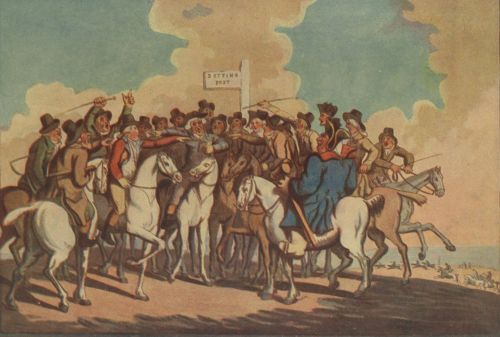
(The Prince Regent.) (Colonel O'Kelly.) Betting. By Rowlandson.
"Remember," said Lord George, "I'm not after a small bet."
"Well," rejoined Lord Kelburne, "I suppose £90,000 to £30,000 will suit you."
This staggered the owner of Gaper, who was obliged to admit that he had never dreamt of taking such a large bet.
Lord Kelburne was rather annoyed. "I thought you wanted to do it 'to money,'" said he sharply; "however, I see I was wrong."
As early as 1823 this sporting peer had created a sensation at the Star Inn at Doncaster, by offering to lay 25 to 1 in hundreds against Brutandorf for the St. Leger, afterwards repeating the offer in thousands.
On the St. Leger of 1824 Jerry won him some £17,000, but three years later he lost £27,000, Mr. Gully's much-fancied Derby winner, Mameluke, being beaten by Matilda. The victory of this filly, which was very popular with the Yorkshire crowd, is commemorated at Stapleton Park, near Pontefract—where her owner, the Hon. E. Petre, lived—by a chiming clock placed over the stables, known as the "Matilda clock," which is appropriately surmounted by a "race-horse weathercock."
Lord George Bentinck is said to have won no less than £100,000 by betting in one year (1845), but his racing expenses amounted to an enormous sum. He won £12,000 by the victory of Cotherstone in the Derby, and it is said would have profited to the extent of some £135,000 had Gaper proved the winner of that classic race. His successes as an owner, though considerable, hardly compensated him for the immense amount of time, thought, and money which he expended upon racing matters. Crucifix, it is true, won the Two Thousand, the One Thousand, and the Oaks in 1840, but Lord George never won the Derby, though if he had not parted with his stud in 1846 he would in all probability have done so, for Mr. Mostyn in his purchase acquired Surplice, who became the winner in 1848. The victory much agitated his former owner when he heard of it.
Sir Joseph Hawley was a very heavy better in his time, though at the end of his Turf career he began a crusade against the evils of plunging—nevertheless, not very long before, he had taken £40,000 to £600 about each of the fillies he had entered for the Derby.
The enormous bets made by the ill-timed Marquis of Hastings are notorious. Now and then he hit the Ring very hard—when Lecturer won the Cesarewitch, for instance, he was a gainer of no less than £75,000—and his Turf winnings in stakes were also considerable for two or three years. In 1864 they amounted to £10,000, in 1866 to £12,000, and in 1867 to over £30,000. Hermit's Derby, however, in the same year is said to have cost him £140,000; and even had Marksman, who was second, won, he would have lost £120,000.
This spendthrift nobleman was anything but shrewd as a plunger. He had made his book so badly that, though he stood to lose heavily, he would only have profited to the extent of a few thousands had Vauban, which was his best horse, been first past the post. In 1868 the Marquis, a broken-down, ruined man, passed to his grave at the early age of twenty-six.
There was very heavy betting in the old days. Davies, the celebrated bookmaker, for instance, more than once made a Derby book amounting to £100,000. As a matter of fact he is said to have generally lost money over the Derby and Oaks, and won it over the St. Leger. When Daniel O'Rourke won the Derby he lost about £50,000 (some say almost double this sum), having laid a great deal of money at 100 to 1. Catherine Hayes also hit him hard, and over West Australian he lost £48,000, of which £30,000 went to the owner, Mr. Bowes. In his latter years Davies rather avoided ante-post betting, especially on the Derby. The victory of Teddington in 1851 took something not far short of £90,000 out of his pockets, one cheque alone sent out by him to Mr. Greville being for £15,000. The Derby in question was very costly to the Ring in general, which lost something like £150,000. The most considerable sum, however, ever won by the great racing public of small means was when Voltigeur won the St. Leger in 1850. The excitement during the deciding heat with Russborough was probably the greatest ever seen on any race-course; and on the evening of the following day, when he won the Doncaster Cup, beating the Flying Dutchman, many of the Yorkshiremen caroused all night. As one of them said, "Who'd go to bed when Voltigeur's won the St. Leger and the Cup?"
Whilst racing possesses some claim to be considered a serious sport owing to the undoubted improvement which it has effected in the breed of horses, its most ardent supporters have been men of pleasure. The founder of the English Turf, indeed, was the "Merry Monarch," though there had been horse-racing for bells long before his time.
Charles the Second did everything he could to improve horsemanship in England. He it was who induced a celebrated French riding master, Foubert by name, to come over and settle in England. This Frenchman set up a riding academy near what is now Regent Street. His name is still perpetuated by "Foubert's Passage."
Charles, who knew a good deal about most things, possessed, it is said, much knowledge of horses, and was himself an experienced and able rider. He became a great supporter of the Turf, gave many prizes to be run for, and delighted in witnessing races. When he resided at Windsor the horses ran on Datchet-mead; but the most distinguished spot for these spectacles was Newmarket, a place which was first chosen on account of the firmness of the ground.
Remains of the house in which Charles lived at what became the head-quarters of the Turf still exist. It was originally purchased by the "Merry Monarch" from an Irish Peer, Lord Thomond.
Here it was that Nell Gwynne is supposed to have held her infant out of the window as Charles passed down the Palace Gardens to his stables, and apostrophised him to the effect that if the child was not made a Duke upon the spot she would drop it.
When the King went to see this palace, as it was called, which he had caused to be built at Newmarket, he thought the rooms too low; but the architect, Sir Christopher Wren, who was of small stature, did not agree. Walking through the rooms he looked up at the King and said, "Please your Majesty, I think they are high enough." The King squatted down to Sir Christopher's height, and creeping about in that posture, cried, "Aye, Sir Christopher, I think they are high enough."
During his visits to the little town Charles usually spent the morning in coursing or playing tennis, repairing to the Heath about three to witness racing, it being the custom for the King and his retinue of courtiers and ladies to ride alongside or after the contending steeds, which on their arrival at the winning post were saluted with the blare of trumpets and the beating of drums. Most of the races in Charles' day would appear to have consisted of matches to decide wagers previously laid.
The Whip which is annually run for at Newmarket has sometimes been said to be the identical one which Charles II. (not George II.) was in the habit of riding with, and which he presented to some nobleman, whose arms it bears, as being the owner of the best horse in England.
The whip itself is of very antique appearance, and by no means "a splendid trophy." The handle, which is very heavy, is of silver, with a ring at the end of it for a wristband, which is made of the mane of Eclipse.
During this reign the Turf became a popular and aristocratic institution. The Merry Monarch even condescended to ride himself, and rode a match at Newmarket in 1671, on which occasion his horse Woodcock was beaten.
Charles kept and entered horses in his own name, and by his attention and generosity added importance and lustre to the institution over which he presided. Bells, the ancient reward of swiftness, were now no longer given; a silver bowl or cup of the value of one hundred guineas succeeded the tinkling prize. On this royal gift the exploits of the successful horse, together with his pedigree, were usually engraven to publish and perpetuate his fame.
James the Second is reputed to have been a good horseman, but his reign was too short and troublesome to permit him to indulge his inclinations as regards horses. He was a lover of hunting, and ever preferred English mounts, several of which he had always in his stables after he became an exile in France.
When William the Third ascended the throne, he not only added to the plates given at different places in the kingdom, but made every attempt at improving horsemanship. Though he was a monarch of considerable austerity, this king once matched a horse of his own for a stake of two thousand guineas.
Queen Anne continued the bounty of her predecessors, with the addition of several plates. Her Consort, George, Prince of Denmark, is said to have taken infinite delight in horse-racing, and to have obtained from the Queen the grant of several plates allotted to different places.
Towards the beginning of the eighteenth century a statute of Queen Anne was enacted with a view to the restriction of betting. Very great sums of money changed hands owing to a match run at Newmarket between the gentlemen of the South and those of the North. It is almost superfluous to add that the proverbial shrewdness of the Northerner was fully demonstrated on this occasion.
Queen Anne herself was, however, a supporter of the Turf, running horses in her own name in matches at Newmarket and York.
Towards the close of the reign of George the First he discontinued the plates, and in lieu of each gave the sum of one hundred guineas.
In the middle of the eighteenth century the Turf had fallen into some disrepute, but the Duke of Cumberland did much to revive the glories which had somewhat languished since the days of Charles II. He it was who first instituted the race meeting at Ascot.
The Duke was a born gambler, and used when out hunting to play at hazard with Lord Sandwich, throwing a main on every green hill and under every green tree whenever the hounds checked.
Though cheery enough in the hunting field, he was anything but tender-hearted when pursuing his avocation as a soldier; indeed his severity at times became cruelty, which gained for him the nickname of "the Butcher."
The day after the decisive battle of Culloden, in the year 1745, the General, or as he was popularly styled, Duke William, was riding over the scene of battle in company with his officers, among whom was Colonel Wolfe, afterwards the hero of Quebec, then a young man. Among the dead and dying stretched on the stricken field, one was so far recovered as to be able to sit upright. Looking at the poor wretch, the Duke said to the young Colonel by his side; "Wolfe, shoot me that rebel." Wolfe glared back at his prince and commander, and, with a flushed countenance which showed his indignation, replied: "Your Royal Highness, I am a soldier, not an executioner." The Duke turned his back upon Wolfe and did not utter another word.
If, however, the Duke, as the saying went, was a "very devil in his boots," he was all right out of them and good-natured enough when racing. Being at a Newmarket meeting just before the horses started, he missed his pocket-book, containing some bank-notes. When the knowing ones came about him and offered several bets, he said he had lost his money already and could not afford to venture any more that day. The horse which the Duke had intended to back was beaten, so he consoled himself, as he said, with the thought that the loss of his pocket-book only anticipated the evil, as if he had betted, he would have paid away as much to the worthies of the Turf. The race, however, was no sooner finished than a veteran half-pay officer presented His Royal Highness with his pocket-book, saying he had found it near the stand, but had not an opportunity of approaching him before. To this the Duke most generously replied; "I am glad it has fallen into such good hands—keep it. Had it not been for this accident, it would have been by this time among the blacklegs and thieves of Newmarket."
In 1764 the Duke of Cumberland matched his famous horse, King Herod, against the Duke of Grafton's Antinous for £1000 over the Beacon Course at Newmarket. This contest excited intense interest, and more than £100,000 is said to have changed hands over the victory of Herod, who won by what was then called half a neck. In the annals of the Turf, however, Duke William is best remembered on account of the fact that he bred the greatest horse of all time, "Eclipse."
This animal, whose wonderful powers as a racer have won him unparalleled fame, was got by Marske (a son of Squirt) out of Spiletta, a bay mare foaled in 1749 by Regulus, a son of the Godolphin Arabian. Eclipse was foaled in 1764, during the great eclipse of that year. When, at the death of the Duke, His Royal Highness's stud was brought to the hammer, Eclipse was purchased as a colt by Mr. Wildman (who appears to have had some insight into his value), under very curious circumstances. Mr. Wildman, who had, it was reported, been put into possession of the extraordinary promise evinced by a particular chestnut colt when a yearling, adopted the following questionable measures in order to make sure of him. When he arrived at the place of sale, he produced his watch and insisted that the auction had commenced before the hour which had been announced in the advertisements, and that the lots should be put up again. In order, however, to prevent a dispute, it was agreed by the auctioneer and company that Mr. Wildman should have his choice of any particular lot. By these means, it is generally believed, he became possessed of Eclipse at the moderate price of seventy or seventy-five guineas. Eclipse did not appear upon the Turf till he was five years old, and so invincibly bad was his temper that it was for some time uncertain whether he would not be raced as a gelding. It is by mere accident, indeed, that the most celebrated of English stallions was preserved to adorn the Calendar with the glories of his descendants. In the neighbourhood of Epsom Downs there lived a man of the name of Ellerton, who, however, was better known by the sobriquet of Hilton, and who united the occupations of poacher and rough-rider. To him, after all else had signally failed, Eclipse was handed over as an incorrigible, and he had recourse to the kill-or-cure system. He was at him day and night, frequently bringing him home at daybreak, after a poaching excursion, with a load of hares strung across his back. Twelve months of this regimen brought him sufficiently to his senses to fit him to be brought to the post, and once there, he ran because it was his pleasure to do so. Still he never could be raced like any other horse. Fitzpatrick, who rode him in almost all his races, never dared to hold him, or do more than sit quiet in his saddle. All through his Turf career his temper was wretched, and very seriously interfered with his value as a racer. His extraordinary superiority was also so palpable that latterly no odds could be got about him save by stratagems. One of these was very clever. For a race in which there were several horses engaged, when O'Kelly failed in getting any money on no-matter-what odds, he took them to a large amount that he placed every horse in it! This he did by naming Eclipse first and all the others nowhere, winning by his horse distancing the field. In 1769, Wildman and O'Kelly were joint-owners of Eclipse, the latter, however, soon after becoming the sole owner at the price of 1750 guineas. At a late period of his life, when an offer to purchase him was made to O'Kelly, these were the terms demanded—£20,000 down, an annuity of £500 for his (O'Kelly's) life, and the right of having three mares every year stinted to him as long as he lived.
This "horse of horses" was short in the forehand, and high in the hips, which gave elasticity to his speed. Upon dissection the muscles were found to be of unparalleled size—a proof of the intimate relation between muscular power and extraordinary swiftness. No horse of his day would appear to have had the shadow of a chance against him.
Eclipse died February 26th, 1789, aged twenty-five, at Cannons, in Middlesex, to which place he had been removed from Epsom about six months previously, in a machine, constructed for the purpose, drawn by two horses, and attended by a confidential groom. When his owner, old O'Kelly, died at his house in Piccadilly on December 28th, 1787, he bequeathed Eclipse and Dungannon to his brother Philip.
Another famous horse was Highflyer, which received his name from having been foaled in a paddock, in which were a number of highflyer walnut trees. He was named by Lord Bolingbroke at a large dinner-party at Sir Charles Bunbury's. The horse in question was the cause of considerable jealousy between Colonel O'Kelly, the owner of Eclipse, and Mr. Tattersall, the founder of the celebrated institution at Hyde Park Corner, whose prosperity was greatly increased by the purchase of Highflyer. "The Hammer and Highflyer" indeed became a favourite toast of the day. Both owners felt the necessity of crossing by the blood of their respective stallions, but each was afraid of increasing the celebrity of the other's horse thereby. The two men were widely different in character. Colonel O'Kelly (of whom an account has already been given) piqued himself upon being descended from the first race of Milesian kings, although he had served for the greatest part of his life some of the humblest offices. It was his boast that he bred and ran his horses for fame. He certainly sacrificed many thousands of pounds in aspiring to the glory of being the Jehu of the day. Mr. Tattersall bred for profit. The former never sold anything before he had trained and ran it at Newmarket; the latter never trained anything, with the exception of one mare early in life, which was of no note. The Irishman matched everything—the Lancashire man sold everything. The one was hasty and impetuous in betting upon the descendants of Eclipse. The other was cautious, and left it to those who had bought them to risk their money upon the progeny of Highflyer. In a word, they resembled each other in nothing, except, it was wickedly said, their total ignorance of horses and extreme good fortune. Mr. Tattersall in the decline of life was more than usually anxious that his son should persevere in keeping stallions and breeding race-horses. O'Kelly directed by his will that all his stud should be sold as soon as possible after his death. Mr. Tattersall's son and heir sold the whole stud after his death. O'Kelly's nephew and executor was obliged to sell under the direction of the will, but he bought most of the horses for his own use. He was a cultivated man, and had been well brought up by his uncle.
Mr. Tattersall used to say that there was no part of Colonel O'Kelly's conduct which he wished he had imitated except that in giving an excellent education to his heir.
Mr. Tattersall was a very economical man. When Highflyer died, many suggestions were made that the horse should be skinned and stuffed, as had been done by Colonel O'Kelly in the case of Eclipse. Mr. Tattersall, however, replied that he did not see the use of stuffing him with hay after he was dead, as he could no longer cover; he had stuffed him full enough with hay and corn when he was alive and producing money. Mr. Tattersall had very practical ideas about such things, and when inspecting his cattle whilst they were fattening, was often overheard to say, "Eat away, my good creature! eat away, and get fat soon. The butcher is waiting for you, and I want money."
Mr. Tattersall's prosperous career arose in a great measure from a successful speculation in Scotland. Having heard that a Scotch nobleman's stud was to be sold there, he applied to a friend to go his halves in the purchase. "If you will find money, for I have none," said he, "I will find skill, and you shall have a good thing." The sum was deposited, and he went to the sale, partly by coach and partly on foot, buying nearly all the horses for a trifle. Upon his return, he sold a few at York for more money than the whole of them had cost, making several hundred pounds out of the rest from purchasers at Newmarket and in London. Mr. Tattersall used often to say this was the first money he ever possessed above a few pounds. Having thus acquired a little capital, he soon increased it by similar means, and also, of course, by his business at Hyde Park Corner.
At that time, though sales of horses by auction were occasionally held, there was no regular repository or fixed sales at stated periods, the lack of which was much felt in the sporting world. Perceiving that a golden opportunity lay ready to hand, Mr. Tattersall, who was well-known to the gentlemen of the Turf and to the horse-dealers, offered his services as an auctioneer, and solicited their patronage. Lord Grosvenor warmly espoused his cause, and built for him the extensive premises at Hyde Park Corner, where Mr. Tattersall died. His success was astonishingly rapid. He soon enlarged the premises and built stands for carriages, which were sold by private contract; as well as kennels for hounds and other dogs, which were sold by auction. He converted a part of his house into a tavern and coffee-house, and fitted up two of the most elegant rooms in London for the use of the Jockey Club, who held their meetings there for some years. He allotted another apartment to the use of betting men. This was supported by an annual subscription of a guinea from each member, and was called the betting-room. Here prominent Turfites assembled every sale-day to lay wagers on the events of future races, and here they met to pay and receive the money won and lost at what were called country races, in contradistinction to the races at Newmarket. His sales were not confined to Hyde Park Corner; he constantly attended the Newmarket meetings and the races at York, where he had considerable employment, and thereby kept up his connection with the jockeys in different parts of the kingdom, who sent their horses to him from all the various districts.
Racing as carried on in the eighteenth century was on a very different scale from that of the present day. Our ancestors were contented with very small stakes and but few races in a day.
In 1755 there were but three meetings at Newmarket, which gave fifteen racing days. Thirteen stakes were run for, the gross amount of which was £1255. There were twenty heats.
Besides the stakes there were twenty-nine matches, which made the daily average of races something over three.
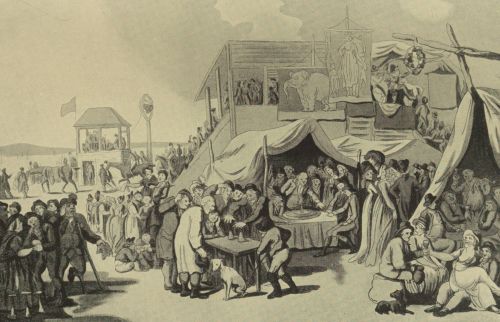
E.O. on a Country Race-course. By Rowlandson.
In those days noblemen and gentlemen met to enjoy each other's society and test the merits of their horses rather than for purposes of gain, the stakes being, from a pecuniary view, a matter of comparative indifference.
At the small country meetings the racing was spread over a greater space of time than at present; all of them lasted three days and many a week. Dinners and balls were the order of the day, the race meeting being an event which was looked forward to throughout the year.
A number of the more aristocratic spectators were mounted, and followed the horses as they ran. So great, indeed, became the disorder caused at race meetings by this riding with and after the horses during racing, that the Chief Magistrate of one provincial town (who, it should be added, had Irish blood in his veins) caused a placard to be posted up just before the races, intimating "that no gentleman would be allowed to ride on the course, except the horses that were to run."
Racing was formerly a very rough-and-ready affair, and much was tolerated on a race-course which would be sternly dealt with to-day. Gambling-booths and E.O. tables were easily to be found, whilst little order was maintained on the course. At Tavistock Races in 1815, a sailor with one arm, who had just been paid off, exhibited his skill in horsemanship, to the no small annoyance of everybody, till at length, checking his Bucephalus at full gallop, he was thrown with great violence, by which his right leg was dreadfully fractured.
Cocked-hat races and other eccentric contests were not infrequent features at race meetings. At Hereford races in 1822 a race between three velocipedes, commonly called hobby-horses, created much mirth. They were ridden by three men, dressed in scarlet, yellow, and white jackets. Much skill was displayed, and every exertion used, with the result that white won, scarlet and yellow being both upset, and the riders each receiving a hearty bump, to the great diversion of all the spectators.
The Turf of former days eased the aristocracy of a good deal of money, and many a fine estate changed hands owing to the vicissitudes of racing. Fox of course lost very large sums. He used to declare after the defeat of his horses that they had as much bottom as other people's, but that they were such slow, good animals that they never went fast enough to tire themselves! Occasionally, however, he was lucky. In April 1772 he won nearly £16,000—the greater part of which was the result of bets against the celebrated Pincher, who lost the match by only half-a-neck, two to one having been laid on him. At the Spring meeting in 1789 Fox is also said to have won about £50,000; and at the October meeting next year he realised £4000 by the sale of two of his horses—Seagull and Chanticleer. In 1788 Fox and the Duke of Bedford won eight thousand guineas between them at the Newmarket Spring meeting. Fox and Lord Barrymore had a match for a large sum; this was given as a dead heat, and the bets were off.
On taking office in 1783, Fox sold his horses, and erased his name from several of the Clubs of which he was a member. In a short time, however, he again purchased a stud, and in October attended the Newmarket meeting, when a King's messenger appeared amongst the sportsmen on the Heath in quest of the Minister, for whom he bore despatches. The messenger, as was usual on these occasions, wore his badge of office, the greyhound, and his arrival created quite a stir on the course.
In 1790, Fox's horse, Seagull, won the Oatlands Stakes at Ascot of one hundred guineas (nineteen subscribers), beating the Prince of Wales's Escape, Serpent, and several of the very best horses of that year. The Prince was much mortified at this, and immediately matched Magpie against the winner, two miles, for five hundred guineas. This match, on which immense sums were depending, was, four days later, won with ease by Seagull. At this time Lord Foley and Mr. Fox raced together.
Lord Foley died in 1793; he entered upon the Turf with a clear £18,000 a year, and some £100,000 in ready money—he left it without ready money, with an encumbered estate, and with a constitution injured by cares and anxieties which embittered the end of his life.
Many other patricians were practically ruined on the Turf at about the same time, some by continuous ill-luck, but more owing to the machinations of the many doubtful characters who were experts at what was then known as "throwing the bull over the bridge"—a cant phrase formerly used by frequenters of the race-course to indicate a sporting swindle.
The phrase in question, it may be added, had its origin in the cruel pastime of bull-baiting. When such an orgy of cruelty was over, and the militia of hell which had witnessed it surfeited with blood, the carcass of the bull was dragged to a bridge, over which his quivering remains were thrown into the water beneath!
Many were the queer freaks and fancies of the great pillars of the Turf of the past. Sir Charles Bunbury, for instance, who trained his horses privately under his own eye, made the lads who groomed them wear his colours whilst at their task, in order to accustom the animals to the racing jackets and prevent all chance of nervousness in public. His horses were never allowed to be sweated or tried on a Good Friday, on account of an accident which had on one of these anniversaries happened to a couple of his racers, who had both fallen and broken their backs, each jockey having got a fractured thigh.