Volume 2 — LUDOVICO ARIOSTO
Reading edition
(1474-1533)
BY L. OSCAR KUHNS

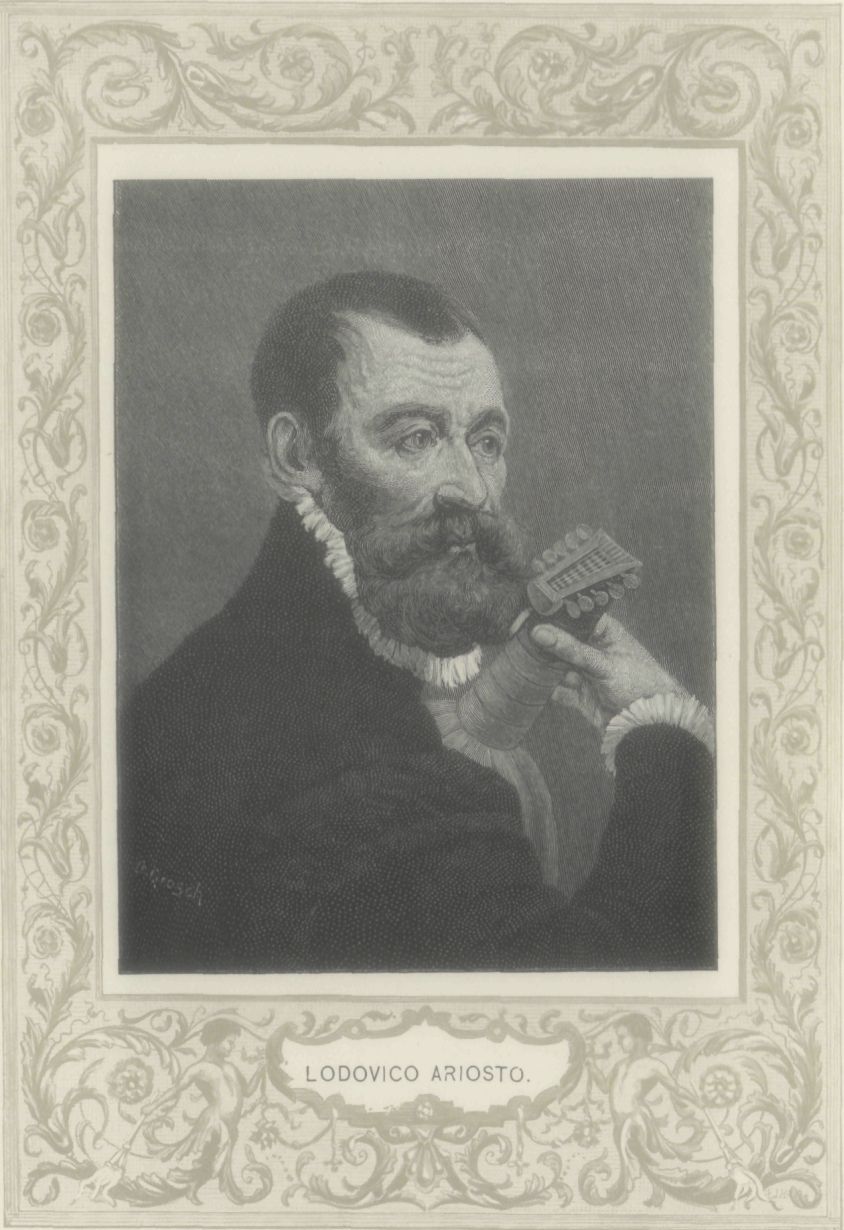
mong the smaller principalities of Italy during the fifteenth and sixteenth centuries, none was more brilliant than the court of Ferrara, and none more intimately connected with the literature of the times. Here, on September 8th, 1474, was born Ludovico Ariosto, the great poet of the Renaissance. Here, like Boiardo before him and Tasso after him, he lived and wrote; and it was to the family of Este that he dedicated that poem in which are seen, as in a mirror, the gay life, the intellectual brilliancy, and the sensuous love for beauty which mark the age. At seventeen he began the study of the law, which he soon abandoned for the charms of letters. Most of his life was passed in the service first of Cardinal d'Este, and afterward of the Duke of Ferrara. But the courtier never overcame the poet, who is said to have begun the famous 'Orlando Furioso' at the age of thirty, and never to have ceased the effort to improve it.
The literary activity of Ariosto showed itself in the composition of comedies and satires, as well as in that of his immortal epic. The comedies were written for the court theatre of Ferrara, to which he seems to have had some such relation as that of Goethe to the theatre at Weimar. The later comedies are much better than the early ones, which are but little more than translations from Plautus and Terence. In general, however, the efforts of Ariosto in this direction are far less important than the 'Orlando' or the 'Satires.' At the first appearance of his plays they were enormously successful, and the poet was hailed as a great dramatic genius. But these comedies are interesting to-day chiefly from the fact that Ariosto was one of the very first of the writers of modern comedy, and was the leader of that movement in Italy and France which prepared the way for Molière.
Of more importance than the comedies, and second only in interest to the 'Orlando' are the 'Satires' seven in number, the first written in 1517 and the last in 1531, thus representing the maturer life of the poet. Nearly everything we know of Ariosto's character is taken from this source. He reveals himself in them as a man who excites neither our highest admiration nor our contempt. He was not born to be a statesman, nor a courtier, nor a man of affairs; and his life as ambassador of Cardinal Ippolito, and as captain of Garafagno, was not at all to his liking. His one longing through all the busy years of his life was for a quiet home, where he could live in liberty and enjoy the comforts of cultured leisure. A love of independence was a marked trait of his character, and it must often have galled him to play the part he did at the court of Ferrara. As a satirist he was no Juvenal or Persius. He was not stirred to profound indignation by the evils about him, of which there were enough in that brilliant but corrupt age. He discussed in easy, familiar style, the foibles of his fellow-men, and especially the events of his own life and the traits of his own character.
The same views of life, the same tolerant temper, which are seen in the 'Satires,' form an important part of the 'Orlando Furioso,' where they take the form of little dissertations, introduced at the beginning of a canto, or scattered through the body of the poem. These reflections are full of practical sense and wisdom, and remind us of the familiar conversation with the reader which forms so great a charm in Thackeray's novels.
In the Italian Renaissance there is a curious mingling of classical and romantic influences, and the generation which gave itself up passionately to the study of Greek and Latin still read with delight the stories of the Paladins of Charlemagne and the Knights of the Round Table. What Sir Thomas Malory had done in English prose, Boiardo did in Latin poetry. When Ariosto entered the service of Cardinal Ippolito, every one was reading the 'Orlando Innamorato,' and the young poet soon fell under the charm of these stories; so that when the inward impulse which all great poets feel toward the work of creation came to him, he took the material already at hand and continued the story of 'Orlando.' With a certain skill and inventiveness, Boiardo had mingled together the epic cycles of Arthur and Charlemagne. He had shown the Saracen host under King Agramante driving the army of Charlemagne before them, until the Christians had finally been shut up within the walls of Paris. It was at this critical moment in his poem that Boiardo died. Ariosto took up the story where he had left it, and carried it on until the final defeat of Agramante, and his death at the hands of Orlando in the desert island.
But we must not think that the 'Orlando Furioso' has one definite plot. At first reading we are confused by the multiplicity of incident, by the constant change of scene, and by the breaking off of one story to make place for another. In a single canto the scene changes from France to Africa, and by means of winged horses tremendous distances are traveled over in a day. On closer examination we find that this confusion is only apparent. The poet himself is never confused, but with sure hand he manipulates the many-colored threads which are wrought into the fabric of the poem. The war between the Saracens and the Christians is a sort of background or stage; a rallying point for the characters. In reality it attracts but slightly our attention or interest. Again, Orlando's love for Angelica, and his madness,--although the latter gave the title to the book, and both afford some of the finest episodes,--have no organic connection with the whole. The real subject, if any there be, is the loves of Ruggiero and Bradamante. These are the supposed ancestors of the house of Este, and it is with their final union, after many vicissitudes, that the poem ends.
But the real purpose of Ariosto was to amuse the reader by countless stories of romantic adventure. It was not as a great creative genius, as the inventor of new characters, as the earnest and philosophical reformer, that he appears to mankind, but as the supreme artist. Ariosto represents in its highest development that love for form, that perfection of style, which is characteristic of the Latin races as distinguished from the Teutonic. It is this that makes the 'Orlando Furioso' the great epic of the Renaissance, and that caused Galileo to bestow upon the poet the epithet "divine."
For nearly thirty years Ariosto changed and polished these lines, so that the edition of 1532 is quite different from that of 1516. The stanzas in which the poem is written are smooth and musical, the language is so chosen as always to express the exact shade of thought, the interest never flags. What seems the arbitrary breaking off of a story before its close is really the art of the poet; for he knows, were each episode to be told by itself, we should have only a string of novelle, and not the picture he desired to paint,--that of the world of chivalry, with its knights-errant in search of adventures, its damsels in distress, its beautiful gardens and lordly palaces, its hermits and magicians, its hippogriffs and dragons, and all the paraphernalia of magic art.
Ariosto's treatment of chivalry is peculiar to himself. Spenser in the sixteenth century, and Lord Tennyson in our own day, pictured its virtues and noble aspirations. In his immortal 'Don Quixote,' Cervantes held its extravagances up to ridicule. In Ariosto's day no one believed any longer in the heroes or the ideals of chivalry, nor did the poet himself; hence there is an air of unreality about the poem. The figures that pass before us, although they have certain characteristics of their own, are not real beings, but those that dwell in a land of fancy. As the poet tells these stories of a bygone age, a smile of irony plays upon his face; he cannot take them seriously; and while he never goes so far as to turn into ridicule the ideals of chivalry, yet, in such episodes as the prodigious exploits of Rodomonte within the walls of Paris, and the voyage of Astolfo to the moon, he does approach dangerously near to the burlesque.
We are not inspired by large and noble thoughts in reading the 'Orlando Furioso.' We are not deeply stirred by pity or terror. No lofty principles are inculcated. Even the pathetic scenes, such as the death of Zerbino and Isabella, stir no real emotion in us, but we experience a sense of the artistic effect of a poetic death.
It is not often, in these days of the making of many books of which there is no end, that one has time to read a poem which is longer than the 'Iliad' and the 'Odyssey' together. But there is a compelling charm about the 'Orlando,' and he who sits down to read it with serious purpose will soon find himself under the spell of an attraction which comes from unflagging interest and from perfection of style and construction. No translation can convey an adequate sense of this beauty of color and form; but the versions of William Stewart Rose, here cited, suggest the energy, invention, and intensity of the epic.
In 1532 Ariosto published his final edition of the poem, now enlarged to forty-six cantos, and retouched from beginning to end. He died not long afterward, in 1533, and was buried in the church of San Benedetto, where a magnificent monument marks his resting-place.
THE FRIENDSHIP OF MEDORO AND CLORIDANE
From 'Orlando Furioso,' Cantos 18 and 19 Two Moors among the Paynim army were, From stock obscure in Ptolomita grown; Of whom the story, an example rare Of constant love, is worthy to be known. Medore and Cloridane were named the pair; Who, whether Fortune pleased to smile or frown, Served Dardinello with fidelity, And late with him to France had crost the sea. Of nimble frame and strong was Cloridane, Throughout his life a follower of the chase. A cheek of white, suffused with crimson grain, Medoro had, in youth, a pleasing grace; Nor bound on that emprize, 'mid all the train, Was there a fairer or more jocund face. Crisp hair he had of gold, and jet-black eyes; And seemed an angel lighted from the skies. These two were posted on a rampart's height, With more to guard the encampment from surprise, When 'mid the equal intervals, at night, Medoro gazed on heaven with sleepy eyes. In all his talk, the stripling, woeful wight, Here cannot choose, but of his lord devise, The royal Dardinel; and evermore Him left unhonored on the field, deplore. Then, turning to his mate, cries, "Cloridane, I cannot tell thee what a cause of woe It is to me, my lord upon the plain Should lie, unworthy food for wolf or crow! Thinking how still to me he was humane, Meseems, if in his honor I forego This life of mine, for favors so immense I shall but make a feeble recompense. "That he may not lack sepulture, will I Go forth, and seek him out among the slain; And haply God may will that none shall spy Where Charles's camp lies hushed. Do thou remain; That, if my death be written in the sky, Thou may'st the deed be able to explain. So that if Fortune foil so far a feat, The world, through Fame, my loving heart may weet." Amazed was Cloridane a child should show Such heart, such love, and such fair loyalty; And fain would make the youth his thought forego, Whom he held passing dear: but fruitlessly Would move his steadfast purpose; for such woe Will neither comforted nor altered be. Medoro is disposed to meet his doom, Or to inclose his master in the tomb. Seeing that naught would bend him, naught would move, "I too will go," was Cloridane's reply: "In such a glorious act myself will prove; As well such famous death I covet, I. What other thing is left me, here above, Deprived of thee, Medoro mine? To die With thee in arms is better, on the plain, Than afterwards of grief, shouldst thou be slain." And thus resolved, disposing in their place Their guard's relief, depart the youthful pair, Leave fosse and palisade, and in small space Are among ours, who watch with little care; Who, for they little fear the Paynim race, Slumber with fires extinguished everywhere. 'Mid carriages and arms they lie supine, Up to the eyes immersed in sleep and wine. A moment Cloridano stopt, and cried, "Not to be lost are opportunities. This troop, by whom my master's blood was shed, Medoro, ought not I to sacrifice? Do thou, lest any one this way be led, Watch everywhere about, with ears and eyes; For a wide way, amid the hostile horde, I offer here to make thee with my sword." So said he, and his talk cut quickly short, Coming where learned Alpheus slumbered nigh; Who had the year before sought Charles's court, In med'cine, magic, and astrology Well versed: but now in art found small support, Or rather found that it was all a lie. He had foreseen that he his long-drawn life Should finish on the bosom of his wife. And now the Saracen with wary view Had pierced his weasand with the pointed sword. Four others he near that Diviner slew, Nor gave the wretches time to say a word. Sir Turpin in his story tells not who, And Time has of their names effaced record. Palidon of Moncalier next he speeds; One who securely sleeps between two steeds. Rearing th' insidious blade, the pair are near The place where round King Charles's pavilion Are tented warlike paladin and peer, Guarding the side that each is camped upon, When in good time the Paynims backward steer, And sheathe their swords, the impious slaughter done; Deeming impossible, in such a number, But they must light on one who does not slumber. And though they might escape well charged with prey, To save themselves they think sufficient gain. Thither by what he deems the safest way (Medoro following him) went Cloridane Where in the field, 'mid bow and falchion lay, And shield and spear, in pool of purple stain, Wealthy and poor, the king and vassal's corse, And overthrown the rider and his horse. The silvery splendor glistened yet more clear, There where renowned Almontes's son lay dead. Faithful Medoro mourned his master dear, Who well agnized the quartering white and red, With visage bathed in many a bitter tear (For he a rill from either eyelid shed), And piteous act and moan, that might have whist The winds, his melancholy plaint to list; But with a voice supprest--not that he aught Regards if any one the noise should hear, Because he of his life takes any thought, Of which loathed burden he would fain be clear; But lest his being heard should bring to naught The pious purpose which has brought them here-- The youths the king upon their shoulders stowed; And so between themselves divide the load. Hurrying their steps, they hastened, as they might, Under the cherished burden they conveyed; And now approaching was the lord of light, To sweep from heaven the stars, from earth the shade, When good Zerbino, he whose valiant sprite Was ne'er in time of need by sleep down-weighed, From chasing Moors all night, his homeward way Was taking to the camp at dawn of day. He has with him some horsemen in his train, That from afar the two companions spy. Expecting thus some spoil or prize to gain, They, every one, toward that quarter hie. "Brother, behoves us," cried young Cloridane, "To cast away the load we bear, and fly; For 'twere a foolish thought (might well be said) To lose two living men, to save one dead;" And dropt the burden, weening his Medore Had done the same by it, upon his side; But that poor boy, who loved his master more, His shoulders to the weight alone applied: Cloridane hurrying with all haste before, Deeming him close behind him or beside; Who, did he know his danger, him to save A thousand deaths, instead of one, would brave. The closest path, amid the forest gray, To save himself, pursued the youth forlorn; But all his schemes were marred by the delay Of that sore weight upon his shoulders borne. The place he knew not, and mistook the way, And hid himself again in sheltering thorn. Secure and distant was his mate, that through The greenwood shade with lighter shoulders flew. So far was Cloridane advanced before, He heard the boy no longer in the wind; But when he marked the absence of Medore, It seemed as if his heart was left behind. "Ah! how was I so negligent," (the Moor Exclaimed) "so far beside myself, and blind, That, I, Medoro, should without thee fare, Nor know when I deserted thee or where?" So saying, in the wood he disappears, Plunging into the maze with hurried pace; And thither, whence he lately issued, steers, And, desperate, of death returns in trace. Cries and the tread of steeds this while he hears, And word and threat of foeman, as in chase; Lastly Medoro by his voice is known, Disarmed, on foot, 'mid many horse, alone. A hundred horsemen who the youth surround, Zerbino leads, and bids his followers seize The stripling; like a top the boy turns round And keeps him as he can: among the trees, Behind oak, elm, beech, ash, he takes his ground, Nor from the cherished load his shoulders frees. Wearied, at length, the burden he bestowed Upon the grass, and stalked about his load. As in her rocky cavern the she-bear, With whom close warfare Alpine hunters wage, Uncertain hangs about her shaggy care, And growls in mingled sound of love and rage, To unsheath her claws, and blood her tushes bare, Would natural hate and wrath the beast engage; Love softens her, and bids from strife retire, And for her offspring watch, amid her ire. Cloridane, who to aid him knows not how, And with Medoro willingly would die, But who would not for death this being forego, Until more foes than one should lifeless lie, Ambushed, his sharpest arrow to his bow Fits, and directs it with so true an eye, The feathered weapon bores a Scotchman's brain, And lays the warrior dead upon the plain. Together, all the others of the band Turned thither, whence was shot the murderous reed; Meanwhile he launched another from his stand, That a new foe might by the weapon bleed, Whom (while he made of this and that demand, And loudly questioned who had done the deed) The arrow reached--transfixed the wretch's throat And cut his question short in middle note. Zerbino, captain of those horse, no more Can at the piteous sight his wrath refrain; In furious heat he springs, upon Medore, Exclaiming, "Thou of this shalt bear the pain." One hand he in his locks of golden ore Enwreaths, and drags him to himself amain; But as his eyes that beauteous face survey, Takes pity on the boy, and does not slay. To him the stripling turns, with suppliant cry, And, "By thy God, sir knight," exclaims, "I pray, Be not so passing cruel, nor deny That I in earth my honored king may lay: No other grace I supplicate, nor I This for the love of life, believe me, say. So much, no longer, space of life I crave, As may suffice to give my lord a grave. "And if you needs must feed the beast and bird, Like Theban Creon, let their worst be done Upon these limbs; so that by me interred In earth be those of good Almontes's son." Medoro thus his suit, with grace, preferred, And words to move a mountain; and so won Upon Zerbino's mood, to kindness turned, With love and pity he all over burned. This while, a churlish horseman of the band, Who little deference for his lord confest, His lance uplifting, wounded overhand The unhappy suppliant in his dainty breast. Zerbino, who the cruel action scanned, Was deeply stirred, the rather that, opprest, And livid with the blow the churl had sped, Medoro fell as he was wholly dead. The Scots pursue their chief, who pricks before, Through the deep wood, inspired by high disdain, When he has left the one and the other Moor, This dead, that scarce alive, upon the plain. There for a mighty space lay young Medore, Spouting his life-blood from so large a vein He would have perished, but that thither made A stranger, as it chanced, who lent him aid.
THE SAVING OF MEDORO
From 'Orlando Furioso,' Canto 19
By chance arrived a damsel at the place, Who was (though mean and rustic was her wear) Of royal presence and of beauteous face, And lofty manners, sagely debonnair. Her have I left unsung so long a space, That you will hardly recognize the fair Angelica: in her (if known not) scan The lofty daughter of Catay's great khan. Angelica, when she had won again The ring Brunello had from her conveyed, So waxed in stubborn pride and haught disdain, She seemed to scorn this ample world, and strayed Alone, and held as cheap each living swain, Although amid the best by fame arrayed; Nor brooked she to remember a gallant In Count Orlando or King Sacripant: And above every other deed repented, That good Rinaldo she had loved of yore; And that to look so low she had consented, (As by such choice dishonored) grieved her sore. Love, hearing this, such arrogance resented, And would the damsel's pride endure no more. Where young Medoro lay he took his stand, And waited her, with bow and shaft in hand. When fair Angelica the stripling spies, Nigh hurt to death in that disastrous fray, Who for his king, that there unsheltered lies, More sad than for his own misfortune lay, She feels new pity in her bosom rise, Which makes its entry in unwonted way. Touched was her naughty heart, once hard and curst, And more when he his piteous tale rehearsed. And calling back to memory her art, For she in Ind had learned chirurgery, (Since it appears such studies in that part Worthy of praise and fame are held to be, And, as an heirloom, sires to sons impart, With little aid of books, the mystery,) Disposed herself to work with simples' juice, Till she in him should healthier life produce. And recollects an herb had caught her sight In passing thither, on a pleasant plain: What (whether dittany or pancy hight) I know not; fraught with virtue to restrain The crimson blood forth-welling, and of might To sheathe each perilous and piercing pain. She found it near, and having pulled the weed, Returned to seek Medoro on the mead. Returning, she upon a swain did light, Who was on horseback passing through the wood. Strayed from the lowing herd, the rustic wight A heifer missing for two days pursued. Him she with her conducted, where the might Of the faint youth was ebbing with his blood: Which had the ground about so deeply dyed Life was nigh wasted with the gushing tide. Angelica alights upon the ground, And he, her rustic comrade, at her best. She hastened 'twixt two stones the herb to pound, Then took it, and the healing juice exprest: With this did she foment the stripling's wound, And even to the hips, his waist and breast; And (with such virtue was the salve endued) It stanched his life-blood, and his strength renewed. And into him infused such force again, That he could mount the horse the swain conveyed; But good Medoro would not leave the plain Till he in earth had seen his master laid. He, with the monarch, buried Cloridane, And after followed whither pleased the maid. Who was to stay with him, by pity led, Beneath the courteous shepherd's humble shed. Nor would the damsel quit the lowly pile (So she esteemed the youth) till he was sound; Such pity first she felt, when him erewhile She saw outstretched and bleeding on the ground. Touched by his mien and manners next, a file She felt corrode her heart with secret wound; She felt corrode her heart, and with desire, By little and by little warmed, took fire. The shepherd dwelt between two mountains hoar, In goodly cabin, in the greenwood shade, With wife and children; in short time before, The brand-new shed had builded in the glade. Here of his grisly wound the youthful Moor Was briefly healed by the Catayan maid; But who in briefer space, a sorer smart Than young Medoro's, suffered at her heart.
[She pines for love of him, and at length makes her love known. They solemnize their marriage, and remain a month there with great happiness.]
Amid such pleasures, where, with tree o'ergrown, Ran stream, or bubbling fountain's wave did spin, On bark or rock, if yielding were the stone, The knife was straight at work, or ready pin. And there, without, in thousand places lone, And in as many places graved, within, Medoro and Angelica were traced, In divers ciphers quaintly interlaced. When she believed they had prolonged their stay More than enow, the damsel made design In India to revisit her Catay, And with its crown Medoro's head entwine. She had upon her wrist an armlet, gay With costly gems, in witness and in sign Of love to her by Count Orlando borne, And which the damsel for long time had worn. No love which to the paladin she bears, But that it costly is and wrought with care, This to Angelica so much endears, That never more esteemed was matter rare; This she was suffered, in the isle of tears, I know not by what privilege, to wear, When, naked, to the whale exposed for food By that inhospitable race and rude. She, not possessing wherewithal to pay The kindly couple's hospitality,-- Served by them in their cabin, from the day She there was lodged, with such fidelity,-- Unfastened from her arm the bracelet gay, And bade them keep it for her memory. Departing hence, the lovers climb the side Of hills, which fertile France from Spain divide.
THE MADNESS OF ORLANDO
From 'Orlando Furioso,' Canto 23
The course in pathless woods, which without rein The Tartar's charger had pursued astray, Made Roland for two days, with fruitless pain, Follow him, without tidings of his way. Orlando reached a rill of crystal vein, On either bank of which a meadow lay; Which, stained with native hues and rich, he sees, And dotted o'er with fair and many trees. The mid-day fervor made the shelter sweet To hardy herd as well as naked swain: So that Orlando well beneath the heat Some deal might wince, opprest with plate and chain. He entered for repose the cool retreat, And found it the abode of grief and pain; And place of sojourn more accursed and fell On that unhappy day, than tongue can tell. Turning him round, he there on many a tree Beheld engraved, upon the woody shore, What as the writing of his deity He knew, as soon as he had marked the lore. This was a place of those described by me, Whither oft-times, attended by Medore, From the near shepherd's cot had wont to stray The beauteous lady, sovereign of Catay. In a hundred knots, amid these green abodes, In a hundred parts, their ciphered names are dight; Whose many letters are so many goads, Which Love has in his bleeding heart-core pight. He would discredit in a thousand modes, That which he credits in his own despite; And would perforce persuade himself, that rind Other Angelica than his had signed. "And yet I know these characters," he cried, "Of which I have so many read and seen; By her may this Medoro be belied, And me, she, figured in the name, may mean." Feeding on such like phantasies, beside The real truth, did sad Orlando lean Upon the empty hope, though ill contented, Which he by self-illusions had fomented. But stirred and aye rekindled it, the more That he to quench the ill suspicion wrought, Like the incautious bird, by fowler's lore, Hampered in net or lime; which, in the thought To free its tangled pinions and to soar, By struggling is but more securely caught. Orlando passes thither, where a mountain O'erhangs in guise of arch the crystal fountain. Here from his horse the sorrowing county lit, And at the entrance of the grot surveyed A cloud of words, which seemed but newly writ, And which the young Medoro's hand had made. On the great pleasure he had known in it, This sentence he in verses had arrayed; Which to his tongue, I deem, might make pretense To polished phrase; and such in ours the sense:-- "Gay plants, green herbage, rill of limpid vein, And, grateful with cool shade, thou gloomy cave, Where oft, by many wooed with fruitless pain, Beauteous Angelica, the child of grave King Galaphron, within my arms has lain; For the convenient harborage you gave, I, poor Medoro, can but in my lays, As recompense, forever sing your praise. "And any loving lord devoutly pray, Damsel and cavalier, and every one, Whom choice or fortune hither shall convey, Stranger or native,--to this crystal run, Shade, caverned rock, and grass, and plants, to say, 'Benignant be to you the fostering sun And moon, and may the choir of nymphs provide, That never swain his flock may hither guide.'" In Arabic was writ the blessing said, Known to Orlando like the Latin tongue, Who, versed in many languages, best read Was in this speech; which oftentimes from wrong And injury and shame had saved his head, What time he roved the Saracens among. But let him boast not of its former boot, O'erbalanced by the present bitter fruit. Three times, and four, and six, the lines impressed Upon the stone that wretch perused, in vain Seeking another sense than was expressed, And ever saw the thing more clear and plain; And all the while, within his troubled breast, He felt an icy hand his heart-core strain. With mind and eyes close fastened on the block, At length he stood, not differing from the rock. Then well-nigh lost all feeling; so a prey Wholly was he to that o'ermastering woe. This is a pang, believe the experienced say Of him who speaks, which does all griefs outgo. His pride had from his forehead passed away, His chin had fallen upon his breast below; Nor found he, so grief-barred each natural vent, Moisture for tears, or utterance for lament. Stifled within, the impetuous sorrow stays, Which would too quickly issue; so to abide Water is seen, imprisoned in the vase, Whose neck is narrow and whose swell is wide; What time, when one turns up the inverted base, Toward the mouth, so hastes the hurrying tide, And in the strait encounters such a stop, It scarcely works a passage, drop by drop. He somewhat to himself returned, and thought How possibly the thing might be untrue: That some one (so he hoped, desired, and sought To think) his lady would with shame pursue; Or with such weight of jealousy had wrought To whelm his reason, as should him undo; And that he, whosoe'er the thing had planned, Had counterfeited passing well her hand. With such vain hope he sought himself to cheat, And manned some deal his spirits and awoke; Then prest the faithful Brigliadoro's seat, As on the sun's retreat his sister broke. Not far the warrior had pursued his beat, Ere eddying from a roof he saw the smoke; Heard noise of dog and kine, a farm espied, And thitherward in quest of lodging hied. Languid, he lit, and left his Brigliador To a discreet attendant; one undrest His limbs, one doffed the golden spurs he wore, And one bore off, to clean, his iron vest. This was the homestead where the young Medore Lay wounded, and was here supremely blest. Orlando here, with other food unfed, Having supt full of sorrow, sought his bed. Little availed the count his self-deceit; For there was one who spake of it unsought: The shepherd-swain, who to allay the heat With which he saw his guest so troubled, thought The tale which he was wonted to repeat-- Of the two lovers--to each listener taught; A history which many loved to hear, He now, without reserve, 'gan tell the peer. "How at Angelica's persuasive prayer, He to his farm had carried young Medore, Grievously wounded with an arrow; where In little space she healed the angry sore. But while she exercised this pious care, Love in her heart the lady wounded more, And kindled from small spark so fierce a fire, She burnt all over, restless with desire; "Nor thinking she of mightiest king was born, Who ruled in the East, nor of her heritage, Forced by too puissant love, had thought no scorn To be the consort of a poor foot-page." His story done, to them in proof was borne The gem, which, in reward for harborage, To her extended in that kind abode, Angelica, at parting, had bestowed. In him, forthwith, such deadly hatred breed That bed, that house, that swain, he will not stay Till the morn break, or till the dawn succeed, Whose twilight goes before approaching day. In haste, Orlando takes his arms and steed, And to the deepest greenwood wends his way. And when assured that he is there alone, Gives utterance to his grief in shriek and groan. Never from tears, never from sorrowing, He paused; nor found he peace by night or day; He fled from town, in forest harboring, And in the open air on hard earth lay. He marveled at himself, how such a spring Of water from his eyes could stream away, And breath was for so many sobs supplied; And thus oft-times, amid his mourning, cried:-- "I am not--am not what I seem to sight: What Roland was, is dead and under ground, Slain by that most ungrateful lady's spite, Whose faithlessness inflicted such a wound. Divided from the flesh, I am his sprite, Which in this hell, tormented, walks its round, To be, but in its shadow left above, A warning to all such as trust in love." All night about the forest roved the count, And, at the break of daily light, was brought By his unhappy fortune to the fount, Where his inscription young Medoro wrought. To see his wrongs inscribed upon that mount Inflamed his fury so, in him was naught But turned to hatred, frenzy, rage, and spite; Nor paused he more, but bared his falchion bright, Cleft through the writing; and the solid block, Into the sky, in tiny fragments sped. Woe worth each sapling and that caverned rock Where Medore and Angelica were read! So scathed, that they to shepherd or to flock Thenceforth shall never furnish shade or bed. And that sweet fountain, late so clear and pure, From such tempestous wrath was ill secure. So fierce his rage, so fierce his fury grew, That all obscured remained the warrior's sprite; Nor, for forgetfulness, his sword he drew, Or wondrous deeds, I trow, had wrought the knight; But neither this, nor bill, nor axe to hew, Was needed by Orlando's peerless might. He of his prowess gave high proofs and full, Who a tall pine uprooted at a pull. He many others, with as little let As fennel, wall-wort-stem, or dill uptore; And ilex, knotted oak, and fir upset, And beech and mountain ash, and elm-tree hoar. He did what fowler, ere he spreads his net, Does, to prepare the champaign for his lore, By stubble, rush, and nettle stalk; and broke, Like these, old sturdy trees and stems of oak. The shepherd swains, who hear the tumult nigh, Leaving their flocks beneath the greenwood tree, Some here, some there, across the forest hie, And hurry thither, all, the cause to see. But I have reached such point, my history, If I o'erpass this bound, may irksome be. And I my story will delay to end Rather than by my tediousness offend.