Volume 2 — ANACREON
Reading edition
(B.C. 562?-477)

f the life of this lyric poet we have little exact knowledge. We know that he was an Ionian Greek, and therefore by racial type a luxury-loving, music-loving Greek, born in the city of Teos on the coast of Asia Minor. The year was probably B.C. 562. With a few fellow-citizens, it is supposed that he fled to Thrace and founded Abdera when Cyrus the Great, or his general Harpagus, was conquering the Greek cities of the coast. Abdera, however, was too new to afford luxurious living, and the singing Ionian soon found his way to more genial Samos, whither the fortunes of the world then seemed converging. Polycrates was "tyrant," in the old Greek sense of irresponsible ruler; but withal so large-minded and far-sighted a man that we may use a trite comparison and say that under him his island was, to the rest of Greece, as Florence in the time of Lorenzo the Magnificent was to the rest of Italy, or Athens in the time of Pericles to the other Hellenic States. Anacreon became his tutor, and may have been of his council; for Herodotus says that when Oroetes went to see Polycrates he found him in the men's apartment with Anacreon the Teian. Another historian says that he tempered the stern will of the ruler. Still another relates that Polycrates once presented him with five talents, but that the poet returned the sum after two nights made sleepless from thinking what he would do with his riches, saying "it was not worth the care it cost."
ANACREON
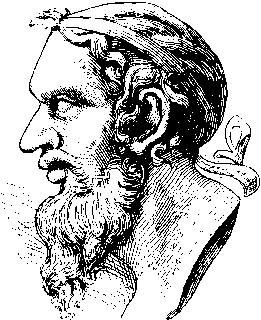
After the murder of Polycrates, Hipparchus, who ruled at Athens, sent a trireme to fetch the poet. Like his father Pisistratus, Hipparchus endeavored to further the cause of letters by calling poets to his court. Simonides of Ceos was there; and Lasus of Hermione, the teacher of Pindar; with many rhapsodists or minstrels, who edited the poems of Homer and chanted his lays at the Panathenæa, or high festival of Athena, which the people celebrated every year with devout and magnificent show. Amid this brilliant company Anacreon lived and sang until Hipparchus fell (514) by the famous conspiracy of Harmodius and Aristogeiton. He then returned to his native Teos, and according to a legend, died there at the age of eighty-five, choked by a grape-seed.
Anacreon was a lyrist of the first order. Plato's poet says of him in the 'Symposium,' "When I hear the verses of Sappho or Anacreon, I set down my cup for very shame of my own performance." He composed in Greek somewhat, to use a very free comparison, as Herrick did in English, expressing the unrefined passion and excesses which he saw, just as the Devonshire parson preserved the spirit of the country festivals of Old England in his vivid verse.
To Anacreon music and poetry were inseparable. The poet of his time recited his lines with lyre in hand, striking upon it in the measure he thought best suited to his song. Doubtless the poems of Anacreon were delivered in this way. His themes were simple,--wine, love, and the glorification of youth and poetry; but his imagination and poetic invention so animated every theme that it is the perfect rendering which we see, not the simplicity of the commonplace idea. His delicacy preserves him from grossness, and his grace from wantonness. In this respect his poems are a fair illustration of the Greek sense of self-limitation, which guided the art instincts of that people and made them the creators of permanent canons of taste.
Anacreon had no politics, no earnest interest in the affairs of life, no morals in the large meaning of that word, no aims reaching further than the merriment and grace of the moment. Loving luxury and leisure, he was the follower of a pleasure-loving court. His cares are that the bowl is empty, that age is joyless, that women tell him he is growing gray. He is closely paralleled in this by one side of Béranger; but the Frenchman's soul had a passionately earnest half which the Greek entirely lacked. Nor is there ever any outbreak of the deep yearning, the underlying melancholy, which pervades and now and then interrupts, like a skeleton at the feast, the gayest verses of Omar Khayyam.
His metres, like his matter, are simple and easy. So imitators, perhaps as brilliant as the master, have sprung up and produced a mass of songs; and at this time it remains in doubt whether any complete poem of Anacreon remains untouched. For this reason the collection is commonly termed 'Anacreontics'. Some of the poems are referred to the school of Gaza and the fourth century after Christ, and some to the secular teachings and refinement of the monks of the Middle Ages. Since the discovery and publication of the text by Henry Stephens, in 1554, poets have indulged their lighter fancies in such songs, and a small literature of delicate trifles now exists under the name of 'Anacreontics' in Italian, German, and English. Bergk's recension of the poems appeared in 1878. The standard translations, or rather imitations in English, are those of Cowley and Moore. The Irish poet was not unlike in nature to the ancient Ionian. Moore's fine voice in the London drawing-rooms echoes at times the note of Anacreon in the men's quarters of Polycrates or the symposia of Hipparchus. The joy of feasting and music, the color of wine, and the scent of roses, alike inspire the songs of each.
DRINKING
The thirsty earth soaks up the rain, And drinks, and gapes for drink again, The plants suck in the earth, and are With constant drinking fresh and fair; The sea itself (which one would think Should have but little need of drink) Drinks twice ten thousand rivers up, So filled that they o'erflow the cup. The busy Sun (and one would guess By 's drunken fiery face no less) Drinks up the sea, and, when he's done, The Moon and Stars drink up the Sun: They drink and dance by their own light; They drink and revel all the night. Nothing in nature's sober found, But an eternal health goes round. Fill up the bowl then, fill it high, Fill all the glasses there; for why Should every creature drink but I? Why, man of morals, tell me why?
--Cowley's Translation.
AGE
Oft am I by the women told, Poor Anacreon, thou grow'st old! Look how thy hairs are falling all; Poor Anacreon, how they fall! Whether I grow old or no, By th' effects I do not know; This I know, without being told, 'Tis time to live, if I grow old; 'Tis time short pleasures now to take, Of little life the best to make, And manage wisely the last stake.
Cowley's Translation.
THE EPICURE
I
Fill the bowl with rosy wine! Around our temples roses twine! And let us cheerfully awhile, Like the wine and roses, smile. Crowned with roses, we contemn Gyges' wealthy diadem. To-day is ours, what do we fear? To-day is ours; we have it here: Let's treat it kindly, that it may Wish, at least, with us to stay. Let's banish business, banish sorrow; To the gods belongs to-morrow.
II
Underneath this myrtle shade, On flowery beds supinely laid, With odorous oils my head o'erflowing, And around it roses growing, What should I do but drink away The heat and troubles of the day? In this more than kingly state Love himself shall on me wait. Fill to me, Love, nay fill it up; And, mingled, cast into the cup Wit, and mirth, and noble fires, Vigorous health, and gay desires. The wheel of life no less will stay In a smooth than rugged way: Since it equally doth flee, Let the motion pleasant be. Why do we precious ointments show'r? Noble wines why do we pour? Beauteous flowers why do we spread, Upon the monuments of the dead? Nothing they but dust can show, Or bones that hasten to be so. Crown me with roses while I live, Now your wines and ointments give After death I nothing crave; Let me alive my pleasures have, All are Stoics in the grave.
Cowley's Translation.
GOLD
A mighty pain to love it is, And 'tis a pain that pain to miss; But, of all pains, the greatest pain It is to love, but love in vain. Virtue now, nor noble blood, Nor wit by love is understood; Gold alone does passion move, Gold monopolizes love; A curse on her, and on the man Who this traffic first began! A curse on him who found the ore! A curse on him who digged the store! A curse on him who did refine it! A curse on him who first did coin it! A curse, all curses else above, On him who used it first in love! Gold begets in brethren hate; Gold in families debate; Gold does friendship separate; Gold does civil wars create. These the smallest harms of it! Gold, alas! does love beget.
Cowley's Translation.
THE GRASSHOPPER
Happy Insect! what can be In happiness compared to thee? Fed with nourishment divine, The dewy Morning's gentle wine! Nature waits upon thee still, And thy verdant cup does fill; 'Tis filled wherever thou dost tread, Nature's self's thy Ganymede. Thou dost drink, and dance, and sing; Happier than the happiest king! All the fields which thou dost see, All the plants, belong to thee; All that summer hours produce, Fertile made with early juice. Man for thee does sow and plow; Farmer he, and landlord thou! Thou dost innocently joy; Nor does thy luxury destroy; The shepherd gladly heareth thee, More harmonious than he. Thee country hinds with gladness hear, Prophet of the ripened year! Thee Phoebus loves, and does inspire; Phoebus is himself thy sire. To thee, of all things upon Earth, Life's no longer than thy mirth. Happy insect, happy thou! Dost neither age nor winter know; But, when thou'st drunk, and danced, and sung Thy fill, the flowery leaves among, (Voluptuous, and wise withal, Epicurean animal!) Sated with thy summer feast, Thou retir'st to endless rest.
Cowley's Translation,
THE SWALLOW
Foolish prater, what dost thou So early at my window do, With thy tuneless serenade? Well 't had been had Tereus made Thee as dumb as Philomel; There his knife had done but well. In thy undiscovered nest Thou dost all the winter rest, And dreamest o'er thy summer joys, Free from the stormy season's noise: Free from th' ill thou'st done to me; Who disturbs or seeks out thee? Hadst thou all the charming notes Of the wood's poetic throats, All thou art could never pay What thou hast ta'en from me away. Cruel bird! thou'st ta'en away A dream out of my arms to-day; A dream that ne'er must equaled be By all that waking eyes may see. Thou, this damage to repair, Nothing half so sweet or fair, Nothing half so good, canst bring, Though men say thou bring'st the Spring.
Cowley's Translation.
THE POET'S CHOICE
If hoarded gold possessed a power To lengthen life's too fleeting hour, And purchase from the hand of death A little span, a moment's breath, How I would love the precious ore! And every day should swell my store; That when the fates would send their minion, To waft me off on shadowy pinion, I might some hours of life obtain, And bribe him back to hell again. But since we ne'er can charm away The mandate of that awful day, Why do we vainly weep at fate, And sigh for life's uncertain date? The light of gold can ne'er illume The dreary midnight of the tomb! And why should I then pant for treasures? Mine be the brilliant round of pleasures; The goblet rich, the hoard of friends, Whose flowing souls the goblet blends!
Moore's Translation.
DRINKING
I care not for the idle state Of Persia's king, the rich, the great! I envy not the monarch's throne, Nor wish the treasured gold my own. But oh! be mine the rosy braid, The fervor of my brows to shade; Be mine the odors, richly sighing, Amid my hoary tresses flying. To-day I'll haste to quaff my wine, As if to-morrow ne'er should shine; But if to-morrow comes, why then-- I'll haste to quaff my wine again. And thus while all our days are bright, Nor time has dimmed their bloomy light, Let us the festal hours beguile With mantling cup and cordial smile; And shed from every bowl of wine The richest drop on Bacchus's shrine! For Death may come, with brow unpleasant, May come when least we wish him present, And beckon to the sable shore, And grimly bid us--drink no more!
Moore's Translation.
A LOVER'S SIGH
The Phrygian rock that braves the storm Was once a weeping matron's form; And Procne, hapless, frantic maid, Is now a swallow in the shade. Oh that a mirror's form were mine, To sparkle with that smile divine; And like my heart I then should be, Reflecting thee, and only thee! Or could I be the robe which holds That graceful form within its folds; Or, turned into a fountain, lave Thy beauties in my circling wave; Or, better still, the zone that lies Warm to thy breast, and feels its sighs! Or like those envious pearls that show So faintly round that neck of snow! Yes, I would be a happy gem, Like them to hang, to fade like them. What more would thy Anacreon be? Oh, anything that touches thee, Nay, sandals for those airy feet-- Thus to be pressed by thee were sweet!
Moore's Translation.