Volume 2 — ARISTOPHANES
Reading edition
(B.C. 448-380?)
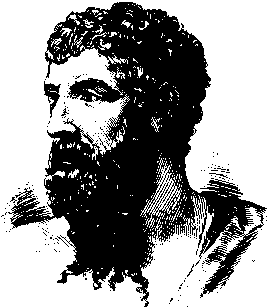
BY PAUL SHOREY

he birth-year of Aristophanes is placed about 448 B.C., on the ground that he is said to have been almost a boy when his first comedy was presented in 427. His last play, the 'Plutus,' was produced in 388, and there is no evidence that he long survived this date. Little is known of his life beyond the allusions, in the Parabases of the 'Acharnians,' 'Knights,' and 'Wasps,' to his prosecution by Cleon, to his own or his father's estate at Aegina, and to his premature baldness. He left three sons who also wrote comedies.
Aristophanes is the sole extant representative of the so-called Old Comedy of Athens; a form of dramatic art which developed obscurely under the shadow of Attic Tragedy in the first half of the fifth century B.C., out of the rustic revelry of the Phallic procession and Comus song of Dionysus, perhaps with some outside suggestions from the Megarian farce and its Sicilian offshoot, the mythological court comedy of Epicharmus. The chief note of this older comedy for the ancient critics was its unbridled license of direct personal satire and invective. Eupolis, Cratinus, and Aristophanes, says Horace, assailed with the utmost freedom any one who deserved to be branded with infamy. This old political Comedy was succeeded in the calmer times that followed the Peloponnesian War by the so-called Middle Comedy (390-320) of Alexis, Antiphanes, Strattis, and some minor men; which insensibly passed into the New Comedy (320-250) of Menander and Philemon, known to us in the reproductions of Terence. And this new comedy, which portrayed types of private life instead of satirizing noted persons by name, and which, as Aristotle says, produced laughter by innuendo rather than by scurrility, was preferred to the "terrible graces" of her elder sister by the gentle and refined Plutarch, or the critic who has usurped his name in the 'Comparison of Aristophanes and Menander.' The old Attic Comedy has been variously compared to Charivari, Punch, the comic opera of Offenbach, and a Parisian 'revue de fin d'année.' There is no good modern analogue. It is not our comedy of manners, plot, and situation; nor yet is it mere buffoonery. It is a peculiar mixture of broad political, social, and literary satire, and polemical discussion of large ideas, with the burlesque and licentious extravagances that were deemed the most acceptable service at the festival of the laughter-loving, tongue-loosening god of the vine.
ARISTOPHANES
The typical plan of an Aristophanic comedy is very simple. The protagonist undertakes in all apparent seriousness to give a local habitation and a body to some ingenious fancy, airy speculation, or bold metaphor: as for example, the procuring of a private peace for a citizen who is weary of the privations of war; or the establishment of a city in Cloud-Cuckoo-Land where the birds shall regulate things better than the featherless biped, man; or the restoration of the eyesight of the proverbially blind god of Wealth. The attention of the audience is at once enlisted for the semblance of a plot by which the scheme is put into execution. The design once effected, the remainder of the play is given over to a series of loosely connected scenes, ascending to a climax of absurdity, in which the consequences of the original happy thought are followed out with a Swiftian verisimilitude of piquant detail and a Rabelaisian license of uproarious mirth. It rests with the audience to take the whole as pure extravaganza, or as a reductio ad absurdum or playful defense of the conception underlying the original idea. In the intervals between the scenes, the chorus sing rollicking topical songs or bits of exquisite lyric, or in the name of the poet directly exhort and admonish the audience in the so-called Parabasis.
Of Aristophanes's first two plays, the 'Banqueters of Hercules' (427), and the 'Babylonians' (426), only fragments remain. The impolitic representation in the latter of the Athenian allies as branded Babylonian slaves was the ground of Cleon's attack in the courts upon Aristophanes, or Callistratus in whose name the play was produced.
The extant plays are the following:--
'The Acharnians,' B.C. 425, shortly after the Athenian defeat at Delium. The worthy countryman, Dicæopolis, weary of being cooped up within the Long Walls, and disgusted with the shameless jobbery of the politicians, sends to Sparta for samples of peace (the Greek word means also libations) of different vintages. The Thirty Years' brand smells of nectar and ambrosia. He accepts it, concludes a private treaty for himself and friends, and proceeds to celebrate the rural Dionysia with wife and child, soothing, by an eloquent plea pronounced in tattered tragic vestments borrowed from Euripides, the anger of the chorus of choleric Acharnian charcoal burners, exasperated at the repeated devastation of their deme by the Spartans. He then opens a market, to which a jolly Boeotian brings the long-lost, thrice-desired Copaic eel; while a starveling Megarian, to the huge delight of the Athenian groundlings, sells his little daughters, disguised as pigs, for a peck of salt. Finally Dicæopolis goes forth to a wedding banquet, from which he returns very mellow in the company of two flute girls; while Lamachus, the head of the war party, issues forth to do battle with the Boeotians in the snow, and comes back with a bloody coxcomb. This play was successfully given in Greek by the students of the University of Pennsylvania in the spring of 1886, and interestingly discussed in the Nation of May 6th by Professor Gildersleeve.
'The Knights,' B.C. 424: named from the chorus of young Athenian cavaliers who abet the sausage-seller, Agoracritus, egged on by the discontented family servants (the generals), Nicias and Demosthenes, to outbid with shameless flattery the rascally Paphlagonian steward, Cleon, and supplant him in the favor of their testy bean-fed old master, Demos (or People). At the close, Demos recovers his wits and his youth, and is revealed sitting enthroned in his glory in the good old Marathonian Athens of the Violet Crown. The prolongation of the billingsgate in the contest between Cleon and the sausage-seller grows wearisome to modern taste; but the portrait of the Demagogue is for all time.
'The Clouds,' B.C. 423: an attack on Socrates, unfairly taken as an embodiment of the deleterious and unsettling "new learning," both in the form of Sophistical rhetoric and "meteorological" speculation. Worthy Strepsiades, eager to find a new way to pay the debts in which the extravagance of his horse-racing son Pheidippides has involved him, seeks to enter the youth as a student in the Thinking-shop or Reflectory of Socrates, that he may learn to make the worse appear the better reason, and so baffle his creditors before a jury. The young man, after much demur and the ludicrous failure of his father, who at first matriculates in his stead, consents. He listens to the pleas of the just and unjust argument in behalf of the old and new education, and becomes himself such a proficient that he demonstrates, in flawless reasoning, that Euripides is a better poet than Aeschylus, and that a boy is justified in beating his father for affirming the contrary. Strepsiades thereupon, cured of his folly, undertakes a subtle investigation into the timbers of the roof of the Reflectory, with a view to smoking out the corrupters of youth. Many of the songs sung by or to the clouds, the patron deities of Socrates's misty lore, are extremely beautiful. Socrates is made to allude to these attacks of comedy by Plato in the 'Apology,' and, on his last day in prison, in the 'Phædo.' In the 'Symposium' or 'Banquet' of Plato, Aristophanes bursts in upon a company of friends with whom Socrates is feasting, and drinks with them till morning; while Socrates forces him and the tragic poet Agathon, both of them very sleepy, to admit that the true dramatic artist will excel in both tragedy and comedy.
'The Wasps,' B.C. 422: a jeu d'esprit turning on the Athenian passion for litigation. Young Bdelucleon (hate-Cleon) can keep his old father Philocleon (love-Cleon) out of the courts only by instituting a private court in his own house. The first culprit, the house-dog, is tried for stealing a Sicilian cheese, and acquitted by Philocleon's mistaking the urn of acquittal for that of condemnation. The old man is inconsolable at the first escape of a victim from his clutches; but finally, renouncing his folly, takes lessons from his exquisite of a son in the manners and deportment of a fine gentleman. He then attends a dinner party, where he betters his instructions with comic exaggeration and returns home in high feather, singing tipsy catches and assaulting the watch on his way. The chorus of Wasps, the visible embodiment of a metaphor found also in Plato's 'Republic,' symbolizes the sting used by the Athenian jurymen to make the rich disgorge a portion of their gathered honey. The 'Plaideurs' of Racine is an imitation of this play; and the motif of the committal of the dog is borrowed by Ben Jonson in the 'Staple of News.'
'The Peace,' B.C. 421: in support of the Peace of Nicias, ratified soon afterward (Grote's 'History of Greece,' Vol. vi., page 492). Trygæus, an honest vine-dresser yearning for his farm, in parody of the Bellerophon of Euripides, ascends to heaven on a dung-beetle. He there hauls Peace from the bottom of the well into which she had been cast by Ares, and brings her home in triumph to Greece, when she inaugurates a reign of plenty and uproarious jollity, and celebrates the nuptials of Trygæus and her handmaid Opora (Harvest-home).
'The Birds,' B.C. 414. Peisthetærus (Plausible) and Euelpides (Hopeful), whose names and deeds are perhaps a satire on the unbounded ambition that brought ruin on Athens at Syracuse, journey to Birdland and persuade King Hoopoe to induce the birds to build Nephelococcygia or Cloud-Cuckoo-Burgh in the air between the gods and men, starve out the gods with a "Melian famine," and rule the world themselves. The gods, their supplies of incense cut off, are forced to treat, and Peisthetærus receives in marriage Basileia (Sovereignty), the daughter of Zeus. The mise en scène, with the gorgeous plumage of the bird-chorus, must have been very impressive, and many of the choric songs are exceedingly beautiful. There is an interesting account by Professor Jebb in the Fortnightly Review (Vol. xli.) of a performance of 'The Birds' at Cambridge in 1884.
Two plays, B.C. 411: (1) at the Lenæa, 'The Lysistrata,' in which the women of Athens and Sparta by a secession from bed and board compel their husbands to end the war; (2) The 'Thesmophoriazusæ' or Women's Festival of Demeter, a licentious but irresistibly funny assault upon Euripides. The tragedian, learning that the women in council assembled are debating on the punishment due to his misogyny, implores the effeminate poet Agathon to intercede for him. That failing, he dispatches his kinsman Mnesilochus, disguised with singed beard and woman's robes, a sight to shake the midriff of despair with laughter, to plead his cause. The advocate's excess of zeal betrays him; he is arrested: and the remainder of the play is occupied by the ludicrous devices, borrowed or parodied from well-known Euripidean tragedies, by which the poet endeavors to rescue his intercessor.
'The Frogs,' B.C. 405, in the brief respite of hope between the victory of Arginusæ and the final overthrow of Athens at Ægospotami. Aeschylus, Sophocles, and Euripides are dead. The minor bards are a puny folk, and Dionysus is resolved to descend to Hades in quest of a truly creative poet, one capable of a figure like "my star god's glow-worm," or "His honor rooted in dishonor stood." After many surprising adventures by the way, and in the outer precincts of the underworld, accompanied by his Sancho Panza, Xanthias, he arrives at the court of Pluto just in time to be chosen arbitrator of the great contest between Aeschylus and Euripides for the tragic throne in Hades. The comparisons and parodies of the styles of Aeschylus and Euripides that follow, constitute, in spite of their comic exaggeration, one of the most entertaining and discriminating chapters of literary criticism extant, and give us an exalted idea of the intelligence of the audience that appreciated them. Dionysus decides for Æschylus, and leads him back in triumph to the upper world.
The 'Ecclesiazusæ' or 'Ladies in Parliament,' B.C. 393: apparently a satire on the communistic theories which must have been current in the discussions of the schools before they found definite expression in Plato's 'Republic.' The ladies of Athens rise betimes, purloin their husbands' hats and canes, pack the Assembly, and pass a measure to intrust the reins of government to women. An extravagant and licentious communism is the result.
The 'Plutus,' B.C. 388: a second and much altered edition of a play represented for the first time in 408. With the 'Ecclesiazusæ' it marks the transition to the Middle Comedy, there being no parabasis, and little of the exuberant verve of the older pieces. The blind god of Wealth recovers his eyesight by sleeping in the temple of Æsculapius, and proceeds to distribute the gifts of fortune more equitably.
The assignment of the dates and restoration of the plots of the thirty-two lost plays, of which a few not very interesting fragments remain, belong to the domain of conjectural erudition.
Aristophanes has been regarded by some critics as a grave moral censor, veiling his high purpose behind the grinning mask of comedy; by others as a buffoon of genius, whose only object was to raise a laugh. Both sides of the question are ingeniously and copiously argued in Browning's 'Aristophanes' Apology'; and there is a judicious summing up of the case of Aristophanes vs. Euripides in Professor Jebb's lectures on Greek poetry. The soberer view seems to be that while predominantly a comic artist, obeying the instincts of his genius, he did frequently make his comedy the vehicle of an earnest conservative polemic against the new spirit of the age in Literature, Philosophy, and Politics. He pursued Euripides with relentless ridicule because his dramatic motives lent themselves to parody, and his lines were on the lips of every theatre-goer; but also because he believed that Euripides had spoiled the old, stately, heroic art of Aeschylus and Sophocles by incongruous infusions of realism and sentimentalism, and had debased the "large utterance of the early gods" by an unhallowed mixture of colloquialism, dialectic, and chicane.
Aristophanes travestied the teachings of Socrates because his ungainly figure, and the oddity (atopia) attributed to him even by Plato, made him an excellent butt; yet also because he felt strongly that it was better for the young Athenian to spend his days in the Palæstra, or "where the elm-tree whispers to the plane," than in filing a contentious tongue on barren logomachies. That Socrates in fact discussed only ethical problems, and disclaimed all sympathy with speculations about things above our heads, made no difference: he was the best human embodiment of a hateful educational error. And similarly the assault upon Cleon, the "pun-pelleting of demagogues from Pnux," was partly due to the young aristocrat's instinctive aversion to the coarse popular leader, and to the broad mark which the latter presented to the shafts of satire, but equally, perhaps, to a genuine patriotic revolt at the degradation of Athenian politics in the hands of the successors of Pericles.
But Aristophanes's ideas interest us less than his art and humor. We have seen the nature of his plots. In such a topsy-turvy world there is little opportunity for nice delineation of character. His personages are mainly symbols or caricatures. Yet they are vividly if broadly sketched, and genuine touches of human nature lend verisimilitude to their most improbable actions. One or two traditional comic types appear for the first time, apparently, on his stage: the alternately cringing and familiar slave or valet of comedy, in his Xanthias and Karion; and in Dicæopolis, Strepsiades, Demos, Trygæus, and Dionysus, the sensual, jovial, shrewd, yet naïve and credulous middle-aged bourgeois gentilhomme or 'Sganarelle,' who is not ashamed to avow his poltroonery, and yet can, on occasion, maintain his rights with sturdy independence.
But the chief attraction of Aristophanes is the abounding comic force and verve of his style. It resembles an impetuous torrent, whose swift rush purifies in its flow the grossness and obscenity inseparable from the origin of comedy, and buoys up and sweeps along on the current of fancy and improvisation the chaff and dross of vulgar jests, puns, scurrilous personalities, and cheap "gags," allowing no time for chilling reflections or criticism. Jests which are singly feeble combine to induce a mood of extravagant hilarity when huddled upon us with such "impossible conveyance." This vivida vis animi can hardly be reproduced in a translation, and disappears altogether in an attempt at an abstract enumeration of the poet's inexhaustible devices for comic effect. He himself repeatedly boasts of the fertility of his invention, and claims to have discarded the coarse farce of his predecessors for something more worthy of the refined intelligence of his clever audience. Yet it must be acknowledged that much even of his wit is the mere filth-throwing of a naughty boy; or at best the underbred jocularity of the "funny column," the topical song, or the minstrel show. There are puns on the names of notable personages; a grotesque, fantastic, punning fauna, flora, and geography of Greece; a constant succession of surprises effected by the sudden substitution of low or incongruous terms in proverbs, quotations, and legal or religious formulas; scenes in dialect, scenes of excellent fooling in the vein of Uncle Toby and the Clown, girds at the audience, personalities that for us have lost their point,--about Cleonymus the caster-away of shields, or Euripides's herb-selling mother,--and everywhere unstinted service to the great gods Priapus and Cloacina.
A finer instrument of comic effect is the parody. The countless parodies of the lyric and dramatic literature of Greece are perhaps the most remarkable testimony extant to the intelligence of an Athenian audience. Did they infallibly catch the allusion when Dicæopolis welcomed back to the Athenian fish-market the long-lost Copaic eel in high Æschylean strain,--
"Of fifty nymphs Copaic alderliefest queen,"
and then, his voice breaking with the intolerable pathos of Admetus's farewell to the dying Alcestis, added,
"Yea, even in death
Thou'lt bide with me, embalmed and beet-bestewed"?
Did they recognize the blasphemous Pindaric pun in "Helle's holy straits," for a tight place, and appreciate all the niceties of diction, metre, and dramatic art discriminated in the comparison between Aeschylus and Euripides in the 'Frogs'? At any rate, no Athenian could miss the fun of Dicæopolis (like Hector's baby) "scared at the dazzling plume and nodding crest" of the swashbuckler Lamachus, of Philocleon, clinging to his ass's belly like Odysseus escaping under the ram from the Cyclops's cave; of the baby in the Thesmophoriazusæ seized as a Euripidean hostage, and turning out a wine bottle in swaddling-clothes; of light-foot Iris in the rôle of a saucy, frightened soubrette; of the heaven-defying Æschylean Prometheus hiding under an umbrella from the thunderbolts of Zeus. And they must have felt instinctively what only a laborious erudition reveals to us, the sudden subtle modulations of the colloquial comic verse into mock-heroic travesty of high tragedy or lyric.
Euripides, the chief victim of Aristophanes's genius for parody, was so burlesqued that his best known lines became by-words, and his most ardent admirers, the very Balaustions and Euthukleses, must have grinned when they heard them, like a pair of augurs. If we conceive five or six Shakespearean comedies filled from end to end with ancient Pistols hallooing to "pampered jades of Asia," and Dr. Caiuses chanting of "a thousand vagrom posies," we may form some idea of Aristophanes's handling of the notorious lines--
"The tongue has sworn, the mind remains unsworn." "Thou lovest life, thy sire loves it too." "Who knows if life and death be truly one?"
But the charm of Aristophanes does not lie in any of these things singly, but in the combination of ingenious and paradoxical fancy with an inexhaustible flow of apt language by which they are held up and borne out. His personages are ready to make believe anything. Nothing surprises them long. They enter into the spirit of each new conceit, and can always discover fresh analogies to bear it out. The very plots of his plays are realized metaphors or embodied conceits. And the same concrete vividness of imagination is displayed in single scenes and episodes. The Better and the Worse Reason plead the causes of the old and new education in person. Cleon and Brasidas are the pestles with which War proposes to bray Greece in a mortar; the triremes of Athens in council assembled declare that they will rot in the docks sooner than yield their virginity to musty, fusty Hyperbolus. The fair cities of Greece stand about waiting for the recovery of Peace from her Well, with dreadful black eyes, poor things; Armisticia and Harvest-Home tread the stage in the flesh, and Nincompoop and Defraudation are among the gods.
The special metaphor or conceit of each play attracts appropriate words and images, and creates a distinct atmosphere of its own. In the 'Knights' the air fairly reeks with the smell of leather and the tanyard. The 'Birds' transport us to a world of trillings and pipings, and beaks and feathers. There is a buzzing and a humming and a stinging throughout the 'Wasps.' The 'Clouds' drip with mist, and are dim with aërial vaporous effects.
Aristophanes was the original inventor of Bob Acres's style of oath--the so-called referential or sentimental swearing. Dicæopolis invokes Ecbatana when Shamartabas struts upon the stage. Socrates in the 'Clouds' swears by the everlasting vapors. King Hoopoe's favorite oath is "Odds nets and birdlime." And the vein of humor that lies in over-ingenious, elaborate, and sustained metaphor was first worked in these comedies. All these excellences are summed up in the incomparable wealth and flexibility of his vocabulary. He has a Shakespearean mastery of the technicalities of every art and mystery, an appalling command of billingsgate and of the language of the cuisine, and would tire Falstaff and Prince Hal with base comparisons. And not content with the existing resources of the Greek vocabulary, he coins grotesque or beautiful compounds,--exquisite epithets like "Botruodöré" (bestower of the vine), "heliomanes" (drunk-with-sunlight), "myriad-flagoned phrases," untranslatable "port-manteaus" like "plouthugieia" (health-and-wealthfulness), and Gargantuan agglomerations of syllables like the portentous olla podrida at the end of the 'Ecclesiazusæ.'
The great comic writer, as the example of Molière proves, need not be a poet. But the mere overflow of careless poetic power which is manifested by Aristophanes would have sufficed to set up any ordinary tragedian or lyrist. In plastic mastery of language only two Greek writers can vie with him, Plato and Homer. In the easy grace and native harmony of his verse he outsings all the tragedians, even that Aeschylus whom he praised as the man who had written the most exquisite songs of any poet of the time. In his blank verse he easily strikes every note, from that of the urbane, unaffected, colloquial Attic, to parody of high or subtle tragic diction hardly distinguishable from its model. He can adapt his metres to the expression of every shade of feeling. He has short, snapping, fiery trochees, like sparks from their own holm oak, to represent the choler of the Acharnians; eager, joyous glyconics to bundle up a sycophant and hustle him off the stage, or for the young knights of Athens celebrating Phormio's sea fights, and chanting, horse-taming Poseidon, Pallas, guardian of the State, and Victory, companion of the dance; the quickstep march of the trochaic tetrameter to tell how the Attic wasps, true children of the soil, charged the Persians at Marathon; and above all--the chosen vehicle of his wildest conceits, his most audacious fancies, and his strongest appeals to the better judgment of the citizens--the anapæstic tetrameter, that "resonant and triumphant" metre of which even Mr. Swinburne's anapæsts can reproduce only a faint and far-off echo.
But he has more than the opulent diction and the singing voice of the poet. He has the key to fairy-land, a feeling for nature which we thought romantic and modern, and in his lyrics the native wood-notes wild of his own 'Mousa lochmaia' (the muse of the coppice). The chorus of the Mystæ in the 'Frogs,' the rustic idyl of the 'Peace,' the songs of the girls in the 'Lysistrata,' the call of the nightingale, the hymns of the 'Clouds,' the speech of the "Just Reason," and the grand chorus of birds, reveal Aristophanes as not only the first comic writer of Greece, but as one of the very greatest of her poets.
Among the many editions of Aristophanes, those most useful to the student and the general reader are doubtless the text edited by Bergk (2 vols., 1867), and the translations of the five most famous plays by John Hookham Frere, to be found in his complete works.
THE ORIGIN OF THE PELOPONNESIAN WAR
From 'The Acharnians': Frere's Translation
DICÆOPOLIS
Be not surprised, most excellent spectators, If I that am a beggar have presumed To claim an audience upon public matters, Even in a comedy; for comedy Is conversant in all the rules of justice, And can distinguish betwixt right and wrong. The words I speak are bold, but just and true. Cleon at least cannot accuse me now, That I defame the city before strangers, For this is the Lenæan festival, And here we meet, all by ourselves alone; No deputies are arrived as yet with tribute, No strangers or allies: but here we sit A chosen sample, clean as sifted corn, With our own denizens as a kind of chaff. First, I detest the Spartans most extremely; And wish that Neptune, the Tænarian deity, Would bury them in their houses with his earthquakes. For I've had losses--losses, let me tell ye, Like other people; vines cut down and injured. But among friends (for only friends are here), Why should we blame the Spartans for all this? For people of ours, some people of our own,-- Some people from among us here, I mean: But not the People (pray, remember that); I never said the People, but a pack Of paltry people, mere pretended citizens, Base counterfeits,--went laying informations, And making a confiscation of the jerkins Imported here from Megara; pigs, moreover, Pumpkins, and pecks of salt, and ropes of onions, Were voted to be merchandise from Megara, Denounced, and seized, and sold upon the spot. Well, these might pass, as petty local matters. But now, behold, some doughty drunken youths Kidnap, and carry away from Megara, The courtesan, Simætha. Those of Megara, In hot retaliation, seize a brace Of equal strumpets, hurried forth perforce From Dame Aspasia's house of recreation. So this was the beginning of the war, All over Greece, owing to these three strumpets. For Pericles, like an Olympian Jove, With all his thunder and his thunderbolts, Began to storm and lighten dreadfully, Alarming all the neighborhood of Greece; And made decrees, drawn up like drinking songs, In which it was enacted and concluded That the Megarians should remain excluded From every place where commerce was transacted, With all their ware--like "old Care" in the ballad: And this decree, by land and sea, was valid. Then the Megarians, being all half starved, Desired the Spartans to desire of us Just to repeal those laws: the laws I mentioned, Occasioned by the stealing of those strumpets. And so they begged and prayed us several times; And we refused: and so they went to war.
THE POET'S APOLOGY
From 'The Acharnians': Frere's Translation. Our poet has never as yet Esteemed it proper or fit To detain you with a long Encomiastic song On his own superior wit; But being abused and accused, And attacked of late As a foe of the State, He makes an appeal in his proper defense, To your voluble humor and temper and sense, With the following plea: Namely, that he Never attempted or ever meant To scandalize In any wise Your mighty imperial government. Moreover he says, That in various ways He presumes to have merited honor and praise; Exhorting you still to stick to your rights, And no more to be fooled with rhetorical flights; Such as of late each envoy tries On the behalf of your allies, That come to plead their cause before ye, With fulsome phrase, and a foolish story Of "violet crowns" and "Athenian glory," With "sumptuous Athens" at every word: "Sumptuous Athens" is always heard; "Sumptuous" ever, a suitable phrase For a dish of meat or a beast at graze. He therefore affirms In confident terms, That his active courage and earnest zeal Have usefully served your common weal: He has openly shown The style and tone Of your democracy ruling abroad, He has placed its practices on record; The tyrannical arts, the knavish tricks, That poison all your politics. Therefore shall we see, this year, The allies with tribute arriving here, Eager and anxious all to behold Their steady protector, the bard so bold; The bard, they say, that has dared to speak, To attack the strong, to defend the weak. His fame in foreign climes is heard, And a singular instance lately occurred. It occurred in the case of the Persian king, Sifting and cross-examining The Spartan envoys. He demanded Which of the rival States commanded The Grecian seas? He asked them next (Wishing to see them more perplexed) Which of the two contending powers Was chiefly abused by this bard of ours? For he said, "Such a bold, so profound an adviser By dint of abuse would render them wiser, More active and able; and briefly that they Must finally prosper and carry the day." Now mark the Lacedæmonian guile! Demanding an insignificant isle! "Ægina," they say, "for a pledge of peace, As a means to make all jealousy cease." Meanwhile their privy design and plan Is solely to gain this marvelous man-- Knowing his influence on your fate-- By obtaining a hold on his estate Situate in the isle aforesaid. Therefore there needs to be no more said. You know their intention, and know that you know it: You'll keep to your island, and stick to the poet. And he for his part Will practice his art With a patriot heart, With the honest views That he now pursues, And fair buffoonery and abuse: Not rashly bespattering, or basely beflattering, Not pimping, or puffing, or acting the ruffian; Not sneaking or fawning; But openly scorning All menace and warning, All bribes and suborning: He will do his endeavor on your behalf; He will teach you to think, he will teach you to laugh. So Cleon again and again may try; I value him not, nor fear him, I! His rage and rhetoric I defy. His impudence, his politics, His dirty designs, his rascally tricks, No stain of abuse on me shall fix. Justice and right, in his despite, Shall aid and attend me, and do me right: With these to friend, I ne'er will bend, Nor descend To a humble tone (Like his own), As a sneaking loon, A knavish, slavish, poor poltroon.
THE APPEAL OF THE CHORUS
From 'The Knights': Frere's Translation.
If a veteran author had wished to engage Our assistance to-day, for a speech from the stage, We scarce should have granted so bold a request: But this author of ours, as the bravest and best, Deserves an indulgence denied to the rest, For the courage and vigor, the scorn and the hate, With which he encounters the pests of the State; A thoroughbred seaman, intrepid and warm, Steering outright, in the face of the storm. But now for the gentle reproaches he bore On the part of his friends, for refraining before To embrace the profession, embarking for life In theatrical storms and poetical strife. He begs us to state that for reasons of weight He has lingered so long and determined so late. For he deemed the achievements of comedy hard, The boldest attempt of a desperate bard! The Muse he perceived was capricious and coy; Though many were courting her, few could enjoy. And he saw without reason, from season to season, Your humor would shift, and turn poets adrift, Requiting old friends with unkindness and treason, Discarded in scorn as exhausted and worn. Seeing Magnes's fate, who was reckoned of late For the conduct of comedy captain and head; That so oft on the stage, in the flower of his age, Had defeated the Chorus his rivals had led; With his sounds of all sort, that were uttered in sport, With whims and vagaries unheard of before, With feathers and wings, and a thousand gay things, That in frolicsome fancies his Choruses wore-- When his humor was spent, did your temper relent, To requite the delight that he gave you before? We beheld him displaced, and expelled and disgraced, When his hair and his wit were grown aged and hoar. Then he saw, for a sample, the dismal example Of noble Cratinus so splendid and ample, Full of spirit and blood, and enlarged like a flood; Whose copious current tore down with its torrent, Oaks, ashes, and yew, with the ground where they grew, And his rivals to boot, wrenched up by the root; And his personal foes, who presumed to oppose, All drowned and abolished, dispersed and demolished, And drifted headlong, with a deluge of song. And his airs and his tunes, and his songs and lampoons, Were recited and sung by the old and the young: At our feasts and carousals, what poet but he? And "The fair Amphibribe" and "The Sycophant Tree," "Masters and masons and builders of verse!" Those were the tunes that all tongues could rehearse; But since in decay you have cast him away, Stript of his stops and his musical strings, Battered and shattered, a broken old instrument, Shoved out of sight among rubbishy things. His garlands are faded, and what he deems worst, His tongue and his palate are parching with thirst. And now you may meet him alone in the street, Wearied and worn, tattered and torn, All decayed and forlorn, in his person and dress, Whom his former success should exempt from distress, With subsistence at large at the general charge, And a seat with the great at the table of State, There to feast every day and preside at the play In splendid apparel, triumphant and gay. Seeing Crates, the next, always teased and perplexed, With your tyrannous temper tormented and vexed; That with taste and good sense, without waste or expense, From his snug little hoard, provided your board With a delicate treat, economic and neat. Thus hitting or missing, with crowns or with hissing, Year after year he pursued his career, For better or worse, till he finished his course. These precedents held him in long hesitation; He replied to his friends, with a just observation, "That a seaman in regular order is bred To the oar, to the helm, and to look out ahead; With diligent practice has fixed in his mind The signs of the weather, and changes of wind. And when every point of the service is known, Undertakes the command of a ship of his own." For reasons like these, If your judgment agrees That he did not embark Like an ignorant spark, Or a troublesome lout, To puzzle and bother, and blunder about, Give him a shout, At his first setting out! And all pull away With a hearty huzza For success to the play! Send him away, Smiling and gay, Shining and florid, With his bald forehead!
THE CLOUD CHORUS
From 'The Clouds': Andrew Lang's Translation SOCRATES SPEAKS Hither, come hither, ye Clouds renowned, and unveil yourselves here; Come, though ye dwell on the sacred crests of Olympian snow, Or whether ye dance with the Nereid Choir in the gardens clear, Or whether your golden urns are dipped in Nile's overflow, Or whether you dwell by Mæotis mere Or the snows of Mimas, arise! appear! And hearken to us, and accept our gifts ere ye rise and go. THE CLOUDS SING Immortal Clouds from the echoing shore Of the father of streams from the sounding sea, Dewy and fleet, let us rise and soar; Dewy and gleaming and fleet are we! Let us look on the tree-clad mountain-crest, On the sacred earth where the fruits rejoice, On the waters that murmur east and west, On the tumbling sea with his moaning voice. For unwearied glitters the Eye of the Air, And the bright rays gleam; Then cast we our shadows of mist, and fare In our deathless shapes to glance everywhere From the height of the heaven, on the land and air, And the Ocean Stream. Let us on, ye Maidens that bring the Rain, Let us gaze on Pallas's citadel, In the country of Cecrops fair and dear, The mystic land of the holy cell, Where the Rites unspoken securely dwell, And the gifts of the gods that know not stain, And a people of mortals that know not fear. For the temples tall and the statues fair, And the feasts of the gods are holiest there; The feasts of Immortals, the chaplets of flowers, And the Bromian mirth at the coming of spring, And the musical voices that fill the hours, And the dancing feet of the maids that sing!
GRAND CHORUS OF BIRDS
From 'The Birds': Swinburne's Translation Come on then, ye dwellers by nature in darkness, and like to the leaves' generations, That are little of might, that are molded of mire, unenduring and shadowlike nations, Poor plumeless ephemerals, comfortless mortals, as visions of shadows fast fleeing, Lift up your mind unto us that are deathless, and dateless the date of our being; Us, children of heaven, us, ageless for aye, us, all of whose thoughts are eternal: That ye may from henceforth, having heard of us all things aright as to matters supernal, Of the being of birds, and beginning of gods, and of streams, and the dark beyond reaching, Trustfully knowing aright, in my name bid Prodicus pack with his preaching! It was Chaos and Night at the first, and the blackness of darkness, and Hell's broad border, Earth was not, nor air, neither heaven; when in depths of the womb of the dark without order First thing, first-born of the black-plumed Night, was a wind-egg hatched in her bosom, Whence timely with seasons revolving again sweet Love burst out as a blossom, Gold wings glittering forth of his back, like whirlwinds gustily turning. He, after his wedlock with Chaos, whose wings are of darkness, in Hell broad-burning, For his nestlings begat him the race of us first, and upraised us to light new-lighted. And before this was not the race of the gods, until all things by Love were united: And of kind united in kind with communion of nature the sky and the sea are Brought forth, and the earth, and the race of the gods everlasting and blest. So that we are Far away the most ancient of all things blest. And that we are of Love's generation There are manifest manifold signs. We have wings, and with us have the Loves habitation; And manifold fair young folk that forswore love once, ere the bloom of them ended, Have the men that pursued and desired them subdued by the help of us only befriended, With such baits as a quail, a flamingo, a goose, or a cock's comb staring and splendid. All best good things that befall men come from us birds, as is plain to all reason: For first we proclaim and make known to them spring, and the winter and autumn in season; Bid sow, when the crane starts clanging for Afric in shrill-voiced emigrant number, And calls to the pilot to hang up his rudder again for the season and slumber; And then weave a cloak for Orestes the thief, lest he strip men of theirs if it freezes. And again thereafter the kite reappearing announces a change in the breezes. And that here is the season for shearing your sheep of their spring wool. Then does the swallow Give you notice to sell your great-coat, and provide something light for the heat that's to follow. Thus are we as Ammon or Delphi unto you. Dodona, nay, Phoebus Apollo. For, as first ye come all to get auguries of birds, even such is in all things your carriage, Be the matter a matter of trade, or of earning your bread, or of any one's marriage. And all things ye lay to the charge of a bird that belong to discerning prediction: Winged fame is a bird, as you reckon; you sneeze, and the sign's as a bird for conviction; All tokens are "birds" with you--sounds, too, and lackeys and donkeys. Then must it not follow That we are to you all as the manifest godhead that speaks in prophetic Apollo?
A RAINY DAY ON THE FARM
From 'The Peace': Frere's Translation
How sweet it is to see the new-sown cornfield fresh and even, With blades just springing from the soil that only ask a shower from heaven. Then, while kindly rains are falling, indolently to rejoice, Till some worthy neighbor calling, cheers you with his hearty voice. Well, with weather such as this, let us hear, Trygæus tell us What should you and I be doing? You're the king of us good fellows. Since it pleases heaven to prosper your endeavors, friend, and mine, Let us have a merry meeting, with some friendly talk and wine. In the vineyard there's your lout, hoeing in the slop and mud-- Send the wench and call him out, this weather he can do no good. Dame, take down two pints of meal, and do some fritters in your way; Boil some grain and stir it in, and let us have those figs, I say. Send a servant to my house,--any one that you can spare,-- Let him fetch a beestings pudding, two gherkins, and the pies of hare: There should be four of them in all, if the cat has left them right; We heard her racketing and tearing round the larder all last night, Boy, bring three of them to us,--take the other to my father: Cut some myrtle for our garlands, sprigs in flower or blossoms rather. Give a shout upon the way to Charinades our neighbor, To join our drinking bout to-day, since heaven is pleased to bless our labor.
THE HARVEST
From 'The Peace': Translation in the Quarterly Review Oh, 'tis sweet, when fields are ringing With the merry cricket's singing, Oft to mark with curious eye If the vine-tree's time be nigh: Here is now the fruit whose birth Cost a throe to Mother Earth. Sweet it is, too, to be telling, How the luscious figs are swelling; Then to riot without measure In the rich, nectareous treasure, While our grateful voices chime,-- Happy season! blessed time.
THE CALL TO THE NIGHTINGALE
From 'The Birds ': Frere's Translation Awake! awake! Sleep no more, my gentle mate! With your tiny tawny bill, Wake the tuneful echo shrill, On vale or hill; Or in her airy rocky seat, Let her listen and repeat The tender ditty that you tell, The sad lament, The dire event, To luckless Itys that befell. Thence the strain Shall rise again, And soar amain, Up to the lofty palace gate Where mighty Apollo sits in state In Jove's abode, with his ivory lyre, Hymning aloud to the heavenly choir, While all the gods shall join with thee In a celestial symphony.
THE BUILDING OF CLOUD-CUCKOO-TOWN
From 'The Birds ': Frere's Translation
[
Enter Messenger, quite out of breath, and speaking in short snatches
.]
Messenger
--Where is he? Where? Where is he? Where? Where
is he?--The president Peisthetairus?
Peisthetairus [coolly
]--Here am I.
Mess. [in a gasp of breath
]--Your fortification's finished.
Peis
.--Well! that's well.
Mess
.--A most amazing, astonishing work it is!
So that Theagenes and Proxenides
Might flourish and gasconade and prance away
Quite at their ease, both of them four-in-hand,
Driving abreast upon the breadth of wall,
Each in his own new chariot.
Peis
.--You surprise me.
Mess
.--And the height (for I made the measurement myself)
Is exactly a hundred fathoms.
Peis
.--Heaven and earth!
How could it be? such a mass! who could have built it?
Mess
.--The Birds; no creature else, no foreigners,
Egyptian bricklayers, workmen or masons.
But they themselves, alone, by their own efforts,--
(Even to my surprise, as an eye-witness)
The Birds, I say, completed everything:
There came a body of thirty thousand cranes,
(I won't be positive, there might be more)
With stones from Africa in their craws and gizzards,
Which the stone-curlews and stone-chatterers
Worked into shape and finished. The sand-martens
And mud-larks, too, were busy in their department,
Mixing the mortar, while the water-birds,
As fast as it was wanted, brought the water
To temper and work it.
Peis. [in a fidget
]--But who served the masons
Who did you get to carry it?
Mess
.--To carry it?
Of course, the carrion crows and carrying pigeons.
Peis. [in a fuss, which he endeavors to conceal
]--
Yes! yes! but after all, to load your hods,
How did you manage that?
Mess
.--Oh, capitally,
I promise you. There were the geese, all barefoot
Trampling the mortar, and when all was ready
They handed it into the hods, so cleverly,
With their flat feet!
Peis. [a bad joke, as a vent for irritation
]--
They footed it, you mean--
Come; it was handily done though, I confess.
Mess
.--Indeed, I assure you, it was a sight to see them;
And trains of ducks there were, clambering the ladders
With their duck legs, like bricklayers' 'prentices,
All dapper and handy, with their little trowels.
Peis
.--In fact, then, it's no use engaging foreigners;
Mere folly and waste, we've all within ourselves.
Ah, well now, come! But about the woodwork? Heh!
Who were the carpenters? Answer me that!
Mess
.--The woodpeckers, of course: and there they were,
Laboring upon the gates, driving and banging,
With their hard hatchet-beaks, and such a din,
Such a clatter, as they made, hammering and hacking,
In a perpetual peal, pelting away
Like shipwrights, hard at work in the arsenal.
And now their work is finished, gates and all,
Staples and bolts, and bars and everything;
The sentries at their posts; patrols appointed;
The watchman in the barbican; the beacons
Ready prepared for lighting; all their signals
Arranged--but I'll step out, just for a moment,
To wash my hands. You'll settle all the rest.
CHORUS OF WOMEN
From the 'Thesmophoriazusæ': Collins's Translation They're always abusing the women, As a terrible plague to men: They say we're the root of all evil, And repeat it again and again; Of war, and quarrels, and bloodshed, All mischief, be what it may! And pray, then, why do you marry us, If we're all the plagues you say? And why do you take such care of us, And keep us so safe at home, And are never easy a moment If ever we chance to roam? When you ought to be thanking heaven That your Plague is out of the way, You all keep fussing and fretting-- "Where is my Plague to-day?" If a Plague peeps out of the window, Up go the eyes of men; If she hides, then they all keep staring Until she looks out again.
CHORUS OF MYSTÆ IN HADES
From 'The Frogs': Frere's Translation
CHORUS [shouting and singing'] Iacchus! Iacchus! Ho! Iacchus! Iacchus! Ho! Xanthias--There, master, there they are, the initiated All sporting about as he told us we should find 'em. They're singing in praise of Bacchus like Diagoras. Bacchus--Indeed, and so they are; but we'll keep quiet Till we make them out a little more distinctly. CHORUS [song] Mighty Bacchus! Holy Power! Hither at the wonted hour Come away, Come away, With the wanton holiday, Where the revel uproar leads To the mystic holy meads, Where the frolic votaries fly, With a tipsy shout and cry; Flourishing the Thyrsus high, Flinging forth, alert and airy, To the sacred old vagary, The tumultuous dance and song, Sacred from the vulgar throng; Mystic orgies that are known To the votaries alone-- To the mystic chorus solely-- Secret unrevealed--and holy. Xan.--O glorious virgin, daughter of the Goddess! What a scent of roasted griskin reached my senses! Bac.--Keep quiet--and watch for a chance of a piece of the haslets. CHORUS [song] Raise the fiery torches high! Bacchus is approaching nigh, Like the planet of the morn Breaking with the hoary dawn On the dark solemnity-- There they flash upon the sight; All the plain is blazing bright, Flushed and overflown with light: Age has cast his years away, And the cares of many a day, Sporting to the lively lay-- Mighty Bacchus! march and lead (Torch in hand toward the mead) Thy devoted humble Chorus; Mighty Bacchus--move before us! Keep silence--keep peace--and let all the profane From our holy solemnity duly refrain; Whose souls, unenlightened by taste, are obscure; Whose poetical notions are dark and impure; Whose theatrical conscience Is sullied by nonsense; Who never were trained by the mighty Cratinus In mystical orgies, poetic and vinous; Who delight in buffooning and jests out of season; Who promote the designs of oppression and treason; Who foster sedition and strife and debate; All traitors, in short, to the Stage and the State: Who surrender a fort, or in private export To places and harbors of hostile resort Clandestine consignments of cables and pitch,-- In the way that Thorycion grew to be rich From a scoundrelly dirty collector of tribute: All such we reject and severely prohibit; All statesmen retrenching the fees and the salaries Of theatrical bards, in revenge for the railleries And jests and lampoons of this holy solemnity, Profanely pursuing their personal enmity, For having been flouted and scoffed and scorned-- All such are admonished and heartily warned; We warn them once, We warn them twice, We warn and admonish--we warn them thrice, To conform to the law, To retire and withdraw; While the Chorus again with the formal saw, (Fixt and assign'd to the festive day) Move to the measure and march away. SEMI-CHORUS March! march! lead forth, Lead forth manfully, March in order all; Bustling, hustling, justling, As it may befall; Flocking, shouting, laughing, Mocking, flouting, quaffing, One and all; All have had a belly-full Of breakfast brave and plentiful; Therefore Evermore With your voices and your bodies Serve the goddess, And raise Songs of praise; She shall save the country still, And save it against the traitor's will; So she says. SEMI-CHORUS Now let us raise in a different strain The praise of the goddess, the giver of grain; Imploring her favor With other behavior, In measures more sober, submissive, and graver. SEMI-CHORUS Ceres, holy patroness, Condescend to mark and bless, With benevolent regard, Both the Chorus and the Bard; Grant them for the present day Many things to sing and say, Follies intermixed with sense; Folly, but without offense. Grant them with the present play To bear the prize of verse away. SEMI-CHORUS Now call again, and with a different measure, The power of mirth and pleasure; The florid, active Bacchus, bright and gay, To journey forth and join us on the way. SEMI-CHORUS O Bacchus, attend! the customary patron of every lively lay; Go forth without delay Thy wonted annual way, To meet the ceremonious holy matron: Her grave procession gracing, Thine airy footsteps tracing With unlaborious, light, celestial motion; And here at thy devotion Behold thy faithful choir In pitiful attire: All overworn and ragged, This jerkin old and jagged, These buskins torn and burst, Though sufferers in the fray, May serve us at the worst To sport throughout the day; And then within the shades I spy some lovely maids With whom we romped and reveled, Dismantled and disheveled, With their bosoms open,-- With whom we might be coping. Xan.--Well, I was always hearty, Disposed to mirth and ease: I'm ready to join the party. Bac.--And I will if you please.
A PARODY OF EURIPIDES'S LYRIC VERSE
From 'The Frogs' Halcyons ye by the flowing sea Waves that warble twitteringly, Circling over the tumbling blue, Dipping your down in its briny dew, Spi-i-iders in corners dim Spi-spi-spinning your fairy film, Shuttles echoing round the room Silver notes of the whistling loom, Where the light-footed dolphin skips Down the wake of the dark-prowed ships, Over the course of the racing steed Where the clustering tendrils breed Grapes to drown dull care in delight, Oh! mother make me a child again just for to-night! I don't exactly see how that last line is to scan, But that's a consideration I leave to our musical man.
THE PROLOGUES OF EURIPIDES
From 'The Frogs'
[The point of the following selection lies in the monotony of both narrative style and metre in Euripides's prologues, and especially his regular cæsura after the fifth syllable of a line. The burlesque tag used by Aristophanes to demonstrate this effect could not be applied in the same way to any of the fourteen extant plays of Sophocles and Æschylus.]
Æschylus
--And by Jove, I'll not stop to cut up your verses
word by word, but if the gods are propitious I'll spoil
all your prologues with a little flask of smelling-salts.
Euripides
--With a flask of smelling-salts?
Æsch
.--With a single one. For you build your verses so that
anything will fit into the metre,--a leathern sack,
or eider-down, or smelling-salts. I'll show you.
Eur
.--So, you'll show me, will you?
Æsch
.--I will that.
Dionysus
--Pronounce.
Eur
. [
declaiming
]--
Ægyptus, as broad-bruited fame reports,
With fifty children voyaging the main
To Argos came, and
Æsch
.-- --lost his smelling-salts.
Dion
.--What the mischief have the smelling-salts got to do with
it? Recite another prologue to him and let me see.
Eur
.--
Dionysus, thyrsus-armed and faun-skin-clad,
Amid the torchlights on Parnassus's slope
Dancing and prancing
Æsch
.-- --lost his smelling-salts.
Dion
.--Caught out again by the smelling-salts.
Eur
.--No matter. Here's a prologue that he can't fit 'em to.
No lot of mortal man is wholly blest:
The high-born youth hath lacked the means of life,
The lowly lout hath
Æsch
.-- --lost his smelling-salts.
Dion
.--Euripides--
Eur
.-- Well, what?
Dion
.-- Best take in sail.
These smelling-salts, methinks, will blow a gale.
Eur
.--What do I care? I'll fix him next time.
Dion
.--Well, recite another, and steer clear of the smelling-salts.
Eur
.--
Cadmus departing from the town of Tyre,
Son of Agenor
Æsch
.-- --lost his smelling-salts.
Dion
.--My dear fellow, buy those smelling-salts, or there won't
be a rag left of all your prologues.
Eur
.--What? I buy 'em of him?
Dion
.--If you'll be advised by me.
Eur
.--Not a bit of it. I've lots of prologues where he can't
work 'em in.
Pelops the Tantalid to Pisa coming
With speedy coursers
Æsch
.-- --lost his smelling-salts.
Dion
.--There they are again, you see. Do let him have 'em,
my good Æschylus. You can replace 'em for a
nickel.
Eur
.--Never. I've not run out yet.
Oeneus from broad fields
Æsch
.--- --lost his smelling-salts.
Eur
.--Let me say the whole verse, won't you?
Oeneus from broad fields reaped a mighty crop
And offering first-fruits
Æsch
.-- --lost his smelling-salts.
Dion
.--While sacrificing? Who filched them?
Eur
.--Oh, never mind him. Let him try it on this verse:--
Zeus, as the word of sooth declared of old--
Dion
.--It's no use, he'll say Zeus lost his smelling-salts. For
those smelling-salts fit your prologues like a kid
glove. But go on and turn your attention to his
lyrics.