LETTERS.
Grace Wallace translation
Weimar, May 21st, 1830.
Never, in the whole course of my travels, do I remember a more glorious and inspiriting day for a journey than yesterday. At an early hour in the morning the sky was grey and cloudy, but the sun presently burst forth; the air was cool and fresh, and being Ascension Sunday the people were all dressed in their best. In one village I saw them crowding into church as I passed, in another coming away from divine service, and, last of all, playing at bowls. The gardens were bright with tulips, and I drove quickly past, eagerly looking at everything. At Weissenfels they gave me a little basket carriage, and at Naumburg an open droschky. My effects, including my hat and cloak, were piled upon it behind. I bought a few bunches of lilies-of-the-valley, and thus I travelled on through the country, as if on a pleasure excursion.
Some collegians came up to me beyond Naumburg, and envied me. We then drove past President G——, seated in a small carriage, which evidently had some difficulty in containing him, and his daughters or wives; in short, the two ladies with him, who appeared equally envious of my position. We actually trotted up the Kösen Hill, for the horses scarcely drew bridle, and overtook several heavily-laden carriages, the drivers of which no doubt also envied me, for I was really to be envied. The scenery had a charming air of spring—so cheerful and gay, and blooming. The sun sank solemnly behind the hills, and presently we came up with the Russian minister and his suite, in two heavy carriages, each with four horses, in true ponderous official array; and my light droschky darted past him like a hare.
In the evening I got a pair of restive horses, so that I had my little annoyance also, (according to my theory, enhancing pleasure,) and not a single bar did I compose all day, but enjoyed complete idleness. It was a delicious day, and one I shall not soon forget. I close this description with the remark, that the children in Eckartsberge dance merry rounds hand-in-hand, just as ours do at home, and that the appearance of a stranger did not in the least disturb them, in spite of his distinguished air; I should have liked to join in their game.
May 24th.
I wrote this before going to see Goethe, early in the forenoon, after a walk in the park; but I could not find a moment to finish my letter till now. I shall probably remain here for a couple of days, which is no sacrifice, for I never saw the old gentleman so cheerful and amiable as on this occasion, or so talkative and communicative. My especial reason however for staying two days longer, is a very agreeable one, and makes me almost vain, or I ought rather to say proud, and I do not intend to keep it secret from you,—Goethe, you must know, sent me a letter yesterday addressed to an artist here, a painter, which I am to deliver myself; and Ottilie confided to me that it contains a commission to take my portrait, as Goethe wishes to place it in a collection of likenesses he has recently commenced of his friends. This circumstance gratified me exceedingly; as however I have not yet seen the complaisant artist who is to accomplish this, nor has he seen me, it is probable that I shall have to remain here until the day after to-morrow. I don't in the least regret this, for, as I have told you, I live a most agreeable life here, and thoroughly enjoy the society of the old poet. I have dined with him every day, and am invited again to-day. This evening there is to be a party at his house, where I am to play. It is quite delightful to hear him conversing on every subject, and seeking information on all points.
I must however tell you everything regularly and in order, so that you may know each separate detail.
Early in the day I went to see Ottilie, who, though still delicate, and often complaining, I thought more cheerful than formerly, and quite as kind and amiable as ever towards myself. We have been constantly together since then, and it has been a source of much pleasure to me to know her more intimately. Ulrike is more agreeable and charming than formerly; a certain earnestness pervades her whole nature, and she has now a degree of repose, and a depth of feeling, that render her one of the most attractive creatures I have ever met. The two boys, Walter and Wolf, are lively, studious, cordial lads, and to hear them talking about "Grandpapa's Faust," is most pleasant.
But to return to my narrative. I sent Zelter's letter at once to Goethe, who immediately invited me to dinner. I thought him very little changed in appearance, but at first rather silent and apathetic; I think he wished to see how I demeaned myself. I was vexed, and thought that possibly he was always now in this mood. Happily the conversation turned on the Frauen-Vereine in Weimar, and on the 'Chaos,' a humorous paper circulated among themselves by the ladies here, I having soared so high as to be a contributor to this undertaking. All at once the old man became quite gay, laughing at the two ladies about their charities and intellectualism, and their subscriptions and hospital work, which he seems cordially to detest. He called on me to aid him in his onslaught, and as I did not require to be asked twice, he speedily became just what he used to be, and at last more kind and confidential than I had ever seen him. The assault soon became general. The 'Robber Bride' of Ries, he said contained all that an artist in these days required to live happily,—a robber and a bride; then he attacked the young people of the present day for their universal tendency to languor and melancholy, and related the story of a young lady to whom he had once paid court, and who also felt some interest in him; a discussion on the exhibitions followed, and a fancy bazaar for the poor, where the ladies of Weimar were the shopwomen, and where he declared it was impossible to purchase anything because the young people made a private agreement among themselves, and hid the different articles till the proper purchasers appeared.
After dinner he all at once began—"Gute Kinder—hübsche Kinder—muss immer lustig sein—tolles Volk," etc., his eyes looking like those of a drowsy old lion. Then he begged me to play to him, and said it seemed strange that he had heard no music for so long; that he supposed we had made great progress, but he knew nothing of it. He wished me to tell him a great deal on the subject, saying "Do let us have a little rational conversation together;" and turning to Ottilie, he said, "No doubt you have already made your own wise arrangements, but they must yield to my express orders, which are, that you must make tea here this evening, that we may be all together again." When in return she asked him if it would not make him too late, as Riemer was coming to work with him, he replied, "As you gave your children a holiday from their Latin to-day, that they might hear Felix play, I think you might also give me one day of relaxation from my work." He invited me to return to dinner, and I played a great deal to him in the evening.
My three Welsh pieces, dedicated to three English sisters, have great success here;[2] and I am trying to rub up my English. As I had begged Goethe to address me as thou, he desired Ottilie to say to me on the following day, in that case I must remain longer than the two days I had fixed, otherwise he could not regain the more familiar habit I wished. He repeated this to me himself, saying that he did not think I should lose much by staying a little longer, and invited me always to dine with him when I had no other engagement. I have consequently been with him every day, and yesterday I told him a great deal about Scotland, and Hengstenberg, and Spontini, and Hegel's 'Æsthetics.'[3] He sent me to Tiefurth with the ladies, but prohibited my driving to Berka, because a very pretty girl lived there, and he did not wish to plunge me into misery.
I thought to myself, this was indeed the Goethe of whom people will one day say, that he was not one single individual, but consisted of several little Goethiden. I am to play over to him to-day various pieces of Bach, Haydn, and Mozart, and thus lead him on, as he said, to the present day I should indeed have been very foolish to have regretted my delay; besides, I am a conscientious traveller, and have seen the Library, and 'Iphigenia in Aulis.' Hummel has struck out all the octaves, etc.
Felix.
Weimar, May 25th, 1830.
I have just received your welcome letter, written on Ascension Day. I cannot help myself, but must still write to you from this place. I will soon send you, dear Fanny, a copy of my symphony; I am having it written out here, and mean to forward it to Leipzig (where perhaps it will be performed), with strict orders to deliver it into your own hands, as soon as possible. Try to collect opinions as to the title I ought to select; Reformation Symphony, Confession Symphony, Symphony for a Church Festival, Juvenile Symphony, or whatever you like. Write to me on this subject, and instead of a number of stupid suggestions, send me one clever one; still, I should rather like to hear some of the nonsensical ones sure to be devised on the occasion.
Yesterday evening I was at a party at Goethe's, and played alone the whole evening,—the Concert-Stück, the Invitation à la Valse, and Weber's Polonaise in C, my three Welsh pieces, and my Scotch Sonata. It was over by ten o'clock, but I of course stayed till twelve o'clock, when we had all sorts of fun, dancing and singing; so you see I lead a most jovial life here. The old gentleman goes to his room regularly at nine o'clock, and as soon as he is gone, we begin our frolics, and never separate before midnight.
To-morrow my portrait is to be finished; a large black-crayon sketch, and very like; but I look rather sulky. Goethe is so friendly and kind to me, that I don't know how to thank him sufficiently, or what to do to deserve it. In the forenoon he likes me to play to him the compositions of the various great masters, in chronological order, for an hour, and also tell him the progress they have made, while he sits in a dark corner, like a Jupiter tonans, his old eyes flashing on me. He did not wish to hear anything of Beethoven's, but I told him that I could not let him off, and played the first part of the Symphony in C minor. It seemed to have a singular effect on him; at first he said, "This causes no emotion, nothing but astonishment: it is grandios." He continued grumbling in this way, and after a long pause he began again,—"It is very grand, very wild; it makes one fear that the house is about to fall down; and what must it be when played by a number of men together!" During dinner, in the midst of another subject, he alluded to it again. You know that I dine with him every day, when he questions me very minutely, and is always so gay and communicative after dinner, that we generally remain together alone for an hour while he speaks on uninterruptedly.
I have no greater pleasure than when he brings out engravings, and explains them to me, or gives his opinion of Ernani, or Lamartine's Elegies, or the theatre, or pretty girls. He has several times lately invited people, which he rarely does now, so that most of the guests had not seen him for a long time. I then play a great deal, and he compliments me before all these people, and "ganz stupend" is his favourite expression. To-day he has invited a number of Weimar beauties on my account, because he thinks that I ought to enjoy the society of young people. If I go up to him on such occasions, he says, "My young friend, you must join the ladies, and make yourself agreeable to them." I am not however devoid of tact, so I contrived to have him asked yesterday whether I did not come too often; but he growled out to Ottilie, who put the question to him, that "he must now begin to speak to me in good earnest, for I had such clear ideas, that he hoped to learn much from me." I became twice as tall in my own estimation, when Ottilie repeated this to me. He said so to me himself yesterday; and when he declared that there were many subjects he had at heart that I must explain to him, I said, "Oh, certainly!" but I thought, "This is an honour I can never forget,"—often it is the very reverse.
Felix.
Munich, June 6th, 1830.
It is a long time since I have written to you, and I fear you may have been anxious on my account. You must not be angry with me, for it was really no fault of mine, and I have been not a little annoyed about it. I expedited my journey as well as I could, inquiring everywhere about diligences, and invariably receiving false information. I travelled through one night on purpose to enable me to write to you by this day's post, of which I was told at Nürnberg; and when at last I arrive, I find that no post leaves here to-day: it is enough to drive one wild, and I feel out of all patience with Germany and her petty Principalities, her different kinds of money, her diligences, which require an hour and a quarter for a German mile, and her Thuringian forests, where there is incessant rain and wind,—nay, even with her 'Fidelio' this very evening, for, though dead beat, I must do my duty by going to see it, when I would far rather go to bed. Pray do not be angry with me, or scold me for my delay in writing; I do assure you that this very night while I was travelling, I thought I saw peeping through the clouds the shadow of your threatening finger; but I shall now proceed to explain why I could not write sooner.
Some days after my last letter from Weimar, I wished, as I told you, to set off for this place, and said so during dinner to Goethe, who made no reply. After dinner however he withdrew with Ottilie into the recess of a window, and said, "You must persuade him to remain." She endeavoured to prevail on me to do so, and walked up and down in the garden with me. I wished however to show that I was a man of determination, so I remained steady to my resolve. Then came the old gentleman himself, and said he saw no use in my being in such a hurry; that he had still a great deal to tell me, and I had still a great deal to play to him; and what I had told him as to the object of my journey, was really all nonsense,—Weimar was my present object,—and he could not see that I was likely to find in tables-d'hôte elsewhere, what I could not obtain here: I would see plenty of hotels in my travels. He talked on in this style, which touched my heart, especially as Ottilie and Ulrike added their persuasions, assuring me that the old gentleman much more often insisted on people going away, than on their remaining; and as no one can be so sure of enjoying a number of happy days, that he can afford to throw away those that cannot fail to be pleasant, and as they promised to go with me to Jena, I resolved not to be a man of determination, and agreed to stay.
Seldom in the course of my life have I so little regretted any resolution as on this occasion, for the following day was by far the most delightful that I ever passed in Goethe's house. After an early drive, I found old Goethe very cheerful; he began to converse on various subjects, passing from the 'Muette de Portici' to Walter Scott, and thence to the beauties in Weimar; to the 'Students,' and the 'Robbers,' and so on to Schiller; then he spoke on uninterruptedly for more than an hour, with the utmost animation, about Schiller's life and writings, and his position in Weimar. He proceeded to speak of the late Grand-Duke, and of the year 1775, which he designated as the intellectual spring of Germany, declaring that no man living could describe it so well as he could; indeed, it had been his intention to have devoted the second volume of his life to this subject; but what with botany, and meteorology, and other stuff of the same kind, for which no one cared a straw, he had not yet been able to fulfil his purpose. He proceeded to relate various anecdotes of the time when he was director of the theatre, and when I wished to thank him, he said, "It is mere chance, it all comes to light incidentally,—called forth by your welcome presence." These words sounded marvellously pleasant to me; in short, it was one of those conversations that a man can never forget so long as he lives. Next day he made me a present of a sheet of the manuscript of 'Faust,' and at the bottom of the page he wrote, "To my dear young friend F. M. B., mighty, yet delicate master of the piano—a friendly souvenir of happy May days in 1830. J. W. von Goethe." He also gave me three letters of introduction to take with me.
If that relentless 'Fidelio' did not begin at so early an hour. I could tell you much more, but as it is, I have only time to detail my farewell interview with the old gentleman. At the very beginning of my visit to Weimar, I spoke of a print taken from Adrian von Ostade, of a peasant family praying, which nine years ago made a deep impression on me. When I went at an early hour to take leave of Goethe, I found him seated beside a large portfolio, and he said, "So you are actually going away? I must try to keep all right till you return; but at all events we won't part now without some pious feelings, so let us once more look at the praying family together." He told me that I must sometimes write to him—(courage! courage! I mean to do so from this very place), and then he embraced me, and we drove off to Jena, where the Frommans received me with much kindness, and where the same evening I took leave of Ottilie and Ulrike, and came on here.
Nine o'clock.—'Fidelio' is over; and while waiting for supper I add a few words.
Schechner is very much gone off; the quality of her voice has become husky; she repeatedly sang flat, yet there were moments when her expression was so touching, that I wept in my own fashion; all the others were bad, and there was also much to censure in the performance. Still, there is great talent in the orchestra, and the style in which they played the overture was very good. Certainly our Germany is a strange land; producing great people, but not appreciating them; possessing many fine singers and intellectual artists, but none sufficiently modest and subordinate to render their parts faithfully, and without false pretension. Marzeline introduces all sorts of flourishes into her part; Jaquino is a blockhead; the minister a simpleton: and when a German like Beethoven writes an opera, then comes a German like Stuntz or Poissl (or whoever it may have been) and strikes out the ritournelle, and similar unnecessary passages; another German adds a trombone part to his symphonies; a third declares that Beethoven is overloaded: and thus is a great man sacrificed.
Farewell! be happy and merry; and may all my heartfelt wishes for you be fulfilled.
Felix.
To Fanny Hensel.
Munich, June 14th, 1830.
My dearest Sister,
I received your letter of the 5th this morning; I see from it that you are not yet quite well. I wish I were with you, and could see you, and talk to you; but this is impossible, so I have written a song for you expressive of my wishes and thoughts. You were in my mind when I composed it, and I was in a tender mood. There is indeed nothing very new in it. You know me well, and what I am; in no respect am I changed, so you may smile at this and rejoice. I could say and wish many other things for you, but none better; and this letter too shall contain nothing else. You know that I am always your own; and may it please God to bestow on you all that I hope and pray.
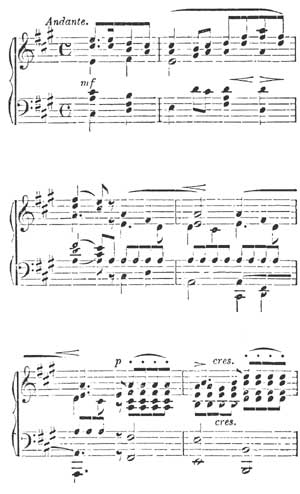
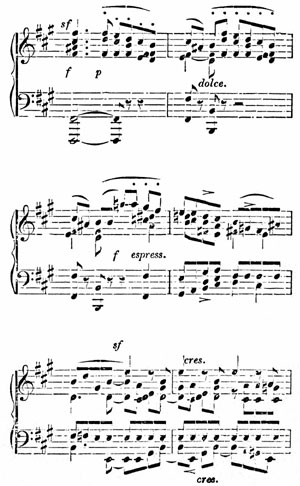
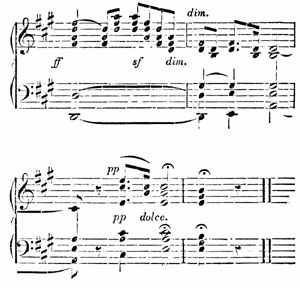
[Listen]
Linz, August 11th, 1830.
Dearest Mother,
"How a travelling musician bore his bad luck in Salzburg." A fragment from the unwritten journal of Count F. M. B. (continuation.) After I had finished my last letter to you, a regular day of misfortunes commenced for me. I took up my pencil, and so entirely destroyed two of my pet sketches, taken in the Bavarian mountains, that I was obliged to tear them from my book, and to throw them out of the window. This provoked me exceedingly; so to divert my mind, I went to the Capuchin Hill: of course I contrived to lose my way, and at the very moment, when I at last found myself on the summit, it began to rain so furiously that I was forced to run down again with all speed under the shelter of an umbrella. Well! I resolved at all events to have a look at the monastery at the foot of the hill, so I rang the bell, when I suddenly recollected that I had not sufficient money to give the monk who was to show the building, and as this is a kind of thing that they take highly amiss, I hurried away without waiting till the porter appeared.
I then closed my packet of letters for Leipzig, and took it myself to the post, but there I was told, that it must first be examined at the Custom-house; so thither I went. They kept me waiting a whole hour, till they composed a certificate of three lines, and behaved so saucily that I was forced to quarrel with them. Hang Salzburg! thought I; so I ordered horses for Ischl, where I hoped to escape from all my bad luck. No horses were to be had without a permission from the police. I went to the police office. "No permission can be granted till you bring your passport." Why pursue the subject? After innumerable delays, and running about hither and thither, the wished-for post-carriage arrived. My dinner was over, my luggage ready, and I thought that at last all was in good train: my bill and the servants fees were paid.
Just as I reached the door, I saw two handsome open carriages approaching at a foot's pace, and the people of the inn hurrying to receive the travellers, who were following on foot. I however paid no attention to the new arrivals, but jumped into my carriage. I observed, that at the same moment, one of the travelling carriages drew up close to mine, and that a lady was seated in it,—but what a lady! That you may not instantly jump to the conclusion that I had suddenly fallen in love, which would have been the crowning point of my unlucky day, I must tell you that she was an elderly lady; but she looked very amiable and benevolent; she wore a black dress, and a massive gold chain, and smiled good-humouredly when she paid the postilion his fare. Heaven knows why I continued to arrange my luggage instead of driving off. I did look across continually at the other carriage, and though the lady was an entire stranger to me I felt a strong inclination to address her. It might be mere imagination on my part, but I do think that she too looked at the dusty traveller in his student's cap. At length she got out of the carriage, and stood close to the door of my vehicle, leaning her hand on it, and I required all my knowledge of the common proprieties of travelling, not to get out myself and say to her, "Dear lady, what may your name be?" Routine however conquered, and I called out with an air of dignity, "Postilion! go on!" on which the lady quickly withdrew her hand, and we set off. I felt in no very pleasant humour, and while thinking over the events of the day, I fell asleep.
A carriage with two gentlemen passing us, woke me up, and the following dialogue ensued between the postilion and myself. I. These gentlemen are coming from Ischl, so I shall probably find no horses there. He. Oh! the two carriages that stopped at the Inn were also from Ischl; still there is no doubt you will get horses. I. Are you sure they came from Ischl? He. Quite sure: they go there every year, and were here last summer also; I drove them. It is a baroness from Vienna, (Heavens! thought I,) and she is dreadfully rich, and has such handsome daughters. When they went to Berchtesgaden to visit the mines, I drove them, and very nice they looked in their miner's dresses: they have a grand estate, and yet they speak to us quite familiarly. Halt! cried I; what name?—Don't know.—Pereira?[4]—Not sure.—Drive back,—said I in a resolute tone.—If I do, we shall not reach Ischl to-night, and we have got over the worst hill; you can learn the name at the next stage.—I hesitated, and we drove on. They did not know the name at the next stage, nor at the following one either. At length, at the end of seven long wearisome hours, we arrived, and before I left the carriage, I said, who were the party who drove to Salzburg this morning in two carriages? and received the quiet reply,—Baroness Pereira; she proceeds to Gastein early to-morrow morning, but returns four or five days hence. Now I had arrived at a certainty, and I also spoke to her driver, who said that none of the family were here. The two gentlemen I met in a carriage on the road, were sons of the Baroness (the very two I had never seen). In addition to all this, I remembered a wretched portrait that I had once got a glimpse of at our aunt H——'s, and the lady in the black dress was Baroness Pereira! Heaven knows when I may have another opportunity of seeing her! I do not think that she ever could have made a more pleasing impression on me, and I shall not assuredly soon forget her attractive appearance, and her kind expression of countenance.
Nothing is more unsatisfactory than a presentiment; we all experience them, but we never discover till too late, that they really were presentiments. I would have returned then and there, and travelled through the night, but I reflected that I should only overtake her at the very moment of her departure, or that possibly she might have left Salzburg before my arrival, and that I should thus frustrate all the plan of my journey to Vienna. At one moment I thought of going to Gastein, but I could not help feeling that Salzburg had treated me very badly, so I once more said adieu, and went to bed very crest-fallen. Next morning I desired that her empty house should be pointed out to me, and made a sketch of it for you, dear mother. My bad luck, however, was still growling in the distance, for I could find no favourable spot to take my sketch from. Besides, they charged me more than a ducat at the inn for one night's entertainment, etc., etc. I gave utterance to various anathemas, both in English and German, and drove away, laying aside among the things of the past, Ischl, Salzburg, Baroness Pereira, and the Traunsee; and so I came on here, where I have taken a day's rest.
To-morrow I intend to pursue my journey, and (D. V.) to sleep in Vienna the day after. I will write to you further from thence. Thus ended my day of misfortunes; "truth, and no poetry," not even the leaning the hand against the door of my carriage is invention; all is a portrait taken from life. The most incomprehensible thing is that I should have totally overlooked Flora, who it seems was also there, for the old lady in a tartan cloak, who went into the inn, was Frau von W——, and the old gentleman with green spectacles who followed her, could not well have been Flora? In short, when things once take a wrong turn, they will have their course. I can write no more to-day, for my disappointment is still too recent; in my next letter I will describe the Salzkammergut, and all the beauties of my journey yesterday. How right Devrient was to advise me to take this route! The Traunstein also, and the Traun Falls, are wonderfully fine; and after all, the world is a very pleasant world, and it is fortunate for me that you are in it, and that I shall find letters from you the day after to-morrow, and possibly much that is agreeable besides. Dear Fanny, I mean now to compose my Non nobis, and the symphony in A minor. Dear Rebecca, if you could hear me singing "Im warmen Thal" in a spasmodic fashion, you would think it rather deplorable; you could sing it better. Oh, Paul! can you declare that you understand the Schein Gulden, W. W. Gulden, heavy Gulden, light Gulden, Conventions Gulden, and the devil and his grandmother's Gulden? I don't, one bit. I wish therefore that you were with me, but for many reasons besides this one. Farewell!
Presburg, September 27th, 1830.
Dear Brother,
Peals of bells, drums and music, carriages on carriages, people hurrying in all directions, everywhere gay crowds, such is the general aspect around me, for to-morrow is to be the coronation of the King, which the whole city has been expecting since yesterday, and are now imploring that the sky may clear up, and wake bright and cheerful, for the grand ceremony which ought to have taken place yesterday was obliged to be deferred on account of the torrents of rain. This afternoon the sky is blue and beautiful, and the moon is now shining down tranquilly on the tumult of the city. To-morrow at a very early hour the Crown Prince is to take his oaths (as King of Hungary) in the large Market-place; he is then to go to church in grand procession, attended by a whole array of bishops and nobles of the realm, and afterwards rides up the Königsberg, which lies opposite my windows, in order to wave his sword towards the banks of the Danube and the four quarters of the globe, in token that he takes possession of his new realm.
This excursion has made me acquainted with a new country; for Hungary with her magnates, her high dignitaries, her Oriental luxury, and also her barbarism, is to be seen here, and the streets offer a spectacle which is to me both novel and striking. We really seem here to approach closer to the East; the miserably obtuse peasants or serfs; the troops of gipsies; the equipages and retainers of the nobles overloaded with gold and gems, (for the grandees themselves are only visible through the closed windows of their carriages); then the singularly bold national physiognomy, the yellow hue, the long moustaches, the soft foreign idiom—all this makes the most motley impression in the world.
Early yesterday I went alone through the streets. First came a long array of jovial officers, on spirited little horses; behind them a crew of gipsies, making music; succeeded by Vienna fashionables, with eye-glasses and kid gloves, conversing with a Capuchin monk; then a couple of uncivilized peasants in long white coats, their hats pressed down on their foreheads, and their straight black hair cut even all round, (they have reddish-brown complexions, a languid gait, and an indescribable expression of savage stupidity and indifference); then came a couple of sharp, acute-looking students of theology, in their long blue coats, walking arm-in-arm; Hungarian proprietors in their dark blue national costume; court servants; and numbers of carriages every moment arriving, covered with mud. I followed the crowd as they slowly moved on up the hill, and so at last I arrived at the dilapidated castle, which commands an extensive view of the whole city and the Danube. People were looking down on all sides from the ancient white walls, and from the towers and balconies; in every corner boys were scribbling their names on the walls for the benefit of posterity; in a small chamber (perhaps once on a time a chapel, or a sleeping-apartment) an ox was in the act of being roasted whole, and as it turned on the spit, the people shouted with delight; a succession of cannons bristled before the castle, destined to bellow forth their appropriate thunders at the coronation.
Below, on the Danube, which runs very rapidly here, darting with the speed of an arrow through the pontoon bridge, lay a new steamer, that had just arrived, laden with strangers; then the extensive view of the flat but wooded country, and meadows overflowed by the Danube; of the embankments and streets swarming with human beings, and mountains clothed with Hungarian vines—all this was not a little strange and foreign. Then the pleasant contrast of living in the same house with the best and most friendly people in the world, and finding novelty doubly interesting in their society. These were really among the happy days, dear brother, that a kind Providence so often and so richly bestows on me.
September 28th, one o'clock.
The King is crowned—the ceremony was wonderfully fine. How can I even try to describe it to you? An hour hence we will all drive back to Vienna, and thence I pursue my journey. There is a tremendous uproar under my windows, and the Burgher-guards are flocking together, but only for the purpose of shouting "Vivat!" I pushed my way through the crowd, while our ladies saw everything from the windows, and never can I forget the effect of all this brilliant and almost fabulous magnificence.
In the great square of the Hospitallers the people were closely packed together, for there the oaths were to be taken on a platform hung with cloth; and afterwards the people were to be allowed the privilege of tearing down the cloth for their own use; close by was a fountain spouting red and white Hungarian wine. The grenadiers could not keep back the people; one unlucky hackney coach that stopped for a moment was instantly covered with men, who clambered on the spokes of the wheels, and on the roof, and on the box, swarming on it like ants, so that the coachman, unable to drive on without becoming a murderer, was forced to wait quietly where he was. When the procession arrived, which was received bare-headed, I had the utmost difficulty in taking off my hat, and holding it above my head; an old Hungarian, however, behind me, whose view it intercepted, quickly devised a remedy, for without ceremony he made a snatch at my unlucky hat, and in an instant flattened it to the size of a cap; then they yelled as if they had all been spitted, and fought for the cloth; in short they were a mob; but my Magyars! the fellows look as if they were born noblemen, and privileged to live at ease, looking very melancholy, but riding like the devil.
When the procession descended the hill, first came the court servants, covered with embroidery, the trumpeters and kettle drums, the heralds and all that class, and then suddenly galloped along the street a mad Count, en pleine carrière, his horse plunging and capering, and the caparisons edged with gold; the Count himself a mass of diamonds, rare herons' plumes, and velvet embroidery (though he had not yet assumed his state uniform, being bound to ride so madly—Count Sandor is the name of this furious cavalier.) He had an ivory sceptre in his hand with which he urged on his horse, causing it each time to rear, and to make a tremendous bound forward.
When his wild career was over, a procession of about sixty more magnates arrived, all in the same fantastic splendour, with handsome coloured turbans, twisted moustaches, and dark eyes. One rode a white horse covered with a gold net; another a dark grey, the bridle and housings studded with diamonds; then came a black charger with purple cloth caparisons. One magnate was attired from head to foot in sky blue, thickly embroidered with gold, a white turban, and a long white dolman; another in cloth of gold, with a purple dolman; each one more rich and gaudy than the other, and all riding so boldly and fearlessly, and with such defiant gallantry, that it was quite a pleasure to look at them. At length came the Hungarian Guards, with Esterhazy at their head, dazzling in gems and pearl embroidery. How can I describe the scene? You ought to have seen the procession deploy and halt in the spacious square, and all the jewels and bright colours, and the lofty golden mitres of the bishops, and the crucifixes glittering in the brilliant sunshine like a thousand stars!
Well, to-morrow, God willing, I proceed on my journey. Now, dear brother, you have a letter, so pray write soon, and let me hear how you are getting on. So you have had an émeute in Berlin? and that, too, an émeute of tailors' apprentices? What did it all mean? Once more I send you my farewell from Germany, my dear parents, and brother and sisters. I am leaving Hungary for Italy, and thence I hope to write to you more frequently and more at leisure. Be of good cheer, dear Paul, and go forwards in a confident spirit; rejoice with those that rejoice, and do not forget the brother who is wandering about the world.
Yours, Felix.
Venice, October 10th, 1830.
Italy at last! and what I have all my life considered as the greatest possible felicity, is now begun, and I am basking in it. The day has been so fruitful in enjoyment, that I must, now that it is evening, endeavour to collect my thoughts a little to write to you, my dear parents, and to thank you for having bestowed such happiness on me. You also, my dear brother and sisters, are often in my thoughts. How much I wish for you, Paul, to be with me here, once more to enjoy your delight in our rapid travels by sea and by land; and I should like to prove to you, Hensel, that the "Assumption of the Blessed Virgin" is the most divine work ever produced by the hands of man. You are not here, however, so I am obliged to give vent to my enthusiasm in bad Italian to the laquais de place, who stands still and listens.
I shall however become quite confused, if things are to go on as they have done on this first day, when every hour brought with it so much never to be forgotten, that I do not know where to find sufficient grasp of intellect to comprehend it all properly. I saw the "Assumption," then a whole gallery of paintings in the Manfrini Palace; then a church festival in the church where hangs Titian's St. Peter; afterwards St. Mark's, and in the afternoon I had a row on the Adriatic, and visited the public gardens, where the people lie on the grass and eat. I then returned to the Piazza of St. Mark, where in the twilight there is always an immense crowd and crush of people; and all this I was obliged to see to-day, because there is so much that is novel and interesting to be seen to-morrow.
But I must now relate methodically how I came hither by water, (for, as Telemachus says, to do so by land would be no easy matter,) and so I begin my history at Gratz, which is certainly the most tiresome hole in the world, and where you yawn all day; and why should I have stayed a single day longer, on account of a (he) relation? How can a traveller with any experience possibly accept of a brother, who is also an ensign, in the place of a charming mother and sister? In short, the man did not know what to do with me, for which I forgive him freely, and shall not defame him to his mother, when I perform my promise and write to her; but he took me to the theatre to see the "Rehbock," the most wretched, silly, objectionable piece that the late Kotzebue ever wrote; and moreover he declared it to be very good and very amusing, and this is not to be forgiven, for this Rehbock has such a haut goût or fumet, that it could not even please a cat: but at all events I have left Gratz, for here I am in Venice.
My old vetturino woke me up at four o'clock in the dark, and the horse crawled off with us both. I thought of you, dear father, at least a hundred times during our journey of two days. You would certainly have gone wild with impatience, and possibly assaulted the coachman also, for at every little declivity, he got slowly off the box, deliberately put on the drag, and crept up the smallest hill at a snail's pace; then he thought fit to walk beside his horses for a time, to stretch his legs: every possible conveyance passed us on the road, even when drawn by dogs or donkeys, and when at last, at a steep hill, the fellow put on two oxen as leaders, whose pace exactly corresponded with that of his horse, I had the greatest difficulty in not belabouring him, indeed I did so more than once; but he then gravely assured me that we were going at a capital pace, and I had no means of proving the contrary. Moreover he always passed the night in the most detestable pot-houses, starting again at four o'clock in the morning, so on arriving at Klagenfurt I was fairly worn out; but when in answer to my question as to the time the Venetian diligence set out, I received the answer,—in an hour hence,—I seemed to revive. I was promised a place, and I also got a good supper. The diligence, indeed, did not arrive for two hours after its time, having been detained by deep snow on the Sömmering, but still it came at last. Three Italians were inside, and chattered so that I could scarcely get to sleep, but my snoring fairly silenced them after a time.
At last morning broke, and as we drove into Resciutta, the driver said, that on the other side of the bridge there, no one understood a word of German. I therefore took leave of my mother tongue for a long time to come, and we drove over the bridge. The style of the houses immediately beyond was entirely different. The flat roofs with their convex tiles, the deep windows, the high white walls, and lofty square towers, all betokened another land. The pale olive faces of the men, the innumerable beggars who besieged the carriage, the various small chapels, brightly and carefully painted on every side with flowers, the nuns, monks, and so forth, were all symptomatic of Italy. The monotonous character of the whole scenery however, and of the road we were travelling, passing through bare white rocks, along the banks of a river with a rough rocky bed, in summer creeping along in the form of a tiny brook, certainly does not seem characteristic of Italy. "I purposely made this passage rather meagre, in order that the subject might be more distinctly heard," says Abt Vogler; and I almost think that Providence has done pretty much the same here, for when we had passed Ospedaletto the subject did come out well, and a fine sight it was. I had imagined that the first impression of Italy would be like that of a sudden explosion, violent and startling; I have not hitherto found this to be the case. The effect produced on me has been rather that of a genial warmth, mildness and cheerfulness, and an indescribable sensation of pervading content and satisfaction.
After passing Ospedaletto we entered a plain, leaving the blue mountains behind us; the sun shone bright and warm through the foliage of the vines; the road winding through orchards, in which the trees were connected by trailing boughs. I felt as if I were at home again, and knew every object, and was once more about to take possession of it all. The carriage too seemed to fly over the smooth road, and towards evening we arrived at Udine, where we passed the night, when for the first time I ordered my supper in Italian, my tongue skating as if on slippery ice, first gliding into English, and then stumbling afresh. Moreover next morning I was famously cheated, but I did not in the least care, and on we went. It happened to be Sunday, and on every side people were coming along, in bright southern costumes, and flowers; the women with roses in their hair. Light single-horse carriages drove past, and men were riding to church on donkeys; at the inns, groups of idlers were to be seen in the most picturesque, indolent attitudes: among others, one man placed his arm quietly round his wife's waist, and swung round with her and then they went on their way; this sounds trivial enough, and yet it had a pretty effect. Venetian villas now were occasionally visible from the road, and by degrees became more frequent, till at length our way led past houses, trees, and gardens like a park. The whole country had a gay festive air, as if a Prince were expected to make his grand entry, and the vine-branches with their rich purple grapes hanging in festoons from the trees, made the most lovely of all festive wreaths. The inhabitants were all gaily dressed and adorned, and a few scattered cypresses only enhanced the general effect.
In Treviso there was an illumination, paper lanterns suspended in every part of the great square, and a large gaudy transparency in the centre. Some most lovely girls were walking about, in their long white veils and scarlet petticoats. It was quite dark when we arrived at Mestre last night, when we got into a boat, and in a dead calm, gently rowed across to Venice. On our passage thither, where nothing but water is to be seen, and distant lights, we saw a small rock which stands in the midst of the sea; on this a lamp was burning; all the sailors took off their hats as we passed, and one of them said, this was the "Madonna of Tempests," which are often most dangerous and violent here. We then glided quietly into the great city, under innumerable bridges, without sound of post-horns, or rattling of wheels, or toll-keepers; the passage now became more thronged, and numbers of ships were lying near; past the theatre, where gondolas in long rows lie waiting for their masters, just as our own carriages do at home, then into the great canal, past the church of St. Mark, the Lions, the palace of the Doges, and the Bridge of Sighs. The obscurity of night only enhanced my delight on hearing the familiar names, and seeing the dark outlines.
And so I am actually in Venice! Well, to-day I have seen the finest pictures in the world, and have at last personally made the acquaintance of a very admirable man, whom hitherto I only knew by name—I allude to a certain Signor Giorgione, an inimitable artist—and also to Pordenone, who paints the most noble portraits, both of himself and many of his simple scholars, in such a devout, faithful, and pious spirit, that you seem to converse with him, and to feel an affection for him. Who would not have been confused by all this? But if I am to speak of Titian, I must do so in a more reverent mood. Till now, I never knew that he was the felicitous artist I have this day seen him to be. That he thoroughly enjoyed life, in all its beauty and fulness, the picture in Paris proves; but he has fathomed the depths of human sorrow, as well as the joys of Heaven. His glorious "Entombment," and also the "Assumption," fully evince this. How Mary floats on the cloud, while a waving movement seems to pervade the whole picture; how you see at a glance her very breathing, her awe, and piety, and in short a thousand feelings,—all words seem poor and commonplace in comparison! The three angels too, on the right of the picture, are of the highest order of beauty,—pure, serene loveliness, so unconscious, so bright and so seraphic. But no more of this! or I must perforce become poetical, or indeed am so already, and this does not at all suit me; but I shall certainly see it every day.
I must however say a few words about the "Entombment," as you have the engraving. Look at it, and think of me. This picture represents the conclusion of a great tragedy: so still, so grand, and so acutely painful. Magdalene is supporting Mary, fearing that she will die of anguish; she endeavours to lead her away, but looks round herself once more, evidently wishing to imprint this spectacle indelibly on her heart, thinking that it is for the last time; it surpasses everything; and then the sorrowing John, who sympathizes and suffers with Mary; and Joseph, who absorbed in his piety, and occupied with the tomb, directs and conducts the whole; and Christ himself, lying there so tranquil, having endured to the end: then the blaze of brilliant colour, and the gloomy mottled sky! It is a composition that speaks to my heart and fills me with enthusiasm, and will never leave my memory.
I believe few things I have yet to see in Italy will affect me so deeply; but you know that I am devoid of all prejudices, and I give you a fresh proof of this by telling you that the "Martyrdom of St. Peter," from which I expected the most, pleased me the least of the three; it did not strike me as being a complete whole; the landscape, which is very fine, seemed to me to predominate too much. Then I was dissatisfied with the disposition in the picture of two victims and only one murderer; (for the small figure in the distant background does not remedy this). I could not bring myself to consider it a martyrdom. But probably I am in error, and I intend to study it more carefully to-morrow; my contemplation of it, besides, was disturbed by some one strumming most sacrilegiously on the organ, and these sacred forms were forced to listen to such miserable opera finales! But this matters not: where such pictures are, I require no organist. I play the organ in my thoughts for myself, and feel as little irritated by such trash as I should be by an ignorant rabble. Titian, however, was a man well adapted to improve others; so I shall try to profit by him, and to rejoice that I am in Italy. At this moment the gondoliers are shouting to each other, and the lights are reflected in the depths of the waters; one is playing a guitar, and singing to it. It is a charming night. Farewell! and think of me in every happy hour as I do of you.
Felix.
To Professor Zelter.[5]
Venice, October 16th, 1830.
Dear Professor,
I have entered Italy at last, and I intend this letter to be the commencement of a regular series of reports, which I purpose transmitting to you, of all that appears to me particularly worthy of notice. Though I only now for the first time write to you, I must beg you to impute the blame to the state of constant excitement in which I lived, both in Munich and in Vienna. It was needless for me to describe to you the parties in Munich, which I attended every evening, and where I played the piano more unremittingly than I ever did in my life before; one soirée succeeding another so closely, that I really had not a moment to collect my thoughts. Moreover, it would not have particularly interested you, for after all, "good society which does not offer materials for the smallest epigram," is equally vapid in a letter. I hope that you have not taken amiss my long silence, and that I may expect a few lines from you, even if they contain nothing save that you are well and cheerful.
The aspect of the world at this moment is very bleak and stormy, and much that was once thought durable and unchangeable, has been swept away in the course of a couple of days. It is then doubly welcome to hear well-known voices, to convince us that there are certain things which cannot be annihilated or demolished, but remain firm and steadfast. You must know that I am at this moment very uneasy at not having received any news from home for some weeks past. I found no letters from my family, either at Trieste or here, so a few lines from you, written in your old fashion, would both cheer and gratify me, especially as it would prove that you think of me with the same kindness that you have always done from my childhood to the present time.
My family have no doubt told you of the exhilarating impression made on me by the first sight of the plains of Italy. I hurry from one enjoyment to another hour by hour, and constantly see something novel and fresh; but immediately on my arrival I discovered some masterpieces of art, which I study with deep attention, and contemplate daily for a couple of hours at least. These are three pictures by Titian. The "Presentation of Mary as a Child in the Temple;" the "Assumption of the Virgin;" and the "Entombment of Christ." There is also a portrait by Giorgione, representing a girl with a cithern in her hand, plunged in thought, and looking forth from the picture in serious meditation (she is apparently about to begin a song, and you feel as if you must do the same): besides many others.
To see these alone would be worth a journey to Venice; for the fruitfulness, genius, and devotion of the great men who painted these pictures, seem to emanate from them afresh as often as you gaze at their works, and I do not much regret that I have scarcely heard any music here; for I suppose I must not venture to include the music of the angels, in the "Assumption," encircling Mary with joyous shouts of welcome; one gaily beating the tambourine, a couple of others blowing away on strange crooked flutes, while another charming group are singing—or the music floating in the thoughts of the cithern player. I have only once heard anything on the organ, and miserable it was. I was gazing at Titian's "Martyrdom of St. Peter" in the Franciscan Church. Divine service was going on, and nothing inspires me with more solemn awe than when on the very spot for which they were originally created and painted, those ancient pictures in all their grandeur, gradually steal forth out of the darkness in which the long lapse of time has veiled them.
As I was earnestly contemplating the enchanting evening landscape with its trees, and angels among the boughs, the organ commenced. The first sound was quite in harmony with my feelings; but the second, third, and in fact all the rest, quickly roused me from my reveries, and sent me straight home, for the man was playing in church and during divine service, and in the presence of respectable people, thus:
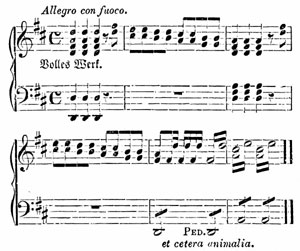
[Listen]
with the "Martyrdom of St. Peter" actually close beside him! I was therefore in no great hurry to make the acquaintance of the organist. There is no regular Opera here at this moment, and the gondoliers no longer sing, Tasso's stanzas; moreover, what I have hitherto seen of modern Venetian art, consists of poems framed and glazed on the subject of Titian's pictures, or Rinaldo and Armida, by a new Venetian painter, or a St. Cecilia by a ditto, besides various specimens of architecture in no style at all; as all these are totally insignificant, I cling to the ancient masters, and study how they worked. Often, after doing so, I feel a musical inspiration, and since I came here I have been busily engaged in composition.
Before I left Vienna, a friend of mine made me a present of Luther's Hymns, and on reading them over I was again so much struck by their power, that I intend to compose music for several next winter. I have nearly completed here the choral "Aus tiefer Noth," for four voices a capella; and the Christmas hymn, "Vom Himmel hoch," is already in my head. I wish also to set the following hymns to music: "Ach Gott, vom Himmel sieh darein," "Wir glauben all' an einen Gott," "Verleih uns Frieden," "Mitten wir im Leben sind," and finally "Ein' feste Burg." The latter, however, it is my intention to compose for a choir and orchestra. Pray write to me about this project of mine, and say whether you approve of my retaining the ancient melodies in them all, but not adhering to them too strictly: for instance, if I were to take the first verse of "Vom Himmel hoch" as a separate grand chorus. Besides this, I am hard at work at an orchestral overture, and if an opportunity for an opera offered it would be most welcome.
I finished two pieces of sacred music in Vienna—a choral in three movements for chorus and orchestra ("O! Haupt voll Blut und Wunden") and an Ave Maria for a choir of eight voices, a capella. The people I associated with there were so dissipated and frivolous, that I became quite spiritually-minded, and conducted myself like a divine among them. Moreover, not one of the best pianoforte players there, male or female, ever played a note of Beethoven, and when I hinted that he and Mozart were not to be despised, they said, "So you are an admirer of classical music?"—"Yes," said I.
To-morrow I intend to go to Bologna to have a glance at the St. Cecilia, and then proceed by Florence to Rome, where I hope (D. V.) to arrive eight or ten days hence. I will then write to you more satisfactorily. I only wished to make a beginning to-day, and to beg you not to forget me, and kindly to accept my heartfelt wishes for your health and happiness. Your faithful
Felix.
Florence, October 23rd, 1830.
Here am I in Florence, the air warm and the sky bright; everything is beautiful and glorious, "wo blieb die Erde," as Goethe says. I have now received your letter of the 3rd, by which I see that you are all well, that my anxiety was needless, that you are all going on as usual, and thinking of me; so I feel happy again, and can now see everything, and enjoy everything, and am able to write to you; in short, my mind is at rest on the main point. I made my journey here amid a thousand doubts and fears, quite uncertain whether to go direct to Rome, because I did not expect any letters at Florence. Fortunately, however, I decided on coming here, and now it is of no consequence how the misunderstanding arose, that caused me to wait for letters in Venice, while you had written to Florence; all I can promise is to endeavour in future to be less over-anxious. My driver pointed out a spot between the hills, on which lay a blue mist, and said "Ecco Firenze!" I eagerly looked towards the place, and saw the round dome looming out of the mist before me, and the spacious wide valley in which the city is situated. My love of travel revived when at last Florence appeared. I looked at some willow-trees (as I thought) beside the road, when the driver said, "Buon olio," and then I saw that they were hanging full of olives.
My driver, as a genus, is undoubtedly a most villanous knave, thief, and impostor; he has cheated me and half-starved me, and yet I think him almost amiable from his enthusiastic animal nature. About an hour before we arrived in Florence he said that the beautiful scenery was now about to commence; and true it is that the fair land of Italy does first begin then. There are villas on every height, and decorated old walls, with sloping terraces of roses and aloes, flowers and grapes and olive leaves, the sharp points of cypresses, and the flat tops of pines, all sharply defined against the sky; then handsome square faces, busy life on the roads on every side, and at a distance in the valley, the blue city.
So I drove confidently into Florence in my little open carriage, and though I looked shabby and dusty, like one coming from the Apennines, I cared little for that. I passed recklessly through all the smart equipages from which the most refined English ladies looked at me; while I thought it may one day actually come to pass that you who are now looking down on the roturier, may shake hands with him, the only difference being a little clean linen and so forth. By the time that we came to the battisterio, I no longer felt diffident, but gave orders to drive to the Post, and then I was really happy, for I received three letters,—yours of the 22nd and the 3rd, and my father's also. I was now quite delighted, and as we drove along beside the Arno, to Schneider's celebrated hotel, the world seemed once more a very pleasant world.
October 24th.
The Apennines are really not so beautiful as I had imagined; for the name always suggested to me richly wooded, picturesque hills, covered with vegetation, whereas they are merely a long chain of melancholy bleak hills; and the little verdure there is, not gratifying to the eye. There are no dwellings to be seen, no merry brooks or rills; only an occasional stream, its broad bed dried up, or a little water-channel. Add to this the shameful roguery of the inhabitants: really, at last, I became quite confused and perplexed, by their incessant cheating, and could scarcely discover for what object they were lying. I therefore, once for all, invariably protested against every demand they made, and declared that I would not pay at all if they asked more than I chose to give; so in this way I managed very tolerably.
Last night I was again in grand quarters: I had made an agreement with the vetturino for board and lodging, and all I required. The natural consequence was, that the fellow took me to the most detestable little inns, and actually starved me. So late yesterday we arrived at a solitary pothouse, the filth of which no pen can describe. The stair was strewed with heaps of dead leaves and firewood; moreover the cold was intense, and they invited me to warm myself in the kitchen, which I agreed to do. A bench was placed for me beside the fire; a whole troop of peasants were standing about, also warming themselves. I looked quite regal from my bench on the hearth among this rough set of fellows, who, in their broad-leaved hats, lit up by the fire, and babbling in their incomprehensible dialect, looked vastly suspicious characters. I made them prepare my soup under my own eyes, giving moreover good advice on the subject; but, after all, it was not eatable.
I entered into conversation with my subjects from my throne on the hearth, and they pointed out to me a little hill in the distance incessantly vomiting forth flames, which had a singular effect in the dark ("Raticosa" is the name of the hill), and then I was conducted to my bed-room. The landlord took hold of the sackcloth sheets, and said, "Very fine linen!" but I slept as sound as a bear, and before falling asleep I said to myself, Now you are in the Apennines: and next morning, after getting no breakfast, my vetturino civilly asked me how I liked my night's entertainment. The fellow talked a great deal of nonsense about politics, and the present state of France, abused his horse in German for being born in Switzerland, and spoke French to the beggars who swarmed round the cabriolet, while I corrected many a fault in his pronunciation.
October 25th.
I now intend to go once more to the Tribune, to be inspired with feelings of reverence. There is a particular place where I like to sit, as the little Venus de' Medici is directly opposite, and above, that of Titian, and by turning rather to the left, I have a view of the Madonna del Cardello, a favourite picture of mine, and which invariably reminds me of la belle Jardinière, and seems to me a kindred creation; and also the Fornarina, which made no great impression on me from the first, for I know the engraving, which is very faithful, and the face has, I think, a most disagreeable and even ordinary expression. In gazing thus, however, at the two Venuses, their loveliness inspires a feeling of piety; it is as if the two spirits who could produce such creations, were flying through the hall and grasping you as they passed.
Titian must have been a marvellous man, and enjoyed his life in his works; still the fair Medici is not to be slighted, and then the divine Niobe with all her children: while we gaze at her, we can find no words. I have not yet been to the Pitti Palace, which possesses the Saint Ezekiel, and the Madonna della Sedia, of Raphael. I saw the gardens of the palace yesterday in sunshine; they are superb, and the thick solid stems of the myrtles and laurels, and the innumerable cypresses, made a strange exotic impression on me; but when I declare that I consider beeches, limes, oaks, and firs, ten times more beautiful and picturesque, I think I hear Hensel exclaim, "Oh, the northern bear!"
October 30th.
After the soft rain of yesterday, the air is so mild and genial, that I am at this moment seated at the open window writing to you; and indeed it is pleasant enough to see the people going about the streets, offering the prettiest baskets of flowers, fresh violets, roses, and pinks. Two days ago, being satiated with all pictures, statues, vases, and museums, I resolved to take a long walk till sunset; so after buying a bunch of narcissuses and heliotropes, I went up the hill through the vineyards. It was one of the most delightful walks I ever remember; every one must feel revived and refreshed at the sight of nature in such a garb as this, and a thousand happy thoughts passed through my mind.
First of all, I went to a villa called Bello Sguardo, whence the whole of Florence and its spacious valley are to be seen, and I thoroughly enjoyed the view of the superb city and its massive towers and palaces. But most of all I admired the countless villas, covering every hill and every acclivity as far as the eye can reach, as if the city extended beyond the mountains into the far distance. And when I took up a telescope and looked down on the valley through the blue mists, every portion of it seemed thickly dotted with bright objects and white villas, while such a large circle of dwellings inspired me with a feeling of home and comfort.
I proceeded far over the hills to the highest point I could see, on which stood an ancient tower, and when I reached it I found all the people throughout the building busily engaged in making wine, drying grapes, and repairing casks. It proved to be Galileo's tower, from which he used to make his discoveries and observations; from here also there was a very extensive view, and the girl who took me to the roof of the tower related a number of stories in her peculiar dialect, which I scarcely understood at all; but she afterwards presented me with some of her sweet dried grapes, which I ate with great gusto. And so I went on to another tower I saw at a distance, but could not manage to find my way; and examining my map as I went along, I stumbled on a traveller busily searching his map also; the only difference between us being, that he was an old Frenchman with green spectacles, who addressed me thus, "È questo S. Miniato al Monte, Signor?" With admirable decision I replied, "Sì, Signor;" and it turned out that I was right. A. F—— immediately recurred to my memory, as she had advised me to see this monastery, which is indeed wonderfully fine.
When I tell you I went from there to the Boboli Gardens, where I saw the sun set, and at night enjoyed the brightest moonlight, you may imagine how much I was invigorated by my ramble. I will write to you about the pictures here some other time, for to-day it is too late, as I have still to take leave of the Pitti Palace and the great Gallery, and to gaze once more at my Venus, who is not indeed mentioned before ladies, but whose beauty is truly divine. The courier goes at five o'clock, and God willing, I shall be in Rome the day after to-morrow. From thence you shall hear again.
Felix.
Rome, November 2nd, 1830.
... I refrain from writing longer in this melancholy strain; for just as your letter, after a lapse of fourteen days, has saddened me, my answer will have the same effect on you fourteen days hence. You would write to me in the same style, and so it might go on for ever. As four weeks must pass before I can receive any answer, I feel that I ought to restrict myself to relating events past and present, and not dwell much on the particular frame of my mind at the moment, which is indeed usually sufficiently manifest in the narrative given, and the various occurrences described.
I have scarcely yet arrived at the conviction that I am now actually in Rome; and when yesterday, just as day was breaking, I drove across a bridge with statues, under a deep blue sky, and in dazzling white moonlight, and the courier said, "Ponte Molle," it all seemed to me like a dream, and at the same moment I saw before me my sick-bed in London a year ago, and my rough Scotch journey, and Munich, and Vienna, and the pines on these hills. The journey from Florence to Rome has very few attractions. Siena, which is, I understand worth seeing, we passed through during the night. It was unpleasant to see a regular Government courier compelled to take a military escort, which was doubled at night; still it must be absolutely necessary, as he is obliged to pay for it. In these days this ought not to be the case. In the meantime everything progresses, and there are moments when the bound forwards is actually visible.
I was still in Florence, waiting for the departure of the post, reading a French newspaper, when at the very moment the bell sounded, I read among the advertisements, "Vie de Siebenkäs, par Jean Paul." Many reflections occurred to me as to so many men of renown gradually vanishing from our sight, and our great geniuses having such homage paid to them after their death, and yet during their life, Lafontaine's novels and French vaudevilles alone make any impression on their fellow-countrymen; while we only strive to appreciate the very refuse of the French, and neglect Beaumarchais and Rousseau. However, it matters little after all.
The first thing connected with music that I met with here, was the "Tod Jesu," by Graun, which an Abbate here, Fortunato Santini, has translated faithfully and admirably into Italian. It appears that the music of this heretic has been sent along with the translation to Naples, where it is to be produced this winter at a great festival, and I hear that the musical world there are quite enchanted with it, and are studying the work with infinite love and enthusiasm. I understand that the Abbate has been long impatiently expecting me, because he hopes to obtain considerable information from me about German music, and thinks I may also have the score of Bach's "Passion." Thus music progresses onwards, as sure to pierce through as the sun; if mists still prevail, it is merely a sign that the spring-time has not yet come, but come again it must and will! Farewell! and from my heart I say,—May a merciful Providence preserve you all in health and happiness!
Felix.
Rome, November 8th, 1830.
I must now write to you of my first week in Rome; how I have arranged my time, how I look forward to the winter, and what impression the glorious objects by which I am surrounded have made on me; but this is no easy task. I feel as if I were entirely changed since I came here. Formerly when I wished to check my haste and impatience to press forward, and to continue my journey more rapidly, I attributed this eagerness merely to the force of habit, but I am now fully persuaded that it arose entirely from my anxiety to reach this goal. Now that I have at last attained it my mood is so tranquil and joyous, and yet so earnest, that I shall not attempt to describe it to you. What it is that thus works on me I cannot exactly define; for the awe-inspiring Coliseum, and the brilliant Vatican, and the genial air of spring, all contribute to make me feel thus, and so do the kindly people, my comfortable apartments, and everything else. At all events I am different from what I was. I am better in health and happier than I have been for a long time, and take delight in my work, and feel such an inclination for it, that I expect to accomplish much more than I anticipated; indeed, I have already done a good deal. If it pleases Providence to grant me a continuation of this happy mood, I look forward to the most delightful and productive winter.
Picture to yourself a small house, with two windows in front, in the Piazza di Spagna, No. 5 which all day long enjoys the warm sun, and an apartment on the first floor, where there is a good Viennese grand piano: on the table are some portraits of Palestrina, Allegri, etc., along with the scores of their works, and a Latin psalm-book, from which I am to compose the Non Nobis;—such is my present abode. The Capitol was too far away, besides I had a great dread of the cold air, which here I have no cause to guard against; for when I look out of my window in the morning across the square, I see every object sharply defined in the sunshine against the blue sky. My landlord was formerly a captain in the French army, and his daughter has the most splendid contralto voice I ever heard. Above me lives a Prussian captain, with whom I talk politics,—in short, the situation is excellent.
When I come into the room early in the morning, and see the sun shining so brightly on the breakfast-table (you see I am marred as a poet), I feel so cheerful and comfortable, for it is now far on in the autumn, and who in our country at this season looks for warmth, or a bright sky, or grapes and flowers? After breakfast I begin my work, and play, and sing, and compose till near noon. Then Rome in all her vast dimensions lies before me like an interesting problem to enjoy; but I go deliberately to work, daily selecting some different object appertaining to history. One day I visit the ruins of the ancient city; another I go to the Borghese gallery, or to the Capitol, or St. Peter's, or the Vatican. Each day is thus made memorable, and as I take my time, each object becomes firmly and indelibly impressed on me. When I am occupied in the forenoon I am willing to leave off, and should like to continue my writing, but I say to myself that I must see the Vatican, and when I am actually there, I equally dislike leaving it; thus each of my occupations causes me the most genuine pleasure, and one enjoyment follows another.
Just as Venice, with her past, reminded me of a vast monument: her crumbling modern palaces, and the perpetual remembrance of former splendour, causing sad and discordant sensations; so does the past of Rome suggest the impersonation of history; her monuments elevate the soul, inspiring solemn yet serene feelings, and it is a thought fraught with exultation that man is capable of producing creations, which, after the lapse of a thousand years, still renovate and animate others. When I have fairly imprinted an object like this on my mind, and each day a fresh one, twilight has usually arrived and the day is over.
I then visit my friends and acquaintances, when we mutually communicate what each has done, which means enjoyed here, and are reciprocally pleased. I have been most evenings at Bendemann's and Hübner's, where German artists usually assemble, and I sometimes go to Schadow's. The Abbate Santini is a valuable acquaintance for me, as he has a very complete library of ancient Italian music, and he kindly gives or lends me anything I like, for no one can be more obliging. At night he makes either Ahlborn or me accompany him home, as an Abbate being seen alone at night in the streets would bring him into evil repute. That such youngsters as Ahlborn and I should act as duennas to a priest of sixty is diverting enough.
The Duchess of —— gave me a list of old music which she was anxious to procure copies of if possible. Santini's collection contains all this, and I am much obliged to him for having furnished me with copies, for I am now looking through them all, and becoming acquainted with them. I beg you will send me for him, as a token of my gratitude, the six cantatas of Sebastian Bach, published by Marx at Simrock's, or some of his pieces for the organ. I should however prefer the cantatas: he already has the "Magnificat" and the Motets, and others. He has translated the "Singet dem Herrn ein neues Lied," and intends it to be executed at Naples, for which he deserves a reward. I am writing to Zelter all particulars about the Papal singers, whom I have heard three times,—in the Quirinal, in the Monte Cavallo, and once in San Carlo.
I look forward with delight to seeing Bunsen, we shall have much to discuss together, and I have likewise an idea that he has got some work for me; if I can conscientiously undertake it, I will do so gladly, and render it all the justice in my power. Among my home pleasures I include that of reading for the first time Goethe's Journey to Italy; and I must avow that it is a source of great satisfaction to me to find that he arrived in Rome the very same day that I did; that he also went first to the Quirinal, and heard a Requiem there; that he was seized with the same fit of impatience in Florence and Bologna; and felt the same tranquil, or as he calls it, solid spirit here: indeed, everything that he describes, I exactly experience myself, so I am pleased.
He speaks in detail of a large picture of Titian's in the Vatican, and declares that its meaning is not to be devised; only a number of figures standing beautifully grouped together. I fancy, however, that I have discovered a very deep sense in it, and I believe that whoever finds the most beauties in Titian, is sure to be most in the right, for he was a glorious man. Though he has not had the opportunity of displaying and diffusing his genius here, as Raphael has done in the Vatican, still I can never forget his three pictures in Venice, and to these I may add the one in the Vatican, which I saw for the first time this morning. If any one could come into the world with full consciousness, every object around would smile on him with the same vivid life and animation, that these pictures do on us. "The School of Athens," and the "Disputa," and the "Peter," stand before us precisely as they were created; and then the entrance through splendid open arches, whence you can see the Piazza of St. Peter's, and Rome, and the blue Alban hills; and above our heads figures from the Old Testament, and a thousand bright little angels, and arabesques of fruit, and garlands of flowers; and then on to the gallery!
You may well be proud, dear Hensel, for your copy of the "Transfiguration" is superb! The pleasing emotion which seizes me, when I see for the first time some immortal work, and the pervading idea and chief impression it inspires, I did not experience on this occasion from the original, but from your copy. The first effect of this picture to-day, was precisely the same that yours had previously made on me; and it was not till after considerable research and contemplation that I succeeded in finding out anything new to me. On the other hand, the Madonna di Foligno dawned on me in the whole splendour of her loveliness. I have passed a happy morning in the midst of all these glorious works; as yet I have not visited the statues, but have reserved my first impression of them for another day.
November 9th, morning.
Thus every morning brings me fresh anticipations, and every day fulfils them. The sun is again shining on my breakfast-table and I am now going to my daily work. I will send you, dear Fanny, by the first opportunity, what I composed in Vienna, and anything else that may be finished, and my sketch-book to Rebecca; but I am far from being pleased with it this time, so I intend to study attentively the sketches of the landscape painters here, in order to acquire if possible a new manner. I tried to produce one of my own, but it would not do!
To-day I am going to the Lateran, and the ruins of ancient Rome; and in the evening to a kind English family, whose acquaintance I made here. Pray send me a good many letters of introduction. I am exceedingly anxious to know numbers of people, especially Italians. So I live on happily, and think of you in every pleasant moment. May you also be happy, and rejoice with me at the prospect which lies before me here!
Felix M. B.
Rome, November 16th, 1830.
Dear Fanny,
No post left this the day before yesterday, and I could not talk to you, so when I remembered that my letter must necessarily remain two days before it left Rome, I felt it impossible to write; but I thought of you times without number, and wished you every happiness, and congratulated myself that you were born a certain number of years ago. It is, indeed, cheering to think what charming, rational beings, are to be found in the world; and you are certainly one of these. Continue cheerful, bright, and well, and make no great change in yourself. I don't think you require to be much better; may good fortune ever abide with you!
And now I think these are all my birthday good wishes; for really it is not fair to expect that a man of my calibre should wish you also a fresh stock of musical ideas; besides you are very unreasonable in complaining of any deficiency in that respect. Per Bacco! if you had the inclination, you certainly have sufficient genius to compose, and if you have no desire to do so, why grumble so much? If I had a baby to nurse, I certainly should not write any scores, and as I have to compose Non Nobis, I cannot unluckily carry my nephew about in my arms. But to speak seriously, your child is scarcely six months old yet, and you can think of anything but Sebastian?[6] (not Bach!) Be thankful that you have him. Music only retreats when there is no longer a place for her, and I am not surprised that you are not an unnatural mother. However, you have my best wishes on your birthday, for all that your heart desires; so I may as well wish you half-a-dozen melodies into the bargain; not that this will be of much use.
In Rome here, we celebrated the 14th of November by the sky shining, in blue and festive array, and breathing on us warm genial air. So I went on pleasantly towards the Capitol and into church, where I heard a miserable sermon from ——, who is no doubt a very good man, but to my mind has a most morose style of preaching; and any one who could irritate me on such a day, in the Capitol, and in church, must have an especial talent for so doing. I afterwards went to call on Bunsen, who had just arrived. He and his wife received me most kindly, and we conversed on much that was interesting, including politics and regrets for your absence. Apropos, my favourite work that I am now studying is Goethe's 'Lili's Park,' especially three portions: "Kehr' ich mich um, und brumm:" then, "Eh la menotte;" and best of all, "Die ganze Luft ist warm, ist blüthevoll," where decidedly clarionets must be introduced. I mean to make it the subject of a scherzo for a symphony.
Yesterday, at dinner at Bunsen's, we had among others a German musician. Oh, heavens! I wish I were a Frenchman! The man said to me, "Music must be handled every day." "Why?" replied I, which rather embarrassed him. He also spoke of earnest purpose; and said that Spohr had no earnest purpose, but that he had distinctly discerned gleams of an earnest purpose in my Tu es Petrus. The fellow, however, has a small property at Frascati, and is about to lay down the profession of music. We have not got so far as that yet!
After dinner came Catel, Eggers, Senf, Wolf, then a painter, and then two more, and others. I played the piano, and they asked for pieces by Sebastian Bach, so I played numbers of his compositions, which were much admired. I also explained clearly to them the mode in which the "Passion" is executed; for they seemed scarcely to believe it. Bunsen possesses it, arranged for the piano; he showed it to the Papal singers, and they said before witnesses, that such music could not possibly be executed by human voices. I think the contrary. It seems, however, that Trautwein is about to publish the score of the Passion of St. John. I suppose I must order a set of studs for Paris, à la Back.
To-day Bunsen is to take me to Baini's, whom he has not seen for a year as he never goes out except to hear confessions. I am glad to know him, and shall endeavour to improve my intimacy with him, for he can solve many an enigma for me. Old Santini continues as kind as ever. When we are together in society, if I praise any particular piece or am not acquainted with it, next morning he is sure to knock gently at my door, and to bring me the piece in question carefully wrapped up in a blue pocket-handkerchief; I, in return, accompany him home every evening; and we have a great regard for each other. He also brought me his Te Deum, written in eight parts, requesting me to correct some of the modulations, as G major predominates too much; so I mean to try if I cannot introduce some A minor or E minor.
I am now very anxious to become acquainted with a good many Italians. I visit at the house of a certain Maestro di San Giovanni Laterano, whose daughters are musical, but not pretty, so this does not count for much. If therefore you can send me letters, pray do so. I work in the morning; at noon I see and admire, and thus the day glides away till sunset: but I should like in the evening to associate with the Roman world. My kind English friends have arrived from Venice; Lord Harrowby and his family are to pass the winter here. Schadow, Bendeman, Bunsen, Tippelskirch, all receive every evening; in short I have no lack of acquaintances, but I should like to know some Italians also.
The present, dear Fanny, that I have prepared for your birthday, is a psalm, for chorus and orchestra, Non nobis, Domine. You know the melody well; there is an air in it which has a good ending, and the last chorus will I hope please you. I hear that next week I shall have an opportunity of sending it to you, along with a quantity of new music. I intend now to finish my overture, and then (D.V.) to proceed with my symphony. A pianoforte concerto, too, that I wish to write for Paris, begins to float in my head. If Providence kindly bestows on me success and bright days, I hope we shall enjoy them together. Farewell! May you be happy!
Felix.
Rome, November 22nd, 1830.
My dear Brother and Sisters,
You know how much I dislike, at a distance of two hundred miles, and fourteen days' journey from you, to offer good advice. I mean to do so, however, for once. Let me tell you therefore of a mistake in your conduct, and in truth the same that I once made myself. I do assure you that never in my life have I known my father write in so irritable a strain as since I came to Rome, and so I wish to ask you if you cannot devise some domestic recipe to cheer him a little? I mean by forbearance and yielding to his wishes, and in this manner, by allowing my father's view of any subject to predominate over your own; then, not to speak at all on topics that irritate him; and instead of saying shameful, say unpleasant; or instead of superb, very fair. This method has often a wonderfully good effect; and I put it, with all submission to yourselves, whether it might not be equally successful in this case? For, with the exception of the great events of the world, ill-humour often seems to me to proceed from the same cause that my father's did when I chose to pursue my own path in my musical studies. He was then in a constant state of irritation, incessantly abusing Beethoven and all visionaries; and this often vexed me very much, and made me sometimes very unamiable. At that very time something new came out, which put my father out of sorts, and made him I believe not a little uneasy. So long therefore as I persisted in extolling and exalting my Beethoven, the evil became daily worse; and one day, if I remember rightly, I was even sent out of the room. At last, however, it occurred to me that I might speak a great deal of truth, and yet avoid the particular truth obnoxious to my father; so the aspect of affairs speedily began to improve, and soon all went well.
Perhaps you may have in some degree forgotten that you ought now and then to be forbearing, and not aggressive. My father considers himself both much older and more irritable than, thank God, he really is; but it is our duty always to submit our opinion to his, even if the truth be as much on our side, as it often is on his, when opposed to us. Strive, then, to praise what he likes, and do not attack what is implanted in his heart, more especially ancient established ideas. Do not commend what is new till it has made some progress in the world, and acquired a name, for till then it is a mere matter of taste. Try to draw my father into your circle, and be playful and kind to him. In short, try to smooth and to equalize things; and remember that I, who am now an experienced man of the world, never yet knew any family, taking into due consideration all defects and failings, who have hitherto lived so happily together as ours.
Do not send me any answer to this, for you will not receive it for a month, and by that time no doubt some fresh topic will have arisen; besides, if I have spoken nonsense, I do not wish to be scolded by you; and if I have spoken properly, I hope you will follow my good advice.
November 23rd.
Just as I was going to set to work at the "Hebrides," arrived Herr B——, a musical professor from Magdeburg. He played me over a whole book of songs, and an Ave Maria, and begged to have the benefit of my opinion. I seemed in the position of a juvenile Nestor, and made him some insipid speeches, but this caused me the loss of a morning in Rome, which is a pity. The Choral, "Mitten wir im Leben sind," is finished, and is certainly one of the best sacred pieces that I have yet composed. After I have completed the Hebrides, I think of arranging Händel's Solomon for future performance, with proper curtailments, etc. I then purpose writing the Christmas music of "Vom Himmel hoch," and the symphony in A minor; perhaps also some pieces for the piano, and a concerto, etc., just as they come into my head.