LETTERS. (continued 3)
Grace Wallace translation
The first ceremony was on Palm Sunday, when the concourse of people was so great, that I could not make my way through the crowd to my usual place on what is called the Prelates' Bench, but was forced to remain among the Guard of Honour, where indeed I had a very good view of the solemnities, but could not follow the singing properly, as they pronounced the words very indistinctly, and on that day I had no book. The result was that on this first day, the various antiphons, Gospels, and Psalms, and the mode of chanting, instead of reading, which is employed here in its primitive form, made the most confused and singular impression on me. I had no clear conception what rule they followed with regard to the various cadences. I took considerable pains gradually to discover their method, and succeeded so well, that at the end of the Holy Week I could have sung with them. I thus also escaped the extreme weariness, so universally complained of during the endless Psalms before the Miserere; for I quickly detected any variety in the monotony, and when perfectly assured of any particular cadence, I instantly wrote it down; so I made out by degrees (which indeed I deserved) the melodies of eight Psalms. I also noted down the antiphons, etc., and was thus incessantly occupied and interested.
The first Sunday, however, as I already told you, I could not make it all out satisfactorily: I only knew that the choir sang "Hosanna in excelsis," and intoned various hymns, while twisted palms were offered to the Pope, which he distributed among the Cardinals. These palms are long branches decorated with buttons, crosses, and crowns, all entirely made of dried palm-leaves, which makes them look like gold. The Cardinals, who are seated in the Chapel in the form of a quadrangle, with the abbati at their feet, now advance each in turn to receive their palms, with which they return to their places; then come the bishops, monks, abbati, and all the other orders of the priesthood; the Papal singers, the knights, and others, who receive olive-branches entwined with palm-leaves. This makes a long procession, during which the choir continues to sing unremittingly. The abbati hold the long palms of their cardinals like the lances of sentinels, slanting them on the ground before them, and at this moment there is a brilliancy of colour in the chapel that I never before saw at any ceremony. There were the Cardinals in their gold embroidered robes and red caps, and the violet abbati in front of them, with golden palms in their hands, and further in advance, the gaudy servants of the Pope, the Greek priests, the patriarchs in the most gorgeous attire; the Capuchins with long white beards, and all the other religious Orders; then again the Swiss, in their popinjay uniforms, all carrying green olive-branches, while singing is going on the whole time; though certainly it is scarcely possible to distinguish what is being sung, yet the mere sound is sufficient to delight the ear.
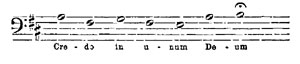
The Pope's throne is then carried in, on which he is elevated in all processions, and where I saw Pius VIII. enthroned on the day of my arrival (vide the 'Heliodorus' of Raphael, where he is portrayed). The Cardinals, two and two, with their palms, head the procession, and the folding doors of the chapel being thrown open, it slowly defiles through them. The singing, which has hitherto incessantly prevailed, like an element, becomes fainter and fainter, for the singers also walk in the procession, and at length are only indistinctly heard, the sound dying away in the distance. Then a choir in the chapel bursts forth with a query, to which the distant one breathes a faint response; and so it goes on for a time, till the procession again draws near, and the choirs reunite. Let them sing how or what they please, this cannot fail to produce a fine effect; and though it is quite true that nothing can be more monotonous, and even devoid of form, than the hymns all' unisono, being without any proper connection, and sung fortissimo throughout, still I appeal to the impression that as a whole it must make on every one. After the procession returns, the Gospel is chanted in the most singular tone, and is succeeded by the Mass. I must not omit here to make mention of my favourite moment; I mean the Credo. The priest takes his place for the first time in the centre, before the altar, and after a short pause, intones in his hoarse old voice the Credo of Sebastian Bach. When he has finished, the priests stand up, the Cardinals leave their seats, and advance into the middle of the chapel, where they form a circle, all repeating the continuation in a loud voice, "Patrem omnipotentem," etc. The choir then chimes in, singing the same words. When I for the first time heard my well-known
[Listen]
and all the grave monks round me began to recite in loud and eager tones, I felt quite excited, for this is the moment I still like the best of all. After the ceremony, Santini made me a present of his olive-branch, which I carried in my hand the whole day when I was walking about, for the weather was beautiful. The Stabat Mater which succeeds the Credo, made much less effect; they sang it incorrectly and out of tune, and likewise curtailed it considerably. The 'Sing Akademie' executes it infinitely better. There is nothing on Monday or Tuesday; but on Wednesday, at half-past four, the nocturns begin.
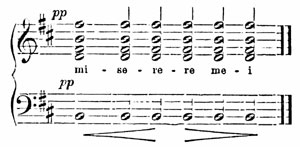
The Psalms are sung in alternate verses by two choirs, though invariably by one class of voices, basses or tenors. For an hour and a half, therefore, nothing but the most monotonous music is heard; the Psalms are only once interrupted by the Lamentations, and this is the first moment when, after a long time, a complete chord is given. This chord is very softly intoned, and the whole piece sung pianissimo, while the Psalms are shouted out as much as possible, and always upon one note, and the words uttered with the utmost rapidity, a cadence occurring at the end of each verse, which defines the different characteristics of the various melodies. It is not therefore surprising that the mere soft sound (in G major) of the first Lamentation, should produce so touching an effect. Once more the single tone recommences; a wax light is extinguished at the end of each Psalm, so that in the course of an hour and a half the fifteen lights round the altar are all out; six large-sized candles still burn in the vestibule. The whole strength of the choir, with alti and soprani, etc., intone fortissimo and unisono, a new melody, the "Canticum Zachariæ," in D minor, singing it slowly and solemnly in the deepening gloom; the last remaining lights are then extinguished. The Pope leaves his throne, and falls on his knees before the altar, while all around do the same, repeating a paternoster sub silentio; that is, a pause ensues, during which you know that each Catholic present says the Lord's Prayer, and immediately afterwards the Miserere begins pianissimo thus:—
[Listen]
This is to me the most sublime moment of the whole. You can easily picture to yourself what follows, but not this commencement. The continuation, which is the Miserere of Allegri, is a simple sequence of chords, grounded either on tradition, or what appears to me much more probable, merely embellishments, introduced by some clever maestro for the fine voices at his disposal, and especially for a very high soprano. These embellimenti always recur on the same chords, and as they are cleverly constructed, and beautifully adapted for the voice, it is invariably pleasing to hear them repeated. I could not discover anything unearthly or mysterious in the music; indeed, I am perfectly contented that its beauty should be earthly and comprehensible. I refer you, dearest Fanny, to my letter to Zelter. On the first day they sang Baini's Miserere.
On Thursday, at nine o'clock in the morning, the solemnities recommenced, and lasted till one o'clock. There was High Mass, and afterwards a procession. The Pope conferred his benediction from the Loggia of the Quirinal, and washed the feet of thirteen priests, who are supposed to represent the pilgrims, and were seated in a row, wearing white gowns and white caps, and who afterwards dine. The crowd of English ladies was extraordinary, and the whole affair repugnant to my feelings. The Psalms began again in the afternoon, and lasted on this occasion till half past seven. Some portions of the Miserere were taken from Baini, but the greater part were Allegri's. It was almost dark in the chapel when the Miserere commenced. I clambered up a tall ladder standing there by chance, and so I had the whole chapel crowded with people, and the kneeling Pope and his Cardinals, and the music, beneath me. It had a splendid effect. On Friday forenoon the chapel was stripped of every decoration, and the Pope and Cardinals in mourning. The history of the Passion, according to St. John, the music by Vittoria, was sung; then the Improperia of Palestrina, during which the Pope and all the others, taking off their shoes, advance to the cross and adore it. In the evening Baini's Miserere was given, which they sang infinitely the best.
Early on Saturday, in the baptistery of the Lateran, Heathens, Jews, and Mahomedans were baptized, all represented by a little child, who screeched the whole time, and subsequently some young priests received consecration for the first time. On Sunday the Pope himself performed High Mass in the Quirinal, and subsequently pronounced his benediction on the people, and then all was over. It is now Saturday, the 9th of April, and to-morrow at an early hour I get into a carriage and set off for Naples, where a new style of beauty awaits me. You will perceive by the end of this letter that I write in haste. This is my last day, and a great deal yet to be done. I do not therefore finish my letter to Zelter, but will send it from Naples. I wish my description to be correct, and my approaching journey distracts my attention sadly. Thus I am off to Naples; the weather is clearing up, and the sun shining, which it has not done for some days past. My passport is prepared, the carriage ordered, and I am looking forward to the months of spring. Adieu!
Felix.
Naples, April 13th, 1831.
Dear Rebecca,
This must stand in lieu of a birthday letter: may it wear a holiday aspect for you! It arrives late in the day, but with equally sincere good wishes. Your birthday itself I passed in a singular but delightful manner, though I could not write, having neither pens nor ink; in fact, I was in the very middle of the Pontine Marshes. May the ensuing year bring you every happiness, and may we meet somewhere! If you were thinking of me on that day, our thoughts must have met either on the Brenner or at Inspruck; for I was constantly thinking of you. Even without looking at the date of this letter, you will at once perceive by its tone that I am in Naples. I have not yet been able to compass one serious quiet reflection, there is everywhere such jovial life here, inviting you to do nothing, and to think of nothing, and even the example of so many thousand people has an irresistible influence. I do not indeed intend that this should continue, but I see plainly that it must go on for the first few days. I stand for hours on my balcony, gazing at Vesuvius and the Bay.
But I must now endeavour to resume my old descriptive style, or my materials will accumulate so much that I shall become confused, and I fear you may not be able to follow me properly. So much that is novel crowds on me, that a journal would be requisite to detail to you my life and my state of excitement. So I begin by acknowledging that I deeply regretted leaving Rome. My life there was so quiet, and yet so full of interest, having made many kind and friendly acquaintances, with whom I had become so domesticated, that the last days of my stay, with all their discomforts and perpetual running about, seemed doubly odious. The last evening I went to Vernet's to thank him for my portrait, which is now finished, and to take leave of him. We had some music, talked politics, and played chess, and then I went down the Monte Pincio to my own house, packed up my things, and the next morning drove off with my travelling companions. As I gazed out of the cabriolet at the scenery, I could dream to my heart's desire. When we arrived at our night quarters, we all went out walking. The two days glided past more like a pleasure excursion than a journey.
The road from Rome to Naples is indeed the most luxuriant that I know, and the whole mode of travelling most agreeable. You fly through the plain; for a very slight gratuity the postilions gallop their horses like mad, which is very advisable in the Marshes. If you wish to contemplate the scenery, you have only to abstain from offering any gratuity, and you are soon driven slowly enough. The road from Albano, by Ariccia and Genzano, as far as Velletri, runs between hills, and is shaded by trees of every kind; uphill and downhill, through avenues of elms, past monasteries and shrines. On one side is the Campagna, with its heather, and its bright hues; beyond comes the sea, glittering charmingly in the sunshine, and above, the clearest sky; for since Sunday morning the weather has been glorious.
Well! we drove into Velletri, our night quarters, where a great Church festival was going on. Handsome women with primitive faces were pacing the alleys in groups, and men were standing together wrapped in cloaks, in the street. The church was decorated with garlands of green leaves, and as we drove past it we heard the sounds of a double bass and some violins; fireworks were prepared in the square; the sun went down clear and serene, and the Pontine Marshes, with their thousand colours, and the rocks rearing their heads one by one against the horizon, indicated the course we were to pursue on the following day. After supper I resolved to go out again for a short time, and discovered a kind of illumination; the streets were swarming with people, and when I at last came to the spot where the church stood, I saw, on turning the corner, that the whole street had burning torches on each side, and in the middle the people were walking up and down, crowding together, and pleased to see each other so distinctly at night. I cannot tell you what a pretty sight it was. The concourse was greatest before the church; I pressed forward into it along with the rest. The little building was filled with people kneeling, adoring the Host, which was exposed; no one spoke a word, nor was there any music. This stillness, the lighted church, and the many kneeling women with white handkerchiefs on their heads, and white gowns, had a striking effect. When I left the church a shrewd, handsome Italian boy explained the whole festival, assuring me that it would have been far finer had it not been for the recent disturbances, for they had been the cause of depriving the people of the horseraces, and barrels of pitch, etc., and on this account it was unlucky that the Austrians had not come sooner.
The following morning, at six o'clock, we pursued our way through the Pontine Marshes. It is a species of Bergstrasse. You drive through a straight avenue of trees along a plain. On one side of the avenue is a continued chain of hills, on the other the Marshes. They are, however, covered with innumerable flowers, which smell very sweet; but in the long-run this becomes very stupefying, and I distinctly felt the oppression of the atmosphere, in spite of the fine weather. A canal runs along beside the chaussée, constructed by the orders of Pius VI. to form a conduit for the marshes, where we saw a number of buffaloes wallowing, their heads emerging out of the water, and apparently enjoying themselves. The straight, level road has a singular appearance. You see the chain of hills at the end of the avenue when you come to the first station, and again at the second and third, the only difference being that as you advance so many miles nearer, the hills loom gradually larger. Terracina, which is situated exactly at the end of this avenue, is invisible till you come quite close to it. On making a sudden turn to the left, round the corner of a rock, the whole expanse of the sea lies before you. Citron-gardens, and palms, and a variety of plants of Southern growth, clothe the declivity in front of the town; towers appearing above the thickets, and the harbour projecting into the sea. To me, the finest object in nature is, and always will be, the ocean. I love it almost more than the sky. Nothing in Naples made a more enchanting impression on my mind than the sea, and I always feel happy when I see before me the spacious surface of waters.
The South, properly speaking, begins at Terracina. This is another land, and every plant and every bush reminds you of it. Above all, the two mighty ridges of hills delighted me, between which the road runs; they were totally devoid of bushes or trees, but clothed entirely with masses of golden wall-flowers, so that they had a bright yellow hue, and the fragrance was almost too strong. There is a great want of grass and large trees. The old robbers' nests of Fondi and Itri looked very piratical and gloomy. The houses are built against the walls of the rocks, and there are likewise some large towers of the date of the Middle Ages. Many sentinels and posts were stationed on the tops of the hills; but we made out our journey without any adventure. We remained all night in Mola di Gaeta; there we saw the renowned balcony whence you look over orange and citron groves to the blue sea, with Vesuvius and the islands in the far distance. This was on the 11th of April. As I had been celebrating your birthday all day long in my own thoughts, I could not in the evening resist informing my companions that it was your birthday; so your health was drunk again and again. An old Englishman, who was of the party, wished me a "happy return to my sister." I emptied the glass to your health, and thought of you. Remain unchanged till we meet again.
With such thoughts in my head, I went in the evening to the citron-garden, close to the sea-shore, and listened to the waves rolling in from afar, and breaking on the shore, and sometimes gently rippling and splashing. It was indeed a heavenly night. Among a thousand other thoughts, Grillparzer's poem recurred to my memory, which it is almost impossible to set to music; for which reason, I suppose, Fanny has composed a charming melody on it; but I do not jest when I say that I sang the song over repeatedly to myself, for I was standing on the very spot he describes. The sea had subsided, and was now calm, and at rest; this was the first song. The second followed next day, for the sea was like a meadow or pure ether as you gazed at it, and pretty women nodded their heads, and so did olives and cypresses; but they were all equally brown, so I remained in a poetic mood.
What is it that shines through the leaves, and glitters like gold? Only cartridges and sabres; for the King had been reviewing some troops in Sant' Agata, and soldiers defiled on both sides of the path, who had the more merit in my eyes because they resembled the Prussians, and for a long time past I have seen only Papal soldiers. Some carried dark-lanterns on their muskets, as they had been marching all night. The whole effect was bold and gay. We now came to a short rocky pass, from which you descend into the valley of Campana, the most enchanting spot I have ever seen; it is like a boundless garden, covered entirely with plants and vegetation as far as the eye can reach. On one side are the blue outlines of the sea, on the other an undulating range of hills above which snowy peaks project; and at a great distance Vesuvius and the islands, bathed in blue vapours, start up on the level surface; large avenues of trees intersect the vast space, and a verdant growth forces its way from under every stone. Everywhere you see grotesque aloes and cactuses, and the fragrance and vegetation are quite unparalleled.
The pleasure we enjoy in England through men, we here enjoy through nature; and as there is no corner there, however small, of which some one has not taken possession in order to cultivate and adorn it, so here there is no spot which Nature has not appropriated, bringing forth on it flowers and herbs, and all that is beautiful. The Campana valley is fruitfulness itself. On the whole of the vast immeasurable surface bounded in the far distance by blue hills and a blue sea, nothing but green meets the eye. At last you come to Capua. I cannot blame Hannibal for remaining too long there. From Capua to Naples the road runs uninterruptedly between trees, with hanging vines, till at the end of the avenue, Vesuvius, and the sea, with Capri, and a mass of houses, lie before you. I am living here in St. Lucia as if in heaven; for in the first place I see before me Vesuvius, and the hills as far as Castellamare, and the bay, and in the second place, I am living up three stories high. Unfortunately that traitor Vesuvius does not smoke at all, and looks precisely like any other fine mountain; but at night the people float in lighted boats on the Bay, to catch sword-fish. This has a pretty enough effect. Farewell!
Felix.
Naples, April 10th, 1831.
We are so accustomed to find that everything turns out quite differently from what we expected and calculated, that you will feel no surprise when instead of a letter like a journal, you receive a very short one, merely saying that I am quite well, and little else.
As for the scenery, I cannot describe it, and if you have no conception of what it really is, after all that has been said and written on the subject, there is little chance of my enlightening you; for what makes it so indescribably beautiful, is precisely that it is not of a nature to admit of description. Any other detail I could send you would be about my life here; but it is so simple, that a very few words suffice to depict it. I do not wish to make any acquaintances, for I am resolved not to remain here longer than a few weeks. I intend to make various excursions to see the country, and all I desire here, is to become thoroughly intimate with nature: so I go to bed at nine o'clock, and rise at five, to refresh myself by gazing from my balcony at Vesuvius, the sea, and the coast of Sorrento, in the bright morning light. I have also taken very long solitary rambles, discovering beautiful views for myself, and I have infinite satisfaction in finding that what I consider the loveliest spot of all is almost entirely unknown to the Neapolitans. During these excursions I sought out some house on a height, to which I scrambled up; or else merely followed any path I fancied, allowing myself to be surprised by night and moonshine, and making acquaintance with vine-dressers, in order to learn my way back; arriving at last at home about nine o'clock, very tired, through the Villa Reale. The view from this villa, of the sea and the enchanting Capri by moonlight, is truly charming, and so is the almost overpowering fragrance of the acacias in full bloom, and the fruit-trees scattered all over with rose-coloured blossoms, looking like trees with pink foliage,—all this is indeed quite indescribable.
As I live chiefly with and in nature, I can write less than usual; perhaps we may talk it over when we meet, and the sketches in our sitting-room at home will furnish materials and reminiscences for conversation. One thing I must not however omit, dear Fanny, which is, that I quite approve of your taste when I recall what you told me years ago that your favorite spot was the island of Nisida. Perhaps you may have forgotten this, but I have not. It looks as if it were made expressly for pleasure-grounds. On emerging from the thicket of Bagnuolo, Nisida has quite a startling effect, rising out of the sea, so near, so large and so green; while the other islands, Procida, Ischia, and Capri, stand afar off, and indistinct in their blue tints. After the murder of Cæsar, Brutus took refuge in this island, and Cicero visited him there; the sea lay between them then, and the rocks, covered with vegetation, bent over the sea, just as they do now. These are the antiquities that interest me, and are infinitely more suggestive than crumbling mason-work. There is a degree of innate superstition and dishonesty among the people here that is totally inconceivable, and this has often even marred my pleasure in nature; for the Swiss, of whom my father complained so much, are positively guileless, primitive beings, compared with the Neapolitans. My landlord invariably gives me too little change for a piastre, and when I tell him of it, he coolly fetches the remainder. The only acquaintances I intend to make here are musical ones, that I may leave nothing incomplete,—for instance Fodor, who does not sing in public, Donizetti, Coccia, etc.
I now conclude by a few words to you, dear Father. You write to me that you disapprove of my going to Sicily; I have consequently given up this plan, though I cannot deny that I do so with great reluctance, for it was really more than a mere whim on my part. There is no danger to be apprehended, and, as if on purpose to vex me, a steamer leaves this city on the 4th of May, which is to make the entire tour; and a good many Germans, and probably the minister here, are to take advantage of it. I should have liked to see a mountain vomiting forth flames, as Vesuvius has been hitherto so unkind as not even to smoke. Your instructions however have till now so entirely coincided with my own inclinations, that I cannot allow the first opportunity I have of showing my obedience to your wishes (even when opposed to my own), to pass without complying with them, so I have effaced Sicily from my travelling route. Perhaps we may meet sooner in consequence of this; and now farewell, for I am going to walk to Capo di Monte.
Felix.
Naples, April 27th, 1831.
It is now nearly a fortnight since I have heard from you. I do earnestly hope that nothing unpleasant has occurred, and every day I expect the post will bring me tidings of you all. My letters from Naples are of little value, for I am too deeply absorbed here to be able easily to extricate myself, and to write descriptive letters. Besides, when we had bad weather lately, I took advantage of it to resume my labours, and zealously applied myself to my "Walpurgis Night," which daily increases in interest for me, so I employ every spare moment in completing it. I hope to finish it in a few days, and I think it will turn out well. If I continue in my present mood, I shall finish my Italian symphony also in Italy, in which case I shall have a famous store to bring home with me, the fruits of this winter. Moreover every day I have something new to see. I generally make my excursions with the Schadows.
Yesterday we went to Pompeii. It looks as if it had been burnt down, or like a recently deserted city. As both of these always seem to me deeply affecting, the impression made on me was the most melancholy that I have yet experienced in Italy. It is as if the inhabitants had just gone out, and yet almost every object tells of another religion and another life; in short, of seventeen hundred years ago; and the French and English ladies scramble about as gaily as possible, and sketch it all. It is the old tragedy of the Past and the Present, a problem I never can solve. Lively Naples is indeed a pleasant contrast; but it is painful to see the crowd of wretched beggars who waylay you in every street and path, swarming round the carriage the instant it stops. The old white-haired men particularly distress me, and such a mass of misery exceeds all belief. If you are walking on the sea-shore, and gazing at the islands, and then chance to look round at the land, you find yourself the centre of a group of cripples, who make a trade of their infirmities; or you discover (which lately happened to me) that you are surrounded by thirty or forty children, all whining out their favourite phrase, "Muoio di fame," and rattling their jaws to show that they have nothing to eat. All this forms a most repulsive contrast; and yet to me it is still more repugnant that you must entirely renounce the great pleasure of seeing happy faces; for even when you have given the richest gratuities to guards, waiters, or workpeople, in short, to whom you will, the invariable rejoinder is, "Nienti di più?" in which case you may be very sure that you have given too much. If it is the proper sum, they give it back with the greatest apparent indignation, and then return and beg to have it again. These are trifles, certainly, but they show the lamentable condition of the people. I have even gone so far as to feel provoked with the perpetual smiling aspect of nature, when in the most retired spots troops of beggars everywhere assailed me, some even persisting in following me a long way. It is only when I am quietly seated in my own room, gazing down on the Bay, and on Vesuvius, that being totally alone with them I feel really cheerful and happy.
To-day we are to ascend the hill to visit the Camaldoli Monastery, and to-morrow, if the weather permits, we proceed to Procida and Ischia. I go this evening to Madame Fodor's with Donizetti, Benedict, etc. She is very kind and amiable towards me, and her singing has given me great pleasure, for she has wonderful facility, and executes her fiorituri with so much taste, that it is easy to see how many things Sonntag acquired from her, especially the mezza voce, which Fodor, whose voice is no longer full and fresh, most prudently and judiciously introduces into many passages. As she is not singing at the theatre, I am most fortunate in having made her acquaintance personally. The theatre is now closed for some weeks, because the blood of St. Januarius is shortly to liquefy. What I heard at the opera previously did not repay the trouble of going. The orchestra, like that in Rome, was worse than in any part of Germany, and not even one tolerable female singer. Tamburini alone, with his vigorous bass voice, imparted some life to the whole. Those who wish to hear Italian operas, must now-a-days go to Paris or London. Heaven grant that this may not eventually be the case with German music also!
I must however return to my "Witches," so you must forgive my not writing any more to-day. This whole letter seems to hover in uncertainty, or rather I do so in my "Walpurgis Night," whether I am to introduce the big drum or not. "Zacken, Gabeln, und wilde Klapperstöcke," seem to force me to the big drum, but moderation dissuades me. I certainly am the only person who ever composed for the scene on the Brocken without employing a piccolo-flute, but I can't help regretting the big drum, and before I can receive Fanny's advice, the "Walpurgis Night" will be finished and packed up. I shall then set off again on my travels, and Heaven knows what I may have in my head by that time. I feel convinced that Fanny would say yes; still, I feel very doubtful; at all events a vast noise is indispensable.
Oh, Rebecca! can you not procure the words of some songs, and send them to me? I feel quite in the humour for them, and you must require something new to sing. If you can furnish me with some pretty verses, old or new, gay or grave, I will compose something in a style to suit your voice. I am at your service for any compact of this kind. Pray do send me wherewithal to work at, during my journey, in the inns. Now, farewell to you all! May you be as happy as I ever wish you to be, and think of me!
Felix.
Naples, May 17th, 1831.
On Saturday, the 14th of May, at two o'clock, I told my driver to turn the carriage. We were opposite the Temple of Ceres at Pæstum, the most southern point of my journey. The carriage consequently turned towards the north, and from that moment, as I journey onwards, I am every hour drawing nearer to you. It is about a year now since I travelled with my father to Dessau and Leipzig; the time in fact exactly corresponds, for it was about the half-year. I have made good use of the past year. I have acquired considerable experience and many new impressions. Both in Rome and here I have been very busy, but no change has occurred in my outward circumstances; and till the beginning of the new year, in fact so long as I am in Italy, it will probably be the same. This period has not however been less valuable to me than some when outwardly, and in the opinion of others, I have appeared to make greater progress; for there must always be a close connection between the two. If I have gathered experience, it cannot fail to influence me outwardly, and I shall allow no opportunity to escape to show that it has done so. Possibly some such may occur before the end of my journey, so I may for the present continue to enjoy nature, and the blue sky, during the months that still remain for me in Italy, without thinking of anything else; for there alone lies true art, now in Italy,—there and in her monuments; and there it will ever remain; and there we shall ever find it, for our instruction and delight, so long as Vesuvius stands, and so long as the balmy air, and the sea, and the trees do not pass away.
In spite of all this, I am enough of a musician to own that I do heartily long once more to hear an orchestra or a full chorus where there is at least some sound, for here there is nothing of the sort. This is our peculiar province, and to be so long deprived of such an element, leaves a sad void. The orchestra and chorus here are like those in our second-rate provincial towns, only more harsh and incorrect. The first violinist, all through the opera, beats the four quarters of each bar on a tin candle-stick, which is often more distinctly heard than the voices (it sounds somewhat like obbligati castanets, only louder); and yet in spite of this the voices are never together. Every little instrumental solo is adorned with old-fashioned flourishes, and a bad tone pervades the whole performance, which is totally devoid of genius, fire, or spirit. The singers are the worst Italian ones I ever heard anywhere (except, indeed, in Italy), and those who wish to have a true idea of Italian singing must go to Paris or to London. Even the Dresden company, whom I heard last year in Leipzig, are superior to any here. This is but natural, for in the boundless misery that prevails in Naples, where can the bases of a theatre be found, which of course requires considerable capital? The days when every Italian was a born musician, if indeed they ever existed, are long gone by. They treat music like any other fashionable article, with total indifference; in fact, they scarcely pay it the homage of outward respect, so it is not to be wondered at that every single person of talent should, as regularly as they appear, transfer themselves to foreign countries, where they are better appreciated, their position better defined, and where they find opportunities of hearing and learning something profitable and inspiriting.
The only really good singer here is Tamburini; he has, however, long since been heard in Vienna and Paris, and I believe in London also; so now, when he begins to discover that his voice is on the decline, he comes back to Italy. I cannot admit either that the Italians alone understand the art of singing; for there is no music, however florid. I have ever heard executed by Italians, that Sonntag cannot accomplish, and in even greater perfection. She certainly, as she acknowledges, learned much from Fodor; but why should not another German in turn learn the same from Sonntag? and Malibran is a Spaniard. Italy can no longer claim the glorious appellation of "the land of music;" in truth, she has already lost it, and possibly she may yet do so even in the opinion of the world, though this is problematical. I was lately in company with some professional musicians, who were speaking of a new opera by a Neapolitan, Coccia; and one of them asked if it was clever. "Probably it is," said another, "for Coccia was long in England, where he studied, and some of his compositions are much liked there." This struck me as very remarkable, for in England they would have spoken exactly in the same way of Italy; but quo me rapis? I say nothing to you, dear sisters, in this letter, but in the course of a few days I mean to send you a little pamphlet dedicated to you. Do not be alarmed, it is not poetry; the thing is simply entitled "Journal of an Excursion to the Islands, in May."
Felix.
Naples, May 28th, 1831.
My dear Sisters,
As my journal is become too stupid and uninteresting to send you, I must at least supply you with an abrégé of my history. You must know, then, that on Friday, the 20th of May, we breakfasted in corpore at Naples, on fruit, etc.; this in corpore includes the travelling party to Ischia, consisting of Ed. Bendemann, T. Hildebrand, Carl Sohn, and Felix Mendelssohn Bartholdy. My knapsack was not very heavy, for it contained scarcely anything but Goethe's poems, and three shirts; so we packed ourselves into a hired carriage, and drove through the grotto of Posilippo to Pozzuoli. The road runs along by the sea, and nothing can be more lovely; so it is all the more painful to witness the horrible collection of cripples, blind men, beggars, and galley slaves, in short, the poor wretches of every description who there await you, amid the holiday aspect of nature.
I seated myself quietly on the mole and sketched, while the others plodded and toiled through the Temple of Serapis, the theatres, the hot springs, and extinct volcanoes, which I had already seen to satiety on three different occasions. Then, like youthful patriarchs or nomads, we collected all our goods and chattels, cloaks, knapsacks, books and portfolios on donkeys, and placing ourselves also on them, we made the tour of the Bay of Baiæ, as far as the Lake of Avernus, where you are obliged to buy fish for dinner; we crossed the hill to Cumæ (vide Goethe's 'Wanderer') and descended on Baiæ, where we ate and rested. We then looked at more ruined temples, ancient baths, and other things of the kind, and thus evening had arrived before we crossed the bay.
At half-past nine we arrived at the little town of Ischia, where we found every corner of the only inn fully occupied, so we resolved to go on to Don Tommaso's; a journey of two hours nominally, but which we performed in an hour and a quarter. The evening was deliciously cool, and innumerable glow-worms, who allowed us to catch them, were scattered on the vine-branches, and fig-trees, and shrubs. When we at last arrived, somewhat fatigued, at Don Tommaso's house, about eleven o'clock, we found all the people still up, clean rooms, fresh fruits, and a friendly deacon to wait on us, so we remained comfortably seated opposite a heap of cherries till midnight. The next morning the weather was bad, and the rain incessant, so we could not ascend the Epomeo, and as we seemed little disposed to converse (we did not get on in this respect, Heaven knows why!) the affair would have become rather a bore, if Don Tommaso had not possessed the prettiest poultry-yard and farm in Europe. Right in front of the door stands a large leafy orange-tree covered with ripe fruit, and from under its branches a stair leads to the dwelling. Each of the white stone steps is decorated with a large vase of flowers, these steps leading to a spacious open hall, whence through an archway you look down on the whole farm-yard, with its orange-trees, stairs, thatched roofs, wine casks and pitchers, donkeys and peacocks. That a foreground may not be wanting, an Indian fig-tree stands under the walled arch, so luxuriant that it is fastened to the wall with ropes. The background is formed by vineyards with summer-houses, and the adjacent heights of the Monte Epomeo. Being protected from the rain by the archway, the party seated themselves there under shelter, and sketched the various objects in the farm the best way they could, the whole livelong day. I was on no ceremony, and sketched along with them, and I think I in some degree profited by so doing. At night we had a terrific storm, and as I was lying in bed, I remarked that the thunder growled tremendously on Monte Epomeo, and the echoes continued to vibrate like those on the Lake of Lucerne, but even for a greater length of time.
Next morning, Sunday, the weather was again fine. We went to Foria, and saw the people going to the cathedral in their holiday costumes. The women wore their well-known head-dress of folds of white muslin placed flat on the head; the men were standing in the square before the church, in their bright red caps, gossiping about politics, and we gradually wound our way through these festal villages up the hill. It is a huge rugged volcano, full of fissures, ravines, cavities, and steep precipices. The cavities being used for wine cellars, they are filled with large casks. Every declivity is clothed with vines and fig-trees, or mulberry-trees. Corn grows on the sides of the steep rocks, and yields more than one crop every year. The ravines are covered with ivy, and innumerable bright-coloured flowers and herbs, and wherever there is a vacant space, young chestnut-trees shoot up, furnishing the most delightful shade. The last village, Fontana, lies in the midst of verdure and vegetation. As we climbed higher, the sky became overcast and gloomy, and by the time we reached the most elevated peaks of the rocks, a thick fog had come on. The vapours flitted about, and although the rugged outlines of the rocks, and the telegraph, and the cross, stood forth strangely in the clouds, still we could not see even the smallest portion of the view. Soon afterwards rain commenced, and as it was impossible to remain, and wait as you do on the Righi, we were obliged to take leave of Epomeo without having made his acquaintance. We ran down in the rain, one rushing after the other, and I do believe that we were scarcely an hour in returning.
Next day we went to Capri. This place has something Eastern in its aspect, with the glowing heat reflected from its rocky white walls, its palm-trees, and the rounded domes of the churches that look like mosques. The sirocco was burning, and rendered me quite unfit to enjoy anything; for really climbing up five hundred and thirty-seven steps to Anacapri in this frightful heat, and then coming down again, is toil only fit for a horse. True, the sea is wondrously lovely, looking down on it from the summit of the bleak rock, and through the singular fissures of the jagged peaks, so strangely formed.
But above all, I must tell you of the blue grotto, for it is not known to every one, as you can only enter it either in very calm weather, or by swimming. The rocks there project precipitously into the sea, and are probably as steep under the water as above it. A huge cavity has been hollowed out by nature, but in such a manner, that round the whole circumference of the grotto, the rocks rest on the sea in all their breadth, or rather are sunk precipitously into it, and ascend thence to the vault of the cavern. The sea fills the whole space of the grotto, the entrance to which lies under the water, only a very small portion of the opening projecting above the water, and through this narrow space you can only pass in a small boat, in which you must lie flat. When you are once in, the whole extent of the huge cave and its vault is revealed, and you can row about in it with perfect ease, as if under a dome. The light of the sun also pierces through the opening into the grotto underneath the sea, but broken and dimmed by the green sea water, and thence it is that such magical visions arise. The whole of the rocks are sky-blue and green in the twilight, resembling the hue of moonshine, yet every nook, and every depth, is distinctly visible. The water is thoroughly lighted up and brilliantly illuminated by the light of the sun, so that the dark skiff glides over a bright shining surface. The colour is the most dazzling blue I ever saw, without shadow or cloud, like a pane of opal glass; and as the sun shines down, you can plainly discern all that is going on under the water, while the whole depths of the sea with its living creatures are disclosed. You can see the coral insects and polypuses clinging to the rocks, and far below, fishes of different species meeting and swimming past each other. The rocks become deeper in colour as they go lower into the water, and are quite black at the end of the grotto, where they are closely crowded together, and still further under them, you can see crabs, fishes, and reptiles in the clear waters. Every stroke too of the oars echoes strangely under the vault, and as you row round the wall, new objects come to light. I do wish you could see it, for the effect is singularly magical. On turning towards the opening by which you entered, the daylight seen through it seems bright orange, and by moving even a few paces you are entirely isolated under the rock in the sea, with its own peculiar sunlight: it is as if you were actually living under the water for a time.
We then proceeded to Procida, where the women adopt the Greek dress, but do not look at all prettier from doing so. Curious faces were peeping from every window. A couple of Jesuits, in black gowns and with gloomy countenances, were seated in a gay arbour of vines, evidently enjoying themselves, and made a good picture. Then we crossed the sea to Pozzuoli, and through the grotto of Posilippo again home.
I cannot write to Paul about his change of residence, and his entrance into the great, wide world of London, because he mentions casually, that he will probably leave for London in the course of three weeks, so my letter could not possibly reach him in Berlin; a week hence I shall take my chance, and address to my brother in London. That smoky place is fated to be now and ever my favourite residence; my heart glows when I even think of it, and I paint to myself my return there, passing through Paris, and finding Paul independent, alone, and another man, in the dear old haunts; when he will present me to his new friends, and I will present him to my old ones, and we shall live and dwell together: so even at this moment I am all impatience soon to go there. I see by some newspapers my friends have sent me, that my name is not forgotten, and so I hope when I return to London, to be able to work steadily, which I was previously unable to do, being forced to go to Italy. If they make any difficulty in Munich about my opera, or if I cannot get a libretto that I like, I intend in that case to compose an opera for London. I know that I could receive a commission to do so, as soon as I chose. I am also bringing some new pieces with me for the Philharmonic, and so I shall have made good use of my time.
As my evenings here are at my own disposal, I read a little French and English. The "Barricades" and "Les États de Blois" particularly interest me, as while I read them I realize with horror a period which we have often heard extolled as a vigorous epoch, too soon passed away. Though these books seem to me to have many faults, yet the delineation of the two opposite leaders is but too correct; both were weak, irresolute, miserable hypocrites, and I thank God that the so highly-prized middle ages are gone never to return. Say nothing of this to any disciple of Hegel's, but it is so nevertheless; and the more I read and think on the subject, the more I feel this to be true. Sterne has become a great favourite of mine. I remembered that Goethe once spoke to me of the 'Sentimental Journey,' and said that it was impossible for any one better to paint what a froward and perverse thing is the human heart. I chanced to meet with the book, and thought I should like to read it. It pleases me very much. I think it very subtle, and beautifully conceived and expressed.
There are very few German books to be had here. I am therefore restricted to Goethe's Poems, and assuredly these are suggestive enough, and always new. I feel especial interest in those poems which he evidently composed in or near Naples, such as Alexis and Dora; for I daily see from my window how this wonderful work was created. Indeed, which is often the case with master-pieces, I often suddenly and involuntarily think, that the very same ideas might have occurred to myself on a similar occasion, and as if Goethe had only by some chance been the first to express them.
With regard to the poem, "Gott segne dich, junge Frau," I maintain that I have discovered its locality and dined with the woman herself; but of course she is now grown old, and the boy she was then nursing is become a stalwart vine-dresser. Her house lies between Pozzuoli and Baiæ, "eines Tempels Trümmern," and is fully three miles from Cumæ. You may imagine therefore with what new light and truth these poems dawn on me, and the different feeling with which I now regard and study them. I say nothing of Mignon's song at present, but it is singular that Goethe and Thorwaldsen are still living, that Beethoven only died a few years ago, and yet H—— declares that German art is as dead as a rat. Quod non. So much the worse for him if he really feels thus; but when I reflect for a time on his conclusions, they appear to me very shallow. Apropos, Schadow, who returns to Düsseldorf in the course of a few days, has promised to extract, if possible, some new songs for me from Immermann, which rejoices me much. That man is a true poet, which is proved by his letters, and everything that he has written. Count Platen is a little, shrivelled, wheezing old man, with gold spectacles, yet not more than five-and-thirty! He quite startled me. The Greeks look very different! He abuses the Germans terribly, forgetting however that he does so in German. But farewell for to-day.
Felix.
Rome, June 6th, 1831.
My dear Parents,
It is indeed high time that I should write to you a rational, methodical letter, for I fear that none of those from Naples were worth much. It really seemed as if the atmosphere there deterred every one from serious reflection, at least I very seldom succeeded in collecting my thoughts or ideas; and now I have been scarcely more than a few hours here, when I once more resume that Roman tranquillity, and grave serenity, which I alluded to in my former letters from this place. I cannot express how infinitely better I love Rome than Naples. People allege that Rome is monotonous, of one uniform hue, melancholy, and solitary. It is certainly true that Naples is more like a great European city, more lively and varied, and more cosmopolitan; but I may say to you confidentially, that I begin gradually to feel the most decided hatred of all that is cosmopolitan;—I dislike it, just as I dislike many-sidedness, which, moreover, I rather think I do not much believe in. Anything that aspires to be distinguished, or beautiful, or really great, must be one-sided; but then this one side must be brought to a state of the most consummate perfection, and no man can deny that such is the case at Rome.
Naples seems to me too small to be called properly a great city; all the life and bustle are confined to two large thoroughfares—the Toledo, and the coast from the harbour to the Chiaja. Naples does not realize to my mind the idea of a centre for a great nation, which London offers in such perfection; chiefly indeed because it is deficient in a people: for the fishermen and lazzaroni I cannot designate as a people, they are more like savages, and their centre is not Naples, but the sea. The middle classes, by which I mean those who pursue various trades, and the working citizens who form the basis of other great towns, are quite subordinate; indeed, I may almost say that such a class is not to be found there. It was this that often made me feel out of humour during my stay in Naples, much as I loved and enjoyed the scenery; but as a dissatisfied feeling constantly recurred, I think I at last discovered the cause to lie within myself. I cannot say that I was precisely unwell during the incessant sirocco, but it was more disagreeable than an indisposition which passes away in a few days. I felt languid, disinclined for all that was serious,—in fact, lazy. I lounged about the streets all day with a morose face, and would have preferred lying on the ground, without the trouble of thinking, or wishing, or doing anything; then it suddenly occurred to me, that the principal classes in Naples live in reality precisely in the same manner; that consequently the source of my depression did not spring from myself, as I had feared, but from the whole combination of air, climate, etc. The atmosphere is suitable for grandees who rise late, never require to go out on foot, never think (for this is heating), sleep away a couple of hours on a sofa in the afternoon, then eat ice, and drive to the theatre at night, where again they do not find anything to think about, but simply make and receive visits. On the other hand, the climate is equally suitable for a fellow in a shirt, with naked legs and arms, who also has no occasion to move about—begging for a few grani when he has literally nothing left to live on—taking his afternoon's siesta stretched on the ground, or on the quay, or on the stone pavement (the pedestrians step over him, or shove him aside if he lies right in the middle). He fetches his frutti di mare himself out of the sea, sleeps wherever he may chance to find himself at night; in short, he employs every moment in doing exactly what he likes best, just as an animal does.
These are the two principal classes of Naples. By far the largest portion of the population of the Toledo there, consists of gaily dressed ladies and gentlemen, or husbands and wives driving together in handsome equipages, or of those olive sans-culottes who sometimes carry about fish for sale, brawling in the most stentorian way, or bearing burdens when they have no longer any money left. I believe there are few indeed who have any settled occupation, or follow up any pursuit with zeal and perseverance, or who like work for the sake of working. Goethe says that the misfortune of the North is, that people there always wish to be doing something, and striving after some end; and he goes on to say, that an Italian was right, who advised him not to think so much, for it would only give him a headache. I suspect however that he was merely jesting; at all events, he did not act in this manner himself, but, on the contrary, like a genuine Northman. If however he means that the difference of character is produced by nature, and subservient to her influence, then there is no doubt that he is quite in the right. I can perfectly conceive that it must be so, and why wolves howl; still it is not necessary to howl along with them. The proverb should be exactly reversed. Those who, owing to their position, are obliged to work, and must consequently both think and bestir themselves, treat the matter as a necessary evil, which brings them in money, and when they actually have it, they too live like the great, or the naked, gentlemen. Thus there is no shop where you are not cheated. Natives of Naples, who have been customers for many years, are obliged to bargain, and to be as much on their guard as foreigners; and one of my acquaintances, who had dealt at the same shop for fifteen years, told me that during the whole of that period there had been invariably the same battle about a few scudi, and that nothing could prevent it.
Thence it is that there is so little industry or competition, and that Donizetti finishes an opera in ten days; to be sure, it is sometimes hissed, but that does not matter, for it is paid for all the same, and he can then go about amusing himself. If at last however his reputation becomes endangered, he will in that case be forced really to work, which he would find by no means agreeable. This is why he sometimes writes an opera in three weeks, bestowing considerable pains on a couple of airs in it, so that they may please the public, and then he can afford once more to divert himself, and once more to write trash. Their painters, in the same way, paint the most incredibly bad pictures, far inferior even to their music. Their architects also erect buildings in the worst taste; among others, an imitation, on a small scale, of St. Peter's, in the Chinese style. But what does it matter? the pictures are bright in colour, the music makes plenty of noise, the buildings give plenty of shade, and the Neapolitan grandees ask no more.
My physical mood was similar to theirs, everything inspiring me with a wish to be idle, and to lounge about, and sleep; yet I was constantly saying to myself that this was wrong; and striving to occupy myself, and to work, which I could not accomplish. Hence arose the querulous tone of some of the letters I wrote to you, and I could only escape from such a mood by rambling over the hills, where nature is so divine, making every man feel grateful and cheerful. I did not neglect the musicians, and we had a great deal of music, but I cared little in reality for their flattering encomiums. Fodor is hitherto the only genuine artist, male or female, that I have seen in Italy; elsewhere I should probably have found a great many faults with her singing, but I overlooked them all, because when she sings it is real music, and after such a long privation, that was most acceptable.
Now however I am once more in old Rome, where life is very different. There are processions daily, for last week was the Corpus Domini; and just as I left the city during the celebration of the week following the Holy Week, I now return after the Corpus Christi to find them engaged in the same way. It made a singular impression on me to see that the streets had in the interim assumed such an aspect of summer: on all sides booths with lemons and iced water, the people in light dresses, the windows open, and the jalousies closed. You sit at the doors of coffee-houses, and eat gelato in quantities; the Corso swarms with equipages, for people no longer walk much, and though in reality I miss no dear friends or relatives, yet I felt quite moved when I once more saw the Piazza di Spagna, and the familiar names written up on the corners of the streets. I shall stay here for about a week, and then proceed northwards.
The Infiorata is on Thursday, but it is not yet quite certain that it will take place, because they have some apprehensions of a revolution; but I hope I shall witness this ceremony. I mean to take advantage of this opportunity to see the hills once more, and then to set off for the north. Wish me a good journey, for I am on the eve of departure. It is a year this very day since I arrived in Munich, heard 'Fidelio,' and wrote to you. We have not met since then; but, please God, we shall see each other again before another year.
Felix.
Rome, June 16, 1831.
Dear Professor,
It was my intention some time ago to have written you a description of the music during the Holy Week, but my journey to Naples intervened, and during my stay there, I was so constantly occupied in wandering among the mountains, and in gazing at the sea, that I had not a moment's leisure to write; hence arose the delay for which I now beg to apologize. Since then I have not heard a single note worth remembering; in Naples the music is most inferior. During the last two months, therefore, I have no musical reminiscences to send you, save those of the Holy Week, which however made so indelible an impression on my mind, that they will be always fresh in my memory. I already described to my parents the effect of the whole ceremonies, and they probably sent you the letter.
It was fortunate that I resolved to listen to the various Offices with earnest and close attention, and still more so, that from the very first moment I felt sensations of reverence and piety. I consider such a mood indispensable for the reception of new ideas, and no portion of the general effect escaped me, although I took care to watch each separate detail.
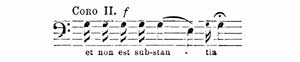
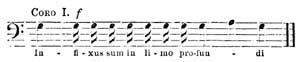
The ceremonies commenced on Wednesday, at half past four o'clock, with the antiphon "Zelus domus tuæ." A little book containing the Offices for the Holy Week explains the sense of the various solemnities. "Each Nocturn contains three Psalms, signifying that Christ died for all, and also symbolical of the three laws, the natural, the written, and the evangelical. The 'Domine labia mea' and the 'Deus in adjutorium' were not sung on this occasion, when the death of our Saviour and Master is deplored, as slain by the hands of wicked godless men. The fifteen lights represent the twelve apostles and the three Marys." (In this manner the book contains much curious information on this subject, so I mean to bring it with me for you.) The Psalms are chanted fortissimo by all the male voices of two choirs. Each verse is divided into two parts, like a question and answer, or rather, classified into A and B; the first chorus sings A, and the second replies with B. All the words, with the exception of the last, are sung with extreme rapidity on one note, but on the last they make a short "melisma," which is different in the first and second verse. The whole Psalm, with all its verses, is sung on this melody, or tono as they call it, and I wrote down seven of these toni, which were employed during the three days. You cannot conceive how tiresome and monotonous the effect is, and how harshly and mechanically they chant through the Psalms. The first tonus which they sang was—
[Listen]
[Listen]
Thus the whole forty-two verses of the Psalm are sung in precisely the same manner; one half of the verse ending in G, A, G, the other in G, E, G. They sing with the accent of a number of men quarrelling violently, and it sounds as if they were shouting out furiously one against another. The closing words of each Psalm are chanted more slowly and impressively, a long "triad" being substituted for the "melisma," sung piano. For instance, this is the first:—
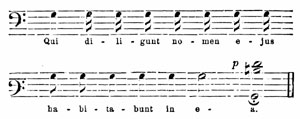
[Listen]
An antiphon, and sometimes more than one, serves as an introduction to each Psalm. These are generally sung by two counter-tenor voices, in canto fermo, in harsh, hard tones; the first half of each verse in the same style, and the second responded to by the chorus of male voices that I already described. I have kept the several antiphons that I wrote down, that you may compare them with the book. On the afternoon of Wednesday, the 68th, 69th, and 70th Psalms were sung. (By the bye, this division of the verses of the Psalms sung in turns by each chorus, is one of the innovations that Bunsen has introduced into the Evangelical Church here; he also ushers in each choral by an antiphon, composed by Georg, a musician who resides here, in the style of canti fermi, first sung by a few voices, succeeded by a choral, such as "Ein' feste Burg ist unser Gott.") After the 70th Psalm comes a paternoster sub silentio—that is, all present stand up, and a short silent inward prayer ensues, and a pause.
Then commences the first Lamentation of Jeremiah, sung in a low subdued tone, in the key of G major, a solemn and fine composition of Palestrina's. The solos are chanted entirely by high tenor voices, swelling and subsiding alternately, in the most delicate gradations, sometimes floating almost inaudibly, and gently blending the various harmonies; being sung without any bass voices, and immediately succeeding the previous harsh intonation of the Psalms, the effect is truly heavenly. It is rather unfortunate however that those very parts which ought to be sung with the deepest emotion and reverence, being evidently those composed with peculiar fervour, should chance to be merely the titles of the chapter or verse, aleph, beth, gimel, etc., and that the beautiful commencement, which sounds as if it came direct from Heaven, should be precisely on these words, "Incipit Lamentatio Jeremiæ Prophetæ Lectio I." This must be not a little repulsive to every Protestant heart, and if there be any design to introduce a similar mode of chanting into our churches, it appears to me that this will always be a stumbling-block; for any one who sings "chapter first" cannot possibly feel any pious emotions, however beautiful the music may be, let him strive as he will.
My little book indeed says, "Vedendo profetizzato il crocifiggimento con gran pietà, si cantano eziandio molto lamentevolmente aleph, e le altre simili parole, che sono le lettere dell' alfabeto Ebreo, perchè erano in costume di porsi in ogni canzone in luogo di lamento, come è questa. Ciascuna lettera ha in se, tutto it sentimento di quel versetto che la segue, ed è come un argomento di esso;" but this explanation is not worth much. After this the 71st, 72nd, and 73rd Psalms are sung in the same manner, with their antiphons. These are apportioned to the various voices. The soprano begins, "In monte Oliveti," on which the bass voices chime in forte, "Oravit ad Patrem: Pater," etc. Then follow the lessons, from the treatise of Saint Augustine on the Psalms. The strange mode in which these are chanted appeared to me very extraordinary when I heard them for the first time on Palm Sunday, without knowing what it meant. A solitary voice is heard reciting on one note, not as in the Psalms, but very slowly and impressively, making the tone ring out clearly.
There are different cadences employed for the different punctuation of the words, to represent a comma, interrogation, and full stop. Perhaps you are already acquainted with these: to me they were a novelty, and appeared very singular. The first, for example, was chanted by a powerful bass voice in G. If a comma occurs, he sings so, on the last word:—
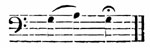
[Listen]
an interrogation thus:—
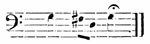
[Listen]
a full stop:—
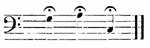
[Listen]
For example:—

[Listen]
I cannot describe to you how strange the falling cadence from A to C sounds; especially when the bass is followed by a soprano, who begins on D, and makes the same falling cadence from E to G; then an alto does the same in his key; for they sang three different lessons alternately with the canto fermo. I send you a specimen of the mode in which they render the canto fermo, regardless both of the words and the sense. The phrase "better he had never been born" was thus sung:—
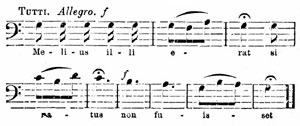
[Listen]
quite fortissimo and monotonously. Then came the Psalms 74, 75, and 76, followed by three lessons, succeeded by the Miserere, sung in the same style as the preceding Psalms, in the following tonus:—
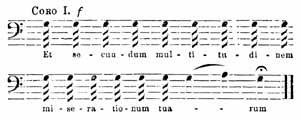
[Listen]
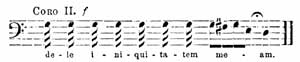
[Listen]
It will be long before you can improve on this. Then followed Psalms 8, 62, and 66; "Canticum Moysi" in its own tone. Psalms 148, 149, and 150 came next, and then antiphons. During this time the lights on the altar are all extinguished, save one which is placed behind the altar. Six wax candles still continue to burn high above the entrance, the rest of the space is already dim, and now the whole chorus unisono intone with the full strength of their voices the "Canticum Zachariæ," during which the last remaining lights are extinguished. The mighty swelling chorus in the gloom, and the solemn vibration of so many voices, have a wonderfully fine effect.
The melody (in D minor) is also very beautiful. At the close all is profound darkness. An antiphon begins on the sentence, "Now he that betrayed him gave them a sign," and continues to the words "that same is he, hold him fast." Then all present fall on their knees, and one solitary voice softly sings, "Christus factus est pro nobis obediens usque ad mortem;" on the second day is added, "mortem autem crucis;" and on Good Friday, "propter quod et Deus exaltavit illum, et dedit illi Nomen, quod est super omne nomen." A pause ensues, during which each person repeats the Paternoster to himself. During this silent prayer, a death-like silence prevails in the whole church; presently the Miserere commences, with a chord softly breathed by the voices, and gradually branching off into two choirs. This beginning, and its first harmonious vibration, certainly made the deepest impression on me. For an hour and a half previously, one voice alone had been heard chanting almost without any variety; after the pause came an admirably constructed chord, which has the finest possible effect, causing every one to feel in their hearts the power of music; it is this indeed that is so striking. The best voices are reserved for the Miserere, which is sung with the greatest variety of effect, the voices swelling and dying away, from the softest piano to the full strength of the choir. No wonder that it should excite deep emotion in every heart. Moreover they do not neglect the power of contrast; verse after verse being chanted by all the male voices in unison, forte, and harshly. At the beginning of the subsequent verses, the lovely, rich, soft sounds of voices steal on the ear, lasting only for a short space, and succeeded by a chorus of male voices. During the verses sung in monotone, every one knows how beautifully the softer choir are about to uplift their voices; soon they are again heard, again to die away too quickly, and before the thoughts can be collected, the service is over.
On the first day, when the Miserere of Baini was given in the key of B minor, they sang thus:—"Miserere mei Deus" to "misericordiam tuam" from the music, with solo voices, two choirs using the whole strength of voices at their command; then all the bass singers commenced tutti forte by F sharp, chanting on that note "et secundum multitudinem" to "iniquitatem meam," which is immediately succeeded by a soft chord in B minor, and so on, to the last verse of all, which they sing with their entire strength; a second short silent prayer ensues, when all the Cardinals scrape their feet noisily on the pavement, which betokens the close of the ceremony. My little book says, "This noise is symbolical of the tumult made by the Hebrews in seizing Christ." It may be so, but it sounded exactly like the commotion in the pit of a theatre, when the beginning of a play is delayed, or when it is finally condemned. The single taper still burning, is then brought from behind the altar, and all silently disperse by its solitary light.
On leaving the chapel, I must not omit to mention the striking effect of the blazing chandelier lighting up the great vestibule, when the Cardinals and their attendant priests traverse the illuminated Quirinal through ranks of Swiss Guards. The Miserere sung on the first day was Baini's, a composition entirely devoid of life or power, like all his works; still it had chords and music, and so it made a certain impression.
On the second day they gave some pieces by Allegri and Bai. On Good Friday all the music was Bai's. As Allegri composed only one verse, on which the rest are chanted, I heard the three compositions which they gave on that day. It is however quite immaterial which they sing, for the embellimenti are pretty much the same in all three. Each chord has its embellimento, thus very little of the original composition is to be discovered. How these embellimenti have crept in they will not say. It is maintained that they are traditional; but this I entirely disbelieve. In the first place no musical tradition is to be relied on; besides, how is it possible to carry down a five-part movement to the present time, from mere hearsay? It does not sound like it. It is evident that they have been more recently added; and it appears to me that the director, having had good high voices at his command, and wishing to employ them during the Holy Week, wrote down for their use ornamental phrases, founded on the simple unadorned chords, to enable them to give full scope and effect to their voices. They certainly are not of ancient date, but are composed with infinite talent and taste, and their effect is admirable; one in particular is often repeated, and makes so deep an impression, that when it begins, an evident excitement pervades all present; indeed, in any discussion as to the mode of executing this music, and when people say that the voices do not seem like the voices of men, but those of angels from on high, and that these sounds can never he heard elsewhere, it is this particular embellimento to which they invariably allude. For example, in the Miserere, whether that of Bai or Allegri (for they have recourse to the same embellimenti in both) these are the consecutive chords:—
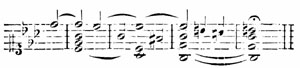
[Listen]
Instead of this, they sing it so:—
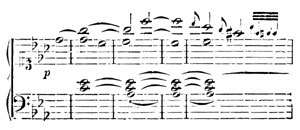
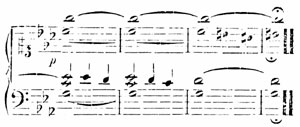
[Listen]
The soprano intones the high C in a pure soft voice, allowing it to vibrate for a time, and slowly gliding down, while the alto holds the C steadily, so that at first I was under the delusion that the high C was still held by the soprano; the skill, too, with which the harmony is gradually developed is truly admirable. The other embellimenti are adapted in the same way to the consecutive chords: but the first one is by far the most beautiful. I can give no opinion as to the particular mode of executing the music; but what I once read, that some particular acoustic contrivance caused the continued vibration of the sounds, is an entire fable, quite as much so as the assertion that they sing from tradition, and without any fixed time, one voice simply following the other; for I saw plainly enough the shadow of Baini's long arm moving up and down; indeed, he sometimes struck his music-desk quite audibly. There is no lack of mystery too, on the part of the singers and others: for example, they never say beforehand what particular Miserere they intend to sing, but that it will be decided at the moment, etc., etc. The key in which they sing, depends on the purity of the voices. The first day it was in B minor, the second and third in E minor, but each time they finished almost in B flat minor.
The chief soprano, Mariano, came from the mountains to Rome expressly to sing on this occasion, and it is to him I owe hearing the embellimenti with their highest notes. However careful and attentive the singers may be, still the negligence and bad habits of the whole previous year have their revenge, consequently the most fearful dissonance sometimes occurs.
I must not forget to tell you that on the Thursday, when the Miserere was about to begin, I clambered up a ladder leaning against the wall, and was thus placed close to the roof of the chapel, so that I had the music, the priests, and the people far beneath me in gloom and shadow. Seated thus alone without the vicinity of any obtrusive stranger, the impression made on me was very profound. But to proceed: you must have had more than enough of Misereres in these pages, and I intend to bring you more particular details, both verbal and written.
On Thursday, at half-past ten o'clock, high Mass was celebrated. They sang an eight-part composition of Fazzini's, in no way remarkable. I reserve for you some canti fermi and antiphons, which I wrote down at the time, and my little book describes the order of the various services and the meaning of the different ceremonies. At the "Gloria in Excelsis" all the bells in Rome peal forth, and are not rung again till after Good Friday. The hours are marked in the churches by wooden clappers. The words of the "Gloria," the signal for all the strange tumult of bells, were chanted from the altar by old Cardinal Pacca, in a feeble trembling voice; this being succeeded by the choirs and all the bells, had a striking effect. After the "Credo" they sang the "Fratres ego enim" of Palestrina, but in the most unfinished and careless manner. The washing of the pilgrims' feet followed, and a procession in which all the singers join; Baini beating time from a large book carried before him, making signs first to one, and then to another, while the singers pressed forward to look at the music, counting the time as they walked, and then chiming in,—the Pope being borne aloft in his state chair. All this I have already described to my parents.
In the evening there were Psalms, Lamentations, Lessons, and the Miserere again, scarcely differing from those of the previous day. One lesson was chanted by a soprano solo on a peculiar melody, that I mean to bring home with me. It is an adagio, in long-drawn notes, and lasts a quarter of an hour at least. There is no pause in the music, and the melody lies very high, and yet it was executed with the most pure, clear, and even intonation. The singer did not drop his tone so much as a single comma, the very last notes swelling and dying away as even and full as at the beginning; it was, indeed, a masterly performance. I was struck with the meaning they attach to the word appoggiatura. If the melody goes from C to D, or from C to E, they sing thus:—

[Listen] [Listen] [Listen]
[Listen]
[Listen]
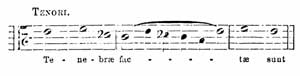
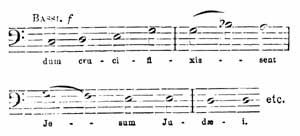
and this they call an appoggiatura. Whatever they may choose to designate it, the effect is most disagreeable, and it must require long habit not to be discomposed by this strange practice, which reminds me very much of our old women at home in church; moreover the effect is the same. I saw in my book that the "Tenebræ" was to be sung, and thinking that it would interest you to know how it is given in the Papal chapel, I was on the watch with a sharp-pointed pencil when it commenced, and send you herewith the principal parts. It was sung very quick, and forte throughout, without exception. The beginning was:—
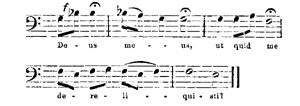
[Listen]
Then
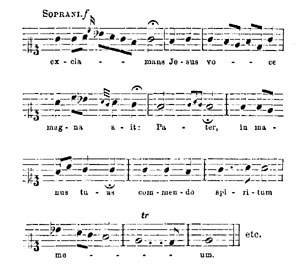
[Listen]
I cannot help it, but I own it does irritate me to hear such holy and touching words sung to such dull, drawling music. They say it is canto fermo, Gregorian, etc.; no matter. If at that period there was neither the feeling nor the capability to write in a different style, at all events we have now the power to do so, and certainly this mechanical monotony is not to be found in the scriptural words; they are all truth and freshness, and moreover expressed in the most simple and natural manner. Why then make them sound like a mere formula? and, in truth, such singing as this is nothing more! The word "Pater" with a little flourish, the "meum" with a little shake, the "ut quid me"—can this be called sacred music? There is certainly no false expression in it, because there is none of any kind; but does not this very fact prove the desecration of the words? A hundred times during the ceremony I was driven wild by such things as these; and then came people in a state of ecstasy, saying how splendid it had all been. This sounded to me like a bad joke, and yet they were quite in earnest!
At Mass early on Friday morning, the chapel is stripped of all its decorations, the altar uncovered, and the Pope and Cardinals in mourning. The "Passion," from St. John, was sung, composed by Vittoria, but the words of the people in the chorus alone are his, the rest are chanted according to an established formula: but more of this hereafter. The whole appeared to me too trivial and monotonous, I was quite out of humour, and, in fact, dissatisfied with the affair altogether. One of the two following modes ought to be adopted. The "Passion" ought either to be recited quietly by the priest, as St. John relates it, in which case there is no occasion for the chorus to sing "Crucifige eum," nor for the alto to represent Pilate—or else the scene should be so thoroughly realized, that it ought to make me feel as if I were actually present, and saw it all myself. In that event, Pilate ought to sing just as he would have spoken, the chorus shout out "Crucifige" in a tone anything but sacred; and then, through the impress of entire truth, and the dignity of the object represented, the singing would become sacred church music.
I require no under-current of thought when I hear music, which is not to me "a mere medium to elevate the mind to piety," as they say here, but a distinct language speaking plainly to me; for though the sense is expressed by the words, it is equally contained in the music. This is the case with the "Passion" of Sebastian Bach; but as they sing it here, it is very imperfect, being neither a simple narrative, nor yet a grand solemn dramatic truth. The chorus sings "Barabbam" to the same sacred chords as "et in terra pax." Pilate speaks exactly in the same manner as the Evangelist. The voice that represents our blessed Saviour commences always piano, in order to have one definite distinction, but when the chorus breaks loose, shouting out their sacred chords, it seems entirely devoid of meaning. Pray forgive these strictures. I now proceed to simple narration again. The Evangelist is a tenor, and the mode of chanting, the same as that of the Lessons, with a peculiar falling cadence at the comma, interrogation, and full stop. The Evangelist intones on D, and sings thus at a full stop:—
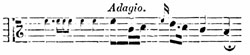
[Listen]
at a comma:—
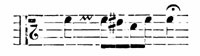
[Listen]
and at the conclusion, when another personage enters, so:—
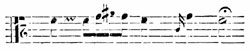
[Listen]
Christ is represented by a bass, and commences always thus:—
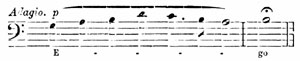
[Listen]
I could not catch the formula, though I noted down several parts, which I can show you when I return: among others, the words spoken on the Cross. All the other personages,—Pilate, Peter, the Maid, and the High Priest,—are altos, and sing this melody only:—
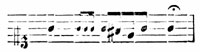
[Listen]
The chorus sings the words of the people from their places above, while everything else is sung from the altar. I must really mark down here as a curiosity the "Crucifige," just as I noted it at the time:—
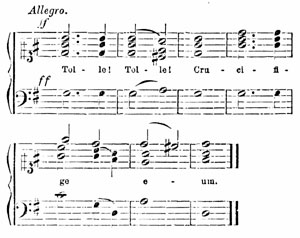
[Listen]
The "Barabbam" too is most singular;—very tame Jews indeed! But my letter is already too long, so I shall discuss the subject no further. Prayers are then offered up for all nations and institutions, each separately designated. When the prayer for the Jews is uttered, no one kneels, as they do at all the others, nor is Amen said. They pray pro perfidis Judæis, and the author of my book discovers an explanation of this also. Then follows the Adoration of the Cross; a small crucifix is placed in the centre of the chapel, and all approach barefooted (without shoes), fall down before it and kiss it; during this time the "Improperia" are sung. I have only once heard this composition, but it seems to me to be one of Palestrina's finest works, and they sing it with remarkable enthusiasm. There is surprising delicacy and harmony in its execution by the choir; they are careful to place every passage in its proper light, and to render it sufficiently prominent without making it too conspicuous—one chord blending softly with the other. Moreover, the ceremony is very solemn and dignified, and the most profound silence reigns in the chapel.
They sing the oft-recurring Greek "Holy" in the most admirable manner, each time with the sane smoothness and expression. You will be not a little surprised, however, when you see it written down, for they sing as follows:—
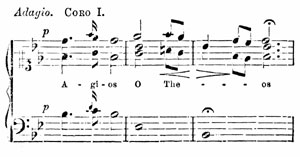
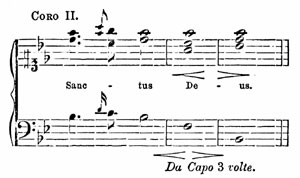
[Listen]
Such passages as that at the commencement, where all the voices sing the very same embellishment, repeatedly occur, and the ear becomes accustomed to them. The effect of the whole is undoubtedly superb. I only wish you could hear the tenors in the first chorus, and the mode in which they take the high A on the word "Theos;" the note is so long-drawn and ringing, though softly breathed, that it sounds most touching. This is repeated again and again till all in the chapel have performed the Adoration of the Cross; but as on this occasion the crowd was not very great, I unluckily had not the opportunity of hearing it as often as I could have wished.
I quite understand why the "Improperias" produced the strongest effect on Goethe, for they are nearly the most faultless of all, as both music and ceremonies, and everything connected with them, are in the most entire harmony. A procession follows to fetch the Host, which had been exposed and adored on the previous evening in another chapel of the Quirinal, lighted up by many hundred wax-lights. The morning service closed at half-past one with a hymn in canto fermo. At half-past three in the afternoon the first nocturn began, with the Psalms, Lessons, etc. I corrected what I had written down, heard the Miserere of Baini, and about seven o'clock followed the Cardinals home through the illuminated vestibule—so all was now seen, and all was now over.
I was anxious, dear Professor, to describe the Holy Week to you minutely, as they were memorable days to me, every hour bringing with it something interesting and long anticipated. I also particularly rejoiced in feeling that, in spite of the excitement and the numerous discussions in praise or blame, the solemnities made as vivid an impression on me, as if I had been quite free from all previous prejudice or prepossession. I thus saw the truth confirmed, that perfection, even in a sphere the most foreign to us, leaves its own stamp on the mind. May you read this long letter with even half the pleasure I feel in recalling the period of the Holy Week at Rome.
Yours faithfully, Felix Mendelssohn Bartholdy
Florence, June 25th, 1831.
Dear Sisters,
On such a day as this my paternal home and those I love are much in my thoughts; my feelings on this point are rather singular. If I feel at any time unwell, or fatigued, or out of humour, I have no particular longing for my own home or for my family; but when brighter days ensue, when every hour makes an indelible impression, and every moment brings with it glad and pleasant sensations then I ardently wish that I were with you, or you with me; and no minute passes without my thinking of one or other of you, to whom I have something particular to say.
I have to-day passed the whole forenoon, from ten till three, in the gallery; it was glorious! Besides all the beautiful work I saw, from which so much fresh benefit is always to be derived, I wandered about among the pictures, feeling so much sympathy, and such kindly emotions in gazing at them. I now first thoroughly realized the great charm of a large collection of the highest works of art. You pass from one to the other, sitting and dreaming for an hour before some picture, and then on to the next.
Yesterday was a holiday here, so to-day the Palazzo degli Uffizi was crowded with people who had come into the city to see the races, and to visit the far-famed gallery; chiefly peasants, male and female, in their country costumes. All the apartments were thrown open, and as I was about to contemplate them for the last time. I contrived to slip quietly through the crowd, and to remain quite solitary, for I knew that I had not one acquaintance among them.
The busts of the various princes who founded and enriched this collection, are placed near the entrance, at the top of the staircase. I suppose I must have been peculiarly susceptible to-day, for the faces of the Medici interested me exceedingly; they looked so noble and refined, so proud and so dignified. I stood looking at them for a long time, and imprinted on my memory those countenances of world-wide renown.
I then went to the Tribune. This room is so delightfully small you can traverse it in fifteen paces, and yet it contains a world of art. I again sought out my favourite armchair, which stands under the statue of the "Slave Whetting his Knife" (L'Arrotino), and taking possession of it, I enjoyed myself for a couple of hours; for here, at one glance, I had the "Madonna del Cardellino," "Pope Julius II.," a female portrait by Raphael, and above it a lovely Holy Family, by Perugino; and so close to me that I could have touched the statue with my hand, the Venus de' Medici; beyond, that of Titian; on the other side, the "Apollino" and the "Wrestlers" (Lottatori); in front of the Raphael, the merry Greek Dancing Faun, who seems to feel an uncouth delight in discordant music, for the fellow has just struck two cymbals together, and is listening to the sound, while treading with his foot on a kind of Pan's pipes, as an accompaniment: what a clown he is! The space between is occupied by other pictures of Raphael's, a portrait by Titian, a Domenichino, etc., and all these within the circumference of a small semicircle, no larger than one of your own rooms. This is a spot where a man feels his own insignificance, and may well learn to be humble.
I occasionally walked through the other rooms, where a large picture by Leonardo da Vinci, only commenced and sketched in, with all its wild dashes and strokes, is very suggestive. I was especially struck with the genius of the monk Fra Bartolommeo, who must have been a man of the most devout, tender, and earnest spirit. There is a small picture of his here, which I discovered for myself. It is about the size of this sheet of paper, in two divisions, and represents the "Adoration" and the "Presentation in the Temple." The figures are about two-thirds of a finger-length in size, but finished in the most exquisite and consummate manner, with the most brilliant colouring, the brightest decorations, and in the most genial sunshine. You can see in the picture itself, that the pious maestro has taken delight in painting it, and in finishing the most minute details; probably with the view of giving it away, to gratify some friend. We feel as if the painter belonged to it, and still ought to be sitting before his work, or had only this moment left it. I felt the same with regard to many pictures to-day, especially that of the "Madonna del Cardellino," which Raphael painted as a wedding-gift, and a surprise for his friend. I could not help meditating on all these great men, so long passed away from earth, though their whole inner soul is still displayed in such lustre to us, and to all the world.