LETTERS. (continued 4)
Grace Wallace translation
While reflecting on these things, I came by chance into the room containing the portraits of great painters. I formerly merely regarded them in the light of valuable curiosities, for there are more than three hundred portraits, chiefly painted by the masters themselves, so that you see at the same moment the man and his work; but to-day a fresh idea dawned on me with regard to them,—that each painter resembles his own productions, and that each while painting his own likeness, has been careful to represent himself just as he really was. In this way you become personally acquainted with all these great men, and thus a new light is shed on many things. I will discuss this point more minutely with you when we meet; but I must not omit to say, that the portrait of Raphael is almost the most touching likeness I have yet seen of him. In the centre of a large rich screen, entirely covered with portraits, hangs a small solitary picture, without any particular designation, but the eye is instantly arrested by it; this is Raphael—youthful, very pale and delicate, and with such onward aspirations, such longing and wistfulness in the mouth and eyes, that it is as if you could see into his very soul. That he cannot succeed in expressing all that he sees and feels, and is thus impelled to go forward, and that he must die an early death,—all this is written on his mournful, suffering, yet fervid countenance, and when looking at his dark eyes, which glance at you out of the very depths of his soul, and at the pained and contracted mouth, you cannot resist a feeling of awe.
How I wish you could see the portrait that hangs above it; that of Michael Angelo, an ugly, muscular, savage, rugged fellow, in all the vigour of life, looking gruff and morose; and on the other side a wise, grave man, with the aspect of a lion, Leonardo da Vinci; but you cannot see this portrait, and I will not describe it in writing, but tell you of it when we meet. Believe me, however, it is truly glorious. Then I passed on to the Niobe, which of all statues makes the greatest impression on me; and back again to my painters, and to the Tribune, and through the Corridors, where the Roman Emperors, with their dignified yet knavish physiognomies, stare you in the face; and last of all I took a final leave of the Medici family.
It was indeed a morning never to be forgotten.
June 26th.
Do not suppose however that I mean to assert that all days are spent thus. You must battle your way through the present living mob, before you can arrive at the nobility, long since dead, and those who have not a strong arm are sure to come badly off in the conflict. Such a journey as mine from Rome to Perugia, and on here, is no joke. Jean Paul says that the presence of a person who openly hates you is most painful and oppressive. Such a being is the Roman vetturino: he grants you no sleep; exposes you to hunger and thirst; at night, when he is bound to provide you with your pranzo, he contrives that you shall not arrive till midnight, when every one is of course asleep, and you are only too thankful to get a bed. In the morning he sets off before four o'clock, and rests his horses at noon for five hours, but invariably in some solitary little wayside inn, where nothing is to be had. Each day he makes out about six German miles, and drives piano, while the sun burns fortissimo.
I was very badly off owing to all this, for my fellow-travellers were far from being congenial; three Jesuits inside, and in the cabriolet, where I particularly desired to sit, a most disagreeable Venetian lady. If I wished to escape from her, I was obliged to go inside, and listen to the praises of Charles X., and to hear that Ariosto ought to have been burnt as a corrupt writer, subversive of all morality. It was still worse outside, and we never seemed to get on. The first day, after a journey of four hours, the axletree broke, and we were obliged to remain for nine hours in the same house in the Campagna where we chanced to be, and at last to stay all night. If there was a church on the road that we had an opportunity of visiting, the most beautiful and devotional creations of Perugino, or Giotto, or Cimabue, enchanted our eyes; and so we passed from irritation to delight, and then to irritation again. This was a wretched state to be in. I was not in the least amused by it all; and if Nature had not bestowed on us bright moonshine at the Lake of Thrasymene, and if the scenery had not been so wonderfully fine, and if in every town we had not seen a superb church, and if we had not passed through a large city each day as we journeyed on, and if—but you see I am not easily satisfied.
The route however was beautiful, and I must now describe my arrival in Florence, which also includes my whole Italian life of the previous days. At Incisa, half a day's journey from Florence, my vetturino became so intolerable from his insolence and abuse, that I found it necessary to take out my luggage, and to tell him to drive to the devil,—which he accordingly did, rather against his will.
It was Midsummer's day, and a celebrated fête was to take place in Florence the same evening, which I would on no account whatever have missed. This is just the kind of thing that the Italians take advantage of, so the landlady at Incisa offered me a carriage at four times the proper fare. When I refused to take it, she said I might try to procure another; and so I accordingly did, but found that no carriages for hire were to be had, only post-horses. I went to the Post, and was there told, to my disgust, that they were at my landlady's, and that she had wished to make me pay an exorbitant price for them. I went back and demanded horses. She said, if I did not choose to pay what she asked, I should have none. I desired to see the regulations, which they are all obliged to have. She said there was no occasion to show them, and turned her back on me. The use of physical strength, which plays a great part here, was resorted to by me on this occasion, for I seized her and pushed her back into a room (for we were standing in the passage) and then hurried down the street to the Podestà. It turned out however that there was no such person in the town, but that he lived four miles off. The affair became every instant more disagreeable, the crowd of boys at my heels increasing at every step. Fortunately a decent-looking man came up, to whom the mob seemed to show some respect; so I accosted him, and explained all that had occurred. He sympathized with me, and took me to a vine-dresser's who had a little carriage for hire.
The whole crowd now congregated before his door, many pressing forward into the house after me, and shouting that I was mad; but the carriage drove up, and I threw a few scudi to an old beggar, on which they all called out that I was a bravo Signore, and wished me buon viaggio. The moderate price the man demanded more fully showed me the abominable overcharge of the landlady. The carriage was easy, and the horses went on at a good pace, and so we travelled across the hills to Florence. In the course of half an hour we overtook my lazy vetturino. I put up my umbrella to defend me from the sun, and I scarcely ever travelled so pleasantly and so comfortably as during those few hours, having left all annoyances behind me, and before me the prospect of the beautiful fête.
Very soon the Duomo, and the hundreds of villas scattered through the valleys, were visible. Once more we passed by decorated terraces, and the tops of trees seen over them; the Arno valley looking lovelier than ever. And so I arrived here in good spirits and dined; and even while doing so I heard a tumult, and looking out of the window I saw crowds, both young and old, all hurrying in their holiday costumes across the bridges.
I followed them to the Corso, and then to the races; afterwards to the illuminated Pergola, and last of all to a masked ball in the Goldoni Theatre. At one o'clock in the morning I went towards home, thinking that the whole affair was over; but the Arno was still covered with gondolas, illuminated by coloured lamps, and crossing each other in every direction. Under the bridge a large ship was passing, hung with green lanterns; the water shone brightly as it rippled along, while a still brighter moon looked down on the whole scene. I recalled to myself the various occurrences of the day, and the thoughts that had chased each other through my mind, and resolved to write them all to you. It is in fact a reminiscence for myself, for it may not be so suggestive to you, but it will one day be of service to me, enabling me to recall various scenes connected with fair Italy.
Extract from a Letter to Frau von Pereira, in Vienna.
Genoa, July, 1831.
At first I resolved not to answer your letter until I had fulfilled your injunctions, and composed "Napoleon's Midnight Review;" and now I have to ask your forgiveness for not having done so, but there is a peculiarity in this matter. I take music in a very serious light, and I consider it quite inadmissible to compose anything that I do not thoroughly feel. It is just as if I were to utter a falsehood; for notes have as distinct a meaning as words, perhaps even a more definite sense. Now it appears to me almost impossible to compose for a descriptive poem. The mass of compositions of this nature do not militate against this opinion, but rather prove its truth; for I am not acquainted with one single work of the kind that has been successful. You are placed between a dramatic conception or a mere narrative; the one, in the "Erl König," causes the willows to rustle, the child to shriek, and the horse to gallop. The other imagines a ballad singer, calmly narrating the horrible tale, as you would a ghost story, and this is the most accurate view of the two; Reichardt almost invariably adopted this reading, but it does not suit me; the music stands in my way. I feel in a far more spectral spirit when I read such a poem quietly to myself, and imagine the rest, than when it is depicted, or related to me.
It does not answer to look on "Napoleon's Midnight Review" as a narrative, inasmuch as no particular person speaks, and the poem is not written in the style of a ballad. It seems to me more like a clever conception than a poem; it strikes me that the poet himself placed no great faith in his misty forms.
I could indeed have composed music for it in the same descriptive style, as Neukomm and Fischhof, in Vienna. I might have introduced a very novel rolling of drums in the bass, and blasts of trumpets in the treble, and have brought in all sorts of hobgoblins. But I love my serious elements of sound too well to do anything of the sort; for this kind of thing always appears to me a joke; somewhat like the painting's in juvenile spelling-books, where the roofs are coloured bright red, to make the children aware they are intended for roofs; and I should have been most reluctant to write out and send you anything incomplete, or that did not entirely please myself, because I always wish you to have the best I can accomplish.
Felix.
Milan, July 14th, 1831.
This letter will probably be the last (D.V.) that I shall write to you from an Italian city; I may possibly send you another from the Borromean Islands, which I intend to visit in a few days, but do not rely on this.
My week here has been one of the most agreeable and amusing that I have passed in Italy; and how this could be the case in Milan, hitherto utterly unknown to me, I shall now proceed to relate. In the first place, I immediately secured a small piano, and attacked with rabbia that endless "Walpurgis Night," to finish the thing at last; and to-morrow morning it will be completed, except the overture; for as yet I have not quite made up my mind whether it shall be a grand symphony, or a short introduction breathing of spring. I should like to take the opinion of some adept on this point. I must say the conclusion has turned out better than I myself expected. The hobgoblins and the bearded Druid, with the trombones sounding behind him, diverted me immensely, and so I passed two forenoons very happily.
'Tasso' also contributed to my pleasure, which I have now for the first time been able to read with facility; it is a splendid poem. I was glad to be already well acquainted with Goethe's 'Tasso;' being constantly reminded of it by the principal passages of the Italian poet, whose verse, like that of Goethe, is so dreamy, harmonious, and tender, its sweet melody delighting the ear. Your favourite passage, dear father, "Era la notte allor," struck me as very beautiful, but the stanzas that I admire most, are those descriptive of Clorinda's death; they are so wonderfully imaginative, and fine. The close however does not quite please me. Tancred's 'Lamentations' are, I think, more charmingly composed than true to nature; they contain too many clever ideas and antitheses; and even the words of the hermit, which soothe him, sound more like a censure on the hermit himself. I should infallibly have killed him on the spot, if he had talked to me in such a strain.
Recently I was reading the episode of 'Armida' in a carriage, surrounded by a company of Italian actors, who were incessantly singing Rossini's "Ma trema, trema," when suddenly there recurred to my thoughts Gluck's "Vous m'allez quitter," and Rinaldo's falling asleep, and the voyage in the air—and I felt in a most melting mood. This is genuine music; thus have men felt, and thus have men spoken, and such strains can never die. I do cordially hate the present licentious style. Do not take it amiss; your motto is, Without hatred, no love,—and I did feel so moved when I thought of Gluck, and his grand embodiments.
Every evening I was in society, owing to a mad prank, which however proved very successful. I think I have invented this kind of eccentric proceeding, and may take out a patent for it, as I have already made my most agreeable acquaintances ex abrupto, without letters or introductions of any kind.
I asked by chance on my arrival at Milan the name of the Commandant, and the laquais de place named General Ertmann. I instantly thought of Beethoven's Sonata in A major, and its dedication; and as I had heard all that was good of Madame Ertmann, from those who knew her; that she was so kind, and had bestowed such loving care on Beethoven, and played herself so beautifully, I, next morning, at a suitable hour for a visit, put on a black coat, desired that the Government-house should be pointed out to me, and occupied myself on the way thither by composing some pretty speeches for the General's lady, and went on boldly.
I cannot however deny that I felt rather dismayed when I was told that the General lived in the first story, facing the street; and when I was fairly in the splendid vaulted hall, I was seized with a sudden panic, and would fain have turned back: but I could not help thinking that it was vastly provincial on my part to take fright at a vaulted hall, so I went straight up to a group of soldiers standing near, and asked an old man in a short nankeen jacket, if General Ertmann lived there, intending then to send in my name to the lady. Unluckily the man replied, "I am General Ertmann: what is your pleasure?" This was unpleasant, as I was forced to have recourse to the speech I had prepared. The General, however, did not seem particularly edified by my statement, and wished to know whom he had the honour of addressing. This also was far from agreeable, but fortunately he was acquainted with my name, and became very polite: his wife, he said was not at home, but I should find her at two o'clock, or any hour after that which might suit me.
I was glad that all had gone off so well, and in the meantime went to the Brera, where I passed the time in studying the 'Sposalizio' of Raphael, and at two o'clock I presented myself to Freifrau Dorothea von Ertmann. She received me with much courtesy, and was most obliging, playing me Beethoven's Sonata in C sharp minor, and the one in D minor. The old General, who now appeared in his handsome grey uniform, covered with orders, was quite enchanted, and had tears of delight in his eyes, because it was so long since he had heard his wife play; he said there was not a person in Milan who cared to hear what I had heard. She mentioned the trio in B major, but said she could not remember it. I played it, and sang the other parts: this enchanted the old couple, and so their acquaintance was soon made.
Since then their kindness to me is so great that it quite overwhelms me. The old General shows me all the remarkable objects in Milan; in the afternoon his lady takes me in her carriage to drive on the Corso, and at night we have music till one o'clock in the morning. Yesterday at an early hour they drove with me in the environs; at noon I dined with them, and in the evening there was a party. They are the most agreeable and cultivated couple you can imagine, and both as much in love with each other as if they were a newly wedded pair,—and yet they have been married for four-and-thirty years. Yesterday he spoke of his profession, of military life, of personal courage, and similar subjects, with a degree of lucidity, and liberality of feeling, that I scarcely ever met with, except in my father. The General has been now an officer for six-and-forty years, and you should really see him galloping beside his wife's carriage in the park,—the old gentleman looking so dignified and animated!
She plays Beethoven's works admirably, though it is so long since she studied them; she sometimes rather exaggerates the expression, dwelling too long on one passage, and then hurrying the next; but there are many parts that she plays splendidly, and I think I have learned something from her. When sometimes she can bring no more tone out of the instrument, and begins to sing in a voice that emanates from the very depths of her soul, she reminds me of you, dear Fanny, though you are infinitely her superior. When I was approaching the end of the adagio in the B major trio, she exclaimed, "The amount of expression here is beyond any one's playing;" and it is quite true of this passage.
The following day, when I went there again to play her the symphony in C minor, she insisted on my taking off my coat, as the day was so hot. In the intervals of our music she related the most interesting anecdotes of Beethoven, and that when she was playing to him in the evening he not unfrequently used the snuffers as a tooth-pick! She told me that when she lost her last child, Beethoven at first shrank from coming to her house; but at length he invited her to visit him, and when she arrived, she found him seated at the piano, and simply saying, "Let us speak to each other by music," he played on for more than an hour, and, as she expressed it, "he said much to me, and at last gave me consolation." In short I am now in the most genial mood, and quite at my ease, having no occasion to resort to any disguise, or to be silent, for we understand each other admirably on all points. She played the Kreutzer Sonata yesterday with violin accompaniment, and when the violin-player (an Austrian cavalry officer) made a long flourish, à la Paganini, at the beginning of the adagio, the old General made such a desperate grimace, that I nearly fell off my chair from laughing.
I called on Teschner, as you, dear mother, desired me to do so; such a musician however is as depressing as a thick fog. Madame Ertmann has more soul in her little finger than that fellow has in his whole body, with his formidable moustaches, behind which he seems to lie in ambush. There is no public music in Milan; they still speak with enthusiasm of last winter, when Pasta and Rubini sang here, but say that they were miserably supported, and the orchestra and choruses bad. I however heard Pasta six years ago in Paris, and I can do the same every year, with the addition of a good orchestra and a good chorus, and many other advantages; so it is evident that if I wish to hear Italian music, I must go to Paris or to England. The Germans however take it amiss when you say this, and persist par force in singing, playing, and acquiring new ideas here, declaring this is the land of inspiration; while I maintain that inspiration is peculiar to no country, but floats about in the air.
Two days ago I was in the morning theatre here, and was amused. There you can see more of the life of the people than in any other part of Italy. It is a large theatre with boxes, the pit filled with wooden benches, on which you can find places if you come early; the stage is like every other stage, but there is no roof either over the pit or boxes, so that the bright sun shines into the theatre and into the eyes of the actors. Moreover, the piece they gave was in the Milanese dialect. You feel as if you were secretly watching all these complicated and diverting situations, and might take part in them if necessary, and thus the most familiar comic dilemmas become novel and interesting; and the public seem to feel the most lively interest in them. And now, good night. I wished to talk to you a little before going to bed, and so it has become a letter.
Felix.
Extracts from two Letters to Edward Devrient.
Milan, July 15th, 1831.
You reproach me with being two-and-twenty without having yet acquired fame. To this I can only reply, had it been the will of Providence that I should be renowned at the age of two-and-twenty, I no doubt should have been so. I cannot help it, for I no more write to gain a name, than to obtain a Kapellmeister's place. It would be a good thing if I could secure both. But so long as I do not actually starve, so long is it my duty to write only as I feel, and according to what is in my heart, and to leave the results to Him who disposes of other and greater matters. Every day, however, I am more sincerely anxious to write exactly as I feel, and to have even less regard than ever to external views; and when I have composed a piece just as it sprang from my heart, then I have done my duty towards it; and whether it brings hereafter fame, honour, decorations, or snuff-boxes, etc., is a matter of indifference to me. If you mean, however, that I have neglected, or delayed perfecting myself, or my compositions, then I beg you will distinctly and clearly say in what respect and wherein I have done so. This would be indeed a serious reproach.
You wish me to write operas, and think I am unwise not to have done so long ago. I answer, place a right libretto in my hand, and in two months the work shall be completed, for every day I feel more eager to write an opera. I think that it may become something fresh and spirited, if I begin it now; but I have got no words yet, and I assuredly never will write music for any poetry that does not inspire me with enthusiasm. If you know a man capable of writing the libretto of an opera, for Heaven's sake tell me his name, that is all I want. But till I have the words, you would not wish me to be idle—even if it were possible for me to be so?
I have recently written a good deal of sacred music; that is quite as much a necessity to me, as the impulse that often induces people to study some particular book, the Bible, or others, as the only reading they care for at the time. If it bears any resemblance to Sebastian Bach, it is again no fault of mine, for I wrote it just according to the mood I was in; and if the words inspired me with a mood akin to that of old Bach, I shall value it all the more, for I am sure you do not think that I would merely copy his form, without the substance; if it were so, I should feel such disgust and such a void, that I could never again finish a composition. Since then I have written a grand piece of music which will probably impress the public at large—the first "Walpurgis Night" of Goethe. I began it simply because it pleased me, and inspired me with fervour, and never thought that it was to be performed; but now that it lies finished before me, I see that it is quite suitable for a great Concertstück, and you must sing the Bearded Pagan Priest at my first subscription concert in Berlin. I wrote it expressly to suit your voice; and as I have hitherto found that the pieces I have composed with least reference to the public are precisely those which gave them the greatest satisfaction, so no doubt it will be on this occasion also. I only mention this to prove to you that I do not neglect the practical. To be sure this is invariably an after-thought, for who the deuce could write music, the most unpractical thing in the world—the very reason why I love it so dearly—and yet think all the time of the practical! It is just as if a lover were to bring a declaration of love to his mistress in rhyme and verse, and recite it to her.
I am now going to Munich, where they have offered me an opera, to see if I can find a man there who is a poet, for I will only have a man who has a certain portion of fire and genius. I do not expect a giant, and if I fail in meeting with a poet there, I shall probably make Immermann's acquaintance for this express purpose, and if he is not the man either, I shall try for him in London. I always fancy that the right man has not yet appeared; but what can I do to find him out? He certainly does not live in the Reichmann Hotel, nor next door; so where does he live? Pray write to me on this subject; although I firmly believe that a kind Providence, who sends us all things in due time when we stand in need of them, will supply this also if necessary; still we must do our duty, and look round us—and I do wish the libretto were found.
In the meantime I write as good music as I can, and hope to make progress, and we already agreed, when discussing this affair in my room, that, as I said before, I am not responsible for the rest. But enough now of this dry tone. I really have become once more almost morose and impatient, and yet I had so firmly resolved never again to be so!
Lucerne, August 27th, 1831.
I quite feel that any opera I were to write now, would not be nearly so good as any second one I might compose afterwards; and that I must first enter on the new path I propose to myself, and pursue it for some little time, in order to discover whither it will lead, and how far it will go, whereas in instrumental music I already begin to know exactly what I really intend. Having worked so much in this sphere, I feel much more clear and tranquil with regard to it—in short, it urges me onwards. Besides, I have been made very humble lately, by a chance occurrence that still dwells on my mind.
In the valley of Engelberg I found Schiller's "Wilhelm Tell," and on reading it over again, I was anew enchanted and fascinated by such a glorious work of art, and by all the passion, fire, and fervour it displays. An expression of Goethe's suddenly recurred to my mind. In the course of a long conversation about Schiller, he said that Schiller had been able to supply two great tragedies every year, besides other poems. This business-like term supply, struck me as the more remarkable on reading this fresh, vigorous work; and such energy seemed to me so wonderfully grand, that I felt as if in the course of my life I had never yet produced anything of importance; all my works seem so isolated. I feel as if I too must one day supply something. Pray do not think this presumptuous; but rather believe that I only say so because I know what ought to be, and what is not. Where I am to find the opportunity, or even a glimpse of one, is hitherto to me quite a mystery. If however it be my mission, I firmly believe that the opportunity will be granted, and if I do not profit by it another will; but in that case I cannot divine why I feel such an impulse to press onwards. If you could succeed in not thinking about singers, decorations, and situations, but feel solely absorbed in representing men, nature, and life, I am convinced that you would yourself write the best libretto of any one living; for a person who is so familiar with the stage as you are, could not possibly write anything undramatic, and I really do not know what you could wish to change in your poetry. If there be an innate feeling for nature and melody, the verses cannot fail to be musical, even though they sound rather lame in the libretto; but so far as I am concerned, you may write prose if you like, I will compose music for it. But when one form is to be moulded into another, when the verses are to be made musically, but not felt musically, when fine words are to replace outwardly what is utterly deficient in fine feeling inwardly—there you are right—this is a dilemma from which no man can extricate himself; for as surely as pure metre, happy thoughts, and classical language do not suffice to make a good poem, unless a certain flash of poetical inspiration pervades the whole, so an opera can only become thoroughly musical, and accordingly thoroughly dramatic, by a vivid feeling of life in all the characters.
There is a passage on this subject in Beaumarchais, who is censured because he makes his personages utter too few fine thoughts, and has put too few poetical phrases into their mouths. He answers, that this is not his fault. He must confess that during the whole time he was writing the piece, he was engaged in the most lively conversation with his dramatis personæ: that while seated at his writing table he was exclaming: "Figaro, prends garde, le Comte sait tout!—Ah! Comtesse, quelle imprudence!—vite, sauve-toi, petit page;" and then he wrote down their answers, whatever they chanced to be,—nothing more. This strikes me as being both true and charming.
The sketch of the opera introducing an Italian Carnival, and the close in Switzerland, I already knew, but was not aware that it was yours. Be so good however as to describe Switzerland with great vigour, and immense spirit. If you are to depict an effeminate Switzerland, with jodeln and languishing, such as I saw here in the theatre last night in the 'Swiss Family,' when the very mountains and Alpine horns became sentimental, I shall lose all patience, and criticize you severely in Spener's paper. I beg you will make it full of animation, and write to me again on the subject.
Isola Bella, July 24th, 1831.
You no doubt imagine that you inhale the fragrance of orange-flowers, see blue sky, and a bright sun, and a clear lake, when you merely read the date of this letter. Not at all! The weather is atrocious, rain pouring down, and claps of thunder heard at intervals;—the hills look frightfully bleak, as if the world were enshrouded in clouds; the lake is grey, and the sky sombre. I can smell no orange-flowers, and this island might quite as appropriately be called "Isola Brutta!" and this has gone on for three days! My unfortunate cloak! I am confessedly the "spirit of negation" (I refer to my mother), and as it is at present the fashion with every one not to consider the Borromean Islands "by any means so beautiful," and somewhat formal; and as the weather seems resolved to disgust me with this spot,—from a spirit of opposition I maintain that it is perfectly lovely. The approach to these islands, where you see crowded together green terraces with quaint statues, and many old-fashioned decorations, along with verdant foliage, and every species of southern vegetation, has a peculiar charm for me, and yet something affecting and solemn too. For what I last year saw in all the luxuriance and exuberance of wild nature, and to which my eye had become so accustomed, I find now cultivated by art, and about to pass away from me for ever. There are citron-hedges and orange-bushes; and sharp-pointed aloes shoot up from the walls—it is just as if, at the end of a piece, the beginning were to be repeated; and this, as you know, I particularly like.
In the steamboat was the first peasant girl I have seen here in Swiss costume; the people speak a bad half-French Italian. This is my last letter from Italy, but believe me the Italian lakes are not the least interesting objects in this country; anzi,—I never saw any more beautiful. People tried to persuade me that the gigantic forms of the Swiss Alps that have haunted me from my childhood[17] had been exaggerated by my imagination, and that after all a snowy mountain was not in reality so grand as I thought. I almost dreaded being undeceived, but at first sight of the foreground of the Alps from the Lake of Como, veiled in clouds, with here and there a surface of bright snow, sharp black points rearing their heads, and sinking precipitously into the lake, the hills first scattered over with trees and villages, and covered with moss, and then bleak and desolate, and on every side deep ravines filled with snow,—I felt just as I formerly did, and saw that I had exaggerated nothing.
In the Alps all is more free, more sharply defined; more uncivilized, if you will: yet I always feel there both healthier and happier. I have just returned from the gardens of the Palace, which I visited in the midst of the rain. I wished to imitate Albano,[18] and sent for a barber to open a vein: he however misunderstood my purpose, and shaved me instead,—a very pardonable mistake. Gondolas are landing on every part of the island, for to-day is the fête following the great festival of yesterday, in honour of which the P. P. Borromeo sent for singers and musicians from Milan, to sing and play to the islanders. The gardener asked me if I knew what a wind instrument was. I said with a clear conscience that I did; and he replied that I ought to try to imagine the effect of thirty such instruments, and violins and basses, all played at once; but indeed I could not possibly imagine it, for it must be heard to be believed. The sounds (continued he) seemed to come from Heaven, and all this was produced by philharmony. What he meant by this term I know not; but the music had evidently made more impression on him, than the best orchestra often does on musical connoisseurs. At this moment some one has just begun to play the organ in the church for Divine service, in the following strain:—
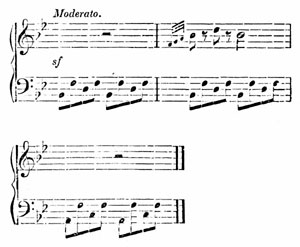
[Listen]
Full organ in the bass, Bourdon 16, and reed stops, have a very fine effect. The fellow has come all the way from Milan, too, expressly to make this disturbance in the church. I must go there for a little, so farewell for a few moments. I intend to remain here for the night, instead of crossing the lake again, for I am so much pleased with this little island. I certainly cannot say that I have slept soundly for the last two nights; one night owing to the innumerable claps of thunder, the next owing to the innumerable fleas; and, in all probability, I have to-night the prospect of both combined. But as the following morning I shall be speaking French, and have left Italy, and crossed the Simplon, I mean to ramble about all this day and to-morrow in true Italian fashion.
I must now relate to you historically how I happened to come here. At the very last moment of my stay in Milan, the Ertmanns came to my room to bid me farewell, and we took leave of each other more cordially than I have done of any one for many a long day. I promised to send you many kind wishes from them, though they are unacquainted with you, and I also agreed to write to them occasionally. Another valued acquaintance I made there, is Herr Mozart, who holds an office in Milan; but he is a musician, heart and soul. He is said to bear the strongest resemblance to his father, especially in disposition; for the very same phrases that affect the feelings in his father's letters, from their candour and simplicity, constantly recur in the conversation of the son, whom no one can fail to love from the moment he is known. For instance, I consider it a very charming trait in him, that he is as jealous of the fame and name of his father, as if he were an incipient young musician; and one evening, at the Ertmanns', when a great many of Beethoven's works had been played, the Baroness asked me in a whisper to play something of Mozart's, otherwise his son would be quite mortified; so when I played the overture to "Don Juan," he began to thaw, and begged me to play also the overture to the "Flauto Magico" of his "Vatter," and seemed to feel truly filial delight in hearing it: it is impossible not to like him.
He gave me letters to some friends near the Lake of Como, which procured me for once a glimpse of Italian provincial life, and I amused myself famously there for a few days with the Doctor, the Apothecary, the Judge, and other people of the locality. There were very lively discussions on the subject of Sand, and many expressed great admiration of him; this appeared strange to me, as the occurrence is of such distant date that no one any longer argues on the subject. They also spoke of Shakspeare's plays, which are now being translated into Italian. The Doctor said that the tragedies were good, but that there were some plays about witches that were too stupid and childish: one, in particular, "Il Sonno d' una Notte di Mezza State." In it the stale device occurred of a piece being rehearsed in the play, and it was full of anachronisms and childish ideas; on which they all chimed in that it was very silly and advised me not to read it.[19] I remained meekly silent, and attempted no defence! I bathed frequently in the Lake, and sketched, and yesterday rowed on the Lake of Lugano, which frowned sternly on us with its cascades and dark canopy of clouds; then across the hills to Luvino, and to-day I came here by steam.
Evening.—I have this moment returned from the Isola Madre, and most splendid it is; spacious, and full of terraces, citron-hedges, and evergreen shrubs. The weather has at last become less inclement; thus the large white house on the island, with its ruins and terraces, looked very pretty. It is indeed a unique land, and I only wish I could bring with me to Berlin a portion of the same balmy air that I inhaled when in the boat to-day. You have nothing like it, and I would rather you enjoyed it, than all the people who imbibe it here. A fiercely moustachioed German was with me in the boat, who examined all the beautiful scenery as if he were about to purchase it and thought it too dear. Presently I heard a trait quite in the style of Jean Paul. When we were walking on the island, surrounded by verdure, an Italian, who was of the party, observed that this was a spot well adapted for lovers to ramble in, and to enjoy the charms of nature. "Ah! yes!" said I, in a languishing tone. "It was on this account," continued he, "that I separated from my wife ten years ago; I established her at Venice in a small tobacconist's shop, and now I live as I please. You must one day do the same."
The old boatman told us that he had rowed General Bonaparte on this lake, and related various anecdotes of him and Murat. He said Murat was a most extraordinary man; all the time that he was rowing him on the lake, he never ceased singing to himself for a single moment, and once when setting off on a journey he gave him his spirit-flask, and said he would buy another for himself in Milan. I cannot tell why these little traits, especially the singing, seemed to realize the man in my mind more than many a book of history.
The "Walpurgis Nacht" is finished and revised, and the overture will soon be equally far advanced. The only person who has heard it as yet, is Mozart, and he was so delighted with it that the well-known composition caused me fresh pleasure; he insisted on my publishing it immediately. Pray forgive this letter, written in true student phraseology. You no doubt perceive from its style that I have not worn a neckcloth for a week past; but I wished you to know how gay and happy I have been during the days spent among the mountains, and with what pleasure I look forward to those that yet await me.
Yours, Felix.
A l'Union-prieuré de Chamounix, end of July, 1831.
My dear Parents,
I cannot refrain from writing to you from time to time, to thank you for my wondrously beautiful journey; and if I ever did so before, I must do so again now, for more delightful days than those on my journey hither, and during my stay here, I never experienced. Fortunately you already know this valley, so there is no occasion for me to describe it to you; indeed, how could I possibly have done so? But this I may say, that nowhere has nature in all her glory met my eyes in such brightness as here, both when I saw it with you for the first time and now; and as every one who sees it, ought to thank God for having given him faculties to comprehend, and to appreciate such grandeur, so I must also thank you for having supplied me with the means of enjoying such a pleasure.
I had been told that I exaggerated the forms of the mountains in my imagination; but yesterday, at the hour of sunset, I was pacing up and down in front of the house, and each time that I turned my back on the mountains, I endeavoured vividly to represent to myself these gigantic masses, and each time when I again faced them, they far exceeded my previous conceptions. Like the morning that we drove away from this when the sun was rising[20] (no doubt you remember it) the hills have been clear and lovely ever since I arrived. The snow pure, and sharply defined, and apparently near in the dark blue atmosphere; the glaciers thundering unremittingly, as the ice is melting; when clouds gather, they lie lightly on the base of the mountains, the summits of which stand forth clear above. Would that we could see them together! I have passed this whole day here quietly, and entirely alone. I wished to sketch the outlines of the mountains, so I went out and found an admirable point of view, but when I opened my book, the paper seemed so very small that I hesitated about attempting it. I have indeed succeeded in giving the outlines what is called correctly,—but every stroke looks so formal, when compared with the grace and freedom which everywhere here pervade nature. And then the splendour of colour! In short, this is the most brilliant point of my travels; and the whole of my excursion on foot, so solitary, independent, and enjoyable, is something new to me, and a hitherto unknown pleasure.
I must however relate how I came here, otherwise my letter at last will contain nothing but exclamations. As I previously wrote to you, I had the most odious weather on the Lago Maggiore, and the Islands. It continued so incessantly stormy, cold, and wet, that the same evening I took my place in the diligence in rather a sulky humour, and we drove on towards the Simplon. Scarcely had we been journeying for half an hour, when the moon came out, the clouds dispersed, and next morning the weather was most bright and beautiful. I felt almost ashamed of this undeserved good fortune, and I could now thoroughly enjoy the glorious scenery; the road winding first through high green valleys, then through rocky ravines and meadows, and at last past glaciers and snowy mountains. I had with me a little French book on the subject of the Simplon road, which both pleased and affected me; for the subject was Napoleon's correspondence with the Directoire about the projected work, and the first report of the General who crossed the mountain. With what spirit and vigour these letters are written! and yet a little swagger too, but with such a glow of enthusiasm that it quite touched me, as I was driven along this capital level road by an Austrian postilion. I compared the fire and poetry displayed in every description contained in these letters (I mean those of the subaltern General) with the eloquence of the present day, which leaves you so terribly cold and is so odiously prosaic in all its philanthropic views, and so lame—where there is plenty of fanfaronnade, but no genuine youth—and I could not but feel that a great epoch has passed away for ever. I was unable to divest myself of the idea that Napoleon never saw this work—one of his favourite conceptions—for he never crossed the Simplon when the road was finished, and was thus deprived of this great gratification. High up, in the Simplon village, all is bleak, and I actually shivered from cold for the first time during the last year and a half. A neat civil Frenchwoman keeps the inn on the summit, and it would not be easy to describe the sensation of satisfaction caused by its thrifty cleanliness, which is nowhere to be found in Italy.
We then descended into the Valais, as far as Brieg, where I stayed all night, overjoyed to find myself once more among honest, natural people, who could speak German, and who plundered me into the bargain in the most infamous manner. The following day I drove through the Valais—an enchanting journey: the road all along, like those you have seen in Switzerland, ran between two lofty ranges of mountains, their snowy peaks starting up at intervals, and through avenues of green, leafy walnut-trees, standing in front of pretty brown houses,—below, the wild grey Rhone,—past Lenk, and every quarter of an hour a village with a little church. From Martigny I travelled for the first time in my life literally on foot, and as I found the guides too dear I went on quite alone, and started with my cloak and knapsack on my shoulders. About a couple of hours later I met a stout peasant lad, who became my guide, and also carried my knapsack; and so we went on past Forclas to Trient, a little dairy village, where I breakfasted on milk and honey, and thence to the Col de Balme.
The whole valley of Chamouni, and Mont Blanc, with all its precipitous glaciers, lay before me bathed in sunshine. A party of gentlemen and ladies (one of the latter very pretty and young) came from the opposite side on mules, with a number of guides; scarcely had we all assembled under one roof, when subtle vapours began to rise, shrouding first the mountain and then the valley, and at last thickly covering every object, so that soon nothing was to be seen. The ladies were afraid of going out into the fog, just as if they were not already in the midst of it; at last they set off, and from the window I watched the singular spectacle of the caravan leaving the house, all laughing, and talking loudly in French and English and patois. The voices presently became indistinct; then the figures likewise; and last of all I saw the pretty girl in her wide Scotch cloak; then only glimpses of grey shadows at intervals, and they all disappeared. A few minutes later I ran down the opposite side of the mountain with my guide; we soon emerged once more into sunshine, and entered the green valley of Chamouni with its glaciers; and at length arrived here at the Union. I have just returned from a ramble to Montanvert, the Mer de Glace, and to the source of the Arveiron. You know this splendid scenery, and so you will forgive me, if, instead of going to Geneva to-morrow, I first make the tour of Mont Blanc, that I may become acquainted with this personage from the southern side also, which is I hear the most striking. Farewell, dear parents! May we have a happy meeting!—Yours,
Felix.
Charney, August 6th, 1831.
My dear Sisters,
You have, I know, read Ritter's "Afrika" from beginning to end, but still I do not think you know where Charney is situated, so fetch out Keller's old travelling map, that you may be able to accompany me on my wanderings. Trace with your finger a line from Vevay to Clarens, and thence to the Dent de Jaman; this line represents a footpath; and where your finger has been my legs also went this morning—for it is now only half-past seven, and I am still fasting. I mean to breakfast here, and am writing to you in a neat wooden room, waiting till the milk is made warm for me; without, I have a view of the bright blue lake; and so I now begin my journal, and mean to continue it as I best can during my pedestrian tour.
After breakfast.—Heavens! here is a pretty business. My landlady has just told me with a long face, that there is not a creature in the village to show me the way across the Dent, or to carry my knapsack, except a young girl; the men being all at work. I usually set off every morning very early and quite alone, with my bundle on my shoulders, because I find the guides from the inns both too expensive and too tiresome; a couple of hours later I hire the first honest-looking lad I see, and so I travel famously on foot. I need not say how enchanting the lake and the road hither were; you must recall for yourself all the beauties you once enjoyed there. The footpath is in continued shade, under walnut-trees and up hill,—past villas and castles,—along the lake which glitters through the foliage; villages everywhere, and brooks and streams rushing along from every nook, in every village; then the neat tidy houses,—it is all quite too charming, and you feel so fresh and so free. Here comes the girl with her steeple hat. I can tell you she is vastly pretty into the bargain, and her name is Pauline; she has just packed my things into her wicker basket. Adieu!
Evening, Château d'Oex, candle-light.
I have had the most delightful journey. What would I not give to procure you such a day! But then you must first become two youths and be able to climb actively, and drink milk when the opportunity offered, and treat with contempt the intense heat, the many rocks in the way, the innumerable holes in the path, and the still larger holes in your boots, and I fear you are rather too dainty for this; but it was most lovely! I shall never forget my journey with Pauline; she is one of the nicest girls I ever met, so pretty and healthy-looking, and naturally intelligent; she told me anecdotes about her village, and I in return told her about Italy; but I know who was the most amused.
The previous Sunday, all the young people of distinction in her village had gone to a place far across the mountain, to dance there in the afternoon. They set off shortly after midnight, arrived while it was still dark, lighted a large fire and made coffee. Towards morning the men had running and wrestling matches before the ladies, (we passed a broken hedge testifying to the truth of this;) then they danced, and were at home again by Sunday evening, and early on Monday morning they all resumed their labours in the vineyards. By Heavens, I felt a strong inclination to become a Vaudois peasant, while I was listening to Pauline, when from above she pointed out to me the villages where they dance when the cherries are ripe, and others where they dance when the cows go to pasture in the meadows and give milk. To-morrow they are to dance in St. Gingolph; they row across the lake, and any one who can play, takes his instrument with him; but Pauline is not to be of the party, because her mother will not allow it, from dread of the wide lake, and many other girls also do not go for the same reason, as they all cling together.
She then asked my leave to say good-day to a cousin of hers, and ran down to a neat cottage in the meadow; soon the two girls came out together and sat on a bench and chattered; on the Col de Jaman above, I saw her relations busily mowing, and herding the cows.
What cries and shouts ensued! Then those above began to jodel, on which they all laughed. I did not understand one syllable of their patois, except the beginning, which was, Adieu Pierrot! All these sounds were taken up by a merry mad echo, that shouted and laughed and jodelled too. Towards noon we arrived at Allière. When I had rested for a time, I once more shouldered my knapsack, for a fat old man provoked me by offering to carry it for me; then Pauline and I shook hands, and we took leave of each other. I descended into the meadows, and if you do not care about Pauline, or if I have bored you with her, it is not my fault, but that of the mode in which I have described her; nothing could be more pleasant in reality, and so was my further journey. I came to a cherry-orchard, where the people were gathering the fruit, so I lay down on the grass and ate cherries for a time along with them. I took my mid-day rest at Latine, in a clean wooden house. The carpenter who built it gave me his company to some roast lamb, and pointed out to me with pride every table, and press, and chair.
At length I arrived here, at night, through dazzling green meadows, interspersed with houses, surrounded by fir-trees and rivulets: the church here stands on a velvet green eminence; more houses in the distance, and still further away, huts and rocks; and in a ravine, patches of snow still lying on the plain. It is one of those idyllic spots such as we have seen together in Wattwyl, but the village smaller and the mountains more green and lofty. I must conclude however to-day by a high eulogy on the Canton de Vaud. Of all the countries I know this is the most beautiful, and it is the spot where I should most like to live when I become really old. The people are so contented, and look so well, and the country also. Coming from Italy it is quite touching to see the honesty that still exists in the world,—happy faces, a total absence of beggars, or saucy officials: in short, there is the most complete contrast between the two nations. I thank God for having created so much that is beautiful; and may it be His gracious will to permit us all, whether in Berlin, England, or in the Château d'Oex, to enjoy a happy evening and a tranquil night!
Boltigen, August 7th, evening.
The lightning and thunder are terrific outside, and torrents of rain besides; in the mountains you first learn respect for weather. I have not gone further, for it would have been such a pity to traverse the lovely Simmen valley under an umbrella. It was grey morning, but delightfully cool for walking in the forenoon. The valley at Saanen, and the whole road, is incredibly fresh and gay. I am never weary of looking at the verdure. I do believe that if during a long life I were always gazing at undulating verdant meadows, dotted over with reddish-brown houses, I should always experience the same pleasure in looking at them. The road winds the whole way through meadows of this kind, and past running streams.
At noon I dined at Zweisimmen, in one of those enormous Bernese houses, where everything glitters with neatness and cleanliness, and where even the smallest detail is carefully attended to. I there dispatched my knapsack by the diligence to Interlaken, and am now about to walk as a regular pedestrian through the country; a shirt in my pocket, a brush and comb, and my sketch-book, this is all I require; but I am very tired. May the weather be fine to-morrow!
Wimmis, the 8th.
A pretty affair! the weather is three times as bad as ever. I must give up my plan of going to Interlaken to-day, as there is no possibility of getting on. For the last few hours the water has been pouring straight down, as if the clouds above had been fairly squeezed out; the roads are as soft as feather-beds; only occasional shreds of the mountains are to be seen, and even these but rarely. I almost thought sometimes that I was in the Margravate of Brandenburg, and the Simmen valley looked perfectly flat. I was obliged to button my waistcoat tight over my sketch-book, for very soon my umbrella was of no use whatever, and so I arrived here to dinner about one o'clock. I had my breakfast in the following place. [Vide page 234.]
Weissenburg, August 8th.
I sketched this on the spot with a pen, so do not laugh at the bold stream. I passed the night very uncomfortably at Boltigen. There was no room in the inn, owing to a fair, so I was obliged to lodge in an adjacent house, where there were swarms of vermin quite as bad as in Italy, a creaking house clock, striking hoarsely every hour, and a baby that screeched the whole night. I really could not help for a time noticing the child's cries, for it screamed in every possible key, expressive of every possible emotion; first angry, then furious, then whining, and when it could screech no longer, it grunted in a deep bass. Let no one tell me that we must wish to return to the days of our childhood, because children are so happy. I am convinced that such a little mortal as this, flies into a rage just as we do, and has also his sleepless nights, and his passions, and so forth.
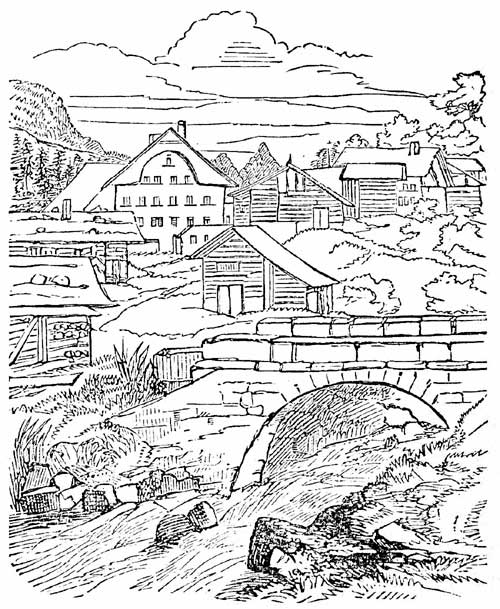
This philosophical view occurred to me this morning, while I was sketching Weissenburg, and so I wished to communicate it to you on the spot; but I took up the 'Constitutionnel,' in which I read that Casimir Périer wishes to resign, and many other things that furnish matter for reflection; among others a most remarkable article on the cholera, which I should like to transcribe, for it is so extraordinary. The existence of this disease is totally and absolutely denied; only one person had it in Dantzic,—a Jew,—and he got well. Then followed a number of "Hegelisms" in French, and the election of the deputies—oh world!—As soon as I had finished reading the paper, I was obliged to set off again in the rain through the meadows. No such enchanting country as this is to be seen, even in a dream; in the worst weather, the little churches, and the numerous houses, and shrubs, and rills are still truly lovely. The verdure to-day was quite in its element. Dinner has been long over, and it is still pouring. I intend to go no further than Spiez this evening. I regret much that I can neither see this place, which seems beautifully situated, nor Spiez, which I know from Rösel's sketches. This is, in fact, the climax of the whole Simmen valley, and thence the old song says:—
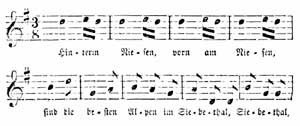
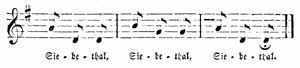
[Listen]
I sang this the whole day while walking along. The Siebethal, however, showed no gratitude for the compliment, and the rain continued unremittingly.
Wyler, evening.
They could not take me in at Spiez, for there is no inn there where you can lodge, so I was obliged to return here. I very much admired the situation of Spiez; it is built on a rock, which projects into the lake, with numbers of turrets, and gables, and peaks. There I saw a manor-house, with an orangery; a sulky-looking nobleman with two sporting dogs at his heels; a little church, and terraces with bright flowers. It was all very lovely. To-morrow I shall see it from the other side, if the weather permits. To-day it has rained for three hours consecutively, and I was well soaked on the way here. The mountain streams are superb in such weather, for they leap and rage furiously. I crossed one of these demons, the Kander, which seemed to have taken leave of its senses, leaping and blustering, and foaming; the water looked quite brown, and scattered its yellow spray in all directions. A black peak of the mountains was here and there visible through the rain-laden clouds, which hung deeper into the valley than I ever before saw them. Yet the day was most enjoyable.
Wyler, the 9th, morning.
To-day the weather is worse than ever. It has rained the whole night through, and this morning too it is pouring. I have however intimated that I shall not set out in such weather, and if it continues I shall write to you again to-night from Wyler. In the meantime I have an opportunity of making acquaintance with my Swiss host. They are very primitive. I could not get on my shoes, because they had shrunk, owing to the rain. The landlady asked if I wished to have a shoe-horn; and as I said I did, she brought me a tablespoon; but it answered the purpose. And moreover they are eager politicians. Over my bed hangs a horrible distorted face, under which is written. "Brinz Baniadofsgi." If he had not a kind of Polish costume, it would be difficult to discover whether it is intended for a man or a woman, for neither the portrait itself nor the inscription throw much light on the subject.
Evening, at Untersee.
All jesting is turned into sad earnest, which in these days may easily be the case. The storm has raged furiously, and caused great damage and devastation; the people here say that they remember no more violent storm and rain for many years; and the hurricane rushes on with such incredible rapidity. This morning early the weather was merely wet and disagreeable, and yet this afternoon all the bridges are swept away, and every passage blocked up for the moment. There has been a landslip at the Lake of Brienz, and everything is in an uproar.
I have just heard here that war has been proclaimed in Europe; so the world certainly bears a wild, bleak aspect at this time, and I ought to feel thankful, that at all events for the present I have a warm room here, and a comfortable roof over my head. The rain ceased for a time early this morning, and I thought that the clouds were fairly exhausted; so I left Wyler, but soon found that the roads were sadly cut up; but worse was to come; the rain began again gently, but came down so violently about nine o'clock, and in such sudden squalls, that it was evident something strange was brewing. I crept into a half built hut, where a great mass of fodder was lying, and nestled comfortably among the fragrant hay. A soldier of the Canton, who was on his way to Thun, also crept in from the other side, and in the course of an hour, as the weather did not improve, we went on our different paths.
I was obliged to take shelter again under a roof at Leisengen, and waited there a long time; but as my luggage was at Interlaken, a distance of only two hours from thence, I thought that I would set the weather at defiance; so about one o'clock I set out for Interlaken. There was literally nothing to be seen but the grey surface of the lake,—no mountains, and seldom even the outlines of the opposite shore. The little springs, which as you may remember often run along by the footpaths, had swollen into streams, through which I was obliged to wade; and where the road was hilly, the waters accumulated in the hollows and formed a pool, so I was forced to jump over dripping hedges, into marshy meadows; the small blocks of wood—by means of which brooks are crossed here—lay deep under the water; at one moment I found myself between two of these brooks, which had run into each other, and for a considerable time I was obliged to walk against the current, above my ankles in water. All the streams are black, or chocolate-brown, looking like earth flowing along. Torrents poured down from above; the wind shook down the water from the dripping walnut-trees; the waterfalls which tumble into the lake thundered frightfully from both shores. You could trace the course of the brown muddy streaks, rushing along through the pure waters of the lake, which, in the midst of all this uproar, remained perfectly tranquil, its surface scarcely ruffled, quietly receiving all the blustering streams that poured into its bosom.
A man now came up, who had taken off his shoes and stockings, and turned up his trowsers. This made me feel rather nervous. Presently I met two women, who said that I could not go through the village, for all the bridges were gone. I asked how far it was to Interlaken. "A good hour," they said. I could not make up my mind to turn back, so I went on towards the village, where the people shouted to me from the windows, that I could come no further, because the waters were rushing down so impetuously from the mountains; and certainly there was a fine commotion in the middle of the village. The muddy stream had swept everything along with it, eddying round the houses, and running along the meadows and footpaths, and finally thundering down into the lake. Luckily there was a little boat there, in which I was ferried across to Neuhaus, though this expedition in an open boat, in torrents of rain, was far from pleasant. My condition, when I arrived at Neuhaus, was miserable enough; I looked as if I wore long black boots over my light-coloured trowsers, my shoes and stockings quite up to my knees, dark brown; then came the original white, then a soaked blue paletôt; even my sketch-book, that I had buttoned under my waistcoat, was wet through.
I arrived in this plight at Interlaken, where I was very ill received, for the people there either could not or would not find room for me, and so I was forced to return to Untersee, where I am famously lodged, and most comfortable. Singularly enough, I had been all along anticipating with such pleasure revisiting the inn at Interlaken, of which I had so many reminiscences, and I drove up in my little Neuhaus carriage to the Nuss-Baum Platz, and saw the well-known glass gallery; the pretty landlady, too, came to the door, but somewhat aged and altered. Neither the dreadful storms, nor the various discomforts I had endured, annoyed me half so much as not being able to remain at Interlaken, consequently for the first time since I left Vevay I was out of humour for half an hour, and obliged to

[Listen]
sing Beethoven's adagio in A flat major, three or four times over, before I could recover my equanimity. I learned here, for the first time, the damage the storm had already done, and may yet do, for the rain is still incessant.
Half-past Nine o'clock at Night.—The bridge at Zweilütschenen is carried away; the vetturini from Brienz, and Grindelwald, will not encounter the risk of driving home, from the fear of some rock falling on their heads. The water here has risen to within a foot and a half of the Aar bridge; the gloom of the sky I cannot describe. I mean to wait here patiently; besides, I do not require the aid of localities, to enable me to summon up my reminiscences. They have given me a room where there is a piano; it indeed bears the date of the year 1794, and somewhat resembles in tone the little old "Silbermann" in my room at home, so I took a fancy to it at the very first chord I struck, and it also recalls you to my mind. This piano has outlived many things, and probably never dreamt that I was likely to compose by its aid, as I was not born till 1809, now fully two-and-twenty years ago; in the meantime, the piano, though seven-and-thirty years old, has plenty of good material in it yet.
I have some new "Lieder" in hand, dear sisters. You have not seen my favourite one in E major "Auf der Reise,"—it is very sentimental. I am now composing one which will not, I fear, be very good; but it will, at all events, please us three, for it is at least well intended. The words are Goethe's, but I don't say what they are; it is very daring in me to compose for this poetry, and the words are by no means suitable for music, but I thought them so divinely beautiful, that I could not resist singing them to myself. Enough for to-day; so good night, dear ones.
August 10th.
The weather this morning is clear and bright, and the storm has passed away; would that all storms ended as quickly, and were as soon allayed! I have passed a glorious day, sketching, composing, and inhaling fresh air. In the afternoon I went on horseback to Interlaken, for no man can go there on foot at this moment. The whole road is flooded, so that even on horseback I got very wet. In this place, too, every street is inundated and impassable. How beautiful Interlaken is! How humble and insignificant we feel when we see how splendid the good Lord has made this world; and nowhere can you see it in greater magnificence than here. I sketched for my father one of the walnut-trees he so much admires, and for the same reason I mean to send him a faithful drawing of one of the Bernese houses. Various parties of ladies and gentlemen, and children, drove past and stared at me; I thought to myself that they were now enjoying the same luxury I formerly did, and would fain have called out to them not to forget this! Towards evening, the snowy mountains were glowing in the clearest outlines and in the loveliest hues.
When I came back. I asked for some music paper, and they referred me to their Pastor, and he to the Forest-ranger, whose daughter gave me two pretty neat sheets. The "Lied" which I alluded to yesterday is now finished; I cannot help after all telling you what it is—but you must not laugh at me—it is actually,—but don't think I am seized with hydrophobia—a sonnet, "Die Liebende schreibt."[21] I am afraid its merit is not great; I think it was more inwardly felt than outwardly well expressed; still there are some good passages in it, and to-morrow I am going to set to music a little poem of Uhland's; a couple of pieces for the piano are also in progress. I can unfortunately form no judgment of my new compositions; I cannot tell whether they are good or bad; and this arises from the circumstance that all the people to whom I have played anything for the last twelve months, forthwith glibly declared it to be wonderfully beautiful, and that will never do. I really wish that some one would let me have a little rational blame once more, or what would be still more agreeable, a little rational praise, and then I should find it less indispensable to act the censor towards myself, and to be so distrustful of my own powers. Nevertheless, I must go on writing in the meantime.
When I was at the Forest-ranger's, I heard that the whole country was devastated, and the most sad intelligence comes from all sides. All the bridges in the Hasli valley are entirely swept away, and also many houses and cottages. A man came here to-day from Lauterbrunnen, and he was up to his shoulders in water; the high road is ruined, and what sounded most dismal of all to me, a quantity of furniture and household things were seen floating down the Kander, coming no one knows whence. Happily the waters are beginning to subside, but the damage they have done cannot so easily be repaired. My travelling plans have also been considerably disturbed by these inundations, for, if there be any risk, I shall certainly not go into the mountains.
The 11th.
So I now close the first part of my journal, and send it off to you. To-morrow I shall begin a new one, for I intend then to go to Lauterbrunnen. The road is practicable for pedestrians, and not an idea of any danger; travellers from thence have come here to-day, but for carriages, the road will not be passable during the remainder of the year. I purpose, therefore, proceeding across the Lesser Scheideck to Grindelwald, and by the Great Scheideck to Meiringen; by Furka and Grimsel to Altorf, and so on to Lucerne; storms, rain, and everything else permitting,—which means, if God will. This morning early, I was on the Harder, and saw the mountains in the utmost splendour. I never remember the Jungfrau so clear and so glowing as both yesterday evening and at early dawn to-day. I rode back to Interlaken, where I finished my sketch of the walnut-tree. After that I composed for a time, and wrote three waltzes for the Forest-ranger's daughter on the remaining music-paper she had given me, politely presenting them to her myself. I have just returned from a watery expedition to an inundated reading-room, as I wished to see how the Poles are getting on—unluckily there is no reference to them in the papers. I must now occupy myself till the evening in packing, but I am most reluctant to leave this room, where I am so comfortable, and shall sadly miss my little piano. I intend to sketch the view from this window with my pen on the back of my letter, and also to write out my second "Lied," and then Untersee will soon also belong to my reminiscences. "Ach! wie schnell!" I quote myself, which is not over-modest, but these lines recur to me but too often when the days are shortening, the leaves of the travelling map turned over, and first Weimar, then Munich, and lastly Vienna, are all things of the past year. Well! here you have my window! [Vide page 246.]
An hour later.—My plans are altered, and I stay here till the day after to-morrow. The people say that by that time the roads will be considerably better, and there is plenty here both to see and to sketch. The Aar has not risen to such a height for seventy years. To-day people were stationed on the bridge, with poles and hooks, watching to catch any fragments of the broken-down bridges. It did look so strange to see a black object come swimming along in the distance from the hills, which was at last recognized to be a piece of balustrade, or a cross-beam, or something of the sort, when all the people made a rush at it, and tried to fish it up with their hooks, and at length succeeded in dragging the monster out of the water. But enough of water,—that is, of my journal. It is now evening, and dark. I am writing by candle-light, and should he so glad if I could knock at your door, and take my seat beside you at the round table. It is the old story over again. Wherever it is bright and cheerful, and I am well and happy, I most keenly feel your absence, and most long to be with you again. Who knows, however, whether we may not come here together in future years, and then think of this day, as we now do of former ones? But as none can tell whether this may ever come to pass, I shall meditate no longer on the subject, but write out my "Lied," take another peep of the mountains, wish you all happiness and good fortune, and thus close my journal.
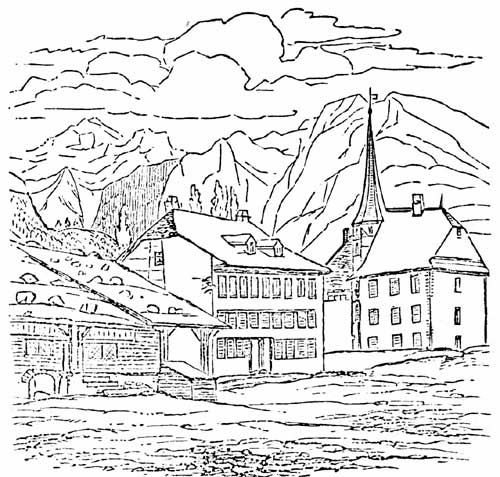
Lauterbrunnen, August 13th, 1831.
I have just returned from an expedition on foot to the Schmadri Bach, and the Breithorn. All that you can by possibility conceive as to the grandeur and imposing forms of the mountains here, must fall far short of the reality of nature. That Goethe could write nothing in Switzerland but a few weak poems, and still weaker letters, is to me as incomprehensible as many other things in this world. The road here is again in a lamentable state; where, six days ago, there was the most beautiful highway, there is now only a desolate mass of rocks; numbers of huge blocks lying about, and heaps of rubbish and sand. No trace whatever of human hands to be seen. The waters, indeed, have entirely subsided, but they are still in a troubled state, for from time to time you can hear the stones tossed about, and the waterfalls also in the midst of their white foam, roll down black stones into the valley.
My guide pointed out to me a pretty new house, standing in the midst of a wild turbulent stream; he said that it belonged to his brother-in-law and formerly stood in a beautiful meadow, which had been very profitable; the man was obliged to leave the house during the night; the meadow has disappeared for ever, and masses of pebbles and stones have usurped its place. "He never was rich, but now he is poor," said he, in concluding his sad story. The strangest thing is, that in the very centre of this frightful devastation,—the Lütschine having overflowed the whole extent of the valley—among the marshy meadows, and masses of rocks, where there is no longer even a trace of a road, stands a char-à-banc—and is likely to stand for some time to come. It chanced that the people in it wished to drive through at the very time of the hurricane; then came the inundation, so they were forced to leave the carriage and everything else to fate, thus the char-à-banc is still standing waiting there. It was a very frightful sight when we reached the spot, where the whole valley, with its roads and embankments, is a perfect rocky sea; and my guide, who went first, kept whispering to himself, "'sisch furchtbar!" The torrent had carried into the middle of the stream some large trunks of trees, which are standing aloft; for at the same moment some huge fragments of rocks having been flung against them, the bare trees were closely wedged in betwixt them, and they now stand nearly perpendicular in the bed of the river.
I should never come to an end were I to try to tell you all the various forms of havoc which I saw between this place and Untersee. Still the beauty of the valley made a stronger impression on me than I can describe. It is much to be regretted, that when you were in this country, you went no further than Staubbach; for it is from there that the valley of Lauterbrunnen really begins. The Schwarzer Mönch, and all the other snowy mountains in the background, become more mighty and grand, and on every side bright foaming cascades tumble into the valley. You gradually approach the mountains covered with snow, and the glaciers in the background, through pine woods, and oaks, and maple-trees. The moist meadows, too, were covered with a profusion of brilliant flowers—snakewort, the wild scabious, campanulas, and many others. The Lütschine had accumulated masses of stones at the sides, having swept along fragments of rocks, as my guide said, "bigger than a stove," then the carved brown wooden houses, and the hedges; it is all beautiful beyond measure! Unfortunately we could not get to the Schmadri Bach, as bridges, paths, and fords, were all gone; but it was a walk I can never forget.
I also tried to sketch the Mönch; but what can you hope to do with a small pencil? Hegel indeed says, "that every single human thought is more sublime than the whole of Nature;" but in this place I consider that too presumptuous; the axiom sounds indeed very fine, but is a confounded paradox nevertheless. I am quite contented, in the meantime, to adhere to Nature, which is the safest of the two. You know the situation of the inn here, and if you cannot recall it, refer to my former Swiss drawing book, where you will find it sketched, badly enough, and where I put in a footpath in front, from imagination, which made me laugh heartily to-day, when I thought of it. I am at this moment looking out of the same window, and gazing at the dark mountains, for it is late in the evening, that is, a quarter to eight o'clock, and I have an idea, which is "more sublime than the whole of Nature"—I mean to go to bed; so good night, dear ones.
The 14th, ten o'clock in the forenoon.
From the dairy hut on the Wengern Alp, in heavenly weather, I send you my greetings.
Grindelwald, evening.
I could not write more to you early this morning; I was most reluctant to leave the Jungfrau. What a day this has been for me! Ever since we were here together I have wished to see the Lesser Scheideck once more. So I woke early to-day, with some misgivings, for so much might intervene—bad weather, clouds, rain, fogs—but none of these occurred. It was a day as if made on purpose for me to cross the Wengern Alp. The sky was flecked with white clouds, floating far above the highest snowy peaks; no mists below on any of the mountains, and all their pinnacles glittering brightly in the morning air; every undulation, and the face of every hill, clear and distinct. Why should I even attempt to portray it? You have already seen the Wengern Alp, but at that time we had bad weather, whereas to-day the whole mountain range was in holiday attire. Nothing was wanting; from thundering avalanches, to its being Sunday, and people dressed in their best going to church, just as it was then.
The hills had only dwelt in my memory as gigantic peaks, for their great altitude had entirely absorbed me. To-day I was struck with amazement at the immense extent of their base, their solid, spacious masses, and the connection of all these huge piles, which seem to lean towards each other, and to reach out their hands to one another. In addition to this you must imagine every glacier, and snowy plateau, and point of rock, dazzlingly lighted up and glittering. Then the far summits of distant mountain ranges stretching hither, as if surveying the others. I do believe that such are the thoughts of the Almighty. Those who do not yet know Him, may here see Him, and the nature He created, visibly displayed. Then the fresh, bracing air, which refreshes you when weary, and cools you when it is warm,—and so many springs! I must at some future time write you a separate treatise on springs, but I have not time for it to-day, as I have something particular to tell you.
Now you will say, I suppose, he came down the mountain again, and is going to inform us once more how beautiful Switzerland is. Not at all. When I arrived at the herdsman's hut, I was told that in a meadow far up the Alps, there was to be a great fête this very day, and I saw people at intervals climbing the mountain. I was not at all fatigued; an Alpine fête is not to be seen every day; the weather said, yes; the guide was willing. "Let us go to Intramen," said I. The old herdsman went first, so we were obliged to climb very vigorously; for Intramen is more than a thousand feet higher than the Lesser Scheideck. The herdsman was a ruthless fellow, for he ran on before us like a cat; he soon took pity on my guide, and relieved him of my cloak and knapsack, but even with them he continued to push forward so eagerly that we really could not keep up with him. The path was frightfully steep; he extolled it, however, saying that there was a much nearer, but much steeper track: he was about sixty years of age, and when my youthful guide and I with difficulty surmounted a hill, we invariably saw him descending the next one. We walked on for two hours in the most fatiguing path I ever encountered; first a steep ascent, then down again into a hollow, over heaps of crumbling stones, and brooks and ditches, across two meadows covered with snow, in the most profound solitude, without a footpath, or the most remote trace of the hand of man; occasionally we could still hear the avalanches from the Jungfrau; otherwise all was still, and not a tree to be seen.
When this silence and solitude had continued for some time, and we had clambered to the top of a grassy acclivity, we suddenly came in sight of a vast number of people standing in a circle, laughing, speaking, and shouting. They were all in gay dresses, and had flowers in their hats; there were a great many girls, some tables with casks of wine, and all around deep solemn silence, and tremendous mountains. It was singular that while I was in the act of climbing, I thought of nothing but rocks and stones, and the snow and the track; but the moment I saw human beings, all the rest was forgotten, and I only thought of men, and their sports, and the merry fête. It was really a fine sight. The scene was in a spacious green meadow far above the clouds; opposite were the snowy mountains in all their prodigious altitude, more especially the dome of the great Eiger, the Schreckhorn, and the Wetterhörner, and all the others as far as the Blümli's Alp; the Lauterbrunnen valley lay far beneath us in the misty depths, quite small, as well as our road of yesterday, with all the little cataracts like threads, the houses like dots, and the trees like grass. Far in the background the Lake of Thun occasionally glanced out of the mist.
The crowd now began wrestling, and singing, and drinking, and laughing; all healthy, strong men. I was much amused by the wrestling, which I had never before seen. The girls served the men with Kirschwasser and Schnapps; the flasks passed from hand to hand, and I drank with them, and gave three little children some cakes, which made them quite happy; a very tipsy old peasant sang me some songs; then they all sang; then the guide favoured us with a modern song; and then little boys fought. Everything pleased me on the Alps, and I remained lying there till towards evening, and made myself quite at home. We descended rapidly into the meadows below, and soon descried the familiar inn, and its windows glittering in the evening sun; a fresh breeze from the glaciers began to blow; this soon cooled us. It is now getting late, and from time to time avalanches are heard,—so thus has my Sunday been spent.—A fête-day indeed!
On the Faulhorn, August 15th.
I am shivering with cold! Outside thick snow is falling, and the wind raging and blustering. We are eight thousand feet above the level of the sea, and a long tract of snow to traverse, but here I am! Nothing can be seen; all day the weather has been dreadful. When I remember how fine it was yesterday, while I earnestly wish that it may be as fine to-morrow, it reminds me of life, for we are always hovering between the past and the future. Our excursion of yesterday seems as far past and remote, as if I knew it only from old memories, and had scarcely been present myself; for to-day when during five mortal hours we were struggling on, against rain and fog, sticking in the mud, and seeing nothing round us but grey vapours, I could scarcely realize that it ever was or ever will be again fine weather, or that I ever lay idly stretched on this wet marshy grass. Besides, everything here wears such a wintry aspect; heated stoves, thick snow, cloaks, freezing, shivering people. I am at this moment in the highest inn in Europe; and just as in St. Peter's, you look down on every church, and on the Simplon, upon every road, so from hence I look down on all other inns; but not morally, for this is little more than a few wooden planks. Never mind. I am now going to bed, and I will no longer watch my own breath. Good night! "Tom's a cold."
Hospital, August 18th.
I have not been able to open my journal for two or three days, as when night came I had no longer time for anything, but to dry myself and my clothes at the fire, to warm myself, to sigh over the weather, like the stove behind which I took refuge, and to sleep a good deal; besides, I did not wish to try your patience, by my everlasting repetitions of how deep I had sunk in the mud, and how incessantly it rained, and so forth. During the last few days in reality I went through the most beautiful country, and yet saw nothing but thick fogs, and water in the sky, and from the sky, and on the earth. I passed places that I had long wished to visit, without being able to enjoy them; what also damped my writing mood, was being obliged to battle with the weather, and if it continues the same, I shall only write occasionally, for really I should have nothing to say, but "a grey sky—rain and fog." I have been on the Faulhorn, the Great Scheideck, on Grimsel Spital, and to-day I crossed Grimsel and Furka, and the principal objects I have seen were the points of my shabby umbrella, and I had not even a glimpse of the huge mountains. At one moment, to-day, the Finsteraarhorn came to light, but it looked as savage as if it wished to devour us; and yet if we were a single half-hour without rain, it was truly beautiful. A journey on foot through this country, even in the most unfavourable weather, is the most enchanting thing you can possibly imagine; if the sky were bright, I think the excess of pleasure would be quite overpowering; I must not therefore complain too much of the weather, for I have had my full share of enjoyment.
During the last few days I felt like Tantalus. When I was on the Scheideck, a glimpse of the lower part of the Wetterhorn was sometimes visible through the clouds, and it seemed beyond measure magnificent and sublime; but I only saw the base. On the Faulhorn, I could not distinguish objects fifty paces off, although I stayed there till ten o'clock in the morning. We went down to the Scheideck in a heavy snow-storm, by a very wet and difficult path, which the incessant rain had made worse than usual. We arrived at Grimsel Spital in rain and storm. To-day I wished to have ascended the Sidelhorn, but was obliged to give it up on account of the fog. The Mayenwand was shrouded in grey clouds, and we had only a single peep of the Finsteraarhorn, when we were on the Furka. We also arrived here in a torrent of rain and water everywhere, but all this does not signify. My guide is a capital fellow: if it rains, he sings and jodels; if it is fine, so much the better; and though I failed in seeing some of the finest objects, still I saw a great deal that was interesting.