LETTERS. (continued 5)
Grace Wallace translation
On this occasion I have formed a particular friendship for the glaciers; they are indeed, the most marvellous monsters in the world. How strangely they are all tumbled about; here, a row of jagged points, there, toppling crags, and above, towers and bastions, while on every side, crevices and ravines are visible, all of the most wondrous pure ice, that rejects all soil of earth, casting up again on the surface the stones, sand, and gravel, flung down by the mountains. Then the superb colouring, when the sun shines on them, and their mysterious advance—they sometimes move on a foot and a half in a single day, so that the people in the village are in the greatest anxiety and alarm, when the glacier arrives so quietly, and yet with such irresistible force, for it shivers rocks and stones when they lie in the way—then the ominous crashing and thundering, and the rushing of so many springs near and round. They are splendid miracles. I was in the Rosenlaui glacier, which forms a kind of cave, that you can creep through; it looks as if built of emeralds, only more transparent. Above, around, on all sides, you can see rivulets running between the clear ice. In the centre of this narrow passage, the ice has left a large round window, through which you look down on the valley, and issue forth again under an arch of ice, and high above, black peaks rear their heads, from which masses of ice roll down in the boldest undulations. The glacier of the Rhone is the most imposing that I have seen, and the sun burst forth on it as we passed early this morning. This is a suggestive sight, and you get a casual glimpse of the rocky peak of a mountain, a plateau covered with snow, cataracts, and bridges spanning them, and masses of crumbling stones and rocks; in short, even if you see little in Switzerland, it is at all events more than is to be seen in any other country.
I have been drawing very busily, and think I have made some progress. I even tried to sketch the Jungfrau; it will at least serve as a reminiscence, and I can enjoy the thought that these strokes were actually made on the spot itself. I see people rushing through Switzerland, and declaring that they find nothing to admire there, or anywhere else (except themselves); not the least affected nor roused, remaining cold and prosaic, even in presence of the mountains; when I meet such people I should like to give them a good drubbing. Two Englishmen and an English lady are at this moment sitting beside me near the stove; they are as wooden as sticks. We have been travelling the same road for a couple of days, and I declare the people have never uttered a syllable except of abuse, that there were no fireplaces either on the Grimsel, or here; but that there are mountains here, is a fact to which they never allude; their whole journey is occupied in scolding their guide, who laughs at them, in quarrelling with the innkeepers, and in yawning in each others' faces. They think everything commonplace, because they are themselves commonplace, therefore they are not happier in Switzerland than they would be in Bernau. I maintain that happiness is relative; another would thank God that he could see all this, and so I will be that other!
Fluelen, August 19th.
A day made for a journey; fine, and enjoyable, and bracing. When we wished to start this morning at six o'clock, there was such a storm of sleet and snow that we were obliged to wait till nine o'clock, when the sun came forth, the clouds dispersed, and we had delightful bright weather as far as this place; but now sombre clouds, heavy with rain, have collected over the lake, so that no doubt to-morrow the old troubles will break loose again. But how glorious this day has been, so clear and sunny—we had the most charming journey! You know the St. Gothard Road in all its beauty; you lose much by coming down from above, instead of ascending from this point, for the grand surprise of the Urner Loch is entirely lost, and the new road which has been made, with all the grandeur, as well as convenience, of the Simplon, impairs the effect of the Devil's Bridge: inasmuch as close beside it a new arch, much bolder and larger, has been constructed, which makes the old bridge look quite insignificant, but the ancient crumbling walls look much more romantic and picturesque. Though the view of Andermatt is thus lost, and the new Devil's Bridge far from being poetical, still you go merrily downhill all day, on a delightfully smooth road, flying rapidly past the various localities, and instead of being sprinkled by the foam of the waterfall on the old bridge as formerly, and endangered by the wind, you now pass along far above the stream, between two ranges of solid parapets.
We came past Göschenen and Wasen and presently appeared the huge firs and beech-trees close to Amsteg; then the charming valley of Altorf, with its cottages, meadows, and woods, its rocks and snowy mountains. We rested at Altorf in a Capuchin Convent, situated on a height; and finally, here I am on the banks of the Vierwaldstadt Lake. To-morrow I purpose crossing the lake to Lucerne, where I hope to find letters from you. I shall then also get rid of a party of young people from Berlin, who have been pursuing almost the same route with me, meeting me at every turn, and boring me terribly; the patriotism of a lieutenant, a dyer, and a young carpenter,—all three bent on destroying France,—was peculiarly distasteful to me.
Sarnen, the 20th.
I crossed the Vierwaldstadt Lake early this morning, in a continued pour of rain, and found your welcome letter of the 5th in Lucerne. As it contained nothing but good tidings, I immediately arranged a tour of three days to Unterwalden and the Brünig. I intend to call again at Lucerne for your next letter, and then I am off to the West, and out of Switzerland. I shall take leave of it with deep regret. The country is beautiful beyond all conception; and though the weather is again odious,—rain and storms the whole day, and all through the night,—yet the Tellen Platte, the Grütli, Brunnen and Schwytz, and the dazzling green of the meadows this evening in Unterwalden, are too lovely ever to be forgotten. The hue of this green is most unique, refreshing the eye and the whole being. I shall certainly attend to your kind precautionary injunctions, dear Mother, but you need be under no apprehensions about me. I am by no means careless with regard to my health, and have not, for a long time, felt so well as during my pedestrian excursions in Switzerland. If eating, and drinking, and sleeping, and music in one's head, can make a man healthy, then, God be praised, I may well call myself so; for my guide and I vie with each other in eating and drinking, and not less so unluckily in singing. In sleeping alone I surpass him; and though I sometimes disturb him by my trumpet or oboe tones, he in turn cuts short my morning sleep. Please God, therefore, we shall have a happy meeting. Before that time arrives, however, many a page of my journal must yet travel to you; but even this interval will quickly pass, just as everything quickly passes, except indeed what is best of all!—so let us be true and loving to each other.
Felix.
Engelberg, August 23rd, 1831.
My heart is so full that I must tell you about it. In this enchanting valley I have just taken up Schiller's "Wilhelm Tell," and read half of the first scene; there is surely no genius like that of Germany! Heaven knows why it is so, but I do think that no other nation could fully comprehend such an opening scene, far less be able to compose it. This is what I call a poem, and a beginning; first the pure, clear verse, in which the lake, smooth as a mirror, and all else, is so vividly described, and then the slow commonplace Swiss talk, and Baumgarten coming in,—it is quite glorious! How fresh, how powerful, how exciting! We have no such work as this in music, and yet even that sphere ought one day to produce something equally perfect. It is so admirable in him too, to have created an entire Switzerland for himself, inasmuch as he never saw it, and yet all is so faithful and so strikingly truthful; the people and life, the scenery and nature. I was delighted when the old innkeeper here, in a solitary mountain village, brought me from the monastery the book with the well-known characters and old familiar names; but the opening again quite surpassed all my expectations. It is now more than four years since I read it. I mean presently to go over to the monastery, to work off my excitement on the organ.
Afternoon.
Do not be astonished at my enthusiasm, but read the scene through again yourself, and then you will find my excitement quite natural. Such passages as those where all the shepherds and hunters shout "Save him! save him!" in the close at the Grütli, when the sun is about to rise, could indeed only have occurred to a German, and above all to Schiller; and the whole piece is crowded with similar passages. Let me refer to that particular one at the end of the second scene, where Tell comes with the rescued Baumgarten to Stauffacher, and the agitating conference closes in such tranquillity and peace: this, along with the beauty of the thought, is so thoroughly Swiss. Then the beginning of the Grütli—the symphony which the orchestra ought to play at the end I composed in my mind to-day, because I could do nothing satisfactory on the little organ: altogether a variety of plans and ideas occurred to me. There is a vast deal to do in this world, and I mean to be industrious. The expression that Goethe made use of to me, that Schiller could have supplied two great tragedies every year, with its business-like tone, always inspired me with particular respect: but not till this morning did the full force of its signification become clear to me, and it has made me feel that I must set to work in earnest. Even the mistakes are captivating, and there is something grand in them; and though certainly Bertha, Rudenz, and old Attinghausen, seem to me great blemishes, still Schiller's idea is evident, and he was in a manner forced to do as he has done; and it is consolatory to find that even so great a man could for once commit such an egregious mistake.
I have passed a most enjoyable morning, and I feel in the kind of mood which makes you long to recall such a man to life, in order to thank him, and inspiring an earnest desire, one day, to compose a work which shall impress others with similar feelings.
Probably you do not understand what induced me to take up my quarters here in Engelberg. It happened thus:—I have not had a single day's rest since I left Untersee, and therefore wished to remain for a day at Meiringen, but was tempted by the lovely weather in the morning, to come on here. The usual rain and wind assailed me on the mountains, and so I arrived very tired. This is the nicest inn imaginable,—clean, tidy, very small and rustic,—an old white-haired innkeeper; a wooden house, situated in a meadow, a little apart from the road; and the people so kind and cordial, that I feel quite at home. I think this kind of domestic comfort is only to be found among those who speak the German tongue; at all events, I never met with it anywhere else; and though other nations may not feel the want of it, or scarcely care about it, still I am a native of Hamburg, and so it makes me feel happy and at home. It is not therefore strange that I decided on taking my day's rest here with these worthy old people. My room has windows on every side, commanding a view of the valley: the room is prettily panelled with wood; some coloured texts and a crucifix are hanging on the walls; there is a solid green stove, and a bench encircling it, and two lofty bedsteads. When I am lying in bed I have the following view:—
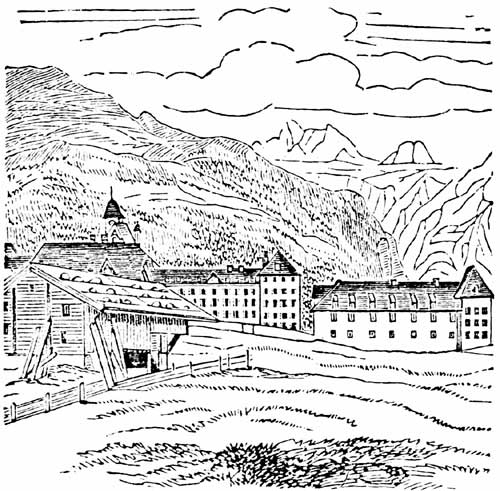
I have failed again in my buildings, and in the hills too, but I hope to make a better sketch of it for you in my book, if the weather is tolerable to-morrow. I shall always consider this valley to be one of the loveliest in all Switzerland. I have not yet seen the gigantic mountains by which it is encompassed, as they have been all day shrouded in mist; but the beautiful meadows, the numerous brooks, the houses, and the foot of the hills, so far as I could see them, are exquisitely lovely. The green of the Unterwalden is more brilliant than in any other canton, and it is celebrated for its meadows even among the Swiss. The previous journey too from Sarnen was enchanting, and never did I see larger or finer trees, or a more fruitful country. Moreover the road is attended with as few difficulties as if you were traversing a large garden; the declivities are clothed with tall slender beeches; the stones overgrown by moss and herbs; then there are springs, brooks, small lakes, and houses: on one side is a view of the Unterwalden and its green plains; and shortly after a view of the whole vale of Hasli, the snowy mountains, and cataracts leaping down from rocky precipices; the road too is shaded the whole way by enormous trees.
Yesterday, early, as I told you, I was tempted by the bright sun to cross the Genthel valley to ascend the Joch, but on the summit the most dreadful weather set in; we were obliged to make our way through the snow, and this was sometimes anything but pleasant. We speedily, however, emerged out of the sleet and snow, and an enchanting moment ensued, when the clouds broke, while we were still standing in them; and far beneath us, we saw through the mists as through a black veil, the green valley of Engelberg. We soon made our way down, and heard the silvery bell of the monastery ring out the Ave Maria. We next saw the white building on the meadow, and arrived here after an expedition of nine hours. I need not say how acceptable at such a time is a comfortable inn, and how good the rice and milk seems, and how long you sleep next morning.
To-day we have had very disagreeable weather, so they brought me "Wilhelm Tell" from the library of the monastery, and the rest you know. I was much struck by Schiller having so completely failed in portraying Rudenz, for the whole character is feeble, and without sufficient motive, and it seems as if he had resolved purposely to represent him throughout, in the worst possible light. His words, in the scene with the apple, might tend to redeem him, but being preceded by that with Bertha, they make no impression. When he joins the Swiss, after the death of Attinghausen, it might be supposed that he is changed, but he instantly proclaims that his Bertha is carried off, so again he has as little merit as ever. It occurred to me that if he had uttered the very same manly words against Gessler, without the explanation with Bertha having previously taken place, and if such a result had arisen out of this in the following act, the character would have been much better, and the explanatory scene not so merely theatrical as it now is. This is certainly very like the egg and the hen, but I should like to hear your opinion on the subject. I dare not speak to one of our learned men on such matters; these gentlemen are a vast deal too wise! If however I chance some of these days to meet one of those youthful modern poets, who look down on Schiller, and only partly approve of him; so much the worse for him, for I must infallibly crush him to death.
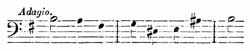
Now, good night; I must rise very early to-morrow; it is to be a grand fête to-day in the monastery, and a solemn religious service, and I am to play the organ for them. The monks were listening this morning while I was extemporizing a little, and were so pleased, that they invited me to play the people in and out at their festival to-morrow. The father organist has also given me the subject on which I am to extemporize; it is better than any that would have occurred to an organist in Italy.
[Listen]
I shall see to-morrow what I can make of this. I played a couple of new pieces of mine on the organ this afternoon in the church, and they sounded rather well. When I came past the monastery the same evening, the church was closed, and scarcely were the doors shut, when the monks began to sing nocturns fervently, in the dark church; they intoned the deep B, which vibrated splendidly, and could be heard far down the valley.
August 24th.
This has been another splendid day—the weather bright and enjoyable, and the bluest sky that I have seen since I left Chamouni; it was a holiday in the village, and in all the mountains. After long-continued fogs, and every variety of bad weather, once more to see from the window in the morning the clear range of mountains and their pinnacles, is indeed a grand spectacle. They are acknowledged to be finest after rain, and to-day they looked as fresh as if newly created. This valley is not surpassed by any in Switzerland. If I ever return here this shall be my head-quarters, for it is even more lovely, and more spacious and unconfined than Chamouni, and more free than Interlaken. The Spann-örter are incredibly grand peaks, and the round Titlis heavily laden with snow, the foot of which lies in the meadows, and the effect of the Urner rocks in the distance, are also well worth seeing: it is now full moon, and the valley is clothed in beauty.
This whole day I have done nothing but sketch, and play the organ: in the morning I performed my duties as organist—it was a grand affair. The organ stands close to the high altar, next to the stalls for the "patres;"—so I took my place in the midst of the monks, a very Saul among the prophets. An impatient Benedictine at my side played the double bass, and others the violins; one of their dignitaries was first violin. The pater præceptor stood in front of me, sang a solo, and conducted with a long stick, as thick as my arm. The élèves in the monastery formed the choir, in their black cowls; an old decayed rustic played on an old decayed oboe, and at a little distance two more were puffing away composedly at two huge trumpets with green tassels; and yet with all this the affair was gratifying. It was impossible not to like the people, for they had plenty of zeal, and all worked away as well as they could. A mass, by Emmerich, was given, and every note of it betrayed its "powder and pigtail." I played thorough-bass faithfully from my ciphered part, adding wind instruments from time to time, when I was weary; made the responses, extemporized on the appointed theme, and at the end, by desire of the Prelate, played a march, in spite of my repugnance to do this on the organ, and was then honourably dismissed.
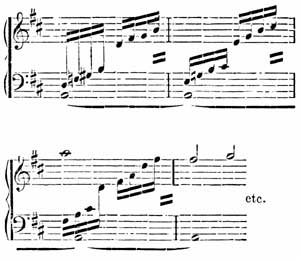
This afternoon I played again alone to the monks, who gave me the finest subjects in the world—the "Credo" among others—a fantasia on the latter was very successful; it is the only one that in my life I ever wished I could have written down, but now I can only remember its general purport, and must ask permission to send Fanny, in this letter, a passage that I do not wish to forget. By degrees various counter subjects were introduced in opposition to the canto fermo; first dotted notes, then triplets, at last rapid semiquavers, through which the "Credo" was to work its way; quite at the close, the semiquavers became very wild, and arpeggios followed on the whole organ in G minor. I proceeded to take up the theme on the pedal in long notes (during the continued arpeggios), so that it ended with A. On the A, I made a pedal point in arpeggios, and then it suddenly occurred to me to play the arpeggios with the left hand alone, so that the right hand could introduce the "Credo" again in the treble with A, thus:—
[Listen]
etc.
This was followed by a stop on the last note, and a pause, and then it concluded. I wish you had heard it, for I am sure you would have been pleased. It was time for the monks to go to complines, and we took leave of each other cordially. They wished to give me letters of introduction for some other places in Unterwalden, but I declined this, as I intend to go to Lucerne early to-morrow, and after that I expect not to be more than five or six days longer in Switzerland.—Your
Felix.
To Wilhelm Taubert.
Lucerne, August 27th, 1831.
I wish to offer you my thanks, but I really do not know where to begin first; whether for the pleasure your songs caused me in Milan, or for your kind letter which I received yesterday; both however are closely connected, and so I think we have already made acquaintance. It is quite as fitting that we should be presented to each other through the medium of music-paper, as by a third person in society; indeed I think that in the former case you feel even more intimate and confidential. Moreover, persons who introduce any one often pronounce the name so indistinctly, that you seldom know who is standing before you; and they never say one word as to whether the man is gay and good-humoured, or melancholy and gloomy. So we are infinitely better off. Your songs have pronounced your name clearly and plainly; they also disclose what you think and what you are; that you love music, and wish to make progress; so thus perhaps I know you better than if we had frequently met.
What a source of pleasure it is, and how cheering, to know there is another musician in the world who has the same purposes and aspirations, and who follows the same path as yourself; perhaps you cannot feel this so strongly as I do at this moment, who have just come from a country where music no longer exists among the people. I never before could have believed this of any nation, and least of all of Italy, with such rich and luxuriant nature, and such glorious, inspiriting antecedents. But alas! the occurrences I latterly witnessed there, fully proved to me that even more than harmony is dead in that land; it would indeed be marvellous if any music could exist where there is no solid principle. At last I was really bewildered, and thought that I must have become a hypochondriac, for all the buffoonery I saw was most distasteful to me, and yet a vast number of serious people and sedate citizens entered into it. When they played me anything of their own, and afterwards praised and extolled my pieces, I cannot tell you how repugnant it was to me; I felt disposed to become a hermit, with beard and cowl, and the whole world was at a discount with me. In Italy you first learn to value a true musician; that is, one whose thoughts are absorbed in music, and not in money, or decorations, or ladies, or fame; it is doubly delightful when you find that, without your being aware of it, your own ideas exist and are developed elsewhere; your songs therefore gave me especial pleasure, because I could gather from them that you must be a genuine musician, and so let us mutually stretch out our hands across the mountains.
I beg that you will also look on me in the light of a friend, and not write so formally as to my "counsel" and "teaching." This portion of your letter makes me feel almost nervous, and I scarcely know what to say; the most agreeable part however is your promise to send me something to Munich, and to write to me again. I will then tell you frankly and freely my honest opinion, and you shall do the same with regard to my new compositions, and thus I think we shall give each other good counsel. I am very eager to see those recent works of yours that you have promised me, for I do not doubt that I shall receive much gratification from them, and many things which are only foreshadowed in the former songs, will probably in these become manifest and distinct. I shall therefore say nothing to-day of the impression your songs have made on me, because possibly any suggestion or question may be already answered in what you are about to send me. I earnestly entreat of you to write to me fully, and in detail, about yourself, in order that we may become better acquainted. I can then write to you what I purpose and what I think, and thus we shall continue in close connection.
Let me know what you have recently composed and are now composing; your mode of life in Berlin, and your plans for the future; in short all that concerns your musical life, which will be of the greatest interest to me. Probably this will be obvious in the music you have so kindly promised me, but fortunately both may be combined. Have you hitherto composed nothing on a greater scale; some wild symphony, or opera, or something of the kind? I, for my part, feel at this moment the most invincible desire to write an opera, and yet I have scarcely leisure even to commence any work, however small. I do believe that if the libretto were to be given to me to-day, the opera would be written by to-morrow, so strong is my impulse towards it. Formerly the bare idea of a symphony was so exciting, that I could think of nothing else when one was in my head; the sound of instruments has such a solemn and glorious effect; and yet for some time past I have laid aside a symphony that I had commenced, in order to compose on a cantata of Goethe's merely because it included, besides the orchestra, voices and a chorus. I intend now, indeed, to complete the symphony, but there is nothing I so strongly covet as a regular opera.
Where the libretto is to come from I know less than ever since last night, when for the first time for more than a year I saw a German æsthetic paper. The German Parnassus seems in as disorganized a condition as European politics. God help us! I was obliged to digest the supercilious Menzel, who presumed modestly to depreciate Goethe,—and the supercilious Grabbe, who modestly depreciates Shakspeare,—and the philosophers who proclaim Schiller to be rather trivial! Is this new, arrogant, overbearing spirit, this perverse cynicism, as odious to you as it is to me? and are you of the same opinion with myself, that the first and most indispensable quality of any artist is to feel respect for great men, and to bow down in spirit before them; to recognize their merits, and not to endeavour to extinguish their great flame, in order that his own feeble rushlight may burn a little brighter? If a person be incapable of feeling true greatness, I should like to know how he intends to make me feel it? And as all these people, with their airs of contempt, only at last succeed in producing imitations of this or that particular form, without any presentiment of free, fresh, creative power, unfettered by individual opinion, or æsthetics or criticism, or the whole world besides; as this is the case, do they not deserve to be abused? and I do abuse them. Pray do not take this amiss; perhaps I have gone too far. But, it was long since I had read anything of the kind, and it vexes me to see that such folly still goes on, and that the philosopher who maintains that art is dead, still persists in declaring that it is so; as if art could in reality ever die.
These are truly strange, wild, and troubled times; and let those who feel that art is no more, allow it for Heaven's sake to rest in peace; but however roughly the storm may rage without, it cannot so quickly succeed in sweeping away the dwelling; and he who works on quietly within, fixing his thoughts on his own capabilities and purposes, and not on those of others, will see the hurricane blow over, and afterwards find it difficult to realize that it ever was so violent as it appeared at the time. I have resolved to act thus so long as I can, and to pursue my path steadily, for at all events no one will deny that music still exists, and that is the chief thing.
How cheering it is to meet with a person who has chosen the same object and the same means as yourself! and I would fain tell you how gratifying each new corroboration of this is to me, but I scarcely know how to do so. You must imagine it for yourself, and your own thoughts must supply any deficiencies; so farewell! Pray let me hear from you soon, and frequently. I beg to send my kindest wishes to our dear friend Berger;[22] I have been long intending to write to him, but have never yet accomplished it. I shall certainly however do so one of these days. Forgive this long, dry letter, next time it shall be more interesting, and now once more farewell.—Yours,
Felix Mendelssohn Bartholdy.
Righi Culm, August 30th, 1831.
I am on the Righi! I need say no more, for you know this mountain. What can be more grand or superb? I left Lucerne early this morning. All the mountains were obscured, and the weather-wise prophesied bad weather. As however I have always found that the very opposite of what the wise people say invariably occurs! I tried to make out signs for myself, though hitherto, in spite of their aid, I have found my predictions quite as false as those of the others; but this morning I really thought the weather very tolerable; still, as I did not wish to begin my ascent while all was still shrouded in vapour (for the Faulhorn had taught me caution), I spent the
whole morning in sauntering round the foot of the Righi, gazing eagerly upwards, to see if the mists were likely to clear off. At last, about twelve o'clock, at Küssnacht, I stood on the cross path leading towards the Righi to the right, and Immensee to the left; and making up my mind not to see the Righi on this occasion, I took a tender farewell of it, and went through the Hohle Gasse to the Lake of Zug, along a charming path, past the water, to Arth; but could not resist frequently glancing at the summit of the Righi Culm, to see if it was becoming clearer; and while I was dining at Arth it did clear up. The wind was very favourable, the clouds lifted on every side; so I made up my mind to begin the ascent.
There was no time to lose, however, if I wished to witness the sunset; so I went along at a steady mountain pace, and in the course of two hours and three-quarters I reached the Culm, and the well-known house. I then became aware that there were about forty men standing on the top, uplifting their hands in admiration, and making signs in a state of the greatest excitement. I ran up, and a new and wondrous sight it was. All the valleys were filled with fogs and clouds, and above them the lofty, snowy crests of the mountains and the glaciers and black rocks stood out bright and clear. The mists swept onwards, veiling a portion of the scenery; then came forth the Bernese Alps, the Jungfrau, the Mönch, and the Finsteraarhorn; then Titlis, and the Unterwalden mountains. At last the whole range was distinctly visible; the clouds in the valleys now also began to roll away, disclosing the lakes of Lucerne and Zug, and towards the hour of sunset, only thin streaks of bright vapour still floated on the landscape. Coming from the Alp, and then looking towards the Righi, it was as if the overture and other portions were repeated at the end of an opera. All the spots whence you have seen such sublime scenery, the Wengern Alp, the Wetter Hörner, the valley of Engelberg, here meet the eye once more in close vicinity, and you can take leave of them all. I had imagined that it was only at first, when still ignorant of the glaciers, that so great an impression was made, from the influence of surprise, but I think the effect at the last is even more striking than ever.
Schwytz, August 31st.
Yesterday and to-day I gratefully recalled the happy auspices under which I first made acquaintance with this part of the world. The remembrance of your profound admiration of these wonders, elevating you above every-day life, has contributed not a little to awaken and to quicken my own perception of them. I often to-day recurred to your delight, and the deep impression it made on me at the time. So the Righi is evidently disposed to be gracious to our family, and in consequence of this kindly feeling towards us, conferred on me to-day a sunrise quite as brilliant and splendid as when you were here. The waning moon, the lively Alpine horn, the long-protracted rosy dawn which first stole over the cold. shadowy, snowy mountains, the white clouds on the Lake of Zug, the clear, sharp peaks bending towards each other in all directions, the light which gradually crept on the heights, the restless, shivering people, wrapped in coverlets, the monks from Maria zum Schnee, nothing was wanting.
I could not tear myself away from this spectacle, and remained on the summit for six consecutive hours, gazing at the mountains. I thought that when next I saw them there might be many changes, so I wished to imprint the sight indelibly on my memory. People came and went, and talked of these anxious, troubled times, of politics, and of the grand mountain range before us.
Thus the morning passed away, and at last, at half-past ten o'clock, I was obliged to go; indeed it was high time, as I wished to get to Einsiedel the same day, by Hacken. On my way, however, in the steep path leading to Lowerz, my trusty old umbrella, which also served me as a mountain staff, broke to pieces; this detained me, so that I preferred remaining here, and to-morrow I hope to be quite fresh for a start.
Wallenstadt, September 2nd.
(Year of rains and storms.) Motto of the copper-smith—"If you can't sing a new song, then begin the old one afresh." Here am I again in the midst of fogs and clouds, unable to go either backwards or forwards, and if fortune specially favours us, we may have a slight inundation into the bargain. When I crossed the lake, the boatmen prophesied very fine weather, consequently the rain began half an hour later, and is not likely soon to cease, for there are piles of heavy, gloomy clouds, such as you can only see on the mountains. If it were twice as bad three days hence, I should not care, but it would be grievous indeed if Switzerland were to take leave of me with so ill-omened an aspect.
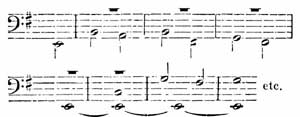
I have this moment returned from the church, where I have been playing the organ for three hours, far into the twilight: an old man, a cripple, blew the bellows for me, and except him, there was not a single soul in the church. The only stops I found available, were a very weak croaking flute, and a quavering deep pedal diapason, of sixteen feet. I contrived to extemporize with these materials, and at last subsided into a choral melody in E minor, without being able to remember what it was. I could not get rid of it, when all at once it occurred to me that it was a Litany, the music of which was in my head because the words were in my heart, so then I had a wide field, and plenty of food for extemporizing. At length the consumptive deep bass resounded quite alone in E minor, thus:—
[Listen]
and then came in its turn the flute, high up in the treble, with the choral in the same key, and so the sounds of the organ gradually died away, and I was obliged to stop, from the church being so dark.
In the meantime there was a terrible hurricane of wind and rain outside, and not a trace of the grand lofty rocky precipices; the most dreary weather! and then I read some dreary newspapers, and everything wore a grey hue. Tell me, Fanny, do you know Auber's "Parisienne?" I consider it the very worst thing he has ever produced, perhaps because the subject was really sublime, and for other reasons also. Auber alone could have been guilty of composing for a great nation, in the most violent state of excitement, a cold, insignificant piece, quite commonplace, and trivial. The refrain revolts me every time I think of it,—it is as if children were playing with a drum, and singing to it—only more objectionable. The words also are worthless; little antitheses and points are quite out of place here. Then the emptiness of the music! a march for acrobats, and at the end a mere miserable imitation of the "Marseillaise." Such music is not what this epoch demands. Woe to us if it be indeed what suits this epoch,—if a mere copy of the Marseillaise Hymn be all that is required. What in the latter is full of fire, and spirit, and impetus, is in the former ostentatious, cold, calculated, and artificial. The "Marseillaise" is as superior to the "Parisienne" as everything produced by genuine enthusiasm must be, to what is made for a purpose, even if it be with a view to promote enthusiasm; it will never reach the heart, because it does not come from the heart.
By the way, I never saw such a striking identity between a poet and a musician, as between Auber and Clauren. Auber faithfully renders note for note, what the other writes word for word—braggadocio, degrading sensuality, pedantry, epicurism, and parodies of foreign nationality. But why should Clauren be effaced from the literature of the day? Is it prejudicial to any one that he should remain where he is? and do you read what is really good with less interest? Any young poet must indeed be degenerate, if he does not cordially hate and despise such trash; but it is only too true that the people like him; so it is all very well, it is only the people's own loss. Write me your opinion of the "Parisienne." I sometimes sing it to myself for fun, as I go along; it makes a man walk like a chorister in a procession.
Sargans, September 3rd, noon.
Wretched weather! it has rained all night, and all the morning too, and the cold as severe as in winter; deep snow is lying on the adjacent hills. There has been again a tremendous inundation in Appenzell, which has done the greatest damage, and destroyed all the roads. At the Lake of Zurich, there are numbers of pilgrimages, and processions, on account of the weather. I was obliged to drive here this morning, as all the footpaths were covered with mud and water. I shall remain till to-morrow, when the diligence passes through at an early hour, and I intend to go with it up the valley of the Rhine, as far as Altstetten.
To-morrow I shall probably have reached, or crossed, the boundaries of Switzerland, for my pleasure excursion is now over. Autumn is arrived, and I have no right to complain if I pass a few tiresome days, after so many enchanting ones, that I can never forget. On the contrary, I think I almost like it; there is always enough to be done, even in Sargans, (a wretched hole,) and in a regular deluge, like that of to-day—for happily an organ is always to be found in this country; they are certainly small, and the lower octave, both in the key-board and the pedal, imperfect, or as I call it, crippled; but still they are organs, and that is enough for me.
I have been playing all this morning, and really begun to practise, for it is a shame that I cannot play Sebastian Bach's principal works. I intend, if I can manage it, to practise for an hour every day in Munich, as after a couple of hours' work to-day, I certainly made considerable progress with my feet (nota bene, sitting). Ritz once told me that Schneider, in Dresden, played him the D major fugue, in the "wohl-temperirten Clavier," on the organ, supplying the bass with the pedal.
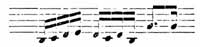
[Listen]
This had hitherto appeared to me so fabulous, that I could never properly comprehend it. It recurred to me this morning when I was playing the organ, so I instantly attempted it, and I at least see that it is far from being impossible, and that I shall accomplish it. The subject went pretty well, so I practised passages from the D major fugue, for the organ, from the F major toccata, and the G minor fugue, all of which I knew by heart. If I find a tolerable organ in Munich, and not an imperfect one, I will certainly conquer these, and feel childish delight at the idea of playing such pieces on the organ. The F major toccata, with the modulation at the close, sounded as if the church were about to tumble down; what a giant that Cantor was!
Besides organ-playing, I have a good many sketches to finish, in my new drawing book, (one was entirely filled in Engelberg) and then I must eat like six hundred wrestlers. After dinner I practise the organ again, and thus a rainy day passes at Sargans. It seems prettily situated, with a castle on the hill, but I cannot go a step beyond the door.
Evening.—Yesterday at this time, I still projected a pedestrian tour, and wished at all events to go through the whole of the Appenzell. It was a strange feeling when I learned that all mountain excursions were probably at an end for this year: the heights are covered with deep snow, for just as it has rained here, in the valley, for thirty-six hours, it has snowed incessantly on the hills above. The flocks have been obliged to come down into the valley from the Alps, where they ought to have remained for a whole month yet, so that all idea of any footpaths is out of the question. Yesterday I was still on the hills, but now they will be inaccessible for six months to come. My pedestrian excursions are over; wondrously beautiful they were, and I shall never forget them.
I mean to work hard at music, and high time that I should. I played on the organ till twilight, and was trampling energetically on the pedal, when we suddenly became aware that the deep C sharp in the great diapason, went buzzing softly on without ceasing; all our pressing, and shaking, and thumping on the keys, was of no avail, so we were obliged to climb into the organ among the big pipes. The C sharp continued gently humming,—the fault lay in the bellows; the organist was in the greatest perplexity, because to-morrow is a fête day; at last I stuffed my handkerchief into the pipe, and there was no more buzzing, but no more C sharp either. I played this passage incessantly, all the same:—
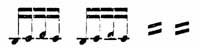
[Listen]
and it did very well.
I am now going to finish my sketch of the Glacier of the Rhone, and then the day will be at my own disposal; which means that I am going to sleep. I will write to you on the next page to-morrow evening wherever I am, for to-day I have no idea where I shall be. Good night! Eight is striking in F minor, and it is raining and blowing in F sharp minor or G sharp minor; in short, in every possible sharp key.

[Listen]
St. Gall, the 4th.
Motto—"Vous pensez que je suis l'Abbé de St. Gall" (Citoyen).[23] I do feel so comfortable here, after braving such storms and tempests. During the four hours when I was crossing the mountains from Altstetten to this place, I was engaged in a regular battle with the elements; when I tell you that I never experienced anything like the storm, nor even imagined anything approaching to it, this does not say much; but the oldest people in the Canton declare the same: a large manufactory has been demolished, and several persons killed. To-morrow, in my last letter from Switzerland, I will tell you of my being again obliged to travel on foot, and arriving here, after crossing by Appenzell, which looked like Egypt after the seven plagues. The bell is now ringing for dinner, and I mean to feast like an abbot.
Lindau, September 5th.
Opposite me lies Switzerland, with her dark blue mountains, pedestrian journeys, storms, and glorious heights and valleys. Here ends the greatest part of my journey, and my journal also.
At noon to-day, I crossed the wild grey Rhine in a ferry-boat, above Rheineck, and now here I am, already in Bavaria. I have of course entirely given up my projected excursion on foot, through the Bavarian mountains; for it would be folly to attempt anything of the kind this year. For the last four days it has rained more or less with incessant vehemence; it seemed as if Providence were wroth. I passed to-day through extensive orchards, which were not under water, but fairly submerged by mud and clay; everything looks deplorable and depressing; you must therefore forgive the doleful style of this last sheet. I never in any landscape saw a more dreary sight than the sward of the green hills, covered with deep snow; while below, the fruit-trees, with their ripe fruit, were standing reflected in the water. The scanty covering of muddy snow, which lay on the fir-woods and meadows, looked the personification of all that was dismal. A Sargans burgher told me that in 1811 this little town had been entirely burnt down, and recently with difficulty rebuilt; that they depend chiefly on the produce of their vineyards, which have been this year destroyed by hail-storms, and the Alps also were now no longer available; this gives rise to serious reflections, and to anxious thoughts with regard to this year.
It is singular enough that if I am obliged to go on foot in such weather, and fairly exposed to it, I am not in the least annoyed; on the contrary, I rather rejoice in setting it at defiance. When I arrived by the diligence yesterday at Altstetten, in freezing cold, like a day in December, I found that there was no carriage road to Tourgen, to which place I had unluckily sent on my cloak and knapsack on the last fine day. I was obliged to have them the same evening, for the cold was intense, so I did not hesitate long, but set off once more for the last time to cross the mountains, and arrived in the Canton of Appenzell.
The state of the woods, and hills, and meadows, and little bridges, baffles all description; being Sunday, and divine service going on, I failed in procuring a guide; not a living soul met me the whole way, for all the people had crept into their houses, so I toiled on quite alone towards Tourgen. To pass through a wood in such weather, and along such paths, inspires a wonderful sense of independence. Moreover I am now quite perfect in the Swiss jodeln and crowing, so I shouted lustily, and jodelled several airs at the pitch of my voice, and arrived in Tourgen in capital spirits. The people in the inn there were rude and saucy, so I politely said, "You be hanged! I shall go on;" and taking out my map, I found that St. Gall was the nearest convenient place, and in fact the only practicable route. I could not succeed in persuading any one to go with me in such horrible weather, so I resolved to carry my own things, abusing all Swiss cordiality.
Shortly afterwards, however, came the reverse of the medal, which not unfrequently occurs. I went to the peasant who had brought my luggage here, and found him in his pretty newly-built wooden house, and I had thus an opportunity of seeing a veritable and genuine Swiss interior, just as we imagine it to be. He and his whole family were sitting round a table, the house clean and warm, and the stove burning. The old man rose and gave me his hand, and insisted on my taking a seat; he then sent through the whole place to try to get me a carriage, or a man to carry my things, but as no one would either drive or walk, he at last sent his own son with me. He only asked two Batzen for carrying my knapsack for two hours. A very pretty fair daughter was sitting at the table sewing, the mother reading a thick book, and the old man himself studying the newspapers; it was a charming picture.
When at last I set off, the weather seemed to say, "If you defy me I can defy you also," for the storm broke loose with redoubled violence, and an invisible hand appeared to seize my umbrella at intervals, shaking it and crumpling it together, and my fingers were so benumbed that I could scarcely hold it fast; the paths were so desperately slippery that my guide fell sprawling full length before me in the mud; but what cared we? We jodelled and reviled the weather to our hearts' content, and at last we passed the Nunnery, which we greeted by a serenade, and soon after reached St. Gall.
Our journey was happily over, and yesterday I drove here, and at night met with a wonderful organ, on which I could play "Schmücke dich, O liebe Seele!" to my heart's content.
To-day I proceed to Memmingen, to-morrow to Augsburg; the day after, God willing, to Munich; and thus, I may now say, I have been in Switzerland. Perhaps I have rather bored you by all the trivial occurrences I have detailed. These are gloomy times, but we need not be so; and when I sent you my journal, it was chiefly to show you that I thought of you whenever I was pleased and happy, and was with you in spirit. The shabby, dripping pedestrian bids you farewell, and a town gentleman, with visiting-cards, fine linen, and a black coat, will write to you next time. Farewell.
Felix.
Burgher Letter from Munich.
Munich, October 6th, 1831.
It is a delightful feeling to wake in the morning and to know that you are to score a grand allegro with all sorts of instruments, and various oboes and trumpets, while bright weather holds out the hope of a cheering long walk in the afternoon.
I have enjoyed these pleasures for a whole week past, so the favourable impression that Munich made on me during my first visit, is now very much enhanced. I scarcely know any place where I feel so comfortable and domesticated as here. It is indeed very delightful to be surrounded by cheerful faces, and your own to be so also, and to know every man you meet in the streets.
I am now preparing for my concert, so my hands are pretty full; my acquaintances every instant interrupting me in my work, the lovely weather tempting me to go out, and the copyists, in turn, forcing me to stay at home; all this constitutes the most agreeable and exciting life. I was obliged to put off my concert, on account of the October festival, which begins next Sunday, and lasts all the week. Every evening there is to be a performance at the theatre, and a ball, so all idea of an orchestra or a concert-room is out of the question. On Monday evening, however, the 17th, at half-past six, think of me,—for then we dash off with thirty violins, and two sets of wind instruments.
The first part begins with the symphony in C minor, the second with the "Midsummer Night's Dream." The first part closes with my new concerto in G minor, and at the end of the second I have unwillingly agreed to extemporize. Believe me, I do so very reluctantly, but the people insist upon it. Bärmann has decided on playing again; Breiting, Mlle. Vial, Loehle, Bayer, and Pellegrini are the singers who are to execute a piece together. The locality is the large Odeon Hall, and the performance for the benefit of the poor in Munich. The magistrates invite the orchestra, and the burgomasters the singers. Every morning I am engaged in writing, correcting, and scoring till one o'clock, when I go to Scheidel's coffee-house in the Kaufinger Gasse, where I know each face by heart, and find the same people every day in the same position; two playing chess, three looking on, five reading the newspapers, six eating their dinner, and I am the seventh. After dinner Bärmann usually comes to fetch me, and we make arrangements about the concert, or after a walk we have cheese and beer, and then I return home and set to work again.
This time I have declined all invitations for the evening; but there are so many agreeable houses, to which I can go uninvited, that a light is seldom to be seen in my room on the parterre till after eight o'clock. You must know that I lodge on a level with the street, in a room which was once a shop, so that if I unbar the shutters of my glass door, one step brings me into the middle of the street, and any one passing along, can put his head in at the window, and say good morning. Next to me a Greek lodges, who is learning the piano, and he is truly odious; but to make up for that, my landlord's daughter, who wears a round silver cap and is very slender, looks all the prettier.
I have music in my rooms at four o'clock in the afternoon, three times every week: Bärmann, Breiting, Staudacher, young Poissl, and others, come regularly, and we have a musical picnic. In this way I become acquainted with operas, which, most unpardonably, I have not yet either heard or seen; such as Lodoiska, Faniska, Medea; also the Preciosa, Abu Hassan, etc. The theatre lends us the scores.
Last Wednesday we had capital fun; several wagers had been lost, and it was agreed that we should enjoy the fruits of them all together; and after various suggestions, we at last decided on having a musical soirée in my room, and to invite all the dignitaries; so a list was made out of about thirty persons; several also came uninvited, who were presented to us by mutual friends. There was a sad want of space; at first we proposed placing several people on my bed, but it was surprising the number of patient sheep who managed to cram into my small room. The whole affair was most lively and successful. E—— was present, as dulcet as ever, languishing in all the glory of poetical enthusiasm, and grey stockings; in short, tiresome beyond all description.
First I played my old quartett in B minor; then Breiting sang "Adelaide;" Herr S—— played variations on the violin (doing himself no credit); Bärmann performed Beethoven's first quartett (in F major), which he had arranged for two clarionets, corno di bassetto, and bassoon; an air from "Euryanthe" followed, which was furiously encored, and as a finale I extemporized—tried hard to get off—but they made such a tremendous uproar that nolens I was forced to comply, though I had nothing in my head, but wine-glasses, benches, cold roast meat, and ham.
The Cornelius ladies were next-door with my landlord and his family, to listen to me; the Schauroths were making a visit on the first story for the same purpose, and even in the hall, and in the street, people were standing; in addition to all this, the heat of the crowded room, the deafening noise, the gay audience; and when at last the time for eating and drinking arrived, the uproar was at its height; we fraternized glass in hand, and gave toasts; the more formal guests with their grave faces, sat in the midst of the jovial throng, apparently quite contented, and we did not separate till half-past one in the morning.
The following evening formed a striking contrast. I was summoned to play before the Queen, and the Court; there all was proper and polite, and polished, and every time you moved your elbow, you pushed against an Excellency; the most smooth and complimentary phrases circulated in the room, and I, the roturier, stood in the midst of them, with my citizen heart, and my aching head! I managed however to get on pretty well, and at the end, I was commanded to extemporize on Royal themes, which I did, and was mightily commended; what pleased me most was, that when I had finished my extempore playing, the Queen said to me, that it was strange the power I possessed of carrying away my audience, for that during such music, no one could think of anything else; on which I begged to apologize for carrying away Her Majesty, etc.
This, you see, is the mode in which I pass my time in Munich. I forgot, however, to say, that every day at twelve o'clock, I give little Mademoiselle L—— an hour's instruction in double counterpoint, and four-part composition, etc., which makes me realize more than ever the stupidity and confusion of most masters and books on this subject; for nothing can be more clear than the whole thing when properly explained.
She is one of the sweetest creatures I ever saw, Imagine a small, delicate-looking, pale girl, with noble but not pretty features, so singular and interesting, that it is difficult to turn your eyes from her; while all her gestures and every word are full of genius. She has the gift of composing songs, and singing them in a way I never heard before, causing me the most unalloyed musical delight I ever experienced. When she is seated at the piano, and begins one of the songs, the sounds are quite unique; the music floats strangely to and fro, and every note expresses the most profound and refined feeling. When she sings the first note in her tender tones, every one present subsides into a quiet and thoughtful mood, and each, in his own way, is deeply affected.
If you could but hear her voice! so innocent, so unconsciously lovely, emanating from her inmost soul, and yet so tranquil! Last year the genius was all there; she had written no song that did not contain some bright flash of talent, and then M—— and I sounded forth her praises to the musical world; still no one seemed to place much faith in us; but since that time, she has made the most remarkable progress. Those who are not affected by her present singing, can have no feeling at all; but unluckily it is now the fashion to beg the young girl to sing her songs, and then the lights are removed from the piano, in order that the society may enjoy the plaintive strains.
This forms an unpleasant contrast, and repeatedly when I was to have played something after her, I was quite unable, and declined doing so. It is probable that she may one day be spoiled by all this praise, because she has no one to comprehend or to guide her; and, strangely enough, she is as yet entirely devoid of all musical cultivation; she knows very little, and can scarcely distinguish good music from bad; in fact, except her own pieces, she thinks all else that she hears wonderfully fine. If she were at length to become satisfied as it were with herself, it would be all over with her. I have, for my part, done what I could, and implored her parents and herself in the most urgent manner, to avoid society, and not to allow such divine genius to be wasted. Heaven grant that I may be successful! I may, perhaps, dear sisters, soon send you some of her songs that she has copied out for me, in token of her gratitude for my teaching her what she already knows from nature; and because I have really led her to good and solid music.
I also play on the organ every day for an hour, but unfortunately I cannot practise properly, as the pedal is short of five upper notes, so that I cannot play any of Sebastian Bach's passages on it; but the stops are wonderfully beautiful, by the aid of which you can vary chorals; so I dwell with delight on the celestial, liquid tone of the instrument. Moreover, Fanny, I have here discovered the particular stops which ought to be used in Sebastian Bach's "Schmücke dich, O liebe Seele." They seem actually made for this melody, and sound so touching, that a tremor invariably seizes me, when I begin to play it. For the flowing parts I have a flute stop of eight feet, and also a very soft one of four feet, which continually floats above the Choral. You have heard this effect in Berlin; but there is a keyboard for the Choral with nothing but reed stops, so I employ a mellow oboe and a soft clarion (four feet) and a viola; these give the Choral in subdued and touching tones, like distant human voices, singing from the depths of the heart.
Sunday, Monday, and Tuesday, by the time you will have received this letter, I shall be on the "Theresien Wiese," with eighty thousand other people; so think of me there, and farewell.
Felix.
Munich, October 18th, 1831.
Dear Father,
Pray forgive me for not having written to you for so long. The last few days previous to my concert, were passed in such bustle and confusion, that I really had not a moment's leisure; besides I preferred writing to you after my concert was over, that I might tell you all about it, hence the long interval between this and my former letter.
I write to you in particular to-day, because it is so long since I have had a single line from you; I do beg you will soon write to me, if only to say that you are well, and to send me your kind wishes. You know this always makes me glad and happy; therefore excuse my addressing this letter, with all the little details of my concert, to you. My mother, and sisters, were desirous to hear them, but I was anxious to say how eagerly I hope for a few lines from you. Pray let me have them. It is a long time since you wrote to me!
My concert took place yesterday, and was much more brilliant and successful than I expected. The affair went off well, and with much spirit. The orchestra played admirably, and the receipts for the benefit of the poor will be large. A few days after my former letter, I attended a general rehearsal, where the whole band were assembled, and in addition to the official invitation the orchestra had received, I was obliged to invite them verbally in a polite speech, in the theatre. This, to me, was the most trying part of the whole concert; still I did not object to it, for I really wished to know the sensations of a man who gives a concert, and this ceremony forms part of it. I stationed myself therefore at the prompter's box, and addressed the performers very courteously, who took off their hats, and when my speech was finished, there was a general murmur of assent. On the following day there were upwards of seventy signatures to the circular. Immediately afterwards, I had the pleasure of finding that the chorus singers had sent one of their leaders to me, to ask if I had not composed some chorus that I should like to be sung, in which case, they would all be happy to sing it gratis. Although I had decided not to give more than three pieces of my composition, still the offer was very gratifying, and the hearty sympathy especially delighted me, for even the regimental musicians whom I had to engage for the English horns and trumpets, positively refused to accept a single kreuzer, and we had above eighty performers in the orchestra.
Then came all the tiresome minor arrangements about advertisements, tickets, preliminary rehearsals, etc., and in addition to all this, it was the week of the October festival. In Munich the days and hours always glide past so very rapidly, that when they are gone, it really seems as if they had never been, and this is more peculiarly the case during this October festival. Every afternoon about three o'clock you repair to the spacious, green "Theresien Wiese," which is swarming with people, and it is impossible to get away till the evening, for every one finds acquaintances without end, and something to talk about, or to look at; a fat ox, target-shooting, a race, or pretty girls in gold and silver caps, etc. Any affair you are engaged in, can be concluded there, for the whole town is congregated on the meadow, and not till the mists begin to rise, does the crowd disperse, and return towards the "Frauen Thürme." The people are in constant motion, running about in all directions, while the snowy mountains in the distance look clear and tranquil, each day giving promise of a bright morrow, and fulfilling that promise; and, what after all is the chief thing, none but careless happy faces to be seen, with the occasional exception perhaps of a few Deputies, drinking coffee in the open air, and discussing the lamentable condition of the people,—while the people themselves are standing round them looking as happy as possible. On the first day the King distributes the prizes himself, taking off his hat to each winner of a prize, and giving his hand to the peasants, or laying hold of their arms and shaking them; now I think this all very proper, as here externally at least society appears more blended, but whether it sinks deep into the heart, we can discuss together at some future time. I adhere to my first opinion; at all events it is so far well, that the absurd restraints of etiquette should not be too strictly observed outwardly, and so it is always something gained.
My first rehearsal took place early on Saturday. We had about thirty-two violins, six double-basses, and double sets of wind instruments, etc.: but, Heaven knows why, the rehearsal went badly; I was forced to rehearse my symphony in C minor alone for two hours. My concerto did not go at all satisfactorily. We had only time to play over the "Midsummer Night's Dream" once, and even then so hurriedly, that I wished to withdraw it from the bills; but Bärmann would not hear of this, and assured me that they would do it better next time. I therefore was forced to wait in considerable anxiety for the next rehearsal: in the meantime there was happily a great ball on Sunday evening, which was very enjoyable, so I recovered my spirits, and arrived next morning at the general rehearsal in high good humour, and with perfect confidence. I started off at once with the overture; we played it over again and again, till at last it went well, and we did the same with my concerto, so that the whole rehearsal was quite satisfactory.
On my way to the concert at night, when I heard the rattling of the carriages, I began to feel real pleasure in the whole affair. The Court arrived at half-past six. I took up my little English bâton, and conducted my symphony. The orchestra played magnificently, and with a degree of fire and enthusiasm that I never heard equalled under my direction; they all crashed in at the forte, and the scherzo was most light and delicate; it seemed to please the audience exceedingly, and the King was always the first to applaud. Then my fat friend, Breiting, sang the air in A flat major from "Euryanthe," and the public shouted "Da capo!" and were in good humour, and showed good taste. Breiting was delighted, so he sang with spirit, and quite beautifully. Then came my concerto; I was received with long and loud applause; the orchestra accompanied me well, and the composition had also its merits, and gave much satisfaction to the audience; they wished to recall me, in order to give me another round of applause, according to the prevailing fashion here, but I was modest, and would not appear. Between the parts the King got hold of me, and praised me highly, asking all sorts of questions, and whether I was related to the Bartholdy in Rome, to whose house he was in the habit of going, because it was the cradle of modern art, etc.[24]
The second part commenced with the "Midsummer Night's Dream," which went admirably, and excited a great sensation; then Bärmann played, and after that we had the finale in A major from Lodoiska. I however did not hear either of these, as I was resting and cooling in the anteroom. When I appeared to extemporize, I was again enthusiastically received. The King had given me the theme of "Non più andrai," on which I was to improviser. My former opinion is now fully confirmed, that it is an absurdity to extemporize in public. I have seldom felt so like a fool as when I took my place at the piano, to present to the public the fruits of my inspiration; but the audience were quite contented, and there was no end of their applause. They called me forward again, and the Queen said all that was courteous; but I was annoyed, for I was far from being satisfied with myself, and I am resolved never again to extemporize in public,—it is both an abuse and an absurdity.
So this is an account of my concert of the 17th, which is now among the things of the past. There were eleven hundred people present, so the poor may well be satisfied: but enough of all this. Farewell! May every happiness attend you all!
Felix.
Paris, December 19th, 1831.
Dear Father,
Receive my hearty thanks for your letter of the 7th. Though I do not quite apprehend your meaning on some points, and also may differ from you, still I have no doubt that this will come all right when we talk things over together, especially if you permit me, as you have always hitherto done, to express my opinion in a straight-forward manner. I allude chiefly to your suggestion, that I should procure a libretto for an opera from some French poet, and then have it translated, and compose the music for the Munich stage.[25]
Above all, I must tell you how sincerely I regret that you have only now made known to me your views on this subject. I went to Düsseldorf, as you know, expressly to consult with Immermann on the point. I found him ready, and willing; he accepted the proposal, promising to send me the poem by the end of May at the latest, so I do not myself see how it is possible for me now to draw back; indeed I do not wish it, as I place entire confidence in him. I do not in the least understand what you allude to in your last letter, about Immermann, and his incapacity to write an opera. Although I by no means agree with you in this opinion, still it would have been my duty to have settled nothing without your express sanction, and I could have arranged the affair by letter from here, I believed however that I was acting quite to your satisfaction when I made him my offer. In addition to this, some new poems that he read to me, convinced me more than ever that he was a true poet, and supposing that I had an equal choice in merit, I would always decide rather in favour of a German than a French libretto; and lastly, he has fixed on a subject which has been long in my thoughts, and which, if I am not mistaken, my mother wished to see made into an opera,—I mean Shakspeare's "Tempest". I was therefore particularly pleased with this, so I shall doubly regret if you do not approve of what I have done. In any event, however, I entreat that you will neither be displeased with me, nor distrustful with regard to the work, nor cease to take any interest in it.
From what I know of Immermann, I feel assured I may expect a first-rate libretto. What I alluded to about his solitary life, merely referred to his inward feelings and perceptions; for in other respects he is well acquainted with what is passing in the world. He knows what people like, and what to give them; but above all he is a genuine artist, which is the chief thing; but I am sure I need not say that I will not compose music for any words I do not consider really good, or which do not inspire me, and for this purpose it is essential that I should have your approval. I intend to reflect deeply on the poem before I begin the music. The dramatic interest or (in the best sense) the theatrical portion, I shall of course immediately communicate to you, and in short look on the affair in the serious light it deserves. The first step however is taken, and I cannot tell you how deeply I should regret your not being pleased.
There is however one thing which consoles me, and it is that if I were to rely on my own judgment, I would again act precisely as I have now done, though I have had an opportunity of becoming acquainted with a great deal of French poetry, and seeing it in the most favourable light. Pray pardon me for saying exactly what I think. To compose for the translation of a French libretto, seems to me for various reasons impracticable, and I have an idea that you are in favour of it more on account of the success which it is likely to enjoy than for its own intrinsic merit. Moreover I well remember how much you disliked the subject of the "Muette de Portici," a Muette too who had gone astray, and of "Wilhelm Tell," which the author seems almost purposely to have rendered tedious.
The success however these enjoy all over Germany does not assuredly depend on the work itself being either good or dramatic, for "Tell" is neither, but on their coming from Paris, and having pleased there. Certainly there is one sure road to fame in Germany,—that by Paris and London; still it is not the only one; this is proved not only by all Weber's works, but also by those of Spohr, whose "Faust" is here considered classical music, and which is to be given at the great Opera-house in London next season. Besides, I could not possibly take that course, as my great opera has been bespoken for Munich, and I have accepted the commission. I am resolved therefore to make the attempt in Germany, and to remain and work there so long as I can continue to do so, and yet maintain myself, for this I consider my first duty. If I find that I cannot do this, then I must leave it for London or Paris, where it is easier to get on. I see indeed where I should be better remunerated and more honoured, and live more gaily, and at my ease, than in Germany, where a man must press forward, and toil, and take no rest,—still, if I can succeed there, I prefer the latter.
None of the new libretti here, would in my opinion be attended with any success whatever, if brought out for the first time on a German stage. One of the distinctive characteristics of them all, is precisely of a nature that I should resolutely oppose, although the taste of the present day may demand it, and I quite admit that it may in general be more prudent to go with the current than to struggle against it. I allude to that of immorality. In "Robert le Diable" the nuns come one after the other to allure the hero of the piece, till at last the abbess succeeds in doing so: the same hero is conveyed by magic into the apartment of her whom he loves, and casts her from him in an attitude which the public here applauds, and probably all Germany will do the same; she then implores his mercy in a grand aria. In another opera a young girl divests herself of her garments, and sings a song to the effect that next day at this time she will be married; all this produces effect, but I have no music for such things. I consider it ignoble, so if the present epoch exacts this style, and considers it indispensable, then I will write oratorios.
Another strong reason why it would prove impracticable is that no French poet would undertake to furnish me with a poem. Indeed, it is no easy matter to procure one from them for this stage, for all the best authors are overwhelmed with commissions. At the same time I think it quite possible that I might succeed in getting one; still it never would occur to any of them to write a libretto for a German theatre. In the first place it would be much more feasible to give the opera here, and infinitely more rational too; in the second place, they would decline writing for any other stage than the French; in fact they could not realize any other. Above all it would be impossible to procure for them a sum equivalent to what they receive here from the theatres, and what they draw as their share from the part d'auteur.
I know you will forgive me for having told you my opinion without reserve. You always allowed me to do so in conversation, so I hope you will not put a wrong construction on what I have written, and I beg you will amend my views by communicating your own.—Your
Felix.
Paris, December 20th, 1831.
Dear Rebecca,
I went yesterday to the Chambre des Députés, and I must now tell you about it; but what do you care about the Chambre des Députés? It is a political song, and you would rather hear whether I have composed any love songs, or bridal songs, or wedding songs; but it is a sad pity, that no songs but political ones are composed here. I believe I never in my life passed three such unmusical weeks as these. I feel as if I never could again think of composing; this all arises from the "juste milieu;" but it is still worse to be with musicians, for they do not wrangle about politics, but lament over them. One has lost his place, another his title, a third his money, and they say this all proceeds from the "Milieu."
Yesterday I saw the "Milieu," in a light grey coat, and with a noble air, in the first place on the Ministerial bench. He was sharply attacked by M. Mauguin, who has a very long nose. Of course you don't care for all this; but what of that? I must have a chat with you. In Italy I was lazy, in Switzerland a wild student, in Munich a consumer of cheese and beer, and so in Paris I must talk politics. I intended to have composed various symphonies, and to have written some songs for certain ladies in Frankfort, Düsseldorf, and Berlin; but as yet not a chance of it. Paris obtrudes herself, and as above all things I must now see Paris, so I am busily engaged in seeing it, and am dumb.
Moreover I am freezing with cold—another drawback. I cannot contrive to make my room warm, and I am not to get another and warmer apartment, till New Year's Day. In a dark little hole on the ground floor, overlooking a small damp garden, where my feet are like ice, how can I possibly write music? It is bitterly cold, and an Italian like myself is peculiarly susceptible. At this moment a man outside my window is singing a political song to a guitar.
I live a reckless life—out morning, noon, and night: to-day at Baillot's; to-morrow I go to some friends of the Bigots; the next day, Valentin; Monday, Fould; Tuesday, Hiller; Wednesday, Gérard; and the previous week it was just the same. In the forenoon I rush off to the Louvre, and gaze at the Raphaels, and my favourite Titian; a person might well wish for a dozen more eyes to look at such a picture.
Yesterday I was in the Chamber of Peers, who were engaged in pronouncing judgment on their own hereditary rights, and I saw M. Pasquier's wig. The day before I paid two musical visits, to the grumbling Cherubini, and the kind Herz. There is a large sign-board before the house: "Manufacture de Pianos, par Henri Herz, Marchand de Modes et de Nouveautés." I thought this formed one, not observing that it was a notice of two different firms, so I went in below, and found myself surrounded by gauze, and lace, and trimmings: so, rather abashed, I asked where the pianos were. A number of Herz's fair scholars with industrious faces, were waiting upstairs. I sat down by the fire and read your interesting account of our dear father's birthday, and so forth. Herz presently arrived, and gave audience to his pupils. We were very loving, recalled old times, and besprinkled each other mutually with great praise. On his pianos is inscribed: "Médaille d'or. Exposition de 1827." This was very imposing.
From thence I went to Erard's, where I tried over his instruments, and remarked written on them in large letters: "Médaille d'or. Exposition de 1827." My respect seemed to diminish. When I went home I opened my own instrument by Pleyel, and to be sure there also I saw in large letters: "Médaille d'or. Exposition de 1827." The matter is like the title of "Hofrath," but it is characteristic. It is alleged that the chambers are about to discuss the following proposition: "Tous les Français du sexe masculin ont dès leur naissance le droit de porter l'ordre de la Légion d'Honneur," and the permission to appear without the order, can only be obtained by special services. You really scarcely see a man in the street without a bit of coloured ribbon, so it is no longer a distinction.
Apropos, shall I be lithographed full length? Answer what you will, I don't intend to do it. One afternoon in Berlin, when I was standing unter den Linden before Schenk's shop looking at H——'s and W——'s lithographs, I made a solemn vow to myself, unheard by man, that I would never allow myself to be hung up till I became a great man. The temptation in Munich was strong; there they wished to drape me with a Carbonaro cloak, a stormy sky in the background, and my fac-simile underneath, but I happily got off by adhering to my principles. Here again I am rather tempted, for the likenesses are very striking, but I keep my vow; and if, after all, I never do become a great man, though posterity will be deprived of a portrait, it will have an absurdity the less.
It is now the 24th, and we had a very pleasant evening at Baillot's yesterday. He plays beautifully, and had collected a very musical society of attentive ladies and enthusiastic gentlemen, and I have seldom been so well amused in any circle, or enjoyed such honours. It was the greatest possible delight to me to hear my quartett in E flat major (dedicated to B. P.) performed in Paris by Baillot's quartett, and they executed it with fire and spirit. They commenced with a quintett by Bocherini, an old-fashioned perruque, but a very amiable old gentleman underneath it. The company then asked for a sonata of Bach's; we selected the one in A major; old familiar tones dawned once more on me, of the time when Baillot played it with Madame Bigot.[26] We urged each other on, the affair became animated, and so thoroughly amused both us and our audience, that we immediately commenced the one in E major, and next time we mean to introduce the four others.
Then my turn came to play a solo. I was in the vein to extemporize successfully, and felt that I did so. The guests being now in a graver mood, I took three themes from the previous sonatas, and worked them up to my heart's content; it seemed to give immense pleasure to those present, for they shouted and applauded like mad. Then Baillot gave my quartett; his manner towards me has something very kind, and I was doubly pleased, as he is rather cold at first and seldom makes advances to any one. He appears a good deal depressed by the loss of his situation. I saw a number of old well-known faces, and they asked after you all, and recalled many anecdotes of that former period.
When I was passing through Louvain two years ago with my "Liederspiel" in my head, and my injured knee,[27] I seized the brass handle of a pump to prevent myself from falling; and when I returned this year in the same miserable diligence, driven by a postilion exactly similar, with a big queue, the "Liederspiel," my knee, and Italy, were all things of the past; and yet the handle of the pump was still hanging there, as clean and brightly rubbed up as ever, having survived 1830, and all the revolutionary storms, and remaining quite unchanged. This is sentimental; my father must not read it, for it is the old story of the past and the present, which we discussed so eagerly one fine evening, and which recurs to me among the crowd here at every step. I thought of it at the Madeleine, and when I went to aunt J——'s, and at the Hôtel des Princes, and at the gallery, which my father showed me fifteen years ago, and when I saw the coloured signs, which at that time impressed me exceedingly, and are now grown brown and shabby.
Moreover this is Christmas Eve; but I feel little interest in it, or in New Year's Night either. Please God, another year may wear a very different aspect, and I will not then go to the theatre on Christmas Eve, as I am about to do to-night, to hear Lablache and Rossini for the first time. How little I care about it! I should much prefer Polichinelles and apples to-day, and I think it very doubtful whether the orchestra will play as pretty a symphony as my "Kinder-Sinfonie."[28] I must be satisfied with it however. I am now modulating into the minor key, a fault with which the "École Allemande" are often reproached, and as I profess not to belong to the latter, the French say I am cosmopolite. Heaven defend me from being anything of the kind!
And now good-bye; a thousand compliments from Bertin de Vaux, Girod de l'Ain, Dupont de l'Eure, Tracy, Sacy, Passy and other kind friends. I had intended to have told you in this letter how Salverte attacked the Ministers, and how during this time a little émeute took place on the Pont Neuf; how I sat in the Chambers along with Franck, in the midst of St. Simoniens; how witty Dupin was; but no more at present. May you all be well and happy this evening, and thinking of me!
Felix.
Paris, December 28th, 1831.
Dear Madam Fanny,
For three months past I have been thinking of writing you a musical letter, but my procrastination has its revenge, for though I have been a fortnight here, I don't know whether I shall still be able to do so. I have appeared in every possible mood here; in that of an inquiring, admiring traveller; a coxcomb; a Frenchman, and yesterday actually as a Peer of France; but not yet as a musician. Indeed there is little likelihood of the latter, for the aspect of music here is miserable enough.
The concerts in the Conservatoire, which were my great object, probably will not take place at all, because the Commission of the Ministry wished to give a Commission to the Commission of the society, to deprive a Commission of Professors of their share of the profits; on which the Commission of the Conservatoire replied to the Commission of the Ministry, that they might go and be hanged (suspended), and then they would not consent to it. The newspapers make some very severe comments on this, but you need not read them, as these papers are prohibited in Berlin; but you don't lose much by this. The Opéra Comique is bankrupt, and so it has had relâche since I came; at the Grand Opéra, they only give little operas, which amuse me, though they neither provoke nor excite me. "Armida" was the last great opera, but they gave it in three acts, and this was two years ago. Choron's "Institut" is closed, the "Chapelle Royale" is gone out like a light; not a single Mass is to be heard on Sundays in all Paris, unless accompanied by serpents. Malibran is to appear here next week for the last time. So much the better, say you: retire within yourself, and write music for "Ach Gott vom Himmel," or a symphony, or the new violin quartett which you mentioned in your letter to me of the 28th, or any other serious composition; but this is even more impossible, for what is going on here is most deeply interesting, and entices you out, suggesting matter for thought and memory and absorbing every moment of time. Accordingly I was yesterday in the Chambre des Pairs, and counted along with them the votes, destined to abolish a very ancient privilege; immediately afterwards I hurried off to the Théâtre Français, where Mars was to appear for the first time for a year past; (she is fascinating beyond conception; a voice that we shall never hear equalled, causing you to weep, and yet to feel pleasure in doing so). To-day I must see Taglioni again, who along with Mars constitutes two Graces (if I find a third in my travels, I mean to marry her), and afterwards I mean to go to Gérard's classical salon. I lately went to hear Lablache and Rubini, after hearing Odillon Barrot quarrel with the Ministry. Having seen the pictures in the Louvre in the morning, I went to Baillot's; so what chance is there of living in retirement? The outer world is too tempting.
There are moments, however, when my thoughts turn inwards—such as on that memorable evening, when Lablache sang so beautifully, or on Christmas-day, when there were no bells and no festivities, or when Paul's letter came from London, inviting me to visit him next spring; the said spring to be passed in England. Then I feel that all that now interests me is merely superficial: that I am neither a politician, nor a dancer, nor an actor, nor a bel esprit, but a musician—so I take courage, and am now writing a professional letter to my dear sister.
My conscience smote me, especially when I read about your new music that you so carefully conducted on my father's birthday, and I reproached myself for not having said a single word to you about your previous composition; but I cannot let you off that, my colleague! What the deuce made you think of setting your G horns so high? Did you ever hear a G horn take the high G without a squeak? I only put this to yourself! and at the end of this introduction, when wind instruments come in, does not the following note

[Listen]
stare you in the face, and do not these deep oboes growl away all pastoral feeling, and all bloom? Do you not know that you ought to take out a license to sanction your writing the low B for oboes, and that it is only permitted on particular occasions, such as witches, or some great grief? Has not the composer evidently, in the A major air, overloaded the voice by too many other parts, so that the delicate intention, and the lovely melody of this otherwise charming piece, with all its beauties, is quite obscured and eclipsed?
To speak seriously, however, this aria is very beautiful, and particularly fascinating. But I have a remark to make about your two choruses, which indeed applies rather to the text than to you. These two choruses are not sufficiently original. This sounds absurd; but my opinion is that it is the fault of the words, that express nothing original; one single expression might have improved the whole, but as they now stand, they would be equally suitable for church music, a cantata, an offertorium, etc. Where, however, they are not of such universal application, as for example, the lament at the end, they seem to be sentimental and not natural. The words of the last chorus are too material ("mit dem kraftlosen Mund, und der sich regenden Zunge"). At the beginning of the aria alone, are the words vigorous and spirited, and from them emanated the whole of your lovely piece of music. The choruses are of course fine, for they are written by you; but in the first place, it seems to me that they might be by any other good master, and secondly, as if they were not necessarily what they are, indeed as if they might have been differently composed. This arises from the poetry not imposing any particular music. I know that the latter is often the case with my own compositions; but though I am fully aware of the beam in my own eyes, I would fain extract the mote from yours, to relieve you at once from its pressure.