Part 1 — THE CORONATION OF THE CZAR (continued 3)
Reading edition
We had two or three gentlemen to dinner, M. d'Orval, ancien officier de Chasseurs, just back from a tour in the Caucasus with the Duc de Chartres, and a Russian merchant for whom Richard had letters—the first person I have seen in Russia who was neither noble nor peasant. Both men were interesting enough. The Russian talked prudently, but fairly openly—said there must be a great change—things couldn't go on as they did now, there was a young generation to be reckoned with, active, educated, intelligent, and they must have their say—that when the uprising came there would be a Revolution such as Europe had never seen. I wonder.
After dinner we went to the Hermitage, the great public gardens. They are pretty enough, large, with trees and bosquets, and every variety of amusement—theatres, concerts, dancing, and even conjurors. Some shepherds from the Wladimir Government with long yellow cloaks and high hats were playing a sort of reed pipe, curious enough. At last I heard some of the Russian national songs—a quartette was singing them in one of the theatres. They are very pretty, monotonous, with an undercurrent of sadness. They sang very true, and the voices are rich, not at all the thin, high northern voice that one expected to hear. We stayed there so long, looking at the various things, that we didn't get home until 12.30—much the latest entertainment I have been to in Moscow, except the Palace ball, where the supper of course prolonged the festivities.
Monday, June 11th.
It was so warm to-day and I had so much to do with the trunks—separating the things—that I only went out after tea, and of course did a little more shopping. I wanted some photographs and also some music—however Benckendorff said he would see about that for me. We dined quite alone with the Embassy—a good dinner perfectly served, tho' Lhermite leaves to-morrow. He came up to get his last instructions from W. while we were having tea. His experiences are most amusing—he says he has learnt a great deal of the language and the Russian ways of doing business, and if ever he comes back he will know how to take care of himself. He became quite excited at remembering various occasions when he had been "roulé."
After dinner W. and I went for a last drive, to look at the Kremlin by moonlight—and beautiful it was—the sky was so blue one could almost see it like the Italian summer sky, and all the great white buildings and towers stood out gloriously. The great church of St. Basile was extraordinary. The colours, pink, green, red, yellow, all so vivid that even at night one quite made them out. It is a mass of towers, domes, and cupolas, every one different in shape, work, and colour. It was planned and executed by an Italian architect, and the story is that the Czar (of the epoch) was so pleased, and at the same time so afraid he might make another like it, that he had his eyes put out. It was curiously dark and quiet inside—scarcely any light; here and there a glimmer high up in one of the Palace rooms. We met two or three carriages with colleagues driving about in the moonlight like ourselves. The river, too, looked beautiful from the terrace—a broad silver band with moonlight full upon it. I took a last look at the black Madonna in the gateway, and the little guard of Cossacks. I shall often think of that last night in the Kremlin when I have returned to civilization and modern life.
I will send this off by to-morrow's courier. My next letter will be from Petersburg. My little boudoir still looks very nice. The little Russian maid is rather sad, and has been in and out 20 times, lighting candles, opening and shutting doors and windows, and keeping up a stream of conversation which I can't possibly understand, though the maids say they do. W. is deep in last despatches, and has departed to his own quarters. I haven't learnt any Russian, which I think is rather weak on my part. I thought I would have some lessons at first, but I don't think I could have learnt much in two weeks. Lagrené was discouraging—says he knows very little, and his mother is a Russian.
To H. L. K.
Hotel Demouth, Petersburg, Jeudi, 14 Juin, 1883.
We arrived here last night at 12.30. The journey was comfortable enough, but long—the Russian trains do not go a terrifying pace. We left Moscow at 9.30, and the Maison Klein a little before 9. The départ was quite imposing—all the personnel drawn up at the foot of the stairs, Lhermite and the three coachmen outside at the door, and a regiment of understrappers of all kinds. The little Russian maid was weeping and kissing my skirts. The faithful Benckendorff accompanied us to the station and saw us safely deposited in our wagon-salon—each Ambassador had one and a smaller one for the suite. Two Chamberlains, not attired in velvet and gold lace this time,—I felt rather aggrieved at having ordinary mortals in plain clothes to look after us—were waiting at the station to see that everything was well done, and they went with us to Petersburg. There was a Mongole at the door of our wagon who appeared at intervals with tea, oranges, and much information of all kinds (in Russian). We had all our meals en route—breakfast at 11, dinner at 4.30, a nondescript sort of meal, half goûter, half supper, with cold fish, fowl, mayonnaise, etc., at 8—and a very pretty little tea at 10.30. We all partook of every meal—how we managed to eat chicken and mayonnaise at 8, having dined at 4.30, seems a mystery, but we did.
It was very hot at starting—the sun pouring down on the plains that are around Moscow—not an atom of shade, but there was a sharp shower about 2 which cooled the air. They tell us Petersburg too is very hot. The day passed quickly enough. Many of our colleagues came and paid us visits. The Nuncio sat a long time. He is most interesting, with that delightful, simple, easy Italian manner. He asked us a great deal about the religious ceremony the day of the Coronation. He had only arrived after that. He is very clever and sympathetic, ready to talk about anything, and so moderate in his views. I think he would have a great success in Paris, where people love to discuss and analyze everything.
Our Spanish colleague also came and sat with us. It seems he wanted W. to come to his carriage and drink champagne and play cards (very high play too), but it was conveyed to him that these were not exactly M. Waddington's tastes. Rumour says he was naively surprised, and said, "Comment, il ne joue pas!—le pauvre homme!" They were certainly a very merry party—we heard roars of laughter every time the train stopped. If anyone was losing heavily he took it most cheerfully.
Our last little tea at 10.30 was really very pretty—several round tables very well arranged with flowers, tea, orangeade, and other drinks—cakes, petits fours, etc. (but no more solid food). W. struck and wouldn't get out, but Richard and I and the rest of the men were quite ready to see what was going on. Do you remember how I always loved getting out at all the buffets at no matter what time of night, when we used to go down to Italy every year? I think the buffet at Bologna with its "fricandeau de veau" is one of my most interesting souvenirs of travel (not from an artistic point of view).
The arrival at Petersburg was curious. It was quite light, and there were as many people at the station and in the streets as if it were 12 o'clock in the day. We read distinctly the names and numbers of the streets and the signs of the shops, and yet it wasn't altogether daylight—more like a late summer afternoon. We found very comfortable rooms here—a large salon with large bedrooms on either side, and a room next to me for Adelaïde. I was quite ready to go to bed—the heat and dust were trying, and yet it seemed funny to go to bed by daylight. They brought tea of course, but we really couldn't do any more, so I departed to my own room. There I quite lost the impression of daylight, as there were double, even triple curtains to all the windows.
This morning we slept late and breakfasted at 12.30, then W., Richard, and I went off in a carriage to the Hermitage (the great Museum). W. sent in his card to the Director of the Museum and also to the head of the Cabinet des Médailles, as he wants a week's work at the medals. It seems there is a splendid collection here. The gentlemen were very civil, and we made rendezvous for to-morrow, W. for the medals and Richard and I for the pictures. The Hermitage is an immense museum. We shall only be able to have an idea of what is in it. We walked through some of the rooms—Peter the Great's gallery, which is full of course of souvenirs—his clothes, arms, tools, furniture, horse stuffed, etc., and in another there were quantities of bibelots of all kinds, and presents given to Peter and Catherine II—a collection of snuff boxes, crystal flagons, and goblets (some with precious stones encrusted in the glass), jewelled belts and caps—most interesting.
We had our first view of the Neva from the windows of one of the rooms. It rushes past like the sea, so broad and strong, with very fair waves, a splendid river. We stayed about an hour lounging through the rooms, and then went on for a general view of the city. It is very handsome, but has no particular cachet (except the Neva) at this season of the year—one ought to see it in winter when the river is frozen and the real winter life begins. It looks so modern after Moscow. We went to the great cathedral of St. Isaac. It is very big and imposing as a mass, but the architecture not very striking—afterwards to the fortress and church of St. Peter and St. Paul, where all the Emperors are buried—to Peter the Great's house (a most ordinary little wooden building), drove a little along the quais, where the lovely fresh breeze from the river was most welcome and invigorating after the heat and dust of Moscow.
There was a good deal of life on the river, boats of all kinds. We think of going by steamer to Stockholm, all along the coast of Finland. They tell us it is a beautiful journey, particularly at this time of year, with the long, clear evenings. I want to see the boat before we decide, as I have an idea that it wouldn't be very clean (they say the boats on the rivers Volga, etc., are something terrible). We wound up in the Perspective Nevsky—the great shopping street, but didn't get out of the carriage, merely drove through. The shops look handsome and the vitrines well arranged, just like Paris. There was very little animation in the streets and very few carriages. They tell us many people have already gone away for the summer.
We dined quietly at the hotel, and just as we were finishing Admiral Jaurès came in to suggest that we should dine at Peterhof to-morrow afternoon. He says it is a very nice excursion—a short hour on the boat, and we can get a fair dinner there. About 9.30 we started again in the carriage to drive to the Islands or "La Pointe"—the great rendezvous in summer of all Petersburg. It is a long hour's drive, crossing quantities of small islands all connected by bridges, and one finally arrives at the "Pointe," end of the drive, and entrance of the Gulf of Finland. There all the carriages draw up, the people get down and walk about, or sit on the benches at the water's edge—a regular salon—in summer one sees all the people who are still "en ville" there. The place in itself is not at all pretty. The water of the Gulf is grey, the banks low, no trees—but the air was delicious.
We met almost all our Moscow colleagues—also Princess Lise Troubetzkoi, who was delighted to see W. and plunge into Paris politics. She wanted us to go back and have tea with her, but it was 11 o'clock and I was tired, having been going all day—evidently that is what people do, as several of our colleagues too asked us, and expressed great surprise at our wanting to go home so early.
We didn't get back to the hotel until 12, and then loitered a little in the salon, as the windows were open, people walking and driving about the streets, and nothing to make us think it was midnight, or at least the midnight we are accustomed to. They brought us some tea, and a little before one, making many excuses, I retired, rather feeling as if I were going to bed with the chickens.
Friday, June 15th.
We have been all the morning at the Hermitage, and I will write a little now after breakfast, before we start for Peterhof. We took ourselves off early in a droshky (Russian fiacre), the porter telling the coachman where to drive to; and telling us how much to give him. It was a lovely morning, not too warm, and we enjoyed our drive. W. was shown at once to the Cabinet des Médailles, where the Conservateur was waiting for him, and Richard and I were taken in hand by a young man attached to the Museum who knew his work well, and was remarkably intelligent, speaking French quite well. The pictures are beautiful—there are quantities of every possible school. The finest we thought the Van Dycks and the Rembrandts, though some of the Italian Madonnas were lovely too. I like the Italian Madonna face so much—it is so pure and young and passionless. Our guide was very talkative, and very anxious to know what we thought of the Moscow ceremonies. We stayed about two hours, seeing all sorts of things "en passant" besides the pictures. The whole Museum is crowded—I don't think they could get much more in.
Saturday, June 16th.
Our excursion to Peterhof was delightful yesterday afternoon. We took the four o'clock boat, and had a nice sail down of an hour and a quarter. The Jaurès came with us, also Pittié, Fayet, and Calmon. Corcelle went back to Paris from Moscow—also Sesmaisons, so our Mission is decidedly diminished. We met several of our Moscow friends on the boat—General Richter, Comte Worontzoff, and some others. The Court is at Peterhof and they are all established there. They told us the Emperor and Empress were not very tired after the excitement and emotions of the Coronation—very happy that all had gone so smoothly, and now quite pleased to be quietly at Peterhof with their children.
The Russians are very proud of Peterhof, call it a "petit Versailles," and "petit" it certainly is in comparison; but the park is pretty, well laid out, with terraces and gardens, and the water-works really very good indeed. A very good Circassian band was playing, and a good many people walking about. What was lovely and quite unlike Versailles were the glimpses of the sea one had on all sides. We got carriages and drove all about. We went into the big Palace, where the present Emperor never lives. He prefers a small place, half farm, half cottage, close to the sea, and lives there quite contentedly and quietly like an ordinary country gentleman. However we couldn't get anywhere near that villa—the gates and alleys were closed, and guards and soldiers everywhere.
We dined very badly at a restaurant we had been told of on the sea, and took the 10 o'clock boat home. The return was enchanting—a beautiful starlight night, and fresh, soft breeze. I had a nice talk with Mdme. Jaurès, who told me a good deal of Russian ways and life. I think she is glad to go back to France, and "au fond" there are very few French women who care to live abroad altogether. After three or four years they get homesick for their own country. She asked me if I was never homesick for America—but I told her I had been so long away, and my life had been such a full one that I sometimes asked myself was I the same little girl that used to run wild in the country at home with a donkey cart and a big Newfoundland dog. Those years seem so long ago the memory is getting duller. Sometimes I shut my eyes and see quite well the big white house with the piazzas, and the climbing roses, the cherry trees, and the white gate with the sharp turn, and the ditch where we upset so often in the sleighs—all the children tumbling out into the snow drift, and nobody minding.
We got home at 11.30 and found letters, which we read quite easily at the window. It is a wonderful light—no one ever seems to think of going to bed.
This morning we have been again at the Hermitage to finish the pictures. Decidedly the Rembrandts are the gems of the collection. There was one old man in a sort of fur robe and cap, with a wrinkled yellow face, whose eyes seemed quite alive, and followed us all round the room. We left W. with his medals and a sort of clerk attached to the Cabinet des Médailles. It seems they never leave anybody alone in the room with the medals. W. is delighted, he has found some rare coins he had never seen, and he means to have a good day's work, will not come back to breakfast with us.
Our young man, Baron Leeven, is always with us, and meets us at the Winter Palace this afternoon to show us the rooms. Our Mission is dwindling; Fayet went off this morning, Pittié and Calmon go Monday. Richard remains to make the journey with us to Stockholm by sea. We have just come in from a pleasant dinner at the Jaurès'. The Embassy is small, but very well arranged, and we had a very good, handsome dinner. All the personnel of the Embassy, Vannutelli and his two auditeurs, and the French Consul and his wife. Admiral Jaurès was very hospitable and en train—all sailors are, I wonder why? The officers of high rank must have so many lonely hours, and are such swells on their ships, where no one can associate much with them, that one would think it would make them rather silent and reserved from long habit—but it is quite the contrary. In all nations sailors are generally cultivated, and good talkers.
We shall become quite intimate with Vannutelli. We met him at the Winter Palace this afternoon, and went all about together. I can't say I found it very interesting. The rooms are handsome—high, generally white, with quantities of pictures—the portraits, some very old ones, interesting—the large modern pictures of battles by sea and land less so. I like very much the pictures of Peter the Great. He has a keen, striking face, must have had splendid eyes, very intelligent, in some of the portraits almost inspired, hard, not cruel. They were very anxious to show us the rooms where the late Emperor died, but there had been some mistake, and the man who has charge of the room could not be found, nor the key either. I was very glad (not that I should have gone in), for they said it was a horrid sight—the camp-bed and even his clothes left as they were, thick with blood. He was carried there directly after the attentat, and died on the little camp-bed. What I liked best was the splendid view again of the Neva from the windows of the ballroom. It looked a beautiful blue sea, the waves dancing in the afternoon light, and all the white sails standing out well in the sun. The two young men who were with us were most amusing. They showed us all the pictures in detail except those concerning the Grande Armée and the disastrous retreat. We were hurried past them, "rien de très intéressant, Madame—pas la peine de s'arrêter——."
Sunday, June 17th.
This morning we went to the French Protestant Church—a large room with white walls, and benches. There were very few people, but they tell us it is fairly full in winter. There is a large French colony—shopkeepers, theatre people, etc., and a great many Protestants. The Pasteur preached a very fair, sensible sermon.
After breakfast we had some visitors—Sir Edward Thornton, who wants us to dine one night; and a nice man, a Russian (whose name I never knew), but who told us to come to this hotel in which he is interested, and who has offered to go shopping with us one day, and show us the best fur-shops. We went for a drive in the afternoon to the Park Catherine, where a sort of fête populaire was going on. There were a great many people, and a great many policemen (as there always are here), one would think they lived in perpetual fear of an émeute, and yet the people all looked so subdued and repressed—I haven't seen one fierce face. The quantity of moujiks in their red shirts made a good effect of colour, but the women are not attractive, nor pretty. All are wrapped up in shawls, with a handkerchief over their heads.
We had a pleasant dinner at the Hunts' (United States Legation), all their people, including of course George Wurts, whom I was very pleased to see again—Admiral Baldwin and his two Aides-de-camp Rogers and Paul, and M. et Mdme. de Struve. They are just going to America—he is named Minister there. They have been in Japan, and didn't seem very keen about America. I should think they would like it better than Japan, but I believe he hoped for some post in Europe. She was very amusing, and from her account life in Japan must still be very primitive.
We came away early—about 10.30—and have been poring over guide-books ever since, making out our journey, always at the window (11 o'clock at night, and with no lamps).
Tuesday, June 19th.
We had a charming afternoon yesterday at Cronstadt on the Lancaster, Admiral Baldwin's flag-ship. He had invited all the Corps Diplomatique, and the few Russians who are still in Petersburg, Jomini, Struve, Benckendorff, etc. We started about 3.30 in the regular Russian steamer, and once under way the breeze was delicious. I wore my white batiste with Valenciennes, and a big black hat (which wasn't very practical on the steamer, as the wind blew the feathers about considerably, but I thought it looked so nice with the white dress). The American ship looked beautiful as we drew near—an old-fashioned frigate, all dressed with flags. The getting on board was not very easy, as she lay far out, and we had to get into small boats from our steamer and go out to her. It didn't look very pleasant when they put the steps down and told us to jump. There were fair waves, and when they told us to jump the boat was apparently nowhere near, but of course swung under the steps on the top of the wave at the right moment. Lady Thornton got down all right, so did I; but one of our colleagues had a most trying time. She was stout and nervous, looked wretched when she was standing on the steps between two strong sailors who told her to jump. She did her best, poor thing, and several times we in the boat below saw a stout white leg suddenly descend, but it was immediately drawn back, and she never let go of her sailors. Her husband, man-like, was furious, which of course made her much more nervous; however, after several attempts she gave it up, and they lowered her in an arm-chair, which didn't look quite comfortable either when it was suspended in the air waiting for the boat to arrive.
We danced about well in the little boat, for every time it came up, and she didn't come down, we had to go back and repeat the performance. The American Legation got off first and were received by a salute of 15 guns, and then we followed. The Admiral with all his officers received us at the top of the ladder, and the band played our national airs, and they gave the Ambassador's salute, 17 guns, and a great noise it made just over our heads as we were mounting the ladder. Lady Thornton and her husband were in front of me, and I heard the "God Save The Queen"—then came the "Marseillaise," and for a moment I forgot I was a Frenchwoman and looked to see whom the "Marseillaise" was for (W. hadn't come in the boat with me, waited for the second one), but I recovered myself in time to bow and smile my thanks.
I was delighted to find myself on an American ship, I so rarely see American officers of any kind. The ship was in splendid condition, so beautifully clean. We had a very handsome dinner in the Admiral's cabin. He took me down to see the table before all the guests came, and very pretty it looked, quantities of flowers and some handsome silver. No one enjoyed the day more than Mgr. Vannutelli. He had a little doubt about coming, as he heard there was to be dancing, and consulted us about it. We told him the dancing would be mild, and he might never have a chance to see a big American ship again, and strongly advised him to come.
While Lady Thornton and I were sitting together one of the young officers came up to her (she knew several of them, as they were some years in Washington) saying he heard one of the Ambassadresses was an American, did she know which one, and could she introduce him. "Certainly," she said, "it is Madame Waddington, wife of the French Ambassador, who is sitting next to me now," and immediately presented the young man, who said he had been looking at all the ladies to see which was the American, but hadn't placed me, he supposed because he heard me speaking French. We became great friends, and he took me all over the ship. We danced a little on deck—a quadrille d'honneur—I with my friend Schimmelpenninck, Lady Thornton with Jaurès, Madame Jaurès with Admiral Baldwin. Then we left the dancing to the young ones and sat quietly on deck till it was time to go. Just as we were starting the Admiral asked me if I would say a few words to the band—they were almost all Italians. I went over at once and talked to them, so did the Nuncio, which of course delighted them.
We started back about 9 in a special Russian steamer. The sea was much calmer, and the getting off one boat and on another was not such a difficult operation even for poor Mdme. A——. The sail back was about two hours—quite enchanting in that beautiful northern twilight, and we were all sorry when it came to an end.
This morning it is very warm, and I am rather seedy, so I have stayed quietly at home. Richard and I breakfasted tête-à-tête, as W. was off at an early hour to his medals, and won't be back until dark. I wonder if the Russian officials will be as astonished at his capacity for a long spell of work as the Italians were. They struck after two days of such work, and then took it in turns. One day at Milan I went to get him at the end of the day, as we were going to drive somewhere in the country, so the Italian smiled all over, and almost winked, saying, "Ah, Madame est venue voir si Monsieur était vraiment aux Médailles toute la journée." I suppose he felt that he wouldn't have stayed working all those hours, and also quite understood that I suspected W. of doing something else.
We have had a nice visit from Benckendorff, who has told us all about the boat we want to take to go to Stockholm. He says they are Swedish boats, very clean, and very good food; also very few people at this time of the year.
Now I must dress and go with Richard to pay some visits. Calmon will go and see you and give you all our news. He won't tell you what I will, that he had a great success in Moscow—his artillery uniform, the astrakhan tunique, was very becoming—all the ladies found him "très beau garçon." I must add too that Richard also had a great success—evidently artillery uniform is becoming. It was rather amusing to see the face of one of the young ladies when I made some reference to Madame Richard Waddington. "M. Waddington married—I never should have dreamed of it"—and after a moment, "What is his wife like?" doubtfully. "Is she pretty?" "Well, yes, she is very pretty." Richard won't tell you that either when he comes back, but I shall tell Louise.
How curious all the Moscow life will seem when I am settled again at Bourneville—walking in the park with the children, riding all over the country with W., and leading an absolutely quiet life. I hope I shall remember all I want to tell you.
To H. L. K.
Hôtel Demoult, Petersburg, Wednesday, June 20th, 1883.
Richard and I went visiting yesterday. We found the Thorntons, who gave us tea. Their Embassy is charming—a big house on the Quai Anglais. The drawing-rooms are large and high. All the windows look out on the Neva, and they say it is quite beautiful at night. Then we went back to the hotel, got W., who had had a fine morning with his medals—says the collection is magnificent, much larger than he had any idea of, and started off to the Quais to see our boat. We leave to-morrow evening between 6 and 7. It looked very nice and clean, and the Captain was quite overwhelmed with the distinguished passengers he was to have the honour of transporting. We have an enormous cabin (two thrown into one) big enough for a family. I interviewed the stewardess, a nice fresh-looking Norwegian woman. Conversation was rather difficult, as I spoke German and she Norwegian, and neither of us understood the other, but I am sure we shall get on very well. They tell us the voyage is enchanting, all in and out of small fiords, islands, and narrow rivers. We stop five or six hours each day to see the country, and never have any sea until we cross to Stockholm, when it is generally rough.
We dined quietly at the hotel with Coutouly, our Consul, a very nice man, very intelligent. He too had interviewed the Captain, and told him to take every care of us. He says the trip is enchanting, and the two Finnish towns, Helsingfors and Abo, very well worth seeing. About 10 o'clock we drove off to the "Pointe" and had a pleasant hour with some of the colleagues. It is always cool there, and the drive out is interesting, so unlike anything else.
Richard went off early this morning with Sermet and Moulin of the French Embassy to see the Falls of Smatra, which are said to be very fine. We pick him up at Helsingfors.
I walked about a little with Adelaïde—I never see anything the least like a femme du monde in the streets. I suppose the "société" are away for the summer, and the streets look rather as September streets do in Paris.
W. and I dined at the Thorntons'—handsome and pleasant. Jaurès was there, not his wife, she has already started for Paris, and the Ternaux Compans, a nice young ménage (just married) attached to the Embassy. She was very well dressed, in white. There was also the Danish Minister (I forget his name). He is a friend of the Empress and très bien vu à la cour. After dinner someone played on the piano, and he and Mary Thornton danced a little, showing us some of the figures of the mazurka. Lady Thornton says, like everyone else, that the society of Petersburg is very fermé. They know everybody, but I fancy very few of the diplomatists make real friends with anyone. I was rather surprised, as the Russians one meets abroad are generally very easy and sociable. She also finds the climate very trying. She showed me all the rooms, which are charming. In all the bedrooms very thick curtains, as the light is most trying, and of course people who live there must have regular hours for sleep—for us birds of passage it is of no consequence, and going to bed seems the last thing one would think of doing in Petersburg.
We came home about 11, and now W. is busy over his Paris letters, also putting his notes in order, as he has finished with the medals. He has had three or four days of real hard work, but says it rested him after all the Court festivities.
Jeudi, 21 Juin.
We have been shopping all the morning,—W. and I and M. Lomatch (I have found his name). We bought, among other things, a sled for Francis—I haven't seen one since I left America—and a good deal of Russian lace, which they say is very solid, and embroidery. We came back to a late breakfast, and I am writing now at the last moment while they are carrying down the trunks. We are going at 4 to the steamer to leave our boxes and Adelaïde, and install ourselves, and then go for tea to Coutouly, who has an apartment on the Quai, just opposite the wharf where the steamer starts from. I am quite sorry to go. We are very comfortable here, and the streets are so amusing. I should like once to hear a little laughing and singing, as the various groups of work-people, soldiers, and peasants pass—but they are a curiously sad, subdued race.
Friday, June 22d. "En mer."
We are just approaching Helsingfors (twelve o'clock), where we go on shore for some hours, and I will write a little. I have a nice straw arm-chair on deck (the sail shades me), a table with books, papers, etc. We embarked at 6.30 yesterday. We went on the boat about 4—saw the Captain, a very nice man, a Finn, who speaks English quite well, and who is much pleased to have us on his boat. He went down to the cabin with us, which is really a large, airy room, with two very fair beds, and a sort of recess which makes a dressing-room. It opens into the ladies' cabin, where he had also arranged the end near our cabin for us—two arm-chairs, a table, etc. Adelaïde has a nice state-room just opposite—also Richard. There were not many people on board—and he said he hadn't many passengers, chiefly men.
We left cloaks, books, etc., and walked across to the Coutoulys', who have a nice apartment directly on the river. It is so broad and swift one feels almost as if one was on the sea-shore. There is much passing all the time, and a good many little posts, as at Venice, where the boats are tied. They gave us tea, and about 6 we went back to the boat.
Jaurès was there with some of his young men, and Benckendorff, who came to say a last good-bye this time. We gave him rendezvous in Paris, as we should like very much to do something for him. He was untiring and devoted to us all the time we were at Moscow—never tired, always taking a great deal of trouble to see that we were well taken care of, and helping us in every way. I found three or four handsome bouquets in the cabin—one from him, and one from M. Lomatch, the proprietor of our hotel. He has written to the hotel at Stockholm for rooms for us. We arrive Sunday morning—have three nights at sea. Adelaïde is quite excited at the prospect of a real voyage "en mer."
We had a very good supper about 8.30, just as we were passing Cronstadt. We have made a very nice arrangement for our meals. The idea of a table-d'hôte with all the people who are on board (many more than I thought) was appalling, so we are to have all our meals half an hour before the others at a small table in the dining-room. It is a most satisfactory arrangement, and we had a nice quiet hour on deck while the other passengers were supping. It was a lovely evening—the sea absolutely calm, and so warm I hardly needed my cloak. We sat late on deck. They brought us a table with tea and Swedish punch, which seems to be the favourite drink here.
The passengers all came up after their supper. They were quiet enough—all had tea, punch, and cigars, and a great many played cards. The men look like commis-voyageurs, or small shopkeepers—almost all, I should think, Swedes or Norwegians. There are three or four English women and girls, governesses, the Captain tells me, going to Stockholm and Christiania.
We went down to our cabin about 12—always the same curious grey light. I slept perfectly well. It seemed to me there was a little roulis about 3 o'clock (I heard a clock strike somewhere), but it was only pleasant. I was up at 8 and had my tea and toast in the ladies' cabin close to a port-hole, and was rather sorry I hadn't had it on deck. I went up as soon as I had finished. We were passing through a series of little bays, all dotted over with islands, some fairly large, some merely a granite rock with a pine tree on it.
Saturday, June 23d. "En mer."
I was interrupted yesterday by the Captain, who came to get us to stand on the passerelle with him and see the approach to Helsingfors. The bay has widened out into a sea, and the harbour seems important. There are lots of ships and steamers—also small boats going backwards and forwards between them and the quais. The men in the boats wear a red cap, something like the Neapolitan fishermen. The town stands out well—there are high cliffs rising straight out of the sea, and a great many steeples (not the green and pink cupolas of Moscow).
We found Richard and our Consul waiting for us on the Quai, and we drove at once to the hotel, and breakfasted. The steamer remains until 12 o'clock to-night, so we have ample time to see the town. Just as we were finishing breakfast a gentleman appeared, a director of something (Postes et Télégraphes, I think) who came to do the honours in the absence of the Governor. He had an open carriage with a pair of nice little Russian horses, and drove us all over the town. Helsingfors is the capital of Finland, and I believe flourishing enough. The town is small and rambling—entirely surrounded by water, and quantities of little islands connected by bridges. I think we must have crossed about 20. Some of the villas are large with nice gardens. The Director showed us his, which looked pretty and comfortable. The streets are narrow—not much movement. The names of the streets are written in three languages—Russian, Swedish, Finnish. All the functionaries are Russian, the small merchants and shopkeepers Swedish, and the peasants and sailors Finns. They (Finns) have a very marked type of their own, not particularly Russian, nothing of the Tartar, only very Northern.
We dined at the famous Café du Parc. W. invited the Director and the Consul to dine with us, and we had a pleasant little dinner, fairly good. There was a good orchestra, who had evidently been told who we were, for as soon as we arrived they played the "Marseillaise" very well. It caused quite a sensation among the people who were dining, as they evidently hadn't noticed particularly the quiet party which came in—all of us of course in travelling dresses. The chef d'orchestre asked our Director if we would like to hear some national airs—which they played very well, and then I asked for the Polonaise from Glinka's "La Vie pour le Czar," which they always played in Moscow whenever the Imperial cortége arrived.
At 11 o'clock the Consul's steam launch came (the café is on the water), and he took us all about the inner harbour, most curious and interesting, and then outside. It was a beautiful moonlight night, and we went sometimes so close up to one of the islands that we could have spoken to anyone on the shore if there had been anybody to speak to—sometimes we were in what seemed a great lake, with no perceptible outlet. We cruised about until midnight, then went back to the hotel, and walked down to the steamer. The light had changed—was rather like dawn, but perfectly light. There were people and carriages, children, badauds, loitering about the wharf. They told us a steamer had started two or three hours earlier with tourists on board to see the midnight sun.
We stayed on deck about half an hour to see the départ. The light was getting much stronger—Richard read a letter quite easily, and at 1 o'clock, when I went down to the cabin, the sun was shining bright. I am writing now on deck after breakfast. Young Moltke, a Dane, came on board last night, and asked if he might have his meals with us. He too had been at the Coronation, and found the standing all those hours very tiring. The day is beautiful—the sea perfectly calm, and the long, lazy hours on deck most resting.
This morning I was interviewed by two English girls—both young and rather pretty, the fair English type. One was a governess going back to her place, somewhere near Stockholm, in the country; the other was just going out on a venture, had no engagement, knew no language but her own, and had merely made the acquaintance of the other girl on the boat. I suggested it was rather a risk coming so far without anything definite; but she said she was sure she would find something, and she had a little money. I asked her how old she was—17. "How could your parents let you start off like that?" "Oh, there are so many of us, and I am strong." They then asked me if I would tell them something about the Coronation—so I talked to them a few minutes. They asked me if I saw many Nihilists—as if they were a marked class—and did the Empress look nervous.
I have also managed to talk a little to the stewardess, or rather to understand her—as I have made out that she is married, and has young children, and no one apparently to leave them with while she is cruising about.
I wish I could sketch, there are so many charming little bits of scenery that I would like to bring home with me. We are getting near Abo, and I must stop. To-night is to be our rough night in the Baltic. At the present moment the sea is like glass, but the Captain says there is always movement crossing over to Stockholm. I should like to go on forever in the boat. The long, long hours on the deck with this soft grey sea and sky, with nobody to talk to, and no dressing of any kind are enchanting. I have got a book, Tolstoy's "Guerre et Paix," but I don't seem to get on much—I am always looking at something.
8 o'clock.
We have just got back after a lovely afternoon at Abo (the old capital of Finland). The approach was very picturesque as we went some distance up a narrow river to the town, which is not directly on the sea. Our Vice-Consul was waiting on the quai with a carriage, and we drove all over the place. It is now a dead city—all the life and interest of Finland is absorbed by Helsingfors, but it is interesting. We saw the Cathedral, the public gardens, and then drove some distance into the country to see the oldest church in Finland—a little old, grey building that looks any age. The country is very pretty, always charming views of the sea, and a few villas dotted about, but nothing like as many as at Helsingfors. It seems people come sometimes in summer for sea air, bathing, and fishing, and occasionally English yachts stop a day or two.
We got back about eight, and I am writing now before supper. We found the boat all dressed with greens, as it is the St. Jean, and they tell us we shall see lights, bonfires, and torches on all the little islands, as they always celebrate the St. Jean here with greens and lights. My next letter will be from Stockholm.
To H. L. K.
Stockholm, Sunday, June 24th, 1883.
Well, Dear, we arrived at 12 o'clock this morning, and I was quite sorry to leave the boat and my nice big cabin, and the good-natured stewardess. Last night was enchanting. We sat on deck until 12.30. W. treated us all to Swedish punch and cakes. It was decidedly cooler—for the first time I had on the warm, long, blue cloth coat I started in from Paris, and there was rather more motion. How it would amuse you—I wish you were here. The deck looks quite picturesque—lots of little round tables with groups of three or four people, all drinking something, and most of them playing cards. Between 11 and 12 there is a sort of night, or darkness, so they brought up some lamps, which looked weird, and gave a faint, flickering light. We run sometimes so close to the islands, between several, in a narrow channel, that one would think it was impossible to pass, but evidently it is deep sea everywhere, and we go steadily on without slackening. I am delighted we decided to come by sea. It is again a most novel experience, and such a contrast to our Moscow stay—all gold and glitter, and colour and courtiers.
We were just getting out of the little channels and islands and making for the open sea when I went downstairs. The captain came and sat with us a little while, and told us where we were. Some of the lights on the small islands looked as if they were rising straight out of the sea. The water was grey, and the rock grey—one only saw the light.
We didn't meet many ships—a few sailing boats as we left Abo—but no steamers or big ships. We were up fairly early, as they told us the entrance to Stockholm was so beautiful. Coming by water it rises straight out of the sea like Venice. There were quantities of islands, but much greener than those of the Finnish coast, and the cliffs higher. Villas everywhere, close down to the water's edge, and running up the hills. Little pleasure boats and yachts skimming all over the harbour. As it was fête St. Jean all the peasants and country people were out in flat-bottomed boats, crowded with women and children down to the water's edge—the boats quite covered with green boughs and leaves, the women in costume—a white skirt, coloured bodice embroidered in gold or silver—silver charms and big pins in their hair. It really was fairy-like for quite two hours before we arrived.
We got in at twelve exactly, and breakfasted on board. The river is so deep that big ships run straight up into the town. The American frigate, Lancaster, which arrived last night, is anchored directly in front of the hotel, under our windows.
We took a most cordial leave of our Captain, who expressed great gratification at having had us on board—hoped we were satisfied and would recommend his boat to any of our friends who wanted to make the same trip. W. and Richard were astounded at the cheapness of the journey. I think they made out it was about 50 francs apiece—tout compris. We were three nights on board, and had all our meals except the day at Helsingfors.
We found various people waiting for us at the quai—one of the secretaries of our Legation—the gérant of the Hôtel de l'Europe—one or two members of the French colony here, and M. Mathias, a French engineer who lives here. We went across to the hotel in a ferry-boat and found charming rooms, with windows and balconies on the river. The proprietor informed us with much pride that the last distinguished foreigner that had occupied the apartment was Mdme. Sarah Bernhardt.
We found quantities of letters, unpacked a little—I wasn't sorry to get out of my blue cloth into something lighter, as it is warm. They say it is going to rain, and it has been dull and grey all the morning. M. Patenôtre, French Minister, has sent word that he will come and see us about 2.30. The King is here, and will receive W. The Queen and Princesses are away, so I have nothing to do. The Royal Palace is opposite—a big square building.
7 o'clock.
Patenôtre and all his Legation appeared. They brought us some picture papers with the Coronation, proclamation (the Heralds dressed in cloth of gold, and preceded by trumpeters) and ball. They say the Graphic is the best, but they hadn't it, you might perhaps, June 10th. We went for a drive with M. Mathias, who will be our cicerone here, as he knows Stockholm well. We went to the Royal Park, which is handsome—fine old trees and allées, and to the Observatory, from which generally there is a beautiful view of Stockholm and its surroundings—but it was grey and misty, raining even a little, so we didn't see much.
We are to dine quietly here and go after dinner to a camp where soldiers and peasants play games and dance and sing, in honour of St. Jean.
The river is still covered with little green boats darting about in every direction.
To H. L. K.
Hôtel D'europe, Stockholm, Monday, June 25th, 1883.
My Dear, this is the most enchanting place. The sun is out this morning, and the river and green hills too lovely. The river is most animated, quantities of sail boats and ordinary little rowing boats flying about in all directions, and plenty of life on the quais. Our expedition last night was not very successful. M. Mathias came to dinner early, at 7 (almost everyone dines at 6), and we went off to the camp. It was a pretty drive all along the river, and would have been nice if it had been clear, but it was a cold, grey evening, and began to rain a little before we got home. We found plenty of people looking on—various carriages drawn up, and it is evidently a thing to do—on a fine night people get out and walk about in the crowd, but as it was misting a little and decidedly muddy, we merely looked on from the carriage. One of the military bands played very well, a sort of quickstep, and the people danced with a certain entrain, but there were no particular steps, nor national dances, nothing very different from what one would see in a French assemblée when the people dance on the pelouse before the Mairie. When they were all dancing round a may-pole dressed with greens, it was pretty, with soldiers and the Dalecarlian women—there were policemen, but not many, and the people looked quite peaceable and happy, evidently enjoying themselves immensely. There were quite a number of children—little tots that looked as if they could just walk, joining in the ring. Some of the costumes were pretty. The Dalecarlian women looked well—they wear a high black cap which is very effective on their fair hair, which is plaited in heavy braids, and goes around the head like a turban; a white bodice, bright coloured apron, and gold or silver charms and hair-pins. The language sounded hard—no more the soft Russian tongue—and, alas! I am afraid no more the long, beautiful Russian twilight. The sky is grey and the clouds low. They say we are going to have a spell of rain.
Mathias says the language is not at all difficult to learn, and it is absolutely necessary to know it, particularly for anyone who is here in any sort of business capacity.
We got home about 10 and went in to pay a visit to the Baldwins, who have the rooms next to us. They had intended going too to the camp, but the rain frightened them off. We told them they hadn't missed much. The Admiral is charming—has been everywhere, seen everything, and takes such a practical American view of everything. He was not at all impressed with all the magnificence of Moscow—"All show (not much of a one) and hollow. What is there underneath?" However, I said I thought the show was pretty good as far as it went, and certainly no other country in the world could offer such a sight; to which he replied, smilingly, that I had been so long away from America that I had forgotten what it was like. I stuck to my guns, and said that certainly not all the intelligence, energy, education, and money of America could produce such a pageant. What was so wonderful was the contrast. All the modern life and luxury grafted upon that old half-Eastern, half-barbaric world. I think I shall never again see anything like the dinner of the Emperor and Empress the day of the Coronation. It looked exactly like some old mediæval picture as they sat there in their robes and crowns in that old dark-vaulted room of the old palace. We had quite an animated discussion. I fancy he always takes the opposite side on principle.
This morning we have been very energetic. Mathias came at 10 o'clock, and we started off sight-seeing. We walked across to the Palace, which is directly opposite, and were there about an hour. There is not much to see, the rooms are large and high, all very simply furnished. Those that give on the river are very gay with all the water life of the city passing under the windows. There is one large gallery "des glaces" rather like the famous one at Versailles, which they told us was beautiful when it was lighted. There are quantities of portraits everywhere, and these, of course, are interesting; also some fine china, large vases. We saw, of course, Bernadotte's room, left exactly as it was when he died there. It was a curious mixture of French and Swedish, several French papers and brochures lying about on the tables just as he had left them, quite yellow with age and the print fading, also note-books and "projets de loi" annotés in his handwriting. They say he never knew a word of Swedish and yet was so popular. There was a fine portrait of him over the fireplace, a handsome man, with fine soldierly bearing.
We found a nice open carriage waiting for us at the door of the Palace and drove off to Drottningholm, one of the Royal residences on Lake Malar. The drive was charming, through pretty green country, and as soon as we came near the Lake, villas (generally white) in every direction. We crossed various little arms of the lake before we arrived at the Château. It is an enormous pile, and stands very well in a large park. The Governor, a fine old soldier (who rather reminded me of Marshal MacMahon), was waiting for us with his son, and showed us everything. The rooms are large and bright and exceedingly simple. It seems the Royal Family are very fond of the place. There is so much room that they can have as many people staying as they like, and they all live on the water. We drove through the park, and saw the Governor's villa, not far from the Palace. As we had been going since 10 o'clock the idea of tea was not disagreeable, so we consulted our coachman (at least Mathias did, as we couldn't talk), and he told us there was a good little café in the park, at one end, far from the Château, where the public were allowed, so we stopped there and had a very good cup of tea. It was cool and green, and we rather liked sitting there with the lake before us in the drowsy quiet of a summer afternoon. However we had to get back to Stockholm, as W. had to make a visit to the Ministre des Affaires Étrangères. He sent him word just as we were starting that the King would receive him to-morrow at one o'clock. He must also see if he can borrow anywhere a Swedish grand cordon. He sent all his decorations back to Paris with his uniform, quite forgetting that he might want some on his way home, and they tell him he must have his, that the King is very particular about such matters, and wouldn't be at all pleased if he presented himself without his order. Patenôtre's is no good, as it isn't the same order.
We left W. the carriage and walked home, stopping and looking at all the shop windows. I don't know that there is much to buy, but we are going on a real shopping expedition to-morrow morning. Mathias showed us some queer old streets and houses and a famous shop where there were all sorts of fishing outfits. He is very anxious that we should go on to Norway, see Christiania and some of the famous fiords. He says the country is much finer than any part of Sweden, and there is much more "couleur locale." It is just the season for it. I should like it extremely, but I am afraid W. won't. He wants to get home, and must stay three or four days at Copenhagen, where there is a fine collection of medals.
Now I am sitting writing at the window, waiting until it is time to dress for dinner at the Legation. The river is a perpetual enjoyment, always something going on. A big boat has just put off from the American man-of-war. The men look a fine sturdy lot, and come up in great style with a good, long stroke. They attract much attention, for as soon as the boat left the ship a little crowd gathered and watched their progress.
Here is W., who enjoyed his visit to the minister very much—found him easy and intelligent, and much interested in the Coronation. They will send him a plaque and a ribbon from the jewellers, so he will be quite correct to-morrow. Adelaïde is much disturbed because I have neither fine dress nor jewels for the dinner to-night. It really is not of the slightest consequence, as I am the only lady (Patenôtre is a bachelor), and we are going to the gardens afterwards. I shall wear Delannoy's blue and white striped silk, half long, and take my hat in my hand, as it must go on for our outing.
12 o'clock.
We have just come in from our dinner, which was pleasant and very good, merely the three, Mathias, Patenôtre, and one of his secretaries, M. de Bondy. The house is large, nice, and looks very pretty, as the Minister has been both in China and Persia and has brought back some beautiful things, carpets, tentures, and curios of all kinds. He evidently didn't find Pekin a very pleasant or healthy residence, says the cold is something awful. He likes Stockholm, says the Swedes are pleasant, kindly people, lead simple lives, and do all they can to make it pleasant for the Corps Diplomatique. There are few large fortunes—very little life, and little private entertaining. The Court gives several balls and dinners every year.
About 8.30 we went off to the gardens and restaurant Haselbach, where all the beau monde of Stockholm assembles in summer, but the season is over and there were not many people there—of Society; people there were, plenty. The gardens are large, well lighted, a very good band was playing, and everyone walking up and down the broad allées, or seated at little tables with tea and punch. We sat there about an hour. Patenôtre pointed out various notabilities to us, but said he didn't know many people.
Now we are discussing routes with maps and books. We shall start for Copenhagen to-morrow night viâ Malmo, and must send in the morning to engage our sleepings. It is a long journey. We leave here at 8.30, and don't get to Copenhagen until 4.30 the next day.
Tuesday, June 26th.
It is lovely again this morning. Richard and I and Mathias have been wandering about the streets shopping. There isn't much to buy—Norwegian knives with carved wooden handles in a leather case, Scandinavian charms, buckles, and brooches roughly worked, but rather pretty and curious shapes—furs, too, of course, but we didn't want any more. I was rather tempted by a large white stuffed bear. I thought it would look so well in the hall in the country; but of course the only reason to have a bear in the house is when you shot it yourself, and that was not possible in the streets of Stockholm in the month of June. The day is divine—sky blue and water dancing. The whole aspect of the place is much gayer than anything we saw in Russia. People don't look sad or preoccupied; there are always badauds hanging over the bridges and exchanging jokes or remarks with the watermen.
Richard and I breakfasted tête-à-tête, as W. had gone off for his Royal audience. His plaque and grand cordon came in time from the jeweller, so he was quite proper. I shall go and see about the trunks, and as soon as W. comes back we shall start again for some last sightseeing, the Museum, churches, etc. We dine at 6 and start at 8 from the hotel. Richard has decided to wait a day longer and go and see the Falls of Upsala, which are quite worth seeing. Mathias will go with him, and he will join us at Copenhagen Thursday. The Baldwins have just come in to say good-bye. They, too, are leaving to-morrow.
I will finish, as I have a quiet hour before dinner. I left the gentlemen at the Museum, as I was not very well, and thought better to rest a little before starting this evening. W. came in a little after two, having enjoyed the hour with the King very much. He says he is a tall, handsome man, very intelligent, and well up in everything. He received him quite informally in his cabinet de travail, which he said had also been Bernadotte's. There was a good picture of him on the walls. He was much interested in the Coronation, though he had heard all about it already from his son, but he was anxious to have W.'s impressions. He said he personally had never been very anxious about a Nihilist plot at that time. He didn't think they would choose that opportunity. He was much interested in everything French, literature, politics, theatres, and asked W. if he was going back to Petersburg as Ambassador. He also asked him if he had ever been in America, as he believed he had married an American, and was much surprised to hear he had never crossed the big pond. He told him too just what some of the Swedish diplomats told me, that all his best young men went to America. They got such high wages, and got on so well, that they were all leaving Sweden. I remember Sandford telling us years ago in Paris, that all the workmen on his orange plantations in Florida were Swedes.
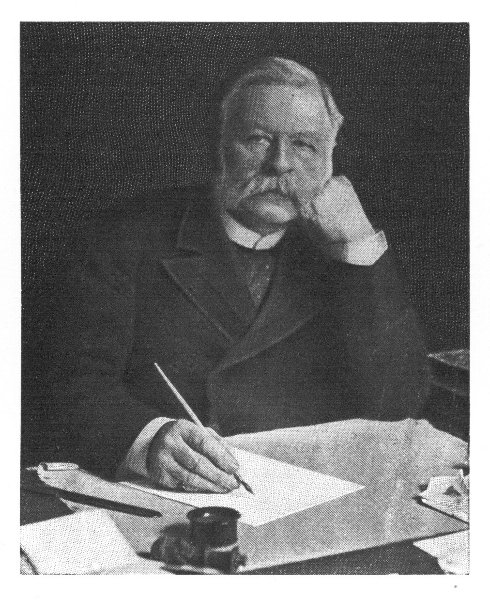
M. William Waddington From a copyright photograph by Russell & Son
W. had just time to get out of his dress clothes, and send back his order when Mathias appeared, and we went for a last tournée. First to the Church des Chevaliers, where all the Swedish Kings are buried, up and down some old streets where there are curious old houses, and wound up at the Museum. I only stayed there half an hour, saw some of the pictures and souvenirs of Charles IX, and then came home, leaving the others.
Now we have finished packing, I have on my travelling dress, and am seated quietly at the window with my book, Tolstoy's "La Guerre et la Paix," but I don't make much progress—I am always looking out. A big steam yacht has just come in—ran straight up the river alongside of the "Lancaster." About twenty little boats have immediately started out, going close up to the yacht, and they have sent off a steam launch, which has come up to the wharf in about five minutes.
Patenôtre and his secretary have come to say good-bye, and to say that all the orders are given for this evening, and we shall have our sleepings. I wonder if you have seen Pontécoulant. He said he would go at once to find you. He has been saving up all he heard about the Americans and their frock coats and grey trousers (when everyone else was covered with gold embroidery and orders) for you, and hopes to get a good rise out of you.
My next letter will be from Copenhagen—then Hamburg and home. The gentlemen have come in—found the Museum very interesting, and we shall dine in a few minutes, so this must stop and will go off from here by the evening courier.
To H. L. K.
Copenhagen, Wednesday, June 27th, 1883.
We arrived at one o'clock to-day, Dear, not tired at all, as our journey was easy. We had a capital waggon, a large sleeping carriage, a bed on each side, and a good toilette. We started punctually at 8.30, through fairly pretty country, nothing very picturesque, but a general impression of verdure. At 10.30 we stopped somewhere, had tea, and the man came and made the beds. I slept quite well. We took the steamer at Malmo, breakfasted on board, and enjoyed the crossing. The sea was beautiful and there were quantities of boats of all kinds. There was a thick fog for about half an hour, which was very uncomfortable, for we knew how many boats there were all around us, and as soon as our own whistle stopped, we heard many others unpleasantly near. However it lifted as we neared Copenhagen.
The approach is good, but not nearly so fine as Stockholm. There are no islands and the country all about is very flat. The quantity of boats of all kinds made it a very pretty sight. We found M. de Kergorlay, Chargé d'Affaires, waiting for us on the quai with a carriage, and drove at once to the hotel. We wanted a little time to change, read our letters (we found a quantity, two from you), which you may imagine I was glad to have. I am so glad the boy has kept well—I am getting very homesick for him now that our faces are turned homewards. M. de Kergorlay said he would come back at 4 and take us a drive. W. too found various letters and papers. We started again at 4 and had a beautiful drive to the "Deer Park" for some distance along the sea, with quantities of villas, casinos, cafés with music all the way. There were some very pretty carriages, officers riding, and every description of pleasure boat, big and small, on the sea. Just as we were leaving the sea and turning into the forest we met a big break, with the Prince Royal driving himself and his family. The carriage was full of children. He recognized of course Kergorlay, then W.—however they are all in the country. We shall have no visits nor audiences of any kind. I am rather sorry not to see the Prince. He was in Paris and dined with us the Exhibition year, when W. was at the Quai d'Orsay, and I found him most sympathetic, and very good-looking.
It was so pretty driving through the deer park. We had tea in one of the casinos, standing high over the sea, with a splendid view. We dined quietly at the hotel at a small table in the dining-room. We saw there General Appert and his family dining. They had come to Copenhagen to see their son, who is military attaché here (Madame Appert is a Dane), also Harry Whitehouse, who said they were in the country, but not far, and would certainly come in and see us. I have written a few notes since dinner, and W. has also sent one to be given early to-morrow morning to the Conservateur des Médailles at the Museum. The hotel is very comfortable, we have an enormous salon on the front, and good bedrooms. Adelaïde has fraternised with the Apperts' maid, and is delighted to have a compatriote to go about with. I was interrupted, as W. suggested we should go out and make a little turn in the streets while he smoked a cigar. The town is much less gay than Stockholm. All the houses are built of grey stone, and are high and narrow, rather like New York. There are a good many people in the streets and in the trams, of which there seem plenty.
Thursday, June 28th.
It is again a beautiful day, and at 10 o'clock W. and I started. I took Adelaïde, for I knew W. would be absorbed at once by the medals, and I didn't care to come home alone. We were received with much empressement by the Director. As I supposed, the Conservateur des Médailles carried off W. at once, and a sub. of some kind was deputed to show me the Historical Museum, which really is very interesting, costumes and interior groups of figures of the whole world. They say it is very exact, but what a work it must have been. We saw it very well and fairly quickly, as it wasn't a public day, and the young man only showed us what was worth seeing. We walked home. It wasn't far, and he explained the route to us. I really needed the exercise. The town is decidedly gloomy, even in the bright sunlight, and might be any Northern town anywhere.
I breakfasted alone at a small table in the dining-room, and had the big room almost to myself—two gentlemen were breakfasting at one end. Almost as soon as I got upstairs I had some visits. First Richard appeared, very pleased with his excursion, said it would have been a pity not to see the Falls, being so near; then came Col. Wyckham Hoffman and Whitehouse. Hoffman was much interested in hearing about the Coronation, as he was five years secretary in Russia and knew all the people. He and Mrs. Hoffman are at Elsinore for the summer and want us very much to come down and dine and stay over night, but I am afraid we can't. W. wants all his time here for the coins, and it would take quite a day to really see the place. Kergorlay came with a carriage at three, and he and I and Richard started again for the same drive. It seems all Copenhagen does it every afternoon. The sea looked enchanting, and I think there were more boats than yesterday—several big steamers, English bound they tell us—and such quantities of pleasure boats. We drove rather further into the forest, as we had more time. It is really very lovely—had tea in another casino with the same view of the sea. We met various private carriages with good horses, a certain number were breaks full of nurses and children; and some rather smart-looking officers well mounted. We didn't meet the Royal break again. It seems they are all (a big family party) at one of their châteaux near Copenhagen, and come into town very often. Kergorlay seems to like Copenhagen—not the climate, he says it is cold and foggy, there are days when one never sees the sun. It makes rather a gloomy impression on me. If I lived here I too would want to come every day to the Deer Park, which wouldn't be convenient perhaps for domestic arrangements.
The streets are curiously banal—I wonder why? Of course one didn't expect to find the colour and half-Eastern look of Moscow, nor the gay half "bains-de mer" impression of Stockholm, but I am disappointed. One thinks of Danes as descendants of the Vikings, heroes, enormous men with long limbs and yellow hair. Do you remember the poem we were so mad about in the days of our youth, "Word was brought to the Danish King that the love of his heart lay dying"? I can see Mrs. Lawrence sitting at the table, and reading it in her full rich voice. I don't remember now who wrote it, but I am sure you will—and Copenhagen looks singularly unpoetical and modern. We found W. on the balcony when we got back, with his papers and his cigar, just tired enough after a long day's work in the Museum to appreciate a quiet hour. It has been warm all day, and is still. We felt the difference as soon as we turned into the streets, and we haven't the river under our windows as we had at Stockholm, and always a breeze.
4 o'clock.
Richard and I are just back from an expedition to Tivoli—the great garden here. We dined quietly at home, and I tried to persuade W. to come with us to the garden, but he declined absolutely, so we left him talking and smoking with General Appert, and we two started off in a fiacre. We were rather pleased with ourselves and the way we got along in a strange place and a strange tongue. We even made out strawberries and cream—"med" and something else I forget now. I don't know which was strawberries and which was cream, but we got them, and med was evidently one or the other. The garden is very pretty, very well arranged, with every variety of entertainment. We sat and listened to the band (a very good one, military) while we had med and ——, and then went into one or two of the small theatres and concert halls. All this too was modern, might have been Paris or London. We saw one or two of our diplomatic friends disporting themselves at one of the theatres where there were "poses plastiques" very well done. I think they were "en garçon"—the pink flower hats they were alongside of didn't give me a family impression.
We rather enjoyed our evening lounging about. A fortune teller, a rather pretty girl, evidently wished to tell our fortunes, that we made out by signs and the cards she had spread out before her, but we didn't think our knowledge of the Danish tongue was sufficient to understand all she would tell us of a brilliant future. Richard is delightful to go about with. He likes to see everything and know about everything, and certainly succeeds in some curious way getting all the information he wants. W. was poring over his notes when we got back. We told him all our experiences, and then talked a little about our day to-morrow.
Friday, June 29th.
It has been frightfully hot all day. I stayed at home all the morning. W. and Richard went off early to the Museum. I had a visit from Kergorlay. He has an interesting face, is a widower, poor fellow, with four children, one boy of two and a half. They say he is so devoted to the children. I told him I should like to see them, and he will send them—at any rate we shall see them to-morrow night, as we dine at the Legation. Richard came back to breakfast. He said it was cool enough in the Museum, and we started off for the Thorwaldsen Gallery. Of course some of the statues and has reliefs are very fine, but they are enormous, almost more than life size. We went on to the Frauen Kirche to see his statues of the 12 Apostles which are there. They were strangely familiar. We must have seen them reproduced in plaster at home. Both St. Peter and St. John I knew quite well, and didn't like them much. While we were loitering about the church the suisse told us a wedding was just going to take place, it might perhaps amuse us to see it, so we stepped into one of the side aisles and saw the cortége. The bride was the regulation white-veiled figure, I think she had a green wreath (it may have been myrtle like the German brides), the man was in uniform. What was really interesting was the dress of the two pastors. They wore black coats with white ruffles, just as they did in Luther's time. That reconciled me a little to this very uninteresting town.
It was still very warm, but we did a little shopping, photographs and one or two trifles. Richard leaves to-night at 7.30, and we shall dine early with him. He is to stop a day or two with Mary at Meiningen, pick up his mother who is there, and bring her back to France. Mary wanted us to come, and I wish we could have managed it. It would have been nice to have been there all together, and they would have enjoyed hearing all our impressions while they were so absolutely fresh, particularly Charles, who leads a very quiet life now ever since his accident at the Quai d'Orsay. It is extraordinary how the last thing seen remains in one's memory. Already Moscow and that splendid pageant is fading a little, and I see Stockholm, and the green islands, and the dancing river.
Saturday, June 30th.
It is still frightfully hot—not a breath of air. I have made as much of a draught as I can by opening the door into the passage. It isn't very convenient, as we are just at the head of the big staircase, but I have put a high-backed arm-chair between me and the passers by. It was really very warm until 11 o'clock last night. We dined downstairs with Richard, and were very sorry to see him go. Then we went to Mrs. Baldwin (the Admiral had gone off for two days) to ask her if she would drive with us. We made the usual turn, the only variety being our tea place—we take a new one every time. The gérant of the hotel explains to the coachman where to go, and he chooses very well. It was lovely driving, and so cool on the top of the cliff that we walked about a little after tea. There is always a long, clear evening, not like Russia, but still very pleasant and pretty, such a soft light over everything. The moment we turned away from the sea back into the town we felt the difference, but the long drive had cooled us. I have asked for my breakfast upstairs in the salon. I really can't dress and sit in that hot room in this weather. W. is at the Museum, but comes back at 4 with the Director, who is to show us some of the treasures of the town. I am getting on very well here with "La Guerre et la Paix," as I am not distracted all the time as I was at Stockholm. I think you would like it, the Russian side of Napoleon's great campaign is so interesting, also the pictures of the society of Moscow at that time, which they say is extremely well done.
W. came in about 4, not very warm, as he says the rooms of the Museum are cool, with such thick walls, and while we were waiting for Monsieur Warsoe, the Directeur, Mr. Vivian, English Minister, paid us a visit. He is very anxious we should come and see them at Elsinore, says it is most interesting (all memories of Hamlet). I should like it extremely, but W. thinks we must get home. I liked Vivian very much. He talked very easily about everything—he is going to dine with us at Kergorlay's, says all the colleagues are most anxious to hear about the Coronation. M. Warsoe appeared about 4.30 and we drove at once to Rosenburg, an old château where there is a fine collection of all sorts of things. Some of the Danish porcelain was lovely, also some fine tapestries. They showed us with much pride their trésor, jewels, and gold and silver services, but really after Moscow and the quantities of gold, silver, enamel, crowns, and jewels of all sorts that one had seen the others made no effect, though of course there were some handsome stones, rubies. What I did like was the 4 lions (couchant) of massive silver, which are always put at each side of the throne whenever there is a great ceremony at Court. They must look splendid.
We went again to the Frauen Kirche, as W. had not seen it, and the second time I liked the Apostles better, a little better. I think it was too hot, and I was too tired when I was there before. We drove out to an old bridge, which was curious, and in some old street where I had never penetrated. The trams worry me, they are so frightfully civilized and up-to-date, however they were crowded, so evidently the Danes are not of my way of thinking.
Our dinner at Kergorlay's was very pleasant and handsome. Adelaïde was again frightfully put out at my garment, and she is right, it is really a street dress, and this time there are several women. I don't know why I didn't keep out one evening dress. It was rather stupid to send everything back. However, I made my excuses to the ladies, and said I was "en touriste." They were all very élégantes, though they were all already settled in the country, and went off about 10 o'clock by the last train. Kergorlay's children came in before dinner. The eldest girl is 10, and the baby two and a half. It was so pathetic to see them in their white dresses and black sashes and to think whom the mourning was for. The dinner was very gay. We had Count and Countess Toll (he is Russian Minister here, and a brother of Countess Pahlen), Marochetti (Italian Minister) and his wife (a Frenchwoman, née Grandval), Vivian (she didn't come, was in the country and rather exhausted with the great heat), General and Madame Appert, and two secretaries. Count Toll was very keen to hear all about Moscow, and what we thought of the great show (he speaks English quite well). I told him we were enchanted, and that one of the great features was Comte Pahlen with his velvet coat and white staff of office with a big sapphire at the top. He certainly took no end of trouble, and looked his part very well. They all seem to like Copenhagen pretty well, except for the climate, which seems most trying. Countess Toll was in white with handsome pearls. I felt rather like a pensionnaire in my simple little dress—foolish, too; I ought to have known better.
We got home quite early, so I can still have a little Tolstoy before I go to bed. Adelaïde instantly inquired what the other ladies had on and was much put out. "C'était Madame l'Ambassadrice qui était le plus mal"—"oh! cela oui, et de beaucoup." I suppose it reflects upon the femme de chambre when the mistress is not up to the mark.
Sunday, July 1st.
It is still frightfully hot. I did not go out all morning, though they sent a notice of services at the English Church. We shall leave to-morrow night for Hamburg. W. says two days more of medals will give him all he wants. After breakfast I went to see Mrs. Baldwin, whom I found gasping, sitting with open doors and windows; also Madame Appert, who looked quite cool and comfortable, as did her two daughters, pretty girls; however, they said they didn't feel cool. When I got back to our rooms I found several cards, and then Mrs. Hoffman appeared. She was very nice and friendly, sent all sorts of messages to you and Anne, and wished Anne would come and stay with her at Elsinore. She likes Copenhagen very much, says the people are friendly and hospitable and invite the diplomats; also that some of the country places are very fine, quite in the English style. She made a great appeal to me to come to Elsinore with her this afternoon, I could come back to-morrow in plenty of time for the night train, but I couldn't manage. W. was still at the Museum, and would have been in a great state of mind if he had come home and found not me but a note saying I had departed for Elsinore. While she was still here, young Moltke appeared, our compagnon de voyage from Helsingfors to Stockholm. He hopes to be sent to Paris or London. I told him if it was Paris he must look us up. He is a very nice young fellow, very good-looking, tall, and fair.
We have had our usual drive. We dined at 5 and started out rather earlier. If possible there were more people than we had ever seen before, as it was Sunday and fête. All Copenhagen, high and low, were on their way to the Deer Park. A stream of conveyances of all descriptions, some peasants' carts with straw at the bottom filled with women and children, everybody in a good humour. There were fewer officers riding, and fewer big boats on the sea, but endless little pleasure yachts. As we came back it was really a pretty sight, all the cafés, casinos, etc., brilliantly lighted, all the villas, too, and people sitting on the verandas, some playing cards, some at tea tables, some walking about in the gardens, we could see the light dresses fluttering about in the shrubberies; animation, laughter, voices, music everywhere. We stopped as usual for tea at one of the high casinos—the sea blue and calm at our feet some distance down, and the whole summer out-door life of Copenhagen behind in the woods and hills. It was delicious driving back, and even the streets were pretty to-night, so many people, and the cool air such a relief after the terrible heat of the day. We have decided to start at 8.30 to-morrow evening.
I tried to glean some information from a Danish paper this afternoon. Col. Hoffman told me that if one knew English or German one could read Danish quite well, giving oneself a little trouble, but I can't say that was my experience. It might have been Hebrew for all I made out. I suppose I didn't keep at it long enough. It doesn't sound easy when one hears the language spoken all about one, rather harsh. I mastered a little Swedish (to understand it) much more easily.
To H. L. K.
Copenhagen, Monday, July 2d, 1883.
The heat is something awful to-day,—I think the worst day we have had. I was up early, as the salon is cooler than the bedroom, more doors and windows. W. is off to his medals until 5, and we leave to-night for Hamburg. The trunks are made (almost for the last time), as we shall stay only one night in Hamburg, and arrive in Paris Thursday morning. I had a nice visit from Kergorlay. He can't come to the station to see us off, as he dines with the King in the country, but will send his chancelier to see about places, luggage, etc. We talked a great deal about his children. He feels such a responsibility, and it is hard for a man to have such a young family to look after. He said their mother was so devoted to them—it seems hard she couldn't have been left to them a little longer.
I breakfasted downstairs, had a little talk with the Apperts, and then went to the reading-room for a little while to see if there was any news. The Comte de Chambord is very ill, dying they say. I wonder if his death will make any difference now—I suppose not. He has been only a memory practically all these years, as he never came to France, and only a few, a very few fidèles clung to him in his exile. I must say I rather admired him always. According to his lights (limited I grant), he was absolutely consistent.
I had another visit from Col. Hoffman, who came to see if we were really going to-night. We have a despatch from Richard saying that we will have much difficulty in getting into any hotel in Hamburg—the town is very full. There are races going on, also a scientific congress of some kind—however, the proprietor of this hotel says it is all right, they will keep us rooms. W. came in at 5, having been working steadily since 9.30 this morning. He took a cordial leave of the various Conservateurs and Directors, but thinks they were not sorry to see him go, and take up their quiet life, two or three hours a day in the cabinet instead of 6 or 7.
My next letter will be from Hamburg—and after that I will tell all I have seen and done, which will be much easier than writing.
Railway Station, Kiel, 7 A.M., Tuesday, July 3d.
We have two hours to wait here, so I will scribble a line to you, which will help to pass the time. We got off very early last night. Some of the young men from the Legation were waiting at the station with a servant to help us with our baggage. It really was not necessary, as we have only two trunks, and the porter of the hotel is most helpful and energetic. It was very warm even at that hour, and the compartment was stuffy, a good many passengers. We got to Korsoe about 11. The boat was directly opposite the station, and we went on board at once. There was some delay getting the baggage on board, so we sat quietly on deck and had our tea, and cooled off. The cabin felt so hot when I went down to leave my things that I couldn't make up my mind to install myself, particularly as the crossing (the Belt) was short, about 5 hours. The Captain said we should arrive between 4 and 5 at Kiel. We stayed on deck till nearly one o'clock. It was a lovely night, the sea quite calm, but a good breeze once outside, which freshened considerably as we drew away from the land.
I went down about one, but didn't get much sleep, and was quite ready to go up on deck when they called me at 4.30, and said we were approaching Kiel. Almost all the passengers were on deck. The approach is not particularly interesting. I heard two gentlemen discussing us in English. They had seen our trunks all labelled Waddington, Couronnement, had taken renseignements from the Captain, who assured them W. was the French Ambassador. They thought he must be mistaken. "That man is an Englishman—he is speaking English now to the lady—I have heard them talking always in English. They certainly are not French." They hovered about us, and then looked rather bewildered, for Adelaïde came up to ask me something, and then W. and I finished our talk in French. We speak sometimes French, sometimes English, it depends upon our milieu.
The harbour is fine as one gets up to it. How hard for the Danes to give it up, and how they must hate the Germans. We got off about 5.30. The city was still wrapped in sleep. We walked about a little, and it was a curious sensation to walk about in apparently a dead town. We had some breakfast at the station, and have been out again. Then (7 o'clock) the town was quite lively, workmen moving about. We shall start in about a quarter of an hour, and have about two hours and a half to Hamburg. The long wait here has been tiresome, nearly three hours. The movement on the water and the quais was amusing, but really until after 7 not a soul was stirring, at least not in this quarter, and no trains coming or going.
To H. L. K.
Hamburg, Tuesday, July 3d, 1883.
No words can tell, Dear, how uncomfortable we are, hot and cross. We arrived at 11, after a very hot, dusty journey. The town is crammed, even at this hotel where they had kept rooms for us (and such nasty little rooms, a small salon, giving on the street it is true, so that we can see all that goes on, and two minute bedrooms on one side) we can't get our trunks, nor apparently our breakfast. The hotel people are quite affolés. There are races (with a German Prince of some kind either presiding or running horses, I can't make out which), "a horticultural show, a cattle fair, (and an anniversary of something)."
We said we would take a carriage this afternoon and drive about the city, and we might just as well have asked for a balloon—nothing to be had before 7 o'clock. I should think every carriage in Hamburg was out—quantities of all kinds and large omnibuses are passing under the windows, filled with women in light dresses, and a generally festive appearance. They hope to give us one then.
We have had breakfast—the dining-room large, fairly cool, and empty (as it was late everyone had breakfasted and flown). They brought us the Figaro. The Comte de Chambord is dead, and the Comte de Paris starting for the funeral. Just as we had got upstairs again the man of the hotel came and asked if Madame l'Ambassadrice de France would receive Madame l'Ambassadrice de France. We were rather puzzled, but said of course we would receive anyone who came, and in walked M. et Mdme. de Courcel, and M. de Pina, our Consul here, M. de Sancy, the military attaché at Berlin. We were delighted to see them. The Courcels had been paying a visit to the Duke of Sagan in his splendid place, and, being not far from Hamburg, had come on to see the town. They were going to the races with M. de Pina, and wanted us to come, but we didn't care to (and indeed I don't know how we should have gone, as they had a small carriage which just held them, and we had none). M. de Pina asked us to dine with the Courcels at 8.30, and that we were very glad to do, as the prospect of a dinner in the big dining-room, with all the crowd of hungry people back from the various festivities, was not alluring. Pina told us as we couldn't get a carriage we had better take one of the small steamers that ply about in the inner harbour, and have an hour's sail. He was sure we would find it pretty and interesting. It would certainly be cooler than sitting in that stuffy little salon.