Part 2 — L'EDUCATION À LA MODE
Reading edition
PAR BERQUIN
MADAME VERTEUIL Mlle. Béatrice de Bunsen
MADAME BEAUMONT Mlle. de Langhe
LÉONORA, sa nièce Lady Mary Pepys
DIDIER, son neveu M. DUPAS, Maître de danse M. Francis Waddington
TRUETTE, soubrette Mlle. Cameron
I was very proud of my little troupe. Béatrice looked very well and stately in powder, black satin, and lace. Mile. de Langhe and Daisy very well got up, and the two children charming. Lady Mary Pepys was too sweet, and they danced their minuet perfectly. There were roars of laughter when Francis appeared as "Maître de Danse" with a white wig and his violin. The children were not at all shy, enjoyed themselves immensely. B. was a little "émue" at first when she saw how many people there were, but it didn't last and she was excellent, so perfectly correct, and unfrivolous, and boring. Francis said his little poetry, "Le bon Gîte" of Déroulède, quite prettily. W. was rather surprised and quite pleased, and Thénard beamed, as she had coached him. She recites some of those "Chants du Soldat" of Déroulède's divinely. It is a perfect treat to hear her recite in her beautiful rich voice "Le Petit Clairon," also "La Fiancée du Timbalier," with an accompaniment of soft music.
All the children (as we had invited Francis's young friends to see the performance) had tea together afterward, and they wound up with a dance. The men of the Embassy were much pleased, particularly Jusserand, who is rather "difficile." They complimented B. very much; said she spoke so distinctly and with very little accent. It was rather trying for her to play before all the Embassy and an ex-member of the Comédie Française. Francis's blue velvet coat and lace ruffles were very becoming to him. Wolff told him how to hold his violin, I wish you could have seen it. It was much prettier than the original little play at Bourneville, when we executed as well as we could a menuet.
We had a very select public, among others Wyndham of the Criterion, who is an interesting man and a charming actor. When you come over I will take you to see his David Garrick, which I consider a perfect bit of acting. I wrote and asked him to "assister aux débuts d'un jeune collaborateur." The funny formal old-fashioned Berquin phrases amused him. He knows French well.
London, August.
We have decided to go to Scotland with Sir Roderick Cameron and his family, and are starting in a day or two. London is dull and empty, has suddenly become a deserted city. Even the shops are empty, and the Park a wilderness. All our colleagues have gone. I think W. is the only Ambassador in London, and he wants to get off to France and have a few days on the Aisne before he goes to the Conseil Général. We means Francis and me for Scotland.
To H. L. K.
Inveraylort, August 17, 1888.
I will try and give you an account of our journey, Dear. We arrived in this most lovely place for late dinner yesterday, and went almost at once to bed, having begun our day at 7 o'clock. We left London Tuesday morning by the Flying Scotchman, and a tremendous pace we came. There were quantities of people at the station, all going apparently by our train—children, dogs, guns, fishing rods, provision baskets, tall footmen racing after distracted French maids, and piles of luggage. We had our saloon carriage reserved (as we were a fair party—C., the four girls, Duncan, a friend Miss W., Francis and I and two or three maids). We had also a fair amount of baskets, shawls, cushions, etc. It was a lovely morning, not too warm, and I think W., who came down to the station to see us off, was half sorry he was not going too.
We stopped for luncheon at York, and got to Edinburgh at 6.30. The pace was frightful, but we went so smoothly that one hardly realised the speed. We went straight to the hotel to see our rooms and order dinner, and then went out for a walk. The streets were crowded; omnibuses and cabs with luggage in every direction. The old town and castle looked most picturesque in the soft summer light. Daisy and I went out again after dinner, and after loitering a little near the hotel we saw a tramcar, asked where it went, and mounted on the top, telling the man we would go as far as we could, and then come back. It was a beautiful moonlight night, and we were very cool and comfortable perched on the top of the car. When the man came to get the money for the places I discovered that I had no change—merely a sovereign. The old gentleman, a tall, white-bearded Scotchman, grumbled a good deal, and made various uncomplimentary remarks to himself in a low tone. However after some little time he appeared with a handful of silver. I took the money mechanically and began to stuff it into my portemonnaie, as he looked at me severely and said—"First count your money to see that it is right, and then give me what you owe for your places."
We were up early the next morning—breakfasted at 9 o'clock as we wanted to see a little of Edinburgh before starting for Oban at 12 o'clock. It was an enchanting morning, not too warm, and we went first to the Castle. There is not much to see inside—always a beautiful view of sea and hills. There is a chapel and some old rooms which various Kings and Queens of Scotland have inhabited at various times. A company of Highlanders in Cameron plaids were being exercised in the courtyard, and a fine stalwart set of men they were.
From there we drove through some of the old streets (Cannongate, etc.) to Holyrood, which was most interesting. The children of course were most anxious to see the spot where Rizzio was murdered, and the blood-stains on the floor, but they have disappeared years ago. We were delighted with the pictures. There are quantities of course of Mary, Queen of Scots—one large portrait with that beautiful, sad Stuart face—as if they all foresaw their destinies. I had forgotten how small and low the rooms are. In these luxurious days no ordinary lady would be satisfied with Queen Mary's bedroom and boudoir; and the servants, accustomed to be quite as comfortable as their masters, would give warning at once. We drove straight from the Palace to the station, where our carriage was waiting for us. All our wraps, cushions, etc., neatly arranged; and started for Oban, a most lovely journey, particularly all about Loch Awe. We got to Oban about 7, and I shall often think of that lovely evening. The harbour filled with yachts and sail-boats of all kinds—the water blue and dancing, and the g most divine soft pink lights on the hills, a little like what we used to love at Capri and Ischia—quite beautiful. Daisy and I did some shopping before dinner—bought clean collars for the children, who were decidedly the worse for the two days' journey, and we also interviewed the well-known Ewan at the tartan shop with a view to kilted skirts. D. found their tartan at once of course as there are so many Camerons—ours was rather more difficult as there are few Chisholms left (my Mother-in-law was born Chisholm) and the authorities in London told us we could certainly wear the family plaid. The shop people promised to get it for me. The man was much interested in the skirt for Miss W. Being an American there was no family tartan to be looked up, and she couldn't quite make up her mind. However he came to the rescue, telling her that "all the American ladies take the Royal Stuart, Miss." We had an excellent dinner at the very small hotel where we were obliged to go—all the swell hotels were full—and there are quantities of people in the streets, and boats coming and going from the yachts. The Englishwomen all look so nice in their yachting dresses, almost all of dark blue serge and a sailor hat or regular yachting cap. The cap is rather trying, but the young and pretty women look charming in it. Some of the trippers and their ladies are wonderful to behold. We stood near a couple who were just starting for Skye on one of the steamers. The man was in a wonderful checked suit, and the lady in a brilliant red and green tartan (not unlike the Chisholm), on her head was a Scotch stalking cap, which was not becoming to a red, round face. However she was satisfied and so was her companion, who looked at her most admiringly, saying—"I say, you are fetching in that cap." "Il y en a pour tous les goûts." When we got back to the hotel we found that Sir R. had quite changed our "itinéraire." He had seen the boat, a fine large one which made the outside passage to Arishaig, so instead of taking the Caledonian Canal and landing at Fort William where carriages and carts were ordered for us, he decided that we should go by sea, and take our chance of finding some means of transport. He did, however, send a telegram to Arishaig, as the hotel man told him he would never find any conveyance for such a large party.
We started at 9 o'clock, and the sail was enchanting. About 12 we ran rather close to a small headland, and the Captain told us we had arrived. Apparently we were in broad Atlantic with a rocky shore in the distance—however a boat appeared, one of those broad, flat boats which one sees all over in Scotland. Our disembarkation was difficult as we were 11 people with quantities of trunks and parcels. Happily the sea was quite smooth. All the passengers were wildly interested in the operation and crowded to the side of the steamer. When all the party had finally got off with trunks, bags, a bird in a cage, and a kitten in a basket, one of the passengers remarked—"They only need a pony in that boat, to make the party complete."
To say we found a landing-place would be absolute fiction. As we neared the shore we saw a quantity of black, slippery rocks, and on these we landed, the boatmen holding the boat as near as they could, and we climbing, and slipping, and struggling to get on shore. Our baggage was dumped on the rocks and there we were—not a habitation or a creature in sight. At last we found a sort of house behind a mass of rocks, and saw several carriages in the distance which we supposed were for us. Not at all! Sir R.'s telegram had not been received and those were carriages waiting for a "Corps" which was being conveyed across on a yacht. We tried to persuade them to take some of us at any rate, and at last with great difficulty one carriage was given to us. The negotiations were extremely difficult, as nobody spoke anything but Gaelic, except an old woman, and she was so cross and apparently so suspicious of the whole party that we got on better by signs and a few extra shillings. Sir R. and the maids walked (4 miles through lovely country) and we all finally arrived at the little fishing village of Arishaig, where there is a good inn. It is a little place, three or four fishermen's cottages, a post-office, and two churches, a large Roman Catholic Cathedral and a small Established Church. We had a good lunch and started at 3.30, getting here at 5.30. Such a beautiful drive—all blue sky, and heather almost as blue—and great grey mountains. We walked up two very steep hills, but had such glorious views at the top that we didn't mind the climb.
This place is charming—the house fairly large. It stands low on the lake or arm of the sea, and has pine woods and high mountains behind. It is absolutely lonely—no houses near, except one or two (agent's and farmer's) that belong to the estate. The country is lovely, wild and picturesque, but it would be a terrible place to be in except with a large party. There is nothing nearer than 10 miles, and no real village or settlement for 25. We are about half way between Fort William and Arishaig (each 20 or 25 miles away). I think all our provisions come from Fort William. A stage passes twice a day, morning and evening. Our baggage arrived at 10.30, and we were all glad to go to bed, as we had begun our day early. It is so still to-night—I am writing in my room—the lake looks beautiful in the moonlight, and there is not a sound.
Inveraylort, Sunday, August 19th.
We have settled down most comfortably in the house, which is fairly large, but we are never indoors except to eat and sleep. We had a lovely drive yesterday all through this property, and to a neighbour's where there is a pillar to show where Prince Charlie landed. There are many Roman Catholics in these parts, which accounts for the large church in the little fishing village of Arishaig.
This morning we had a service in the "Wash-house"—a red-headed Scotch peasant was the "Minister." It was a curious sort of independent service, impromptu prayers, and a long sermon. The congregation consisted of ourselves and the household. Miss Cameron, the owner of this place, who is staying at her agent's cottage on the place, some friends of hers, and the people of the little inn where the daily coach from Fort William stops for rest and luncheon. There are no other habitations of any kind except a few crofters' cottages across the lake. After luncheon we went for a long walk along the stream where there are plenty of fish, and came home over the hills. They are blue and deep purple, with heather, and there are divine views in every direction.
Thursday, August 22d.
It is again a beautiful day. We intended to row down to see some friends of Sir R.'s about 5 or 6 miles off at the mouth of the lake, where it runs into the sea, but there is some trouble about the boats. Our "propriétaire," Miss C., seems to have singular ideas as to the respective rights of owners and tenants. It was so fine and cool that we decided to walk, and the B.'s promised to send us back in their boat. It was long, but the path was not too steep all along the lake, and we arrived not too exhausted. They gave us tea, showed us the house and garden, and we started back about 9. The row home was enchanting, but weird—not a thing to be seen of any kind, except seals, which came up close to the boat. I had never seen one near, and thought at first they were dogs and was so surprised to see so many swimming about; not a sound except the splash of our oars in the water when we turned our backs to the sea, the heather-covered mountains shutting us in on all sides. It was quite wild and beautiful, but a solitude that would be appalling if one lived altogether in the country.
Inveraylort, August 27th.
After all they are not going to stay the month, Sir R. and his proprietor can't come to terms, and I think they will probably take a yacht and cruise about a little. The lake is decidedly rough this morning, but still we thought we must row across to some crofters' cottages. They told us they were of the poorest description, and we wanted to see what their life and houses were. Most wretched little houses (our horses much better off in their stables), generally one room, sometimes two; no floor, merely the earth trodden hard, and covered with straw. To-day it had been raining; there were puddles in the corners and the straw was decidedly damp. A peat fire was burning, and the only opening (no window) was a hole in the thatched roof, which lets the smoke out and the rain in. An old woman was spinning and an old man was sitting in the corner mending a fishing net. They were tall, gaunt figures—might be any age. They spoke nothing but Gaelic, but soon a young woman appeared on the scene who knew English. She looked as old as her mother, but had a keen, sharp face. I was rather interested in the spinning-wheel, so the two women suggested that I should try; but I could do nothing. Either I went too fast and broke the yarn, or else the wheel remained absolutely motionless. I bought some yarn, as I had broken various bits, and then we started home, carrying away an impression of wretched poverty and hard lives of toil, with little to lighten the burden.
Oban, August 29th.
We are back here after a most eventful journey from Inveraylort. We started in the rain, the mist closing round us and blotting out the whole landscape. We had two carriages, but the pony cart came to grief, and the two girls and Francis were thrown out. Miss W. had an ugly cut on her face, but poor N. was lying on the ground, pale and suffering, convinced that her arm was broken. When we got up to them we took her into the waggonette and got on as quickly as we could to Caupar, our destination, where we had been told of a wonderful bone-setter who was well known in all these parts. He saw at once what was wrong—her shoulder was dislocated, and said she must not continue the journey, so we left her there with her sister and brother, and we came on here. They all appeared this afternoon—N. with her arm in a sling and looking fairly well. She said the man set it so quickly and gently she hardly had time to feel any pain.
Oban, September 3d.
We had a beautiful day yesterday for our excursion to Staffa and Iona. The sea was perfectly calm, and the lights and shades on the mountains enchanting. It was a lovely sail; sometimes we ran into little shaded harbours with two or three cottages and a hotel perched high up on the top of a mountain, and sometimes passed so close to land under the great cliffs that one could throw a stone on the shore. The islands are most interesting, with their old churches and their curious stone crosses, and there were not too many people on the boat. The return was delicious as we sat on deck, watching all the colours fade away from sea and hills.
We leave to-morrow for London and Paris, and I am very sorry to go. We have enjoyed our three weeks immensely. The country is so beautiful, and then it was a great pleasure to be with some of my own people; we have been away so long that the family ties get weaker. Francis was quite happy with some cousins to run about with.
To G. K. S.
Albert Gate, May 21, 1889.
I got back from Paris last night, rather sorry to come. The weather was enchanting, warm and bright, and, of course, quantities of people for the Exhibition. It isn't half ready yet, but is most interesting—so much to see. I dined and breakfasted there several times at the various restaurants—one evening with the Walter Burns and a party, and we went afterward to see the "fontaines lumineuses," which are really fairy-like; but such a crowd. I also heard the two American prima donnas—Miss Eames, who is very handsome, has a fresh, young voice, and is an ideal Juliette. She is a vision really in her bridal dress as Juliette. Miss Sanderson is also very handsome, but in quite a different style. Her voice is very high and true; she was singing "Esclarmonde" at the Opéra Comique. Massenet has taught her everything. I have found quantities of invitations here, in fact was obliged to come over, as we have a big dinner the day after to-morrow, and the Court ball.
Tuesday, May 28, 1889.
We had our first encounter with Boulanger this morning. W. and I were walking our horses down the Row when we met three gentlemen cantering toward us. As they passed we heard they were speaking French, but didn't pay any particular attention. I merely said, "I wonder who those men are," one so rarely hears French spoken in the Row. A few minutes later we met Lord Charles Beresford, who took a little turn with us, and said to W., "The other distinguished Frenchman is also in the Row,"—then we divined. A few moments afterward (the Row is so small one crosses people all the time) we met them again, Boulanger in the middle riding his famous black horse—a man on each side riding good horses, chestnuts. They all wore top-hats, which no Englishmen do now in the morning. The men all wear low hats, the women also, and covert coats, the girls cotton blouses; not at all the correct style we used to admire as children in Punch when those beautiful women of Leech's riding in the Park filled our childish hearts with envy. I was rather curious as to what would happen, as W. knows Boulanger slightly, and went to him when he was Minister of War about something concerning the military attaché; however, there was no difficulty, as Boulanger was apparently too engrossed in conversation with his companions to notice anyone. I wonder if we shall meet him anywhere? They tell us that some of the society people mean to invite him, but I suppose they will scarcely ask us together.
Thursday, May 30th.
Yesterday was the last Drawing-room of this season. I rather feel as if it were my last in London, but one never knows. We (Corps Diplomatique) were still all in black, the English in colours. It was long and tiring. We dined at Lord Sudeley's—I rather wishing I had no engagement. I am always tired after those hours of standing, and the diadem is heavy, and the train, too, held over one's arm; however, I was quite repaid, as I had a charming neighbour. I didn't know at all who he was, as they rarely introduce in England, so we embarked on one of those banal, inane conversations one has with a stranger of whom one knows nothing, and were talking on smoothly about nothing at all, when he remarked, casually, "I suppose you never go to church." This I at once resented vehemently, so he explained that he didn't know, as I was a Frenchwoman, probably a Catholic (as if they didn't go to church), etc. He turned out to be Canon Rogers, a charming, intelligent, well-known man, most independent in his words and actions. He is rector of St. Botolph's, a church in Bishopsgate, the most disreputable part of London. We became great friends, and he asked me if I would go and lunch with him one Sunday, and he would show me Petticoat Lane. I agreed of course, and we decided for next Sunday. He said he had never had a French lady and an Ambassadress as a guest, and didn't quite know what to do. Should he ask the Prince of Wales and order champagne? I told him my tastes were very simple, and if I might bring my cousin Hilda, and one of the Secretaries, I should be quite happy—also I liked apple-pie, which he says his cook makes very well. I haven't had such a pleasant dinner for a long time.
Monday, June 3d.
We made our expedition to Bishopsgate yesterday, and most interesting it was. I went with Hilda and M. Lecomte, one of the secretaries, who knows English, and is very keen to see anything a little out of the way. We had a long drive to the church through the city, and arrived only to hear the end of Canon Rogers' sermon, which was strong and practical. As soon as the service was over we went down to the door and found him and his curate waiting for us. The first thing he did was to send away my carriage, which had already attracted much attention with the tall footman, velvet breeches, cockades, etc. He said he would never venture into Petticoat Lane in such an equipage, and would we please share his modest conveyance; so Hilda and I got into his victoria, and Lecomte and the curate walked close to the carriage behind. We had two policemen in front, two behind, and a detective. I rather demurred to such a display of municipal strength on my account, but he said it was necessary, he much preferred having them, he was afraid people would crowd around us and insist upon my buying something. The street was narrow, crowded with people, as there was also a fair going on and everything imaginable being sold (it is the one place in London where you can buy one shoe or one stocking!). The people were almost all Jews, and I must say they were a bad-looking lot, frightfully rough specimens. Some of the women, girls too, with such sullen, scowling faces. We went at a foot's pace (the only carriage), and hadn't the slightest difficulty in making our way. Everyone knew Mr. Rogers and spoke to him—"Good morning, Governor," "God bless you, Sir." Two or three children ran up to him, one a pretty little dark-eyed girl breathless to tell him she was in church, though she came late. He was so nice to them all, called them all by name, patted the children on the head, and exhorted some of the women to keep their husbands out of the drinking shops, and to wash their children's faces. They say he does an immense amount of good down there, but it must be uphill work. I have rarely seen such a forbidding looking set of people. Some of the women came up rather close to the low victoria and made comments on our garments. (We had dressed very simply at his request. I wore my blue foulard and a blue straw bonnet with iris on it. Hilda was in light grey with a black hat.) "You have got a beautiful bonnet, my lady. Oh, look at her umbrell!" The "umbrell" excited much attention. I couldn't think why at first, as it was also rather dark and plain; when I remembered that it had a watch in the handle upon which, of course, all eyes were fixed. I think the detective kept his eye upon it too, as he came up rather close on my side. The detective took Lecomte to a famous jeweller's shop near in Whitechapel, where there had been a murder some days ago. We drove all through the fair surrounded by these villainous faces (here and there a pretty, fair, innocent, childish face) and I wasn't sorry to get back to civilisation and the rectory, though I am very glad to have seen it. The rectory is a large old-fashioned house in Devonshire Square, shut in with high houses and high trees, and never, I should think, could a ray of sunshine get anywhere near it. One felt miles away from London and life of any kind. It was a curious contrast to the turbulent, noisy, seething crowd we had just left. We had a charming breakfast, Mr. Rogers talking all the time delightfully, so original and so earnest, convinced that everyone in their small circle could do so much to help, not only the poor but the really bad, if only by example and a little sympathy; he says no one ever helps the bad ones, only the deserving poor get looked after.
About 3.30 we started again to see the People's Palace, which he takes great interest in, and hopes he may succeed in keeping the men away from the drinking shops in the evening. It looked comfortable and practical, the reading-room particularly, which is large and airy, with all sorts of morning and evening papers (some foreign ones), illustrated papers, and good, standard books. The librarian told me that Walter Scott was always asked for, also some American books, particularly Indian stories, and travels of all kinds. I was rather interested in hearing that, as whenever W. gives books to a school library, or prizes in France, Walter Scott or Fenimore Cooper are still the favourites (translated, of course. I read the "Last of the Mohicans" in French, and it was very well done). There were not many people, but Mr. Rogers says on a fine, warm Sunday they all prefer to be in the open air. There is also a large swimming bath, given by Lord Rosebery. We parted from our host at the door, having had a delightful afternoon. It is a long time since I have heard anyone talk who interested me so much.
The drive home along the Embankment was nice—quantities of people out, quite like a Sunday in France. We dined quietly at home. W. was much interested in my day. I think if he had known exactly where I was going, and that an escort of police was necessary, he wouldn't have agreed to the expedition.
To H. L. K.
Thursday, June 4, 1889.
The Court Ball was brilliant last night. The Prince opened the ball with Princess Louise, and the Princess with Lord Fife. The engagement of Princess Louise of Wales to Lord Fife is just announced, and has of course created quite a sensation. Of course there are two currents of opinion—the old-fashioned people are rather shocked at the idea of a Royal Princess marrying a subject; but I fancy the entourage of the Prince and Princess of Wales are pleased,—and Fife is a general favourite. It is not very easy for the English princesses to marry. They must marry Protestants, and there are not many Protestant princes who are not near relations.
I talked a little to the Shah, but I didn't find that very amusing. He knows very little English or French, and has a most disagreeable way of looking hard at one. He planted himself directly in front of me, very close, and said "he thought he had seen me before," which of course he had, in Paris.
It seems that one of the Princesses pointed out to him, in the supper-room, a lady neither very young nor very beautiful, who was covered with splendid jewels, thinking they might interest him. He stopped short in front of her—then turned his back at once, saying "monstre." They say he finds no woman handsome who has passed twenty.
Tuesday, July 2d.
It was a splendid summer day yesterday, ideal, for the Shah's arrival by water. We drove down to the Speaker's to see him come. The streets were lined with troops, and there were quantities of people about. They let us drive through the Mall and to Westminster between the lines of soldiers (all the traffic was stopped). Almost all the houses and balconies on the way were draped with red, and crowded with women in their light, gay summer dresses. There were a good many people at the Speaker's, who gave us some tea and strawberries. The Royal Barge arrived very punctually. It was not very beautiful—an ordinary river steamer, painted light grey, with gold lines, and fitted up with palms, red cushions, and carpets, etc. The Thames was a pretty sight, such quantities of boats of all kinds. We saw everything quite well. There was a fair procession of state carriages, and an escort of Life Guards; but what a barbarian the Shah looks, with his embroidered coat and his big jewels, and his coarse, bad face—however he was smiling, and seemed pleased with his reception.
We waited to let the crowd disperse a little, and then came home the same way through Constitution Hill. We met the Prince and Princess coming back from Buckingham Palace. Both looked very well—he in uniform, and she in white, extraordinarily young in face and figure. The two princes, Eddy and George, were with them, and they were much applauded as they passed. In the evening we had a musical party at Blumenthal's. The garden was lighted and everyone sitting outside. The party was in honour of Princess Louise, and the music very good, as it always is there. Mdme. Grondal, a Swedish woman, played beautifully, and Plunkett Greene sang very well. He always brings down the house with "I'm Off to Philadelphy in the Morning." Lord Lorne took me to supper. I always like to talk to him. He was not much impressed with his Persian Majesty either—thought the days of Eastern potentates were over. I asked him what he had come for, and why the English were so civil to him; to which he replied, "Oh, I suppose some of the swells want concessions, or railways."
Monday, July 8, 1889.
We went to Hatfield this morning, where there was a luncheon party for the Shah. It was decidedly grey and uncertain, in fact, raining a little when we started, and I looked once or twice at my crème linon trimmed with Valenciennes—but as I had ordered it especially for that occasion, I decided to wear it. I put on a long cloak for the train. The Hatfield parties are always very well arranged—trains starting every ten minutes. It is hardly three-quarters of an hour from London. There were lots of people, and the short trajet passed quickly enough. All the women were looking at each other to see the dresses, as the weather was really bad. At Hatfield, one of Lord Salisbury's sons was at the station to receive the swells. I got separated in the crowd from W., so Lord Edward put me into a brougham, and asked me if I would take another Ambassador, as mine was missing for the moment. I agreed, of course, so Comte Hatzfeldt came with me. There was a large party staying in the house, including the Prince and Princess, the Shah, and various members of the family and Court. Lady Salisbury was standing at one of the big doors opening on the terrace. Lord Salisbury, she told me, was taking the Shah for a drive in the park. We all loitered about a little on the terrace. The rain had stopped and, though there was no sun, the house looked beautiful with its grey walls and splendid lines. The first person I saw was the Duc d'Aumale, and we had quite a talk while waiting for luncheon. The Prince also came out and talked. Luncheon was served at small, round tables in the great dining-room. As Doyens we were at the Royal table. The Prince took me, and I had next to me the Grand Vizier, who had taken in Lady Londonderry. She is very handsome, very well dressed, and the Grand Vizier enjoyed himself very much. It seems he is a very difficult gentleman, and at some man's house party, Ferdinand Rothschild's, I think, he was not pleased with his reception, or his place at the table, and declined to come downstairs. There were about 70 people at luncheon, and as many more, they told me, upstairs. Quantities of flowers, silver, servants, etc., and a band playing. After breakfast we all adjourned to the terrace and some photographic groups were taken. There was some wonderful shooting by some Americans which interested the Persians very much, and one of the Shah's suite was most anxious to try his hand at it, and forcibly took a rifle from the American, who protested vigorously, but the Persian kept hold of his gun and evidently meant to shoot, so the American appealed directly to the Prince, saying there would be an accident if he was allowed to go on; and the Prince interfered and persuaded the irate Oriental to give up his weapon.
They had asked a great many people to tea, but evidently the rain had kept many away. The toilettes were most varied—every description of costume, from the Duchess of Rutland in white satin and diamonds (large stones sewed all over the body of her dress) to the simplest description of blue serge, covert coat, and even a waterproof carried over one's arm. I was thinking of going to get a cup of tea, when I crossed again the Duc d'Aumale, who was also looking for the tea-table, so we went off together and had a pleasant "quart d'heure." He is always so nice to W. and me, and is so distinguished-looking wherever he is—such extraordinary charm of manner and so soldierly. He had been much amused by the stories he had heard of the eccentricities of the Persian suite. One of the ladies staying in the house found two gentlemen sitting on her bed when she went up to dress for dinner. I must say I think it was awfully good of Lady Salisbury to ask them all to stay.
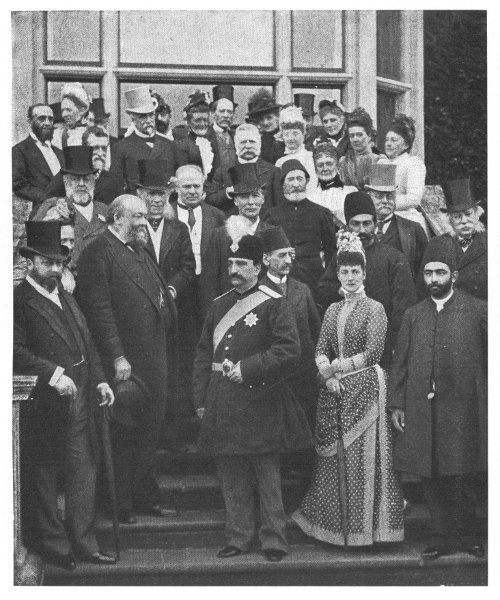
Group at Hatfield House during the visit of the Shah of Persia, July, 8, 1889 The following are among those in the picture Prince of Wales Lord Salisbury Shah of Persia Princess of Wales Rustem Turkish Ambassador Hatzfeldt German Ambassador Lord Halsbury the Lord Chancellor M de Staal Russian Ambassador Duc d'Aumale Countess of Cadogan M Waddington French Ambassador Madame Waddington Countess of Galloway Duchess of Devonshire From a photograph by Russell & Sons London
Saturday, July 27th.
Princess Louise of Wales and Fife were married this morning in the small chapel at Buckingham Palace. Very few people were asked, no diplomats except Falbe, Danish Minister, who is a great favourite at Court, and asked always. The streets, especially Piccadilly, were crowded with people. We had to go round by Belgrave Square and Buckingham Palace to get to Marlborough House. We were invited at 2 o'clock to see the bride and the presents. The wedding party drove up just as we arrived. Fife's coach, dark green with green and gold liveries, was very handsome. The Princess of Wales looked radiant, and the bride charming—beautifully dressed and just pale enough to be interesting. The King of Greece and Crown Prince of Denmark were both there. The presents were beautiful—every imaginable thing in diamonds and silver. The Prince and Princess's tiara very handsome—also Fife's. There was a buffet and tea in the garden, also in the drawing-rooms; and we waited to see the young couple start. They looked very happy and smiling. Their carriage was very handsome, with four black horses and an outrider. Everyone cheered and threw rice after them. They started with a Royal escort, but at the top of the park Fife sent it back, and they made their entry into Sheen in his carriage only. They said he made a condition that there should be no lady-in-waiting, that his wife should be Duchess of Fife only; but of course she can never lose her rank. None but Ambassadors were asked to the reception at Marlborough House—no other diplomats.
July 30th.
We had our last dinner this season—musical and all Italians, Tosti, Vinci, and Picolellis. Mme. de Florian came in late with her dinner guests, among others the Duchesse de Richelieu, who is very fond of music. Tosti is delightful once he gets to the piano, sings (with no voice) and plays whatever one wants—his own music, anybody's, and always so simply. It was very warm. We all sat and stood on the balcony when we were not playing and singing.
To G. K. S.
Hatfield, January 8, 1891.
We came down last night for dinner. It was very cold, snow and ice in London, and skating everywhere. We are not a very large party—the family, some of Lord Salisbury's secretaries, Casa Laiglesia (just made Ambassador—very happy. Spain had only a Minister here till now), the Duke and Duchess of Newcastle, etc. After dinner the older members of the party played whist, and the young ones danced in the great hall. This time we have King James I.'s rooms, an enormous bed (with a Royal crown on the top) where he really slept. We have been out all day; the gentlemen went off early to shoot, and I got down about 12. I found some of the young women, Ladies Cranborne and Northcote, in the hall and we decided we would go and skate. It was bitterly cold, but no wind, and the pond is not far, just at the end of the terrace. There was a little wooden house on the edge where we put on our skates, and plenty of chairs and canes. Ladies Northcote and Gwendoline Cecil skate very well. Lady Salisbury came down to the pond, took a broom from one of the numerous sweepers, and swept hard to keep herself warm. After lunch I went for a sleigh ride with Lady Salisbury in a pretty little one-horse sleigh she had bought at the Exhibition. It was very good going in the park, but we bumped occasionally going across the fields. To-night we broke up rather early; we were all tired with the first day's skating, and the men with their shooting.
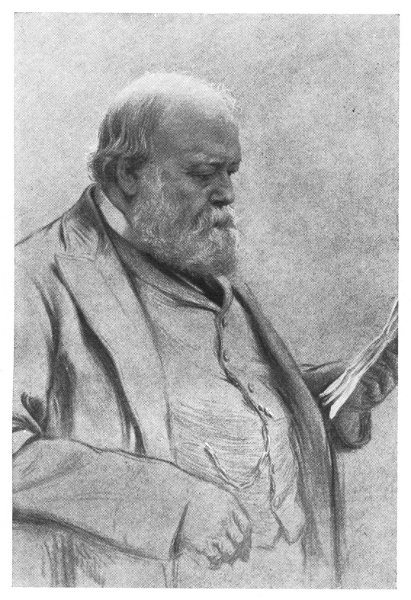
Lord Salisbury From a photograph by Weston & Son Dover
Friday.
It has been again a beautiful winter's day, and we have skated all the afternoon until dark. Lady Salisbury came again with her broom and swept vigorously. It seems many doctors recommend sweeping now for women who need exercise and cannot ride or walk. We tried hard to make Casa Laiglesia come down to the pond, but he refused absolutely—that was not at all his idea of pleasure. We spent some time in the library looking over some of the old manuscripts of the time of Queen Elizabeth and King Philip of Spain, and we saw him taking a short, very short turn on the terrace in the sun, wrapped up so as to be almost "méconnaissable."
London, January 18th.
It is still very cold—the Serpentine is quite frozen, and quantities of people skating. The ice is very bad, rather like a ploughed field, but it is amusing to see all the people. We have been this afternoon to Wimbledon, and there it was delightful. There was quite a large part reserved and beautifully smooth, belonging to a club; so Comte de St. Genys (one of the secretaries), who was with us, sent in his card, saying he was there with the French Ambassadress; and they were most civil, brought us chairs, and begged us to come back whenever we liked. We saw some beautiful fancy skating, both men and women. We skated afterward a little on the big lake to see the people. It was a beautiful day, and a very pretty sight, quite like a Dutch picture.
I was interrupted by a visit from Mr. Bryce. He came really to ask about you and to know if you would stay on at Alassio. He spoke so warmly and admiringly of Schuyler that it was a pleasure to hear him. He said he was certainly the cleverest, most cultivated American he had ever seen, that he had never met anyone who knew so many things well. He couldn't conceive how any Government that had such a man to place could have let any party feeling prevent them from giving him a prominent place, in their own interest.
Albert Gate, Thursday, February 19th.
We have had a funny day. There was a sale of horses, hunters principally, at Cricklewood, a place just outside of London, where they have very good horses. We have been there several times with Deichmann, who has always fine horses, and have bought two or three ourselves. I am looking for a saddle horse, so W. and I drove out the other day, and I tried two which I liked very much (there is a riding-school where one can try). Then Newman, the head man, rode them over some hurdles to show me how well they jumped. They promised to let us know when the sale would be, and yesterday sent word we must come to-day. I drove out with Hilda in her pony carriage. We drew up close to the ring and the auctioneer's stand and saw everything well. Her horses were taken out and we made ourselves as comfortable as we could with furs and couvertures. It was bitterly cold, with a high wind that cut one in two. W. and Deichmann wandered about in the crowd. The collection of people was most amazing, horsey to a degree; horse dealers, trainers, jockeys, racing men and women—a few gentlemen here and there, not many. There was a champagne lunch going on at Newman's, but that we declined—so they brought us tea and excellent bread and butter to the carriage. The two horses I had tried were among the first and I hoped I should get one of them, but they brought much more than the dealers supposed they would. They looked extremely well when they were brought out first, galloped over the grass, and then jumping their hurdles beautifully, taking them easily in a long stride (of course they were beautifully handled, every point made the most of). W. made various bids, but when it got beyond a certain sum he wouldn't give any more, as it was a fancy price and could have gone up indefinitely. I was rather disappointed, as I had set my heart on the black horse. It was cold driving home in the teeth of the wind. We dined with the Deichmanns, with some of our colleagues, and everyone was discussing the Empress Frederick's visit to Versailles. Until then everything had gone most swimmingly, but of course all French people were "froissés" at that. I don't exactly understand her going. She is so intelligent, and had apparently realised quite well how difficult it would be for her ever to go to Paris. Years ago in Rome, where we met her almost every night, she told us she was so anxious to go to Paris, but she was afraid she could not manage it. She wanted very much to meet Renan—admired his books so much, and his great intelligence; and I think she would have been delighted with him. He was a charming talker on every subject, and so easy.
To G.K.S.
Albert Gate, Tuesday, March 10, 1891.
We had an awful storm yesterday, a regular blizzard, and a terrible night in the Channel. One of the good boats, the Victoria, was out all night, not daring to land at either Dover or Calais. One of our young attachés was on board, bringing over despatches, and they say he looked green when he finally did arrive. The trains were snowed up everywhere, even between Folkestone and London, and the passengers nearly frozen and starved. It seems incredible in such a short distance. The young men are generally rather eager to bring over despatches, but I rather think this one won't try it again, in winter at any rate. I am extraordinarily lucky in my crossings, because probably I am a good sailor. I go backward and forward in all seasons and always have good weather. The Florians have had some wonderful crossings, nine hours between Calais and Dover, both of them tied in their chairs, and the chairs tied to the mast.
Thursday, March 12, 1891.
Yesterday we were at Windsor to dine and sleep. The party was small—Staal, the Russian Ambassador, Lord Hartington, Sir Frederick Leighton, Lord and Lady Curzon, Countess Perponcher and Count Seckendorff in attendance on the Empress Frederick, and of course the regular members of the Queen's Household. Lady Antrim was in waiting. We assembled as usual in the long corridor close to the door by which the Royal party entered. We were all in black, as the Empress was there. The Queen and the Empress came in together. The Queen shook hands with me and the two Ambassadors—the Empress with me only, bowing to the others. She is still in deep mourning—her dress black (woollen stuff of some kind) covered with crêpe, and a crêpe veil arranged in a point, or sort of Mary Stuart cap, on the top of her head, and falling behind to the edge of her skirt. The corsage was a little open, and she had a splendid necklace of pearls, also a miniature of the Emperor Frederick set in diamonds fastened on the front of her bodice. The dress was very becoming—she looked very stately and graceful as she walked through the corridor. She gave her arm to the Queen, and they walked in first to the dining-room, the Empress sitting next to the Queen on her right. W. followed with Princess Beatrice, sitting on the Queen's left; Staal with Princess Margaretta, and sat on the right of the Empress. Lord Hartington took me. The Queen talked a great deal to W.—the Empress joined in occasionally. They were both much interested in the Protestants in France, and wanted to know if the feeling was as strong as in the old days of Huguenots and Catholics. I think there is a very strong feeling, and it is rare when a French Protestant marries a Catholic—rarer still when they become Catholics.
The dinner is always quickly served, and the conversation nil. Nobody talks except those who are next the Princesses. The cercle was, as usual, in the corridor between the two doors. The Queen stood a little, but not all the time. She spoke to me about Johannes Wolff—admired his playing so much. The Empress talked a long time to W., and spoke immediately about her visit to Paris and Versailles, which was rather awkward for him, as he regretted very much that she had gone. All the first part of her stay went so well. She told W. she had had nothing but respect, and even sympathy wherever she had been, and that she was much astonished and distressed when she saw the papers and found what a storm was raging in the press. The Queen said a few words to me about the visit, and seemed to think it was a radical demonstration against the Government. I answered vaguely that all radicals made mischief—it wasn't a very easy subject to discuss. The cercle was not very long—about three-quarters of an hour—and then the Court retired, the two Sovereigns going out as they came in, together. We finished the evening in the drawing-room, but broke up early. W. went off to smoke, and I had a nice hour in the beautiful little yellow salon. I had a splendid fire, quantities of candles (always my mania—I hate lamps, particularly in these days of petroleum), and was quite happy. Adelaïde was very eloquent over the style of the housekeeper's room, and was funny over Charles, our French footman, and his indignation at being excluded from the society of the valets and ladies' maids. W.'s man was ill, so he took the French footman, who has often done his service. That gentleman being in livery was considered one of the lower servants (sat some way below the salt) and when the swells (Adelaïde, of course, included) retired to the housekeeper's room for dessert and coffee he remained with the under servants. All these domestic arrangements are quite unheard of in France—any distinctions of that kind would set the whole establishment in a storm.
It was a cold night, snow lying thick on the ground, clouds dark and low, and the great towers looked grim and formidable. W. came in about 12—said the talk in the fumoir was pleasant. He likes Count Seckendorff very much, finds him intelligent and moderate and sensible in his opinions—like all men who have knocked about a great deal and who know, not only other countries but the people of the country. After all, churches, and palaces, and picture galleries have a certain "resemblance," but people are different, and sometimes very interesting. We came away this morning at 10.30. I did not see anyone except Lady Antrim, as I never go to the dining-room for breakfast. I was ready a little before the time, and wandered about the corridor a little, looking at all the pictures. I met Staal doing the same thing. There is so much to see.
It is a beautiful bright day, and Hyde Park looked very animated as we drove through. Everyone was waiting to see the Queen pass. She arrived about an hour after us, as there is a Drawing-room to-morrow. We had some music this afternoon—2 pianos, 8 hands—and we play rather well a splendid symphony of Brahms'—not at all easy. We dined with Mr. Henry Petre, one of the most soigné dinners in London. It is always pleasant at his house—they say it is because he is a bachelor, which is not very flattering to us, but I think it is true, I don't know why. As we were out we went on, as they say here, to Lady Aberdeen, who had a small dance, but did not stay very long, as it was rather a young company. People always say there is nothing going on in London before the season, but we dine out every night and often have (I at least) something in the afternoon—a tea, or music. I don't believe anybody ever dines at home in London. The theatres are always crowded, quite as much as in Paris. Hilda and I went the other night with Count Seckendorff to see "Charlie's Aunt," a ridiculous farce which is having a great success. He protested at first at our choice—would have preferred something more classic, but he was perfectly amused (though protesting all the time). The piece is absolutely stupid, but so well played that the house was in roars of laughter, and that is always infectious. The man who played the part of the maiden aunt was extraordinarily well got up. His black silk dress and mittens were lovely—he looked really a prim old spinster and managed his skirts so well.
Saturday, April 4, 1891.
We lunched to-day with Ferdinand Rothschild to meet the Empress Frederick. We were a small party, principally Diplomatists. The Deyms, Hatzfeldt, Soveral, Harry Whites, etc. The Empress came (punctually) with Countess Perponcher and Seckendorff. The lunch was very handsome, quickly served and very animated, everybody talked. I had Hatzfeldt on the other side (I sat between him and Rothschild) so I was quite happy—there is nobody I like so much to talk to. He is very clever, very entrain, speaks French beautifully and talks about anything—just enough "moqueur" to keep one's wits sharpened. We had a discussion as to what was the origin of "Mrs. Grundy." None of us knew. I must ask Jusserand, who will I am sure be able to tell us.
We were all dressed in black velvet, one would have thought it was a "mot d'ordre." The Empress is very easy and likes to talk. She asked me if I knew Déroulède, said she heard some of his poetry was charming. I told her the "Chants du Soldat" were delightful, but I couldn't send them to her (they are all about the Franco-German War). One of the ladies, Mrs. White I think, said she would.
Tuesday, April 21, 1891.
We had a pleasant little dinner Sunday night for Wormser, the composer of "L'Enfant Prodigue," which has had an enormous success here. Wolff came too, and they played all the evening. I haven't seen the piece yet, so I was delighted to hear the music. I promised him I would go on Wednesday, my first free night.
Last night I went with Lady Northcote to the Opera; it was "Lohengrin" with Miss Eames and the Reszkes. The girl looked beautiful, quite the patrician maiden, and sang very well; a little cold, but that was of less importance in that opera than in "Romeo and Juliet," which needs more passion. The house was very full and she was much applauded. Jean de Reszke looked magnificent and sang divinely. What a voice it is, and how well he knows how to use it. I fancy Covent Garden is a much better salle to sing in than our great Paris Opéra. The voices seem so far off there, and all the singers complain and get soon tired. W. came in late just as I did. He had had a delightful dinner at Mr. Murray's (the publisher) with Mr. Gladstone. He said Mr. G. was in great form, talking about everything: books, politics, theories, and always with a perfect knowledge of each subject expressed in beautiful English. He must have a marvellous memory.
To H. L. K.
French Embassy, June 6, 1891.
You will be amused, Dear, to hear that after all we have decided to have the children's comedy. The moment is not exactly propitious in the height of the London season when every instant is taken, but I think we can make something pretty, and Mdme. Thénard is very keen about it. We shall take the "Reine des Fées"—but very much changed, and parts added for every child—also a gavotte and a chorus. I saw some of the mammas, Countess Deym; Mdme. de Bille; Ladies Londonderry, Clanwilliam, etc., yesterday, and they will let me have their daughters. Thénard will direct the whole thing, with Count de St. Genys (Secretary of the French Embassy in London) as régisseur and also décorateur, as he has begun painting a charming décor (the interior of the bailiff's cottage). Mdme. de Langhe will undertake the chœurs and leçons de diction, and I don't quite know yet whom we shall get for the gavotte, or how many children we must have. The dresses will be pretty—two sets—Marie Antoinette and all her ladies in powder—Trianon costumes—and peasants, market women, etc. Of course the boys are a difficulty. There are so few who are here of Francis's old friends—they are all at school. Thénard has a little friend (girl) whom she will dress as a Marquis—she says she will look the part very well. Francis is much excited—he is to be the cruel bailiff who takes all the money and everything else he can get from the poor peasants. St. Genys will see about his costume, and make a croquis from some picture of the period.
June 12, 1891.
We are all (except the Ambassador) perfectly taken up with the comédie—and to-day we had our first répétition of the gavotte in the drawing-room. I hadn't thought of saying anything about the dancing to the young men, and it seems the "chancellerie" went nearly mad; their rooms being directly under the salons, they heard everything—the music beginning the same thing over and over again—and the heavy little feet that couldn't stay long on the tips of their toes. I had some trouble in finding a dancing-mistress—I thought first of the American who had that dancing class here where all the children went, but she didn't seem to understand exactly what I wanted. Finally some one told me I had much better send for Mrs. Roffy—ballet-mistress at the Alhambra—who has sometimes arranged menuets and gavottes for "les femmes du monde"; so I wrote to her to come and see me. She knew exactly what I wanted, would undertake the whole thing—how many children—what sort of a dance—was most business-like—and we fixed the first répétition at once. There were about 20 children, of all ages and sizes, varying from 3 years to 14—Muriel White, Gay Edwardes and her brother, a little de Breunen, Elsa Deichmann, etc. Mrs. Roffy looked very nice. She is very tall, but rather graceful—she had a little black bag in which were her black silk stockings and pointed slippers, and asked if she might have a room to arrange herself—so Clarisse took charge of her. I took the piano—and most distracting it was—as no two of the children ever began their steps at the same time. It was amusing to see Mrs. Roffy. She moved extraordinarily gracefully for such a tall woman, and was so patient—holding up her dress, pointing her toes, and talking to them all the time—"Heads up, Dears—Heads up! Look at me—very proud, please." I should have given up in despair after a quarter of an hour. All the little arms and legs went at wrong times in wrong directions, and no one seemed to have the slightest idea of time. She will give one or two private lessons to some of the very small ones.
Madame de Langhe, too, has her hands full with the chorus, "Vive la Reine"—but I think she must have some one behind the scenes to sing the solo, and then the children will come out strong in the chorus. The rôles are all distributed—Bianca Deym—a tall handsome girl—is to be Marie Antoinette; and the various other Court ladies are Lady Helen Stewart (Lady Londonderry's daughter), Lady J. Meade (Lady Clanwilliam's daughter), Marguerite Phelps, Anna Lawrence, Elsa de Bille, etc. I think it will be pretty.
June 15, 1891.
Hilda and I have been half over London to-day for our stage scenes. We must have real ones representing a sort of wood where the market people have their stands, and the Queen and the ladies come to buy flowers—also sufficient space for the gavotte. The man promises to send it all the day before, as the children must rehearse at least once with the real scenes—for their entrées—that is always a little difficulty. The bigger girls do all right, but the little ones rush in—speak very quickly—and always to Thénard, who stands at one side—looking hard at her to see if they are doing right—and paying no attention whatever to Her Gracious Majesty Queen Marie Antoinette. Muriel White is very good, very deliberate, very careful, and taking all the French nuances and intonations very well. Gay Edwardes, too, is very good—her French is pretty and easy, she learnt it so young in Paris. One of the others (I forget which one) was having a private lesson in a corner with Francis, who was trying to make her roll her Rs in a proper French fashion. She had a complaint to make of her garden—all about "carottes" et "giroflées," and the sentences had a true British ring. Francis is very important, takes himself quite "au sérieux," and is most interested in the proper diction of all the young ladies. I sat some time in the drawing-room while St. Genys was painting his scenes. We had various visitors (even W., who was very complimentary over the décor), tea, and Thénard to settle about a rampe of flowers and tapestry curtain.
Saturday, June 20, 1891.
I am rather lazy this morning and feel as if I had suddenly nothing to do. The comédie went off very well yesterday and was a pretty sight. Until the last moment I was doubtful, as we had so many péripéties. At the dress rehearsal on Thursday, Bianca Deym (Marie Antoinette) was so hoarse she could hardly speak. The girl looked very handsome and distinguished in powder (trés bien coiffée) and one of her mother's handsome Court dresses, but Thénard wouldn't let her speak—said all her part herself, and told Bianca to pay great attention to her voice and gestures. Toupet (Francis), the cruel bailiff, had such a stiff neck and sore throat that he could hardly move—so he was rubbed hard with Elliman's Embrocation and sent to bed as soon as the répétition was over. His costume was very good—coat and long waistcoat of prune cloth—lace jabot—tricorne and gold-headed cane lent by one of his English cousins—a wig of course—which quite changed him. The girls looked charming—I don't know which was the most becoming—the powder and Court dress or the short skirts and high caps of the paysannes. The gavotte went very well. The small children in front and the bigger ones behind. I never could have believed that anyone could evolve anything like a gavotte from the whirling chaos of arms and legs that was my first impression. M. Lecomte (Secretary of the Embassy), who is a very good musician, was at the piano, and marked the time very exactly, which was absolutely necessary for such young performers.
Various friends and Mammas came to look on and criticise—which was what we wanted—and all were pleased. Thénard and St. Genys were quite delighted—and as they have seen it from the first and noted the improvement, that was reassuring. Henry Edwardes came, much amused and slightly astonished at his children's performance (the boy was so good). He told me he considered it quite remarkable. He offered to take charge of the green-room the day of the performance, and I accepted with pleasure, as I am sure the children will be rather excited and probably unruly.
I had a note from Miss Knollys while the répétition was going on saying that the Princess of Wales and her two daughters, Princesses Victoria and Maud, would be present on Friday at the performance. I announced this at once to my young troupe, and they were filled with pleasure and dismay at the appalling prospect of playing before Royalties. I went for a ride Friday morning with Pontavice and when I came in was given a wild note from the Countess Deym saying that Bianca had a complete "extinction de voix" and what could be done. If someone else could take the part (which was impossible at such short notice) she would send all her daughter's dress, which was very handsome, or Bianca would come and look the part and Thénard do the talking from the coulisses. Of course I chose the latter, and sent off Clarisse at once to the Austrian Embassy with a remedy that Mdme. Richard of the Opéra gave me. Francis was all right, his neck quite straight. After breakfast I had a last practice with him and Lecomte for the gavotte. I got in a small piano from Érard (my big one took up too much room behind the scenes) and then I dismissed the whole thing from my mind, and went to dress. I told the children to be there at 4.30 so as to begin the minute the Princess arrived. She said she would come at five.
The little blue salon was a pretty sight when it was filled with all the children in costume. Thénard's Marquis looked too sweet—she had dressed the girl so well in satin coat, ruffles, and silk stockings, and enormous paste buckles on her shoes. She did her part perfectly—so easy, and such pretty French. The Princess came punctually with her two daughters, and the play began at once. I think there were about 100 people—we couldn't seat any more as the stage took up a good deal of room. The prettiest scenes were the Trianon and the Market Place. In the Trianon, Marie Antoinette was seated surrounded by her ladies, and le Marquis telling them "les petites nouvelles de la cour." The child was killing when she took out her snuff-box and made flowery phrases. The Market was very well arranged with flowers and vegetables. Violet Freeman made a splendid old woman at one stall, and Hilda Deichmann did her boy's part very well. After the Queen had made her round (her voice came back, though she was rather hoarse still) she and her ladies retired a little to the background, where the Court made a brilliant group, while the peasants sang their chorus, "Vive la Reine." Then came the gavotte, which really went extremely well. Mrs. Roffy was breathless with recommendations until the last moment. Both chorus and gavotte were encored, and there was much applause when the curtain fell.
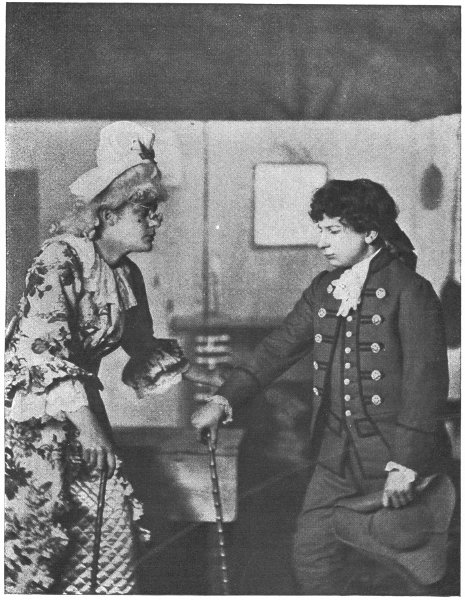
Violet FreemanFrancis Waddington
A Comedy for Children at the French Embassy From a Photograph by Barker & Pragnell London
The Princess, who is always so gracious, asked me what I would like her to do, so I said if she would allow the whole troupe to defile before her I would name each one—and I knew it would give them great pleasure. She agreed at once, so the procession, headed by Marie Antoinette, passed, and the Princess shook hands with every one, talking a little to those she knew. They all applauded when Toupet, with his wig and cane, appeared. Then I named Mdmes. Thénard and Roffy—and I wish you could have seen those ladies' curtseys (Mdme. Roffy's particularly splendid), also St. Genys and Lecomte. The whole thing lasted a short hour, even with the répétition of chorus and gavotte. We had tea in the drawing-room—the children downstairs. The Princess told me she thought it charming—quite wonderful. The only two French children were Francis and the Marquis, but I must say I thought the others quite wonderful. When the Princess went away all the children assembled in the hall at the foot of the stairs, bowing and curtseying—and it was a pretty sight, such a mass of colour and flushed, eager little faces. The Princess told them all again how much she had enjoyed the performance, and it was quite a happy little crowd that dispersed soon afterward to their respective homes. W. complimented Thénard very much, who had given herself no end of trouble—also Mdme. de Langhe, who had undertaken the chorus. Some of the ladies were rather anxious we should repeat the performance for the benefit of some charity, but W. didn't like to have a paying thing at the Embassy; and at one of the public halls it would not have been very easy—some of the ladies objected.
I dined at home, but went to a concert in the evening, and had various compliments for my troupe. The Prince of Wales told me that the Princess had told him it was quite charming. I think on the whole W. was pleased. He was rather doubtful about inviting the Princess—thought it was a little informal, and would bore her, but I don't think it did.
Tuesday, June 23, 1891.
We have had various notices in the French papers of the comédie; generally "une bonne presse," but one or two of the very Republican papers expressed great surprise at such a Royalist Demonstration—couldn't imagine why we had chosen that particular chorus, "Vive la Reine," at an Embassy representing the French Republic!
I am sorry you couldn't come over—all the répétitions would have amused you so much. Nothing was funnier than to see Francis always in a corner with some of the girls. Madame Campan (Elsa de Bille) had a long thing to say, and was most anxious to have the correct accent.
To H. L. K.
London, July 8, 1891.
I dined quietly with some of the personnel last night, and had Thekla Staal, as her mother and father had gone to Windsor for the State banquet for the German Emperor. Mdme. de Staal came in for a moment on her way home—she said it was very handsome, very well done, as it always is at Windsor, only they were all rather uncomfortable, as they went down from London by special train in full dress—diamonds and feathers—and when they arrived at the Castle they were asked to take off their wraps in the hall, no dressing-room of any kind provided. I don't know what my erratic hair would have looked like. Of course I couldn't go on account of my mourning.
All London was on the "qui vive" this morning, as the German Emperor was to make his formal entry into London. I thought I wouldn't go in the carriage and take up a position, so Mrs. Edwardes suggested that I should go with her to Constitution Hill, where she had places, and see the Emperor pass there; so we started off on foot quite cheerfully, but as soon as we got outside the Park and wanted to cross the Square, we were confronted by lines of soldiers and policemen, who refused to let us pass. I explained who I was and that I was merely going to cross to Constitution Hill, but they evidently thought nothing of an Ambassadress in a simple black dress with neither equipage nor servants, and we were getting rather discouraged when I saw a Park-keeper who knew me, so he instantly went after one of the heads of the mounted police, who appeared, made way for us and accompanied us (he riding) across the Square. Some of our friends, who were looking on from windows in the houses opposite, were rather anxious—thought we had been arrested. We waited a little while and very soon the head of the procession appeared. We made ourselves as small as we could and squeezed close up to the gate, but the Horse Guards on their big, black horses came unpleasantly near and the least plunge or kick would have been disastrous. The Royal carriage passed quite close to us at a quick trot. The Emperor looked very wide-awake and soldierly in blue dragoon uniform; the Empress, tall and fair, in white, was seated next to him; the Prince of Wales and the Duke of Edinburgh on the front seat. There was not much enthusiasm, a few hats (not all) lifted. The Emperor saluted all the time, mechanically. When he saw me he leaned forward, smiled and bowed in evident recognition. I can't think how he knew me, standing there in a crowd of nursery-maids and children. He had seen me but twice before, and then in the evening in full dress. I suppose it is that extraordinary memory, instinct almost, that all Princes have, and which does them such good service. Everyone is pleased and flattered at being recognised by a Royalty. I was, too, just like all the rest. I wasn't mistaken in thinking he knew me. He told one of our secretaries at the reception at the Palace that he had seen Mdme. Waddington standing in the crowd.
Hilda came to dinner with Countess Eulenbourg (wife of the Master of Ceremonies of the German Court) and her boy. They were very late, as the Countess had been to Buckingham Palace to see the Empress. She said the confusion was something awful. She had great difficulty in getting in, was sent from pillar to post and finally the carriage was allowed to enter through the stable-yard. She was glad to have a quiet evening. Her husband was at the gala performance at the Opera with the Emperor and Empress. She spoke a great deal about the Emperor, said it was impossible to be with him without feeling what a strong personality he is; that what he felt was right and best for Germany he would certainly do—also that he would never shirk a responsibility, or put the blame on others if he made a mistake. It seems curious to be suddenly out of everything. W. is still in France[11] and of course our deep mourning makes all Court and gala things impossible for us. I think W. must come back before the Emperor goes and try to see him in a private audience, if nothing else can be arranged.
Thursday, 9th.
All the Corps Diplomatique were received this morning at Buckingham Palace—the men by the Emperor, the women by the Empress. Hatzfeldt presented the men. In W.'s absence, d'Estournelles represented the Embassy (with all the secretaries of course). As he was only Chargé d'Affaires, he could not take W.'s place as Doyen at the head of the row—on the contrary, was quite at the end; after all the Ministers of the small Powers—however they made a little group apart. The Emperor talked a little while to d'Estournelles—regretted very much not seeing W.—knew that he was still in France, and told him to tell me that he had recognised me at once in the Park. He said a few words to each member of the Embassy. The ladies were presented by Mdme. de Staal—my young women told me she did it very well, passing down the line with the Empress and naming every one. They also found the Empress very gracious, saying something to each one—of course there is never any real conversation on such occasions, people are usually in a hurry and anxious to get through their function.
This afternoon was the garden party at Marlborough House—Mdme. d'Estournelles and Florian came in afterward to tell me about it; also Mme. de Bille (wife of the Danish Minister), she is an American, née Zabriskie. They said there was a great crowd, and such a hedge of loyal subjects around the Royalties that it was almost impossible to see them even. Princess of Monaco (née Heine), who was with the Court (her husband being a "prince regnant," of a minute principality certainly), made a sign to Countess de Florian to come and speak to her, and she also had quite a talk with Princess Amélie of Schleswig Holstein, cousin of the German Emperor, whom she had known as a girl in Pau, when her father, Marquis de Nadaillac, was Préfet there. Staal came in late, and hopes that W. will come back (he is always such a good colleague). He thinks it will make a bad effect, the French Ambassador being the only one absent. He thinks he ought to come over for the breakfast at the Mansion House, which is strictly official, and where the Emperor will probably make a speech. I will write to him to-night and tell him what they all say.
Friday, July 10th.
I rode this morning with Pontavice, the Military Attaché, and just missed the Emperor, who was riding with six or seven officers, all in uniform, which seems strange, as the officers never wear uniform except when they are on duty. We sometimes see the officer of the day riding in the Row in uniform, but never any other. In Paris it is quite different; all the officers of the Paris garrison, which is a very large one, always ride in uniform in the Bois in the morning. I went to the War Office afterward to see the Emperor, Empress, and Prince and Princess pass on their way to the Lord Mayor's banquet. The display of troops was rather mesquin—the Grenadiers standing so far apart that there were groups of street boys in between. The Royalties were fairly applauded (the Prince and Princess are always whenever they appear). The Emperor was in a white uniform, but his helmet is so big and heavy and so low on his face that one could hardly see him. Francis and I dined quietly at the Russian Embassy, and the Staals told us all about the various fêtes. They said the getting away from the Mansion House was awful—when the gentlemen of the household were trying to make a passage for the Princess of Wales there was a general skirmish, one of the ladies of the Corps Diplomatique was struck on the shoulder by one of the gentlemen, and there was a fine row—the husband of the lady furious, the unfortunate equerry protesting, saying he was incapable of such an enormity, etc. However, excuses were made and peace restored.
Saturday, July 11th.
I rode this morning with Pontavice, and we met the Emperor, also riding, several times; but he did not recognise me this time in my habit. He had six or seven officers with him and two grooms. All the officers, the Emperor also, in uniform, and wearing those long German sabres that hang loose and make a great clatter. They all rode at a gallop and set all the horses in the Row by the ears. I really had some trouble with my quiet animal, who was jumping and kicking all over the place. I had several visits at tea-time. My windows and balconies giving on the Park are most attractive, as there are quantities of people about—a sort of general excitement in the air, and royal carriages and soldiers passing all the time. D'Estournelles came in and told me about the review. He said the troops looked splendid, but the arrangements were very bad—no seats reserved—he and his wife and many ladies standing all the time. Mme. d'Estournelles was dead tired and had gone home to bed. W. came back for dinner; he looks grave and sad. We sat on the balcony after dinner while he smoked. He said he must go to the luncheon at Hatfield for the Emperor and Empress. As long as he was Ambassador, he had no right to let any private grief prevent his taking part in a public function, particularly in this case, when his absence might be misconstrued.
Sunday, July 18th.
I went this afternoon to consult some of my colleagues about my dress for Hatfield. Of course I am in deep mourning, and I didn't know if I could meet Royalties in black. At some Courts, Russia for instance, black is not allowed—when people are in mourning they wear white. After various consultations, I decided that I would go in my black dress; so I have had some lace put on top of the flounce of "crépon de laine," which is really very deep mourning.
To H. L. K.
Tuesday, July 19, 1891.
We had a most interesting day at Hatfield, and evidently we were right in going. We went down by a special, W. in deep mourning, I in my black crépon, my big pearls in my ears and around my neck, a little crêpe bonnet (with a soupçon of jet) and an ordinary dotted tulle veil. All our colleagues were most empressés and nice—said it had been so strange not to see either of us at any of the fêtes. There were, as usual, a certain number of young men, sons of the house, secretaries, etc., at the station at Hatfield; plenty of carriages, and in a few minutes we were at the house. We passed straight through the rooms to the terrace, where a very smart company was assembled. Some of the young women in white satin and lace, high bodices of course, all very much dressed, and all with necklaces and jewels on their corsages. No one in particular received us. Lady Salisbury was driving with the Empress, Lord Salisbury talking with the Prince of Wales, and the Emperor riding. (The Salisburys had an enormous house party, all arrived the night before for dinner—the Emperor and Empress with their suite, also the Prince and Princess and theirs.) I was strolling about the terrace with Countess Deym when we came suddenly upon the Princess of Wales, walking about with her "Kodak" and looking about 25 in her simple grey foulard and big black hat. As we went up to speak to her, she made us a sign to stop, saying "I want you in my picture." We talked to her a little while and then she said she must go and make herself "smart" for the lunch-party. There was still some time before there was any sign of Princes—or lunch. Mr. Barrington asked us to stand near the perron, as he had charge of the placing of the people. The Emperor and Empress appeared first, and immediately made a sort of cercle. Lady Salisbury presented me at once to the Empress, and she was most amiable, regretted not having seen me at the reception at Buckingham Palace, adding, "J'ai vu toutes vos jeunes femmes, plus jolies les unes que les autres." The Emperor, too, was easy and pleasant, but so many people were brought up to him all the time that he couldn't talk much. It was interesting to watch him. He was of course the central figure, and there is always a certain curiosity as to what he will do. He holds himself very straight, has a stern face and rather a stiff manner, not particularly gracious, speaks English of course perfectly well (in fact looks like an Englishman, particularly in ordinary dress—of course the uniform changes him a little). I think he knew about everybody who was presented to him; soldiers, statesmen, artists, and seemed to be interested in the very short talks he had with each one. He and W. had quite a talk, and he again expressed his regret at not having seen him before, and also for the cause which had kept him away. The Prince and Princess stood about on the terrace while all the presentations were going on, talking to their friends. After about half an hour there was a move to the great dining-hall. I think there were about 150 guests. The Royalties and swells lunched in the great hall at small tables of ten, and the others in the ordinary dining-room. I was at Lord Salisbury's table, who took in the Empress; the Prince took me; Hatzfeldt (German Ambassador) Mdme. de Staal; Rustem (Turkish Ambassador) Princess Maud; Soveral (Portuguese Minister) Countess Spencer. At Lady Salisbury's table were the Emperor, Princess, Staal, W., etc. The talk was fairly easy at our table—Hatzfeldt said to me rather pointedly, "Je suis très heureux de vous voir ici aujourd'hui, Madame Waddington." The Prince also said we were quite right to come. I said I thought my plain black dress was rather out of place at such a brilliant entertainment, but he assured me it was quite correct.
About half way through luncheon came the pearl necklace incident (which you saw in the papers). I suddenly felt that my necklace was unclasped. It was sewed on the corsage in front, as the pearls are large and heavy, and I am always afraid of breaking the string. I asked Soveral, who was next to me, if he couldn't clasp it for me. He tried, but was nervous or awkward; at any rate couldn't manage it, and we were both getting red and flustered when suddenly we heard the Emperor from his table calling W.'s attention to the fact that "le Portugal était en train d'étrangler la France"; also Staal, saying that his "Collègue du Portugal se livrait à une gymnastique étrange." They all made various jokes at my expense, and the Prince said "Let me do it," but he couldn't either, and again we heard the Emperor remarking, "Maintenant c'est plus sérieux—l'Angleterre s'en mêle." W., who had his back to me and who couldn't see what was going on, was decidedly mystified, and wondered what on earth I was doing to attract so much attention, in fact was rather annoyed. When we got up from table the Prince and I retreated to a corner of the terrace, and he cut the stitches that held the necklace in front with his knife (which again looked funny to the people assembled on the terrace). He advised me to put the pearls, not in my pocket, but in a safe place, as they were very handsome, so I put them inside my dress. Of course everybody asked me what had happened, and what the Emperor was saying to me from the other table. I asked the Empress if she was never afraid of losing her pearls, but she said all her jewels were most carefully sewn on and strung on a very thick string or sort of silk cord.
Very soon after lunch the Emperor and Empress left, as they were starting in the evening for Germany, and had to go to Windsor to take leave of the Queen. The Prince and Princess followed quickly, and then, of course, all of us. W. had again a talk with the Emperor, and all his colleagues told him he was quite right to come. Any little incident between France and Germany always assumes gigantic proportions, and the papers, both French and German, would have been full of the marked absence of the French Ambassador from all the fêtes for the Emperor; his mourning a pretext, etc. It was a beautiful entertainment—bright, perfect summer day, quantities of pretty women beautifully dressed (a great many in white) and representative people of all kinds. The general impression was that the Emperor was not a lady's man—he evidently preferred talking to army and political men. My talk with him was so perfectly banal that I can scarcely have an opinion, but I should think one might talk to him easily. His face is certainly stern, and the manner very cold, but his smile, like the Queen's, lights up and softens the face. I said to one of the pretty young women who had made a luncheon-party for him, that I had heard that it was beautifully done, and that he was much pleased. She said she hoped he was, that as far as she personally was concerned he hadn't the slightest idea whether she was 25 or 50.
To H. L. K.
London, January 12, 1892.
W. and I came over yesterday in a snowstorm. It was beastly getting out of the train and on the boat at Calais. I am rather depressed, having left Francis behind at a professor's near the Lycée Janson, to follow the cours there as externe. I shall miss him frightfully, but it was quite time for him to go to France and go through the regular course. He was forgetting his French here. Of course he and his father always speak French to each other, but he went to a little English school, Miss Quirim's, in Sloane Street (where there were quantities of little friends beginning their education), played all day with English children, heard nothing else spoken around him, and was rapidly becoming an Englishman. The house seems dreadfully quiet without him, and poor little Bonny, the fox-terrier, is miserable. He couldn't think why he wasn't with us to-day on our journey and galloped up to his room as soon as he arrived at the Embassy, asking everybody really with his eyes where his master was. Florian came in at once to see us, and told us that the Duke of Clarence was frightfully ill at Sandringham. He always looked rather delicate, tall and slight and colourless, but I hope his youth will pull him through. He had been rather more en évidence these last months since his engagement to Princess May, daughter of Princess Mary, Duchess of Teck. I think it is a marriage that pleases the nation. Princess May is young and pretty, with a pretty figure and essentially English—born and brought up in the country. Everybody adores her mother, Princess Mary, and I think it will be a very happy marriage.
January 13, 1892.
I am afraid there is no chance for the poor young Prince. Florian came in for a moment, just back from Marlborough House, where the bulletins are posted twice a day. There were crowds of people reading them and trying to get some detailed information. Florian saw one of the equerries, who told him there was no hope, he was sinking fast and would probably not live through the night. He told him the Princess never left him and was heart-broken, her eldest boy. It is hard for her. They seem to think it was a neglected cold, caught out shooting, and not taken in time. All the personnel came in to see me and brought their New Year's present—4 pretty corbeilles for bonbons. They always give me something New Year's Day and I am much pleased to have the souvenirs. I can hardly realise that we have been here nearly 9 years. We came in '83 and thought we should stay perhaps two years. I am so accustomed to the life now that I feel as if I had always spent half the year in England and the other half in France. I suppose I shall miss a great many things when we retire into private life, perhaps most of all the family life with all the personnel of the Embassy. We have had various changes, of course, but I generally pull well with them all, and I must say they are always ready to help me in every way. I haven't had too many women, which is pleasant; women are much more complicated to deal with than men—there are always so many small jealousies and rivalries.
Thursday, January 14, 1892.
The poor young Duke is dead at 9 o'clock this morning, in spite of all that tender nursing and skill could do. He had not strength to fight against the malady. It is awfully hard at his age and in his position; just now, too, when his marriage was so popular. Florian came at once to tell us, and said there was such a crowd outside Marlborough House that he could hardly get through into the court, where the policeman showed him the Prince of Wales's telegram, "All is over." We had various visits at tea-time; Deym among others, who had done just what we did—sent telegrams to the Prince and Princess and the Tecks at Sandringham. He told me he had dined at White Lodge with the Tecks on Christmas Eve (for their Christmas tree) and that they were all so happy. Princess Mary took him upstairs and showed him all the presents—coupons of velvet, brocade, etc., for dresses, also the wedding dress, and said to him, "Je suis si heureuse que j'en ai peur." Poor thing; perhaps it was a presentiment. I am awfully sorry for them, for her perhaps more than for Princess May, who is young and must of course get over it, as youth happily is elastic and rebounds; but Princess Mary is different. She has her share of worries and disappointments, and she was so happy and proud of the marriage. It must be an awful blow to her.
Sunday, January 19, 1892.
I went to the little church behind the Embassy this morning and am very sorry now that I didn't go to St. Paul's, where there was a fine service—the organ playing the Dead March in Saul, and all the congregation standing, a good many women crying, all in black. It was impressive in the little church—everyone in black. There is a general mourning ordered for three weeks, and Court mourning for six (which is a shorter time than I thought). (I send on a sheet apart what I would like you to order for me. I have nothing black but my black satin evening dress, which fortunately is all black, no white, lace, or colour). They sang the funeral hymn "Labourer, thy work is o'er," the first time I had ever heard it, and beautiful it was; read the prayer for the "Royal Family in affliction," and one for the influenza—which surprised me, as I should not have thought the epidemic was bad enough for that. The sermon, of course, was all about Prince Eddie and the young life cut short. It was very simple and earnest and the congregation certainly felt and showed great sympathy. I went for a short turn in the Park afterward and walked about a little with Henry Edwardes and his children. He is rather down, poor fellow, as his congé drags on and they seem in no hurry at the Foreign Office to give him another post. I believe he didn't get on very well with his last chief, and of course all chiefs are not commodes, but equally of course when there comes a question the secretary is always in the wrong. Edwardes is very clever and cultivated. W. thinks him an excellent agent. In Paris he always knew what was going on, and knew so many people of all kinds.