Part 2 — MADAME WADDINGTON
Reading edition
SERA CHEZ ELLE
le Samedi, 9 Mai, 2 à 4 heures,
Mlle. de Bury lira une étude de critique littéraire sur Racine, son milieu, et sa tragédie de Bérénice.
Do you think it would have tempted you? I am afraid Schuyler wouldn't have come.
To H. L. K.
London, May, 1885.
We are having most beautiful weather, Dear, and our morning rides are delightful. If only the Park was a little bigger. We always get a good gallop on the other side by the Marble Arch, but it is small, and one goes round and round. When I ride with W. we generally make three or four turns as fast as we can go, he hates to dawdle. When I ride with the military attaché, or some other friends, we do the Row, and amble up and down, talking to the people walking as well as the riders. The children always delight in scampering along on their ponies, and they certainly begin young. A friend of ours, who has a nice sturdy boy of about six, was wondering whether he should begin with his child on a narrow pony, thinking he was still rather young, so he consulted Lady P., a beautiful rider, and an authority on all matters connected with riding. "You mustn't begin too early with boys," she said; "one must be careful; I never put any boy of mine on a horse until he was two years old."
May 13th.
To-day we have had a very long Drawing-room held by the Queen, which of course attracts everyone. She rarely stays more than an hour, just long enough to receive the Corps Diplomatique and the people who have the entrée. The Queen looked very well, merely shook hands with me, but talked some little time to W., said she had enjoyed her stay at Aix-les-Bains so much, and that everything had been done to make her comfortable. I watched her while she was talking and I never saw a smile make such a difference in a face. Hers is quite beautiful and lights up her whole face. It was tiring to-day—unending. Lord R. told me there were 400 presentations, and at the end said about 1,200 people had passed. They say the Queen is sometimes made sick by the quantity of people curtseying before her—the constant movement of the people bending down and rising has the same effect upon her as the waters of the sea. I can understand it.
The long Drawing-room to-day was a god-send to Lady A.,—one of Lord C.'s daughters. She is a "débutante," had a very pretty new dress, and was much excited over her presentation, had started very early with her mother so as to see the Queen (who stays only a short hour). The early start and the long waiting in the row of carriages and also the ante-room, exhausted her absolutely. She was sick and faint; they did all they could, brought her brandy, put her near an open window—nothing did any good. She had to retire from the room, go downstairs, have her dress cut open (there was a knot in the lace and they couldn't unlace her bodice), and remained extended on a sofa in the hall—train, veil, feathers, all in a heap. After a rest of two hours, and a cup of tea (procured with great difficulty, as there is no buffet on these occasions) she felt better, and her mother hearing from a friend upstairs, who was "de service," that the Drawing-room was still going on, was most anxious that the girl should pass, so they arranged her veil, hair, and feathers as well as they could, tied the bodice of her dress, and filled in the intervals with some bits of tulle cut from her veil. She passed, and I don't believe anyone noticed anything wrong with her dress, and she was so thankful not to have to go through that long waiting again. It is a most fatiguing day for those who haven't the entrée, as they must sit so long in their carriages in the file.
Hatfield, May 30th.
We came down yesterday to this most beautiful old place. A large Elizabethan castle, standing rather high, with courts and terraces in every direction. We found Lady Salisbury at her tea-table on the terrace with a lovely view of park and woods on all sides. Various members of the family and house-party sauntered up, some of the young ladies in their habits, having been riding; and some guests having walked up from the station, which is quite near at the end of the Park. After an hour's talk Lady Salisbury took me to my room (miles away through the long hall and up a great staircase), and told me dinner was "easy 8." The room is large, all panelled in oak which has become almost black with age, an enormous bed (they have always had their sheets made especially for these beds for more than 200 years, in Germany I think, as no ordinary sheets could cover more than half). The beds are very long and almost square. They would easily hold Brigham Young and all his wives. Do you remember the picture in Mark Twain? Mine was so high I had to take a footstool to clamber into it. W.'s room, next, about the same. We went downstairs at 8.10 and certainly didn't dine until after 8½. We were about 30 in the great dining-room, a splendid hall with portraits of Queen Elizabeth (one in fancy dress, most curious with bright red hair), Henry VIII, Mary Queen of Scots, etc. We played cards in the evening and broke up rather early. This morning Lady Salisbury showed me the house—most interesting, full of treasures and memories, a great library with all sorts of letters from the time of Elizabeth, and in the drawing-room a vitrine filled with relics of the "Virgin Queen." It was curious to see her gloves, shoes, hat. I think Lady Salisbury was somewhat surprised at my interest in these last things, but I told her she must make allowances for the American, who was not accustomed to old family traditions and souvenirs of that kind. When I think of our Revolution, then it seems ages ago to me. We enjoyed our visit extremely, they are all so nice and simple.
We got back to London this morning and of course dined out somewhere. I was amused by one of the ladies saying to me after dinner, "Did you really enjoy your visit to Hatfield? Aren't they all dreadfully clever?" I don't think I should have applied the same adverb, but clever they certainly are. Lord Salisbury has such a fine, thoughtful face.
To H. L. K.
June, 1885.
We went to Ascot this morning, a beautiful day, and the lawn like a flower garden with all the women in their light dresses dotted about. We lunched with the Prince and Princess of Wales. The Maharajah of Johore was there, and had brought down his own cook, attired in yellow satin with a large flat hat on his head. He made a sort of curry for his master, which everybody tasted—except me—I don't like culinary experiments, and I think the yellow satin garments didn't inspire me with confidence. I told Juteau when he came up for orders just now how far below the mark he was as to costume.
June 29th.
I went this afternoon with Francis to Lord Aberdeen's, where they had a hay-making party. They have a pretty little cottage, or rather a small farm about an hour's drive from London. There were plenty of people, and all sorts of amusements for the children; Punch and Judy, lawn-tennis, and two tea-tables on the lawn. After tea they all rushed down a steep hill to a field where there were quantities of little heaps of hay, and harmless wooden pitchforks. They had a fine time rolling and tumbling about in the hay and making hay-stacks. Then a cow appeared on the scene, dressed with flowers and ribbons, and the maids made syllabub on the spot, which the children enjoyed immensely.
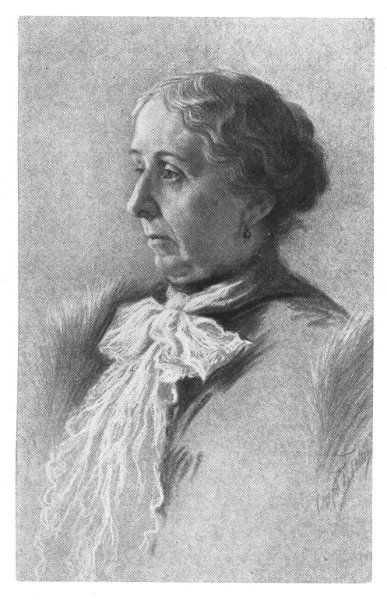
Lady Salisbury
June 30th, 1885.
We dined at Lady Molesworth's with the Duc d'Aumale, who is always charming, and makes everything easy, as there are always bothering little questions of official etiquette with non-reigning Princes. He is a fine type of the soldier-prince. It seems hard that a man of his intelligence and education shouldn't play a great part in his own country.
Albert Gate, July, 1885.
We had the Court concert this evening. The Duc d'Aumale was there, looking so well and so royal. He is always charming to us, and we were very proud of our French Prince. H. came with us and enjoyed herself extremely. The entrance of the Court amused her very much, the two tall Chamberlains with their wands walking backwards. She says she never saw anything so pretty as the curtsey the Princess of Wales made to the assembled company as soon as she got into the room. What always appeals in some sort of way to our irreverent American minds is the singing of the "God Save the Queen," all the company, including Prince and Princess, rising and standing.
To J. K.
Chevening, Sevenoaks, Sunday, July 27, 1885.
I will begin my letter here to-day, Dear Jan, from the Stanhopes' place, where we came last evening to spend Sunday. It was awfully hot yesterday. I almost died on the way from London down, fortunately it was only an hour. We are a party of 14—Lord and Lady John Manners, Lord Derby and his step-daughter, Lady Margaret Cecil, Mr. and Mrs. Edward Stanhope, Mr. and Mrs. Jeune, Lord Boston, a nice young fellow, and a Mr. Praed, a riding man, who has travelled everywhere. We had tea on the terrace overlooking a lovely garden and lake, and dined at 8. After dinner we sat on the terrace, and it was charming, a beautiful full moon, and not a breath of air. Friday we had the closing festivity of the season at Marlborough House. A beautiful ball it was, about 600 people, all the crème de la société and beautiful dresses and jewels. I wore my pink and green Moscow dress (my Russian garments have done me good service this year), and it was much admired. All the Battenberg family were there in great force, and I renewed acquaintance with the Prince of Bulgaria, whom I used to know. They had covered in a great part of the garden, and the room was beautifully arranged with the Prince's Indian carpets and arms. The supper room, also built out in the garden, was so pretty—a collection of small round tables for 8 or 10 persons, with flowers and handsome silver. Prince Albert Victor took me in, and I had a young Battenberg next. Neither Phelps nor Harry White was there, on account of Grant's death, which I thought very nice of them. I danced once or twice after supper, and we came away at 2. I hear they kept it up until 5, having begun at 11. There is a reception at Lady Salisbury's on Tuesday, which will be really the end of all things, and purely political, as all the swells go off to Goodwood Monday.
11.30.
We have just come upstairs after a very hot day. I didn't go to church, as I knew I could not stand the heat, and talked a little and read very happily in the big drawing-room till luncheon. Lady Stanhope took me over the house, which is not very large, but interesting. There is a charming library full of books and manuscripts and letters, some from Lord Chesterfield to his son, written in French, and beginning "Mon cher ami, comment vont les grâces et les manières." After luncheon, we sat out under the lime trees, and after tea I made a little tournée with Lord Stanhope and prowled about the park, and went also to the church, where there are several interesting monuments. This evening we have been sitting again on the terrace, quite delicious. I in my white dress, with nothing on my shoulders.
London, Tuesday, 28th.
We got back yesterday at 2 o'clock and the weather has changed to-day. It was very hot all day yesterday. I spent the afternoon on my sofa until 6.30, when we went for a ride and met the few last people who are still here. Last night we discussed our summer plans, and I shall go over to France on Saturday with Francis, stay three or four days in Paris, and then go down to St. Léger. It is curious how London is suddenly empty. There were not 5 carriages in the park yesterday. This morning I have been careering about the stable-yard trying a new habit. They are so difficult to make in these days, so tight that the least change of saddle makes them go every way but the right one. I don't know if I wrote after the Harwoods lunched with us. W. was much pleased with them and found them a most attractive family. The girls are charming, so pretty and simple. I must stop, as Holmes (the English butler) is waiting for me to tell him all sorts of final arrangements before we start.
To G. K. S.
Albert Gate, November 9, 1885.
The young King of Spain is dead. The Ambassador, M. de Casa La Iglesia, was to have dined with us. He sent a note at 5.30 saying that he must give up the pleasure of dining with us for a "bien pénible raison," but without saying what it was—so one of the secretaries went off "aux informations" and came back with the news that the King was dead. Poor young fellow, his reign was short.
December 5th.
We had a service at the Spanish chapel in Manchester Square for the King of Spain. All the Diplomats and official world there. It was very long—all the ladies were in black—Comtesse Karolyi (Austrian Ambassadress) and Comtesse de Bylandt (wife of the Dutch Minister) in crêpe, long veils. They told me I was not at all correct, that a crêpe veil was "de rigueur" for crowned heads. I thought I was all right in black velvet, a tulle veil, and black gloves (in fact was rather pleased with my get-up), but the ladies were very stern.
London, December 15, 1885.
I wish you were here this morning, Dear, as the Embassy is a curiosity—might just as well be in Kamtchatka as far as the outside world is concerned—for nothing exists beyond the walls of the house. When they drew back my curtains this morning I couldn't really think for a moment where I was. Adelaïde had a lighted candle in her hand (it was 8.30 o'clock in the morning) and I thought my window panes had been painted a dirty yellow in the night. However it was only a yellow London fog; I could literally see nothing when I went to the window. It has lightened now a little, but we have had lamps for breakfast, and I am writing with my candles! The big shops opposite are all lighted, and one sees little glimmers of light through the fog. I can't see across the street. The fog gets into everything—was quite thick and perceptible in the hall when we went down to breakfast. The coachman has been in and said he couldn't take out his horses, not even with a link-boy running alongside, so let us hope it will brighten up a little in the course of the afternoon.
December 16th.
The fog did lift about 4; but the day was trying and the traces most evident the next day, as everything in the house was filthy—all the silver candlesticks and little silver ornaments that are on the tables; the white curtains—in fact everything one touched. I should think laundresses would make their fortune in London. My maid came to my room about 3 o'clock, just as I was going out, with her apron really black with smuts. I said, "What in the world have you been doing, cleaning the chimneys?" "Non, Madame, je n'ai fait que travailler chez Madame et dans la lingerie; j'ai voulu montrer mon tablier à Madame, c'est le troisième que je mets depuis ce matin...!"
December 17, 1885.
Yesterday I made an excursion to the city with Hilda Deichmann and her husband to buy things for our Christmas trees. It was most amusing ransacking in all the big wholesale houses, and reminded me of my childish days and similar expeditions to Maiden Lane. There is so much always in England that recalls early days. I think it is not only the language, but the education and way of living are the same. We have read the same books and sung the same hymns, and understand things in the same way. Our shopping was most successful. All the prettiest things come from the German shops. The ginger-bread animals were wonderful,—some horses and dogs with gilt tails and ears most effective. The decorations were really very pretty—the stars and angels quite charming. When we had finished our shopping Deichmann took us to Pym's, a celebrated oyster cellar, to lunch. A funny little place well known to all City people. We had a capital lunch—all oysters.
This afternoon we have been playing, 8 hands, two pianos, which was interesting. Two of our colleagues, Princess Ghika, Roumanian Legation, and Countess de Bylandt, Dutch, are excellent musicians. They lead, and Hilda and I follow as well as we can. I am the least good, but I manage to get along, and of course whenever I know the music my ear helps me. We have two fine Érard grand pianos in the drawing-room, which is large, and fairly light for London. I was much tempted by a beautiful Steinway piano, but thought it right at the French Embassy to have Érards, which are of course fine instruments. I fancy Steinway is more brilliant, but I think we make noise enough, particularly when we are playing Wagner—the Kaiser March for instance.
December 23d.
It was not very cold this morning, so I tried the new horse, and he went very well. I have had a thick hunting habit made, and was quite comfortable, except the hands, which were cold at starting. I fussed all day over the Christmas tree which we are to have on the 26th, and this evening we had a small farewell dinner for Nigra, the Italian Ambassador, who is going away to Vienna. I am very sorry, as he is a good colleague and an easy and charming talker. He sat a long time with me the other day talking over his Paris experiences and the brilliant days of the Empire—Tuileries, Compiègne, etc. It was most interesting and new to me, as I only know Paris since the war (1870) and have never seen either Emperor or Empress. I suppose I never shall see her, as she never comes to London, and lives a very secluded life at Farnborough with a small household, and some Paris friends who come sometimes, not very often, to see her. What a tragic "fin de vie" hers is, having had everything and lost everything. We had also the Russian and Spanish Ambassadors—Staal charming, clever, easy, simple—"simpatico," the only word I know in any language which expresses exactly that combination of qualities. Casa La Iglesia, the Spaniard, is a tall, handsome, attractive-looking man. He made havoc in the various posts he has occupied, and when we want to tease him we ask him about his departure from Berlin, and all the "femmes affolées" who were at the station to see the last of him. Henrietta and Anne have arrived for Christmas, laden of course with presents and souvenirs for everybody, and Francis is quite happy with his aunts.
To G. K. S.
Albert Gate, London, December 24, 1885.
The sisters and I have been shopping all day getting the last things for the tree, which is to be on the 26th. The streets are most animated, full of people, all carrying parcels, and all with smiling faces. The big toy-shops and confectioners crowded. "Buzzard," the great shop in Oxford Street, most amusing; hundreds of Christmas cakes of all sizes. There are plum cakes frosted with sugar icing, the date generally in red letters and a sprig of ivy or evergreen stuck in at the top. We had ordered a large one, and they were much pleased to do it for the French Embassy, and wanted to make the letters in "tri-color," red, white, and blue. We wound up at the Army and Navy Stores, and really had some difficulty in getting in. They had quantities of Christmas trees already decorated, which were being sold as fast as they were brought in.
There were splendid turkeys, enormous; and curiously enough they told us many of them came from France, from a well-known turkey farm in the Loiret. I must ask the Ségurs, who live in that part of the country, if they know the place. There were quantities of plum-puddings of all sizes and prices, and it must be a very poor household that doesn't have its plum-pudding to-morrow. We were glad to get back to tea and hot buttered toast—a thoroughly English institution. I would like some of my French servants to learn how to make it, but I don't suppose they will. In fact I don't know exactly who makes it here—I am quite sure neither Juteau nor his "garçon de cuisine" would condescend to do anything so simple. I suppose it isn't the "odd man" who seems to do all the things that no one else will, but I sha'n't inquire as long as it appears.
We had a quiet evening—talked a little politics while W. was smoking. Henrietta always sees a great many people of all kinds, and tells him various little things that don't come to him in his official despatches. The house is comfortable enough, though there is no calorifère, and it is a corner house. There are enormous coal fires everywhere, except in my bedroom and dressing-room, where I always burn wood—and such wood—little square pieces like children's blocks.
Christmas Day.
It was dark and foggy this morning, we could hardly see the trees opposite, and the lamps are lighted in the house and the streets. Francis was enchanted with his presents. I think the billiard-table from Paris and the big boat ("aussi grand que Monsieur Toutain"—one of our Secretaries) were what pleased him most. There is a sort of sailing match every Sunday morning on the Serpentine. Some really beautiful boats (models) full-rigged, and it is a pretty sight to see them all start a miniature yacht race across the river. Francis always goes with Clarisse, and Yves, his own little Breton footman, carries his boat, which is much bigger than he is, also Boniface, a wise little fox-terrier who knows all about it, and gallops around the top of the lake to meet his master's boat on the other side. They have also one of the Park keepers and a gigantic policeman, who is always on duty at Albert Gate, to look after them. Not a useless precaution, as the boat often gets entangled in the reeds, and has been known to go to the bottom of the lake, and Boniface always gets lost and is brought back by a policeman or a soldier, or a friend—Hilda Deichmann brought him back one day.
We had a cheerful Christmas dinner—all our personnel—M. Blanchard de Forges, Consul General, and Villiers, the correspondent of the "Débats" in London. We did a little music after dinner. I tried for some Christmas carols "We Three Kings of Orient Are" (do you remember that at Oyster Bay? how long ago it seems), but the English-speaking element was not strong enough. We danced a little, winding up with a sort of Scotch reel—Henrietta, Waru (our Military Attaché), and Petiteville being the chief performers.
December 26th.
We are all rather exhausted after the Christmas tree; however, the children were quite pleased, and the tree really very pretty. A gigantic pine, reaching to the top of the ceiling in the ballroom, a star on the top and very well lighted. We had 34 children of all ages and nationalities, from Nadine Karolyi, aged 18, daughter of Count Karolyi, Austrian Ambassador and Doyen of the Corps Diplomatique, to Florence Williams' baby girl of 16 months. The little ones were sweet, speechless at first, with round eyes fixed on the tree, and then little fat arms stretched out for something. The children's tea-table looked pretty, arranged with coloured candles and holly, and an enormous Christmas cake in the middle with a wreath of holly around it. Nadine Karolyi cut the first slice of cake, as daughter of the Doyen she sat on Francis's right hand, and Thekla Staal, daughter of the Russian Ambassador, on his left. W. was much amused at the correct placing of the young ladies. We start to-morrow for Knowsley and Luton Hoo, and the packing is quite an affair. I take 10 dresses, besides jackets, hats, etc. I must have short costumes to follow the battues for fine and bad weather—a swell day dress, as we are to lunch at Croxteth, Lord Sefton's place near Knowsley; and two ball dresses, as there is to be a county ball for all the neighbourhood at Luton, New Year's night, and a small dance with a cotillon (which is unusual in England) the next night. Adelaïde is rather fatigued, as besides my trunk she has to finish off her toilettes, and she has just come in to ask me if she shall take the regulation black silk, or a blue silk, which is more dressy; as they tell her the ladies in the housekeeper's room are very dressy at Luton. I said the blue silk by all means—she must be up to the mark. The fog has kept up pretty well all day. I hope it will clear to-morrow, we are going straight into the coal country. Knowsley is near Liverpool, and I fancy it is always dark there.
I was telling Nigra the other day about our first Roman Christmas and what an impression it made upon us. Such a splendid winter, always a bright blue sky, and roses straggling over all the old grey walls. The Pifferari singing to the Madonnas at all the street corners, the midnight Mass and mysterious Pastorale in St. Peter's at early dawn with the tapers trembling on the high altar so far away; and the grand Christmas ceremony at St. Peter's, with all the magnificent pomp of the Catholic Church in Rome. We talked on for some time about "Roma com' era," which of course he doesn't regret, and I told him of our last night in Rome, when we all went "en bande" to drink at the Fountain of Trevi (which is supposed to act as a charm and to bring people back to Rome). I remember quite well how tearful I was when we left. I didn't think then that life was worth living out of the shadow of St. Peter's, and think so a little still even now, though my lines have lain in very different places.
We leave Francis in the sisters' charge, with the joys of a pantomime before him.
To H. L. K.
Knowsley, December 29, 1885.
We arrived here late yesterday afternoon. It is a long, uninteresting journey (almost to Liverpool), was cold and foggy all the way down, and we found snow when we arrived in the Park—also a perfect gale of wind, the enormous bare, black winter trees swaying like poplars. The large house, with all the façade brightly lighted, gave us at once a cheerful welcome. Lady Derby was waiting for us in the long, low drawing-room with tea, and we went up almost immediately to dress for dinner. We had sent the servants by an earlier train, which was convenient, as they had time to unpack and have everything ready for us. We have a charming apartment—a very good-sized salon, with bedrooms large and comfortable on each side. The salon furnished in a bright chintz, and good pictures, mostly family portraits, on the walls. There were blazing fires everywhere—these enormous rocks of Liverpool coal one sees here. I instantly proceeded to demolish mine in my bedroom. Adelaïde had already tried to make the housemaid understand that her lady didn't like warm rooms, but the other one pointed to the snow under the windows, and heaped on her pieces of coal.
Dinner was at 8 punctually (which was a contrast to Hatfield, where we had been staying the other day. There dinner was easily half past eight, and after we had been at table some little time various friends and members of the family appeared, and slid quietly into their places at the end of the very long table). There is a large family party here and some other guests, including the two historians, Froude and Lecky, both most interesting.
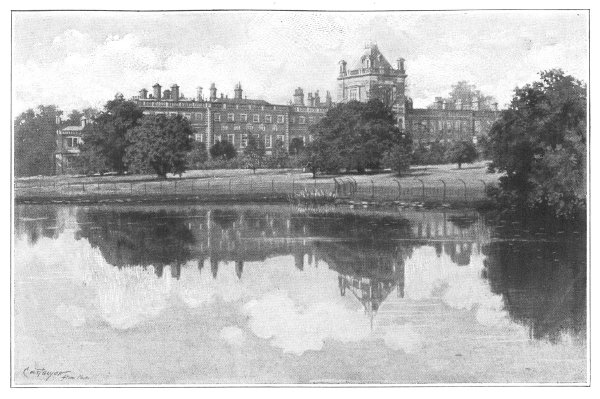
Knowsley Hall The Earl of Derby's place at Prescot Lancashire
We dined in a fine hall with family portraits of all the Derbys, from the first one at Bosworth down to the present Earl, who is the 16th Earl of Derby. There was beautiful plate on the table—fine racing cups—as the Stanleys were always quite as much racing men as statesmen. These are such curious things in England, the love of sport is so strong. Fancy any of our statesmen, Thiers, Guizot, Dufaure, etc., with racing stables. Lord Derby is very easy and rather inclined to chaff Americans a little, but I didn't mind. The evening was short after we adjourned to the drawing-room. Lady Derby is rather delicate, and is suffering just now from a bad eye. I sat some time in my comfortable room upstairs, but was glad to get to bed early after the cold journey. W. went off to the fumoir, and had a most interesting talk over Ireland and Irish questions with Mr. Lecky. This morning was awful; snow, sleet, and a cold rain—however, the sportsmen were not to be deterred by any such mild obstacle, and started at 9.30 in a big break with four horses. I watched the departure from my window, and was very glad I was not going to make any such expedition. I had my breakfast upstairs, and had an amusing explanation with the housemaid who appeared at 9.30 with an enormous tray and breakfast enough for a family—tea, beefsteaks, cold partridges, eggs, rolls, toast, potatoes, buns and fruit—you never saw such a meal. She couldn't believe that I only wanted tea and toast and an egg (which was an extra, but as I knew we should only lunch at two, and I am accustomed to have my déjeuner à la fourchette at 12, I was sure I should be hungry if I didn't take something), and asked me most respectfully if I was not well, and would like something else—"a little soup perhaps."
I went downstairs about 12 and found the ladies in the drawing-room all complaining of the cold. Lady Derby took me over the house—it has not the beautiful proportions of Hatfield—is long, low, and rambling, but most comfortable. The library is a fine room with deep window recesses, and most comfortable with a bright fire burning. The librarian was there and showed us some of his treasures, among them an old copy of the "Roman de la Rose," and various old manuscripts. We went on to the dining-room, and Lady Derby explained the family portraits to me. The long, unbroken line of Earls of Derby is most interesting, and the change in the portraits for the two or three generations where the French blood shows itself, most curious. The wife of the Earl of Derby who died on the scaffold, giving his life for his King, was the famous Charlotte de la Trémouille, who defended her castle—Lathom House—so gallantly against Fairfax and his Roundheads. Do you remember one of our school-room books in America, "Heroines of History," where there was a description of the siege of Lathom House, and a picture of the Countess of Derby standing on the ramparts in a riding habit and hat and feathers and apparently loading a cannon herself and showing a gunner how to point it?
The portraits are most interesting; first the regular Saxon type, then the French streak, pale oval faces, and dark eyes and hair (not unlike the Stuarts, who have always a foreign look); then the true British, more and more accentuated down to the present Earl. They have also in one of the halls the block on which the Lord Derby knelt who was beheaded in 1631.
The sportsmen arrived about tea-time, apparently neither cold nor tired, and having had a fine shoot.
New Year's Day, 1886.
We are leaving this afternoon for Luton, Mme. de Falbe's place, where there is a ball and cotillon to-night. We were to go and join the shooters yesterday, but it was rainy and cold, and the ladies didn't care to go out. The talk at luncheon was pleasant; Froude is brilliant and easy. His American experiences and stories were amusing, but I told him he mustn't take the very eccentric ladies and gentlemen whom he had encountered as specimens of Americans. I didn't know any such people, that really most of us were quite quiet and ordinary, and like everybody else. Lord Derby rather urged him on, and was amused at our perfectly amicable discussion. We drove over to Croxteth, Lord Sefton's place, after lunch. The park is fine and they have capital shooting. Our evening was quiet, and we broke up early, as they always have a midnight service in the chapel on New Year's eve for the family and servants and any of the guests who like to attend. We left the drawing-room at 10.30, so that the servants might put out the lights, finish their work, etc., and also to have time to get out of our low dresses and jewels. A little before 12 Lady Margaret Cecil (Lady Derby's daughter by her first husband, Lord Salisbury) came for us and we went to the chapel. I had put on a dark cloth dress and jacket, nothing on my head. The chapel was full, all the servants (including my French maid) and household. Lady Margaret, looking like a saint in her plain black dress, and beautiful earnest expression, sat at the little organ, and everybody, gardeners, keepers, coachmen, cooks, housemaids, joined in the singing. It was very solemn and impressive. At the end of the service we all went out first, and then Lady Margaret and her brother Lord Lionel stood at the head of the stairs and shook hands with all the guests, and all the servants, wishing all a "Happy New Year." It was a nice beginning of the New Year. Lord Derby hopes our next one will be also in England and at Knowsley, but everything is so uncertain, and of such short duration in our country (especially Cabinets) that we can hardly look forward a year.
Luton, January 3, 1886.
Our journey yesterday from Knowsley was not very long, and some of the country all about Matlock, in Derbyshire, quite wild and lovely. Our host here is M. de Falbe, Danish Minister, who married Mrs. Leigh, owner of this charming place. We found the house party, mostly young, assembled in the morning-room with tea, the ladies all, as usual, in very dressy tea-gowns. I can't quite get used to that fashion, though I see it is very practical in the country at this season. Everyone goes out (in all weathers generally) from luncheon till tea-time, and of course one must get out of short skirts and muddy boots before coming down to the drawing-room. We went up early to dress, as Mme. de Falbe wanted to dine precisely at 8, on account of the ball afterwards. The house is large, with endless corners and corridors, fine drawing-rooms, library, and a large chapel with a fine organ. The dinner was handsome and very well arranged, five round tables, and quantities of silver, flowers, servants, etc. About 10.30 the company began to arrive, many county neighbours, Salisburys, Lyttons, Caledons, etc., bringing their house parties with them. We had a very pretty cotillon. At the end the children's pony came in carrying two big baskets filled with presents. The poor little thing was very gentle, but was evidently afraid of slipping on the parquet floor.
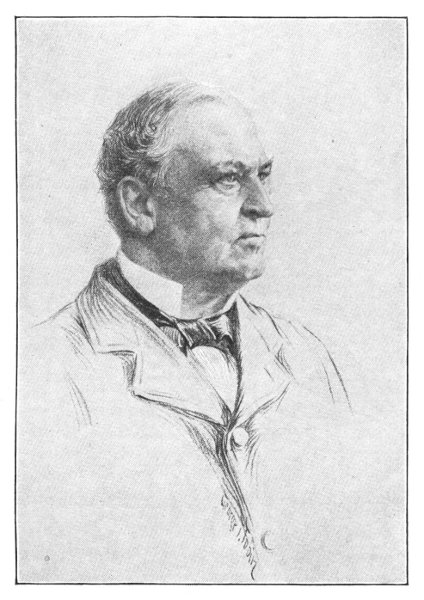
The Late Earl of Derby From a photograph by Franz Baum, London
Sunday, 3d.
To-day has been charming; first the service in the house chapel, very good organ music—Mme. de Falbe is musical and arranges everything. After breakfast they organized a paper hunt for the "jeunesse" in the park, and the older people walked about. The rendezvous was the dairy—a model one, quite delightful with tiles, and creepers running along the walls and peeping everywhere in at the windows. One by one the young people assembled, flushed and exhausted with running, and all clamouring for tea. Comte Jacques de Pourtalès (one of our Secretaries), a young officer of the Blues, and Forbes, Mme. de Falbe's son-in-law, were the hares and got in some time before the hounds. After tea Falbe took me over to the stables, where there were plenty of horses, and also to the "vacherie," which was perfect. They have 40 small Alderney cows, all the same breed and colour, pretty little beasts, and so wonderfully clean, kept like pet dogs.
The dinner and evening was most lively, choruses, banjos (which is a favourite instrument in English houses), and every kind of game, including musical chairs—M. de Falbe at the piano. I think everyone played except the Falbes and ourselves. W. and Falbe retired afterwards to the smoking-room, and were deep in foreign politics. Falbe is a perfect type of the diplomatist, tall, good-looking, and a charming, courteous manner. We ladies went off about 11, and an hour later we heard the most unearthly noises in the house. All the men parading the corridors with banjos, bells, gongs, etc., and singing (if singing it can be called) at the top of their voices. They stopped at every door to serenade. The party breaks up to-morrow, and we all go back to London.
To G. K. S.
London, Sunday, January 17, 1886.
We had a musical dinner last night for Miss Griswold and Albanesi, and they sang and played all the evening. Albanesi has a charming, delicate touch, and plays with all the Italian brio. He told me—what surprised me—that he was always frightfully nervous when playing in public, and much preoccupied with the "composition de la salle"—if he saw one or two unsympathetic faces he had at once a disagreeable sensation! Gertrude Griswold has always the same lovely voice with a beautiful clear ring in it, and sings most artistically.
This morning we have been to church at St. Paul's. It is a fine service, a splendid organ, and very good well-trained choir—but not at all solemn. I felt as if I was in one of the great Catholic cathedrals in Italy. People were coming and going all the time, and walking about the church. It is so enormous that it is quite a walk from the big doors to the small (comparatively) enclosed space where the congregation assembles.
I have been at home all the afternoon receiving—men only, which is a regular London custom. Adams came in at tea-time. He and W. always like to have a good talk over old times. They were at school and college together, and Adams, when he was Chargé d'Affaires at the British Embassy, used to have all sorts of questions to treat with W., who was then Ministre des Affaires Étrangeres in Paris. They always began their conversations in French, and then fell into English, which of course they had always spoken together.
To-night we have a small dinner for Rustem Pacha, and I have asked one or two people in the evening. I should like to be at home always on Sunday night, as we did in the Champs Élysées, but they tell me no English will come. Many of them don't go out on Sunday night, and don't take their horses out, and give servants a rest. I asked Lady A., who is very mondaine, if she would come to dinner to meet a few colleagues, and she said—"Dear Mme. Waddington, let me come another night; I never take out my carriage and servants on Sunday."
Jean Gordon Gumming is very much exercised over what she calls my French ways, and constantly tells me people don't do such and such things in England; but I always tell her the French Embassy is not England; however, she is rather worried over me, and finds me un-English (which is not surprising) and unconventional, which is also not surprising, considering my nationality.
To H. L. K.
January 21, 1886.
We have had a great function to-day, the Queen opened Parliament. We all went in gala, Countess D'A. and P. with us, the men in uniform, I in red satin, low, with diamonds and feathers. The road was lined with policemen and mounted soldiers in lieu of infantry, as there would have been with us. As we passed through the Horse-Guards the trumpeters saluted. We went at once into the great hall of the Lords', which was a fine sight. All the peers were there in their scarlet robes trimmed with white fur, and the women in low dresses, diamonds, and feathers (feathers play a great part in all English toilettes). The Judges also were in full dress, with wigs and gowns. About 1.30 the Princes began to arrive, Prince of Wales, Dukes of Edinburgh, Connaught, and Cambridge all also in scarlet robes with bands of ermine and gold, and the collar of the Garter. We sat close to the Throne (Countess Karolyi didn't come, so I was Doyenne), then Madame de Staal and the Duchesses Bedford, Hamilton, Sutherland, and others. The Prince of Wales stood next to me some time, presenting the Duke of Connaught, whom I had not seen, and talked pleasantly enough, explaining various things to me; also said he was rather shy at taking his seat on the raised platform until the last moment. He had an arm-chair on the right of the Throne. I asked him for whom the other arm-chair was and he said it was his father's, had never been used since his death, and showed me the Saxon arms on it. The three brothers, Wales, Edinburgh, and Connaught, remained standing together. The other Princes, Christian, Duke of Teck, and Henry of Battenberg, were opposite to us; Battenberg, who has a slight, stylish figure, looking handsome in British Volunteer Uniform (dark green) with the collar of the Garter. Teck looks badly, older and thinner. He must have been a very handsome man (which, by the way, he tells one frequently). When Prince Alexander of Battenberg was at one of the Court balls everyone was talking about him and saying what a magnificent man he was. Teck, who was dancing a quadrille with me, was much put out, and said to me, "Do you really find Battenberg so very handsome? It is a pity you didn't know me when I was his age; I was much handsomer," and appealed to Count D., Austrian Ambassador, an old friend and "compagnon d'armes," to support his statement, which I must say he did most warmly, and one can quite see it.
All the Ambassadors and men of the Corps Diplomatique faced us—the English women were upstairs. About 2.30 (we had been there since 1.30) we heard a trumpet call, and all the company stood up. We women dropped our cloaks, and the Prince took his place standing on the dais. Presently appeared the Garter King-at-Arms and various officers of the household. The Duke of Portland stood on the right of the Throne holding a Royal crown on a cushion. Lord Salisbury (Premier) carried a large sword with a double handle, and then came the Queen followed by Princess Beatrice and Princes Eddie and George of Wales. The Queen was dressed in black satin with a long train, lined and trimmed with ermine, quantities of diamonds on her neck and corsage, the blue ribbon of the Garter, and a regular closed crown of diamonds, and white veil. As she came in the Prince of Wales advanced, touched the ground with one knee, kissed her hand, and led her to the Throne. He did his part most easily and gracefully, and didn't look at all shy. The Queen's train was carried by Sir Henry Ponsonby and two pages in red and gold. Princess Beatrice and the Duchess of Buccleuch (Mistress of the Robes) stood behind the Queen on her right, Princes Eddie and George on her left, Lord Salisbury, Halsbury, Lathom, and some others were also on the dais. As soon as the Queen was settled on her Throne she bowed to us all right and left. We made deep curtseys, and then she made a sign that we were to sit down. There was a few moments' silence while they went to summon the Commons. Then one heard a noise of scrambling and racing in the corridors—and they appeared; the Speaker, looking very well in his wig and gown, came first, fairly shot into the hall like a bomb by the impatient crowd behind him. Then the Lord Chancellor, asking the Queen's permission, read her speech in a clear, distinct voice, so that one heard every word. It was very short, and as soon as it was over the Queen went away with the same ceremony as when she came. When she got to the foot of the dais she made a very pretty half curtsey. The Princes left directly afterwards—we too. The crowd in the street was tremendous, everyone always is anxious to see the Queen, and much excited over the cream-coloured Hanoverian horses which she uses when she goes anywhere in semi-state. As they only go out very seldom it is rather a responsibility for the Master of the Horse to see that they are perfectly quiet.
Windsor, March 8, 1886.
We are at Windsor for the second time to dine and sleep, and we are "Doyens" now, so have a sweller apartment in one of the towers—the walls so thick that they make splendid deep window recesses (and a piano). We had asked an audience of Princess Beatrice, who received us before dinner about 7. I wore my brown velvet in which I had come down, and we found her in a small salon with a piano and pretty pictures and bibelots about. She was in an ordinary red costume, and was rather cold and shy at first, but thawed when Battenberg appeared. He has a delightful easy way, that sort of charm that so many Poles have. The party was a small one—no other diplomats but Mr. and Mrs. Phelps, both charming, and some English. The ceremony was quite the same as before. The Queen came about nine and went alone into the dining-room, and had her two sons-in-law, Christian and Battenberg, on each side. W. took in Princess Beatrice, and Mr. Phelps me, so I was quite happy. The Queen spoke little, in German, principally, to her neighbours, the English scarcely at all, and almost in whispers. I don't know what would happen to me if I dined often at court, I couldn't sit at table for an hour without talking to someone. Mr. P. says American women are not made for courts and convenances. They lose all their charm if they are not natural, and I think he is right. The cercle lasted about an hour. The Queen and I talked music. She regrets Münster, who is going to Paris.
London, March 9.
We were asked this morning if we would like to drive to the Mausoleum before we went back to town, which we accepted of course. W. and I went in an open carriage, a pair of horses and postillion, and Lord Thurlow, Lord in Waiting, with us. In the next came Mr. and Mrs. Phelps with Mrs. F., Lady in Waiting. We drove down the "long walk" to the Mausoleum, which is not very far from the Castle. It is a handsome building with a fine marble floor like some of the old Italian chapels. The tomb of the Prince Consort is very fine, with a recumbent marble statue and a place beside it for the Queen when her turn comes. There is a pretty monument "In Memoriam" to Princess Alice (of Hesse) with her child in her arms, and a tablet to the memory of John Brown as "a grateful tribute from Queen Victoria to the faithful servant and friend of 34 years." We then drove to Frogmore and saw the farm, basse-cour, dairy, etc., and took the 12.30 train back to London. This evening we have had a handsome dinner and reception at the Russian Embassy; the whole house open, band playing, and all London there. The Duchess of Edinburgh dined. Corti made his first appearance in the "grand monde" as Ambassador. He is much pleased to be in London. I don't know if he and W. will be very cordial colleagues, as Corti decidedly resented W.'s attitude in the Berlin Congress.
To J. K.
Clieveden, Maidenhead, Sunday, March 29, 1886.
I will begin my letter this evening, Dear Jan, in this most lovely place of the Duke of Westminster's which Karolyi, the Austrian Ambassador, always hires, until after Easter, as his wife hates to spend the winter in town. We came down yesterday afternoon with one of their secretaries, a nice young fellow. We found the Karolyis alone in a charming library filled with books in all languages, and with the most enchanting view of the Thames—quite like the view from Richmond Terrace, if you remember it. They gave us tea—and about 7 we went up to our rooms. Mine is the one the Duchess always has, and W. has the dressing-room next, a large room, all hung with rose-coloured silk, faded into yellow now, an enormous bed with yellow silk curtains and counterpane, a bath-room with marble bath opening out of a little passage, quite complete, and always the same divine view. The rooms are filled with pictures, souvenirs of all the Sutherlands (whose place it was originally), Westminsters, and all the English Royal family of all ages. At 8 a gong sounded and we went down to the library (where they live entirely), and found them there with the addition of Count Victor Karolyi, a cousin. The dinner was good, 4 servants, their chasseurs, in Hungarian uniform, 2 in black and one in plain livery. After dinner the 2 Karolyi men sat down to cards, W. and the young man talked, also Mme. K. and I—and all the men smoked. It was easy enough, as everyone talked a great deal. We broke up at 11. This morning we had breakfast at 10, and afterwards Mme. K. showed me the house, which is very handsome, one large, beautiful drawing-room opening on the terrace and river view. They live only in the library, as the rest is so enormous to light and heat. At 12 M. and Mme. de Staal, the Russian Ambassador and his wife, arrived, and we went for a stroll in the grounds. Went out again after lunch for a long walk down by the river in short skirts and thick boots, as it was very damp—almost always is on the banks, generally low, of the Thames. It looked very pretty and gay, quite a number of boats and some people we all knew, staying in one of the houses near, got out of their boats and walked along with us. We came in for tea at 5.30, and after that adjourned to our respective rooms till dinner. The evening was pleasant, as we were more numerous and Staal talks a great deal. Now I am going to bed, as it is 11 o'clock, and we breakfast at a quarter to ten to-morrow, and get back to London at 11.30.
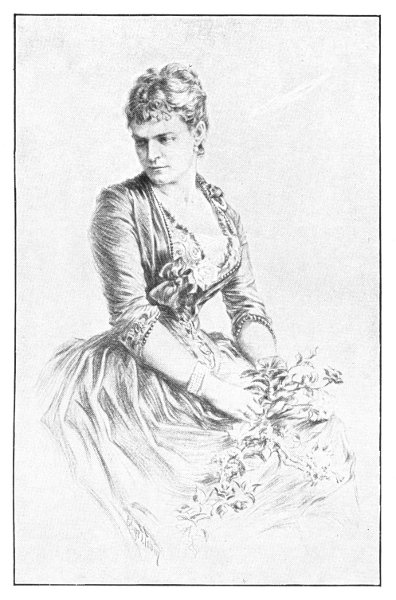
The Countess Fanny Karolyi 1888 the Austrian Ambassadress From a photograph by Walery London
London, Monday, 30th.
We got back this morning at 1 for lunch, and have been in a wild state ever since with the bad news from Tonkin and the defeat of our troops. The Ministry is out, and Heaven knows what will happen. W. is as blue as indigo over the news, as he had been very cocky over Tonkin, as compared with the English blunders in the Soudan. Already there are despatches in the clubs here, saying W. has been asked to take the Foreign Office. Of course he hasn't been asked, and I hope he won't be, for I should hate to begin that official life in Paris again, and I am very happy here now—however, one never knows in political life. Do you know anything about Phelps? W. is very anxious to have your opinion. He says you ought to know about a Vermont man. He will have a difficult "succession." Mr. Lowell is much liked and admired.
London, April 10, 1886.
We have had a pleasant morning luncheon at Roll's Court with Lord Esher, who showed us a quantity of most interesting old manuscripts. A letter from "Bloody Mary" to Cardinal Pole announcing her "grossesse" (the arrival of a Prince), also the confession and signature of Guy Fawkes after torture, such a wavering, faint signature, "Guido." It is extraordinary how all the papers and handwriting have lasted. All these old-world things are so interesting to me, I seem to realize history so much more. I hope to get over to Paris for a little this month. We had a nice party (music) at Louisa Lady Ashburton's this evening, and an interesting collection of people, fashionable, literary, and Salvation Army. The house is crowded with statues, pictures, and artistic treasures of all kinds.
To J. K.
Ambassade de France à Londres, Sunday, May 29, 1887.
We seem to have a gleam of sunshine this afternoon, Dear Jan, after weeks of bleak east winds and grey skies, and we are going to take advantage of it to drive out to White Lodge, Richmond Park, and see the Tecks. We are revelling in Whitsuntide recess, and no dinners or banquets until Friday, the second Court Concert. Last night I went to the Opéra with the Staals. It was "Faust," very well given, with Albani, Scalchi, and Gayare. The house was fairly brilliant, but not full—the Prince and Princess of Wales, Rothschilds, and a certain number of people, who came to hear Albani (she is such a favourite here). I should think it would be a losing operation. Tell Janet Mlle. de Staal looks so nice, is so much more animated, really very pretty, so high bred and always well dressed. Lady Salisbury's reception at the F. O. on Tuesday for the Queen's Birthday was very brilliant; there were quantities of Princes; a Danish Prince, brother of the Princess of Wales; a young Russian Grand Duke, a son of the late Prince Frederick Charles, brother of the Duchess of Connaught, and any quantity of Maharajahs, covered with gold and silver embroidery and diamonds and emeralds as big as eggs. They always make a great fuss over the Indian Princes at Court—treat them like Royalty, and give them very good places. The Corps Diplomatique always protests. The lion of the evening was Herbert Bismarck. From the Prince of Wales down everyone, men and women, was overwhelming him with attentions. I didn't think the Danish Prince looked much pleased. He remarked that "Bismarck had a most disagreeable voice." Lizzie P. was wandering about looking very handsome. I didn't see Buffalo Bill, which rather surprised me. I suppose he is genuine, isn't he? He professed to remember Captain King perfectly when I said I had a brother who had been some time on the plains with his regiment. Certainly the "Wild West Show" is most original and entertaining. The Indians look savage enough to satisfy anyone, and Buffalo Bill and the King of the Cowboys are splendid specimens of frontiersmen.
Monday.
I will finish this morning; it is still dark and rainy. We went out yesterday to White Lodge and had a pleasant visit. It was much too cold to sit out, so we had tea in the gallery and enjoyed it very much. Princess Mary is always so easy. The young Princess May looked very nice in a light tweed with a white waistcoat. She asked after Janet, and wanted to know if she was to be here this season. I asked Princess Mary what she was going to wear at the Jubilee Te Deum at Westminster. She said she had no idea, but she had been told long dress, smart bonnet, decorations and diamonds. It seems the Queen is going to wear a white bonnet covered with diamonds. I have asked no questions and mean to wear a short dress—no one will see, as we do not join any cortége. We arrive quite simply and go straight to our places. I shall wear white lace with mousse velvet, and a mousse bonnet with pink roses. Tell Janet, I am convinced I shall never wear my moiré apricot dress from Roulf, that I couldn't wear last year at any of the Court fêtes. I am sure the German Prince will die. They say he may at any moment, as the excrescence in his throat may increase, and then he would suffocate. Wouldn't it be strange if that old Emperor outlived the son. Neither sled nor fans have yet arrived. I suppose they will appear soon. We have one or two things we mean to send out, as soon as we have an opportunity—gloves, etc. I should think some of the 75,000 Americans who are coming over would go back in the course of the summer. Princess Mary told me yesterday that a pretty American girl—an heiress—she couldn't remember the name—did I know?—is probably going to marry a Count Btetju, aide-de-camp to the Prince of Denmark. It seems he saw her here and fell in love with her at once. I must stop now. Have any quantity of notes to write.
To G. K. S.
London, June 14, 1887.
London is getting ready for the Jubilee and the streets are crowded. Various Royalties have arrived, and one meets Royal carriages, escorts, and strong squads of police at every turn. It is warm and lovely to-day—so was yesterday. W., Francis and I drove out to Sheen, where W. plays tennis in Lord F.'s private court. I wandered about under the trees, and Francis sailed his boat in the pond and was quite happy. It is such a rest to get a few hours in the country when one is going out all the time as we are here—and above all not to have to talk. We had a remarkable entertainment last night, given by the Hawaiian Secretary (who is a German-American) for his Queen, of the Sandwich Islands. We arrived in due time, I rather protesting.
There was a large reception after dinner and the mistress of the house asked us if we wouldn't stand by the Queen and make a sort of cercle, and a funny contrast we made—Mrs. P. beautifully dressed in white satin and lace, Lady R. with splendid jewels, I wore my pink brocade and old Venetian lace. It really was too absurd. I talked a little to the Princess, who is intelligent enough. The Queen is a great stickler for etiquette, and insisted upon the same honours as any other Royalties, an escort of Life Guards;—wouldn't accept any less distinguished escort.
London, June 18, 1887.
We have had rather an amusing afternoon. I think I wrote you that we wanted to leave Westminster Abbey the minute the ceremony was over, get through the line of troops, and back to a friend's house in Piccadilly to see the cortége—we being Mrs. Phelps and I. Our respective husbands were most discouraging (as men always are), but we dined last night with Knowles to meet the Duke of Cambridge, and I told His Royal Highness what we wanted to do, and asked him if he could help us. After some little discussion he said he would advise us to go directly to Sir Charles Warren (Chief of Police) and see what he could arrange for us. Again our husbands remonstrated, "Warren was overrun with applications of all kinds, worked to death, and it was very unreasonable," but backed by the Duke we determined to try.
I told His Royal Highness I should put on my most becoming Paris bonnet and beard the lion in his den. He said, "Quite right, my dear, a man is always flattered when a woman tries to please him," so accordingly about 3 Mrs. Phelps and I started for Scotland Yard. George was rather surprised when I gave the order. We drove through one or two courts and were stopped once by a huge policeman, who let us go on when we said it was the French Ambassadress. We were shown at once into Sir Charles's room, and I must say he was charming, most kind and courteous. We had arranged beforehand that I was to be spokeswoman, and I went at once to the point. He was sitting at his table with letters and papers and telegrams, the telegraph ticking all the time, despatches and telegrams being brought in, and as busy a man as I ever saw. He immediately sent for maps of the route, distribution of the troops, etc., and said he thought he could manage it. We must have a light carriage (of course we must go to the Abbey in state in the gala coach) waiting at the Poets' Corner, as near the door as it can get; he will send us a pass to break through the lines, and will have three or four policemen waiting for us at the corner of Piccadilly and one of the smaller streets to pass us through the crowd. We really didn't derange him very much. The whole conversation lasted about ten minutes, and he was rather amused at this sudden appearance of the two "femmes du monde" in his "milieu" of clerks, policemen, telegraph boys, type-writers and a hurrying, bustling crowd of employés of all kinds. We returned triumphant to our respective houses.
We had a fine reception last night at the Austrian Embassy in honour of Prince Rudolph. We arrived late, having dined out. The Prince is very good-looking, slight, elegant figure, and charming manners and smile. All the world was there—quantities of pretty women, and pretty dresses—the Countess Karolyi always the handsomest.
London, June 20, 1887.
London is really a sight to-day, the streets gay with flags, draperies, stands, illuminations, and quantities of people gaping all day long. I went for a drive with Mary Sheridan, daughter of Mr. Motley, late Minister from the United States to the Court of St. James. We didn't attempt going down Piccadilly, as we saw what a dense crowd and block there was, so we crossed to Constitution Hill. We went all round Westminster Abbey; I wanted to see the Poets' Corner where we are to go in to-morrow, and the House of Commons stand where she is to be with her sister. We were blocked for a quarter of an hour standing close to the Embankment. Some of the mottoes are very nice. I like the humble ones best, "God bless our Queen." We were a long time getting back to the Embassy, Piccadilly almost impassable. It was amusing, as everyone was arranging their balconies, and we recognised various friends standing at windows, and on balconies directing the arrangement of chairs, plants, flags, etc. After dinner W. took his cigar and we walked about a little in Piccadilly. Some of the illuminations had already begun and the crowd was dense, but no jostling or roughs, everyone good-humoured and wildly interested in the decorations. London is transformed for the moment and looks like a great continental city, all lights and flags and an "air de fête." We didn't stay out very late, as we have a long day before us to-morrow. They say the Queen is well, but rather "émue" and a little nervous, which must be expected. I shall wear white, the only objection to that being that jewels won't show out, as they would on a darker colour.
To H. L. K.
Albert Gate, London, June 22, 1887.
I am still exhausted, Dear, with the visions of a brilliant, motley, moving crowd, when I shut my eyes. Yesterday was beautiful, a glorious summer day. I was waked up at 6.30 by the dull rumble of carriages, and people already on the move. I thought they must have forgotten to call me, but the house was still wrapped in slumber, and though it was only 6.30 the Park was full of carriages, men in uniform and women in full dress. We started at 9.30 in the gala carriage, W. in uniform, and were followed by a second carriage, landau, the men equally in gala. We remained blocked for a long time in Piccadilly, it didn't seem possible to get on; distracted policemen, mounted and on foot, and officers did what they could, but there we remained, curiously enough all the Ambassadors' carriages together. Finally an order was given to let the Ambassadors' carriages pass, and we got on a little. Various Court carriages passed us—one so pretty with the three little daughters of the Duke of Edinburgh all in white with straw hats, and long white feathers, sitting on the back seat, and smiling and bowing, and looking quite charming with their fair hair streaming down their backs. They had an equerry in uniform with them on the front seat. Once past St. James's Street we went quickly enough thro' long lines of soldiers, and behind them quantities of people waiting patiently to see the great show. We went into the Abbey at the Poets' Corner, where an entrance was reserved for the Corps Diplomatique and Court functionaries. It was a fine sight; tier upon tier of seats covered with red cloth and filled with men in uniform, and women in handsome dresses. The Peers and Peeresses sat just below us and looked very well; as it was Collar Day, all the Garter men wore their white shoulder-knots, which were most effective. It was very difficult to distinguish people, the building is so enormous, but as we were close to the dais we saw all the Royalties perfectly. At last various members of the Royal Family came in, and the first Sovereign to enter was Her Majesty of the Sandwich Islands with her cortége; then came quickly the King of the Belgians, King of Denmark, various other Princes, and they all took their places on a platform facing the Queen's dais. We waited some time, and then came a flourish of trumpets which announced the Queen's arrival. It was most interesting to see her come up the aisle—quite alone in front—her three sons, Wales, Edinburgh, and Connaught, just behind her. She was dressed in black with silver embroidery, a white lace bonnet with feathers, and lace caught back by diamond pins. As she reached the dais she stepped on it quite alone, and advancing to the front made a pretty curtsey to the assembled Royalties. Then came a long procession of family Princes, headed by the Prince of Wales and the German Crown Prince, who looked magnificent in his white uniform, and the Princess of Wales and the German Crown Princess. They all passed before the Queen, and it was most striking to see her seated there, a quiet figure dressed in black, very composed and smiling, yet "émue" too, as the long line of children and grandchildren representing all Europe passed to do her homage. It was a gorgeous crowd of uniforms, orders, jewels, and really glittering garments of all kinds; but every eye was fixed on the central figure. The service began at once and was impressive. The Prince Consort's "Te Deum" sounded magnificent with organ and full band. I must own to considerable distraction during the service, as I was quite taken up with looking at everything. When the ceremony was over—or nearly—we started at once, found our carriage (ordinary landau) at the Poets' Corner again, and drove quickly around by Belgravia and Albert Gate (breaking the lines of troops once or twice, but with no difficulty, as orders had been given), to the corner of Hamilton Place and Piccadilly. There we had to leave the carriage, but it was merely a few steps to my friend's house where we were to see the procession pass; however we should never have got there if we hadn't found the 4 gigantic policemen who were waiting for us, and who deposited us rather pulled about, but intact, at the door. We found the balcony prettily decorated and filled with people, and had an excellent view of the procession. The Queen's carriage was handsome, an open landau red and gold, with six cream-coloured horses with red and gold trappings, and running footmen. She was alone on the back seat; the Princesses of Wales and Germany on the front seat. The escort of Princes was very brilliant. The Prince of Wales looked well on a fine horse, and the German Crown Prince superb, towering over everyone else, and his helmet shining in the bright sunlight. The cheering was tremendous as the Queen passed, and one felt it was absolutely genuine (nothing commandé), her people (I always like that phrase so much, "My people," when she uses it in a speech or proclamation) really delighted to have her still with them. Another who also was much cheered was Princess Mary of Teck. They love her, and she looked so happy and smiling as she acknowledged the salutation. She has such a gracious manner always to everyone—never seems bored. However I must say that for the Prince of Wales; no matter what the function is (and he must be bored very often) he never looks it, but always does graciously, and as if he liked it, whatever he undertakes. There was a very substantial lunch provided for us at Lady Borthwick's, and as soon as the cortége disappeared I clamoured for something to eat, as it was nearly 3.30, and I had had nothing to eat but my early cup of tea and piece of toast about 8.30. I went straight back to the Embassy after luncheon—even then, at 4 o'clock, we had to go at a foot's pace thro' the crowd—and I didn't stir again all the afternoon, but I had visitors at tea-time, as of course the windows and balconies giving on the Park were most attractive. There were thousands of people still in the Park, and Royal carriages and escorts coming and going; music, flags, and a general impression of movement and colour everywhere.
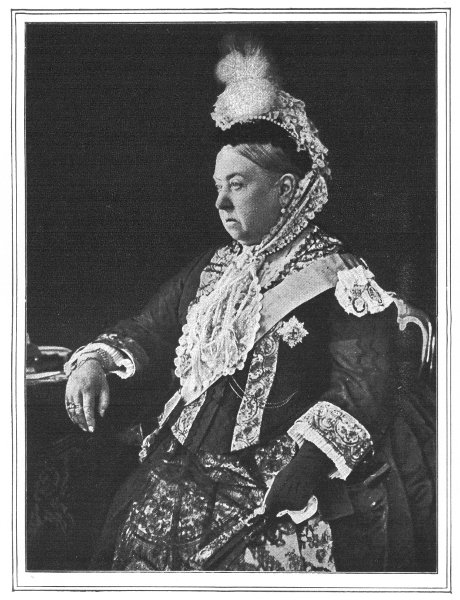
Queen Victoria, in the Dress Worn During the State Jubilee Celebration, June 21, 1887. From a photograph copyright, by Hughes & Mullins, Ryde, England.
In the evening we started at 10 for the Palace, and they thought there would be such a crowd that we had a mounted policeman, but we had no trouble. Everyone made way for the carriage, though, of course, the general traffic was stopped, and everybody (including our own secretaries, who weren't invited to the Palace, merely the "chefs de mission") in the middle of the streets, looking at the illuminations. There was great confusion at the Palace—dinners still going on and servants hurrying backward and forward with dishes, and piles of plates on the floor as we passed through the long corridor. We had to pass through the great hall where the numerous "suites" were dining—and we naturally hesitated a moment as they were still at table—but Colonel Byng came forward and ushered us upstairs, and into one of the large rooms. There were very few people—the "chefs de mission," the Nunzio who had come expressly, Lord and Lady Salisbury, and Lord C., Indian Secretary (as there were many Indian Princes). We waited nearly an hour and were then summoned to the ball-room, where the Queen and Court were assembled. The Queen was standing, dressed just as she always is for a Drawing-room, with her small diamond crown and veil, and again the background of Princes and uniforms made a striking contrast to the one black-robed figure. The Prince of Wales stood a little behind, on her right, also Lord Lathom (Lord Chamberlain). We all passed before her, two by two, with our husbands, and she said a few words to each one, but no real conversation; it was evidently an effort, and we felt we must not stay a moment longer than necessary. I talked to one or two people while the others were passing. The German Crown Princess came over and talked to us. I asked her if the Queen was very tired. She said not nearly as much as she expected, it was more the anticipation of the day that had made her nervous, that she was very agitated when she started, but that wore off, and she was not very tired this evening, and very happy, as were all her children, I said, "You might add her people, Madam, for I never saw such a splendid outburst of loyalty." The Crown Princess herself is perfectly delightful, so clever and cultivated, and so easy, with such beautiful, clear, smiling eyes. Do you remember how much I admired her in Rome the first time I met her? She is always so kind to us. W. loves to talk to her; they don't always agree, but she quite understands people having their own opinions, rather prefers it, I think, as she must necessarily be so often thrown with people who never venture to disagree with her. The Crown Prince of Sweden also came and recalled himself to me, and the Duc d'Aoste. The Queen remained about an hour; then the Royal party moved off in procession, and we got our carriages as quickly as we could. I have written you a volume (but you must say that doesn't happen often from my lazy pen, but I felt I must write at once, or I should never have the courage). Please send the letter to the family in America. I am dead tired, and my eyes shutting by themselves.
London, June 22, 1887.
We went this afternoon with the Florians, Comte de Florian, Secretary of the Embassy, and Comtesse de Florian, Francis, Baroness Hilda Deichmann and her children and some of the Embassy men, to the children's fête in Hyde Park. It was very pretty, and very well arranged; 30,000 children from all parts of London, and amusements, food, and jubilee mugs provided for all. We got there a little after 3, and it was warm and fatiguing standing and walking about. There were various refreshment tents for the "quality committee," etc., and the children got iced cream and cakes to their hearts' content, also each a jubilee mug with which they were much pleased. The Prince and Princess of Wales, with some of the foreign Princes, came about 4 (and horribly bored the foreigners looked—naturally). We stood and walked about until 6, when the Queen arrived. Her procession was rather pretty, just a troop of mounted police, then the Life Guards, the Indian contingent, and the Queen in an open carriage with 4 horses, the postilions in black, and two Highland servants in costume behind. The Crown Princess of Germany, Princess Christian, and Duke of Edinburgh in the carriage with her; and the Duke of Cambridge (Ranger of the Park) riding at the portière. Several Royal carriages followed, all the women in smart clothes, and the men in uniform, as the Queen was to make her formal Jubilee entrée into Windsor on leaving London after the fête. There was such a press and jostling when the Queen came—even the women pushing and struggling to get to the front, that I should have been nearly crushed with the two children (I had Hilda and Francis with me) if Prince Hermann of Saxe-Weimar hadn't recognised me and come to my rescue. He is very tall and broad, so he made way for me, put the children in front, and then stood behind me so that no one could get at me. I must say it was a fine struggle, the ladies used their arms valiantly. A small slight woman would have had no show at all. The Queen didn't get out of her carriage. The Prince stood bareheaded at the carriage door all the time the Queen was there, and various people were brought up and presented to her. I found plenty of people to talk to, among others the German Crown Prince, who they say is in a very bad way; he doesn't look changed, perhaps a little thinner, but the voice has gone. He spoke in a whisper. He noticed the children, said Francis was very like his father. I told him Hilda was a little compatriote, and named her to him. He knows her parents well. The Queen was much cheered as she drove off; then there were more cheers for the Prince, who acknowledged them most graciously, as he does always. We had again rather a struggle to get through the crowd and across to the Embassy, and then at 6.30 I had some tea, got into a tea-gown, and refused to move again. W. tried to entice me to the Foreign Office where there was a big reception, but I was utterly incapable of another word (the heat always tries me so); so he departed sadly, but didn't stay long—merely showed himself. He said the crowd was awful, and Lord Cranborne, the son of the house, in a wild state on the stairs, with his supper list, as he couldn't find half the people. W. told him not to worry about us, as he was going home, and I was in bed.
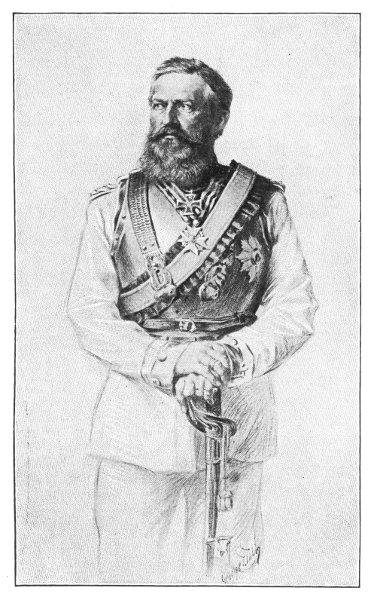
The Crown Prince Frederick of Germany, in the Uniform Worn by Him at the Jubilee Celebration, London June, 1887 From a photograph by Loescher & Petsch Berlin
To H. L. K.
London, June 24, 1887.
Yesterday I had rather a quiet day, I was still so dead tired after the children's fête. Jean and I drove about in the afternoon. She wanted to see the "Black Queen," as the Queen of the Sandwich Islands is called, and we crossed her once or twice driving in the Park. It does look funny to see her sitting up in the Royal carriage with red liveries. We had a beautiful ball last night, given by Lord and Lady Rosebery at Lansdowne House for all the Royalties. The House was beautifully arranged; the ballroom panelled half way up the wall with red roses and green leaves. I danced a quadrille with the King of Greece, who is easy and talks a great deal; he speaks English perfectly well. He asked about the Schuylers, and spoke most warmly of them—said Schuyler was one of the few perfectly intelligent men he had ever met, "knew everything about everything," I must write it to them. The supper was very well arranged, small tables of eight or ten. Almost all the Royalties were there, but not the Hawaiian Queen. I asked our host why he hadn't invited Queen Kapiolani; but he said he really couldn't. The ball was small, and Lady Rosebery left out many of her friends, who naturally were not pleased. W. actually stayed to supper—I was so surprised, as he hates it.
June 24, 1887.
This afternoon all the swells went to Ranelagh to see a polo match, but I thought I would reserve myself for the Palace Ball. The Queen didn't appear, but we had two others, the Queen of the Belgians, and always Kapiolani. It was badly managed at first, the result being that when the Court came we had a crowd of people, officers, pages, etc., about four deep in front of us, so that we could neither see nor be seen, nor hardly move. When the first "quadrille d'honneur" was being danced we saw nothing, so after a consultation we all left the ball-room. Then there were various "pourparlers," and they finally did what they should have done at first, enlarged the circle, so that we were out of the crowd and near the Court. There was also a great rush at supper, so that they had to shut one door for a moment. I didn't see many people to talk to, but of course it was very difficult. The Grand Duchess Serge looked beautiful, with splendid emeralds (she is the daughter of Princess Alice), and the Duchesse de Braganza (daughter of the Comte de Paris) was charming, so very high-bred, tall and slight, with a pretty little dark head. I always find the Princess of Wales the most distinguished looking. She stands out everywhere. Our "Doyenne," Countess Karolyi, was superb—also with magnificent jewels. The Indian Princes made a great show, of course, with their silk, heavily embroidered tuniques, and the quantities of jewels, but they are not often well cut, nor well set, and they themselves are certainly off color—they look barbarians, and have such false faces—I wouldn't trust one of them.
London, July 3, 1887.
It is delicious summer weather now, and yesterday we went to Buckingham Palace to see the Queen review the Volunteers. I wore for the first time my Jubilee Medal. It came Friday with a note from the Duchess of Roxburghe saying the Queen hoped I would wear it as a souvenir of her Jubilee. It is a plain little silver medal about the size of a two-shilling piece, with the Queen's head on one side and an inscription on the other, fastened to a bow of blue and white ribbon. We three Ambassadresses are the only women of the Corps Diplomatique that have it. All the Queen's household have it, Duchesses of Bedford, Buccleuch, Roxburghe, etc. The Princesses, also, of course, but theirs are in gold.
It was most amusing waiting in the courtyard of the Palace seeing everyone arrive. All the Royalties took up their positions at the foot of the Queen's tribune, and waited for her. Our tribune was on one side of hers, and one for the Indian Princes opposite. The Volunteers looked and passed very well; as it was Saturday afternoon and the shops in London are closed early always Saturday, all the various butchers, bakers, and candle-stick-makers could leave their shops and parade, and extremely well some of them looked; stout, heavy men moving quite lightly and at ease in their stiff uniforms. It was pretty to see the various Princes break away from their places on the Duke of Cambridge's staff and ride ahead of the various regiments of which they are honorary colonels. The Prince of Wales looked well on his handsome chestnut, which is perfectly trained and steps beautifully. The Duke of Connaught is a handsome soldier. We were a long time getting away, but as we had no dinner-party it wasn't of any consequence. It was such a pleasure not to put on a low bodice and diamonds. I always grumble about putting on my diadem—as a rule I never wear anything in my hair, not even feathers (except at Court), and the diadem is heavy. After dinner W. and I went for a drive along the Thames Embankment—our favourite recreation after a long, hot day. There are still people about, and a general air of festivity.
London, July 21, 1887.
It is just four years to-day since W. came to London. We got back from Moscow and the Coronation the 6th, and almost immediately the Minister offered W. London. My "beau-frère" said he would give us two years when we came over. I wonder how much longer it will last. We had a big dinner to-night, and Lord Lathom, the Lord Chamberlain, was next to me. He said no one could imagine how difficult it had been to arrange everything for the Jubilee ceremonies; that the Queen was consulted on every point, as she knew more about etiquette and court ceremonies than anyone else. One day he had 42 telegrams from her. We told him we thought everything was well managed (except the ball, where all the young officers crowded in front of us, and stepped on our toes, and on our trains). He quite admitted that that might have been better done, but also remarked that he thought the Corps Diplomatique a little exacting; so, as usual, there are two sides to every question.
To H. L. K.
London, July 25, 1887.
We have had a nice outing, Dear, thanks to the Naval Review; two such beautiful interesting days. I am burned brown as a berry, but, as the season is over, that is of no consequence, and I shall have plenty of time at Bourneville to bleach. We started Saturday at 9.30 for Portsmouth with the Florians, Waru, and R., Naval Attaché, in a special train. The harbour looked so pretty as we came in sight of it. Every description of vessel (even the "Victory," Nelson's old ship, now a training ship), and all sorts of ironclads, big steamers, yachts, and the smallest sort of pleasure-boat, dressed with flags. We went at once on board the "Helicon," a small despatch boat, especially destined to the Corps Diplomatique and distinguished strangers. There were about 150 people on board, all colleagues, also the Arch Duke Regnier of Austria, and the two young sons of the Duc d'Aoste with their suites. Directly after us came two great English transports painted white, one for the Lords, and one for the Commons, and all around us a fleet of ordinary rowing-boats and barges filled with people—quantities of women and children. We steamed slowly across the Solent to Osborne to meet the Queen, and passed close to the great ironclads, which looked monsters, and formidable ones. We had a handsome substantial lunch on board, to which we all did honour. There were not many foreign ships. Our two looked very well and were much admired, an old frigate, the "Iphigénie," now a training ship, with the midshipmen on board, and the "Élan," a pretty little despatch boat. There were only two other foreign boats: a German and a Dutchman. The Italian ships put into Spithead, and then went off to Dartmouth, no one knows why exactly. Some say they were not satisfied with their place (they arrived after the French ships, and would have been decidedly farther off, and behind ours), others that they were not in good condition, not smart enough; however, they were not there and the Italian Princesses who had expected to sleep on board, and meet their brother who is on one of the ships, were much disgusted. As soon as the "Osborne," with the Queen, the Prince of Wales, and the King of Greece (we didn't understand the Greek flag at first, as we didn't know the King was on board), had passed, we followed and went down the line. It was a beautiful sight, and England could certainly be proud of her great ironclads filling the harbour, and showing her strength as a naval power. We went slowly, and it was amusing to hear the criticisms and appreciations of all the assembled foreigners on the show—however, I suppose all ironclads now are pretty much alike, only England happens to have three times as many as any of the rest of us. About 6 o'clock there was a halt. We of course had tea on deck, and suddenly we saw quantities of steam launches coming across the water in all directions. They looked like enormous white birds in the distance. They were almost all white, low in the water, and going very fast. The captains of all the ships had been called on board the Queen's yacht to be received by her. This made a long delay, and our colleagues were getting impatient, as they foresaw that they would be very late in getting back to London. We took that opportunity to ask the Captain of the "Helicon" to bear down toward the "Iphigénie," as we were to dine and sleep on board. We changed our course a little, and in about 10 minutes two very smart French boats ran alongside, coming up in grand style. The three English officers stood on the bridge and helped us off, and I must say it was all done admirably—not the slightest confusion, and we were a big party. Our fellow-passengers decidedly envied us. The Bylandts (Dutch Minister) were much put out. They had asked the Captain of their ship to let them dine and sleep on board, but he refused absolutely; said he had just arrived from a long cruise, and was not prepared to receive anyone. We got to the "Iphigénie" in about 15 minutes. The Commandant, Noccomore, was standing on the bridge. W. got out first, then T., and as soon as W. put his foot on the deck, where all the sailors, officers, and midshipmen were drawn up, there was a salute of drums and clarions (they couldn't give the regular salute of guns to the Ambassador, as, when the Queen is in the harbour, no one else can be saluted). The Commandant gave me his arm, and we went at once to his quarters (or rather "carré," as they say on board ship). We passed through a fine room or hall, the entire width of the frigate, where a good-sized dinner-table was ready. The Commandant asked when we would dine; we said in a "quart d'heure," just the time to wash our faces, which were black with smoke and red with sun, and he showed W. and me our quarters (his of course), and most comfortable. The cabin large, with a wardrobe, and a large "cabinet de toilette," with English wash-stand, bath-room, etc. For one person it was perfectly roomy. Of course when a second bed was put in the "cabinet de toilette" it was a little small. Mmes. de Florian and Heurtel had the second officer's cabin, and the men hammocks in some part of the ship.
The dinner was good and handsome. I had the "Aumônier" on the other side of me. He was intelligent, ready to talk about anything, and the dinner was very agreeable. Plenty of talk. W. talked a great deal, and the naval officers were interesting, as they always are. They have seen so much, and had such varied experiences. After dinner we had coffee in the Commandant's salon, and then went on deck, where we spent a delightful evening. The sea was perfectly calm, not a ripple, and lights everywhere—all the ships illuminated and sending off fireworks at intervals. We could hardly see our own, but the little "Élan" looked very smart and natty. We broke up about 11, and I don't know when I have enjoyed anything so much as that perfectly quiet summer night on the water; such a rest after the long day, and early start from London. We promised to be ready at a quarter to 10 for Mass, and the visit of the ship. You would have been amused to see how well Drejet did my service (they asked me if I could do without my maid for one night, as they really didn't know what to do with her). He told Adelaïde he could do everything for me except my hair, and tying my sash, which seemed to be a serious performance to him, and really all my dressing things were put out and a "saut de lit" disposed gracefully over the back of a chair just as A. always did. I supposed she coached him. I was stirring early enough the next morning, but I couldn't tie my sash either, so I wandered out on the deck to have my early tea, and Countess de Florian helped me to finish my toilette. We went all over the ship before Mass. The midshipmen's quarters are small, but of course beautifully kept, and the young men all looked as smiling and prosperous as possible, and were much pleased at the Ambassador's visit. At 10 o'clock we assembled on deck for Mass. Part of the deck was covered in with flags, and as a compliment to my nationality they had put the "Stars and Stripes" immediately over my head. I was much pleased, as it is a good many years since I have sat under the old flag. I suppose I can't say my flag any more, but I feel it all the same. There were three armchairs directly in front of the altar—two big ones for W. and me and a smaller one between for the Commandant.34 As soon as we were seated the Abbé came, made a bow to W. and me, and began his Mass. It was very impressive—so still, not a sound except the little waves beating against the side of the ship, and the word of command for the marines at the raising of the Host, when there was a fine salute of drums and bugles. We had a very gay breakfast, the Captain of the "Élan" coming to join us, and at 1 o'clock we left our hospitable frigate for the "Élan" which was going to cruise about with us all the afternoon. They certainly received us most hospitably and charmingly; I shall often think of those quiet hours on the deck, and the Mass this morning, which impressed me very much. We had a lovely afternoon on the "Élan," practically doing the Review over again, and going close up to the big ironclads, such ugly, heavy masses as they seem when one is near them. We crossed over to Cowes, went alongside of the Prince of Wales' yacht, but didn't stop. The captain gave us an interesting account of their reception on the "Osborne." It seems there was some mistake in the orders brought by the Aide-de-Camp of the Admiral of the Fleet. The Commandant of the "Iphigénie" thought he could take several officers with him, and when he appeared on the "Osborne" with 5 or 6 officers, the Admiral was much embarrassed, and didn't know what to do, as the Queen intended to receive only the Commandants. However the Prince of Wales, with his never-failing tact, said he would put it all right, and in a few moments they were told that the Queen would be very pleased to receive all the French officers. They told us they saw a lady in deep mourning, with perfectly white hair, standing behind the Queen, who looked so earnestly at the French uniforms, and was agitated when they passed; they only realised afterward that it was the Empress.[9] I wonder if I shall ever see her, I would like to so much. We dined on board, anchored just off Portsmouth, and got back to London about 11 o'clock, having enjoyed our two days immensely. It was a beautiful ending to the Jubilee, and a beautiful sight. The "cadre" was so lovely for all those big ships. All the line of the Isle of Wight is so pretty, beautifully green, and the Solent covered with boats of all descriptions, and plenty of room for all. Some of the small row-boats seemed dangerously near the big steamers, but nothing ever happened. When I get back to Bourneville and take up my quiet life in the woods, these last days will seem a sort of fairy-tale.