Part 2 — TEN YEARS IN ENGLAND
Reading edition
To G. K. S.
Boulogne-sur-Mer, August, 1883.
Here we are after all settled for a month at the sea. I really needed the change and the sea-air after the fatigues of Moscow, and I was glad to get out of my own house, which is still crowded with boxes and huge cases labelled Waddington Couronnement, which now will not be unpacked, but go direct to London, as all the Court dresses, gala liveries, harness, etc., will be needed there.
We decided just at the last moment to come here, and consequently couldn't get a house near the big hotels in the real "quartier des baigneurs," so we have taken one quite the other end of the town near all the fishing boats. They are a never-failing attraction. We love to see them go out, and, above all, come in, when all the women, bare-legged, and with flat baskets on their backs, go out to meet them and bring in the fish. W. wanted us to come here, as he was in London and thought he would often get over from Saturday to Monday.
I made my first visit to the Embassy on the 15th of August (Journée de l'Assomption). W. thought I had better come over and see the house before arriving in November to take possession. We started quite cheerfully. It was warm and bright with a good breeze—a few white-caps, but nothing out of the way. We saw the boats dance a little as they came in, but didn't realise what a gale was blowing until we got on board of ours. The wind was howling through the rigging, and the Captain told us he couldn't start, as the wind was blowing the water off the bar. It increased very much while we were waiting, and several passengers left the boat and stayed over in Boulogne until the next day. However we had promised to go; we are fairly good sailors, and W. had just two idle days he could give us in London—so we started. It was certainly the worst crossing I have ever made. The boat rolled and pitched terribly, we shipped heavy seas all the time, and arrived at Folkestone shivering and drenched. All the way to London we felt little streams of water running down our backs, and our hats were a curiosity—filled with water like a bowl. We emptied them on the quay, but the feathers, of course, were finished. We were met at Victoria by two swell young secretaries, in evening dress, with gardenias in their button-holes, who had come to meet their Ambassadress; and I have wondered since what impression they had of the limp, damp, exhausted female they extracted from the reserved saloon carriage. It was only a few minutes' drive to the Embassy at Albert Gate, where we were received by a stout porter and a most distinguished "groom of the chambers," dressed in black, with a silver chain around his neck. We dined alone in a fair-sized dining-room, with splendid Gobelin tapestries on the walls. W. came in about 11, having had a man's dinner with Gladstone.
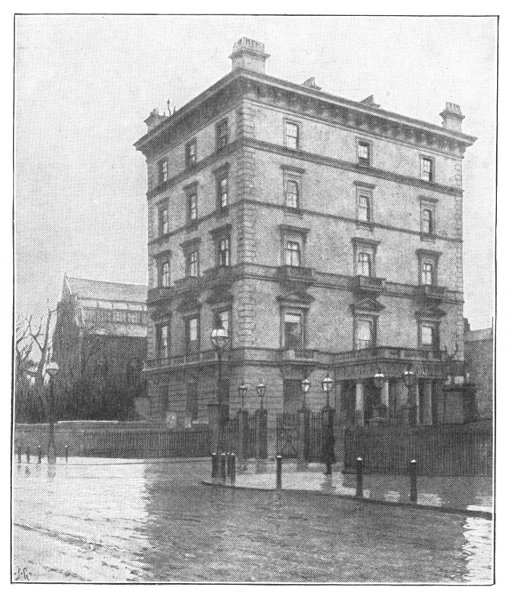
The French Embassy, Albert Gate, London
The next day we went all over the house, which is neither handsome nor comfortable. It is high and narrow, like a cage, with no very large rooms, and a general appearance of dinginess and accumulated dust. However, the Minister has promised to paint and clean, and to do over the small drawing-room entirely, just as I like. Of course I shall have blue satin—you remember how I always like blue everywhere, on me and near me. The situation is delightful, on the Park—just at Albert Gate. The windows and balconies of the drawing-rooms give on the drive, and the "Row" is so near that I could easily recognise horses and riders. The season is practically over, but I have just seen a pretty group pass; a lady mounted on a fine chestnut and a child on each side of her on nice, small fat ponies; close to the little girl, about eight years old, with her fair hair streaming down her back from under a blue cap, rides an old groom, evidently much pleased with his little lady's performance, and watching her so carefully.
Our inspection of the house took us all the morning. The kitchen, offices, servants' hall and rooms are enormous, and in very bad order. I should think it would take weeks to get it clean and habitable, and need an army of servants to keep it so. I am thinking rather sadly of my little hotel in Paris, so clean and bright, with not a dark corner anywhere.
We went out driving in the afternoon, and I had my first experience as Ambassadress, as the coachman drove down Constitution Hill—a right of way reserved for Royalties and the Corps Diplomatique. We went straight to Mrs. Brown, the famous milliner, in Bond Street, to get ourselves new hats, as ours were quite impossible after our very lively passage, and the housemaid at Albert Gate had a handsome present of two hats with drooping feathers and a strong smell of sea and salt. London was of course empty, but a few carriages were in the park, and it amused us to drive about and see all the shops, and the general look of the streets, so different from Paris.
We spent our evening quietly at home looking over our installation with W., horses, carriages, servants, and in fact the complete organisation of a big London house, which is so unlike a French one. I shall bring over all my French servants and add as many English as are necessary. I don't quite see Hubert, our French coachman, driving about the London streets, and keeping to the left. I should think we should have daily discussions with all the drivers in London; however, we must try. I wonder if I shall like being an Ambassadress, and I also wonder how long we shall stay here. My brother-in-law R. says perhaps two years.
We got back three days ago—started on a bright summer's day. The Ambassador and secretaries came down to the station to see us off, and W. promised to come over and spend Sunday. We had an ideal crossing—blue sky, bright sun, and few passengers, and, notwithstanding our hard experience in the first passage, we are glad to have been over and made acquaintance with the personnel of the Embassy, also to have seen the house and realized a little what I must bring over to give it a look of home.
This morning we have the news of the Comte de Chambord's death, and I am wondering if it will make any political complication. However, for years past he has only been a name—a most honourable one certainly—but one wants more than that to deal with the present state of France.
After all W. never came over. Although London was empty, he had always some business to attend to, and on Sunday usually went to see some friends in the country. Last Sunday he spent with Lord Granville at Walmer, which he said was delightful. The castle so close to the sea that the big ships passed almost under the windows; Granville himself a charming host. He knows France and the French well, having been a great deal in Paris as a boy when his father was British Ambassador to Louis Philippe (1830-4); Lord Palmerston was then British Foreign Secretary.
We are very busy these days making our "pacquets," as we leave in three days. I am sorry to go, as I have so much enjoyed the quiet life with the sisters and the children. We have seen few people, as we are not in the fashionable quarter, but we have become most intimate with all the fishing population. The young women and girls jibe at us when we go shrimp fishing, on terms of perfect equality—there are no distinctions in the sea—because we have not the sleight of hand necessary to jerk the shining, slippery little fish into the basket from the net. Some local swell, the Mayor, I think, came to see me the other day, and was told I was on the beach, so he came down and was much astonished when they pointed out to him Madame l'Ambassadrice in a hat and feathers, diamond ear-rings, very short skirts, and neither shoes nor stockings, walking up to her knees in the water with a fishing-net in one hand and a basket in the other, and followed by her little son and niece similarly equipped, all quite happy and engrossed with their sport. We have one or two country visits to make, and then I must have some time in Paris to dismantle my house and make my preparations for London.
To J. K.
Mersham Hatch, Ashford, Kent, Wednesday, November 28, 1883.
You will say I am taking up my old habits of writing to you always from the country, but you cannot imagine how busy I have been in London since I came over just 2 weeks ago to-day.
We came down here Monday afternoon to stay with W.'s old college friend and cousin, Charles Monk. The house and park are charming—quantities of large, comfortable rooms, and capital shooting. The gentlemen brought down a great many pheasants yesterday. The party in the house are Lord and Lady Abinger and Miss Scarlett, Sir George and Lady Chetwode, Mr. Leveson-Gower, a brother of Lord Granville, with a most polished courteous manner; a Mr. Price W. Powel, and a young Wm. Gladstone, nephew of the Premier. Monk has no wife, and three unmarried daughters; the eldest, Julia, does the honours very well and simply. I absolutely declined the 9.30 breakfast and asked to have my tea sent up to me.
Yesterday I came down about 12, took a little turn in the garden until one, and at 1.30 had luncheon. Then we went for a drive to Eastwood, the Duke of Edinburgh's place. The house is not so large as this, but the park is charming, with quantities of deer. We had tea when we came in—some of the gentlemen appeared and we dined at 8, all the ladies most gorgeous in satin, lace, and diamonds, the girls generally in white. After dinner we talked a little, then some of them played whist, and the young ladies sang. This morning the gentlemen have started again shooting, and I shall sit in my room quite quietly until 12, which gives me an hour and a half with the ladies before luncheon.
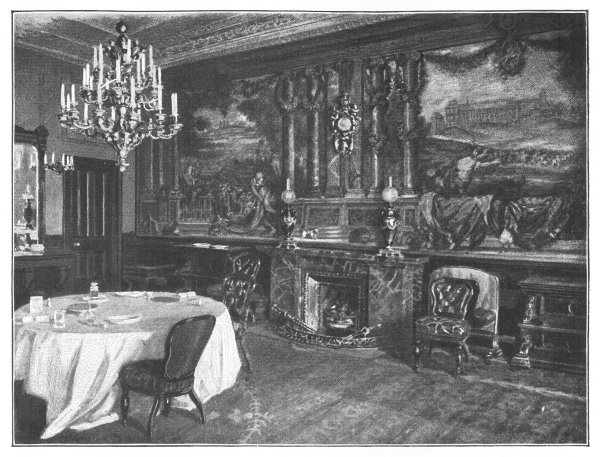
The Dining room of the French Embassy, London, Showing its Two Famous Gobelin Tapestries
Thursday, 29th.
W. is off again "running for partridges," whatever that may mean, and at 3 we go back to London. He has a big dinner somewhere to-night. Yesterday two ladies came over to luncheon, and in the afternoon Julia Monk and I took a drive in the pony carriage to meet the sportsmen, who had a very busy day. In the evening we made a little music, Miss Scarlett played very well. I expect to be very busy all this next week in London. The workmen will be out of the drawing-rooms, and I shall get all kinds of little odd tables and chairs and unpack my own bibelots. The carriages arrive, too, and we must decide about horses. Two English giants are engaged as footmen, of equal height, to go on the gala carriage, and we have our own two Frenchmen, one of whom is very tall. He and Adelaïde came down here with us, and Adelaïde is much entertained at the respect with which she is treated. She looked quite a swell yesterday with her black silk dress, but she says the other maids are much more dressy, attired in black velvet and satin and open dresses. Soon there will be nothing left for the mistresses.
I will stop now, as I must be down a little earlier this morning. I hope you will soon be settled in Washington, and that the children will have no more scarlet fever or measles complications.
To H. L. K.
French Embassy, Albert Gate, December 1, 1883.
I am gradually settling down, but everything, hours, service, habits, servants, is so different that I still feel rather strange. I quite sympathised with Francis, who was already unhappy at leaving Paris and his dear "Nounou," and very much put out with his new German governess who was deadly ill crossing. His woes culminated on arriving at Albert Gate, when he was solemnly conducted upstairs by a very tall footman to his room (a nice large nursery and bedroom giving on the Park), and he wept bitterly and refused to eat any dinner or to have his coat and hat taken off. A great many people have been to see us, and we shall have some quiet dinners—and a shooting party at Mr. Monk's one of these days.
The shooting party at Mr. Monk's was pleasant. He has a fine large house and capital shooting. The ladies walked about a little and followed some battues, and everyone assembled in the drawing-room for tea. All the women in full dress and diamonds for dinner.
Our Harcourt dinner was pleasant. Sir William is charming—such an easy talker, with no pose of any kind. It is decided that Lady Harcourt presents me to the Queen. Lady Granville is away, and it falls upon her as wife of the Home Secretary. Sir William had been to Windsor, and had told the Queen of the curious coincidence—the French Ambassadress, an American, presented by the wife of the British Home Secretary, also an American,[8] and an amie d'enfance of Mrs. Waddington. I had some little difficulty in finding out what I was to wear (as there is little etiquette at the English Court upon these occasions), but they finally told me ordinary visiting dress, so I shall wear my blue velvet. We go down to lunch and see the Queen afterward.
December 7, 1883.
I have had my audience to-day, and will write to you at once while I still remember it all. First I must tell you about Francis. He heard someone asking me the other day if I had been yet to see the Queen. I saw his face change a little, so when we were alone, he said, tremulously, "Tu vas voir la Reine?" "Oui, mon fils." "Est-elle toujours si méchante?" "Mais la Reine n'est pas méchante, mon enfant." "Elle ne vas pas te faire couper la tête?" Evidently his mind had been running on the Tower of London, where we went the other day, and where the block on which Anne Boleyn and Lady Jane Grey had their heads cut off was of course shown. When he heard I was going to see the Queen, his heart failed him, and I had some difficulty in comforting him, and explaining that sovereigns in these days didn't have recourse to such extreme measures (at least in civilised countries. I suppose the Shah of Persia wouldn't hesitate to dispose of a head that was in his way).
Lady Harcourt and I started for Paddington at 1 o'clock, and got to Windsor a little before two. We found a landau with two servants in plain black liveries waiting for us, and we drove at once to the Castle. It was a beautiful bright day, but snow had fallen heavily in the country, so that the old gray walls and round towers stood out splendidly as we drove up. We drove through several courts and finally drew up at an entrance where there were five servants in the royal red liveries with crape on their sleeves (all the Queen's household are always in mourning), a big Highlander in full dress, and a butler in black who ushered us into a large drawing-room with an enormous bow-window looking on the Park. Instantly there appeared Lady Erroll, lady in waiting, and four maids of honour. Lady Erroll shook hands and introduced the maids of honour, who made us low curtseys. Then came Lord Methuen—Lord in waiting—and we went at once in to luncheon. Everything was served on silver plate; there were four footmen and a butler, but the repast was of the simplest description—an ordinary English luncheon—roast mutton, fowl, pudding, apple-tart, etc. After luncheon we talked a little, and then Sir Henry Ponsonby appeared to give Lady Harcourt her last instructions. It was the first time she had presented an Ambassadress in a private audience. Precisely at three a servant in black appeared and said, "Will you come to see the Queen?" Lady Harcourt, Ponsonby, and I proceeded down a handsome long corridor filled with pictures, vitrines, of china principally, and old furniture, to a room at one end where a footman was standing. Sir Henry opened the door, Lady Harcourt made a low curtsey at the threshold, saying, "I have the honour to present the French Ambassadress," and then immediately backed herself out, and I found myself in the room. I made a first low curtsey, but before I had time to make another the Queen, who was standing in the middle of the room with Princess Beatrice, advanced a step, shook hands, and said, with a very pretty smile and manner, "I am very glad to see you." She asked me to sit down, and talked a great deal, was most gracious, asked me if I was getting accustomed to the climate and the stairs, whether I had seen all my "colleagues," and how many children I had. When I said one little boy whom I had left in London, she asked me what he was doing; I thought I would tell her about his fears for his mother's head, so I replied he was trembling at home until his mother should return. She looked a little surprised, but was really amused, and laughed when I told her his preoccupations; said, "Poor little boy, how glad he will be to see his mother back with her head on her shoulders."
Princess Beatrice took no part in the conversation. She looked smiling and very intelligent. The Queen was very simply dressed in black, with her white widow's cap and veil, no ornaments, but a gold chain and pearls around her neck, and a medallion with a portrait of a man in uniform, whom I supposed to be Prince Albert. I think the interview lasted about fifteen minutes. Then the Queen arose, shook hands, and said she hoped my husband and I would like the life in England. Princess Beatrice shook hands—I backed myself out, and it was over. I was very much impressed with the Queen's personality. She is short, stout, and her face rather red, but there is a great air of dignity and self-possession, and a beautiful smile which lights up her whole face.
I never could find out any minor details in dress, as to taking off veil, gloves, etc., but I did as I had done with other Royalties and took off veil and gloves, which I hope was right.
Lady Harcourt and Ponsonby were waiting for me in the corridor, and seemed to think my audience had been longer than usual—were also surprised that the Queen made me sit down. It seems she sometimes receives standing all the time, at a first formal presentation.
As we had some little time before starting for the station, Ponsonby showed us part of the Castle. The great halls, St. George's and Waterloo, are very fine, and it was interesting to see the great pictures which one has always seen reproduced in engravings—the Queen's Marriage, Coronation, Reception of King Louis Philippe, Baptism of the Prince of Wales, etc. One room was beautiful, filled with Van Dycks. We went back to the station in the same carriage, and Lady Harcourt and I talked hard all the way home. It was certainly a very simple affair; as little etiquette as possible, but the Castle was fine. The old gray fortress and its towers and crenellated walls, the home of the sovereign who lives there with little pomp and few guards—guarded by her people, in the same Castle, and the same surroundings as when she began her long reign, a mere girl. When one thinks of all the changes she has seen in other countries—kingdoms and dynasties disappearing—one can realise what a long wise rule hers has been. It is such a contrast to my last Royal Audience at Moscow, which now seems a confused memory of Court officials, uniforms, gold-laced coats, jewelled canes (I can see one of the Chamberlains who had an enormous sapphire at the end of his staff), princes, peasants, Cossacks, costumes of every description, court carriages, Russian carriages, the famous attelage of three horses, every language under the sun, and all jostling and crowding each other in the courts of the Kremlin—with its wonderful churches and domes of every possible colour from pink to green—only soldiers, soldiers everywhere, and the people kept at a distance—very unlike what I have just seen here.
Sunday, December 16, 1883.
This afternoon we have had our audience of the Prince and Princess of Wales—W. and I together. We got to Marlborough House a little before 4, and were shown at once into a room on the ground floor, where we found Miss Knollys and a gentleman in waiting. In a few minutes Sir Dighton Probyn, comptroller of the household, appeared and took us upstairs to a large, handsome salon. He opened the door, and we found the Prince and Princess standing. The room was filled with pretty things. The Princess was dressed in blue velvet (I too—I daresay Fromont made both dresses), and looked charming, no older than when I had seen her in Paris three or four years ago, and with that same beautiful slight figure and gracious manner.
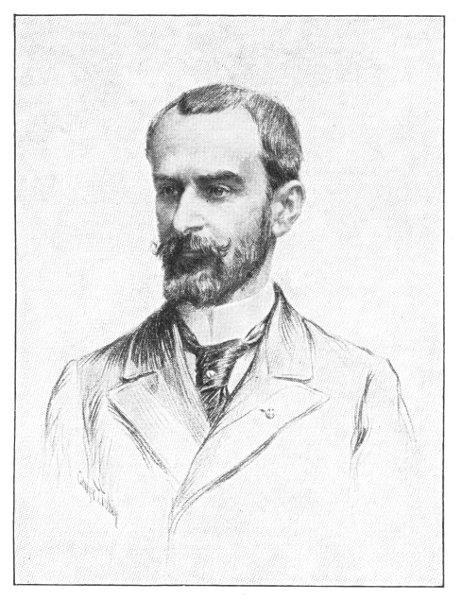
J J Jusserand Counsellor of the French Embassy, 1883 Recently appointed French Ambassador to the United States From a photograph by Walery, Paris
While the Prince and W. were talking she asked me a great deal about Moscow and the Coronation, and particularly if the Empress was well dressed always, as she had been rather bothered with the quantity of dresses, manteaux de cour, etc., that she was obliged to have. The Prince remembered that I was the granddaughter of Rufus King, who had been United States Minister to London under George III. He was very pleasant, with a charming, courteous manner. The Princess instantly referred to Francis and his fears for his mother's head, of which she said the Queen had told her.
Friday, 21st.
This afternoon we had tea with the Duke and Duchess of Albany. She is a German Princess, and was rather shy at first, but when the tea came it was easier. The Duke is very amiable, talks easily. He looks, and is, I believe, delicate. We have a few dinners before us, and I am gradually getting to know all my colleagues. Mohrenheim is Russian Ambassador; Münster German; and Nigra Italian. Münster is practically an Englishman. His second wife was Lady Harriet St. Clair, a sister of Lord Rosslyn. He is evidently English in his tastes and habits, rides regularly in the Park, and drives a coach with four chestnuts that are known all over London. Mr. Lowell is United States Minister, and is much liked and appreciated in England. Mrs. Lowell is in bad health and goes out very little.
To H. L. K.
Albert Gate, January 5, 1884.
This afternoon we had our audience from the old Duchess of Cambridge. We found her in handsome rooms in St. James's Palace, and one lady in waiting with her. She was lying on a sofa—she is very old, eighty-four—has seen and known everyone, and talks easily both French and English. It really seemed a page of history to listen to her. She asked us to come back, and Lady G. told us that when she felt well, visits were a great pleasure to her, and also that she was always glad to see any members of the French Embassy.
We got home to tea—and then I had various skirmishes with the servants. It really is difficult to make French and English servants work together. The butler is an Englishman, and directs all the men of the house. It is not easy to make the Frenchmen take their orders from him. They all want to be in direct communication with me. There are always two together in the hall—one Frenchman and one Englishman, and the result of that is that when anything goes wrong, and the bell is not answered, the Frenchman tells me he was not there, it was the Englishman's turn; and of course the Englishman the same—so now I have told Holmes (the butler) to make me out a regular paper every Monday with the men's names and their hours of service—Yves et George, 10-12; William and Charles, 12-2—I hope that will work. As to Hubert he hasn't driven me yet. He goes about London all day in a brougham, with one of those non-descript English servants, half French, half English, that we got from the British Embassy in Paris. I find the domestic part of the Embassy rather a bore, but I suppose things will settle down. The housemaids are a delightful institution, though I was amazed upon inquiring one day from my own maid as to who was a young lady with a red velvet dress, and a large hat and feathers, I had met on the stairs, when she replied, "C'est Alice, Madame, la seconde fille de chambre." It seems that my maid remonstrated with her for spending her money on clothes, to which she replied that all housemaids in big houses dressed like that, and that she herself would be ashamed if she dressed as plainly as my maids. The two thrifty Frenchwomen were scandalised.
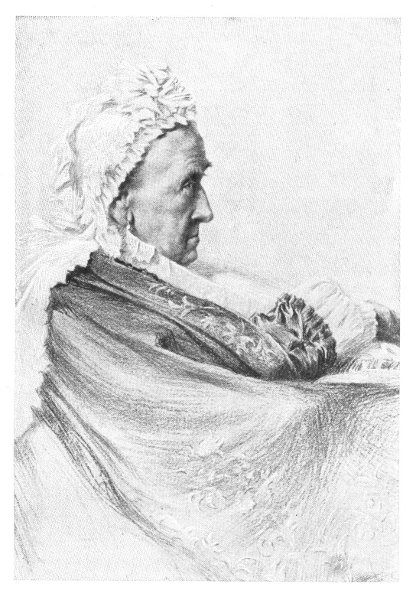
The Duchess of Cambridge From a photograph by Walery London.
London, January 9, 1884.
I paid a visit to-day to the Dowager Lady Stanley of Alderley. I found her at her tea-table in her drawing-room, with Mr. Gladstone having his cup of tea with her, and talking easily and cheerfully about all sorts of things (never a word of politics); no one would have imagined that he was to make a great speech that evening in the House. He really is an extraordinary, many-sided man. In the course of conversation the talk fell upon the Roman Catholic religion, and its extension in many countries, particularly in America. He said, turning to me, that a great friend of his, an American, Mr. Hurlbert, certainly the most brilliant talker he had ever heard, and one of the most intelligent, had told him how much the Roman Catholic religion was gaining ground in the Northern States of America. I rather demurred to his statement, even though it came from Mr. Hurlbert. His intelligence and brilliancy are undeniable, but I should have thought his views were a little fantastic at times. "I rather agree with you," said Mr. Gladstone; "but I have recently had letters from my friends Bishop P. of New York, Bishop A. of Massachusetts, and other distinguished Churchmen in the United States, who tell me that the Roman Catholic religion is making certain progress; their preachers are so clever, and know so well how to adapt themselves to the liberal views they must have in America." We then talked some time about the various Bishops and clergymen he knew in America, the slight difference between the two Prayer Books, etc. One would really have thought it was a Church of England clergyman, who has passed all his life studying theological questions. A few moments after something turned his thoughts in another direction, and he was discussing with Lady Stanley the translation into English of an Italian sonnet which he thought was badly done. "Too literal, really not understanding the poetry, and the beautiful imagination of the writer." It was extraordinary. I was rather mortified when he asked if I knew the two Bishops. I didn't, but it is fair to say he understood when I said how many years I had been away from America.
Lady Stanley is a delightful old lady. She has seen and known everyone worth knowing in Europe for the last fifty years, and it is most amusing to hear her down-right way of talking. She was killing over the "Professional Beauties," a style of modern woman she couldn't understand. She asked me to come in again and have a cup of tea with her, and I shall certainly go, as one doesn't hear such talk every day.
We dined with Mr. Childers, and there was a big reception in the evening, with all the celebrities of the Liberal party, the Harcourts, Hayters, Lord Northbrook, Tennyson (son of the poet), and many others, but of course in a crowd like that one can't talk. I hope I shall remember the faces. About 11 o'clock we went on to Lady Stanhope's, where there was a big reception of the Conservative party. There I found the Lyttons and some few people I knew, and many more were presented. They were all talking politics hard; said the Ministry couldn't last another week, as there is to be a vigorous attack on them in both Houses on Tuesday. Everyone says the Lyttons are going to Paris when Lord Lyons leaves. She will be a charming Ambassadress, and he is so fond of France and so thoroughly well up in French literature that they will be delighted to have him in Paris.
The political talk was exactly like what I have heard so often in Paris, only in English instead of in French, and the men talking more quietly, though they abused one another well, and with less gesticulating. Also they don't carry politics into private life as they do with us; the men of opposite sides lavish abuse upon each other in the House, but there it ends, and they meet at dinner and chaff each other, and the wives are perfectly intimate. In France there is a great gulf between parties, even moderates, royalists, and republicans, and I was astounded when I first mixed in political life in France to see people in society turn their backs upon some perfectly distinguished, honourable gentleman because he had not the same opinion as themselves in politics.
To H. L. K.
Sandringham, January 12, 1884.
We arrived this afternoon at two o'clock, and I am writing in my room, as we have come up to bed, and the gentlemen have retired to smoke. We came down at 2½, found a saloon carriage reserved for us, and the Mohrenheims installed—father, mother, and daughter. We got to Wolverton at six, one of the Prince's gentlemen was waiting for us with two or three carriages and footmen. We had all sent our servants and baggage by an earlier train, as it had been suggested to us. The house looked large and handsome as we drove up. The party was assembled in a great hall, with a long low tea-table at which the Princess presided. It was easy enough, and I should think a nice party. The Goschens, Lady Lonsdale, the Master of Magdalen, Lord Carlingford, and others. The three young Princesses, Prince Eddy, and the Prince were all there. We talked some little time and then the Princess said Miss Knollys would show us our rooms. I found two large comfortable English rooms opening into each other, a blazing coal fire in mine, which I immediately proceeded to demolish as much as I could. Miss Knollys had told us not to bring low dresses—merely open bodices.
We went down to the drawing-room about 8½, and a little before 9 the Prince and Princess and Prince Albert Victor (better known as Prince Eddy) came in. The dinner was handsome and pleasant, footmen in royal red liveries, men in black in culottes and silk stockings, and a Highlander in full dress, who stood behind the Prince's chair, and at the end of the dinner walked solemnly round the table playing the bagpipes. The evening was pleasant. The Prince showed us the new ballroom just redecorated with Indian stuffs and arms, and at 11 we went upstairs with the Princess, bidding her good-night at the top of the stairs, and the men went to the smoking-room.
Sunday.
This morning we went to church, the ladies in an omnibus with the Princess and her three daughters, and the gentlemen walked across the Park, the Prince appearing as the sermon began. It is a pretty English country church in the grounds. In the afternoon we walked about the grounds; I was much interested in the large stables, where there are certainly over fifty horses.
We had changed our dresses after lunch for walking, and the Princess looked marvellously young in her short walking skirt and little toque. One could hardly believe she was the mother of her big son, twenty-one years old. After the walk we assembled again in the big hall for tea, a substantial meal with every variety of muffin, crumpet, toast, cakes and jam that can be imagined, but it seemed quite natural to consume unlimited quantities after our long walk. The Princess and English ladies were in very dressy tea-gowns, velvet and satin with lace and embroidery; Madame de Mohrenheim and I in ordinary tailor costumes. The evening was pleasant; I remarked the absence of the Highland piper at dinner, and asked the Prince if he was not going to play. "Oh, no," he said, "not on Sunday, he certainly wouldn't; I shouldn't like to ask him to, and if I did I am sure he wouldn't do it." We all leave to-morrow, the Prince going with us to London. We have enjoyed our visit very much, the Princess always charming and lovely to look at, and the Prince a model host, so courteous and ready to talk about anything.
Monday.
We got off this morning at 11 o'clock. There is one curious custom. The Prince himself weighs everyone, and the name and weight are written in a book. Some of the ladies protested, but it was of no use, the Prince insisted. One young lady weighed more than her father, and was much mortified.
I went downstairs to breakfast, which I don't generally do; I keep to my old habit of a cup of tea in my room. It was a most informal meal. None of the Royal family appeared, except Prince Eddy, who was going to hunt, and his red coat made a nice patch of colour. All the rest of us sat down anywhere, and the servants brought the menu. We travelled up with the Prince in his private car, and had luncheon in the car, served by two tall footmen, and everything on silver plate and hot. The Prince himself quite charming, talking a great deal, and seeing that everyone had enough to eat. I should think all servants, railway guards, and small functionaries generally would adore him. He has always a pleasant word and a smile.
To H. L. K.
Albert Gate, January 31, 1884.
We have had two days in the country with the D.s at their little hunting box at Bicester, one of the great hunting centres. It was my first experience of an English hunt and hunt ball, and amused me perfectly. The house is small, with enormous stables and splendid horses. His four in hand is well known, one of the best in England, and the coach and servants so perfectly turned out. We have two young German secretaries, good-looking Teutons, and two girls who have just returned from a four months' excursion in the tropics with the Brasseys in their beautiful yacht, the "Sunbeam."
We started on the coach on Tuesday at 10.30, well wrapped up, as there were occasional showers and violent gusts of wind, particularly when we stopped at crossroads to see which way the hunt was going. The meet was at Middleton Park, Lord Jersey's fine place, and the park was a pretty sight as we drove up. A good many people, almost all the men in pink, but not so many women as I had expected to see. We really followed very well, as D. knows the ground perfectly and apparently at what spot the fox was to cross the road, which he did close to us, followed by the whole hunt, all jumping out of the field on to the road and back again into the other field, very good fences, too, but the horses evidently knew just what they had to do. We drove about till 3 o'clock, and then went back to Middleton to have luncheon. We found a most hospitable table, and it was funny to see the people dropping in at intervals, some of the men in their red coats, one or two ladies, and two or three children who had been scampering about on ponies. Evidently the meal had been going on for some time, and the supply inexhaustible; we had a very good hot luncheon.
After lunch Lady Jersey (who is charming, very intelligent, and interested in everything) showed us the house. Beautiful pictures and old furniture, a massive silver table that was the dressing table of Queen Elizabeth. Of course we hadn't time to really see all the interesting things in the house, as it was getting late, and we still had a fair drive before us. Notwithstanding the good and late luncheon we were very glad to have tea when we got home. I certainly eat much more here, I suppose it is the climate, and then the food is a little different from what we are accustomed to, and I think very good.
The hunt ball was really very pretty, the ballroom well arranged with foxes' heads, brushes, etc., all the men in pink. Everyone was "en train," and everybody of all ages dancing. I should think W. and D. were the only men in the room who didn't dance. They went home about 12, but H. and I stayed until 2. We heard afterward that the Master of Hounds was much depressed all the evening, as he knew he must take the French Ambassadress to supper (of course, he didn't know that I was American born, and could speak English), and the prospect of a long conversation in French with a woman he didn't know filled him with dismay. However we made friends (in English), and I hope he didn't find the supper hour too tiresome. There are two reasons why an Englishman hates to speak French; first, a sort of natural timidity which they all have more or less, and then a decided objection to doing anything he doesn't want to do, or which bores him. This country is certainly a Paradise for men, from the nursery days when all the women of the household—nurses, maids, and sisters, are slaves of the boys, to manhood, when equally all the women do exactly what the men want, and regulate their lives to suit the men of the family, who have everything their own way.
London, February, 1884.
I made my début in the official world last night at a reception at Mr. Gladstone's in Downing Street. There were four large men's dinners (and receptions afterward) for the opening of Parliament. Lord Granville and Mr. Gladstone, Ministerial; Lord Salisbury and Sir Stafford Northcote, "Her Majesty's Opposition."
The Gladstone house is small and dark (that is one of the things that strikes me here—the rooms are so much less lighted than in Paris), and always the chintz covers left on the furniture, which makes the rooms look ordinary. We found a great many people there. The Duke of Cambridge had been dining and was presented to us. He looks a fine old English soldier (was in uniform), was very amiable, and spoke to me in French, which he speaks very well. Quantities of people were presented to me, I can't remember half the names. Almost all the women were in black, half-high and no display of jewels. Mrs. Gladstone is an old lady, very animated and civil, she wears a cap, with blue ribbons, rather as I remember Mother. I was also presented to Countess Karolyi, Austrian Ambassadress, very handsome, and charming manner; she speaks English as well as I do. It seems strange to me to hear so much English spoken, it is so long since I have been in a purely English salon. W. brought me up various old friends of Rugby and Cambridge days; also some of the minor diplomats, as of course I have not yet seen all my colleagues.
Albert Gate, February, 1884.
I am rather bewildered by the number of people I see and the quantity of cards left at the Embassy. I shall have to ask an English friend of mine to look over my list and tell me who the people are, and, above all, which cards I must return personally (or even make a personal visit) and which can be distributed by the Chancellerie. I drive about every afternoon for two hours leaving cards, and as no one has regular reception days here as in Paris, I rarely find people. We have had various dinners, political chiefly, at Mr. Gladstone's, Lord Stanhope's, Lord Northbrook's, a child's party at Marlborough House, which was very pretty. Francis made great friends with the two charming little daughters of the Duchess of Edinburgh, and sat between them at tea, the Duchess herself supplying them with cakes and sandwiches.
Yesterday there was a pleasant dinner at Lord Granville's. Two tables of 12; one presided over by him and one by Lady Granville. Her table was covered with red tulips, and his with yellow—nothing but flowers on the table. The drawing-rooms are large and handsome, and he has some splendid pictures. One thing seems curious to me—all the furniture at this season is covered with ordinary chintz housses or coverings—and the effect is strange with all the guests in full dress, diamonds and orders, servants in powder and breeches. We would never dream of doing it in Paris. When we have distinguished people of any kind to dine we make our salons as pretty as possible, and would want particularly to uncover our handsome furniture. Here it seems they consider that the season only begins after Easter.
Apropos of powder, it was rather an affair to put the two French footmen in powder, as they of course had never worn it or seen it. Francis was much excited at Yves' appearance in blue velvet breeches and powder, Yves being a young Breton, his own special attendant. I think the maids powdered him in the laundry. However Francis came flying downstairs holding the reluctant Yves by the hand, to my room, saying, "Oh, Maman, viens voir Yves, il est joli, joli!" with the youth naturally much abashed at being so complimented in my presence.
To H. L. K.
February 29, 1884.
We are commanded to Windsor this evening to dine and sleep. It is inconvenient, as we have to put off a dinner of twenty-one people. The chef is tearing his hair, as of course all his dinner is ready. When my maid came to pack the trunks she had rather a flustered look; I thought it was on account of the Windsor visit. Not at all. It seems a friend of Juteau's (our chef), who is also a chef in one of the great houses, heard that we were going to Windsor, so he wrote him a note telling him that his wife (my maid) must be well dressed and take a low or open bodice to Windsor for their dinner. The maid was most indignant for being supposed not to know what was right, and answered the note saying, "she had accompanied her mistress to every court in Europe, and knew quite well how to dress herself."
Windsor Castle, March 1, 1884.
Our dinner last night went off very well, and was not so stiff as I had expected. We took the 6 o'clock train from Paddington, and found the Russian Ambassador, Baron Mohrenheim, and his wife at the station. At Windsor two or three carriages and footmen were waiting, but no equerry as at Sandringham. We were driven to a side door at the Castle, where two servants in plain black were waiting, who showed us at once to our rooms. We had a pretty apartment furnished in yellow satin, with beautiful pictures, principally portraits; a small salon with a bedroom on each side, bright fires burning, and a quantity of candles. They brought us tea, beautifully served all on silver, with thin bread and butter (no muffins or toast), and almost at the same moment Sir John Cowell, Master of the Household, came to pay us a visit. He told us who the party was, said dinner was at 8.45, that a page would come and tell us at 8.30, and that we should assemble in the great corridor. Quite punctually at 8.30 they notified us, and we proceeded down the long corridor, W. in black breeches and stockings (no order, as he hadn't the Légion d'Honneur, and couldn't wear a foreign order), I in white brocaded velvet and diamonds. We found the party assembled, the Mohrenheims; Lord and Lady Kimberley; Nigra, Italian Ambassador; Lady Churchill (who was in waiting); Lord Kenmare (Lord Chamberlain), and Lord Dalhousie (Lord in waiting) and one or two other men. We moved up to a door just opposite the dining-room, and about 9 the Queen came with the Duchess of Edinburgh and Princess Beatrice. She shook hands with me and Madame Mohrenheim; bowed very graciously to all the others, and passed at once into the dining-room alone. Mohrenheim followed with the Duchess of Edinburgh; Nigra with Princess Beatrice; W. with Madame Mohrenheim; and Kimberley took me. The table was handsome, covered with gold and silver plate, quantities of servants in red livery, plain black, and two Highlanders in costume behind the Queen's chair.
The conversation was not very animated. The Queen herself spoke little, and the English not at all—or so low that one couldn't understand them—however, my Ambassador couldn't stand that long, so he began talking most cheerfully to the Duchess of Edinburgh about Moscow, Kertch, and antiquities of various kinds, and as the Duchess is clever and inclined to talk, that corner became more lively. I can't say as much for our end. I think most Englishmen are naturally shy, and the presence of Royalty (the Queen above all) paralyses them.
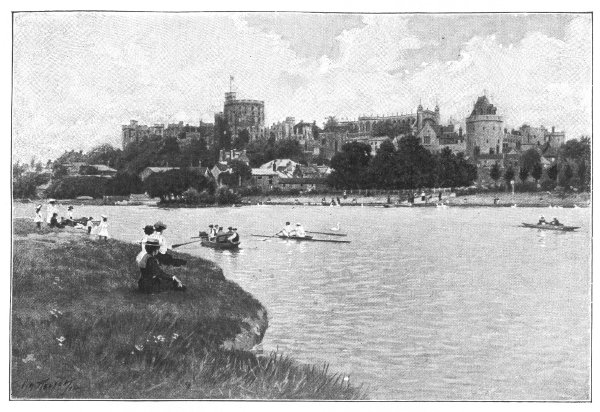
Windsor Castle
After dinner, which was quickly served, we all went out as we had come in, and the Queen held a short cercle in the corridor, in the small space between the two doors. She stood a few minutes talking to the two Princesses, while she had her coffee (which was brought for her alone on a small tray), and then crossed over to Madame Mohrenheim and talked a little. She sat down almost immediately, Madame Mohrenheim remaining standing. She then sent for me, Lord Dalhousie summoning us all in turn. She was very gracious, saying that she could not yet stand or walk, which worried her very much—asked me a great deal about my life in London, did I find everything very different from Paris, and had I found little friends and a school for Francis? The conversation was not easy. She sat on rather a low chair, and I standing before her had to bend down always. She was dressed in black, with her usual little cap and veil, opal necklace, diamonds and orders. While she was talking to the others the two Princesses moved about and talked to us. It was pleasant—the whole cercle lasted about an hour. The Queen and Princesses retired together, all shaking hands with me and Madame Mohrenheim, and bowing to the others. We finished the evening in the drawing-room with the household, staying there about half an hour, and a little after eleven we broke up. W. has gone off to smoke—at the extreme end of the Castle, as the Queen hates smoke and perhaps doesn't know that anyone dares smoke here—and I am writing with about twelve tall wax candles on my table.
It is a bright moonlight night, and the Castle looks enormous. A great mass of towers, vaulted gateways, walled courts, and the beautiful grass slopes that look quite green in the moonlight. The lights at the far end seem like twinkling tapers. It is certainly a magnificent Royal residence.
Saturday, March 1884.
We got back for lunch, leaving the Castle at 10.30. We breakfasted with the household at 9.30; no ceremony, people coming in as they liked, and sitting down anywhere. We loitered a little in the corridor until it was time to start, looking at the pictures, portraits, and the curious cabinets and the bits of old furniture which are interesting.
To H. L. K.
Albert Gate, March 14, 1884.
To-day was our first Drawing-room, and we turned out in great force, I had three secretaries' wives. We had out our two carriages. W. and I in the gala carriage with Count de Florian, Secretary of Embassy, Hubert driving us, and two English giants behind; then came the landau with merely one footman on the box, all in full dress livery, blue breeches, silk stockings, and powdered wigs. There was a great display of troops, and a crowd waiting on the pavement outside the door at the Embassy to see us start. There are no porte-cochères in London, so you go straight out into the street to get your carriages, and a carpet is kept in the hall, which is rolled down the steps every time you go out. The streets were crowded as we came near Buckingham Palace.
We entered the Palace by a side entrance, leaving our wraps in one of the rooms, and went up the great staircase, which was a pretty sight. Quantities of plants and flowers and a long procession of women with handsome Court dresses, splendid tiaras, and a few men in uniform—of course women preponderate. We walked through various rooms all filled with Court functionaries, officers in uniform, and finally arrived in the large salon opening into the Throne-Room where all the Corps Diplomatique and English people who had the entrée were assembled. Countess Granville, wife of the Foreign Secretary, Earl Granville, looked most distinguished, tall and fair, in black with a handsome tiara. Countess Karolyi, Austrian Ambassadress, was beautiful in her Hungarian costume and splendid jewels. The Russians also most picturesque in their national court dress, red velvet trains heavily embroidered in gold, white veils spangled with gold, and the high head-dress (kakoshnik) in velvet studded with jewels.
When the doors were opened the Foreign Secretary and his wife passed first and took up their station close beside the Princess of Wales, to name the members of the Corps Diplomatique. Then the Master of Ceremonies gave his hand to the Doyenne—the Austrian Ambassadress—her train was spread out by two pages,—and they entered the Throne-Room, making low bows or curtseys on the threshold. One makes 3 curtseys; one on entering the room, one half way and a third as one gets close to the Princess. We followed quickly, I with my ladies coming directly behind the Russians. The Court was small—Princess of Wales, Princess Beatrice, Prince of Wales and Duke of Cambridge. The Princess, a charming graceful figure dressed in dark velvet with coloured embroideries and jewels and orders; Princess Beatrice in mauve, and the two Princes in uniform of English Field Marshal. The Princesses shook hands with us chefesses and bowed to the young ladies—the Princes the same. There was no sort of trouble about the train; they are down only for a moment, just as you pass the Queen or Princess—a chamberlain picks them up most adroitly, puts them in your arm, and one never gives them a thought. As soon as we had passed the group of Princes we turned into a deep window recess and stood there until the end. That was most amusing, as we faced the door and saw everyone come in. It amused and interested me extremely to see how differently people passed. Most of the women looked well, their fresh, fair skins standing the test—and a pretty severe one it is—of full dress, white feathers and veil at three in the afternoon of a cold March day. Many had been dressed since 12, first sitting a long time in their carriages, and then waiting a long time in the drawing-room at the Palace, until their turns came. They were generally timid and nervous when they passed—some bracing themselves as if they were facing a terrible ordeal, some racing past very quickly, forgetting to take their trains in their arms, and pursued down the room by an impatient chamberlain, and some, especially the débutantes, making carefully and conscientiously the low regulation curtsey to each Prince, and trembling with shyness. When the last person had passed the Court turned and made us bows and curtseys—the Princess' half curtsey is charming—and it was over. We all got away quickly.
The great hall was an interesting sight, filled with women and uniforms of every kind, and a band playing in the great square. We had the usual "Drawing-room tea" to show our dresses. I wore the blue embroidered Court dress I had made for Moscow, with blue feathers and diamond tiara. All the English women wear white feathers and veils, which naturally does not suit everyone, particularly if they are not well put on. Some of the coiffures were almost eccentric, one rather high feather, and a long one very low running down one's back. The young men were pleased, as they had many compliments for our carriages and liveries. We were the only Embassy that had out two carriages.
To G. K. S.
London, May, 1884.
We went to the Derby this morning with Lord Cork. I had never been, and W. not for many years. We went down by train—(special, with the Prince and racing coterie) and I enjoyed the day. We were in the Jockey Club box, and it was a curiosity to see the crowd on the lawn, packed tight, and every description of person, all engrossed with the race, and wildly interested in the horses. There was almost a solemn silence just before the Derby was run. This time there was a tie, which is rare, I believe. It was rather amusing driving home from Victoria, as all the balconies along the road were decorated, and crowded with people, but I believe the great fashion of driving down had almost disappeared. Nearly everyone now goes down by train.
London, June 28, 1884.
This morning H. and I went to the second meet of the Coaching Club on D.'s coach. It was a pretty sight; a bright beautiful morning and Hyde Park crowded with equipages, riders, and pedestrians—quantities of pretty women all much dressed, principally in white, with hats trimmed with flowers, and light parasols. The tops of the coaches looked like flower beds. Everyone engrossed with the teams, criticising and admiring with perfect frankness. The fly-drivers were killing, knew all the horses, and expressed themselves freely on the way they were handled.
We drove through the Park, and then on to Richmond (not all the coaches), where we breakfasted at the "Star and Garter." The breakfast was good, and at dessert we had "Maids of Honour," the famous cakes that one always gets there. We walked about the Park a little after breakfast; it was delightful under the big trees, and then mounted our coach again and went back by Hurlingham to see a polo match. The road was crowded and driving very difficult, but D. is a capital whip, and I wasn't in the least nervous, though sometimes it did seem as if the bit of road they left us was rather narrow. However D. drove straight on without slackening—and they do make way for a coach. I think it is a sort of national pride in a fine team.
Hurlingham is very pretty and there were quantities of people there. We saw very well from the top of the coach, and I must say the game was beautifully played. Of course the men all rode perfectly, but the ponies were so clever, quite as keen as the riders, and seemed to know all about it. We got back to the Embassy about 8, and happily had no one to dinner, but sat on the balcony all the evening, W. smoking, and talking about his conference, which is not going smoothly. The English are stiff, and the people at home unreasonable. I can't imagine how French and English can ever work together—they are so absolutely unlike.
London, July, 1884.
W. went to Paris this morning and H. and I are left to our own devices. I dined alone at the Speaker's and it was pleasant. After dinner we went down to the terrace and walked and sat about. It was so warm that we all sat there with bare arms and necks. It was so pretty; boats passing on the river, all the bridges lighted, and so cool and dark on the terrace that one could hardly recognise the people as they walked up and down. I went back to the Embassy to get H., and we went to Devonshire House, where there was a big reception—all the world there, and the house very handsome, a fine staircase; Lord Hartington receiving us, as the Duke is an old man and couldn't stand the fatigue.
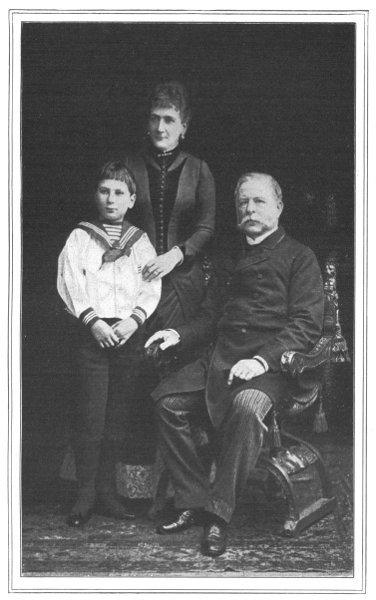
M and Mme Waddington and Their Son From a photograph by Cesar Paris
To G. K. S.
Albert Gate, February 9, 1885.
This morning we have the news of the fall of Khartoum and the murder of Gordon. W. is in the country trying horses, so I put on my hat and went out into the Row to hear what was going on. It was crowded with people talking and gesticulating. The Conservatives furious, "such a ministry a disgrace to the country," and a tall man on a handsome chestnut, talking to Admiral C. most energetically, "I am a moderate man myself, but I would willingly give a hand to hang Gladstone on this tree." They are much disgusted—and with reason.
Monday, February 23, 1885.
It seems to be my week, Dear Gertrude, so I will at any rate begin this morning. We are now in full tide of dinners and routs, which last is the most frightful species of entertainment that the human mind has ever devised. They consist of 400 or 500 people packed close in a house which holds about 150—so warm in the rooms that you almost stifle—and so cold on the staircase and halls where the door is always open wide that I always wonder how I can escape without a fluxion de poitrine. We had a banquet ourselves last Tuesday, Harcourts Münsters, Corks, etc., followed by a mild dance, which was however successful, as Pourtalès, who is a gay little fellow, led a spirited cotillon, and there were 22 couples. I performed 2 quadrilles, which, naturally, is the extent of my dancing now, unless I take a stray turn with an old partner.
Of course the great excitement has been the departure of the Guards for Egypt, as it takes the husbands, sons, and brothers of half London away. It does seem such a useless campaign and sacrifice of human life.
There was a child's party at Marlborough House on Friday afternoon which was very successful. Mimi and I were bidden, or commanded, as the correct phrase is, at 4 o'clock, so we took ourselves off, he in his white sailor suit, with blue collar, and I in blue velvet. Both Prince and Princess were very amiable, and the Duchess of Edinburgh was very good to Mimi, as she always is, making him sit by her daughters to see the conjuror, and at her table for tea. The children had their tea in the dining-room, with a great many little round tables, we had ours with the Princess. It is very informal, she always makes it herself, and everyone sits down. The Princess Louise was also there, looking very nice, and such a pretty figure. After the tea the children had a fine romp, ending with a most animated Sir Roger de Coverley, in which all the Princes—I mean the 2 younger ones, Prince Eddy and Prince George—joined, and all the Aides-de-Camp. We didn't leave till 7—and the afternoon was rather long, but still I must say I enjoyed myself.
Yesterday we had a pleasant dinner at Lady Hayter's—a Liberal political salon. She has big dinners—receptions every Saturday. It was pleasant at first, until many more people came than the house would hold, but that is what the "Maîtresse de Maison" particularly aims at.
Everyone here sympathises with Lowell on the death of his wife. She was so very peculiar. I wrote him a little note, as he was always very amiable to me and complimentary about Father and Grandpa. This evening we had a dinner at Julia, Lady Tweeddale's, who is chaperoning her niece, Sir Robert Peel's daughter.
Tuesday.
I couldn't finish last evening, so take up my letter now at 7 o'clock, while I am waiting to dress for dinner. It is a quiet dinner at the Miss Monks'—two cousins, maiden ladies—and I shall wear a high dress, which is much easier to get into. Our dinner last night was pleasant and swell—Duke and Duchess of Leeds, Lord and Lady Delawarr, Lord and Lady Claud Hamilton (she a beauty, with a fine figure; he an attractive Irishman, son of the Duke of Abercorn) and others. They danced afterwards, and we stayed till 12 o'clock. The pose of the fast young married set is not to dance. There is no one to dance with, the Guards are gone. The Row was lovely this morning, like a May day, everybody out. I hope to begin to ride again next week. I am in treaty for a very handsome chestnut, if the man will come down a little in his price.
Albert Gate, February 25, 1885.
We have been to-day to the House of Lords to hear Lord Salisbury speak and the vote of censure passed. The House was full—the Prince and Duke of Cambridge there. Lord Salisbury spoke well; very calm, very nasty for his adversaries, and as he had the beau rôle he was much applauded. The defence was weak, the orator feeling evidently that his cause was a bad one, and the temper of the House against him. I should think Lord Salisbury would be a most unpleasant adversary, though always perfectly courteous in manner.
To J. K.
Ambassade de France à Londres, Monday, March 9, 1885.
This is my week again, Dear Jan, and I will begin to-day.
We are going on in a wildly dissipated manner. Last week was very full. We went to a very pretty ball given by the Artillery Company of London to the Prince and Princess. The Duke of Portland, a young fellow, is colonel of the regiment, and the thing was very well done. Both Prince and Princess danced several times. The supper was very pretty. When it was ready everybody made a line all down the ballroom, and then the procession, with the Princess first and the Duke of Portland, then the Prince with me and various other Princes and swells, walked down the long room, the band playing the "British Grenadiers," and all the people bowing and curtseying. The Royal party supped on a platform and there were 1,000 people seated at supper at long narrow tables, everyone looking hard at the Princess.
Thursday, 12th.
I never got any further and never have had time since, but I will begin this morning and finish my letter this evening. To-day is the first Drawing-room of the season. As Countess Karolyi doesn't come, I am the Doyenne, and shall have to go in first, led by Sir Francis Seymour. Mr. Lowell has asked me to take his presentation. However there is only Bessie V. R., Eugene's daughter, who is pleased at being presented by an Ambassadress. She will also see the Diplomatic Corps pass. I wish Jess were here, and so does Adelaïde, who would be so delighted to dress her. Last night we had a very pleasant dinner at Lady Jersey's. Such a handsome woman was there, the young Duchess of Montrose. After dinner we went to the Speaker's reception, which was crowded, but rather amusing—such funny looking people and such dresses.
I am overrun with artists. There are several French artists of all kinds here, and I must make them play once, so I have decided upon next Friday afternoon. It is my day and I shall invite all the musical and entertaining people I know, as of course they all wish to be heard. One girl really does play very well on the violin, and wants me very much to sing with her accompaniment, which, naturally, I shan't, and another sings, not very remarkably, and a third, Marie Dubois, plays really beautifully—premier prix du Conservatoire. I will write you all about it when it is over.
7 o'clock.
Well, we have performed the Drawing-room—it was short, not more than an hour and a quarter, and I must say very few pretty faces or pretty dresses—Bessie V. R. looked very well, very distinguished. She followed directly behind me—even in front of my secretaries' wives, and was the third lady in the room. There were quite a lot of Princes—Prince and Princess of Wales, Prince Waldemar of Denmark, Duke and Duchess of Edinburgh, Duke of Cambridge and Prince Edward of Saxe-Weimar. Mme. de Bylandt, wife of the Dutch Minister, presented Mme. and Mlle. de Brenen, Dutch ladies, both mother and daughter handsome and well dressed. The Princess looked charming in white and gold. The Duchess of Edinburgh had a dark green velvet train. We all came back here to tea and had various visitors to look at the dresses, including Baron Pawel-Rammingen, husband of Princess Frederica of Hanover, who also happened in and was much amused at finding such an étalage of trains—happily we have nothing this evening. Next week is the marriage of the Duke of B.'s daughter. It is to be at Westminster Abbey and very swell, the Prince and Princess going. There is to be a party Tuesday night, where all her jewels are to be shown, which they say are splendid. I am sorry not to go, but we have a dinner and a dance ourselves. I shall go to the wedding. She is small and quiet—rather shy. I don't know whether one of those mysterious changes will take place which one sees sometimes after marriage—coronets and trains do a great deal. I must finish, as I have of course several notes to answer. I hate it so, when people wait for answers. I suppose I shall have a fine account of the Inauguration from Gertrude. I hope the girls have enjoyed it.
To G. K. S.
London, March 12, 1885.
I went yesterday to say good-bye to Lady R. They are leaving for Bombay, where he is named Governor. It is for five years; I think I should be unwilling to go so far, and to such a trying climate, but she seems plucky enough and will certainly do well.
Francis and I were driving up Constitution Hill yesterday just as the Queen arrived, so we had a very good look at her. She was in an open carriage with Princess Beatrice and her fiancé, Prince Henry of Battenberg (such a handsome man), and the usual escort of Life-Guards. She recognised me perfectly, and always has a gracious bow and smile. Just before she came one of our English friends who was walking about with her daughter (a young girl who had never seen the Queen) suddenly spied me (as mine was the only carriage that was allowed to stand) and asked me if she and her daughter could get into the carriage with me, as that would be such a good chance for the girl to see the Queen. I of course was delighted to have them, as Francis and I were alone, and the girl saw perfectly. So many English people, except those who go to Drawing-Rooms, never get a chance to see the Queen at all.
Sunday, March.
We have been to Church this morning at Westminster Abbey, such a magnificent service. The Dean always gives us seats, and I love the music, the boys sing very well, and the hymns are grand as they echo through the fine old church. In every direction there is some historical souvenir; tombs, old glass windows, tattered flags, crests,—all England's past. We walked home through Green Park, and it is curious to notice the absence of equipages—so many English people don't take out their carriages on Sunday (to rest the horses and let the servants go to church), again such a striking contrast to Paris, where every kind of conveyance is out on that day. I think of the little grocer near H. who goes out every Sunday as soon as it is at all warm with his whole family and 2 or 3 dogs in his little covered cart. All the "Société" is out also; at the big concerts, reviews, races, etc. Sunday is the great Parisian holiday.
This morning before starting I had my head out of the window on the other side of the Embassy, looking at the Guards pass on their way to the little church just behind the Embassy in Knightsbridge. They came down from the barracks at a swinging pace, a fine body of men, the sergeants with their canes, and several officers. The band, a very good one, plays all the time (to-day they marched to the French tune "Le Père Victoire"), and takes up its station, always playing, at the door of the church. They play until the last man files in, then suddenly the music stops, and the band goes in also. It always interests the French servants immensely, the two maids had their heads out too, and said to me just now, "C'est bien beau, Madame, quel dommage que cela ne se passe pas comme cela chez nous." The service in the Guards' Chapel at Wellington Barracks is also a fine one, the chapel filled with soldiers, a mass of red (as one sees only their tunics), and the singing very good—a little loud sometimes when it is a favourite hymn and all join in.
To H. L. K.
Albert Gate, March 13, 1885.
We have had our second "Drawing-room" to-day, and were asked to come in "demi-deuil," as it was the first time the Queen had received any of the Corps Diplomatique since the Duke of Albany's death. There are always more people when the Queen holds the Drawing-room, as it is the only chance so many of her subjects ever have of seeing her. She rarely comes to London, and stays only two or three days. She was dressed with her little closed diamond crown, the blue ribbon of the Garter, and many diamonds. I thought the black becoming generally.
March 16th.
At our dinner to-day at Lord A.'s Mr. Campbell was next to me, and told me he was most anxious to be recalled to the French Ambassador, that he had been his fag at Rugby, and had never seen him since. Of course they made acquaintance again after dinner, and plunged into all sorts of recollections of their school days. The other men who were smoking with them said the talk was most interesting and curious, as their careers in after life had been so very different. At every turn W. finds someone who had been at Rugby or Cambridge with him.
To H. L. K.
April 9, 1885.
This morning it is pouring, so I gave up the Oxford and Cambridge boat race. W. and Count de Florian started all with light blue rosettes (Cambridge). W. was on the umpire boat. Cambridge won easily, which was of course a great pleasure to him (having rowed himself so many years ago in the Cambridge crew), in the evening. He said he was so much cheered when he got up to speak—young men standing on chairs to see him—that he had to wait some time before he could begin. He is certainly the only foreign Ambassador that ever rowed in the Cambridge eight. He was quite pleased when he came home, so many old memories of happy boyish days had been brought back. We talked for some time after dinner, and recalled all sorts of Cambridge experiences—once when the Queen came with Prince Albert to Cambridge the students were all assembled in the court-yard as her carriage drove up. It had been raining, and the Queen hesitated a moment in getting out, as the ground was wet and there was mud. Instantly W. had his gown off and on the ground, the others followed his example, and she walked over a carpet of silk gowns the few steps she had to make. W. said he had never forgotten her smile as she bowed and thanked them.
To J. K.
The Garth, Bicester, Sunday, April 19, 1885.
I believe this is my week, Dear Jan. I am staying here at a queer little hunting box in Oxfordshire with Hilda Deichmann (née de Bunsen). It is literally an enormous stable, with a cottage attached, but they have added a story and wings and it is the most wonderful-looking place, very low—but comfortable. W. went off to Paris Sunday, and I came down here last Saturday with Mimi. He is very fond of the children—a big boy of 11 and a girl of 7—and has enjoyed himself thoroughly. We feel awfully cut up at Pontécoulant's death. He has been such a good friend to us, and so completely associated with all our political life. It seems incredible that a strong man should be carried off like that in 4 days from a cold. Henrietta will miss him awfully, as, now that we are so much away he was always there and attending to anything she wanted done.
Of course everyone is talking and speculating about the Anglo-Russian question. W. thinks the English must fight, and that they will. I think this government, with Gladstone at its head, will never make up their minds to fight seriously or in time, judging from the way the Soudan campaign has been conducted.
We have been driving all over the country, which is charming, flat, but all grass (Oxfordshire is a regular hunting country), and since three days the weather has been enchanting. Yesterday we made a lovely excursion to Blenheim on Deichmann's coach. We picked up 2 neighbours, nice, pretty English girls, and had a beautiful drive over the downs. Mimi had never been on a coach before, and was in a wild state of delight when all four horses galloped up the hills, and they blew the horns at all the railway stations and passing thro' the villages. I had forgotten how magnificent Blenheim was. The house is rather dismantled, as the present Duke has sold all the books and some of the handsomest pictures, but there are plenty left—Van Dycks, Rubens, etc., and the rooms and halls are splendid. There were lots of portraits of the Dukes and Duchesses, from the great Duke down, some curiously like the present Churchills, particularly the women. When we had finished sauntering through the house, we drove about the park looking for a shady place to lunch, and then established ourselves; the horses were taken out, the lunch basket opened, and we had a very good lunch on the top of the coach. We drove back through Woodstock and stopped for tea at Dashwood Park, one of the great places of the country. They gave us tea, with every variety of toast, cake, and bread that can be imagined, in a beautiful room as large as a church, opening on a stone terrace, and the most lovely (English) views of grass meadows and trees, stretching miles away. There were quantities of family portraits there, too, but we hadn't time to see them. We got home at 7 o'clock, rather exhausted, but having had a lovely day.
I began my letter this morning before breakfast and will finish it now. The children are off to the woods with the German tutor after primroses, but it is too warm for us—so we shall take a walk after tea. I am very fond of Hilda Deichmann. She is very clever—knows a great many things—draws well, paints well, is a good musician, and is womanly and practical. We fraternised from the first moment. We are going back to London to-morrow afternoon. Mimi's school begins on Tuesday, and I think he has had a good outing for the present. I haven't an idea what we shall do this winter. Perhaps when W. comes back he will have some plans. With this new Ministry, it is difficult to make any. I am so afraid of their proposing some beastly measure, like the exile of the Orléans Princes, or something of that kind to be popular before the election. The Wales' visit to Ireland seems to be progressing most delightfully and much more quietly than people thought. He has such wonderful charm of manner. I should think personal contact with him would always work wonders. I must stop now or my letter will not go this afternoon.
To G. K. S.
May 6, 1885.
We had yesterday a typical London Season evening. We dined at Lady Vivian's—a large, handsome dinner, everybody rather in a hurry to get away, as there were two big parties; Lady Derby's in St. James's Place, and Lady Salisbury's in Arlington Street. We drove down Piccadilly with much difficulty, getting along very slowly in spite of our "white card," but finally did arrive at Lady Derby's. The staircase was a mass of people struggling to get in, an orchestra playing, and about 1,200 people in rooms that would hold comfortably about half. Of course on such occasions one doesn't talk. We spoke to our host and hostess, were carried on by the crowd, made the tour of the rooms and got down again with much waiting and jostling, as there were two currents coming and going. However, we did finally get our carriage, and then with many stops and very slowly, got to Arlington Street, where apparently the same people were struggling on the staircase, the same orchestra playing, and just as big a crowd (I should think the whole Conservative party), for though the house is larger they had invited more people, so the result was practically the same. We did exactly the same thing, exchanged a few words with Lady Salisbury, made the tour, and came home. We were two hours performing these two receptions, but I suppose it was right to do it once. However, the English certainly enjoy the sight, and don't mind the waiting. Lady Jersey, who is a grandmother, told me this afternoon she had bored herself to death last night. "Why did you go?" I said, "you must know these big political parties by heart." "Oh, I like the parties," she said; "only I didn't get to either," and then she explained her evening. She started alone in her carriage at 10 o'clock for Lady Derby's, was kept waiting an interminable time in Piccadilly, and when she finally did reach Lady Derby's door, a friendly link-man advised her not to go in as everybody was coming away, and she would never get up the stairs, so she turned back and proceeded to Arlington Street. She had the same crowd, the same long wait, and when she arrived at Lady Salisbury's the party was over, and no one could possibly get in. It was then midnight, and she drove home, having passed her whole evening since 10 o'clock alone in her brougham in Piccadilly.
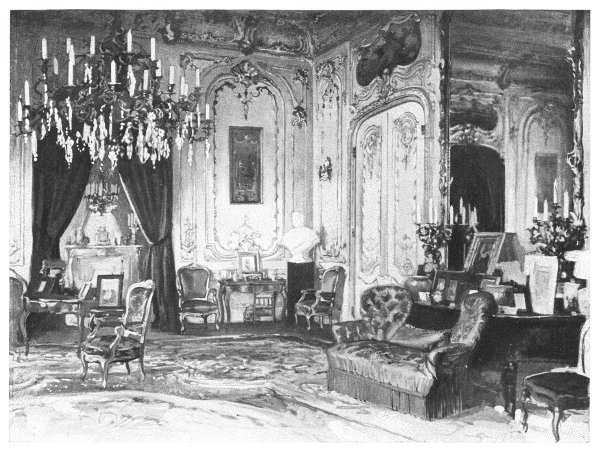
The Salon of the French Embassy in London, 1891
May 9, 1885.
This afternoon we have had a conférence "sur Racine" in the big drawing-room. A good many people came and apparently listened, and I hope it may do the young lady good. Mlle. de B. wishes to get up classes of French literature for ladies, but I hardly think it will succeed here in the season; on a bright day no one will shut herself up in a smallish room to hear about Racine, Molière, etc. I was amused by one of our colleagues whom I invited. He refused promptly, "he really couldn't do that even for me. He hadn't thought about Racine since he left school, and hadn't felt it a blank in his life." Mlle. de B. did it very well; she sat on a little platform with a table in front of her, and all the swells in red and gilt arm-chairs facing her, and looking at her hard. She was a little nervous at first, but soon got over that, and her language was good and well chosen, she knew her subject perfectly, and spoke in a pretty clear voice. This was the invitation:—