LEST WE FORGET (continued 5)
Reading edition
"Austria says suddenly to Serbia: 'You are a wicked little state. I have annexed and governed against their will some millions of your countrymen, yet you are still full of anti-Austrian feeling, which I do not intend to allow. You will dismiss from your service all officials, politicians, and soldiers who do not love Austria, and I will further send you from time to time lists of persons whom you are to dismiss or put to death. And if you do not agree to this within forty-eight hours, I, being vastly stronger than you, will make you. As a matter of fact, Serbia did her very best to comply with Austria's demands; she accepted about two thirds of them, and asked for arbitration on the remaining third. But it is clear that she could not accept them all without being dishonored. That is, Serbia would have given up her freedom at the threat of force; the Serbs would no longer be a free people, and every individual Serb would have been humiliated. He would have confessed himself to be the kind of man who will yield when an Austrian bullies him. And if it is urged that under good Austrian government Serbia would become richer and safer, and the Serbian peasants get better markets, such pleas cannot be listened to. They are a price offered for slavery; and a free man will not accept slavery at any price.
"Germany, again, says to Belgium: 'We have no quarrel with you, but we intend for certain reasons to march across your territory and perhaps fight a battle or two there. We know that you are pledged by treaty not to allow any such thing, but we cannot help that. Consent, and we will pay you afterwards; refuse, and we shall make you wish you had never been born.' At that moment Belgium was a free, self-governing state. If it had yielded to Germany's demand, it would have ceased to be either free or self-governing. It is possible that, if Germany had been completely victorious, Belgium would have suffered no great material injury; but she would have taken orders from a stranger who had no right to give them, simply because he was strong. Belgium refused. She has had some of her towns destroyed, some thousands of her soldiers killed, many more thousands of her women, children, and non-combatants outraged and beggared; but she is still free. She still has her honor.
"Let us think this matter out more closely. The follower of Tolstoy will say: 'We speak of Belgium's honor and Serbia's honor; but who is Serbia and who is Belgium? There is no such person as either. There are only great numbers of people who happen to be Serbians and Belgians, and who mostly have had nothing to do with questions at issue. Some of them are honorable people, some dishonorable. The honor of each one of them depends very much on whether he pays his debts and tells the truth, but not in the least on whether a number of foreigners walk through his country or interfere with his government. King Albert and his ministers might feel humiliated if the German government compelled them to give way against their will; but would the ordinary population? Would the ordinary peasant or shop-keeper or artisan in the districts of Vise and Liége and Louvain have felt particularly disgraced or ashamed? He would probably have made a little money and been greatly amused by the sight of the troops passing. He would not have suffered any injury that can for a moment be compared with what he has suffered now, in order that his government might feel proud of itself.'
"I will not raise the point that, as a matter of fact, to grant a right of way to Germany would have been to declare war against France, so that Belgium would not, by giving up her independence, have been spared the danger of war. I will assume that it was simply a question of honor. And I believe that our follower of Tolstoy is very wrong.
"Is it true, in a healthy and well-governed state, that the average citizen is indifferent to the honor of his country? We know that it is not. True, the average citizen may often not understand what is going on, but as soon as he knows, he cares. Suppose for a moment that the King, or the Prime Minister, or the President of the United States, were found to be in the pay of a foreign state, can any one pretend that the ordinary citizens of Great Britain or America would take it quietly? That any normal man would be found saying: 'Well, the King, or the President, or the Prime Minister, is behaving dishonorably, but that is a matter for him, not for me. I am an honest and honorable man, and my government can do what it likes.' The notion is absurd. The ordinary citizen would feel instantly and without question that his country's honor involved his own. And woe to the society in which it were otherwise! We know of such societies in history. They are the kind which is called 'corrupt,' and which generally has not long to live. Belgium has proved that she is not that kind of society.
"But what about Great Britain herself? At the present moment a very clear case has arisen, and we can test our own feelings. Great Britain had, by a solemn treaty, pledged herself to help keep the neutrality of Belgium. Belgium is a little state lying between two very strong states, France and Germany, and in danger of being overrun or abused by one of them unless the Great Powers guaranteed her safety. The treaty, signed by Prussia, Russia, Austria, France, and Great Britain, bound all these Powers not to attack Belgium, move troops into it, or annex any part of it; and further, to resist by armed force any Power which should try to do any of these things. Belgium, on her part, was bound to maintain her own neutrality to the best of her power, and not to side with any state which was at war with another.
"At the end of July, 1914, the exact case arose in which we had pledged ourselves to act. Germany, suddenly and without excuse, invaded Belgium, and Belgium appealed to us and France to defend her. Meantime she fought alone, desperately, against overwhelming odds. The issue was clear. The German Chancellor, Herr von Bethmann-Hollweg, in his speech of August 6, admitted that Germany had no grievance against Belgium, and no excuse except 'necessity.' She could not get to France quick enough by the direct road. Germany put her case to us, roughly, on these grounds. 'True, you did sign a treaty, but what is a treaty? We ourselves signed the same treaty, and see what we are doing! Anyhow, treaty or no treaty, we have Belgium in our power. If she had done what we wanted, we would have treated her kindly; as it is we shall show her no mercy. If you will now do what we want and stay quiet, later on we will consider a friendly deal with you. If you interfere, you must take the consequences. We trust you will not be so insane as to plunge your whole empire into danger for the sake of "a scrap of paper."' Our answer was: 'Evacuate Belgium within twelve hours or we fight you.'
"I think that answer was right. Consider the situation carefully. No question arises of overhaste or lack of patience on our part. From the first moment of the crisis, we had labored night and day in every court of Europe for any possible means of peace. We had carefully and sincerely explained to Germany beforehand what attitude she might expect from us. We did not send our ultimatum till Belgium was already invaded. It is just the plain question put to the British government, and, I think, to every one who feels himself a British citizen: 'The exact case contemplated in your treaty has arisen: the people you swore to protect is being massacred; will you keep your word at a gigantic cost, or will you break it at the bidding of Germany?' For my own part, weighing the whole question, I would rather die than submit; and I believe that the government, in deciding to keep its word at the cost of war, has expressed the feeling of the average British citizen.
"War is not all evil. It is a true tragedy, which must have nobleness and triumph in it as well as disaster, but we must not begin to praise war without stopping to reflect on the hundreds of thousands of human beings involved in such horrors of pain that, if here in our ordinary hours we saw one man so treated, the memory would sicken us to the end of our lives; we must remember the horses and dogs, remember the gentle natures brutalized by hardship and filth, and the once decent persons transformed by rage and fear into devils of cruelty. But, when we have realized that, we may begin to see in this desert of evil some oases of good.
"Do the fighting men become degraded? Day after day come streams of letters from the front, odd stories, fragments of diaries, and the like; full of the small intimate facts which reveal character, and almost with one accord they show that these men have not fallen, but risen. No doubt there has been some selection in the letters; to some extent the writers repeat what they wish to have remembered, and say nothing of what they wish to forget. But, when all allowances are made, one cannot read the letters and the dispatches without a feeling of admiration for the men about whom they tell. They were not originally a set of chosen men. They were just our ordinary fellow citizens, the men you meet on a crowded pavement. There was nothing to suggest that their conduct in common life was better than that of their neighbors. Yet now, under the stress of war, having a duty before them that is clear and unquestioned and terrible, they are daily doing nobler things than we most of us have ever had the chance of doing, things which we hardly dare hope that we might be able to do. I am not thinking of the rare achievements that win a V.C. or a Cross of the Legion of Honor, but of the common necessary heroism of the average man; the long endurance, the devoted obedience, the close-banded life in which self-sacrifice is the normal rule, and all men may be forgiven except the man who saves himself at the expense of his comrade. I think of the men who share their last biscuit with a starving peasant, who help wounded comrades through days and nights of horrible retreat, who give their lives to save mates or officers.
"For example, to take these two stories:
"Relating his experiences to a pressman, Lance-Corporal Edmondson, of the Royal Irish Lancers, said: 'There is absolutely no doubt that our men are still animated by the spirit of old. I came on a couple of men of the Argyll and Sutherland Highlanders who had been cut off at Mons. One was badly wounded, but his companion had stuck by him all the time in a country swarming with Germans, and, though they had only a few biscuit between them, they managed to pull through until we picked them up. I pressed the unwounded man to tell me how they managed to get through the four days on six biscuit, but he always got angry and told me to shut up. I fancy he went without anything, and gave the biscuit to the wounded man. They were offered shelter many times by French peasants, but they were so afraid of bringing trouble on these kind folk that they would never accept shelter. One night they lay out in the open all through a heavy downpour, though there was a house at hand where they could have had shelter. Uhlans were on the prowl, and they would not think of compromising the French people, who would have been glad to help them.'
"The following story of an unidentified private of the Royal Irish Regiment, who deliberately threw away his life in order to warn his comrades of an ambush, is told by a wounded corporal of the West Yorkshire Regiment now in hospital in Woolwich:
"'The fight in which I got hit was in a little French village near to Rheims. We were working in touch with the French corps on our left, and early one morning we were sent ahead to this village, which we had reason to believe was clear of the enemy. On the outskirts we questioned a French lad, but he seemed scared and ran away. We went on through the long narrow street, and just as we were in sight of the end, the figure of a man dashed out from a farmhouse on the right. Immediately the rifles began to crack in front, and the poor chap fell dead before he reached us.
"'He was one of our men, a private of the Royal Irish Regiment. We learned that he had been captured the previous day by a party of German cavalry, and had been held a prisoner at the farm, where the Germans were in ambush for us. He tumbled to their game, and though he knew that if he made the slightest sound they would kill him, he decided to make a dash to warn us of what was in store. He had more than a dozen bullets in him and there was not the slightest hope for him. We carried him into a house until the fight was over, and then we buried him next day with military honors. His identification disk and everything else was missing, so that we could only put over his grave the tribute that was paid to a greater: "He saved others; himself he could not save." There wasn't a dry eye among us when we laid him to rest in that little village.'
"Or I think again of the expressions on faces that I have seen or read about, something alert and glad and self-respecting in the eyes of those who are going to the front, and even of the wounded who are returning. 'Never once,' writes one correspondent, 'not once since I came to France have I seen among the soldiers an angry face or heard an angry word.... They are always quiet, orderly, and wonderfully cheerful.' And no one who has followed the war need be told of their heroism. I do not forget the thousands left on the battlefield to die, or the groaning of the wounded sounding all day between the crashes of the guns. But there is a strange, deep gladness as well. 'One feels an extraordinary freedom,' says a young Russian officer, 'in the midst of death, with the bullets whistling round. The same with all the soldiers. The wounded all want to get well and return to the fight. They fight with tears of joy in their eyes.'
"Human nature is a mysterious thing, and man finds his weal and woe not in the obvious places. To have something before you, clearly seen, which you know you must do, and can do, and will spend your utmost strength and perhaps your life in doing, that is one form at least of very high happiness, and one that appeals—the facts prove it—not only to saints and heroes but to average men. Doubtless the few who are wise enough and have enough imagination, may find opportunity for that same happiness in everyday life, but in war ordinary men find it. This is the inward triumph which lies at the heart of the great tragedy."
O yet we trust that somehow good Will be the final goal of ill, To pangs of nature, sins of will, Defects of doubt, and taints of blood; That nothing walks with aimless feet; That not one life shall be destroyed, Or cast as rubbish to the void, When God hath made the pile complete; That not a worm is cloven in vain; That not a moth with vain desire Is shrivelled in a fruitless fire, Or but subserves another's gain. Behold, we know not anything; I can but trust that good shall fall At last—far off—at last, to all, And every winter change to spring. Alfred Tennyson.
WHAT ONE AMERICAN DID[10]ToC
If a person had been standing one night beside the railroad tracks in Germany in the fall of 1917, he would have seen a train speeding along through the darkness at about thirty-five miles an hour. He would have noticed through an open window a tall soldier in the uniform of an English flyer, a lieutenant in the R.F.C. (Royal Flying Corps), stand up on the seat as if to get something out of the rack; and then he would have been astounded to see the same tall English flyer come flying out feet first through the window, to land on the side of his head on the stone ballast of the opposite track.
Few persons could do this and come through alive. This English flyer a few weeks before had fallen eight thousand feet, with a bullet in his neck, when his airplane had been shot down in a fight with four German machines. When picked up within the German lines, he was enough alive to be taken to a hospital. The bullet was removed, and he recovered. He was a British flyer, simply because America did not enter the war soon enough for him, and like many other young Americans, he was eager to fight the German beast and "save the world for democracy."
He was being taken with six other officers from a prison in Belgium to a prison camp in Germany. He knew that, once there, his chances for escape would be very small; and he felt he preferred death to life in a German prison camp. He knew that, if he were not killed in his leap from the train, the Germans would doubtless shoot him as a spy, should they succeed in recapturing him. Some Germans wanted all Americans who enlisted in the Allied armies to be shot, as they had shot Captain Fryatt, on the ground that they were non-combatants attacking war forces; for this was before America entered the war against Germany. Besides, prisoners were not allowed to know what was going on in Germany. An escaped prisoner who could find out was, therefore, likely to be treated as a spy.
Pat O'Brien's cheek was cut open, and his left eye badly injured and swollen so that he could not open it. He had scratched his hands and wrists, and sprained his ankle. But he was hard to kill. In the excitement caused by his jump through the car window, the Germans did not stop the train immediately, and so did not reach the spot where he had fallen, until he had recovered consciousness and had got away from the track. He was careful in walking away to hold the tail of his coat so that the blood dropping from his cheek would not fall upon the ground and show which way he went. Before daylight he had been able to put more than five miles between him and the tracks. He then hid in a deep woods, knowing that he must travel by night and keep out of sight by day, for he was wearing the uniform of a British flyer.
The story of his adventures is one of the most interesting of all the strange and interesting stories of the World War. When he reached England, King George sent for him to come to Buckingham Palace and spent nearly an hour listening to it. Lieutenant O'Brien has published it in a book which he calls "Outwitting the Hun." Boys and girls who like an exciting story of adventure, a true story, will want to read this book.
He knew the North Star, and by this he set his course west, in order to reach Belgium, and then go north from Belgium to Holland. It rained a great share of the time, but this did not make much difference, for he had to swim so many canals and rivers that his clothes were always wet. At first he had taken off his clothes when he had to swim and had tied them in a bundle to his head to keep them from getting wet; but after he lost one of his shoes in the water in this way and had to spend nearly two hours diving before he recovered it, he swam with his clothes and shoes on. He never could have gone on without shoes. Had he not been a good diver, he could not have found the shoe in the mud under eight feet of water; had he not been a good swimmer, he could not have crossed the Meuse River, nearly half a mile wide, after many days and nights of traveling almost without food (as it was, he dropped in a dead faint when he reached the farther side); and had he not known the North Star, he would have had no idea at night whether he was going in the right direction or going in, a circle. Rainy and cloudy nights delayed him greatly.
He did not dare ask for food at the houses in Germany, for he would have been immediately turned over to the authorities. So he lived on raw carrots, turnips, cabbages, sugar beets, and potatoes, which he found in the fields. He knew he must not make a fire even if he could do so in the Indian's way, by rubbing sticks together. He had no matches. He found some celery one night and ate so much of it that it made him sick. He had only the water in the canals and rivers to drink, and most of this was really unfit for human beings. He lay for an hour one night in a cabbage field lapping the dew from the cabbage leaves, he was so thirsty for pure, fresh water.
One day before he reached Belgium, he was awakened from his sleep in the woods by voices near him. He kept very quiet, and soon heard the sound of axes and saw a great tree, not far from him, tremble. He was lying in a clump of thick bushes and could not move without making a noise. He knew that if the great tree with its huge branches fell in his direction, he would surely be killed or at least pinned to the earth and badly injured—and his capture meant that he would be shot as a spy. But there was nothing for him to do but wait, and hope. At last the tree began to sway, and then fell away from him instead of towards him. He had again escaped death.
When he reached Belgium, which he did in eighteen days after his escape through the car window, he followed the North Star, for he knew Holland was to the north, and once in Holland he would be free. His feet were sore and bleeding, his knees badly swollen, and he was sick from exposure and starvation. For a while, he had a severe fever and raved and talked all night long in his half sleeping state. He feared some one would hear him and that he would be taken. He was weary and tired of struggling and fighting, and ready to give up; but his will, his soul, would not let him. He tells us how he raved when the fever was on him, and called on the North Star to save him from the coward, Pat O'Brien, who wanted him to quit.
He says he cried aloud, "There you are, you old North Star! You want me to get to Holland, don't you? But this Pat O'Brien—this Pat O'Brien who calls himself a soldier—he's got a yellow streak—North Star—and he says it can't be done! He wants me to quit—to lie down here for the Huns to find me and take me back to Courtrai—after all you've done, North Star, to lead me to liberty. Won't you make this coward leave me, North Star? I don't want to follow him—I just want to follow you—because you—you are taking me away from the Huns and this Pat O'Brien—this fellow who keeps after me all the time and leans on my neck and wants me to lie down—this yellow Pat O'Brien who wants me to go back to the Huns!"
In Belgium, he had a somewhat easier time, as far as food went, for he found he could go to the Belgian houses and ask for it. As he could not speak the language, and did not want them to know he was an English soldier, he pretended he was deaf and dumb. He had finally succeeded in getting some overalls and discarding his uniform.
Belgium was full of German soldiers, many of them living in the houses of the Belgians, so he was obliged to use extreme care in approaching a house to ask for food or help. Every Belgian was supposed to carry a card, called in German an Ausweiss. It identified the bearer when stopped by a German sentinel or soldier. Lieutenant O'Brien knew that without this card he would be arrested and that his looks made him a suspicious character. His eye had hardly healed, his face was covered with a three weeks' beard, and altogether he was a disreputable looking creature.
After very many interesting and exciting experiences, he succeeded in reaching the boundary line. To prevent Belgians taking refuge in Holland and to prevent escaped prisoners, and even German soldiers, from crossing the line into this neutral country, where, if they were in uniform, they would be interned for the rest of the war, the Germans had built all along the line three barbed wire fences, six feet apart. The center fence was charged with electricity of such a voltage that any human being coming in contact with it would be instantly electrocuted. This triple barrier of wire was guarded by German sentinels day and night.
Lieutenant O'Brien reached the barrier in the night, and hid himself when he heard the tramp of the German sentinel. He waited until the sentinel returned and noted carefully how long he was gone, in order to learn how much time he had in which to work.
He thought he could build a ladder out of two fallen trees by tying branches across them, and in this way get over the ten-foot center fence. He succeeded in getting his ladder together, by working all night, and with it he hid in the woods all the next day. When night came, he shoved the ladder under the first barbed wire fence and crawled in after it. He placed it carefully up against one of the posts to which the charged electric wires were fastened and began to climb up it, when all of a sudden it slipped and came in contact with the live wires. The trees out of which he had constructed it were so soaked with water that they made good conductors of electricity, and he received such a charge that he was thrown to the ground unconscious, where he lay while the sentinel passed within seven feet of him.
He gave up the ladder and decided to dig under the live wires. He had only his hands to dig with, but the ground was fairly soft. After some hours, he had a hole deep enough and wide enough to crawl through without touching the live wire. He found a wire running along under the ground. He knew this could not be alive, for the ground would discharge any electricity there might be in it. So he took hold of it and, after much struggling, was able to get it out of the way. Then he crawled carefully under the live wires and was a free man in Holland, for he wore no uniform and would not be interned.
At the first village he came to, some of the Dutch people loaned him enough money to ride third-class to Rotterdam. He said he was glad he was not riding first-class, for he would have looked as much out of place in a first-class compartment as a Hun would in heaven.
The English consul at Rotterdam gave him money and a passport to England, and from there he came to see his mother, in a little town in Illinois, called Momence.
FOOTNOTES:
RAEMAEKERSToC
There are many ways of fighting, and the Germans, in their forty-four years of planning to conquer the world, thought of them all. The only forces they neglected were the mighty forces of fairness, justice, innocence, pity, purity, friendship, love, and other similar spiritual forces that Americans have been taught to look upon as the greatest of all.
There is a force called Rumor which sometimes speaks the truth, but which usually lies, that is a great power for evil and rarely for good. The Germans used this with the Italian troops in Italy, sending into their lines, by dropping them from airplanes and in other ways, all sorts of rumors about Austria and Italy, about the coming collapse of the Allies, about what great friends the Russians and Germans had become when the Russians realized that it was foolish and wrong to fight,—until the Italian soldiers lost the spirit which had carried them over the Alps and very near to the conquest of Austria, and were then easily defeated in the next powerful Austrian attack.
German agents spread stories through the papers of the United States to help Germany in the eyes and minds of the American people. They bought leading papers in Paris and one in New York to use in misleading people as to Germany's actions and aims. They printed lies for their own people to make them believe the war was forced on Germany, and that they were fighting against the whole world, for their lives and for liberty. They published cartoons in German papers in great numbers to carry, even to those who could not read, the ideas about the war and about her enemies that German rulers wished the people to believe.
The German leaders, in all lines, realize the power of advertising, and they tried to fill men's eyes and ears with false statements of the German cause. Not long ago almost any kind of advertisement was allowed in the papers published in the United States. Pictures of a man perfectly bald were printed side by side with others of a man with flowing locks, all the result of a few applications of Dr. Quack's Wonderful Hair Restorer, or some other equally good. Letters were published, bought and paid for, often from prominent people, declaring that two bottles (or more) of some patent medicine had made them over from hopeless invalids to vigorous, joyous manhood or womanhood. Falsehoods, or at least misleading statements, were given about foodstuffs, either on the packages or in advertisements about them.
But the United States government soon put a stop to this misrepresentation and compelled advertisers and food manufacturers not only to stop lying, but even to print the truth; and the manufacture and sale of things injurious to the public health were controlled. The American people want honesty, frankness, and fair dealing in all things.
The Germans seem to be a different kind of people in every way. It is to be hoped that sometime they will cease to act as manufacturers of patent medicines and adulterated foods were accustomed to act; but as long as Germany is after material gain, as these manufacturers were after money, it is very likely that she will seek to get it by deceit and lying, until the governments of the earth oblige her to be honest, or quit business.
It is said that it takes a long time to catch a lie. It depends, however, upon how many get after it and how swift and powerful they are. German lies have been counted upon as a considerable part of her fighting forces. She has spent millions of dollars and used thousands of men in this service. Is it not strange that one little, almost insignificant looking Dutchman, hardly heard of before the war, has been able almost alone to defeat the money and the men used by Germany to hoodwink the world? But this Dutchman, Louis Raemaekers, working for the Amsterdam Telegraf, had for years seen through German ideas and aims. He says, "Germany has never made any secret of her ideas or her intentions, She has always been frank, as selfish people often are. I have seen through the German idea for more than twenty years. A generation ago, I saw, as every one who cared to see did, what it was leading us to; in fact, Germany told us."
And he adds about the German people: "There is only one way to reach the modern German. Beat him over the head. He understands nothing else. The world must go on beating him over the head until he cries 'Enough'; or the world can never live with him."
Knowing Germany, and that German victory meant the loss of all that is really worth while in this world, the loss of liberty, and the destruction of any government that is what Lincoln said all governments should be, "of the people, for the people, and by the people"—Louis Raemaekers fought Germany with his pen and his brush, and fought her so well that the German government offered a large reward for him dead or alive, and a leading German writer said he had done more harm to the Prussian cause than an armed division of Allied troops.
The Cologne Gazette, in a furious article dealing with Raemaekers, declared that after the war Germany would settle accounts with Holland and would demand payment with interest for the damage done Germany by his cartoons.
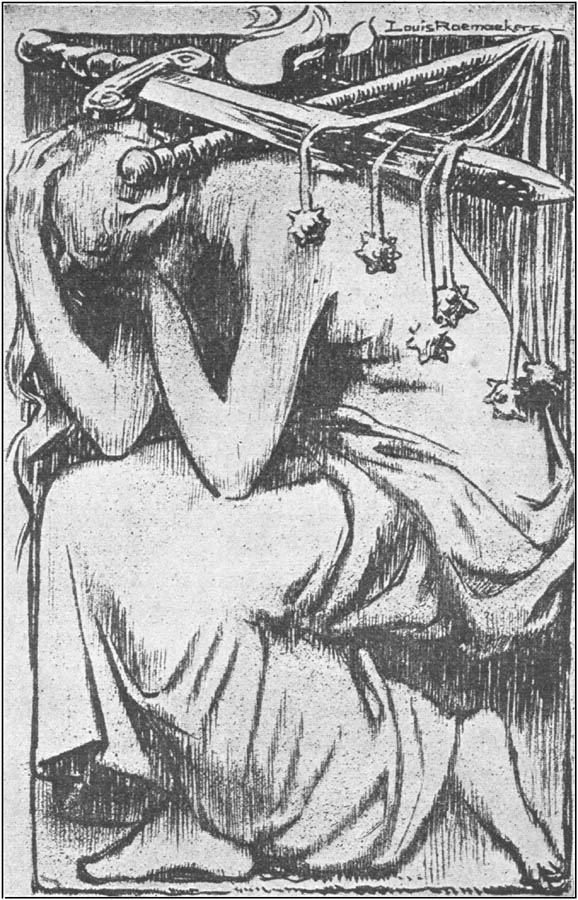
Civilization under the Lash
Taken from "Raemaekers' Cartoon History of the War," by permission of The Century Company.
Some of the Dutch people feared Germany so greatly that they succeeded in bringing Raemaekers to trial for having violated the neutrality of Holland. German influence was strong in Holland, and Raemaekers was hated by many of his own people; but the better sense of the Dutch triumphed, and he was acquitted.
One of his first cartoons represented Germany in the form of the Kaiser, wearing a German uniform and spiked helmet, with a foot upon the body of Luxemburg and a knee upon the prostrate form of Belgium, whom he was choking to death. He holds an uplifted sword in his hand and is saying, "This is how I deal with the small fry."
Another shows with almost sickening force the heart-breaking suffering of Belgian mothers, as contrasted with the cruelty and hard-heartedness of the Huns. A Belgian woman is kneeling beside a pile of dead from her village, with an expression of almost insane suffering upon her face. A German officer is passing, with one hand thrust into his coat front and a cigar in his mouth. He stops to say, "Ah! was your boy among the twelve this morning? Then you'll find him among this lot."
A third shows a German looting a house and carrying away everything that he thinks is of value to him. The furniture is smashed and a woman and child lie dead on the floor. The Hun is saying, "It's all right. If I had not done it some one else might."
A fourth shows a line of hostages standing in front of a wall to be shot for an offense that the German officer in command claims some one in the village committed. Those taken as hostages are innocent of wrong doing. The cartoon shows the ends of the barrels of the German muskets pointed at the hearts of the hostages and a German officer with his sword raised and his lips parted to give the order to fire. It shows but four of the hostages: an old man, probably the mayor of the town; a white-haired priest; a well-to-do man, and his son, about fourteen years of age. The boy is asking, "Father, what have we done?"—the cry that went up to their Heavenly Father from thousands of martyrs in Belgium.
It is no wonder that the German rulers fear this Dutch artist more than they do a division of soldiers. His fighting against the Huns and their atrocities and against the German nature and teaching that made these atrocities possible will continue in every nation of the earth, as long as printing presses furnish pictures and people look at them.
His pen or pencil wrote a language that all could read, and they spoke the truth so that it turned all who read it against the modern Hun.
When he visited England, one of the leading papers declared that he was a genius, probably the only genius produced by the war; and that long after the most exciting and interesting articles in newspapers and magazines were forgotten, and the great number of books on the war had been lost or stowed away in dusty garrets, his cartoons would live and stir the indignation of men yet unborn; and that Louis Raemaekers had nailed the Kaiser to a cross of immortal infamy.
France has honored him as one of the great heroes of the war, and has given him the Legion of Honor.
George Creel says, "He is a voice, a sword, a flame. His cartoons are the tears of women, the battle shout of indomitable defenders, the indignation of humanity, the sob of civilization. They will go down in history."
One of the wonderful painters of old Japan put so much of himself, of his soul and heart, into every stroke of his brush that it was said, "If a swift and keen sword should cut through his brush at work, it would bleed."
Through the pen and brush of Louis Raemaekers has pulsed the heart blood of suffering Belgium and horrified humanity; and for this reason, his cartoons are inspired and move the hearts and minds of all men to despise and condemn those who could commit such inhuman deeds.
THE GOD IN MANToC
A soldier on the firing step, aiming at the enemy, is suddenly struck; and he drops down to the bottom of the trench. His nearest comrade must keep on firing, but two stretcher-bearers are ready at their posts. They rush forward, take the first-aid packet from the soldier's pocket, cut his clothes away from the wound, and quickly dress it. They carry him to the trench doctor, who treats the wound again. Then they take the soldier from the trenches to the nearest field ambulance, where his wound is again cared for.
He is so badly hurt that he needs to recover far from the sound of the thundering cannon. But he is not so seriously injured that he cannot stand a short journey. So he is placed, as comfortably as possible, in an ambulance train, with skilled Red Cross nurses to attend to him. The train arrives just in time to meet the hospital ship at the port. The soldier is carried on board, and soon finds himself in a quiet hospital in London—all in little more than twenty-four hours, a day and a night.
So thousands of men have been cared for each week, by a never-ending line of devoted Red Cross stretcher-bearers, doctors, and nurses, on the battlefield, on the trains, on hospital ships, and in the home hospitals, in London, and in every fighting country in the world.
Somewhat back from the lines are the stationary hospitals, where many soldiers are left who cannot be carried farther, but must be treated there. "Mushroom hospitals" they are called; for, although they have the appearance of having been there before, they really have sprung up only since the war started. The wards are spotlessly clean, filled with rows and rows of beds, also spotlessly clean. Beyond are the operating rooms, baths, kitchens, and gardens filled with flowers, where the wounded men may breathe fresh air and get back the strength which they have so willingly lost in service. All the time, hundreds of new patients are arriving, hundreds are leaving, either to go to more distant hospitals, or to go back to the lines to fight.
In comes one soldier who does not see or know where he is, nor who it was that brought him. But when at last he opens his eyes, he finds himself in a spotlessly clean white bed for the first time in months. He looks about, and yes, there is Bobby, his own pet collie, sitting beside him. He had lost him when he went over the top in the fight; but somehow Bobby had followed him here, and somebody had been kind enough to let him stay beside his master in this clean and pleasant room.
By and by the wounded soldier grows well enough to be carried out into the garden. There he and Bobby sit and watch the men caring for the flowers. These men are not hired; they are wounded soldiers helping about the hospital. The garden itself was made by a soldier who was a gardener before the war. Every man helps with his knowledge of some trade. The napkin rings and salt cellars used in the hospital were made by a soldier tinsmith out of old biscuit boxes.
One day our wounded soldier becomes so well that he may walk away with Bobby, and a nurse brings him his suit, his rifle, and all his equipment, nicely cleansed and put in order.
So everybody does his bit in the hospitals. Dentists and eye-specialists, surgeons and nurses, wearing the Red Cross, work tirelessly from morning till night and sometimes both day and night, to save the brave wounded men. They do their work as best they can, sweetly and cheerfully, caring for the German soldiers as well as for their own Allied soldiers. To know of them, to watch them in their work of mercy, is to realize that there is something different from the beast in man—there is the God in man, the spirit of love and tender, skillful care, which they dare to give in the face of awful danger.
One of the brave nurses wrote home to America something of all she was doing. Among many things, she said: "The Huns were pouring down in streams to attack our men. I immediately began to get the hospital ready to receive the wounded.
"Our surgeon was away on leave, but another equally good arrived. On Tuesday, the wounded men began to come in. Wednesday and Thursday I served from early morning until midnight. Bombs were bursting in the distance, and news came that the Huns were within a few miles of us.
"A Red Cross unit came, and one English nurse arrived to help us. She had lost the others in her party, and had walked miles to get here. It seemed as if God had sent them all from heaven!
"All the surgical supplies that I could save from those you sent me from the Red Cross, I had put away for emergency. I don't know what we would have done without them!
"I had to see that the surgeons had whatever they needed, and from all sides every one was calling for help. Through it all, I was up every morning at four and never went to bed till midnight. The cannon were roaring, star shells exploding, bombs dropping around us,—but nothing touching us!
"For eight days our men fought gloriously. They were a wonder and such a surprise to the Huns. Now perhaps they know what they have to face!
"The little hospital was able to save many, many lives. We have sent away most of our wounded to-day, and are now waiting in suspense for what may come next—but we are ready to do our best, whatever comes.
"We do not dare keep the seriously wounded now for any length of time, for no one knows when the Huns may fight their way through. We know what the 'front line' really means. No one goes in or out except by military or Red Cross camion. No private telegrams can be sent, and to our joy, we do not have to bother with food-ration cards, for a while at least. Boches are over our heads all day, and cannons booming. I am so used to it now that I don't mind it.
"I am so homesick to see you all, but I will not leave my work until the end of this horrible war, if God will give me health and strength. Don't worry. I intend to stick to my post to the end, and if the Huns come down upon us, the Red Cross will get us out."
Nor are these all of the ways in which the Red Cross shows the God in man. From the beginning of the war until March, 1918, over $36,000,000 of American money alone was spent in the following ways:
France, $30,936,103.
Established rest stations along all routes followed by the American troops in France.
Built canteens for use of French and American soldiers at the front, also at railroad junctions and in Paris.
Supplied American troops with comfort kits and sent them Christmas gifts.
Established a hospital-distributing service that supplies 3423 French military hospitals, and a surgical dressing service that supplies 2000.
Provided an artificial-limb factory and special plants for the manufacture of splints and nitrous oxide gas.
Established a casualty service for gathering information in regard to wounded and missing, this information to be sent to relatives.
Opened a children's refuge hospital in the war zone and established a medical and traveling center to accommodate 1200 children in the reconquered sections of France. Fifty thousand children throughout France are being cared for in some measure by the Red Cross.
Planned extensive reclamation work in the invaded sections of France from which the enemy has been driven; this work is now being carried out with the coöperation of the Society of Friends and alumnæ units from Smith College and other colleges.
Established a large central warehouse in Paris and numerous warehouses at important points from the sea to the Swiss border, for storing of hospital supplies, food, soldiers' comforts, tobacco, blankets, clothing, beds, and other articles of relief.
Secured and operated 400 motor cars for the distribution of supplies.
Opened a hospital and convalescent home for children; also established an ambulance service for the adult refugees, who are now returning from points within the German lines at the rate of 1000 a day.
Improved health conditions in the American war zone before the coming of American troops.
Belgium, $2,086,131.
Started reconstruction work in reconquered territory, supplying returned refugees with temporary dwellings, tools, furniture, farm animals, and supplies essential to giving them a fresh start in life.
Appropriated $600,000 for the relief of Belgian children, covering their removal from territories under bombardment and the establishment and maintenance of them in colonies.
Provided funds for the operation of a hospital for wounded Belgian soldiers and for part of the equipment of a typhoid hospital.
Italy, $3,588,826.
Provided the Italian army with 60 ambulances, 40 trucks, and 100 American drivers.
Contracted for 10 field hospitals complete for use by the Sanita Militaire and the Italian Red Cross.
Supplied 1,000,000 surgical dressings. Opened relief headquarters in 9 districts of Italy.
Established a hospital for refugees at Rimini.
Planned and made appropriations for extensive work among the refugees in all parts of Italy.
Roumania, $2,676,368.
Rushed more than $100,000 worth of medical supplies and foodstuffs into Roumania immediately after the retreat to Jassy.
Carried general relief work into every part of the stricken country not invaded by the Teuton and Bulgarian forces.
United States, $8,589,899.
Organized and trained 45 ambulance companies, totaling 5580 men, for service with American soldiers and sailors.
Built and maintained four laboratory cars for emergency use in stamping out epidemics at cantonments and training camps.
Started work of bettering sanitary conditions in the zones immediately surrounding the cantonments.
Established camp service bureaus to look out for comfort and welfare of soldiers in training.
Supplied 2,000,000 sweaters to soldiers and sailors.
Mobilized 14,000 trained nurses for care of our men.
Established a department of Home Service and opened training schools for workers.
Planned convalescent houses at all cantonments and training camps. Increased membership from scant half million to approximately 22,000,000.
For War Relief in other countries, including Great Britain, Russia, and Serbia $7,581,075
To supply food to American prisoners in Germany $343,304
For supplies purchased for shipment abroad $15,000,000
The Jewish Relief Societies of this country have also forwarded large sums of money to relieve the terrible suffering among their people in Russia, Poland, Turkey, Palestine, and others of the war-stricken countries. Approximately $24,000,000 was sent abroad for this purpose during the first four years of the war.
One evening the train drew into the station of a little town in France. It stopped long enough for half a hundred tired, dusty soldiers to gain the platform, then puffed away out of sight. They were not the fighting soldiers—they were engineers. The men looked about in a bewildered way for the train with which they were supposed to connect. But it was nowhere in sight; it had gone. They were sorry not to meet the rest of their company, but there was nothing for them to do but remain in the town overnight. They walked the streets, and found that every hotel, boarding house, and private home was filled to the last cot. Thousands of American troops were in the town, on their way to the front. The engineers had ridden for many hours and were very hungry, but their pockets were nearly empty.
Suddenly they stopped before a large building painted a deep blue, and bearing the sign,
Knights of Columbus Everybody Welcome.
The half a hundred men walked in, passed group after group of soldiers and sailors, and found the secretary. Soon they were dining on Knights of Columbus ham and eggs, without money and without price! The secretary himself served them.
They entered the large lounging room, found tables covered with good reading books, easy chairs and writing benches set about the room, and a stage at the back with piano, victrola, and a moving picture screen.
So when they least expected it, but most wanted it, they found a place that seemed like home. Knights of Comfort, the Knights of Columbus have been called, and comfort they have given to thousands of soldiers and sailors. About $50,000,000 has been raised by the society for one year of such good work.
Almost on the very battleground is another source of comfort to the fighting men,—the little huts with the sign of the Red Triangle,—the Y.M.C.A. There is hardly one American home which has not received from some soldier a letter on paper marked with the little red triangle. Thousands have been written at the benches inside the huts, and thousands of books and magazines found in the huts have been read in spare time by the soldier lads.
Usually only the paper for letter writing is furnished at the huts, and the men buy their postage stamps. Often fifty to a hundred men are in line to purchase stamps, so that at times the secretary heaves a sigh of relief when at last he has to hang up the sign "Stamps All Out." In one hut as many as three thousand letters have been handled in one day, besides parcel-post packages, registered letters, and money-orders.
The United States government has realized the valuable services of the society and recognized it officially, permitting its men to wear the uniform, and to accompany the soldiers right into the trenches.
Often before and always after the men go into battle, the "Y" workers bring up great kettles of hot chocolate and a store of biscuit. This is a godsend to the men who have been fighting for hours with little, if anything, to eat.
Passing over the battlefield, the workers write down messages from wounded and dying men, to be sent to their relatives. They learn all they can about those who have been taken prisoners, and so bring comfort to the people at home.
The secretaries send to the United States free of charge money from the soldiers to their home folks. In one month, a million dollars was brought to the Y.M.C.A. with the simple instructions that it be delivered to addresses given by the soldiers. The controller of the New York Life Insurance Company in France has had charge of this.
The association has nearly 400 motor trucks engaged in various kinds of transport work. It aids greatly in caring for and entertaining the soldiers, as many as 4000 of them at a time. It has opened many hotels in France, four of them in Paris, and owns several factories for the making of chocolate. It holds religious services for the men, providing preachers of all the different faiths. So it, too, shares in the godlike services of the Red Cross and Knights of Columbus.
Near the trenches and at training camps, other work has been done similar to that of the Y.M.C.A. and Knights of Columbus, by the Salvation Army. The soldier boys have especially enjoyed the doughnuts and pies furnished them by this society.
It has, it is said, placed 153 comfort and refreshment huts at the front in Europe, and is building many more. It maintains about 80 military homes, caring for about 100,000 men each week. It operates nearly 50 ambulances. Over 700 of its members are devoting their lives to war work in the trenches and at the camps. It was the first, it is said, of the societies of mercy at the front, and spent for the work mentioned $1,000,000, all made up of nickels and dimes of small givers, before the society made any "drive" for funds.
Letters from officials, friends, and soldier boys tell what glorious work these and other similar societies have done and are doing. They bring a little touch of heaven into the very worst places and conditions, and show the God in man.
IN FLANDERS FIELDSToC
In Flanders fields the poppies blow Between the crosses, row on row, That mark our place; and in the sky The larks still bravely singing, fly Scarce heard amid the guns below. We are the Dead. Short days ago We lived, felt dawn, saw sunset glow, Loved and were loved, and now we lie In Flanders fields. Take up our quarrel with the foe: To you from failing hands we throw The torch; be yours to hold it high. If ye break faith with us who die We shall not sleep, though poppies grow In Flanders fields. Lieutenant-Colonel John McCrae.
THE WORLD WARToC
The story of the World War is the story of the control of the sea by the Allies, of land fighting on two fronts, the western and the eastern, and of separate scattered campaigns in Africa and Asia.
THE WESTERN FRONT
Here the war really began and here it seems likely to be decided and ended. The Germans who planned the war were ready and, using their railroads built for that purpose, rushed their armies to the Belgian border before France had hardly begun to mobilize. Luxemburg was overrun at once and Belgium invaded. The brave Belgians under General Leman held up the advance for several days at Liége and saved France and western civilization. The Huns soon occupied nearly all of Belgium, taking Brussels on August 20 and Antwerp on October 9.
They pushed on directly toward Paris, driving the British who had been landed, the Belgians, and the French, before them. They advanced to within twenty miles of Paris, near Meaux on the Marne, and were there defeated September 5-10, 1914, and forced to retreat to the Aisne, where they entrenched themselves.
The Germans had driven the British south by constantly threatening to outflank them, and there had been a race to the gates of Paris. Now the British turned the tables and, in attempting to outflank the Germans, there was a race away from Paris to the North Sea, with the final result that the enemies were lined up opposite each other, from Switzerland near the German border to the coast between Dunkirk and Ostend.
Until 1918 trench warfare continued. The Germans sought to drive the English out of Ypres, but did not succeed. In one of these attacks on April 22, 1915, gas was used for the first time.
The British and French won a great victory on the Somme, July, 1916, taking nearly 75,000 prisoners. This battle is recognized as one of the turning points of the war, for it caused the extensive retreat of the Germans the following spring. The Huns devastated the territory from which they retreated more completely and mercilessly than any army, even barbarians, had ever done before in the history of the world. The British attempted to capture Lille and the bases of the German submarines on the Belgian coast at Ostend and Zeebrugge, but were unsuccessful.
In November, 1917, General Byng, in a surprise attack in which for the first time a large number of tanks were used, broke the famous Hindenburg line of trenches and captured 8000 Germans. He soon lost all the territory he had gained and many men, through being surprised himself by attacks on both sides of the pocket or salient which he had pushed into the German lines.
The Battle of the Somme referred to above was intended to relieve the terrible pressure of the Germans on the French forts at Verdun. The German Crown Prince had attacked these in July, 1916, determined to break through at whatever cost. But the soul of France rose to the occasion and declared, "They shall not pass!" The Battle of Verdun lasted from July until December, 1916. The Germans lost half a million men, but they did not pass. Before many months every vantage point which the Germans had won was back in French hands.
In 1917, the French pushed the Germans back between Rheims and Soissons to the Ailette River, where they remained until the Second Battle of the Marne, July, 1918.
Little of importance happened during the winter of 1917 and 1918, and Germany, with Russia out of the way, prepared to deliver a final blow and win the war, before American troops should arrive in force. The Germans, with large numbers of troops from the eastern front, were so confident, that great fear was felt among the Allies that America would be too late.
The German plan as it unfolded itself was to attack, wave after wave, with tremendous numbers of men; to use great quantities of a new and more terrible gas; to pay no attention to losses, but to break through where the French and English lines joined; then to push the French south towards Paris and the English north towards the sea. They expected to take Amiens, forty miles from the mouth of the Somme, and to push down the river to the sea. With the broad river between them and the French, a small force could keep the French from crossing, while the great German army captured or destroyed the British, who would be hemmed in by the sea.
The attack was launched on March 21 over a front of fifty miles and it nearly succeeded. It brought the Germans to within six miles of Amiens, which would have been captured if the English on Vimy Ridge had not prevented them by holding the German line from advancing. The Germans waited a month, planning an attack which should capture Vimy Ridge and prepare the way for the capture of Amiens. In this they were unsuccessful.
Not being able to divide the armies of the French and English or to take the Channel ports, they turned in May toward Paris. They attacked in tremendous force between Rheims and Soissons and pushed forward thirty-two miles to the Marne. On July 15 they launched another great offensive over a front of fifty miles from east of Rheims to west of Château-Thierry. They crossed the Marne and were making some progress when, on July 18, the French and Americans struck them on the flank between Soissons and Château-Thierry. The Germans were forced to retreat, having lost 220,000 men, hundreds of guns, and vast stores.
At this time over 1,000,000 American soldiers were in France. They arrived in time and showed themselves "the bravest of the brave." One of the American units was granted, for its bravery in the Second Battle of the Marne, the only regimental decoration ever awarded by France to a foreign regiment; and the French commander bestowed upon one division the most thrilling praise. "They showed," he said, "discipline that filled the Germans with surprise. They marched with officers at the sides and with closed ranks exactly like veteran French troops."
Italy began operations against Austria in May, 1915. For more than two years, she advanced over almost impassable mountain ranges to the reconquest of the territory Austria had stolen from her. Then, in October, 1917, Italy met with a terrible disaster; she lost 180,000 men and was driven back to the river Piave and to within fifteen miles of Venice. This costly defeat was due partly to lack of supplies which her allies should have furnished her; partly to printed lies dropped from Austrian airplanes among the Italian soldiers telling of the wonderful peace and liberty that had come to Russia, where Germans and Russians were like brothers; and partly to the mistake of Italy and her commanders. It resulted in making all the Allies realize that they could not succeed separately but must work together as one, if they were going to win; and in the appointment of General Ferdinand Foch as commander in chief of all the allied forces in the West, including European Russia.
In the spring of 1918, the Austrians, at Germany's command, renewed their attack and succeeded in crossing the Piave, which in its upper reaches towards the mountains was almost a dry river bed. They waited until, as they supposed, the mountain snows had melted. After many of them were across and after they had been checked on the western bank by the Italians, they attempted to recross the river. In the meantime floods had poured down from the mountains changing the dry bed into a rushing river, deep and broad, in which thousands of the Austrians were lost. Austria was able to make no further effort.
THE EASTERN FRONT
Russia was the first of the Great Powers among the Allies to enter the war, but Germany did not count upon her remaining in it long. German influence, especially that of the German Socialists with the uneducated Russians, was so strong that the Kaiser expected a revolution long before it happened. The Russian leaders were self-seeking, and the Tsar and his advisers were lacking in ability and force. The Germans thought Russia would collapse very soon, and thus leave Germany free to turn and conquer France; after which they could settle with England, and then with the United States.
Until the close of 1916, the Russian armies gave the Germans fierce opposition except when, through treachery of the officers of the government, supplies and ammunition were withheld and the soldiers had to fight cannon, machine guns, and rifles with the butts of their muskets. Of course the Russians were driven back, but not until they had come within one hundred and eighty-five miles of Berlin, which was the nearest approach of an enemy army during the first four years of the war.
In the fall of 1914, the Russian armies suffered through treachery a terrible defeat near Tannenberg in the Masurian Lake region of East Prussia, but the great leader of their armies farther south, Grand Duke Nicholas, invaded Austria, capturing stronghold after stronghold until treachery of Russian officials forced him to retreat. The retreat of his armies was conducted in so masterly a manner that it has ranked him as one of the great generals of the World War.
As soon as German money and German lies had undermined the directing forces at the Russian capital, it was an easy matter for German armies to overrun Russian Poland, to capture Warsaw and the great Russian fortresses, and to advance as far north as Riga.
Then in the spring of 1917 came the revolution, when the Duma refused to obey the order of the Tsar. The soldiers sided with the people; the Tsar was thrown into prison, to be shot more than a year later. Germany made a "peace drive," and soon had the entire Russian army ready to quit. Leaders in the service of Germany, like Lenine, used dreamers like Trotsky to help on the breaking up of Russia. Kerensky, who had been chosen to lead the government after the first revolution, was deposed and obliged to flee the country as the result of a second revolution by soldiers, sailors, and workmen. Lenine became Prime Minister and Trotsky, Foreign Minister. Then the way was clear for Germany to work her will. Agreeing to all proposals, she led the Bolsheviki, which means "the majority," into such a situation that they were powerless. Then throwing aside all her agreements, she forced them to sign the disgraceful treaty of peace at Brest-Litovsk. It broke up a portion of the old Russia into several nations or independent provinces, which separated the Russia that remained entirely from the rest of Europe. The provinces, Ukraine, Poland, Finland, Esthonia, Livonia, Courland, and Lithuania were really dependencies of Germany. Turkey was also rewarded by receiving a part of Transcaucasia, which Germany later attempted to take from her.
The Germans promised not to use soldiers from the eastern front against Russia's former allies in the West; but this promise was only another "scrap of paper," and she transferred vast numbers to the front in Italy and in France and, by their help, nearly won her great drives of 1918.
When Russia collapsed and made peace with the Central Powers, Roumania, who entered the war on the side of the Allies, August 27, 1916, was left entirely surrounded by enemies and, to save herself from the fate of Belgium and Serbia, was obliged to consent to peace terms offered by Germany. She ceded a large part of her territory south of the Danube to Bulgaria, who had joined the Central Powers "for what she could get out of it," on October 4, 1915. Bulgaria's king is called "The Fox of the Balkans" and looks upon agreements, treaties, and honesty in the German manner. Like the Germans, all his acts show that he believes "might is right" and that any act is justified if necessary to his success.
THE DARDANELLES AND FARTHER EAST
In the spring of 1915, English and French fleets attempted to force the Dardanelles, but failed. Had the straits been opened and Constantinople taken, Russia would probably have been saved and the war shortened. Many believe now that a mistake was made in not sacrificing the ships necessary to force the straits and to capture Constantinople, but at the time the French and British leaders were unwilling to make the sacrifice. Troops had been landed at Gallipoli to assist the fleets, but they were withdrawn in January, 1916.
England sent an expedition from the Persian Gulf to capture Bagdad in the fall of 1914. It was small in numbers and suffered some reverses, but succeeded in capturing the city on March 11, 1917.
When Turkey entered the war on the side of the Central Powers, the Germans hoped to stir up a religious war, uniting all the Mohammedans in the East under the lead of Turkey, against the Christian nations. All Mohammedans, however, do not recognize the Sultan of Turkey as their leader, and the King of Hedjaz revolted against Turkey in June, 1916. Hedjaz includes all the Arab tribes between the Tigris on the east and Syria on the west. Arabia forms the largest part of the territory of this kingdom.
With the assistance of the King of Hedjaz, the English have been able, by advancing across the Sinai Desert, to capture Jerusalem. Jerusalem, the Holy City of the Christians, has been in Mohammedan hands, except for two short periods, for seven hundred and thirty years. The Crusades were fought to take it from them, and ever since, Christians have mourned that it had to be left in the hands of the Moslems. It probably will never again pass from the control of Christian nations.
Japan entered the war early, August 23, 1914, as an ally of Great Britain and, on November 7, had taken the only German colony in China, Tsingtau. Germany had forced this from China, as punishment for the murder of two German missionaries. Japan and Australia soon captured all the German possessions in the Pacific, and Great Britain all the German colonies in Africa, leaving Germany without a single colonial possession.
THE SEA
The Kaiser is reported to have said, "Germany's future lies on the sea"; and it seems as if the control of the sea by the Allies has really determined her future, for had the Central Powers controlled the sea, they would have won the war.
By the wise foresight of those directing the movements of the British navy, the Grand Fleet, numbering about four hundred vessels, had been assembled for inspection just before the war broke out, and they were ready, when England entered the war, to move to ports from which they could attack the Germans, if the latter should decide to send out their fleet. The Grand Fleet has all through the war remained hidden, and, like some invisible power, is protecting the freedom of the world. Hundreds of swift scout ships keep watch ready to report every move of the enemy. Only once has Germany come out in force, to be driven back to shelter, defeated, in the Battle of Jutland, May 31, and June 1, 1916.
Germany placed her hopes in the submarine, but she has had little chance to use it against English war vessels. She also scattered mines upon the high seas in violation of the laws of war and of nations. One of these mines on June 5, 1916, sank the British cruiser Hampshire, which was carrying Lord Kitchener to Russia. Lord Kitchener and his staff were lost.
Germany used every power in her hands to win, never hesitating to set aside the laws of nations or the opinions of civilized men. So she turned her submarines against merchant ships in violation of international law. The sinking of the Lusitania was the first great shock to the United States. President Wilson protested on behalf of the American people, and after other merchant vessels had been sunk and more American lives lost, Germany was given her choice of a break with America or of promising that she would give up her submarine attacks without warning upon merchant ships. Germany promised to do so, but made this promise, as the United States learned later, only to give her time to build enough submarines to starve out England in a year or less by using them against merchant ships in violation of her agreement with the United States. It was only another "scrap of paper."
So America entered the war April 6, 1917, and at once the danger from submarines began to grow less, for American destroyers, combined with those of the other Allies, soon were sinking submarines faster than Germany could build them, and American shipyards began to turn out merchant ships in such unheard-of numbers that the sinking of a few ships each month became a minor matter. At the close of the fourth year of the war, an English writer said of what America had done in one year:
It would be idle to recount here what America has done. But for what she has done the heart of every Briton beats with gratitude. There is physical evidence of it over here. American soldiers throng the streets. American sailors gather in our ports. American naval vessels are scouring our home waters in fullest coöperation with the British and French and have reduced the destruction by submarine pirates by more than half what it was one year ago. On land they are fighting with the Allies the battles of civilization and dying for its ideals, and the fondest wish of every patriot both here and in France is that the community of feeling thus cemented in blood will never pass away.
In October, 1918, there were about two million American soldiers in France. They had made possible the great victories, beginning with the Second Battle of the Marne, by which all the German gains of 1918 were wiped out and the St. Mihiel salient recovered. The Huns had held this salient since 1914. Its capture was a brilliant victory for the American army under General Pershing. It was accomplished in twenty-seven hours.
King George of England wired President Wilson as follows:
London, Sept. 14, 1918.
On behalf of the British Empire, I heartily congratulate you on the brilliant achievement of the American and Allied troops under the leadership of General Pershing in the St. Mihiel salient.
The far-reaching results secured by these successful operations, which have marked the active intervention of the American army on a great scale under its own administration, are the happiest augury for the complete, and, I hope, not far-distant triumph of the Allied cause.
President Wilson cabled to General Pershing:
Please accept my warmest congratulations on the brilliant achievements of the army under your command. The boys have done what we expected of them and done it in the way we most admire.
We are deeply proud of them and of their chief. Please convey to all concerned my grateful and affectionate thanks.
Frank H. Simonds, the famous military critic, says:
In our own national history, therefore, as in world history, the Battle of St. Mihiel will have an enduring place. To the world it announced the arrival of America in her appointed place in the battle line of civilization.... The road from Concord Bridge to the heights above the Meuse is long, but it runs straight, and along it men are still led by the same love of liberty and service of democracy which was revealed in our first battle morning nearly a century and a half ago.
At the beginning of October, 1918, the Allies were everywhere successful, in Palestine, in the Balkans, in northern Russia, in Siberia, and on the western front. The world was proving again that deceit and violence always lose in the long run.
THE FINAL CHAPTER OF THE WAR
In July, 1918, the western battle line, running from the North Sea to Switzerland, was, in general, a huge curve bending into France. Germany had been working on interior lines on this western front—that is, as her forces were needed to defend or to attack, she moved them from place to place on the inside of the circle. The Allies were obliged to work on the outside of the circle and were therefore at a considerable disadvantage.
Then, too, the Germans had the initiative, that is, they could determine when and where to attack, while the Allies in 1918, up to July 18, were having all they could attend to in defending themselves and preventing a serious break in their lines.
With July 18, 1918, all this was changed. The Allied forces were now under the direction of a single commander, Marshal Foch, one of the great military geniuses of all time. His plan was to strike at a weakened point; then, when the Germans had rushed reinforcements to ward off the danger, to strike at some other point in the line and thus use up the German reserves; and to give the German commanders no time to prepare an offensive on a large scale. The German by nature seems to think that size determines victory. The big things seem to him the things that are effective and that win. So his offensives were planned on a great scale and required months of preparation; and after one offensive had been stopped, he required more months of comparative rest to plan and prepare another. The French nature is different; it is subtle, deft, and skillful, and by repeated strokes of less force, often accomplishes what the German fails to do with one mighty blow. In riveting the plates on a ship, or in joining the framework of a steel skyscraper, a riveting machine is used which, by very rapidly repeated blows, does the work quickly and well. Somewhat in this way did Marshal Foch strike the German line, now in this spot, now in that, capturing or putting out of action large numbers of German troops, outflanking first one strategic point and then another. As a consequence, the German line was obliged to draw back and back to prevent the Allies from breaking through and attacking the German supply trains coming up in the rear with food and munitions.
West of Verdun the Germans had come into Belgium and France along the line of the Meuse through Liége and Namur, and across Luxemburg by the main railway through Sedan. Could either of these great lines of communication be captured, the Germans would be unable to withdraw to their own territory without terrible losses, if at all; for between their armies and Germany lay the great forest region of Ardennes with but few roads. Two millions of men could not retreat through this region without leaving guns and munitions behind and their retreat becoming a rout.
From Verdun the Meuse River runs north and west to Sedan and to the railroad which extended from the German lines through Luxemburg to Germany. Marshal Foch honored General Pershing and the American troops by assigning to them the difficult task of advancing from Verdun through the valley of the Meuse to Sedan. The story of the fighting of the Americans in this advance is a story glowing with deeds of heroism and of reckless daring, a story of the overcoming of almost impossible difficulties and of final victory. At Sedan in 1870, the Germans humbled the French and decided the Franco-Prussian War. It is a strange turn of history that, with the capture of Sedan from the Germans in 1918, the World War was practically decided and ended.
The Allied army from Salonica, with the help of the Serbians, had conquered Bulgaria late in September, and she had surrendered unconditionally, thus cutting off Germany and Austria from communication with their ally, Turkey. General Allenby's conquest of Palestine and occupation of Aleppo brought Turkey to realize that she was helpless. She surrendered the last of October. Then the strengthened and refreshed Italian army attacked the Austrians on the Piave in Italy and won perhaps the most complete victory of the war on the western front, capturing over five hundred thousand prisoners and completely breaking Austria's power for further resistance. Austria surrendered on November 4.
Thus Germany was left alone, open to attack on her southern and eastern fronts, while being hopelessly beaten in the west. She asked President Wilson to secure an armistice from the Allied nations. The President had declared earlier in the war that we would never deal with the Kaiser and the autocratic rulers of Germany who had repeatedly broken their word to us and to other nations. The German people, aware of this fact, were taking things into their own hands, and the German Revolution had really begun.
The German Chancellor informed President Wilson that Germany had changed its form of government and was now being ruled by those responsible to the German people, and that the German government was willing to make peace on the basis of President Wilson's Fourteen Points, as stated on January 8, 1918, and of his later declarations, particularly that of September 27, 1918.
After some correspondence, the President referred the German government to Marshal Foch. Envoys were sent from Spa, the German headquarters, under flag of truce to the headquarters of Marshal Foch in a railroad car near Senlis. The terms of the armistice made it absolutely impossible for Germany to renew the war after the cessation of hostilities, for she was obliged to evacuate all invaded territory, to remove all her troops twenty miles back from the Rhine, and to give the control of the river and its crossings to the Allies. She was also forced to surrender vast quantities of large and small guns, two thousand air-planes, all her submarines, and the greater part of her navy. She was practically to give over the control of her railways and shipping to the Allies and to renounce the unfair treaties with Russia and Roumania. Alsace-Lorraine was to be returned to France, and Belgium and northern France restored. The armistice was signed by the Germans on November 11, 1918. It has been called the most complete surrender ever known, but Germany had no choice, for her armies were defeated and her navy had no hope in a battle against the overwhelming odds of the Allies.
Der Tag or "The Day" for which haughty Germans had hoped, had come, but how different from the day they had imagined! When the white flag of truce was raised on the German battle line, the red flag of revolution was unfurled in Berlin and other German cities. The Kaiser had abdicated, the Crown Prince had renounced his right to the throne, and both had taken refuge in Holland. Other German kings were abdicating and royal princes were fleeing for safety.
Great celebrations were held in the Allied countries. It seemed as if the people in the great cities of America had gone wild with joy. President Wilson appeared in the hall of the national House of Representatives at one o'clock on the afternoon of Monday, November 11, and announced the signing of the armistice and its terms and the conclusion of the war. He asked America to show a spirit of helpfulness rather than one of revenge toward the conquered Germans, concluding his message as follows:
The present and all that it holds belongs to the nations and the peoples who preserve their self-control and the orderly processes of their governments; the future to those who prove themselves the true friends of mankind. To conquer with arms is to make only a temporary conquest. I am confident that the nations that have learned the discipline of freedom and that have settled with self-possession to its ordered practice are now about to make conquest of the world by the sheer power of example and of friendly helpfulness.
The peoples who have but just come out from under the yoke of arbitrary government and who are now coming at last into their freedom, will never find the treasures of liberty they are in search of if they look for them by the light of the torch. They will find that every pathway that is stained with blood of their own brothers leads to the wilderness, not to the seat of their hope. They are now face to face with their initial test. We must hold the light steady until they find themselves. And in the meantime, if it be possible, we must establish a peace that will justly define their place among the nations, remove all fear of their neighbors and of their former masters, and enable them to live in security and contentment when they have set their own affairs in order. I, for one, do not doubt their purpose or their capacity. There are some happy signs that they know and will choose the way of self-control and peaceful accommodation. If they do, we shall put our aid at their disposal in every way that we can. If they do not, we must await with patience and sympathy the awakening and recovery that will assuredly come at last.
To the people of the United States he sent the following message:
My Fellow Countrymen: The armistice was signed this morning. Everything for which America fought has been accomplished. It will now be our fortunate duty to assist, by example, by sober, friendly council, and by material aid, in the establishment of just democracy throughout the world.
Woodrow Wilson.
No one can foretell all that this victory, won through the most terrible suffering and sacrifice the world has ever been called upon to bear, means to mankind; but we know it means a new day and a new opportunity for millions of down-trodden men and women in all parts of the world. It means giving a new world of democracy and equality of opportunity to those who never dreamed this possible, except by leaving their native lands and coming to America. It means bringing all that America means to us to races that for centuries have lived without hope. It means the downfall and the punishment of those who would selfishly rise by the persecution and suffering of others. It means that in the end right must always conquer might.
NATIONS AND THE MORAL LAWToC
I believe there is no permanent greatness to a nation except it be based upon morality. I do not care for military greatness or military renown. I care for the condition of the people among whom I live. Crowns, coronets, mitres, military display, the pomp of war, wide colonies, and a huge empire are in my view all trifles, light as air and not worth considering, unless with them you can have a fair share of comfort, contentment, and happiness among the great body of the people. Palaces, baronial castles, great halls, stately mansions, do not make a nation. The nation in every country dwells in the cottage.
I ask you then to believe, as I do most devoutly believe, that the moral law was not written for men alone in their individual character, but that it was written as well for nations.
If nations reject and deride that moral law, there is a penalty which will inevitably follow. It may not come at once, it may not come in our life-time; but rely upon it, the great Italian is not a poet only, but a prophet, when he says:
The sword of heaven is not in haste to smite, Nor yet doth linger. John Bright.
PRONOUNCING VOCABULARY
Foreign sounds which cannot be exactly reproduced in English are represented by their nearest English equivalents.
Aerschot (är´skŏt)
Ailette (ail ĕt´)
Aisne (ain)
Aix-la-Chapelle (aiks´-lȧ-shȧ pel´)
Alsace (ȧl säss´)
Amiens (ȧ mee ăng´)
Ancre (äng´kr)
Andenne (äng dĕn´)
Aonzo (ä ōn´zō)
Arras (ȧ räss´)
Ausweiss (ows´vīz)
Auteuil (ō ter´yẽ)
Battice (bat tees´)
Belfort (bĕl fōr´)
Belloy-en-Santerre (bel wä´-äng-säng tair´)
Bernstorff (berns´torf)
Bethmann-Hollweg (bait´man-holl´vaik)
Boche (bŏsh)
Boelke (bāl´kẽ)
Boers (bo͞ors)
Bolsheviki (bol shay´vee kee´)
Bonnier (bon ee ay´)
Bordeaux (bor dō´)
Bouée (bo͞o ay´)
Boulogne (bo͞o lōn´)
Brest-Litovsk (brĕst´-lyĕ tŏfsk´)
Bruges (breezh)
Brussels (brŭs´elz)
Buccari (bo͝ok kä´ree)
Bueken (bee´kĕn)
Bülow (bee´lō)
Calais (kȧ lay´)
Cambrai (kam bray´)
Carnegie (kär nĕg´ĭ)
Castelnau (kȧs tel nō´)
Celle (tsel´ẽ)
Châlons (shä long´)
Champagne (sham pain´)
Chandos (chan´dŏs)
Charleroi (shär lẽ rwä´)
Château-Thierry (shä tō´-tee ẽ ree´)
Chaudfontaine (shōd fong tain´)
Chillon (shee yŏng´)
Cologne (kō lōn´)
Courtrai (ko͞or tray´)
D'Annunzio (dȧ no͝on´tsiō)
De Bussy (dẽ bee´see)
Deutschland über Alles (doich´lant ee´ber äl´ẽs)
Devon (dĕv´ŭn)
Dinant (dee näng´)
Dixmude (diks meed´)
Dniester (nees´ter)
Douaumont (do͞o ȧ mong´)
Du Guesclin (dee gay klăng´)
Dunajec (do͞on´ȧ yeck)
Dürer (dee´rer)
Duruy (dee ree ee´)
École (ay kol´)
Embourg (em bo͝ork´)
Épinal (ay pee näl´)
Evegnée (ĕ vain yay´)
Foch (fŏsh)
franc-tireur (fräng-tee rer´)
Gallipoli (gal lip´o lee)
Gemmenich (ḡĕm men´ik)
Genet (zhĕ nay´)
Gheluvelt (hay lee´velt)
Ghent (ḡĕnt)
Grietchen (greet´shĕn)
Guynemer (gwee nay may´)
Hague (haig)
Havre (äv´r')
Hedjaz (hej äz´)
Herve (herv)
Hotel de Ville (o tel´dẽ veel´)
Huerta (wair´tä)
Jagow (yä´gow)
Jaroslav (yä rō släv´)
Jassy (yäs´sy)
Jeanne d'Arc (zhän dark´)
Jeanniot (zhän nee ō´)
Joffre (zhōff)
Junkers (yo͞ong´kers)
Kharkov (kär´kŏf)
Kiaochau (kee ow´chow)
Krupp (kro͝op)
Kultur (ko͝ol to͞or´)
Leman (lee´man)
Lens (läng)
Lichnowsky (lish nov´skee)
Liége (lee aizh´)
Lille (leel)
Loire (lwär)
Loncin (long săng´)
Lorraine (lō rain´)
Loti, Pierre (lō tee´, pee air´)
Louvain (lo͞o văng´)
Lycée (lee say´)
Maas (mäs)
Madero (mä day´rō)
Magdeburg (mäg´dĕ bo͝ork)
Malines (mȧ leen´)
Manoury (mȧ no͞o´ry)
Marne (märn)
Marseillaise (mär sĕ lāz´)
Meaux (mō)
Mercier (mer seeay´)
Meuse (merz)
Mignon (meen yong´)
Millerand (meel räng´)
Mindanao (meen dä nä´ō)
Mons (mongs)
mooshiki (mo͞o shee kee´)
Moselle (mō zĕl´)
Munsterlagen (mun ster lä´gen)
Namur (nȧ meer´)
noblesse oblige (no blĕs´ ō bleezh´)
Notre Dame (nō tr' dȧm´)
Ostend (ŏs tend´)
Ourcq (o͞ork)
Pau (pō)
Piave (pee ä´vay)
poilu (pwä lee´)
Poincaré (pwäng´kȧ ray´)
Poiret (pwȧ ray´)
Provençe (prō vängs´)
Raemaekers (rä mä´kers)
Rasputin (rȧs pū´tin)
Reichstag (rīchs´täk)
retournment (rĕ to͝orn mäng´)
Rheims (reemz)
Richthofen (rikt´hō fen)
Rivesaltes (reev sȧlt´)
Rizzo, Luigi (reet´so, lo͞o ee´jee)
St. Mihiel (săng´mee yĕl´)
Saint Pierre (săng pee air´)
Saint Quentin (săng käng tăng´)
Sarrail (sȧr rȧ´yẽ)
Scyros (sī´rŏs)
Seine (sain)
Seraing (ser răng´)
Soissons (swä sŏng´)
Somme (sŏm)
Tamines (tȧ meen´)
Toul (to͞ol)
Tours (to͞or)
Tsingchau (tsing´chow)
Uhlan (o͞o´län)
Vaux (vō)
Verdun (vĕr dŭng´)
Vesle (vail)
Villa (veel´yä)
Vimy (vee´mee)
Vise (vees)
Viva l'Italia (vee´vȧ lee tȧ´lee ȧ)
Vive la France (veev´lȧ fränts´)
Vladivostok (vlä dee väs tŏk´)
Von Diederichs (fōn dee´der iks)
Von Kluck (fōn klo͞ok)
vrille (vree´yẽ)
Wackerzeel (vȧk´er tsail´)
Werchter (verk´ter)
Ypres (ee´pr')
Yser (ee say´)
Zeebrugge (tsay bro͝og´ẽ)
THE RECKONINGToC

What do they reck who sit aloof on thrones, Or in the chambered chancelleries apart, Playing the game of state with subtle art, If so be they may win, what wretched groans Rise from red fields, what unrecorded bones Bleach within shallow graves, what bitter smart Pierces the widowed or the orphaned heart— The unhooded horror for which naught atones! A word, a pen-stroke, and this might not be! But vengeance, power-lust, festering jealousy Triumph, and grim carnage stalks abroad. Hark! Hear that ominous bugle on the wind! And they who might have stayed it, shall they find No reckoning within the courts of God? CLINTON SCOLLARD
