LEST WE FORGET (continued 2)
Reading edition
If my information is correct, the sentence in the present case is more severe than all the others that have been passed in similar cases which have been tried by the same Court, and, without going into the reasons for such a drastic sentence, I feel that I have the right to appeal to your Excellency's feelings of humanity and generosity in Miss Cavell's favor, and to ask that the death penalty passed on Miss Cavell may be commuted and that this unfortunate woman shall not be executed.
Miss Cavell is the head of the Brussels Surgical Institute. She has spent her life in alleviating the sufferings of others, and her school has turned out many nurses who have watched at the bedside of the sick all the world over, in Germany as in Belgium. At the beginning of the war Miss Cavell bestowed her care as freely on the German soldiers as on others. Even in default of all other reasons, her career as a servant of humanity is such as to inspire the greatest sympathy and to call for pardon. If the information in my possession is correct, Miss Cavell, far from shielding herself, has, with commendable straightforwardness, admitted the truth of all the charges against her, and it is the very information which she herself has furnished, which has aggravated the severity of the sentence passed on her.
It is then with confidence, and in the hope of its favorable reception, that I have the honor to present to your Excellency my request for pardon on Miss Cavell's behalf.
Brand Whitlock.
But no real attention was paid to the American notes. Edith Cavell was sentenced at five o'clock on the afternoon of October 11, and was put to death that same night.
Permission was refused to take her body for burial outside the prison. It is doubtless still buried in the prison yard unless the Germans have removed it for fear a monument may be erected above it. The English are to erect a monument in her honor in London. Dr. James M. Beck, in writing about her case, says of her burial in the prison yard, "One can say of that burial place, as Byron said of the prison cell of Chillon: 'Let none these marks efface, for they appeal from tyranny to God.'"
SON[2]ToC
He hurried away, young heart of joy, under our Devon sky! And I watched him go, my beautiful boy, and a weary woman was I. For my hair is gray, and his was gold; he'd the best of his life to live; And I'd loved him so, and I'm old, I'm old; and he's all I had to give. Ah, yes, he was proud and swift and gay, but oh, how my eyes were dim! With the sun in his heart he went away, but he took the sun with him. For look! How the leaves are falling now, and the winter won't be long.... Oh, boy, my boy with the sunny brow, and the lips of love and of song! How we used to sit at the day's sweet end, we two by the fire-light's gleam, And we'd drift to the Valley of Let's Pretend, on the beautiful River of Dream. Oh, dear little heart! All wealth untold would I gladly, gladly pay Could I just for a moment closely hold that golden head to my gray. For I gaze in the fire, and I'm seeing there a child, and he waves to me; [67] And I run and I hold him up in the air, and he laughs and shouts with glee; A little bundle of love and mirth, crying: "Come, Mumsie dear!" Ah, me! If he called from the ends of the earth I know that my heart would hear. * * * * * * * Yet the thought comes thrilling through all my pain: how worthier could he die? Yea, a loss like that is a glorious gain, and pitiful proud am I. For Peace must be bought with blood and tears, and the boys of our hearts must pay; And so in our joy of the after-years, let us bless them every day. And though I know there's a hasty grave with a poor little cross at its head, And the gold of his youth he so gladly gave, yet to me he'll never be dead. And the sun in my Devon lane will be gay, and my boy will be with me still, So I'm finding the heart to smile and say: "Oh God, if it be Thy Will!" Robert W. Service.
FOOTNOTES:
THE CASE OF SERBIAToC
But Belgium is not the only little nation that has been attacked in this war, and I make no excuse for referring to the case of the other little nation—the case of Serbia. The history of Serbia is not unblotted. What history in the list of nations is unblotted? The first nation that is without sin, let her cast a stone at Serbia—a nation trained in a horrible school. But she won her freedom with her tenacious valor, and she has maintained it by the same courage. If any Serbians were mixed up in the assassination of the Grand Duke, they ought to be punished. Serbia admits that. The Serbian Government had nothing to do with it. Not even Austria claimed that. The Serbian Prime Minister is one of the most capable and honored men in Europe. Serbia was willing to punish any one of her subjects who had been proved to have any complicity in that assassination. What more could you expect?
What were the Austrian demands? Serbia sympathized with her fellow-countrymen in Bosnia. That was one of her crimes. She must do so no more. Her newspapers were saying nasty things about Austria. They must do so no longer. That is the Austrian spirit. How dare you criticize a Prussian official? And if you laugh, it is a capital offense. Serbian newspapers must not criticize Austria. I wonder what would have happened had we taken up the same line about German newspapers. Serbia said: "Very well, we will give orders to the newspapers that they must not criticize Austria in future, neither Austria, nor Hungary, nor anything that is theirs." She promised not to sympathize with Bosnia; promised to write no critical articles about Austria. She would hold no public meetings at which anything unkind was said about Austria. That was not enough. She must dismiss from her army officers whom Austria should subsequently name. But these officers had just emerged from a war where they were adding luster to the Serbian arms—gallant, brave, efficient. I wonder whether it was their guilt or their efficiency that prompted Austria's action. Serbia was to undertake in advance to dismiss them from the army—the names to be sent in subsequently. Can you name a country in the world that would have stood that? Supposing Austria or Germany had issued an ultimatum of that kind to this country. "You must dismiss from your army and from your navy all those officers whom we shall subsequently name." Well, I think I could name them now. Lord Kitchener would go. Sir John French would be sent about his business. General Smith-Dorrien would be no more, and I am sure that Sir John Jellicoe would go. And there is another gallant old warrior who would go—Lord Roberts.
It was a difficult situation for a small country. Here was a demand made upon her by a great military power who could put five or six men in the field for every one she could; and that power supported by the greatest military power in the world. How did Serbia behave? It is not what happens to you in life that matters; it is the way in which you face it. And Serbia faced the situation with dignity. She said to Austria: "If any officers of mine have been guilty and are proved to be guilty, I will dismiss them." Austria said, "That is not good enough for me." It was not guilt she was after, but capacity.
Then came Russia's turn. Russia has a special regard for Serbia. She has a special interest in Serbia. Russians have shed their blood for Serbian independence many a time. Serbia is a member of her family, and she cannot see Serbia maltreated. Austria knew that. Germany knew that, and Germany turned around to Russia and said: "I insist that you shall stand by with your arms folded whilst Austria is strangling your little brother to death." What answer did the Russian Slav give? He gave the only answer that becomes a man. He turned to Austria and said: "You lay hands on that little fellow and I will tear your ramshackle empire limb from limb."
David Lloyd George, 1914.
THE MURDER OF CAPTAIN FRYATTToC
Captain Charles Fryatt was in command of a British steamship named Brussels, running from Tilbury, England, to the Hook of Holland. His ship was hailed in 1915 by a German submarine and ordered to stop.
A torpedo costs several thousand dollars, therefore a submarine saves one whenever she can sink a ship by some other means. Also a submarine can carry but few torpedoes, so by saving them she can remain longer at sea and at her work of destruction.
Captain Fryatt was well aware that if he came to a stop, the Germans would board his ship and sink her by bombs, or would order the passengers off and sink her by shells from the guns. This is the way they sank the Carolina off the coast of New Jersey, leaving the passengers in open boats—many of whom died from exposure and by the capsizing of one boat in the tempest which struck them at midnight.
Captain Fryatt knew that by the laws of nations he had the right to defend his ship, so instead of stopping as the Germans ordered him to do, he put on full speed and turned the head of his ship towards the submarine, hoping to ram her and sink her. He was obeying instructions from his government, and was doing nothing but what he had a perfect right to do according to international law.
He did not succeed, but he gained time and forced the submarine to submerge, for British destroyers were coming up in answer to his wireless call.
For his bravery, the British Government rewarded him by giving him a gold watch and naming him with praise in the House of Commons.
More than a year later, on June 23, 1916, German warships out on a raid captured the Brussels, which Captain Fryatt still commanded. He was taken to Bruges, Belgium, and put on trial for his life. The Germans claimed his case was like that of a non-combatant on land who fired upon the soldiers. They found him guilty on June 27 and sentenced him to be shot, for having attempted to sink the submarine, U-33, by ramming it. They laid much emphasis on the fact that the British Government had rewarded him, although this really had nothing to do with whether or not he had a right to defend his ship.
The United States was not then at war with Germany, and the diplomatic affairs of England were in charge of the United States Ambassador in Berlin. When Ambassador Gerard learned that Captain Fryatt had been captured and taken to Bruges for trial, he sent two notes to the proper German officials, demanding the right to visit Captain Fryatt and to secure counsel for him.
The German officials acknowledged his notes and assured him that they would take the necessary steps to meet his request.
But the morning of the day after Ambassador Gerard sent his notes, Captain Fryatt was tried and sentenced, and was shot in the afternoon of the same day. As in the case of Edith Cavell, Germany's answer to America was a lie, and a scornful carrying out of her illegal purpose before the American Ambassador could do anything more. She acted in exactly the same way in connection with the Lusitania, and with all her submarine warfare, or piracy, as it really is according to international law.
One of the leading German writers on international law says, "The merchant ship has the right of self-defense against an enemy attack, and this right it can exercise against visit, for this is indeed the first act of capture."
Germany knew she had no right to shoot Captain Fryatt, and she did not want her right challenged at his trial; so she did not allow the American Ambassador to see him and to secure counsel for him.
She desired to make him an example of German "frightfulness" as she had in the case of Edith Cavell and of the Lusitania. She thought this would prevent other British vessels trying to ram her submarines.
The whole world is wondering if Germany would cower under "frightfulness," and therefore believes other peoples will. Her policy certainly has never had the effect that she hoped it would. It has simply made her enemies fight all the harder and dare all the more, because they remember her inhuman acts and unlawful deeds.
The Germans published the following notice of the trial and execution:
On Thursday at Bruges before the Court Martial of the Marine Corps, the trial took place of Captain Fryatt, of the British steamer Brussels, which was brought in as a prize. The accused was condemned to death because, although he was not a member of a combatant force, he made an attempt, on the afternoon of March 28, 1915, to ram the German submarine, U-33, near the Maas Lightship.
The accused received at the time from the British Admiralty a gold watch as a reward for his brave conduct on that occasion, and his action was mentioned with praise in the House of Commons.
On the occasion in question, disregarding the U-boat's signal to stop and show his national flag, he turned at a critical moment at high speed against the submarine, which escaped the steamer by a few metres only because of swiftly diving. He confessed that in so doing he had acted in accordance with the instructions of the Admiralty. The sentence was confirmed yesterday afternoon and carried out by shooting.
This is one of the many nefarious franc-tireur proceedings of the British merchant marine against our war vessels, and it has found a belated but merited expiation.
The civilized nations of the world, in which we do not include Germany and her allies, have agreed that the execution of Captain Fryatt was a murder. Possibly the Germans also know it, but defend it as they did the invasion of Belgium, as "necessary" to German victory.
History will forever record it as an example of the black deeds done by desperate men who care only to accomplish their selfish ends, and will explain how these evil deeds of horror and of terror have injured those who committed them more than those who suffered from them.
On the very day of the execution of Captain Fryatt, the British passenger liner Falaba was torpedoed and sunk without warning. She sank in eight minutes carrying with her one hundred and four men, women, and children, who were "not members of a combatant force."
RUPERT BROOKE[3]ToC
Among the losses that the World War has caused—many of them losses that can never be made good—is that of the promising young English poet, Rupert Brooke.
He was a fine type in mind and body. His father was a teacher in the great English school at Rugby, and here the boy learned to write, and to play cricket, tennis, and football. He was interested in every form of athletics and was strong and skillful at all. He was a great walker and a fine diver and swimmer. He was said to have been one of the handsomest Englishmen of his day, tall, broad, easy, and graceful in his movements, with steady blue eyes, and a wavy mass of fair hair.
He had traveled much in France, Germany, Italy, the United States, Canada, and the South Seas, where he visited Stevenson's home in Samoa. Of all lands, however, he loved England best.
When the war broke out, Brooke said, "Well, if Armageddon's on, I suppose I should be there." He enlisted, was commissioned as lieutenant, and was sent almost immediately with the English forces to relieve Antwerp, at that time besieged by the Germans. This experience, lying day after day in trenches under German fire, followed by the terrible retreat by night with the thousands of Belgians who had lost everything except their lives, changed the careless, happy youth into a man. He was but twenty-seven years old when he enlisted. He wrote but little poetry after his enlistment, but it is all of a finer, more spiritual quality than any of his previous work.
He spent the following winter training in England, and then joined the British Expeditionary Forces for the Dardanelles. He never reached there, however, for he died at Scyros on April 23, 1915, and was buried by torchlight at night, in an olive grove on the island.
One of his friends, Wilfred Gibson, has paid a beautiful tribute to him in a short poem entitled "The Going." It is a tribute that might well be offered to any of the thousands of young heroes from many lands who have gone with a sudden glory in their young eyes to give all, that human liberty should not be lost.
He's gone. I do not understand. I only know That, as he turned to go, And waved his hand, In his young eyes a sudden glory shone, And I was dazzled by a sunset glow— And he was gone
Death appeared to be in his mind constantly after his terrible experience at Antwerp, but he seems never to have feared it. It is really the subject of all of his five sonnets written in 1914, and these are the best of his work. He thought constantly of England and of all that she had done for him and meant to him. He thought also of the little meaningful things of life, and put them into these sonnets—dawn, sunset, the beautiful colors of the earth, music, flowers, the feel of furs, and the touch of a cheek. Strange that he should have thought of the touching of fur. It probably gave him a strange sensation as it does to many. And then he thought of water and its movement in the wind, and its warmth under the sun, which seemed to him like life, just as its freezing under the frost seemed to him like death. All of this and more he put into a beautiful sonnet entitled "The Dead."
These hearts were woven of human joys and cares, Washed marvellously with sorrow, swift to mirth. The years had given them kindness. Dawn was theirs, And sunset, and the colors of the earth. These had seen movement, and heard music; known Slumber and waking; loved; gone proudly friended; Felt the quick stir of wonder; sat alone; Touched flowers and furs and cheeks. All this is ended. There are waters blown by changing winds to laughter And lit by the rich skies, all day. And after, Frost, with a gesture, stays the waves that dance [79] And wandering loveliness. He leaves a white Unbroken glory, a gathered radiance, A width, a shining peace, under the night.
Note how significant is every human experience which he mentions from "the quick stir of wonder" which the youth feels, to the kindness which comes with years. "They had seen movement" is strange, and yet many like Rupert Brooke are fascinated with movement and see life chiefly in motion,—in smiles and steps.
His finest poem, however, is the last of the five sonnets and is entitled "The Soldier." Here he pours out his heart in love of England and in the pride that he feels in being an Englishman. Read France or America or some other worthy homeland in place of England and it will appeal to other hearts beside Englishmen. It is a beautiful poem, one that will live forever.
If I should die, think only this of me: That there's some corner of a foreign field That is forever England. There shall be In that rich earth a richer dust concealed; A dust whom England bore, shaped, made aware, Gave, once, her flowers to love, her ways to roam, A body of England's, breathing English air, Washed by the rivers, blest by suns of home. And think, this heart, all evil shed away, A pulse in the eternal mind, no less Gives somewhere back the thoughts by England given; [80] Her sights and sounds; dreams happy as her day; And laughter, learnt of friends; and gentleness, In hearts at peace, under an English heaven.
One of our American poets, George Edward Woodberry, has beautifully said:
There is a grave in Scyros, amid the white and pinkish marble of the isle, the wild thyme and the poppies, near the green and blue waters. There Rupert Brooke was buried. Thither have gone the thoughts of his countrymen, and the hearts of the young especially. It will long be so. For a new star shines in the English heavens.
Ever the faith endures, England, my England— "Take us and break us: we are yours, England, my own! Life is good, and joy runs high Between English earth and sky: Death is death; but we shall die To the song on your bugles blown, England— To the stars on your bugles blown." W.E. Henley.
FOOTNOTES:
"LET US SAVE THE KIDDIES"ToC
At 12:20 noon, on Saturday, May 1, 1915, there steamed out of New York harbor one of the largest and fastest passenger ships in the world. It was the Lusitania, flying the British flag, and bound for Europe, via Liverpool. On board were nearly two thousand men, women, and children. They were not overcrowded, however, for the Lusitania was the finest, the most comfortable of ocean boats. It was more than an eighth of a mile in length, 88 feet in width, and 60 feet in depth, and had a speed of nearly 30 miles an hour.
Her passengers, once out from shore, settled down to seven days of life in this immense, floating hotel. Tiny babies toddled across the smooth, shining floors of the new home, or watched with gurgles of delight the older children rollicking and romping over the decks. The women chatted and sang, and played all sorts of games. The men, too, engaged in many contests, athletic stunts, and games. At night, when the little ones were quietly sleeping in their bunks, their elders gathered in the grand saloon and there listened to some fine singer, a famous violinist, or a great lecturer.
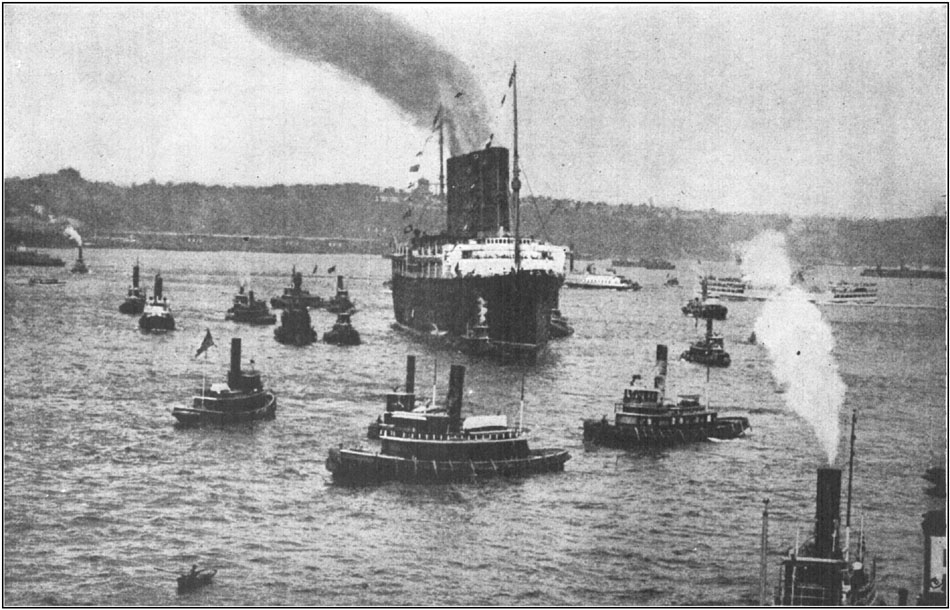
Copyright by Underwood & Underwood, N.Y.
The Lusitania in New York Harbor
So the days passed, the people living as one great family. New friendships grew, and many delightful acquaintances were formed. The complete harmony and restfulness of such a life, the clear skies and sunshine, and the vast expanse of blue-green ocean, all made them forget that they were riding into a region of horror and war.
For nearly ten months Belgium, England, France, and Russia had been waging war against Germany. Around England's coasts lurked the horrors of the German submarine. The travelers on the morning of sailing had read the warning against crossing. It has since been called the "Death Notice." It read:
NOTICE
Travelers intending to embark on the Atlantic voyage are reminded that a state of war exists between Germany and her allies and Great Britain and her allies; that the zone of war includes the waters adjacent to the British Isles; that in accordance with formal notice given by the Imperial German Government, vessels flying the flag of Great Britain or any of her allies, are liable to destruction in those waters; and that travelers sailing in the war zone on ships of Great Britain or her allies do so at their own risk.
Imperial German Embassy.
Washington, D.C., April 22, 1915.
It had been printed in the newspapers beside the advertisement of the sailing of the Lusitania, and was posted that very morning by order of Count von Bernstorff, German ambassador to the United States. But most of the travelers paid no attention to the notice after reading it, for they were sure that no implement of war would be turned against a passenger ship. With stout hearts, many of the travelers said, "We are Americans. No country will refuse respect and protection for an American citizen in any part of the world." Or they said, "We are British citizens,—not soldiers. We are on a merchant vessel—not a battleship. Surely our rights will be respected. We cross under necessity."
So they dared to exercise their freedom and their rights when they boarded the steamer for this return trip.
After sailing for five days in safety, they came at last within sight of land. Early on Friday morning a heavy fog had lowered, but the ship continued to plow steadily through the tranquil waters. Toward noon the fog lifted and the sunshine and blue sky came to view, contributing to the full enjoyment of the travelers.
They had just finished luncheon. Some were quietly writing letters—others playing games. Many had strolled to the upper decks. They greeted their new acquaintances, regretting that they were so soon to part, for they were now but ten or fifteen miles out from shore off "Old Head of Kinsale," and within a few hours all would land, going on their separate ways for the rest of the journey. Though they were nearing a world at war, all seemed peaceful.
The ship's clock pointed at two, when a few men standing on deck saw what looked like a whale rising from the water about three quarters of a mile away. They saw it speeding toward them, and suddenly they knew what it was; but no one named it, until with a train of bubbles it disappeared under the ship, and they cried, "It's a torpedo!"
With a fearful explosion, the center of the ship was blown up through the decks, making a great heap of wreckage. The passengers fled from the lower to the upper decks, many of them not stopping for life preservers. Some of those who did strap on the life preservers did not put them on correctly. Many leaped into the water, trusting to be picked up by a passing boat. Although every one was terribly frightened, yet there seemed to be no panic. The men lowered the lifeboats, which were crowded to the full. As many as seventy or eighty people, it is said, were packed into one small boat.
Leslie N. Morton, a mere lad, has been officially named as bravest of the crew. He was stationed on the starboard side, keeping look-out, when the torpedo struck. He, with the assistance of his mate, rowed a lifeboat for some miles, put the people on a fishing smack, and returned again for other survivors, rescuing in all nearly a hundred.
There were many acts of heroism among the passengers, but in all of the distress one young man stood out among the hundreds upon the ship. Alfred G. Vanderbilt, a young American millionaire, quickly realizing that the steamer was sinking, turned to his valet and cried, "Let us save the kiddies!" The two sprang to the rescue of the babies and small children, carrying two of the little ones in their arms at a time and placing them carefully in the lifeboats with their mothers. Mr. Vanderbilt and his valet continued their efforts to the very last. When they could find no more children, they turned to the assistance of the women that were left. When last seen, Mr. Vanderbilt was smilingly, almost happily, lending his aid to the passengers who still remained on deck.
The whole civilized world honors the memory of this brave youth, who gave his life in serving helpless women and children. Gratifying indeed it is to know that the little ones were cared for, though sad to learn that even then only twenty-five of the hundred and twenty-nine babies on board were saved. About one hundred children were innocent victims of that dastardly deed which the Germans, through savage desire to terrorize, became brutes enough to do.
Elbert Hubbard, a noted American writer, and his wife went down with the ship. Charles Frohman, a leading producer of plays, was another prominent American lost. He has been cited as the finest example of faith and calm strength, for, realizing that there was little hope for him, he smilingly remarked, "Why fear death? It is the most beautiful adventure that life gives us."
In less than twenty minutes after the torpedo struck, nothing except floating pieces of wreckage strewn on the disturbed surface of the water marked the place of the great calamity.
The wireless operator had sent the S.O.S. signal of distress several times, and also had time to send the message, "Come at once, big list, 10 miles south of 'Old Head of Kinsale.'" He had received answers before his apparatus was put out of use, and soon trawlers and pilot boats came to the rescue and brought to shore those who had survived. The cold ocean water, however, had made many so numb that they were unable to help themselves enough to be lifted into the lifeboats, even when the life preservers had kept them afloat. Of the 159 Americans on board, 124 perished. In all, only 761 people were saved; 1198 perished.
That day the terrible news came over the cable to America,—the great passenger steamer Lusitania had been torpedoed by a German submarine; probably a thousand lives had been lost, among them many Americans!
At the White House, the President realized the awful import of such a message.
In a day or so, nearly two thousand telegrams poured in from all parts of the country; and it is said that the President read them all, for he wanted to know how the individual American felt.
The Germans offered all sorts of excuses for their cruel deed. A German paper printed the following:
Must we not, we who may be defeated by starvation and by lack of war materials, must we not defend ourselves from this great danger (with which the enemy's blockade threatens us), with all our might and with all the means that the German spirit can invent, and which the honor of the German people recognizes as lawful weapons? Have those, who now raise such outcries, any right to accuse us, those who allowed their friends and relatives to trust themselves on a ship whose destruction was announced with perfect clearness in advance? When our enemy's blockade method forces us to measures in self-defense, the death of non-combatants is a matter of no consequence.
A blockade of an enemy's ports is, and always has been, a perfectly fair kind of warfare. In our Civil War, the southern ports were, from the beginning, blockaded by the northern warships. Germany was in no danger of starving, as the events since have proved. Her excuses were, as they have been in every case where she has played the part of the brute, worse than no excuses and always based on falsehoods.
"The steamer carried ammunition for England," they said. But it was bought and carried in accordance with international law. Germany had the same right to buy and carry from a neutral country. "It was a British ship," they said. But it was a passenger ship and carried nearly two thousand people, many of them Americans, who, according to all international agreements, were guaranteed safe passage even in time of war.
All nations recognize the obligation of an enemy to visit and search the vessel they think should be sunk, to make sure it carries contraband of war, and if so, to give the people an opportunity to get safely into the lifeboats. Not only did the Germans not do this, but they did not even signal the ship that it was about to be sunk. The newspaper warning put out by Bernstorff was no excuse for committing an unlawful, inhuman act.
From all points of view, the Germans, in sinking the Lusitania, committed a horrible crime, not only against international law, but against humanity and civilization. In all war, armed forces meet armed forces; never do armed forces strangle and butcher the innocent and unprotected. There is such a thing as legitimate warfare, except among barbarians.
Here again was shown the German attitude in the "scrap of paper." Evidently trusting to the great distance of the United States and her well-known unpreparedness, Germany thought that a friendly relation with this country was a matter of entire indifference to her; or, if she hoped to draw America into the war, she little dreamed to what end those hopes would come!
Around the world one verdict was pronounced against Germany. This verdict was well worded in a Russian paper, the Courier:
The right to punish these criminals who violate the laws of humanity belongs first and foremost to the great American Republic. America knows well how to use this right. The sympathy of the civilized world is guaranteed her beforehand. The world is being suffocated by poisonous gases of inhuman cruelty spread abroad by Germany, who, in the madness of her rage, is committing needless, purposeless, and senseless murder, solely from lust of blood and horrors!
The American government, upon the occurrence of the calamity, showed great forbearance, believing that "a man of proved temper and tried courage is not always bound to return a madman's blow." A strong protest was sent to the Imperial German Government, which caused Germany to abandon for a time her submarine attacks upon neutral vessels. It was the renewal of these attacks that finally led to the declaration of war by the United States of America upon Germany and her allies, and it was the Lusitania outrage more than any other one event that roused the fighting spirit of America.
THE CHARGE OF THE BLACK WATCH AND THE SCOTS GREYSToC
Sometimes a retreat is in reality a great victory. It has been said that it requires a greater general to direct successfully a great retreat than it does to direct a great attack.
Some marvelous retreats have occurred in the World War, the greatest coming at its very beginning, when the English and French fell back to save Paris and to defeat the Germans at the Marne. This retreat was really a series of battles, day after day, with terrible losses on both sides.
An English private in the Black Watch, named Walter Morton, only nineteen years of age, described for the Scotsmen one of these battles in which his regiment and the Scots Greys made a magnificent charge. His story was as follows:
We went straight from Boulogne to Mons, being one of the first British regiments to reach that place. Neither army seemed to have a very good position there, but the numbers of the Germans were far too great to give us any chance of success. We were hard at it all day on Monday; and on Tuesday, as the French reinforcements which we had been expecting did not arrive, the order was given to retire.
In our retreat we marched close upon eighty miles. We passed through Cambrai, and a halt was called at St. Quentin. The Germans, in their mad rush to get to Paris, had seldom been far behind us, and when we came to St. Quentin the word went through the ranks that we were going into action. The men were quite jubilant at the prospect. They had not been at all pleased at their continued retirement before the enemy, and they at once started to get things ready. The engagement opened briskly, both our artillery and the Germans going at it for all they were worth. We were in good skirmishing order, and under the cover of our guns we were all the time getting nearer and nearer the enemy. When we had come to within 100 yards of the German lines, the commands were issued for a charge, and the Black Watch made the charge along with the Scots Greys. Not far from us the 9th Lancers and the Cameronians joined in the attack.
It was the finest thing I ever saw. The Scots Greys galloped forward with us hanging on to their stirrups, and it was a sight never to be forgotten. We were simply being dragged by the horses as they flew forward through a perfect cloud of bullets from the enemy's maxims. All other sounds were drowned by the thunder of the horses' hoofs as they careered wildly on, some of them nearly driven mad by the bullets which struck them. It was no time for much thinking. Saddles were being emptied quickly, as we closed on the German lines and tore past their maxims, which were in the front ranks.
We were on the German gunners before they knew where they were, and many of them went down, scarcely realizing that we were amongst them. Then the fray commenced in deadly earnest. The Black Watch and the Scots Greys went into it like men possessed. They fought like demons. It was our bayonets against the Germans' swords. You could see nothing but the glint of steel, and soon even that was wanting as our boys got well into the midst of the enemy. The swords of the Germans were no use against our bayonets. They went down in hundreds.
Then the enemy began to waver, and soon broke and fled before the bayonets, like rabbits before the shot of a gun.
There were about 1900 of us in that charge against 20,000 Germans, and the charge itself lasted about four hours. We took close upon 4000 prisoners, and captured a lot of their guns. In the course of the fighting I got a cut from a German sword—they are very much like saws—and fell into a pool of water, where I lay unconscious for twenty-three hours. I was picked up by one of the 9th Lancers.
THE BATTLES OF THE MARNEToC
At Marathon (490 B.C.) and at Salamis (480 B.C.) the Greeks defeated the Persians and saved Europe for western civilization. Had the Persians won, the history of Europe and of the world would be the story of the civilization of the East instead of that of the West.
At Tours (732 A.D.) Charles Martel defeated the forces of the Mohammedans, who had already conquered Spain, and saved Europe for Christianity.
At the Marne (1914 and 1918) the French, the English, and (in the second battle) the Americans, defeated the modern Huns and saved Europe for democracy and from the rule of merciless brute force. The First Battle of the Marne has been called the sixteenth decisive battle of the world.
Before the First Battle of the Marne, September 5 to 10, 1914, the German military machine had been winning, as never an army had won before in the entire recorded history of the world. Its path had been one of treachery, of atrocities, of savagery, but one of tremendous and unparalleled victory. The Germans at home called it "the great times."
Brave little Belgium had been able to hold back the German hordes but for a short time at Liége and Namur, but, as future events proved, long enough to make possible the decisive battles at the Marne. The Germans had taken Brussels and Antwerp, had destroyed Louvain, had filled themselves with outrage and murder, had drunk of blood and wine and success until they were thoroughly intoxicated with the belief so common to drunken brutes that no men in the world can stand against them. The little Belgian army, "the contemptible little English army" (as the Kaiser called it), and the magnificent French army had been retreating day by day almost as fast as the Germans could advance. Soon Paris and then all of France would be in German hands—and what a glorious time they would have in the gayest and most beautiful capital of the world. Although bodies of German cavalry raided the coast, the German leaders, elated and intoxicated with thoughts of rich plunder and dissipation, did not turn aside in force to follow the Belgian army and to take the Channel ports of Dunkirk, Calais, and Boulogne, but pushed on toward Paris. The French government, expecting a siege of the city, moved to Bordeaux.
The main forces of the Germans had turned south from the coast towards Paris with General von Kluck's army of about 200,000 men at the right or west of the German line of advance. General von Kluck was attempting to outflank the English army, that is, to throw part of his forces around the extreme western end of the English army, which had to keep retiring rapidly to avoid being encircled. The French army was obliged to fall back to keep in touch with the British.
The English retired nearly one hundred miles without losing their cheerfulness or their confidence. It was this turning movement on the left that forced all the allies to retire. An English writer who was with the army said that though the Germans constantly attacked with reckless courage, yet the British and French retired slowly with their faces to the foe, and showing the greatest heroism. The numbers of the Germans were greater than those of the Allies, and the Germans gave them no rest. Night and day they hammered away, coming on like great waves. The gaps the English made were filled instantly. The German guns played upon the Allies constantly. Their cavalry swept down upon them recklessly. If the English had great losses, the Germans had greater. The English fought with cool bravery. They never wavered an instant. But the pressure upon them could not be resisted. Column after column, squadron after squadron, mass after mass, the enemy came on like a battering ram, crushing everything in its way. They swarmed on all sides, even though shattered by shot and shell. Nothing but the steadfast courage, the sheer pluck, the spirit, the soul of the English soldiers saved the army from complete destruction.
"The enemy hung on to us like grim death," said a wounded soldier. "They wanted us to retreat in a direction that would best suit their plans. But we were not taking marching orders from them. We went our own way at our own pace. We were retiring, not retreating."
Then on the fifth of September came General Joffre's appeal to the defenders of civilization, and particularly to the French soldiers: "The hour has come to hold our positions at any cost and to fight rather than to retreat.... No longer must we look at the enemy over our shoulders, for the time has come to put forth all our efforts in attacking and defeating him."
A French writer has said of the retreat, which by order of General Joffre had now come to an end, "Their bodies retreated, but never their souls;" and he might have added of the German advance, "It was an advance of bodies, not of souls." It was material might in men and guns forcing back an army weaker in everything except soul and spirit. The World War has shown over and over again, not only at the Marne but at a hundred other places and in a hundred other ways, that soul and spirit are the real conquerors and that God is not always, as Napoleon said, on the side of the larger battalions.
The Germans had come on flushed with success and egotism, destroying French property, looting, and dissipating. Their spirit was the spirit they found in the French wine cellars, and as for soul, as civilized people understand the word, they had none. They were an army of tired, conquering brutes. Their morale was low because of their great success and all that had accompanied it of feasts and slaughter. The morale of the French was never higher. Every day and every hour they had been compelled to retreat, giving up, giving up all that they loved even better than life itself to these brutes, until the brain of the French army said on the evening of September 5, 1914, "You have gone so far in order that you may now stand successfully." And in the morning at dawn, it was not only the bodies of the French soldiers that hurled themselves against the invaders, but the souls of French men, the soul of France; and all along the line from Verdun to Meaux, under the gallant leadership of Manoury, Foch, Sarrail, Castelnau, and others, the French armies held. If they had not held—not only held but attacked—all of future history would be different.
General Foch, commander in chief at the Second Battle of the Marne, inspired his troops in this first battle to supernatural bravery. He knew they must not yield, so with his right broken, his left shattered, he attacked with his center. It was that or retreat. His message to the commander-in-chief, General Joffre, will never be forgotten.
"My left has been forced back, my right is routed. I shall attack with the center."
The Germans could not put their souls into the battles as the French soldiers did, and besides, the Germans were weakened by feasting and dissipation. With the Huns it was the right of might; with the Allies it was the might of right, and in the end the second always defeats the first.
Some one has well said:
"It is the law of good to protect and to build up. It is the law of evil to destroy. It is in the very nature of good to lead men aright. It is in the very nature of evil to lead men astray. Goodness makes for wisdom. Badness is continually exercising poor judgment.
"Germany and Austria have made colossal mistakes in this war because of their colossal violation of truth and justice. In brutally wronging Serbia, they lost the friendship and support of Italy. In perpetrating the monstrous crime against Belgium, they brought against them the whole might of the British Empire. In breaking international law with their reckless submarine warfare, they caused the United States to enter the war on the side of the Allies."
It is said that the army of the German Crown Prince retreated before the impetuous attack of the French and, because of this retreat, all the other German armies were obliged to do likewise. It is more probable, however, that the general retreat was due to General Joffre's strategy. The Germans under General von Kluck were within about twenty miles of Paris, near Meaux on the Marne, when suddenly they were struck in the flank and rear by about twenty thousand fresh troops brought out unexpectedly from Paris in motor trucks, taxis, limousines, and all kinds of pleasure cars. Now the Germans, who had caused the retreat of the French and British armies upon Paris by continually outflanking the British, were in their turn outflanked and compelled to retreat, and Paris was saved.
An English writer has said that although the Germans were outflanked only in the west, yet the blow passed from one end of the German line to the other, from Meaux to Verdun, just as the blow from the buffer of the engine, when it is coupled to the train, passes from one truck to another to the very end of the train.
The Germans in the next few days retreated from the Marne to the Aisne, where they entrenched. Paris and France and Europe and the only world worth living in were saved. The French government moved back to Paris.
Hall Caine in "Three Hundred and Sixty-five Days" says: "The soul of France did not fail her. It heard the second approach of that monstrous Prussian horde, which, like a broad, irresistible tide, sweeping across one half of Europe, came down, down, down from Mons until the thunder of its guns could again be heard on the boulevards. And then came the great miracle! Just as the sea itself can rise no higher when it has reached the top of the flood, so the mighty army of Germany had to stop its advance thirty kilometres north of Paris; and when it stirred again, it had to go back. And back and back it went before the armies of France, Britain, and Belgium, until it reached a point at which it could dig itself into the earth and hide in a long, serpentine trench stretching from the Alps to the sea.
"Only then did the spirit of France draw breath for a moment, and the next flash as of lightning showed her offering thanks and making supplications before the white statue of Jeanne d'Arc in the apse of the great cathedral of Notre Dame, sacred to innumerable memories. On the Feast of St. Michael, ten thousand of the women of Paris were kneeling under the dark vault, and on the broad space in the front of the majestic façade, praying for victory. It was a great and grandiose scene, recalling the days when faith was strong and purer. Old and young, rich and poor, every woman with some soul that was dear to her in that inferno at the front—the Motherhood of France was there to ask God for the triumph of the right.
"And in the spirit of that prayer the soul of France still lives."
Nearly four years later the Germans, with greatly increased forces in France, due to the collapse of Russia, were again upon the Marne and only about forty miles from Paris. French and English and Americans were opposing them upon a line shaped like a great letter U, extending south with Rheims at the top on the east, and Soissons at the top on the west. The Marne River was at the curve at the bottom, and there most of the Americans were stationed.
On July 15, 1918, the Germans began the offensive which was to result, as they hoped, in the capture of Paris. They attacked on the Marne and between the Marne and Rheims. At the end of the fourth day, they had advanced about six miles, crossing the Marne and pushing back the American troops. The Americans fought bravely and soon regained the ground they had lost, although the French generals suggested that they should not attempt to retake it. The American commander, however, sent word to the French general, who was his superior officer, saying that he did not feel able to follow the suggestion, for the American flag had been compelled to retire. None of his soldiers, he said, would understand this being allowed as long as they were able to attack. "We are going to counter-attack," he added. They did so, and regained all the ground lost.
It is clear now that the French generals knew the counter-attack was unnecessary, and knew why. West of the line from Soissons to the Marne is a great forest, and back of this General Foch, commander in chief of all the allied armies, had been for several days gathering guns, ammunition, tanks, and troops ready to strike the flank of the Germans, when they should attack between Rheims and the Marne and attempt to cross the Marne, as he knew they would in their desire to take Paris. A terrible tempest passed over the region just before the Allied attack, preventing the Germans from observing the advancing tanks and troops. An English writer has said, "The storm which had covered the noise of the final preparation of a number of tanks which led the assault, was over. Not a sound was heard in the forest, though it was teeming with men and horses. Then suddenly the appointed moment came when day broke. There was a roar from all the guns, the whole front broke into activity as men and tanks dashed forward. I suppose there has been nothing more dramatic in the whole war than this scene on which the general looked down from the top of a high perch in the forest on that quiet July morning!"
The Allies struck so unexpectedly that they captured hundreds of guns and thousands of prisoners, and obliged the Germans to fall back across the Marne, losing all the territory they had gained and much more. The danger to Paris was again turned aside by the military genius of General Foch and the bravery of the troops under his command.
It was the first great battle in which the Americans took part. They showed themselves equal to the best of the Allies, and better than the Germans. A London paper called the American counter-attack one of the historical incidents of the whole war. All Europe, except Hunland, rang with praises of the American troops.
In the history of the World War, most of the great land battles will be named from rivers, the Marne, the Yser, the Somme, the Aisne, the Ailette, the Ancre, the Bug, the Dneister, the Dunajec and the Piave. A battle of the Rhine will probably be fought before German territory can be invaded to any great extent.
THE QUEEN'S FLOWERToC
On July 25, 1918, nearly every person in Washington, the capital of the United States, was asked to buy a bunch of forget-me-nots; and nearly every one responded, so that almost $7000 worth was sold in about an hour. In many other cities sales were held, and for many years to come such sales will be held all over the civilized world, for the forget-me-not is the Queen's flower, chosen by Elizabeth, Queen of Belgium, to be sold on her birthday, July 25, to raise money for the children of Belgium. She is a lover of flowers as are all the people of her country. Many parts of Belgium were before the war, like Holland, devoted to raising flowers for bulbs and seeds. It is said that the garden at the Belgian Royal Palace was the most beautiful garden in the world.
For many years it has been the Queen's custom to name a flower to be sold on her birthday for the benefit of some good cause. In 1910 she named the La France rose to be sold for the benefit of sufferers from tuberculosis in Belgium. Nearly $100,000 was raised on this one day.
The war has not done away with the beautiful custom, and on the Queen's birthday in 1918, she named a flower to be sold to raise money to help care for the children of Belgium. She chose the forget-me-not, for the Queen can never forget the terrible sacrifice her country was called upon to make, nor the brutal manner in which the Huns used their power.
Those who have carefully studied the facts have concluded that the Huns coolly and deliberately planned to destroy Belgium as a country and a people, not only during the war but forever. It was to carry out this plan that the villages and cities were burned or bombarded until they were nothing but heaps of stone and ashes; that much of the machinery was either destroyed or carried into Germany; that the Belgian boys and men were herded together and deported into Germany to work as slaves; and that the Belgian babies were neglected, starved, and murdered. If only the old and feeble were left at the end of the war, there could be no Belgium to compete with Germany, and Germany desired this whether she should win or lose.
America has done much to relieve the suffering of the Belgian people. Germany saw to it, however, that the babies and very young children were neglected as far as possible, with the exception of healthy Belgian boy babies, and many of these she snatched from their parents and carried into Germany to be raised as Huns. It has been said that no horror of the war equaled the horror of what Germany did to Belgian childhood.
Queen Elizabeth realized the danger and did everything in her power to protect and help the babies of Belgium. Although she is by birth a German princess, she wishes never to forget and that the world may never forget the great wrong done her country. In naming the forget-me-not she meant that Belgium's wrong should never be forgotten, and that the children of Belgium should not be forgotten.
The flower is to be sold for the benefit of Belgian children at all times and in all countries, for the Queen has said she will never name another.
The little blue forget-me-not will be sold all over the civilized world, that means except in Hunland, and wherever it is sold Belgium's story will be remembered. All that is sweet and beautiful and pure is connecting itself in the minds and hearts of men with Belgium in her sacrifice and suffering; and as long as history is recorded and remembered, the word "Belgium" will awaken these feelings in those who read. This is a part of her reward, just as the opposite is a part of the punishment of the Hun.
AT SCHOOL NEAR THE LINESToC
The boys and girls in America have listened with great interest and sympathy to the many stories of children in devastated France, left fatherless, homeless, perhaps motherless, with no games or sport, indeed with no desire to play games or sports of any kind. For them, there seemed to be only the awful roar and thunder of the cannon, which might at any moment send down a bursting shell upon their heads. The clothes they wore and the food they ate were theirs only as they were given to them, and so often given by strangers.
In America the school children worked, earned, saved, and sent their gifts to those thousands of destitute children, and with their gifts sent letters of love and interest to their little French cousins across the seas.
Many of the letters were written in quiet, sunny schoolrooms, thousands of miles from the noise of battle. But many a letter thus written reached the hands of a child who sat huddled beside his teacher in a damp, dark cellar that took the place of the pleasant little schoolhouse he had known.
But in those cellars and hidden places, the children studied and learned as best they might, in order some day to be strong, bright men and women for their beloved France, when the days of battle should be over and victory should have been won for them to keep.
The gladness of the children when they received the letters will probably never be fully known. Perhaps it seemed to some of them like that morning on which they marched away from the school building for the last time. The shells had begun to burst near them, as they sat in the morning session. Quickly they put aside their work, and listened quietly while the master timed the interval between the bursting of the shells. At his order, they had formed in line for marching, and at the moment the third or fourth shell fell, they marched out of the school away into a cellar seventy paces off. There, sheltered by the strong, stout walls, they listened to the next shell bursting as it fell straight down into the schoolhouse, where by a few moments' delay, they would all have perished or been severely injured.
So, while they heard the cannon roaring, they were happy to know that their friends in America thought of them and were helping them. No one will ever realize just how much it meant to the French people to know that America was their friend, or the great joy they felt when the American soldiers marched in to take their places in the fight for France and the freedom of the world.
Odette Gastinel, a thirteen-year-old girl of the Lycée Victor Duruy, one of the schoolrooms near the front, has written of the coming of the Americans. Throughout the United States her little essay has been read, and great men and women have marveled at its beauty of thought and wording, and have called it a little masterpiece.
In the first paragraph, she tells of the great distance between the millions of men (the Germans and the Allies) although separated only by a narrow stream; and in the second, she speaks of the closeness of sympathy between France and America,—though America lies three thousand miles over the sea.
It was only a little river, almost a brook; it was called the Yser. One could talk from one side to the other without raising one's voice, and the birds could fly over it with one sweep of their wings. And on the two banks there were millions of men, the one turned toward the other, eye to eye. But the distance which separated them was greater than the spaces between the stars in the sky; it was the distance which separates right from injustice.
The ocean is so vast that the sea gulls do not dare to cross it. During seven days and seven nights the great steamships of America, going at full speed, drive through the deep waters before the lighthouses of France come into view; but from one side to the other, hearts are touching.
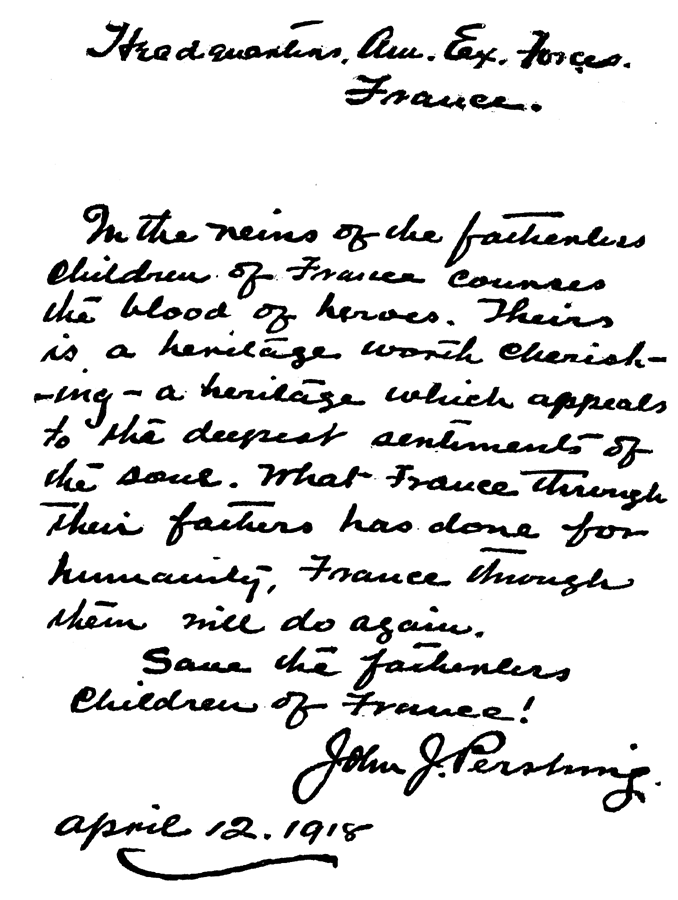
It is no wonder that the great American, General Pershing, stopped, in all the tumult and business of war, to write to people in America:
A PLACE IN THE SUNToC
The history of Rome about 1500 years ago tells us of "the wild and terrifying hordes" of Huns, with ideas little above those of plunder and wanton destruction, led by Attila whose "purpose was to pillage and increase his power." They came near setting civilization back for hundreds of years, but were finally subdued. When we remember these facts, we do not wonder that the Germans are called, and probably always will be called, Huns; but another explanation is the true one.
When in 1900, a German army was embarking at Bremerhaven for China to help other nations to put down the Boxer rebellion, the German Kaiser, William II, in addressing his troops said: "When you come upon the enemy, no quarter will be given, no prisoners will be taken. As the Huns under their King Attila, a thousand years ago, made a name for themselves which is still mighty in tradition and story, so may the name of German in China be kept alive through you in such a wise that no Chinese will ever again attempt to look askance at a German."
The United States helped put down the Boxer rebellion, and with other nations was paid an indemnity by China. By vote of Congress, the United States returned the money to China. Germany acted very differently, for but three years before, she had seized from China the land about Kiaochau Bay and the port of Tsingchau, as reparation for the murder of two German missionaries. Although Germany had strongly fortified this territory, Japan besieged it and regained it in November, 1914.
In speaking in 1901 of Germany's then new possession in China, the Kaiser said: "In spite of the fact that we have no such fleet as we should have, we have conquered for ourselves a place in the sun. It will now be my duty to see to it that this place in the sun shall remain our undisputed possession, in order that the sun's rays may fall fruitfully upon our activity and trade in foreign parts." The German Crown Prince, in an introduction to a book published in 1913, said: "It is only by relying on our good German sword that we can hope to conquer the place in the sun which rightly belongs to us and which no one will yield to us voluntarily. Till the world comes to an end, the ultimate decision must rest with the sword."
These statements make clear to us how the modern Huns would win the place in the sun which they have been taught to believe rightly belongs to them.
It is possible that the Kaiser took his idea of "a place in the sun" from a wonderful old copper engraving by the greatest of all German artists, Albrecht Dürer. The engraving was made in 1513 and represents a German knight in full armor mounted upon a fine war horse, riding into a dark and narrow defile between cliffs, to reach a beautiful castle standing in the sun on a hill beyond. A narrow path runs down from the castle, which the knight can reach only by passing through the gloomy and dangerous defile between the rocks. If he would reach his desired place in the sun, he must be afraid of nothing, even though human skulls and lizards are under his horse's feet and death and the devil travel by his side. His horse and his dog are evidently afraid, but the knight himself shows no fear as he rides forward with his "good German sword" at his side and his long spear over his shoulder. A recent German writer has said about this picture, "Every German heart will comprehend the knight who persists in spite of death and the devil in the course on which he has entered. Such a man of resolute action is not tormented by subtle doubts."
So has Germany in the World War tried to ride through the valley of death and destruction, with death and the devil always by her side, to reach a coveted place in the sun. That such a place can be attained only by force is the terribly wrong ideal that has been taught to the German people, to the children in the schools, to the adults in public meetings and in the public press, until at last they have come to believe it, and are willing to ride through the world accompanied by death and the devil if they may thus gain "a place in the sun."
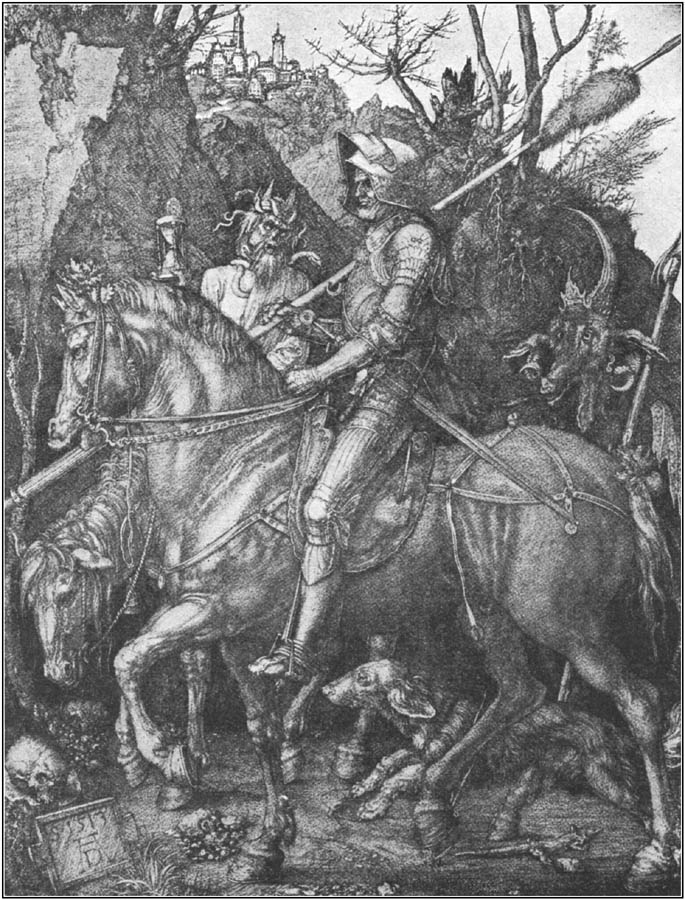
By Albrecht Dürer
Seeking A Place In the Sun
They are, as a German poet, Felix Dahn, wrote, the kith and kin of Thor, the god of might, who conquered all lands with his thundering hammer; and it is their destiny to conquer the world by "the good German sword."
This is the ideal that the Allies are fighting against. What is the ideal they are fighting for? It may also be illustrated by a picture, but this time by a word picture written by a man long familiar with Dürer's wonderful engraving. For years he had a copy of the engraving hung above his desk. As he studied it, he finally saw himself a knight riding on through the world; and he saw riding with him, not death and the devil, but two other knights. One of the knights was hideous to look upon, and rode just behind him; and one was wonderfully beautiful and strong, and rode just ahead of him. And all three rode at full speed forever and ever, the knight, who was the man himself, in the middle, always striving to outrun the knight who was behind him, and to overtake the one before him. Finally he put the thought in verse, for it seemed to him to represent the life of every human being who was free to live out his life as he would wish.
THE QUEST
A knight fared on through a beautiful world On a mission to him unknown; At his left and a little behind there rode The self of his deeds alone. At his right and a length before sped on— Him none but the knight might see— A braver heart and a purer soul, The self that he longed to be. And ever the three rode on through the world With him at the left behind; Till never the knight would look at him, Feeble and foul and blind. Desperately on they drave, these three, With him at the right before, While the knight rode furiously after him And thought of the world no more. Forever on he must ride on his quest And peace can be his no more, Till the one at his left he has dropped from sight And o'ertaken the one before. Thus ages ago the three fared on, And on they fare to-day, With him at the left a little behind, The right still leading the way.
This knight seeks not a place in the sun but a change in himself, to become a better, a braver, a truer knight. Then, wherever he may be, he will find his place in the sun; and that nation whose people seek to grow wiser and better and nobler will always find "the sun's rays falling fruitfully" upon them.
To win prosperity and happiness through becoming abler and better people, under a government which will do all it can to aid them, because it is "a government of the people, for the people, and by the people," is the ideal for which the Allies fight.
"What shall it profit a man if he gain the whole world and lose his own soul?"
It is for us, the living, rather, to be dedicated here to the unfinished work which they who fought here have thus far so nobly advanced. It is rather for us to be here dedicated to the great task remaining before us—that from these honored dead, we take increased devotion to that cause for which they gave the last full measure of devotion—that we here highly resolve that these dead shall not have died in vain—that this nation, under God, shall have a new birth of freedom—and that government of the people, by the people, for the people, shall not perish from the earth.
Abraham Lincoln.
MARSHAL JOFFREToC
The greatest leaders in history are often men who for the larger part of their lives have been almost unknown. Poor, simple in their habits, but loyal and true of heart, they have risen from obscurity to positions they alone could fill, and then through their devotion and achievement have become the heroes of the people.
Lincoln, the greatest example and inspiration to American hearts, was in his youth such a simple and obscure person. The Pilgrim fathers, the early pioneers in the West, the great inventors of the hundreds of improvements in the world of business, travel, and communication, were nearly all of them unknown for the greater part of their lives, but were men of true hearts and of strong purposes.
Unattractive, ungainly in appearance, unpopular save among those who knew him well, but with the strength of will and soul born of the simple, true life he had lived, Lincoln rose step by step to seats of power until he sat at length in the highest of all. By that calmness and vision which belong to such great men, Lincoln saved the nation from failure and corruption. He must have foreseen the great nation into which the United States might grow, if only he could rescue it from the terrible ravages of war and reunite the people with one strong, common soul.
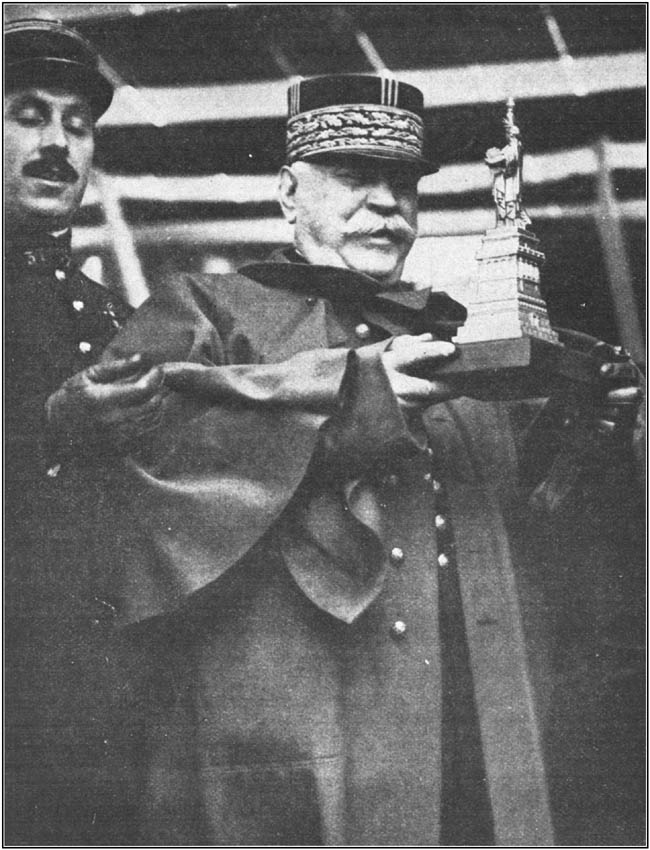
Copyright by Underwood & Underwood, N.Y.
Marshal Joseph Jacques Joffre
Marshal Joffre is holding the golden miniature Liberty Statue presented to him when he visited New York City in 1917
We Americans, by thinking of such a leader as Lincoln, may more clearly appreciate what it meant to France in this World War to follow on to victory with such a leader as Joseph Jacques Joffre.
Marshal Joffre was born in 1852 and lived for years in Rivesaltes, a little town near the boundary between France and Spain. His ancestors for generations had been farmers, and his father was a cooper by trade. The boy was a sweet-tempered, modest, intelligent, blue-eyed, and blonde-haired youth. He suffered somewhat from his school-fellows, as any boy does who is popular with his teachers. But he was industrious, wide-awake, and interested in a great many things, mathematics probably being the subject in which he excelled. Trained by thrifty peasant parents, he acquired regular habits which were valuable to him all his life long. Even in this World War, when great responsibility pressed upon him, he rarely failed to retire by nine or ten at night and to rise at five in the morning. Before six each morning, he was out for a short, brisk walk or for a ride on his horse.
When he was only fifteen years old, he astonished his parents by announcing his intention to try for entrance to the École Polytechnique in Paris, a great training school for military officers. Such a plan seemed, not only to his parents, but to his many friends, much too ambitious for a barrel-maker's son. But he insisted on trying the examination and passed fourteenth in a class of one hundred and thirty-two. His sister, for whom Joffre always had a great affection, declared that he would have secured a higher rank if he had not passed such a poor examination in German, a language for which he evidently had a strong dislike. Those who have seen his examination papers say that they are models of neatness, clear thinking, and accuracy.
Because of his high standing, Joffre was made sergeant of his class at the École Polytechnique. This honor, which made him responsible for the order and behavior of his own classmates, was rather an embarrassing one, for he was not of a domineering nature, and was besides the youngest boy in the hall. He found great difficulty in exercising his authority over these dozen or so lively youths, though he was destined one day to be given command over more than three million men.
By hard work he made good progress in his studies. But he did not finish his course, for in 1870 the Franco-Prussian War broke out. Joffre, but eighteen years of age, was made a sub-lieutenant in a Paris fort. That terrible year left its impression upon him for life. He felt the greatest agony at the loss of beautiful Alsace-Lorraine—a part of his own beloved country, taken by the enemy. From that time he lived with one hope—that he might some day be of service in setting right that wrong, in getting back for France that which had been stolen from her. He once said, "I have seen 1870. I have given my life utterly to see that it did not happen again." Thus, it has been said: "The formula for Joffre is easy to find. It is a number; it is a date; it is 1870." What he saw at that time shaped his purposes for the future.
Joffre is not only a thinker, but a man of action. He thinks hard for a time, and then feels compelled to put his thoughts into action. The story is told of how Confucius, upon leaving a funeral service, presented his horse to the chief mourner. When asked why he did so, he replied, "I wept with that man and so I felt I ought to do something for him." Joffre thought long and hard and then wanted to do something.
After the war of 1870, he went into the engineering corps of the army and for fifteen years served well in building barracks and fortifications. Then he asked to go to Indo-China where France was waging a colonial war. He was commissioned a lieutenant, and at the end of three years returned a captain, with the Legion of Honor.
He was made a member of the staff of administration of the engineering corps, and while in this service it was said of him: "Joffre is good at all jobs. He will be good for the big job some day."
In 1892 he went to Africa to build a railroad. While working at that, news came that Colonel Bonnier and his party of Frenchmen had been attacked and many of them massacred by the natives near Timbuctoo. Joffre organized a rescuing expedition (which has ever since been held up as a model), took possession of Timbuctoo, and subdued the tribes; then went back and finished his railroad. When he returned to France this time he was a colonel, having risen one degree in the Legion of Honor.
After three years he was sent to Madagascar, where he built such excellent defenses that upon his return he was made head of the French military engineering corps. He then had the task of preparing the forts of France. He built the forts of Belfort, Épinal, Toul, and Verdun, all of which victoriously withstood the German attacks in the World War.
By this time, Joffre was a general. He practiced at handling troops in the field until he knew all the tactics in moving great bodies of men. He became chief of such matters as transportation, armament, and mobilization.
Yet all this time Joffre was almost entirely unknown among the French people. Quiet, almost shy, a man of few words, he was not one to call attention to himself. Only those who were close to him knew him and his great ability. Late in life he had married a widow with two beautiful daughters. He lived with them very quietly in Auteuil in the suburbs of Paris. Here the great chief loved to gather his family about the piano and enjoy their companionship and an evening of music. He could often be seen mornings, walking with his two beloved daughters. Always he was a kind, thoughtful, gentle, often silent man, and, being silent, he had also the virtue of being a good listener. For he hated empty words, though he talked long enough when he had something to say. He spoke with the greatest simplicity, however, and was always very gentle and courteous in his manners.
The officers of the staff of eleven men who directed the military affairs of the country, of which staff Joffre was a member, valued and esteemed him highly. It was from among the men of this staff that a commander in chief would be chosen in case of war.
But when the time came in 1911 to reorganize the army and appoint a commander in chief, the minds and hearts of the French people turned toward General Pau, the one-armed hero of the Franco-Prussian War. While they were eagerly waiting to applaud his promotion, they were informed that General Joseph Joffre had accepted the appointment. General Pau had refused the position, saying, "No patriotic Frenchman has any right to accept this when such a man as Joffre is available."
Joffre had a great deal of opposition to face. Unpleasant comments were made, and worse than all, France herself was filled with all sorts of political and social evils.
Germany, as all France knew, was planning to dash across the border, and that before very long. But Joffre determined that, should his country be attacked from beyond the Rhine, it would be defended.
Joffre was now fifty-nine years old with his blonde hair and eyebrows grown white. His large head, square face and jaw, his great and powerful frame, suggested strength, vigor, and a marvelous ability for leadership. His first act was to place General Pau, whom he recognized as a very able man, in the next highest command.
Assisted by President Poincaré and Millerand, Minister of War, he set out to reform the army. There prevailed a system of spying, by which officers were privately watched and reported for disloyalty upon the least suspicion. Joffre destroyed this system entirely and announced that all officers would be appointed purely on the basis of merit. He dismissed several generals, some of them his own personal friends, because they were incompetent. They were generals who were either too old, or who could not act quickly and efficiently in the field, even though they were good thinkers. This caused him some unhappy hours, but he did it for France. He promoted men who successfully performed their duties. He made excellent preparation in the new departments created by modern science and inventions,—telephones, automobiles, and aëroplanes. Altogether he put system and order into everything, aroused a soul in his army, and created a new spirit in France.
A year before the war came, Germany had 720,000 men ready to march into France. Joffre, with remarkable skill, raised his army in numbers to about 600,000. Even so they were greatly outnumbered, but Joffre knew that all depended on their ability, for the first few weeks, to withstand the expected onrush of German troops. So he organized them carefully, and best of all, put into their hearts the belief that "there is something which triumphs over all hesitations, which governs and decides the impulses of a great and noble democracy like France,—the will to live strong and free, and to remain mistress of our destinies." This spirit in Joffre and in the other French leaders made France powerful in those first fateful days. It was the same spirit which Joffre later imparted to his men on the eve of the Battle of the Marne, the spirit which made that battle result in victory for France. As the men on that September evening gathered about their officers and listened to the reading of Joffre's message, Joffre's spirit itself took possession of every one of them.
"Advance," the order read, "and when you can no longer advance, hold at all costs what you have gained. If you can no longer hold, die on the spot."
Joffre was careful not to make any decisions until he had thought the question over deeply, but once made, his decisions were immediately carried out. When he ordered a retreat, he knew the reason, and his men trusted him and followed his orders implicitly. The people of France, too, came to love and trust this great general of theirs.
When the German army, fairly on its way to Paris, suddenly met the greatest defeat Germany had known since the days of Napoleon, the villagers near Auteuil, where Joffre had his home, came and covered the steps of his house with flowers. This was the first tribute of the people to the man who had saved the nation, and it showed their confidence in the future of the country as long as it should rest in the hands of Joseph Jacques Joffre.
Thus, from the unknown man who in 1911 had been exalted to a great and responsible position, Joffre quickly became known and loved by all the people of France as "Our Joffre." He was later retired from active service with the highest military rank, Marshal of France.
THE HUN TARGET—THE RED CROSSToC
All the civilized nations of the world have agreed to respect the Red Cross, believing that when men are carried from the battlefield wounded or dying, it is inhuman to war upon them further. But the agreement to this by Germany, like all other German agreements, became only "a scrap of paper" when the Hun leaders thought they saw an advantage in tearing it up.
Germany is also the only nation claiming to be civilized that kills its prisoners when it thinks best. When the Kaiser told the German soldiers going to China to take no prisoners, he meant that they should kill them.
Frightfulness was not a sudden afterthought on the part of the Germans, arising in the excitement of war. It was deliberately planned and taught to the German officers and soldiers. The manual prepared for their use in land warfare contains the rules which are to guide them. Among the directions are these: Endeavor to destroy all the enemies' intellectual and material resources. The methods which kill the greatest number at once are permitted. Force the inhabitants to furnish information against their own armies and their own people. Prisoners may be killed in case of necessity. Any wrong, no matter how great, that will help to victory is allowed.
How the Germans carried out the "Rules for Land Warfare" is well shown by the proclamation posted by General von Bülow in the streets of Namur on August 25, 1914. It read as follows:
Before four o'clock all Belgian and French soldiers must be turned over to us as prisoners of war. Citizens who fail to do this will be sentenced to hard labor for life in Germany. At four o'clock all the houses in the city will be searched. Every soldier found will be shot. Ten hostages will be taken for each street and held by German guards. If there is any trouble in any street, the hostages for that street will be shot. Any crime against the German army may bring about the destruction of the entire city and every one in it.
Frightfulness was taught not only to officers and soldiers but to all the German people, and especially to the children in the schools. One of the selections read and recited, even in the primary schools of Germany before the war, was "The Hymn of Hate" by a German poet, which in English prose is in substance as follows:
Hate! Germany! hate! Cut the throats of your hordes of enemies. Put on your armor and with your bayonets pierce the heart of every one of them. Take no prisoners. Strike them dead. Change their fertile lands into deserts. Hate! Germany! hate! Victory will come from your rage and hate. Break the skulls of your enemies with blows from your axes and the butts of your guns. They are timid, cowardly beasts. They are not men. Let your mailed fist execute the judgment of God.
A German general told Edith Cavell, when she was pleading in behalf of some homeless Belgian women and children, "Pity is a waste of feeling—a moral parasite injurious to the health."
The whole idea of the German War Book is given in the statement made by a great German:
"True strategy means to hit your enemy and to hit him hard, to inflict on the inhabitants of invaded towns the greatest possible amount of suffering, so that they shall become tired of the struggle and cry for peace. You must leave the people of the country through which you march only their eyes to weep with."
And these rules and teachings came at a time when nations were seeking to do away with war forever and were agreeing upon rules that, if war should come, would make it less horrible and that would in particular spare non-combatants.
A German soldier wrote to the American minister, Mr. Gerard, early in the war while Mr. Gerard was still in Berlin:
To the American Government, Washington, U.S.A.:
Englishmen who have surrendered are shot down in small groups. With the French one is more considerate. I ask whether men let themselves be taken prisoner in order to be disarmed and shot down afterwards? Is that chivalry in battle?
It is no longer a secret among the people; one hears everywhere that few prisoners are taken; they are shot down in small groups. They say naïvely: "We don't want any unnecessary mouths to feed. Where there is no one to enter complaint, there is no judge." Is there, then, no power in the world which can put an end to these murders and rescue the victims? Where is Christianity? Where is right? Might is right.
A Soldier and a Man Who Is No Barbarian.
On October 25, 1914, a small party of German soldiers succeeded in entering Dixmude and capturing the commander of the French marines defending the town, and some of his men. It was a dark night and raining hard, and although the Germans had been able to get through the lines into the city and to capture Commander Jeanniot and a few of his men, they were unable to find a way back through the lines and out of the city. They wandered about in the rain and mud for nearly four hours, driving the captured French marines before them with the butts of their rifles. Day was dawning and there was no chance for them to escape in a body in the daytime. So the officers halted them behind a hedge and directed them to scatter.
Then the question arose as to what they should do with their prisoners. The majority voted that they should be put to death, and at a sign from their leader, the Boches knelt and opened fire upon the prisoners, who knew nothing of what was being planned. They were all killed, including the commander, except one, who was hit only in the shoulder. Before the Germans could put him to death, a party of French marines discovered them. The whole band was taken prisoner and brought before the Admiral, who sentenced three of the leaders to be executed. To have killed them all when they were taken would have seemed only too good for them, but the French are not a barbarian but a law-abiding people.
Germany believes she can win in war by making it so "frightful" that none but Germans can be strong enough to endure it. So among other atrocities, Germany has used the red cross on hospitals and hospital ships as a mark to guide them in dropping bombs and in aiming torpedoes. The Roumanian Minister of the Interior stated to the United States government the following:
Because of the action of Germany and her allies, it has been found advisable to remove the Red Cross conspicuously painted on the top of the hospital buildings, because it served as a special mark for the bombs, etc., from aeroplanes.
Germany also believes, without doubt, that killing wounded who may otherwise recover and go back into service will reduce the man power of her enemies, who, she thinks, are too Christianlike, too merciful, too faithful to their agreements to do likewise. Bombing hospitals and killing nurses and doctors will also make it likely that more wounded will die through lack of care and treatment. She knows that every hospital ship sunk means another must be taken to replace it from those carrying food or troops.
There is no mistake about her intentions, although she did at first offer lying excuses. She has dropped "flares," great burning torches, at night to be sure that the red cross was there and then dropped her bombs upon the hospital. She has killed many non-combatants in this way.
Germany has torpedoed, during the first four years of the war, hospital ships with the big red crosses painted on their sides and all lights burning at night (to show they were hospital ships), amounting to a total tonnage of over 200,000 tons. The torpedo that sank the Rewa without warning hit the German target, the red cross, exactly. Germany torpedoed the hospital ship Britannic, 50,000 tons, the largest British ship afloat, partly, without doubt, so that she could not compete with German ships after the war.
The first hospital ship destroyed by the Huns was the Portugal, sunk by a German submarine while she was lying at anchor in the Black Sea. One of the survivors described the sinking as follows:
The Portugal was sinking at the place where she was broken in two, her stern and stem going up higher all the time as she settled amidships. All around me unfortunate Sisters of Mercy were screaming for help. The deck became more down-sloping every minute and I rolled off into the water between the two halves of the sinking steamer. It so happened that the disturbance of the water somewhat abated and I succeeded in swimming up again. I glanced around. The Portugal was no more. Nothing but broken pieces of wreck, boxes which had contained medicaments, materials for dressings, and provisions, were floating about. Everywhere I could see the heads and arms of people battling with the waves, and their shrieks for help were frightful. The hospital ship Portugal was painted white, with a red border all around. The funnels were white with red crosses and a Red Cross flag was on the mast. These distinguishing signs were plainly visible and there can be no doubt whatever that they could be perfectly well seen by the men in the submarine. The conduct of the submarine proves that the men in it knew that they had to do with a hospital ship. The fact of the submarine's having moved so slowly shows the enemy was conscious of being quite out of danger.
Eighty-five lives were lost, including twenty-one nuns who were serving as nurses.
Notwithstanding the fact that, according to the Germans, God is on their side, some power for good saved most of those on the hospital ship Asturias. She did not sink when struck by the torpedo, but she was rendered helpless by the loss of her rudder. There was no sandy beach in sight, so the captain tried to guide her near the rocky shore where, if she sank, perhaps some might reach land, but he found he could not guide the ship. It was dark night, but guided by some unseen power she dodged a reef upon which she would have gone to pieces, rounded a headland, and beached herself upon the only piece of sandy shore in that vicinity.
The English hospital ship Lanfranc was carrying many wounded Germans to England when she was torpedoed. An English officer gave the following vivid description to a London daily paper:
The Lanfranc was attacked by a submarine about 7:30 Tuesday evening just as we had finished dinner. A few of us were strolling to and fro on the deck when there was a crash which shook the liner violently. This was followed by an explosion, and glass and splinters of wood flew in all directions. I had a narrow escape from being pitched overboard and only regained my feet with difficulty. In a few minutes the engine had stopped and the Lanfranc appeared to be sinking rapidly, but to our surprise she steadied herself and after a while remained perfectly motionless. We had on board nearly 200 wounded prisoners belonging to the Prussian Guard, and about twice as many British wounded, many being very bad cases. The moment the torpedo struck the Lanfranc, many of the slightly wounded Prussians made a mad rush for the lifeboats. One of their officers came up to a boat close to which I was standing. I shouted to him to go back, whereupon he stood and scowled. "You must save us," he begged. I told him to wait his turn.
Meanwhile the crew and the staff had gone to their posts. The stretcher cases were brought on deck as quickly as possible and the first boats were lowered without delay. Help had been summoned, and many vessels were hurrying to our assistance. In these moments, while wounded Tommies—many of them as helpless as little children—lay in their cots unaided, the Prussian morale dropped to zero. They made another crazy effort to get into a lifeboat. They managed to crowd into one, but no sooner had it been lowered than it toppled over. The Prussians were thrown into the water, and they fought each other in order to reach another boat containing a number of gravely wounded soldiers.
The behavior of our own lads I shall never forget. Crippled as many of them were, they tried to stand at attention while the more serious cases were being looked after. And those who could lend a hand hurried below to help in saving friend or enemy. I have never seen so many individual illustrations of genuine chivalry and comradeship. One man I saw had had a leg severed and his head was heavily bandaged. He was lifting himself up a staircase by the hands and was just as keen on summoning help for Fritz as on saving himself. He whistled to a mate to come and aid a Prussian who was unable to move owing to internal injuries. Another Tommy limped painfully along with a Prussian officer on his arm, and helped the latter to a boat. It is impossible to give adequate praise to the crew and staff. They were all heroes. They remained at their posts until the last man had been taken off, and some of them took off articles of their clothing and threw them into the lifeboats for the benefit of those who were in need of warm clothing. The same spirit manifested itself as we moved away from the scene of outrage. I saw a sergeant take his tunic off and make a pillow of it for a wounded German. There was a private who had his arms around an enemy, trying hard to make the best of an uncomfortable resting place.