LEST WE FORGET (continued 4)
Reading edition
"We are not likely to have to fight three scourges, typhus, malaria, and cholera, though the possibility of the last has to be considered. But there remain dysentery, pneumonia, and enteric.
"Dysentery has been for centuries one of the most terrible of camp diseases, killing thousands, and, in its prolonged damage to health, it is one of the most fatal of foes to armies. So far as we know, it is conveyed by water, and only by carrying out strictly, under all circumstances, the directions about boiling water, can it be prevented. It is a disease which, even under the best of circumstances, cannot always be prevented; but with care there should never again be widespread outbreaks in camps themselves.
"Pneumonia is a much more difficult disease to prevent. Many of us, unfortunately, carry the germ with us. In these bright days all goes well in a holiday camp like this; but when the cold and the rain come, and the long marches, the resisting forces of the body are lowered, the enemy, always on the watch, overpowers the guards, rushes the defenses, and attacks the lungs. Be careful not to neglect coughs and colds. A man in good condition should be able to withstand the wettings and exposures that lower the system, but in a winter campaign, pneumonia causes a large amount of sickness and is one of the serious enemies of the soldier.
"Above all others one disease has proved most fatal in modern warfare—enteric, or typhoid fever. Over and over again it has killed thousands before they ever reached the fighting line. The United States troops had a terrible experience in the Spanish-American War. In six months, between June and November, among 107,973 officers and men in 92 volunteer regiments, 20,738, practically one fifth of the entire number, had typhoid fever, and 1580 died. The danger is chiefly from persons who have already had the disease and who carry the germs in their intestines, harmless to them, but capable of infecting barracks or camps. It was probably by flies and by dust carrying the germs that the bacilli were so fatal in South Africa. Take to heart these figures: there were 57,684 cases of typhoid fever, of which 19,454 were invalided, and 8022 died. More died from the bacilli of this disease than from the bullets of the Boers. Do let this terrible record impress upon you the importance of carrying out with religious care the sanitary regulations.
"One great advance in connection with typhoid fever has been made of late years, and of this I am come specially to ask you to take advantage. An attack of an infectious disease so alters the body that it is no longer susceptible to another attack of the same disease; once a person has had scarlet fever, smallpox, or chicken pox, he is not likely to have a second attack. He is immune. When bacilli make a successful entry into our bodies, they overcome the forces that naturally protect the system, and grow; but the body puts up a strong fight, all sorts of anti-bodies are formed in the blood, and if recovery takes place, the patient is safe for a few years at least against that disease.
"It was an Englishman, Jenner, who, in 1798, found that it was possible to produce this immunity by giving a person a mild attack of the disease, or of one very much like it. Against smallpox all of you have been vaccinated—a harmless, safe, and effective measure. Let me give you a war illustration. General Wood of the United States Army told me that, when he was at Santiago, reports came that in villages not far distant smallpox was raging, and the people were without help of any kind. He called for volunteers, all men who showed scars of satisfactory vaccination. Groups of these soldiers went into the villages, took care of the smallpox patients, cleaned up the houses, stayed there until the epidemic was over, and not one of them took the disease. Had not those men been vaccinated, at least 99 per cent of them would have taken smallpox.
"Now what I wish to ask you is to take advantage of the knowledge that the human body can be protected by vaccination against typhoid. Discovered through the researches of Sir Almroth Wright, this measure has been introduced successfully into our own regular army, into the armies of France, the United States, Japan, and Germany. I told you a few minutes ago about the great number of cases of typhoid fever in the volunteer troops in America during the Spanish-American War. That resulted largely from the wide prevalence of the disease in country districts, so that the camps became infected; and we did not then know the importance of the fly as a carrier. But in the regular army in the United States, where inoculation has been practiced now for several years, the number of cases has fallen from 3.53 per thousand men to practically nil. In a strength of 90,646 there were, in 1913, only three cases of typhoid fever. In France the typhoid rate among the unvaccinated was 168.44 per thousand, and among the vaccinated .18 per thousand. In India, where the disease has been very prevalent, the success of the measure has been remarkable.
"In the United States, and in France, and in some other countries, this vaccination against the disease is compulsory. It is not a serious matter; you may feel badly for twenty-four hours, and the place of inoculation will be tender, but I hope I have said enough to convince you that, in the interests of the cause, you should gladly put up with this temporary inconvenience. If the lessons of past experience count, any expeditionary force on the Continent has much more to fear from the bacillus of typhoid fever than from bullets and bayonets. Think again of South Africa, with its 57,000 cases of typhoid fever! With a million of men in the field, their efficiency will be increased one third if we can prevent typhoid. It can be prevented, it must be prevented; but meanwhile the decision is in your hands, and I know it will be in favor of your King and Country."
The soldiers in the American army are also inoculated against measles, scarlet fever, and the pneumonia germ.
Tetanus, or lockjaw, is one of the grave dangers faced by the wounded soldiers; for the germ of this disease has its home in the earth, and during a battle, soldiers with open wounds often lie for hours in the fields and trenches. Antitoxin treatment has reduced the death-rate.
Two new diseases have been produced by the World War,—spotted typhus and trench fever; both are carried by vermin. This was proved by soldiers who volunteered to permit experiments to be made upon them. By preventing and destroying the vermin, these diseases are being conquered.
THE TORCH OF VALOR[7]ToC
The torch of valor has been passed from one brave hand to another down the centuries, to be held to-day by the most valiant in the long line of heroes. Deeds have been done in Europe since August, 1914, which rival the most stirring feats sung by Homer or Virgil, by the minnesingers of Germany, by the troubadours of Provençe, or told in the Norse sagas or Celtic ballads. No exploit of Ajax or Achilles excels that of the Russian Cossack, wounded in eleven places and slaying as many foes. The trio that held the bridge against Lars Porsena and his cohorts have been equaled by the three men of Battery L, fighting with their single gun in the gray and deathly dawn until the enemy's battery was silenced. Private Wilson, who, single-handed, killed seven of the enemy and captured a gun, sold newspapers in private life; but he need not fear comparison with any of his ancient and radiant line. Who that cares for courage can forget that Frenchman, forced to march in front of a German battalion stealing to surprise his countrymen at the bridge of Three Grietchen, near Ypres? To speak meant death for himself, to be silent meant death for his comrades; and still the sentry gave no alarm. So he gave it himself. "Fire! For the love of God, fire!" he cried, his soul alive with sacrifice; and so died. The ancient hero of romance, who gathered to his own heart the lance heads of the foe that a gap might be made in their phalanx, did no more than that. Nelson conveniently forgot his blind eye at Copenhagen, and even in this he has his followers still. Bombardier Havelock was wounded in the thigh by fragments of shell. He had his wound dressed at the ambulance and was ordered to hospital. Instead of obeying, he returned to his battery, to be wounded again in the back within five minutes. Once more he was patched up by the doctor and sent to hospital, this time in charge of an orderly. He escaped from his guardian, went back to fight, and was wounded for the third time. Afraid to face the angry surgeon, he lay all day beside the gun. That night he was reprimanded by his officers—and received the V.C.! Also there are the airmen, day after day facing appalling dangers in their frail, bullet-torn craft. Was there ever a stouter heart than that of the aviator, wounded to death and still planing downwards, to be found seated in his place and grasping the controls, stone-dead? Few eyes were dry that read the almost mystic story of that son of France who, struck blind in a storm of fire, still navigated his machine, obedient to the instructions of his military companion, himself mortally wounded by shrapnel and dying even as earth was reached.
There is no need to worship the past with a too-abject devotion, whatever in the way of glory it has been to us and done for us. Chandos and Du Guesclin, Leonidas and De Bussy have worthy compeers to-day. Beside them may stand Lance-Corporal O'Leary, the Irish peasant's son. Of his own deed he merely says that he led some men to an important position, and took it from the Huns, "killing some of their gunners and taking a few prisoners." History will tell the tale otherwise: how this modest soldier, outstripping his eager comrades, coolly selected a machine gun for attack, and killed the five men tending it before they could slew round; how he then sped onwards alone to another barricade, which he captured, after killing three of the enemy, and making prisoners of two more. Even officialism burst its bonds for a moment as it records the deed:
Lance-Corporal O'Leary thus practically captured the enemy's position by himself, and prevented the rest of the attacking party from being fired on.
The epic of Lieutenant Leach and Sergeant Hogan, who volunteered to recapture a trench taken by the Germans, after two failures of their comrades, is reading to give one at once a gulp in the throat and a song in the heart. With consummate daring they undertook the venture; with irresistible skill they succeeded, killing eight of the enemy, wounding two, and taking sixteen prisoners. In the words of the veteran of Waterloo, "It was as good fighting as Boney himself would have made a man a gineral for."
There are isolated incidents of this kind in every war; but in a thousand different places in France and Belgium the dauntless, nonchalant valor of Irishmen, Englishmen, Scotsmen, and Welshmen has shown itself. Did ever the gay Gordons do a gayer or more gallant thing than was done on the 29th of September, 1914, on the western front? Thirty gunners of a British field battery had just been killed or wounded. Thirty others were ordered to take their place. They knew that they were going to certain death, and they went with a cheery "Good-by, you fellows!" to their comrades of the reserve. Two minutes later every man had fallen, and another thirty stepped to the front with the same farewell, smoking their cigarettes as they went out to die—like that "very gallant gentleman," Oates, who went forth from Scott's tent into the blizzard and immortality. Englishmen can lift up their heads with pride, human nature can take heart and salute the future with hope, when the Charge of the Five Hundred at Gheluvelt is recalled. There, on the Ypres road to Calais, 2400 British soldiers, Scots Guards, South Wales Borderers, and the Welsh and Queen's Regiments held up 24,000 Germans in a position terribly exposed. On that glorious and bloody day the Worcesters, 500 strong, charged the hordes of Germans, twenty times their number, through the streets of Gheluvelt and up and beyond to the very trenches of the foe; and in the end the ravishers of Belgium, under the stress and storm of their valor, turned and fled. On that day 300 out of 500 of the Worcesters failed to answer the roll call when the fight was over, and out of 2400 only 800 lived of all the remnants of regiments engaged; but the road to Calais was blocked against the Huns; and it remains so even to this day. Who shall say that greatness of soul is not the possession of the modern world? Did men die better in the days before the Cæsars?
Not any one branch of the service, not any one class of men alone has done these deeds of valor; but in the splendid democracy of heroism, the colonel and the private, the corporal and the lieutenant—one was going to say, have thrown away, but no!—have offered up their lives on the altars of sacrifice, heedless of all save that duty must be done.
But greater than such deeds, of which there have been inspiring hundreds, is the patient endurance shown by men whose world has narrowed down to that little corner of a great war which they are fighting for their country. To fight on night and day in the trenches, under avalanches of murdering metal and storms of rending shrapnel, calls for higher qualities than those short, sharp gusts of conflict which in former days were called battles. Then men faced death in the open, weapon in hand, cheered by color and music and the personal contest, man upon man outright, greatly daring for a few sharp hours. Now all the pageantry is gone; the fight rages without ceasing; men must eat and sleep in the line of fire; death and mutilation ravage over them even while they rest. Nerves have given way, men have gone mad under this prolonged strain, and the marvel is that any have borne it; yet they have not only borne it, they have triumphed over it. These have known the exaltation of stripping life of its impedimenta to do a thing set for them to do; giving up all for an idea. The great obsession is on them; they are swayed and possessed by something greater than themselves; they live in an atmosphere which, breathing, inflames them to the utmost of their being.
There was a corner in the British lines where men had fought for days, until the place was a shambles; where food could only rarely reach them; where they stood up to their knees in mud and water, where men endured, but where Death was the companion of their fortitude. Yet after a lull in the firing there came from some point in the battered trench the new British battle-cry, "Are we downhearted?" And then, as we are told, one blood-stained specter feebly raised himself above the broken parapet, shouted "No!" and fell back dead. There spoke a spirit of high endurance, of a shining defiance, of a courage which wants no pity, which exalts as it wends its way hence.
Sir Gilbert Parker.
Mother Earth! Are thy heroes dead? Do they thrill the soul of the years no more? Are the gleaming snows and the poppies red All that is left of the brave of yore? Are there none to fight as Theseus fought, Far in the young world's misty dawn? Or to teach as the gray-haired Nestor taught? Mother Earth! Are the heroes gone? Gone?—in a grander form they rise; Dead?—we may clasp their hands in ours, And catch the light of their clearer eyes, And wreathe their brows with immortal flowers. Wherever a noble deed is done, 'Tis the pulse of a hero's heart is stirred; Wherever right has a triumph won There are the heroes' voices heard. Edna Dean Proctor.
FOOTNOTES:
MARSHAL FOCHToC
A Great German philosopher said many years ago that history was the story of the struggle of the human race for freedom. Would the Huns conquer Europe and put back human liberty for hundreds of years? This was the question that was answered at the battle of the Marne in September, 1914, and the answer depended upon what General Foch was able to do with his army. It was necessary that he should attack, and General Joffre ordered him to do so.
General Foch did not reply that he was having all he could do to hold his own and to prevent his army from being captured or destroyed, although this was really the situation. He sent back to his commanding general a message that will never be forgotten, one that was in keeping with the maxim he had always taught his students in the military school, that the best defense is an offense: "My left has been forced back; my right has been routed; I shall attack with my center."
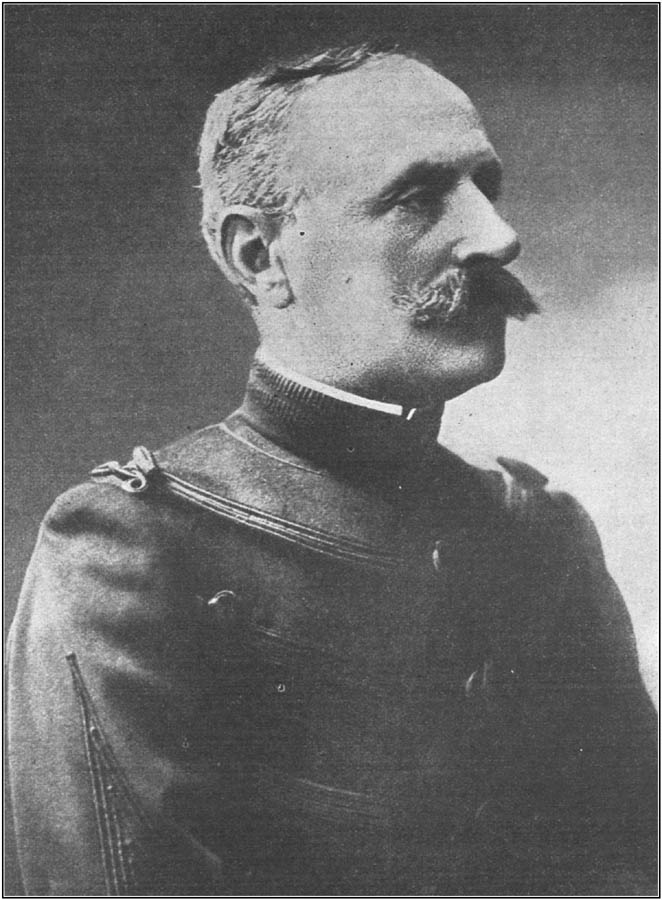
Copyright by Underwood & Underwood, N.Y.
Marshal Ferdinand Foch
Foch is a man of medium height. His face is an especially striking one. He has the forehead of a thinker, with two deep folds between the eyebrows; he has deep-set eyes, a large nose, a strong mouth slightly hidden under a gray mustache, and a chin which shows decision and force. His whole face expresses great power of thought and will.
Before the war, he was a professor of military history. He was accustomed to outline to the young officers in his class a clear statement of a military situation, and the orders which had been followed. He would then call upon his pupils to decide what difficulties would arise and what the results would be. In this way, they learned to discover for themselves the solutions of many kinds of military problems.
Since Foch has been accustomed to this clear reasoning on all war problems, no military situation can surprise him. As a commander, he selects the goal to be reached, and the most skillful way of reaching it, and his men have confidence that he is right. This is what gives a commander the power to do things.
Marshal Joffre realized General Foch's ability and quickly advanced him.
After the First Battle of the Marne, it was necessary to appoint a commander for the French forces north of Paris, and it was very important to select one who had the initiative and the ability to check the German attempt to capture the Channel ports. The new commander must also be a man of great tact, for he would have to work with the British and the Belgians. General Foch was selected, and has proved to be the right man in the right place.
The race for the Channel ports was an exciting one. Although the Germans lost, it seemed at times as if they would win, and be able to establish submarine bases within a very short distance of England. In fact, if they had captured Calais, they could have fired with their long-range guns across the Channel and have bombarded English coast towns, and perhaps London itself.
Foch's decision and strength of purpose are well illustrated by an incident which is told by the French officers working under his command. He had sent some cavalry to protect the British army from being outflanked and disastrously defeated. At the close of the day, the cavalry commander reported to General Foch that he had been obliged to withdraw, as the Germans had been reënforced. "Did you throw all the forces possible into the fight?" asked General Foch. "No," answered the cavalry commander. "You will at once take up your old position and hold the enemy there until you have lost every gun," directed the general. "Then you will report to headquarters for further orders."
Foch is a leader who plans well, who knows how to command, and how to make others obey. His orders always end with the words, "Without delay!" Because the enemy has usually had larger numbers and more ammunition, time has been everything to the Allies. Foch saved time and so saved the Allies.
After his great victory at the Second Battle of the Marne, Foch was made a Marshal of France.
The Allies, in 1918, through the influence of President Wilson, it is said, decided to appoint a generalissimo, that is, one who should have direction of all the Allied forces on the west front, including those in Italy. Foch was appointed to this command, and from this time the German plans and campaigns began to go wrong. To this one man, who entered the French army in his teens, and who commanded at sixty-six the largest forces ever under one general, the successes of the Allies were due, more than to any other single individual, unless it be President Wilson.
Between July 15 and October, he had regained all the territory taken by the Germans in their great drives of 1918 and had driven the enemy out of the St. Mihiel salient which they had held since 1914. These victories were won not by hammer blows of greatly superior numbers but by generalship of the highest order and far superior to that of the German leaders.
THE MEXICAN PLOTToC
It is true that Germany does not know the meaning of honesty and fair play. Most Americans, in everything, want "a square deal." They demand it for themselves, and a true American feels that the harshest thing that can be said of him is that he is not fair and square in his dealings. In any American school, a pupil who is deceitful is at once shunned by all the other boys and girls as a "cheat" and a "sneak." He has no place among them, least of all in their games and sports, for not to play according to the rules of the game is to upset and spoil the sport entirely.
In playing some of our great national games, like baseball and football, where the players are divided into teams, one player, by cheating, does not suffer for it himself alone, but his whole team has to pay the penalty. Indeed, if he persisted in being unfair, he would soon lose his place in the team for all time.
The Germans would not understand this, and they would not understand that the last half of the ninth inning in a ball game is seldom played because the winners do not wish to "rub in" the defeat of their opponents. Some think that it is because German children have had few sports and games that the German nation has so little sense of honesty and fair play.
In German schools, the pupils at one time were allowed to engage in certain sports, but later these were officially forbidden.
The rulers of Germany have for years forbidden anything taught in their schools which did not praise Germany and make the children believe their Emperor to be a god. The pupils are taught in history, geography, and even in reading, only those facts about other countries which show how much inferior they are to Germany.
So the pupils have never learned the true and the interesting things about other countries in the great wide world. German history tells only about Germany's great war victories. The pupils never learn of Germany's defeats in war. The teacher makes the history class the liveliest of the day, often seeming to be more of a Fourth of July orator than a school teacher. The children are taught that Germany is the one civilized country in the world; that there was never anything good that did not come from Germany; that even the victory of the North, in the Civil War in America, was due to there being such a large majority of German-born men on the Northern side.
Their geography tells only about Germany's political divisions, its civilization, and its commerce. Their readers contain stories of German military "heroes." The two great school holidays are the Emperor's Birthday and Sedan Day, the anniversary of the great defeat of the French in the Franco-Prussian War.
The walls of the schoolrooms are covered with pictures of the Emperor, the Empress, and of battle scenes, especially those showing German soldiers bringing in French prisoners. The singing of "Deutschland über Alles" occurs several times a day.
A German boy is trained into a soldier, hard-hearted and deceitful. The pupils in school are made to spy on one another, and the teachers, too, spy on one another. An American boy was expelled from a German gymnasium in Berlin, because he refused to "tattle-tale" on the pupils in his class.
The Germans have not been taught to respect the rights of others,—no one apparently has any personal rights except the Kaiser and certain high officials; and so great has been their power that they have been able to cheat the whole German nation, and they have attempted to cheat the other nations of the world.
Some years before the Spanish-American War, Germany began to show an unfair spirit toward the United States. Much ill-feeling existed between the two countries in their commercial relationships. There grew up among the aristocracy of Germany, especially among the landowners, an extremely hostile attitude toward the government in Washington. This hostility was first publicly shown by a remark reported to have been made by the Emperor at mess with a company of officers, to the effect that "it would not be too bad if America should very soon require Europe to teach her the proper place for her." This remark was afterward officially denied, with the addition that the Emperor's feeling for the United States was not hostile.
When, however, Prince Henry of Prussia, brother of the German Emperor, arrived on a government mission in Hongkong, it is said he gave a banquet to representatives from all the fleets in port. Commodore Dewey of the American fleet was present. After the dinner, Prince Henry called for the usual national toasts. There is a custom in the navy of calling upon the representatives of the different nations in a certain regulated and well-understood order. But when the time came to call for the toast to the United States, the Prince passed it by; he did this several times. Commodore Dewey, realizing that this was intentional on the part of Prince Henry, left the banquet. The next morning a messenger from the German prince brought the explanation that the act had been committed wholly by mistake, and was not meant as a discourtesy to the United States or her commander. Dewey thanked the messenger for his courteous manner in delivering his Admiral's word, but sent back the statement that such an incident called for a personal apology from the Prince. Very soon Prince Henry called in person and apologized, saying that the name of the United States had not been written in its proper order on the list which he followed in giving the toasts.
When war had been declared between the United States and Spain, and Commodore Dewey had received orders to "seek the Spanish fleet and destroy it," he set sail from Hongkong for Manila. Germany, according to announcements from Spain, was determined to prevent the bombardment of the city, because of German interests and German subjects there. After capturing the Spanish fortress which guarded Manila, it was necessary for Dewey to maintain a strict blockade against the city, lest Spanish reënforcements should arrive. No American troops or ships could reach him in less than six weeks.
In Manila Bay were warships of Great Britain, Russia, France, Japan, and Austria. These nations were content to send only one or two vessels, while from Germany there were five and sometimes seven. One of them, the Deutschland, was commanded by Prince Henry, and was heavily armed. In fact, in numbers and guns, the Germans were stronger than the Americans with their six small vessels.
There was one regulation common to all blockade codes, one which was always followed by the officers on every ship. It was that no foreign boats should move about the bay after sunset, without the permission of the blockade commander.
But the Germans sent launches out at night and in many ways violated the rules. When Dewey protested, they only sent them off later at night. They even gave the Spaniards many supplies. Then Dewey had to turn the searchlights on them and keep their vessels covered, to prevent any boat leaving at night without his knowledge.
This is particularly offensive to any naval commander, and the German Admiral, Von Diederichs, objected. The American commander was courteous but firm, and said that the United States, and not Germany, was holding the blockade.
Still the Germans persisted in moving their vessels so mysteriously that an American ship was sent to meet every incoming vessel to demand its nationality, its last port, and its destination. To the German flag lieutenant, who brought a strong protest against this order, Dewey said: "Tell Admiral von Diederichs that there are some acts that mean war, and his fleet is dangerously near those acts. If he wants war, he may have it here, now, or at the time that best suits him."
Von Diederichs answered that his actions were not intended to violate the rules, but he then went to the British commander, Captain Chichester, and asked whether he intended to follow such strict orders. The English captain suspected the German and answered, "Admiral Dewey and I have a perfect understanding in the matter." Then he added, "He has asked us to do just what he has asked of you, and we have been directed to follow his orders to the letter."
The English commander then sent a dispatch to Admiral Dewey, saying that his orders were just, his regulations fair, and that if the American commander felt unable to enforce them alone, he could depend upon the British fleet to assist him. It is understood that the British officer afterward informed Von Diederichs of what he had done, and the Germans strictly obeyed the rules and gave no further trouble.
Not many years ago, in 1911 in fact, while the United States was doing her best by Germany, the German government tried to injure and deceive her.
At that time Germany was also plotting against France, to make war upon her and to seize the whole country. Perhaps Germany knew that America would not allow such horrible crimes to succeed, and so sooner or later she would find herself at war with the United States.
Therefore Germany must think ahead, and plan some means of making the United States keep her ideas of justice to herself and let Germany do as she chose. German officials consulted together and said, "Mexico is a little country at the very southern tip of the United States, conveniently near the new waterway at Panama. We could do some damage there, with Mexico's help, and as a reward, Mexico might get back some of the states just over the border—New Mexico, Texas, and Arizona—which formerly belonged to her.
"Then Japan is across the sea from Mexico and the gold coast of the United States. Japan needs more land for her millions of people. She might as well take California and some of the islands near Panama. All this would keep America busy so that she could not hinder us from doing our will in France."
A press correspondent in Berlin, as early as February, 1911, sent the following word by cablegram:
The story was told here last night that Japan and Mexico have come to an understanding with each other against America, and that the United States, therefore, is secretly favoring the Mexican revolutionists led by Madero. To-day the report is published in several newspapers, even in the most trustworthy of them. The report says: "Since America obtained the Panama Canal, she has had an increasing interest in robbing Mexico and the Central American states of their independence."
According to the story, the present trouble has arisen because of Mexico's refusal to allow the United States to use Magdalena Bay as a coaling station. There must be some reason for publishing the story so widely. It is made much of by the jingo press, which warns the Central and the South American states to beware of ambitious political plans of the United States.
As this word was sent in time of peace, it was not censored, and while it did not at that time appear to be of great importance, it really meant that Germany was taking advantage of the civil war in Mexico to stir up antagonism between that country and the United States.
In American and German newspapers, stories were also printed hinting at bad feelings between the United States and the Japanese government, though no one seemed to know from whom the stories came. It was said that, before long, an American fleet would be forcing its way into Japanese waters, or the Japanese fleet would form in battle line somewhere along the coast of California.
In that same year, stories were publicly printed in American papers, intended to spread the belief that Japan and Mexico were especially friendly to Germany, and that they were interested in plotting together against the United States. These stories were so mysterious and mischievous that explanations from the different governments became necessary.
During the last week of February, 1917, there came into the hands of the State Department in America, a note from Alfred Zimmermann, German Minister of Foreign Affairs, to the German Minister in Mexico City. The American government had already urged the German government to cease submarine warfare, as it was not at all a fair method of fighting, but was, instead, entirely barbarous and contrary to international law. Germany, however, determined to wage unrestricted submarine warfare against England and her allies. Twelve days before the plan was finally announced, this note was sent to the German Minister in Mexico:
Berlin, Jan. 19, 1917.
On the 1st of February we intend to begin submarine warfare unrestricted. In spite of this, it is our intention to endeavor to keep neutral with the United States of America.
If this attempt is not successful, we propose an alliance on the following basis with Mexico:
That we shall make war together and together make peace. We shall give general financial support, and it is understood that Mexico is to reconquer the lost territory in New Mexico, Texas, and Arizona. The details are left to you for settlement.
You are instructed to inform the President of Mexico of the above in the greatest confidence, as soon as it is certain that there will be an outbreak of war with the United States, and suggest that the President of Mexico, on his own initiative, should communicate with Japan suggesting adherence at once to this plan; at the same time offer to mediate between Germany and Japan.
Please call to the attention of the President of Mexico that the employment of ruthless submarine warfare now promises to compel England to make peace in a few months.
Zimmermann.
When all this became known to the American people, at first it was almost impossible for them to believe that Germany had been plotting against the United States, and for so long. Only the word of the President of the United States, saying that clear and sufficient evidence to prove it beyond dispute was in the hands of the government, could persuade them that Germany had been for years acting the "cheat" and the "sneak."
The first step taken by the American government was to ask Mexico and Japan to explain the many stories that had been circulated, and to tell whether they had agreed with Germany to war against the United States.
The people in this country waited anxiously to hear from Japan, for it would be denying the truth to say that the stories had not aroused suspicion. Japan answered just as the United States would have answered in her place, an answer that left no room for doubt. Not only did the Japanese Foreign Minister deny that Japan had been asked by Mexico or Germany to join against the United States, but he added more than is absolutely necessary in diplomatic circles; he added that even if such a proposal had come, it would have been rejected at once.
This is exactly such an answer as the United States would have given to any friendly country. The answer did more to bind the friendship between the two countries than many years of official visits and formal expressions of goodwill could possibly have done. The Japanese people were glad that such an answer had been sent by their government. In fact, the Japanese Ambassador in this country, in speaking of the matter said, "We cannot condemn the plot too strongly. Our Foreign Minister and Premier have expressed the feeling of the Japanese Government and the Japanese people. And it is not alone the government; but the people are back of the government in denouncing the intrigue. In one way it is unfortunate, because we do not feel flattered at the thought of being approached for such an object; but the incident, on the other hand, is certain to have the good effect of putting us in a true light before the world, and of binding our friendship with America. We have a treaty alliance with Great Britain, and owe allegiance to the Allied cause. In Japan we place above everything else our national honor, which involves faithfulness to our treaties."
Germany never supposed that she would be the means by which Japan and the United States, instead of being thrust further apart, would be drawn closer together. Germany dreamed a different sort of dream. Judging other nations by herself, she did not expect England to come to the aid of Belgium and France, and now she had made another mistake. She had set both Japan and Mexico down as the natural foes of the United States, waiting only for a favorable opportunity to strike.
The answer from Mexico was not so satisfactory as that from Japan. Villa, the famous Mexican bandit chief, when he conferred on the border with Major-General Scott as to the firing at Naco, it is said, had whispered to the American General a story of Japanese conspiracy in Mexico City. He claimed that the captain of a Japanese vessel in a Mexican port had spoken of the natural ties of friendship that should exist between Mexico and Japan, and had also spoken of the United States as the natural enemy to both countries. Villa had boasted loudly that, if war came between Japan and the United States, Mexico would be found fighting for her American neighbor. But later, when the United States recognized Carranza as ruler of Mexico and turned against Villa, the bandit chief hastened to seek aid against his "neighbor," from Tokio. Needless to say, he failed.
General Huerta's effort to start a new revolution in Mexico, after he returned to the United States from Spain, has been traced directly to the Germans. He, too, looked hopefully for aid from Japan, but was disappointed.
Before the United States had recognized the Carranza government, the Carranza officials displayed great affection for the Japanese Minister who had been sent to their country, and for Japan. But the government at Tokio knew that the display was merely made for American eyes, and carefully avoided any warm response. Thus has Zimmermann's scheme come to be called his "back-stairs policy" and "the plot that failed."
Thanks to the discovery of the Zimmermann plot, Japan and the United States understand each other better, and are growing more and more friendly. Mexico is keeping her troubles to herself and has all she can do in straightening out her own affairs. The boys and girls in America will hope, if baseball and football will teach the Mexicans to play fair, that these games and others like them will become as popular there as they are in the United States.
A man is a father, a brother, a German, a Roman, an American; but beneath all these relations, he is a man. The end of his human destiny is not to be the best German, or the best Roman, or the best father, but the best man he can be....
Though darkness sometimes shadows our national sky, though confusion comes from error, and success breeds corruption, yet will the storm pass in God's good time; and in clearer sky and purer atmosphere, our national life grow stronger and nobler, sanctified more and more, consecrated to God and liberty by the martyrs who fall in the strife for the just and true.
George William Curtis.
WHY WE FIGHT GERMANYToC
Because of Belgium, invaded, outraged, enslaved, impoverished Belgium. We cannot forget Liége, Louvain, and Cardinal Mercier. Translated into terms of American history, these names stand for Bunker Hill, Lexington, and Patrick Henry.
Because of France, invaded, desecrated France, a million of whose heroic sons have died to save the land of Lafayette. Glorious, golden France, the preserver of the arts, the land of noble spirit, the first land to follow our lead into republican liberty.
Because of England, from whom came the laws, traditions, standards of life, and inherent love of liberty which we call Anglo-Saxon civilization. We defeated her once upon the land and once upon the sea. But Australia, New Zealand, Africa, and Canada are free because of what we did. And they are with us in the fight for the freedom of the seas.
Because of Russia—new Russia. She must not be overwhelmed now. Not now, surely, when she is just born into freedom. Her peasants must have their chance; they must go to school to Washington, to Jefferson, and to Lincoln, until they know their way about in this new, strange world of government by the popular will.
Because of other peoples, with their rising hope that the world may be freed from government by the soldier.
We are fighting Germany because she sought to terrorize us and then to fool us. We could not believe that Germany would do what she said she would do upon the seas.
We still hear the piteous cries of children coming up out of the sea where the Lusitania went down. And Germany has never asked the forgiveness of the world.
We saw the Sussex sunk, crowded with the sons and daughters of neutral nations.
We saw ship after ship sent to the bottom—ships of mercy bound out of America for the Belgian starving, ships carrying the Red Cross and laden with the wounded of all nations, ships carrying food and clothing to friendly, harmless, terrorized peoples, ships flying the Stars and Stripes—sent to the bottom hundreds of miles from shore, manned by American seamen, murdered against all law, without warning.
We believed Germany's promise that she would respect the neutral flag and the rights of neutrals, and we held our anger and outrage in check. But now we see that she was holding us off with fair promises until she could build her huge fleet of submarines. For when spring came, she blew her promise into the air, just as at the beginning she had torn up that "scrap of paper." Then we saw clearly that there was but one law for Germany, her will to rule.
We are fighting Germany because in this war feudalism is making its last stand against on-coming democracy. We see it now. This is a war against an old spirit, an ancient, outworn spirit. It is a war against feudalism—the right of the castle on the hill to rule the village below. It is a war for democracy—the right of all to be their own masters. Let Germany be feudal if she will. But she must not spread her system over a world that has outgrown it.
We fight with the world for an honest world in which nations keep their word, for a world in which nations do not live by swagger or by threat, for a world in which men think of the ways in which they can conquer the common cruelties of nature instead of inventing more horrible cruelties to inflict upon the spirit and body of man, for a world in which the ambition of the philosophy of a few shall not make miserable all mankind, for a world in which the man is held more precious than the machine, the system, or the State.
Secretary Franklin K. Lane, June 4, 1917.
GENERAL PERSHINGToC
In April, 1917, a small group of men in civilian dress climbed up the side of the ocean liner, the Baltic, just outside of New York harbor. Each one carried a suitcase or a hand-bag, which was his only baggage. They had come down the harbor through the fog and mist on a tugboat. These men were officers in the United States army, and among them were General Pershing and his staff—"Black Jack Pershing," as his men affectionately called him.
They were given no farewell at the dock, in fact their going was kept a profound secret; for should the Germans learn upon what liner the chief officers of the American army that was soon to gather in France, took passage, all their submarines would neglect everything else in attempting to sink this one vessel.
The officers reached England in safety, and made preparations for the great American armies that were soon to follow them. General Pershing was appointed commander of these armies. He had just come from service in Mexico, where he had led American troops in search of the outlaw, Villa.
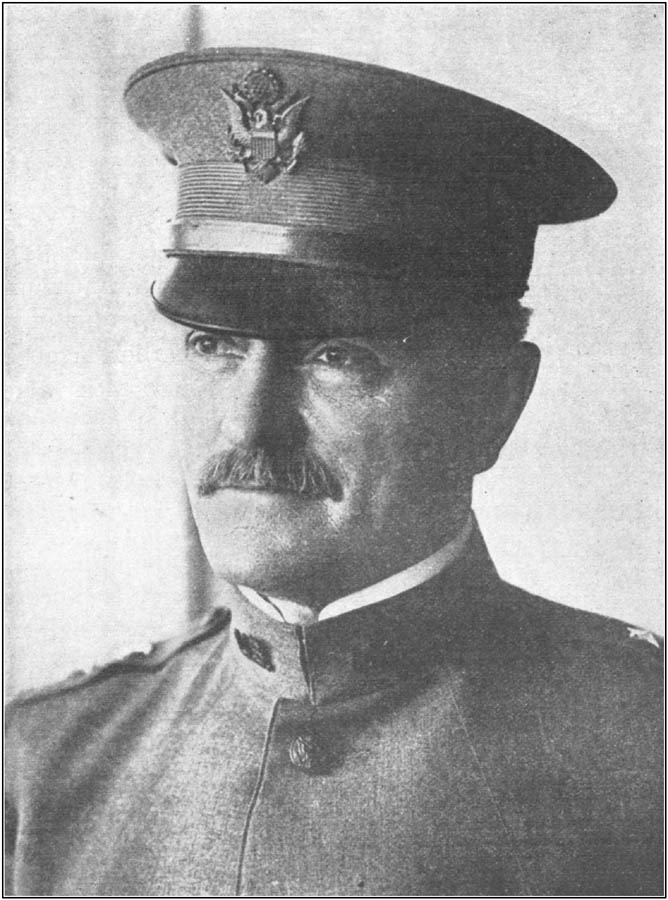
Photograph from Underwood & Underwood, N.Y.
General John J. Pershing
General Pershing is a West Point graduate; but he narrowly escaped following another career, for he gained his appointment to West Point by only one point over his nearest competitor. He has made fighting his life work. We are all beginning to see that in the world as it is made up at present, some men must prepare for fighting and make fighting their life work. Universal peace must come through war, and many are hoping that it will come as a result of the World War. William Jennings Bryan and Henry Ford are among the world's leading advocates of universal peace. When the United States declared war, Bryan said, "The quickest road to peace is through the war to victory"; and Henry Ford turned over to the government his great automobile factories and gave his own services on one of the war boards, to make the war more quickly successful.
An interesting story is told us in the Dallas News of Pershing's school days at normal school, before he went to West Point. It shows that he never shunned a fight, if the rights of others needed to be defended.
An incident of the boyhood days of General John J. Pershing, illustrating how the principle for which the American general is leading this nation's armies against the hordes of autocracy—the square deal for every one—has always predominated in the American leader, was related yesterday by Dr. James L. Holloway of Dallas, who went to school with Pershing in Kirksville, Missouri, many years ago, and who during that period was an intimate friend of the General.
"When I arrived at Kirksville to attend the Normal School there, I was a green country boy," Dr. Holloway said, "and carried my belongings in a very frail trunk. The baggageman who was on the station platform was handling my trunk roughly, and when I remonstrated with him in my timid way, he merely pitched the trunk off the baggage wagon and laughed at me. When the trunk fell on the ground it broke open and scattered my things around on the platform. I indignantly told him that I would report the matter to the headquarters of the railroad in St. Louis, and again he laughed at me.
"I wrote the head of the baggage department, as I said I would, and later learned that the offending baggageman had been severely censured. Meanwhile I had struck up a strong acquaintance with Jack Pershing, who was a big, husky boy from a Missouri country town. I will always remember his broad forehead, his determined-looking jaw, and his steel gray eyes. He was a favorite among the boys at the Normal School, not so much on account of his mental brilliancy but because of his personal stamina.
"Two weeks after my encounter with the baggageman, Pershing and I walked down to the railroad station. It was on Sunday and the baggage office was closed. Pershing left me for a moment, and as I walked around a corner of the station I met the baggageman, who approached threateningly. 'You're the fellow who reported me to headquarters,' he said, bullying me. I admitted that I had. 'Well,' said the baggageman, 'I'm going to lick you good for it.' With these words he started toward me. At this juncture Pershing's big frame rounded the corner of the station.
"'What's the trouble, Holloway?' he asked. I told him the baggageman was threatening me with violence. 'He is, is he?' said Pershing. 'Well, we'll clean his plowshare for him right now.'
"I shall never forget this expression. The baggageman, seeing that he was no match for Pershing—let alone the two of us—left the scene of action. We didn't even have a chance to lay our hands on him.
"Six months after this occurred, Pershing was appointed to West Point. I have never seen him since."
For several years after his graduation from West Point, no promotion came to Pershing; but he was not idle nor soured by disappointment. He continued to study, especially military tactics. He became so well versed in this branch that he was sent to West Point to teach it.
When the Spanish-American War broke out, Pershing asked for a command, and was appointed first lieutenant with a troop of colored cavalry, and sent to Cuba. At the battle of El Caney he led his troops with such bravery and success that he was at once promoted and made a captain "for gallantry in action."
Then he went to the Philippines with General Chaffee. He performed much valuable service there. Perhaps the single deed by which his work there is best known is the lesson he taught the Sultan of Mindanao. The Sultan was a Mohammedan, and ruled over many thousand Malays. To kill a Christian was thought to be a good deed by the Sultan, and he was always glad of an opportunity to show his goodness. For three hundred years, he and his predecessors had escaped punishment by the Spaniards, who owned and ruled the islands.
The Sultan's chief village and stronghold could be reached only by passing through the dense and dangerous tropical jungles; and when it was reached, it was found to be surrounded by a wall of earth and bamboo, forty feet thick, and outside the wall by a moat fifty feet wide. It does not seem so strange that the Spaniards had done nothing.
But Pershing cut a path through the jungles and reached the Sultan's village, and informed him that there must be no more murders of Christians. The Sultan was very pleasant, in fact he laughed at the young American captain.
Soon word came to American headquarters that the Sultan had caused the death of another Christian missionary. In forty-eight hours most of the earth and bamboo wall was in the moat, and the Sultan's village was destroyed. In less than two years, Pershing established law and order in all of western Mindanao.
He was also in command of the troops sent to the Border and into Mexico after the outlaw, Villa. The soldiers with him there always recall his constant advice, "Shoulders back, chin up, and do your best."
General Pershing is a man who has never feared obstacles, and has never hesitated to give the time and labor necessary to overcome them. That there is no easy path to greatness and success, but that both will come to him who prepares himself, who works, who sticks at it, who is brave and sacrificing—this is the lesson of General Pershing's life and work.
Shortly after General Pershing reached France, the French people celebrated the birthday of Lafayette; and General Pershing visited the tomb of the great French patriot, to place there a wreath in token of America's gratitude. A large number of French people were gathered there, and every one supposed General Pershing would make a speech—that is, every one except General Pershing. When he was called upon, he was dumfounded, but at last he said, "Well, Lafayette, we are here." That was all.
Could he have said more if he had talked an hour? He said, "Lafayette, your people now need us. We have not forgotten. Here we are, and behind us are all the resources of the wealthiest and most enterprising nation in the world, billions of dollars and millions of men. We are only the first to arrive to pay the debt we have owed to you for one hundred and forty years, but here we are at last."
It is said that men and women wept aloud as the full significance of the words and all they meant for France became clear to them.
THE MELTING POTToC
America has been called the "crucible" or the "melting pot" of nations, because many peoples of many races and many countries come together here, and in the heat of life and struggle are molded into Americans. President Wilson said, in a speech at Cincinnati in 1916, "America is not made out of a single stock. Here we have a great melting pot."
As soon as we entered the war against Germany, the question arose in the minds of most people as to how the large number of Germans in the United States would act. Germany had taught them that even though they became naturalized and took the oath of allegiance as American citizens, such action was not binding, but was like "a scrap of paper" to be destroyed and forgotten whenever necessity demanded, and that "once a German" meant "always a German." It seems now that Germany actually expected the Germans, who had left their native land to seek opportunity, freedom, and citizenship under the Stars and Stripes, to fight against their new and adopted home; but events have proved that most German-Americans have higher ideals of right. A leading German-American has written a book entitled "Right before Peace"; its title carries the thought that has guided most of his fellow-countrymen and their children in the United States during the World War.
A few months after the United States had declared that a state of war existed with Germany, many leading men of this country of foreign birth and parentage, signed, with others, a declaration drawn up by Theodore Roosevelt. This declaration, somewhat abbreviated but not altered in thought, is as follows. It makes very clear what America should mean to her adopted children.
We Americans are the children of the crucible. We have boasted that out of the crucible, the melting pot of life, in this free land, all the men and all the women who have come here from all the nations come forth as Americans, and as nothing else, like all other Americans, equal to them, and holding no allegiance to any other land or nation. We hold it then to be our duty, as it is of every American, always to stand together for the honor and interest of America, even if such a stand brings us into conflict with our fatherland. If an American does not so act, he is false to the teachings and the lives of Washington and Lincoln; he has no right in our country, and he should be sent out of it; for he has shown that the crucible has failed to do its work. The crucible must melt all who are cast into it, and it must turn them out in one American mold, the mold shaped one hundred and forty years ago by the men who, under Washington, founded this as a free nation, separate from all others. Even at that time, these true Americans were of different races; Paul Revere and Charles Carroll, Marion, Herkimer, Sullivan, Schuyler, and Muhlenberg were equals in service and respect with Lighthorse Harry Lee and Israel Putnam. Most of them, however, were of English blood, but they did not hesitate to fight Great Britain when she was in the wrong. They stood for liberty and for the eternal rule of right and justice, and they stood as Americans and as nothing else.
So must all Americans of whatever race act to-day; otherwise they are traitors to America. This applies, especially to-day, to all Americans of German blood who, in any manner, support Germany against the United States and her Allies.
Many pacifists have during the last three years proved themselves the evil enemies of their country. They now seek an inconclusive peace. In so doing they show themselves to be the spiritual heirs of the Tories, who, in the name of peace, opposed Washington, and of the Copperheads, who, in the name of peace, opposed Lincoln. We look upon them as traitors to the Republic and to the great cause of justice and humanity. This war is a war for the vital interests of America. When we fight for America abroad, we save our children from fighting for America at home beside their own ruined hearthstones. To accept any peace, except one based on the complete overthrow of Germany as she is under the ideals of Prussia and the Hohenzollerns, we believe would be an act of baseness and cowardice, and a betrayal of this country and of mankind.
The test of an American to-day is service against Germany. We should put forth as speedily as possible every particle of our vast, lazy strength to win the triumph over Germany. The government should at once deal with the greatest severity with traitors at home.
We must have but one flag. We must also have but one language. This must be the language of the Declaration of Independence, of Washington's Farewell Address, and of Lincoln's Gettysburg Speech.
Of us who sign, some are Protestants, some are Catholics, some are Jews. Most of us were born in this country of parents born in various countries of the Old World—in Germany, France, England, Ireland, Italy, the Slavonic and the Scandinavian lands; some of us were born abroad; some of us are of Revolutionary stock. All of us are Americans, and nothing but Americans.
THE AMERICAN'S CREED[8]
I believe in the United States of America as a government of the people, by the people, for the people, whose just powers are derived from the consent of the governed; a democracy in a republic; a sovereign Nation of many sovereign States; a perfect Union, one and inseparable, established upon those principles of freedom, equality, justice, and humanity for which American patriots sacrificed their lives and fortunes.
I therefore believe it is my duty to my country to love it; to support its Constitution; to obey its laws; to respect its flag; and to defend it against all enemies.
FOOTNOTES:
BIRDMENToC
Although I am an American, I am still in the French aviation corps, in which I enlisted when the war broke out. I am too old for service under the Stars and Stripes, but not too old to risk my life under the French flag for the freedom of the world.
I was trained in a French aviation school. Flyers were needed immediately; and so I did not go through "a ground school," or any teaching like that given for eight weeks in the American ground schools. I was sent directly to the flying field and given a machine at once. I did not, as they do at American flying fields, go up first with an instructor who might be tempted to "scare me to death" by "looping the loop" or doing "tail spins." I took my own machine at the very start and, after being given the simplest directions, away I went in it; but I did not break any records for altitude.
It was a small monoplane with a 20-horse-power motor, and its wings had been clipped; so all it could do was to roll along the ground. It was, however, some time before I could guide it in a straight line. I was discouraged at first, but felt better when I learned that it was very difficult even for an experienced flyer.
Such machines are called "penguins" and have a trick of turning suddenly in a short half circle and smashing the end of a wing against the ground. The queer antics of beginners in them furnish fun for every one on the flying fields.
After I had mastered this machine, I was given one with a motor of greater horse power, and in this I could fly along the ground at nearly sixty miles an hour; but I could not rise into the air, for the wings were clipped and did not have sufficient sustaining power to hold the machine in the air.
Then at last I was given a plane with full-sized wings; but, as its motor generated only about 25-horse power, I could get only from three to six feet above the ground, and went skimming along now on the ground and now a few feet in the air.
In these machines, we learned only how to manage the tail of the machine. As we skimmed along the ground, we tipped the tail at an angle slightly above a straight line. In a few moments we were off the ground, and the roar of the motor sounded softer and smoother. It seemed as if we were very far from the earth, and that something might break and dash us to our death—in reality, we had not risen six feet. To get back to earth, we must push the lever that lowers the tail—but this must be done very slightly and very carefully. A little push too much, and the machine will suddenly dive into the ground.
After my experience with the first two machines, I found it easy to handle this one, and was soon given one that would take me up about fifty feet and give me a chance to learn the "feel of the air." All my flying was still in straight lines, or as nearly straight as I could make it. We were not yet allowed to try to turn.
In the next machine I could rise two or three hundred feet and began to learn to turn, although most of the flying was still in straight lines.
I was beginning to make good landings, which is the hardest part of the game. We have to let the ship down on two wheels and let the tail skid at a speed of thirty-five miles an hour and not break the landing gear.
The machines often bound three or four times when landing and that is hard on the landing gear. My last landing was so soft that I was not sure when I touched the ground. To take off is quite easy. The ship is controlled by an upright stick which is between one's knees and just right for the left hand. The rudder is controlled by the feet, and the throttle is on the right side. To take off, we get up a speed of about forty-six miles per hour and raise the tail up until the ship is level, and then when she starts to rise, lift the nose just a little and climb slowly.
On turns, the ship has to be banked, tipped up with the inside wing low, and turned with the rudder. It is quite a hard thing to do when it is rough, as just about the time we bank, we get a puff of wind which will hit one wing and she will roll and rock so that we have to get her straightened out. It is a fight all the time until you get about 3000 feet up, when the air gets steady.
To land, we slow the engine down to idling speed and come down in a steep glide until five or six feet from the ground, then level off and glide along until she begins to settle, then jerk the tail down until she stops. We always have to take off and come down against the wind.
I was obliged to follow the directions of my instructor, much against my own wishes. It seemed to me that I could now do anything in the air and that there was not the slightest danger. This too early feeling of mastery is the cause of many beginners' being injured or killed, by trying "stunts" too difficult for them.
I did not spend much time in flying at first, after I had learned how to handle the airplane. It is not difficult to stay in the air and to fly, but it is difficult to land safely without breaking the machine. So I was kept practicing landing.
To secure my license I was required to fly 50 miles in a straight line to a named place, and then back; then to fly 200 miles in a triangle, passing through two named places; and last of all to stay one hour in the air at an altitude higher than 7000 feet.
Now the French schools require only a 30-mile flight with three successful landings, before sending the flyer to the finishing school, where he learns to do all the "stunts" that a fighter must be able to do in order to succeed. I learned the tail wing slip, the tail spin and dive, the vrille, to loop the loop, and many other fancy flying tricks. They have saved my life more than once.
I was interested in reading the other day James Norman Hall's funny description of how he learned at last to master the penguin. He felt triumphant, but he says, "But no one had seen my splendid sortie. Now that I had arrived, no one paid the least attention to me. All eyes were turned upward, and following them with my own, I saw an airplane outlined against a heaped-up pile of snow-white cloud. It was moving at tremendous speed, when suddenly it darted straight upward, wavered for a second or two, turned slowly on one wing, and fell, nose-down, turning round and round as it fell, like a scrap of paper. It was the vrille, the prettiest piece of aërial acrobatics that one could wish to see. It was a wonderful, an incredible sight.
"Some one was counting the turns of the vrille. Six, seven, eight; then the airman came out of it on an even keel, and, nosing down to gather speed, looped twice in quick succession. Afterward he did the retournement, turning completely over in the air and going back in the opposite direction; then spiraled down and passed over our heads at about fifty meters, landing at the opposite side of the field so beautifully that it was impossible to know when the machine touched the ground."
There is nothing in all the experiences of life like what one feels in flying through the air, especially at a great height and with no other machines in sight. There is a loneliness, unlike any other kind of loneliness; there is a feeling of smallness and weakness; a sense of the immensity of things and of the presence and nearness of God. It is surprising that in doing that in which man has shown his greatest power over the forces of Nature, he feels most his littleness and how easily he could be destroyed by the very forces he has conquered.
Lieutenant Roberts, an American flying in France, described not long ago an experience that came just after his first flight. He was up in the air, higher than anybody had ever been before, when the machine suddenly broke into little pieces, which, as he was tumbling down through the air, he vainly tried to catch. Just as he hit the ground and broke every bone in his body, he woke up on the floor beside his bunk.
The Englishmen are the most daring of all the flyers, take the most risks, and do the most dangerous "stunts." Not so much is heard of them because their exploits and their scores are not announced by the British army. Bishop, who has just been ordered from the flying field to safer work, is said to have brought down nearly eighty German planes, and on the day he learned of his recall, went up and brought down two.
The Americans are daredevils, too. I took one of them one night as a "guest," when I went over Metz on a bombing expedition. One of the bombs stuck. He thought it might cause us trouble when we landed, possibly explode and kill us, so he crawled out over the fusilage and released it. He certainly earned his passage.
With several other Americans we formed what we called the American Escadrille; but as the United States was neutral at that time, we were obliged to change the name to the Lafayette Escadrille.
Since joining the squadron, I have used all sorts of machines, and there are many of them, from the heavy bombing machine to the swift little swallow-like scouts.
My first important work was reconnoissance, in which I carried an observer. I managed the machine, and he did the reconnoitering. We went out twice a day and flew over into German territory, sometimes as far in as fifty miles, observing all that was going on, the movements of troops and supplies, and the building of railroads and defensive works. We also took photographs of the country over which we flew.
Reconnoissance is dangerous work, and is constantly growing more so, as anti-aircraft guns are improved. These guns are mounted on a revolving table, upon which is a mirror in which the airplane shows as soon as it comes within range of the gun. With an instrument designed for the purpose, the crew get the flyer's altitude; and with another, the rate at which he is traveling. They aim the gun for the proper altitude, make the correct allowance for the time it will take the shell to reach him, and as they have an effective range of over 30,000 feet, there is reason to worry. Yet by zig-zagging and other devices, the aviators are rarely brought down by anti-aircraft guns. The small scout machines with a wing spread of not more than thirty feet are not visible to the naked eye when at an altitude of over 10,000 feet, and are therefore safe from these guns at this height.
But reconnoissance, to be effective, must be done at a much lower altitude, and sometimes the machine must remain under fire for a considerable period of time. Poiret, the French aviator, fighting with the Russians, with a captain of the General Staff for an observer, was under rifle and shell fire for about twenty minutes. His machine was up about 4000 feet. Ten bullets and two pieces of shell hit his airplane, but he never lost control. The captain was shot through the heel, the bullet coming out of his calf; but he continued taking notes. They returned in safety to their lines.
I also did some work in directing artillery fire. For this my machine was equipped with a wireless apparatus for sending. No method has yet been devised whereby an airplane in flight can receive wireless messages. In directing the fire of the big guns, the aviator seeks to get directly over the object that is under fire, and to signal or send wireless messages in regard to where the shells land. After the aviator is in position, the third shot usually reaches the target.
I am not yet one of the great aces, and will not, therefore, tell you about any of my air battles. I hope some day you may read of them and that I may come to have the honor of being named with Lufbery, Guynemer, Nungesser, Fonk, Bishop, Ball, Genét, Chapman, McConnell, Prince, Putnam, and other heroes of the air.
Lieutenant R.A.J. Warneford, who won the Victoria Cross for destroying a giant Zeppelin, is one of the greatest of these; at least, he performed a feat never accomplished before and never since.
At three o'clock one morning in June, 1915, he discovered a Zeppelin returning from bombing towns along the east coast of England. The Huns shot Captain Fryatt because, as they said, he was a non-combatant and tried to defend himself. The rule that non-combatants should not attack military forces was made with the understanding that military forces would not war on non-combatants. But law, or justice, or agreements never are allowed by the Huns to stand in their way. This Zeppelin was returning from a raid in which twenty-four were killed and sixty seriously injured, nearly all women and children, and all non-combatants.
Lieutenant Warneford well knew of the dastardly deeds of the Zeppelins, and he immediately gave chase, firing as he approached. The Zeppelin returned his shots. He mounted as rapidly as possible so as to get the great gas-bag below him, until he reached over 6000 feet and the Zeppelin was about 150 feet directly below him. Both were moving very rapidly, and to hit was exceedingly difficult, but he dropped six bombs, one after the other. One of them hit the Zeppelin squarely, exploded the gas-bag, and set it afire its entire length. The explosion turned Lieutenant Warneford's airplane upside down, and although he soon righted it, he was obliged to land. He was over territory occupied by the Germans and he landed behind the German lines, but he succeeded in rising again before being captured, and returned to his hangar in safety, to tell his marvelous story. The Zeppelin and its crew were completely destroyed. A few days later Lieutenant Warneford was killed.
One of the greatest air duels, between airplanes, was during the Battle of Vimy Ridge. At that time Immelman was as great a German ace as were Boelke and Richthofen later, and Ball was the greatest of the English.
One morning Ball learned that Immelman was stationed with the Germans on the opposite line, and carried him a challenge which read:
Captain Immelman: I challenge you to a man-to-man fight to take place this afternoon at two o'clock. I will meet you over the German lines. Have your anti-aircraft guns withhold their fire while we decide which is the better man. The British guns will be silent.
Ball.
Ball dropped this from his airplane behind the German lines, and soon afterward Immelman dropped his answer behind the British lines:
Captain Ball:
Your challenge is accepted. The German guns will not interfere. I will meet you promptly at two.
Immelman.
A few minutes before two, the guns ceased firing, and all on both sides fixed their eyes in the air to witness a contest between two knights that would make the contests of the days of chivalry seem tame.
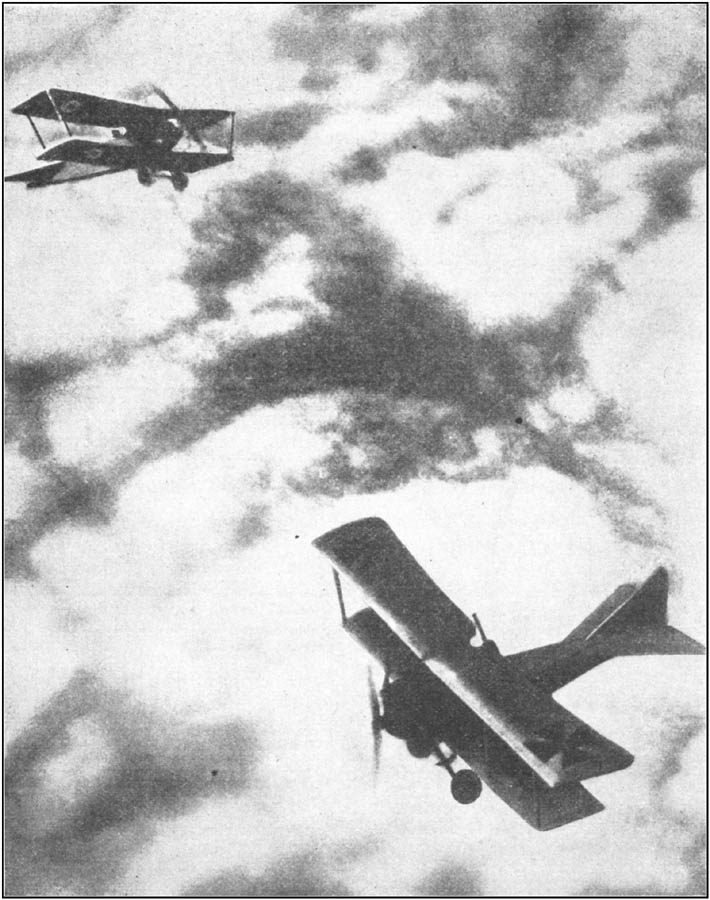
Copyright by Underwood & Underwood, N.Y.
A Battle in the Air
The French plane at the top is maneuvering for position preparatory to swooping down on its German adversary.
In an air battle, the machine that is higher up is thought to have the advantage. Both Ball and Immelman went up very high, but Ball was below and seemed uncertain what to do. The British were afraid that he had lost his nerve and courage when he found himself below, for he made no effort to get above his opponent, but was flying now this way and now that, as if "rattled."
Immelman did not delay, but went into a nose dive directly towards the machine below, which he would be able to rake with his machine gun as he approached; but just at the proper moment, Ball suddenly looped the loop and was directly above the German, and in position to fire. As the shower of bullets struck Immelman and his machine, it burst into flames and dropped like a blazing comet.
Ball returned to his hangar, got a wreath of flowers, and went into the air again to drop them upon the spot where Immelman had fallen dead.
Four days later Ball was killed in a fight with four German planes, but not until he had brought down three of them.
But the fighting planes do not get all the thrills in the air. A young English aviator and his observer who were directing artillery fire in September, 1918, showed as great devotion and courage as any ace and lived through as exciting an adventure as ever befell a fighting plane.
They were flying over No Man's Land to get the proper range for a battery which was to destroy a bridge of great value to the Huns. Their engine had been running badly and back-firing. They would have returned home had their work been of less importance.
Suddenly the pilot smelled burning wood, and looking down, saw the framework near his feet blackened and smoldering. It had caught fire from the backfire of the engine and the exhaust, but was not yet in a decided blaze. He turned off the gas and opened the throttle. Then he made a steep, swift dive, and the powerful rush of the air put the fire out.
Then he hesitated, trying to decide whether to "play safe" and go home or whether to continue their work until the battery had secured the exact range. He knew that in a very short time and with a little more observation, their work would be completely successful. So he turned to the observer and asked him what he thought. The observer leaned over and examined the damage near the pilot's feet. It did not look very bad; so he shouted, "Let's carry on."
Up they went again and in a short time had shells from the battery falling all about the bridge, which was soon destroyed. Their work was done, and well done. In the excitement they had forgotten the bad engine until they heard it give one last sputter and stop.
Then they perceived the woodwork was on fire again and really blazing this time. To dive now would only fan the flames about the pilot's feet, but they must get to the ground, and get there quickly, too.
The pilot put the machine into a side slip toward the British line. This fanned the flames away from his feet. The observer squirted the fire extinguisher on the burning wood near the pilot's feet, and thus enabled him to keep control of the rudder bar.
They were now within fifteen hundred feet of the ground, but the heat was almost unbearable. The right wing was beginning to burn. Down, down, they went, and luckily towards a fairly good landing place. One landing wheel struck the ground with such force that it was broken off, and the airplane bumped along on the other for a short distance until it finally crashed on its nose and left wing.
Both pilot and observer were unhurt. They sprang to the ground and hurried away from the burning wreck just in time, for a few seconds later the gasoline tank exploded. They looked at each other without a word, but neither of them regretted that he had stayed up until the job had been finished.
Such is the life and the danger of the flyers; but thousands of the finest young men of all the nations at war eagerly seek the service, for the aviators are the eyes of the armies and will determine always more than any other branch which side shall be finally victorious.
ALAN SEEGER[9]ToC
As England and the world lost Rupert Brooke, so America and the world lost Alan Seeger. English poetry and lovers of beauty expressed in verse are losers to a greater extent than we can ever know.
It is not strange that these two young poets should have enlisted at the very beginning of the war, for they recognized what high-minded men mean by noblesse oblige. Much having been given you, much is expected from you. Those of the highest education should show the way to those less favored. So Rupert Brooke enlisted in the English navy, and Alan Seeger enlisted in the French army as one of the Foreign Legion.
He felt he owed a debt to France that could only be paid by helping her in her struggle for life and liberty. He gave his life, at the age of twenty-eight, to pay the debt.
Alan Seeger lived a life like that of many other American boys. At Staten Island where he passed his first years, he could see every day the Statue of Liberty, Brooklyn Bridge, the skyscrapers of New York, the ferry boats to the Jersey shore, the great ocean liners inward bound and outward bound,—all the great and significant things that say "America" to one landing for the first time at the greatest seaport of the world. Later he lived in New York and attended the Horace Mann School. His vacations were spent among the hills and mountains of New Hampshire and in southern California. He fitted for college at a famous preparatory school at Tarrytown on the Hudson, attended Harvard College, and after graduation lived for two years in New York City. All this is American, and thousands of other American boys have passed through the same or a similar experience.
Alan Seeger was romantic. So are most boys. But with most boys, romance goes no further than books and dreams. "Robinson Crusoe," "Huckleberry Finn," "Treasure Island," and other tales of adventure and of foreign lands are all the romance that many know. But, like Rupert Brooke, Alan Seeger had the opportunity to live romance, as he always declared he would do. He found it in his life as a boy in Mexico, as a young man in Paris, and in the Foreign Legion of the French army. The Foreign Legion was made up of foreigners in France who volunteered to fight with the French army. Its story is a stirring one of brave deeds and tremendous losses. To have belonged to it is a great glory.
Alan Seeger enjoyed life and found the world exceedingly beautiful. He says,
From a boy I gloated on existence. Earth to me Seemed all sufficient, and my sojourn there One trembling opportunity for joy.
Like Rupert Brooke, he thought often of Death, which he feared not at all. In his beautiful poem entitled, "I Have a Rendezvous with Death," he looked forward to his own death in the spring of 1916. He lost his life on July 4 of that year while storming the village of Belloy-en-Santerre. The first two stanzas are as follows:
I have a rendezvous with Death At some disputed barricade, When Spring comes back with rustling shade And apple blossoms fill the air— I have a rendezvous with Death When Spring brings back blue days and fair It may be he shall take my hand And lead me into his dark land And close my eyes and quench my breath— It may be I shall pass him still. I have a rendezvous with Death On some scarred slope of battered hill, When Spring comes round again this year And the first meadow flowers appear.
Alan Seeger has written two poems that all Americans should know. One is entitled "Ode in Memory of the American Volunteers Fallen for France." It was to have been read before the statue of Lafayette and Washington in Paris, on Memorial Day, 1916; but permission to go to Paris to read it did not reach Seeger in time, to the disappointment of him and many others. It is perhaps the best long poem Seeger has written, although "Champagne, 1914-15" is by many ranked ahead of it.
"A man is judged and ranked by that which he considers to be of the greatest value. Some men believe it is knowledge, and spend their lives in study and research; some think it is beauty, and vainly seek to capture it and hold it in song, poem, statue, or painting; some say it is goodness, and devote their lives to service, self-denial, and sacrifice; some declare it is life itself, and therefore never kill any creature and always carefully protect their own lives from disease and danger; and some are sure it is being true to the best knowledge, the greatest beauty, the highest good that one can know and feel and realize; for this alone is life, and times come when the only way to save one's life is to lose it."
FOOTNOTES:
CAN WAR EVER BE RIGHT?ToC
After England had entered the war against the Central Powers, Gilbert Murray, an English writer, asked this question and answered it by saying "Yes," and giving his reasons.
He had always favored peace. He hated war, not merely for its own cruelty and folly, but because it was an enemy of good government, of friendship and gentleness, and of art, learning, and literature.
Yet he believed firmly that England was right in declaring war against Germany on August 4, 1914, and that she would have failed in her duty if she had remained neutral. France, Russia, Belgium, and Serbia had no choice. They were obliged to fight, for the war was forced upon them. Germany did not wish to fight England; but after carefully looking over the whole matter, England, of her own free will, declared war. She took upon her shoulders a great responsibility. But she was right.
With a few changes in the wording and some omissions, the argument of Gilbert Murray is as follows:
"How can such a thing be? It is easy enough to see that our cause is right, and that the German cause is wrong. It is hardly possible to study the official papers issued by the British, the German, and the Russian governments, without seeing that Germany—or some party in Germany—had plotted this war beforehand; that she chose a moment when she thought her neighbors were at a disadvantage; that she prevented Austria from making a settlement even at the last moment; that in order to get more quickly at France she violated her treaty with Belgium. Evidence shows that she has carried out the violation with a cruelty that has no equal in the wars of modern and civilized nations. Yet there may be some people who still feel doubtful. Germany's wrong-doing they think is no reason for us to do likewise. We did our best to keep the general peace; there we were right. We failed; the German government made war in spite of us. There we were unfortunate. It was a war already on an enormous scale and we decided to make it larger still. There we were wrong. Could we not have stood aside, as the United States did, ready to help refugees and sufferers, anxious to heal wounds and not make them, watchful for the first chance of putting an end to this time of horror?
"'Try for a moment,' they say, 'to realize the suffering in one small corner of a battlefield. You have seen a man here and there badly hurt in an accident; you have seen perhaps a horse with its back broken, and you can remember how dreadful it seemed to you. In that one corner how many men, how many horses, will be lying, hurt far worse, and just waiting to die? Terrible wounds, extreme torment; and all, further than any eye can see, multiplied and multiplied! And, for all your just anger against Germany, what have these wounded done? The horses are not to blame for anybody's foreign policy. They have only come where their masters took them. And the masters themselves ... though certain German rulers and leaders are wicked, these soldiers, peasants, working-men, shop-keepers, and schoolmasters, have really done nothing in particular; at least, perhaps they have now, but they had not up to the time when you, seeing they were in war and misery already, decided to make war on them also and increase their sufferings. You say that justice must be done on such wrong-doers. But as far as the rights and wrongs of the war go, you are simply condemning to death and torture innocent men, by thousands and thousands; is that the best way to satisfy your sense of justice? These innocent people, you say, are fighting to protect the guilty parties whom you are determined to reach. Well, perhaps, at the end of the war, after millions of innocent people have suffered, you may at last, if all goes well with your arms, get at the "guilty parties." You will hold an inquiry, you will decide that certain Prussians with long titles are the guilty parties, and even then you will not know what to do with them. You will probably try, and almost certainly fail, to make them somehow feel ashamed. It is likely enough that they will instead become great national heroes.
"'And after all, this is supposed to be a war in which one party is wrong and the other right, and the right wins. Suppose both are wrong; or suppose the wrong party wins? It is as likely as not; for, if the right party is helped by his good conscience, the wrong has probably taken pains to have the odds on his side before he began quarreling. In that case, all the wild waste of blood and treasure, all the suffering of innocent people and dumb animals, all the tears of women and children have not set up the right, but established the wrong. To do a little evil that great or certain good may come is all very well; but to do great evil for only a chance of getting something which half the people may think good and the other half think bad ... that is neither good morals nor good sense. Anybody not in a passion must see that it is insanity,' So they say who think war always wrong.
"Their argument is wrong. It is judging war as a profit-and-loss account. It leaves out of sight the fact that in some causes it is better to fight and be broken than to yield peacefully; that sometimes the mere act of resisting to the death is in itself a victory.
"Let us try to understand this. The Greeks who fought and died at Thermopylæ had no doubt that they were doing right to fight and die, and we all agree with them. They probably knew they would be defeated. They probably expected that, after their defeat, the Persians would easily conquer the rest of Greece, and would treat it much more harshly because it had resisted. But such thoughts did not affect them. They would not consent to their country's dishonor.
"Take again a very clear modern case: the fine story of the French tourist who was captured, together with a priest and some other white people, by Moorish robbers. The Moors gave their prisoners the choice either to trample on the Cross or to be killed. The Frenchman was not a Christian. He disliked Christianity. But he was not going to trample on the Cross at the orders of a robber. He stuck to his companions and died with them.
"Honor and dishonor are real things. I will not try to define them; but will only notice that, like religion, they admit no bargaining. Indeed, we can almost think of honor as being simply that which a free man values more than life, and dishonor as that which he avoids more than suffering or death. And the important point for us is that there are such things as honor and dishonor.
"There are some people, followers of Tolstoy, who accept this as far as dying is concerned, but will have nothing to do with killing. Passive resistance, they say, is right; martyrdom is right; but to resist violence by violence is sin.
"I was once walking with a friend of Tolstoy's in a country lane, and a little girl was running in front of us. I put to him the well-known question: 'Suppose you saw a man, wicked or drunk or mad, run out and attack that child. You are a big man, and carry a big stick: would you not stop him and, if necessary, knock him down?' 'No,' he said, 'why should I commit a sin. I would try to persuade him, I would stand in his way, I would let him kill me, but I would not strike him,' Some few people will always be found, less than one in a thousand, to take this view. They will say: 'Let the little girl be killed or carried off; let the wicked man commit another wickedness; I, at any rate, will not add to the mass of useless violence that I see all around me.'
"With such persons one cannot reason, though one can often respect them. Nearly every normal man will feel that the real sin, the real dishonor, lies in allowing such an act to be committed under your eyes while you have the strength to prevent it. And the stronger you are, the greater your chance of success, by so much the more are you bound to interfere. If the robbers are overpoweringly strong and there is no chance of beating them, then and only then should you think of martyrdom. Martyrdom is not the best possibility. It is almost the worst. It is the last resort when there is no hope of successful resistance. The best thing—suppose once the robbers are there and intent on crime—the best thing is to overawe them at once; the next best, to defeat them after a hard struggle; the third best, to resist vainly and be martyred; the worst of all, the one evil that need never be endured, is to let them have their own will without protest.
"We have noticed that in all these cases of honor there seems to be no counting of cost, no balancing of good and evil. Ordinarily we are always balancing results, but when honor or religion come on the scene, all such balancing ceases. The point of honor is the point at which a man says to some wrong proposal, 'I will not do it. I will rather die.'
"These things are far easier to see where one man is concerned than where it is a whole nation. But they arise with nations, too. In the case of a nation the material consequences are much larger, and the point of honor is apt to be less clear. But, in general, whenever one nation in dealing with another relies simply on force or fraud, and denies to its neighbor the common consideration due to human beings, a point of honor must arise.