LEST WE FORGET (continued 3)
Reading edition
In the midst of all this tragedy the element of comedy was not wanting. A cockney lad struck up a ditty, and the boat's company joined in the chorus of Raymond Hitchcock's "All Dressed Up and Nowheres to Go." Then we had "Take Me Back to Blighty," and as a French vessel came along to our rescue, the boys sang "Pack Up Your Troubles in Your Old Kit-Bag and Smile, Smile, Smile." The French displayed unforgettable hospitality. As soon as they took our wounded on board, they improvised beds and stripped themselves almost bare that English and German alike might be comfortable.
The destruction of the Llandovery Castle was as bad or worse than those already described. For a time the Huns ceased to sink hospital ships running from France to England, but when they learned, through spies, that the Warilda carried no Germans, she was sunk early in August, 1918, with a loss of one hundred and twenty-three doctors, nurses, and wounded. After the Llandovery Castle, after the Warilda, there could be no further German pretense that Germany was waging any other than a barbarian war.
Such inhumanity seems like the work of madmen. Is the Kaiser insane? Are the German war leaders insane? Or are the German people, all, entirely different from the people we consider sane?
Let us remember that a Roman writer said many centuries ago, "Whom the gods would destroy, they first make mad."
When the Huns are losing, they show themselves at their very worst. When they were winning in the first stages of the war, they committed deeds blacker than those of the barbarians who sacked Rome, but after the tide turned against them, then they became even worse and began to use the red cross as a target in bombing hospitals and torpedoing hospital ships.
Moreover, at the Second Battle of the Marne, orders were issued to the German soldiers, who were being driven back with great loss, that seemed too inhuman even for the modern Huns. They were as follows: "Henceforth the enemy is not to be allowed to recover his dead and wounded except behind his own position, even under the Red Cross flag. If stretcher bearers go out, a warning shot is to be fired. If no attention is paid to the shot, the enemy must be thoroughly engaged at once."
As the Philadelphia Public Ledger says, "This is typical of Prussian militarism. It is precisely the sort of thing that our young men have sailed away across the Atlantic to uproot and finally destroy."
We do pray for mercy; And that same prayer doth teach us all to render The deeds of mercy. Shakespeare.
"THEY SHALL NOT PASS"ToC
The caves described in the Arabian Nights are not more wonderful than the rock citadel of Verdun; in many ways they are not so marvelous. The old citadel is now like a deserted cave, but a cave lighted by electricity and with a passenger elevator to carry one from the lowest floor to the top of the rock, a hundred feet above. In former wars it was a hive of soldiers.
Blasted out of the solid rock-hill are rooms, great halls, passages, hospitals, storerooms, and barracks. The heaviest shells of the enemy fall harmless from the natural rock. Here, one would think, a few soldiers could hold the town and the Meuse valley against greatly superior numbers. And this would be true if it were not for the fact that modern long-range guns can be placed by an enemy on the surrounding hills, once they have won them, and prevent food, ammunition, or supplies being brought to the citadel. Leaving these guns with enough men to work them, the great body of the enemy could then advance towards Paris, for the Meuse valley at Verdun is the highway from Metz to Paris.
The French generals realized long ago that the city and the valley could not, because of the increased power of big guns, be defended from the citadel. So they built great forts several miles from the city upon the hills which surrounded it, to halt the Germans when they should advance, as France knew they would when they were ready.
For an army to get from Germany into France and to the plains east of Paris, it was necessary to pass down the valley of the Meuse and through Verdun, and for this reason France spent vast sums of money to make these forts impregnable.
After the opening weeks of the World War had shown how easy it was for the German big guns to destroy the finest modern forts, like those at Liége, Namur, and Antwerp, the French command removed the garrisons from the forts protecting Verdun and placed them in trenches farther away from the city and the citadel, upon the second range of hills.
There was another way for the Germans to reach the plains of Champagne and of Châlons, which by treaty they had agreed not to use. That way was through Belgium. When the Huns declared this treaty only "a scrap of paper" to be torn up whenever their plans required it, and, to the surprise of all honorable nations, went through Belgium, they were soon able to reach the plains east and north of Paris, and Verdun ceased to be a key position. Verdun was about one hundred and fifty miles from Paris, and the Germans were already less than half that distance from the city. So when it was learned that the enemy had determined to capture Verdun, the forts surrounding it, and the highway through the river valley, the French command decided it was not worth holding at the cost in lives that would be necessary. To capture it would help the Germans very little, and to retire from it would greatly improve the French lines.
The Germans doubtless realized that this would be the decision of the French and that they would have an easy, an almost bloodless, victory. They also knew that all Germans and all Frenchmen had for centuries looked upon Verdun as a second Gibraltar and as one of the chief defenses of Paris and northern France, one which had been made—as the French thought—impregnable by the expenditure of vast sums of money. For this reason the Germans believed its loss would be taken as a terrible blow by the French people, and would be considered by the German populace as the greatest victory of the war. They hoped it might be the last straw, or one of the last, that would break the backbone of the French resistance. In order to give credit for this great victory to their future Kaiser, the armies of the Crown Prince were selected for the easy task.
The French command, it is said, had already issued the first orders for the retreat to stronger positions, when the French civic leaders realized Germany's game by which she hoped to win a great moral victory and to add to the hopes and courage of the German people; and although General Joffre believed it was a mistake, the French decided to remain just where they were.
The Germans were so sure of everything going as they had planned that they had advertised their coming victory in every corner of Germany and even in the Allied countries. When they found they were to be opposed, they brought up larger forces and when these were not strong enough to win, they increased them, until the Battle of Verdun, in which the Germans lost nearly half a million men in killed, wounded, and prisoners, became probably the greatest battle in the history of the world. It continued for six months.
Is it not strange that this, the greatest of all battles, was not a conflict waged to secure some territory, some river crossing, some fort, or some city absolutely necessary to win further progress, but a battle to add strength to the German mind and soul and to weaken the spirit of the French? Think of these modern Huns, who believe in the force of might and of material things, fighting for a victory over the spirit, which is never really broken by such things and is never conquered by them, but is to be won only by justice, mercy, friendship, love, and other spiritual forces.
And the French spirit did not flinch or weaken. The French people and the French soldiers said, "They shall not pass," and they did not pass. The Germans brought their big guns near enough to destroy the city, but the citadel laughed at them. They captured Fort Douaumont and Fort Vaux, but later had to give them up to the French.
All of Hunland rejoiced when the Brandenburgers captured Fort Douaumont, and the disappointment of the French people made every one realize that to have given up the city and the citadel without a fight, even though it was wise from a military point of view, would have been a grave mistake. But before the long battle was over, the French soldiers made one of their most remarkable charges back of waves of shell fire and swept the Germans from the hill upon which the fort was built. They recaptured the fort, taking six thousand prisoners, and sent thrills and cheers through France and the civilized world.
No, they did not pass. The soul of France with her flaming sword stood in the way. The Huns were trained to fight things that they could see, that they could touch, that they could measure, and especially things that they could frighten and kill. The soul of France they could not see, just as they could not, at the opening of the war, see or understand the soul of Belgium, and just as they did not believe in or comprehend the soul of America, later. But the soul of France barred their way and they did not pass, for they could neither frighten her nor kill her.
For though the giant ages heave the hill And break the shore, and evermore Make and break and work their will; Though world on world in myriad myriads roll Round us, each with different powers And other forms of life than ours, What know we greater than the soul?
The right is more precious than peace. We shall fight for the things which we have always carried nearest our hearts. To such a task we dedicate our lives.
Woodrow Wilson, 1917.
VERDUNToC
She is a wall of brass; You shall not pass! You shall not pass! Spring up like summer grass, Surge at her, mass on mass, Still shall you break like glass, Splinter and break like shivered glass, But pass? You shall not pass! Germans, you shall not, shall not pass! God's hand has written on the wall of brass— You shall not pass! You shall not pass! The valleys are quaking, The torn hills are shaking, The earth and the sky seem breaking. But unbroken, undoubting, a wonder and sign, She stands, France stands, and still holds to the line. She counts her wounded and her dead; You shall not pass! She sets her teeth, she bows her head; You shall not pass! Till the last soul in the fierce line has fled, You shall not pass! Help France? Help France? Who would not, thanking God for this great chance, Stretch out his hands and run to succor France? Harold Begbie.
THE BEAST IN MANToC
A German leader once said, "The oldest right in the world is the right of the strongest." This is true and will always continue to be true as long as the world is made up only of inanimate matter and lifeless forces and of living, thinking beings who consider "the strongest" as meaning the powers or things that can cause the greatest destruction and the most terrible evil. The beasts recognize these as the strongest, and without question admit that the oldest right in the world is the chief right in the world.
But as men have become civilized, they have come to fear destruction, and even the loss of life, less and less, and have learned to feel the strength of beauty, truth, justice, mercy, purity, and innocence. So it comes to pass that Robert Burns mourns when his plow turns under a mountain daisy or destroys the home of a field mouse. Because he feels the influence of the innocent and the helpless, the "wee, modest, crimson-tipped flower" and the "wee, sleekit, cowrin, tim'rous beastie," he gives us two of the most beautiful poems in the English language, poems that, by the power of their tenderness, truth, and beauty, have brought tears to the eyes of many a strong, brave man who feared no enemy.
Such was the power of Joan of Arc when she led the French soldiers to battle and to victory,—simply the power of her belief and her faith, for she was a simple, untrained peasant girl, knowing nothing of how battles are to be won.
Such is the power of the English nurse, Edith Cavell, executed by the Germans as a spy, because she helped English and Belgians to escape from the German horrors in Belgium by crossing the line into Holland.
Such is the power of the murdered mothers and children on the Lusitania, the memory of whose wrongs cause English and American soldiers to go "over the top," crying "Lusitania! Lusitania!"
Such is the power of undaunted Cardinal Mercier, who in the very midst of German officers and troops, denounces German atrocities in Belgium, and yet is himself untouched.
The exercise of the right of the strongest, the right which comes through might, brings about war. General Sherman, who knew the terrors of war from what he saw in our Civil War, said, "War is hell." He could not describe its horrors and so he used the one word that means to most people the most horrible state and place in which human beings can suffer. For many years most men have realized that war is the most dreadful scourge of the human race, and that it should be abolished. But as is always the case, men cannot agree,—which is, of course, the chief reason why there are wars. In the face of terrible calamities, disasters, and great crises, men will agree. Perhaps the World War will prove the great disaster that will lead men to do away forever with war.
For twenty-five years before the world's peace was rudely broken by the ambitions of Germany, the people of other countries had been urgently seeking some means of doing away with war. Peace societies had been organized and wealthy men had donated money to be used in efforts to secure the permanent peace of the world. A Peace Palace had been erected at The Hague from funds donated by the American multi-millionaire, Andrew Carnegie, who had also set aside a fund of $10,000,000 for the purpose of keeping the world at peace. The Nobel prize of $40,000 was awarded annually to the person anywhere in the world who had done the most for peace. Theodore Roosevelt, while President, won this by settling the Russian-Japanese War. The Tsar of Russia had proposed at one of the conferences of nations held at the Peace Palace that the nations should gradually do away with military preparations. We can see now why all these efforts failed. Germany had her mind and heart set on war and on conquering the world.
Most men agree that war is unnecessary, and before the German attack upon Belgium and upon the liberty of the world, many leaders of thought in other countries were sure a great war could never occur in modern times. One group argued that its cost in money would be so great that no nation could meet it for more than a few months. But the United States is, in 1918, spending nearly $50,000,000 a day for war, and she can continue to do so for some years, if necessary. The cost in dollars will never prevent war nor make a great war a very brief one.
But think of what the cost of the war for one year would accomplish if spent for the purposes of peace, for construction instead of destruction. Ten billion dollars, the approximate cost of the war for the United States for the year 1918, if put at interest at four per cent, would earn $400,000,000, or about the cost of the Panama Canal. This interest would send 500,000 young men and women to college each year, and pay all their necessary expenses. It would do away with all the slums and poverty of our great cities. If the cost to one nation for one year would, as a permanent fund, accomplish this, it is easy to realize that the world could almost be made an ideal one in which to live, if the money that all the nations spend upon the World War could have been saved and made a permanent fund for the betterment of world conditions.
Another group said, "Modern science has made war so terrible and so destructive that men will not take part in it, or if this is not true now, it soon will be." When we think of what has occurred and is occurring every day in the present war, this seems also unlikely.
When we read of guns that will carry a shell weighing a ton for over twenty-five miles which will, when it explodes, destroy everything within an eighth of a mile, and of guns less destructive that will carry over seventy-five miles, almost wholly destroying a church and killing sixty-five men, women, and children; when we read of bombs dropped from the sky, killing innocent women and children, hundreds of miles from the field of battle; of the terrible work of poison gases and of liquid fire; of battles above the clouds from which men fall to death in blazing air-planes, and of battles beneath the waves in which men sink in submarines to be suffocated to death; of an entire ridge being undermined and blown up by tons of dynamite, with an explosion heard nearly one hundred miles away and killing thousands: how can we believe that war is likely soon to become so terrible that men will not engage in it, if they are willing to do so now? Sir Gilbert Parker well says: "Guns have been invented before which the stoutest fortresses shrivel into fiery dust; shells destroy men in platoons, blow them to pieces, bury them alive; death pours from the clouds and spouts upward through the sea; motor-power hurls armies of men on points of attack in masses never hitherto employed; concealment is made well nigh impossible. These things, however, have but made war more difficult and dreadful; they have not made it impossible. They have only succeeded in plumbing profounder depths of human courage, and evoking higher qualities of endurance than have ever been seen before."
No, most people who are thinking about the subject to-day are agreed that wars will not end because of the destructive power of men, but through the constructive power of human feeling and intellect. When the great majority of men recognize, as so many do now, that as the world exists to-day, no nation can ever gain by a war of aggression, but that the nation at war loses her best, her young and strong, and has left only the old and defective who cannot fight, that she loses her industrial and commercial prosperity as well, and through these losses loses more than she can ever gain by conquest; when all nations realize that the destruction of great cathedrals like Rheims, of the beautiful town hall at Lille, of the unique Cloth Market at Ypres, and of a University like that of Louvain makes the whole world poorer beyond measure, then will men agree that no small group of men, and no single nation shall, in the future, be allowed to cause war; and then they will organize some power strong enough to prevent war.
Then will come the League of Nations to Enforce Peace, or the Parliament of Man of which Tennyson wrote in "Locksley Hall" seventy-five years ago. The poet seemed as in a vision to see the present World War with its terrors and its battles in the air. Perhaps his vision of the abolition of war and the federation of the world is equally true.
For I dipt into the future, far as human eye could see, Saw the Vision of the world, and all the wonder that would be; Saw the heavens fill with commerce, argosies of magic sails, Pilots of the purple twilight, dropping down with costly bales; Heard the heavens fill with shouting, and there rain'd a ghastly dew From the nations' airy navies grappling in the central blue; Far along the world-wide whisper of the south wind rushing warm, With the standards of the peoples plunging through the thunder storm; Till the war drum throbb'd no longer, and the battle flags were furled In the Parliament of man, the Federation of the world.
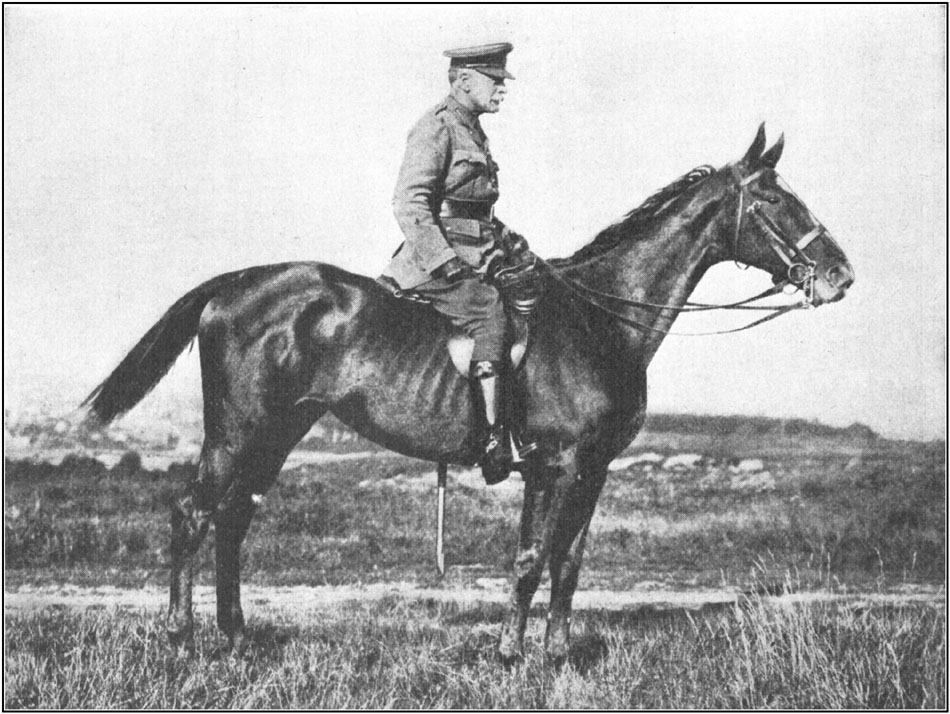
Copyright by Underwood & Underwood, N.Y.
Sir Douglas Haig—In Command of the British Armies
WHEN GERMANY LOST THE WAR[4]ToC
No man knows exactly when and where the three and twenty allies will win the war, but all men know when and where Germany lost it. It was four years ago this morning, at a point near Gemmenich, a village southwest of Aix-la-Chapelle. It was then and there that the first gray uniform crossed the frontier from Germany into Belgium.
An hour before and it was not too late for Germany to win the war, or at least to lose it with honor. An hour afterward, and Germany was doomed. What has befallen her since that 4th of August, what will befall her in the future, were predetermined from the fatal instant of that summer morning when the first German soldier trod where Prussia had promised he should never go. There is not a German killed to-day in the flight to the Vesle whose fate was not written at Gemmenich.
It was not merely that the invasion of a land guaranteed perpetual neutrality brought Great Britain into the fight and turned into a world war what Germany had hoped would be a small, swift, and easy campaign. It was the exposure of Germany herself. Know of her what we may to-day, we thought of her otherwise four years ago yesterday. She had thrown about herself a mantle which hid the sword and the thick, studded boots. She worked at science and played at art. She sang and thumped the piano. She cleaned her streets and washed her children's faces. Many persons in America and England believed that she was efficient and that her very verboten signs were guides to the ideal life. Even as the Kaiser reviewed his armies he babbled of peace; peace, to believe him, was the first object of his life.
We do not know of any writer who has condensed the proof of Germany's falsehood and cowardice into so few words as Von Bethmann-Hollweg, who, as Chancellor of the Empire, spoke as follows to the Reichstag four years ago this afternoon:
Gentlemen, we are now acting in self-defence. Necessity knows no law. Our troops have occupied Luxemburg and have possibly already entered on Belgian soil. [The speaker knew that the invasion had begun.]
Gentlemen, that is a breach of international law.
The French Government has notified Brussels that it would respect Belgian neutrality as long as the adversary respected it. But we know that France stood ready for an invasion. France could wait, we could not. A French invasion on our flank and the lower Rhine might have been disastrous. Thus we were forced to ignore the rightful protests of the Governments of Luxemburg and Belgium. The injustice—I speak openly—the injustice we thereby commit we will try to make good as soon as our military aims have been attained. He who is menaced as we are and is fighting for his all, can only consider the one and best way to strike.
There stood the German Empire, intensively trained in the arts of war for forty years, pleading cowardice in extenuation of her broken word. "France could wait, we could not!" A brave man, Bethmann-Hollweg, unless he knew before he spoke that the whole nation had sunk to the immoral level of the cowards who invaded Belgium because they feared that on a fair field France would have beaten them! It is curious that in the whole record of German state-craft in the war, the Chancellor's confession of his empire's degradations stands out almost like a clean thing.
The Chancellor did not deceive the people except in his implication that France would have struck through Belgium if Germany had not. He did not deceive himself, either. He knew the cowardice of Germany. It is probable that he believed, as the Junkers believed, that England, too, was a coward. Prince Lichnowsky had told them the truth about England, but they had not believed. In the years of Kultur, they had forgotten what honor was like. They chose to credit the stories that England was torn with dissensions, threatened with rebellion in Ireland and India, nervous from labor troubles, and not only physically unprepared for war but mentally and morally unfit for war. Even the telegram of Sir Edward Grey, communicated on the day of Belgium's invasion, to the German Government by the British Ambassador at Berlin, did not dispel the illusion about Great Britain:
In view of the fact that Germany declined to give the same assurance respecting Belgium as France gave last week in reply to our request made simultaneously at Berlin and Paris, we must repeat that request and ask that a satisfactory reply to it and to my telegram of this morning be received here by 12 o'clock to-night. If not, you are instructed to ask for your passports and to say that His Majesty's Government feels bound to take all steps in their power to uphold the neutrality of Belgium and the observance of a treaty to which Germany is as much a party as ourselves.
Even that memorable document, we say, did not convince Germany that common honor still lived across the Channel. The Foreign Secretary, Von Jagow, a mere tool of the Kaiser, took it mechanically; but Von Bethmann-Hollweg added to the sum of German cowardice. Brave as he had been in the Reichstag, he whimpered to Sir Edward Goschen when he saw that "12 o'clock to-night" on paper. This account of the conversation is Goschen's, but the German Chancellor later confirmed the Englishman's version:
I found the Chancellor very agitated. His Excellency at once began a harangue which lasted for about twenty minutes. He said that the step taken by His Majesty's Government was terrible to a degree; just for a word—"neutrality," a word which in war time had so often been disregarded—just for a scrap of paper, Great Britain was going to make war on a kindred nation who desired nothing better than to be friends with her.
When he added that it was a matter of "life and death" to Germany to advance through Belgium, the British Ambassador replied that it was "a matter of life and death for the honor of Great Britain that she should keep her solid engagement to do her utmost to defend Belgium's neutrality if attacked." Her utmost! Aye, she has done it!
A last gasp from the German Chancellor: "But at what price will that compact have been kept? Has the British Government thought of that?" Sir Edward Goschen replied that "fear of consequences could hardly be regarded as an excuse for breaking solemn engagements," but these words were lost. The German Chancellor had abandoned himself to the contemplation of the truth: that morning Germany had been beaten when a soldier stepped across a line. How long the decision might be in dispute Bethmann-Hollweg could not know, but he must have known that, cheating, Germany had loaded the dice at the wrong side. If she had struck fairly at France, England would have had to stand by, neutral. The seas would be open to Germany. If France had violated Belgium's neutrality—as Germany professed to believe she intended to do—England would have attacked France, keeping the pledge made in the Treaty of London. But now, because England weighed a promise and not the price of keeping it, there could be no swift stroke at lone France, no dash eastward to subdue Russia. To-day, when Germany sees how ripe Russia was then for revolution, the remembrance of that 4th of August must be the bitterest drop in the deep cup of her regret.
The items at which we have glanced were not all or even the most important acts of Germany's dawning tragedy. It was not merely that she revealed herself to the world, but that she revealed herself to herself. The moving picture of Kultur, of fake idealism, of humaneness, which she had unreeled before our charitable eyes was stopped, and stopped forever. The film, exposed momentarily to the flame of truth, exploded and left on the screen the hideous picture of Germany as she was. No more sham for a naked nation. In went the unmasked Prussian to outrage and murder, to bind and burn. When a Government violated its word to the world, why should the individual check his passions? All the world, at first unbelieving, watched the procession of horror, and then, against its wishes, against all the ingrained faith that the long years had stored within the human breast, the world saw that it was dealing with nothing less than a monster.
England's day, this? Yes, and a glorious anniversary for her. She has indeed kept her "solid engagement to do her utmost." In a million graves are men of the British Empire who did not consider the price at which the compact would be kept. Their lives for a scrap of paper—and welcome! When we think that we are winning the war—and nobody denies that it is American men and food and ships and guns that are winning it now—let us look back to the 4th of August, 1914, and remember what nation it was that stood between the beast and his prey, scorning all his false offers of kindness to Belgium, his promises not to rob France, and his hypocritical cry of "kindred nation" to the England he really hated.
But it is not alone England's day. It is the day of the opening of the world's eyes to the criminality of Prussia. It is the anniversary of Germany's loss of the war. We—America, France, England, Italy, and the rest of us—will win it, but Germany lost it herself with the one stroke at Gemmenich. She believed it a masterpiece of cunning. It was the foul thrust of a coward and the deliberate mistake of a fool.
The New York Sun, August 4, 1918.
FOOTNOTES:
CARRY ON![5]ToC
It's easy to fight when everything's right, And you're mad with the thrill and the glory; It's easy to cheer when victory's near, And wallow in fields that are gory. It's a different song when everything's wrong, When you're feeling infernally mortal; When it's ten against one, and hope there is none, Buck up, little soldier, and chortle: Carry on! Carry on! There isn't much punch in your blow. You're glaring and staring and hitting out blind; You're muddy and bloody, but never you mind. Carry on! Carry on! You haven't the ghost of a show. It's looking like death, but while you've a breath, Carry on, my son! Carry on! And so in the strife of the battle of life It's easy to fight when you're winning; It's easy to slave, and starve and be brave, When the dawn of success is beginning. But the man who can meet despair and defeat With a cheer, there's the man of God's choosing; The man who can fight to Heaven's own height Is the man who can fight when he's losing. Carry on! Carry on! [163] Things never were looming so black. But show that you haven't a cowardly streak, And though you're unlucky you never are weak. Carry on! Carry on! Brace up for another attack. * * * * * Carry on, old man! Carry on! There are some who drift out in the deserts of doubt, And some who in brutishness wallow; There are others, I know, who in piety go Because of a Heaven to follow. But to labor with zest, and to give of your best, For the sweetness and joy of the giving; To help folks along with a hand and a song; Why, there's the real sunshine of living. Carry on! Carry on! Fight the good fight and true; Believe in your mission, greet life with a cheer; There's big work to do, and that's why you are here. Carry on! Carry on! Let the world be the better for you; And at last when you die, let this be your cry: Carry on, my soul! Carry on! Robert Service.
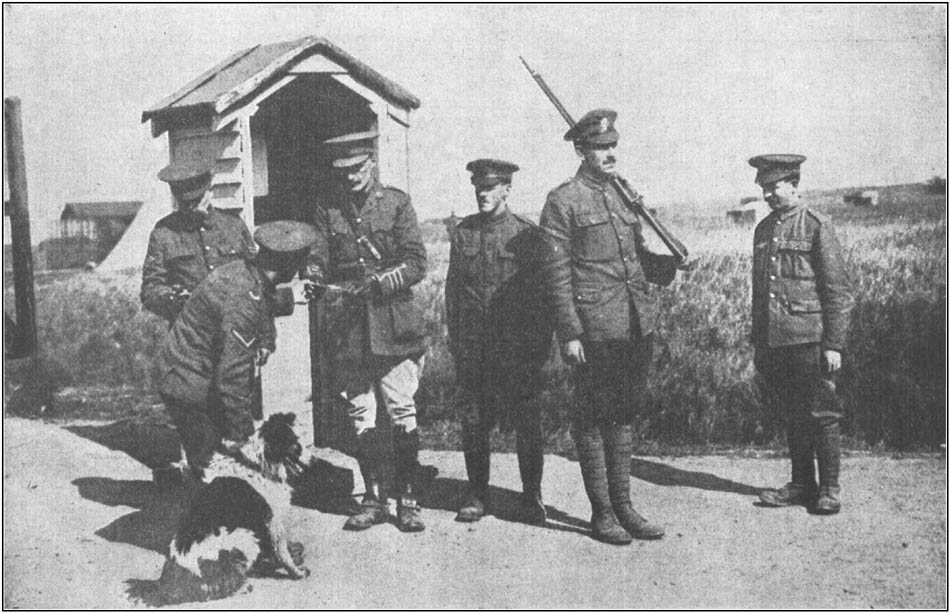
Copyright by Western Newspaper Union Photo. Service
A Dog Delivering a Dispatch at Headquarters
FOOTNOTES:
WAR DOGSToC
The story of "The Animals Going to War" tells how, one by one, the wild creatures, then the enemies of man, were made his friends and learned to be his helpers. In the World War, the horse has borne man into the thick of the conflict, the mule has drawn his big guns into place, and the dog has wonderfully come to his aid, so that now, whenever the "dogs of war" are let loose, the war dogs go with them.
The Battle of Verdun had been raging for months; Fort Douaumont had been taken, lost, and finally retaken by the French. The Germans still poured against it a terrific rain of shot and shell, and within the battered fortress the guns were disabled and the ammunition nearly exhausted. Help was needed and needed at once. Long ago the wireless had been shot to pieces, and the telephones had been destroyed. It was sure death for a man to venture outside, let alone trying to reach the lines behind, where he might secure help.
Still the defenders stood firm, and in their hearts, if not with their lips, over and over they repeated those magic words, "They shall not pass!" But the shells continued to fall in their very midst, and unless that battery could be silenced, the fort and all the men in it would be lost. What could be done when no messenger could reach the lines behind?
Suddenly, as the men were straining their eyes almost hopelessly in the direction of those lines, they saw a small, dark speck moving across the fields, stopping only here and there behind a rock to take shelter from the bursting shells. Now and then it dashed wildly over the open fields. But ever straight on toward the fort it came. Swiftly the entrance of the fort was flung open, and in dashed one of the faithful dogs, unhurt. In the wallet, fastened to his collar, was found a message telling that relief was coming. Strapped to his back was a tiny pannier, inside of which were two frightened carrier pigeons. On a slip of paper the commander quickly wrote his message: "Stop the German battery on our left." Then adding any necessary facts as to pointing the guns, he fastened the message to the trembling bird and let it loose. Straight to its home, above shot and shell, flew the pigeon. In a few moments the German battery was silenced, and Douaumont and the brave defenders were saved.
All along the lines, the dogs were busy bearing important messages back and forth from one commander to another, and from one fort to another. Zip, an English bulldog, ran two miles in heavy shell fire and afterward had to go about with his jaw in splints; but he delivered his message and seemed anxious to get well enough to carry another. One of the other messenger dogs, it is said, carried orders almost continuously for seventy-two hours, hardly stopping to eat or drink; for no war dog would eat or drink anything given him by strangers. The faithful animals were in danger of being taken prisoners, as well as of being struck. Indeed, in one instance a heavy cannon rolled over upon a big mastiff, pinning him there until help came.
When the battle ceased, the dogs sprang from the trenches and searched the fields and woods for wounded men. They could find them much more quickly and with less danger of being seen than any Red Cross man.
In former wars among civilized peoples, the firing has always been upon armed forces, and the guns were silent after each battle to allow both sides to find and care for the wounded soldiers in the field. The Germans, however, have used the Red Cross doctors and stretcher-bearers for targets, so that to send them out only means to add them to the number wounded. But the dogs, creeping among the men, can seldom be seen by the enemy, and besides are able to find the wounded quicker and more easily. As soon as a dog finds an injured soldier, he seizes his cap, a button, or a bit of his clothing, and runs back with it to the doctor or a Red Cross nurse, for he will give it to no one else. The stretcher-bearers then follow the dog and bring back the wounded man. Often the man may lie in a dense thicket where no one would think to look for him, but the dog, by his keen sense of smell or by hearing the deep breaths or some slight sound made by the injured man, creeps in and finds him.
Sometimes, to attract the attention of an ambulance driver, the dogs give several short, quick barks; but usually they do their work silently, for if they bark, the enemy will fire.
Many times a dog finds a man unable to get back to the lines, but not so seriously wounded but that he can help himself somewhat. In such a case, before running for help, the dog stands quiet, close to the soldier, and allows him to take the flasks and first-aid bandages from the wallet which is hung about the dog's neck or pinned to the blanket on his back.
Thus, by the help of these faithful friends, the lives of many hundreds of men have been saved. Over one hundred were rescued in one night after a battle. A big Newfoundland, named Napoleon, had the credit of saving as many as twenty. One of the men, in speaking of him, said, "Part of his tail has been blown away, and once he was left for dead in No Man's Land, but he is still on the job, working for civilization."
When not fighting or on watch, the men in the trenches enjoy the company of the dogs and teach them to perform all sorts of tricks, the fox terriers proving especially intelligent. They also do good work in keeping the trenches free from rats.
At night, a French sentinel sometimes crawls through the entanglements on his way to a "listening post" out in No Man's Land. With him goes a sentinel dog. The sentinel's purpose is to discover if the enemy are getting ready for a surprise attack. Lying flat on the earth, or crouching in a shell hole, he listens with bated breath for any telltale noises. The dog, listening too, creeps along beside him, or slinks silently out into the darkness. He can tell, when his master cannot, if an enemy is abroad. Making no sound, giving no betraying bark, as soon as he discovers the enemy the dog draws near to his master, stands at attention, his ears pricked up, his hair bristling, his tail wagging as he silently paws the ground or growls so low that only his master can hear him. If the German soldier attempts to fight, the dog springs at him and throws him to the ground.
A group of soldiers were on watch one night in one of the front trenches, when all of the dogs suddenly became uneasy, growling low, and growing more and more excited. The soldiers knew their dogs and trusted their warnings, so they telephoned back to the main trenches for help. In less than half an hour, an attack was made from the German trenches opposite. Meanwhile, however, reënforcements had arrived for the Allies, which sent the enemy back to his own lines again. How the dogs knew so long before that the attack was coming, whether they could have heard the first faint signs of preparation in the enemy trenches, the soldiers could not tell.
When a front line trench of the enemy is captured, it is the faithful dogs who draw up the many cartloads of ammunition and supplies, and some of the smaller guns. For this, the Belgian dogs are especially well fitted.
Happy as long as they can help in the fighting, restless and uneasy whenever sent back to the hospitals for treatment or rest, these dogs have shown the worth of all the training they have received, as well as a great amount of natural intelligence.
While Zip, Napoleon, Spot, Stop, Mignon, and Bouée have been doing their bit on the firing line, still others have been taking their training in readiness to go to the front. And very hard training it is. Sheep dogs, fox terriers, bulldogs, collies, St. Bernards, Newfoundlands, Alaskan wolf dogs, mongrels,—all must be carefully trained by expert dog trainers.
First they must learn to distinguish between the uniform of their country and that of the enemy. They must not bark, because then the enemy will be sure to shoot. In carrying letters from post to post, they must learn to recognize the posts by name.
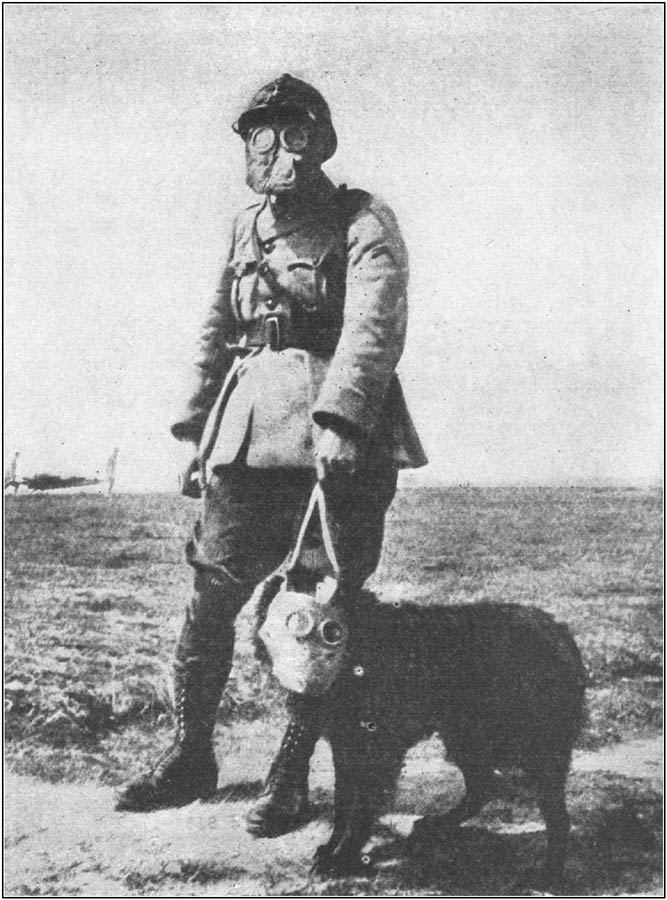
Copyright by Underwood & Underwood, N.Y.
A French Officer and His Dog Both Wearing Anti-Gas Masks While Crossing a Dangerous Zone in France
About three months of training are necessary to teach the dogs to travel as far as three kilometres in this work. Two of the dogs are put into the care of two trainers, and taught to recognize both as their masters, and to carry dispatches from one to the other.
The dogs must be trained to obey implicitly. If the master stops abruptly in his walk, the dog must do the same; if the trainer runs, the dog must keep in perfect step, ready at a given signal to lie down, or follow a scent, or find a wounded soldier. For many hours he must be trained in jumping, because of the great heights over which he must spring, carrying heavy weights in his mouth or upon his back or around his neck. He must learn to make no sound except when ordered to do so, to find objects which have been most skillfully hidden, to distinguish between a dead man and one wounded and breathing, to deliver the token of a wounded man only to the doctor or Red Cross nurse, to allow nothing to hinder him from carrying out any task, to refuse food and water from strangers, and to aid soldiers on the watch. These watch dogs must learn to give a signal when they scent poison gas or hear the enemy creeping up. And they must guard prisoners very carefully.
Some dogs cannot learn all of these duties, and so specialists examine every dog that is enlisted. There are tests for health, intelligence, speed, quick tempers, and even tempers. When a dog has been in training for several weeks, he is sometimes found in the end to be unfit for service, and the trainer has to admit a new recruit in his place and start all over again. Often a dog can do certain tasks much better than others, and so each one is assigned to the kind of service which he can do best.
It is marvelous what great services these dogs have rendered in the World War. The governments have recognized their worth, and societies have been formed to train and protect them. The French people, in 1912, organized the "Blue Cross." It is a Blue Cross officer who examines the dogs and a Blue Cross doctor who gives first aid and orders an injured dog to the hospital for further treatment. The Blue Cross also has been at work in Italy.
The American Red Cross Society has taken over the task of securing and protecting dogs on the American front, but instead of the red cross, the animals wear a red star, so that the field is blest with three red symbols of mercy—the red cross, the red triangle, and the red star. The number of dogs added to the war service during the first four years of the war was about ten thousand on all fronts.
Not only have dogs been provided by various societies, but many have been given by private families. One elderly French father wrote to the French War Department, "I already have three sons and a son-in-law with the Colors; now I give up my dog, and 'Vive la France!'"
The French government officials, as well as the various societies, have shown their gratitude by awarding honors to the canine heroes. Many have been mentioned in the orders for bravery and heroic conduct. Several have been presented with gold collars. The French government has even published a "Golden Book of Dogs," in which are recorded some of the heroic deeds of these brave and faithful friends of man. One of the dogs wearing a French medal of honor is a plucky fox terrier, who is said to have saved one hundred fifty lives after the Battle of the Marne. Bouée, a fuzzy-haired, dirty, yellow-and-black, tailless little fellow, is another hero, who has been cited three times for his bravery. During a heavy action, when all the telephone wires had been destroyed, Bouée carried communications between a commandant and his force, fulfilling his duty perfectly without allowing anything to distract him.
Shall we not change the old proverb from "As brave as a lion," to "As brave as a dog"?
THE BELGIAN PRINCEToC
The Belgian Prince was a British cargo steamer. On a voyage from Liverpool to Philadelphia, with Captain Hassan in command, she was, on July 31, 1917, attacked and sunk by a German U-boat. For brutal savagery and barbarism, the drowning of the crew of the Belgian Prince is one of the most astounding in the history of human warfare. Captain Hassan was taken aboard the U-boat, and no further knowledge of his fate has been received. The Belgian Prince was a merchant ship, not a warship in any sense of the word.
The Germans evidently intended to sink her without a trace left behind to tell the story, as their Minister to Argentina advised his government to do with Argentine ships; but three members of her crew, the chief engineer and two seamen, escaped as by a miracle. Their stories are now among the records of the British Admiralty; they have also been published in many books which have a place in thousands of libraries, public and private, all over the world. How will the Hun, when peace comes again, face his fellow-men?
The story of the chief engineer, Thomas Bowman, is as follows:
At 7:50 P.M. on the night of July 31, the Belgian Prince was traveling along at ten knots, when she was struck. The weather was fine and the sea smooth. It was a clear day and just beginning to darken. I was on the after deck of the ship, off watch, taking a stroll and having a smoke. The donkeyman shouted out, "Here's a torpedo coming." I turned and saw the wake on the port about a hundred yards away. I yelled a warning, but the words were no more than out of my mouth when we were hit.
I was thrown on deck by a piece of spar, and when I recovered I found the ship had a very heavy list to port and almost all the crew had taken to the boats. I got into the starboard lifeboat, which was my station. Until then I had seen no submarine, but now heard it firing a machine gun at the other side of the ship. With a larger gun it shot away the radio wires aloft so that we could send out no S.O.S. messages. As soon as we had pulled away from the ship I saw the U-boat, which promptly made toward our own boats and hailed us in English, commanding us to come alongside her. We were covered by their machine gun and revolvers. We were in two lifeboats and the captain's dinghy.
The submarine commander then asked for our captain and told him to come on board, which he did. He was taken down inside the submarine and we saw him no more. The rest of us, forty-three in number, were then ordered to board the submarine and to line up on deck. A German officer and several sailors were very foul and abusive in their language. They ordered us, in English, to strip off our life belts and overcoats and throw them down on the deck.
When this was done they proceeded to search us, making us hold up our hands and threatening us with revolvers. These sailors, while they passed along the deck and were searching us, deliberately kicked most of the life belts overboard from where we had dropped them. Beyond making us take off our life belts and coats there was no interference with our clothing. They robbed me of my seaman's discharge book and certificate, which they threw overboard, but kept four one-pound notes.
After searching us, the German sailors climbed into our lifeboats and threw out the oars, gratings, thole-pins, and baling tins. The provisions and compass they lugged aboard the submarine. They then smashed our boats with axes so as to make them useless, and cast them adrift. I saw all this done myself. Several of the German sailors then got into our dinghy and rowed to the Belgian Prince. These men must have been taken off later, after they had ransacked the ship.
The submarine then moved ahead for a distance of several miles. I could not reckon it accurately because it was hard to judge her speed. She then stopped, and after a moment or two I heard a rushing sound like water pouring into the ballast tanks of the submarine.
"Look out for yourselves, boys," I shouted. "She is going down."
The submarine then submerged, leaving all our crew in the water, barring the captain, who had been taken below. We had no means of escape but for those who had managed to retain their life belts. I tried to jump clear, but was carried down with the submarine, and when I came to the surface I could see only about a dozen of our men left afloat, including a young lad named Barnes, who was shouting for help.
I swam toward him and found that he had a life belt on, but was about paralyzed with cold and fear. I held him up during the night. He became unconscious and died while I was holding him. All this time I could hear no other men in the water. When dawn broke I could see the Belgian Prince about a mile and a half away and still floating. I began to swim in her direction, but had not gone far when I saw her blow up.
I then drifted about in the life belt for an hour or two longer and saw smoke on the horizon. This steamer was laying a course straight for me, having seen the explosion of the Belgian Prince. She proved to be a British naval vessel, which also found the two other survivors in the water. We were taken to port and got back our strength after a while. None of us had given the submarine commander and crew any reason for their behavior toward us. And I make this solemn declaration conscientiously, believing it to be true.
The two common sailors who survived were William Snell, a negro, of Norfolk, Virginia, and George Silenski, a Russian. William Snell's story is as follows:
Two men of the submarine's crew stayed on top of the conning tower with rifles in their hands which they kept trained on us. Seven other Germans stood abreast of our line on the starboard side of the boat, armed with automatic pistols. The captain of the submarine, a blond man with blue eyes, was also on deck and stood near the forward gun, giving orders to his crew in German, and telling them what to do. Pretty soon he walked along in front of the men of the Belgian Prince, asking them if they had arms on them. He ordered us to take off our life belts and throw them on deck, which we did. As they dropped at our feet, he helped his sailors pick them up and sling them overboard.
When I threw my belt down, I shoved it along on the deck with my foot, and finally stood on it. As the commander walked along the line, he huddled us together in a crowd and then went and pulled the plugs out of our lifeboats, which were lying on the starboard side of the submarine. When he went back to the conning tower, I quickly picked up my belt and hid it under a big, loose oilskin which I was wearing when I left the Belgian Prince. The Germans did not make me take it off when they searched me. I hugged the life belt close to my breast with one arm.
When the commander returned to the conning tower, four German sailors came on deck from below and got into our captain's small boat, which was on the port side. The submarine then backed a little, steamed ahead, and rammed and smashed one of our lifeboats, which had been cast adrift.
The four men who had jumped into our captain's boat now pulled alongside the Belgian Prince. The submarine then got under way and moved ahead at about nine knots, as near as I could guess, leaving her four men aboard the Belgian Prince, and all of us, except our skipper, huddled together on the forward deck, which was almost awash.
She steamed like this for some time, and then I noticed that the water was rising slowly on the deck until it came up to my ankles. I had also noticed, a little while before this, that the conning tower was closed. The water kept on rising around my legs, and when it got almost up to my knees I pulled out my life belt, threw it over my shoulders, and jumped overboard. The other men didn't seem to know what was going to happen. Some of them were saying, "I wonder if they mean to drown us."
About ten seconds after I had jumped, I heard a suction as of a vessel sinking and the submarine had submerged entirely, leaving the crew of the Belgian Prince to struggle in the water.
I began to swim toward our own ship which I could see faintly in the distance, it being not very dark in that latitude until late in the evening. The water was not cold, like the winter time, and I was not badly chilled, but swam and floated all night, on my back and in other positions. One of our crew, who had no life belt, kept about five yards from me for half an hour after the submarine submerged. Then he became exhausted and sank. I could hear many other cries for help, but I could not see the men.
When day came, there were lots of bodies of old shipmates floating around me. Then about five o'clock, as near as I can judge, I made out the Belgian Prince and four men coming over the side. They had been lowering some stuff into a boat. I cried out, "Help, help!" but they paid no attention to me.
Then the submarine came to the surface and the four sailors hoisted their stuff out of the rowboat and were taken aboard. Ten minutes later the submarine submerged. Then there was a great explosion as the Belgian Prince broke in two and sank. Soon I saw a vessel approaching and she passed me, but turned and came back just in time. I was all in. It was a British patrol steamer, and as soon as I came to, I made a full report to the captain of the loss of the Belgian Prince and the drowning of her crew.
The Russian, in his story, tells of the taking away of the life belts and the smashing of the lifeboats; of the crew of the Belgian Prince being left to sink or swim after the U-boat submerged—in all of these details agreeing with the stories of the other two. And he adds:
Then I swam toward the ship all night, although I had no life belt or anything to support me. About five o'clock in the morning I reached the Belgian Prince and climbed on board. I stayed there about an hour and got some dry clothes and put them on.
I saw the submarine come near the ship and three or four of her men climbed on board. I hid and they did not notice me. They had come to put bombs in the ship, so I jumped overboard from the poop with a life belt on. The submarine fired two shells into the ship to make her hurry up and sink. Then the Germans steamed away. I climbed into our little boat which had been left adrift and stayed there until a British patrol ship came along and picked me up.
Do you wonder that the members of the British Seamen's Union have taken a pledge, "No peace until the sea is free from Hun outrages"; and that they have declared a boycott on all German ships, cargoes, and sailors for seven years after the war? Sailors of other nations are joining with the British in this boycott.
The quality of mercy is not strain'd, It droppeth as the gentle rain from heaven Upon the place beneath: it is twice blest; It blesseth him that gives and him that takes: 'Tis mightiest in the mightiest: it becomes The thronèd monarch better than his crown: * * * * * It is an attribute to God himself; And earthly power doth then show likest God's When mercy seasons justice. Shakespeare.
DARING THE UNDARABLEToC
We are thirty in the hands of Fate And thirty-one with Death, our mate.
So sang the men who, with D'Annunzio, the Italian poet and hero, set out "to dare the undarable."
Little has yet been told of the deeds of the Italians in the World War, but as they become known, the people of other nations realize that Italy has really worked wonders in her almost superhuman attempts to conquer, not only men, but nature as well. When the complete story is written of her struggles with avalanches, snow, frost, and enemy soldiers in the mountain passes, it will be one continuous record of heroic deeds.
D'Annunzio, although well over fifty years of age, and in most countries judged too old for actual warfare, has been one of Italy's most daring fighters. He was known throughout his native land by his writings, and his fiery, passionate pleas published in all Italian cities before Italy entered the war, helped his countrymen see the right and decide to fight for it.
As soon as Italy decided to join the Allies, D'Annunzio sought and was granted a post of great danger. He became an aviator, in the same corps with his son.
Austria, whenever possible, sent aviators over Venice and other Italian cities to drop bombs, although this warfare upon non-combatant women and children was contrary to international law. The Austrians, like the Germans, seemed to believe that it was wise for them to use any means to win.
In August, 1918, D'Annunzio commanded a flight of eight bombing airplanes over Vienna. It was a long-distance record for a squadron of planes. Leaving the Italian lines at half past five in the morning, they flew to Vienna and back, over six hundred miles, reaching home in about sixteen hours. It was necessary for them to fly very high, at about fifteen thousand feet, to cross the Alps and to escape the Austrian barrage. All the machines returned but one, which was obliged to land on account of engine trouble.
More than a million printed declarations, or statements, were dropped on Vienna to inform the Austrians of the real state of affairs. In Germany and Austria, the people were allowed to know only what their rulers thought would be good for them to know. D'Annunzio wanted to show them that Italians could drop bombs on Vienna if they desired to do so, or thought it right to do so.
The manifestoes, as they are called, were in German, and read as follows:
We Italians do not war upon women, children, and old men—but only upon your blind, obstinate, and cruel rulers, who cannot give you either peace or food, but try to keep you quiet with hatred and falsehood.
You are said to be intelligent. Why do you wear the uniform of Prussia? It is suicide for you to continue the war. The victory that would end the war promised to you by the Prussians is like the wheat they promised you from Ukraine. You will all die while waiting for it. People of Vienna, think for yourselves! Awake!
In February, 1918, D'Annunzio with twenty-nine companions set out on three small torpedo boats to destroy some Austrian warships discovered by an Italian aviator to be lying hidden in the Bay of Buccari. To get at them, it was necessary to steam past the Austrian fortifications. Discovery meant death.
It is not strange that D'Annunzio was the mastermind of this expedition, for he loves the sea, as he says, with all the strength of his soul. He was born on a yacht at sea and has written much about ships and the ocean. He has taken as his motto three Latin words, "Memento audere semper," which mean, "Remember always to dare."
As they steam away from the Italian shores, D'Annunzio talks to his brave companions. He says, "Sailors, companions, what we are about to do is a task for silent men. Silence is our trusty helmsman. For that reason I need not urge you with many words to be brave, for I know you are already eager to match your courage against the unknown danger. If I were to tell you where we are bound, you would hardly be able to keep from dancing for joy. We are only a handful of men on three small ships, but our hearts are stronger than the motors, and our wills can go further than the torpedoes.
"We carry with us, to leave for a souvenir for the enemy, three bottles sealed and crowned with the flaming tricolor of Italy. We will leave them to-night floating on the smooth surface of the bay amid the wreckage of the vessels we have struck."
Then D'Annunzio reads to them the letter which he has written and inclosed in each bottle, ridiculing the Austrians because they have hidden their ships safely behind the guns of the forts, and do not have courage to come out in the open sea. He says the Italians are always ready "to dare the undarable," and that they have come to make the enemy whom they hate most of all, the laughingstock of the world.
He goes on speaking to the sailors: "Because this thing that we attempt is so dangerous, we have already conquered Fate. To-morrow your names will be honored in all Italy, and will shine as golden as the torpedo. Therefore, every one to-day must give all of himself and more than all of himself, all of his strength and courage, and even more. Do you swear it? Answer me."
The sailors cry, "We swear it! Viva l'Italia!"
And D'Annunzio answers, "Memento audere semper."
They have been steaming for twenty-four hours and are now very near the enemy's guns guarding the entrance to the bay. The very audacity of the Italians seems to save them, for they steam on unchallenged, and when near enough, discharge a torpedo at the giant Austrian dreadnought. The ship is struck and all is excitement and confusion. Rockets are sent up to alarm and inform the forts. The Italian torpedo boats turn for home. D'Annunzio says, "The sky is starry, the sea is starry, and our hearts are starry, too."
One of their three ships is soon disabled and falls behind. The other two turn back to help her, and this is what probably saves them all; for the Austrian forts, seeing them sailing into the harbor, think they are Austrian vessels and do not fire upon them. When they steam out of the harbor, the forts think they are Austrian torpedo boats in pursuit of the Italians who must have escaped in the darkness. As D'Annunzio says, "Our very audacity has conquered Fate."
They sank one of the largest of the Austrian dreadnoughts, and then returned in safety to Italy.
It remained, however, for another Italian naval officer to outdo those who "dared the undarable" at Buccari. Lieutenant Luigi Rizzo, with two small motor patrol boats, succeeded in sinking two huge dreadnoughts protected by an escort of fast destroyers. His story of the encounter is as follows:
We were returning to our base just before dawn on July 10, 1918, after a night of dull, monotonous work along the enemy's coast, when I saw smoke coming from ships nearly two miles away. I thought we had been discovered and were being pursued. The only way I could know what we had to contend with was to get nearer the enemy, so I turned the two boats in my command toward the distant smoke.
Soon I discovered that it was two of Austria's largest dreadnoughts protected by a great convoy of destroyers. Evidently because we were so small, we had not been seen in the darkness; and although we were poorly armed, with only two large torpedoes for each of our two boats and eight smaller ones to throw by hand, we crept ahead until we were inside the line of the destroyers, and slowly and quietly approaching the dreadnoughts. I headed for one of them which proved to be the St. Stephen, and Lieutenant Aonzo, in charge of the other boat, made for the other, the Prince Eugene.
Then the watch on the dreadnoughts discovered us and began to fire at us with their small guns. How we escaped destruction is a miracle. Lieutenant Aonzo sent his first torpedo, and missed; but the second struck the giant fairly. Both of my torpedoes struck the St. Stephen.
After that all was confusion and excitement. We were fired upon and encircled by a muddled crowd of destroyers. I turned my boat to escape. A destroyer stood directly in my way and I veered off and almost touched the bow of the sinking St. Stephen in passing. The destroyers gave their attention to me and this allowed Lieutenant Aonzo to escape.
I saw that I would soon be overtaken, so I sent two torpedoes at the nearest destroyer. The first missed, but the second hit the mark. There was a tremendous explosion. The destroyer wobbled and began to turn over. I put on all power and escaped in the darkness.
The whole thing did not take over fifteen minutes. When we were sure of our escape, the five boys of my crew went nearly mad with joy, hugging, cheering, kissing, and crying in their excitement at what we had done. They hoisted our largest flag and trimmed our boat with bunting. A short way from us we could see that Lieutenant Aonzo was doing the same.
We knew the reception we would have when those at home learned the story, but we did not expect so much. The King decorated and honored us, the Admiralty gave us prize money, and the people added their contributions to it, for they declared we doubtless saved the city of Ancona from bombardment.
Lieutenant Rizzo was promoted to the rank of Commandant although not yet thirty years of age.
The St. Stephen sank where she was torpedoed. The Prince Eugene was able to make for home, but sank before she reached there, a short way from the Austrian coast. At the beginning of 1918, Austria had four of these giant dreadnoughts; on July 11, she had but one still floating.
KILLING THE SOULToC
As the centuries pass, the greatest glory of any nation, its highest satisfaction and pride, is in the works of art which it possesses. In each country there are works of art which have been preserved through many generations. They are the great inheritance of all the past ages. Every nation prizes this inheritance and wishes to hold it in safekeeping for still another generation; for into these creations of genius, men have put their souls.
If a famous inventor of machinery dies and the particular machine which he made is destroyed, there are yet other machines left, which have been made after his pattern, usually much better than the first one which he constructed.
While steamboats, railways, telegraphs, and automobiles are very useful, they are not so mysterious and individual but that they may be exactly copied and many, many duplicates be made and used by every country under the sun.
If all the music of the great composer Beethoven should be destroyed so that no copy remained in the world, there perhaps would be some master musicians of to-day who could remember and write down the notes, and so reproduce the wonderful compositions once more.
But there have been artists who have seen visions and dreamed dreams of God and heaven and the best and happiest things they had found in life. Such a one, with the power of his great genius, has made the dream into a picture, a painting, a statue, or a wonderful building, which no other person in the world is able to copy exactly. Indeed, there are many half-finished works which no artist, however great, has been able to complete. The creator has put into the work his soul, the best of all he thought and knew. So when many artists with their many dreams brought their finest works together into one place, it was certain that forever that place would be cherished and the wonder of it would belong to all people everywhere. While the artists have died long ago, their spirits, their very souls, seem alive to-day in the beautiful art works which they have left. It is for this reason that we speak of great artists who lived eight or nine hundred years ago, as if they were still living to-day, for their souls are alive in what they so wonderfully made. Those who look upon these works are mysteriously inspired to live better and happier lives themselves.
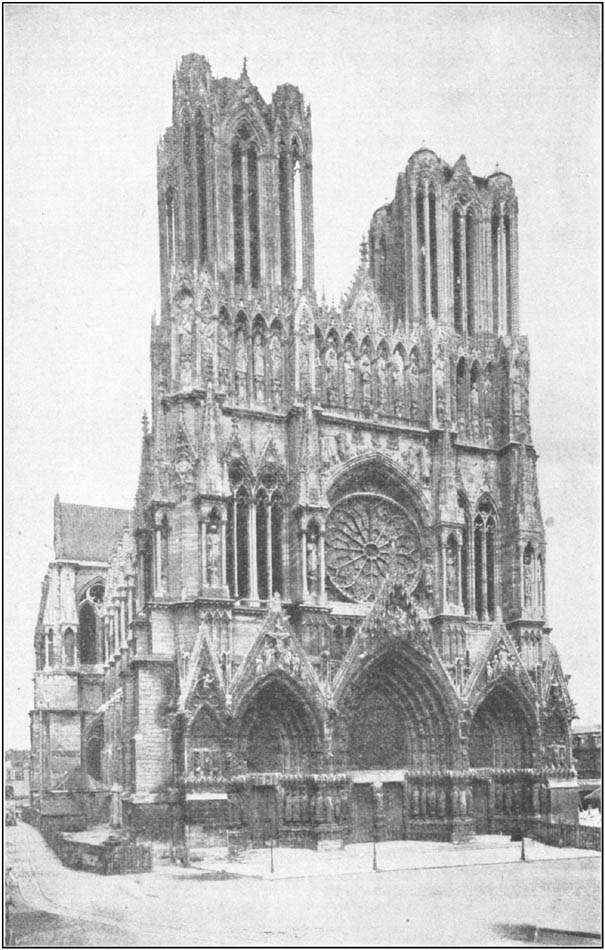
Rheims Cathedral
The loveliest art works in France are its Gothic cathedrals, and of them all, the Cathedral at Rheims was probably the most wonderful. No monument of ancient or modern times is more widely known to the world. It was built in the Middle Ages and expressed all the aspiration and faith of the people of that time. For seven hundred years it has been cherished for its great beauty, for the memory of the men who made it so beautiful, and for the sacred services which have been held in it. All the kings of France, except six, were crowned in it. One of the most striking services was the coronation of Charles VII, while Joan of Arc stood beside him with the sacred banner in her hands.
The cathedral held the works of many ancient artists. It was especially famous for its rose window, in which the figures of prophets and martyrs were glorified by the afternoon sun. Beneath the window was a magnificent gallery. Statues of angels, a beautiful statue of Christ, and one of the Madonna were to be found in this wonderful building. The stained glass windows were all very beautiful. Even the bells in the tower were famous.
With the excuse that the French were using the great towers of the old cathedral as observation posts, the Germans bombarded and destroyed the church. The roof was battered in and burned, the stained glass windows broken, the famous bells pounded into a shapeless mass of metal, and the wonderful statues and decorations hopelessly destroyed. Only the statue of Joan of Arc, in front of the cathedral, remained uninjured, as though to say, "I am the soul of France. You cannot injure or kill me." Afterwards the Germans bombarded the church a second time, attempting to tear down even the walls that were still standing.
Even savages in war respect sacred places, but the Germans deliberately aimed their guns at them. No excuse can ever be accepted by the civilized world for this deliberate destruction, and certainly the excuse cannot be accepted by military men that the act was due to bad marksmanship.
Other ancient churches were horribly damaged. The Germans stabled their horses in them, broke down the candelabra and statues, and carried away many valuable relics.
The burning of the University buildings at Louvain completely destroyed the treasures that had been preserved for centuries. Priceless manuscripts, paintings that can never be replaced, and valuable books in rare bindings were lost to the world.
The Germans scornfully but ignorantly declared, "Why should we care if every monument in the world is destroyed? We can build better ones." But the German idea of beauty is great strength and huge size. Their own public buildings and statues are often horrible in color, immense and awkward in appearance. They give people the impression of a fearsome brute spreading himself out before them. With few exceptions, there are no dainty figures and designs, nor any beautiful thoughts and feelings, as shown in the work of real artists.
The old cathedral at Rheims can never be restored. No one can ever bring back the old beauty and color; no one can revive those statues and paintings so that ever again they will seem to breathe forth the soul of the artists who fashioned them seven hundred years ago. The walls may be rebuilt, and artists of tomorrow may beautify them, but the spirit of the great men of the Middle Ages is gone—it has fled from the place forever. Thus the Germans, not content with killing the bodies of men, have in this way killed the souls of some of the greatest of the geniuses of the past. How can she pay the damage, or meet a fitting punishment?
What a peerless jewel was this cathedral, more beautiful even than Notre Dame in Paris, more open to the light, more ethereal, more soaringly uplifted with its columns like long reeds surprisingly fragile considering the weight they bear, a miracle of the religious art of France, a masterpiece which the faith of our ancestors had called into being in all its mystic purity.
Pierre Loti.
THE RUSSIAN REVOLUTIONToC
The controller, as he is called on the Siberian railroad, was passing through the cars to see that every passenger had a ticket. He did not notice the mooshik, which is what the Russian peasant is called in his own language, hiding under one of the car seats with a large bundle in front of him; or if he saw him, he passed on without seeming to have done so.
The mooshik had given the brakeman a small sum of money, about fifty cents in our currency, to let him hide there whenever the controller came around, and in this way ride from Petrograd, or Petersburg as the Bolsheviki renamed it after the revolution, to Vladivostok, a distance of about four thousand miles.
Now this mooshik did not need to go to Vladivostok; but his Russian nature made him go, go somewhere, it made little difference where. He had been the year before to Jerusalem, but this was for religious reasons, and now he must go again for no reason except that from within came the impulse to travel, an impulse too strong to be denied. The Russian government did not attempt to discourage the people from traveling, but actually made it easier by fixing fares for long distances at very small amounts. This traveler did not have even that small amount, but he found it easy with a smaller one to bribe his way in Russia.
There is a society in Russia, whose members pledge themselves never to remain more than three days in any one place; and it is said that wealthy Russians, after their children have grown up, will often divide their property and with staff in hand spend the remainder of their lives in traveling from one holy place to another.
A dream, a vision, leads the wealthy man to do this, and perhaps this is true also of the mooshik; but it is as likely that he goes because of the reality, the real people, the real village, the real home that he leaves behind. He is uneducated, for only seven out of every hundred can read and write in Russia. He lives in a shed as filthy and bad smelling as a pig-pen, or rather he starves there, starves both for food and for comfort. Black bread, potatoes, and sometimes cabbage, make up his "balanced diet." He cannot afford money for meat, eggs, milk, butter, sugar, or any of the many other ordinary foods of the American home, nor for the light of lamp or candle.
It is not strange that such mooshiki constantly move on and have no love for their native place, and have never established an "Old Home Day." It is not so strange that their former Tsar, Peter the Great, said, "One can treat other European people as human beings, but I have to do with cattle." Are they not treated like cattle?
But it is strange that a Russian writer can say of these people, and say it with truth, "A Russian may steal and drink and cheat until it is almost impossible to live with him; and yet, in spite of it all, you feel a charm in him that draws you to him, and that there is something more in him, some good or promise of good, that raises him above the level of all other races you have ever met." It is strange that he is so religious, so pitying of others, and so critical of himself; that he has so many noble visions and dreams for which he is ready and willing to die.
Uneducated, with little or no respect for truth or honesty in their own dealings, with no experience in government, having always been robbed by the aristocracy, and now eager and willing in turn to rob them, but with dreams of a society of men where all crime and hardship and unnecessary suffering are abolished, where there are no grafters, no self-seekers, no wrong-doers, no conflict, no robbery, no war—these Russian mooshiki, workmen, soldiers, and sailors, as a result of a revolution, found themselves attempting to govern a nation nearly twice as large in population as the United States. There are indeed two problems before the world, to make the world safe for democracy, and to make democracy safe for the world.
History tells the story of many revolutions. The story of the American Revolution, which was an uprising of the American colonies against the mother country, and that of the French Revolution, in which the laborers and peasants and some others rose against the extravagant and autocratic rulers of France, are well known to Americans.
When the real character and aims of the German autocracy were made plain to the world, all free people hoped for and expected the World War to end in a revolution of the German people. But the mass of the German people are kept ignorant of what the rest of the world feels and thinks about them, and have so long been trained to unquestioning obedience that a German revolution can come, if ever, only after some unexpected and appalling German defeat.
It has been said that if, at the time the Russian revolution broke out, a few regiments of trained veteran soldiers had been in Petrograd, the revolution would have been put down by these soldiers, to whom obedience to commands of superiors had become second nature. Those on guard in the city were newly-formed regiments recently trained and taken into the service.
The Russian revolution of March 9-13, 1917, overthrew Tsar Nicholas and the Romanoff dynasty. The Tsar has since been shot, and his son and heir has died—from exposure, it was reported. When Tsar Nicholas succeeded his father on the throne of Russia, the Russian people rejoiced and felt certain better days were at hand, and that they should love and loyally support the new Tsar. He had his opportunity and he threw it aside. Instead of granting larger liberty and a greater part in the government to the common people when they petitioned for it, he replied, "Let it be known that I shall guard the autocracy as firmly as did my father." His father was as autocratic as the German Kaiser.
Tsar Nicholas was weak and fickle. He made promises when in trouble and refused to keep his promises when trouble seemed avoided. The Russian people were much disappointed in him, and every year their disappointment grew. Some dreadful massacres of workers at Jaroslav, of peasants in Kharkov, and of miners on the Lena changed their disappointment to hatred.
As the Tsar grew older he drew away from touch with the people, and lived in his palaces, leaving affairs of state to his ministers who were chosen from a small and selfish clique. They brought on the war with Japan, and its failure was due to them. When Russia was defeated, the people were on the brink of a revolution; but the Tsar promised them a constitution, and trouble was put off for a while. When the people were quiet again, he broke his word and did not give them a constitution. Instead, in every way possible, he lessened the power and freedom of the people, and took revenge upon those who had caused the trouble by having them arrested and exiled, or executed.
He was very much under the influence of his wife. She was even weaker in many ways than he was and seemed to be in the power of an ignorant and wicked peasant who claimed to be a monk and was called Rasputin, the Black Monk. His influence over the weak Tsar and the weaker Tsarina so angered and disgusted some of the young Russian leaders that finally they had him secretly put to death—but not until he had helped to set every one against Tsar Nicholas and his wife.
For a while after the World War broke out, matters seemed to be going better. The people wanted the influence of Germany destroyed, and they expected the Russian army would soon be in Berlin. But when defeat and disaster overwhelmed the armies through the treachery of government officials, the people began to turn and to condemn Rasputin, the Tsarina, and the Tsar. It is said that Rasputin had one of his friends serving as physician to the Tsar and that he kept Nicholas drugged. It hardly seems possible that this can be true, but at any rate, the Tsar seemed to show no sense in his dealing with the situation. Instead of appointing better ministers, he appointed worse ones, suggested by Rasputin. Every one became disgusted and felt that only a revolution would save Russia. If it had not come from the people, it would have come from the nobles. It was looked forward to by all, but not until after the war.
There was suffering everywhere in the capital, Petrograd. Living was very high. It was difficult to get enough to eat or to get carried from place to place. Steam trains and trolleys were few and irregular. Though there was plenty of food in Russia, the railroads were in such bad shape that it did not reach the capital. But the Russians were fighting Germany, and no one expected or seemed to desire a revolution until after the war. When it did come, it was not planned, but seemed to come as if by accident.
Trouble began in the factory districts, in connection with bread riots. Stones were thrown, and some damage was done to property. Then crowds gathered and marched up and down the streets crying for bread, singing revolutionary songs, and carrying red flags.
The police were not able to handle the situation alone, and the soldiers were called upon. These were Cossacks and recently trained. There was bad feeling between the police and the Cossacks, and so the Cossacks were inclined to listen to the people and to become friendly with them.
On Sunday, March 11, the factory hands planned to make a great demonstration. The Tsar, learning of it, ordered notices to be posted warning the people that if they gathered, the soldiers were ordered to fire upon them. A few people did gather, and they were fired upon by machine guns and several were killed. The next morning, the officers who had ordered the soldiers to fire upon the people were killed by their own men. Then notices were posted by the government saying that unless the rioters went to work, they would immediately be sent to the front.
Other regiments revolted, and there was a battle between these and the few who remained loyal to the government. It was not a serious battle; but some were killed and the loyal regiments were defeated. Then soldiers and people ran through the streets crying, "Down with the Government."
The Tsar was at the front. Had he been in Petrograd, he might have saved the government by making some new promises; but, as it was, it soon fell.
As soon as the government was overthrown and the Tsar taken prisoner, those who had long sought for a revolution and had been forced to flee from Russia, came rushing back from Switzerland, Greece, France, and the United States. They were the real leaders after they arrived.
An American who was in Petrograd at the time gives the following account of the revolution:
Their first demand was that all prison doors should be opened and that the oppressed the world over should be freed.
The revolution was picturesque and full of color. Nearly every morning one could see regiment after regiment, soldiers, Cossacks, and sailors, with their regimental colors, and bands, and revolutionary flags, marching to the Duma to take the new oath of allegiance. They were cheered; they were blessed; handkerchiefs were waved; hats were raised, as marks of appreciation and gratitude to these men, without whose help there would have been no revolution. The enthusiasm became so contagious that men and women, young and old, high and low, fell in alongside, or behind, joined in the singing of the Marseillaise, and walked to the Duma to take the oath of allegiance, and having taken it, they felt as purified as if they had partaken of the communion.
Another picturesque sight was the army trucks filled with armed soldiers, red handkerchiefs tied to their bayonets, dashing up and down the streets, ostensibly for the purpose of protecting the citizens, but really for the mere joy of riding about and being cheered. One of these trucks stands out vividly in my mind: it contained about twenty soldiers, having in their midst a beautiful young woman with a red banner, and a young hoodlum astride the engine.
No one knows, at the end of the fourth year of the World War, what the result of the Russian revolution will be. It has so far left Russia a prey to Germany, but Germany is showing such criminal greed and unfairness that she may find her easily gained plunder will be her destruction, like the drowning robber with his pockets filled with gold.
The Russian mooshik has a motto, or rather a philosophy, which is expressed by the word "nitchevo." This word has several meanings, one of which is "nothing." Just what the mooshik has in mind when he says "nitchevo" is illustrated by the following story.
When Bismarck was Prussian ambassador at the court of Tsar Alexander II, he was invited by the Tsar to take part in a great hunt, a dozen or more miles out of the capital.
Bismarck started with his own horses and sledge but soon met with a serious accident, and was obliged to call upon the Russian peasants, or mooshiki, to help him by providing a horse, sledge, and driver. Soon a peasant appeared with a very small and raw-boned horse attached to a sledge that seemed about ready to fall to pieces.
"That looks more like a rat than a horse," growled Bismarck, but he got into the sledge.
The peasant answered but one word, "Nitchevo."
Soon the horse was flying over the snow at a great rate of speed. There was no road to be seen and the peasant was heading for the woods. "Look out!" yelled Bismarck. "You will throw me out!" But the peasant replied, "Nitchevo."
In a moment they were among the trees and were turning, now this way, now that, to avoid hitting them. The raw-boned horse had not lessened his speed in the least. Suddenly there was a crash. The sledge had skidded and struck a tree. The peasant and his passenger were thrown out headlong.
Bismarck was a man of fiery temper. When he had picked himself up, he rushed up to the peasant, who was trying to stop his bleeding nose, and yelled, "I will kill you." The mooshik did not seem at all frightened or troubled, and answered simply, "Nitchevo." He drew a piece of rope from the sledge and began to tie the broken parts together.
"I shall be late at the hunt," yelled the angry Bismarck.
"Nitchevo," replied the peasant.
While the sledge was being repaired, Bismarck noticed a small piece of iron broken from the runner and lying on the snow. He picked it up and put it in his pocket.
The mooshik soon had the sledge ready for them, and this time he reached the hunting lodge with his distinguished passenger without further accident or delay.
The Tsar and his companions laughed heartily at the story, as related by Bismarck, and then explained to the Prussian that by nitchevo the mooshik meant that nothing mattered, that they would get where they had started for, if they did not let accidents or circumstances turn them from it.
When Bismarck returned to the capital he had a ring made from the piece of iron, and on the inside of it he had inscribed the word nitchevo.
The Russian mooshik of to-day is the same in character and belief as the mooshik that replied "Nitchevo" to Bismarck. To Germany, to the Kaiser, to the world, the Russians, amid all their sorrows and troubles, are saying "Nitchevo." They will reach their goal at length, for they look upon the dangers and delays as nothing.
The Russian word Bolsheviki, used to designate the revolutionary party which was in power in Russia in 1918, is composed of two words: bolsh, meaning many; and vik, meaning most. Bolsheviki means the greatest number, or the common people, as compared with the few, or the aristocracy. Bolshevik, with the accent on the first syllable, is the singular and means one of the greatest number. Bolsheviki, with accents on the second and on the last syllables, is the plural. Similarly mooshik means a peasant, and mooshiki means peasants.
A BALLAD OF FRENCH RIVERS[6]ToC
Of streams that men take honor in The Frenchman looks to three, And each one has for origin The hills of Burgundy; And each has known the quivers Of blood and tears and pain— O gallant bleeding rivers, The Marne, the Meuse, the Aisne. Says Marne: "My poplar fringes Have felt the Prussian tread, The blood of brave men tinges My banks with lasting red; Let others ask due credit, But France has me to thank; Von Kluck himself has said it: I turned the Boche's flank!" Says Meuse: "I claim no winning, No glory on the stage; Save that, in the beginning I strove to save Liége. Alas! that Frankish rivers Should share such shame as mine— In spite of all endeavors I flow to join the Rhine!" Says Aisne: "My silver shallows [208] Are salter than the sea, The woe of Rheims still hallows My endless tragedy. Of rivers rich in story That run through green Champagne, In agony and glory, The chief am I, the Aisne!" Now there are greater waters That Frenchmen all hold dear— The Rhone, with many daughters, That runs so icy clear; There's Moselle, deep and winy, There's Loire, Garonne and Seine. But O the valiant tiny— The Marne, the Meuse, the Aisne! Christopher Morley.
A river is the most human and companionable of all inanimate things. It has a life, a character, a voice of its own; and is as full of good-fellowship as a sugar-maple is of sap. It can talk in various tones, loud or low; and of many subjects, grave or gay.
Henry van Dyke.
FOOTNOTES:
BACILLI AND BULLETSToC
Sir William Osler, one of the greatest medical men in the world, told the soldiers in the English training camps that he wanted to help them to get a true knowledge of their foes. The officers had impressed the soldiers with the truth that it was always necessary to find out where their enemies were and how many they were. But Sir William Osier told them of other invisible enemies which they should most fear, and fight against. "While the bullets from your foes are to be dreaded," he said, "the bacilli are far more dangerous." Indeed in the wars of the world, the two have been as Saul and David,—the one slaying thousands, the other tens of thousands.
He continued, "I can never see a group of recruits marching to the depot without asking what percentage of these fine fellows will die from wounds, and what percentage will perish miserably from neglect of ordinary sanitary precautions. It is bitter enough to lose thousands of the best of our young men in a hideous war, but it adds terribly to the tragedy to think that more than one half of the losses may be due to preventable disease. Typhus fever, malaria, cholera, enteric, and dysentery have won more victories than powder and shot. Some of the diseases need no longer be dreaded. Typhus and malaria, which one hundred years ago routed a great English army in the expedition against Antwerp, are no longer formidable foes. But enough such foes remain, as we found by sad experience in South Africa. Of the 22,000 lives lost in that war—can you believe it?—the bullets accounted for only 8000, the bacilli for 14,000. In the long, hard campaign before us, more men will go into the field than ever before in the history of the Empire. Before it is too late, let us take every possible precaution to guard against a repetition of such disasters. I am here to warn you soldiers against enemies more subtle, more dangerous, and more fatal than the Germans, enemies against which no successful battle can be fought without your intelligent coöperation. So far the world has only seen one great war waged with the weapons of science against these foes. Our allies, the Japanese, went into the Russian campaign prepared as fully against bacilli as against bullets, with the result that the percentage of deaths from disease was the lowest that has ever been attained in a great war. Which lesson shall we learn? Which example shall we follow, Japan, or South Africa with its sad memories?